0606 P23 - Nov 2025 - Q1 - 5 marks
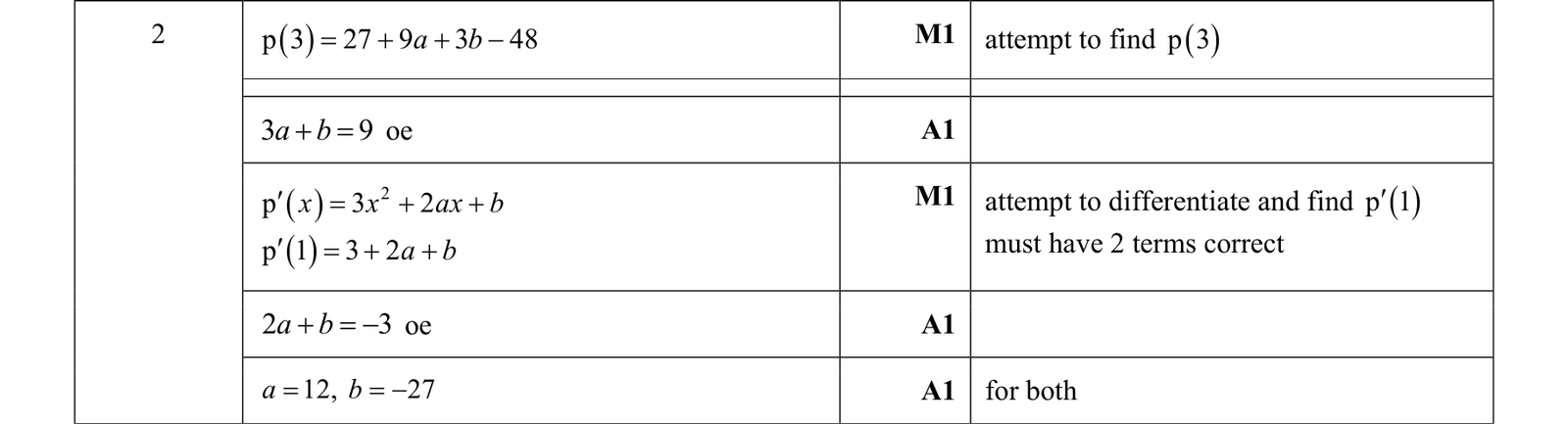
It is given that \(\mathrm{p}(x)=a x^{3}-7 x^{2}-b x+9\), where \(a\) and \(b\) are constants.
\(x-3\) is a factor of \(\mathrm{p}(x)\).
When \(\mathrm{p}(x)\) is divided by \(x+2\) the remainder is -35 .
Find the values of \(a\) and \(b\).
0606 P21 - Nov 2025 - Q1 - 5 marks
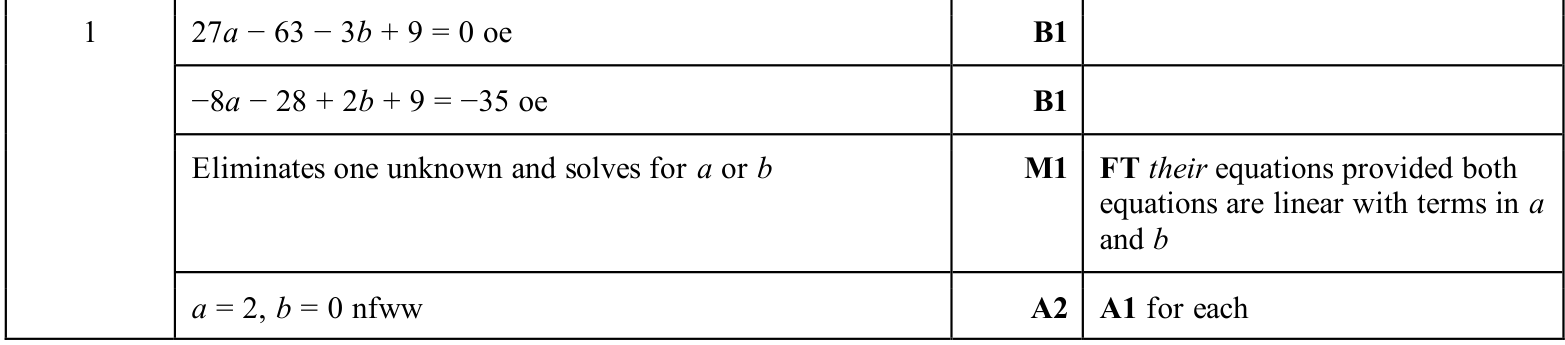
The polynomial \(\mathrm{p}\) is such that \(\mathrm{p}(x)=x^3+ax^2+bx-2\), where \(a\) and \(b\) are constants.
It is given that \(x+2\) is a factor of \(\mathrm{p}(x)\), and when \(\mathrm{p}(x)\) is divided by \(x-3\) the remainder is \(40\).
Find the values of \(a\) and \(b\).
0606 P12 - Nov 2025 - Q2 - 7 marks
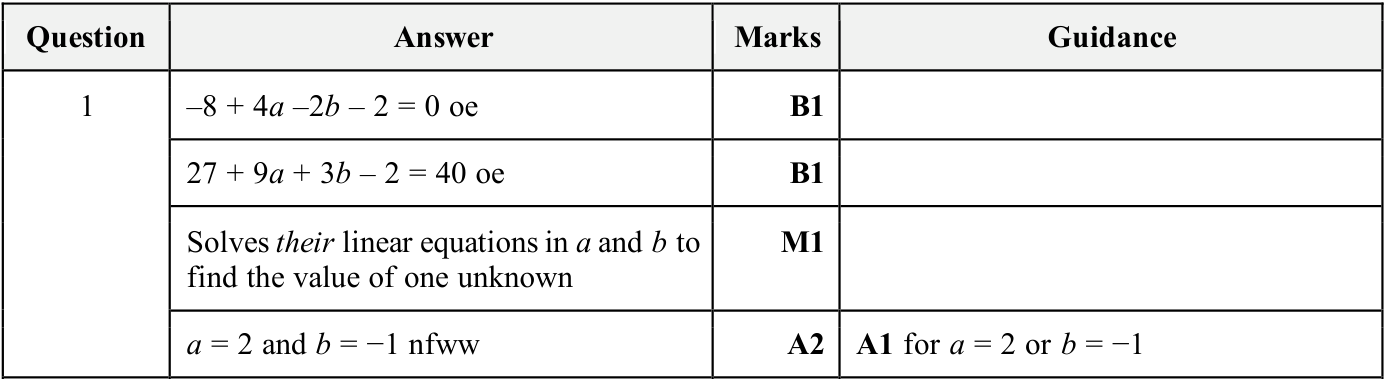
The polynomial \(\mathrm{p}\) is such that \(\mathrm{p}(x)=2x^3+ax^2+13x+b\), where \(a\) and \(b\) are integers.
It is given that \(x+2\) is a factor of \(\mathrm{p}(x)\). When \(\mathrm{p}(x)\) is divided by \(x+1\), there is a remainder of \(6\).
(a) Find the values of \(a\) and \(b\).
(b) Show that the equation \(\mathrm{p}(x)=0\) has only one real root.
0606 P11 - Nov 2024 - Q6 - 6 marks
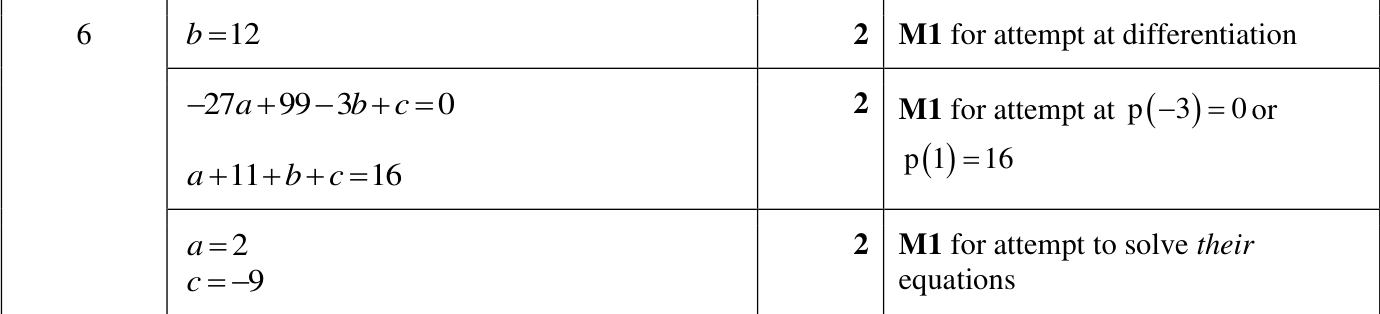
The polynomial p is such that \(\mathrm{p}(x)=a x^{3}+11 x^{2}+b x+c\), where \(a, b\) and \(c\) are integers. It is given that \(\mathrm{p}^{\prime}(0)=12\). It is also given that \(x+3\) is a factor of p . When p is divided by \(x-1\) the remainder is 16 . Find the values of \(a, b\) and \(c\).
0606 P13 - Nov 2024 - Q5 - 6 marks
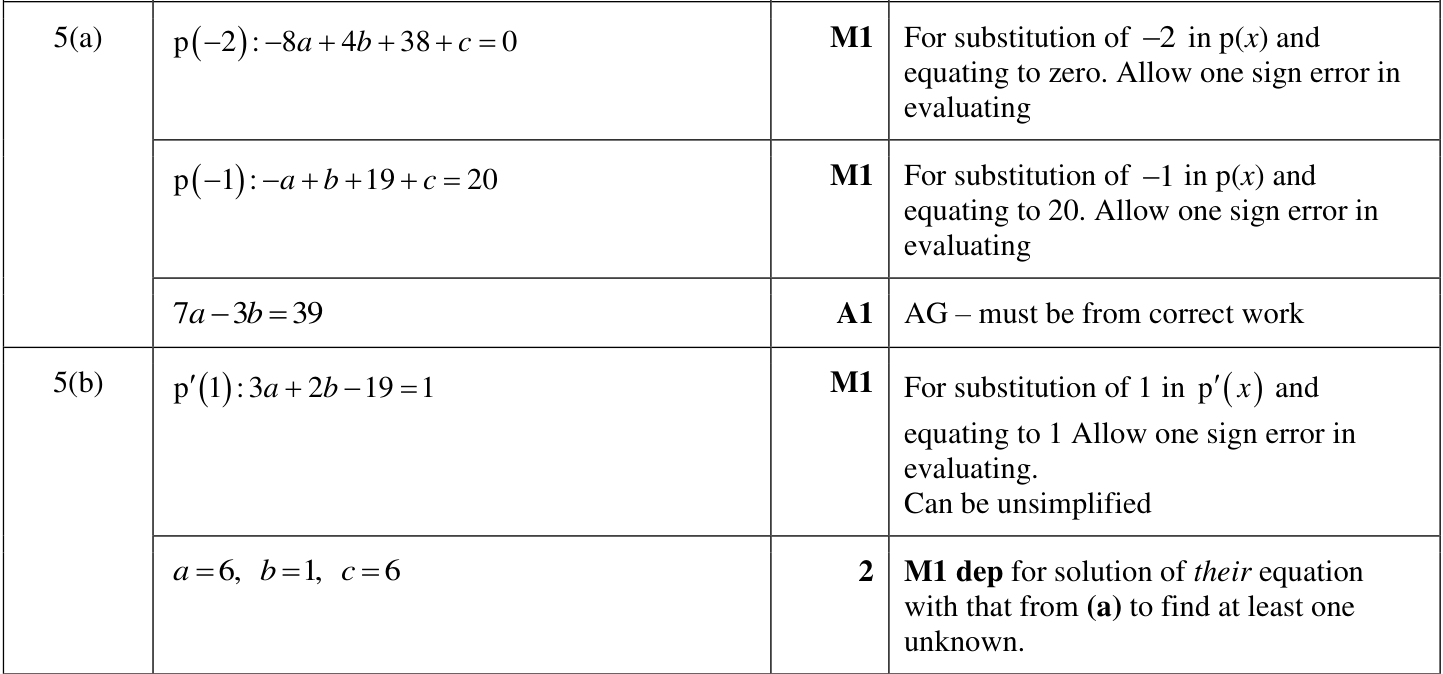
The polynomial p is such that \(\mathrm{p}(x)=a x^{3}+b x^{2}-19 x+c\), where \(a, b\) and \(c\) are integers. It is given that \(x+2\) is a factor of \(\mathrm{p}(x)\). When \(\mathrm{p}(x)\) is divided by \(x+1\) the remainder is 20 . (a) Show that \(7 a-3 b=39\).
It is also given that when \(\mathrm{p}^{\prime}(x)\) is divided by \(x-1\) the remainder is 1 . (b) Find the values of \(a, b\) and \(c\).
0606 P11 - Jun 2023 - Q2 - 9 marks
The polynomial \(p\) is given by
\(p(x)=ax^3+7x^2+bx+c\),
where \(a\), \(b\) and \(c\) are integers.
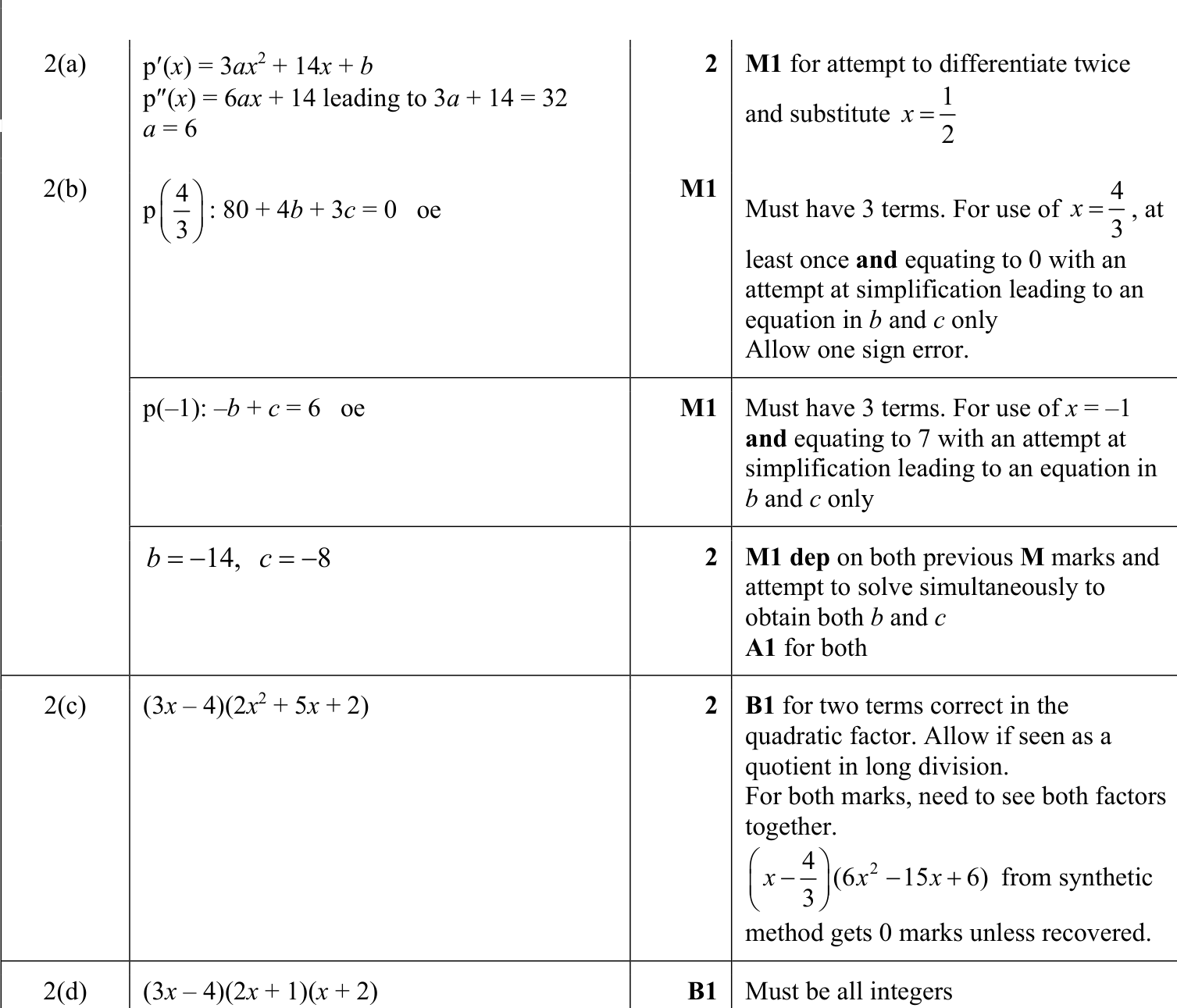
(a) Given that \(p''\left(\frac12\right)=32\), show that \(a=6\).
(b) Given that \(p(x)\) has a factor \(3x-4\) and a remainder of 7 when divided by \(x+1\), find the values of \(b\) and \(c\).
(c) Write \(p(x)\) in the form \((3x-4)q(x)\), where \(q(x)\) is a quadratic expression.
(d) Hence express \(p(x)\) as a product of three linear factors, each with integer coefficients.
0606 P11 - Nov 2023 - Q2 - 8 marks
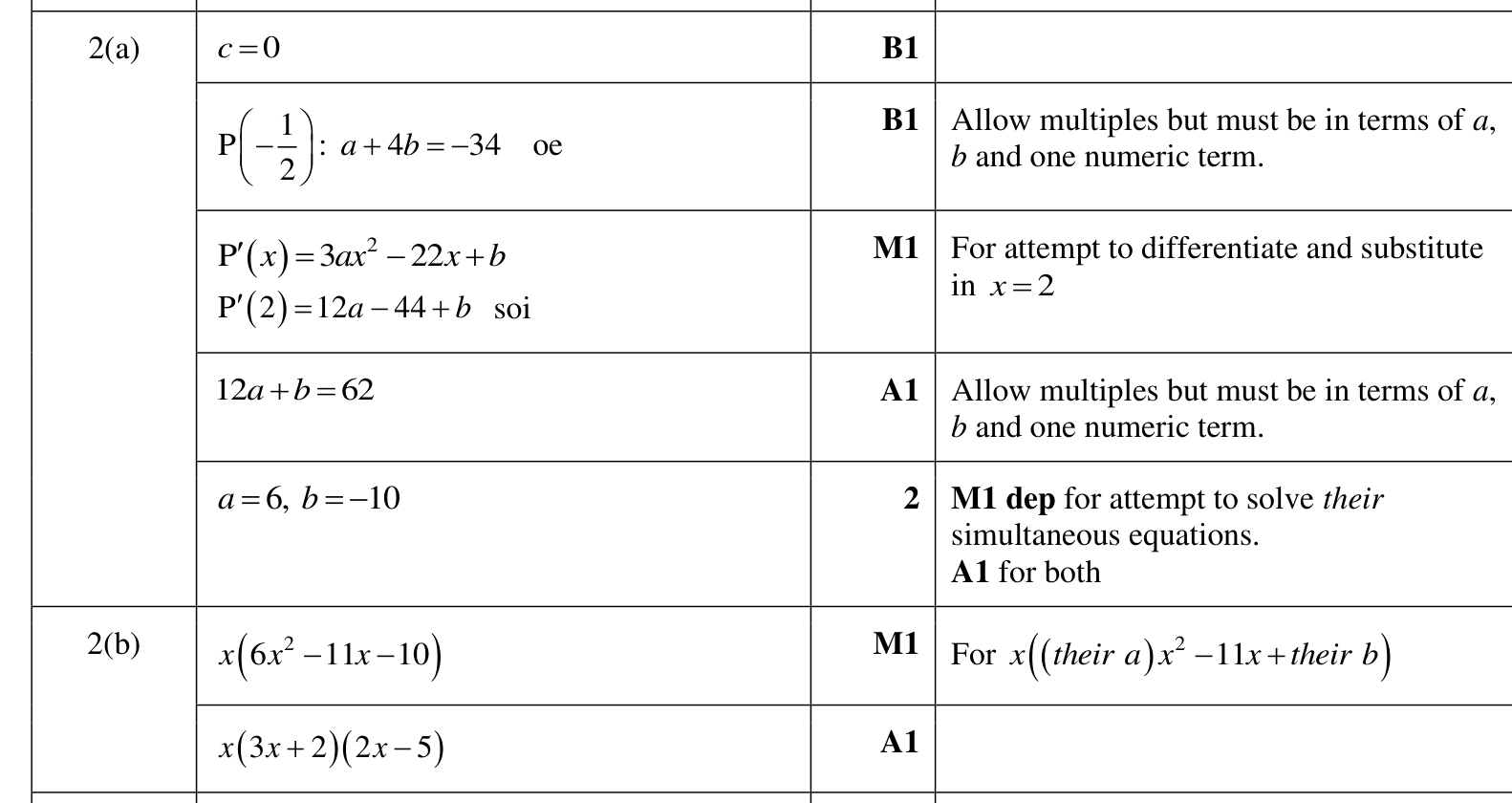
The polynomial \(P(x)=ax^3-11x^2+bx+c\), where \(a\), \(b\) and \(c\) are integers, is divisible by \(x\).
When \(P(x)\) is divided by \(2x+1\), the remainder is \(\frac32\).
It is also given that \(P'(2)=18\).
(a) Find \(a\), \(b\) and \(c\).
(b) Hence factorise \(P(x)\) completely.
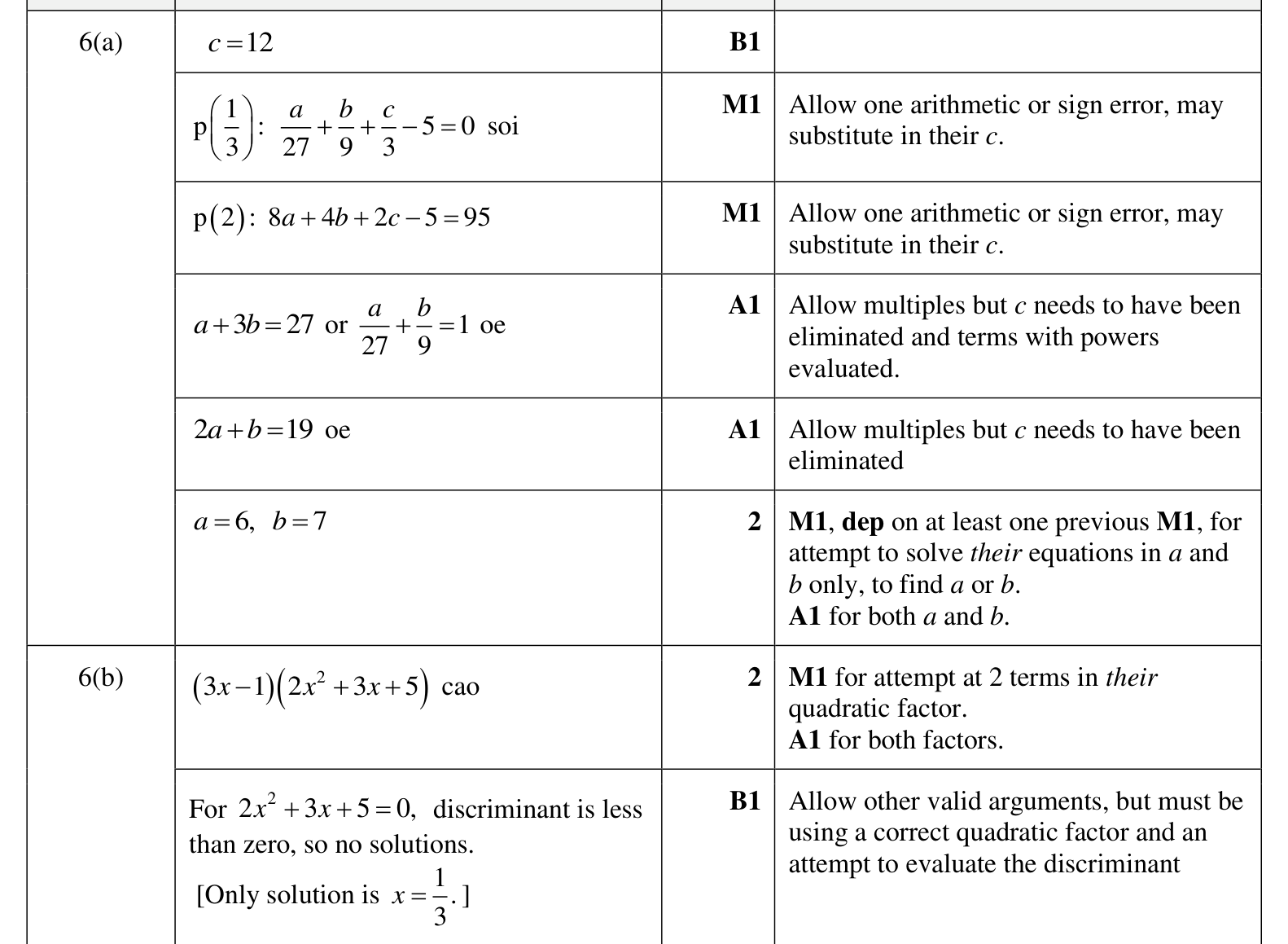
0606 P12 - Nov 2023 - Q6 - 10 marks
The polynomial \(p(x)\) is such that
\(p(x)=ax^3+bx^2+cx-5\),
where \(a\), \(b\) and \(c\) are integers.
It is given that \(p'(0)=12\). It is also given that \(p(x)\) has a factor of \(3x-1\) and a remainder of 95 when divided by \(x-2\).
(a) Find the values of \(a\), \(b\) and \(c\).
(b) Show that the equation \(p(x)=0\) has only one real root.
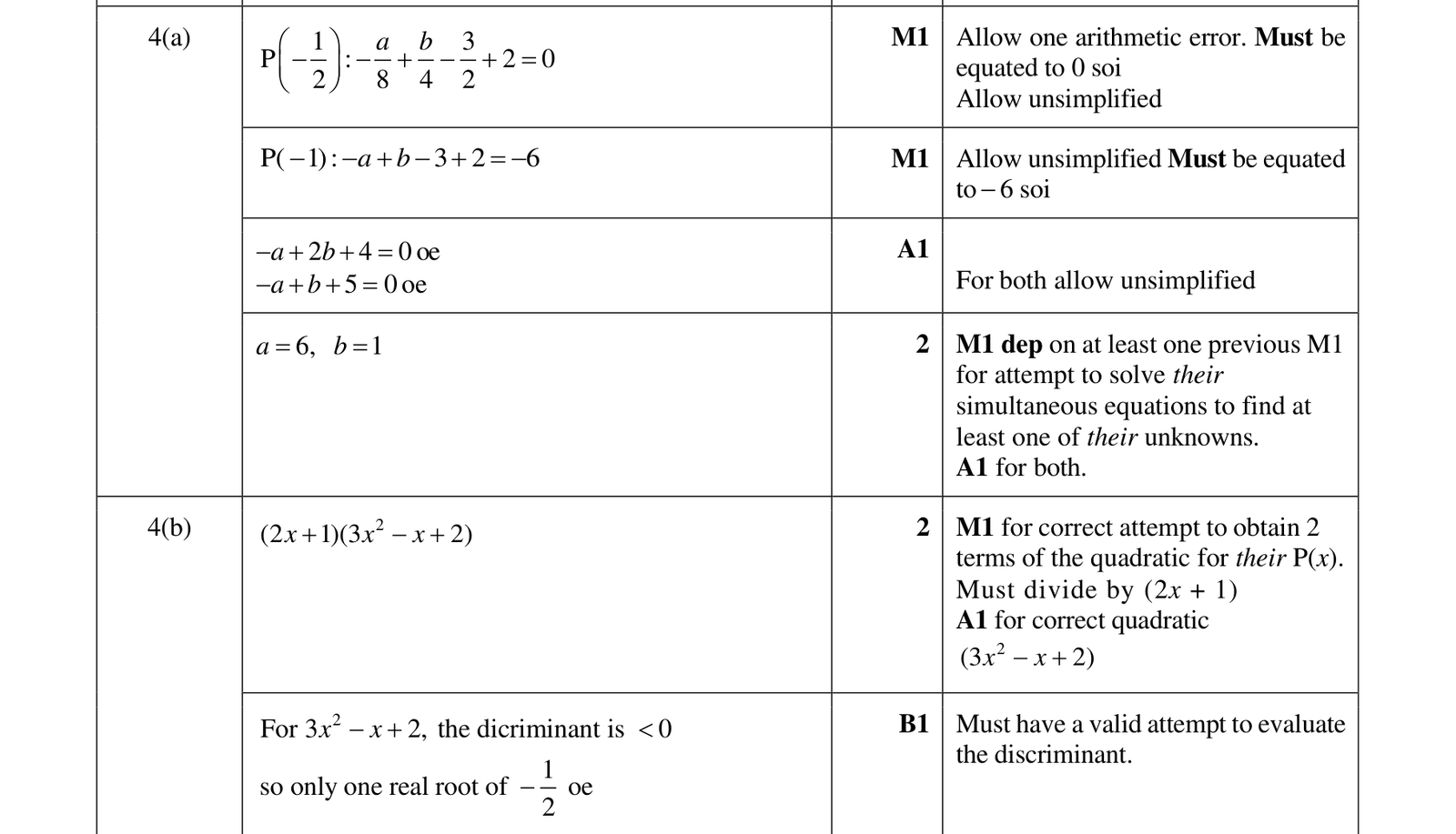
0606 P13 - Nov 2023 - Q4 - 8 marks
The polynomial \(\mathrm P\) is given by
\(\mathrm P(x)=ax^3+bx^2+3x+2\),
where \(a\) and \(b\) are integers. \(\mathrm P(x)\) has a factor of \(2x+1\). \(\mathrm P(x)\) has a remainder of \(-6\) when divided by \(x+1\).
(a) Find the values of \(a\) and \(b\).
(b) Show that the equation \(\mathrm P(x)=0\) has only one real root.
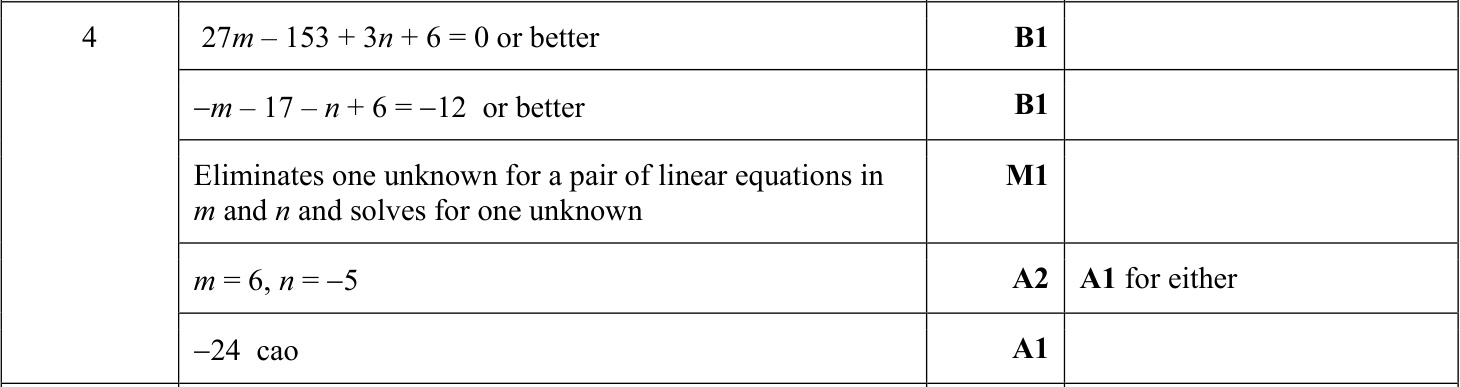
0606 P21 - Jun 2022 - Q4 - 6 marks
The polynomial \(p(x)=mx^3-17x^2+nx+6\), where \(m\) and \(n\) are constants, has a factor \(x-3\). When \(p(x)\) is divided by \(x+1\), the remainder is \(-12\). Find the remainder when \(p(x)\) is divided by \(x-2\).
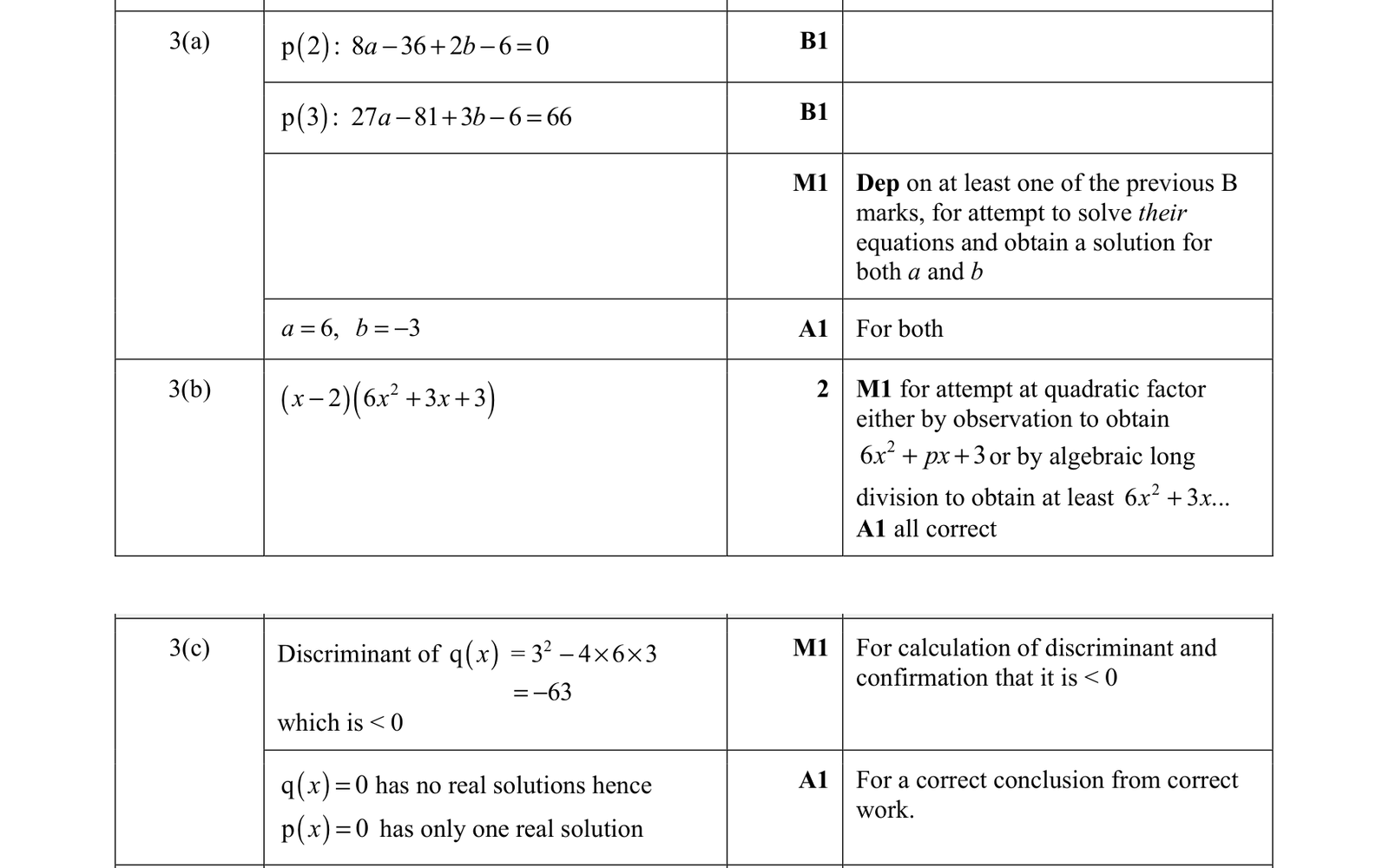
0606 P11 - Jun 2021 - Q3 - 8 marks
The polynomial
\(\mathrm p(x)=ax^3-9x^2+bx-6,\)
where \(a\) and \(b\) are constants, has a factor of \(x-2\). The polynomial has a remainder of \(66\) when divided by \(x-3\).
(a) Find the value of \(a\) and of \(b\).
(b) Using your values of \(a\) and \(b\), show that
\(\mathrm p(x)=(x-2)\mathrm q(x),\)
where \(\mathrm q(x)\) is a quadratic factor to be found.
(c) Hence show that the equation \(\mathrm p(x)=0\) has only one real solution.
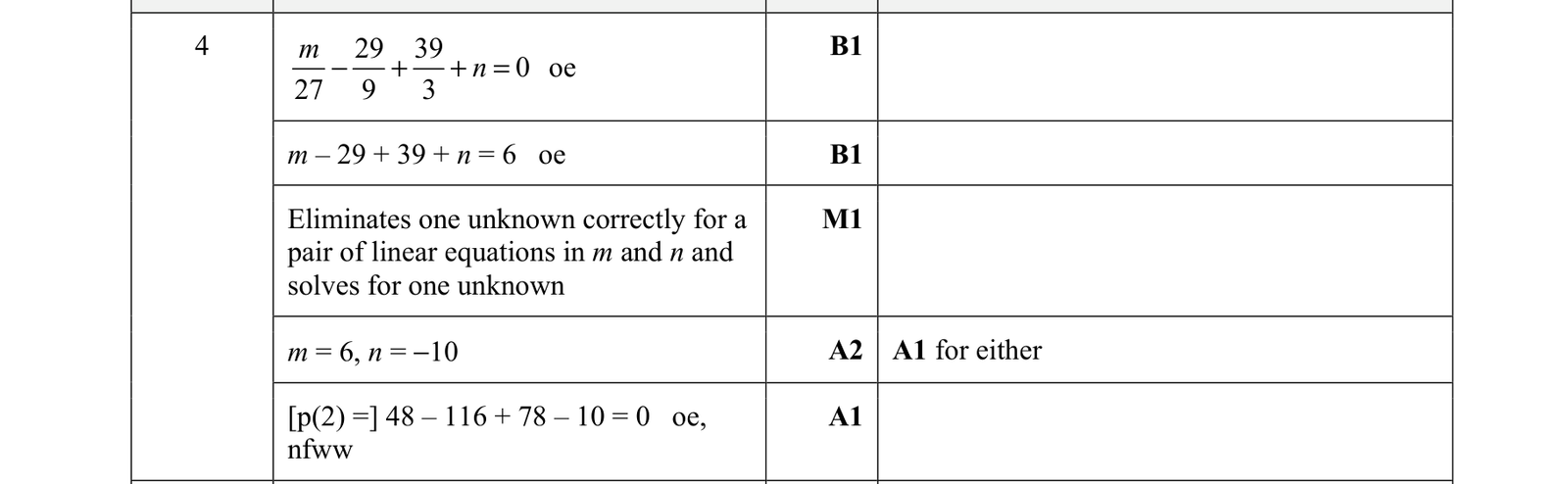
0606 P22 - Jun 2021 - Q4 - 6 marks
The polynomial
\(\mathrm p(x)=mx^3-29x^2+39x+n,\)
where \(m\) and \(n\) are constants, has a factor \(3x-1\), and remainder \(6\) when divided by \(x-1\).
Show that \(x-2\) is a factor of \(\mathrm p(x)\).
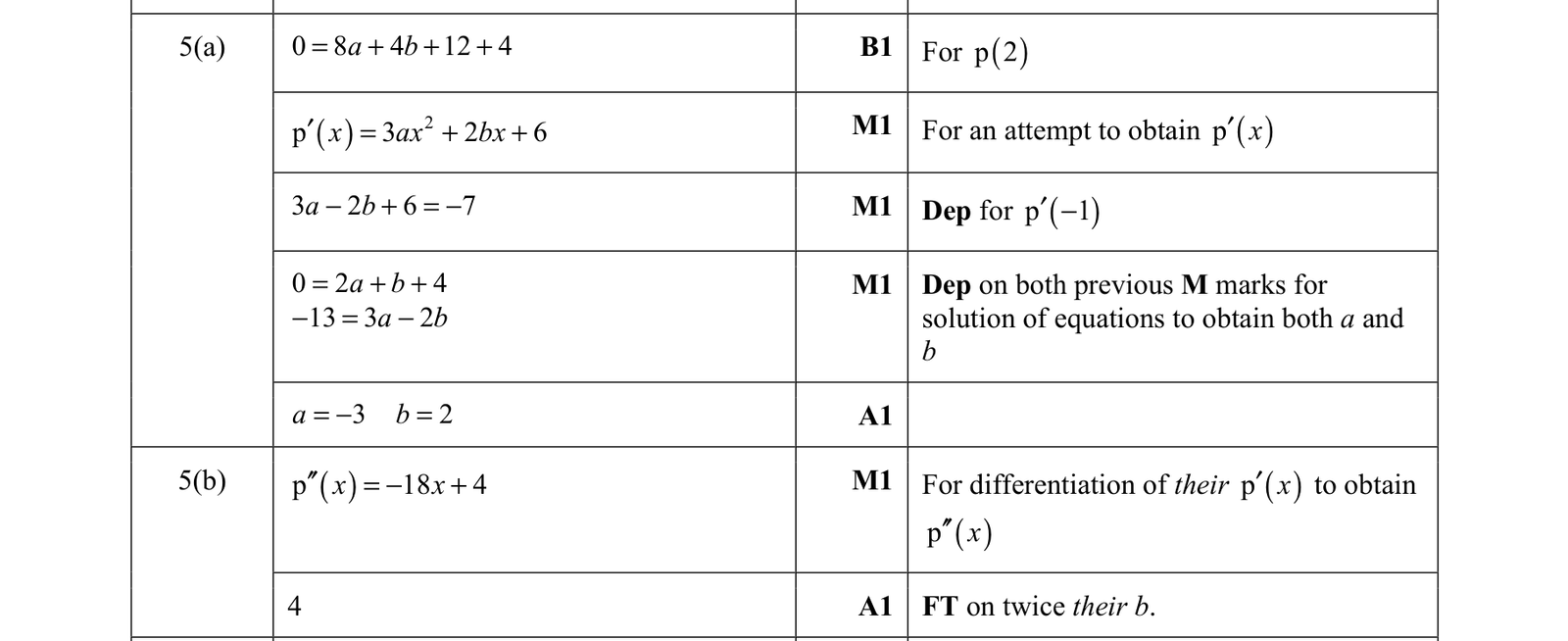
0606 P11 - Nov 2021 - Q5 - 7 marks
The polynomial \(\mathrm p(x)=ax^3+bx^2+6x+4\), where \(a\) and \(b\) are integers, is divisible by \(x-2\). When \(\mathrm p'(x)\) is divided by \(x+1\), the remainder is \(-7\).
(a) Find the value of \(a\) and of \(b\).
(b) Using your answers to part (a), find the remainder when \(\mathrm p''(x)\) is divided by \(x\).
0606 P12 - Nov 2020 - Q10 - 8 marks
The polynomial \(\mathrm{p}(x)\) is given by
\(\mathrm{p}(x)=6x^3+ax^2+bx+2,\)
where \(a\) and \(b\) are constants. It is given that \(x-2\) is a factor of \(\mathrm{p}(x)\), and that \(\mathrm{p}(1)=-2\mathrm{p}(0)\).
(a) Find the values of \(a\) and \(b\).
(b) Find the remainder when \(\mathrm{p}(x)\) is divided by \(2x-1\).
(c) Factorise \(\mathrm{p}(x)\) completely.

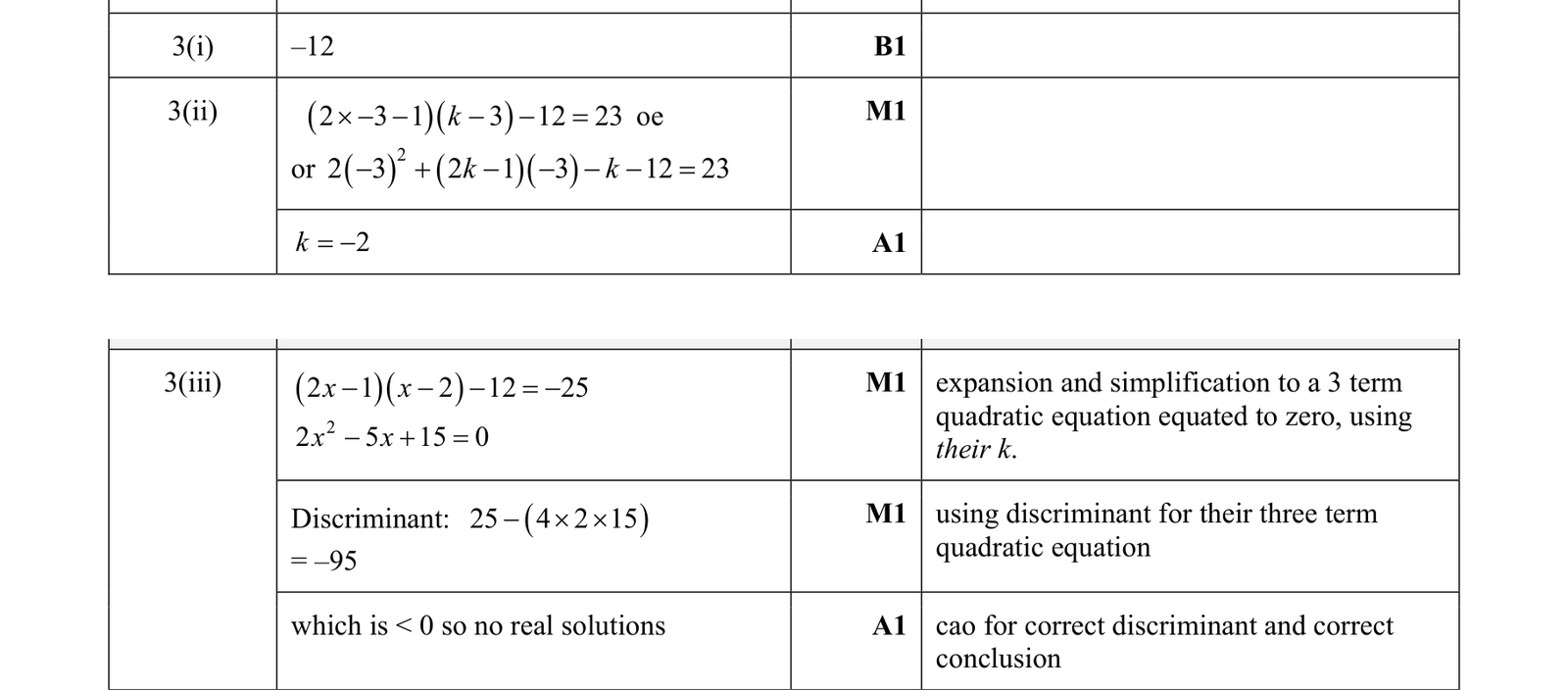
0606 P11 - Jun 2019 - Q3 - 6 marks
The polynomial \(p(x)=(2x-1)(x+k)-12\), where \(k\) is a constant.
(i) Write down the value of \(p(-k)\).
When \(p(x)\) is divided by \(x+3\), the remainder is \(23\).
(ii) Find the value of \(k\).
(iii) Using your value of \(k\), show that the equation \(p(x)=-25\) has no real solutions.
0606 P12 - Mar 2018 - Q1 - 5 marks
The polynomial \(p(x)\) is given by
\(p(x)=x^3+ax^2-3x+b\),
where \(a\) and \(b\) are constants. The remainder when \(p(x)\) is divided by \(x+3\) is twice the remainder when \(p(x)\) is divided by \(x-2\). It is also given that \(p(x)\) is exactly divisible by \(x+1\). Find the values of \(a\) and \(b\).

0606 P22 - Jun 2018 - Q3 - 6 marks
It is given that \(x+3\) is a factor of the polynomial
\(p(x)=2x^3+ax^2-24x+b.\)
The remainder when \(p(x)\) is divided by \(x-2\) is \(-15\). Find the remainder when \(p(x)\) is divided by \(x+1\).

0606 P11 - Nov 2018 - Q2 - 6 marks
\(p(x)=2x^3+5x^2+4x+a,\qquad q(x)=4x^2+3ax+b.\)
Given that \(p(x)\) has a remainder of 2 when divided by \(2x+1\) and that \(q(x)\) is divisible by \(x+2\),
(i) find the value of each of the constants \(a\) and \(b\).
Given that \(r(x)=p(x)-q(x)\), and using your values of \(a\) and \(b\),
(ii) find the exact remainder when \(r(x)\) is divided by \(3x-2\).

0606 P12 - Nov 2018 - Q9 - 8 marks
The polynomial \(p(x)=ax^3+bx^2+cx-9\) is divisible by \(x+3\). It is given that \(p'(0)=36\) and \(p''(0)=86\).
(i) Find the value of each of the constants \(a\), \(b\) and \(c\).
(ii) Using your values of \(a\), \(b\) and \(c\), find the remainder when \(p(x)\) is divided by \(2x-1\).

0606 P11 - Jun 2017 - Q2 - 5 marks
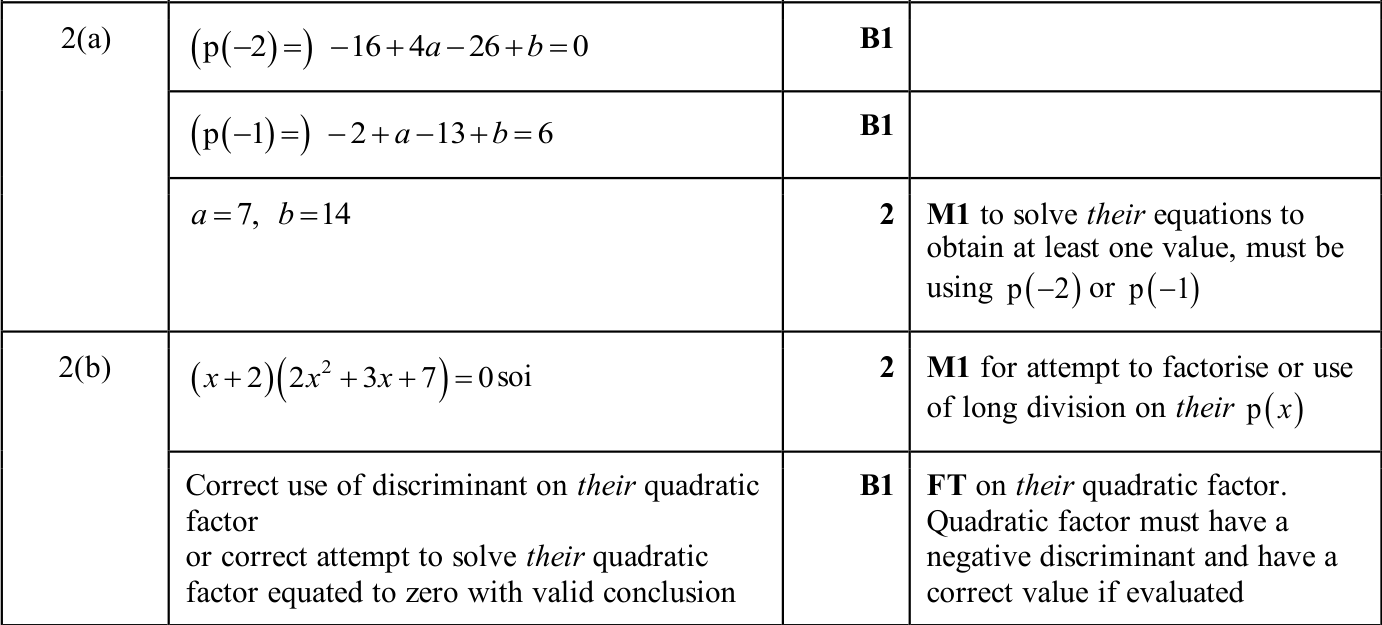
It is given that \(p(x)=x^3+ax^2+bx-48\). When \(p(x)\) is divided by \(x-3\), the remainder is \(6\).
Given that \(p'(1)=0\), find \(a\) and \(b\).