0606 P12 - Jun 2025 - Q5 - 10 marks
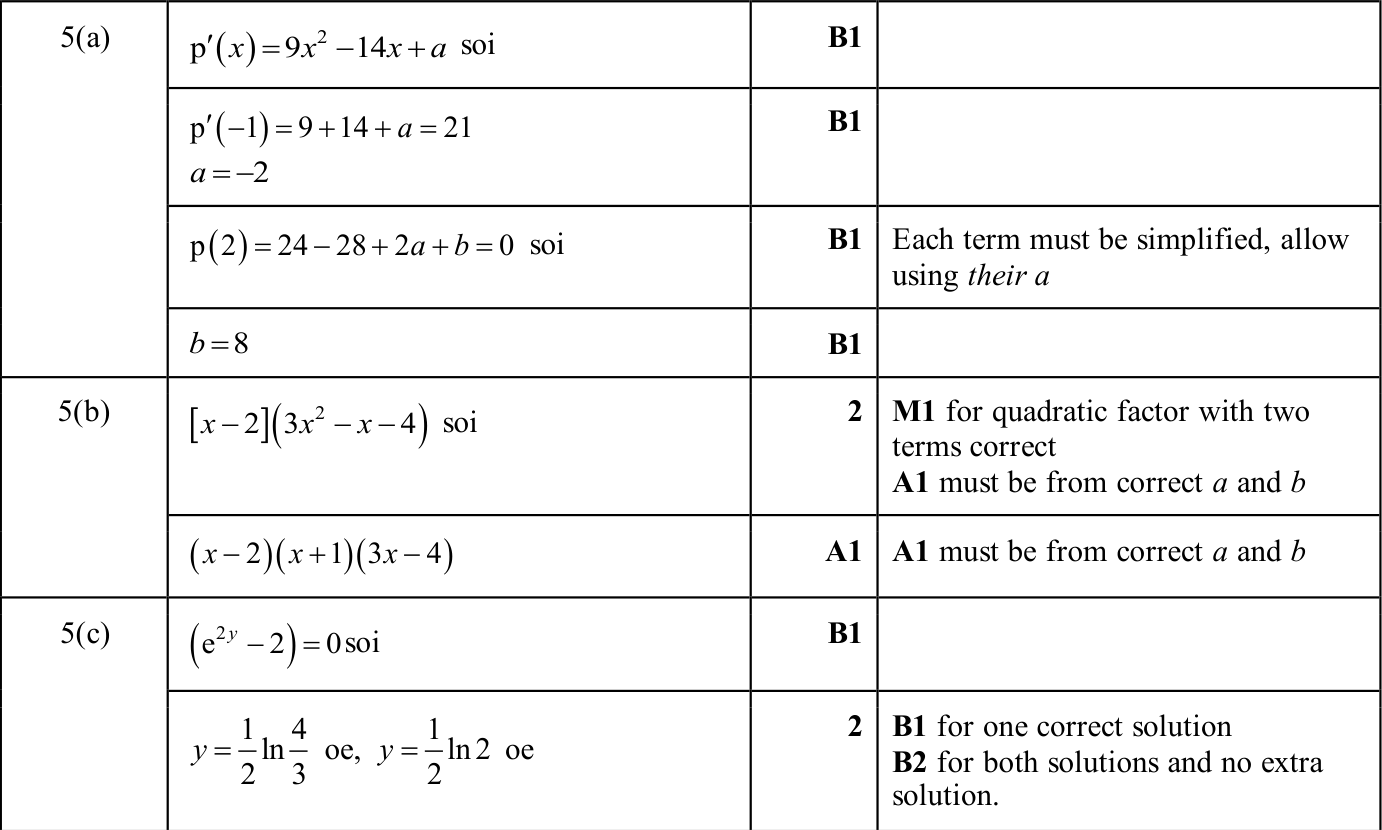
The polynomial \(\mathrm{p}\) is such that \(\mathrm{p}(x)=3x^3-7x^2+ax+b\), where \(a\) and \(b\) are integers.
It is given that \(\mathrm{p}'(-1)=21\) and that \(x-2\) is a factor of \(\mathrm{p}(x)\).
(a) Find the values of \(a\) and \(b\).
(b) Hence write \(\mathrm{p}(x)\) as a product of linear factors with integer coefficients.
(c) Using your values of \(a\) and \(b\), solve the equation \(3\mathrm{e}^{6y}-7\mathrm{e}^{4y}+a\mathrm{e}^{2y}+b=0\).
0606 P13 - Jun 2025 - Q3 - 5 marks
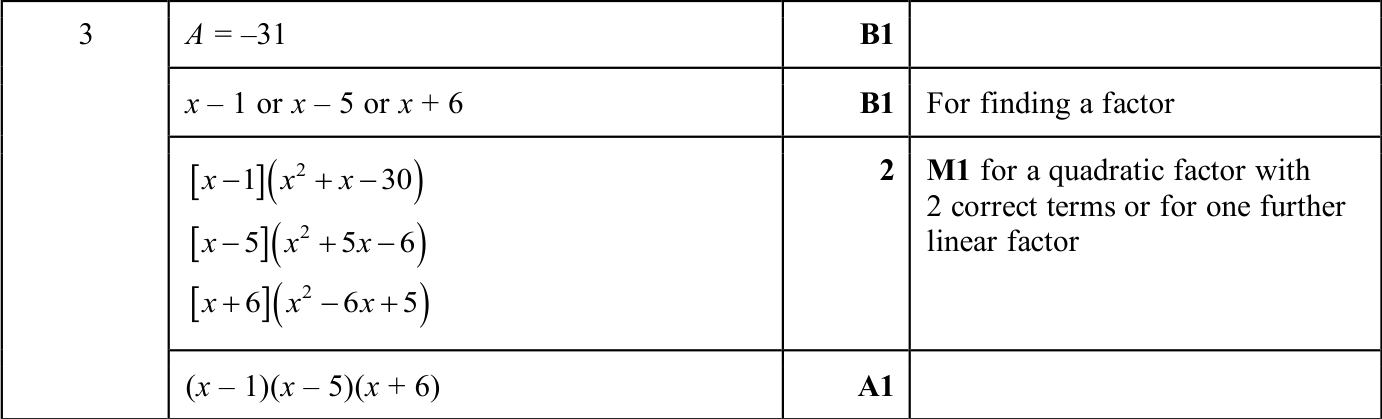
The polynomial p is such that \(\mathrm{p}(x)=x^{3}+A x+30\), where \(A\) is a constant. When \(\mathrm{p}(x)\) is divided by \(x+2\) the remainder is 84 . Write \(\mathrm{p}(x)\) as a product of linear factors.
0606 P12 - Mar 2025 - Q4 - 6 marks
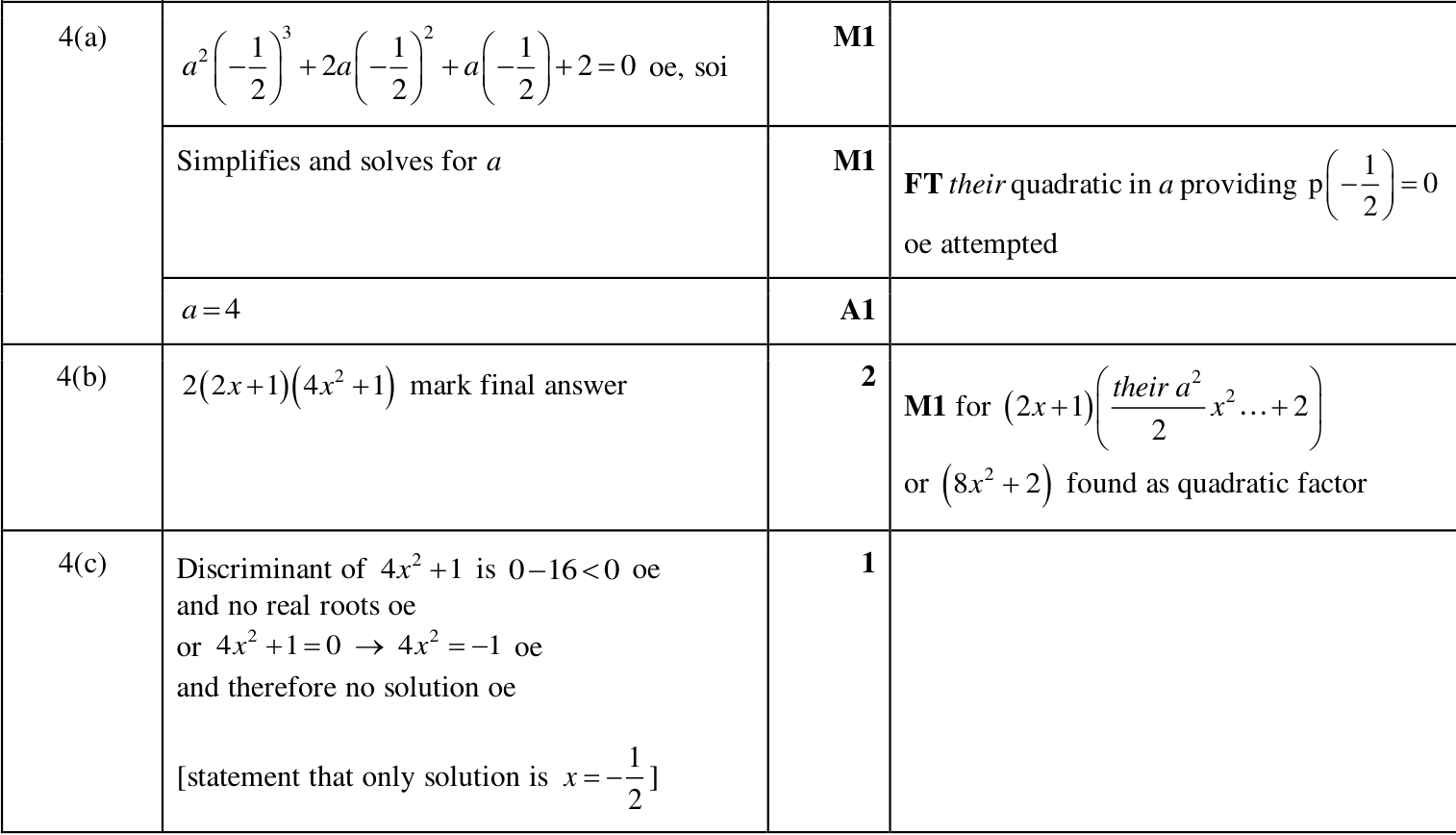
The polynomial \(\mathrm{p}\) is given by \(\mathrm{p}(x)=a^2x^3+2ax^2+ax+2\), where \(a\) is a positive integer.
It is given that \(2x+1\) is a factor of \(\mathrm{p}(x)\).
(a) Find the value of \(a\).
(b) Hence factorise \(\mathrm{p}(x)\).
(c) Hence show that the equation \(\mathrm{p}(x)=0\) has only one real root.
0606 P12 - Mar 2024 - Q5 - 13 marks
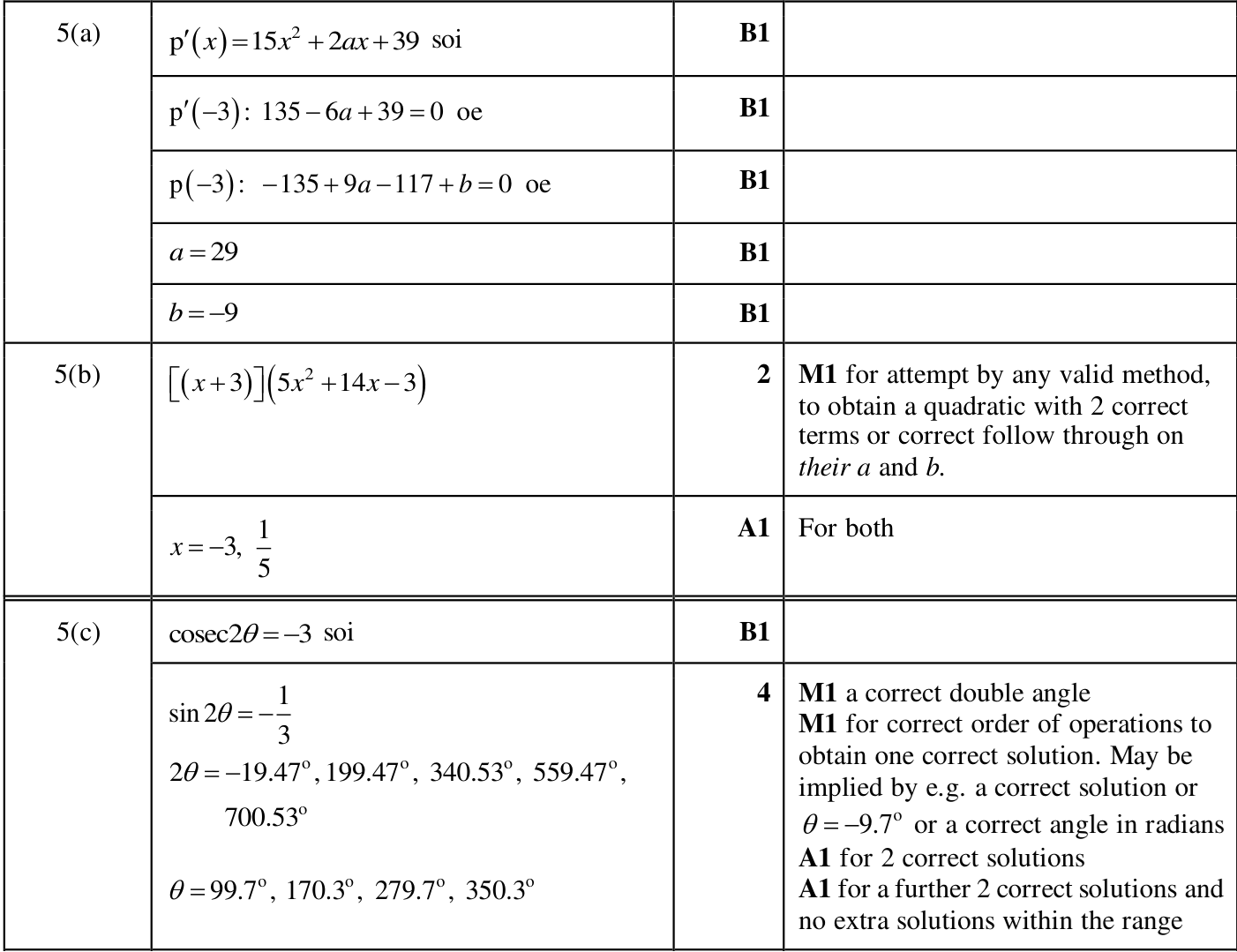
The polynomial p is such that \(\mathrm{p}(x)=5 x^{3}+a x^{2}+39 x+b\), where \(a\) and \(b\) are constants. (a) Given that \(x+3\) is a factor of both \(\mathrm{p}(x)\) and \(\mathrm{p}^{\prime}(x)\), find the values of \(a\) and \(b\).
(b) Hence solve the equation \(\mathrm{p}(x)=0\).
You must show your working.
(c) Hence, using your values for \(a\) and \(b\), solve the equation \(5 \operatorname{cosec}^{3} 2 \theta+a \operatorname{cosec}^{2} 2 \theta+39 \operatorname{cosec} 2 \theta+b=0 \text { for } 0^{\circ} \leqslant \theta \leqslant 360^{\circ} .\)
0606 P23 - Jun 2023 - Q4 - 5 marks
The polynomial \(p(x)\) is defined by
\(p(x)=2x^3+11x^2+22x+40.\)
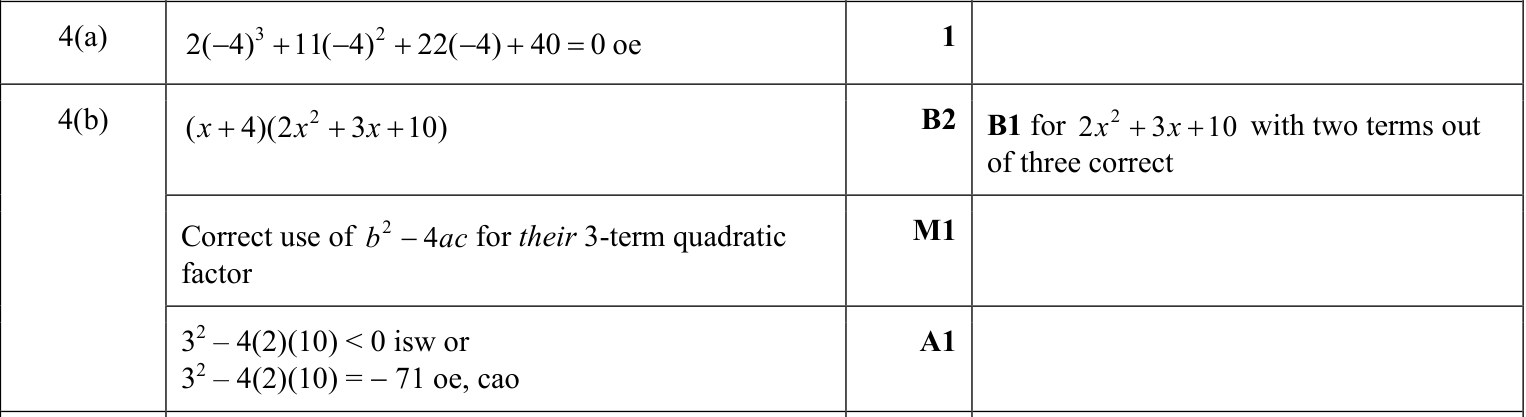
(a) Show that \(x=-4\) is a root of the equation \(p(x)=0\).
(b) Factorise \(p(x)\) and show that the equation \(p(x)=0\) has no other real roots.
0606 P12 - Jun 2022 - Q6 - 7 marks
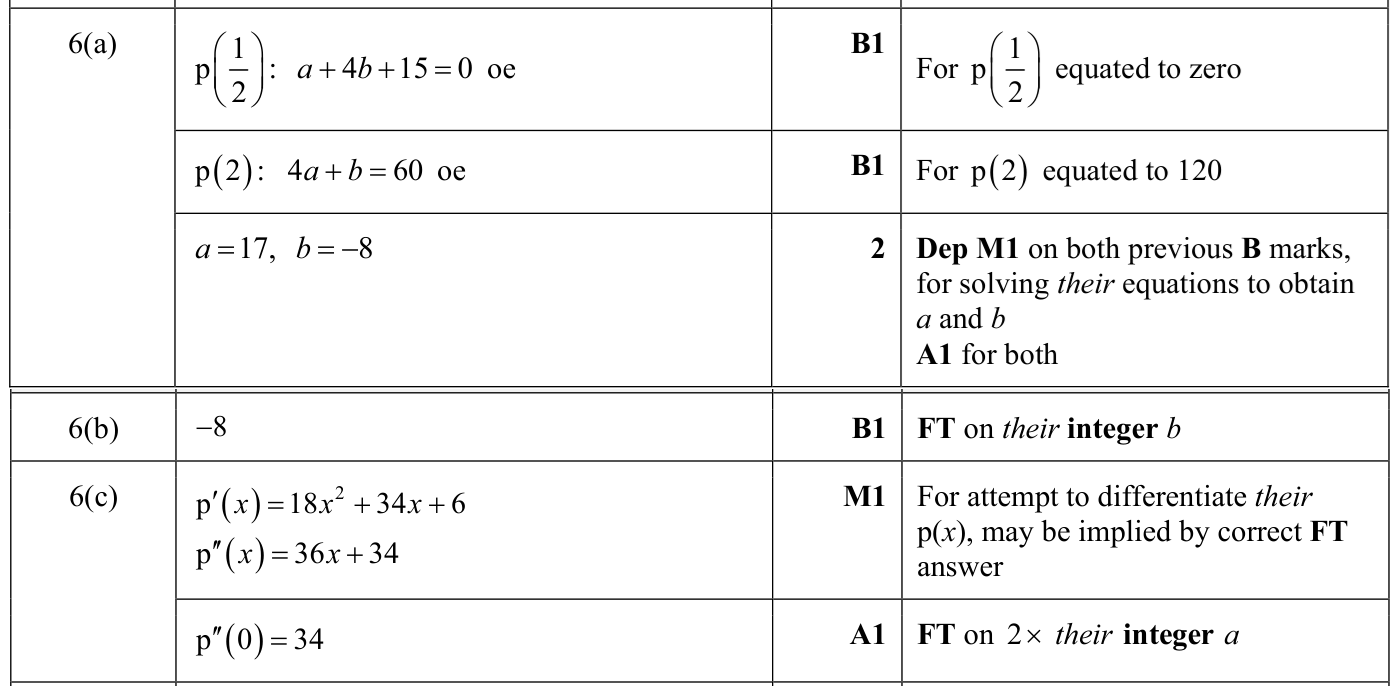
The polynomial \(p(x)=6x^3+ax^2+6x+b\), where \(a\) and \(b\) are integers, is divisible by \(2x-1\). When \(p(x)\) is divided by \(x-2\), the remainder is \(120\).
(a) Find the values of \(a\) and \(b\).
(b) Hence write down the remainder when \(p(x)\) is divided by \(x\).
(c) Find the value of \(p''(0)\).
0606 P23 - Jun 2022 - Q6 - 8 marks
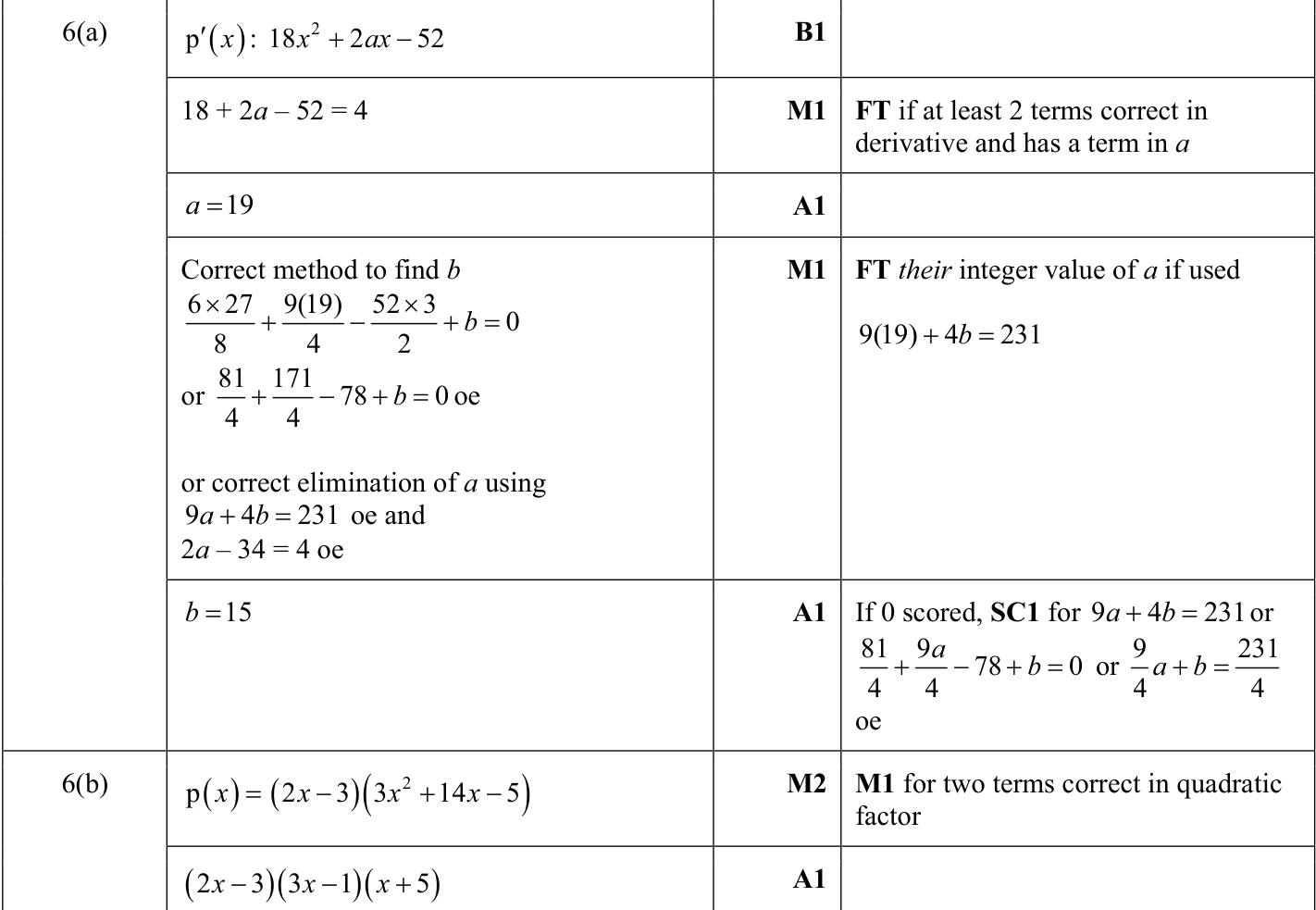
The polynomial \(p(x)=6x^3+ax^2-52x+b\) is exactly divisible by \(2x-3\). It is also given that \(p'(1)=4\).
(a) Find the values of \(a\) and \(b\).
(b) Hence factorise \(p(x)\) fully.
0606 P13 - Nov 2022 - Q4 - 7 marks
The polynomial \(p(x)\) is such that
\(p(x)=ax^3+13x^2+bx+c,\)
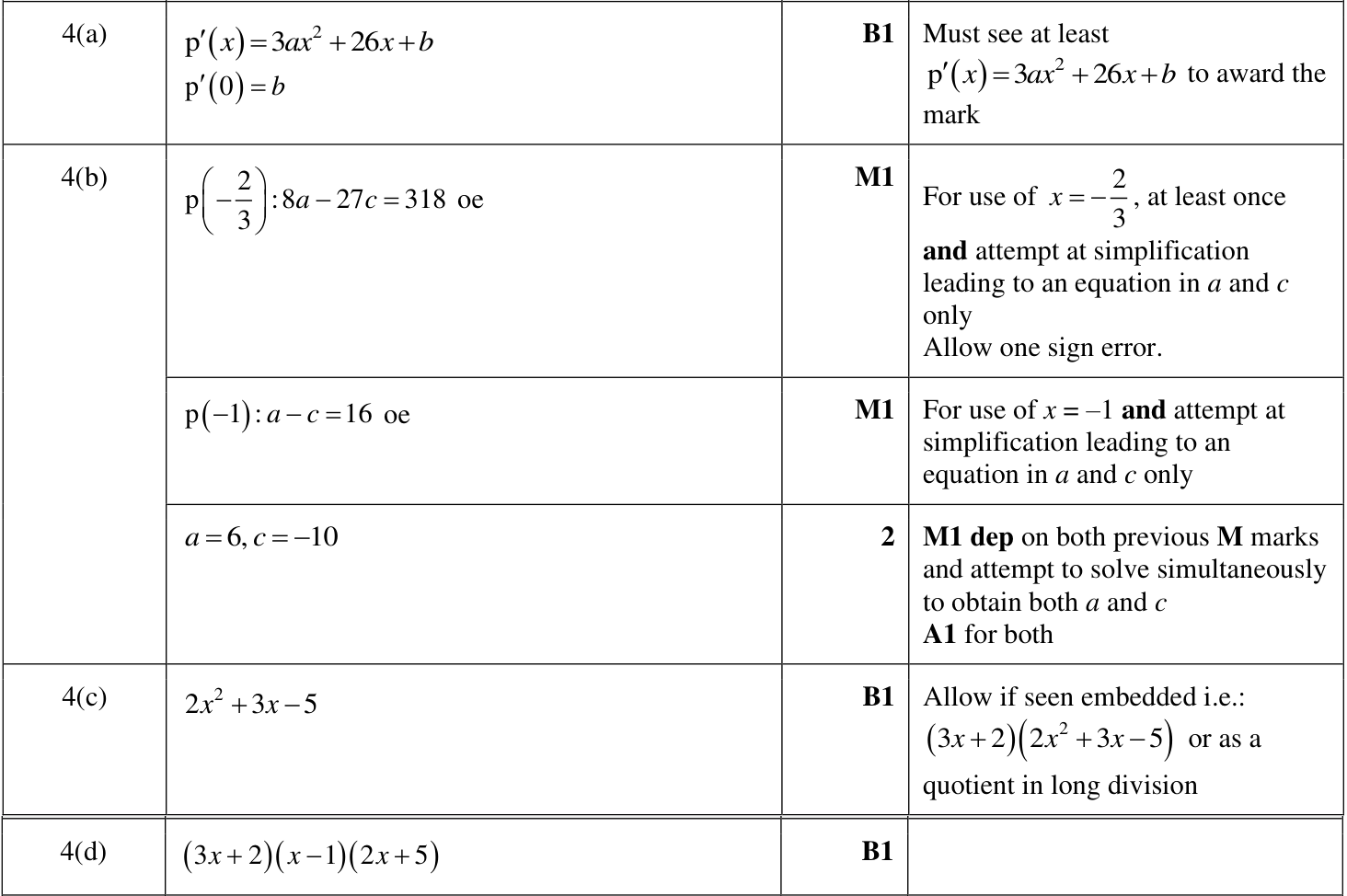
where \(a\), \(b\) and \(c\) are integers. It is given that \(p'(0)=-9\).
(a) Show that \(b=-9\).
It is also given that \(3x+2\) is a factor of \(p(x)\) and that when \(p(x)\) is divided by \(x+1\) the remainder is \(6\).
(b) Find the values of \(a\) and \(c\).
(c) Find the quadratic \(q(x)\) such that
\(p(x)=(3x+2)q(x).\)
(d) Hence find \(p(x)\) as a product of linear factors with integer coefficients.
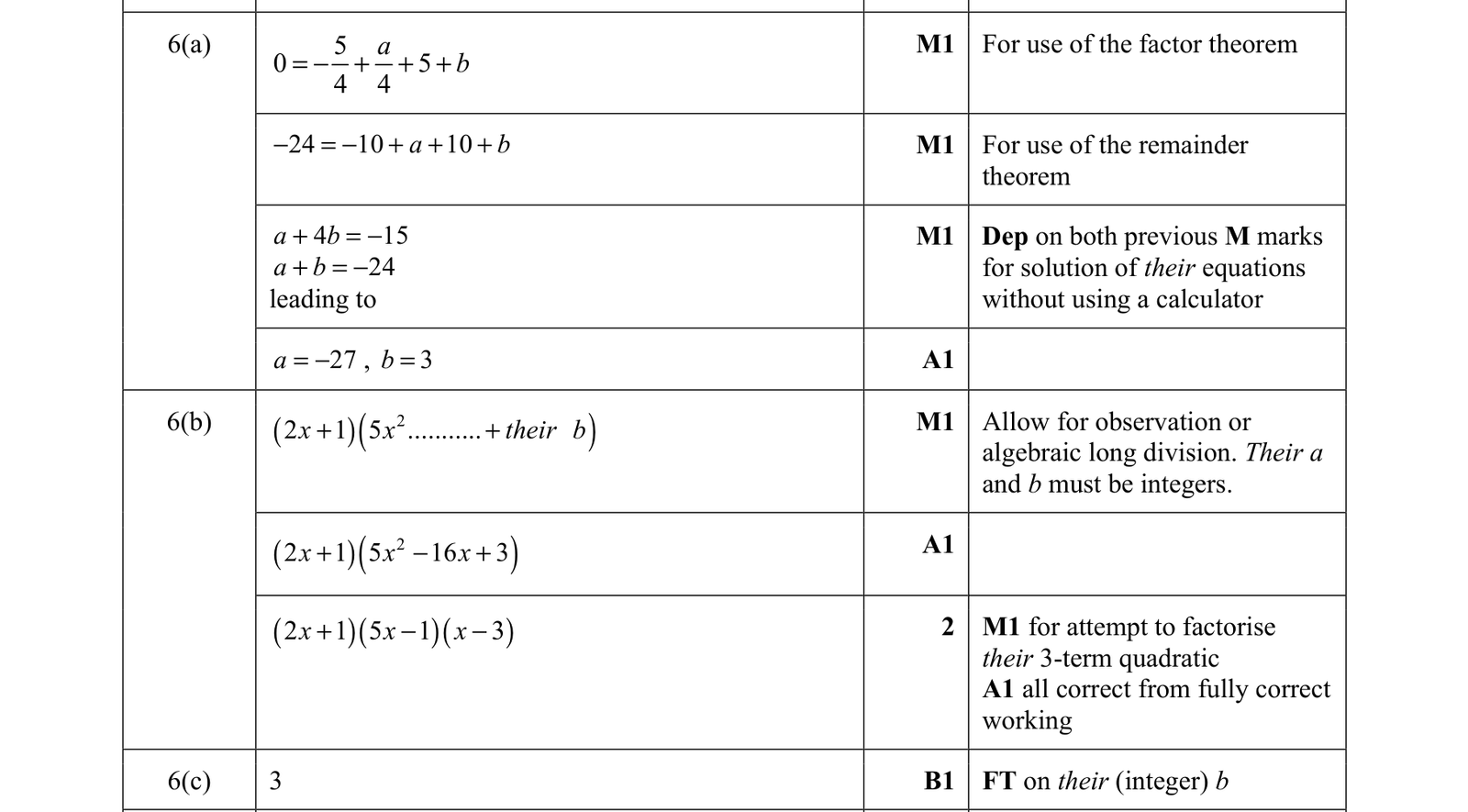
0606 P12 - Nov 2021 - Q6 - 9 marks
Do not use a calculator in this question.
The polynomial \(\mathrm p(x)=10x^3+ax^2-10x+b\), where \(a\) and \(b\) are integers, is divisible by \(2x+1\). When \(\mathrm p(x)\) is divided by \(x+1\), the remainder is \(-24\).
(a) Find the value of \(a\) and of \(b\).
(b) Find an expression for \(\mathrm p(x)\) as the product of three linear factors.
(c) Write down the remainder when \(\mathrm p(x)\) is divided by \(x\).
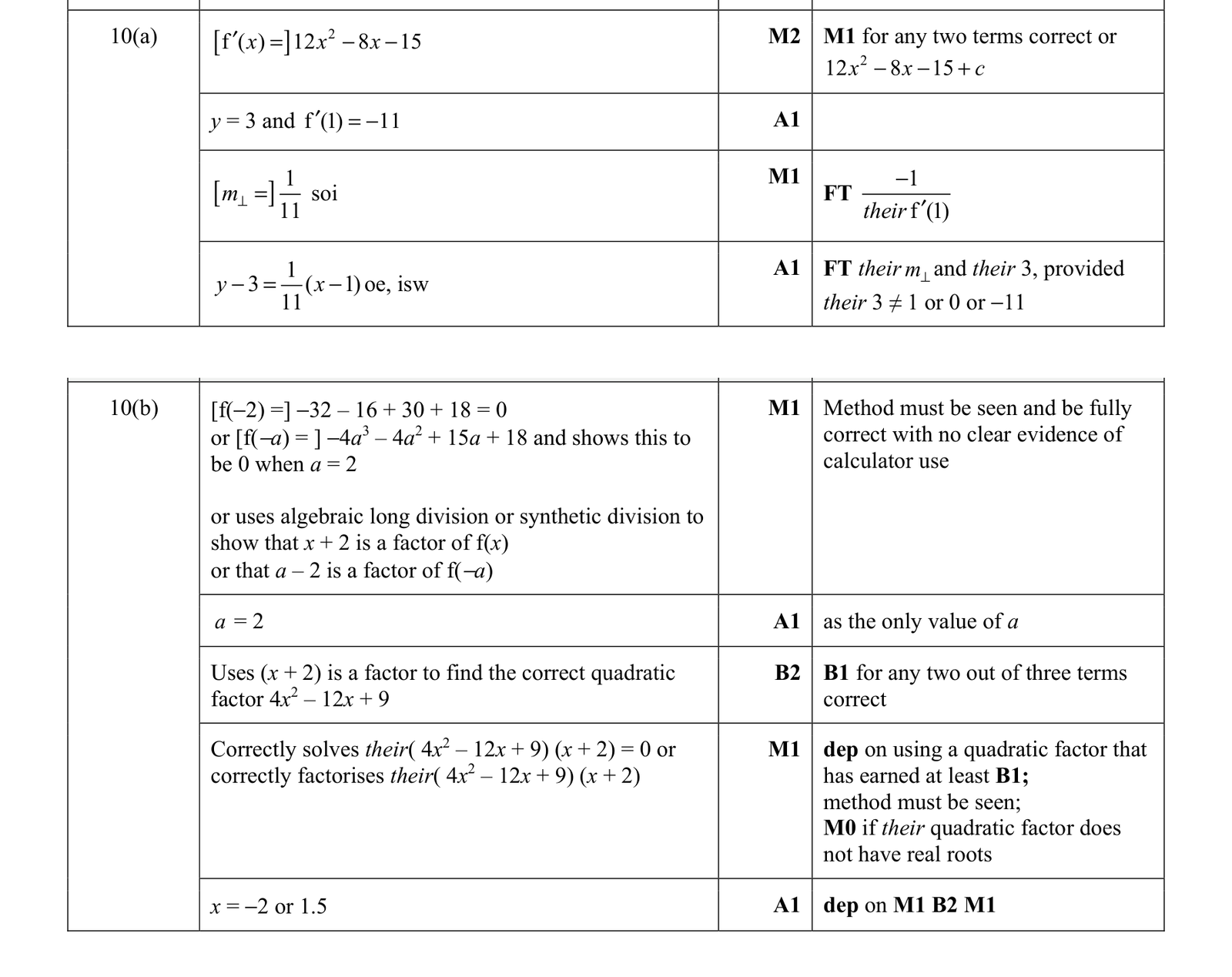
0606 P23 - Nov 2021 - Q10 - 11 marks
(a) It is given that
\(\mathrm f(x)=4x^3-4x^2-15x+18.\)
Find the equation of the normal to the curve \(y=\mathrm f(x)\) at the point where \(x=1\).
(b) Without using a calculator, it is also given that \(x+a\), where \(a\) is an integer, is a factor of \(\mathrm f(x)\). Find \(a\) and hence solve the equation \(\mathrm f(x)=0\).
0606 P12 - Mar 2020 - Q7 - 9 marks
\(p(x)=ax^3+3x^2+bx-12\)
has a factor of \(2x+1\). When \(p(x)\) is divided by \(x-3\), the remainder is \(105\).
(a) Find the value of \(a\) and of \(b\).
(b) Using your values of \(a\) and \(b\), write \(p(x)\) as a product of \(2x+1\) and a quadratic factor.
(c) Hence solve \(p(x)=0\).

0606 P13 - Jun 2020 - Q5 - 8 marks
\(p(x)=6x^3+ax^2+12x+b,\)
where \(a\) and \(b\) are integers.
\(p(x)\) has a remainder of \(11\) when divided by \(x-3\) and a remainder of \(-21\) when divided by \(x+1\).
(a) Given that \(p(x)=(x-2)Q(x)\), find \(Q(x)\), a quadratic factor with numerical coefficients.
(b) Hence solve \(p(x)=0\).

0606 P21 - Jun 2020 - Q3 - 6 marks
Do not use a calculator in this question.
The polynomial \(p(x)\) is given by
\(p(x)=15x^3+22x^2-15x+2.\)
(a) Find the remainder when \(p(x)\) is divided by \(x+1\).
(b)(i) Show that \(x+2\) is a factor of \(p(x)\).
(b)(ii) Write \(p(x)\) as a product of linear factors.

0606 P13 - Nov 2020 - Q7 - 8 marks
The polynomial
\(\mathrm{p}(x)=ax^3+bx^2-19x+4,\)
where \(a\) and \(b\) are constants, has a factor \(x+4\) and is such that
\(2\mathrm{p}(1)=5\mathrm{p}(0).\)
(a) Show that
\(\mathrm{p}(x)=(x+4)(Ax^2+Bx+C),\)
where \(A\), \(B\) and \(C\) are integers to be found.
(b) Hence factorise \(\mathrm{p}(x)\).
(c) Find the remainder when \(\mathrm{p}'(x)\) is divided by \(x\).

0606 P21 - Nov 2020 - Q7 - 6 marks
Do not use a calculator in this question.
\(\mathrm{p}(x)=2x^3-3x^2-23x+12.\)
(a) Find the value of \(\mathrm{p}\left(\frac12\right)\).
(b) Write \(\mathrm{p}(x)\) as the product of three linear factors and hence solve \(\mathrm{p}(x)=0\).

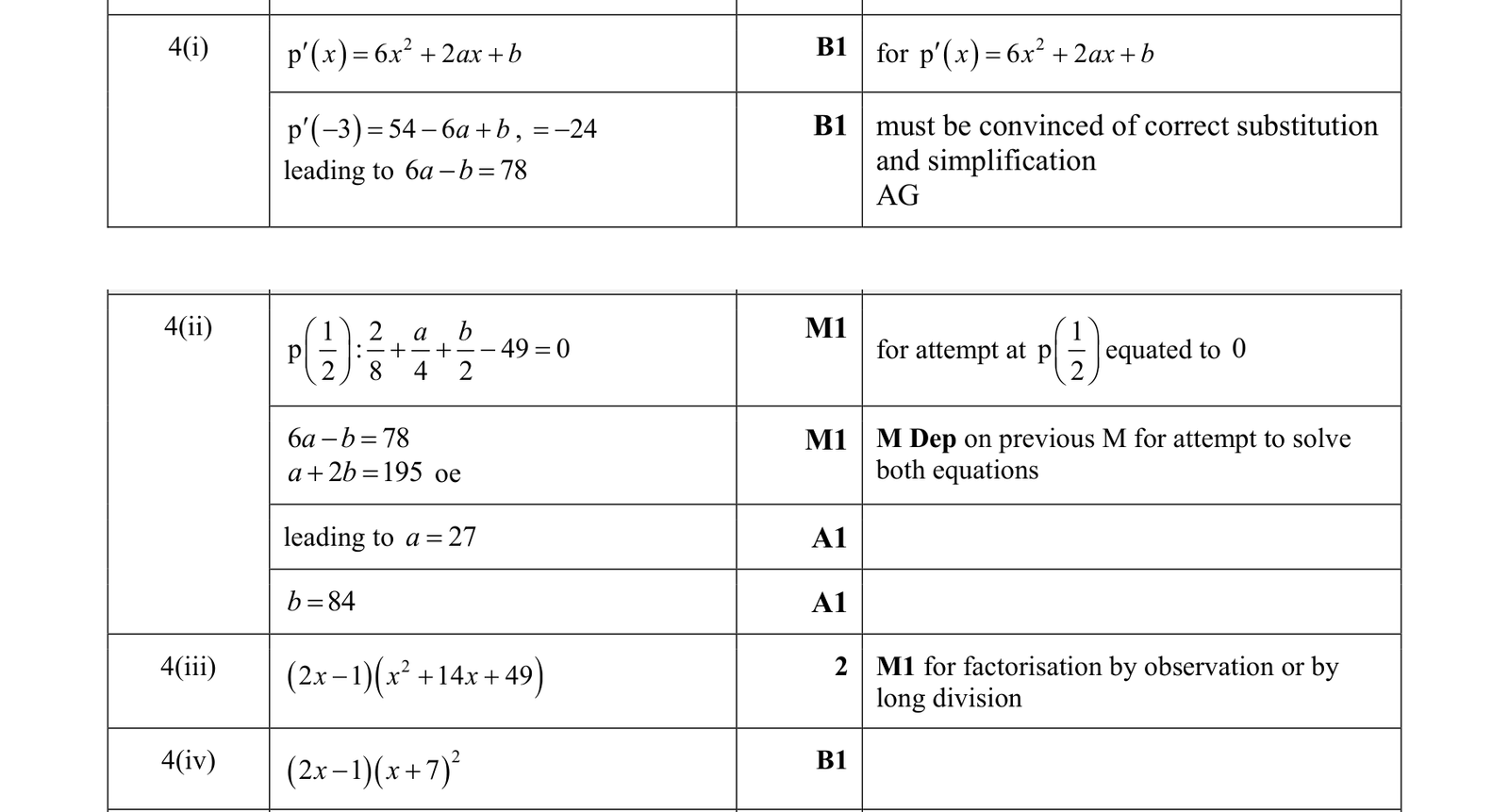
0606 P12 - Mar 2019 - Q4 - 9 marks
The polynomial \(p(x)\) is defined by \(p(x)=2x^3+ax^2+bx-49\), where \(a\) and \(b\) are constants. When \(p'(x)\) is divided by \(x+3\), the remainder is \(-24\).
(i) Show that \(6a-b=78\).
It is now given that \(2x-1\) is a factor of \(p(x)\).
(ii) Find the values of \(a\) and \(b\).
(iii) Express \(p(x)\) in the form \((2x-1)Q(x)\), where \(Q(x)\) is a quadratic expression.
(iv) Hence factorise \(p(x)\) completely.
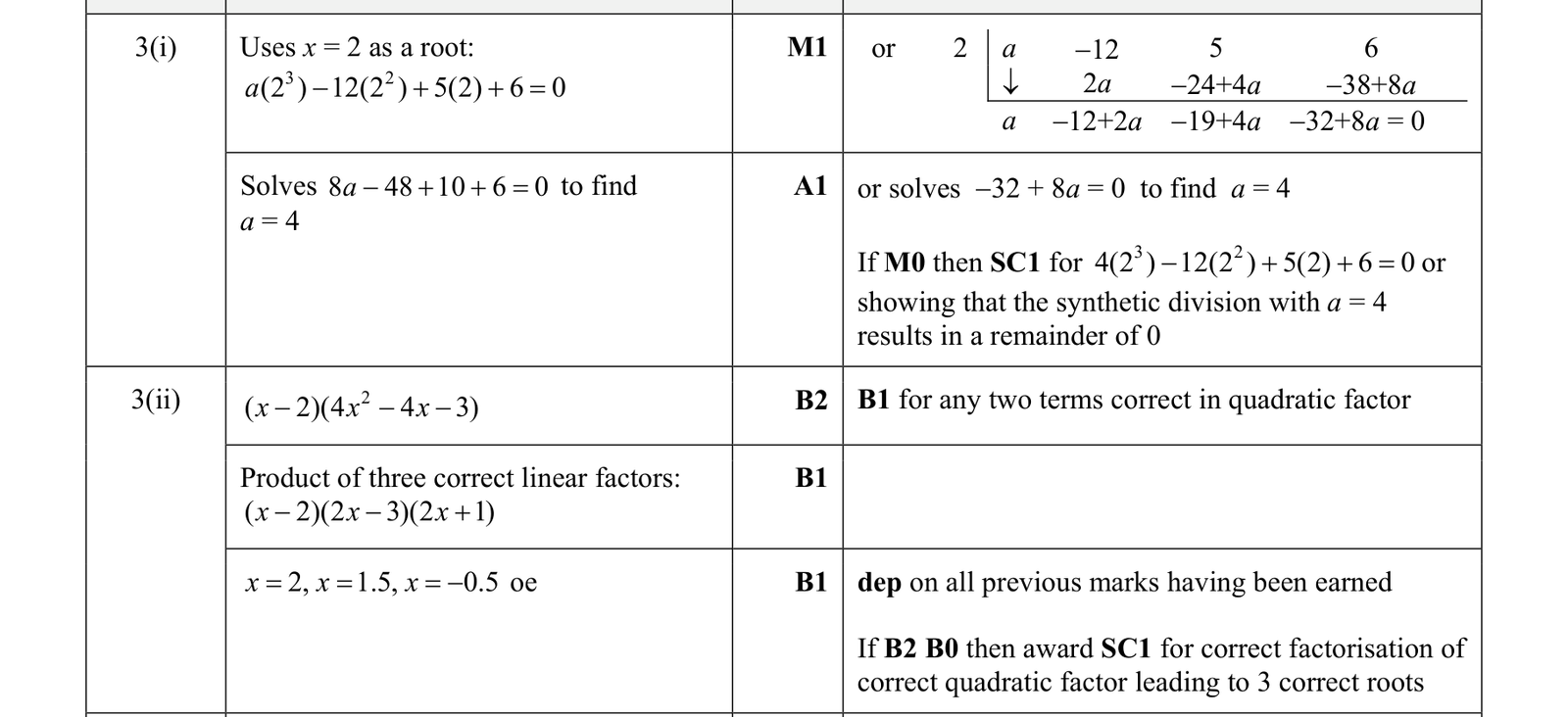
0606 P22 - Jun 2019 - Q3 - 6 marks
(i) Given that \(x-2\) is a factor of \(ax^3-12x^2+5x+6\), use the factor theorem to show that \(a=4\).
(ii) Factorise \(4x^3-12x^2+5x+6\) and hence solve \(4x^3-12x^2+5x+6=0\).
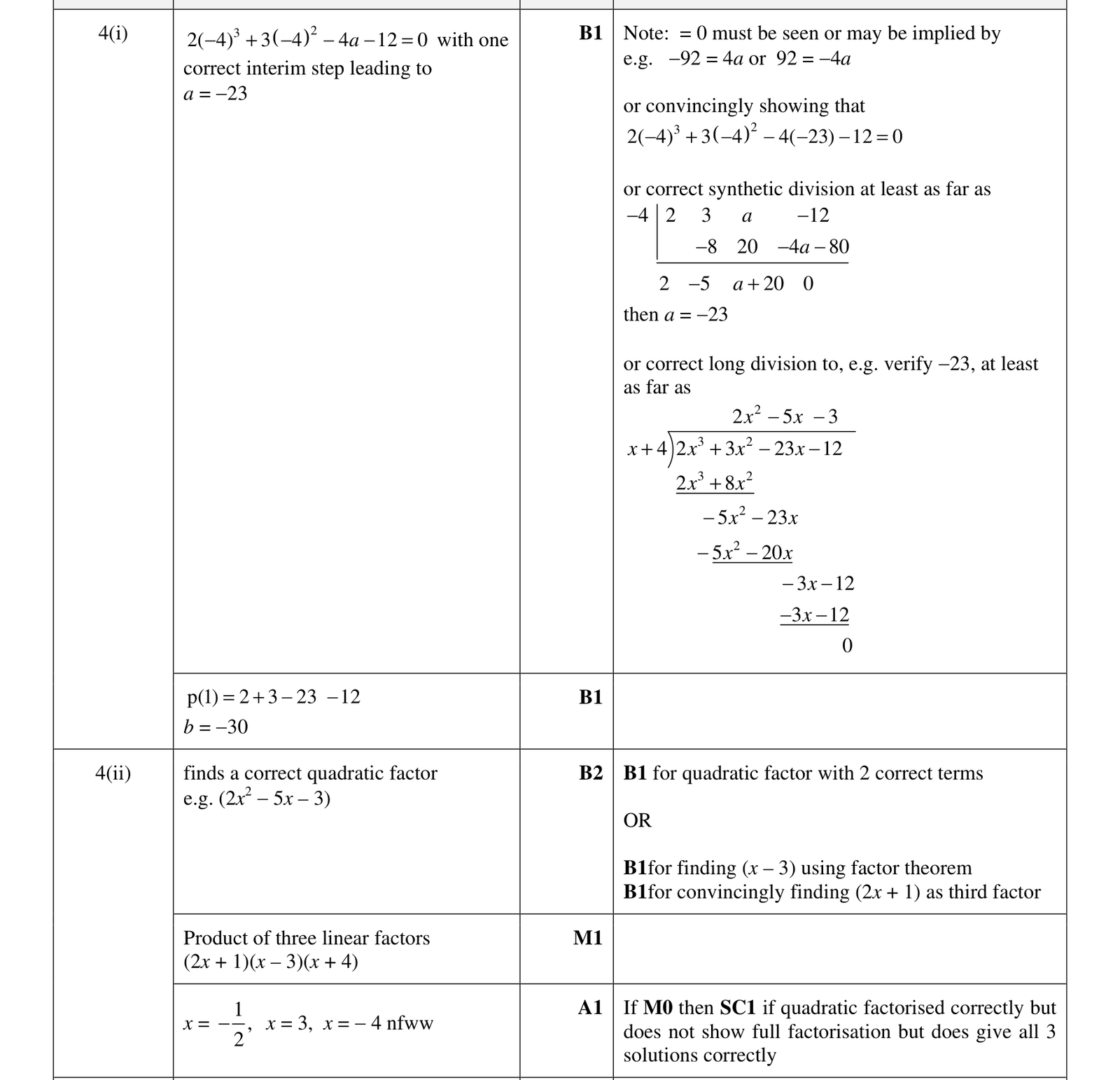
0606 P21 - Jun 2018 - Q4 - 6 marks
Do not use a calculator in this question.
It is given that \(x+4\) is a factor of
\(p(x)=2x^3+3x^2+ax-12.\)
When \(p(x)\) is divided by \(x-1\), the remainder is \(b\).
(i) Show that \(a=-23\) and find the value of the constant \(b\).
(ii) Factorise \(p(x)\) completely and hence state all the solutions of \(p(x)=0\).
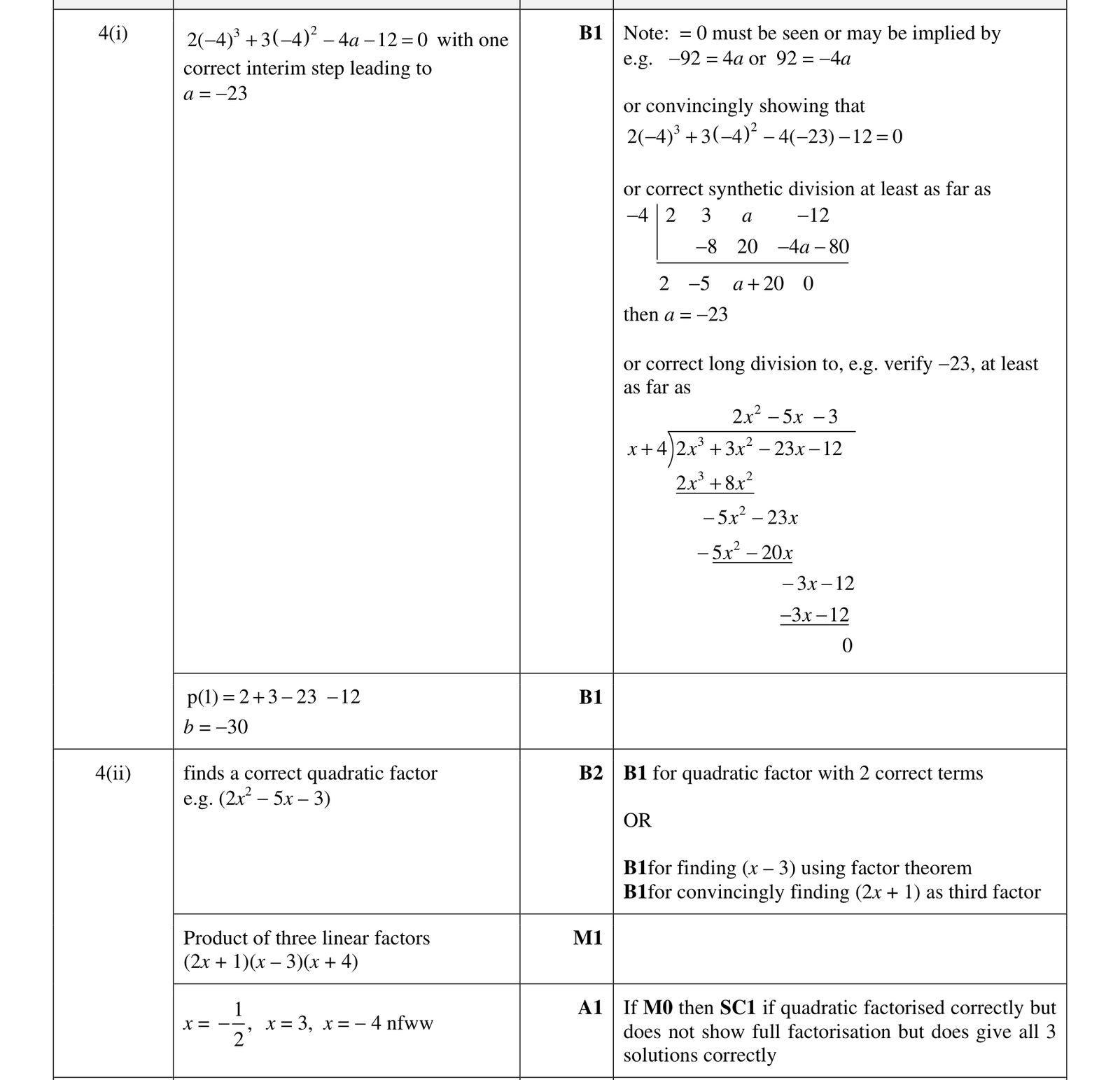
0606 P23 - Jun 2018 - Q4 - 6 marks
Do not use a calculator in this question.
It is given that \(x+4\) is a factor of
\(p(x)=2x^3+3x^2+ax-12.\)
When \(p(x)\) is divided by \(x-1\), the remainder is \(b\).
(i) Show that \(a=-23\) and find the value of the constant \(b\).
(ii) Factorise \(p(x)\) completely and hence state all the solutions of \(p(x)=0\).
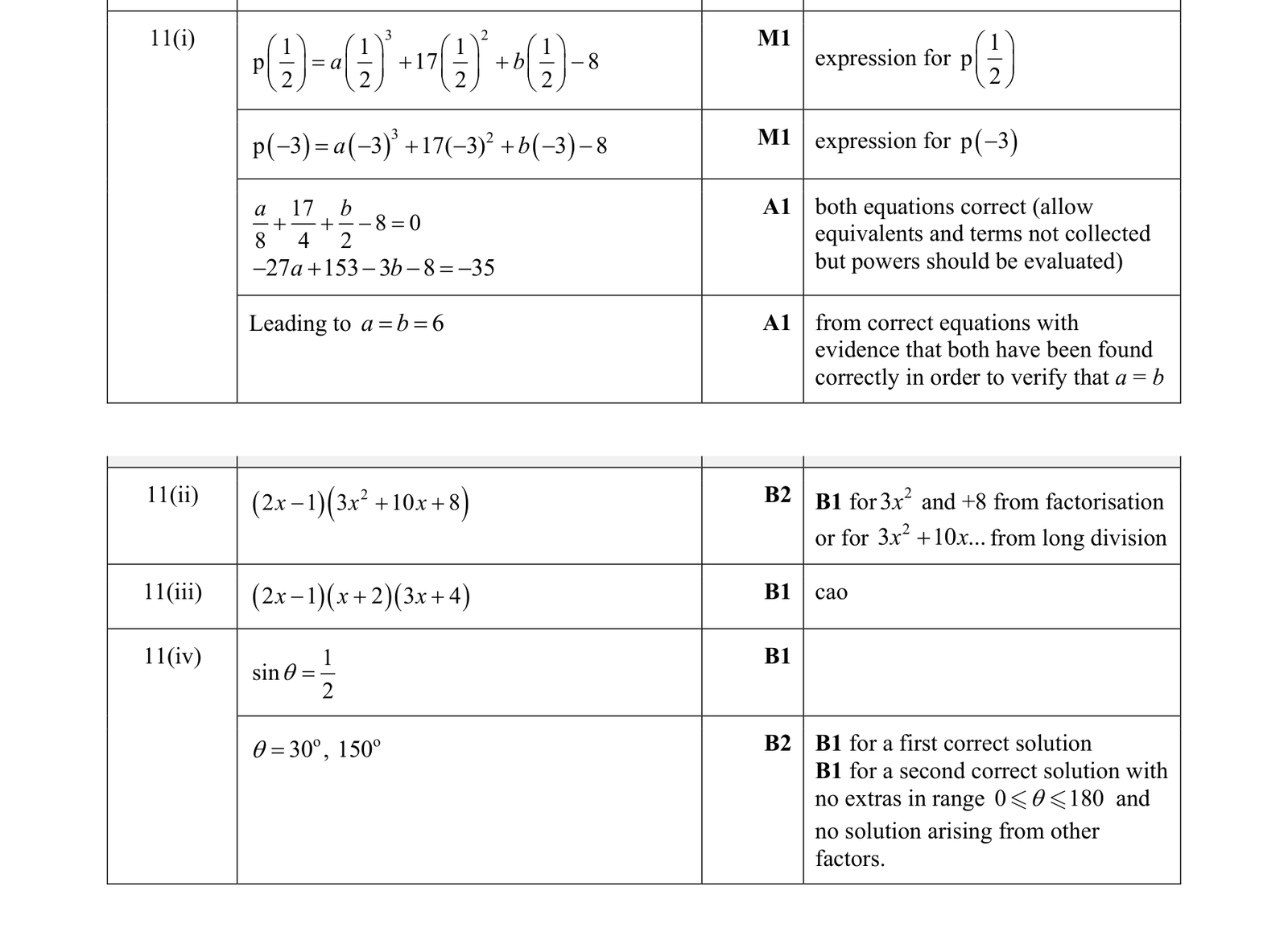
0606 P13 - Nov 2018 - Q11 - 10 marks
The polynomial \(p(x)=ax^3+17x^2+bx-8\) is divisible by \(2x-1\) and has a remainder of \(-35\) when divided by \(x+3\).
(i) By finding the value of each of the constants \(a\) and \(b\), verify that \(a=b\).
Using your values of \(a\) and \(b\),
(ii) find \(p(x)\) in the form \((2x-1)q(x)\), where \(q(x)\) is a quadratic expression.
(iii) factorise \(p(x)\) completely.
(iv) solve \(a\sin^3\theta+17\sin^2\theta+b\sin\theta-8=0\) for \(0^\circ\lt \theta\lt 180^\circ\).
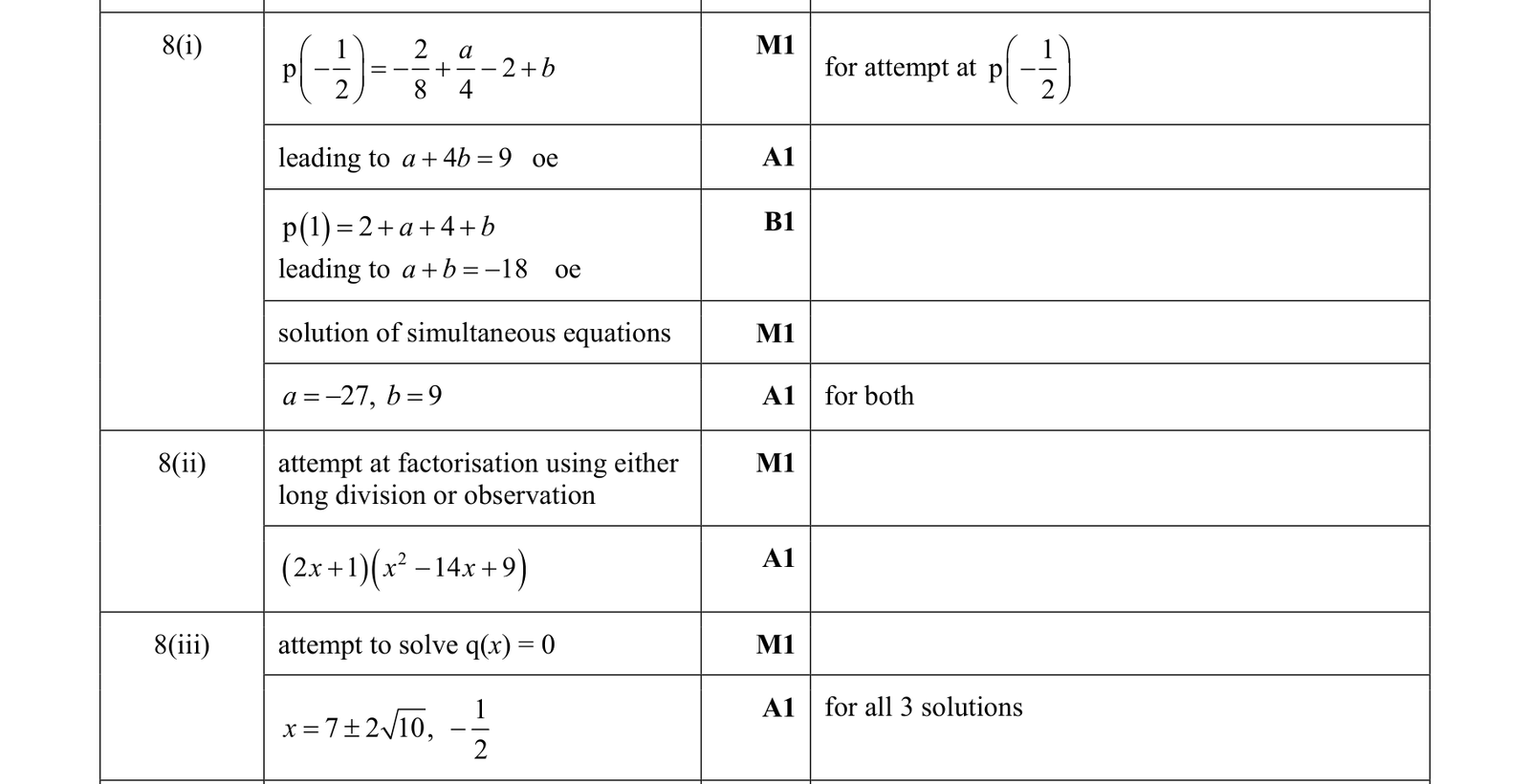
0606 P13 - Jun 2017 - Q8 - 9 marks
It is given that
\(p(x)=2x^3+ax^2+4x+b,\)
where \(a\) and \(b\) are constants. It is given also that \(2x+1\) is a factor of \(p(x)\) and that when \(p(x)\) is divided by \(x-1\) there is a remainder of \(-12\).
(i) Find the value of \(a\) and of \(b\).
(ii) Using your values of \(a\) and \(b\), write \(p(x)\) in the form \((2x+1)q(x)\), where \(q(x)\) is a quadratic expression.
(iii) Hence find the exact solutions of the equation \(p(x)=0\).
0606 P22 - Jun 2017 - Q3 - 5 marks
Without using a calculator, factorise the expression
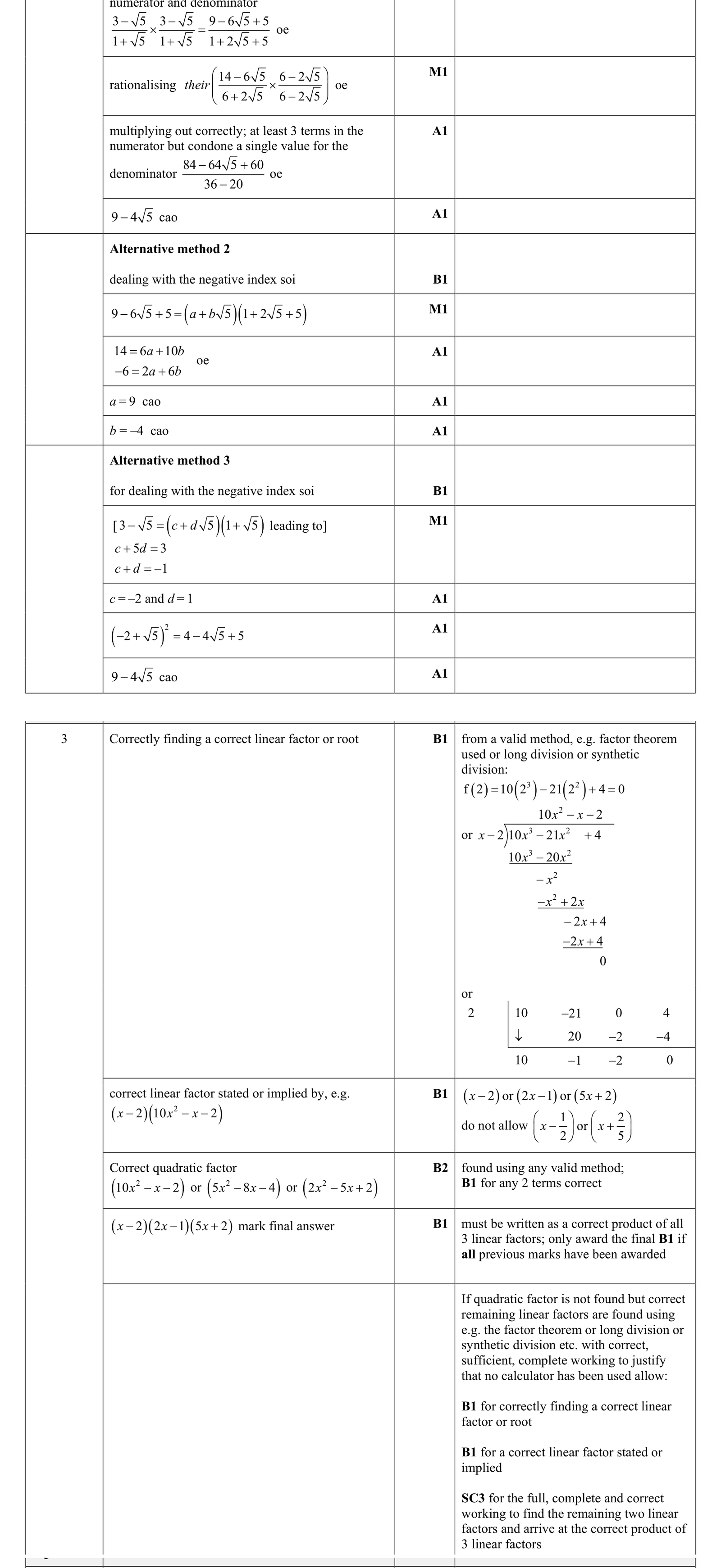
\(10x^3-21x^2+4.\)
0606 P11 - Nov 2017 - Q2 - 7 marks
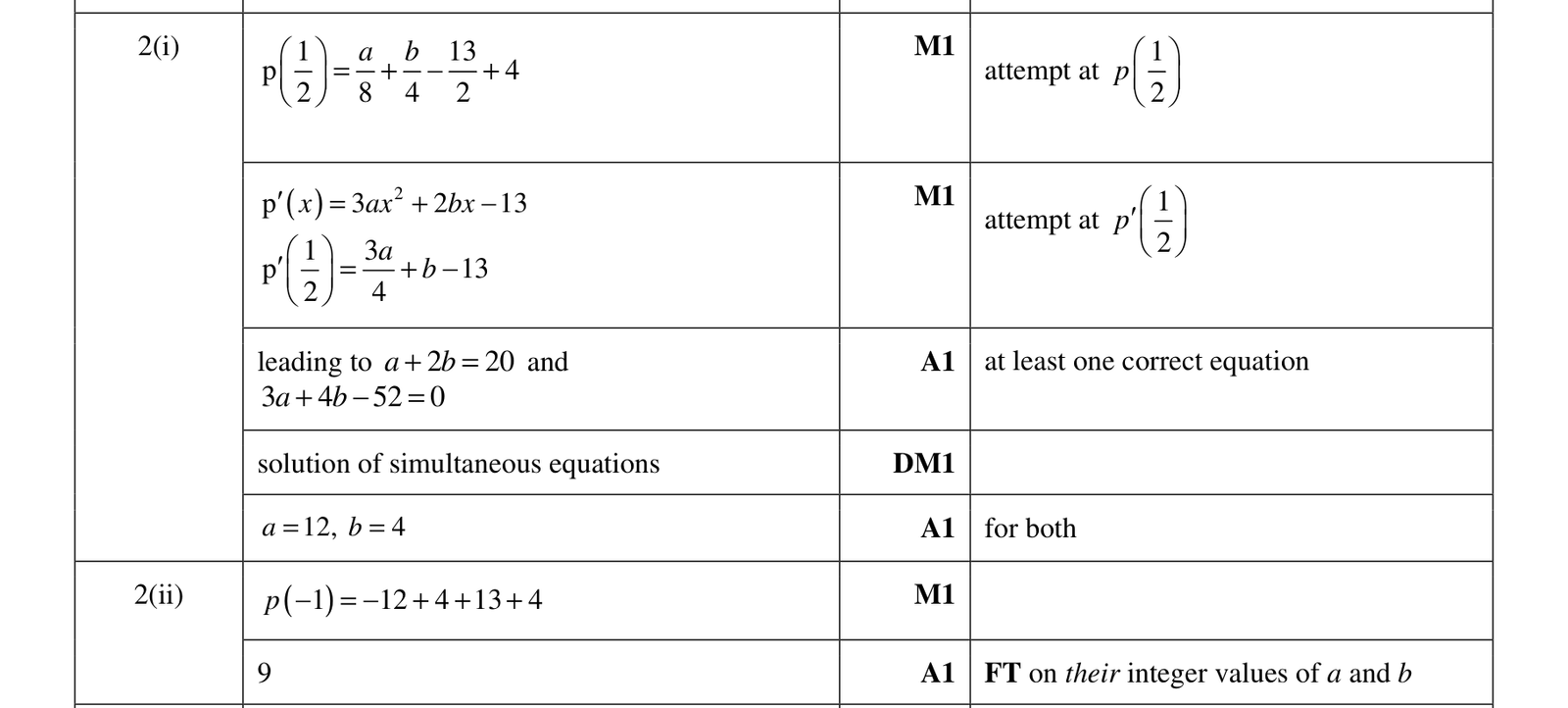
The polynomial \(p(x)\) is \(ax^3+bx^2-13x+4\), where \(a\) and \(b\) are integers. Given that \(2x-1\) is a factor of \(p(x)\) and also a factor of \(p'(x)\),
(i) find the value of \(a\) and of \(b\).
Using your values of \(a\) and \(b\),
(ii) find the remainder when \(p(x)\) is divided by \(x+1\).
0606 P12 - Nov 2017 - Q7 - 7 marks
A polynomial \(p(x)\) is \(ax^3+8x^2+bx+5\), where \(a\) and \(b\) are integers. It is given that \(2x-1\) is a factor of \(p(x)\) and that a remainder of \(-25\) is obtained when \(p(x)\) is divided by \(x+2\).
(i) Find the value of \(a\) and of \(b\).
(ii) Using your values of \(a\) and \(b\), find the exact solutions of \(p(x)=5\).
