0606 P23 - Nov 2025 - Q3 - 9 marks
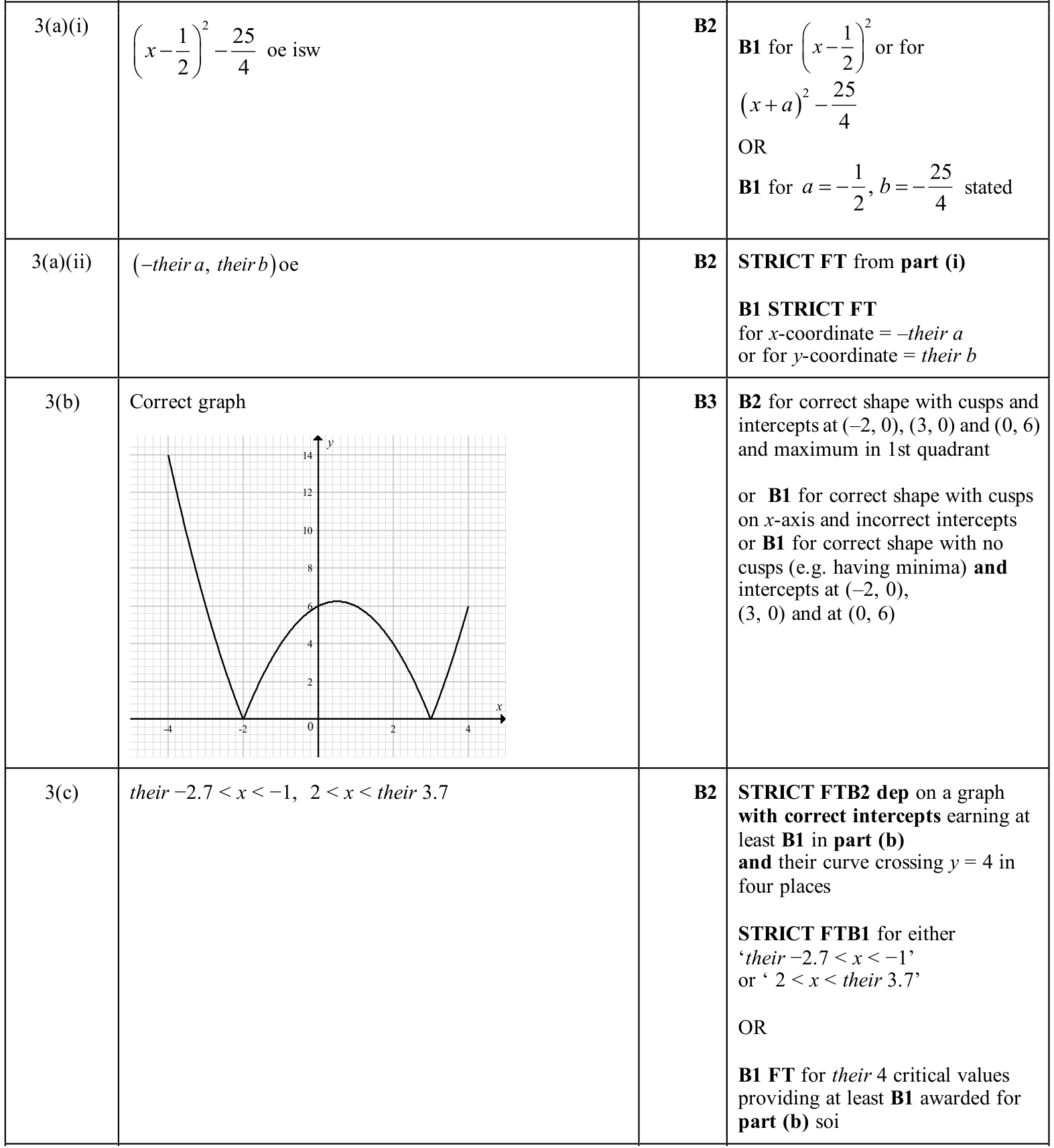
(a) (i) Write \(x^{2}-x-6\) in the form \((x+a)^{2}+b\) where \(a\) and \(b\) are constants.
(ii) Hence write down the coordinates of the stationary point on the curve \(y=x^{2}-x-6\).
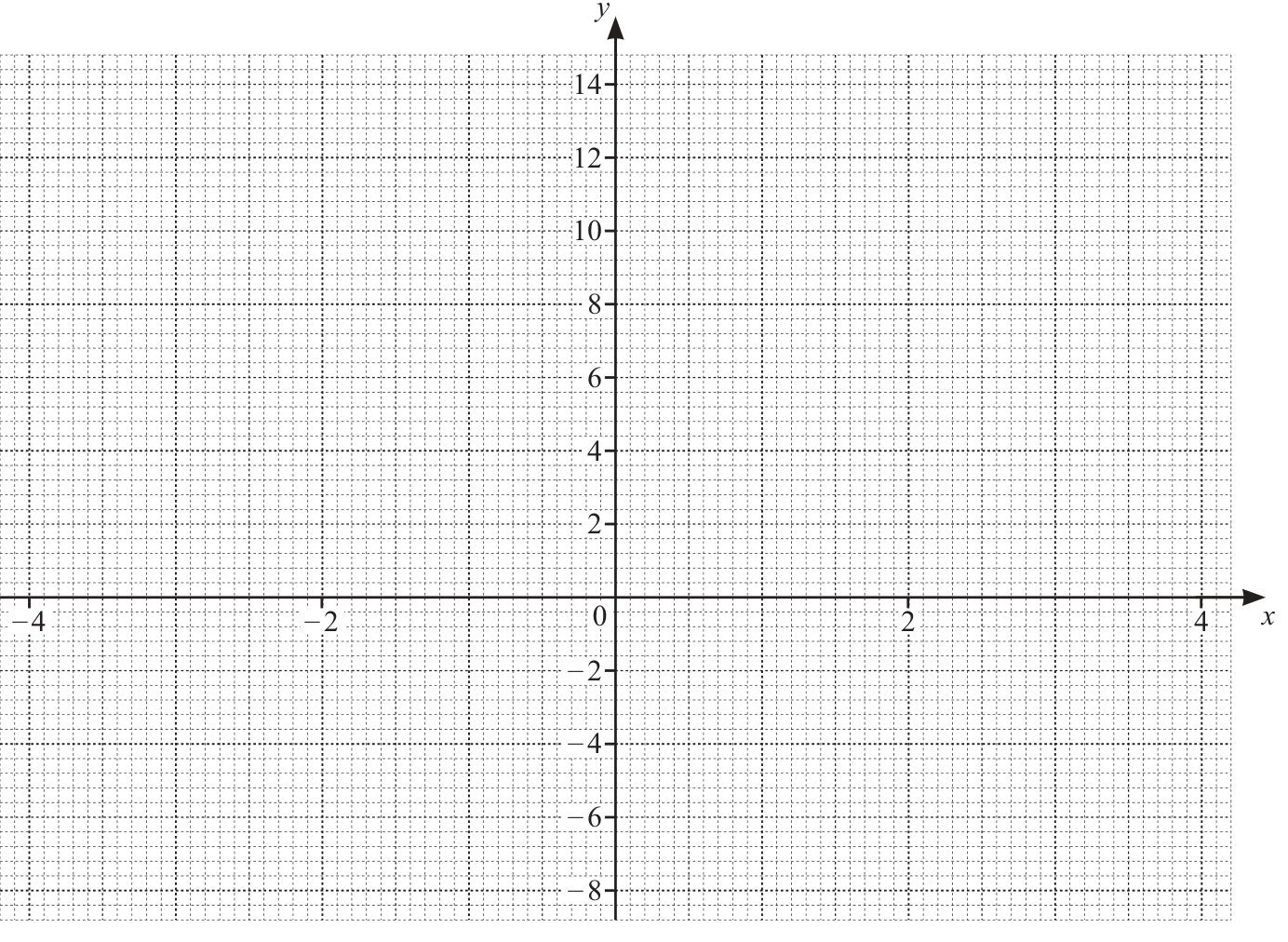
(b) On the axes, draw the graph of \(y=\left|x^{2}-x-6\right|\) for \(-4 \leqslant x \leqslant 4\).
(c) Use your graph to solve the inequality \(\left|x^{2}-x-6\right|\lt 4\).
0606 P13 - Nov 2024 - Q1 - 6 marks
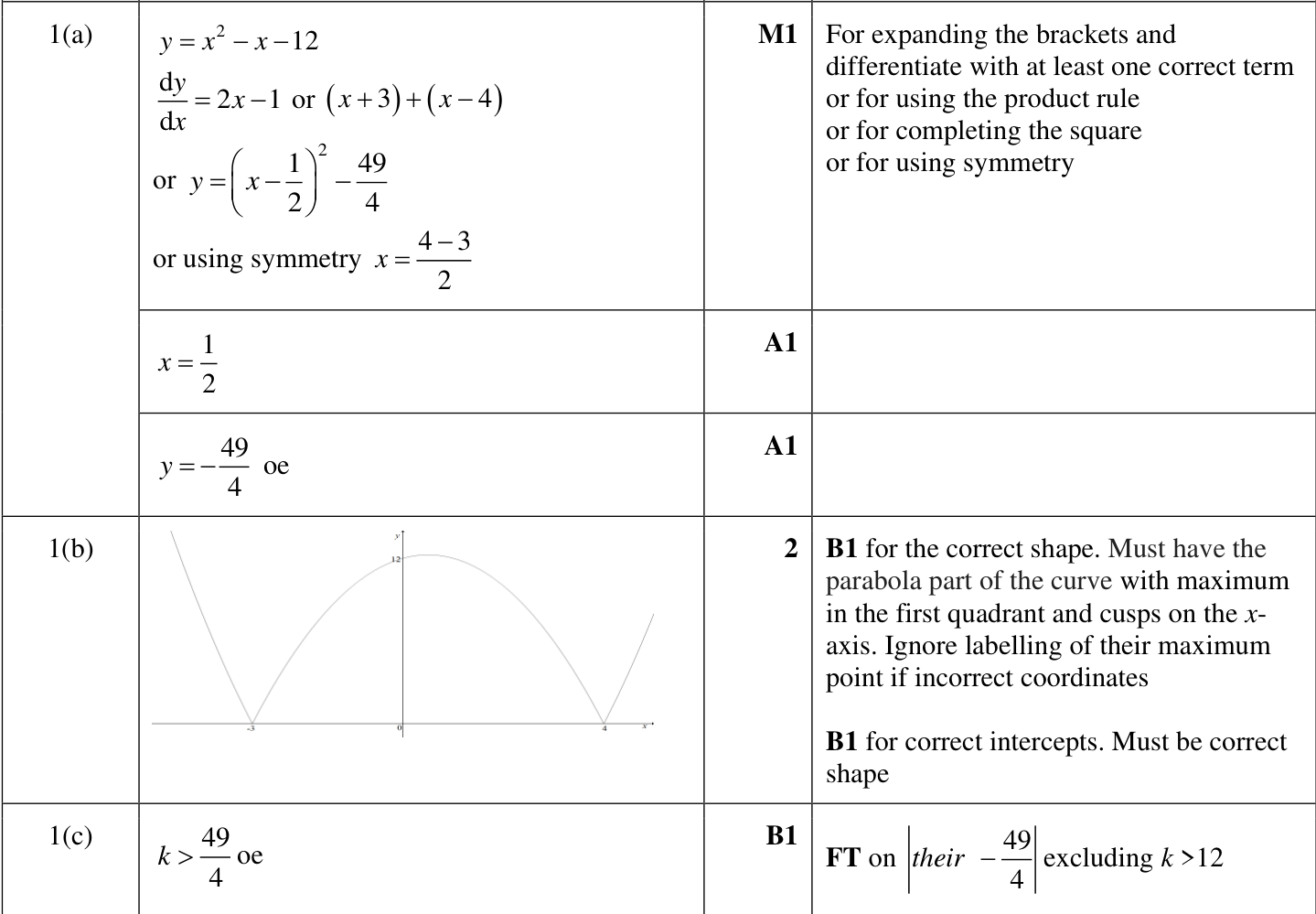
(a) Find the coordinates of the stationary point on the curve \(y=(x+3)(x-4)\).
(b) On the axes, sketch the graph of \(y=|(x+3)(x-4)|\), stating the intercepts with the axes. (c) Given that \(k\gt 0\), write down the values of \(k\) for which the equation \(|(x+3)(x-4)|=k\) has exactly 2 distinct real roots.
0606 P11 - Jun 2023 - Q1 - 10 marks
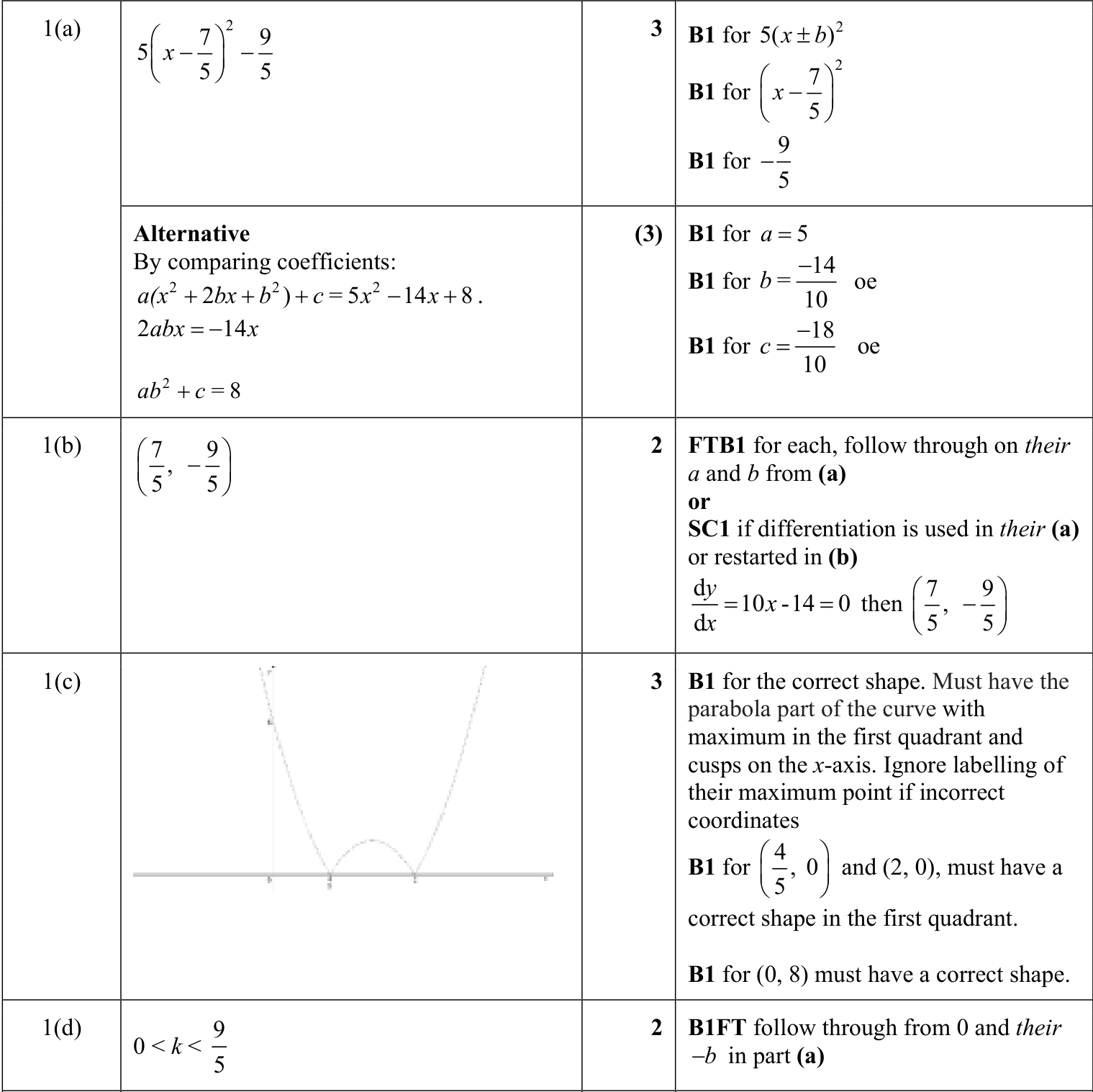
(a) Write \(5x^2-14x+8\) in the form \(a(x+b)^2+c\), where \(a\), \(b\) and \(c\) are constants to be found.
(b) Hence state the coordinates of the stationary point on the curve \(y=5x^2-14x+8\).
(c) On the axes, sketch the curve \(y=\lvert 5x^2-14x+8\rvert\), stating the coordinates of the points where the curve meets the coordinate axes.
(d) Find the set of values of \(k\) for which the equation \(\lvert 5x^2-14x+8\rvert=k\) has four distinct roots.
0606 P12 - Nov 2022 - Q2 - 8 marks
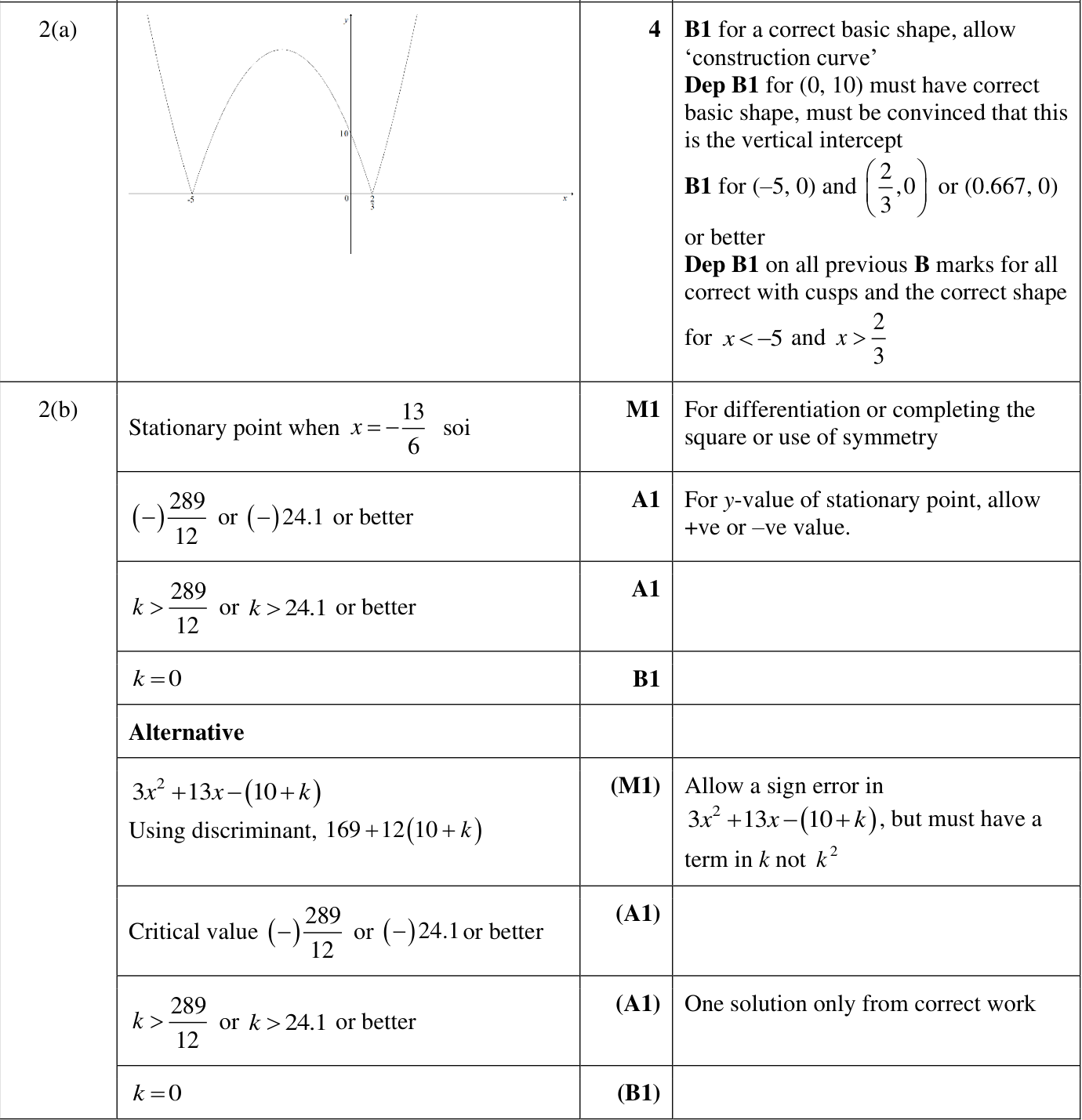
(a) On the axes, draw the graph of
\(y=\left|3x^2+13x-10\right|,\)
stating the coordinates of the points where the graph meets the axes.
(b) Find the set of values of the constant \(k\) such that the equation
\(k=\left|3x^2+13x-10\right|\)
has exactly \(2\) distinct roots.
0606 P13 - Nov 2022 - Q2 - 8 marks
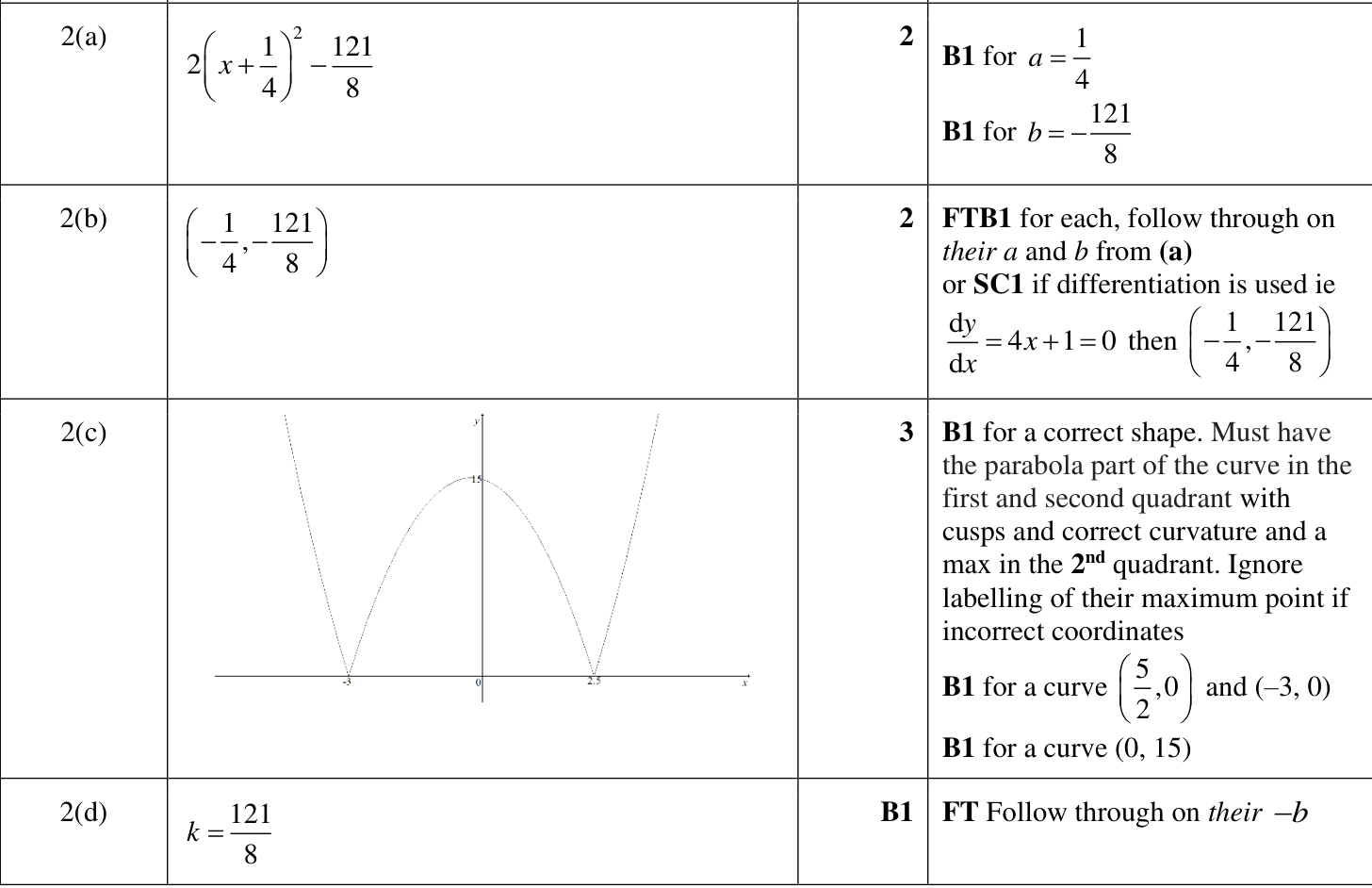
(a) Show that \(2x^2+x-15\) can be written in the form \(2(x+a)^2+b\), where \(a\) and \(b\) are exact constants to be found.
(b) Hence write down the coordinates of the stationary point on the curve \(y=2x^2+x-15\).
(c) On the axes, sketch the graph of
\(y=\left|2x^2+x-15\right|,\)
stating the coordinates of the points where the graph meets the coordinate axes.
(d) Write down the value of the constant \(k\) for which the equation
\(\left|2x^2+x-15\right|=k\)
has \(3\) distinct solutions.
0606 P12 - Mar 2021 - Q4 - 9 marks
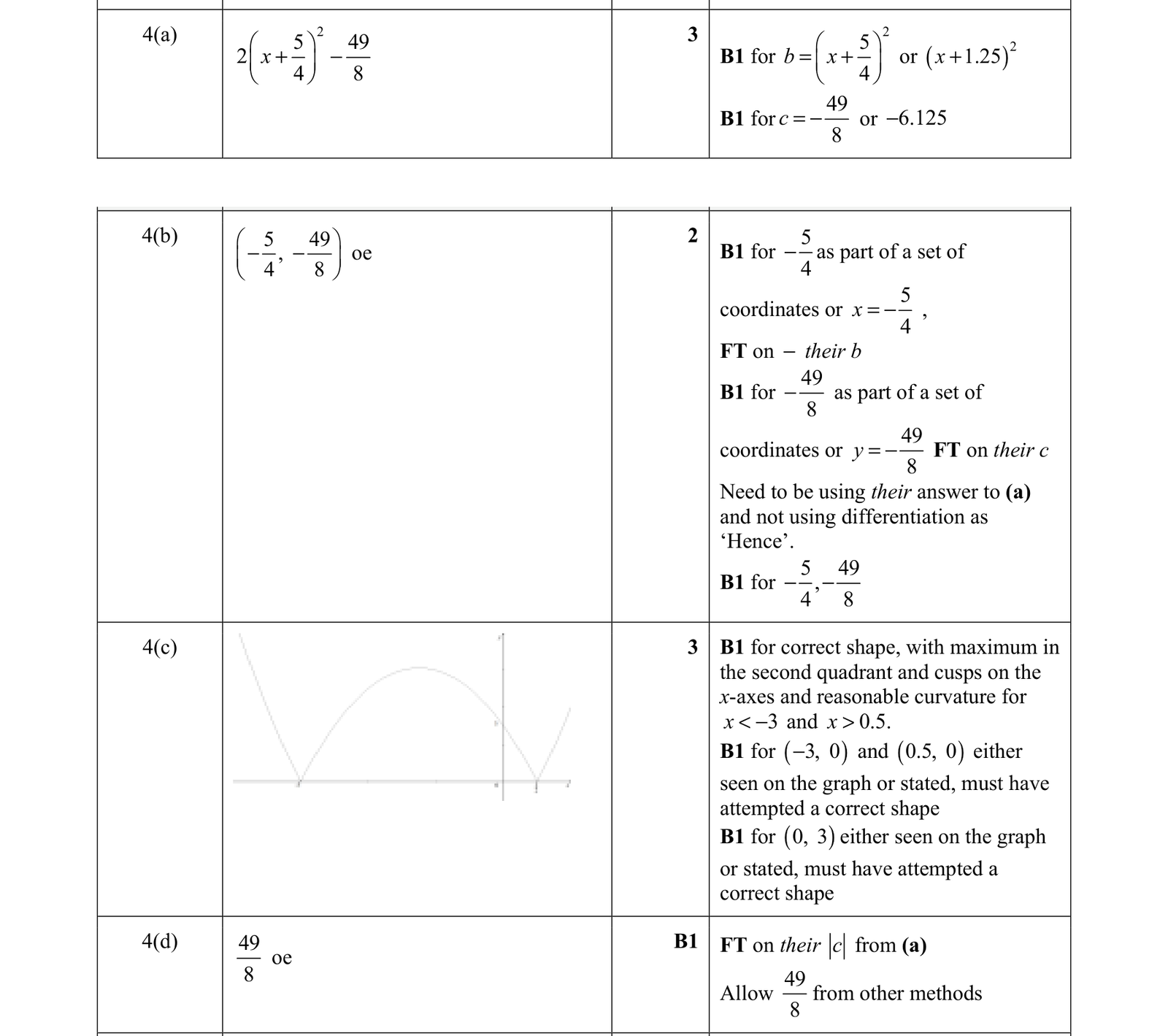
(a) Show that \(2x^2+5x-3\) can be written in the form \(a(x+b)^2+c\), where \(a\), \(b\) and \(c\) are constants.
(b) Hence write down the coordinates of the stationary point on the curve with equation
\(y=2x^2+5x-3.\)
(c) On the axes, sketch the graph of \(y=|2x^2+5x-3|\), stating the coordinates of the intercepts with the axes.
(d) Write down the value of \(k\) for which the equation \(|2x^2+5x-3|=k\) has exactly 3 distinct solutions.
0606 P13 - Jun 2020 - Q4 - 9 marks
(a) Write
\(2x^2+3x-4\)
in the form \(a(x+b)^2+c\), where \(a\), \(b\) and \(c\) are constants.
(b) Hence write down the coordinates of the stationary point on the curve \(y=2x^2+3x-4\).
(c) Sketch the graph of
\(y=\left|2x^2+3x-4\right|,\)
showing the exact values of the intercepts of the curve with the coordinate axes.
(d) Find the value of \(k\) for which \(\left|2x^2+3x-4\right|=k\) has exactly 3 values of \(x\).

0606 P12 - Mar 2019 - Q2 - 4 marks
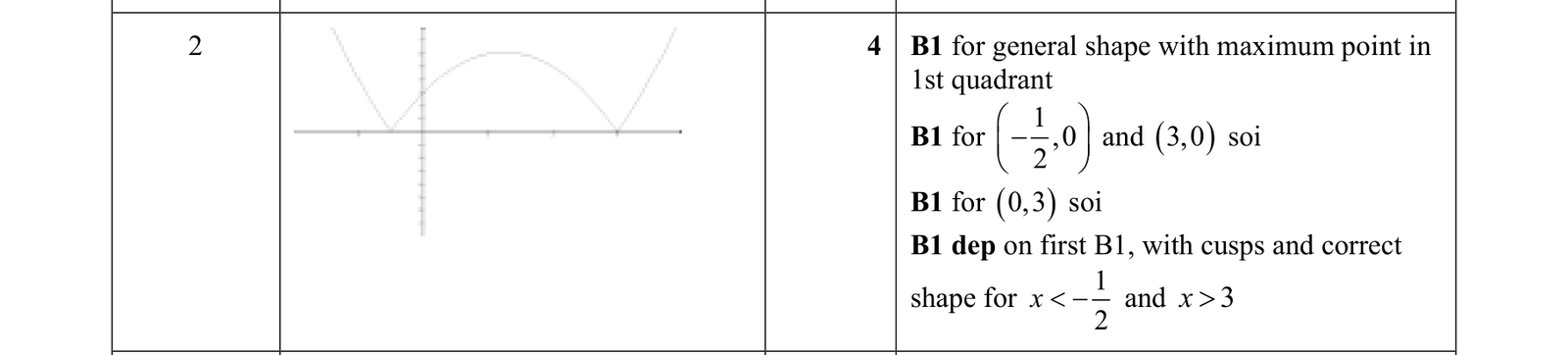
Sketch the graph of \(y=\left|2x^2-5x-3\right|\), stating the coordinates of the intercepts with the coordinate axes.
0606 P13 - Jun 2019 - Q5 - 7 marks
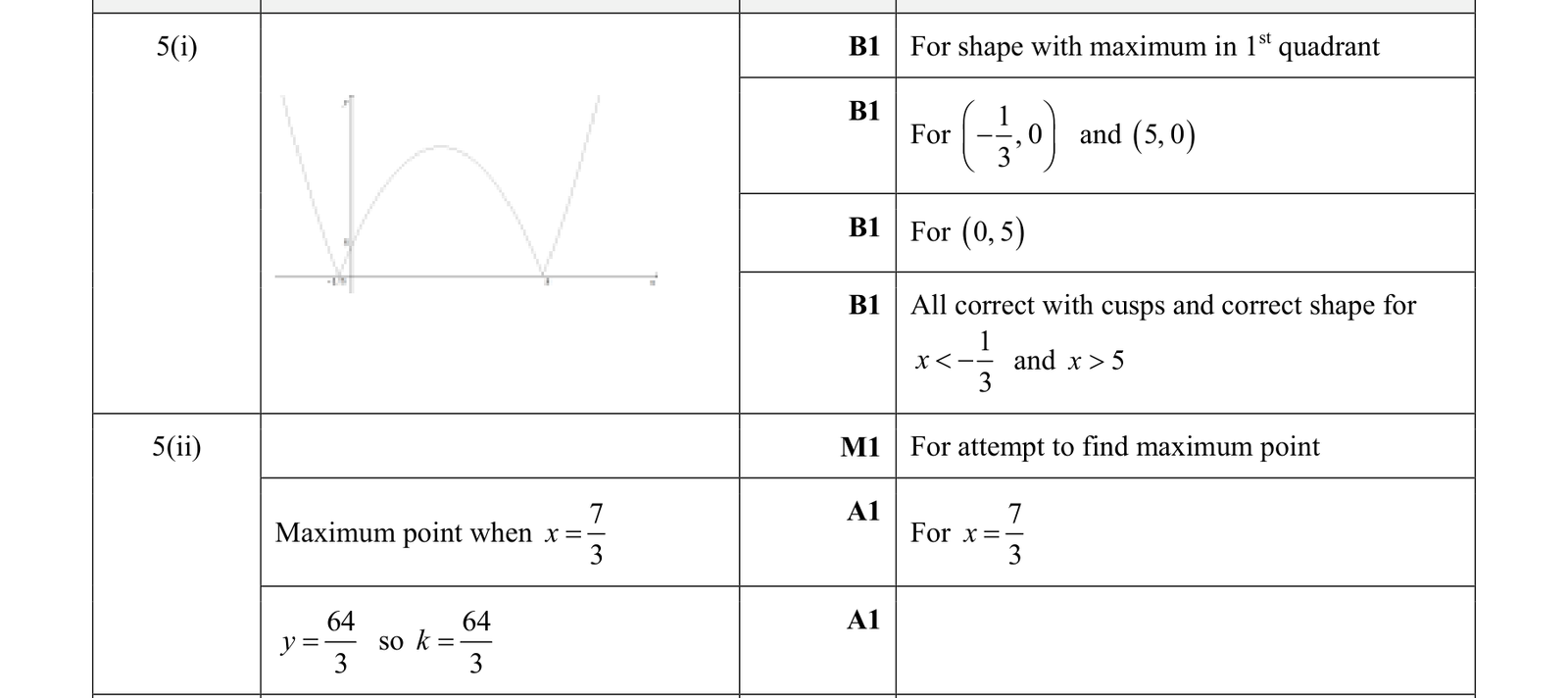
(i) Sketch the graph of \(y=\left|3x^2-14x-5\right|\), showing the coordinates of the points where the graph meets the coordinate axes.
(ii) Find the exact value of \(k\) such that \(\left|3x^2-14x-5\right|=k\) has 3 solutions only.
0606 P12 - Nov 2019 - Q4 - 7 marks
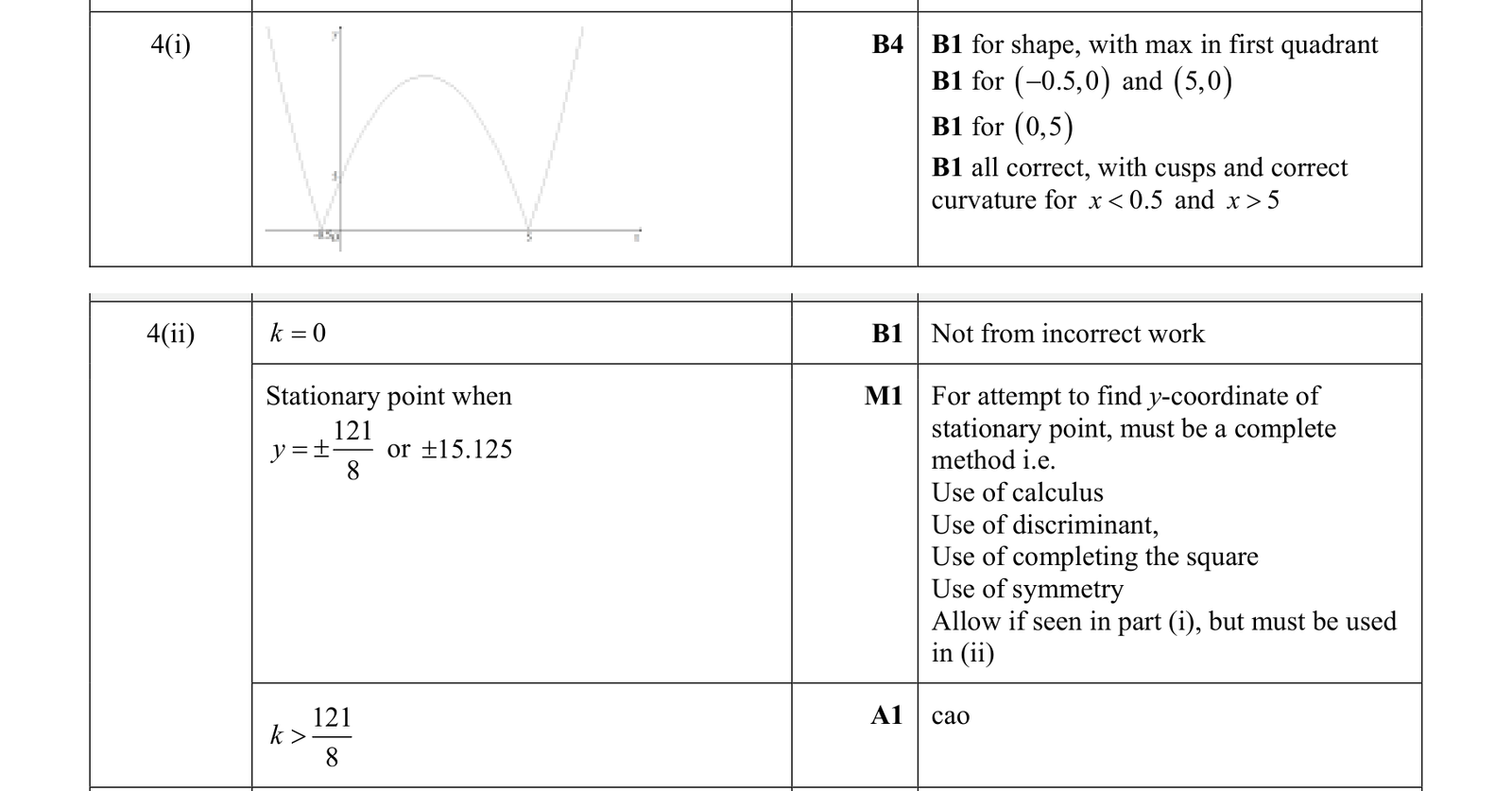
(i) Sketch the graph of
\(y=\left|2x^2-9x-5\right|,\)
showing the coordinates of the points where the graph meets the axes.
(ii) Find the values of \(k\) for which \(\left|2x^2-9x-5\right|=k\) has exactly \(2\) solutions.
0606 P21 - Jun 2018 - Q9 - 9 marks
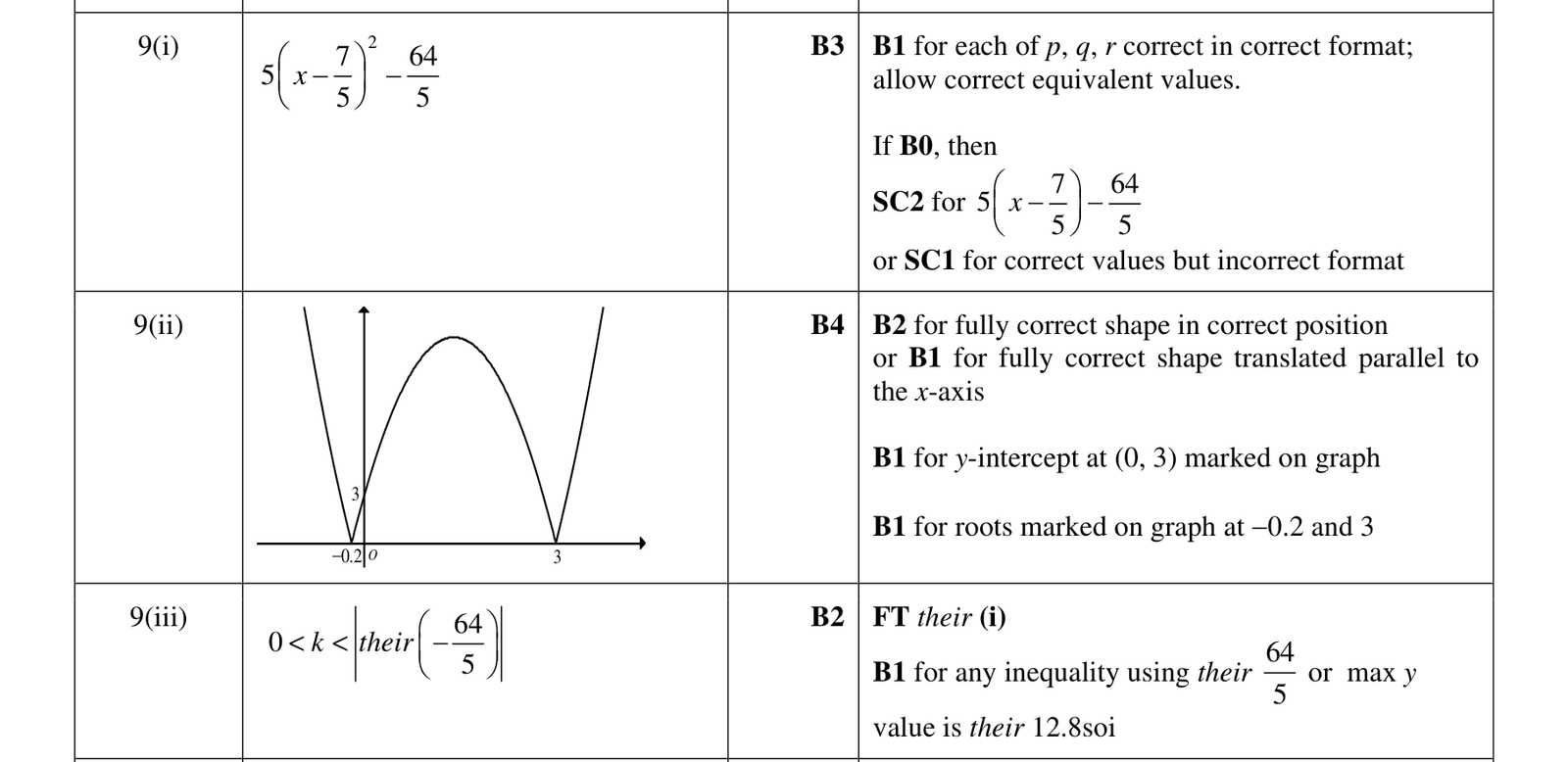
(i) Express \(5x^2-14x-3\) in the form \(p(x+q)^2+r\), where \(p\), \(q\) and \(r\) are constants.
(ii) Sketch the graph of \(y=\left|5x^2-14x-3\right|\). Show clearly any points where your graph meets the coordinate axes.
(iii) State the set of values of \(k\) for which \(\left|5x^2-14x-3\right|=k\) has exactly four solutions.
0606 P23 - Jun 2018 - Q9 - 9 marks
(i) Express \(5x^2-14x-3\) in the form \(p(x+q)^2+r\), where \(p\), \(q\) and \(r\) are constants.
(ii) Sketch the graph of \(y=\left|5x^2-14x-3\right|\). Show clearly any points where your graph meets the coordinate axes.
(iii) State the set of values of \(k\) for which \(\left|5x^2-14x-3\right|=k\) has exactly four solutions.

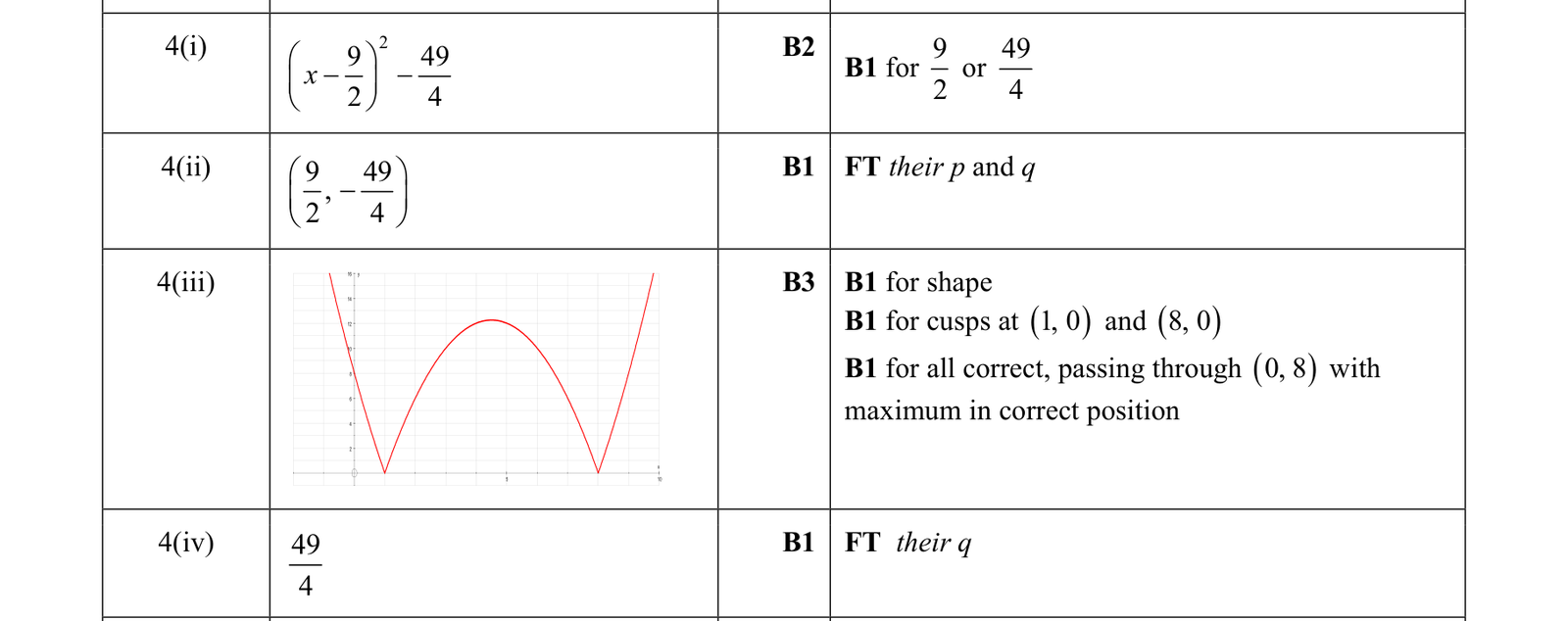
0606 P11 - Nov 2018 - Q4 - 7 marks
(i) Write \(x^2-9x+8\) in the form \((x-p)^2-q\), where \(p\) and \(q\) are constants.
(ii) Hence write down the coordinates of the minimum point on the curve \(y=x^2-9x+8\).
(iii) Sketch the graph of \(y=\left|x^2-9x+8\right|\), showing the coordinates of the points where the curve meets the coordinate axes.
(iv) Write down the value of \(k\) for which \(\left|x^2-9x+8\right|=k\) has exactly 3 solutions.