0606 P22 - Nov 2025 - Q9 - 5 marks
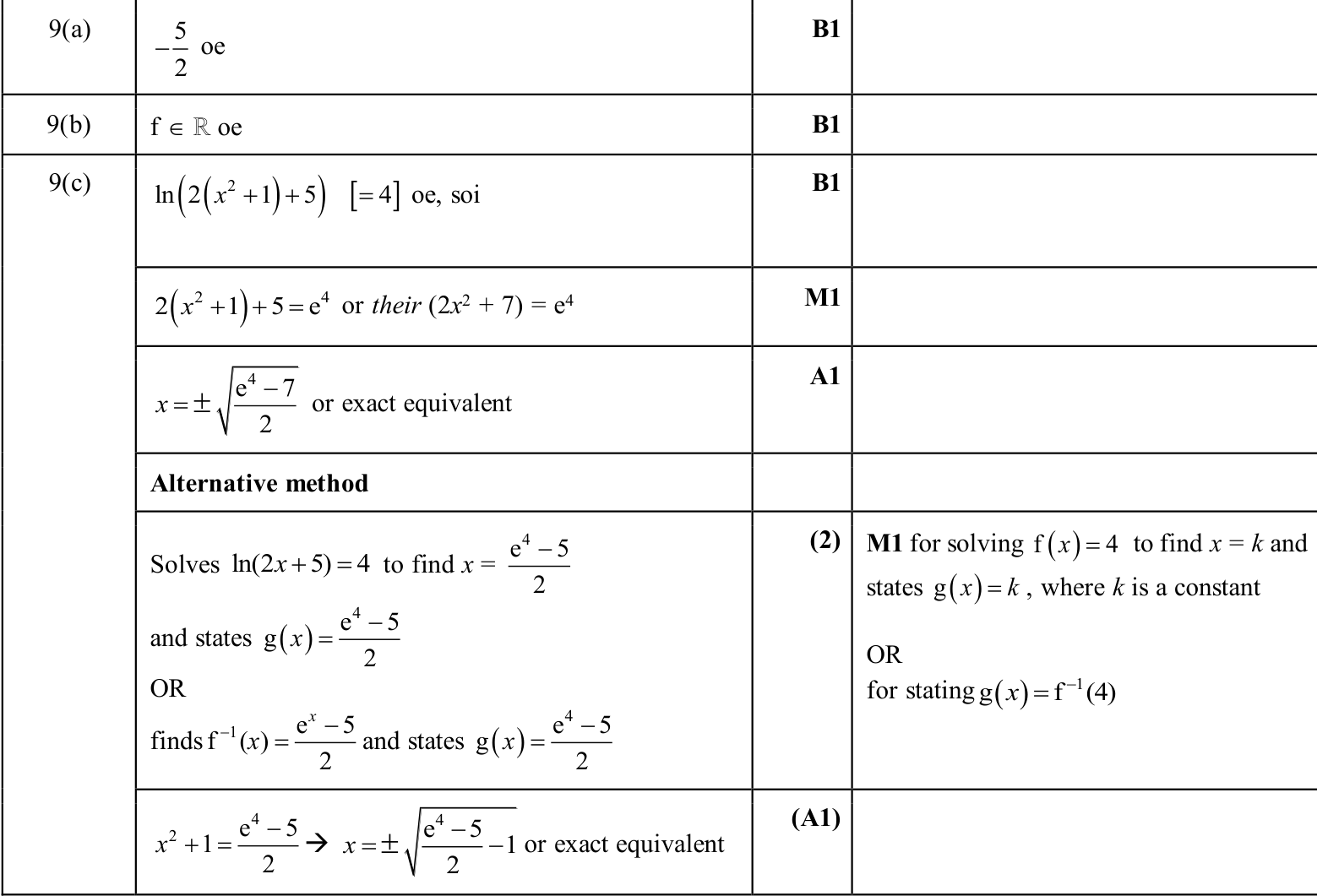
It is given that \(\mathrm{f}(x)=\ln(2x+5)\) for \(x\gt a\), where \(a\) is a constant.
(a) Write down the least possible value of \(a\).
(b) Using your value of \(a\), write down the range of \(\mathrm{f}\).
It is also given that \(\mathrm{g}(x)=x^2+1\), for \(x\in\mathbb{R}\).
(c) Using your value of \(a\), solve the equation \(\mathrm{fg}(x)=4\). Give your answers in exact form.
0606 P11 - Nov 2025 - Q4 - 10 marks
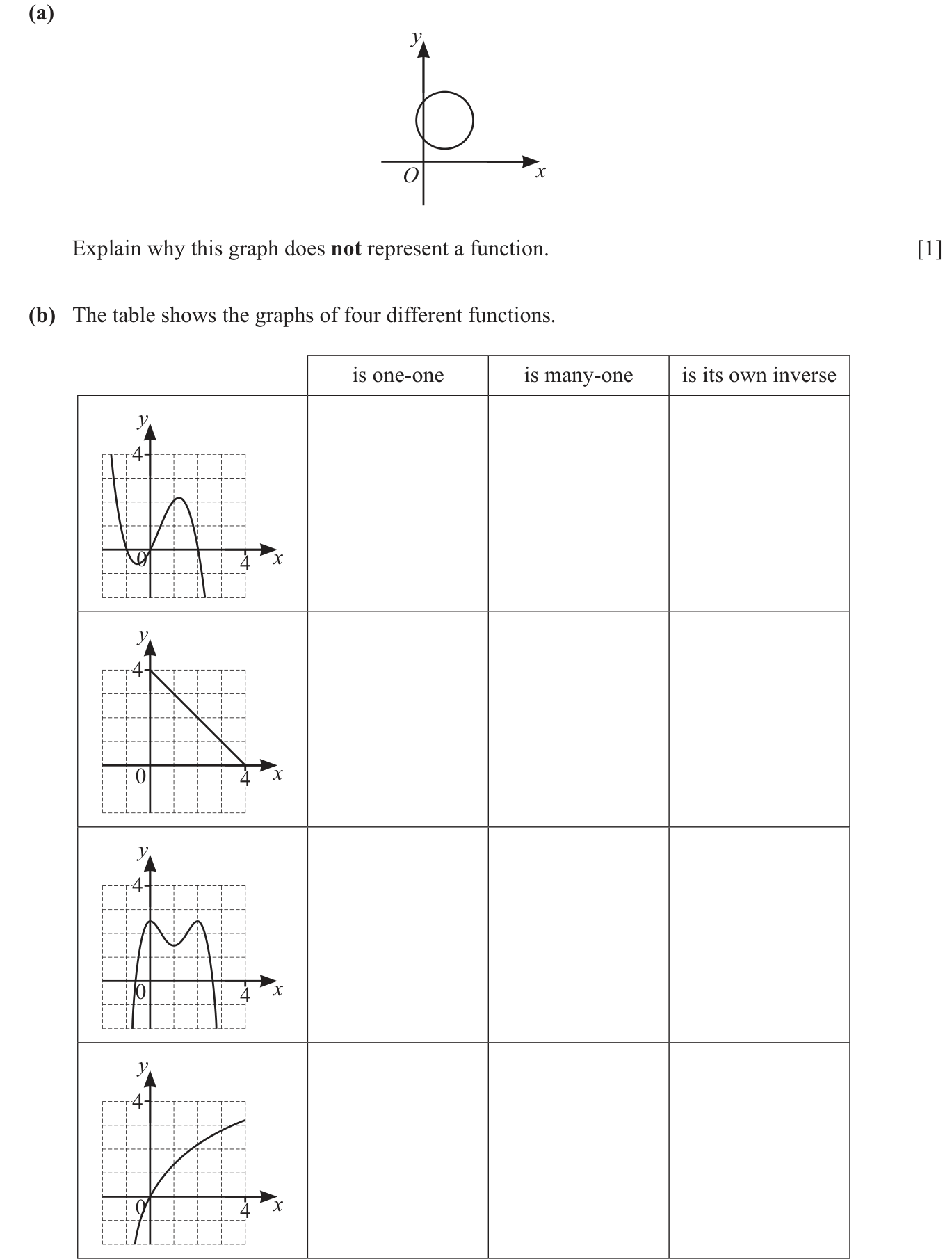
The diagrams show four different relations.
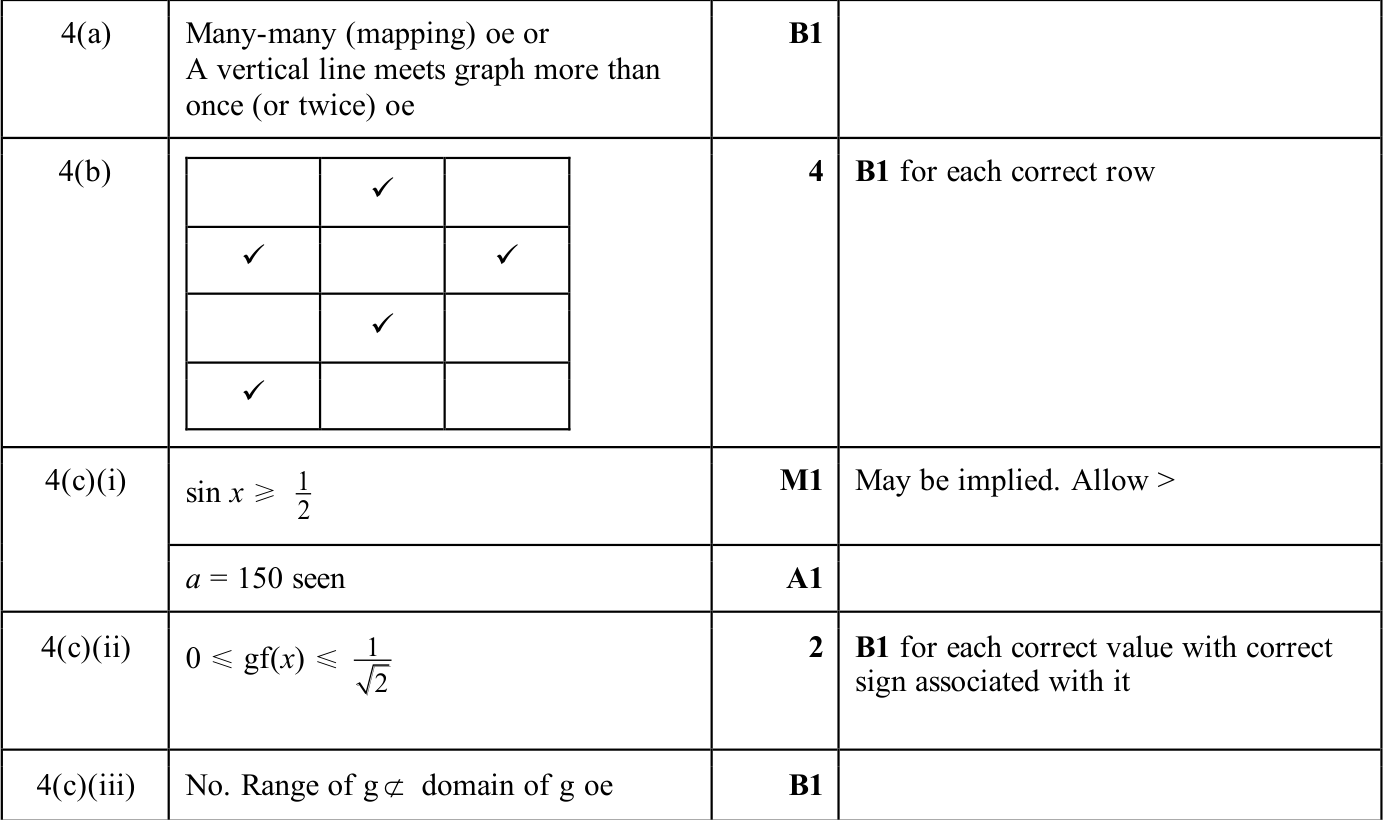
(b) State whether each relation is one-one, many-one, and whether it is its own inverse.
(c) The functions are given by \(\mathrm{f}:x\mapsto\sin x\), for \(30^\circ\leqslant x\leqslant a^\circ\), and \(\mathrm{g}:x\mapsto\sqrt{x-\frac12}\), for \(x\geqslant\frac12\). Given that \(\mathrm{g}\mathrm{f}\) exists, find the largest possible value of \(a\), the range of \(\mathrm{g}\mathrm{f}\), and explain why \(\mathrm{g}^2\) does not exist.
0606 P22 - Jun 2025 - Q3 - 4 marks
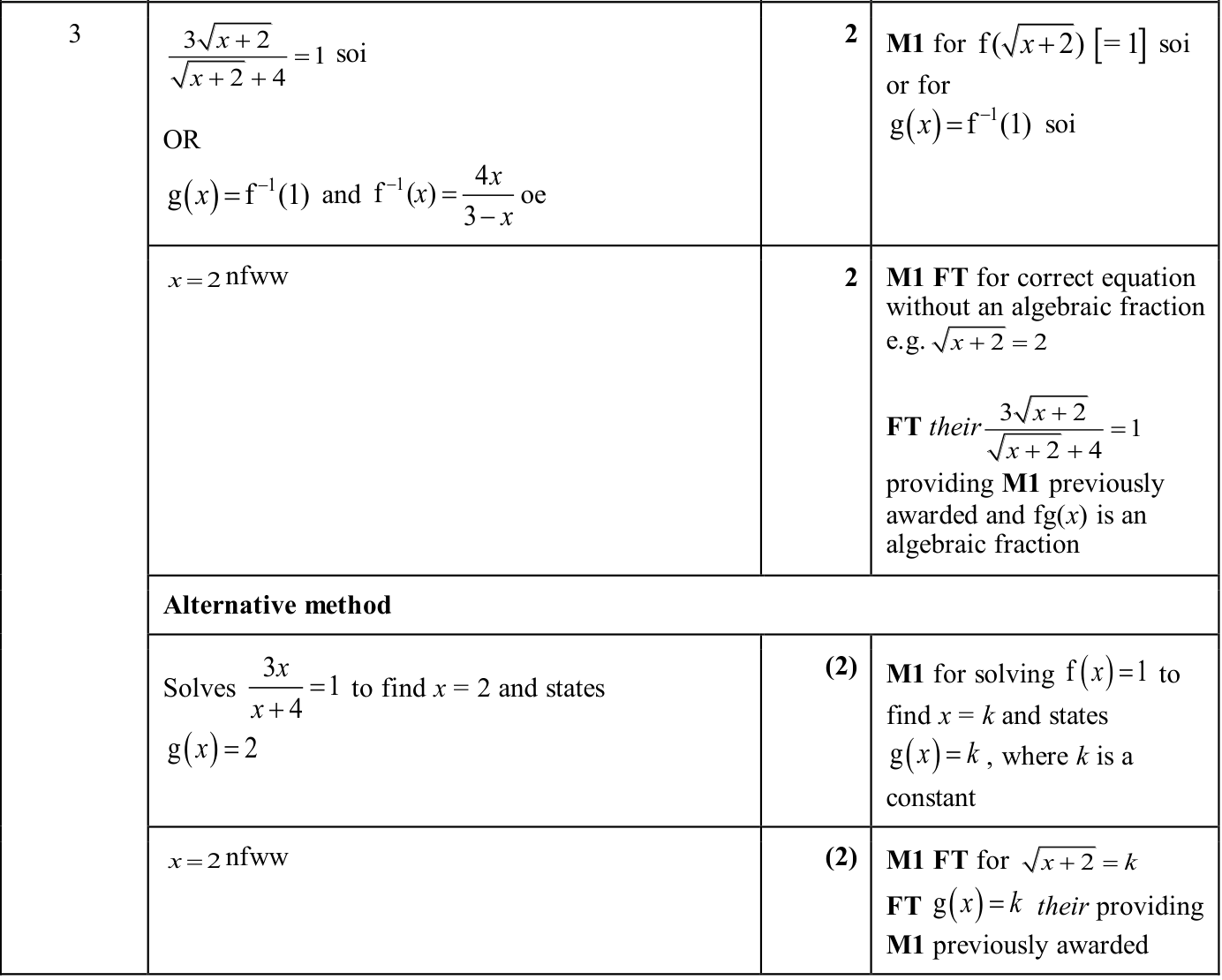
Functions \(f\) and \(g\) are such that
\(\mathrm{f}(x)=\frac{3x}{x+4}\) for \(x\gt 0\).
\(\mathrm{g}(x)=\sqrt{x+2}\) for \(x\gt -2\).
Solve the equation \(\mathrm{fg}(x)=1\).
0606 P22 - Mar 2025 - Q7 - 5 marks
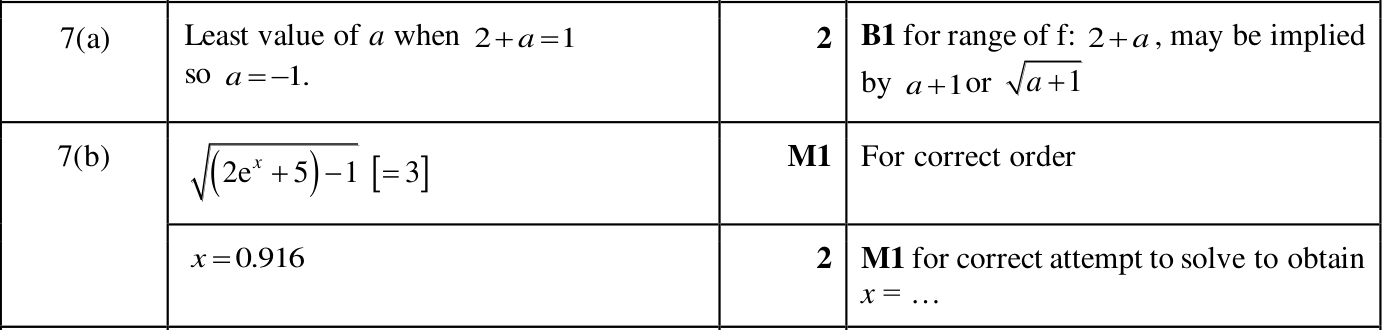
It is given that \(\mathrm f(x)=2\mathrm e^x+a\) for \(x\geqslant0\), where \(a\) is an integer, and \(\mathrm g(x)=\sqrt{x-1}\) for \(x\geqslant1\).
(a) Find the least value of \(a\) so that the function \(\mathrm{gf}\) exists for all \(x\geqslant0\).
(b) In the case where \(a=5\), solve the equation \(\mathrm{gf}(x)=3\). Give your answer correct to 3 decimal places.
0606 P23 - Nov 2023 - Q1 - 6 marks
The functions \(\mathrm f\) and \(\mathrm g\) are defined as follows, for all real values of \(x\).
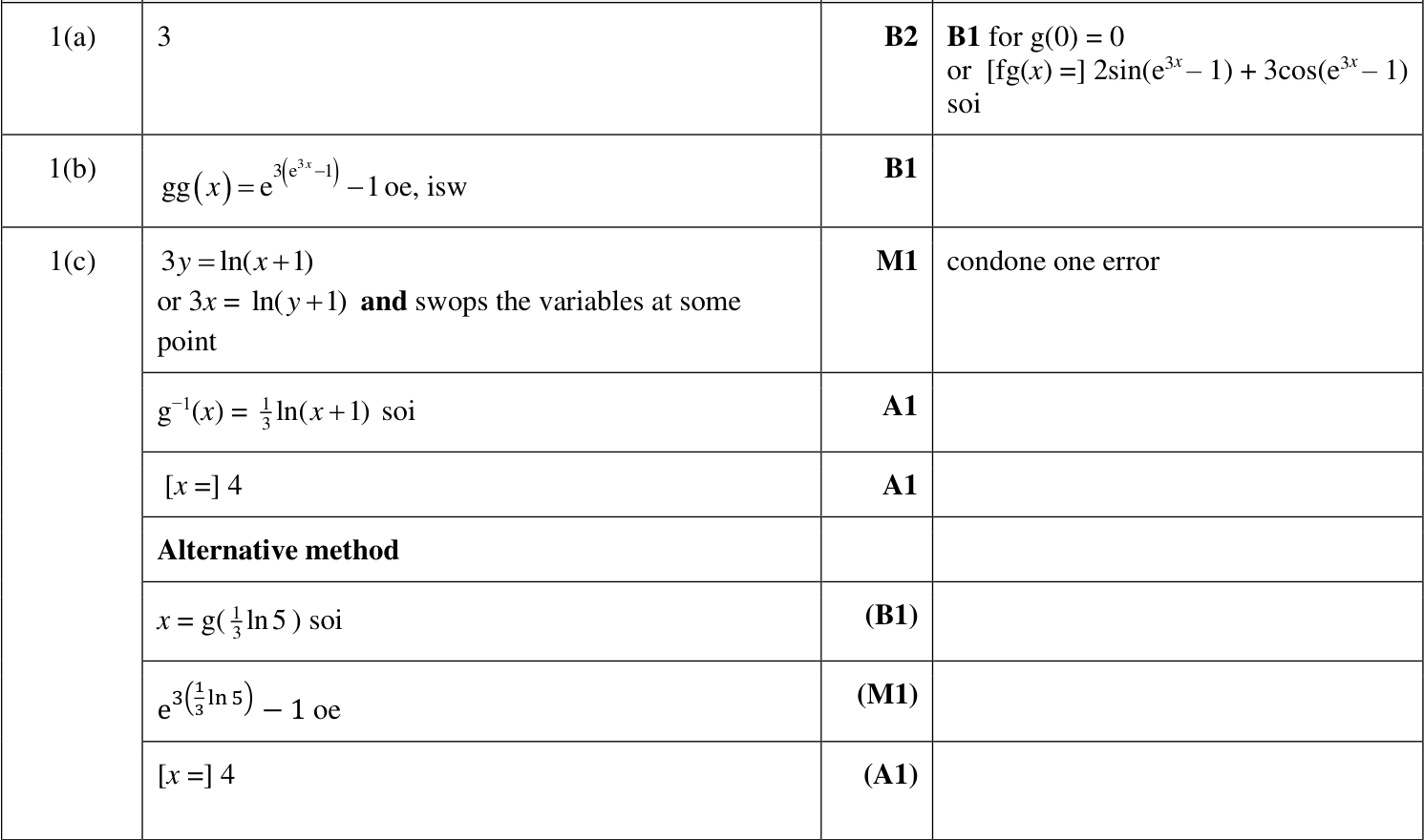
\(\mathrm f:x\mapsto2\sin x+3\cos x\)
\(\mathrm g:x\mapsto \mathrm e^{3x}-1\)
(a) Find the value of \(\mathrm{fg}(0)\).
(b) Find \(\mathrm{gg}(x)\) in terms of \(x\), giving your answer in its simplest form.
(c) Solve the equation \(\mathrm g^{-1}(x)=\frac13\ln5\).
0606 P13 - Jun 2022 - Q6 - 10 marks
(a) It is given that \(\mathrm f:x\mapsto2x^2\), for \(x\ge0\), and \(\mathrm g:x\mapsto2x+1\), for \(x\ge0\).
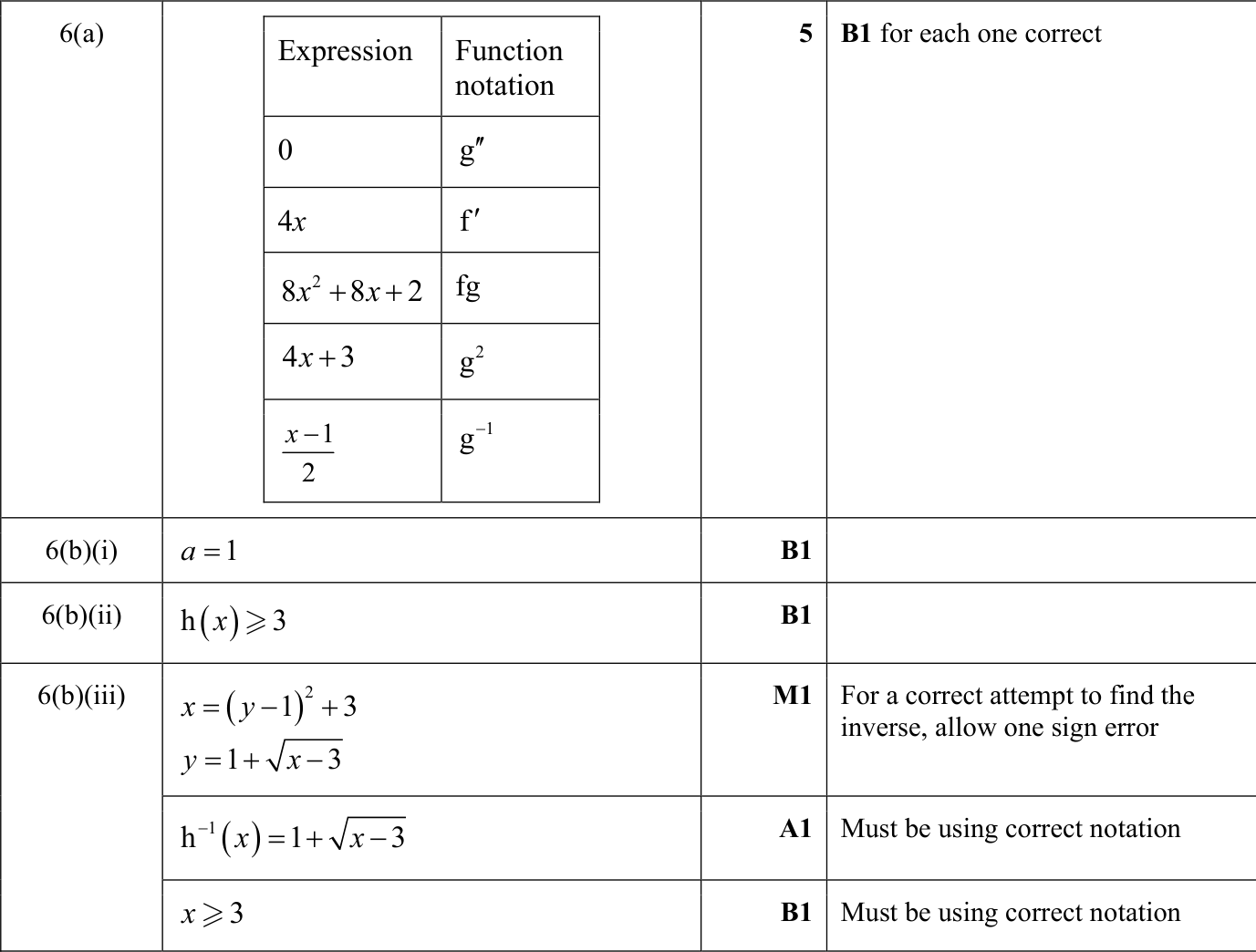
Each of the expressions in the table can be written as one of \(\mathrm f'\), \(\mathrm f''\), \(\mathrm g'\), \(\mathrm g''\), \(\mathrm{fg}\), \(\mathrm{gf}\), \(\mathrm f^2\), \(\mathrm g^2\), \(\mathrm f^{-1}\), \(\mathrm g^{-1}\). Complete the table.
| Expression | Function notation |
|---|---|
| \(2\) | \(\mathrm g'\) |
| \(4x\) | |
| \(8x^2+8x+2\) | |
| \(4x+3\) | |
| \(\frac{x-1}{2}\) |
(b) It is given that \(\mathrm h(x)=(x-1)^2+3\), for \(x\ge a\). The value of \(a\) is as small as possible such that \(\mathrm h^{-1}\) exists.
(i) Write down the value of \(a\).
(ii) Write down the range of \(\mathrm h\).
(iii) Find \(\mathrm h^{-1}(x)\) and state its domain.
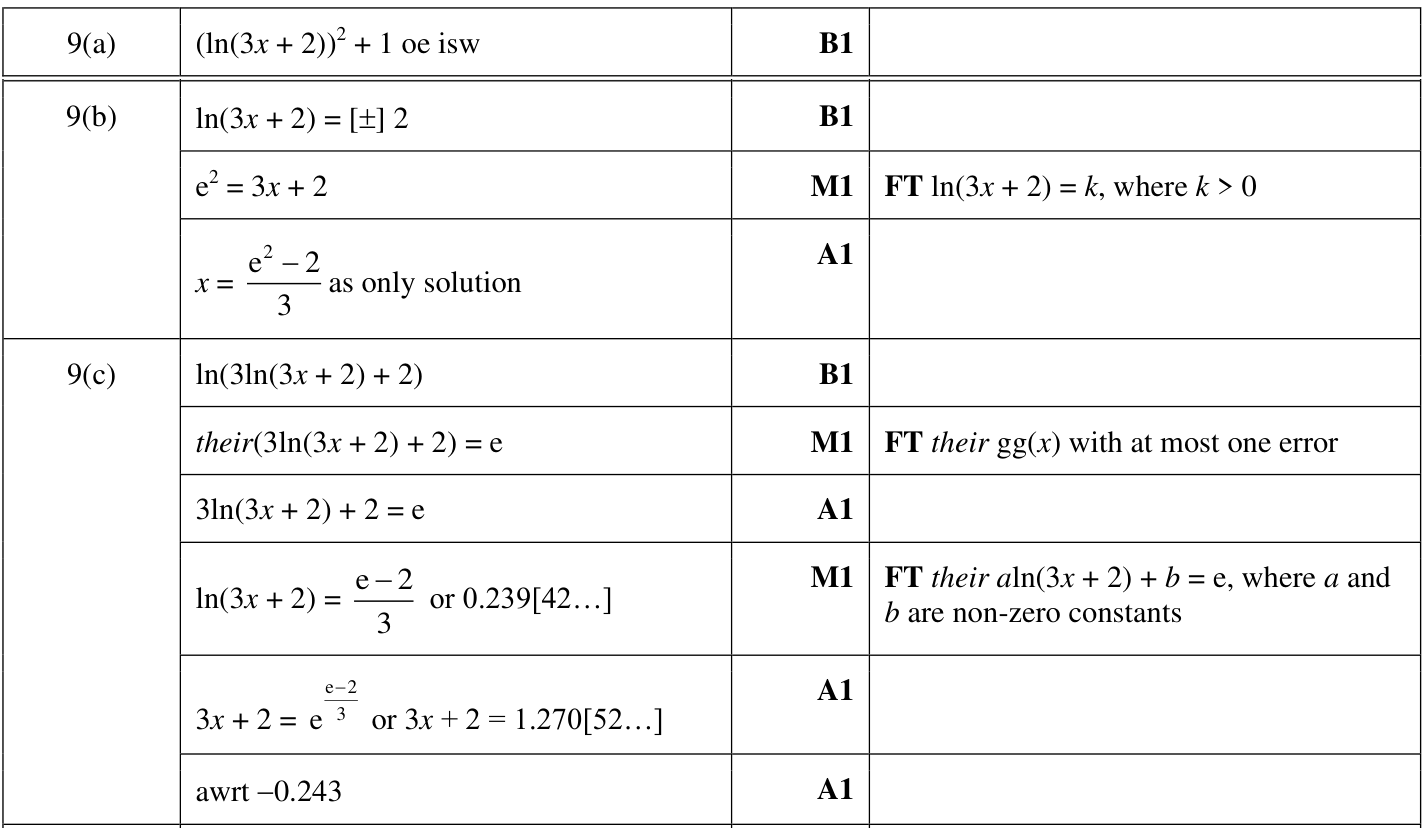
0606 P21 - Nov 2022 - Q9 - 10 marks
The functions \(f(x)\) and \(g(x)\) are defined as follows for \(x\gt -\frac23\) by
\(f(x)=x^2+1, \qquad g(x)=\ln(3x+2).\)
(a) Find \(fg(x)\).
(b) Solve the equation \(fg(x)=5\), giving your answer in exact form.
(c) Solve the equation \(gg(x)=1\).
0606 P11 - Jun 2021 - Q5 - 7 marks
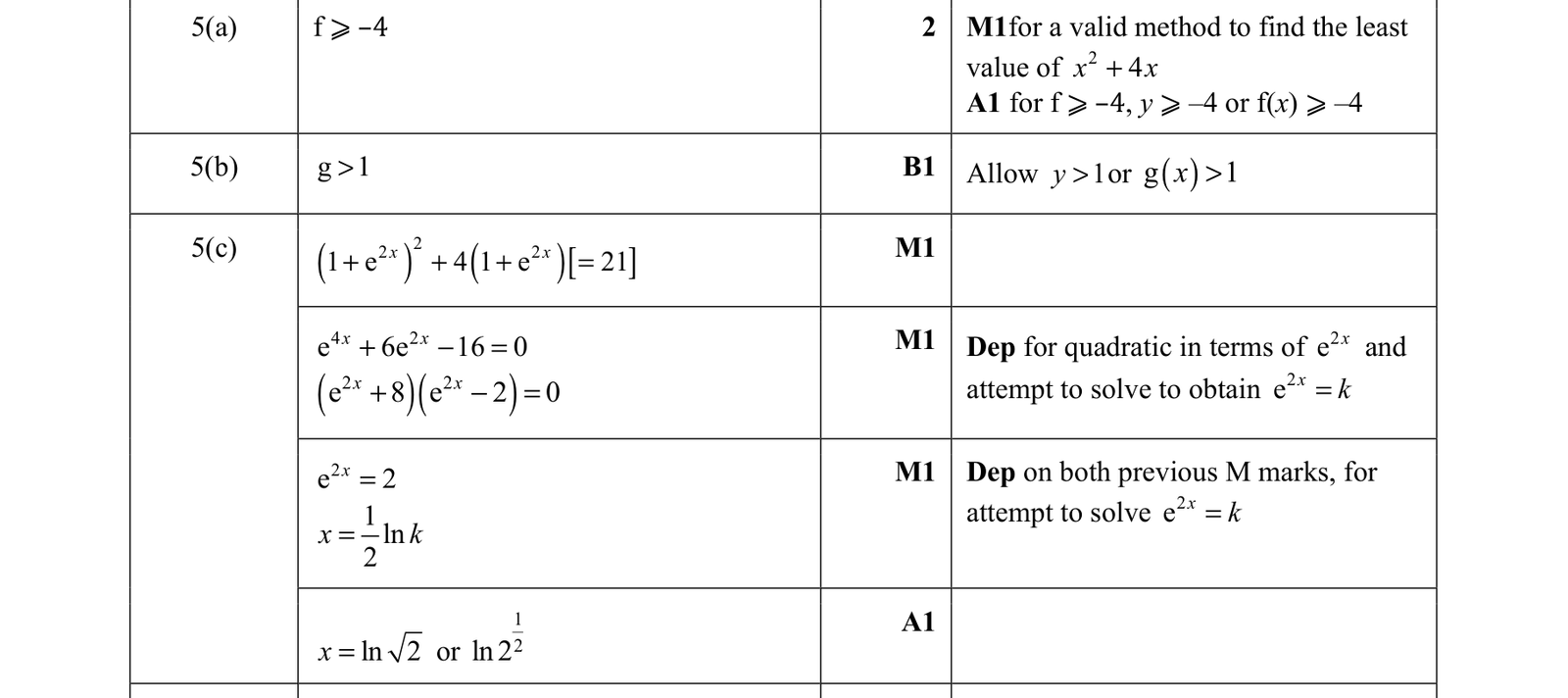
The functions \(\mathrm f\) and \(\mathrm g\) are defined as follows.
\(\mathrm f(x)=x^2+4x\quad\text{for }x\in\mathbb R,\)
\(\mathrm g(x)=1+\mathrm e^{2x}\quad\text{for }x\in\mathbb R.\)
(a) Find the range of \(\mathrm f\).
(b) Write down the range of \(\mathrm g\).
(c) Find the exact solution of the equation \(\mathrm{fg}(x)=21\), giving your answer as a single logarithm.
0606 P21 - Nov 2021 - Q9 - 9 marks
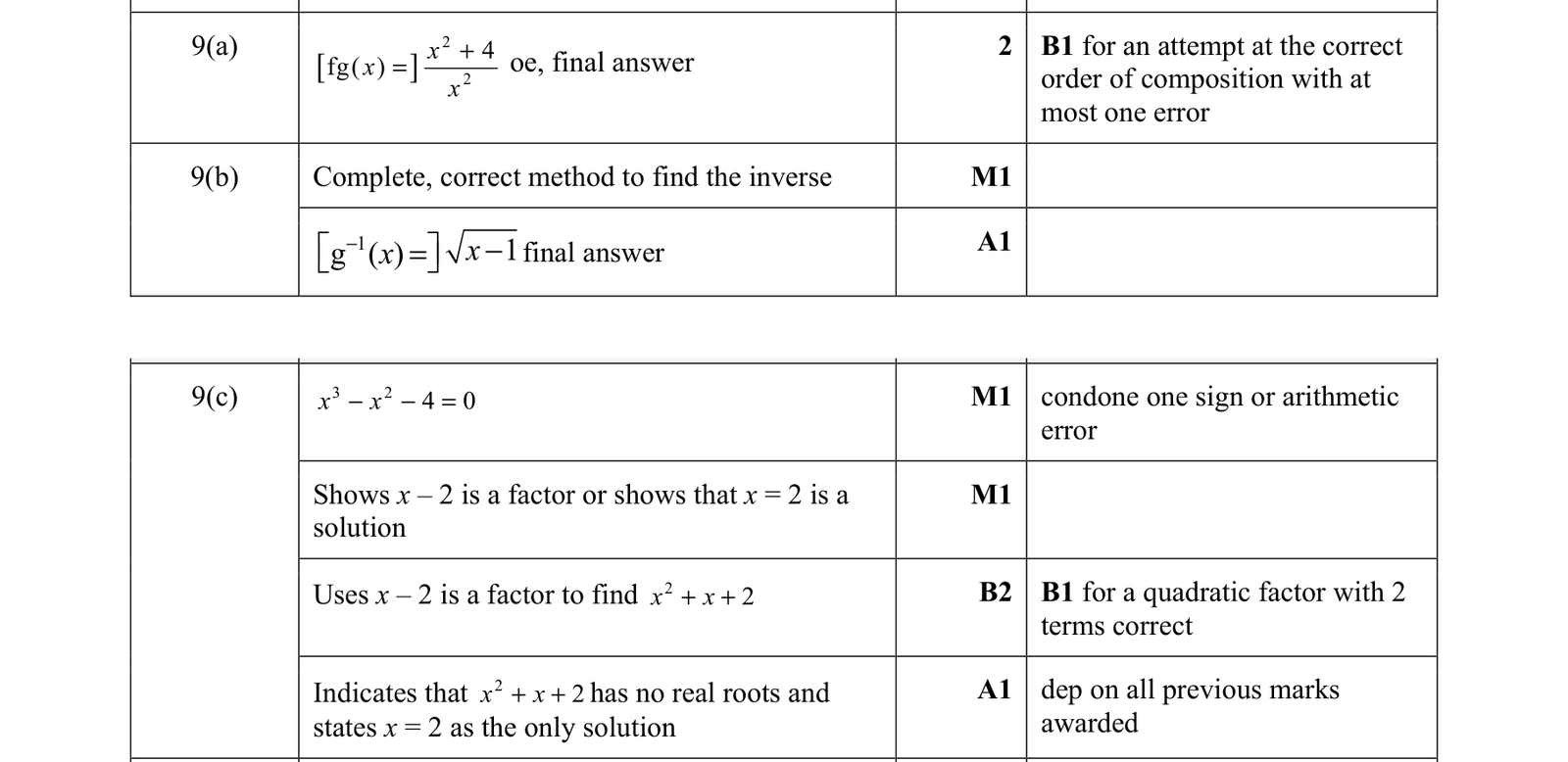
The functions \(\mathrm f\) and \(\mathrm g\) are defined for \(x\gt 1\) by
\(\mathrm f(x)=\frac{x+3}{x-1},\qquad \mathrm g(x)=1+x^2.\)
(a) Find \(\mathrm{fg}(x)\).
(b) Find \(\mathrm g^{-1}(x)\).
(c) Without using a calculator, solve the equation \(\mathrm f(x)=\mathrm g(x)\).
0606 P13 - Jun 2020 - Q1 - 7 marks
\(f(x)=3+e^x\quad\text{for }x\in\mathbb R\)
\(g(x)=9x-5\quad\text{for }x\in\mathbb R\)
(a) Find the range of \(f\) and of \(g\).
(b) Find the exact solution of \(f^{-1}(x)=g'(x)\).
(c) Find the solution of \(g^2(x)=112\).

0606 P12 - Nov 2019 - Q5 - 7 marks
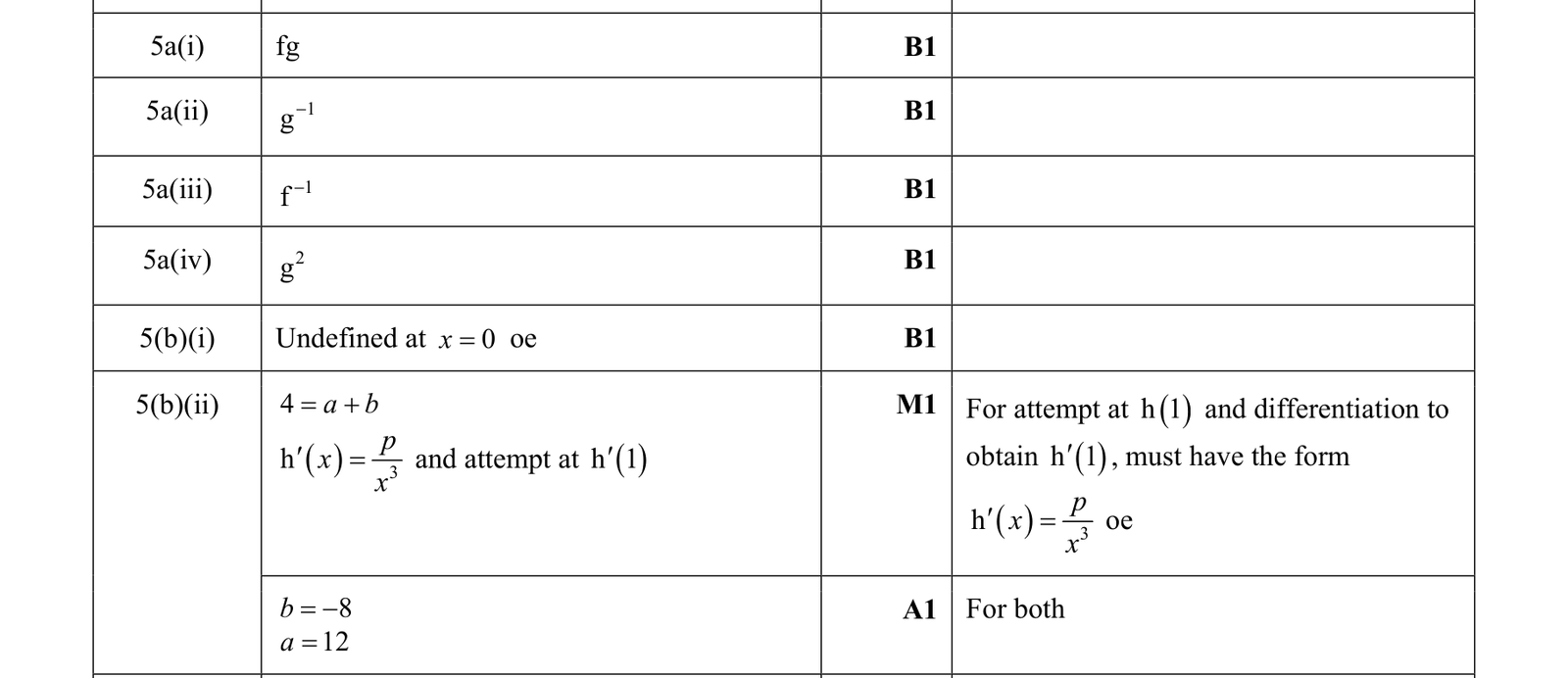
(a) It is given that
\(f:x\mapsto\sqrt{x}\quad\text{for }x\geq0,\)
\(g:x\mapsto x+5\quad\text{for }x\geq0.\)
Identify each of the following functions with one of \(f^{-1}\), \(g^{-1}\), \(fg\), \(gf\), \(f^2\), \(g^2\).
(i) \(\sqrt{x+5}\)
(ii) \(x-5\)
(iii) \(x^2\)
(iv) \(x+10\)
(b) It is given that
\(h(x)=a+\frac{b}{x^2},\)
where \(a\) and \(b\) are constants.
(i) Why is \(-2\leq x\leq2\) not a suitable domain for \(h(x)\)?
(ii) Given that \(h(1)=4\) and \(h'(1)=16\), find the value of \(a\) and of \(b\).
0606 P22 - Nov 2018 - Q11 - 9 marks
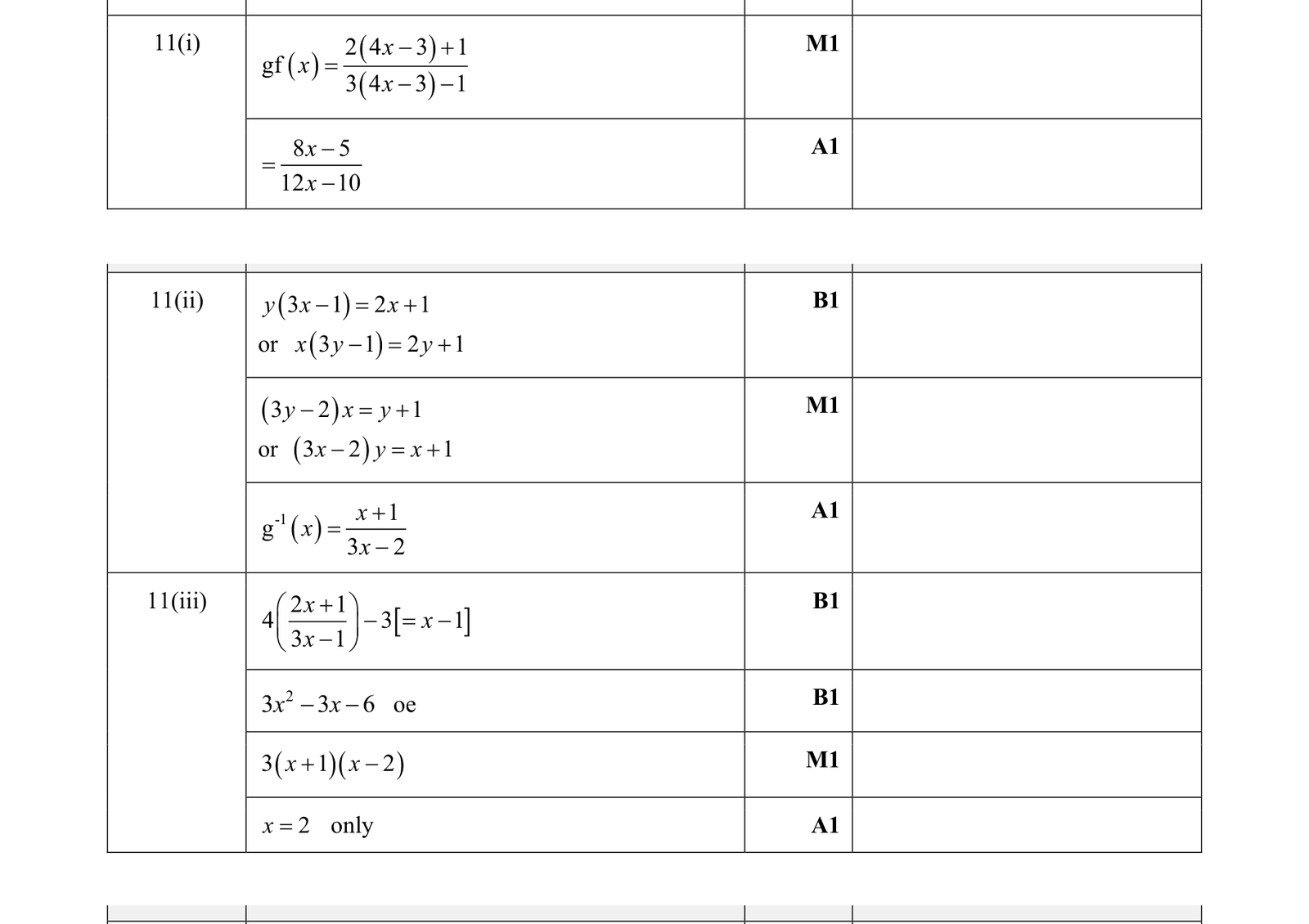
The functions \(f\) and \(g\) are defined for real values of \(x\gt 1\) by
\(f(x)=4x-3, \qquad g(x)=\frac{2x+1}{3x-1}.\)
(i) Find \(gf(x)\).
(ii) Find \(g^{-1}(x)\).
(iii) Solve \(fg(x)=x-1\).
0606 P22 - Jun 2017 - Q12 - 7 marks
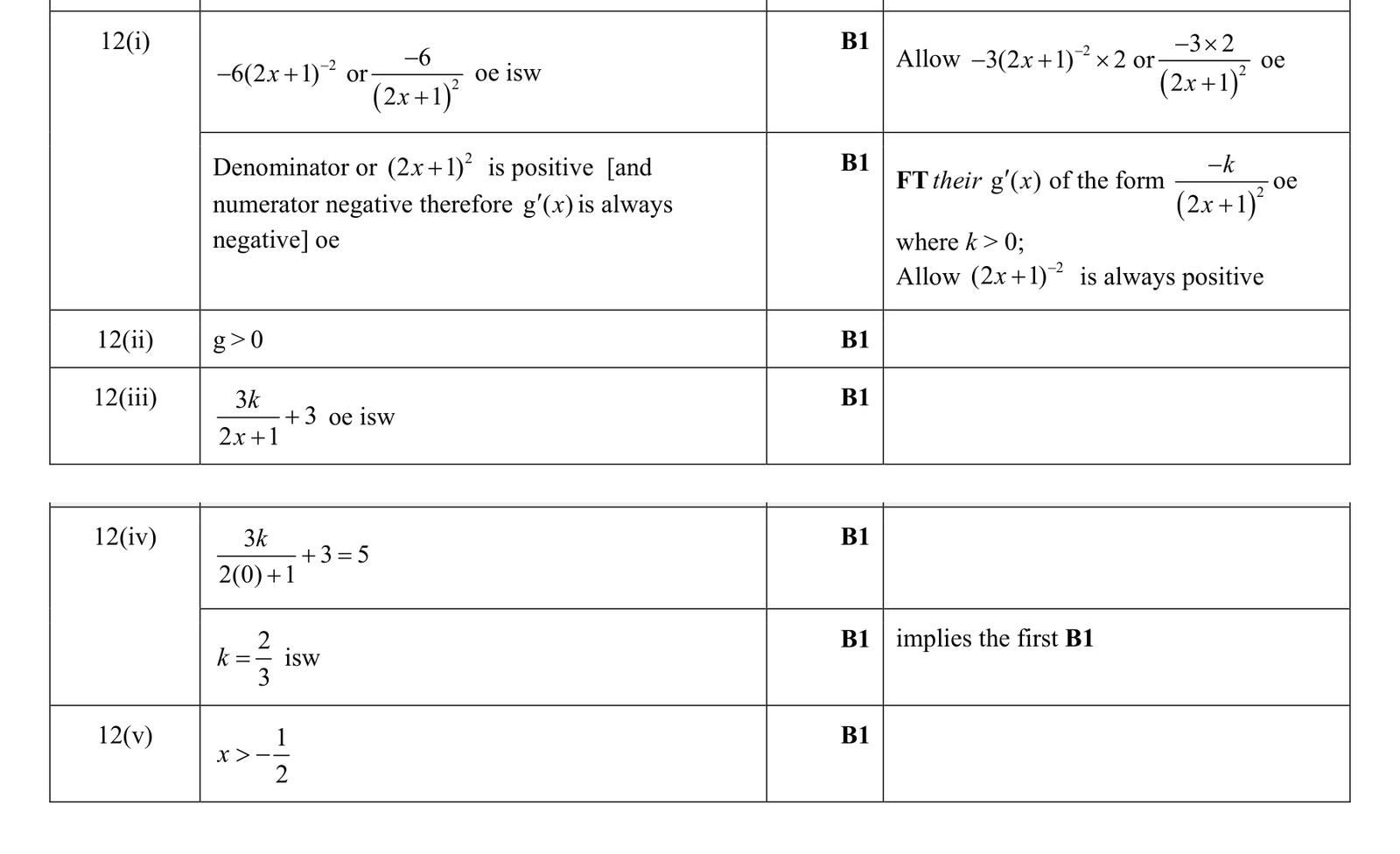
The function \(g\) is defined, for \(x\gt -\dfrac12\), by
\(g(x)=\frac{3}{2x+1}.\)
(i) Show that \(g'(x)\) is always negative.
(ii) Write down the range of \(g\).
The function \(h\) is defined, for all real \(x\), by \(h(x)=kx+3\), where \(k\) is a constant.
(iii) Find an expression for \(hg(x)\).
(iv) Given that \(hg(0)=5\), find the value of \(k\).
(v) State the domain of \(hg\).