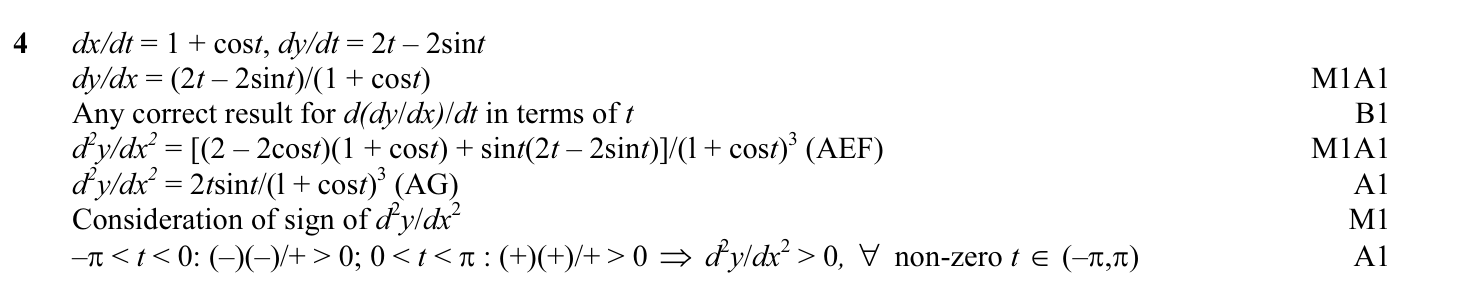
9231 P13 - Jun 2019 - Q8 - 10 marks
8 Find the particular solution of the differential equation
\(9 \frac{\mathrm{~d}^{2} x}{\mathrm{~d} t^{2}}+6 \frac{\mathrm{~d} x}{\mathrm{~d} t}+x=50 \sin t\)
given that when \(t=0, x=0\) and \(\frac{\mathrm{d} x}{\mathrm{~d} t}=0\).
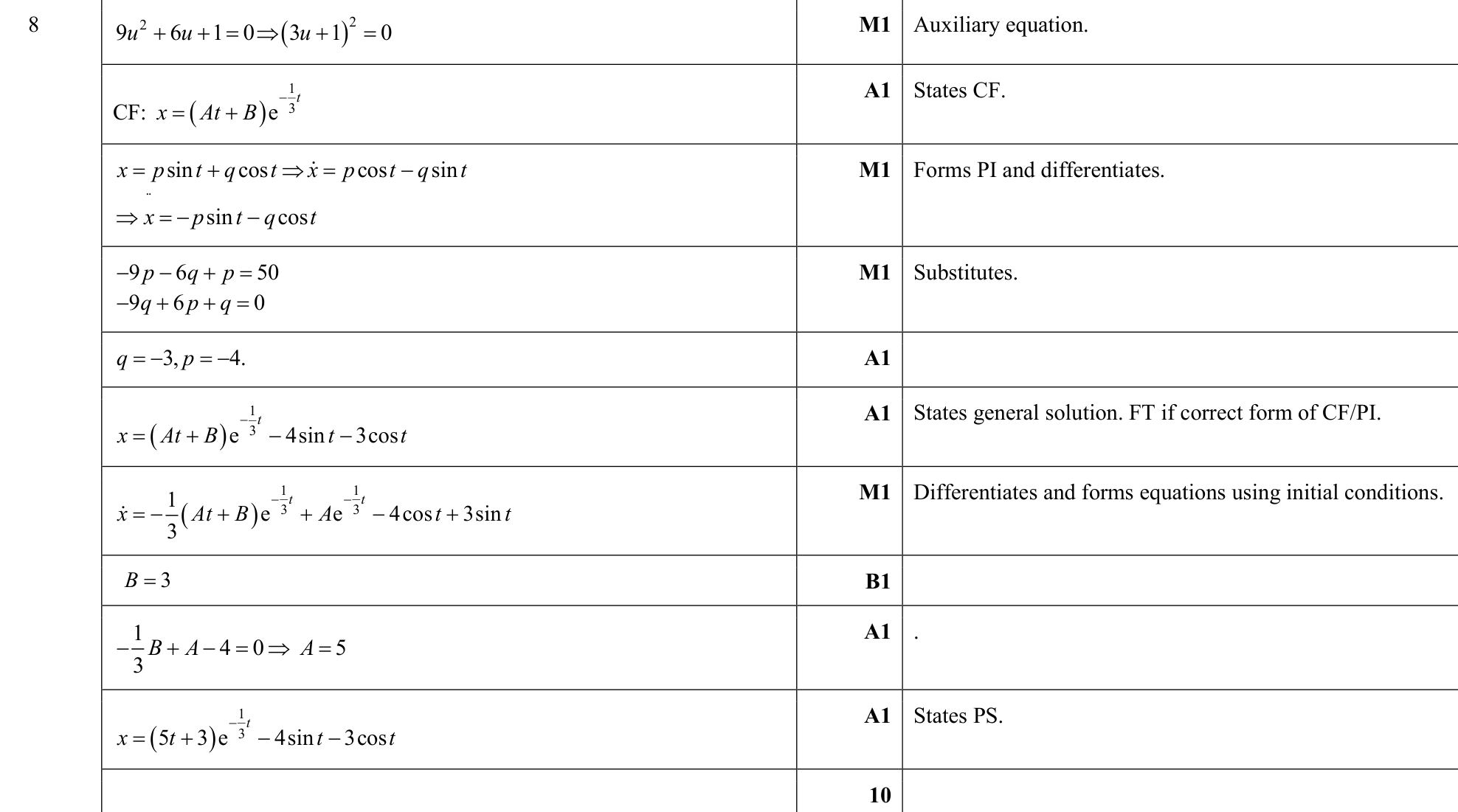
9231 P11 - Nov 2018 - Q10 - 13 marks
(i) Find the particular solution of the differential equation
\(\frac{d^2x}{dt^2}+2\frac{dx}{dt}+10x=37\sin3t,\)
given that \(x=3\) and \(\dfrac{dx}{dt}=0\) when \(t=0\).
(ii) Show that, for large positive values of \(t\) and for any initial conditions,
\(x\approx\sqrt{37}\sin(3t-\phi),\)
where \(\phi\) is such that \(\tan\phi=6\).
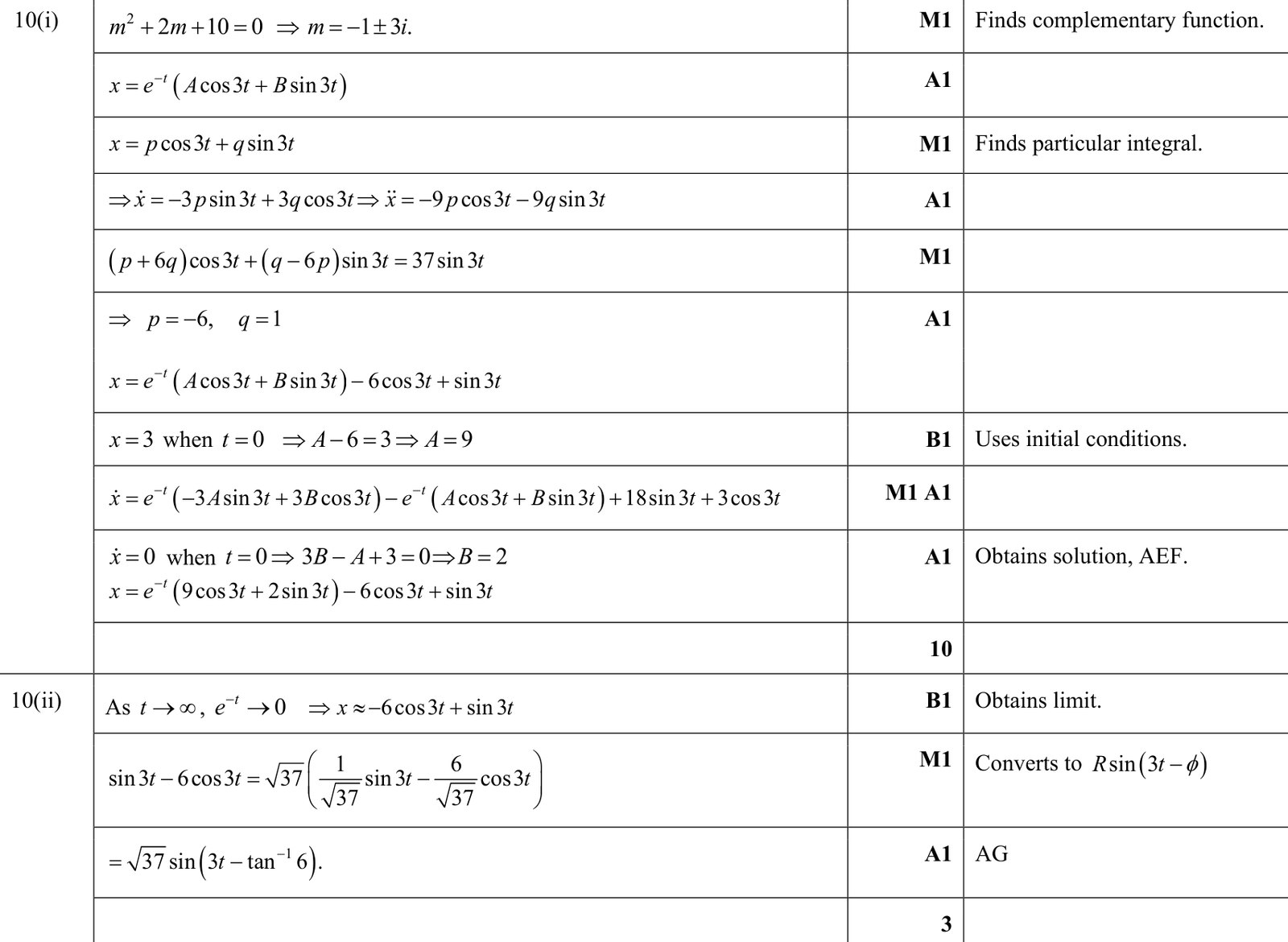
9231 P23 - Jun 2025 - Q4 - 10 marks
Find the particular solution of the differential equation
\(\frac{\mathrm{d}^{2} x}{\mathrm{~d} t^{2}}+\frac{\mathrm{d} x}{\mathrm{~d} t}-2 x=2 t^{2}+t-1\)
given that, when \(t=0, x=\frac{\mathrm{d} x}{\mathrm{~d} t}=0\).
9231 P21 - Jun 2025 - Q5 - 10 marks
Find the particular solution of the differential equation
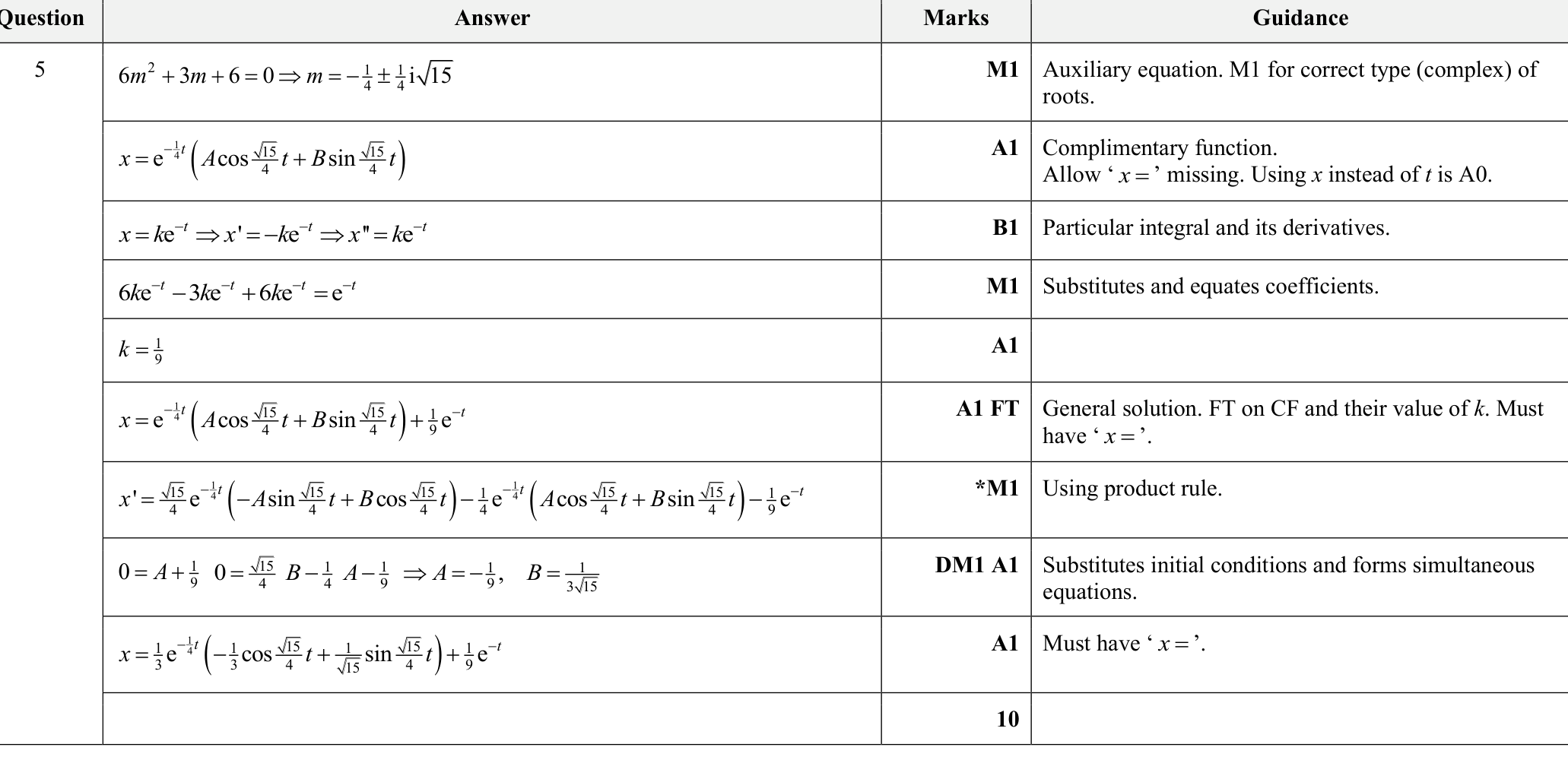
\(6 \frac{\mathrm{~d}^{2} x}{\mathrm{~d} t^{2}}+3 \frac{\mathrm{~d} x}{\mathrm{~d} t}+6 x=\mathrm{e}^{-t}\)
given that, when \(t=0, x=\frac{\mathrm{d} x}{\mathrm{~d} t}=0\).
9231 P23 - Jun 2024 - Q5 - 10 marks
(a) Find the general solution of the differential equation
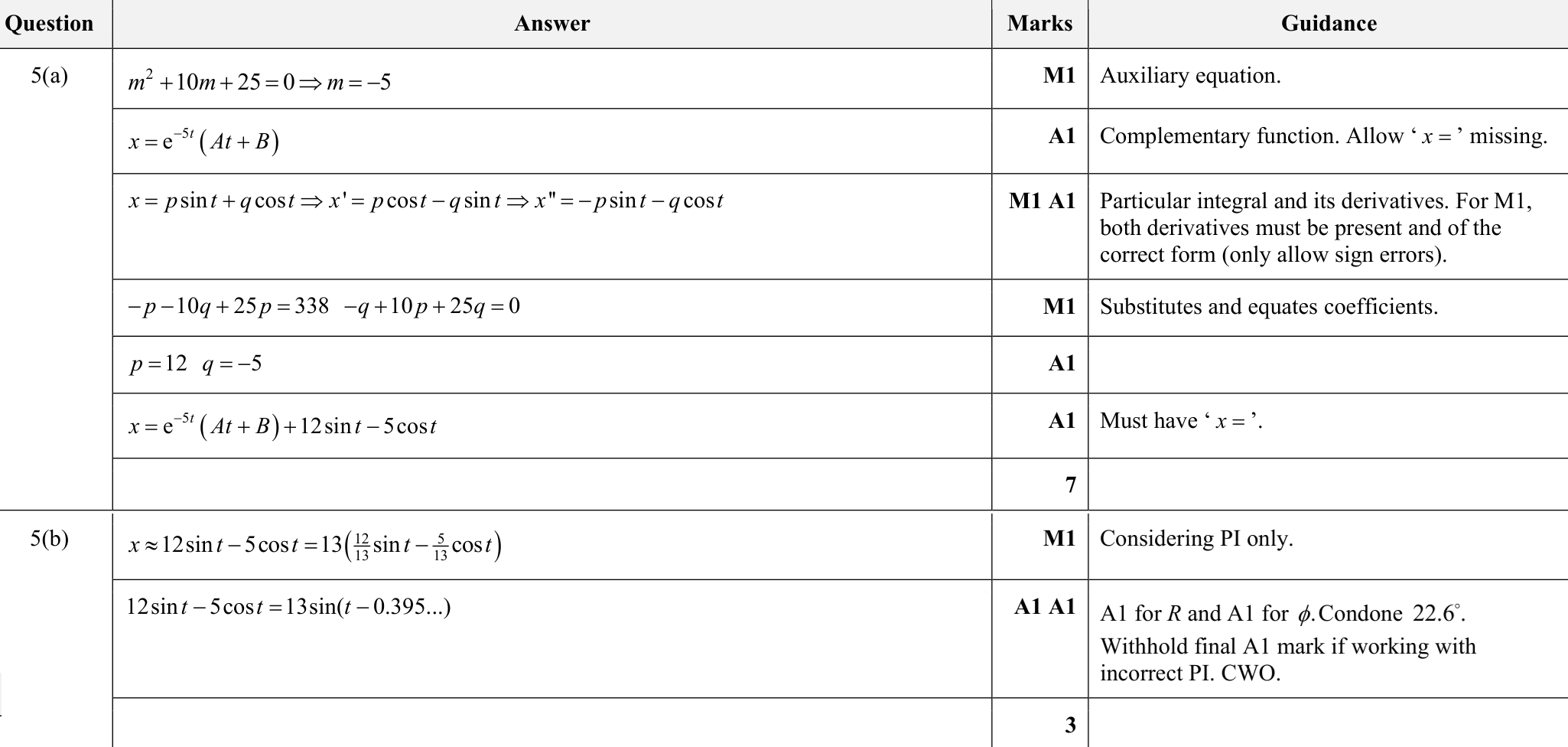
\(\frac{\mathrm{d}^{2} x}{\mathrm{~d} t^{2}}+10 \frac{\mathrm{~d} x}{\mathrm{~d} t}+25 x=338 \sin t\)
(b) Show that, for large positive values of \(t\) and for any initial conditions,
\(x \approx R \sin (t-\phi)\)
where the constants \(R\) and \(\phi\) are to be determined.
9231 P21 - Jun 2024 - Q3 - 7 marks
It is given that
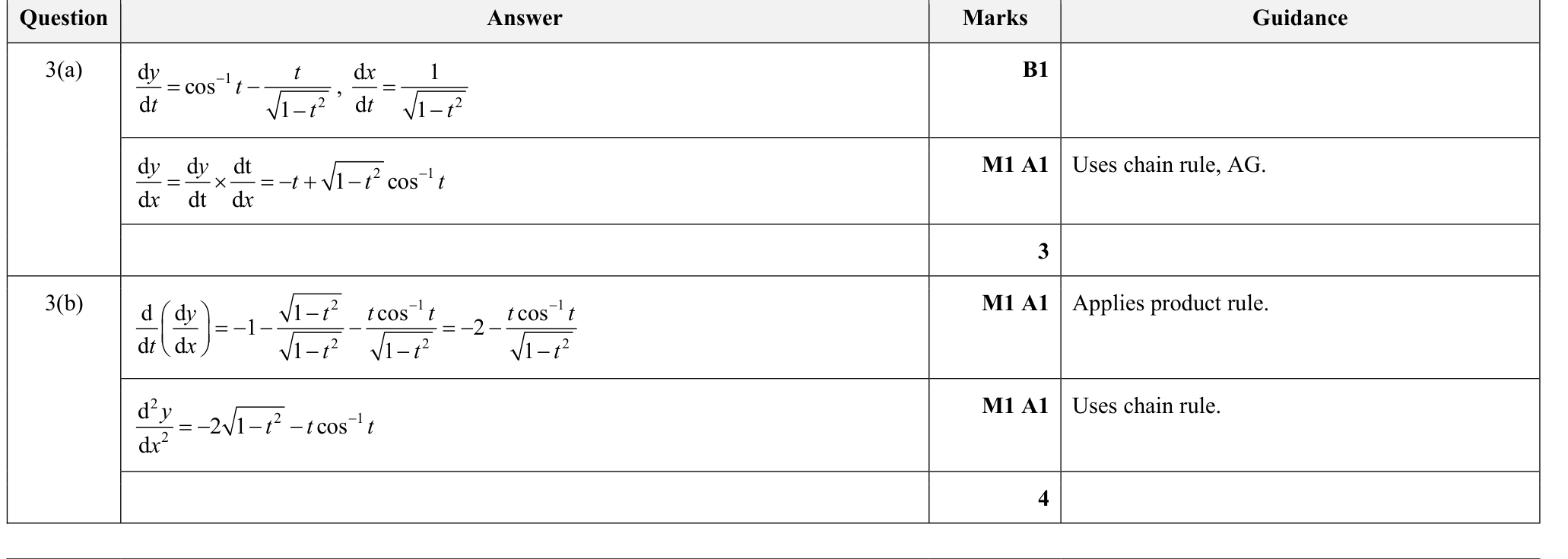
\(x=\sin ^{-1} t \quad \text { and } \quad y=t \cos ^{-1} t, \quad \text { for } 0 \leqslant t\lt 1 .\)
(a) Show that \(\frac{\mathrm{d} y}{\mathrm{~d} x}=-t+\sqrt{1-t^{2}} \cos ^{-1} t\).
(b) Find \(\frac{\mathrm{d}^{2} y}{\mathrm{~d} x^{2}}\) in terms of \(t\).
9231 P23 - Jun 2023 - Q2 - 7 marks
The variables \(x\) and \(y\) are related by the differential equation
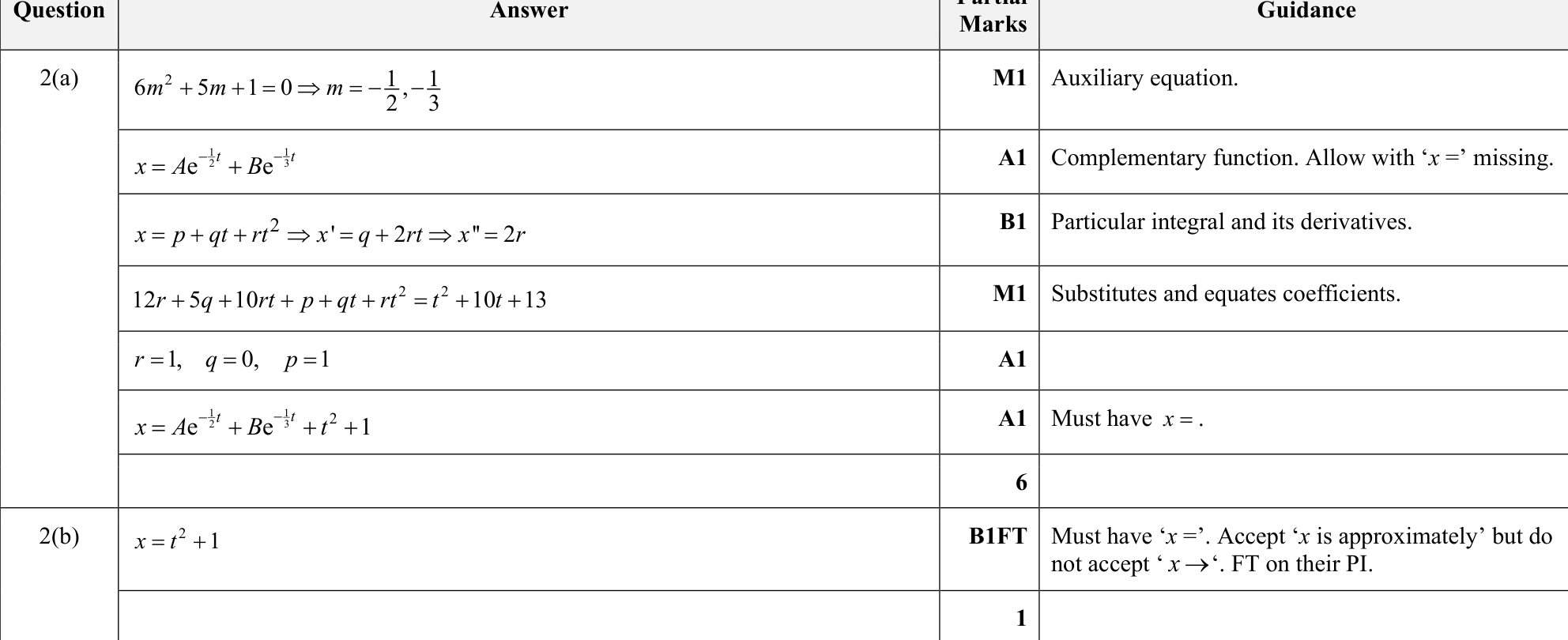
\(6 \frac{\mathrm{~d}^{2} x}{\mathrm{~d} t^{2}}+5 \frac{\mathrm{~d} x}{\mathrm{~d} t}+x=t^{2}+10 t+13\)
(a) Find the general solution for \(x\) in terms of \(t\).
(b) State an approximate solution for large positive values of \(t\).
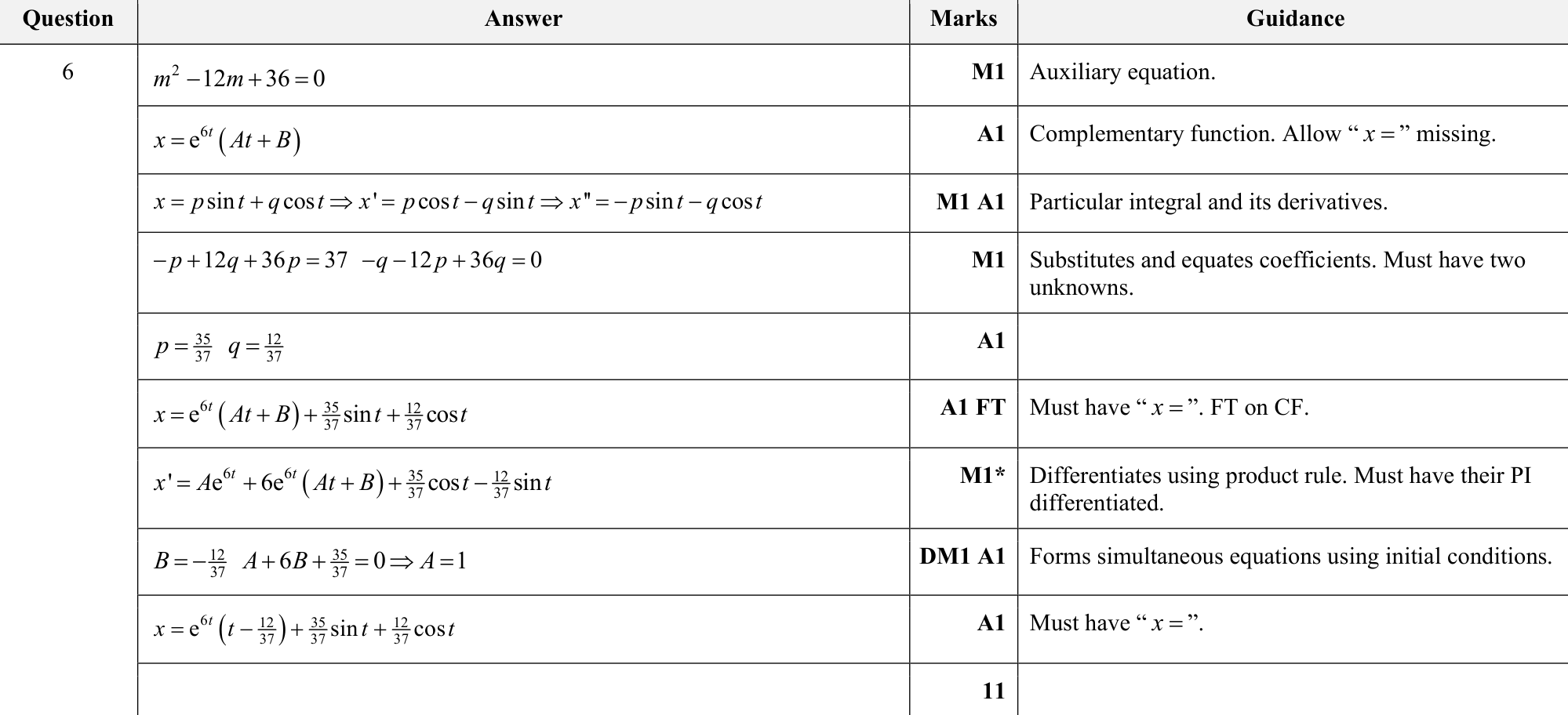
9231 P21 - Jun 2023 - Q6 - 11 marks
Find the particular solution of the differential equation
\(\frac{\mathrm{d}^{2} x}{\mathrm{~d} t^{2}}-12 \frac{\mathrm{~d} x}{\mathrm{~d} t}+36 x=37 \sin t\)
given that, when \(t=0, x=\frac{\mathrm{d} x}{\mathrm{~d} t}=0\).
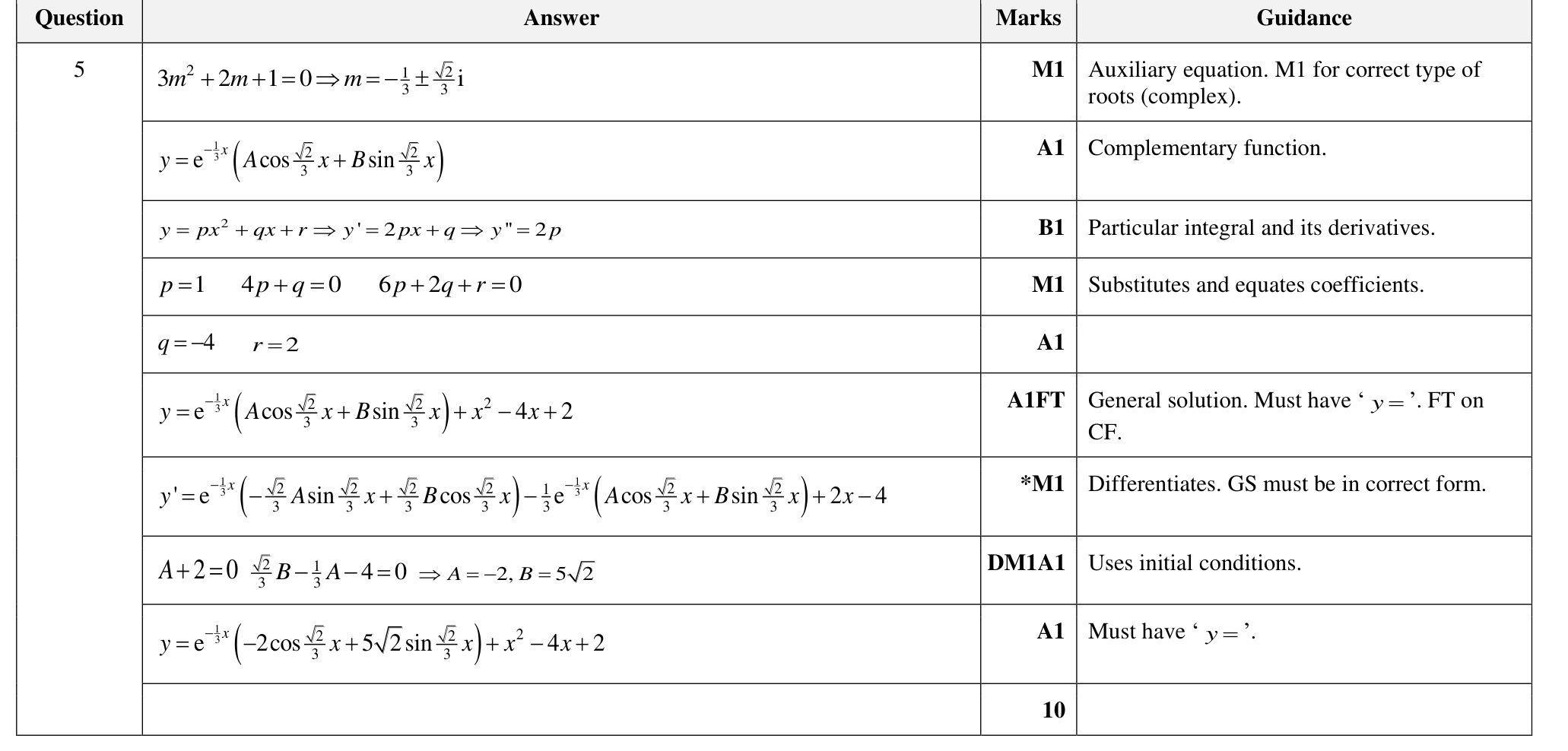
9231 P22 - Nov 2024 - Q5 - 10 marks
Find the particular solution of the differential equation
\(3 \frac{\mathrm{~d}^{2} y}{\mathrm{~d} x^{2}}+2 \frac{\mathrm{~d} y}{\mathrm{~d} x}+y=x^{2},\)
given that, when \(x=0, y=\frac{\mathrm{d} y}{\mathrm{~d} x}=0\).
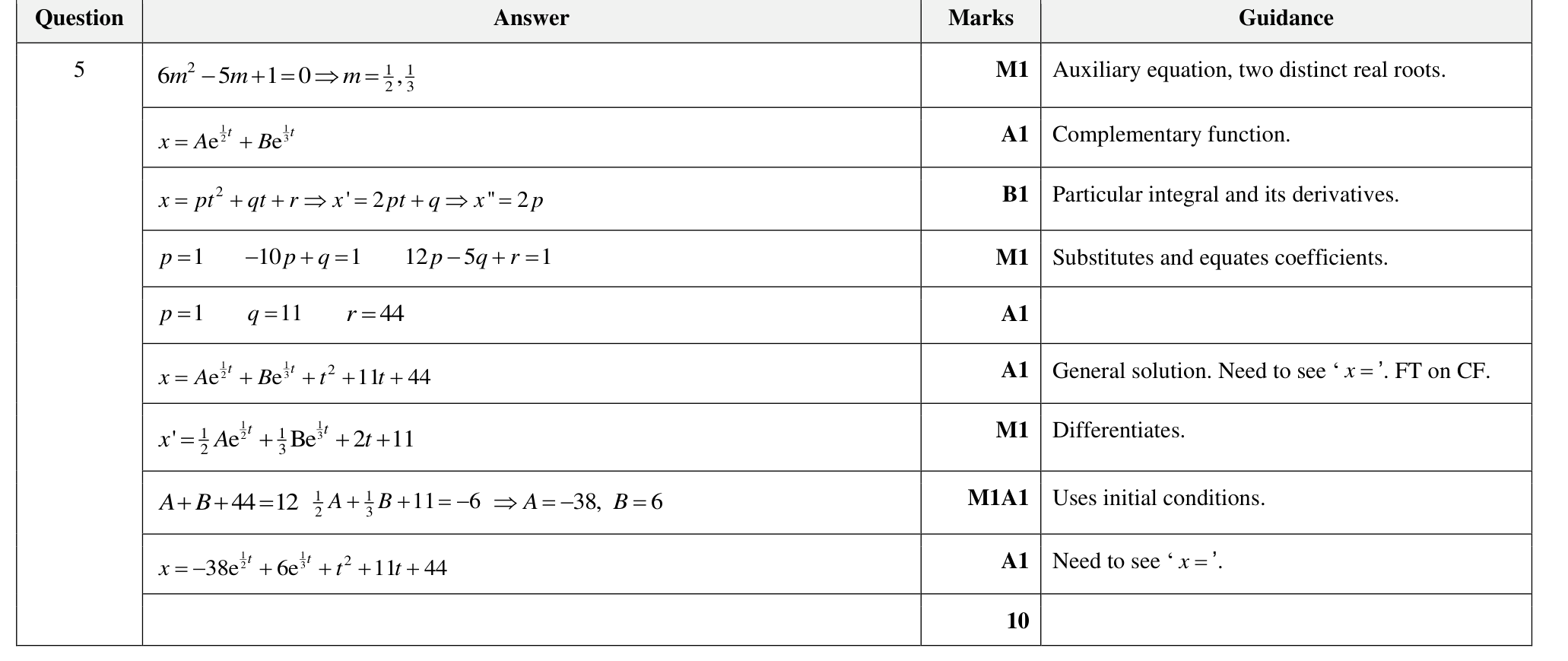
9231 P21 - Nov 2024 - Q5 - 10 marks
Find the particular solution of the differential equation
\(6 \frac{\mathrm{~d}^{2} x}{\mathrm{~d} t^{2}}-5 \frac{\mathrm{~d} x}{\mathrm{~d} t}+x=t^{2}+t+1\)
given that, when \(t=0, x=12\) and \(\frac{\mathrm{d} x}{\mathrm{~d} t}=-6\).
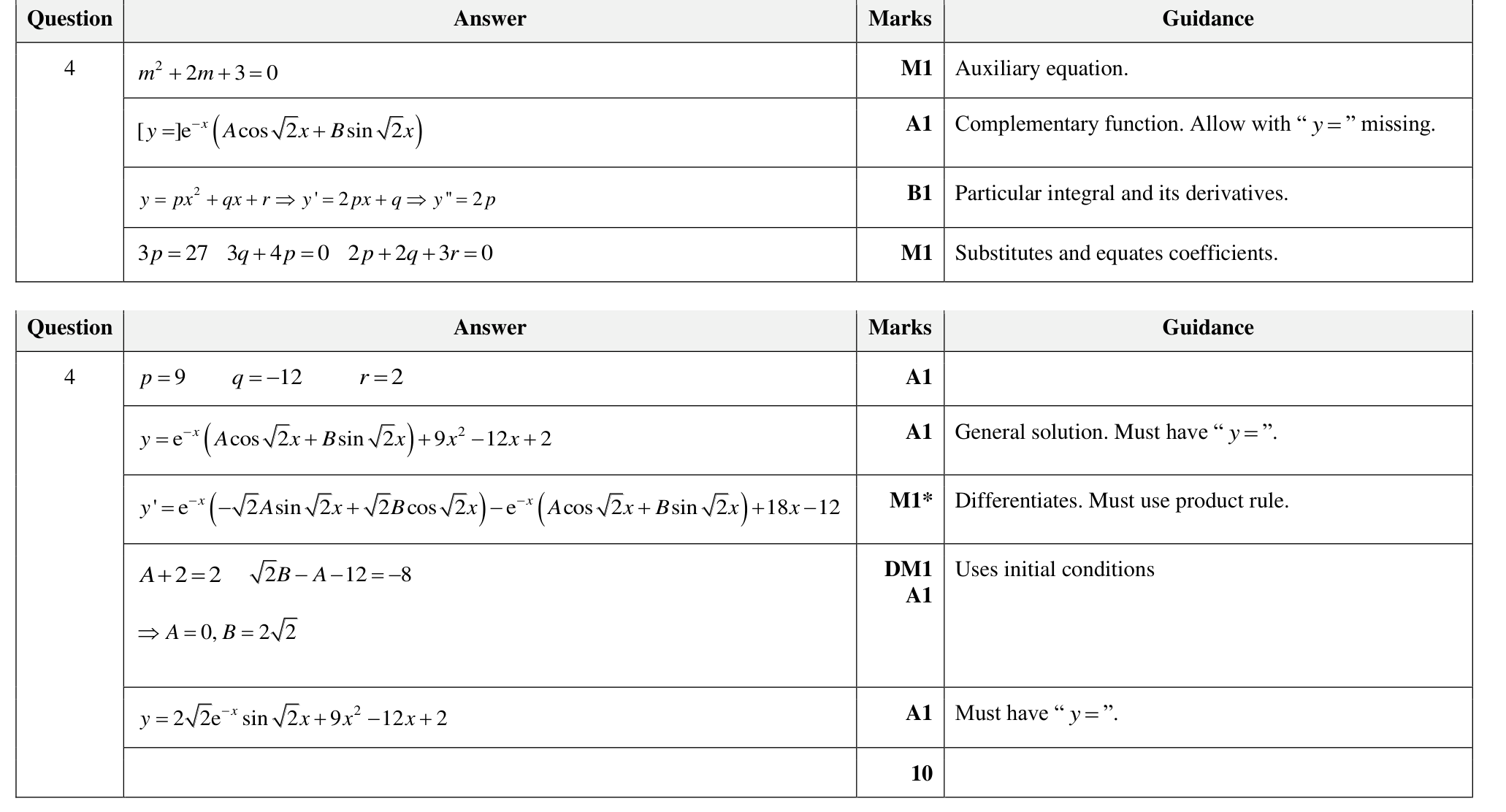
9231 P21 - Nov 2023 - Q4 - 10 marks
Find the particular solution of the differential equation
\(\frac{\mathrm{d}^{2} y}{\mathrm{~d} x^{2}}+2 \frac{\mathrm{~d} y}{\mathrm{~d} x}+3 y=27 x^{2}\)
given that, when \(x=0, y=2\) and \(\frac{\mathrm{d} y}{\mathrm{~d} x}=-8\).
9231 P21 - Jun 2022 - Q3 - 8 marks
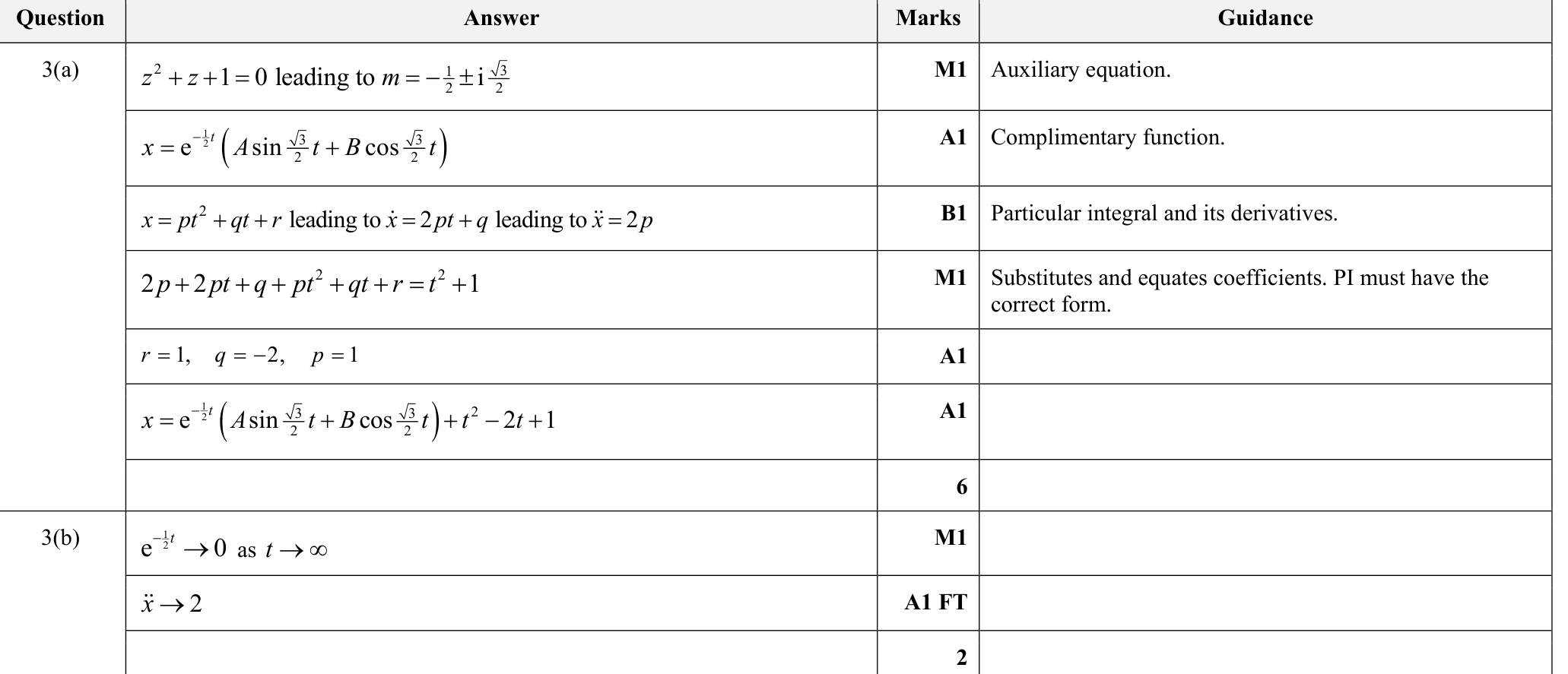
The variables \(t\) and \(x\) are related by the differential equation
\(\frac{\mathrm{d}^{2} x}{\mathrm{~d} t^{2}}+\frac{\mathrm{d} x}{\mathrm{~d} t}+x=t^{2}+1\)
(a) Find the general solution for \(x\) in terms of \(t\).
(b) Deduce an approximate value of \(\frac{\mathrm{d}^{2} x}{\mathrm{~d} t^{2}}\) for large positive values of \(t\).
9231 P23 - Jun 2022 - Q7 - 11 marks
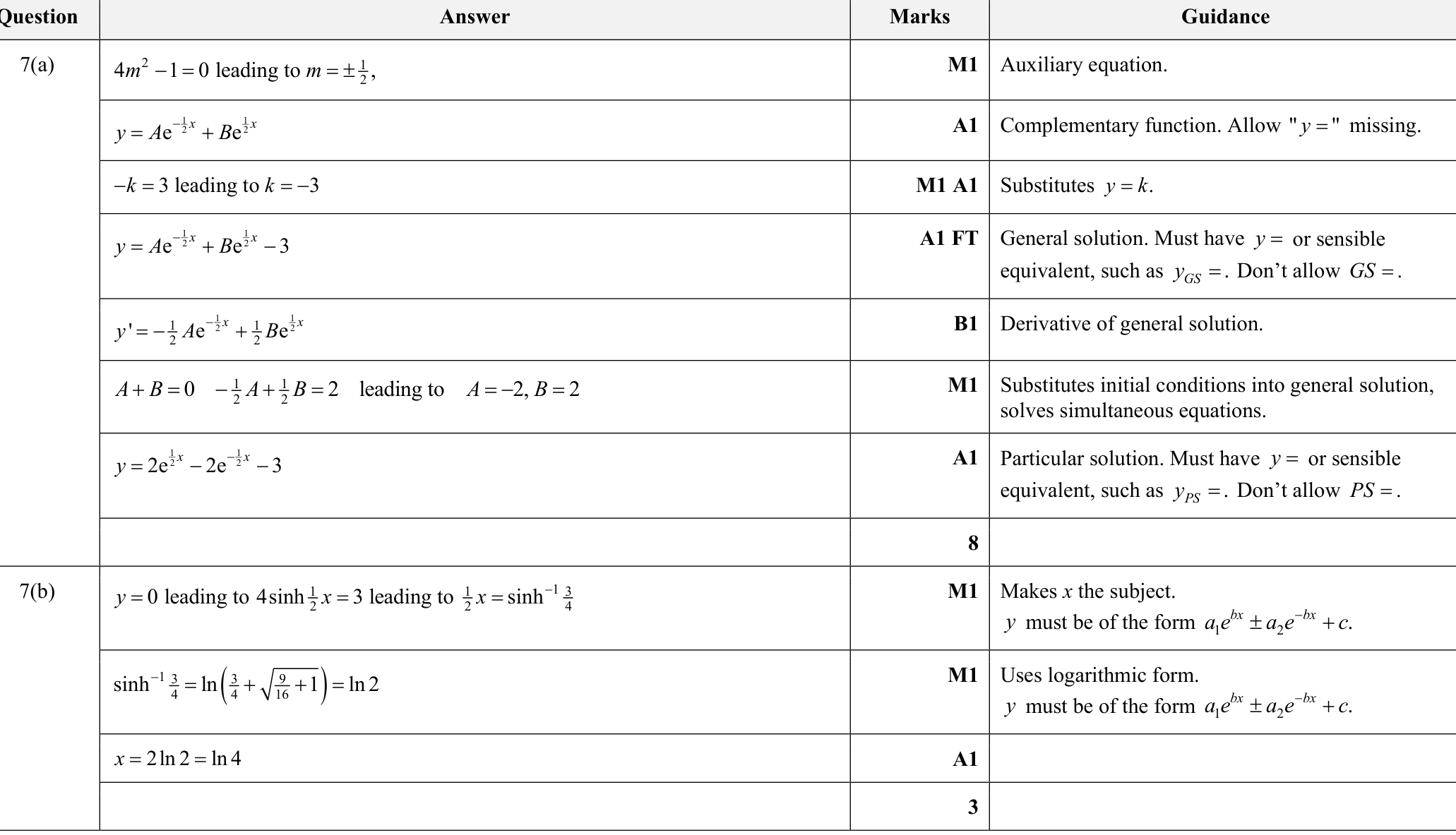
The variables \(x\) and \(y\) are related by the differential equation
\(4 \frac{\mathrm{~d}^{2} y}{\mathrm{~d} x^{2}}-y=3 .\)
It is given that, when \(x=0, y=-3\) and \(\frac{\mathrm{d} y}{\mathrm{~d} x}=2\).
(a) Find \(y\) in terms of \(x\).
(b) Deduce the exact value of \(x\) for which \(y=0\). Give your answer in logarithmic form.
9231 P21 - Nov 2022 - Q5 - 10 marks
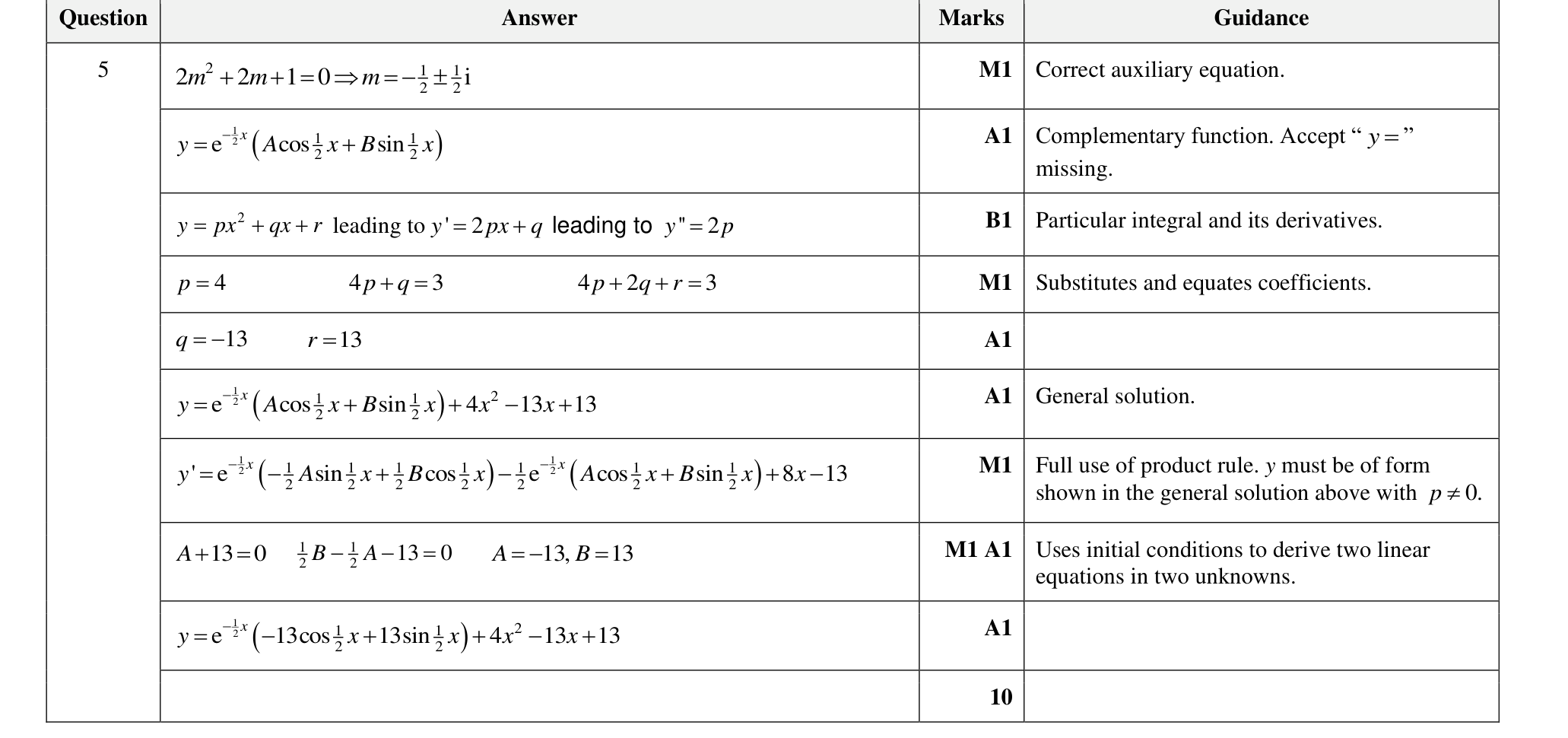
Find the particular solution of the differential equation
\(2 \frac{\mathrm{~d}^{2} y}{\mathrm{~d} x^{2}}+2 \frac{\mathrm{~d} y}{\mathrm{~d} x}+y=4 x^{2}+3 x+3\)
given that, when \(x=0, y=\frac{\mathrm{d} y}{\mathrm{~d} x}=0\).
9231 P21 - Jun 2021 - Q2 - 7 marks
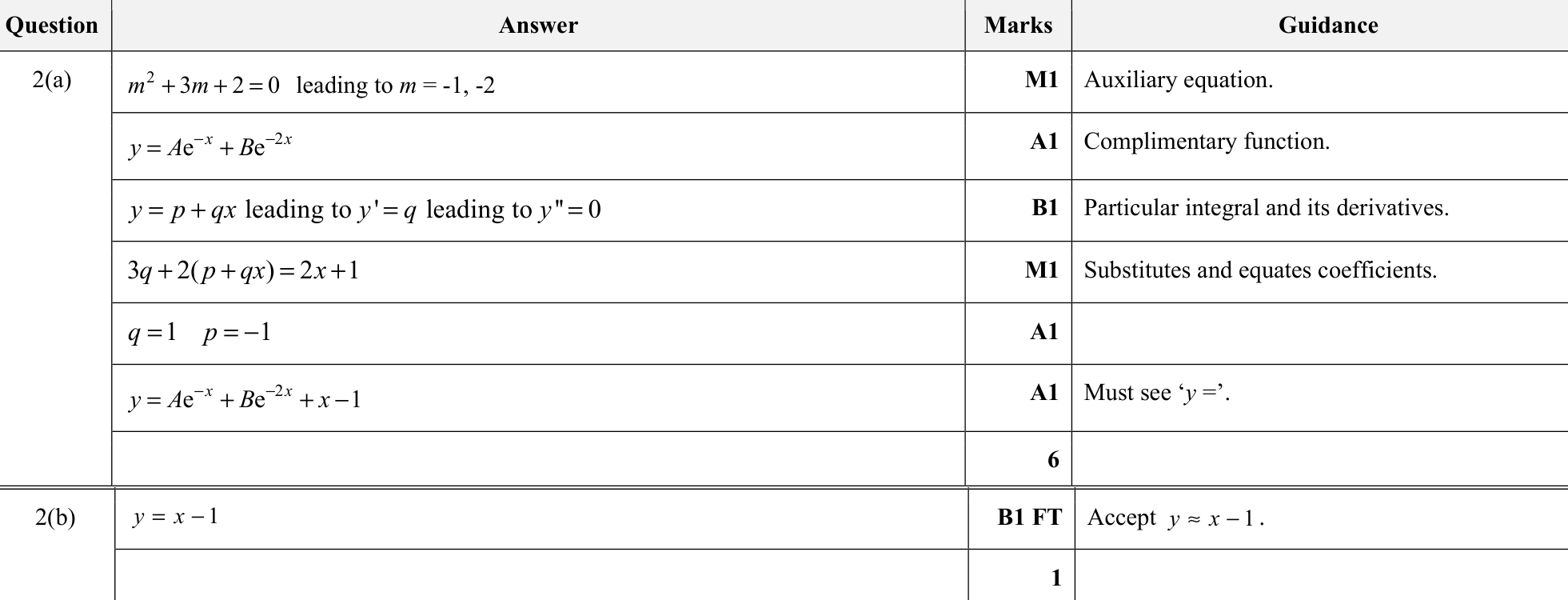
The variables \(x\) and \(y\) are related by the differential equation
\(\frac{\mathrm{d}^{2} y}{\mathrm{~d} x^{2}}+3 \frac{\mathrm{~d} y}{\mathrm{~d} x}+2 y=2 x+1\)
(a) Find the general solution for \(y\) in terms of \(x\).
(b) State an approximate solution for large positive values of \(x\).
9231 P21 - Nov 2021 - Q5 - 11 marks
Find the particular solution of the differential equation
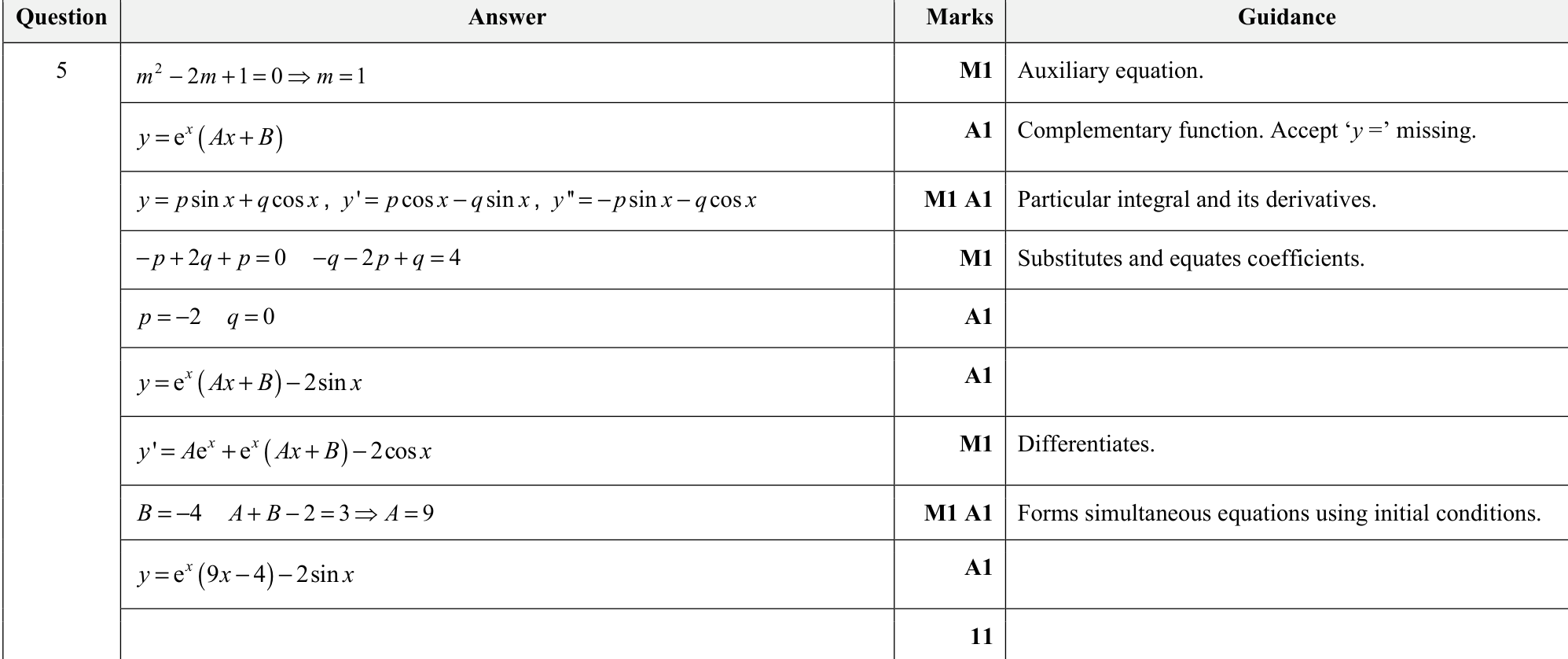
\(\frac{\mathrm{d}^{2} y}{\mathrm{~d} x^{2}}-2 \frac{\mathrm{~d} y}{\mathrm{~d} x}+y=4 \cos x\)
given that, when \(x=0, y=-4\) and \(\frac{\mathrm{d} y}{\mathrm{~d} x}=3\).
9231 P23 - Jun 2020 - Q1 - 6 marks
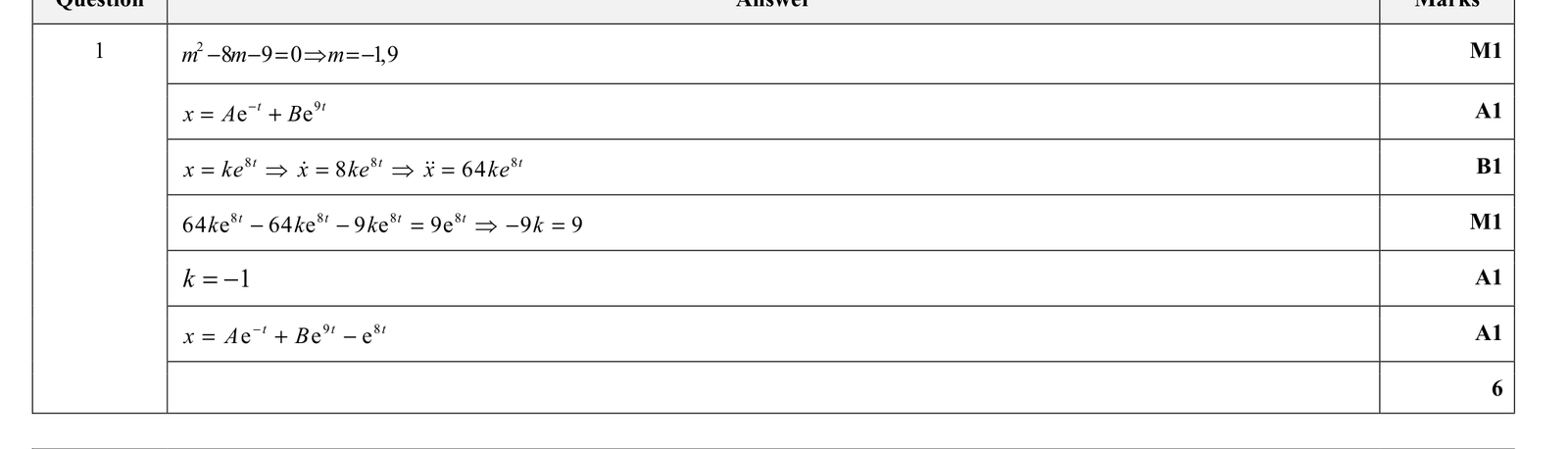
Find the general solution of the differential equation
\[\frac{\mathrm{d}^{2} x}{\mathrm{~d} t^{2}}-8 \frac{\mathrm{~d} x}{\mathrm{~d} t}-9 x=9 \mathrm{e}^{8 t}\]
9231 P23 - Jun 2021 - Q5 - 10 marks
The variables \(x\) and \(y\) are related by the differential equation
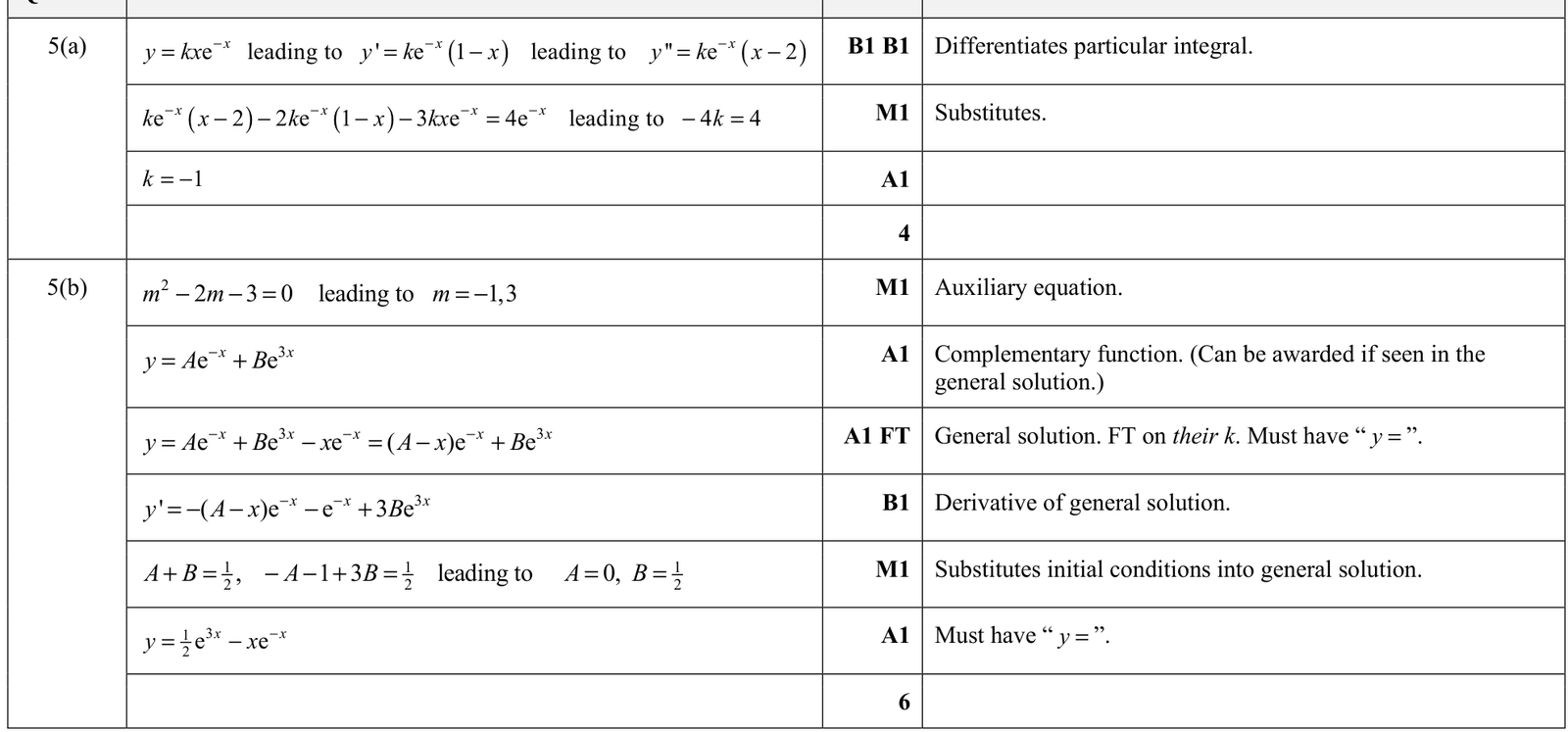
\[\frac{\mathrm{d}^{2} y}{\mathrm{~d} x^{2}}-2 \frac{\mathrm{~d} y}{\mathrm{~d} x}-3 y=4 \mathrm{e}^{-x} .\]
(a) Find the value of the constant \(k\) such that \(y=k x \mathrm{e}^{-x}\) is a particular integral of the differential equation.
(b) Find the solution of the differential equation for which \(y=\frac{\mathrm{d} y}{\mathrm{~d} x}=\frac{1}{2}\) when \(x=0\).
9231 P22 - Nov 2020 - Q6 - 11 marks
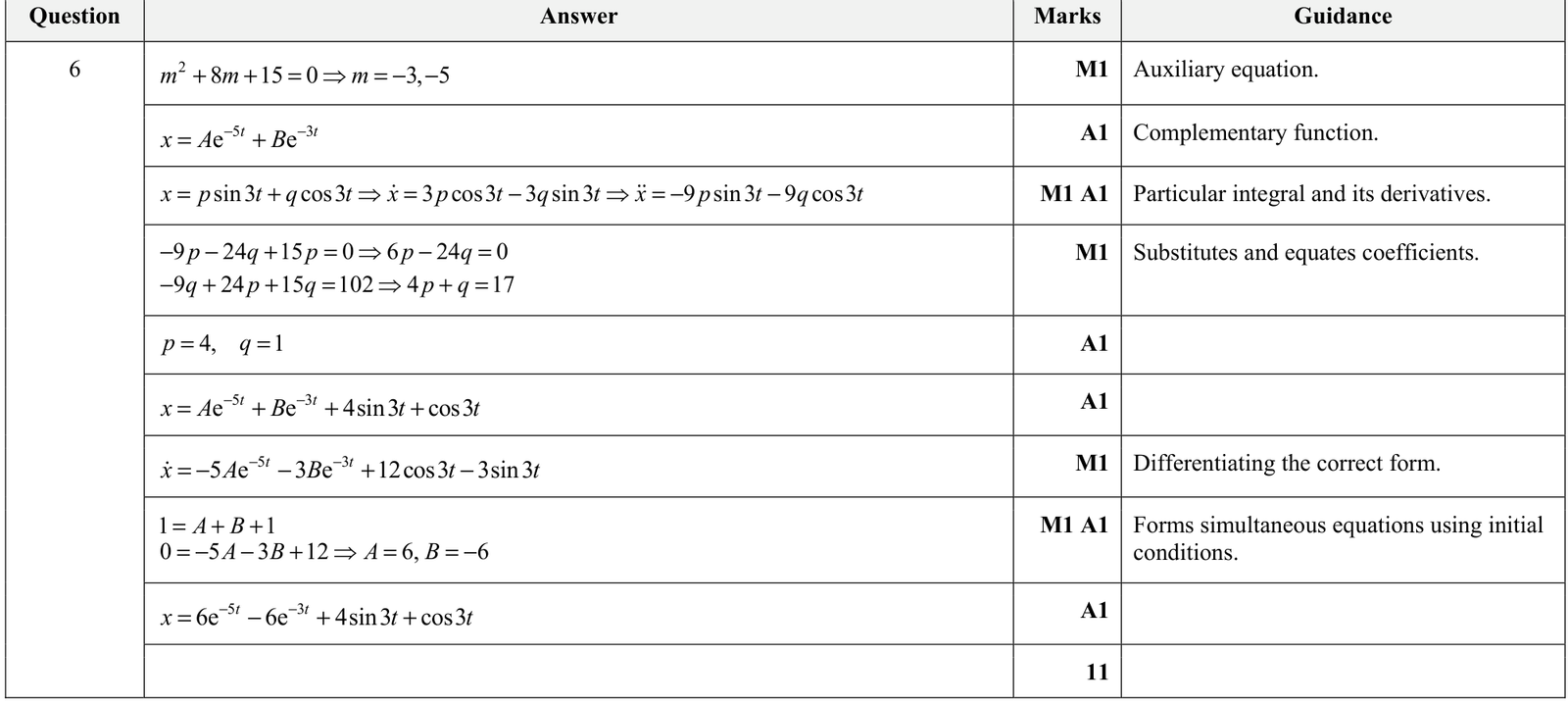
Find the particular solution of the differential equation
\[\frac{\mathrm{d}^{2} x}{\mathrm{~d} t^{2}}+8 \frac{\mathrm{~d} x}{\mathrm{~d} t}+15 x=102 \cos 3 t\]
given that, when \(t=0, x=1\) and \(\frac{\mathrm{d} x}{\mathrm{~d} t}=0\).
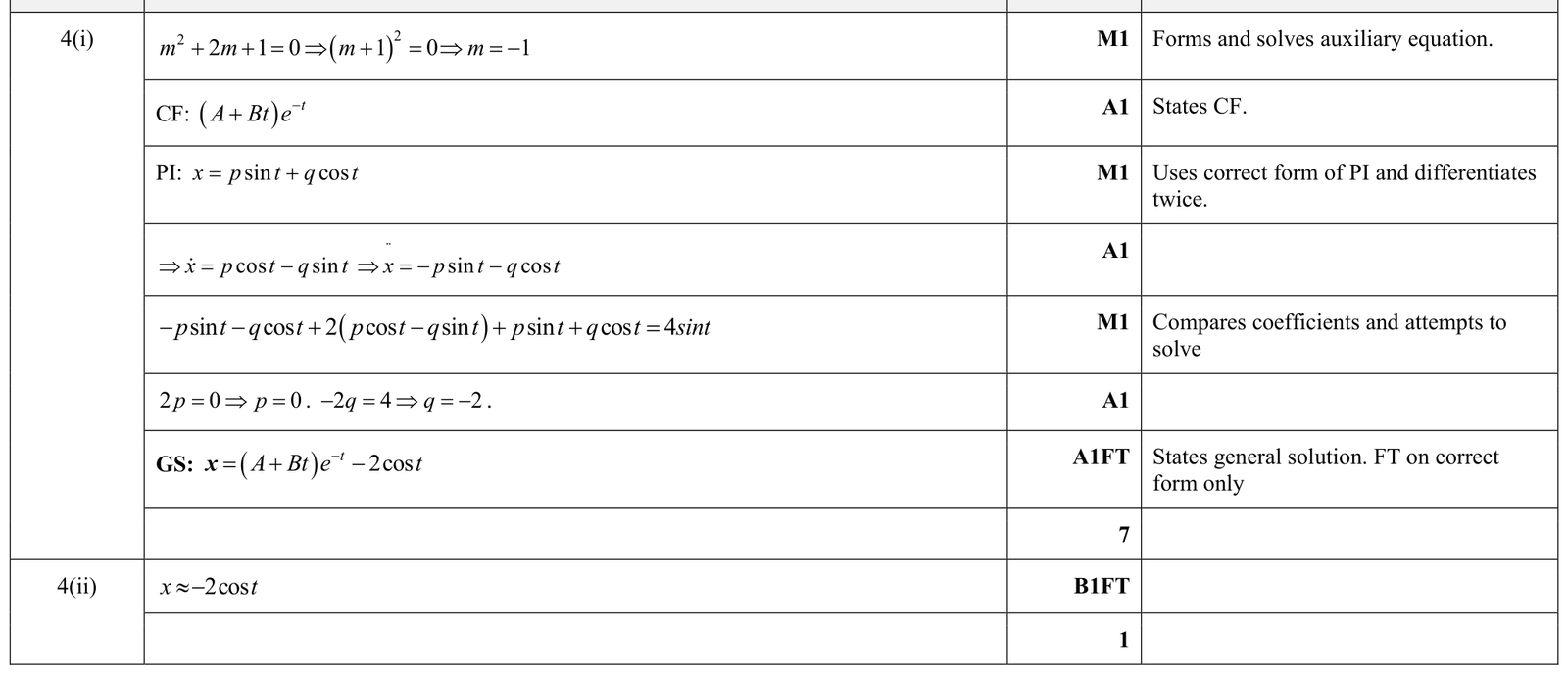
9231 P12 - Nov 2018 - Q4 - 8 marks
(i) Find the general solution of the differential equation
\(\frac{\mathrm{d}^{2} x}{\mathrm{~d} t^{2}}+2 \frac{\mathrm{~d} x}{\mathrm{~d} t}+x=4 \sin t\)
(ii) State an approximate solution for large positive values of \(t\).
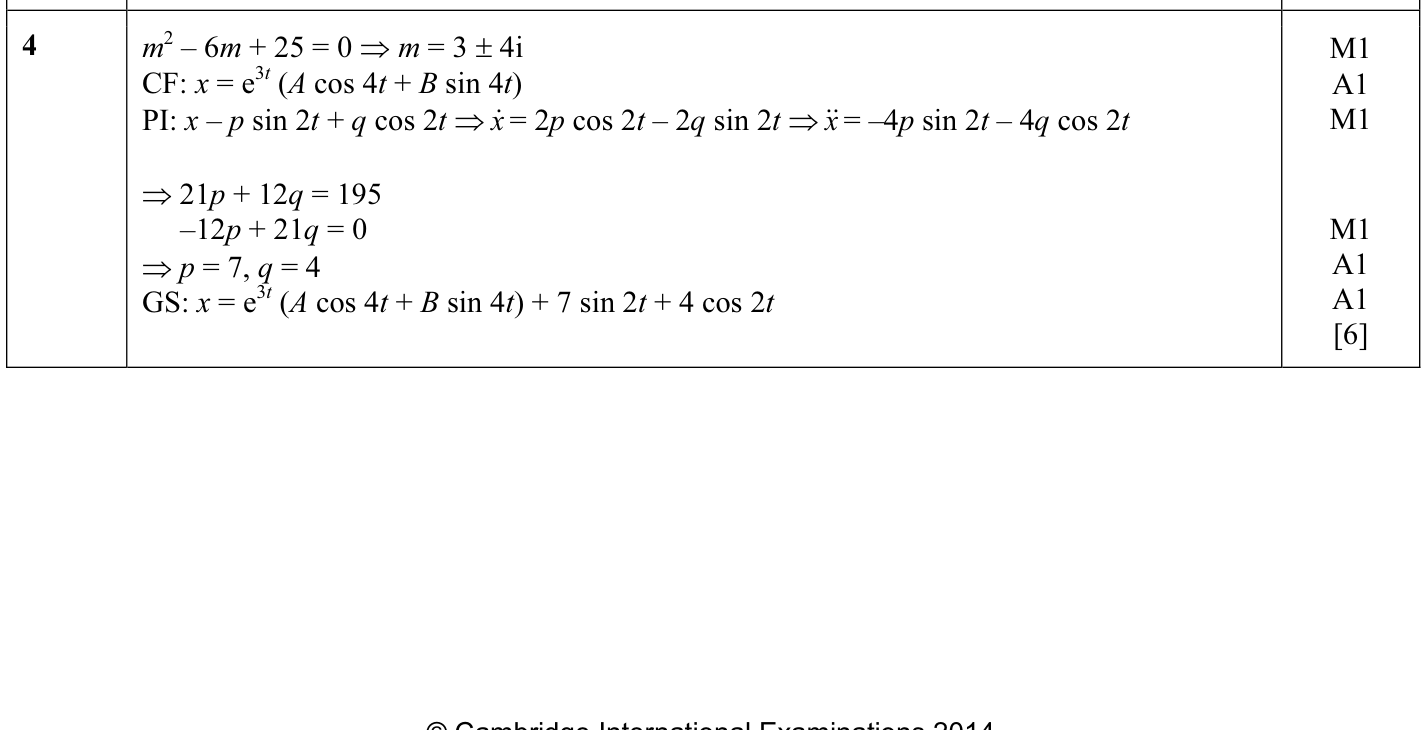
9231 P11 - Jun 2014 - Q4 - 6 marks
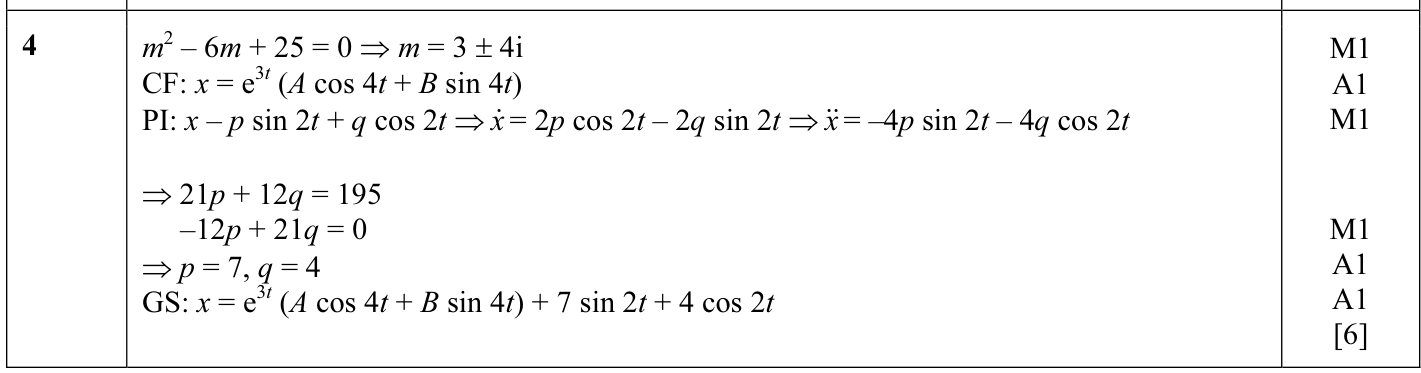
Obtain the general solution of the differential equation
\(\frac{\mathrm{d}^{2} x}{\mathrm{~d} t^{2}}-6 \frac{\mathrm{~d} x}{\mathrm{~d} t}+25 x=195 \sin 2 t\)
9231 P13 - Jun 2015 - Q9 - 11 marks
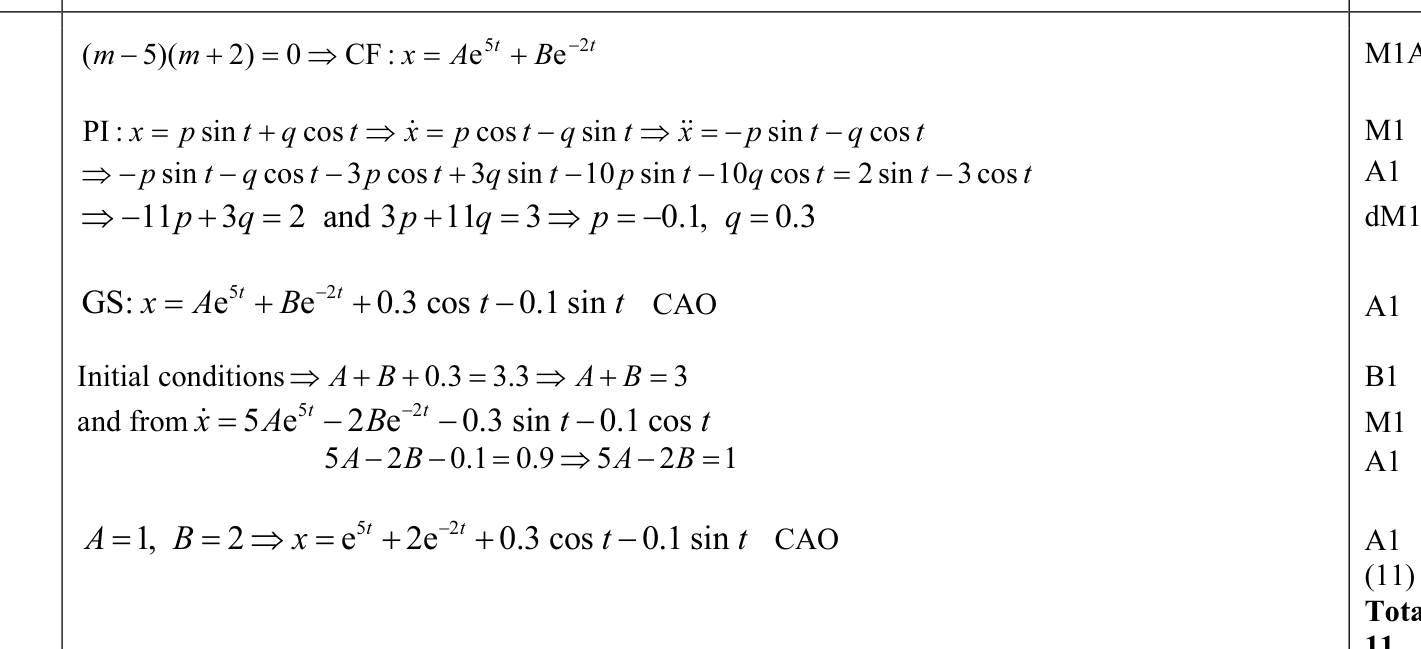
Find the particular solution of the differential equation
\(\frac{\mathrm{d}^{2} x}{\mathrm{~d} t^{2}}-3 \frac{\mathrm{~d} x}{\mathrm{~d} t}-10 x=2 \sin t-3 \cos t\)
given that, when \(t=0, x=3.3\) and \(\frac{\mathrm{d} x}{\mathrm{~d} t}=0.9\).
9231 P11 - Jun 2015 - Q11E - 14 marks
EITHER
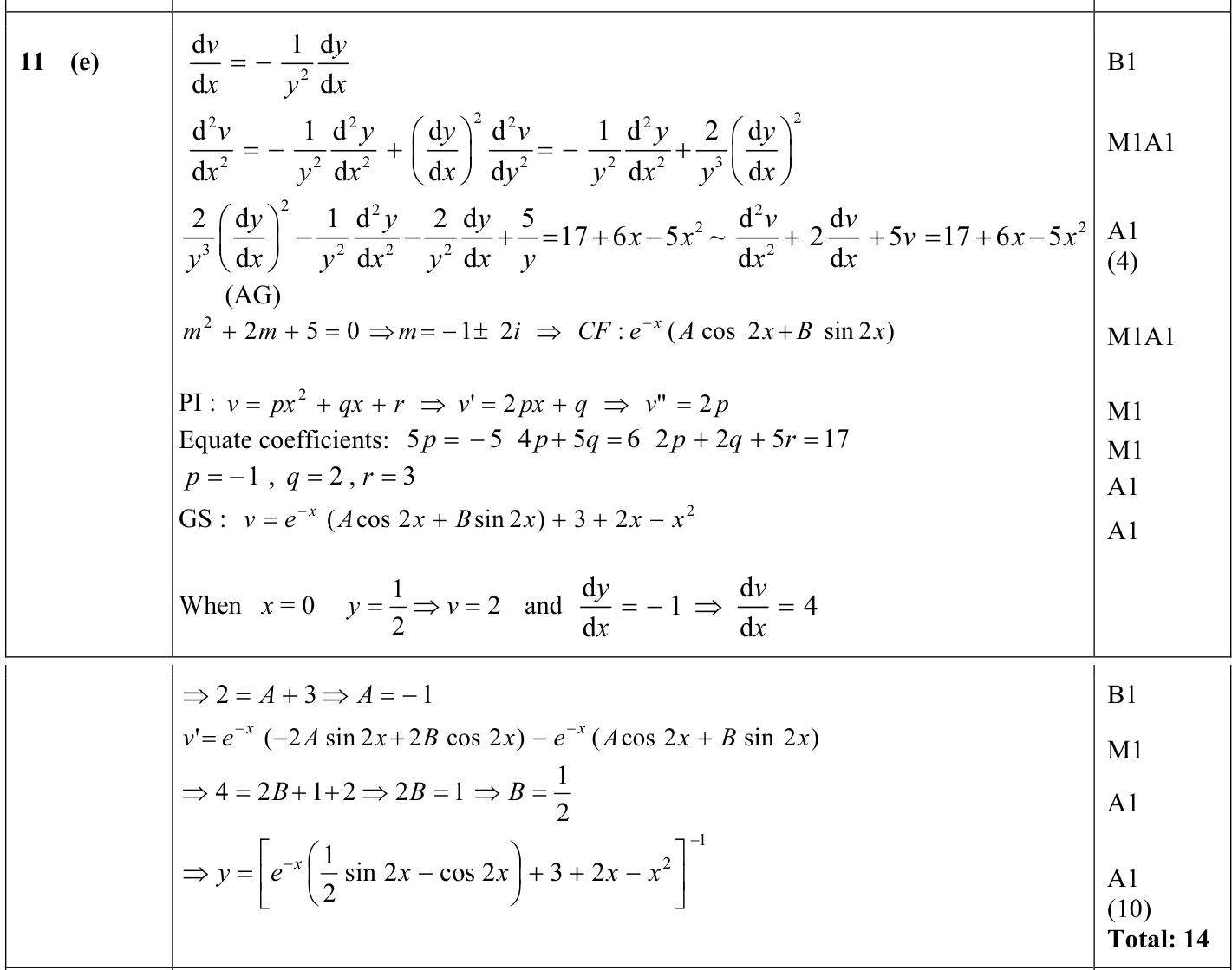
Show that the substitution \(v=\frac1y\) reduces the differential equation
\(\frac2{y^3}\left(\frac{dy}{dx}\right)^2-\frac1{y^2}\frac{d^2y}{dx^2}-\frac2{y^2}\frac{dy}{dx}+\frac5y=17+6x-5x^2\)
to the differential equation
\(\frac{d^2v}{dx^2}+2\frac{dv}{dx}+5v=17+6x-5x^2\).
Hence find \(y\) in terms of \(x\), given that when \(x=0\), \(y=\frac12\) and \(\frac{dy}{dx}=-1\).
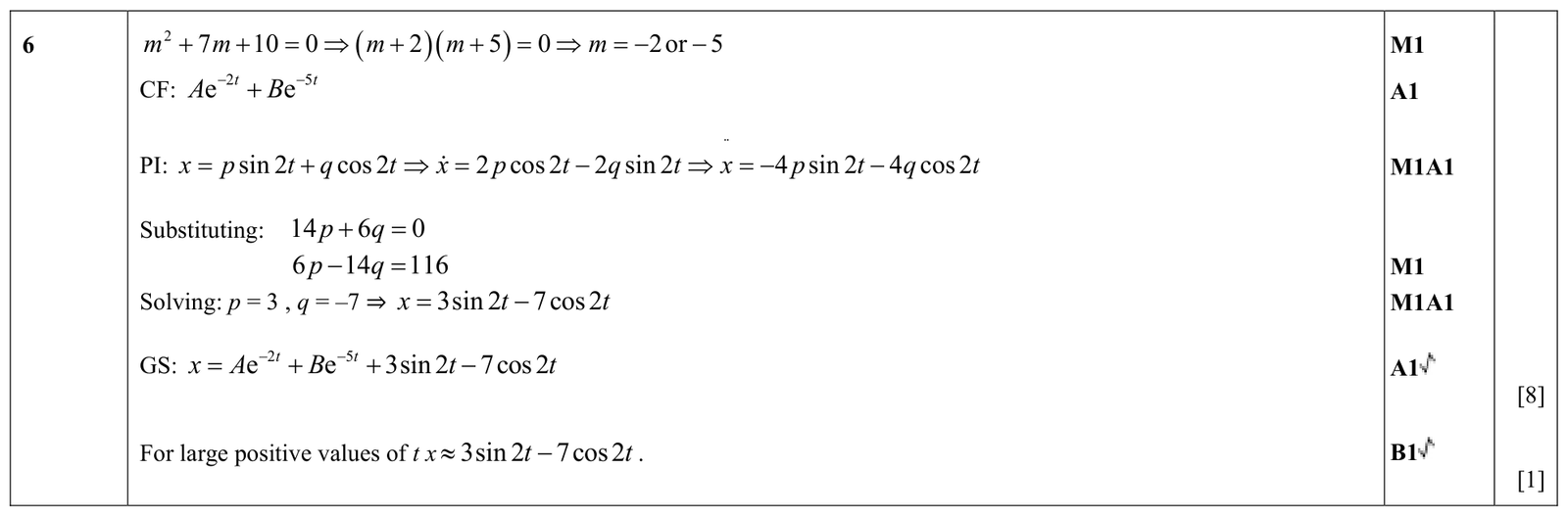
9231 P11 - Nov 2016 - Q6 - 9 marks
Find the general solution of the differential equation
\(\frac{\mathrm{d}^{2} x}{\mathrm{~d} t^{2}}+7 \frac{\mathrm{~d} x}{\mathrm{~d} t}+10 x=116 \sin 2 t\)
State an approximate solution for large positive values of \(t\).
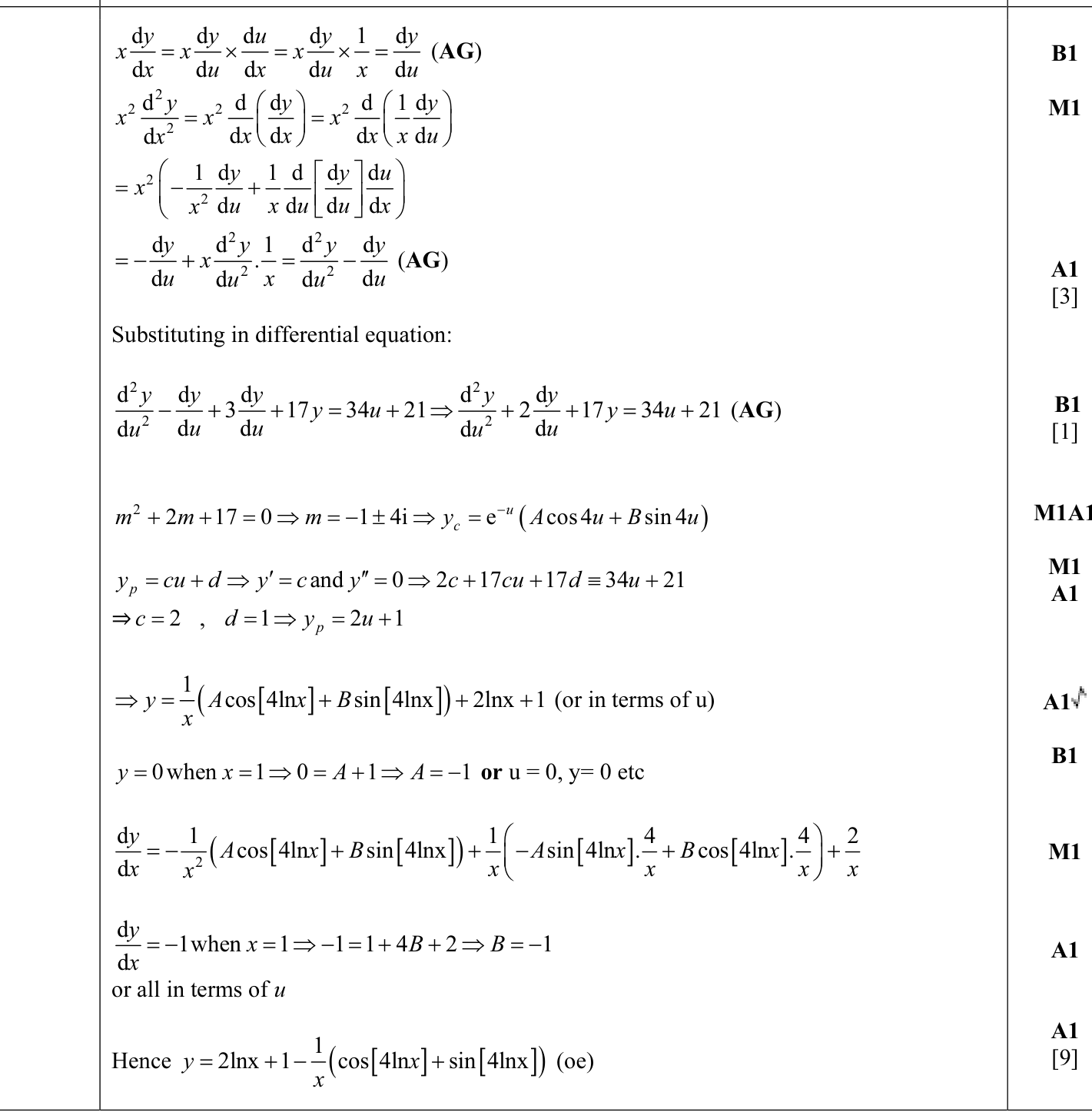
9231 P13 - Jun 2016 - Q10 - 13 marks
Given that \(y\) is a function of \(x\) and that \(x=e^u\), show that
\(x\frac{dy}{dx}=\frac{dy}{du}\quad\text{and}\quad x^2\frac{d^2y}{dx^2}=\frac{d^2y}{du^2}-\frac{dy}{du}.\)
Given also that
\(x^2\frac{d^2y}{dx^2}+3x\frac{dy}{dx}+17y=34\ln x+21,\)
deduce that
\(\frac{d^2y}{du^2}+2\frac{dy}{du}+17y=34u+21.\)
Find \(y\) in terms of \(x\), given that \(y=0\) and \(\dfrac{dy}{dx}=-1\) when \(x=1\).
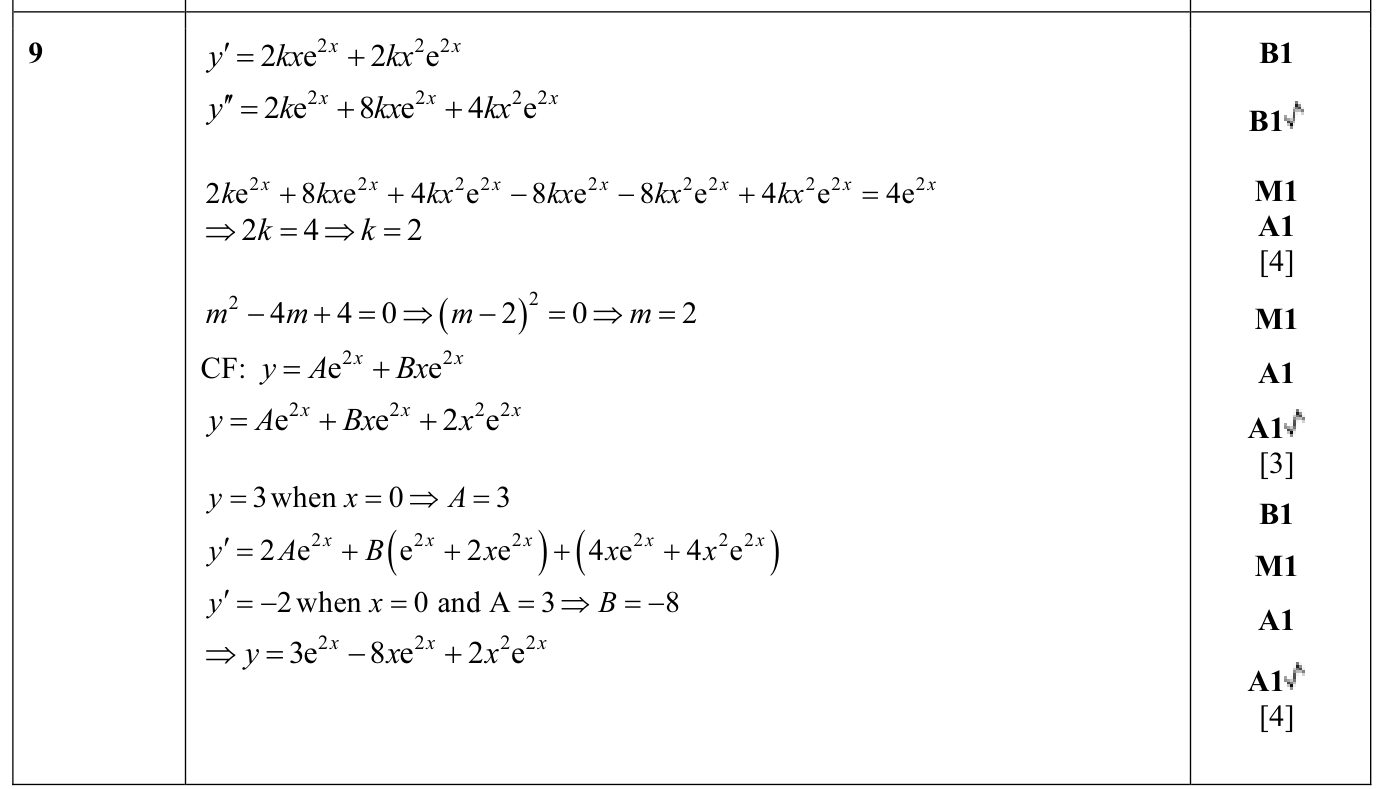
9231 P11 - Jun 2016 - Q9 - 11 marks
Find the value of the constant \(k\) such that \(y=k x^{2} \mathrm{e}^{2 x}\) is a particular integral of the differential equation
\(\frac{\mathrm{d}^{2} y}{\mathrm{~d} x^{2}}-4 \frac{\mathrm{~d} y}{\mathrm{~d} x}+4 y=4 \mathrm{e}^{2 x} .\)
Hence find the general solution of (*).
Find the particular solution of \((*)\) such that \(y=3\) and \(\frac{\mathrm{d} y}{\mathrm{~d} x}=-2\) when \(x=0\).
9231 P12 - Jun 2014 - Q4 - 6 marks
Obtain the general solution of the differential equation
\(\frac{\mathrm{d}^{2} x}{\mathrm{~d} t^{2}}-6 \frac{\mathrm{~d} x}{\mathrm{~d} t}+25 x=195 \sin 2 t\)
9231 P13 - Nov 2012 - Q12 - 28 marks
Answer only one of the following two alternatives.
EITHER
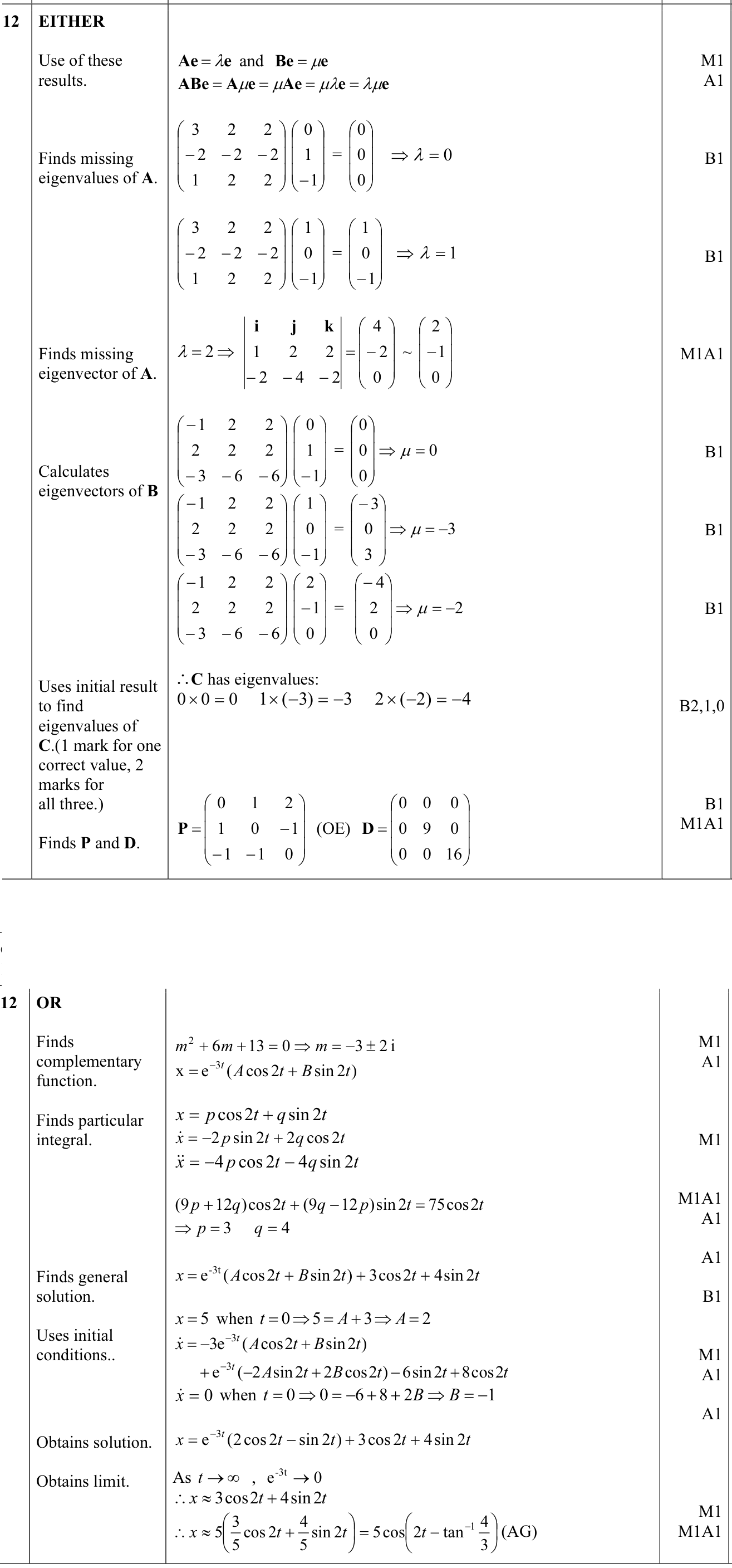
The vector \(\mathbf{e}\) is an eigenvector of each of the \(n \times n\) matrices \(\mathbf{A}\) and \(\mathbf{B}\), with corresponding eigenvalues \(\lambda\) and \(\mu\) respectively. Prove that \(\mathbf{e}\) is an eigenvector of the matrix \(\mathbf{A B}\) with eigenvalue \(\lambda \mu\).
It is given that the matrix \(\mathbf{A}\), where
\(\mathbf{A}=\left(\begin{array}{rrr} 3 & 2 & 2 \\ -2 & -2 & -2 \\ 1 & 2 & 2 \end{array}\right),\)
has eigenvectors \(\left(\begin{array}{r}0 \\ 1 \\ -1\end{array}\right)\) and \(\left(\begin{array}{r}1 \\ 0 \\ -1\end{array}\right)\). Find the corresponding eigenvalues.
Given that 2 is also an eigenvalue of \(\mathbf{A}\), find a corresponding eigenvector.
The matrix \(\mathbf{B}\), where
\(\mathbf{B}=\left(\begin{array}{rrr} -1 & 2 & 2 \\ 2 & 2 & 2 \\ -3 & -6 & -6 \end{array}\right),\)
has the same eigenvectors as \(\mathbf{A}\). Given that \(\mathbf{A B}=\mathbf{C}\), find a non-singular matrix \(\mathbf{P}\) and a diagonal matrix \(\mathbf{D}\) such that
\(\mathbf{P}^{-1} \mathbf{C}^{2} \mathbf{P}=\mathbf{D} .\)
OR
Obtain the general solution of the differential equation
\(\frac{\mathrm{d}^{2} x}{\mathrm{~d} t^{2}}+6 \frac{\mathrm{~d} x}{\mathrm{~d} t}+13 x=75 \cos 2 t\)
Given that \(x=5\) and \(\frac{\mathrm{d} x}{\mathrm{~d} t}=0\) when \(t=0\), find \(x\) in terms of \(t\).
Show that, for large positive values of \(t\) and for any initial conditions,
\(x \approx 5 \cos (2 t-\phi),\)
where the constant \(\phi\) is such that \(\tan \phi=\frac{4}{3}\).
9231 P13 - Jun 2011 - Q8 - 11 marks
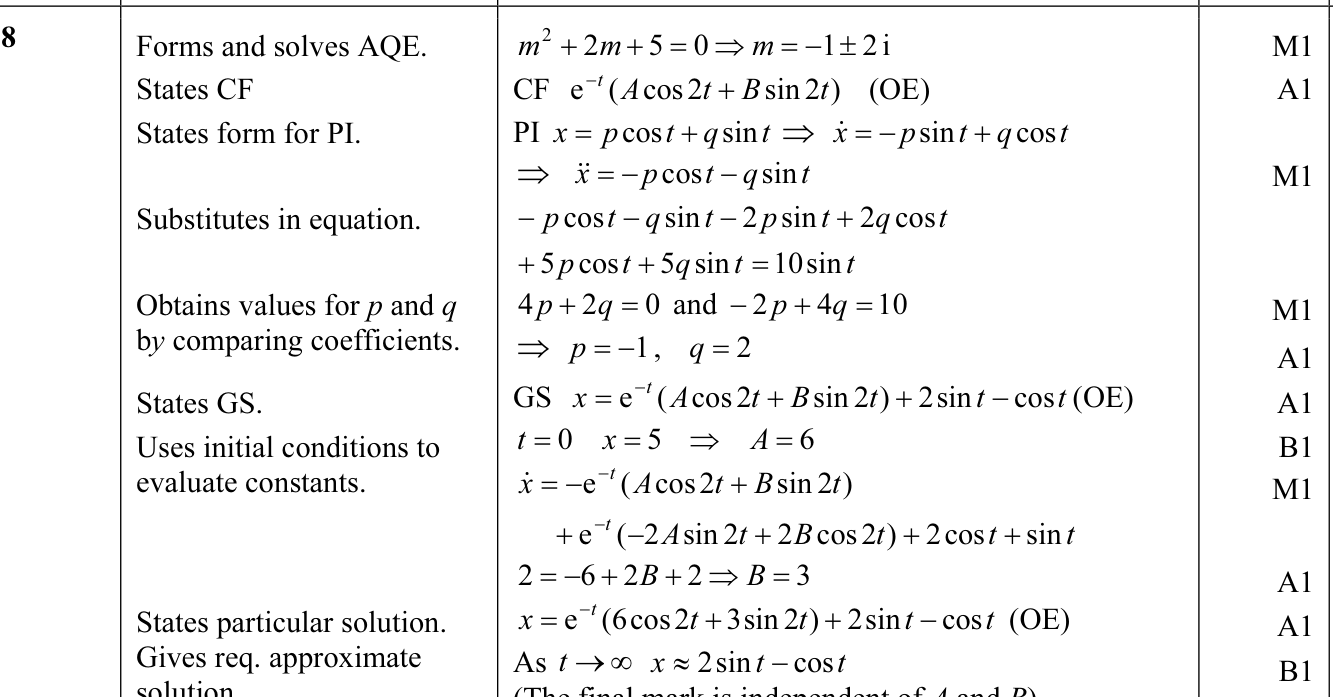
Find the general solution of the differential equation
\(\frac{\mathrm{d}^{2} x}{\mathrm{~d} t^{2}}+2 \frac{\mathrm{~d} x}{\mathrm{~d} t}+5 x=10 \sin t\)
Find the particular solution, given that \(x=5\) and \(\frac{\mathrm{d} x}{\mathrm{~d} t}=2\) when \(t=0\).
State an approximate solution for large positive values of \(t\).
9231 P13 - Nov 2011 - Q6 - 8 marks
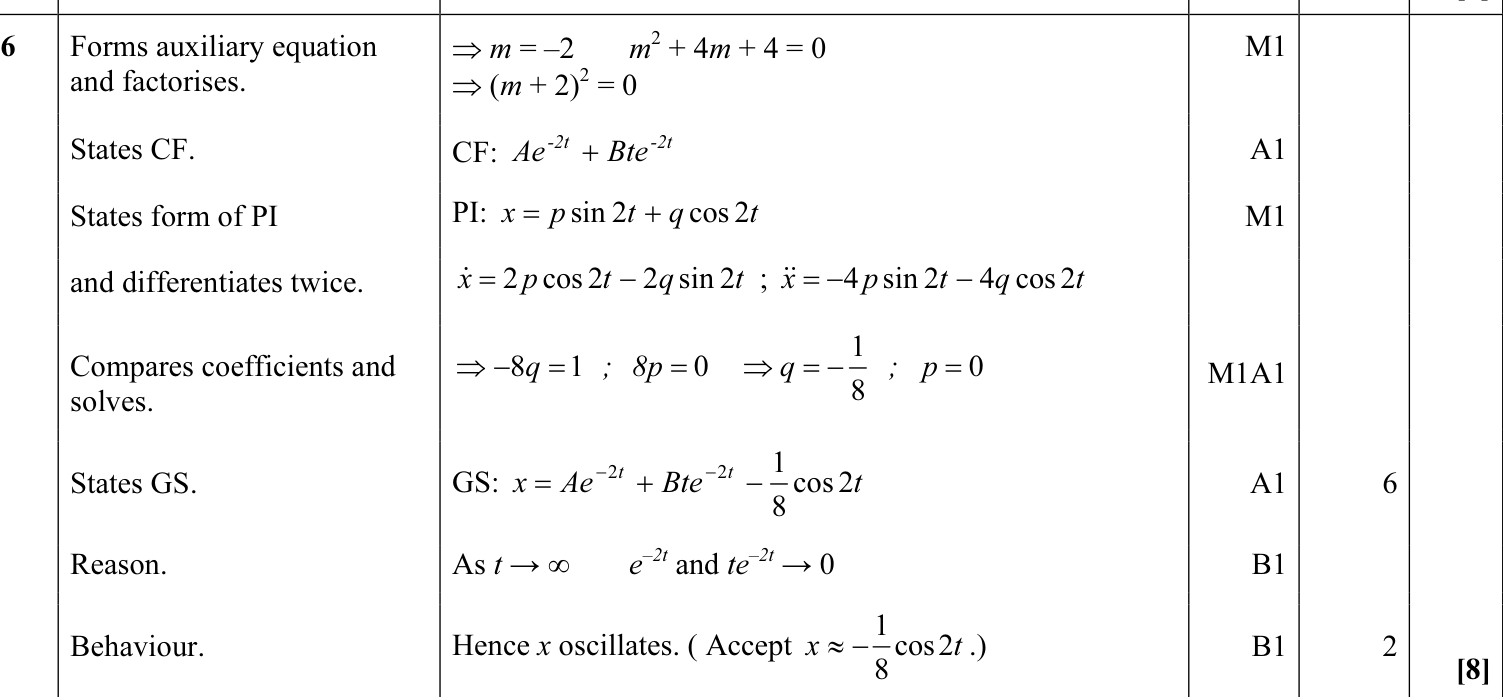
Find the general solution of the differential equation
\(\frac{\mathrm{d}^{2} x}{\mathrm{~d} t^{2}}+4 \frac{\mathrm{~d} x}{\mathrm{~d} t}+4 x=\sin 2 t\)
Describe the behaviour of \(x\) as \(t \rightarrow \infty\), justifying your answer.
9231 P13 - Jun 2010 - Q8 - 9 marks
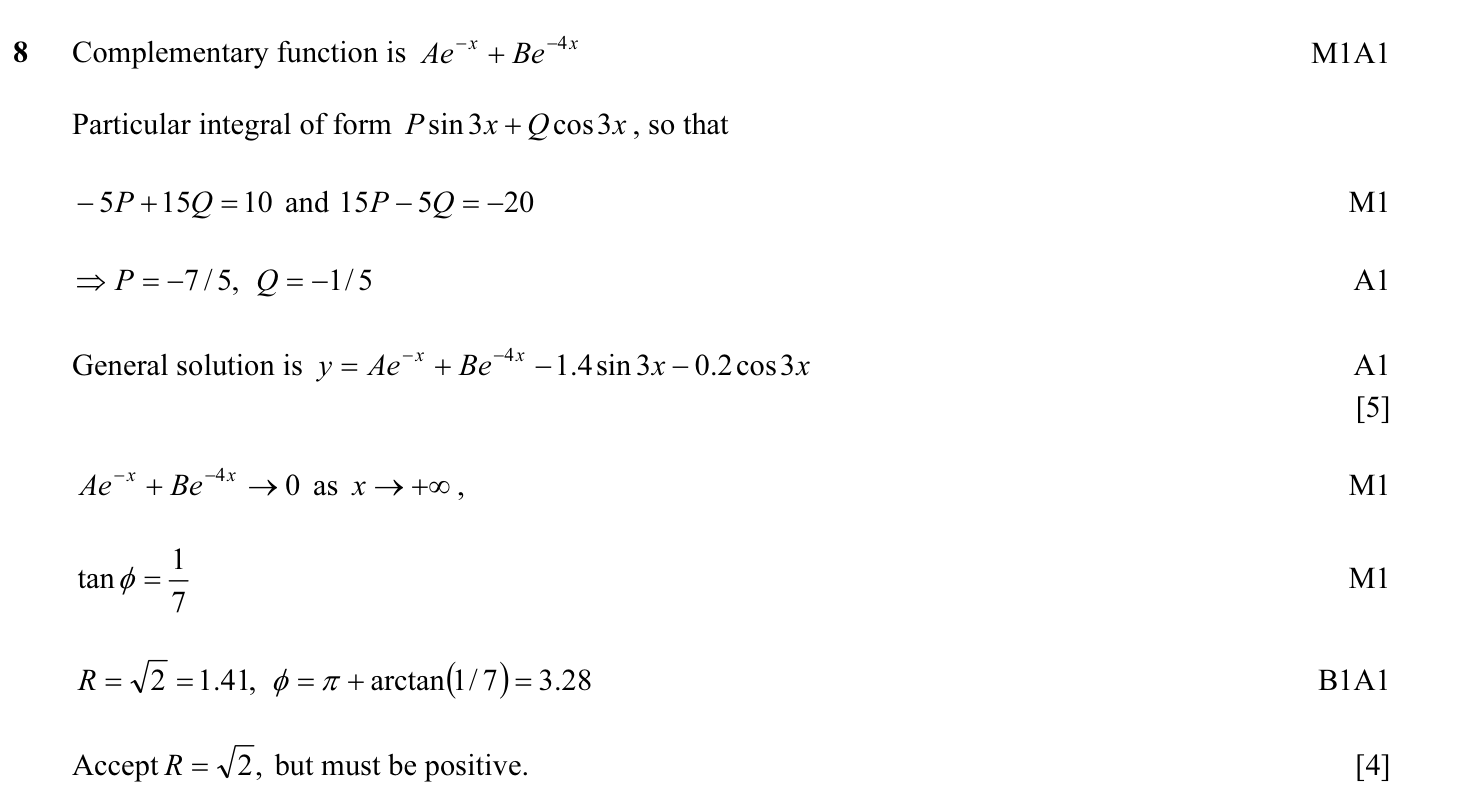
Obtain the general solution of the differential equation
\(\frac{\mathrm{d}^{2} y}{\mathrm{~d} x^{2}}+5 \frac{\mathrm{~d} y}{\mathrm{~d} x}+4 y=10 \sin 3 x-20 \cos 3 x\)
Show that, for large positive \(x\) and independently of the initial conditions,
\(y \approx R \sin (3 x+\phi),\)
where the constants \(R\) and \(\phi\), such that \(R\gt 0\) and \(0\lt \phi\lt 2 \pi\), are to be determined correct to 2 decimal places.
9231 P1 - Nov 2009 - Q1 - 4 marks
Given that
\(y=x^{2} \sin x,\)
(i) show that the mean value of \(\frac{\mathrm{d} y}{\mathrm{~d} x}\) with respect to \(x\) over the interval \(0 \leqslant x \leqslant \frac{1}{2} \pi\) is \(\frac{1}{2} \pi\),
(ii) find the mean value of \(\frac{\mathrm{d}^{2} y}{\mathrm{~d} x^{2}}\) with respect to \(x\) over the interval \(0 \leqslant x \leqslant \frac{1}{2} \pi\).

9231 P1 - Nov 2009 - Q4 - 8 marks
It is given that
\(x=t+\sin t, \quad y=t^{2}+2 \cos t,\)
where \(-\pi\lt t\lt \pi\). Find \(\frac{\mathrm{d} y}{\mathrm{~d} x}\) in terms of \(t\).
Show that
\(\frac{\mathrm{d}^{2} y}{\mathrm{~d} x^{2}}=\frac{2 t \sin t}{(1+\cos t)^{3}} .\)
Show that \(\frac{\mathrm{d} y}{\mathrm{~d} x}\) increases with \(x\) over the given interval of \(t\).