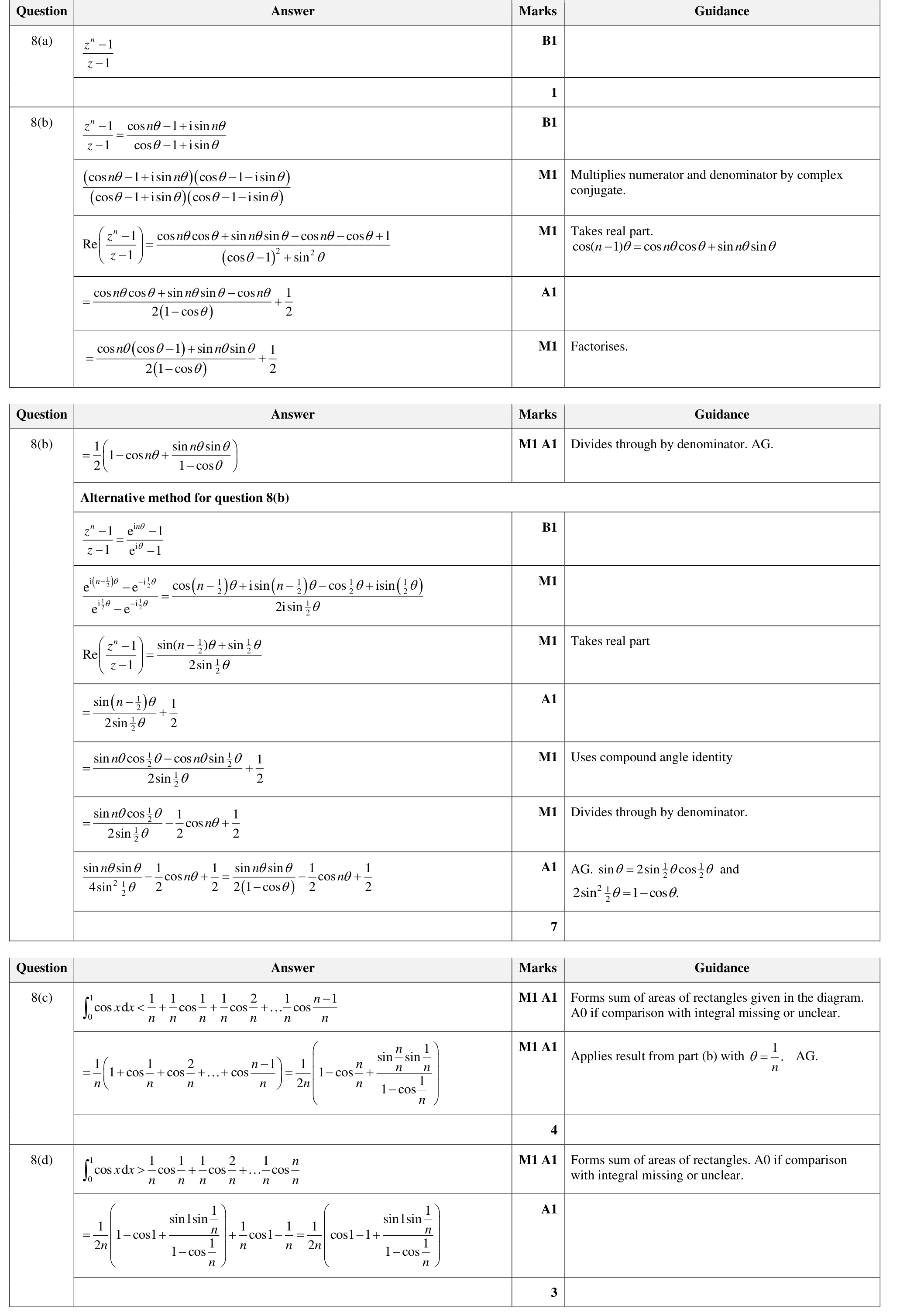
9231 P21 - Nov 2023 - Q8 - 15 marks
(a) State the sum of the series \(1+z+z^{2}+\ldots+z^{n-1}\), for \(z \neq 1\).
(b) By letting \(z=\cos \theta+\mathrm{i} \sin \theta\), where \(\cos \theta \neq 1\), show that
\(1+\cos \theta+\cos 2 \theta+\ldots+\cos (n-1) \theta=\frac{1}{2}\left(1-\cos n \theta+\frac{\sin n \theta \sin \theta}{1-\cos \theta}\right) .\)
The diagram shows the curve with equation \(y=\cos x\) for \(0 \leqslant x \leqslant 1\), together with a set of \(n\) rectangles of width \(\frac{1}{n}\).
(c) By considering the sum of the areas of these rectangles, show that
\(\int_{0}^{1} \cos x \mathrm{~d} x\lt \frac{1}{2 n}\left(1-\cos 1+\frac{\sin 1 \sin \frac{1}{n}}{1-\cos \frac{1}{n}}\right)\)
(d) Use a similar method to find, in terms of \(n\), a lower bound for \(\int_{0}^{1} \cos x \mathrm{~d} x\).
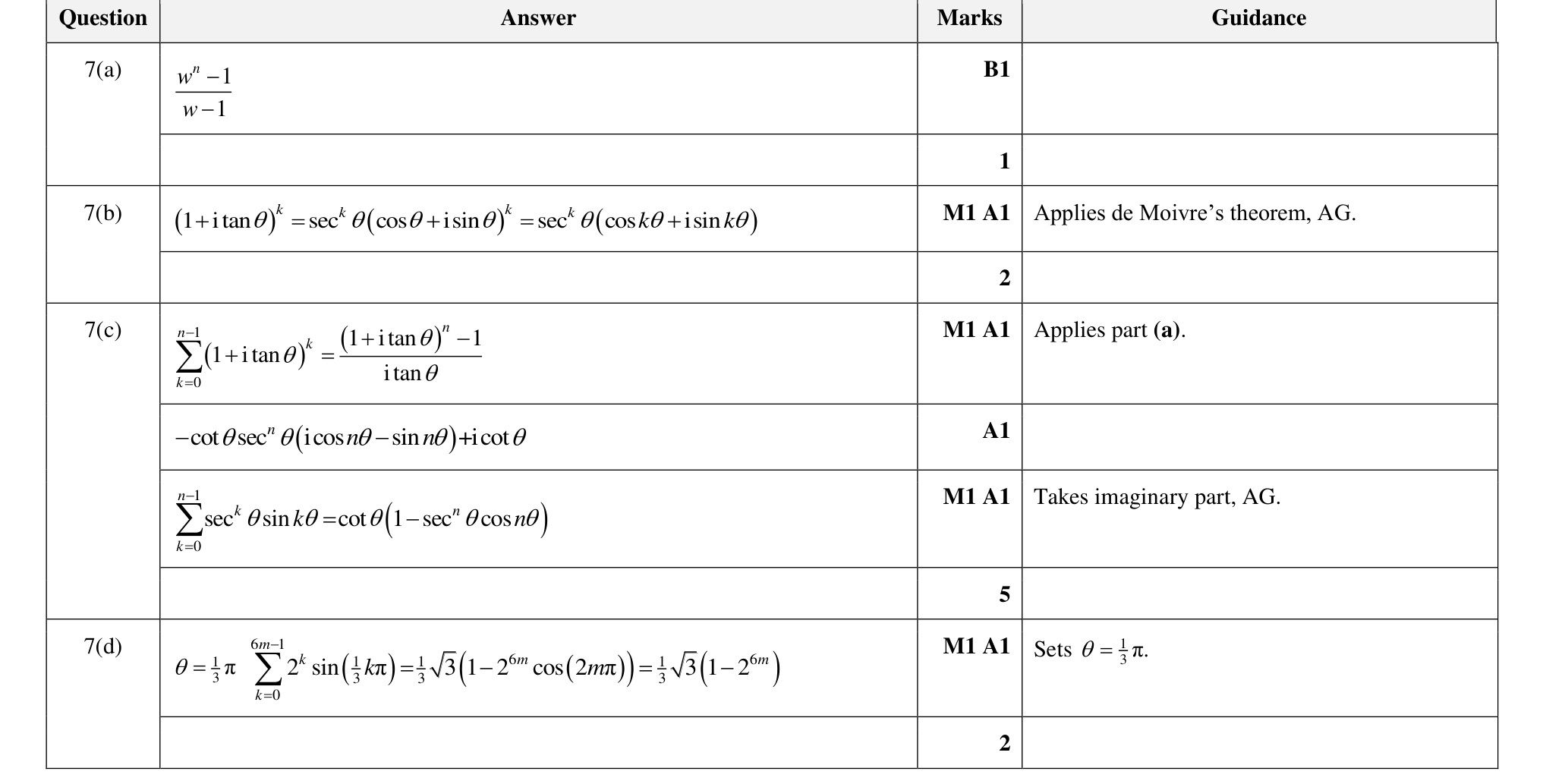
9231 P21 - Nov 2022 - Q7 - 10 marks
(a) State the sum of the series \(1+w+w^{2}+w^{3}+\ldots+w^{n-1}\), for \(w \neq 1\).
(b) Show that \((1+\mathrm{i} \tan \theta)^{k}=\sec ^{k} \theta(\cos k \theta+\mathrm{i} \sin k \theta)\), where \(\theta\) is not an integer multiple of \(\frac{1}{2} \pi\).
(c) By considering \(\sum_{k=0}^{n-1}(1+\mathrm{i} \tan \theta)^{k}\), show that
\(\sum_{k=0}^{n-1} \sec ^{k} \theta \sin k \theta=\cot \theta\left(1-\sec ^{n} \theta \cos n \theta\right),\)
provided \(\theta\) is not an integer multiple of \(\frac{1}{2} \pi\).
(d) Hence find \(\sum_{k=0}^{6 m-1} 2^{k} \sin \left(\frac{1}{3} k \pi\right)\) in terms of \(m\).
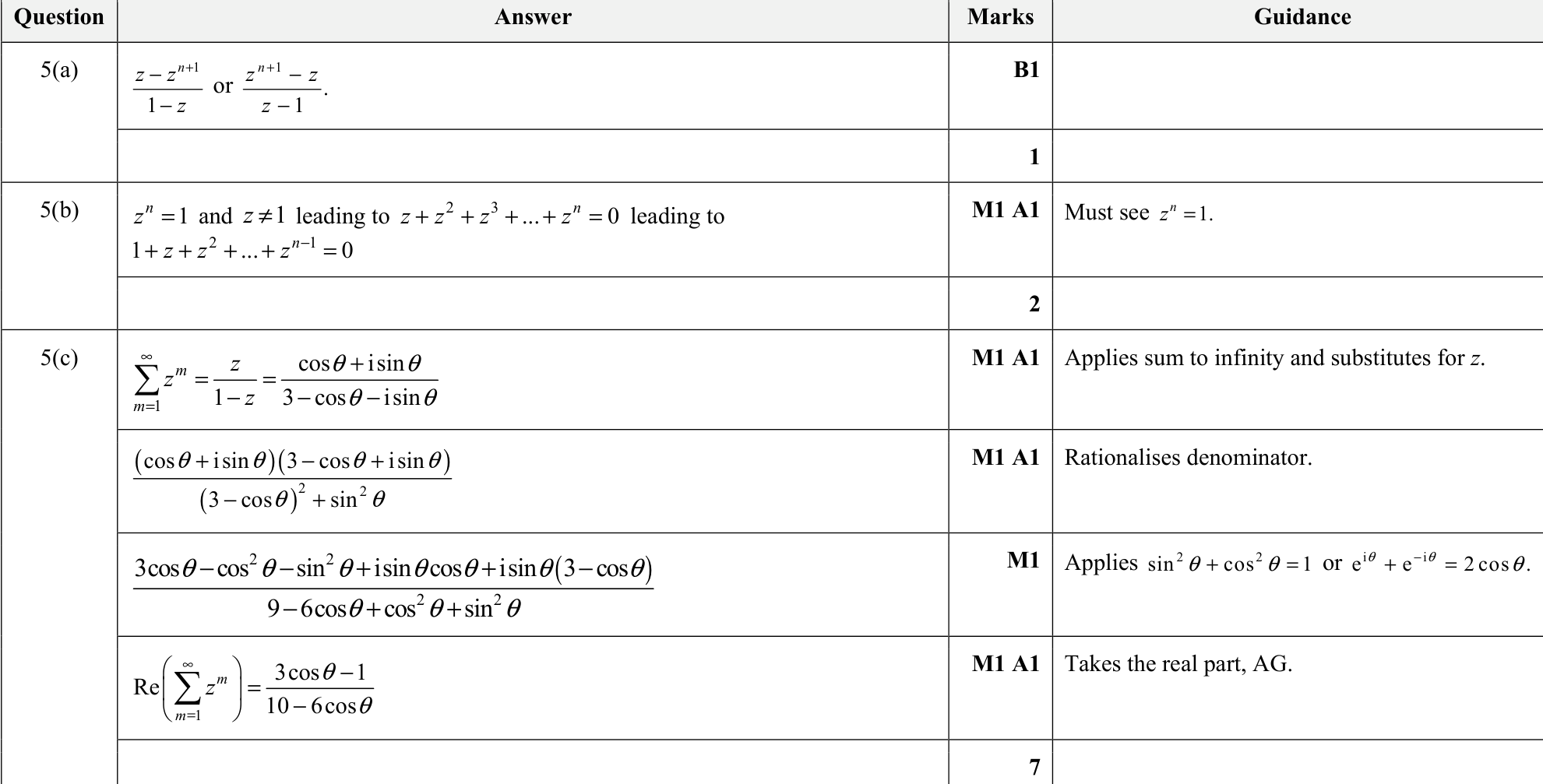
9231 P21 - Jun 2021 - Q5 - 10 marks
(a) State the sum of the series \(z+z^{2}+z^{3}+\ldots+z^{n}\), for \(z \neq 1\).
(b) Given that \(z\) is an \(n\)th root of unity and \(z \neq 1\), deduce that \(1+z+z^{2}+\ldots+z^{n-1}=0\).
(c) Given instead that \(z=\frac{1}{3}(\cos \theta+\mathrm{i} \sin \theta)\), use de Moivre's theorem to show that
\(\sum_{m=1}^{\infty} 3^{-m} \cos m \theta=\frac{3 \cos \theta-1}{10-6 \cos \theta}\)
9231 P22 - Nov 2020 - Q7 - 7 marks
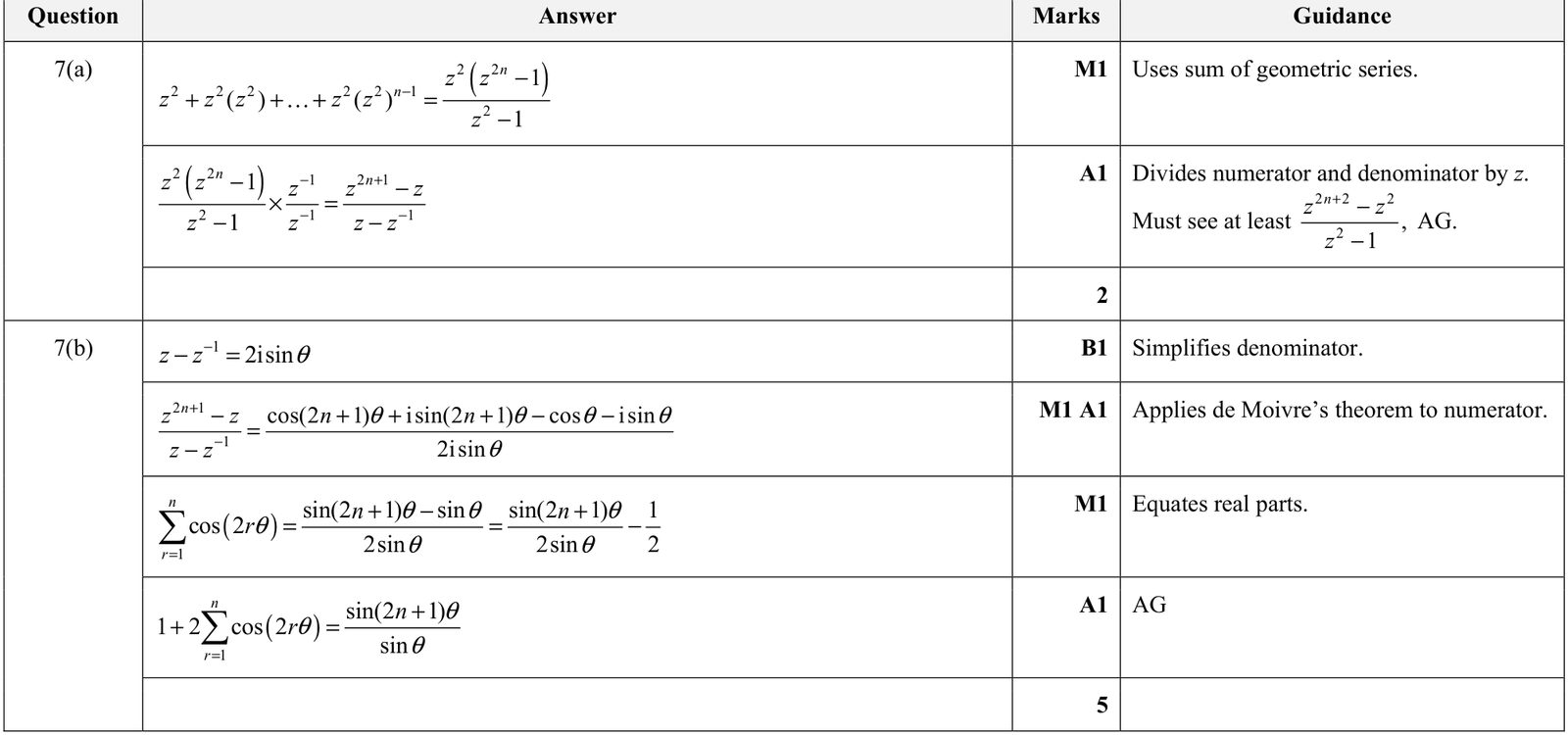
(a) Show that \(\sum_{r=1}^{n} z^{2 r}=\frac{z^{2 n+1}-z}{z-z^{-1}}\), for \(z \neq 0,1,-1\).
(b) By letting \(z=\cos \theta+\mathrm{i} \sin \theta\), show that, if \(\sin \theta \neq 0\),
\[1+2 \sum_{r=1}^{n} \cos (2 r \theta)=\frac{\sin (2 n+1) \theta}{\sin \theta}\]
9231 P13 - Jun 2014 - Q5 - 8 marks
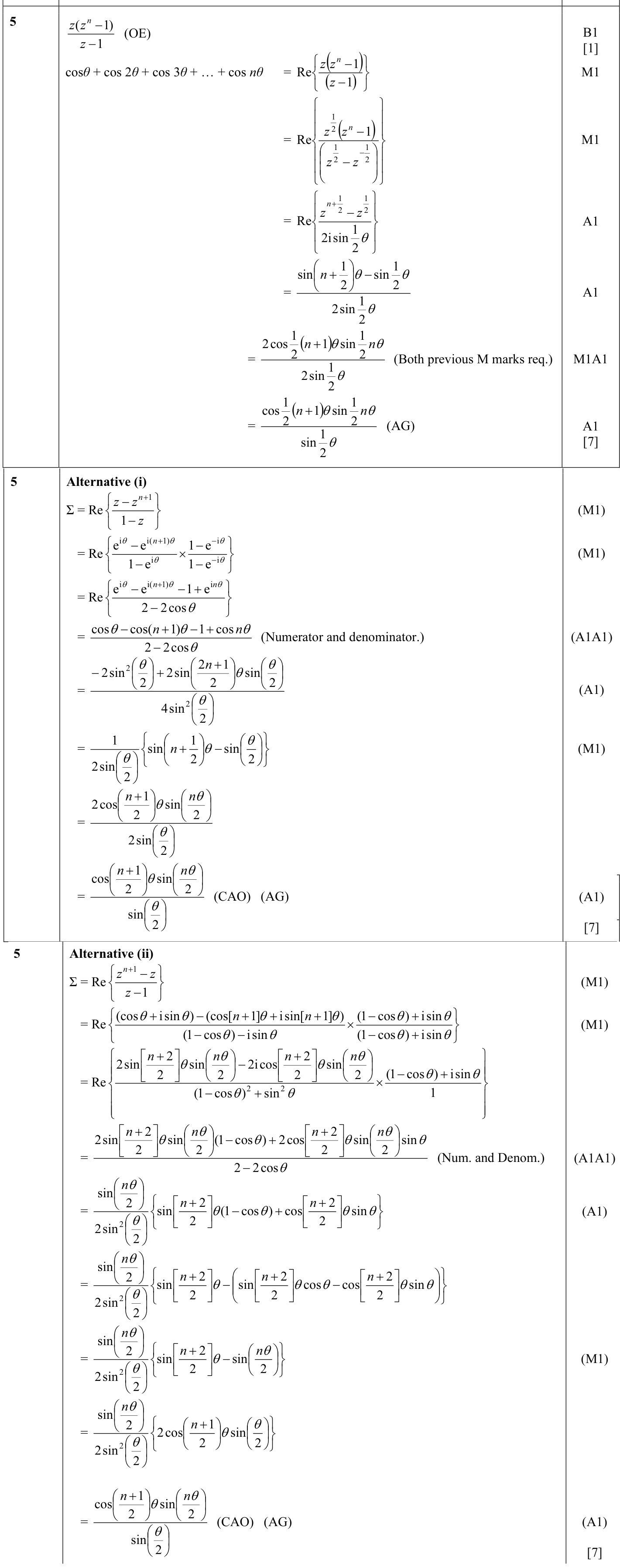
State the sum of the series \(z+z^{2}+z^{3}+\ldots+z^{n}\), for \(z \neq 1\).
By letting \(z=\cos \theta+\mathrm{i} \sin \theta\), show that
\(\cos \theta+\cos 2 \theta+\cos 3 \theta+\ldots+\cos n \theta=\frac{\sin \frac{1}{2} n \theta}{\sin \frac{1}{2} \theta} \cos \frac{1}{2}(n+1) \theta\)
where \(\sin \frac{1}{2} \theta \neq 0\).
9231 P11 - Jun 2015 - Q8 - 11 marks
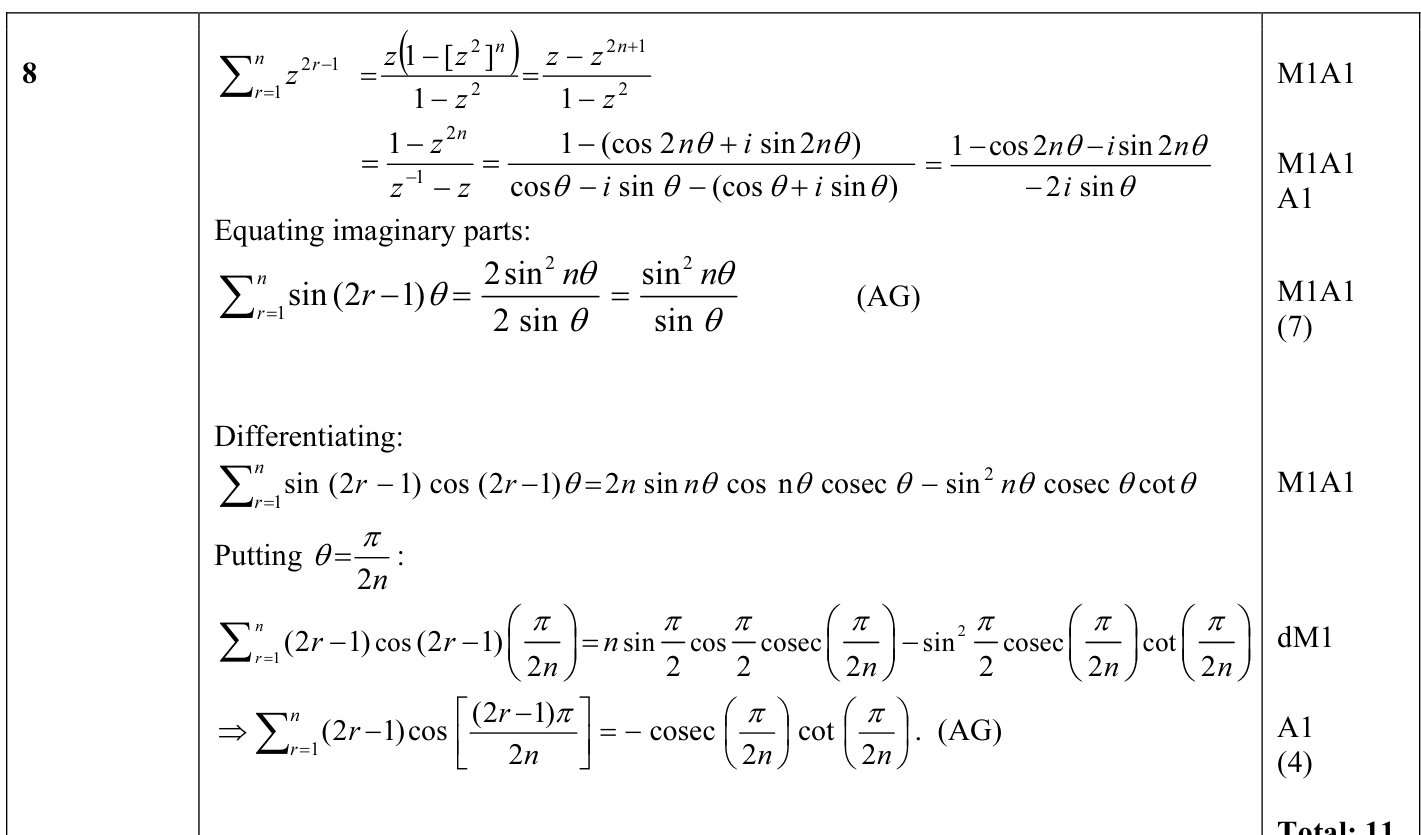
By considering \(\sum_{r=1}^{n} z^{2 r-1}\), where \(z=\cos \theta+\mathrm{i} \sin \theta\), show that, if \(\sin \theta \neq 0\),
\(\sum_{r=1}^{n} \sin (2 r-1) \theta=\frac{\sin ^{2} n \theta}{\sin \theta}\)
Deduce that
\(\sum_{r=1}^{n}(2 r-1) \cos \left[\frac{(2 r-1) \pi}{2 n}\right]=-\operatorname{cosec}\left(\frac{\pi}{2 n}\right) \cot \left(\frac{\pi}{2 n}\right)\)
9231 P1 - Jun 2008 - Q10 - 10 marks
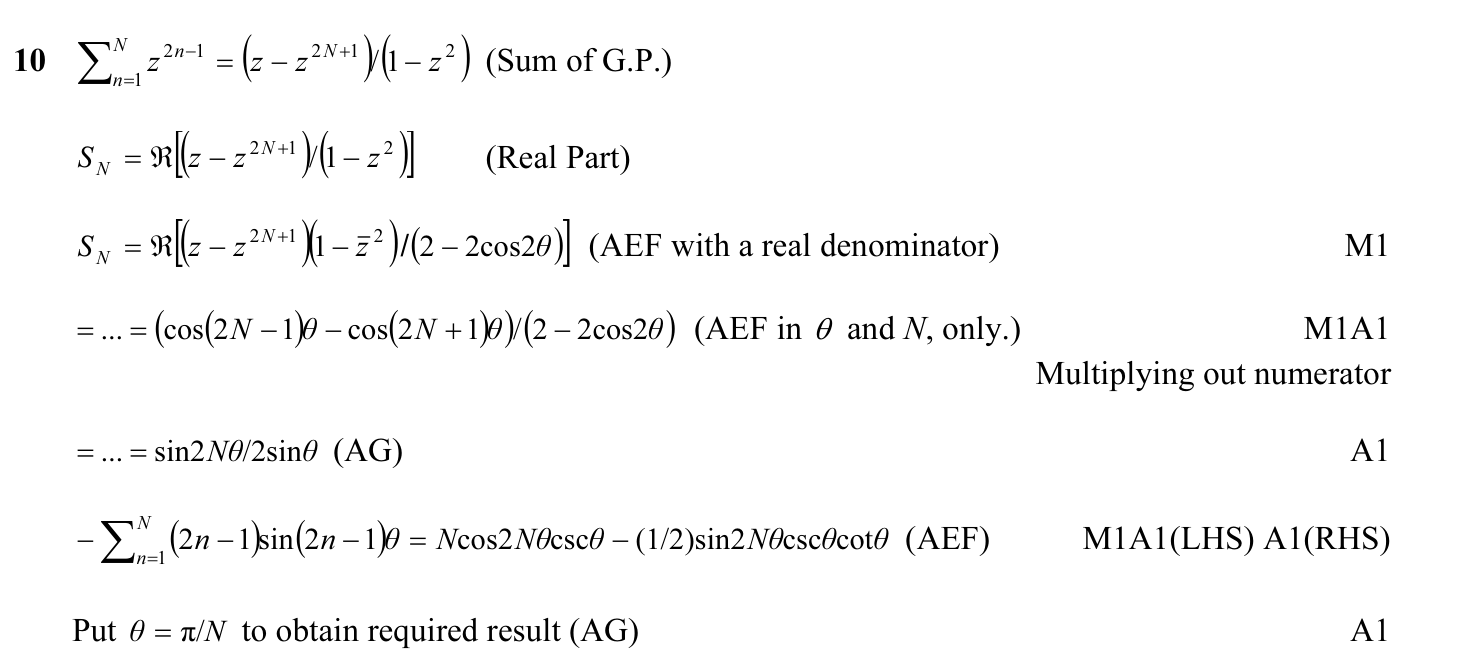
By considering \(\sum_{n=1}^{N} z^{2 n-1}\), where \(z=\mathrm{e}^{\mathrm{i} \theta}\), show that
\(\sum_{n=1}^{N} \cos (2 n-1) \theta=\frac{\sin (2 N \theta)}{2 \sin \theta},\)
where \(\sin \theta \neq 0\).
Deduce that
\(\sum_{n=1}^{N}(2 n-1) \sin \left[\frac{(2 n-1) \pi}{N}\right]=-N \operatorname{cosec} \frac{\pi}{N} .\)
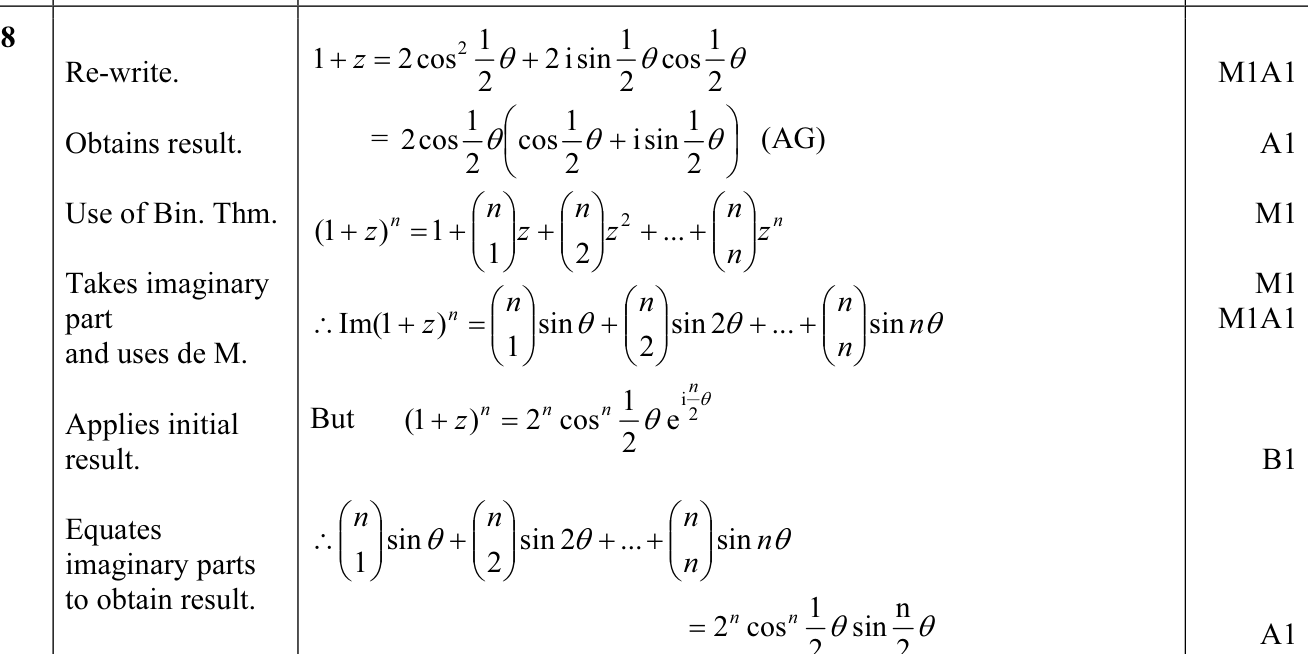
9231 P13 - Nov 2012 - Q8 - 9 marks
Let \(z=\cos \theta+\mathrm{i} \sin \theta\). Show that
\(1+z=2 \cos \frac{1}{2} \theta\left(\cos \frac{1}{2} \theta+i \sin \frac{1}{2} \theta\right)\)
By considering \((1+z)^{n}\), where \(n\) is a positive integer, deduce the sum of the series
\(\binom{n}{1} \sin \theta+\binom{n}{2} \sin 2 \theta+\ldots+\binom{n}{n} \sin n \theta\)