9231 P13 - Jun 2019 - Q3 - 7 marks
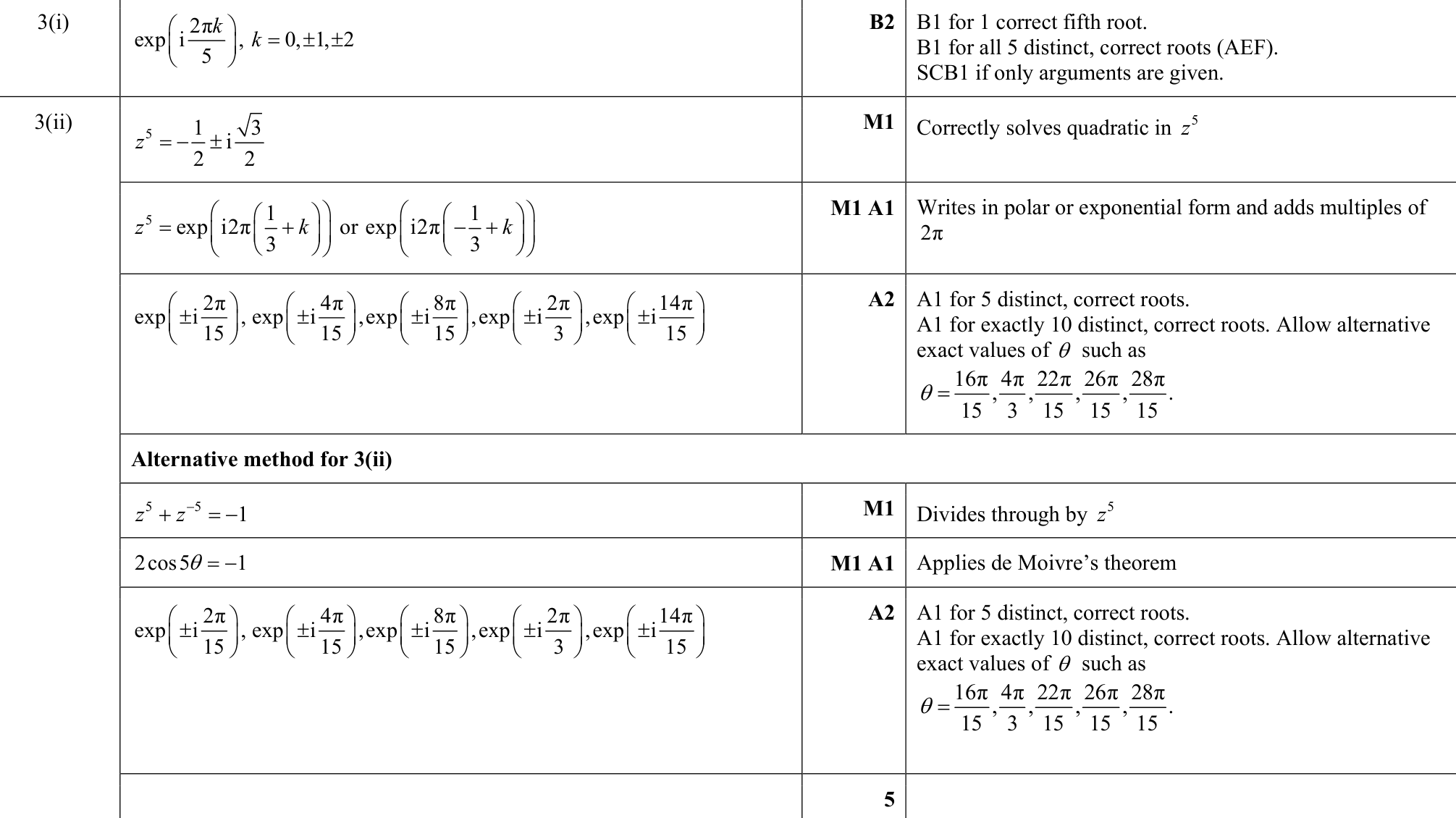
3 (i) Write down the fifth roots of unity.
(ii) Find all the roots of the equation
\(z^{10}+z^{5}+1=0\)
giving each root in the form \(\mathrm{e}^{\mathrm{i} \theta}\).
9231 P23 - Jun 2021 - Q1 - 7 marks
(a) Find \(a\) and \(b\) such that
\[z^{8}-\mathrm{i} z^{5}-z^{3}+\mathrm{i}=\left(z^{5}-a\right)\left(z^{3}-b\right) .\]
(b) Hence find the roots of
\[z^{8}-\mathrm{i} z^{5}-z^{3}+\mathrm{i}=0\]
giving your answers in the form \(r \mathrm{e}^{\mathrm{i} \theta}\), where \(r>0\) and \(0 \leqslant \theta<2 \pi\).

9231 P22 - Nov 2020 - Q3 - 4 marks
Find all the roots of the equation \((w+1)^{6}=1\), giving your answers in the form \(x+\mathrm{i} y\) where \(x\) and \(y\) are real and exact.

9231 P22 - Nov 2021 - Q4 - 10 marks
(a) Write down all the roots of the equation \(x^{5}-1=0\).
(b) Use de Moivre's theorem to show that \(\cos 4 \theta=8 \cos ^{4} \theta-8 \cos ^{2} \theta+1\).
(c) Use the results of parts (a) and (b) to express each real root of the equation
\[8 x^{9}-8 x^{7}+x^{5}-8 x^{4}+8 x^{2}-1=0\]
in the form \(\cos k \pi\), where \(k\) is a rational number.

9231 P11 - Jun 2010 - Q9 - 11 marks
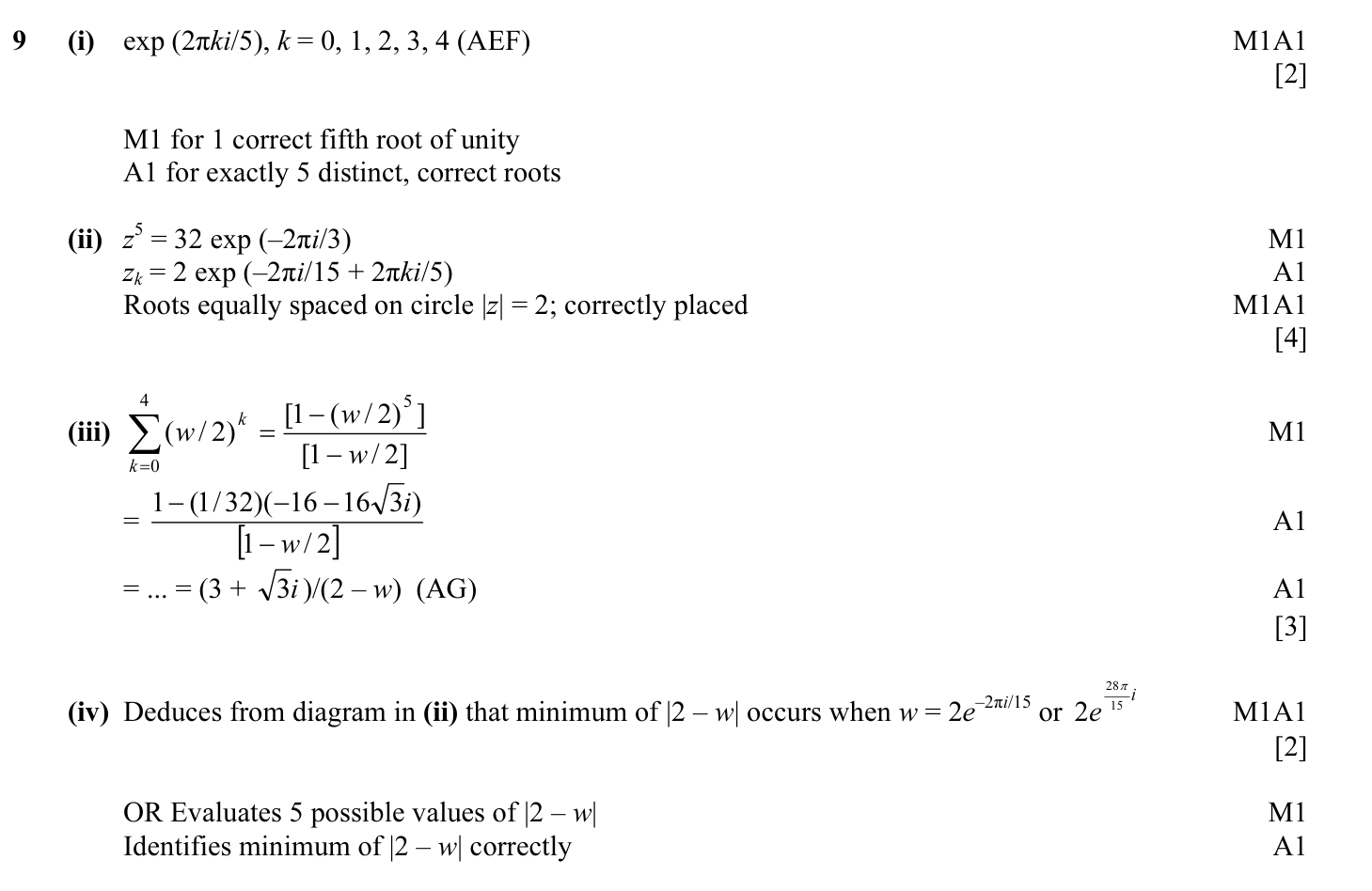
(i) Write down the five fifth roots of unity.
(ii) Hence find all the roots of the equation
\(z^{5}+16+(16 \sqrt{ } 3) i=0\)
giving answers in the form \(r \mathrm{e}^{\mathrm{i} q \pi}\), where \(r\gt 0\) and \(q\) is a rational number. Show these roots on an Argand diagram.
Let \(w\) be a root of the equation in part (ii).
(iii) Show that
\(\sum_{k=0}^{4}\left(\frac{w}{2}\right)^{k}=\frac{3+i \sqrt{ } 3}{2-w} .\)
(iv) Identify the root for which \(|2-w|\) is least.