9231 P11 - Nov 2019 - Q9 - 11 marks
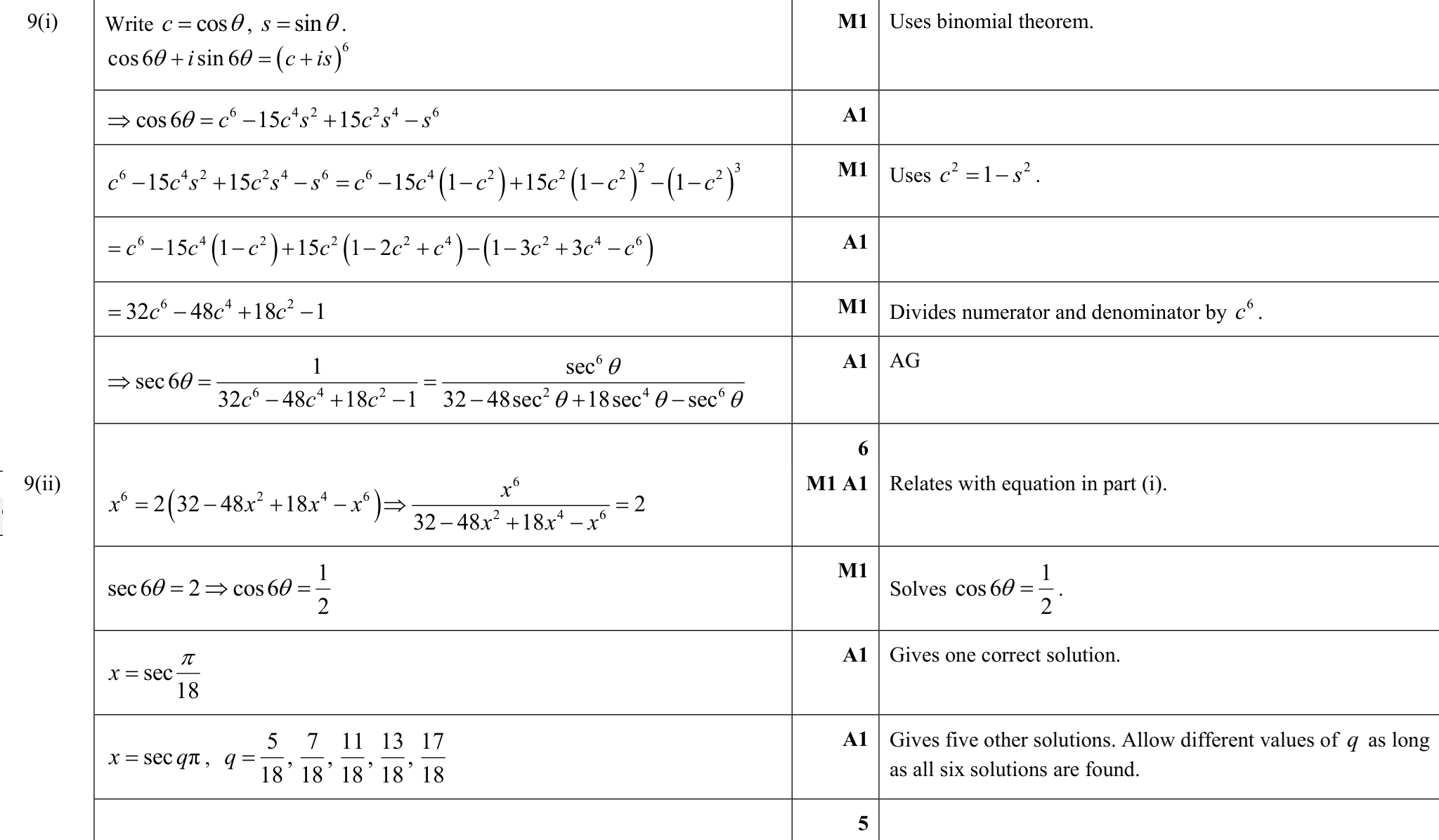
(i) Use de Moivre's theorem to show that
\(\sec 6 \theta=\frac{\sec ^{6} \theta}{32-48 \sec ^{2} \theta+18 \sec ^{4} \theta-\sec ^{6} \theta}\)
(ii) Hence obtain the roots of the equation
\(3 x^{6}-36 x^{4}+96 x^{2}-64=0\)
in the form sec \(q \pi\), where \(q\) is rational.
9231 P13 - Jun 2018 - Q3 - 8 marks
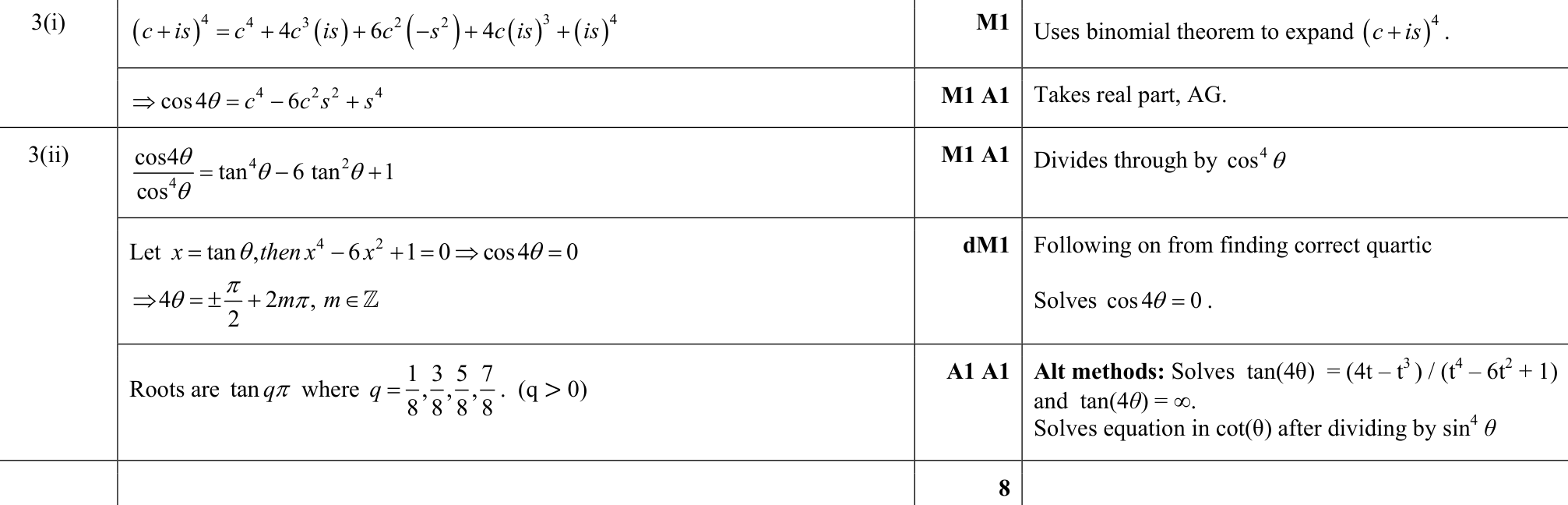
(i) Use de Moivre's theorem to show that
\(\cos 4 \theta=\cos ^{4} \theta-6 \cos ^{2} \theta \sin ^{2} \theta+\sin ^{4} \theta\)
(ii) Hence find all the roots of the equation
\(x^{4}-6 x^{2}+1=0\)
in the form \(\tan q \pi\), where \(q\) is a positive rational number.
9231 P11 - Nov 2018 - Q7 - 10 marks
(i) Use de Moivre's theorem to show that
\(\sin 8 \theta=8 \sin \theta \cos \theta\left(1-10 \sin ^{2} \theta+24 \sin ^{4} \theta-16 \sin ^{6} \theta\right)\).
moniainatian
(ii) Use the equation \(\frac{\sin 8 \theta}{\sin 2 \theta}=0\) to find the roots of
\(16 x^{6}-24 x^{4}+10 x^{2}-1=0\)
in the form \(\sin k \pi\), where \(k\) is rational.

9231 P21 - Jun 2025 - Q3 - 6 marks
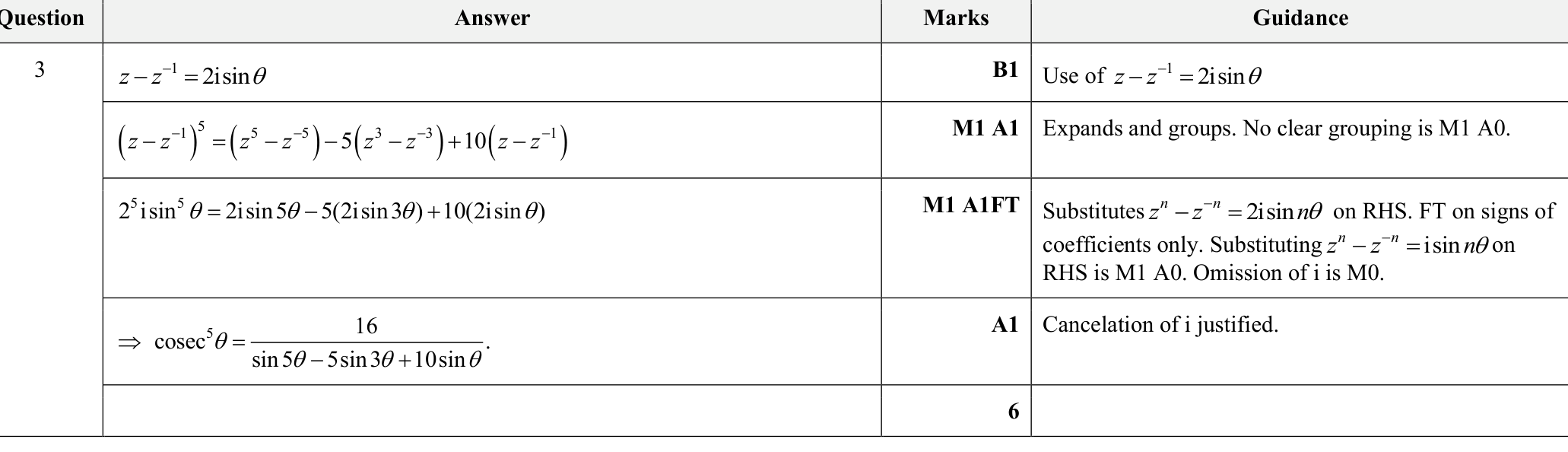
By considering the binomial expansion of \(\left(z-\frac{1}{z}\right)^{5}\), where \(z=\cos \theta+\mathrm{i} \sin \theta\), use de Moivre's theorem to show that
\(\operatorname{cosec}^{5} \theta=\frac{a}{\sin 5 \theta+b \sin 3 \theta+c \sin \theta},\)
where \(a, b\) and \(c\) are integers to be determined.
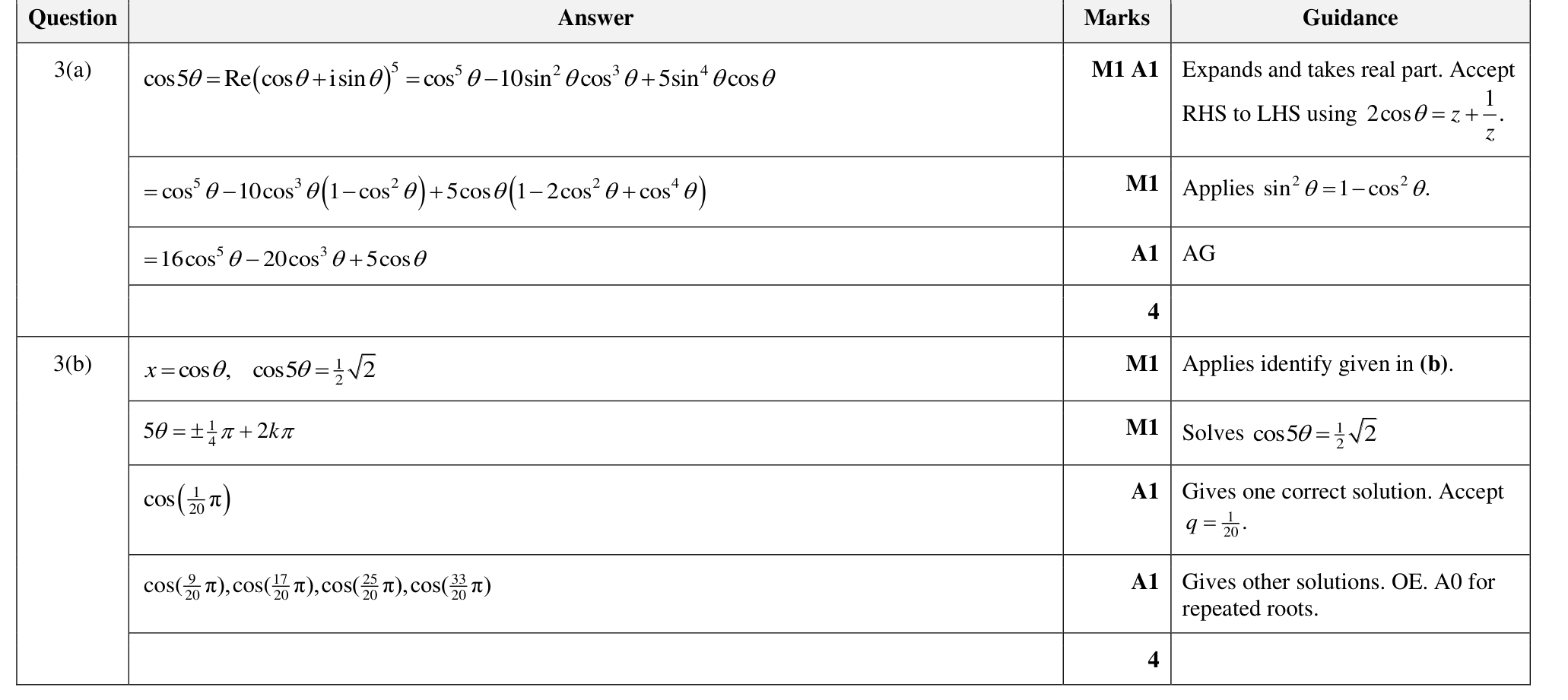
9231 P22 - Nov 2023 - Q3 - 8 marks
(a) Use de Moivre's theorem to show that
\(\cos 5 \theta=16 \cos ^{5} \theta-20 \cos ^{3} \theta+5 \cos \theta\)
(b) Hence obtain the roots of the equation
\(32 x^{5}-40 x^{3}+10 x-\sqrt{2}=0\)
in the form \(\cos (q \pi)\), where \(q\) is a rational number.
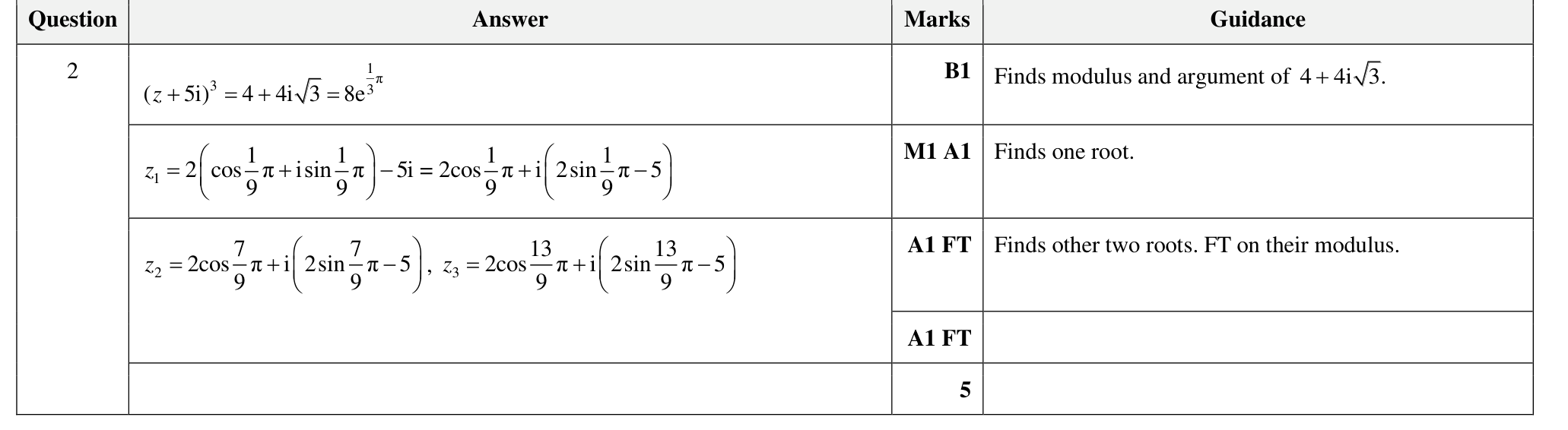
9231 P21 - Nov 2023 - Q2 - 5 marks
Find the roots of the equation \((z+5 \mathrm{i})^{3}=4+4 \sqrt{3} \mathrm{i}\), giving your answers in the form \(r \cos \theta+\mathrm{i}(r \sin \theta-5)\), where \(r\gt 0\) and \(0\lt \theta\lt 2 \pi\).
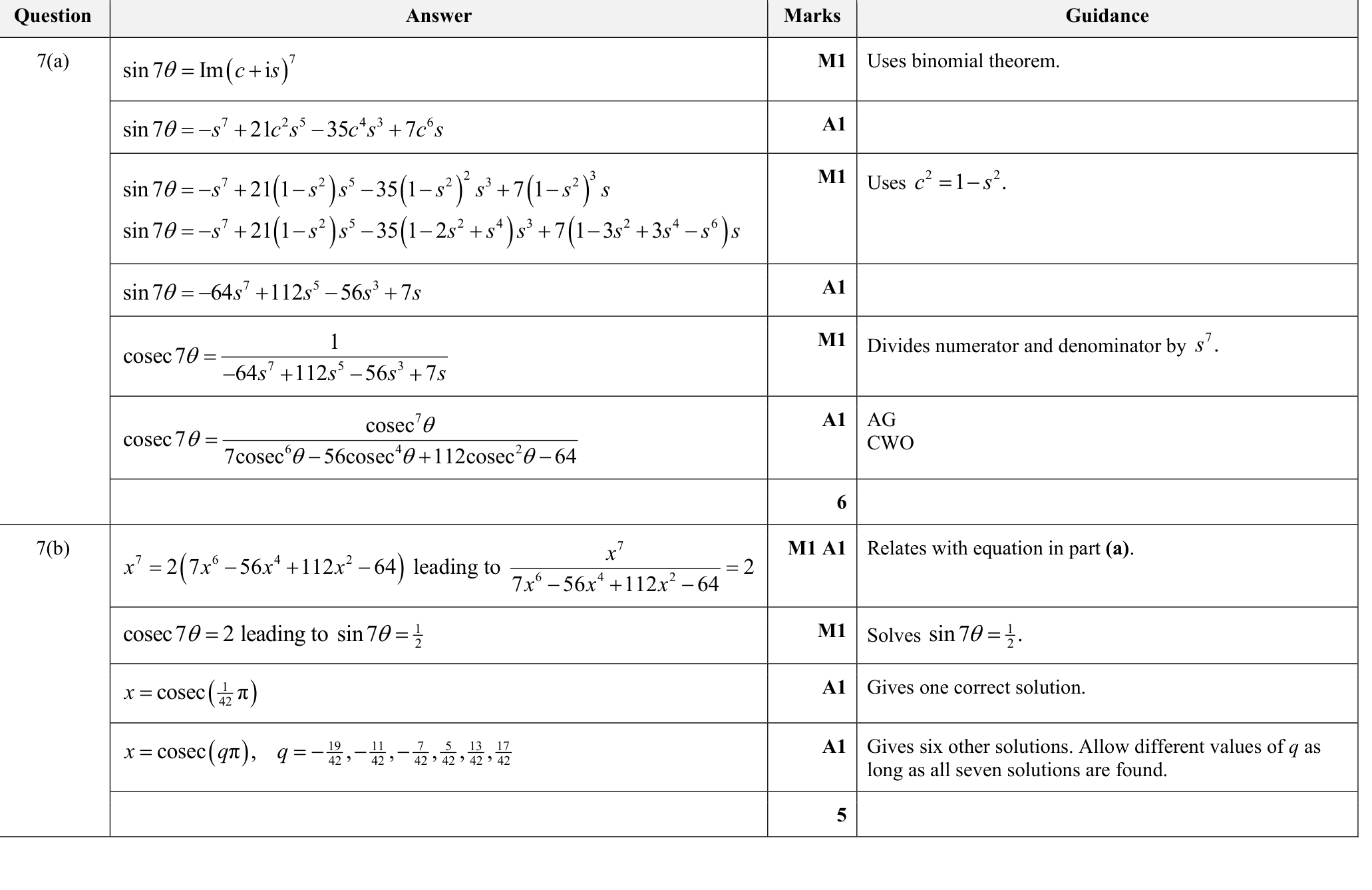
9231 P21 - Jun 2022 - Q7 - 11 marks
(a) Use de Moivre's theorem to show that
\(\operatorname{cosec} 7 \theta=\frac{\operatorname{cosec}^{7} \theta}{7 \operatorname{cosec}^{6} \theta-56 \operatorname{cosec}^{4} \theta+112 \operatorname{cosec}^{2} \theta-64}\)
(b) Hence obtain the roots of the equation
\(x^{7}-14 x^{6}+112 x^{4}-224 x^{2}+128=0\)
in the form \(\operatorname{cosec} q \pi\), where \(q\) is rational.
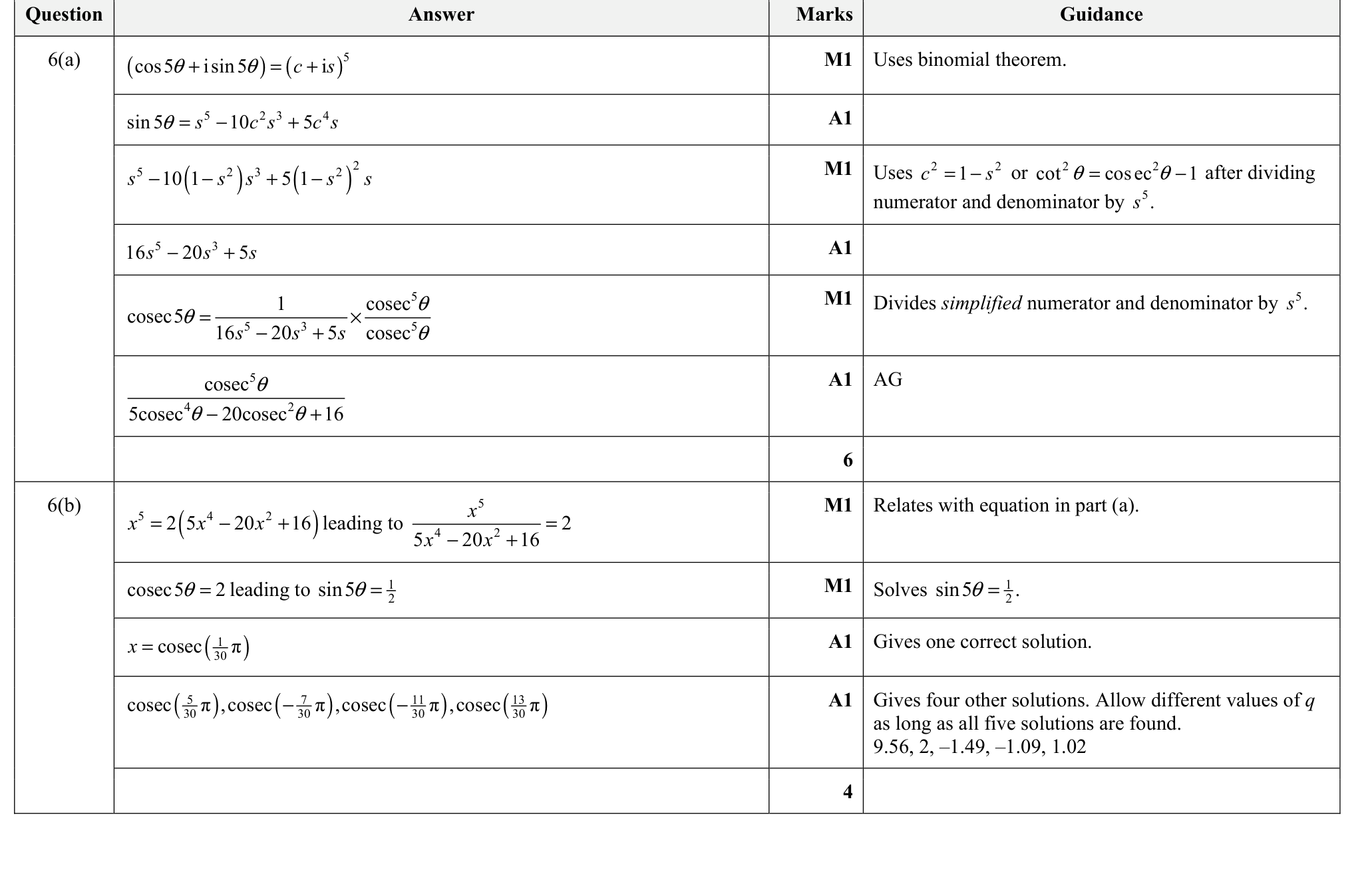
9231 P21 - Nov 2021 - Q6 - 10 marks
(a) Use de Moivre's theorem to show that
\(\operatorname{cosec} 5 \theta=\frac{\operatorname{cosec}^{5} \theta}{5 \operatorname{cosec}^{4} \theta-20 \operatorname{cosec}^{2} \theta+16} .\)
(b) Hence obtain the roots of the equation
\(x^{5}-10 x^{4}+40 x^{2}-32=0\)
in the form \(\operatorname{cosec}(q \pi)\), where \(q\) is rational.
9231 P23 - Jun 2020 - Q8 - 15 marks
(a) Use de Moivre's theorem to show that \(\sin ^{6} \theta=-\frac{1}{32}(\cos 6 \theta-6 \cos 4 \theta+15 \cos 2 \theta-10)\).
It is given that \(\cos ^{6} \theta=\frac{1}{32}(\cos 6 \theta+6 \cos 4 \theta+15 \cos 2 \theta+10)\).
(b) Find the exact value of \(\int_{0}^{\frac{1}{3} \pi}\left(\cos ^{6}\left(\frac{1}{4} x\right)+\sin ^{6}\left(\frac{1}{4} x\right)\right) \mathrm{d} x\).
(c) Express each root of the equation \(16 c^{6}+16\left(1-c^{2}\right)^{3}-13=0\) in the form \(\cos k \pi\), where \(k\) is a rational number.

9231 P23 - Jun 2021 - Q4 - 7 marks
By considering the binomial expansions of \(\left(z+\frac{1}{z}\right)^{5}\) and \(\left(z-\frac{1}{z}\right)^{5}\), where \(z=\cos \theta+\mathrm{i} \sin \theta\), use de Moivre's theorem to show that
\[\tan ^{5} \theta=\frac{\sin 5 \theta-a \sin 3 \theta+b \sin \theta}{\cos 5 \theta+a \cos 3 \theta+b \cos \theta}\]
where \(a\) and \(b\) are integers to be determined.

9231 P11 - Jun 2017 - Q8 - 9 marks
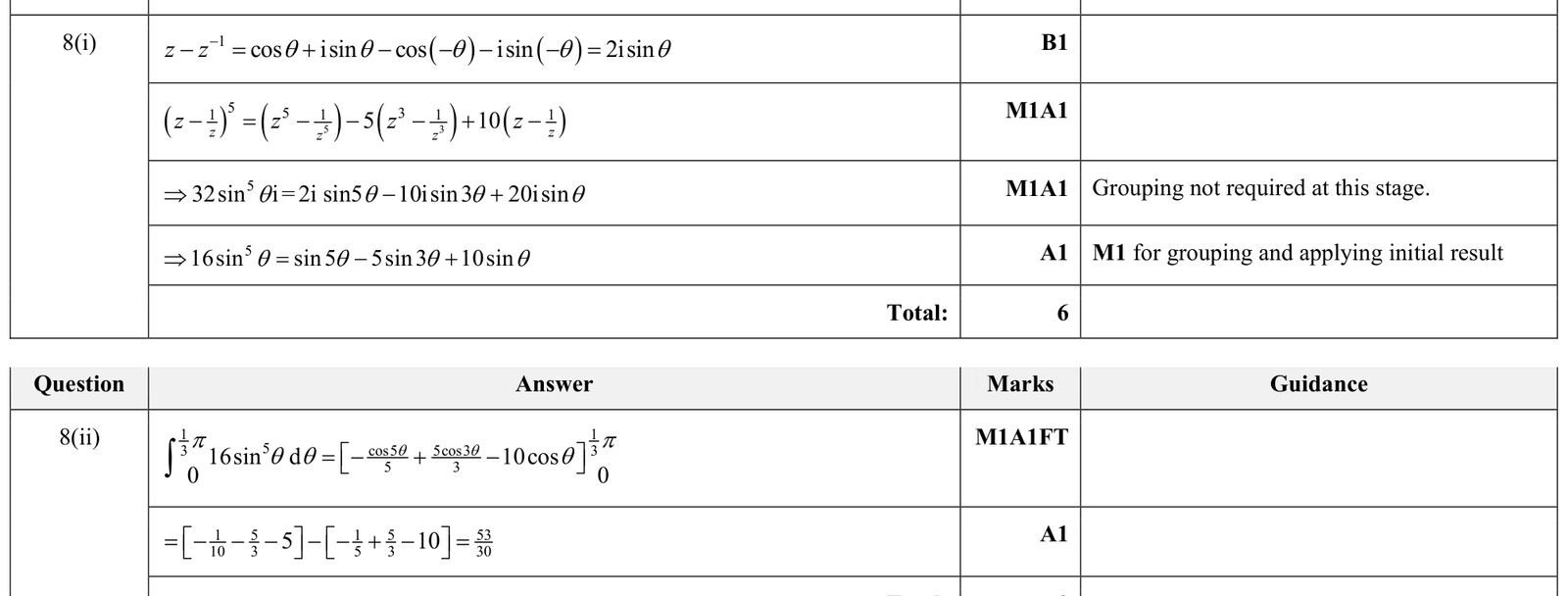
(i) Let \(z=\cos \theta+\mathrm{i} \sin \theta\). Show that \(z-\frac{1}{z}=2 \mathrm{i} \sin \theta\) and hence express \(16 \sin ^{5} \theta\) in the form \(\sin 5 \theta+p \sin 3 \theta+q \sin \theta\), where \(p\) and \(q\) are integers to be determined.
(ii) Hence find the exact value of \(\int_{0}^{\frac{1}{3} \pi} 16 \sin ^{5} \theta \mathrm{~d} \theta\).
9231 P11 - Nov 2017 - Q10 - 14 marks
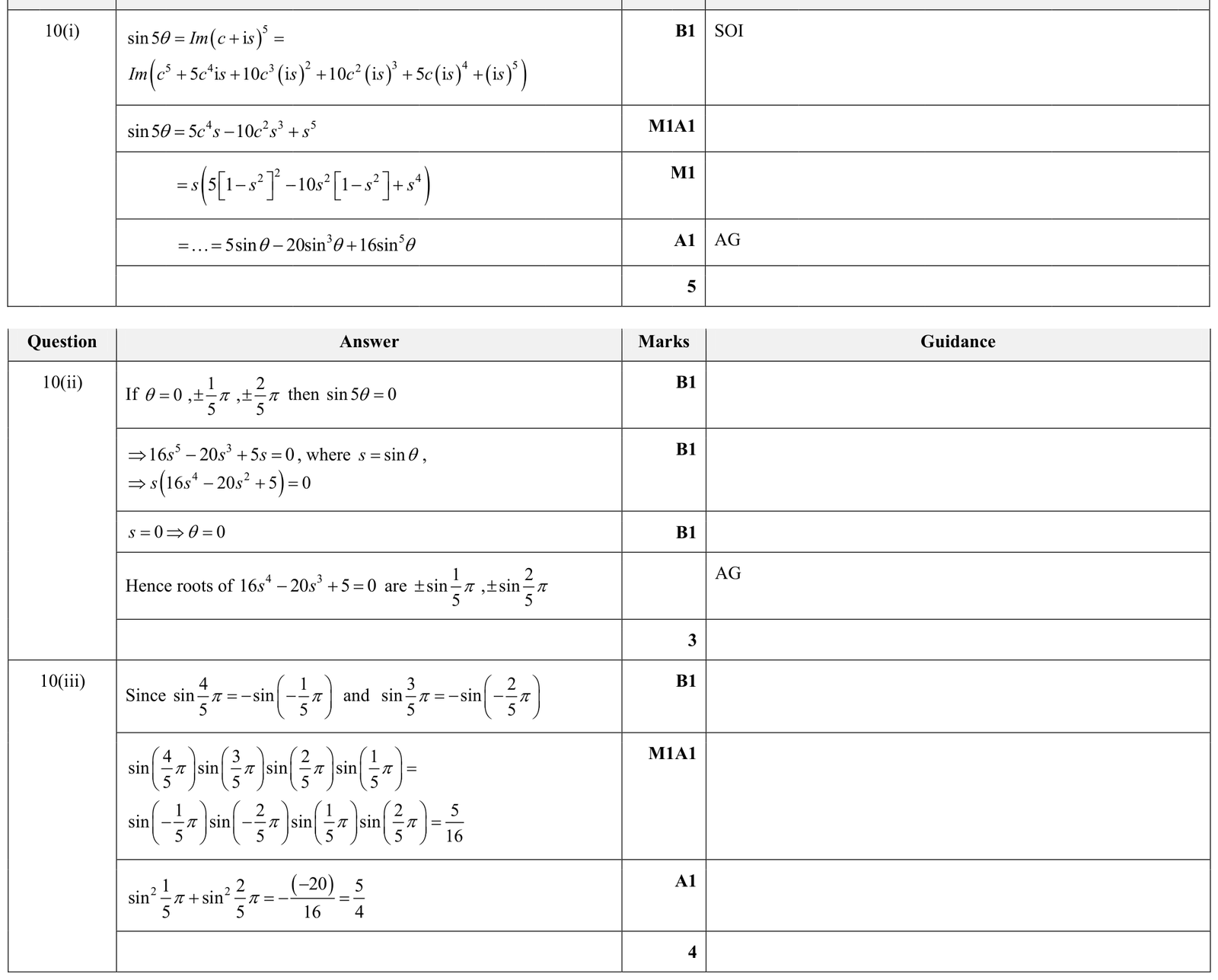
(i) Use de Moivre's theorem to show that
\(\sin 5 \theta=5 \sin \theta-20 \sin ^{3} \theta+16 \sin ^{5} \theta .\)
(ii) Hence explain why the roots of the equation \(16 x^{4}-20 x^{2}+5=0\) are \(x= \pm \sin \frac{1}{5} \pi\) and \(x= \pm \sin \frac{2}{5} \pi\).
(iii) Without using a calculator, find the exact values of
\(\sin \frac{1}{5} \pi \sin \frac{2}{5} \pi \sin \frac{3}{5} \pi \sin \frac{4}{5} \pi \quad \text { and } \quad \sin ^{2}\left(\frac{1}{5} \pi\right)+\sin ^{2}\left(\frac{2}{5} \pi\right) .\)
9231 P12 - Nov 2014 - Q6 - 9 marks
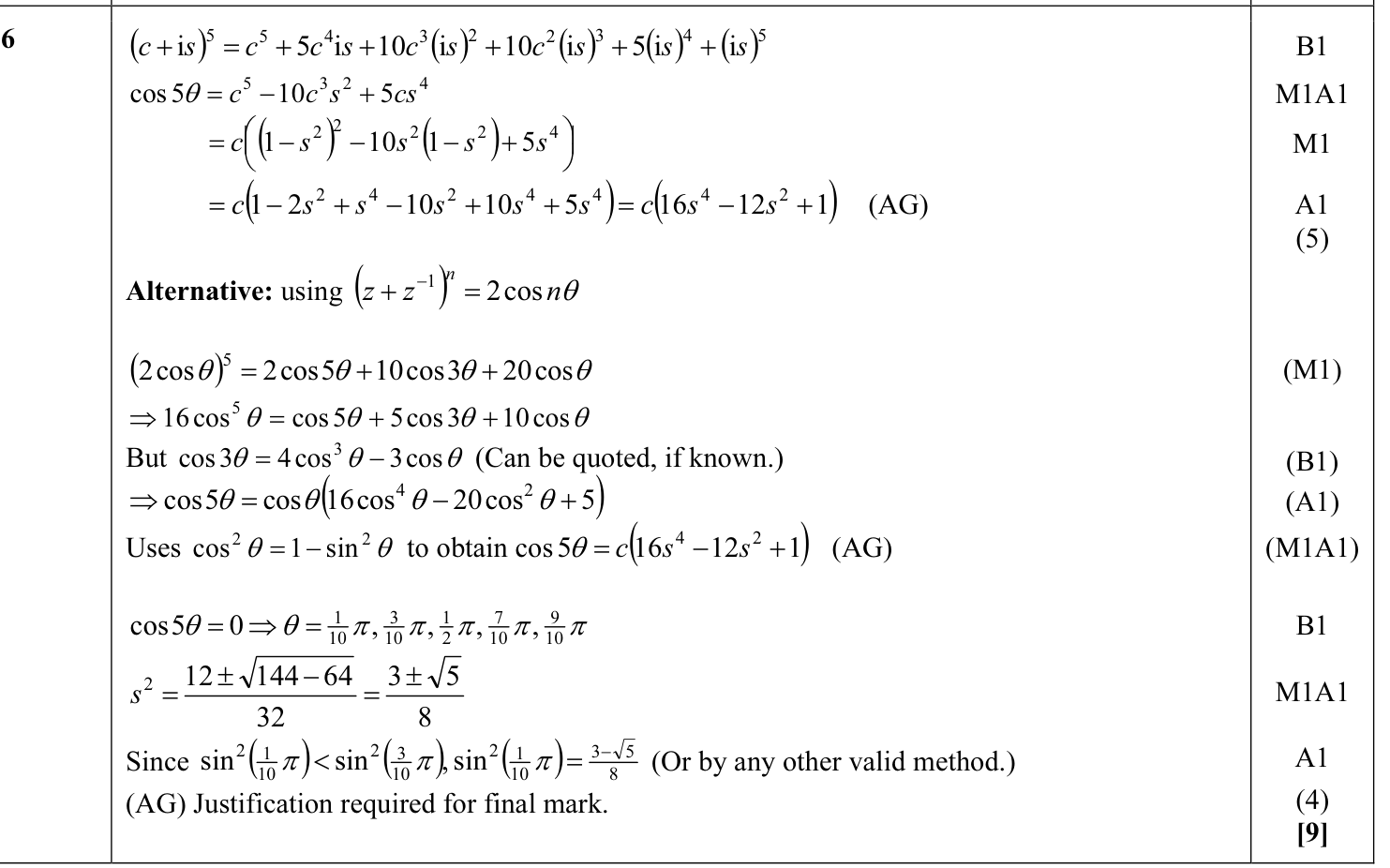
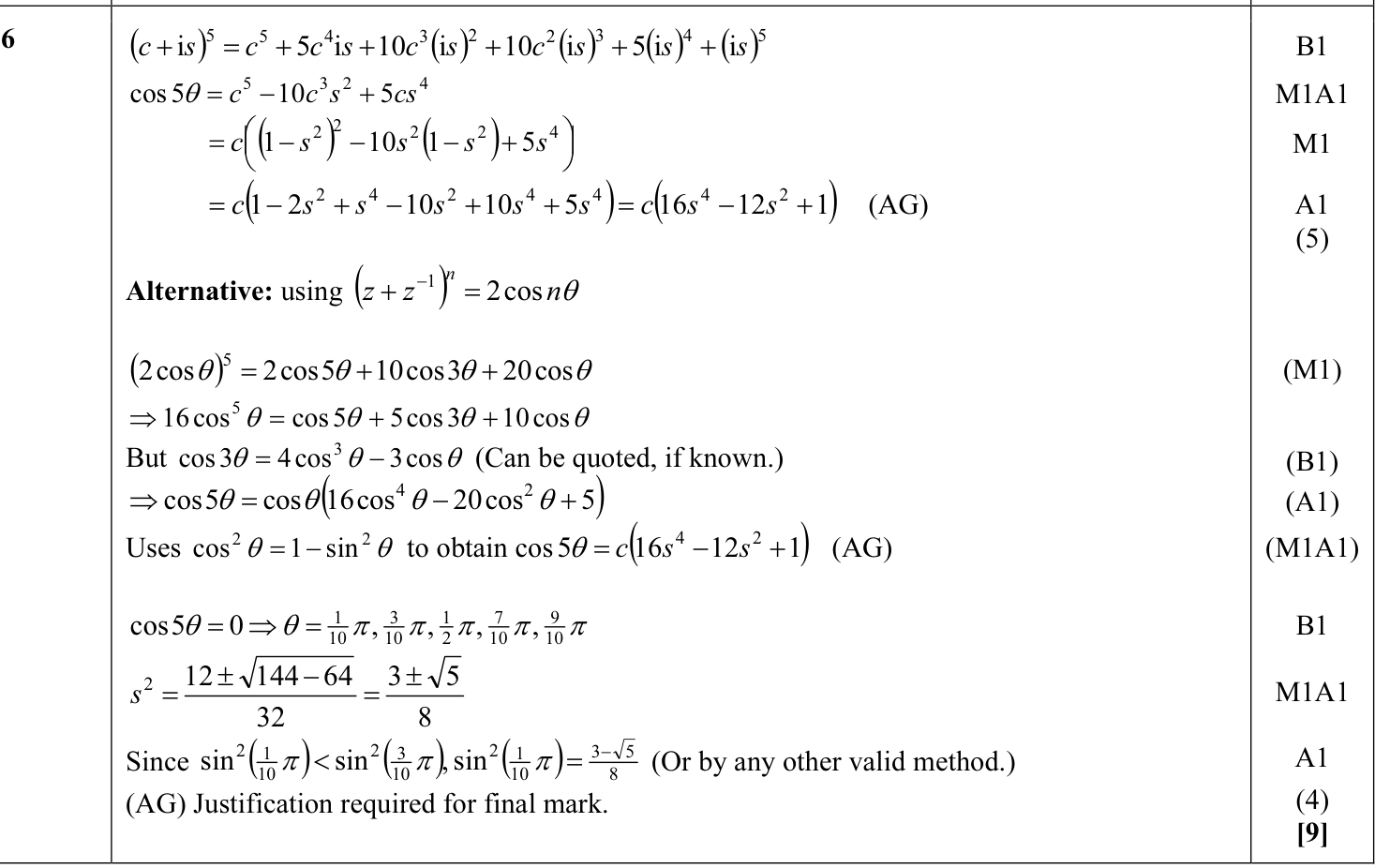
Use de Moivre's theorem to show that
\(\cos 5 \theta \equiv \cos \theta\left(16 \sin ^{4} \theta-12 \sin ^{2} \theta+1\right)\)
By considering the equation \(\cos 5 \theta=0\), show that the exact value of \(\sin ^{2}\left(\frac{1}{10} \pi\right)\) is \(\frac{3-\sqrt{ } 5}{8}\).
9231 P11 - Nov 2014 - Q6 - 9 marks
Use de Moivre's theorem to show that
\(\cos 5 \theta \equiv \cos \theta\left(16 \sin ^{4} \theta-12 \sin ^{2} \theta+1\right)\)
By considering the equation \(\cos 5 \theta=0\), show that the exact value of \(\sin ^{2}\left(\frac{1}{10} \pi\right)\) is \(\frac{3-\sqrt{ } 5}{8}\).