9231 P23 - Jun 2025 - Q6 - 10 marks
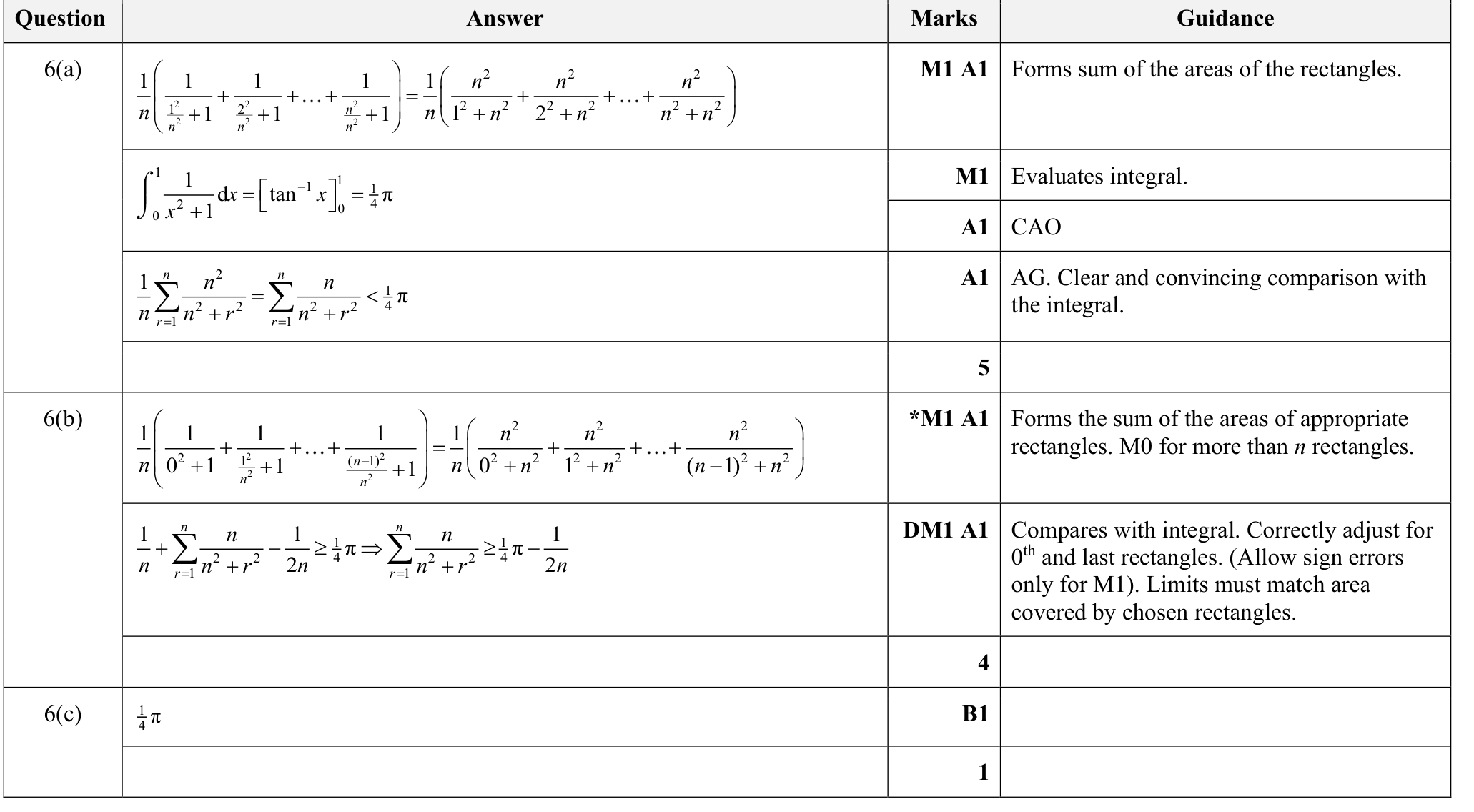
The diagram shows the curve with equation \(y=\frac{1}{x^{2}+1}\) for \(0 \leqslant x \leqslant 1\), together with a set of \(n\) rectangles of width \(\frac{1}{n}\).
(a) By considering the sum of the areas of these rectangles, show that
\(\sum_{r=1}^{n} \frac{n}{n^{2}+r^{2}}<\frac{1}{4} \pi .\)
(b) Use a similar method to find a lower bound for \(\sum_{r=1}^{n} \frac{n}{n^{2}+r^{2}}\). Give your answer in terms of \(n\) and \(\pi\).
(c) Deduce the exact value of \(\lim _{n \rightarrow \infty} \sum_{r=1}^{n} \frac{n}{n^{2}+r^{2}}\).
9231 P21 - Jun 2025 - Q4 - 9 marks
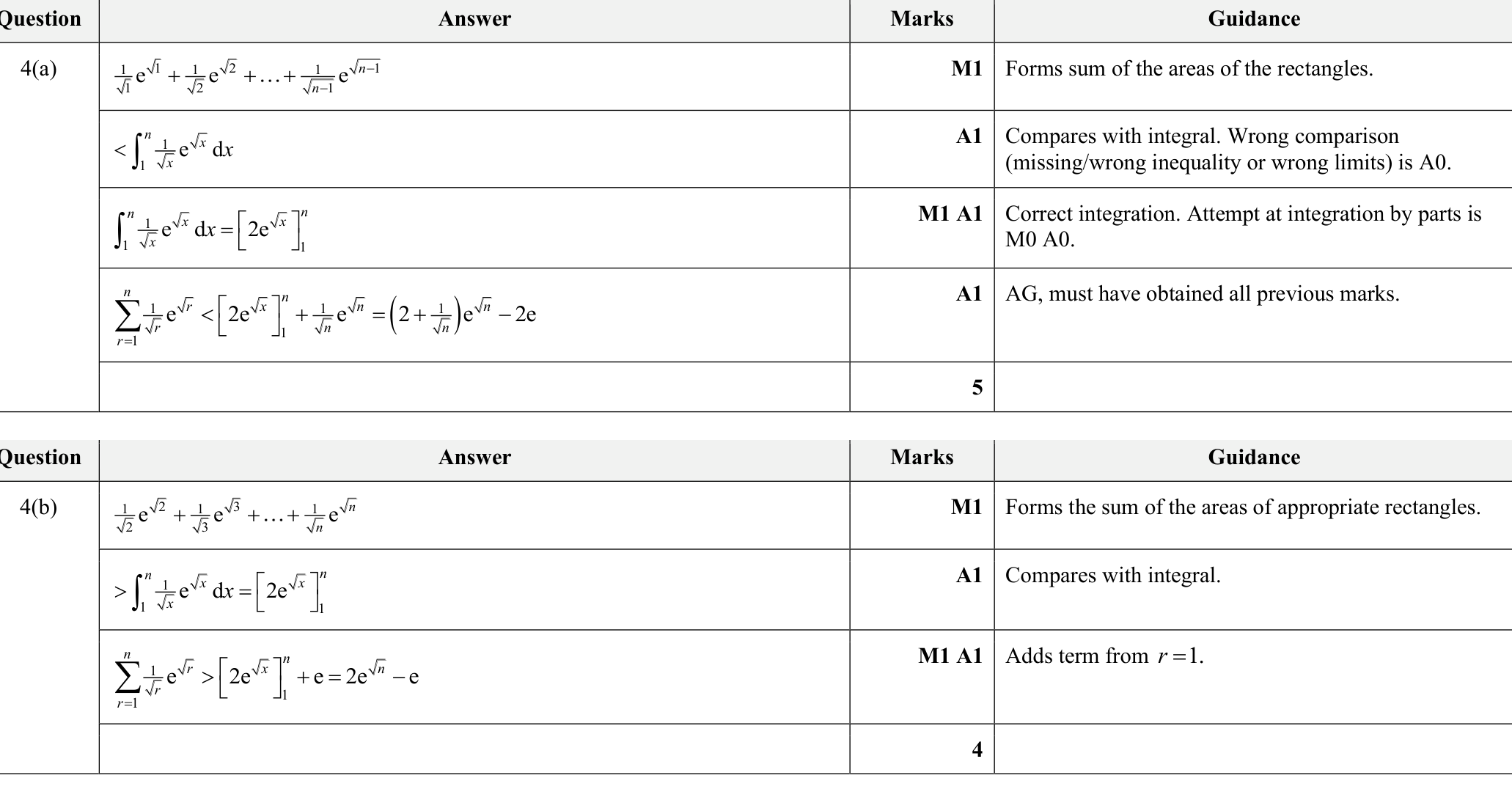
The diagram shows the curve with equation \(y=\frac{1}{\sqrt{x}} \mathrm{e}^{\sqrt{x}}\) for \(x \geqslant 1\), together with a set of \(n-1\) rectangles of unit width.
(a) By considering the sum of the areas of these rectangles, show that
\(\sum_{r=1}^{n} \frac{1}{\sqrt{r}} \mathrm{e}^{\sqrt{r}}<\left(2+\frac{1}{\sqrt{n}}\right) \mathrm{e}^{\sqrt{n}}-2 \mathrm{e} .\)
(b) Use a similar method to find, in terms of \(n\), a lower bound for \(\sum_{r=1}^{n} \frac{1}{\sqrt{r}} \mathrm{e}^{\sqrt{r}}\).
9231 P23 - Jun 2024 - Q4 - 10 marks
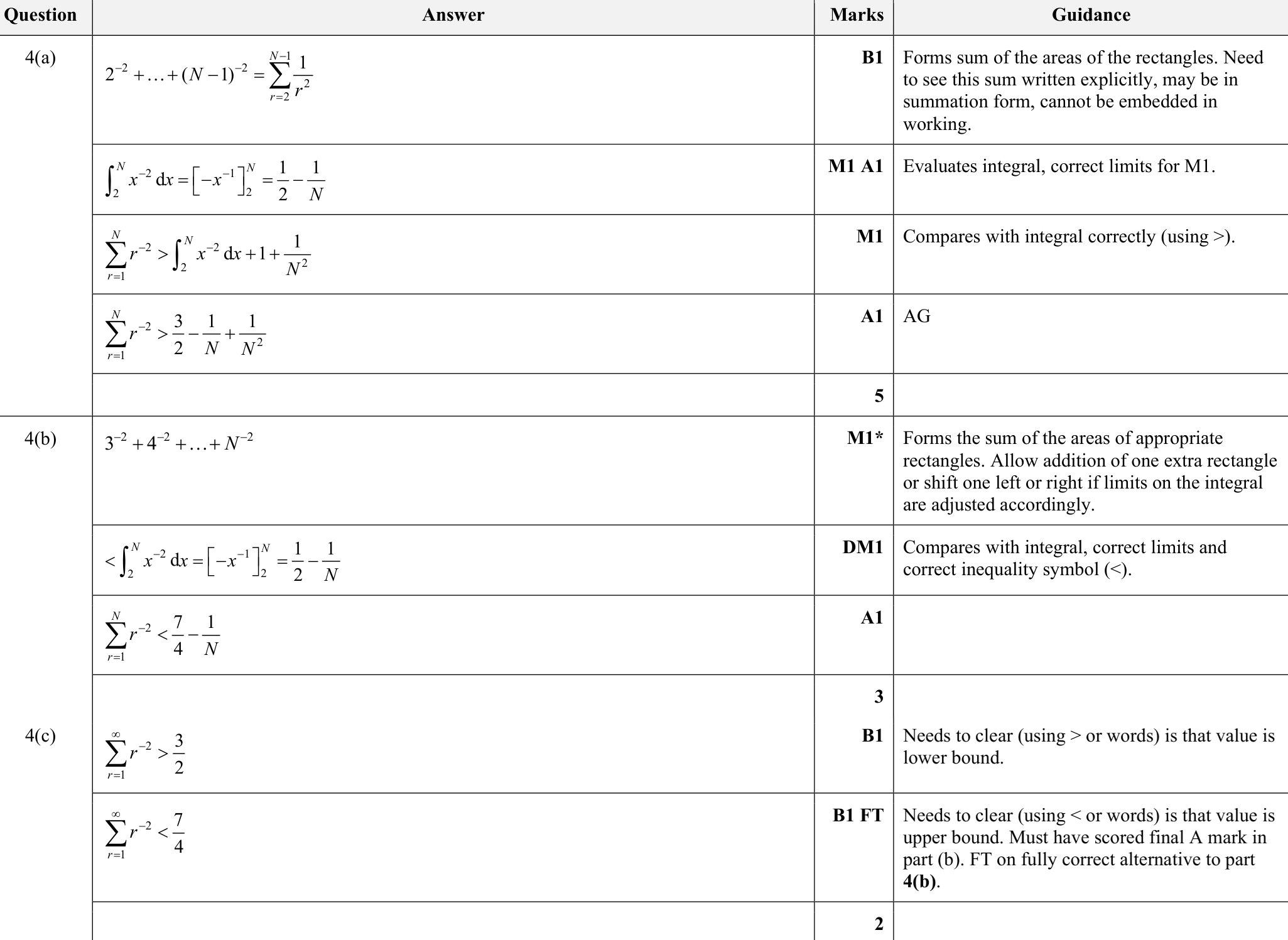
The diagram shows the curve with equation \(y=x^{-2}\) for \(2 \leqslant x \leqslant N\) together with a set of \((N-2)\) rectangles of unit width.
(a) By considering the sum of the areas of these rectangles, show that
\(\sum_{r=1}^{N} \frac{1}{r^{2}}\gt \frac{3}{2}-\frac{1}{N}+\frac{1}{N^{2}}\)
(b) Use a similar method to find, in terms of \(N\), an upper bound for \(\sum_{r=1}^{N} \frac{1}{r^{2}}\).
(c) Deduce lower and upper bounds for \(\sum_{r=1}^{\infty} \frac{1}{r^{2}}\).
9231 P21 - Jun 2024 - Q5 - 11 marks
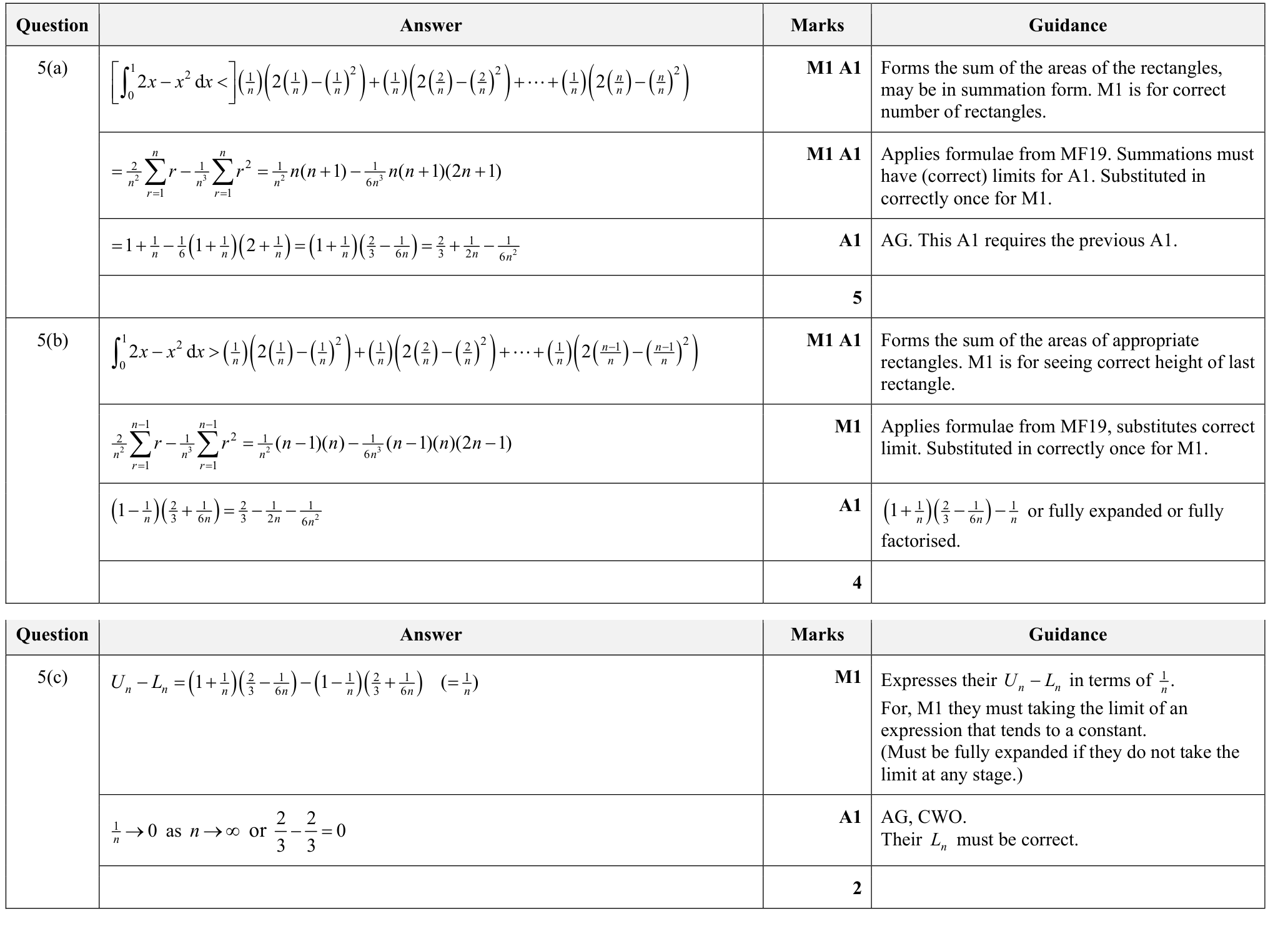
The diagram shows the curve with equation \(y=2 x-x^{2}\) for \(0 \leqslant x \leqslant 1\), together with a set of \(n\) rectangles of width \(\frac{1}{n}\).
(a) By considering the sum of the areas of these rectangles, show that \(\int_{0}^{1}\left(2 x-x^{2}\right) \mathrm{d} x\lt U_{n}\), where
\(U_{n}=\left(1+\frac{1}{n}\right)\left(\frac{2}{3}-\frac{1}{6 n}\right) .\)
(b) Use a similar method to find, in terms of \(n\), a lower bound \(L_{n}\) for \(\int_{0}^{1}\left(2 x-x^{2}\right) \mathrm{d} x\).
(c) Show that \(\lim _{n \rightarrow \infty}\left(U_{n}-L_{n}\right)=0\).
9231 P23 - Jun 2023 - Q6 - 11 marks
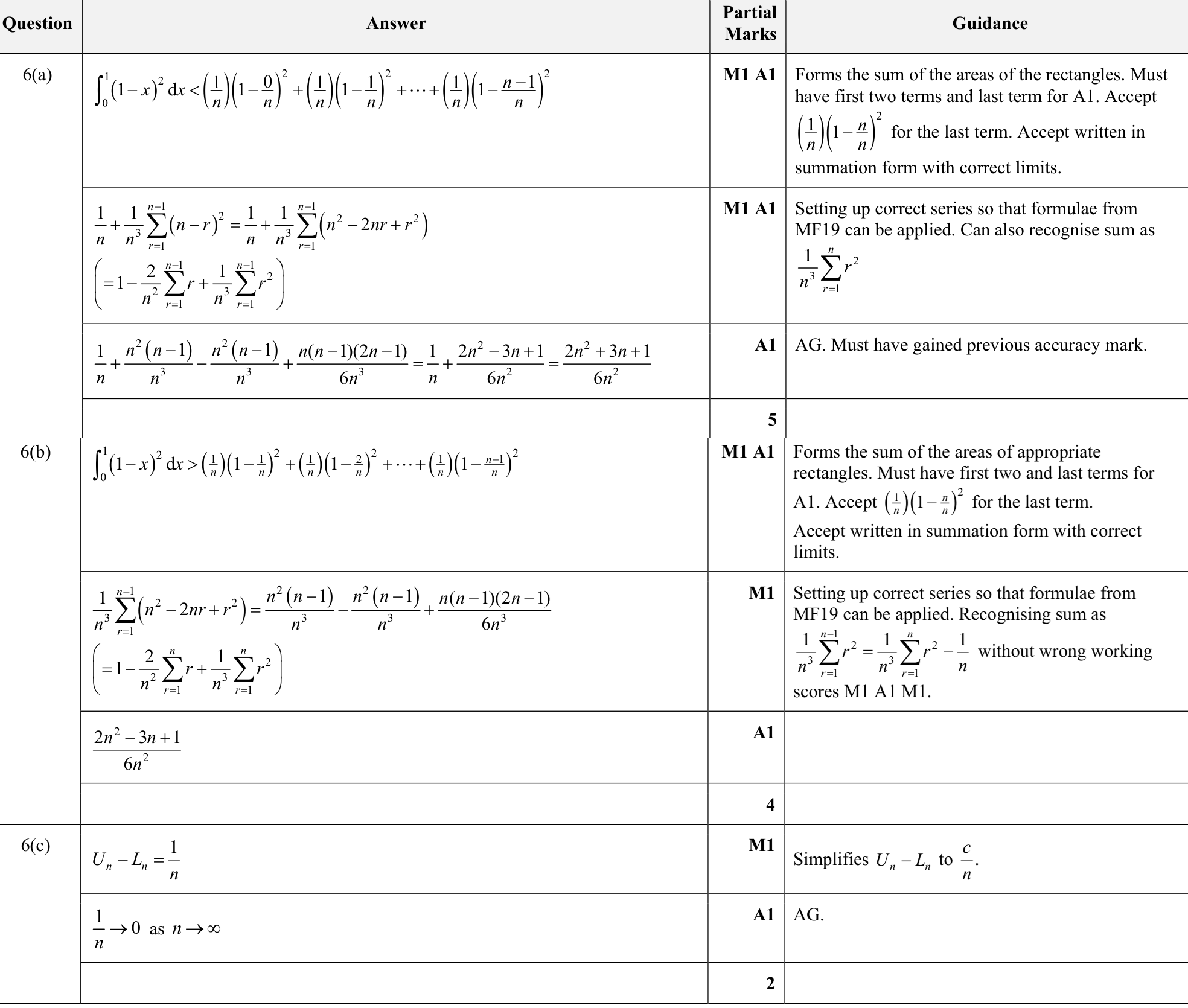
The diagram shows the curve with equation \(y=(1-x)^{2}\) for \(0 \leqslant x \leqslant 1\), together with a set of \(n\) rectangles of width \(\frac{1}{n}\).
(a) By considering the sum of the areas of these rectangles, show that \(\int_{0}^{1}(1-x)^{2} \mathrm{~d} x\lt U_{n}\), where
\(U_{n}=\frac{2 n^{2}+3 n+1}{6 n^{2}} .\)
(b) Use a similar method to find, in terms of \(n\), a lower bound \(L_{n}\) for \(\int_{0}^{1}(1-x)^{2} \mathrm{~d} x\).
(c) Show that \(\lim _{n \rightarrow \infty}\left(U_{n}-L_{n}\right)=0\).
9231 P21 - Jun 2023 - Q7 - 11 marks
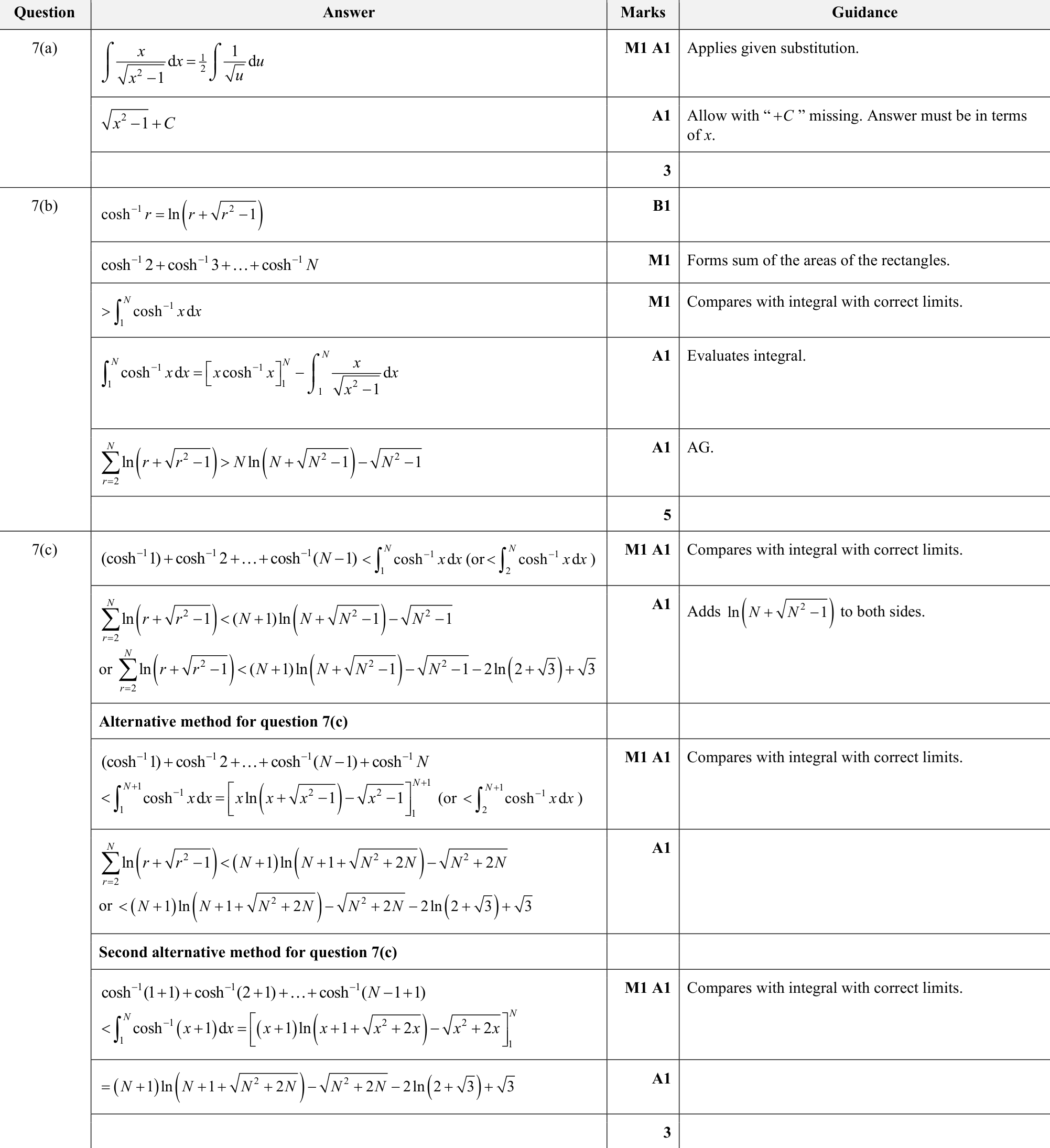
(a) Use the substitution \(u=x^{2}-1\) to find \(\int \frac{x}{\sqrt{x^{2}-1}} \mathrm{~d} x\).
The diagram shows the curve with equation \(y=\cosh ^{-1} x\) together with a set of \((N-1)\) rectangles of unit width.
(b) By considering the sum of the areas of these rectangles, show that
\(\sum_{r=2}^{N} \ln \left(r+\sqrt{r^{2}-1}\right)\gt N \ln \left(N+\sqrt{N^{2}-1}\right)-\sqrt{N^{2}-1}\)
(c) Use a similar method to find, in terms of \(N\), an upper bound for \(\sum_{r=2}^{N} \ln \left(r+\sqrt{r^{2}-1}\right)\).
9231 P22 - Nov 2024 - Q6 - 16 marks
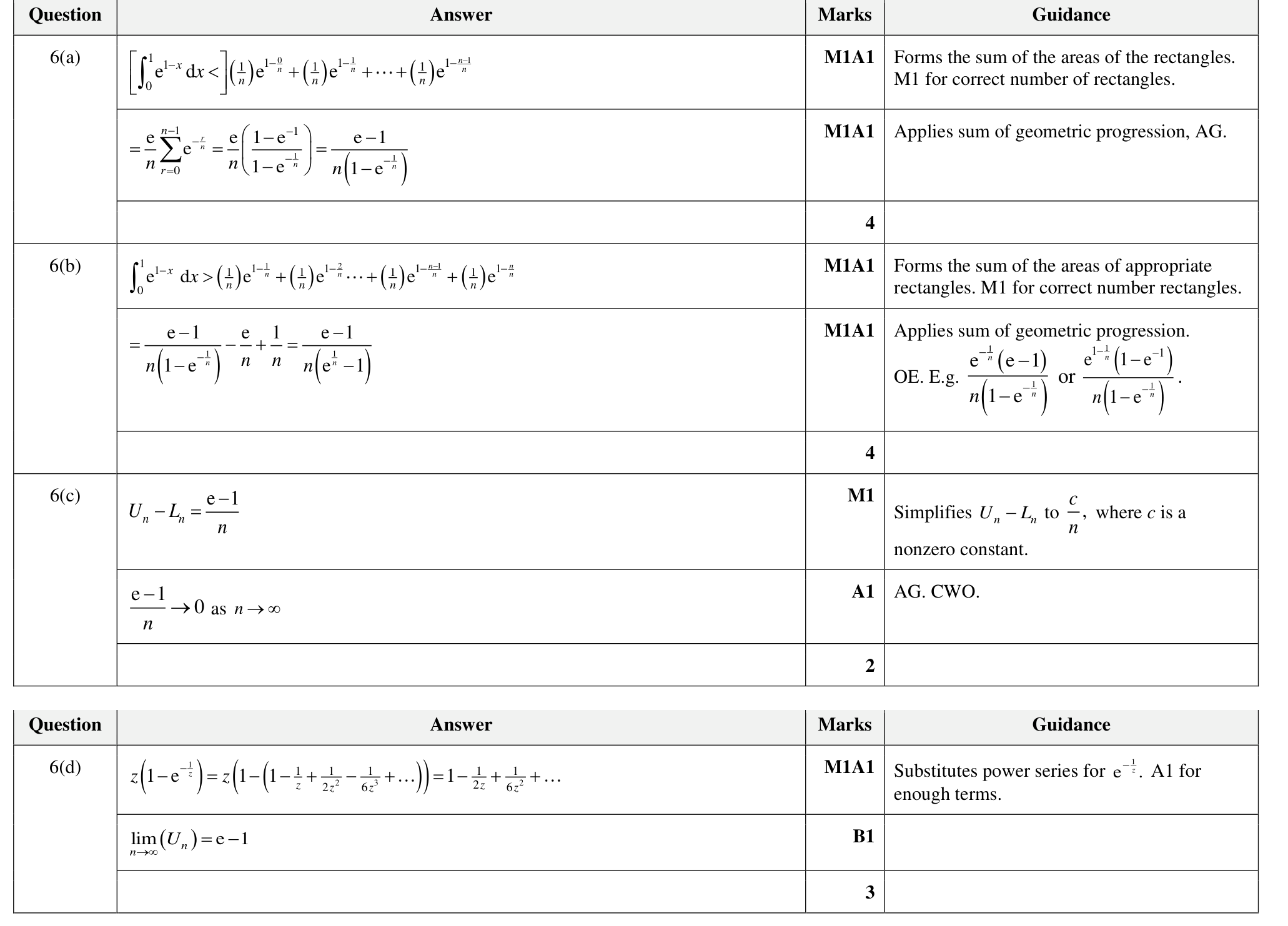
The diagram shows the curve with equation \(y=\mathrm{e}^{1-x}\) for \(0 \leqslant x \leqslant 1\), together with a set of \(n\) rectangles of width \(\frac{1}{n}\).
(a) By considering the sum of the areas of these rectangles, show that \(\int_{0}^{1} \mathrm{e}^{1-x} \mathrm{~d} x\lt U_{n}\), where
\(U_{n}=\frac{\mathrm{e}-1}{n\left(1-\mathrm{e}^{-\frac{1}{n}}\right)} .\)
(b) Use a similar method to find, in terms of \(n\), a lower bound \(L_{n}\) for \(\int_{0}^{1} \mathrm{e}^{1-x} \mathrm{~d} x\).
(c) Show that \(\lim _{n \rightarrow \infty}\left(U_{n}-L_{n}\right)=0\).
(d) Use the Maclaurin's series for \(\mathrm{e}^{x}\) given in the list of formulae (MF19) to find the first three terms of the series expansion of \(z\left(1-\mathrm{e}^{-\frac{1}{z}}\right)\), in ascending powers of \(\frac{1}{z}\), and deduce the value of \(\lim _{n \rightarrow \infty}\left(U_{n}\right)\).
9231 P21 - Nov 2024 - Q6 - 14 marks
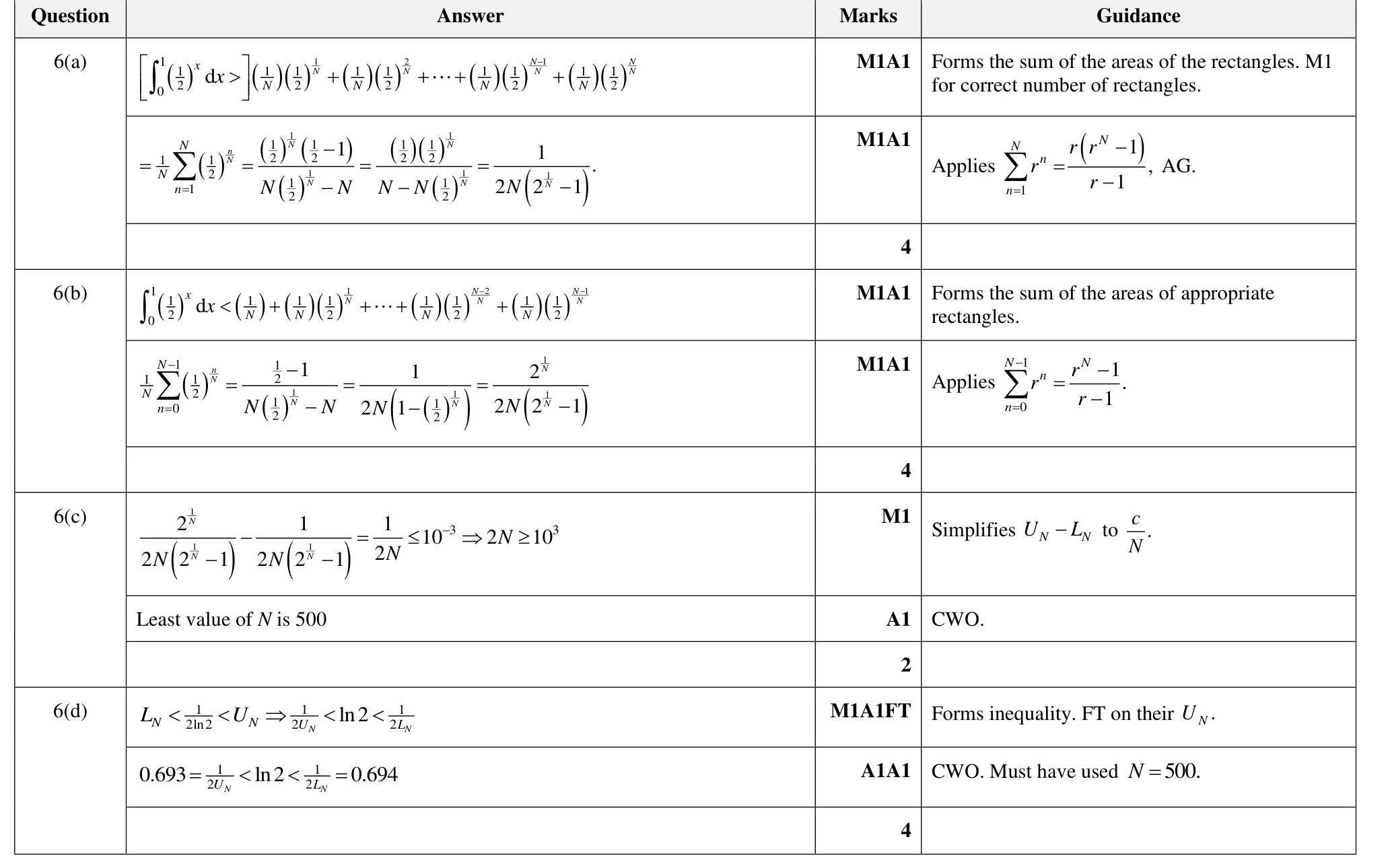
The diagram shows the curve with equation \(y=\left(\frac{1}{2}\right)^{x}\) for \(0 \leqslant x \leqslant 1\), together with a set of \(N\) rectangles each of width \(\frac{1}{N}\).
(a) By considering the sum of the areas of these rectangles, show that \(\int_{0}^{1}\left(\frac{1}{2}\right)^{x} \mathrm{~d} x\gt L_{N}\), where
\(L_{N}=\frac{1}{2 N\left(2^{\frac{1}{N}}-1\right)} .\)
(b) Use a similar method to find, in terms of \(N\), an upper bound \(U_{N}\) for \(\int_{0}^{1}\left(\frac{1}{2}\right)^{x} \mathrm{~d} x\).
(c) Find the least value of \(N\) such that \(U_{N}-L_{N} \leqslant 10^{-3}\).
(d) Given that \(\int_{0}^{1}\left(\frac{1}{2}\right)^{x} \mathrm{~d} x=\frac{1}{2 \ln 2}\), use the value of \(N\) found in part (c) to find upper and lower bounds for \(\ln 2\).
9231 P22 - Nov 2023 - Q5 - 10 marks
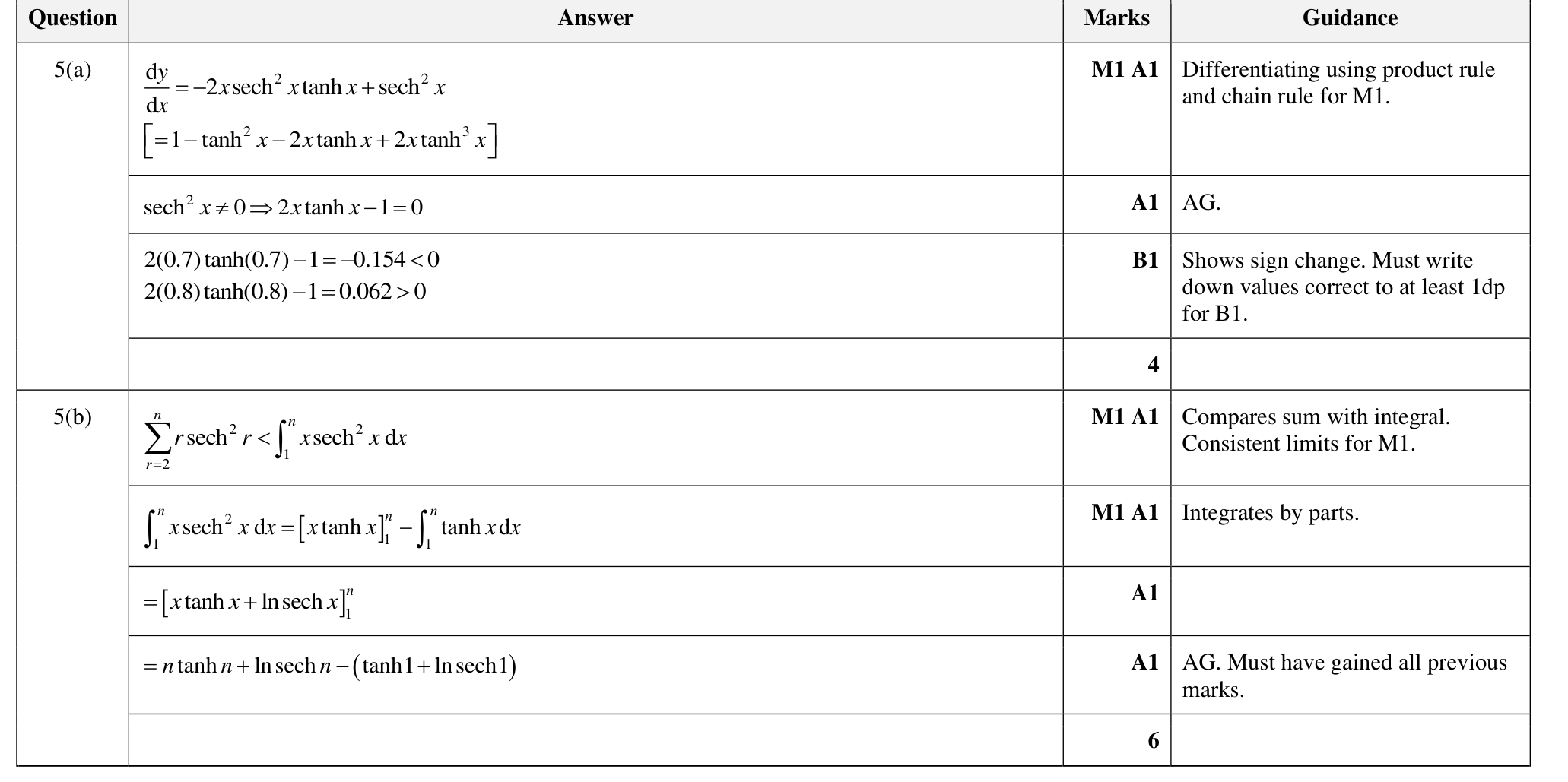
The diagram shows part of the curve \(y=x \operatorname{sech}^{2} x\) and its maximum point \(M\).
(a) Show that, at \(M\),
\(2 x \tanh x-1=0\)
and verify that this equation has a root between 0.7 and 0.8 .
(b) By considering a suitable set of rectangles, use the diagram to show that
\(\sum_{r=2}^{n} r \operatorname{sech}^{2} r\lt n \tanh n+\ln \operatorname{sech} n-\tanh 1-\ln \operatorname{sech} 1 .\)
9231 P21 - Jun 2022 - Q4 - 10 marks
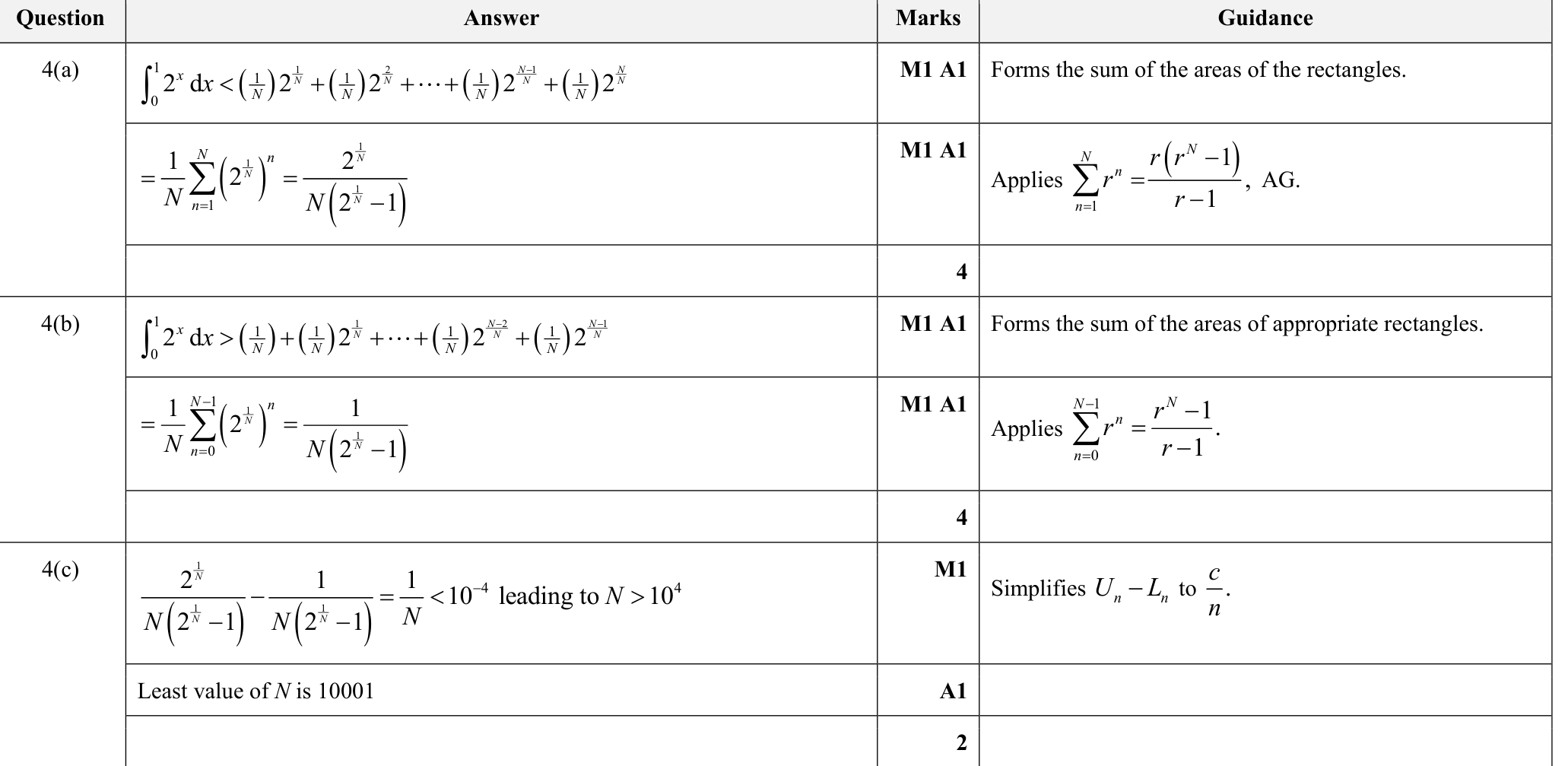
The diagram shows the curve with equation \(y=2^{x}\) for \(0 \leqslant x \leqslant 1\), together with a set of \(N\) rectangles each of width \(\frac{1}{N}\).
(a) By considering the sum of the areas of these rectangles, show that \(\int_{0}^{1} 2^{x} \mathrm{~d} x\lt U_{N}\), where
\(U_{N}=\frac{2^{\frac{1}{N}}}{N\left(2^{\frac{1}{N}}-1\right)} .\)
(b) Use a similar method to find, in terms of \(N\), a lower bound \(L_{N}\) for \(\int_{0}^{1} 2^{x} \mathrm{~d} x\).
(c) Find the least value of \(N\) such that \(U_{N}-L_{N}\lt 10^{-4}\).
9231 P23 - Jun 2022 - Q6 - 10 marks
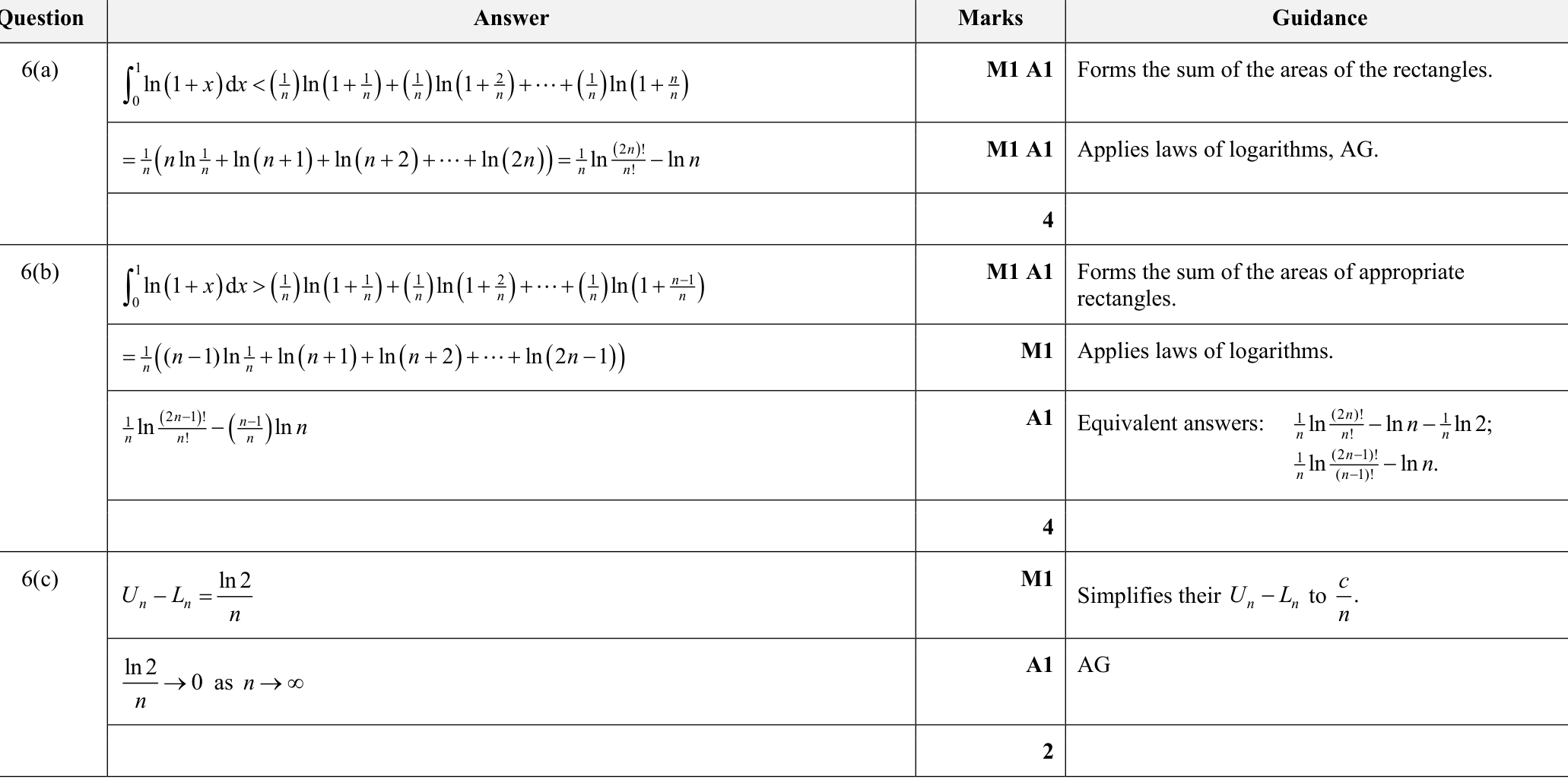
The diagram shows the curve with equation \(y=\ln (1+x)\) for \(0 \leqslant x \leqslant 1\), together with a set of \(n\) rectangles each of width \(\frac{1}{n}\).
(a) By considering the sum of the areas of these rectangles, show that \(\int_{0}^{1} \ln (1+x) \mathrm{d} x\lt U_{n}\), where
\(U_{n}=\frac{1}{n} \ln \frac{(2 n)!}{n!}-\ln n .\)
(b) Use a similar method to find, in terms of \(n\), a lower bound \(L_{n}\) for \(\int_{0}^{1} \ln (1+x) \mathrm{d} x\).
(c) By simplifying \(U_{n}-L_{n}\), show that \(\lim _{n \rightarrow \infty}\left(U_{n}-L_{n}\right)=0\).
9231 P21 - Nov 2022 - Q4 - 12 marks
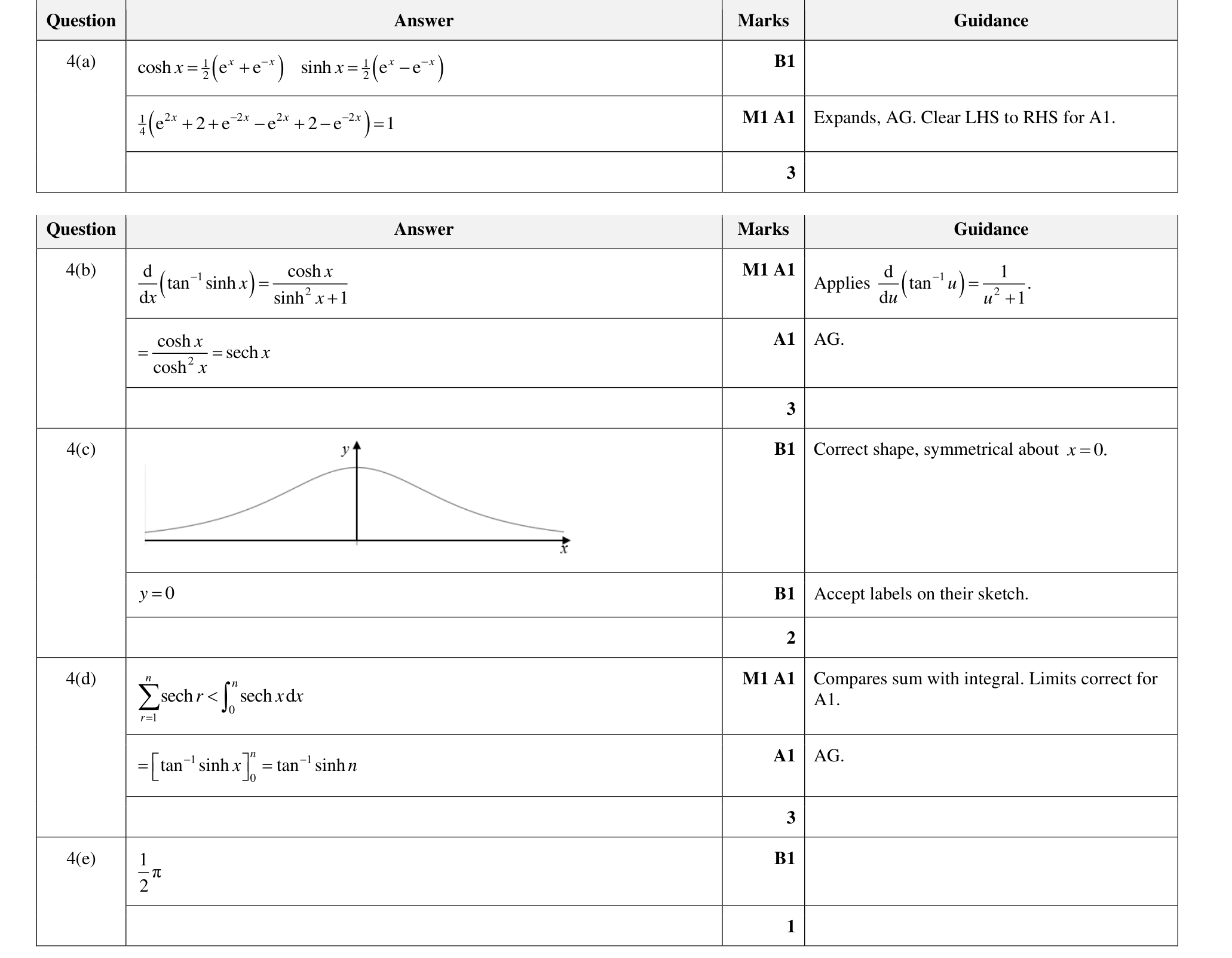
(a) Starting from the definitions of cosh and sinh in terms of exponentials, prove that
\(\cosh ^{2} x-\sinh ^{2} x=1 .\)
(b) Show that \(\frac{\mathrm{d}}{\mathrm{d} x}\left(\tan ^{-1}(\sinh x)\right)=\operatorname{sech} x\).
(c) Sketch the graph of \(y=\operatorname{sech} x\), stating the equation of the asymptote.
(d) By considering a suitable set of \(n\) rectangles of unit width, use your sketch to show that
\(\sum_{r=1}^{n} \operatorname{sech} r\lt \tan ^{-1}(\sinh n) .\)
(e) Hence state an upper bound, in terms of \(\pi\), for \(\sum_{r=1}^{\infty} \operatorname{sech} r\).
9231 P22 - Nov 2022 - Q6 - 10 marks
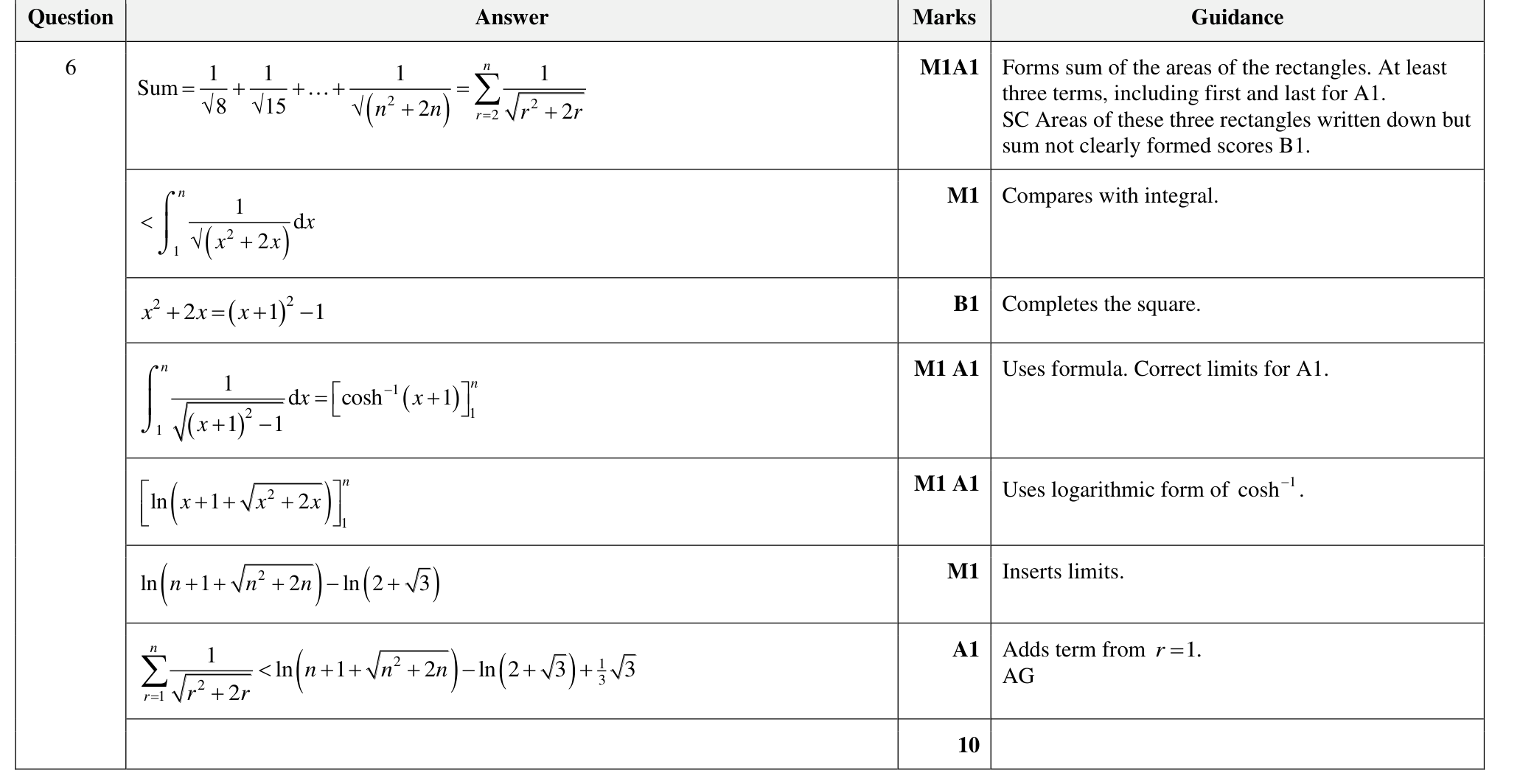
The diagram shows the curve \(y=\frac{1}{\sqrt{x^{2}+2 x}}\) for \(x\gt 0\), together with a set of \((n-1)\) rectangles of unit
width. width.
By considering the sum of the areas of these rectangles, show that
\(\sum_{r=1}^{n} \frac{1}{\sqrt{r^{2}+2 r}}\lt \ln \left(n+1+\sqrt{n^{2}+2 n}\right)+\frac{1}{3} \sqrt{3}-\ln (2+\sqrt{3}) .\)
9231 P21 - Jun 2021 - Q3 - 10 marks
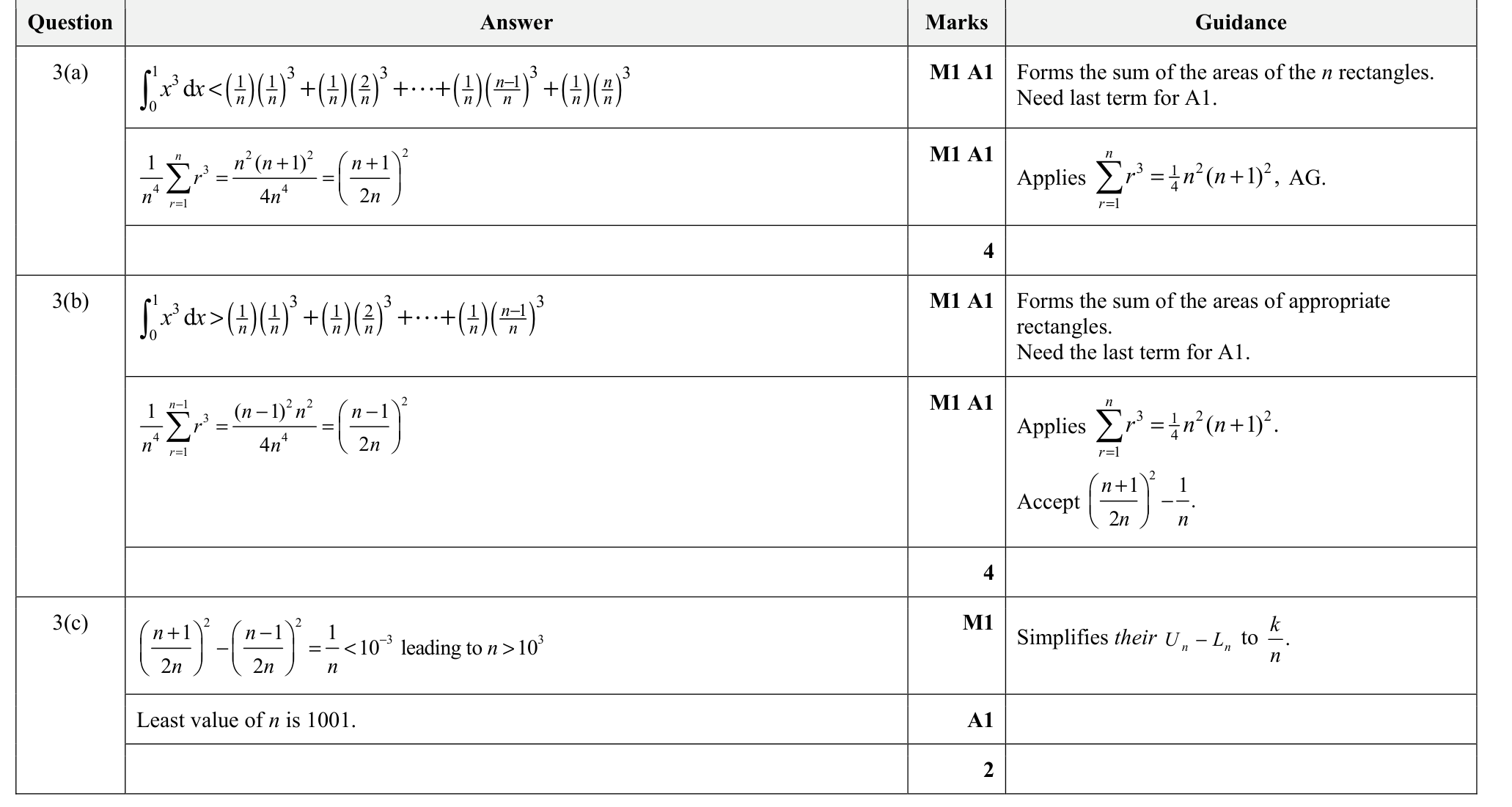
The diagram shows the curve with equation \(y=x^{3}\) for \(0 \leqslant x \leqslant 1\), together with a set of \(n\) rectangles of width \(\frac{1}{n}\).
(a) By considering the sum of the areas of these rectangles, show that \(\int_{0}^{1} x^{3} \mathrm{~d} x\lt U_{n}\), where
\(U_{n}=\left(\frac{n+1}{2 n}\right)^{2} .\)
(b) Use a similar method to find, in terms of \(n\), a lower bound \(L_{n}\) for \(\int_{0}^{1} x^{3} \mathrm{~d} x\).
(c) Find the least value of \(n\) such that \(U_{n}-L_{n}\lt 10^{-3}\).
9231 P21 - Nov 2021 - Q4 - 10 marks
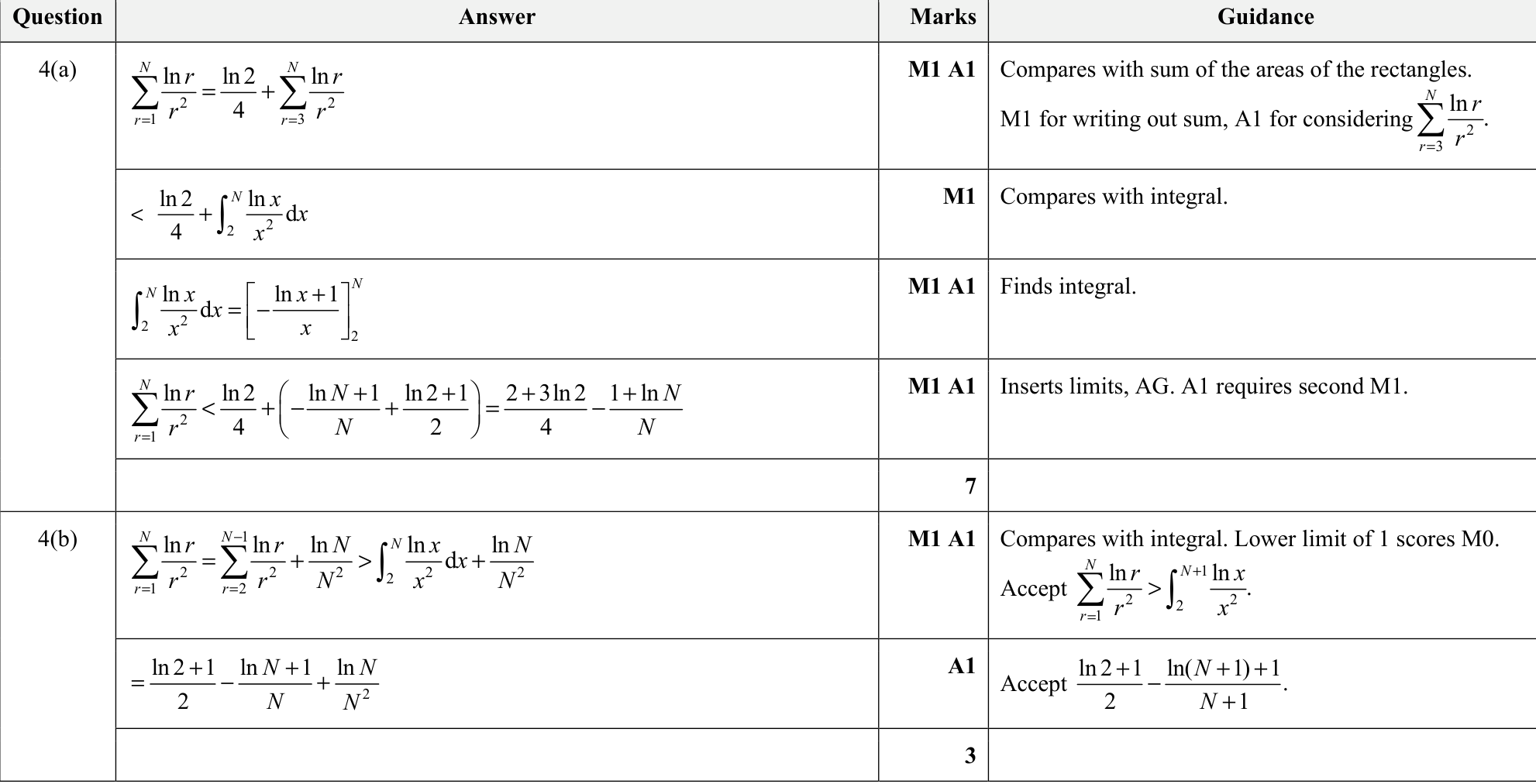
The diagram shows the curve with equation \(y=\frac{\ln x}{x^{2}}\) for \(x \geqslant 2\), together with a set of \((N-2)\) rectangles of unit width.
(a) By considering the sum of the areas of these rectangles, show that
\(\sum_{r=1}^{N} \frac{\ln r}{r^{2}}\lt \frac{2+3 \ln 2}{4}-\frac{1+\ln N}{N} .\)
(b) Use a similar method to find, in terms of \(N\), a lower bound for \(\sum_{r=1}^{N} \frac{\ln r}{r^{2}}\).
9231 P21 - Jun 2020 - Q4 - 8 marks
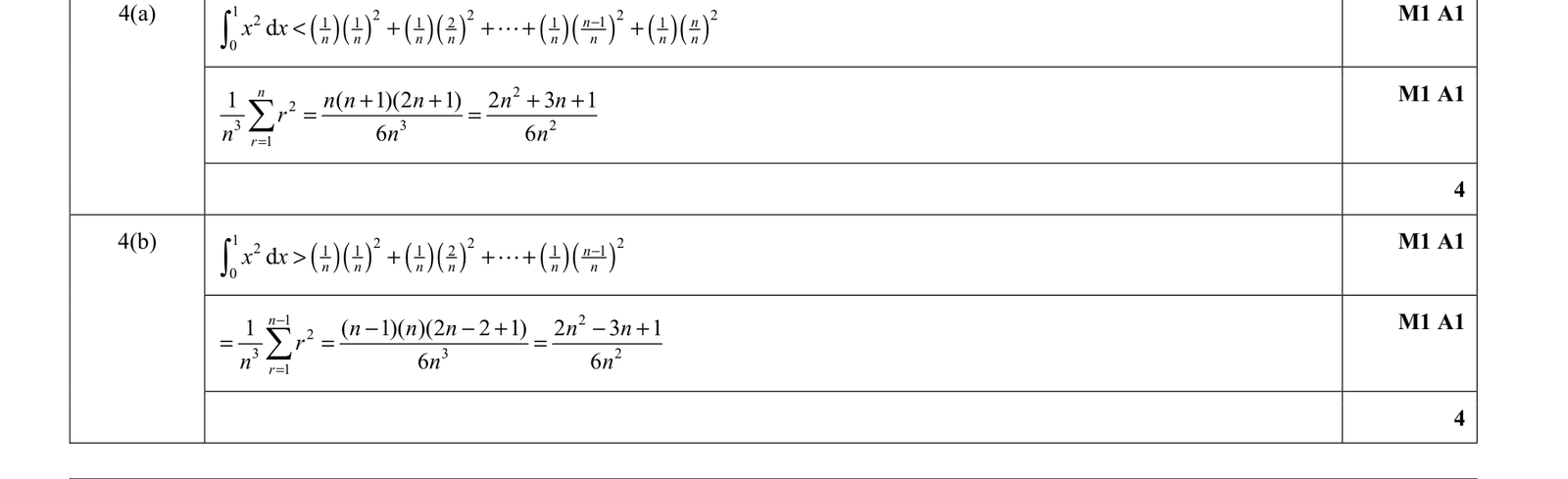
The diagram shows the curve with equation \(y=x^{2}\) for \(0 \leqslant x \leqslant 1\), together with a set of \(n\) rectangles of width \(\frac{1}{n}\).
(a) By considering the sum of the areas of these rectangles, show that
\[\int_{0}^{1} x^{2} \mathrm{~d} x<\frac{2 n^{2}+3 n+1}{6 n^{2}} .\]
(b) Use a similar method to find, in terms of \(n\), a lower bound for \(\int_{0}^{1} x^{2} \mathrm{~d} x\).
9231 P23 - Jun 2020 - Q4 - 8 marks
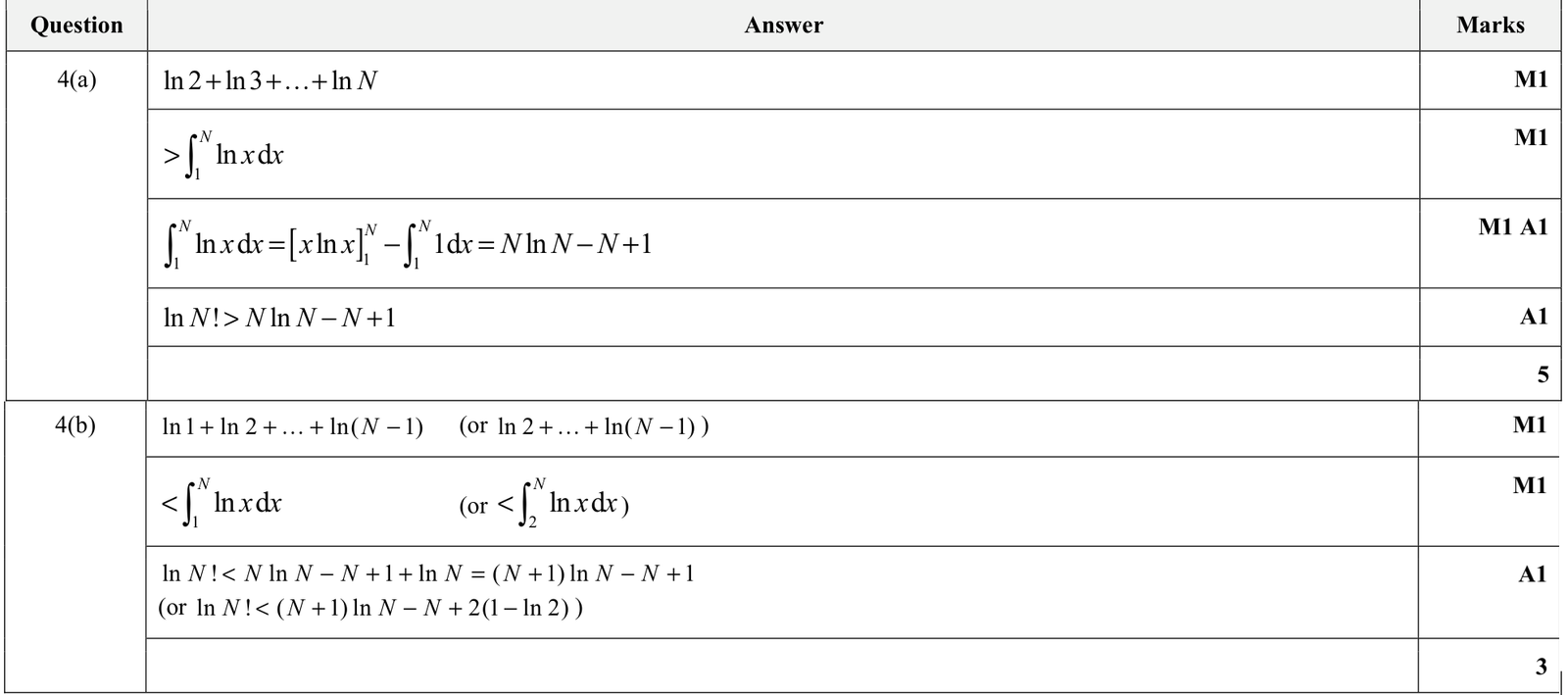
The diagram shows the curve with equation \(y=\ln x\) for \(x \geqslant 1\), together with a set of \((N-1)\) rectangles of unit width.
(a) By considering the sum of the areas of these rectangles, show that
\[\ln N!>N \ln N-N+1 .\]
(b) Use a similar method to find, in terms of \(N\), an upper bound for \(\ln N!\).
9231 P23 - Jun 2021 - Q3 - 10 marks
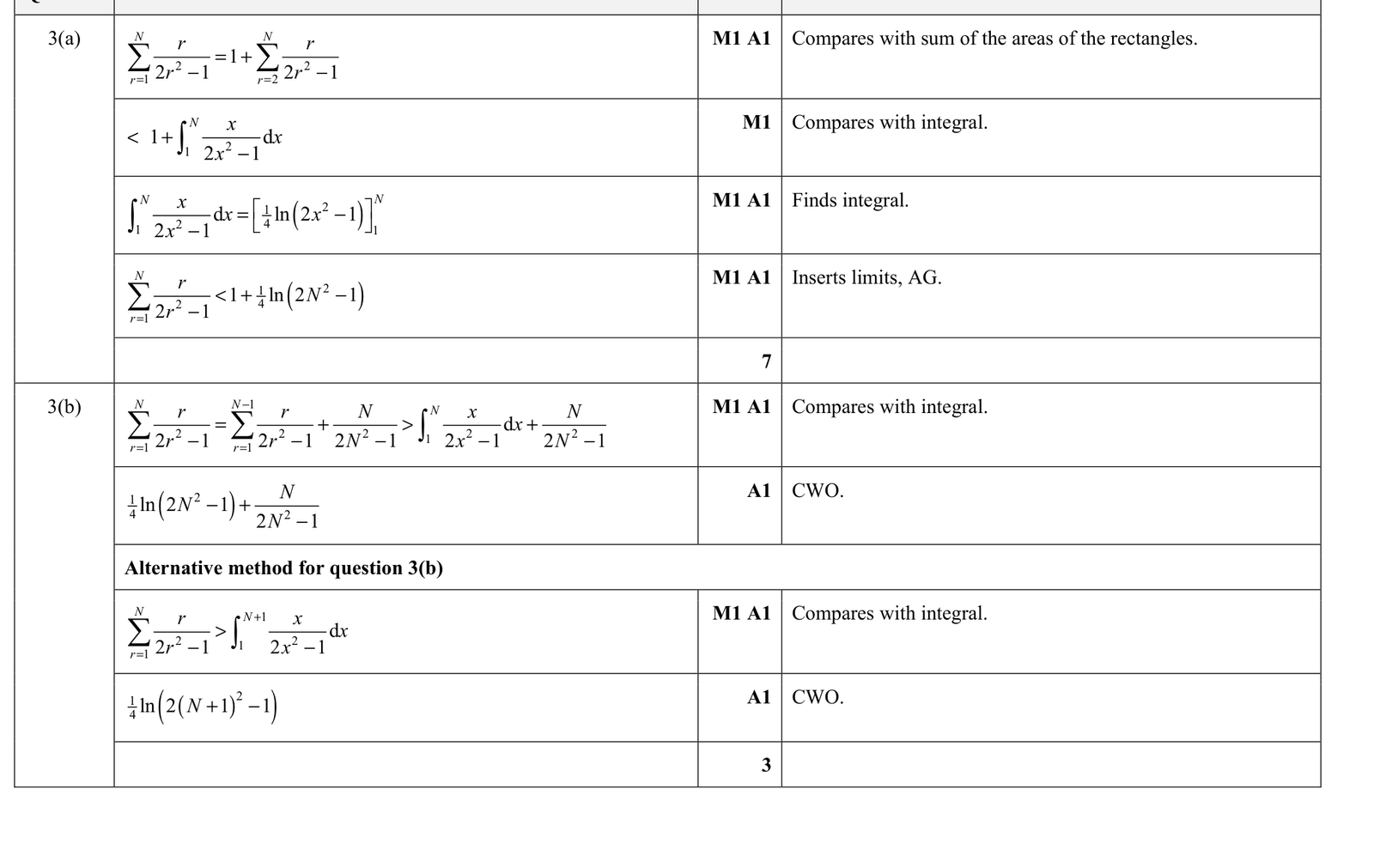
The diagram shows the curve \(y=\frac{x}{2 x^{2}-1}\) for \(x \geqslant 1\), together with a set of \(N-1\) rectangles of unit width.
(a) By considering the sum of the areas of these rectangles, show that
\[\sum_{r=1}^{N} \frac{r}{2 r^{2}-1}<\frac{1}{4} \ln \left(2 N^{2}-1\right)+1\]
(b) Use a similar method to find, in terms of \(N\), a lower bound for \(\sum_{r=1}^{N} \frac{r}{2 r^{2}-1}\).
9231 P22 - Nov 2020 - Q8 - 10 marks
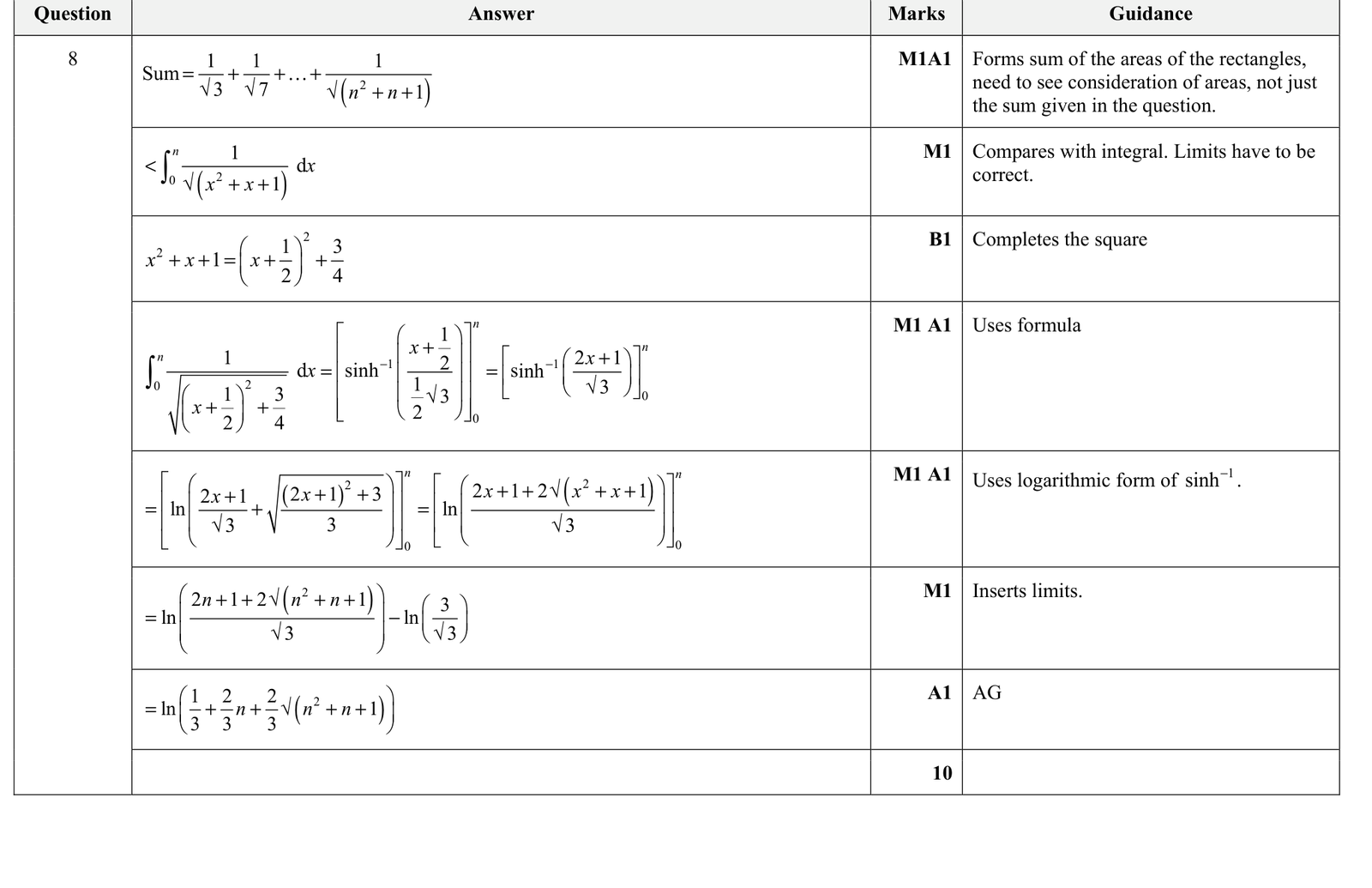
The diagram shows the curve \(y=\frac{1}{\sqrt{x^{2}+x+1}}\) for \(x \geqslant 0\), together with a set of \(n\) rectangles of unit width. By considering the sum of the areas of these rectangles, show that
\[\sum_{r=1}^{n} \frac{1}{\sqrt{r^{2}+r+1}}<\ln \left(\frac{1}{3}+\frac{2}{3} n+\frac{2}{3} \sqrt{n^{2}+n+1}\right) .\]
9231 P22 - Nov 2021 - Q3 - 8 marks
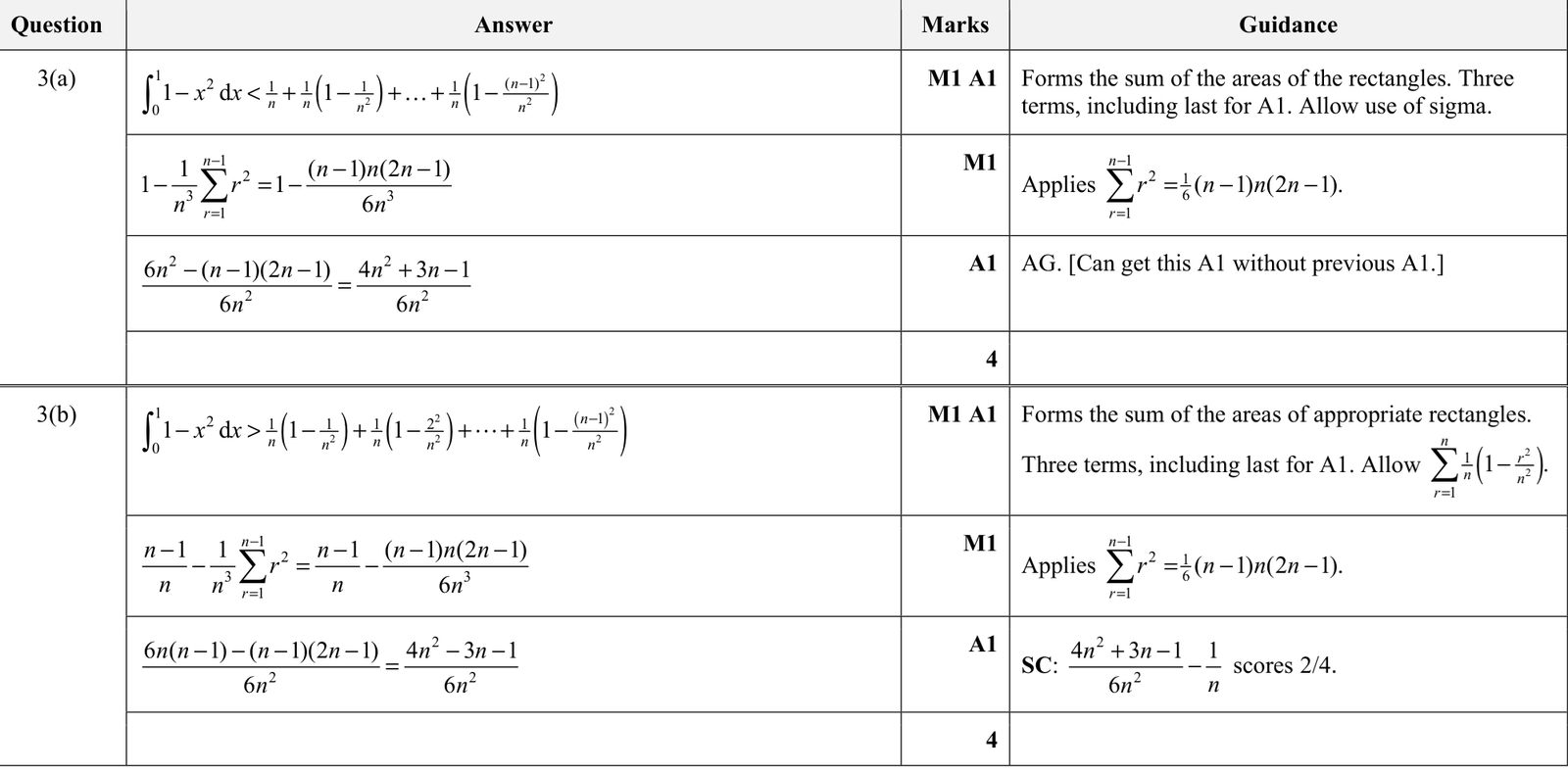
The diagram shows the curve with equation \(y=1-x^{2}\) for \(0 \leqslant x \leqslant 1\), together with a set of \(n\) rectangles of width \(\frac{1}{n}\).
(a) By considering the sum of the areas of the rectangles, show that
\[\int_{0}^{1}\left(1-x^{2}\right) \mathrm{d} x<\frac{4 n^{2}+3 n-1}{6 n^{2}} .\]
(b) Use a similar method to find, in terms of \(n\), a lower bound for \(\int_{0}^{1}\left(1-x^{2}\right) \mathrm{d} x\).