9231 P11 - Jun 2019 - Q5 - 8 marks
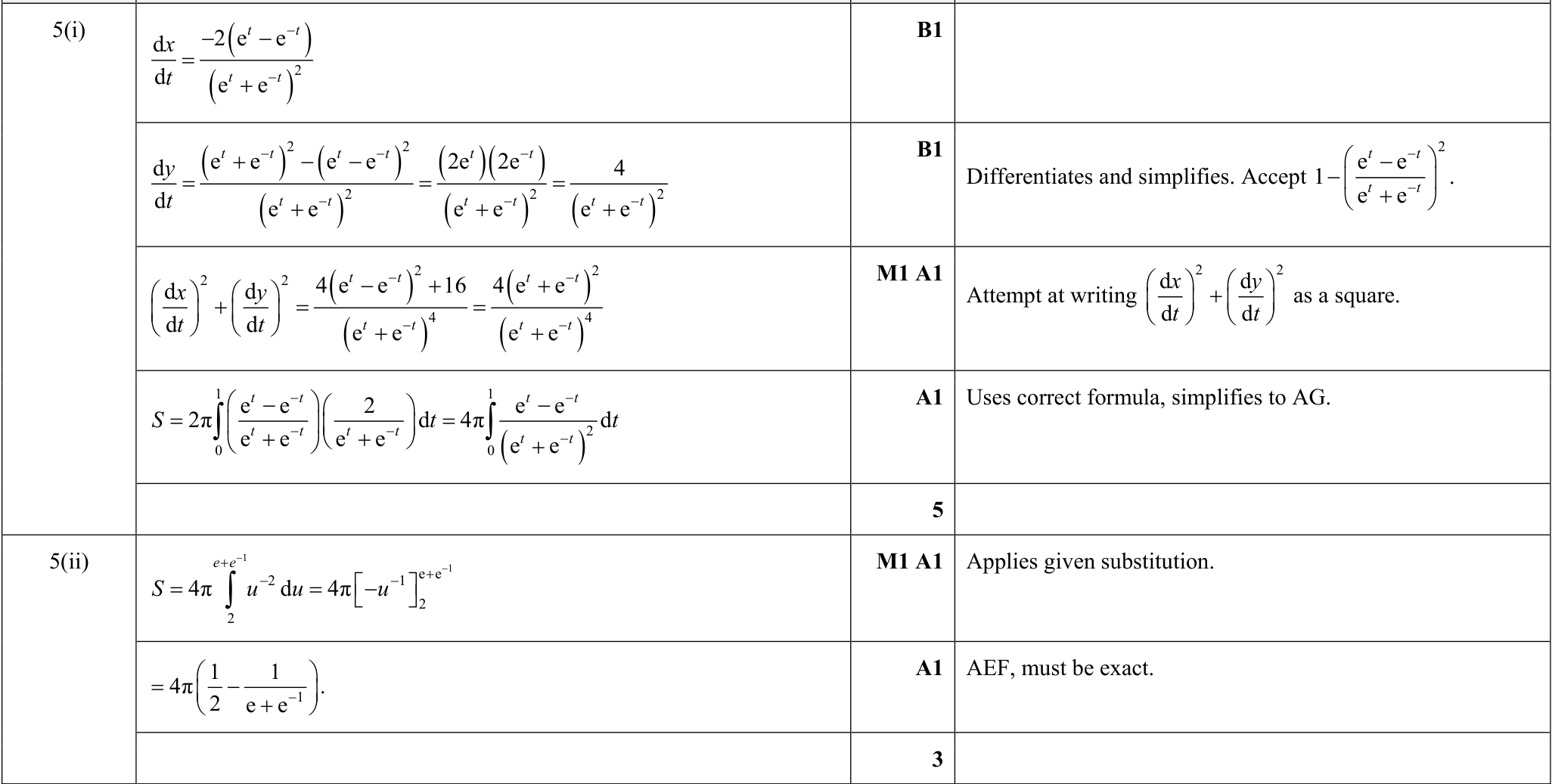
5 A curve \(C\) is defined parametrically by
\(x=\frac{2}{\mathrm{e}^{t}+\mathrm{e}^{-t}} \quad \text { and } \quad y=\frac{\mathrm{e}^{t}-\mathrm{e}^{-t}}{\mathrm{e}^{t}+\mathrm{e}^{-t}},\)
for \(0 \leqslant t \leqslant 1\). The area of the surface generated when \(C\) is rotated through \(2 \pi\) radians about the \(x\)-axis is denoted by \(S\).
(i) Show that \(S=4 \pi \int_{0}^{1} \frac{\mathrm{e}^{t}-\mathrm{e}^{-t}}{\left(\mathrm{e}^{t}+\mathrm{e}^{-t}\right)^{2}} \mathrm{~d} t\).
(ii) Using the substitution \(u=\mathrm{e}^{t}+\mathrm{e}^{-t}\), or otherwise, find \(S\) in terms of \(\pi\) and e .
9231 P11 - Jun 2018 - Q1 - 5 marks
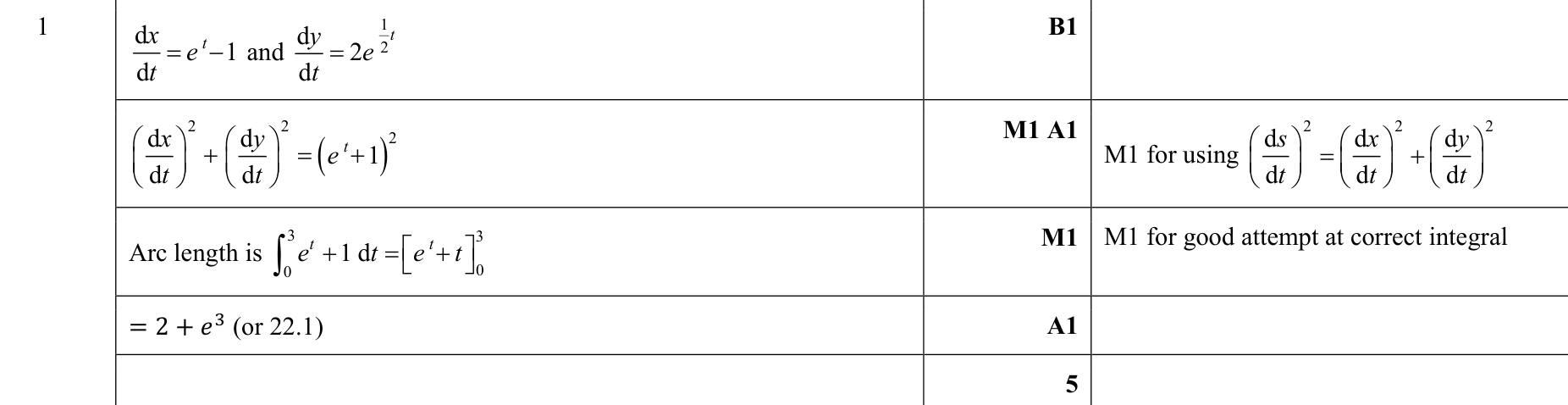
The curve \(C\) is defined parametrically by
\(x=\mathrm{e}^{t}-t, \quad y=4 \mathrm{e}^{\frac{1}{2} t} .\)
Find the length of the arc of \(C\) from the point where \(t=0\) to the point where \(t=3\).
9231 P11 - Nov 2018 - Q4 - 8 marks
A curve is defined parametrically by
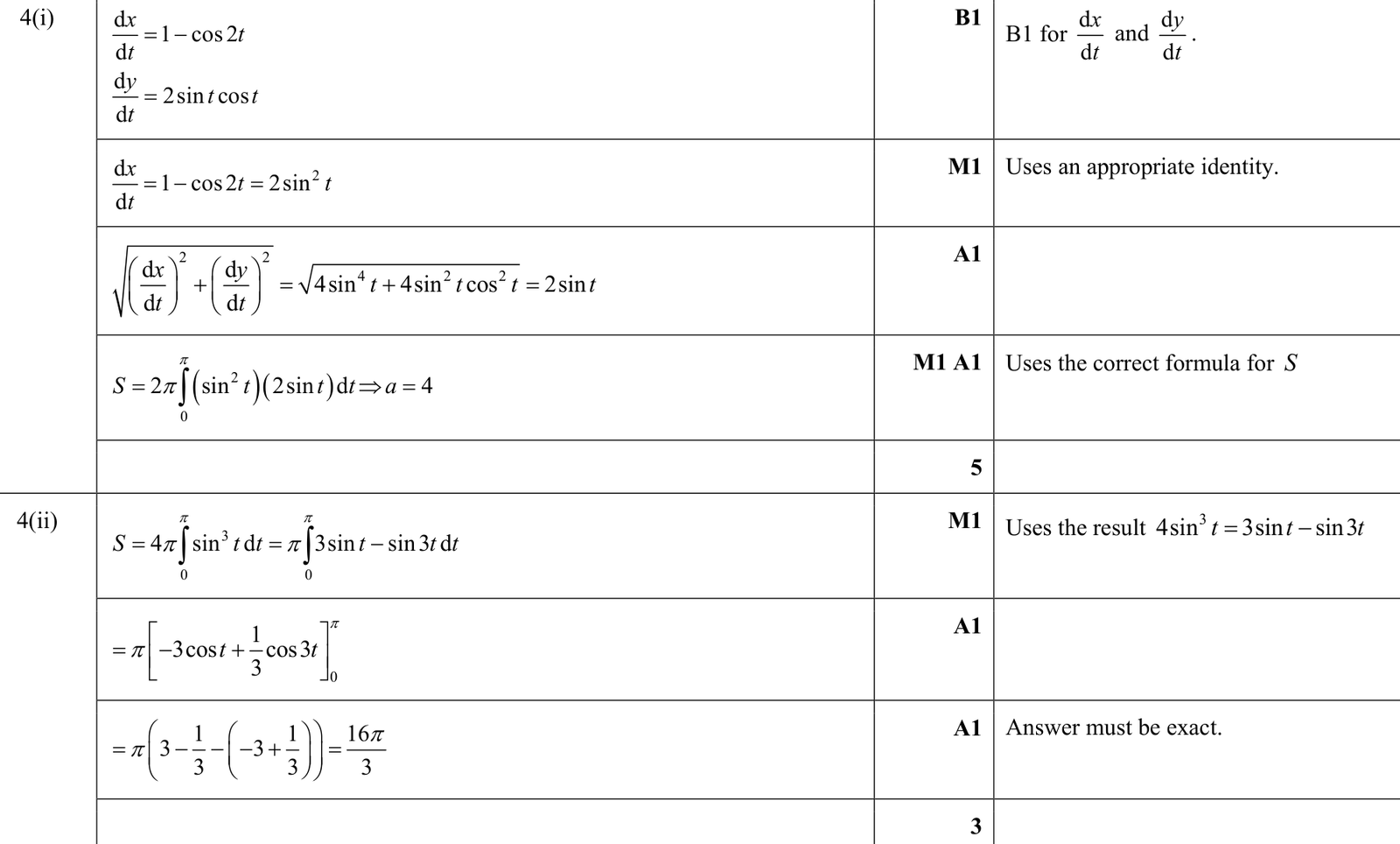
\(x=t-\frac{1}{2} \sin 2 t \quad \text { and } \quad y=\sin ^{2} t\)
The arc of the curve joining the point where \(t=0\) to the point where \(t=\pi\) is rotated through one complete revolution about the \(x\)-axis. The area of the surface generated is denoted by \(S\).
(i) Show that
\(S=a \pi \int_{0}^{\pi} \sin ^{3} t \mathrm{~d} t\)
where the constant \(a\) is to be found.
(ii) Using the result \(\sin 3 t=3 \sin t-4 \sin ^{3} t\), find the exact value of \(S\).
9231 P21 - Nov 2024 - Q3 - 8 marks
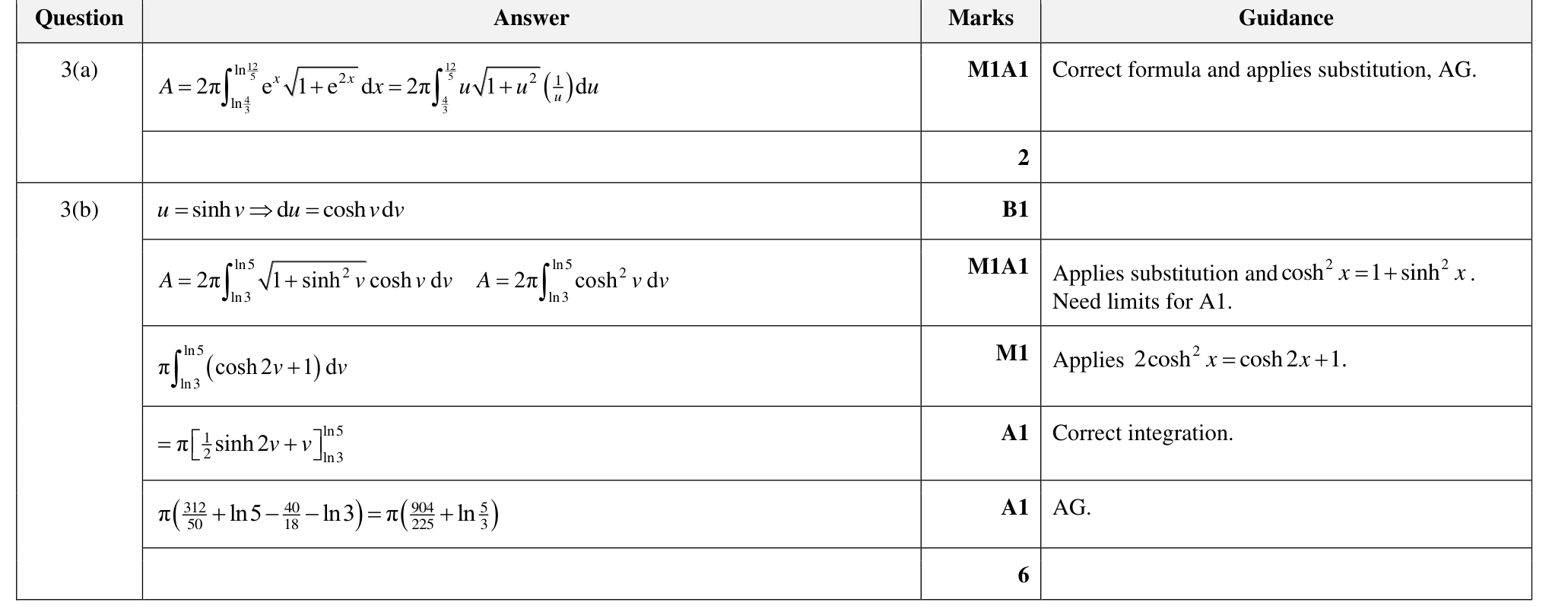
A curve has equation \(y=\mathrm{e}^{x}\) for \(\ln \frac{4}{3} \leqslant x \leqslant \ln \frac{12}{5}\). The area of the surface generated when the curve is rotated through \(2 \pi\) radians about the \(x\)-axis is denoted by \(A\).
(a) Use the substitution \(u=\mathrm{e}^{x}\) to show that
\(A=2 \pi \int_{\frac{4}{3}}^{\frac{12}{5}} \sqrt{1+u^{2}} \mathrm{~d} u\)
(b) Use the substitution \(u=\sinh v\) to show that
\(A=\pi\left(\frac{904}{225}+\ln \frac{5}{3}\right)\)
9231 P22 - Nov 2023 - Q7 - 12 marks
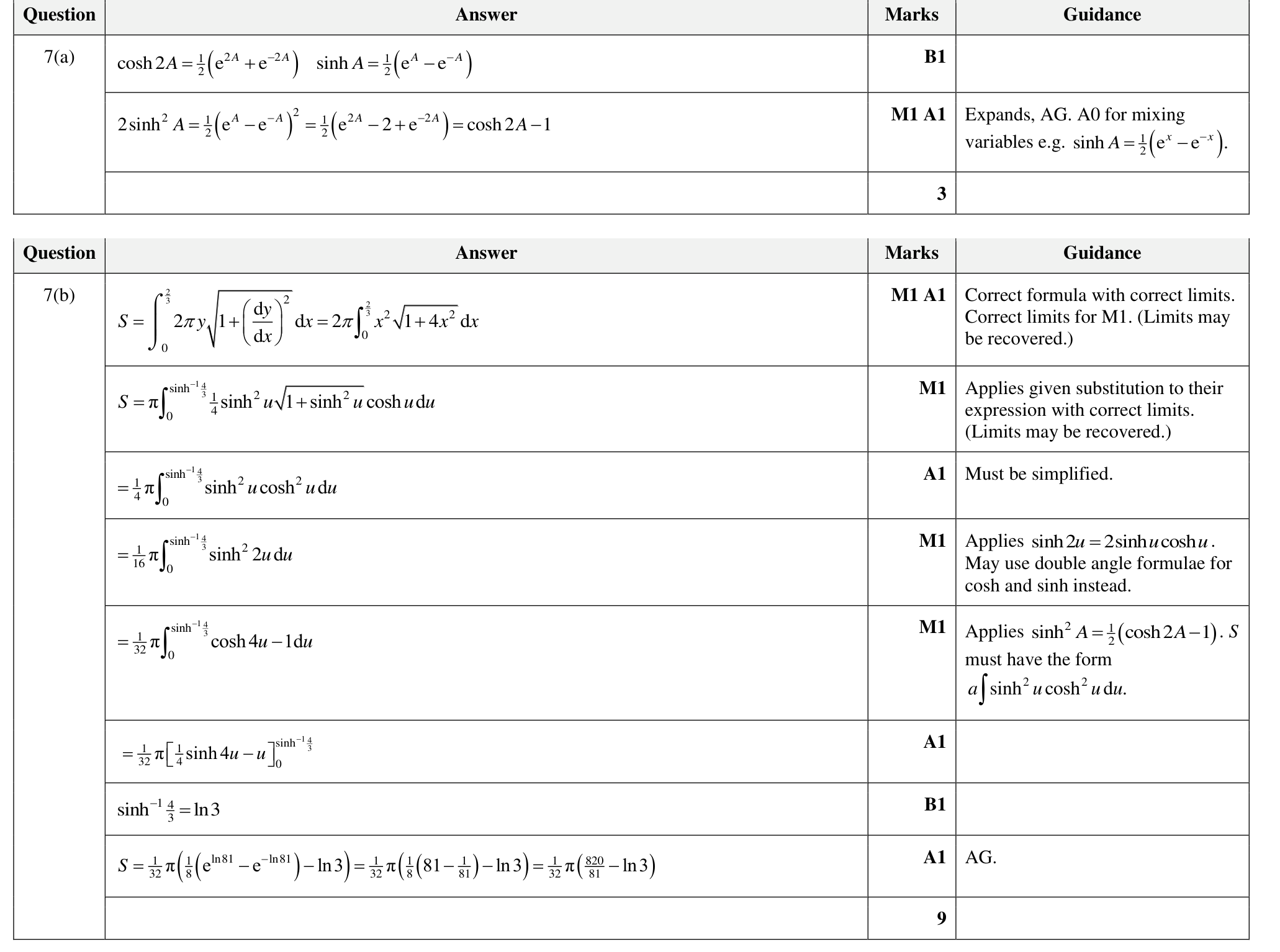
(a) Starting from the definitions of cosh and sinh in terms of exponentials, prove that
\(2 \sinh ^{2} A=\cosh 2 A-1\)
(b) A curve has equation \(y=x^{2}\), for \(0 \leqslant x \leqslant \frac{2}{3}\). The area of the surface generated when the curve is rotated through \(2 \pi\) radians about the \(x\)-axis is denoted by \(S\).
Use the substitution \(x=\frac{1}{2} \sinh u\) to show that \(S=\frac{1}{32} \pi\left(\frac{820}{81}-\ln 3\right)\).
9231 P22 - Nov 2022 - Q3 - 8 marks
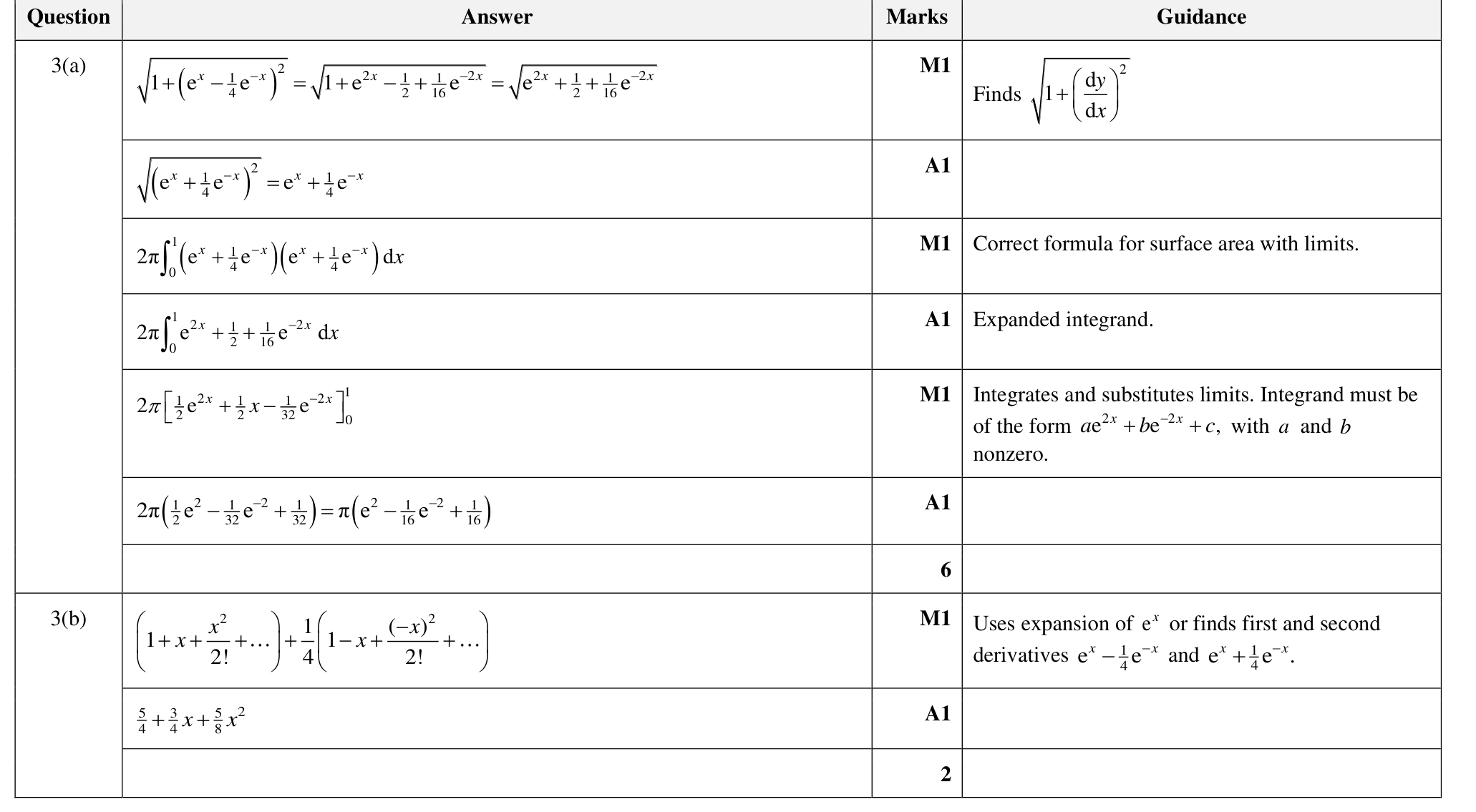
(a) A curve has equation \(y=\mathrm{e}^{x}+\frac{1}{4} \mathrm{e}^{-x}\), for \(0 \leqslant x \leqslant 1\). Find, in terms of \(\pi\) and e , the area of the surface generated when the curve is rotated through \(2 \pi\) radians about the \(x\)-axis.
(b) Using standard results from the list of formulae (MF19), or otherwise, find the Maclaurin's series for \(\mathrm{e}^{x}+\frac{1}{4} \mathrm{e}^{-x}\) up to and including the term in \(x^{2}\).
9231 P21 - Jun 2021 - Q8 - 13 marks
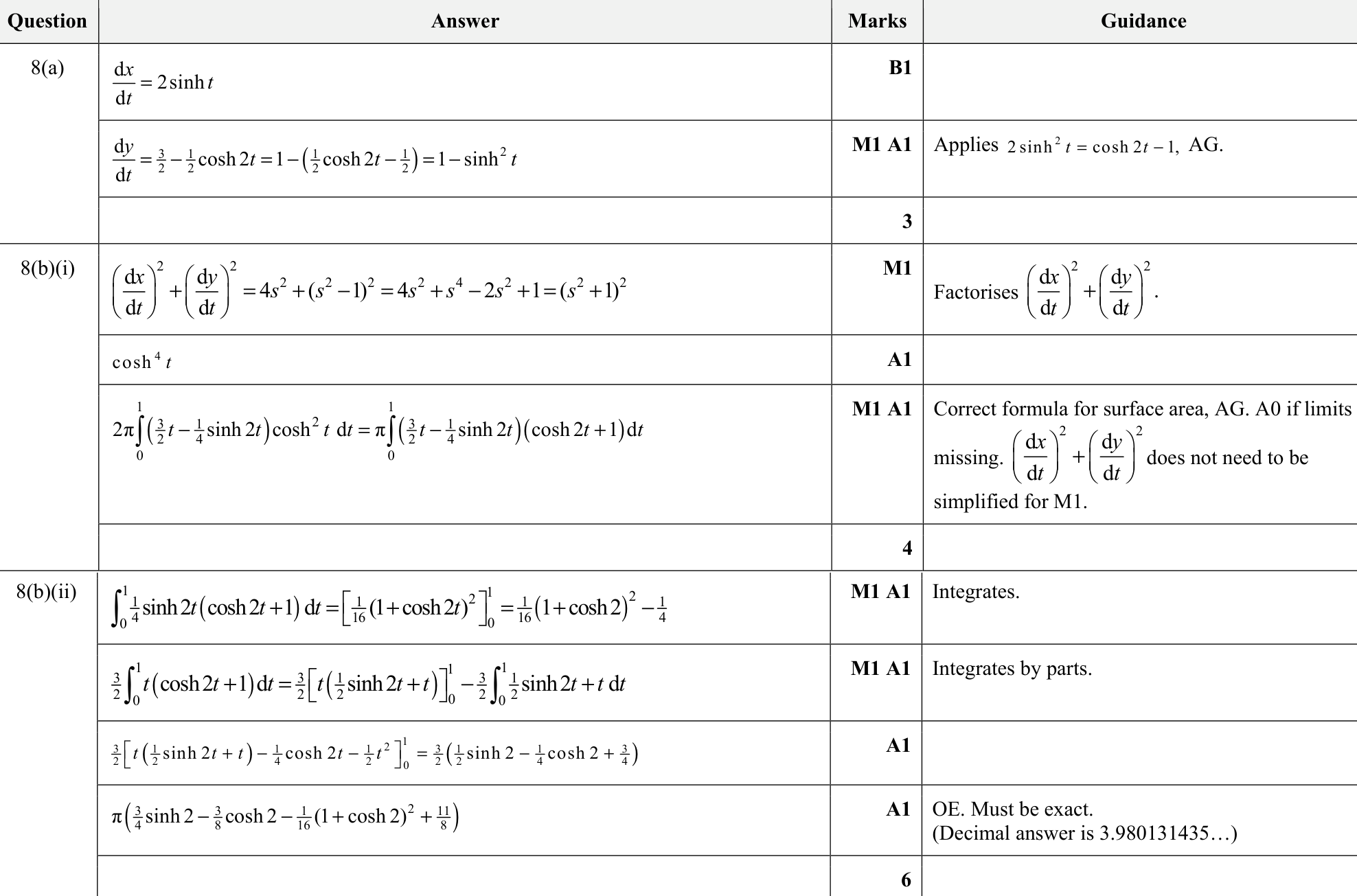
The curve \(C\) has parametric equations
\(x=2 \cosh t, \quad y=\frac{3}{2} t-\frac{1}{4} \sinh 2 t, \text { for } 0 \leqslant t \leqslant 1 .\)
(a) Find \(\frac{\mathrm{d} x}{\mathrm{~d} t}\) and show that \(\frac{\mathrm{d} y}{\mathrm{~d} t}=1-\sinh ^{2} t\).
The area of the surface generated when \(C\) is rotated through \(2 \pi\) radians about the \(x\)-axis is denoted by \(A\).
(b) (i) Show that \(A=\pi \int_{0}^{1}\left(\frac{3}{2} t-\frac{1}{4} \sinh 2 t\right)(1+\cosh 2 t) \mathrm{d} t\).
(ii) Hence find \(A\) in terms of \(\pi, \sinh 2\) and \(\cosh 2\).
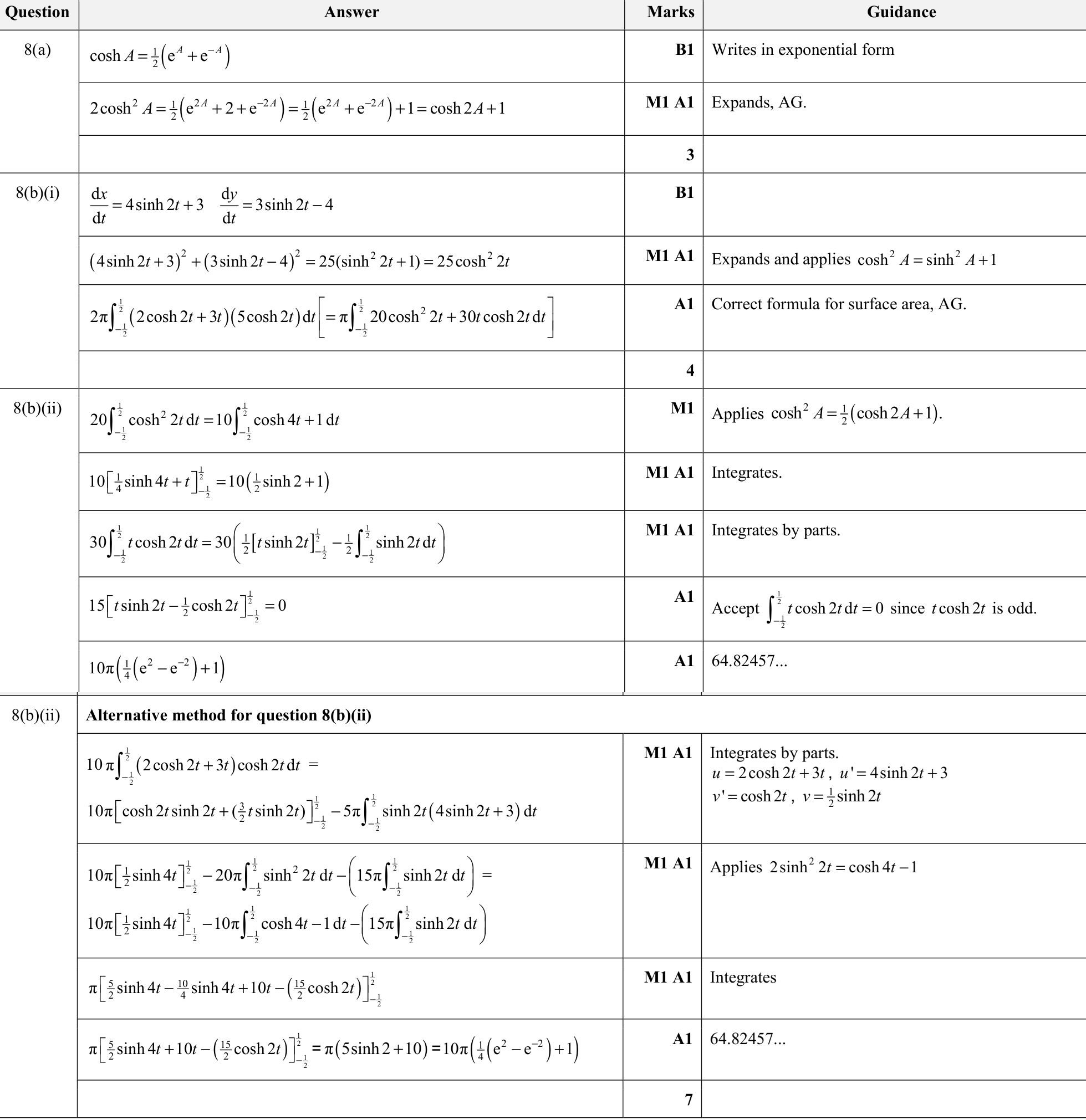
9231 P21 - Nov 2021 - Q8 - 14 marks
(a) Starting from the definition of cosh in terms of exponentials, prove that
\(2 \cosh ^{2} A=\cosh 2 A+1\)
The curve \(C\) has parametric equations
\(x=2 \cosh 2 t+3 t, \quad y=\frac{3}{2} \cosh 2 t-4 t, \quad \text { for }-\frac{1}{2} \leqslant t \leqslant \frac{1}{2} .\)
The area of the surface generated when \(C\) is rotated through \(2 \pi\) radians about the \(y\)-axis is denoted by \(A\).
(b) (i) Show that \(A=10 \pi \int_{-\frac{1}{2}}^{\frac{1}{2}}(2 \cosh 2 t+3 t) \cosh 2 t \mathrm{~d} t\).
(ii) Hence find \(A\) in terms of \(\pi\) and e.
9231 P21 - Jun 2020 - Q5 - 11 marks
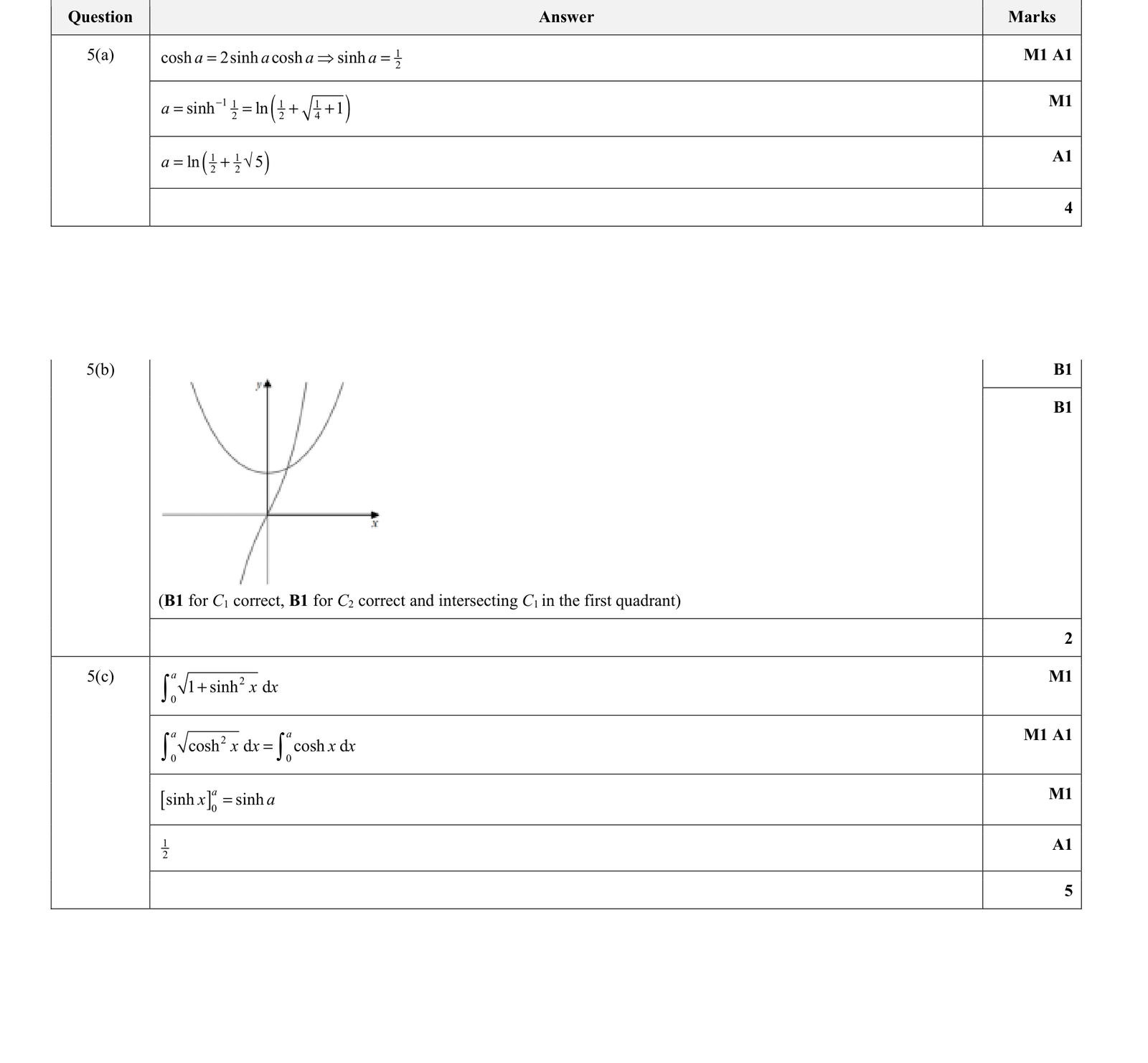
The curves \(C_{1}: y=\cosh x\) and \(C_{2}: y=\sinh 2 x\) intersect at the point where \(x=a\).
(a) Find the exact value of \(a\), giving your answer in logarithmic form.
(b) Sketch \(C_{1}\) and \(C_{2}\) on the same diagram.
(c) Find the exact value of the length of the \(\operatorname{arc}\) of \(C_{1}\) from \(x=0\) to \(x=a\).
9231 P22 - Nov 2020 - Q2 - 6 marks
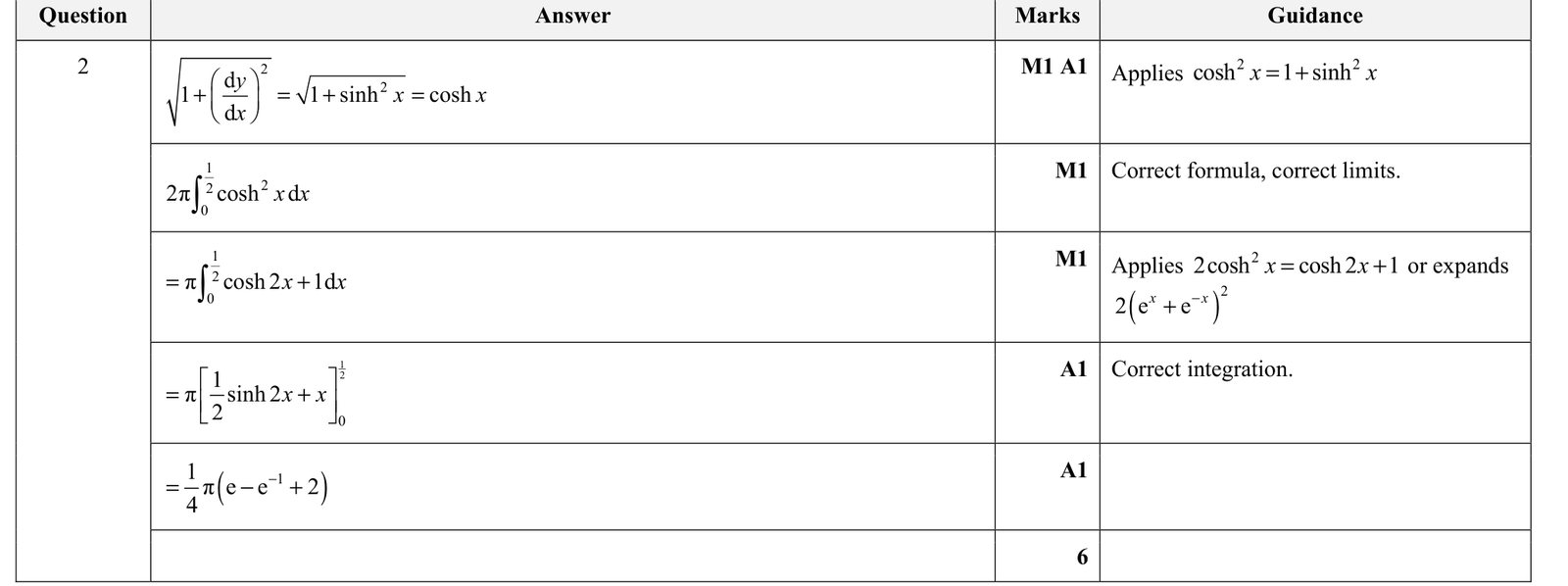
A curve has equation \(y=\cosh x\), for \(0 \leqslant x \leqslant \frac{1}{2}\).
Find, in terms of \(\pi\) and e , the area of the surface generated when the curve is rotated through \(2 \pi\) radians about the \(x\)-axis.
9231 P12 - Nov 2018 - Q11E - 14 marks
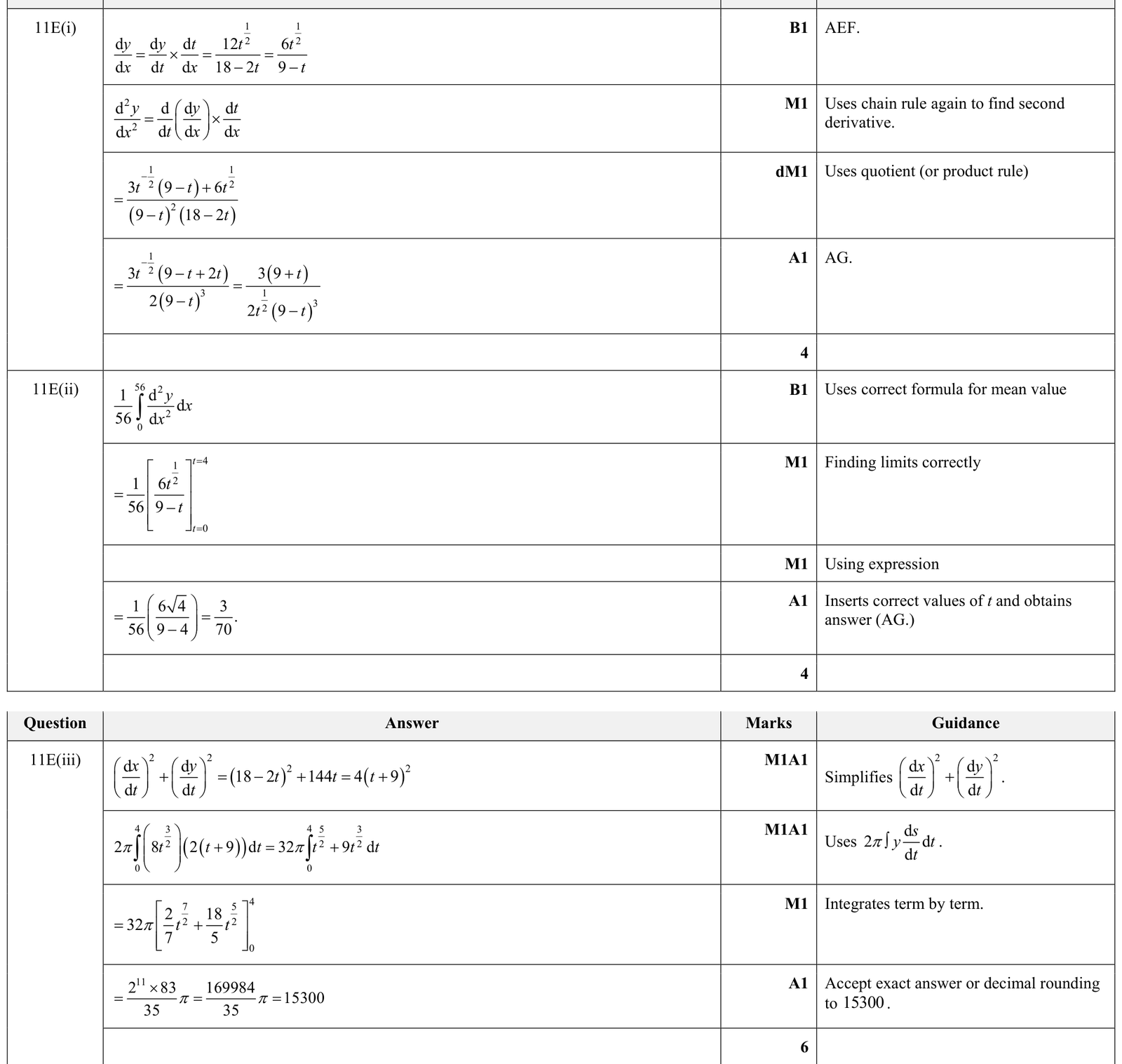
The curve \(C\) is defined parametrically by \(x=18t-t^2\) and \(y=8t^{3/2}\), where \(0\lt t\lt4\).
(i) Show that, at all points of \(C\), \(\frac{d^2y}{dx^2}=\frac{3(9+t)}{2t^{1/2}(9-t)^3}\).
(ii) Show that the mean value of \(\frac{d^2y}{dx^2}\) with respect to \(x\) over the interval \(0\le x\le56\) is \(\frac{3}{70}\).
(iii) Find the area of the surface generated when \(C\) is rotated through \(2\pi\) radians about the \(x\)-axis, showing full working.
9231 P11 - Jun 2017 - Q11 - 13 marks
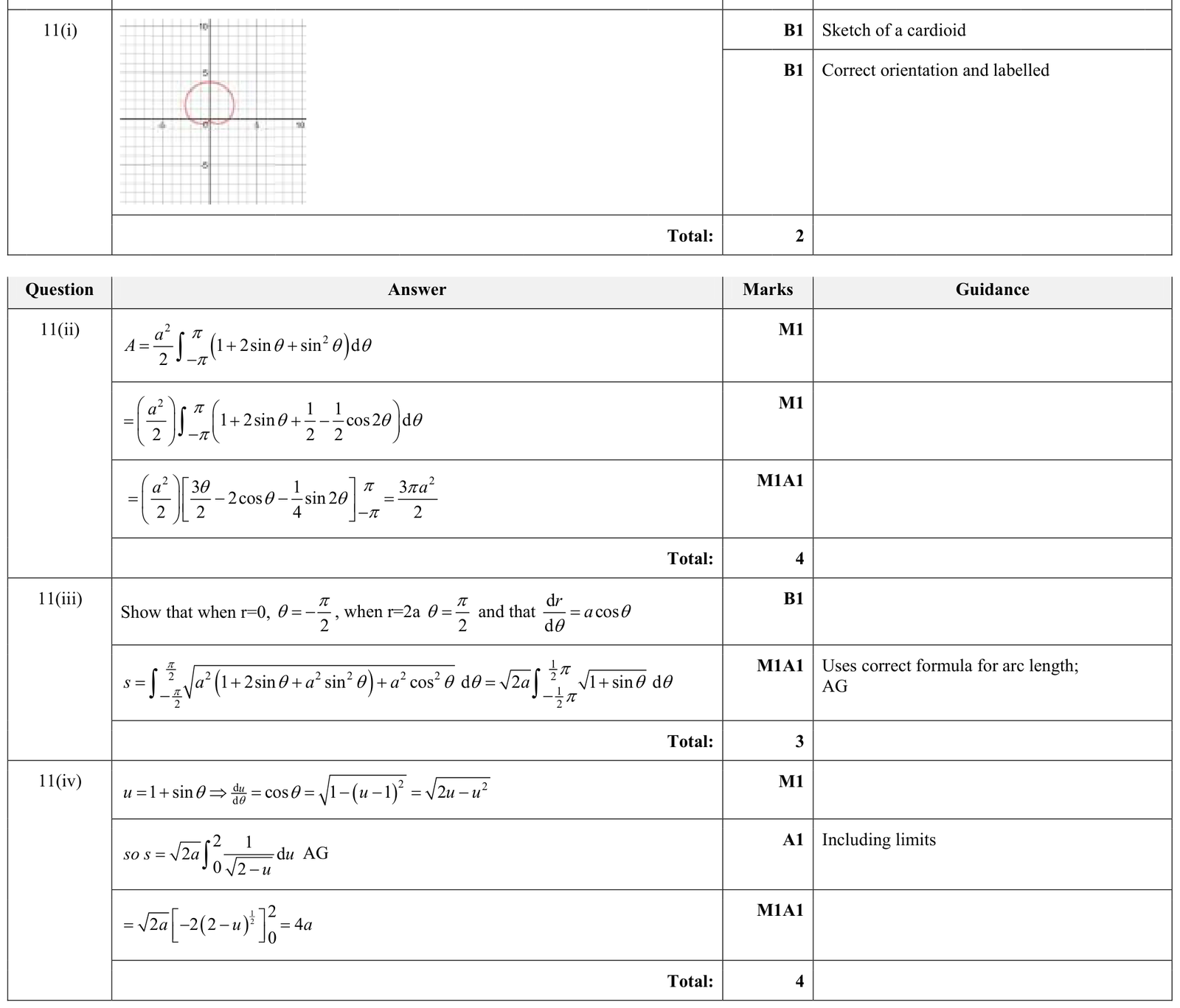
The curve \(C\) has polar equation \(r=a(1+\sin \theta)\) for \(-\pi\lt \theta \leqslant \pi\), where \(a\) is a positive constant.
(i) Sketch \(C\).
(ii) Find the area of the region enclosed by \(C\).
(iii) Show that the length of the arc of \(C\) from the pole to the point furthest from the pole is given by
\(s=(\sqrt{ } 2) a \int_{-\frac{1}{2} \pi}^{\frac{1}{2} \pi} \sqrt{ }(1+\sin \theta) \mathrm{d} \theta\).
(iv) Show that the substitution \(u=1+\sin \theta\) reduces this integral for \(s\) to \((\sqrt{ } 2) a \int_{0}^{2} \frac{1}{\sqrt{ }(2-u)} \mathrm{d} u\). Hence evaluate \(s\).
9231 P11 - Jun 2017 - Q12E - 14 marks
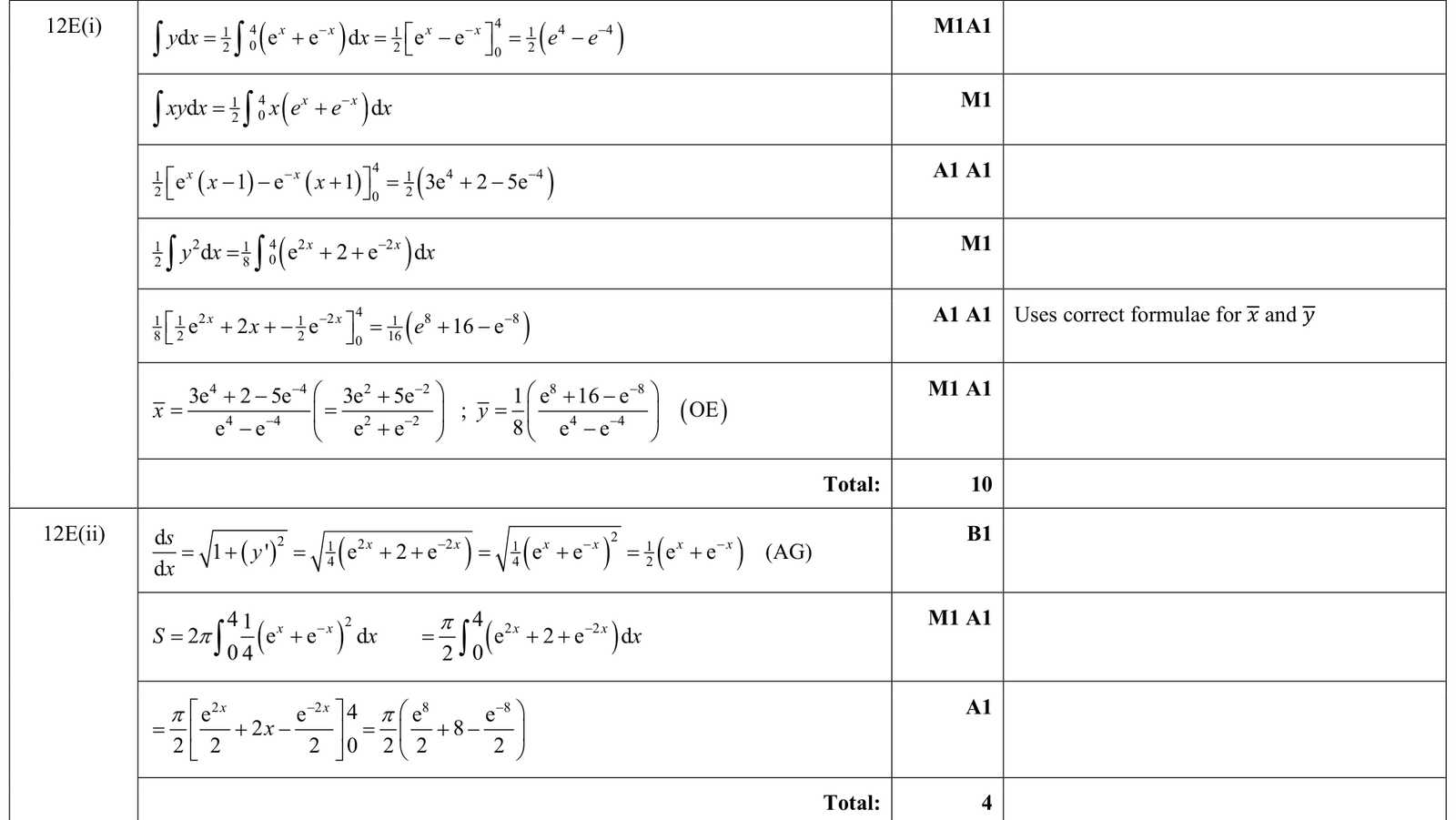
The curve \(C\) has equation \(y=\frac12(e^x+e^{-x})\), for \(0\le x\le4\).
(i) The region \(R\) is bounded by \(C\), the \(x\)-axis, the \(y\)-axis and the line \(x=4\). Find, in terms of \(e\), the coordinates of the centroid of the region \(R\).
(ii) Show that \(\frac{ds}{dx}=\frac12(e^x+e^{-x})\), where \(s\) denotes the arc length of \(C\), and find the surface area generated when \(C\) is rotated through \(2\pi\) radians about the \(x\)-axis.
9231 P13 - Jun 2017 - Q5 - 8 marks
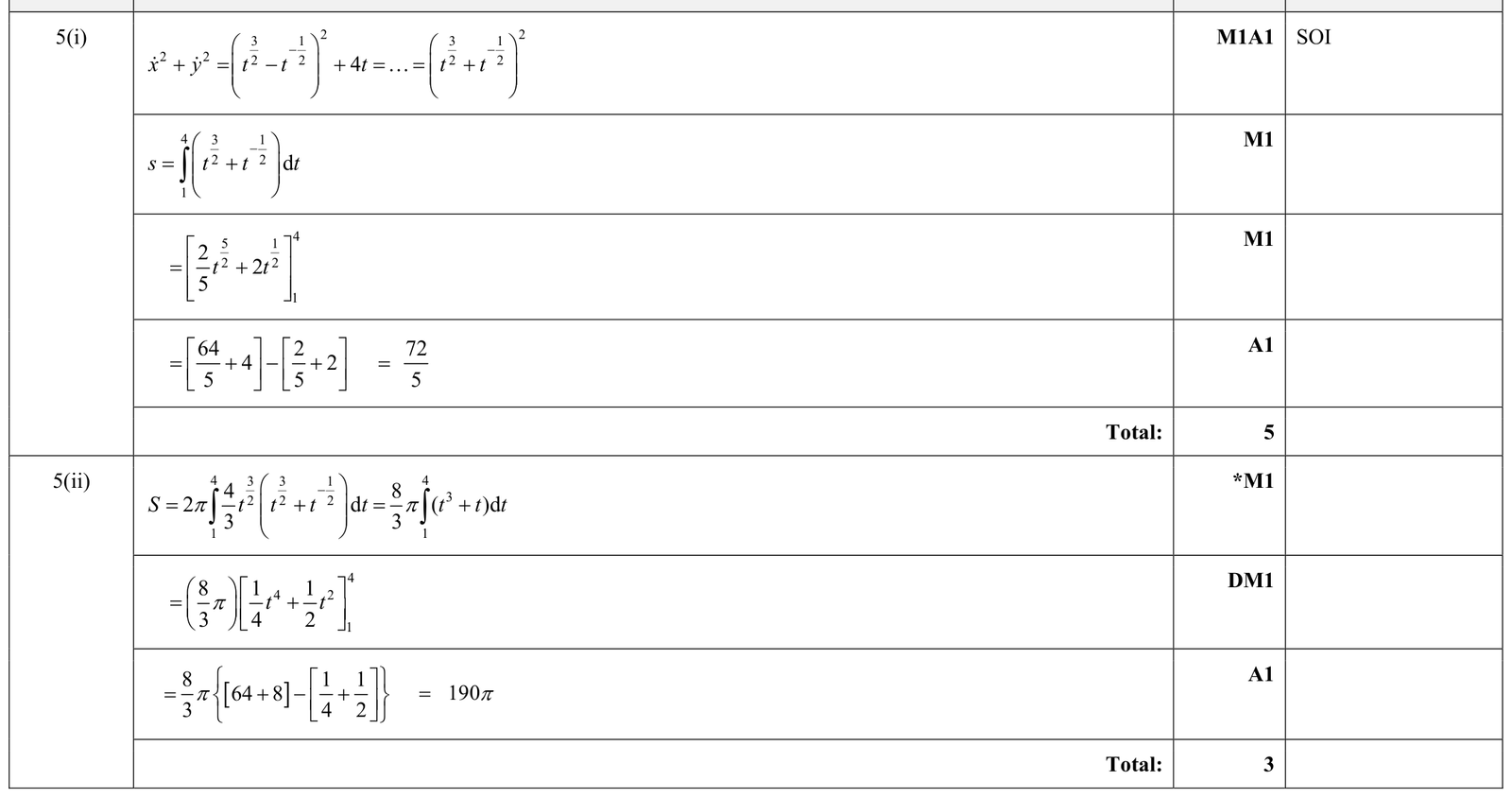
A curve \(C\) has parametric equations
\(x=\frac{2}{5} t^{\frac{5}{2}}-2 t^{\frac{1}{2}}, \quad y=\frac{4}{3} t^{\frac{3}{2}}, \quad \text { for } 1 \leqslant t \leqslant 4\)
(i) Find the exact value of the arc length of \(C\).
(ii) Find also the exact value of the surface area generated when \(C\) is rotated through \(2 \pi\) radians about the \(x\)-axis.
9231 P13 - Jun 2014 - Q6 - 10 marks
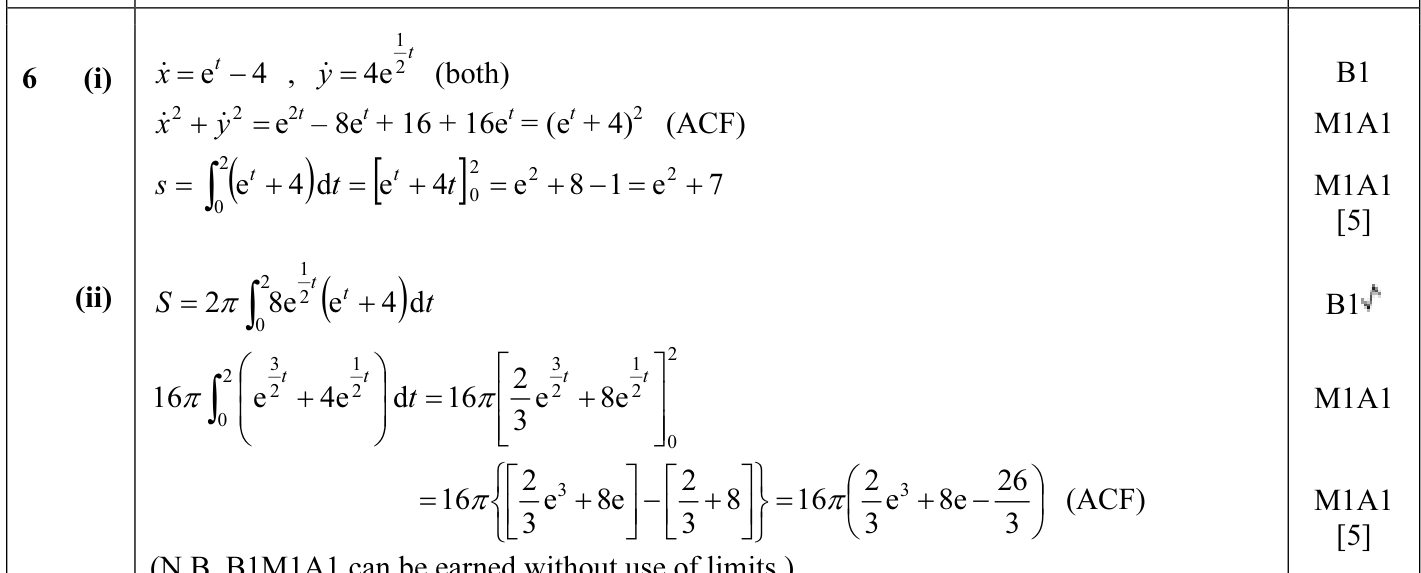
The curve \(C\) has parametric equations
\(x=\mathrm{e}^{t}-4 t+3, \quad y=8 \mathrm{e}^{\frac{1}{2} t}, \quad \text { for } 0 \leqslant t \leqslant 2 .\)
(i) Find, in terms of e , the length of \(C\).
(ii) Find, in terms of \(\pi\) and e , the area of the surface generated when \(C\) is rotated through \(2 \pi\) radians about the \(x\)-axis.
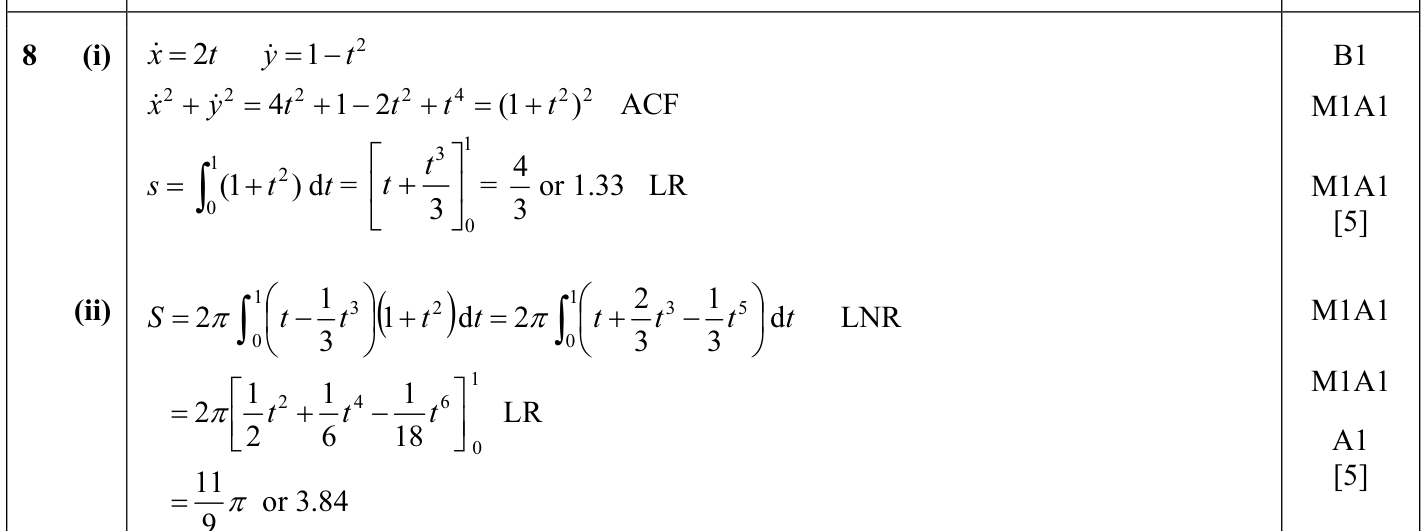
9231 P11 - Jun 2014 - Q8 - 10 marks
The curve \(C\) has parametric equations
\(x=t^{2}, \quad y=t-\frac{1}{3} t^{3}, \quad \text { for } 0 \leqslant t \leqslant 1 .\)
Find
(i) the arc length of \(C\),
(ii) the surface area generated when \(C\) is rotated through \(2 \pi\) radians about the \(x\)-axis.
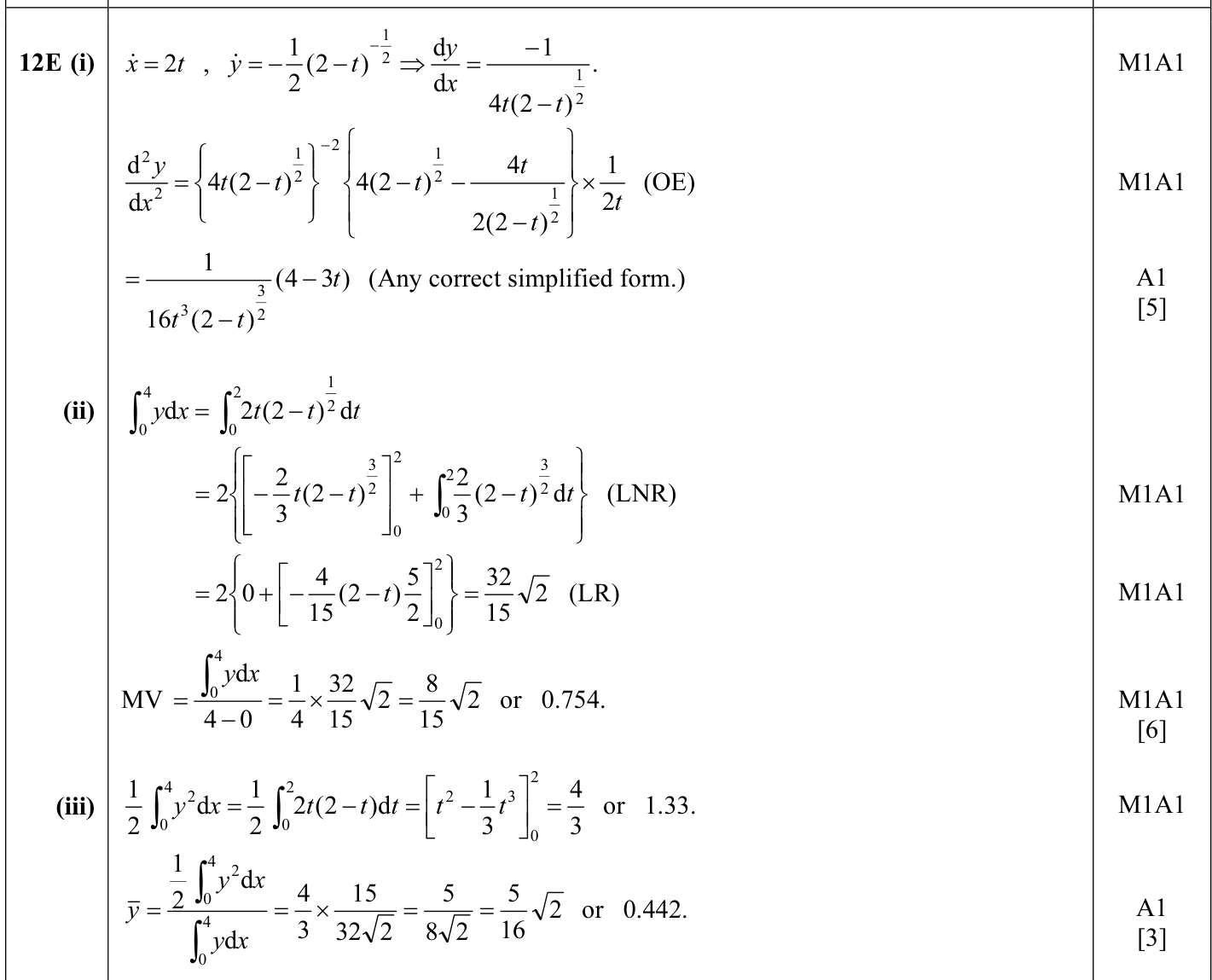
9231 P11 - Jun 2014 - Q12E - 14 marks
The curve \(C\) has parametric equations
\(x=t^2,\qquad y=(2-t)^{\frac12},\qquad 0\leq t\leq2.\)
Find:
(i) \(\frac{d^2y}{dx^2}\) in terms of \(t\);
(ii) the mean value of \(y\) with respect to \(x\) over \(0\leq x\leq4\);
(iii) the \(y\)-coordinate of the centroid of the region enclosed by \(C\), the \(x\)-axis and the \(y\)-axis.
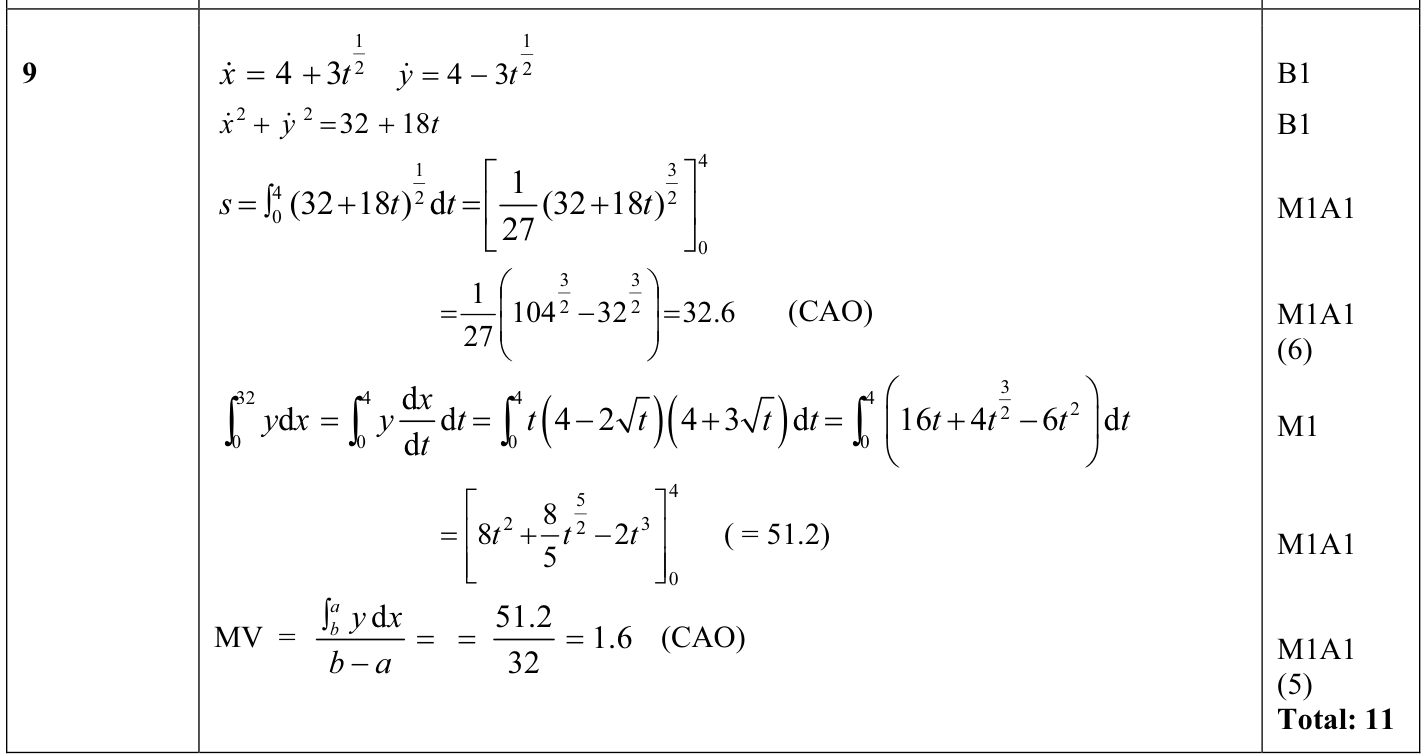
9231 P11 - Jun 2015 - Q9 - 11 marks
The curve \(C\) has parametric equations
\(x=4 t+2 t^{\frac{3}{2}}, \quad y=4 t-2 t^{\frac{3}{2}}, \quad \text { for } 0 \leqslant t \leqslant 4\)
Find the arc length of \(C\), giving your answer correct to 3 significant figures.
Find the mean value of \(y\) with respect to \(x\) over the interval \(0 \leqslant x \leqslant 32\).
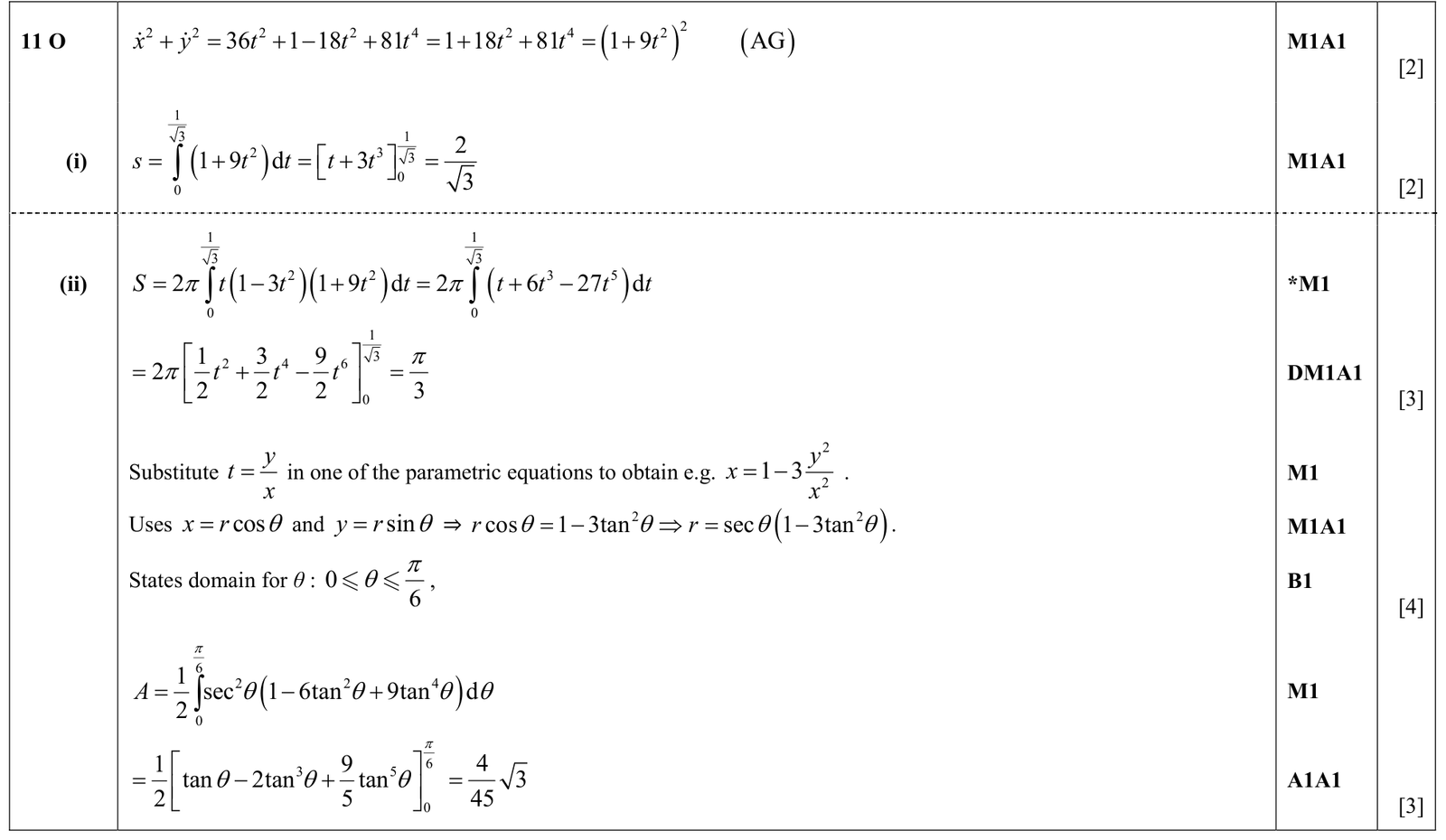
9231 P11 - Nov 2016 - Q11O - 14 marks
OR
A curve \(C\) has parametric equations
\(x=1-3t^2,\qquad y=t(1-3t^2),\qquad 0\leqslant t\leqslant \frac{1}{\sqrt3}.\)
Show that
\(\left(\frac{dx}{dt}\right)^2+\left(\frac{dy}{dt}\right)^2=(1+9t^2)^2.\)
Hence find (i) the arc length of \(C\), and (ii) the surface area generated when \(C\) is rotated through \(2\pi\) radians about the \(x\)-axis.
Use the fact that \(t=\dfrac{y}{x}\) to find a cartesian equation of \(C\). Hence show that the polar equation of \(C\) is \(r=\sec\theta(1-3\tan^2\theta)\), and state the domain of \(\theta\).
Find the area of the region enclosed between \(C\) and the initial line.
9231 P13 - Jun 2016 - Q4 - 8 marks
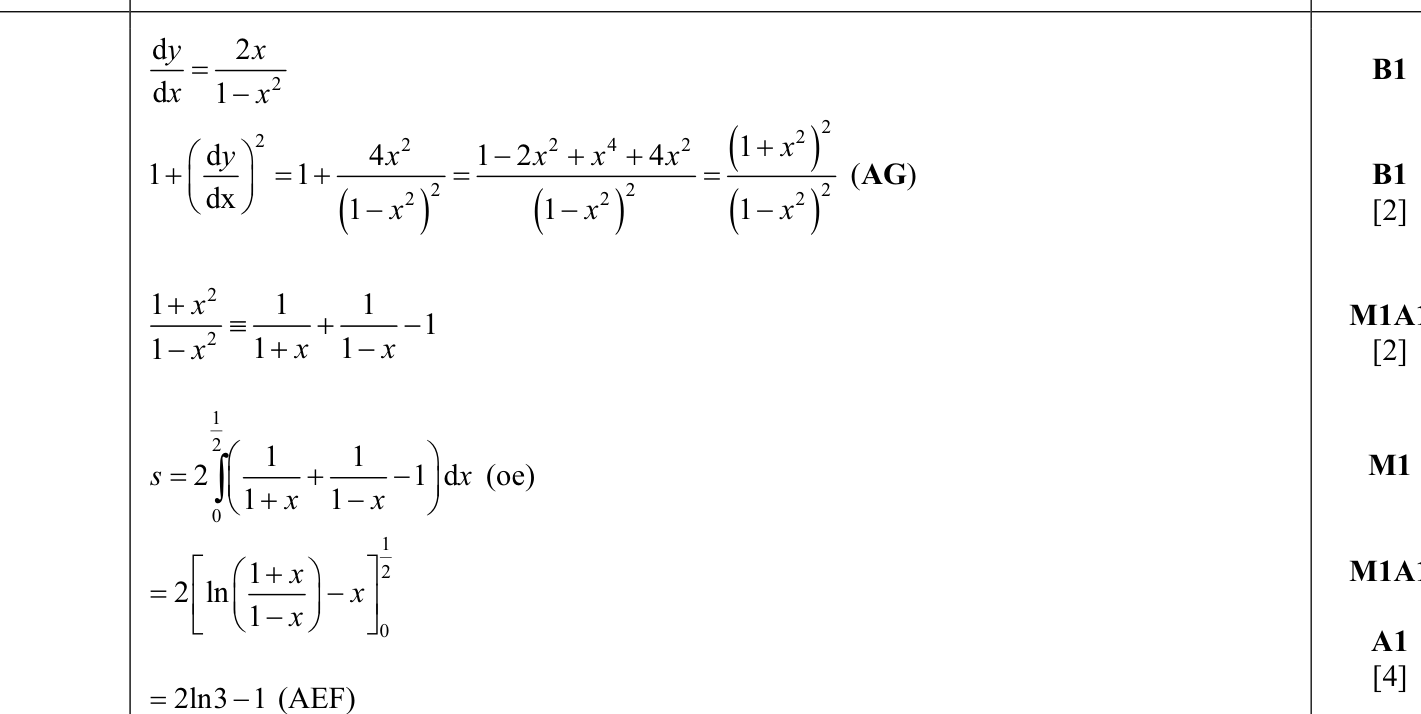
The curve \(C\) has equation \(y=-\ln \left(1-x^{2}\right)\) for \(-\frac{1}{2} \leqslant x \leqslant \frac{1}{2}\). Show that
\(1+\left(\frac{\mathrm{d} y}{\mathrm{~d} x}\right)^{2}=\left(\frac{1+x^{2}}{1-x^{2}}\right)^{2}\)
Show further that \(\frac{1+x^{2}}{1-x^{2}}\) may be expressed in the form \(\frac{P}{1+x}+\frac{Q}{1-x}+R\), where \(P, Q\) and \(R\) are constants to be determined.
Find the exact arc length of \(C\).
9231 P11 - Jun 2016 - Q11E - 14 marks
EITHER
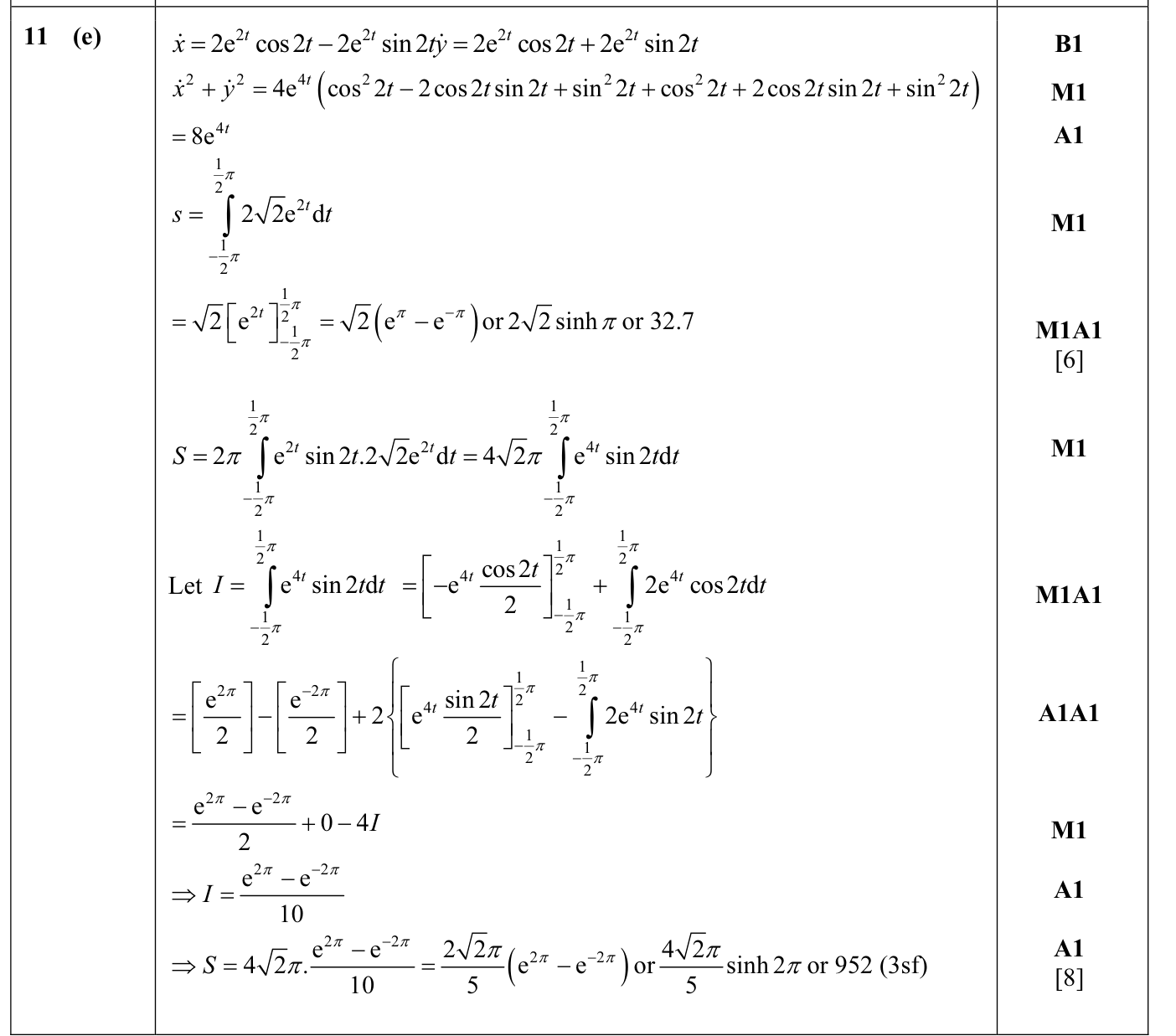
A curve \(C\) has parametric equations
\(x=e^{2t}\cos2t,\qquad y=e^{2t}\sin2t,\qquad -\frac{\pi}{2}\leq t\leq\frac{\pi}{2}.\)
Find the arc length of \(C\).
Find the area of the surface generated when \(C\) is rotated through \(2\pi\) radians about the \(x\)-axis.
9231 P12 - Nov 2014 - Q2 - 6 marks
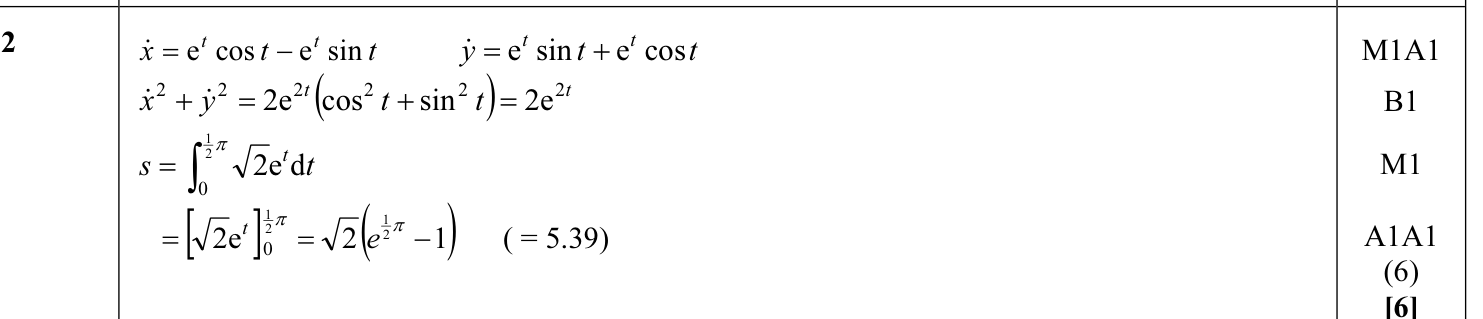
A curve \(C\) has parametric equations
\(x=\mathrm{e}^{t} \cos t, \quad y=\mathrm{e}^{t} \sin t, \quad \text { for } 0 \leqslant t \leqslant \frac{1}{2} \pi\)
Find the arc length of \(C\).
9231 P11 - Nov 2014 - Q2 - 6 marks
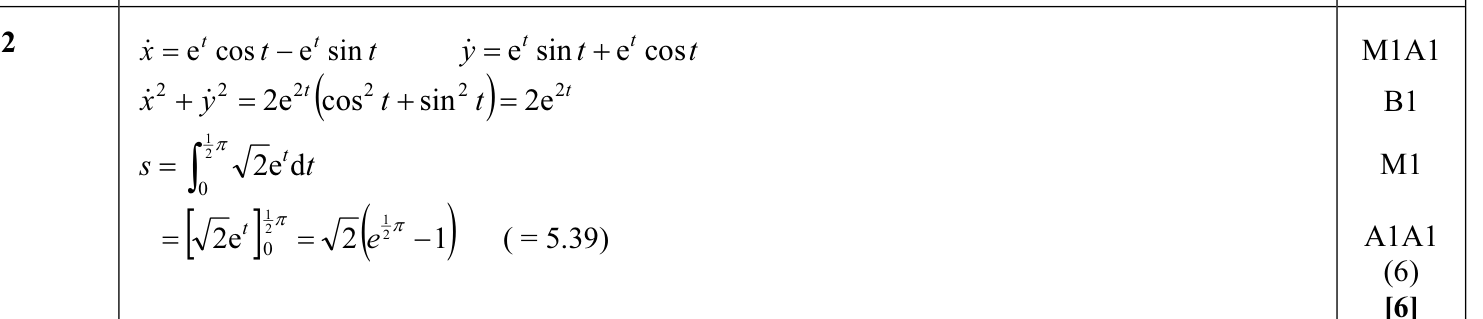
A curve \(C\) has parametric equations
\(x=\mathrm{e}^{t} \cos t, \quad y=\mathrm{e}^{t} \sin t, \quad \text { for } 0 \leqslant t \leqslant \frac{1}{2} \pi\)
Find the arc length of \(C\).
9231 P11 - Jun 2013 - Q11 - 28 marks
Answer only one of the following two alternatives.
EITHER
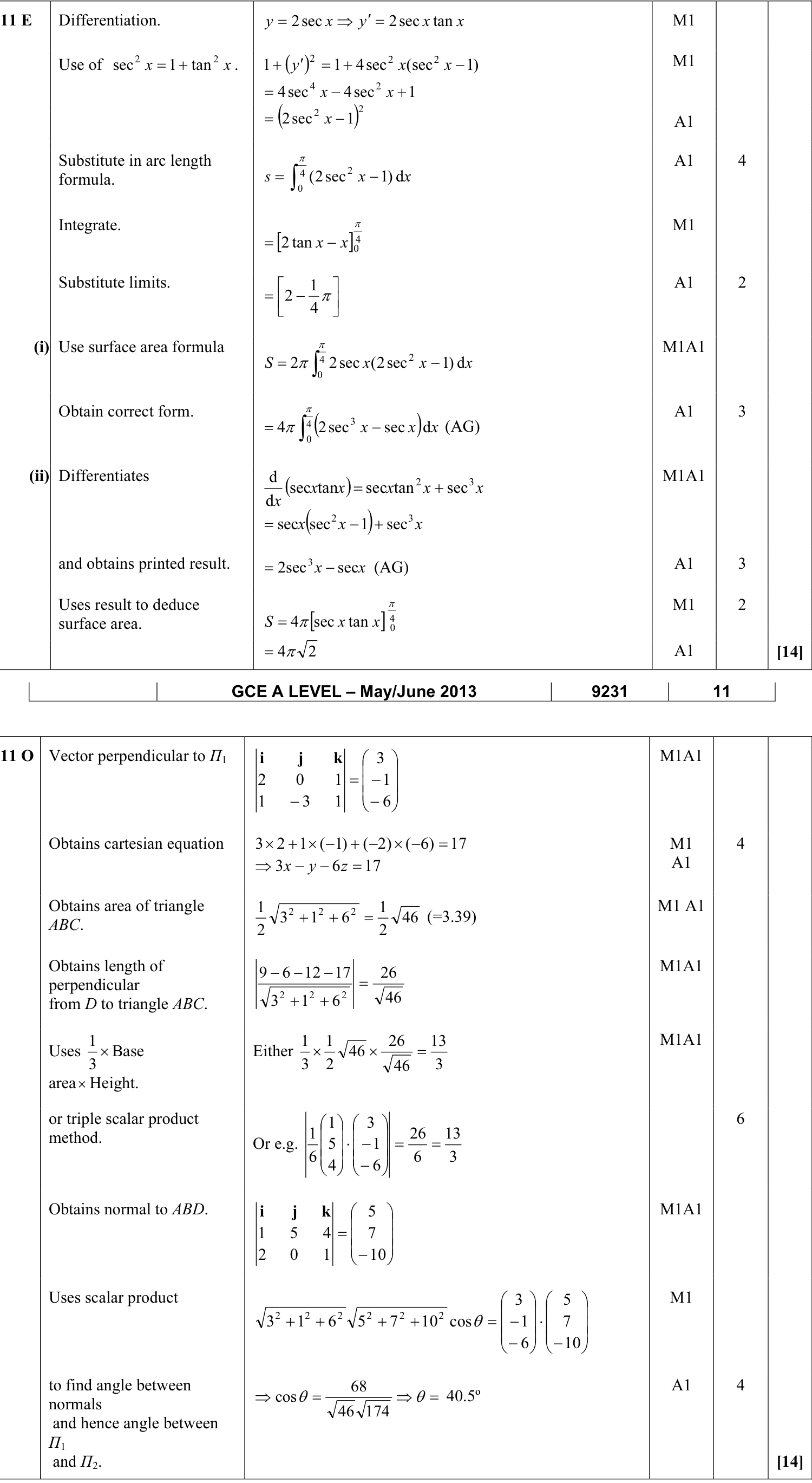
The curve \(C\) has equation \(y=2 \sec x\), for \(0 \leqslant x \leqslant \frac{1}{4} \pi\). Show that the arc length \(s\) of \(C\) is given by
\(s=\int_{0}^{\frac{1}{4} \pi}\left(2 \sec ^{2} x-1\right) \mathrm{d} x\)
Find the exact value of \(s\).
The surface area generated when \(C\) is rotated through \(2 \pi\) radians about the \(x\)-axis is denoted by \(S\). Show that
(i) \(S=4 \pi \int_{0}^{\frac{1}{4} \pi}\left(2 \sec ^{3} x-\sec x\right) \mathrm{d} x\),
(ii) \(\frac{\mathrm{d}}{\mathrm{d} x}(\sec x \tan x)=2 \sec ^{3} x-\sec x\).
Hence find the exact value of \(S\).
OR
The points \(A, B, C\) and \(D\) have coordinates as follows:
\(A(2,1,-2), \quad B(4,1,-1), \quad C(3,-2,-1) \quad \text { and } \quad D(3,6,2) .\)
The plane \(\Pi_{1}\) passes through the points \(A, B\) and \(C\). Find a cartesian equation of \(\Pi_{1}\).
Find the area of triangle \(A B C\) and hence, or otherwise, find the volume of the tetrahedron \(A B C D\).
[The volume of a tetrahedron is \(\frac{1}{3} \times\) area of base × perpendicular height.]
The plane \(\Pi_{2}\) passes through the points \(A, B\) and \(D\). Find the acute angle between \(\Pi_{1}\) and \(\Pi_{2}\).
9231 P13 - Jun 2013 - Q8 - 11 marks
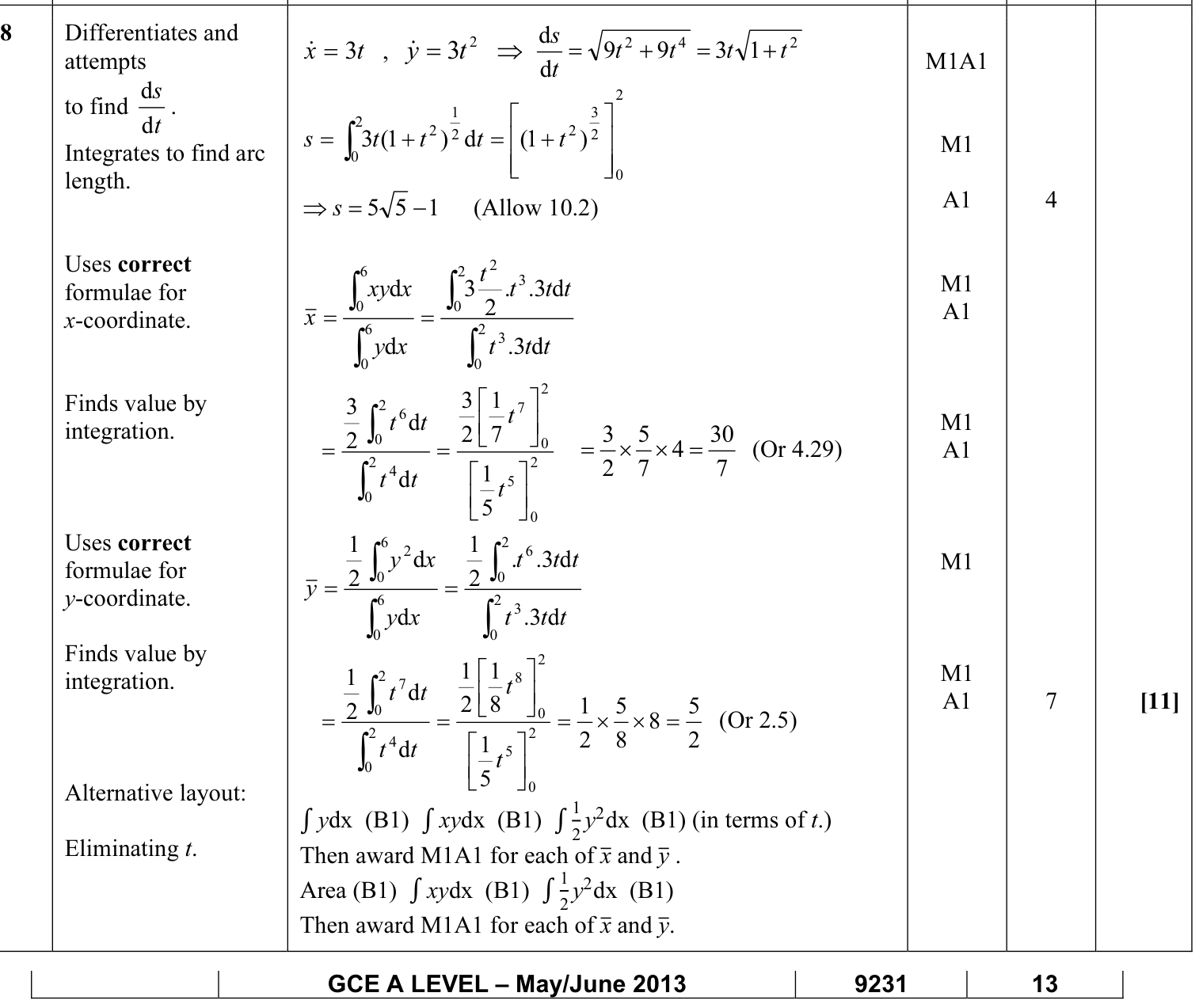
The curve \(C\) has parametric equations \(x=\frac{3}{2} t^{2}, y=t^{3}\), for \(0 \leqslant t \leqslant 2\). Find the arc length of \(C\).
Find the coordinates of the centroid of the region enclosed by \(C\), the \(x\)-axis and the line \(x=6\).
9231 P11 - Nov 2013 - Q9 - 12 marks
The curve \(C\) has parametric equations
\(x=t^{2}, \quad y=t-\frac{1}{3} t^{3}, \quad \text { for } 0 \leqslant t \leqslant 1\)
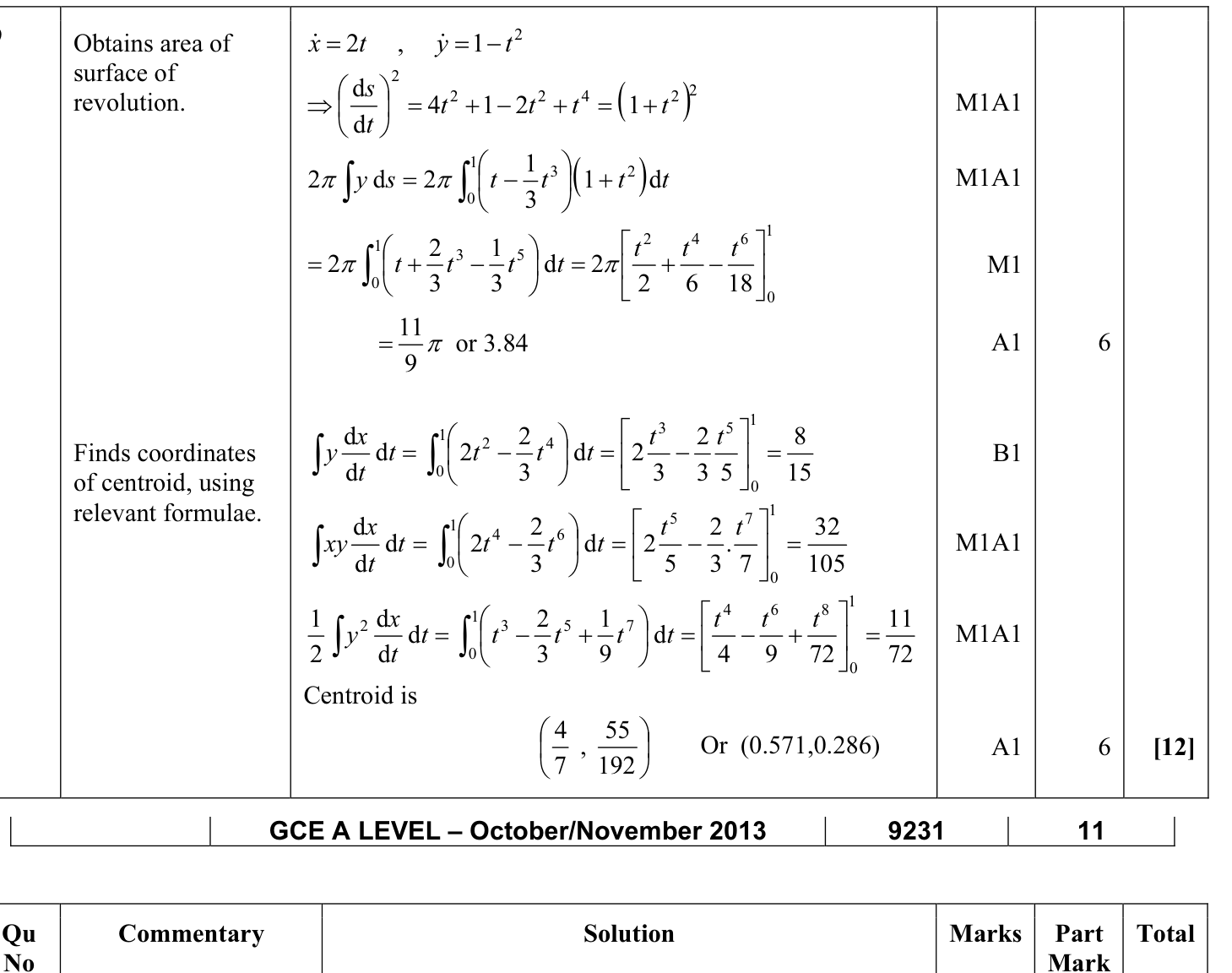
Find the surface area generated when \(C\) is rotated through \(2 \pi\) radians about the \(x\)-axis.
Find the coordinates of the centroid of the region bounded by \(C\), the \(x\)-axis and the line \(x=1\).
9231 P12 - Nov 2013 - Q9 - 12 marks
The curve \(C\) has parametric equations
\(x=t^{2}, \quad y=t-\frac{1}{3} t^{3}, \quad \text { for } 0 \leqslant t \leqslant 1\)
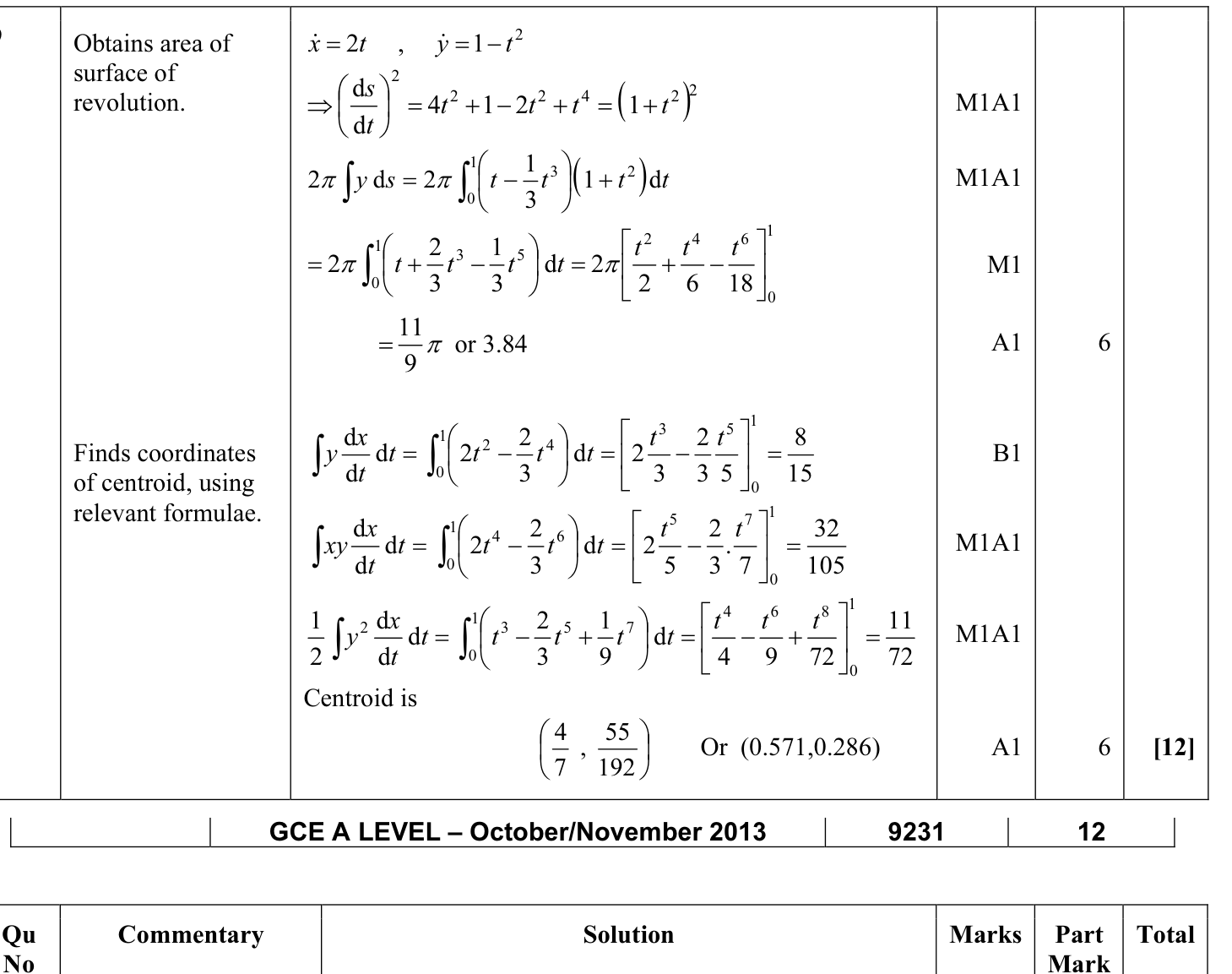
Find the surface area generated when \(C\) is rotated through \(2 \pi\) radians about the \(x\)-axis.
Find the coordinates of the centroid of the region bounded by \(C\), the \(x\)-axis and the line \(x=1\).
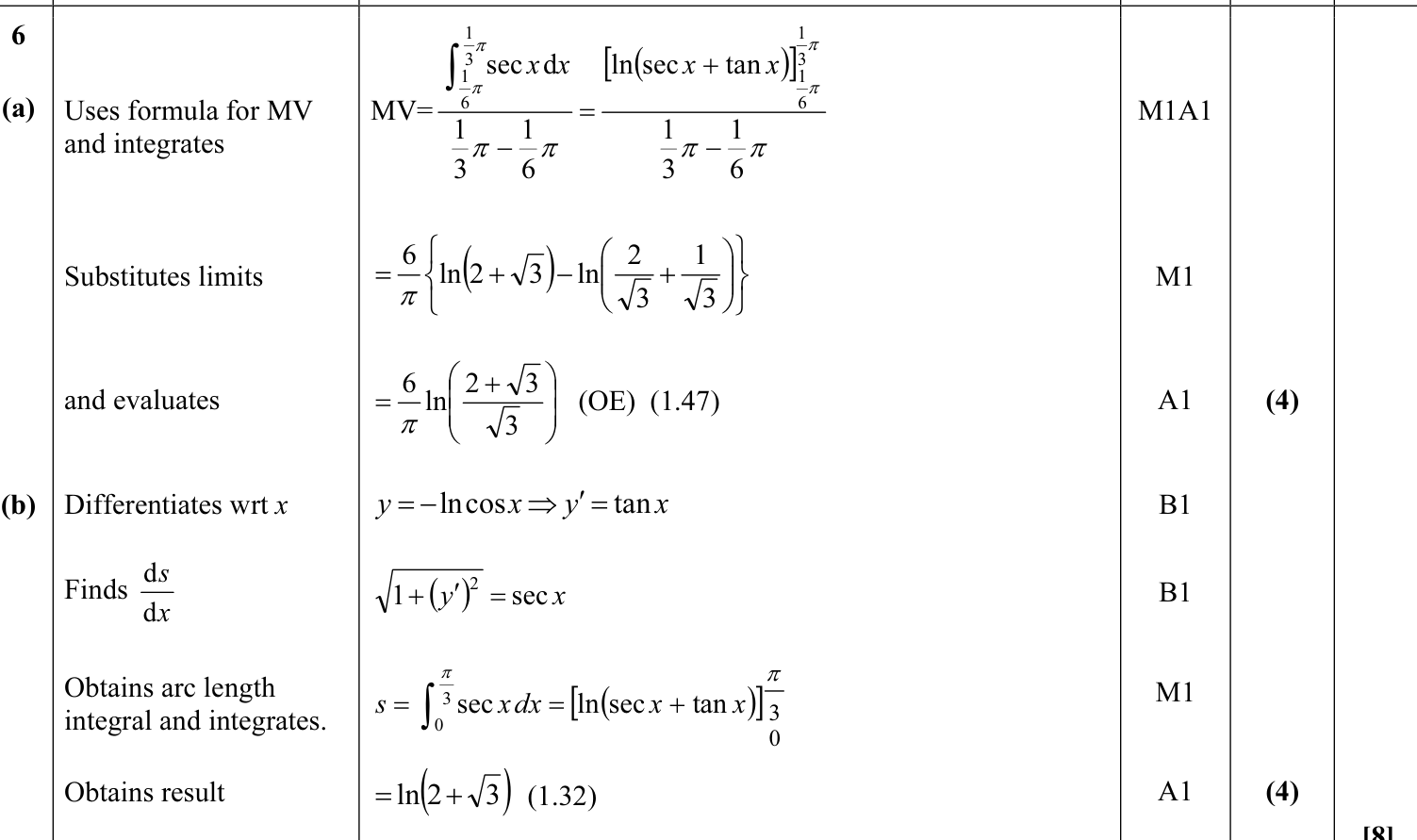
9231 P13 - Nov 2013 - Q6 - 8 marks
[In this question you may use, without proof, the formula \(\int \sec x \mathrm{~d} x=\ln (\sec x+\tan x)+\operatorname{const}\).]
(a) Let \(y=\sec x\). Find the mean value of \(y\) with respect to \(x\) over the interval \(\frac{1}{6} \pi \leqslant x \leqslant \frac{1}{3} \pi\).
(b) The curve \(C\) has equation \(y=-\ln (\cos x)\), for \(0 \leqslant x \leqslant \frac{1}{3} \pi\). Find the arc length of \(C\).
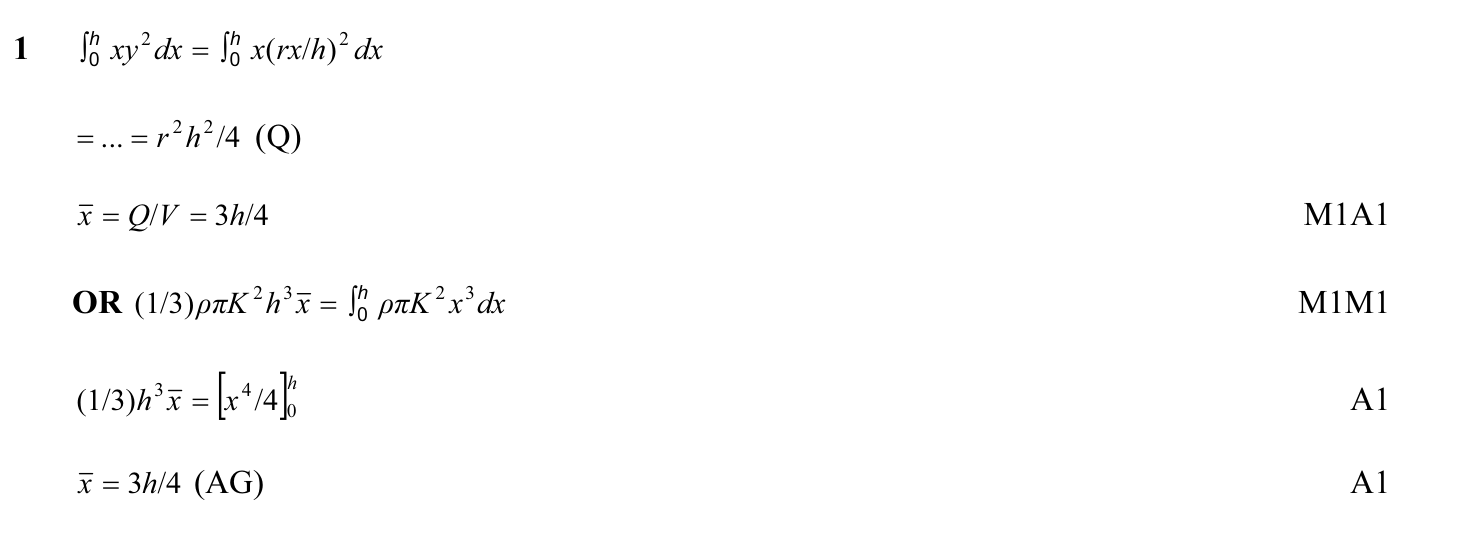
9231 P1 - Jun 2008 - Q1 - 4 marks
The finite region enclosed by the line \(y=k x\), where \(k\) is a positive constant, the \(x\)-axis is and the line \(x=h\) is rotated through 1 complete revolution about the \(x\)-axis. Prove by integ. the centroid of the resulting cone is at a distance \(\frac{3}{4} h\) from the origin \(O\).
[The volume of a cone of height \(h\) and base radius \(r\) is \(\frac{1}{3} \pi r^{2} h\).]
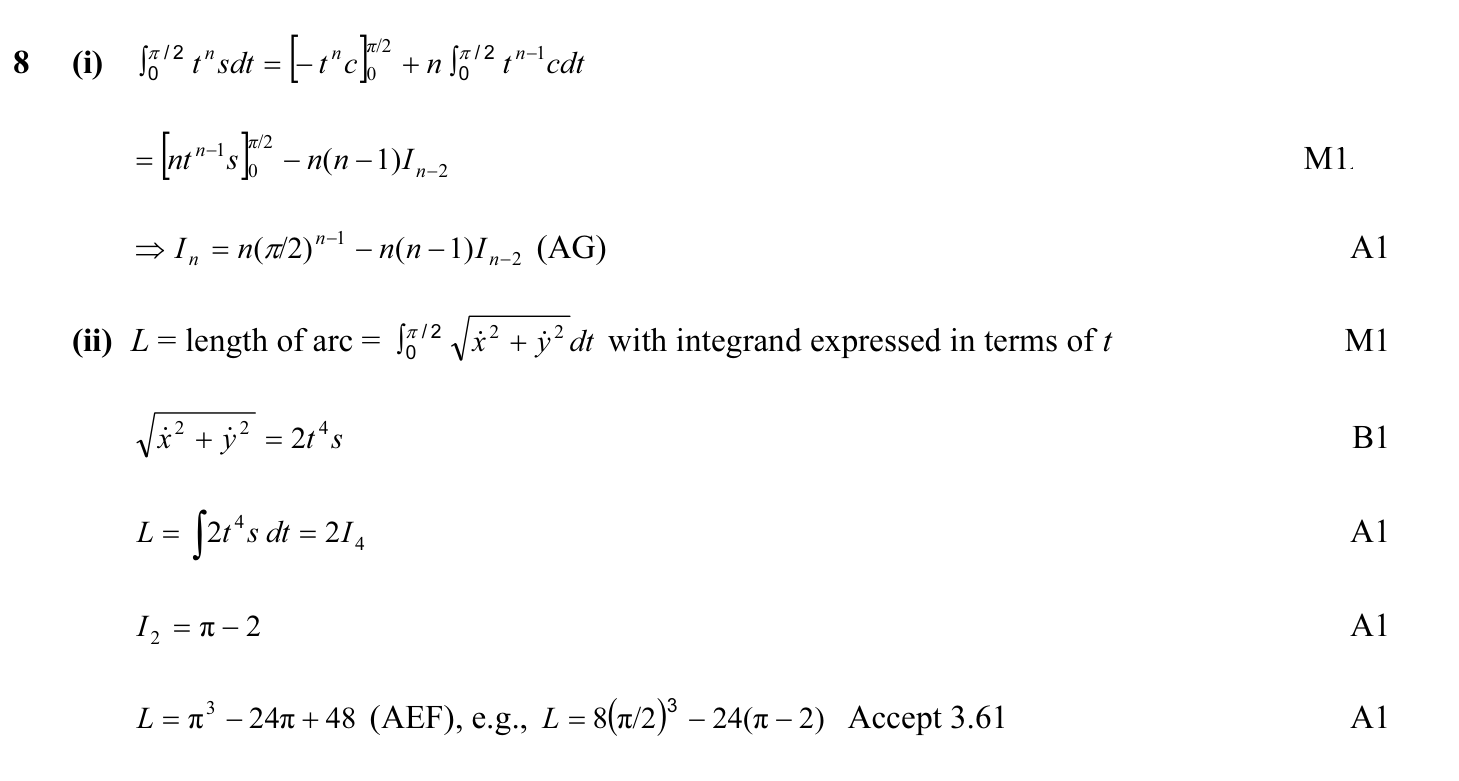
9231 P1 - Jun 2008 - Q8 - 10 marks
(i) Given that
\(I_{n}=\int_{0}^{\frac{1}{2} \pi} t^{n} \sin t \mathrm{~d} t\)
show that, for \(n \geqslant 2\),
\(I_{n}=n\left(\frac{\pi}{2}\right)^{n-1}-n(n-1) I_{n-2} .\)
(ii) A curve \(C\) in the \(x-y\) plane is defined parametrically in terms of \(t\). It is given that
\(\frac{\mathrm{d} x}{\mathrm{~d} t}=t^{4}(1-\cos 2 t) \quad \text { and } \quad \frac{\mathrm{d} y}{\mathrm{~d} t}=t^{4} \sin 2 t .\)
Find the length of the arc of \(C\) from the point where \(t=0\) to the point where \(t=\frac{1}{2} \pi\).
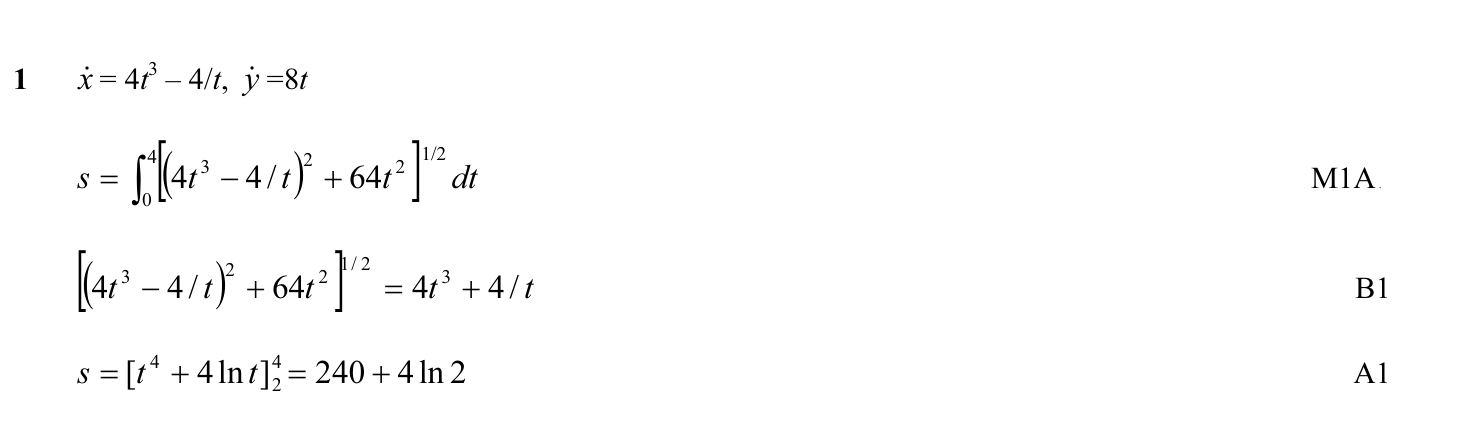
9231 P1 - Nov 2008 - Q1 - 5 marks
The curve \(C\) is defined parametrically by
\(x=t^{4}-4 \ln t, \quad y=4 t^{2} .\)
Show that the length of the arc of \(C\) from the point where \(t=2\) to the point where \(t=4\) is
\(240+4 \ln 2 .\)
9231 P11 - Jun 2011 - Q9 - 12 marks
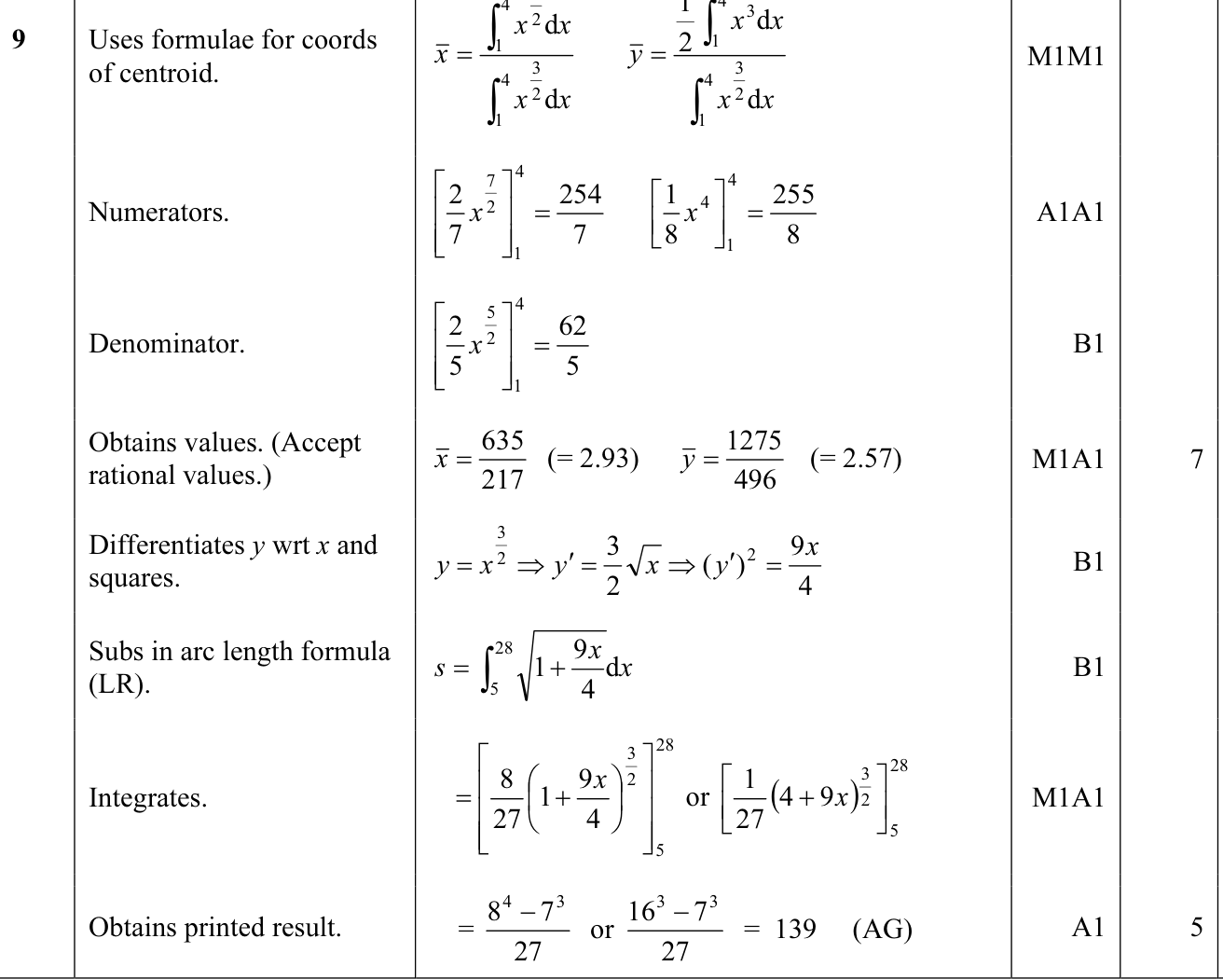
The curve \(C\) has equation \(y=x^{\frac{3}{2}}\). Find the coordinates of the centroid of the region bounded by \(C\), the lines \(x=1, x=4\) and the \(x\)-axis.
Show that the length of the arc of \(C\) from the point where \(x=5\) to the point where \(x=28\) is 139 .
9231 P12 - Jun 2014 - Q8 - 10 marks
The curve \(C\) has parametric equations
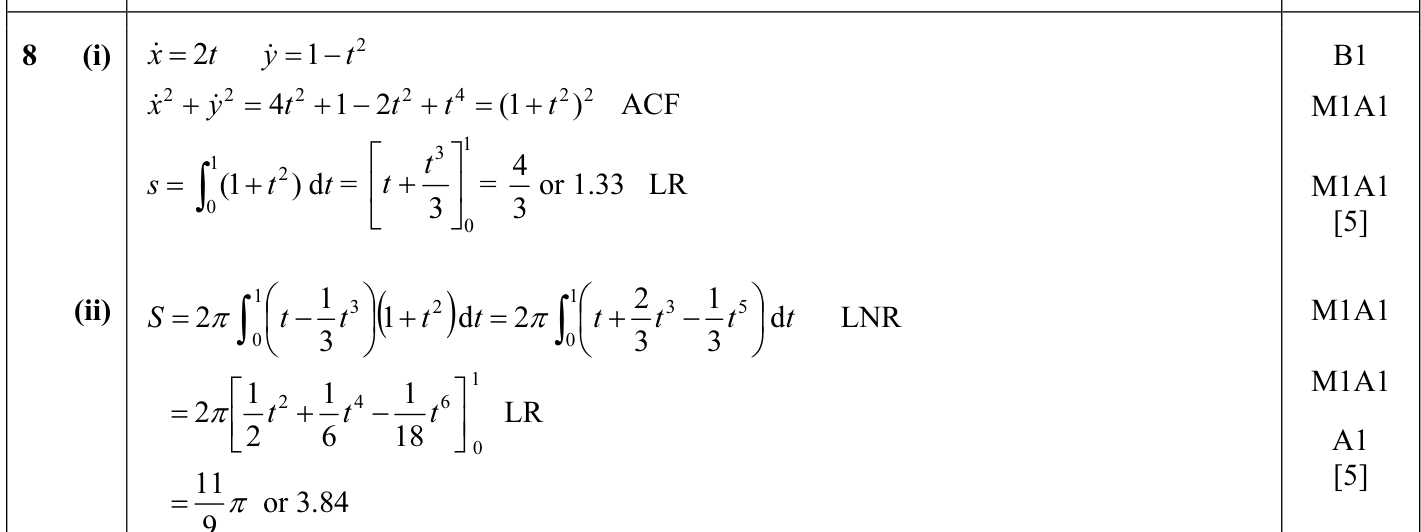
\(x=t^{2}, \quad y=t-\frac{1}{3} t^{3}, \quad \text { for } 0 \leqslant t \leqslant 1 .\)
Find
(i) the arc length of \(C\),
(ii) the surface area generated when \(C\) is rotated through \(2 \pi\) radians about the \(x\)-axis.
9231 P13 - Nov 2012 - Q6 - 7 marks
The curve \(C\) has parametric equations
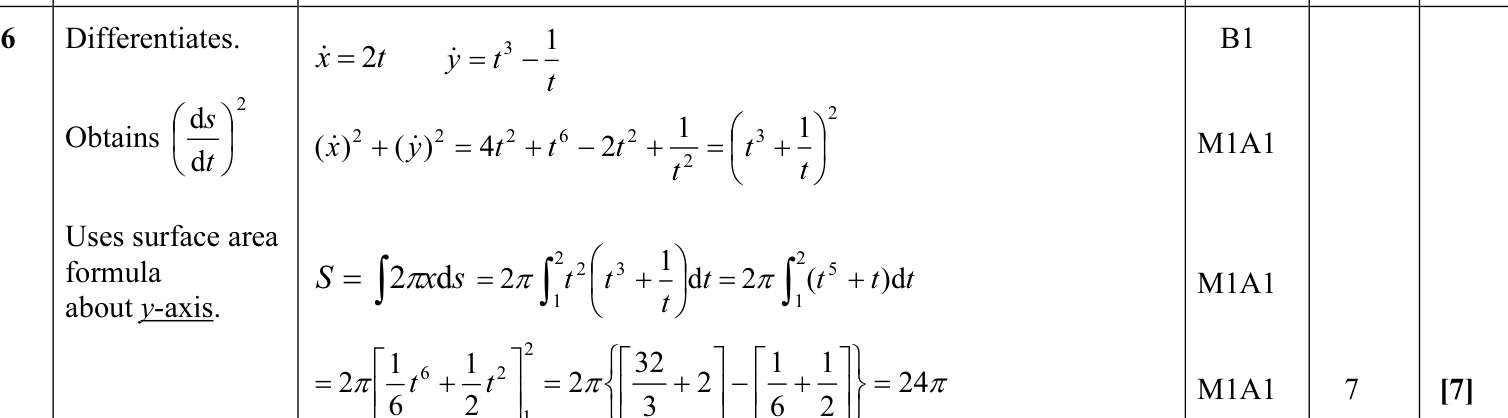
\(x=t^{2}, \quad y=\frac{1}{4} t^{4}-\ln t,\)
for \(1 \leqslant t \leqslant 2\). Find the area of the surface generated when \(C\) is rotated through \(2 \pi\) radians about the \(y\)-axis.
9231 P11 - Jun 2010 - Q3 - 7 marks
At any point \((x, y)\) on the curve \(C\),
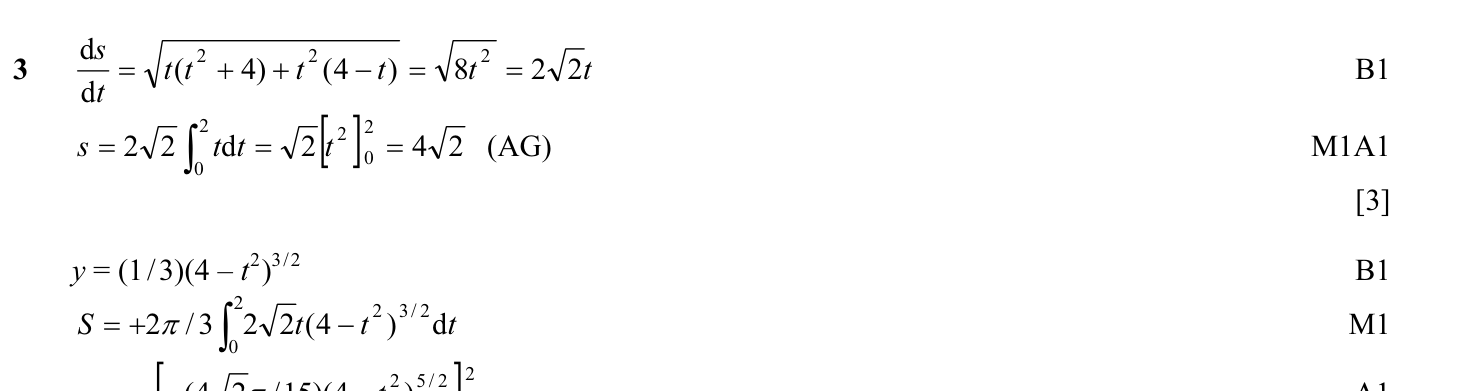
\(\frac{\mathrm{d} x}{\mathrm{~d} t}=t \sqrt{ }\left(t^{2}+4\right) \quad \text { and } \quad \frac{\mathrm{d} y}{\mathrm{~d} t}=-t \sqrt{ }\left(4-t^{2}\right)\)
where the parameter \(t\) is such that \(0 \leqslant t \leqslant 2\). Show that the length of \(C\) is \(4 \sqrt{ } 2\).
Given that \(y=0\) when \(t=2\), determine the area of the surface generated when \(C\) is rotated through one complete revolution about the \(x\)-axis, leaving your answer in an exact form.
9231 P13 - Jun 2011 - Q7 - 11 marks
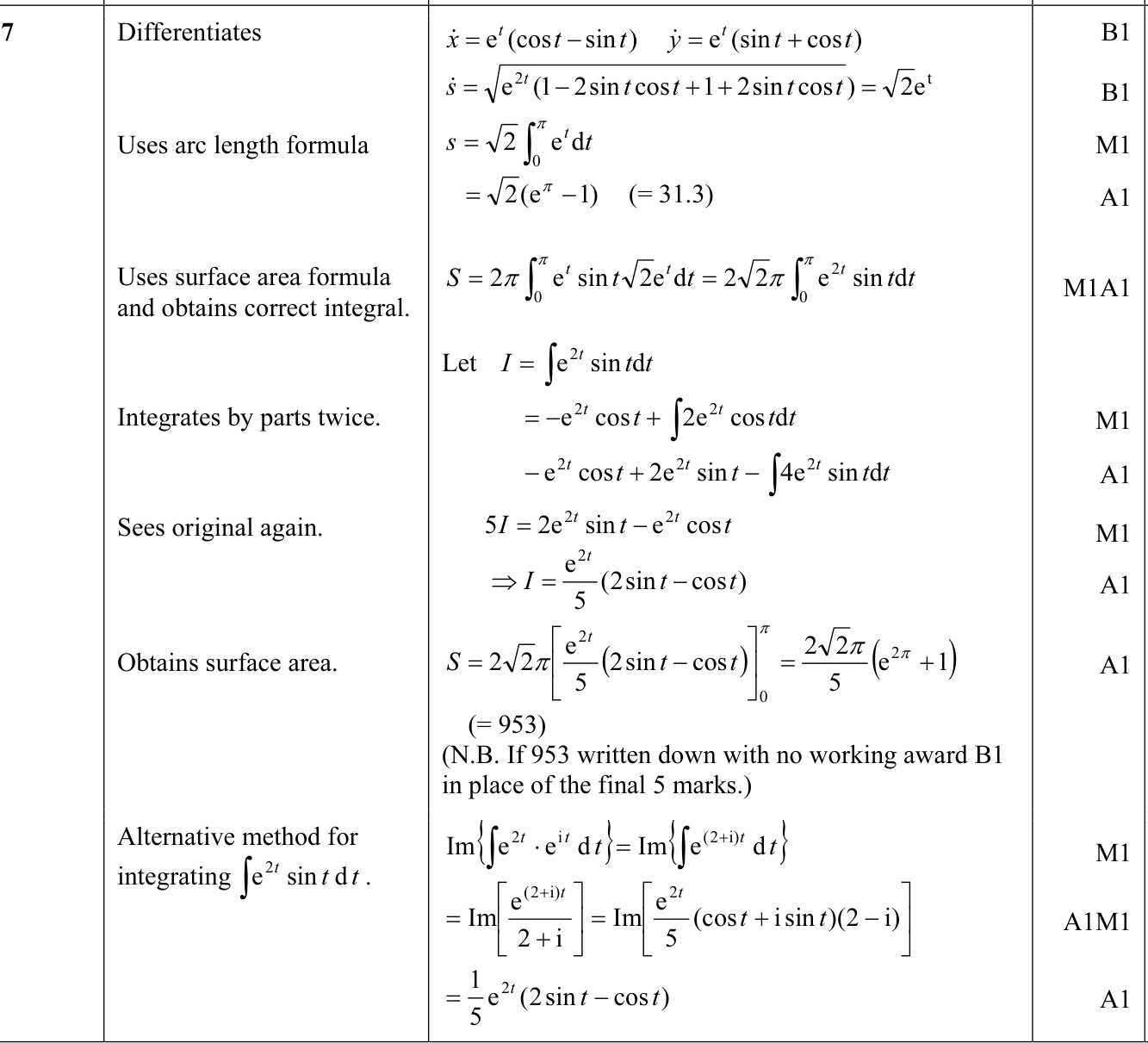
A curve \(C\) has parametric equations \(x=\mathrm{e}^{t} \cos t, y=\mathrm{e}^{t} \sin t\), for \(0 \leqslant t \leqslant \pi\). Find the arc \(l=\)
Find the area of the surface generated when \(C\) is rotated through \(2 \pi\) radians about the \(x\)-axis.
9231 P11 - Nov 2011 - Q9 - 12 marks
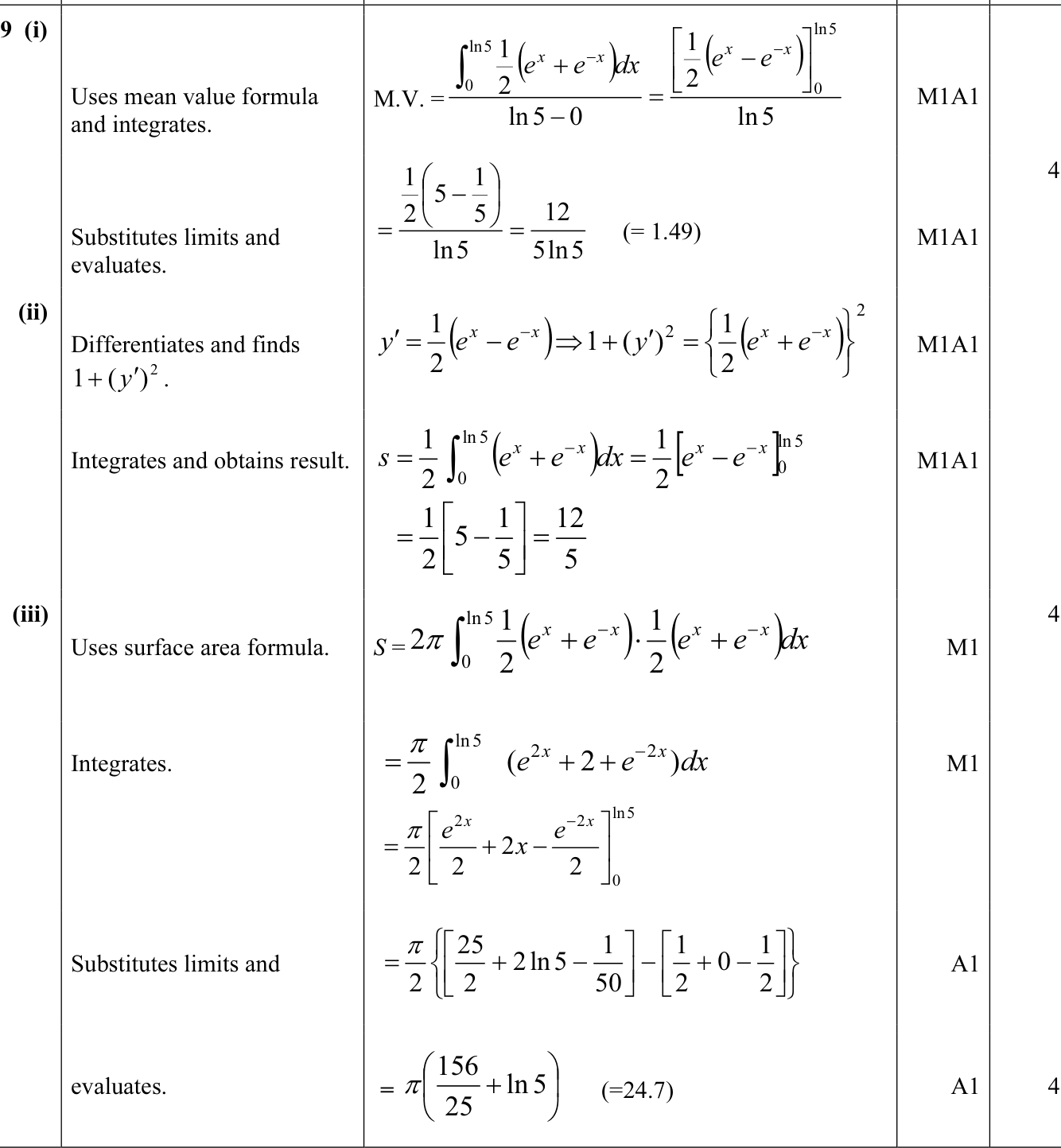
The curve \(C\) has equation \(y=\frac{1}{2}\left(\mathrm{e}^{x}+\mathrm{e}^{-x}\right)\) for \(0 \leqslant x \leqslant \ln 5\). Find
(i) the mean value of \(y\) with respect to \(x\) over the interval \(0 \leqslant x \leqslant \ln 5\),
(ii) the arc length of \(C\),
(iii) the surface area generated when \(C\) is rotated through \(2 \pi\) radians about the \(x\)-axis.
9231 P1 - Jun 2009 - Q4 - 6 marks
A curve has equation
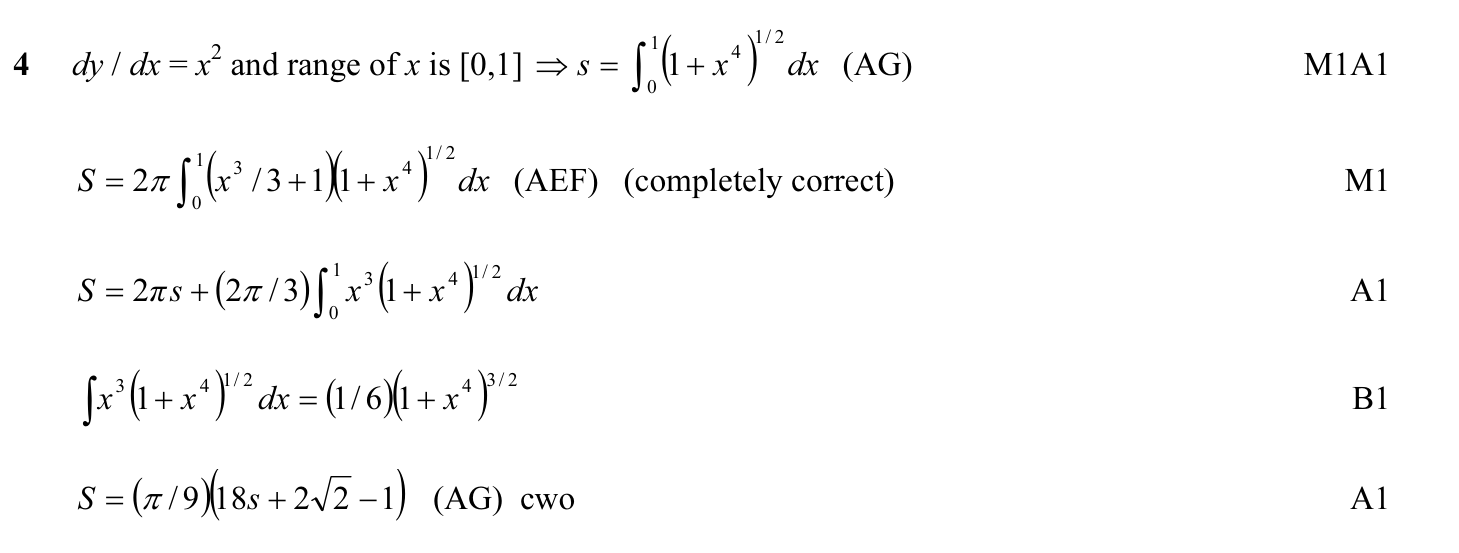
\(y=\frac{1}{3} x^{3}+1 .\)
The length of the arc of the curve joining the point where \(x=0\) to the point where \(x=1\) is denoted by \(s\). Show that
\(s=\int_{0}^{1} \sqrt{ }\left(1+x^{4}\right) \mathrm{d} x\)
The surface area generated when this arc is rotated through one complete revolution about the \(x\)-axis is denoted by \(S\). Show that
\(S=\frac{1}{9} \pi(18 s+2 \sqrt{ } 2-1) .\)
[Do not attempt to evaluate \(s\) or \(S\).]
9231 P13 - Jun 2010 - Q4 - 7 marks
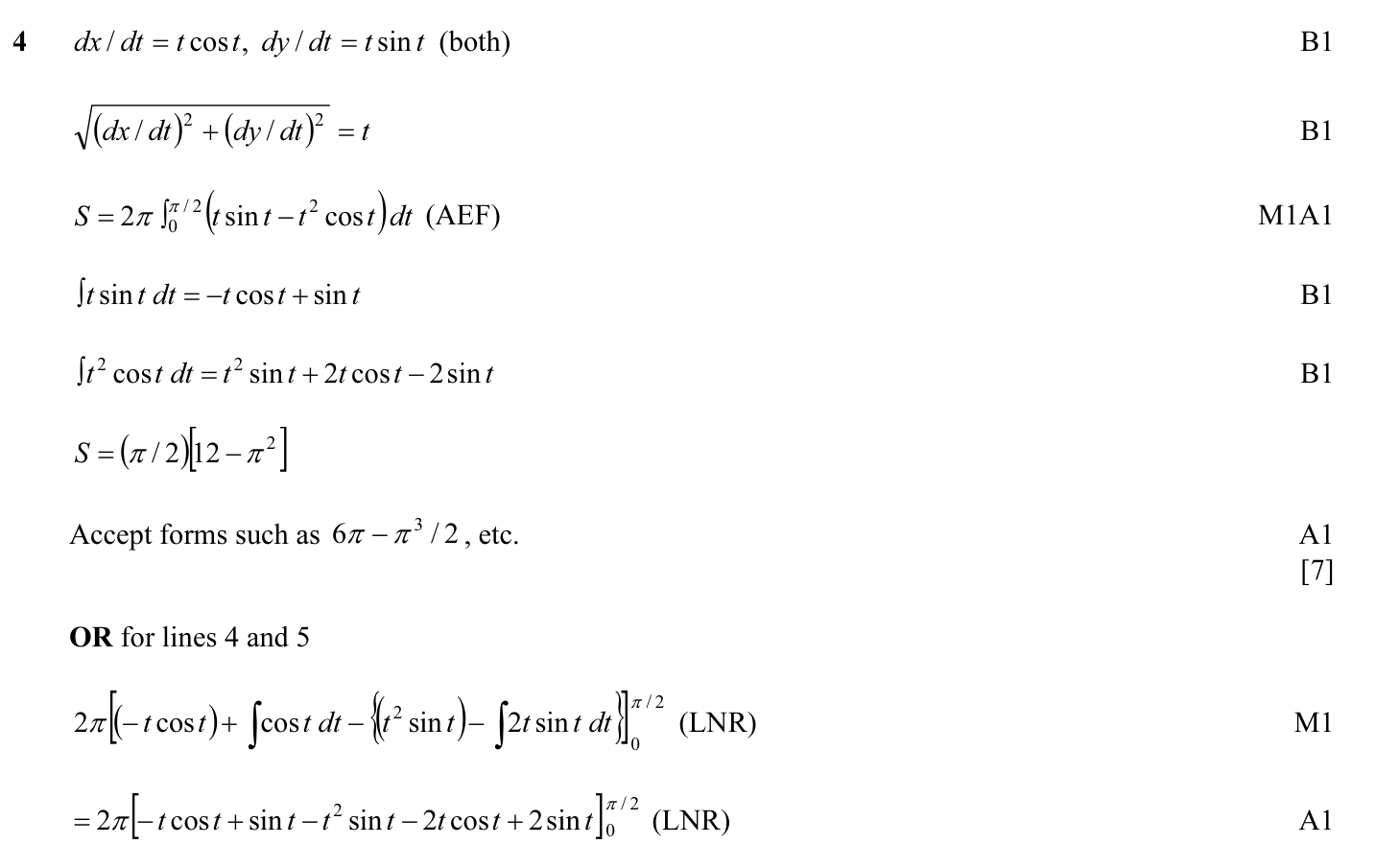
The parametric equations of a curve are
\(x=\cos t+t \sin t, \quad y=\sin t-t \cos t\)
The arc of the curve joining the point where \(t=0\) to the point where \(t=\frac{1}{2} \pi\) is rotated about the \(x\)-axis through one complete revolution. Find the area of the surface generated, leaving your result in terms of \(\pi\).
9231 P1 - Nov 2009 - Q8 - 10 marks
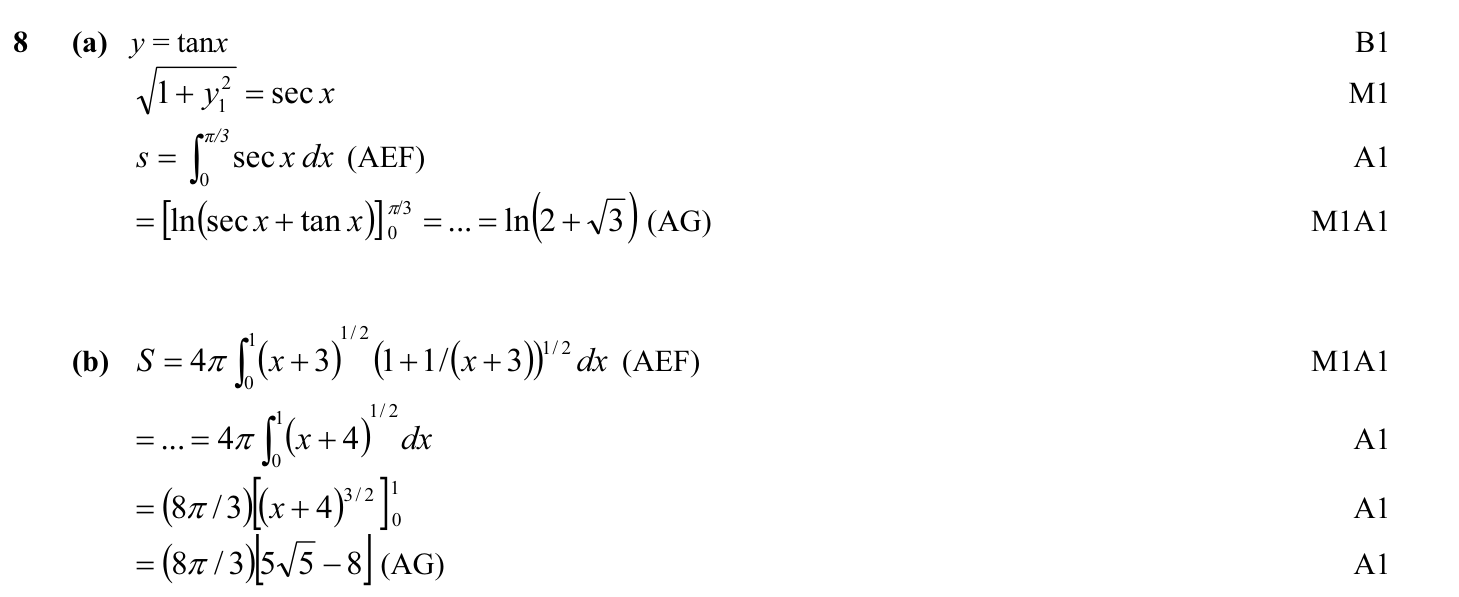
(a) The curve \(C_{1}\) has equation \(y=-\ln (\cos x)\). Show that the length of the arc of \(C_{1}\) from the point where \(x=0\) to the point where \(x=\frac{1}{3} \pi\) is \(\ln (2+\sqrt{3})\).
(b) The curve \(C_{2}\) has equation \(y=2 \sqrt{ }(x+3)\). The arc of \(C_{2}\) joining the point where \(x=0\) to the point where \(x=1\) is rotated through one complete revolution about the \(x\)-axis. Show that the area of the surface generated is
\(\frac{8}{3} \pi(5 \sqrt{ } 5-8) .\)