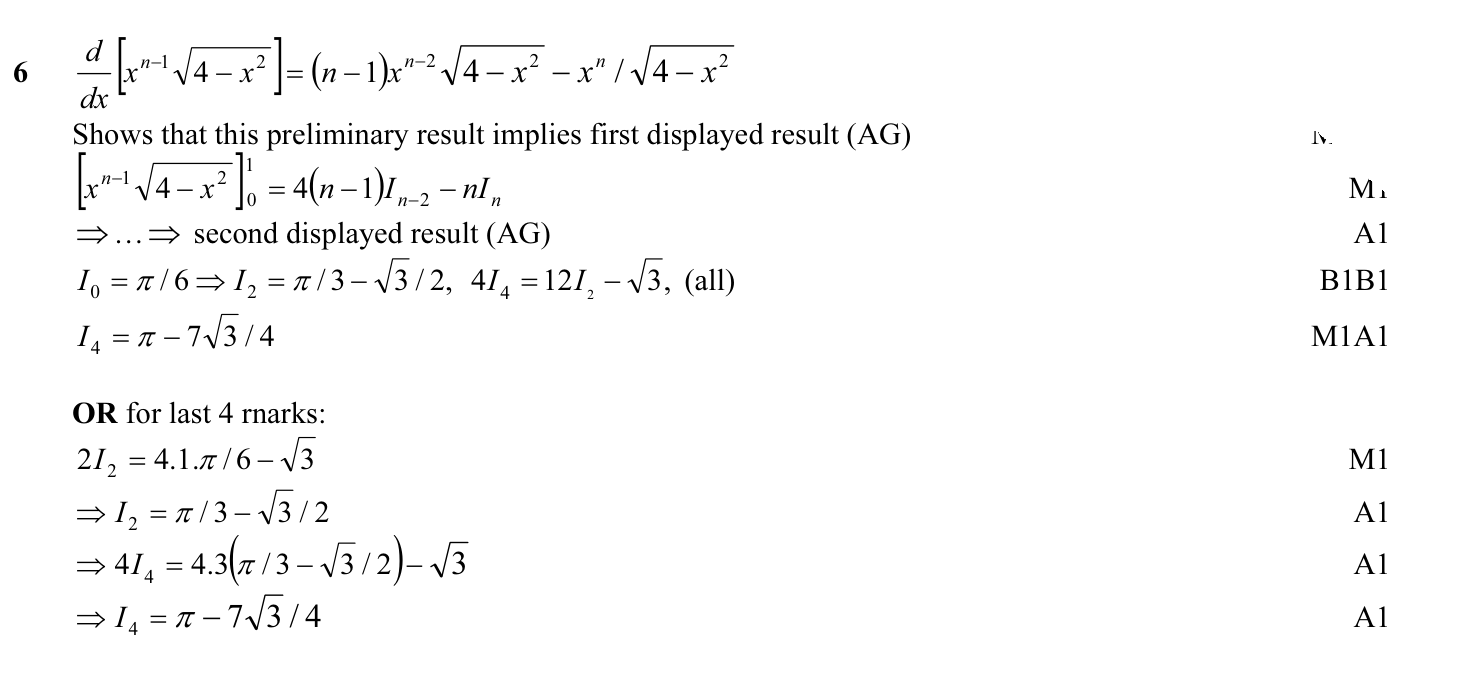
9231 P11 - Jun 2019 - Q4 - 8 marks
\(4 \quad\) It is given that, for \(n \geqslant 0\),
\(I_{n}=\int_{0}^{1} x^{n} \mathrm{e}^{x^{3}} \mathrm{~d} x\)
(i) Show that \(I_{2}=\frac{1}{3}(\mathrm{e}-1)\).
(ii) Show that, for \(n \geqslant 3\),
\(3 I_{n}=\mathrm{e}-(n-2) I_{n-3} .\)
(iii) Hence find the exact value of \(I_{8}\).
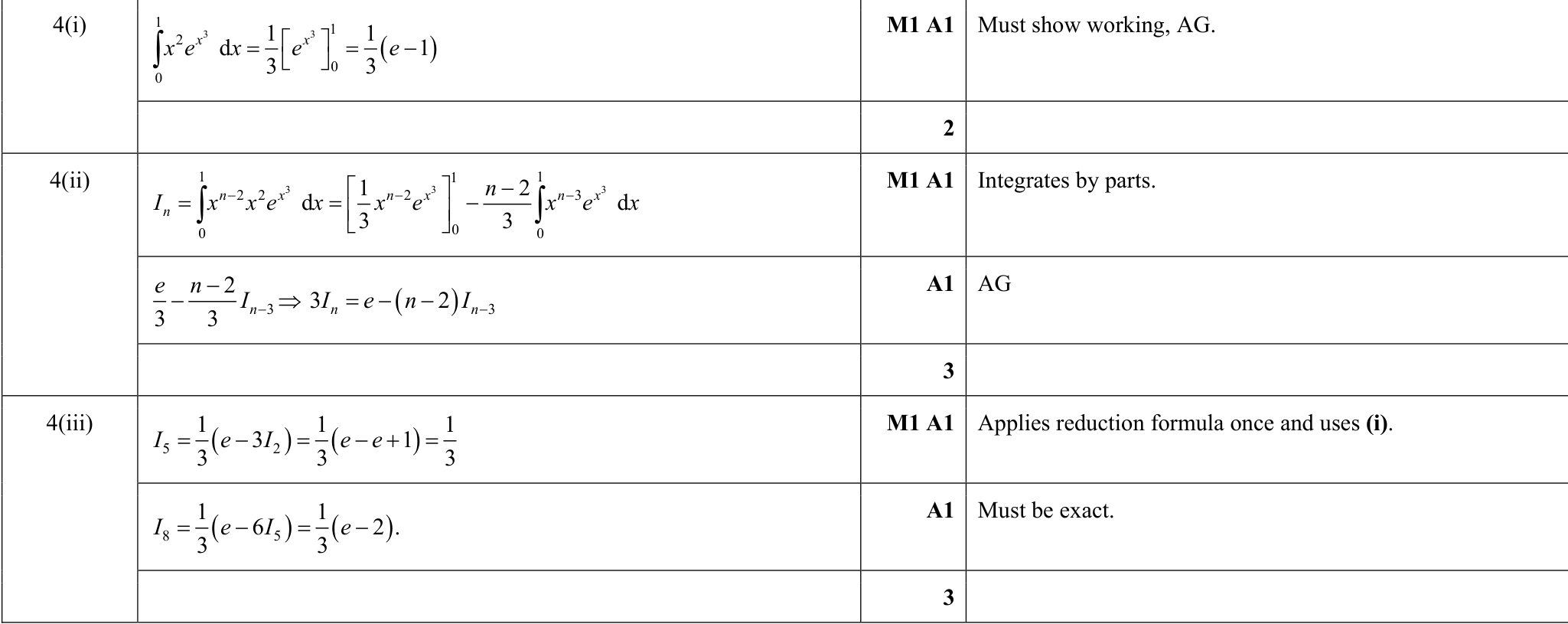
9231 P11 - Nov 2019 - Q3 - 7 marks
The integral \(I_{n}\), where \(n\) is a positive integer, is defined by
\(I_{n}=\int_{\frac{1}{2}}^{1} x^{-n} \sin \pi x \mathrm{~d} x\)
(i) Show that
\(n(n+1) I_{n+2}=2^{n+1} n+\pi-\pi^{2} I_{n} .\)
(ii) Find \(I_{5}\) in terms of \(\pi\) and \(I_{1}\).
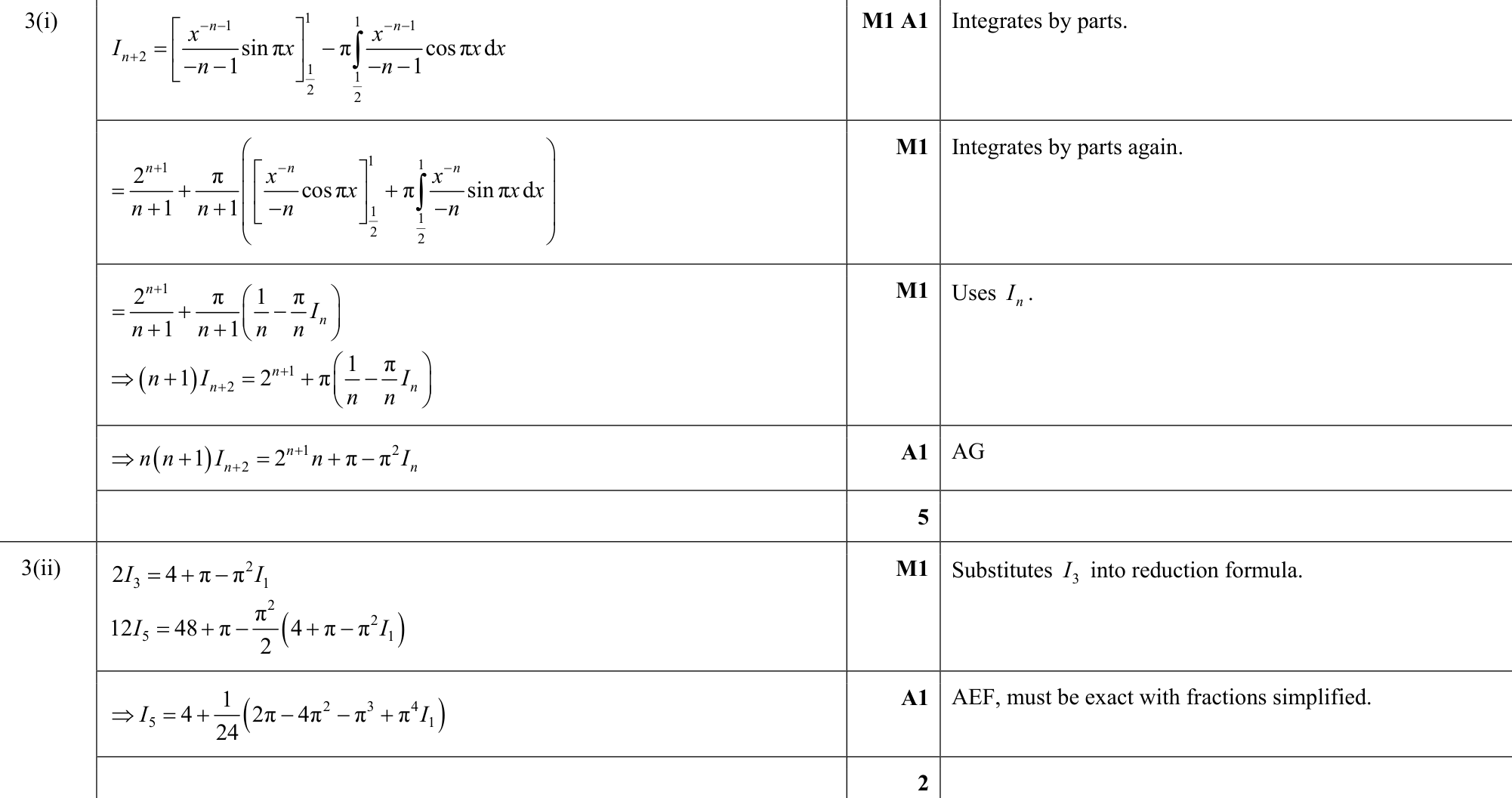
9231 P13 - Jun 2018 - Q11 - 28 marks
Answer only one of the following two alternatives.
EITHER
(i) Show that
\(\int_{-\frac12\pi}^{\frac12\pi} e^x\cos x\,dx=\frac12\left(e^{\frac12\pi}+e^{-\frac12\pi}\right).\)
(ii) It is given that, for \(n\ge 0\),
\(I_n=\int_{-\frac12\pi}^{\frac12\pi} e^{2x}\cos^n x\,dx.\)
Show that, for \(n\ge 2\),
\(4I_n=n(n-1)\int_{-\frac12\pi}^{\frac12\pi} e^{2x}\sin^2x\cos^{n-2}x\,dx-nI_n,\)
and deduce the reduction formula
\((n^2+4)I_n=n(n-1)I_{n-2}.\)
(iii) Using the result in part (i) and the reduction formula in part (ii), find the \(y\)-coordinate of the centroid of the region bounded by the \(x\)-axis and the arc of \(y=e^x\cos x\) from \(x=-\frac12\pi\) to \(x=\frac12\pi\). Give your answer correct to 3 significant figures.
OR
Let \(V\) be the subspace of \(\mathbb R^4\) spanned by
\(\mathbf v_1=\begin{pmatrix}1\\2\\0\\2\end{pmatrix},\quad \mathbf v_2=\begin{pmatrix}-2\\-5\\5\\6\end{pmatrix},\quad \mathbf v_3=\begin{pmatrix}0\\-3\\15\\18\end{pmatrix},\quad \mathbf v_4=\begin{pmatrix}0\\-2\\10\\8\end{pmatrix}.\)
(i) Show that the dimension of \(V\) is 3.
(ii) Express \(\mathbf v_4\) as a linear combination of \(\mathbf v_1\), \(\mathbf v_2\) and \(\mathbf v_3\).
(iii) Write down a basis for \(V\).
Let
\(\mathbf M=\begin{pmatrix}1&-2&0&0\\2&-5&-3&-2\\0&5&15&10\\2&6&18&8\end{pmatrix}.\)
(iv) Find the general solution of \(\mathbf M\mathbf x=\mathbf v_1+\mathbf v_2\).
The set of elements of \(\mathbb R^4\) which are not solutions of \(\mathbf M\mathbf x=\mathbf v_1+\mathbf v_2\) is denoted by \(W\).
(v) State, with a reason, whether \(W\) is a vector space.
9231 P21 - Jun 2025 - Q2 - 7 marks
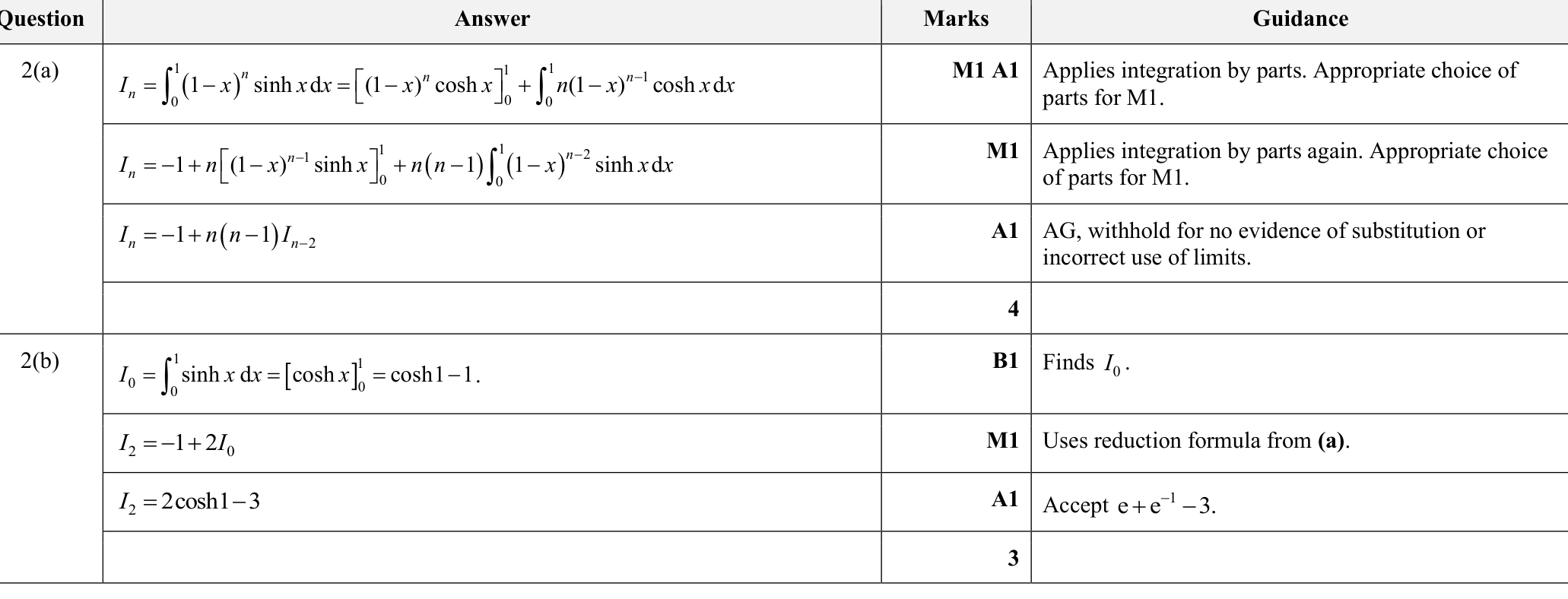
Let \(I_{n}=\int_{0}^{1}(1-x)^{n} \sinh x \mathrm{~d} x\), where \(n\) is a non-negative integer.
(a) Show that, for \(n \geqslant 2, \quad I_{n}=-1+n(n-1) I_{n-2}\).
(b) Find the exact value of \(I_{2}\).
9231 P21 - Jun 2024 - Q4 - 8 marks
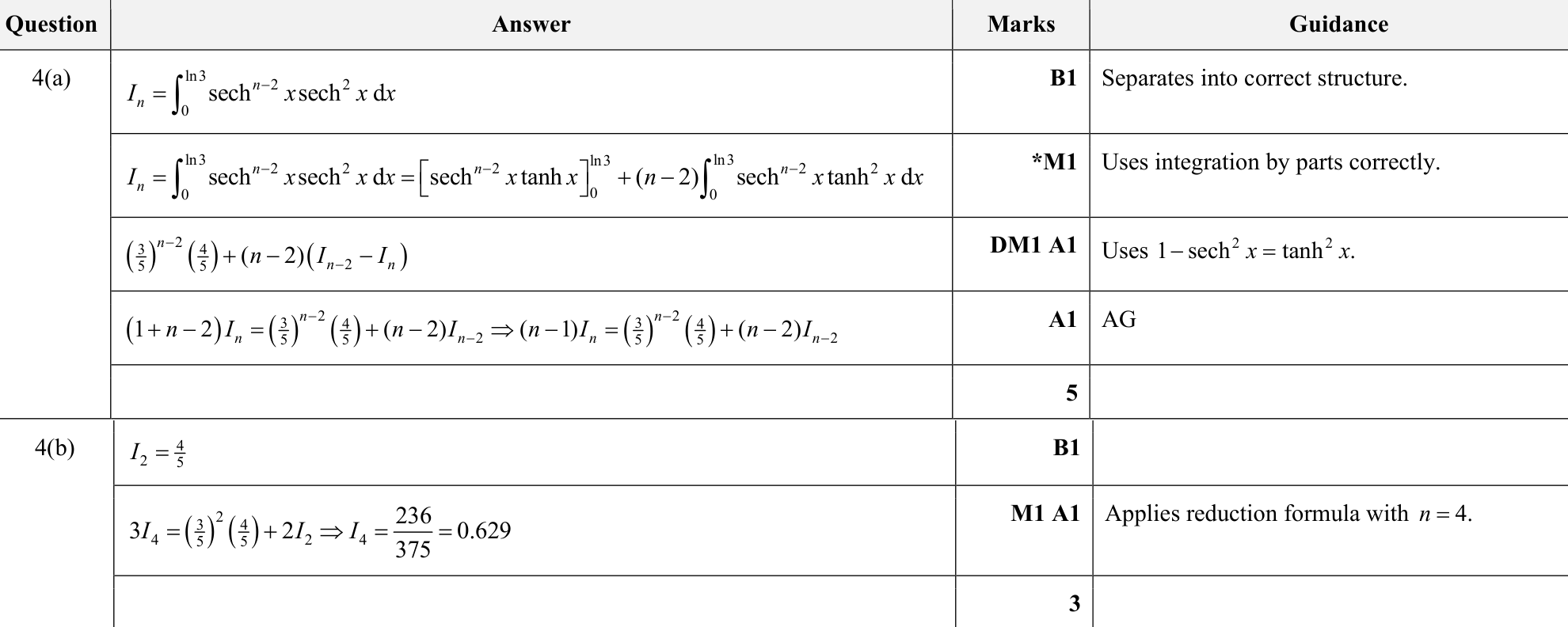
It is given that, for \(n \geqslant 0, I_{n}=\int_{0}^{\ln 3} \operatorname{sech}^{n} x \mathrm{~d} x\).
(a) Show that, for \(n \geqslant 2\),
\((n-1) I_{n}=\left(\frac{3}{5}\right)^{n-2}\left(\frac{4}{5}\right)+(n-2) I_{n-2} .\)
[You may use the result that \(\frac{\mathrm{d}}{\mathrm{d} x}(\operatorname{sech} x)=-\tanh x \operatorname{sech} x\).]
(b) Find the value of \(I_{4}\).
9231 P23 - Jun 2023 - Q7 - 11 marks
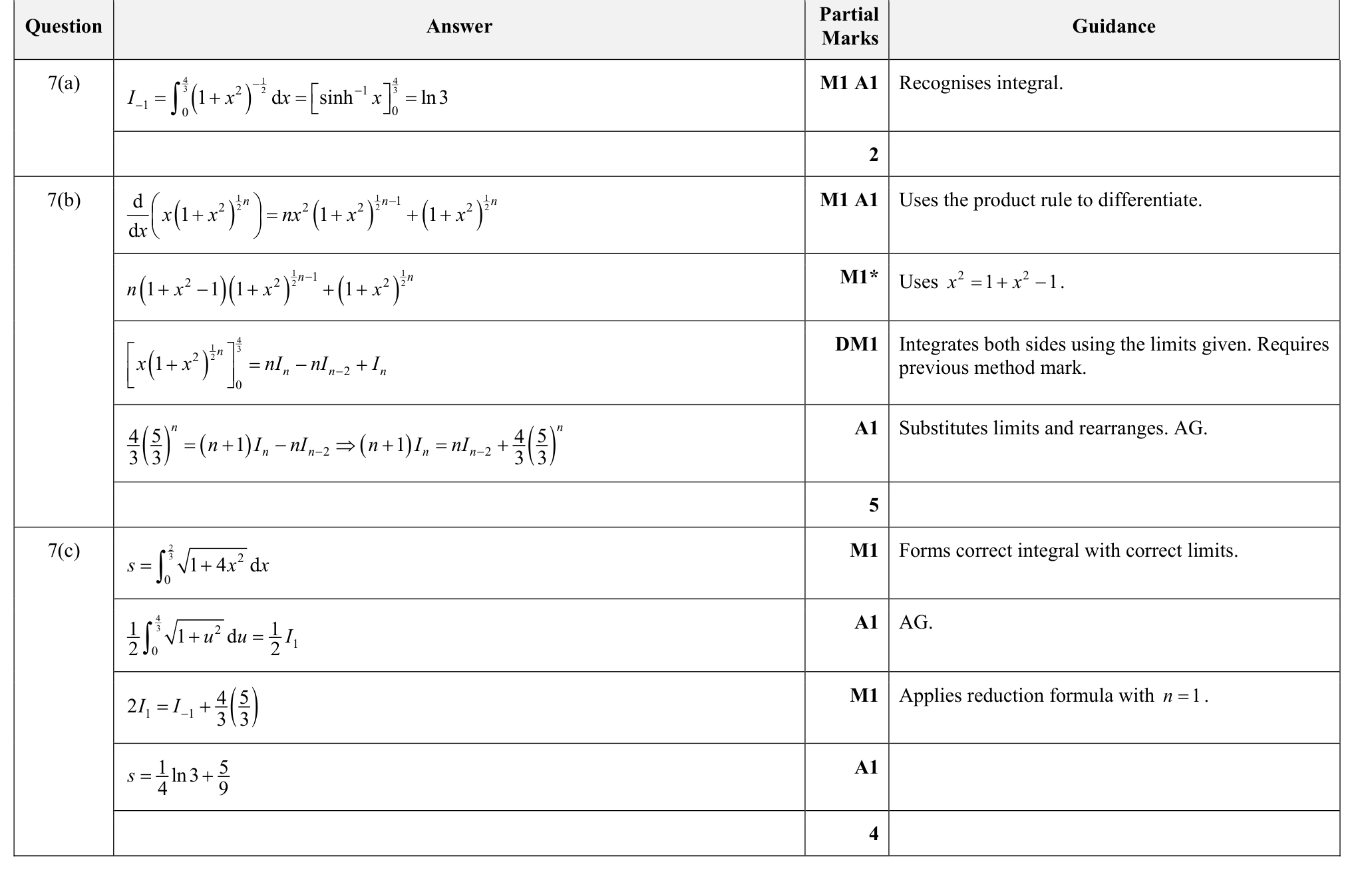
The integral \(I_{n}\), where \(n\) is an integer, is defined by \(I_{n}=\int_{0}^{\frac{4}{3}}\left(1+x^{2}\right)^{\frac{1}{2} n} \mathrm{~d} x\).
(a) Find the exact value of \(I_{-1}\) giving your answer in the form \(\ln a\), where \(a\) is an integer to be determined.
(b) By considering \(\frac{\mathrm{d}}{\mathrm{d} x}\left(x\left(1+x^{2}\right)^{\frac{1}{2} n}\right)\), or otherwise, show that
\((n+1) I_{n}=n I_{n-2}+\frac{4}{3}\left(\frac{5}{3}\right)^{n} .\)
(c) A curve has equation \(y=x^{2}\), for \(0 \leqslant x \leqslant \frac{2}{3}\). The arc length of the curve is denoted by \(s\).
Use the substitution \(u=2 x\) to show that \(s=\frac{1}{2} I_{1}\) and find the exact value of \(s\).
9231 P21 - Jun 2023 - Q4 - 9 marks
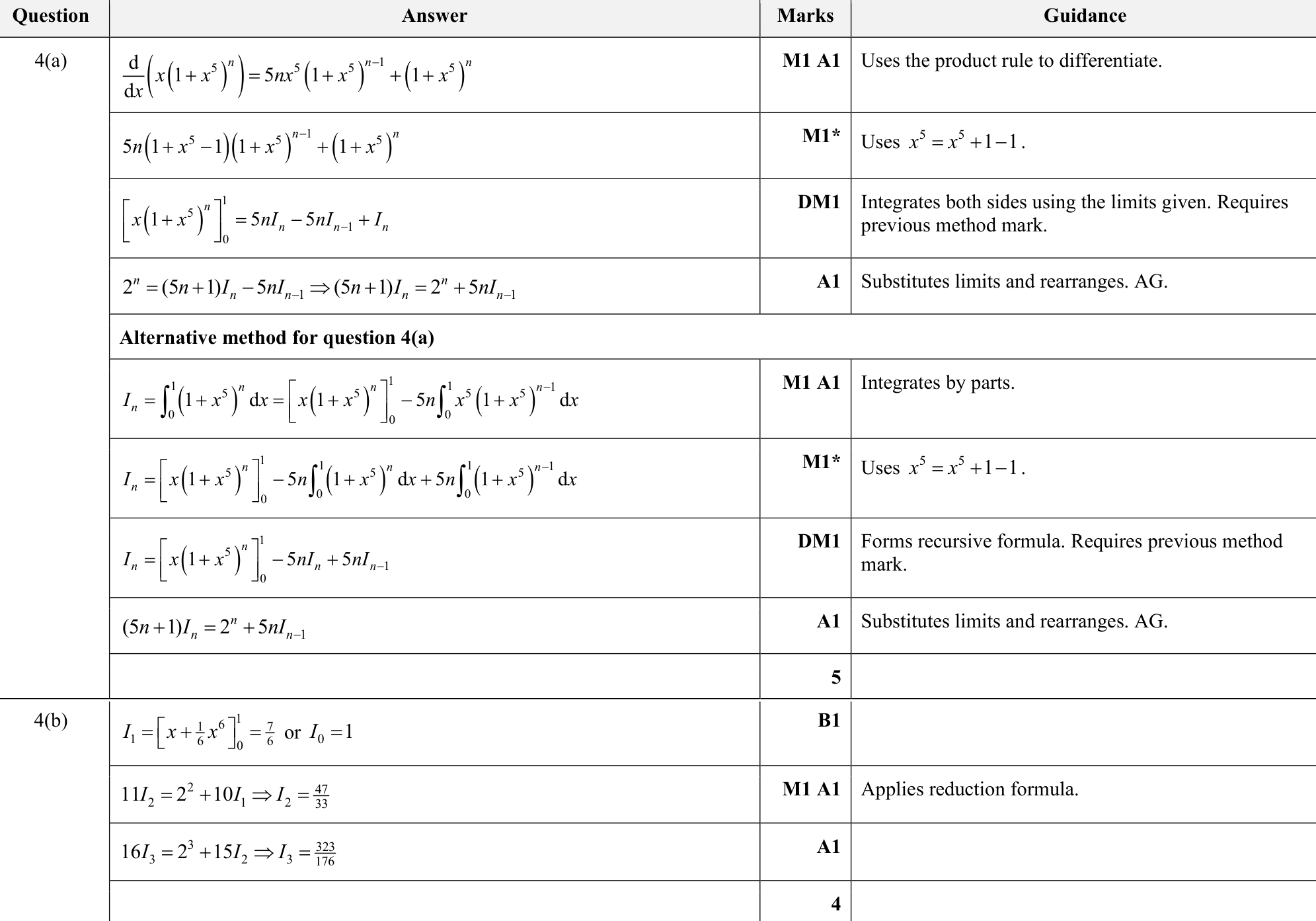
The integral \(I_{n}\) is defined by \(I_{n}=\int_{0}^{1}\left(1+x^{5}\right)^{n} \mathrm{~d} x\).
(a) By considering \(\frac{\mathrm{d}}{\mathrm{d} x}\left(x\left(1+x^{5}\right)^{n}\right)\), or otherwise, show that
\((5 n+1) I_{n}=2^{n}+5 n I_{n-1}\)
(b) Find the exact value of \(I_{3}\).
9231 P23 - Jun 2022 - Q8 - 16 marks
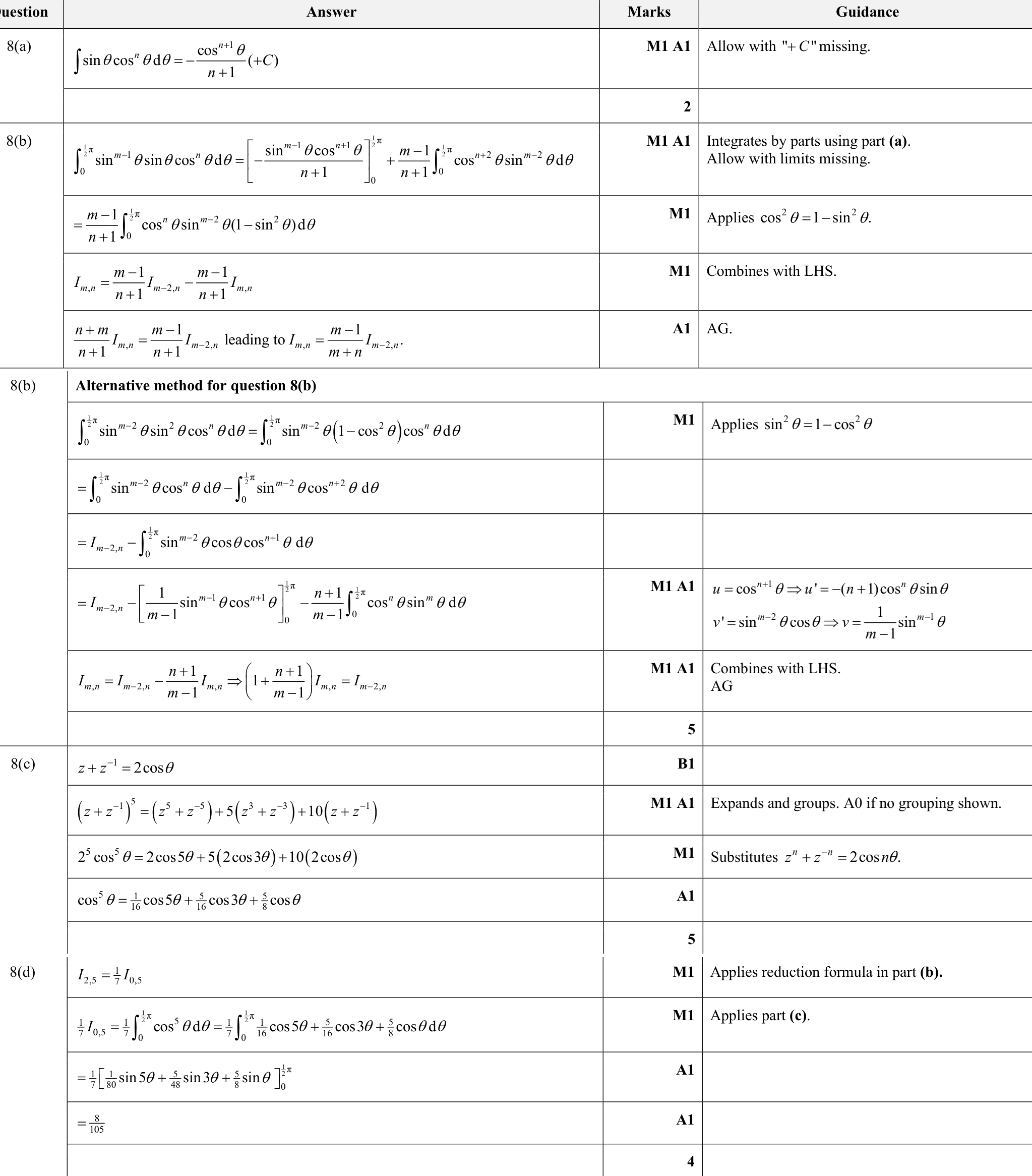
(a) Find \(\int \sin \theta \cos ^{n} \theta \mathrm{~d} \theta\), where \(n \neq-1\).
Let \(I_{m, n}=\int_{0}^{\frac{1}{2} \pi} \sin ^{m} \theta \cos ^{n} \theta \mathrm{~d} \theta\).
(b) Show that, for \(m \geqslant 2\) and \(n \geqslant 0\),
\(I_{m, n}=\frac{m-1}{m+n} I_{m-2, n}\)
(c) By considering the binomial expansion of \(\left(z+\frac{1}{z}\right)^{5}\), where \(z=\cos \theta+\mathrm{i} \sin \theta\), use de Moivre's theorem to show that
\(\cos ^{5} \theta=a \cos 5 \theta+b \cos 3 \theta+c \cos \theta\)
where \(a\), \(b\) and \(c\) are constants to be determined.
(d) Using the results given in parts (b) and (c), find the exact value of \(I_{2,5}\).
9231 P21 - Jun 2020 - Q6 - 10 marks
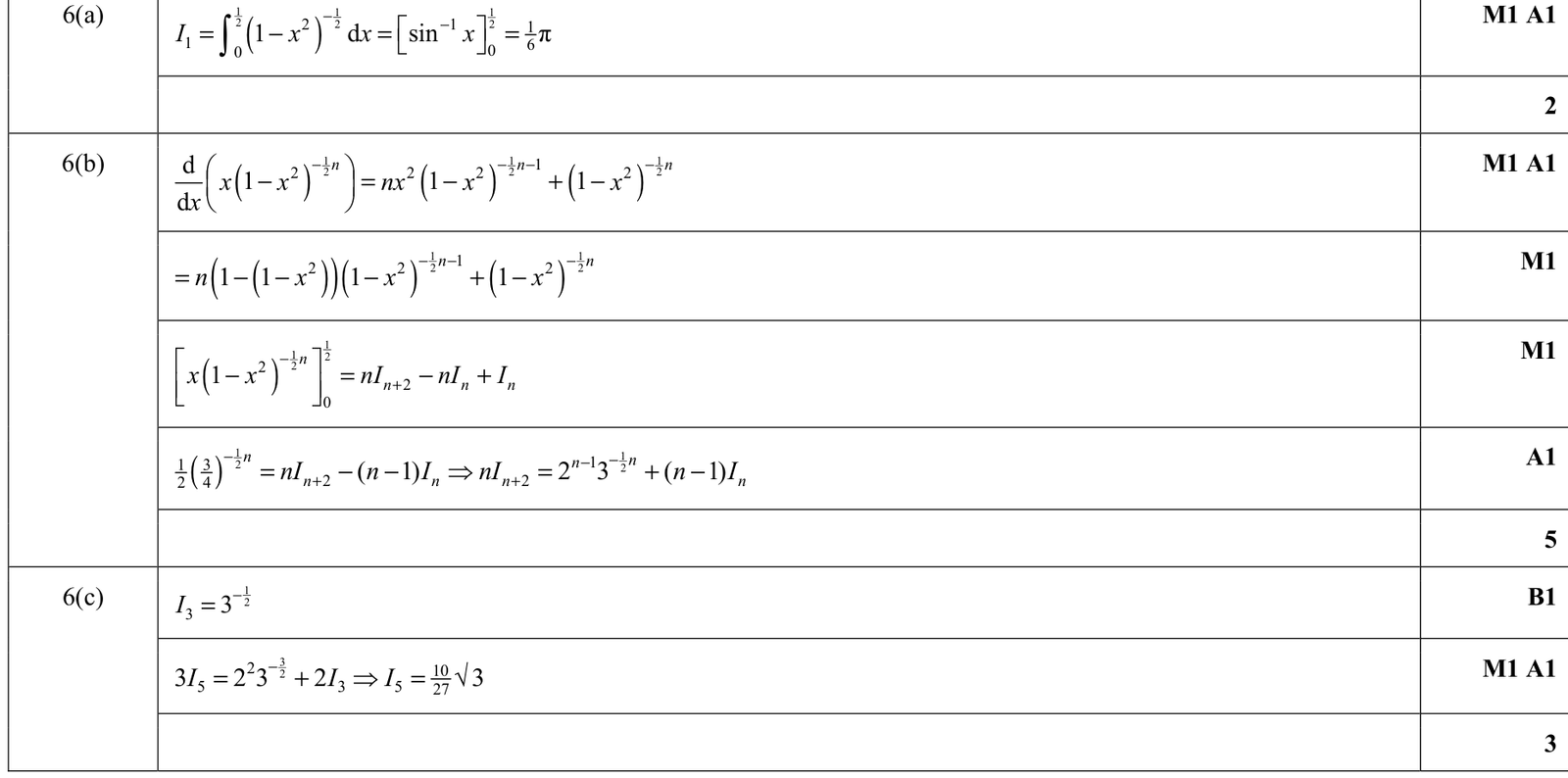
The integral \(I_{n}\), where \(n\) is an integer, is defined by \(I_{n}=\int_{0}^{\frac{1}{2}}\left(1-x^{2}\right)^{-\frac{1}{2} n} \mathrm{~d} x\).
(a) Find the exact value of \(I_{1}\).
(b) By considering \(\frac{\mathrm{d}}{\mathrm{d} x}\left(x\left(1-x^{2}\right)^{-\frac{1}{2} n}\right)\), or otherwise, show that
\[n I_{n+2}=2^{n-1} 3^{-\frac{1}{2} n}+(n-1) I_{n} .\]
(c) Find the exact value of \(I_{5}\) giving the answer in the form \(k \sqrt{3}\), where \(k\) is a rational number to be determined.
9231 P23 - Jun 2020 - Q2 - 6 marks
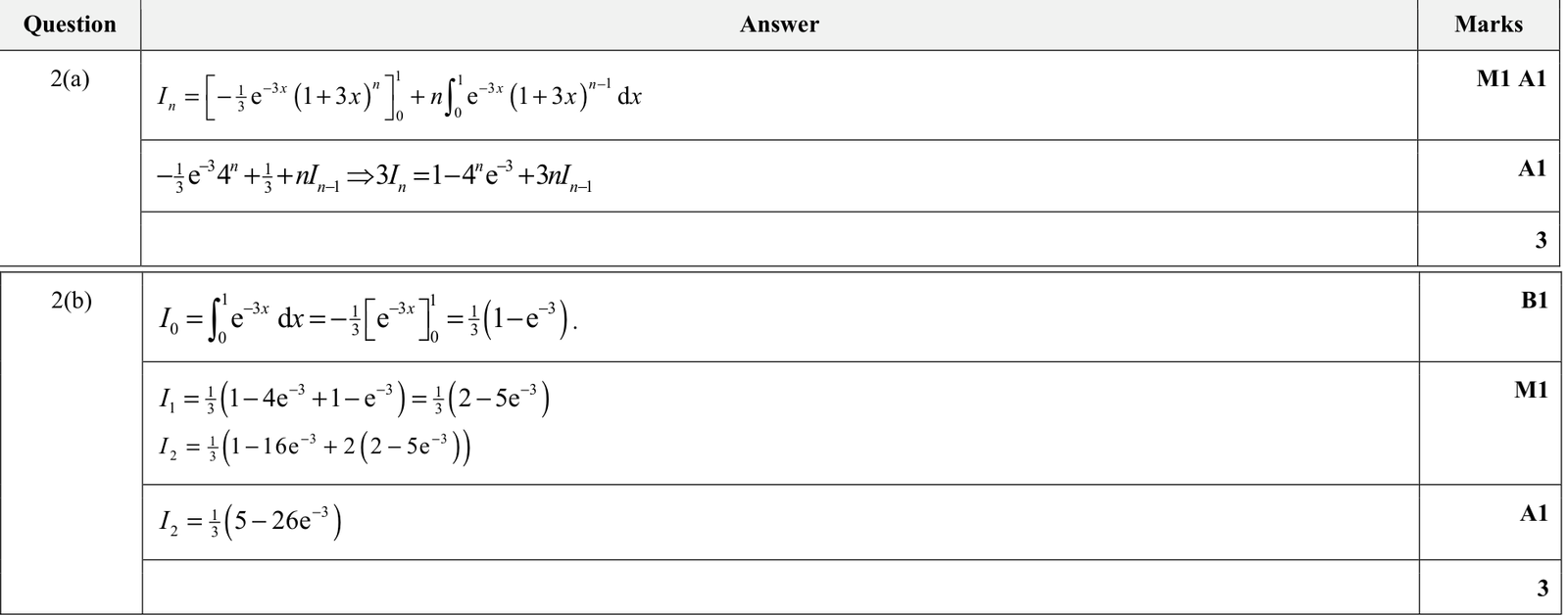
Let \(I_{n}=\int_{0}^{1}(1+3 x)^{n} \mathrm{e}^{-3 x} \mathrm{~d} x\), where \(n\) is an integer.
(a) Show that \(3 I_{n}=1-4^{n} \mathrm{e}^{-3}+3 n I_{n-1}\).
(b) Find the exact value of \(I_{2}\).
9231 P23 - Jun 2021 - Q7 - 11 marks
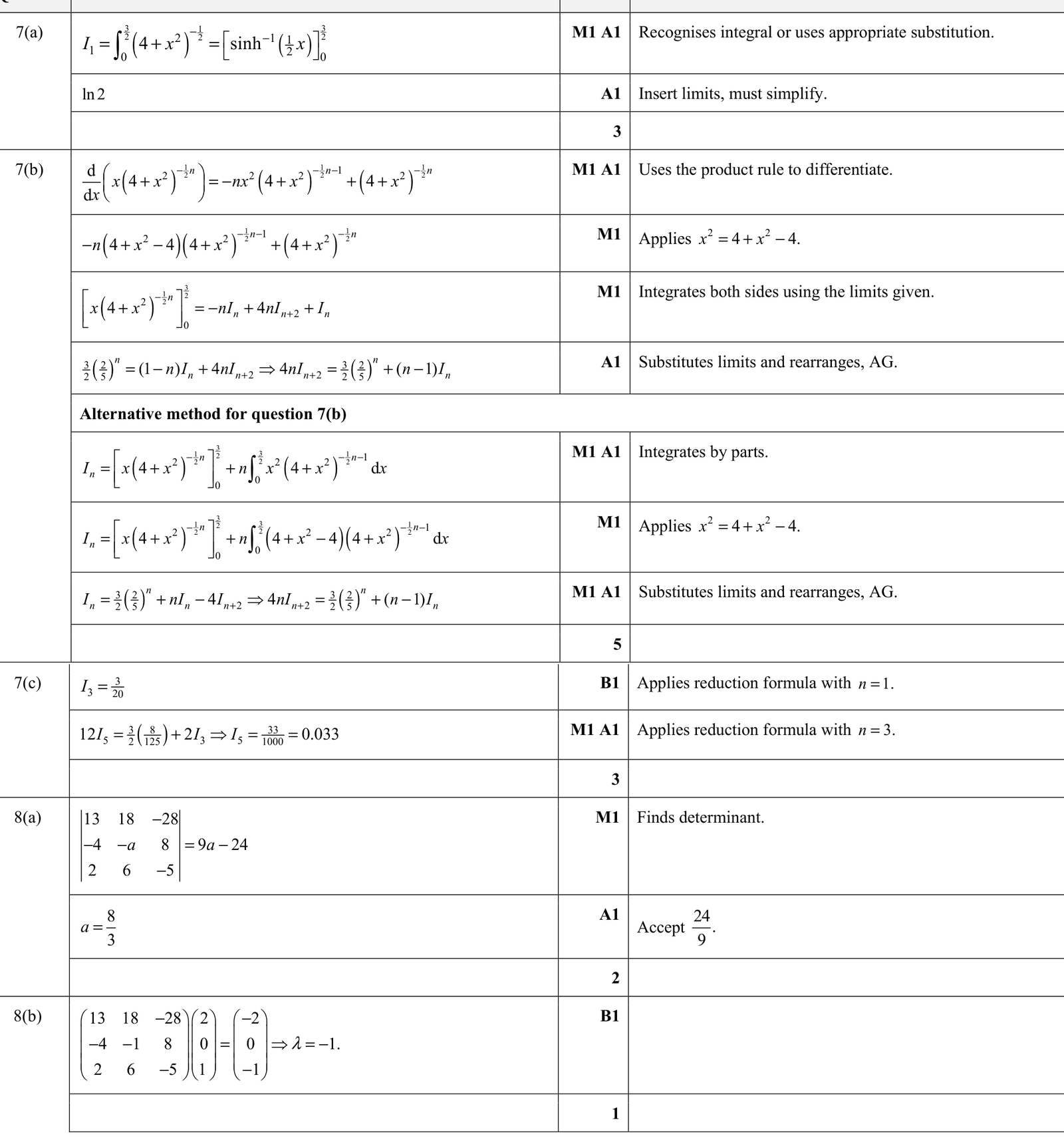
The integral \(I_{n}\), where \(n\) is an integer, is defined by \(I_{n}=\int_{0}^{\frac{3}{2}}\left(4+x^{2}\right)^{-\frac{1}{2} n} \mathrm{~d} x\).
(a) Find the exact value of \(I_{1}\), expressing your answer in logarithmic form.
(b) By considering \(\frac{\mathrm{d}}{\mathrm{d} x}\left(x\left(4+x^{2}\right)^{-\frac{1}{2} n}\right)\), or otherwise, show that
\[4 n I_{n+2}=\frac{3}{2}\left(\frac{2}{5}\right)^{n}+(n-1) I_{n} .\]
(c) Find the value of \(I_{5}\).
9231 P22 - Nov 2021 - Q8 - 13 marks
(a) Starting from the definitions of tanh and sech in terms of exponentials, prove that
\[1-\tanh ^{2} x=\operatorname{sech}^{2} x\]
(b) Using the substitution \(u=\tanh x\), or otherwise, find \(\int \operatorname{sech}^{2} x \tanh ^{2} x \mathrm{~d} x\).
It is given that, for \(n \geqslant 0, I_{n}=\int_{0}^{\ln 3} \operatorname{sech}^{n} x \tanh ^{2} x \mathrm{~d} x\).
(c) Show that, for \(n \geqslant 2\),
\[(n+1) I_{n}=\left(\frac{4}{5}\right)^{3}\left(\frac{3}{5}\right)^{n-2}+(n-2) I_{n-2}\]
[You may use the result that \(\frac{\mathrm{d}}{\mathrm{d} x}(\operatorname{sech} x)=-\tanh x \operatorname{sech} x\).]
(d) Find the value of \(I_{4}\).
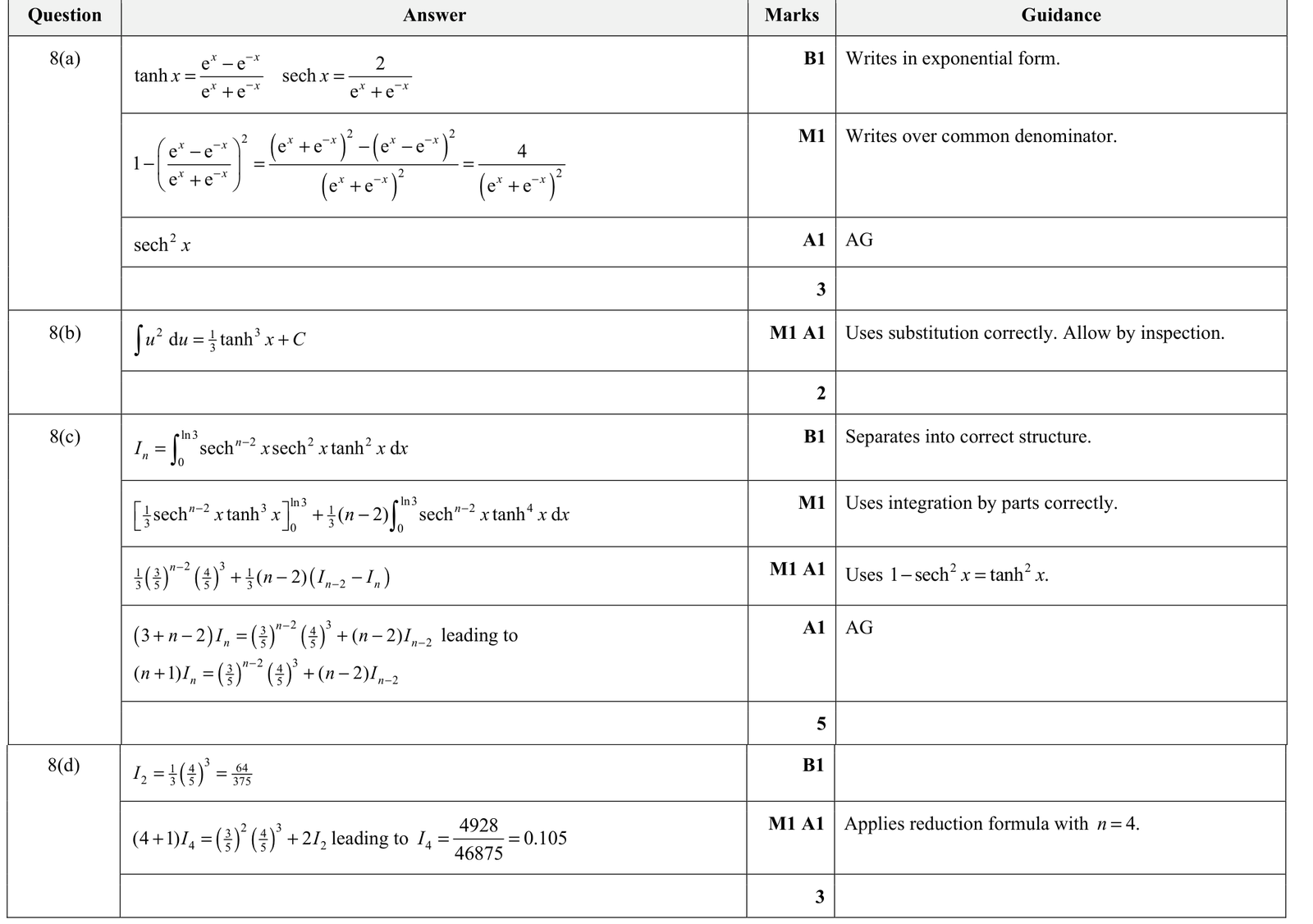
9231 P12 - Nov 2018 - Q11O - 14 marks
Let \(I_n=\int_1^{\sqrt2}(x^2-1)^n\,dx\).
(i) Show that, for \(n\ge1\), \((2n+1)I_n=\sqrt2-2nI_{n-1}\).
(ii) Using the substitution \(x=\sec\theta\), show that \(I_n=\int_0^{\pi/4}\tan^{2n+1}\theta\sec\theta\,d\theta\).
(iii) Deduce the exact value of \(\int_0^{\pi/4}\frac{\sin^7\theta}{\cos^8\theta}\,d\theta\).
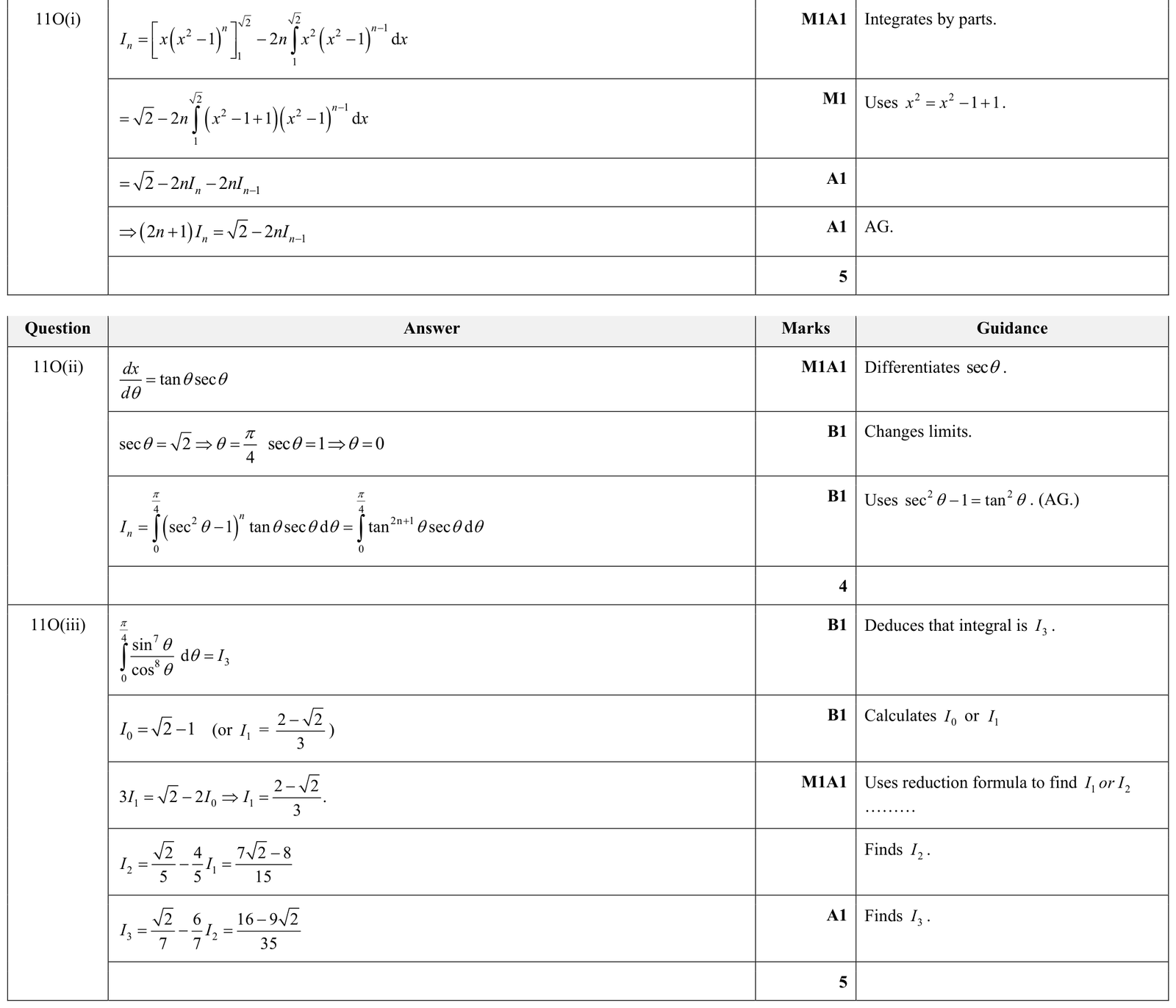
9231 P11 - Jun 2017 - Q6 - 7 marks
Let \(I_{n}=\int_{0}^{\frac{1}{2} \pi} x^{n} \sin x \mathrm{~d} x\).
(i) Prove that, for \(n \geqslant 2\),
\(I_{n}+n(n-1) I_{n-2}=n\left(\frac{1}{2} \pi\right)^{n-1}\)
(ii) Calculate the exact value of \(I_{1}\) and deduce the exact value of \(I_{3}\).
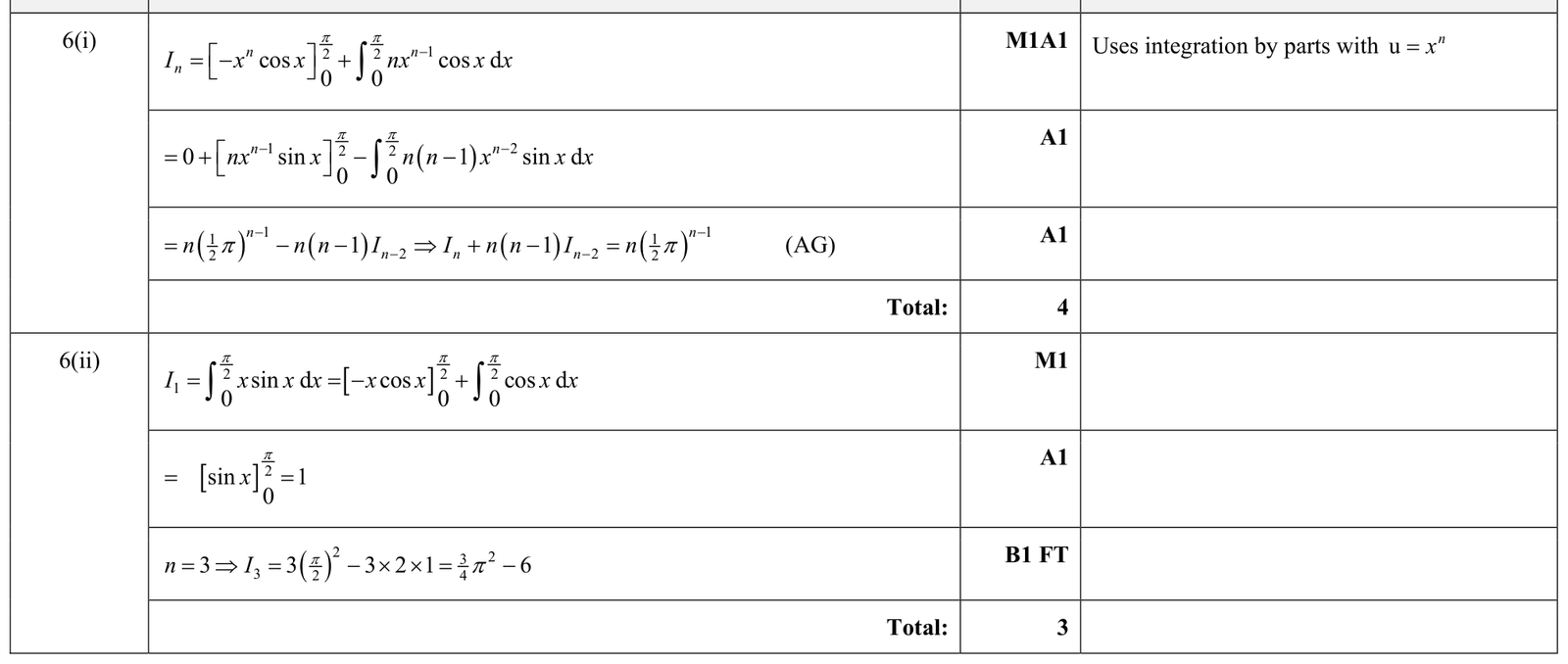
9231 P13 - Jun 2017 - Q6 - 10 marks
Let \(I_{n}\) denote \(\int_{0}^{2}\left(4+x^{2}\right)^{-n} \mathrm{~d} x\).
(i) Find \(\frac{\mathrm{d}}{\mathrm{d} x}\left(x\left(4+x^{2}\right)^{-n}\right)\) and hence show that
\(8 n I_{n+1}=(2 n-1) I_{n}+2 \times 8^{-n}\)
(ii) Use the result for integrating \(\frac{1}{x^{2}+a^{2}}\) with respect to \(x\), in the List of Formulae (MF10), to find the value of \(I_{1}\) and deduce that
\(I_{3}=\frac{3}{1024} \pi+\frac{1}{128} .\)
9231 P13 - Jun 2014 - Q9 - 10 marks
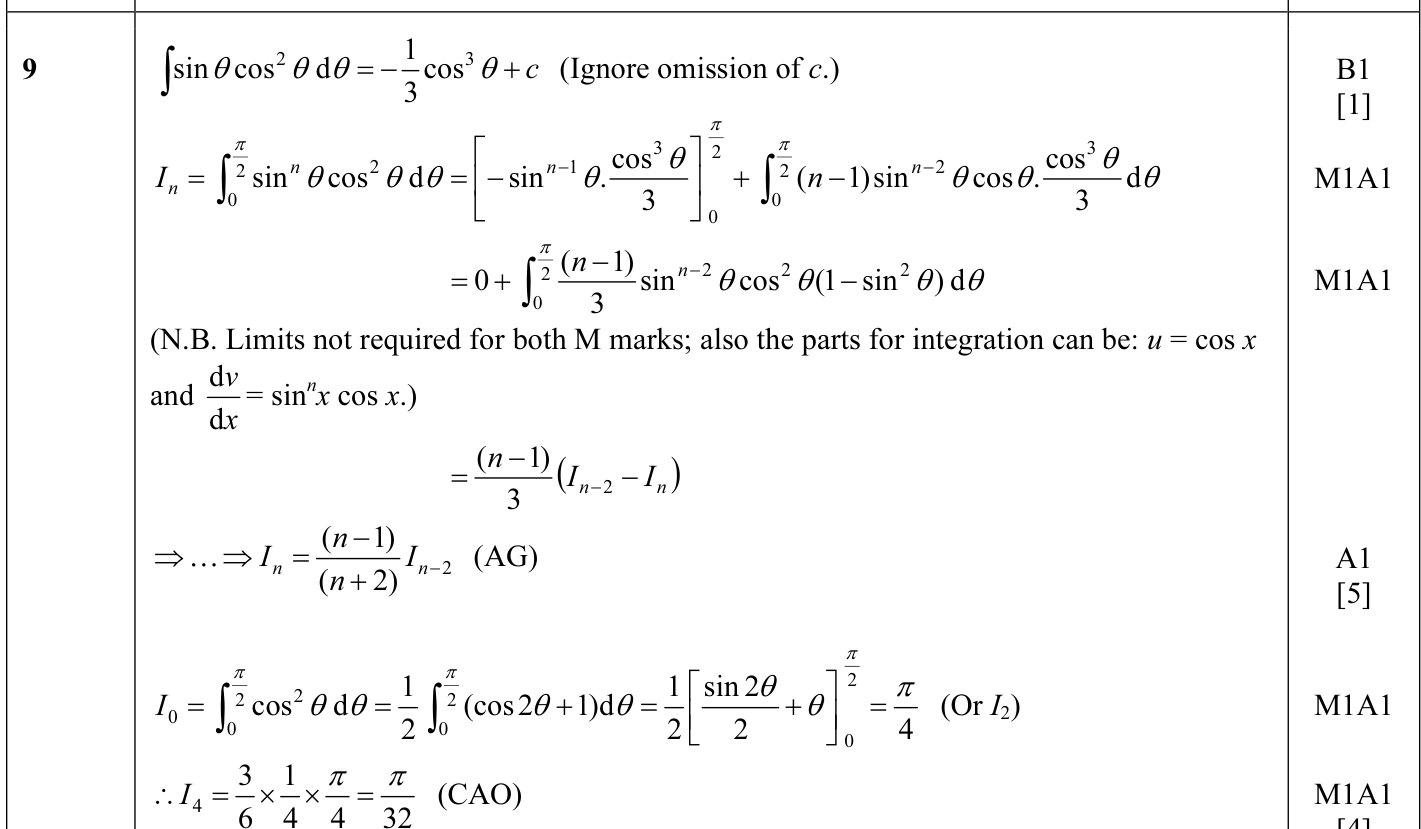
Using the substitution \(u=\cos \theta\), or any other method, find \(\int \sin \theta \cos ^{2} \theta \mathrm{~d} \theta\).
It is given that \(I_{n}=\int_{0}^{\frac{1}{2} \pi} \sin ^{n} \theta \cos ^{2} \theta \mathrm{~d} \theta\), for \(n \geqslant 0\). Show that, for \(n \geqslant 2\),
\(I_{n}=\frac{n-1}{n+2} I_{n-2}\)
Hence find the exact value of \(\int_{0}^{\frac{1}{2} \pi} \sin ^{4} \theta \cos ^{2} \theta \mathrm{~d} \theta\).
9231 P11 - Jun 2014 - Q10 - 10 marks
It is given that
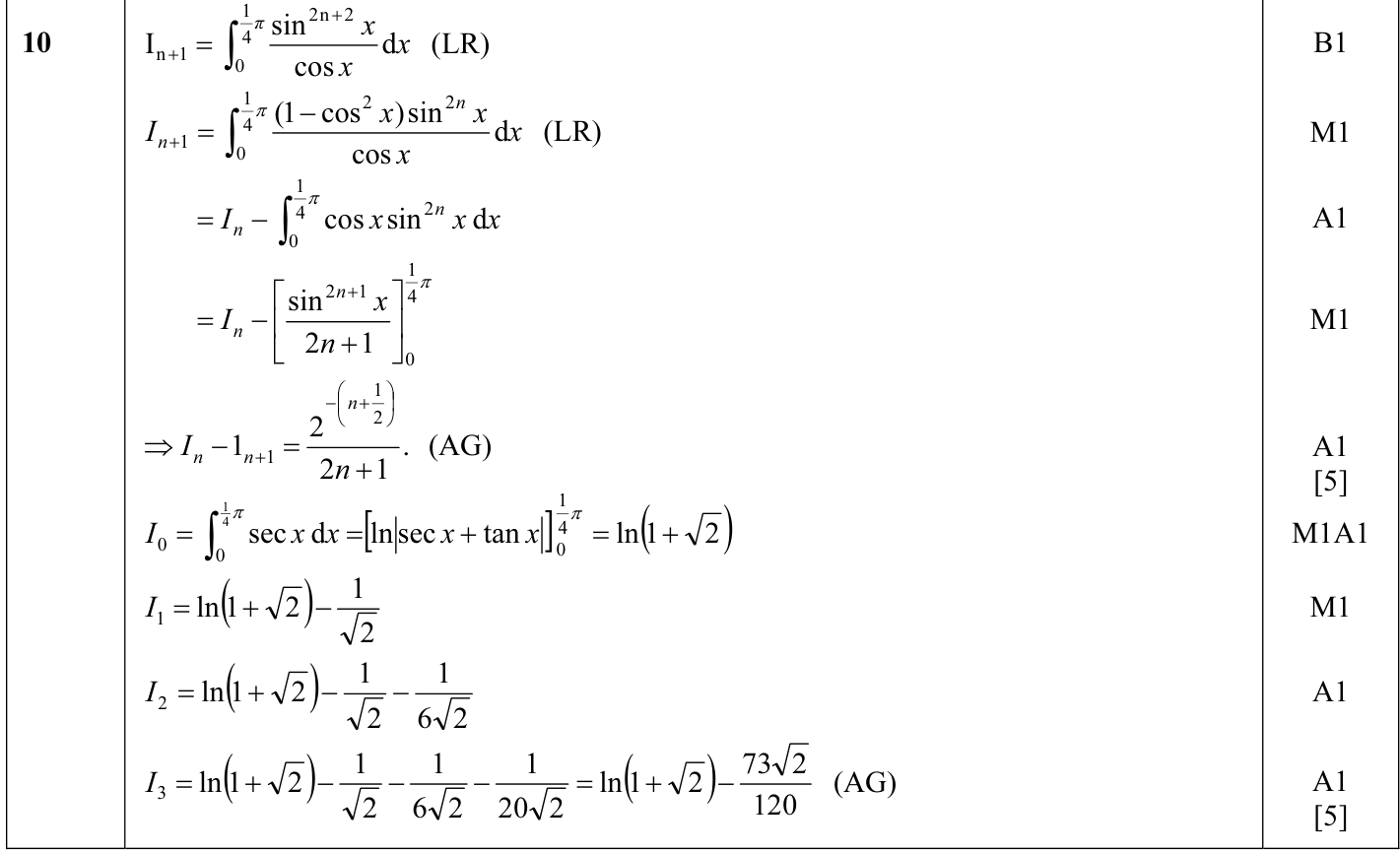
\(I_n=\int_0^{\frac14\pi}\frac{\sin^{2n}x}{\cos x}\,dx,\qquad n\geq0.\)
Show that
\(I_n-I_{n+1}=\frac{2^{-\left(n+\frac12\right)}}{2n+1}.\)
Hence show that
\(\int_0^{\frac14\pi}\frac{\sin^6x}{\cos x}\,dx=\ln(1+\sqrt2)-\frac{73\sqrt2}{120}.\)
9231 P11 - Nov 2015 - Q9 - 12 marks
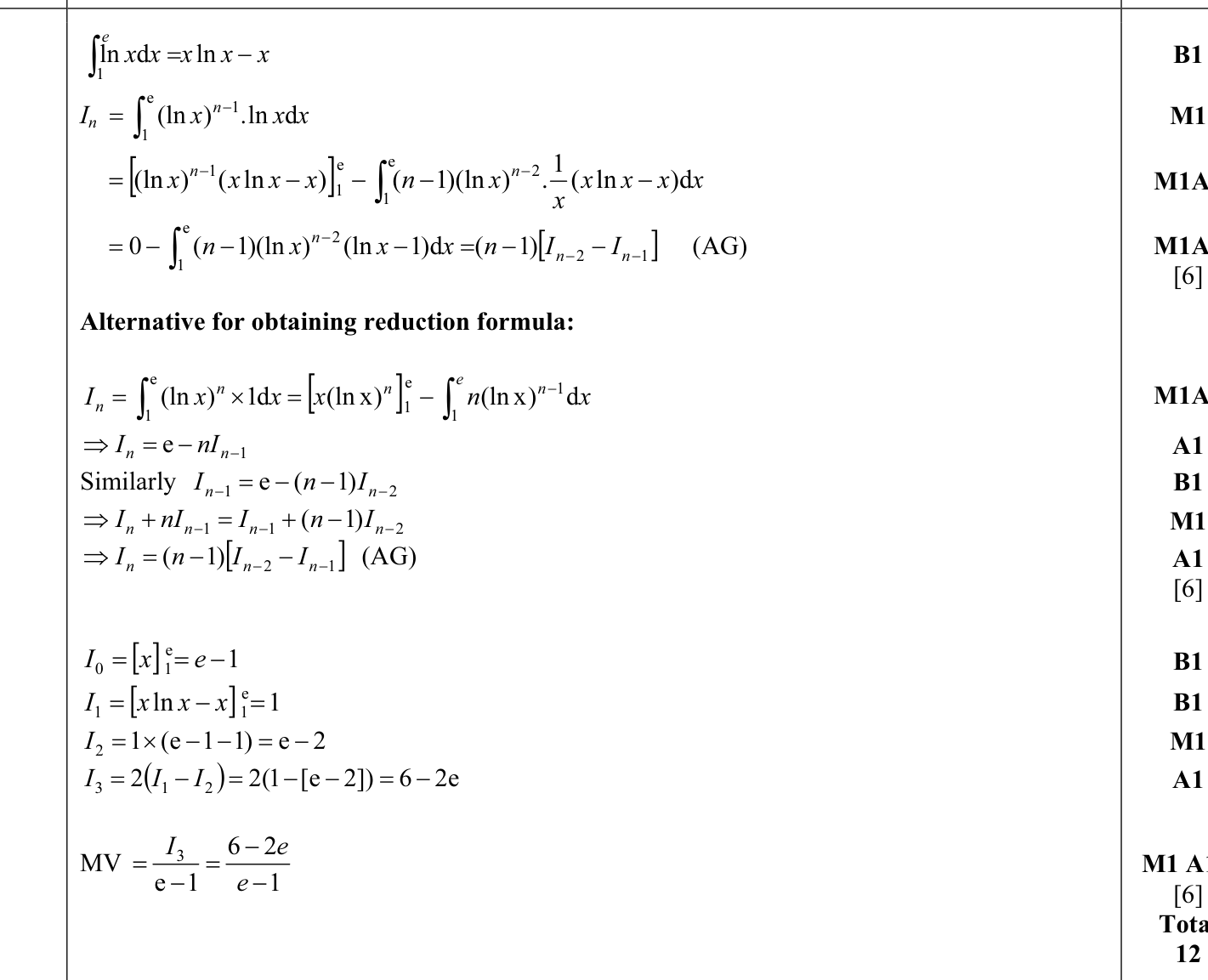
It is given that \(I_{n}=\int_{1}^{\mathrm{e}}(\ln x)^{n} \mathrm{~d} x\) for \(n \geqslant 0\). Show that
\(I_{n}=(n-1)\left[I_{n-2}-I_{n-1}\right] \text { for } n \geqslant 2 \text {. }\)
Hence find, in an exact form, the mean value of \((\ln x)^{3}\) with respect to \(x\) over the interval \(1 \leqslant x \leqslant \mathrm{e}\).
9231 P13 - Jun 2015 - Q5 - 9 marks
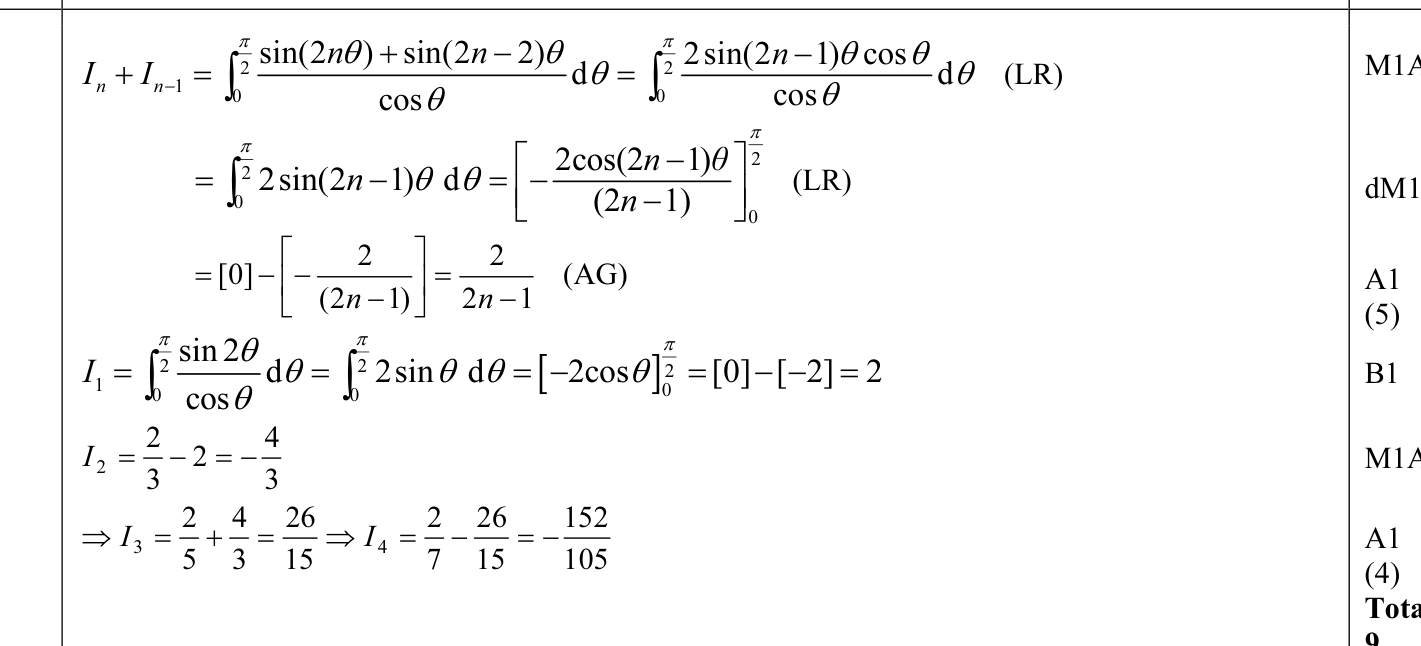
Let \(I_{n}=\int_{0}^{\frac{1}{2} \pi} \frac{\sin 2 n \theta}{\cos \theta} \mathrm{~d} \theta\), where \(n\) is a non-negative integer.
(i) Use the identity \(\sin P+\sin Q \equiv 2 \sin \frac{1}{2}(P+Q) \cos \frac{1}{2}(P-Q)\) to show that \(I_{n}+I_{n-1}=\frac{2}{2 n-1}\), for all positive integers \(n\).
(ii) Find the exact value of \(\int_{0}^{\frac{1}{2} \pi} \frac{\sin 8 \theta}{\cos \theta} d \theta\).
9231 P11 - Jun 2015 - Q7 - 9 marks
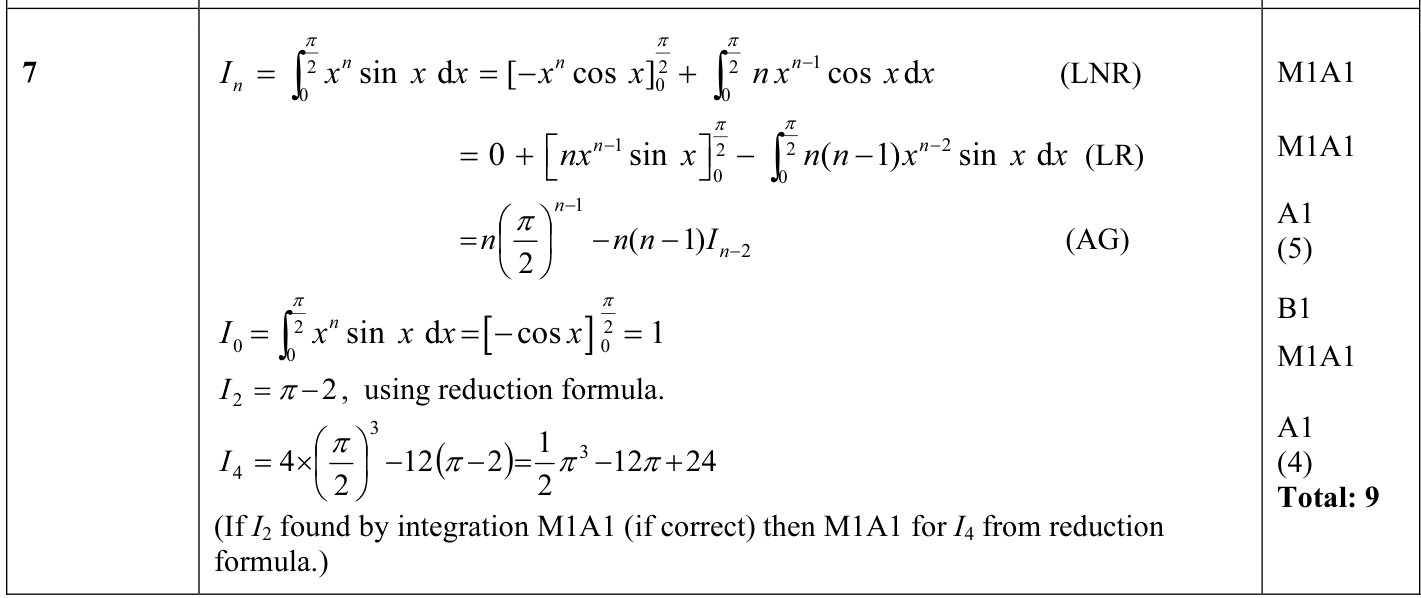
Let \(I_{n}=\int_{0}^{\frac{1}{2} \pi} x^{n} \sin x \mathrm{~d} x\), where \(n\) is a non-negative integer. Show that
\(I_{n}=n\left(\frac{1}{2} \pi\right)^{n-1}-n(n-1) I_{n-2}, \quad \text { for } n \geqslant 2 .\)
Find the exact value of \(I_{4}\).
9231 P11 - Nov 2016 - Q9 - 11 marks
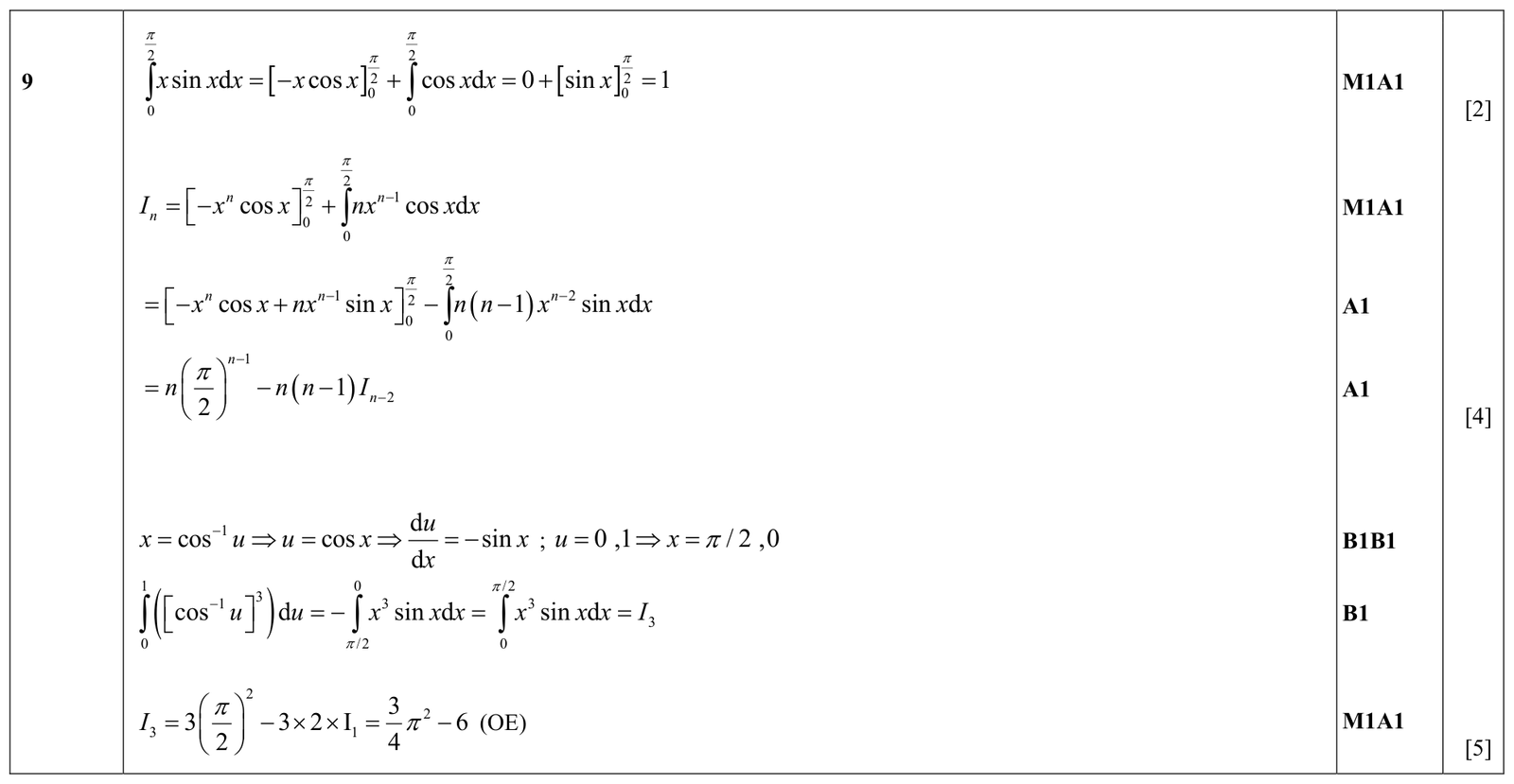
Evaluate \(\int_{0}^{\frac{1}{2} \pi} x \sin x \mathrm{~d} x\).
Given that \(I_{n}=\int_{0}^{\frac{1}{2} \pi} x^{n} \sin x \mathrm{~d} x\), prove that, for \(n\gt 1\),
\(I_{n}=n\left(\frac{1}{2} \pi\right)^{n-1}-n(n-1) I_{n-2}\)
By first using the substitution \(x=\cos ^{-1} u\), find the value of
\(\int_{0}^{1}\left(\cos ^{-1} u\right)^{3} \mathrm{~d} u\)
giving your answer in an exact form.
9231 P13 - Jun 2016 - Q6 - 8 marks
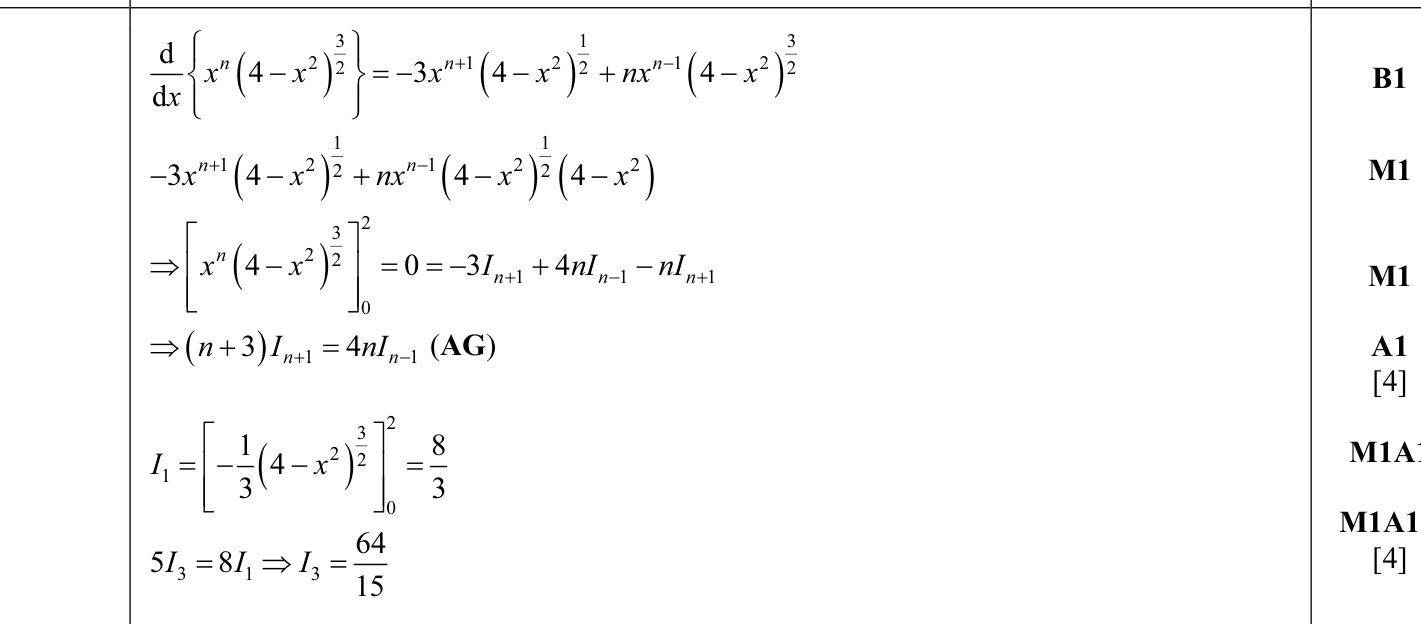
Let \(I_{n}=\int_{0}^{2} x^{n}\left(4-x^{2}\right)^{\frac{1}{2}} \mathrm{~d} x\), for \(n \geqslant 1\). By considering \(\frac{\mathrm{d}}{\mathrm{d} x}\left\{x^{n}\left(4-x^{2}\right)^{\frac{3}{2}}\right\}\), show that
\((n+3) I_{n+1}=4 n I_{n-1}, \text { where } n \geqslant 2\)
Find the value of \(I_{1}\) and deduce the exact value of \(I_{3}\).
9231 P11 - Jun 2016 - Q5 - 9 marks
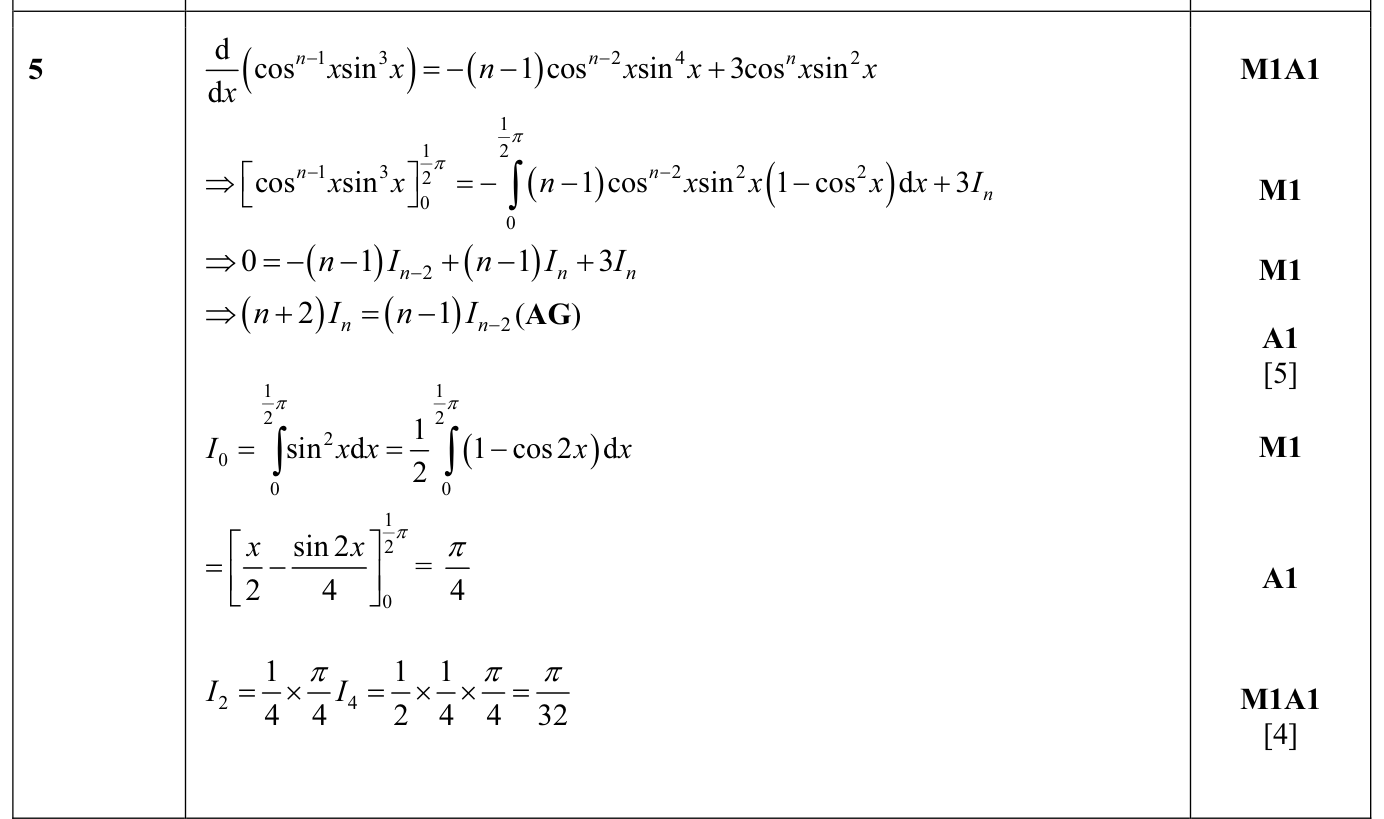
Let \(I_{n}=\int_{0}^{\frac{1}{2} \pi} \cos ^{n} x \sin ^{2} x \mathrm{~d} x\), for \(n \geqslant 0\). By differentiating \(\cos ^{n-1} x \sin ^{3} x\) with respect to \(x\), prove that
\((n+2) I_{n}=(n-1) I_{n-2} \quad \text { for } n \geqslant 2 .\)
Hence find the exact value of \(I_{4}\).
9231 P11 - Nov 2017 - Q8 - 11 marks
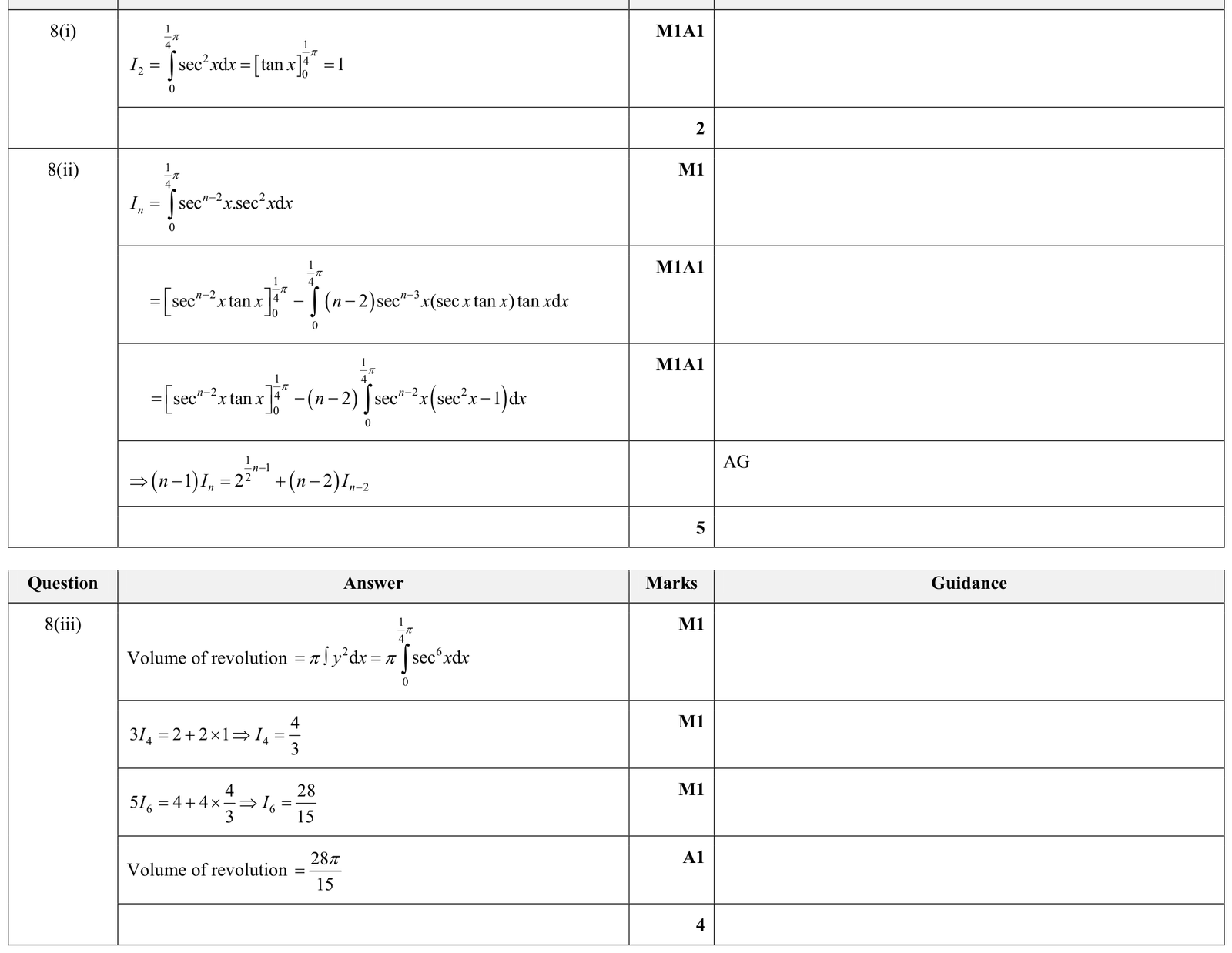
Let \(I_{n}=\int_{0}^{\frac{1}{4} \pi} \sec ^{n} x \mathrm{~d} x\) for \(n\gt 0\).
(i) Find the value of \(I_{2}\).
(ii) Show that, for \(n\gt 2\),
\((n-1) I_{n}=2^{\frac{1}{2} n-1}+(n-2) I_{n-2} .\)
(iii) The curve \(C\) has equation \(y=\sec ^{3} x\) for \(0 \leqslant x \leqslant \frac{1}{4} \pi\). The region \(R\) is bounded by \(C\), the \(x\)-axis, the \(y\)-axis and the line \(x=\frac{1}{4} \pi\). Find the volume of revolution generated when \(R\) is rotated through \(2 \pi\) radians about the \(x\)-axis.
9231 P12 - Nov 2014 - Q7 - 11 marks
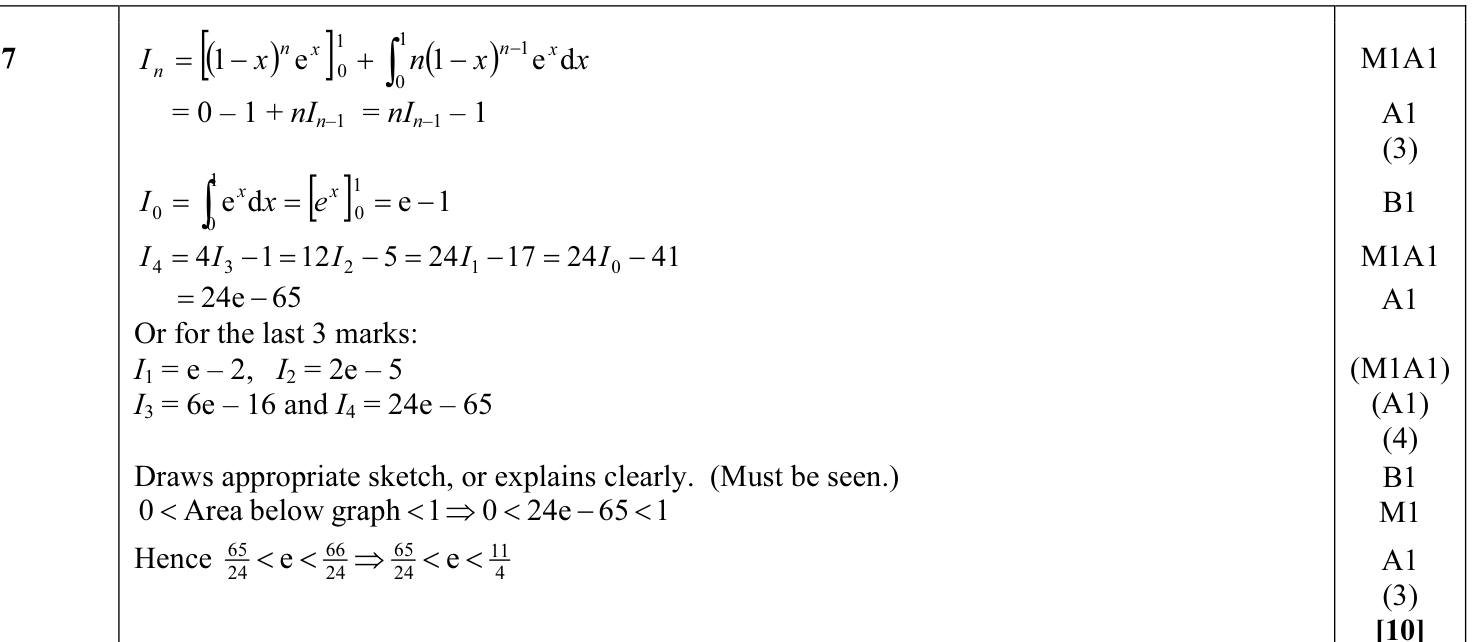
Let \(I_{n}=\int_{0}^{1}(1-x)^{n} \mathrm{e}^{x} \mathrm{~d} x\). Show that, for all positive integers \(n\),
\(I_{n}=n I_{n-1}-1\)
Find the exact value of \(I_{4}\).
By considering the area of the region enclosed by the \(x\)-axis, the \(y\)-axis and the curve with equation \(y=(1-x)^{4} \mathrm{e}^{x}\) in the interval \(0 \leqslant x \leqslant 1\), show that
\(\frac{65}{24}\lt \mathrm{e}\lt \frac{11}{4} .\)
9231 P11 - Nov 2014 - Q7 - 10 marks
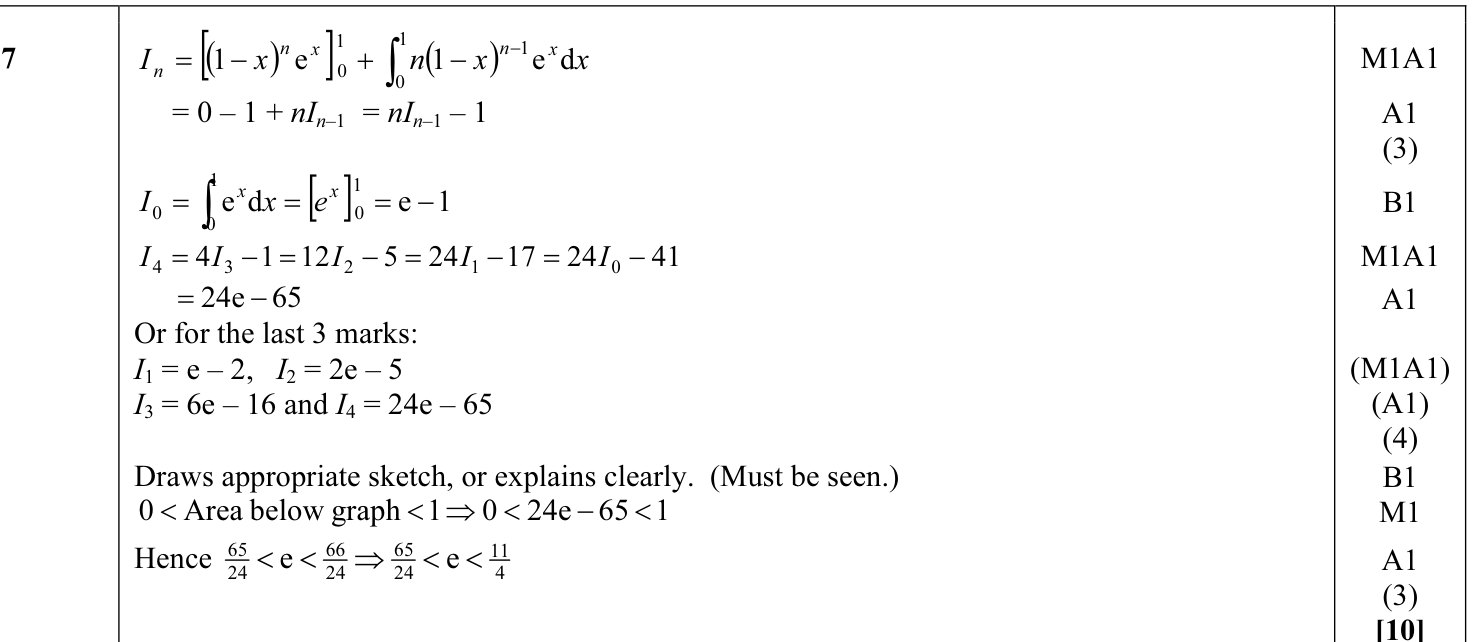
Let \(I_{n}=\int_{0}^{1}(1-x)^{n} \mathrm{e}^{x} \mathrm{~d} x\). Show that, for all positive integers \(n\),
\(I_{n}=n I_{n-1}-1 .\)
Find the exact value of \(I_{4}\).
By considering the area of the region enclosed by the \(x\)-axis, the \(y\)-axis and the curve with equation \(y=(1-x)^{4} \mathrm{e}^{x}\) in the interval \(0 \leqslant x \leqslant 1\), show that
\(\frac{65}{24}\lt \mathrm{e}\lt \frac{11}{4} .\)
9231 P11 - Jun 2013 - Q4 - 8 marks
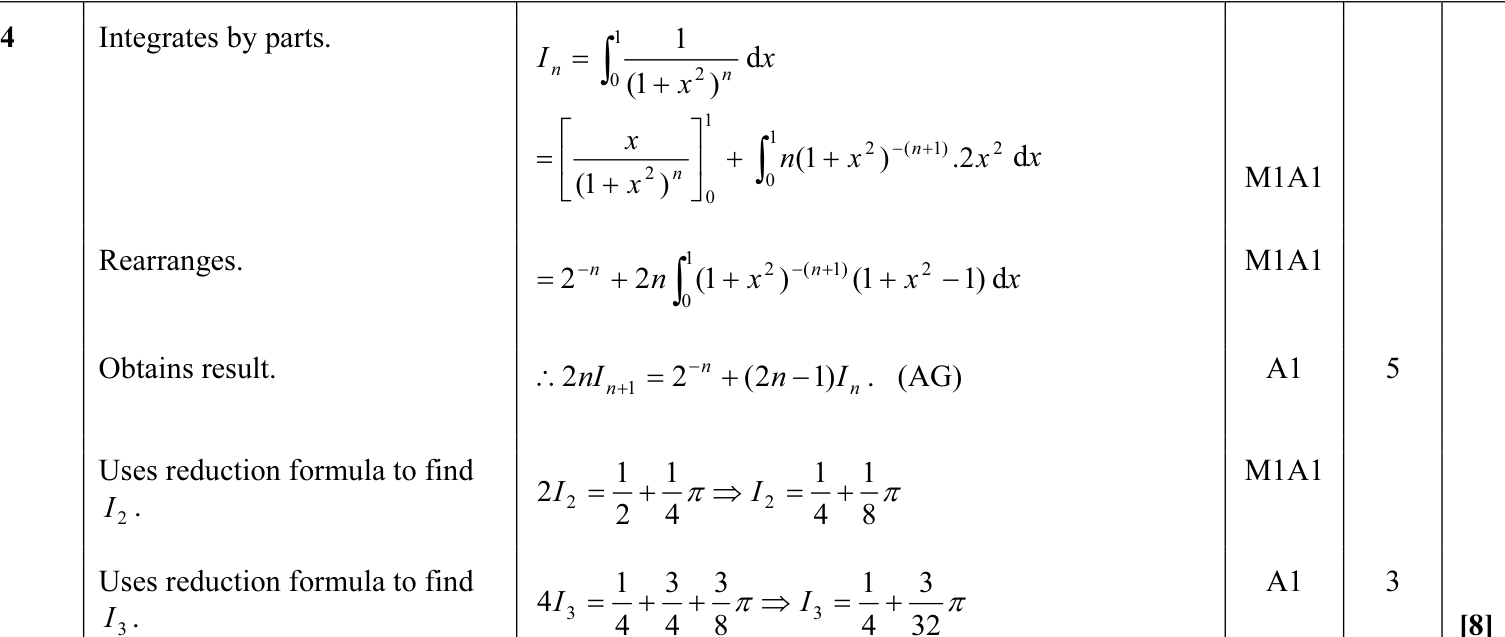
Let \(I_{n}=\int_{0}^{1} \frac{1}{\left(1+x^{2}\right)^{n}} \mathrm{~d} x\). Prove that, for every positive integer \(n\),
\(2 n I_{n+1}=2^{-n}+(2 n-1) I_{n} .\)
Given that \(I_{1}=\frac{1}{4} \pi\), find the exact value of \(I_{3}\).
9231 P13 - Jun 2013 - Q5 - 8 marks
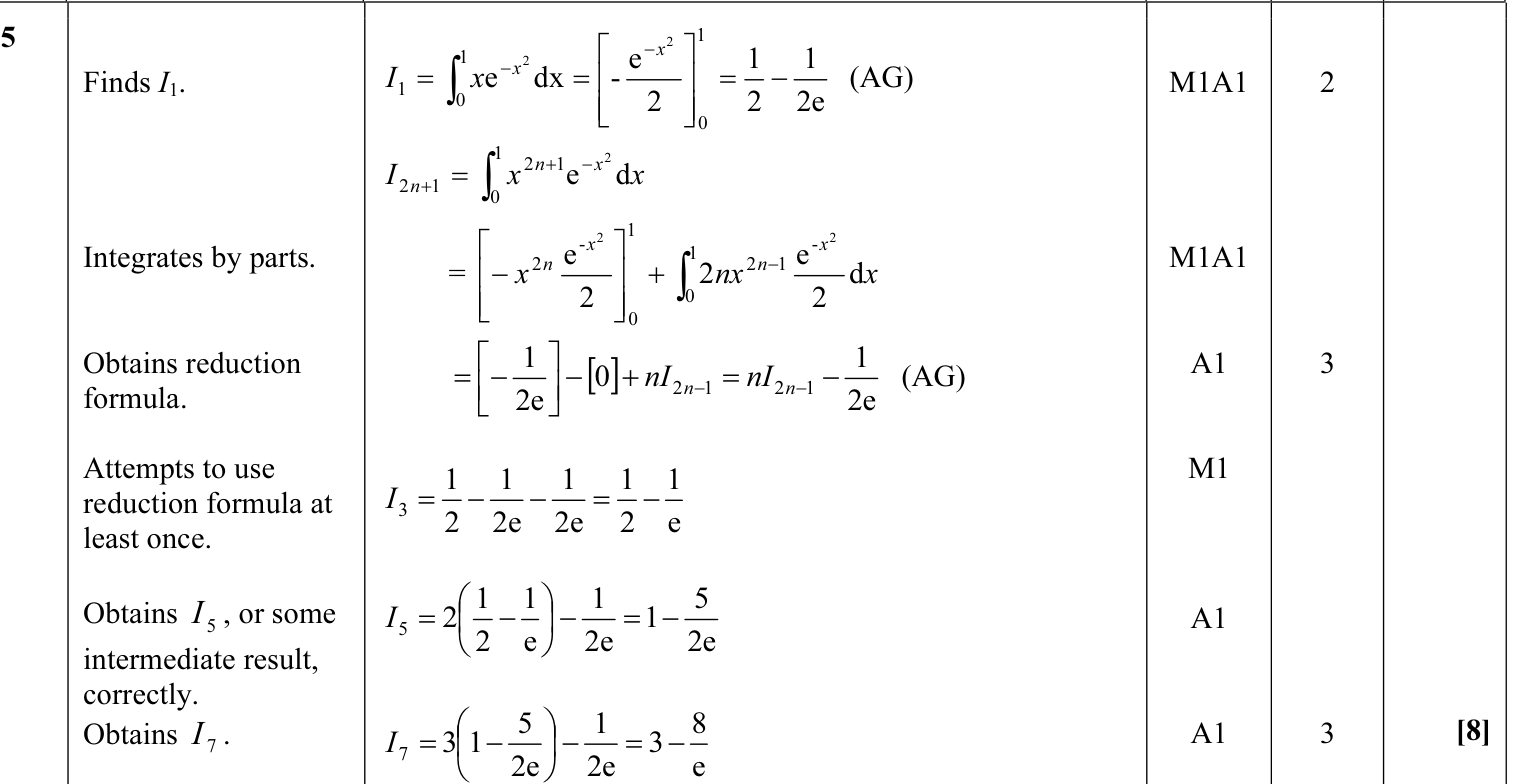
Show that \(\int_{0}^{1} x \mathrm{e}^{-x^{2}} \mathrm{~d} x=\frac{1}{2}-\frac{1}{2 \mathrm{e}}\).
Let \(I_{n}=\int_{0}^{1} x^{n} \mathrm{e}^{-x^{2}} \mathrm{~d} x\). Show that \(I_{2 n+1}=n I_{2 n-1}-\frac{1}{2 \mathrm{e}}\) for \(n \geqslant 1\).
Find the exact value of \(I_{7}\).
9231 P11 - Nov 2013 - Q4 - 7 marks
It is given that
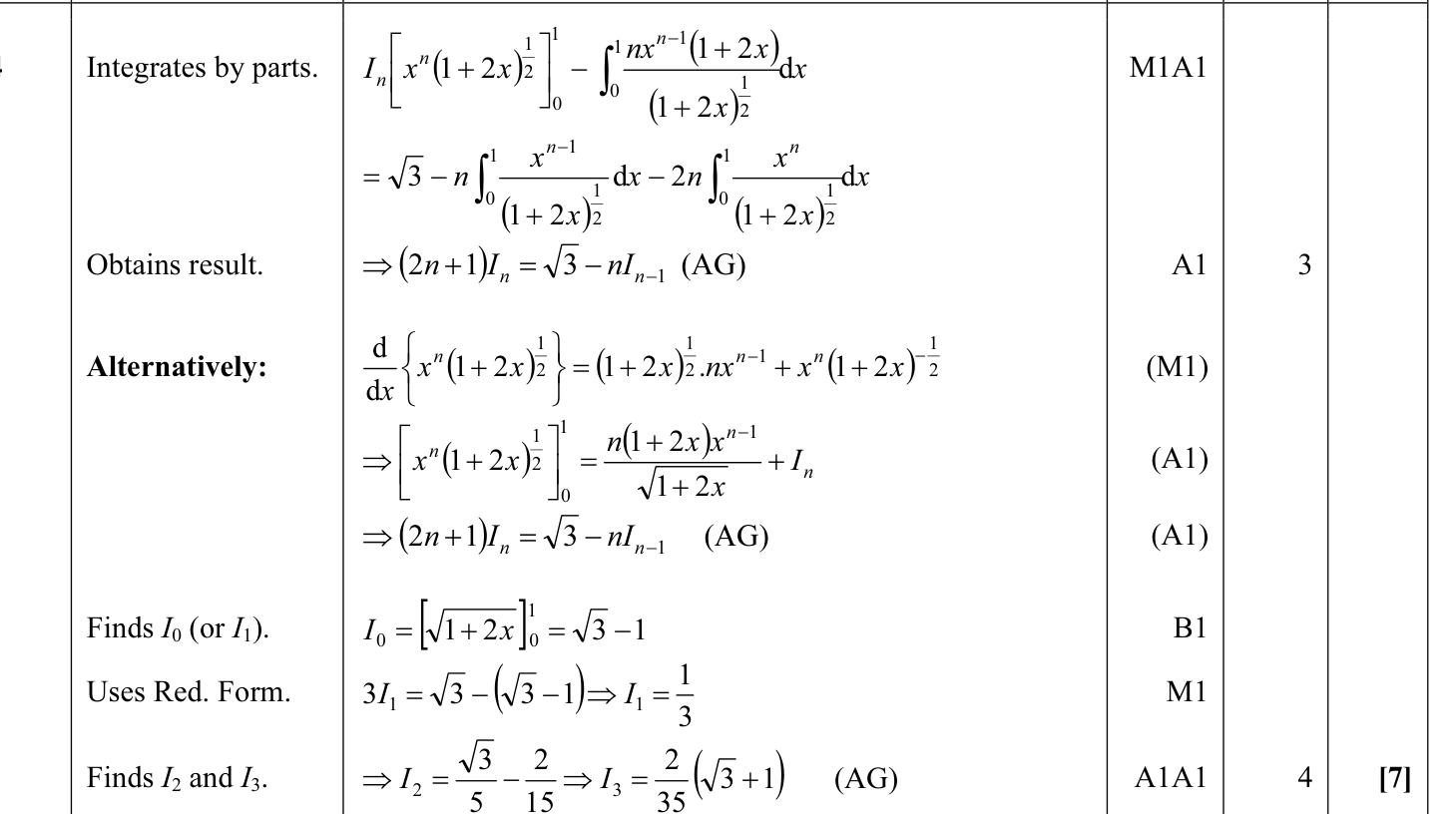
\(I_n=\int_0^1 \frac{x^n}{\sqrt{1+2x}}\,\mathrm{d}x\).
Show that, for \(n\geqslant 1\),
\((2n+1)I_n=\sqrt3-nI_{n-1}\).
Show that
\(I_3=\frac{2}{35}(\sqrt3+1)\).
9231 P12 - Nov 2013 - Q4 - 7 marks
It is given that
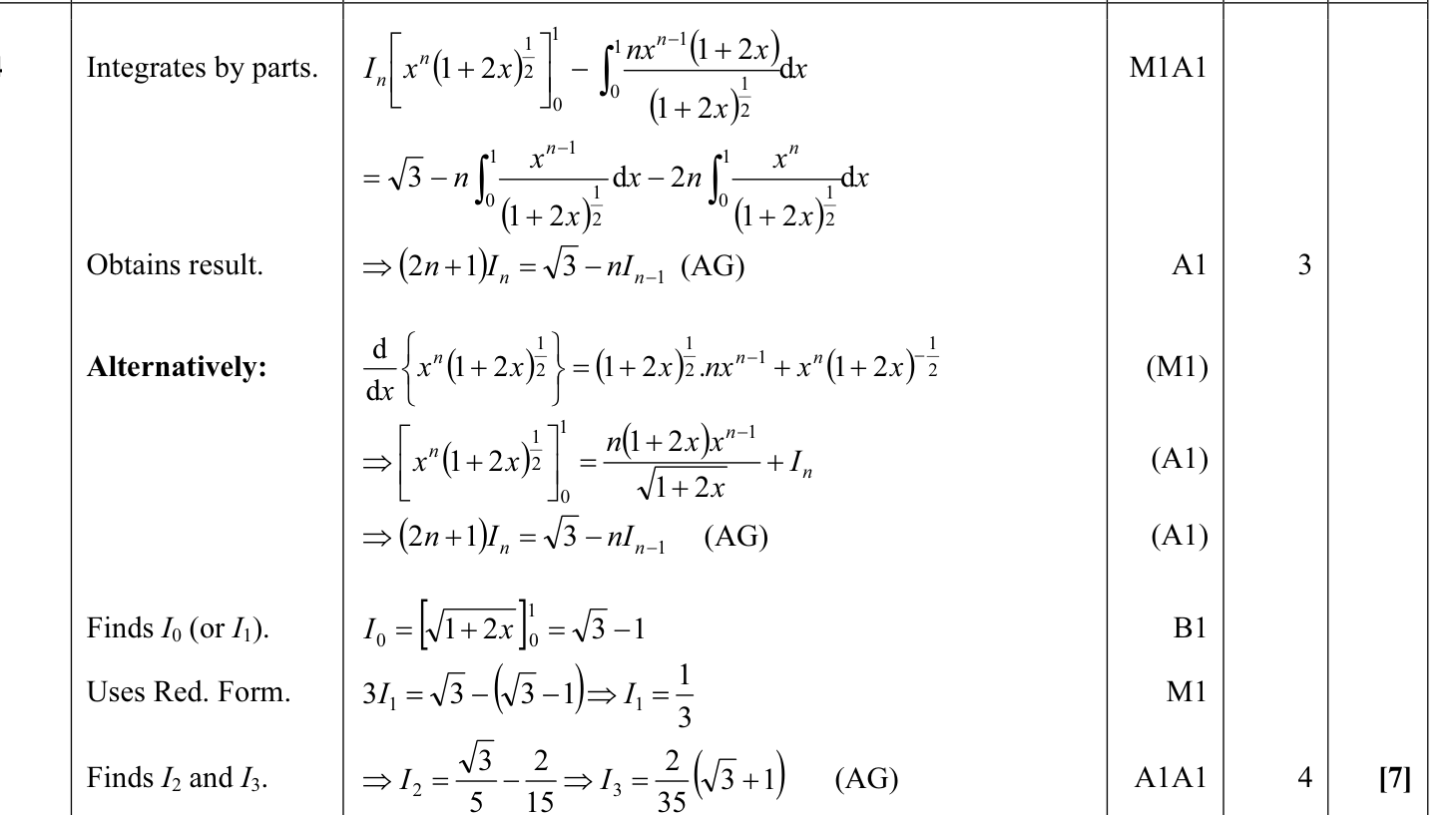
\(I_n=\int_0^1 \frac{x^n}{\sqrt{1+2x}}\,\mathrm{d}x\).
Show that, for \(n\geqslant 1\),
\((2n+1)I_n=\sqrt3-nI_{n-1}\).
Show that
\(I_3=\frac{2}{35}(\sqrt3+1)\).
9231 P1 - Nov 2008 - Q7 - 8 marks
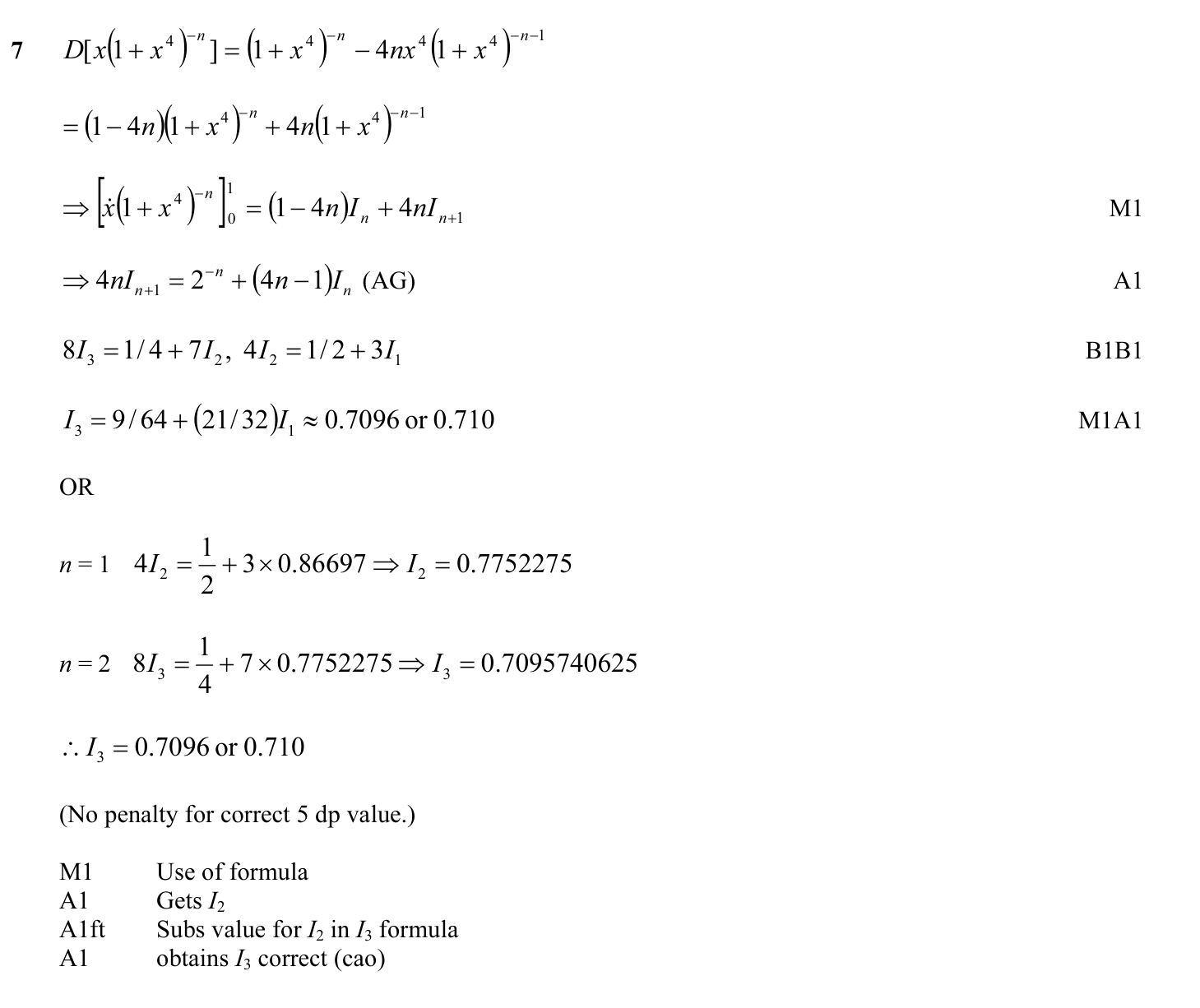
Let \(I_{n}=\int_{0}^{1} \frac{1}{\left(1+x^{4}\right)^{n}} \mathrm{~d} x\). By considering \(\frac{\mathrm{d}}{\mathrm{d} x}\left(\frac{x}{\left(1+x^{4}\right)^{n}}\right)\), show that
\(4 n I_{n+1}=\frac{1}{2^{n}}+(4 n-1) I_{n} .\)
Given that \(I_{1}=0.86697\), correct to 5 decimal places, find \(I_{3}\).
9231 P13 - Jun 2012 - Q4 - 8 marks
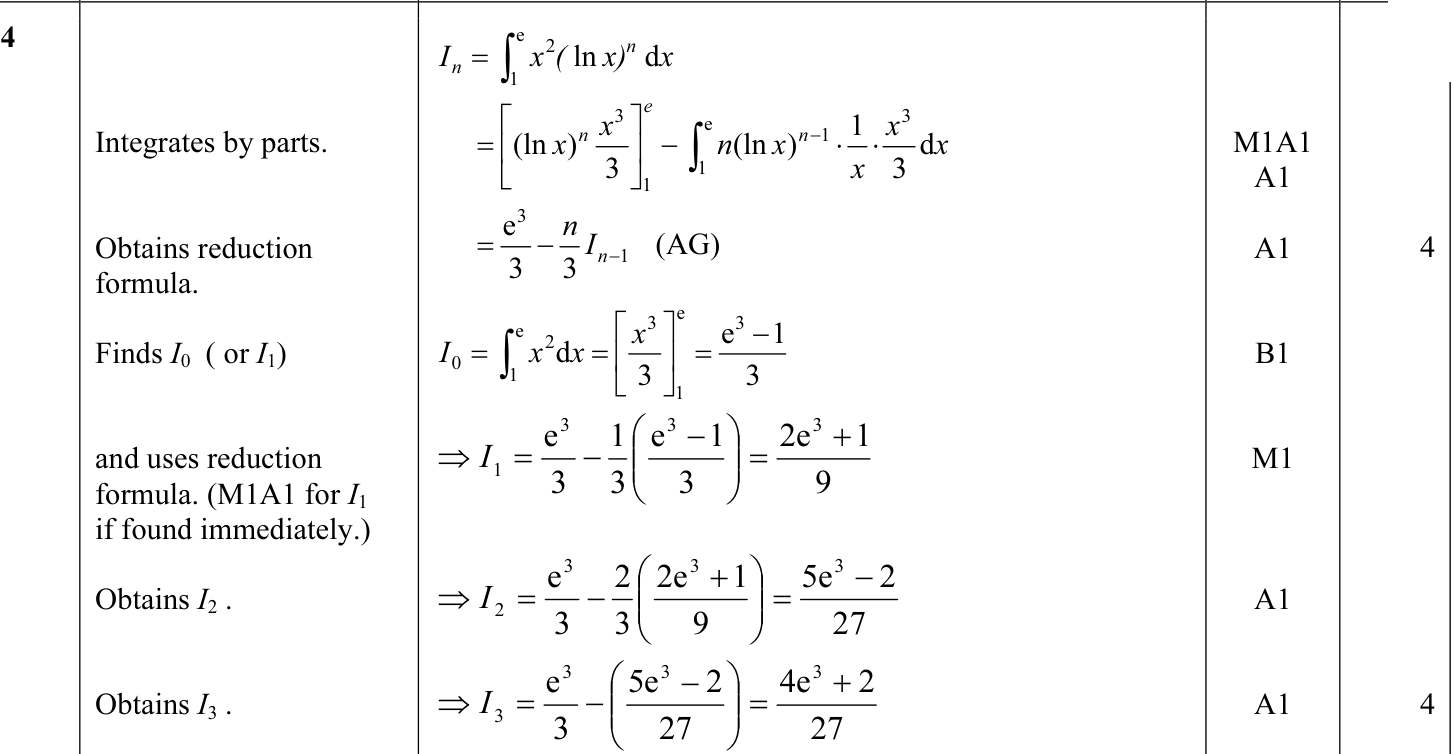
Let
\(I_{n}=\int_{1}^{\mathrm{e}} x^{2}(\ln x)^{n} \mathrm{~d} x\)
for \(n \geqslant 0\). Show that, for all \(n \geqslant 1\),
\(I_{n}=\frac{1}{3} \mathrm{e}^{3}-\frac{1}{3} n I_{n-1} .\)
Find the exact value of \(I_{3}\).
9231 P12 - Jun 2014 - Q10 - 10 marks
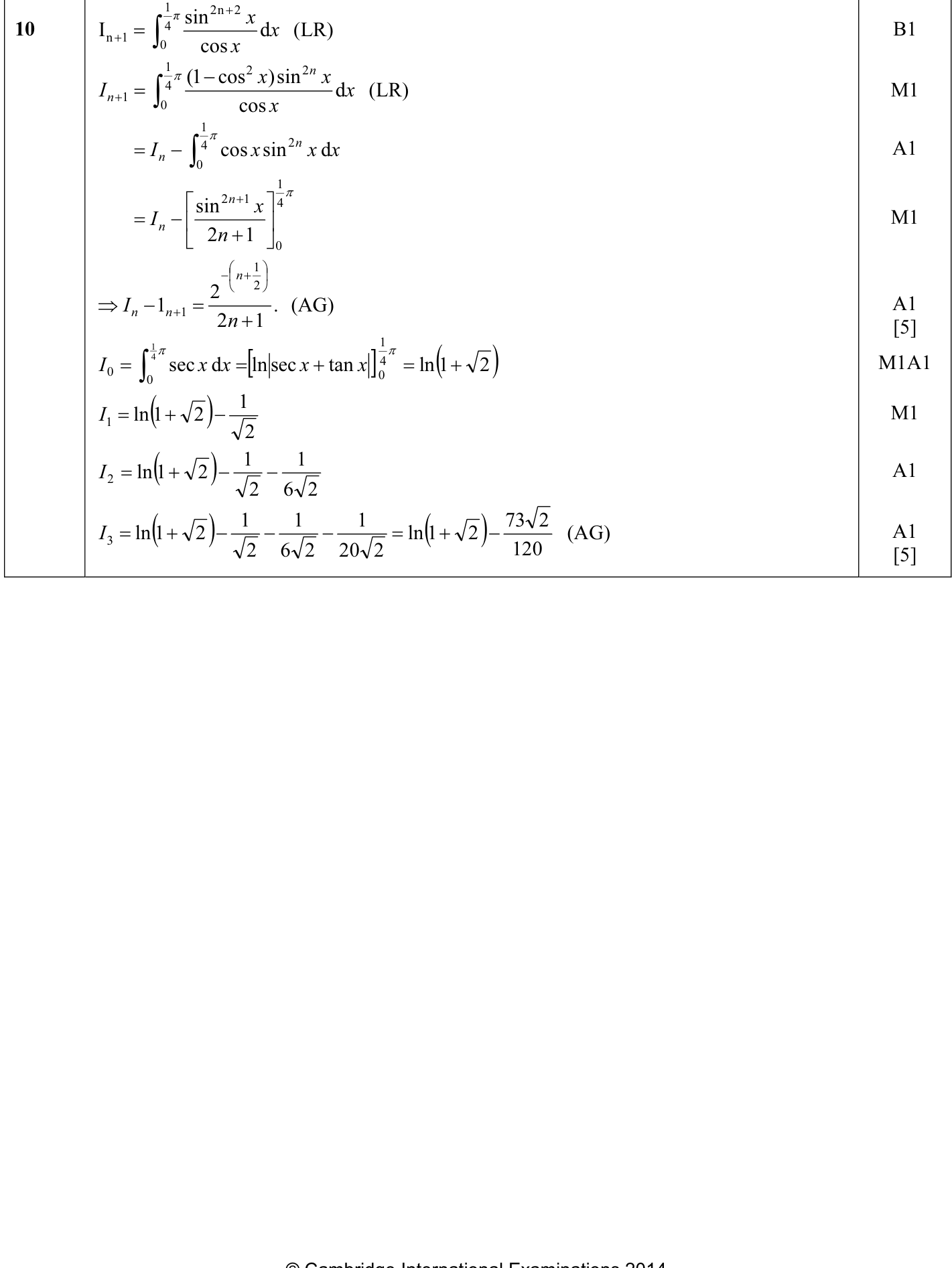
It is given that \(I_{n}=\int_{0}^{\frac{1}{4} \pi} \frac{\sin ^{2 n} x}{\cos x} \mathrm{~d} x\), where \(n \geqslant 0\). Show that
\(I_{n}-I_{n+1}=\frac{2^{-\left(n+\frac{1}{2}\right)}}{2 n+1} .\)
Hence show that \(\int_{0}^{\frac{1}{4} \pi} \frac{\sin ^{6} x}{\cos x} \mathrm{~d} x=\ln (1+\sqrt{ } 2)-\frac{73}{120} \sqrt{ } 2\).
9231 P13 - Nov 2012 - Q11 - 13 marks
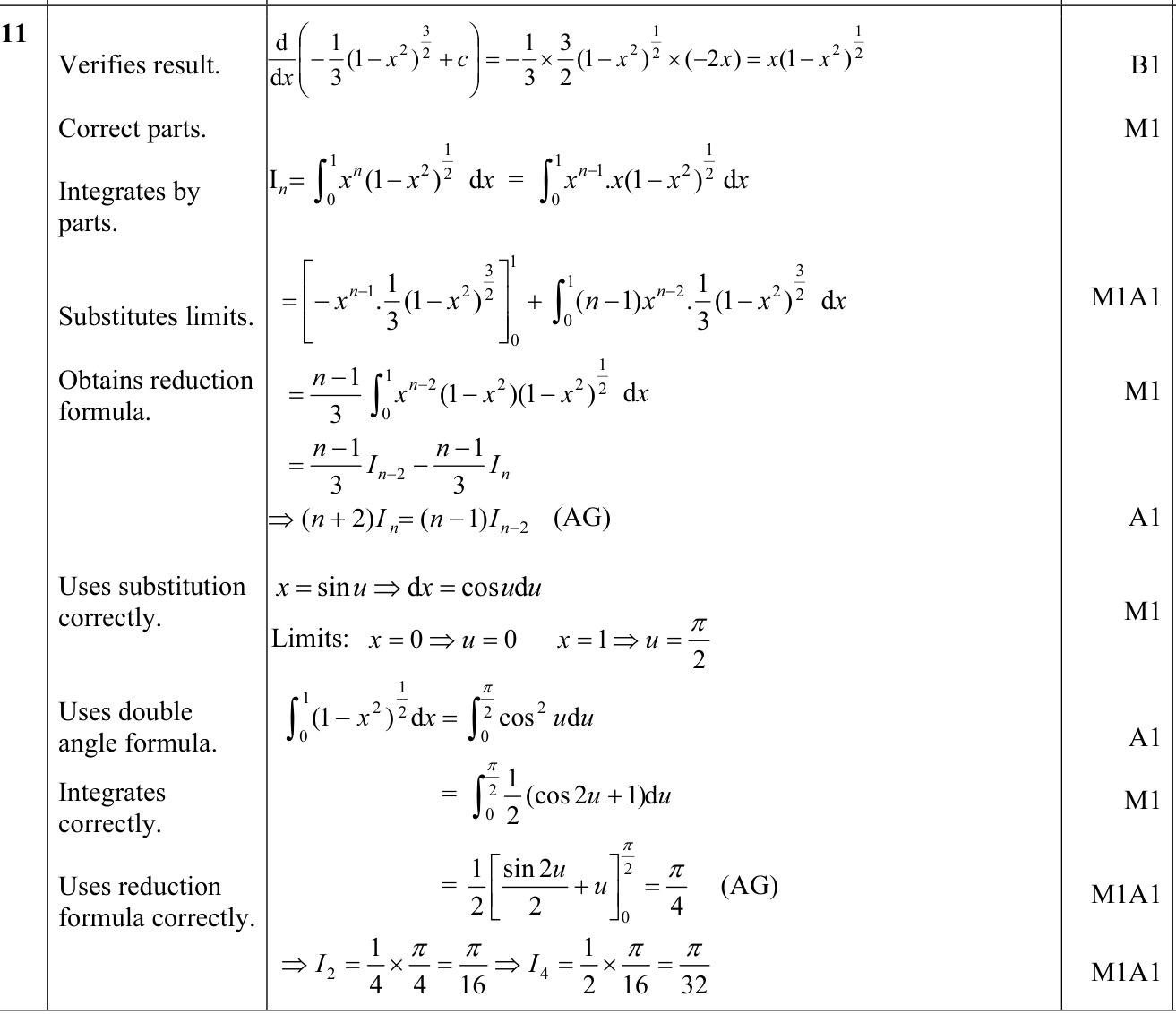
Show that \(\int x\left(1-x^{2}\right)^{\frac{1}{2}} \mathrm{~d} x=-\frac{1}{3}\left(1-x^{2}\right)^{\frac{3}{2}}+c\), where \(c\) is a constant.
Given that \(I_{n}=\int_{0}^{1} x^{n}\left(1-x^{2}\right)^{\frac{1}{2}} \mathrm{~d} x\), prove that, for \(n \geqslant 2\),
\((n+2) I_{n}=(n-1) I_{n-2} .\)
Use the substitution \(x=\sin u\) to show that
\(\int_{0}^{1}\left(1-x^{2}\right)^{\frac{1}{2}} \mathrm{~d} x=\frac{1}{4} \pi\)
Find \(I_{4}\).
9231 P11 - Jun 2010 - Q5 - 9 marks
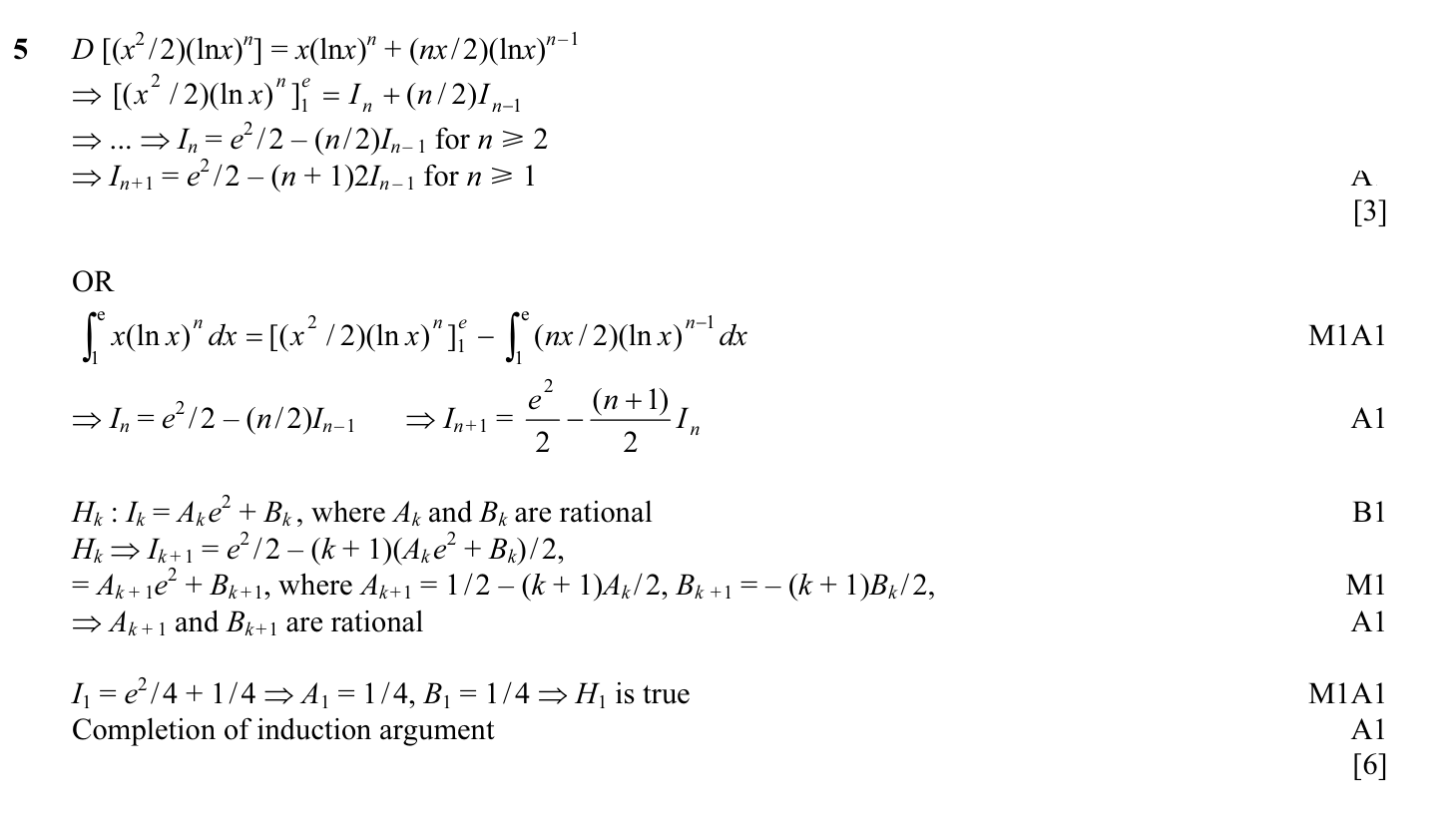
Let
\(I_{n}=\int_{1}^{\mathrm{e}} x(\ln x)^{n} \mathrm{~d} x,\)
where \(n \geqslant 1\). Show that
\(I_{n+1}=\frac{1}{2} \mathrm{e}^{2}-\frac{1}{2}(n+1) I_{n} .\)
Hence prove by induction that, for all positive integers \(n, I_{n}\) is of the form \(A_{n} \mathrm{e}^{2}+B_{n}\), where \(A_{n}\) and \(B_{n}\) are rational numbers.
9231 P13 - Jun 2011 - Q5 - 8 marks
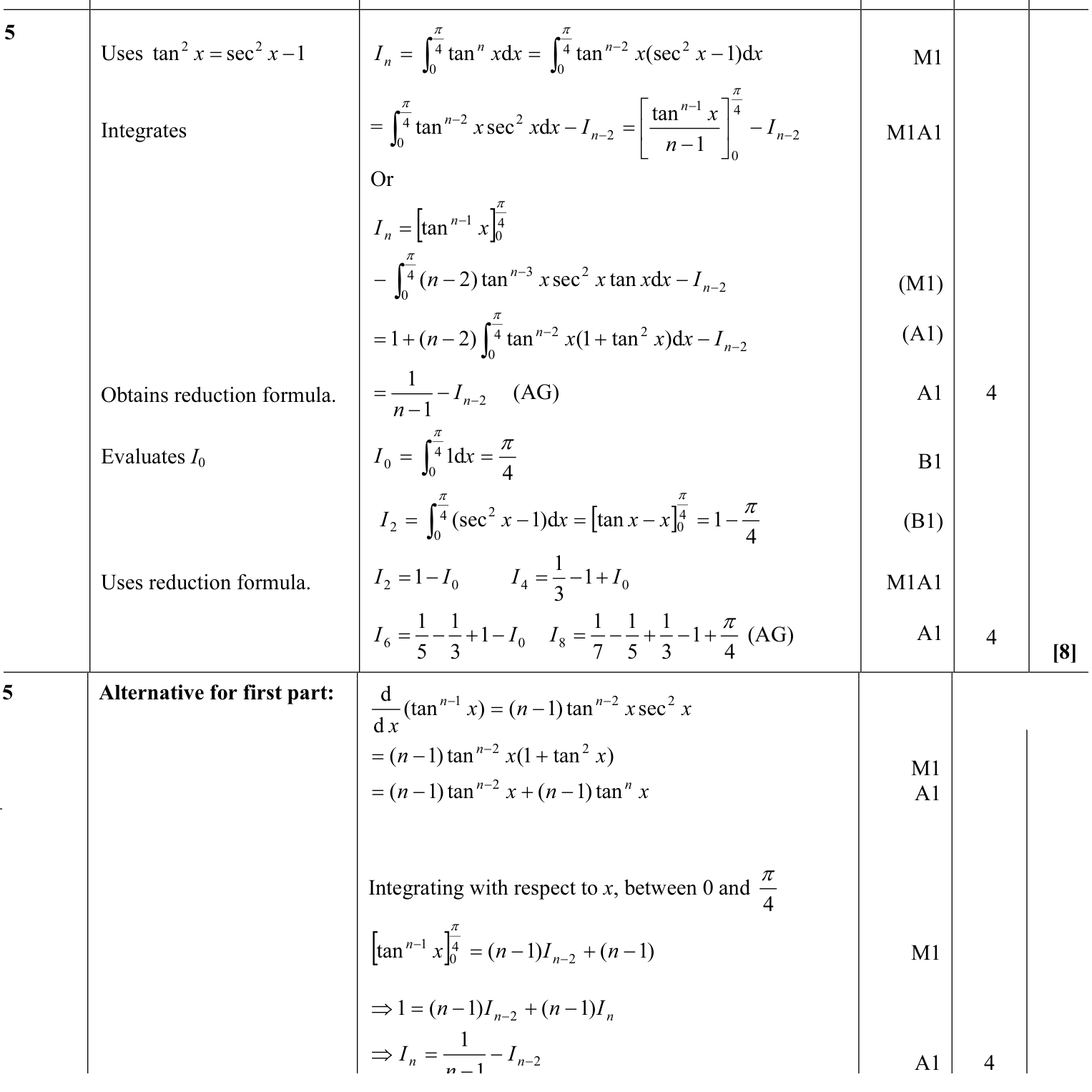
Let
\(I_{n}=\int_{0}^{\frac{1}{4} \pi} \tan ^{n} x \mathrm{~d} x\)
where \(n \geqslant 0\). Use the fact that \(\tan ^{2} x=\sec ^{2} x-1\) to show that, for \(n \geqslant 2\),
\(I_{n}=\frac{1}{n-1}-I_{n-2}\)
Show that \(I_{8}=\frac{1}{7}-\frac{1}{5}+\frac{1}{3}-1+\frac{1}{4} \pi\).
9231 P11 - Nov 2011 - Q6 - 8 marks
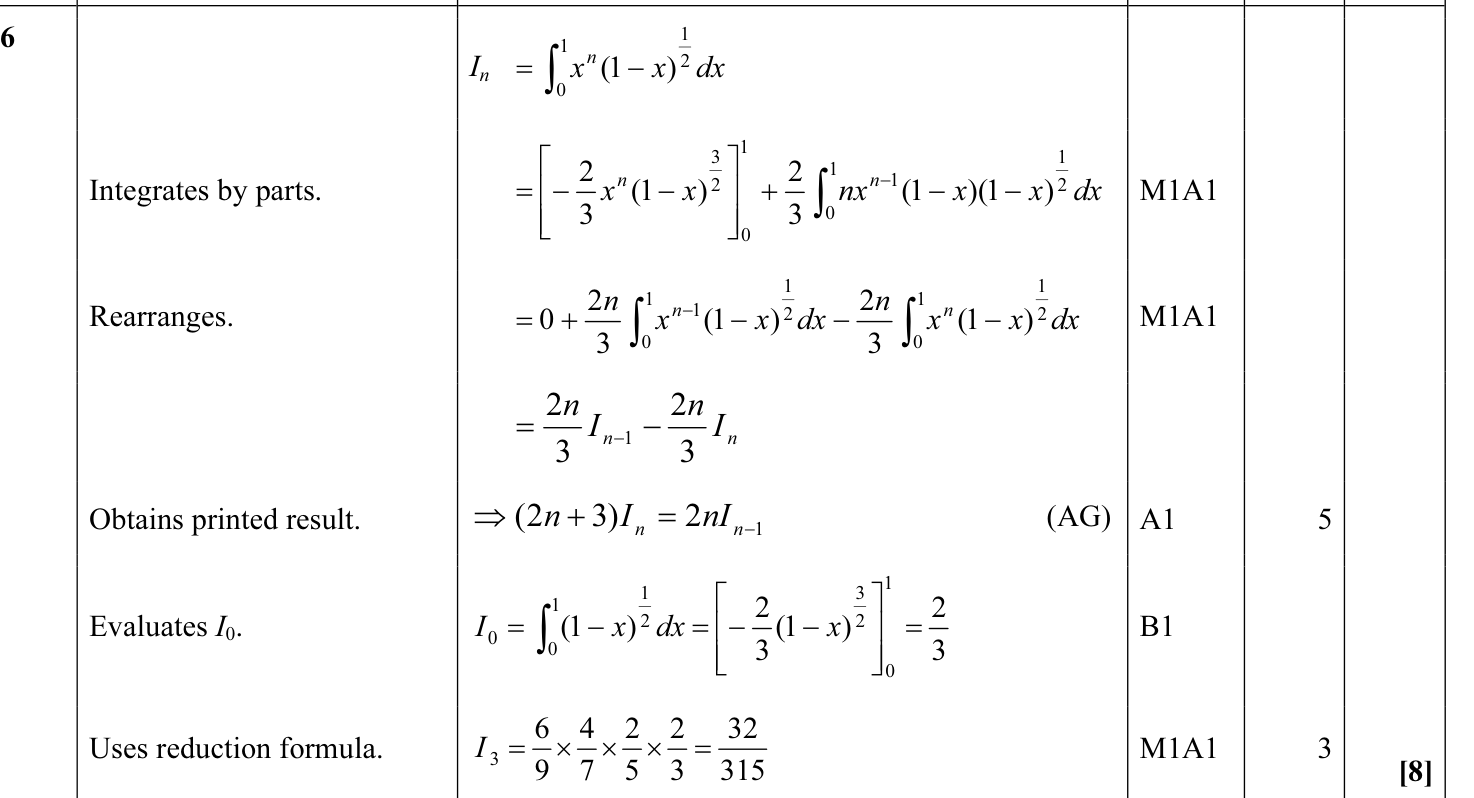
Let \(I_{n}=\int_{0}^{1} x^{n}(1-x)^{\frac{1}{2}} \mathrm{~d} x\), for \(n \geqslant 0\). Show that, for \(n \geqslant 1\),
\((3+2 n) I_{n}=2 n I_{n-1} .\)
Hence find the exact value of \(I_{3}\).
9231 P13 - Nov 2011 - Q7 - 9 marks
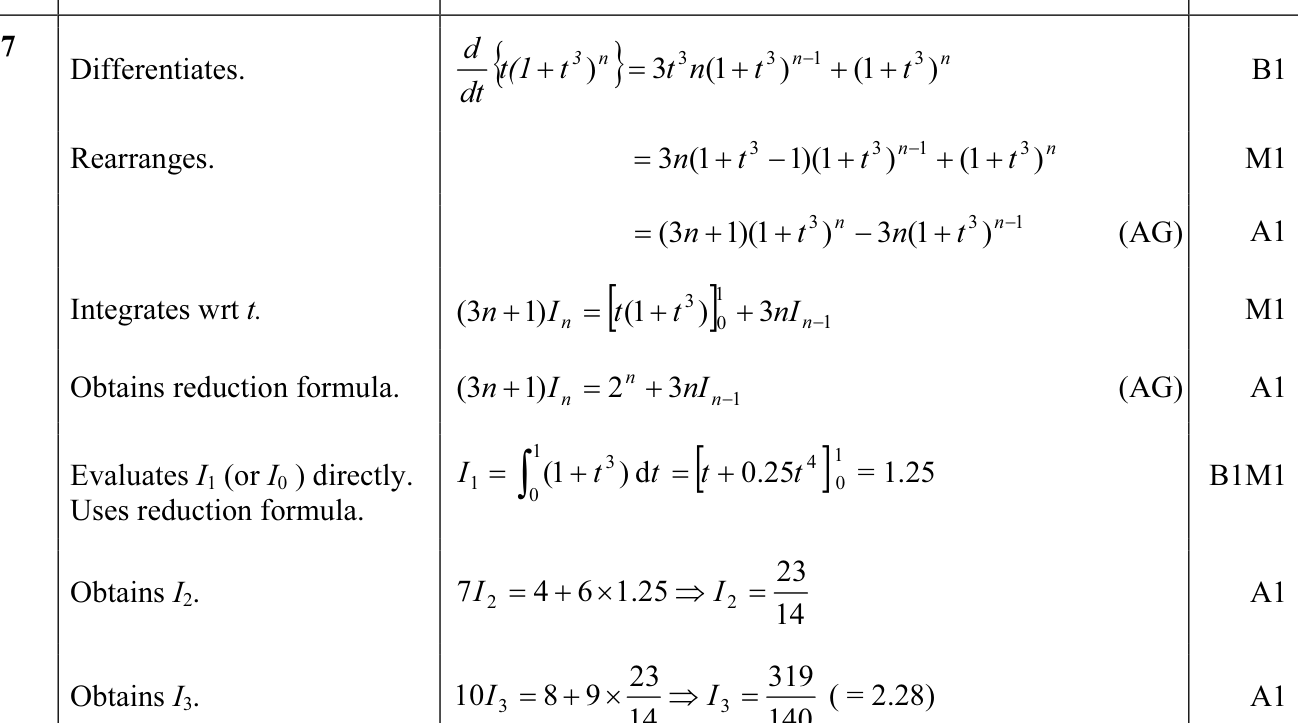
Show that \(\frac{\mathrm{d}}{\mathrm{d} t}\left(t\left(1+t^{3}\right)^{n}\right)=(3 n+1)\left(1+t^{3}\right)^{n}-3 n\left(1+t^{3}\right)^{n-1}\).
Let \(I_{n}=\int_{0}^{1}\left(1+t^{3}\right)^{n} \mathrm{~d} t\). Using the above result, or otherwise, show that
\((3 n+1) I_{n}=2^{n}+3 n I_{n-1}\)
Hence evaluate \(I_{3}\).
9231 P1 - Jun 2009 - Q7 - 8 marks
Let
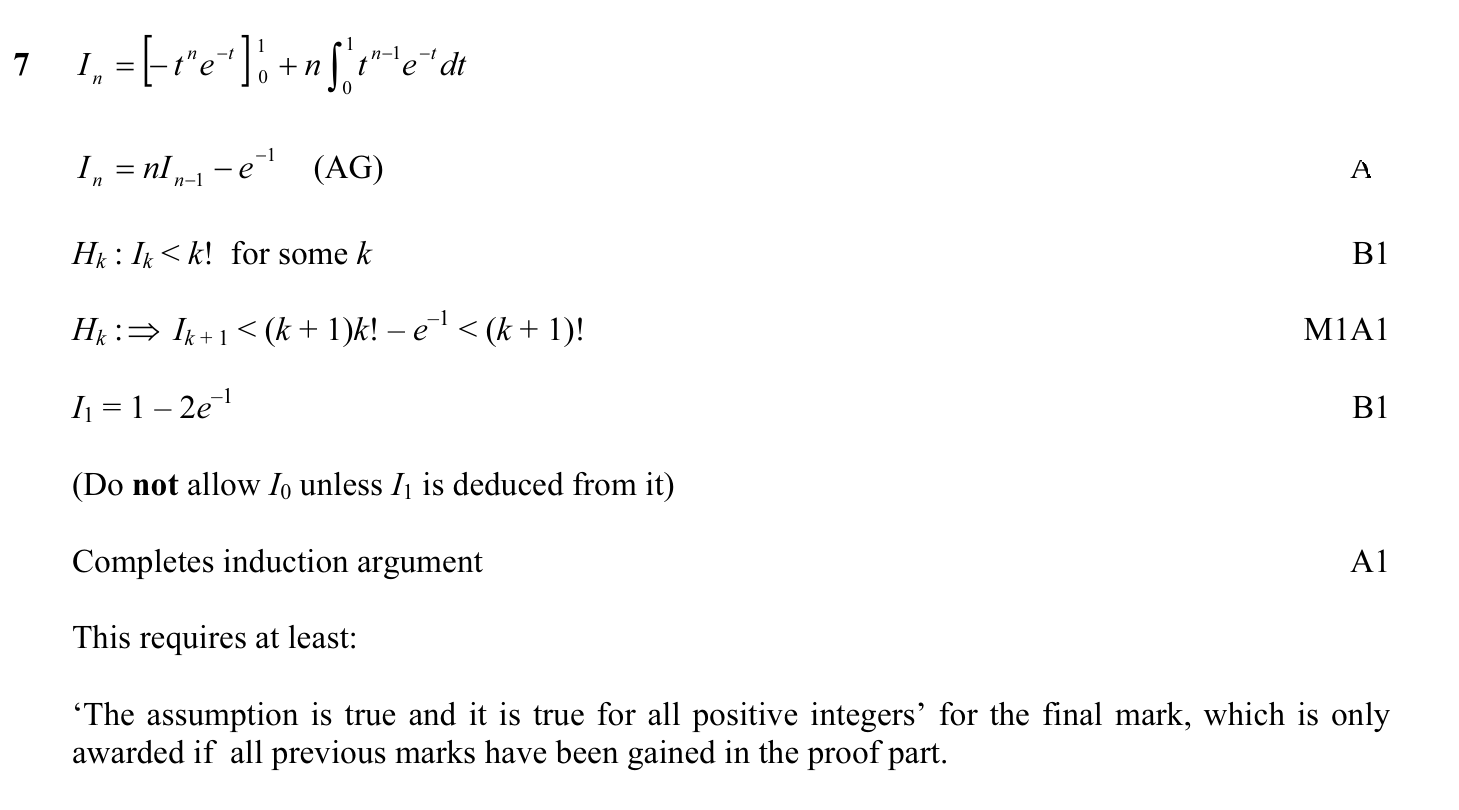
\(I_{n}=\int_{0}^{1} t^{n} \mathrm{e}^{-t} \mathrm{~d} t\)
where \(n \geqslant 0\). Show that, for all \(n \geqslant 1\),
\(I_{n}=n I_{n-1}-\mathrm{e}^{-1}\)
Hence prove by induction that, for all positive integers \(n\),
\(I_{n}\lt n!.\)
9231 P1 - Nov 2009 - Q6 - 9 marks
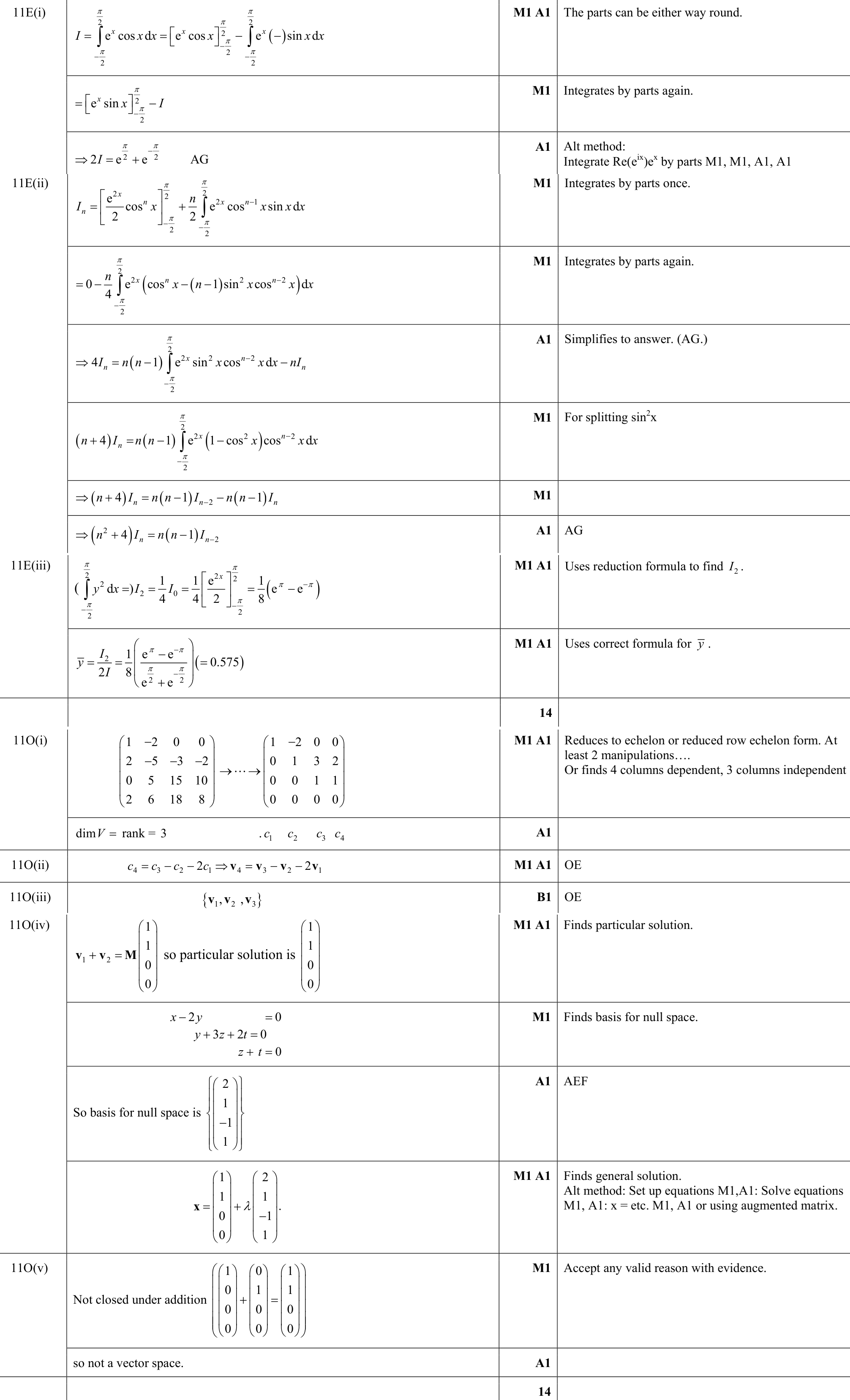
Show that
\(\frac{\mathrm{d}}{\mathrm{~d} x}\left[x^{n-1} \sqrt{ }\left(4-x^{2}\right)\right]=\frac{4(n-1) x^{n-2}}{\sqrt{ }\left(4-x^{2}\right)}-\frac{n x^{n}}{\sqrt{ }\left(4-x^{2}\right)} .\)
Let
\(I_{n}=\int_{0}^{1} \frac{x^{n}}{\sqrt{ }\left(4-x^{2}\right)} \mathrm{d} x\)
where \(n \geqslant 0\). Prove that
\(n I_{n}=4(n-1) I_{n-2}-\sqrt{ } 3,\)
for \(n \geqslant 2\).
Given that \(I_{0}=\frac{1}{6} \pi\), find \(I_{4}\), leaving your answer in an exact form.