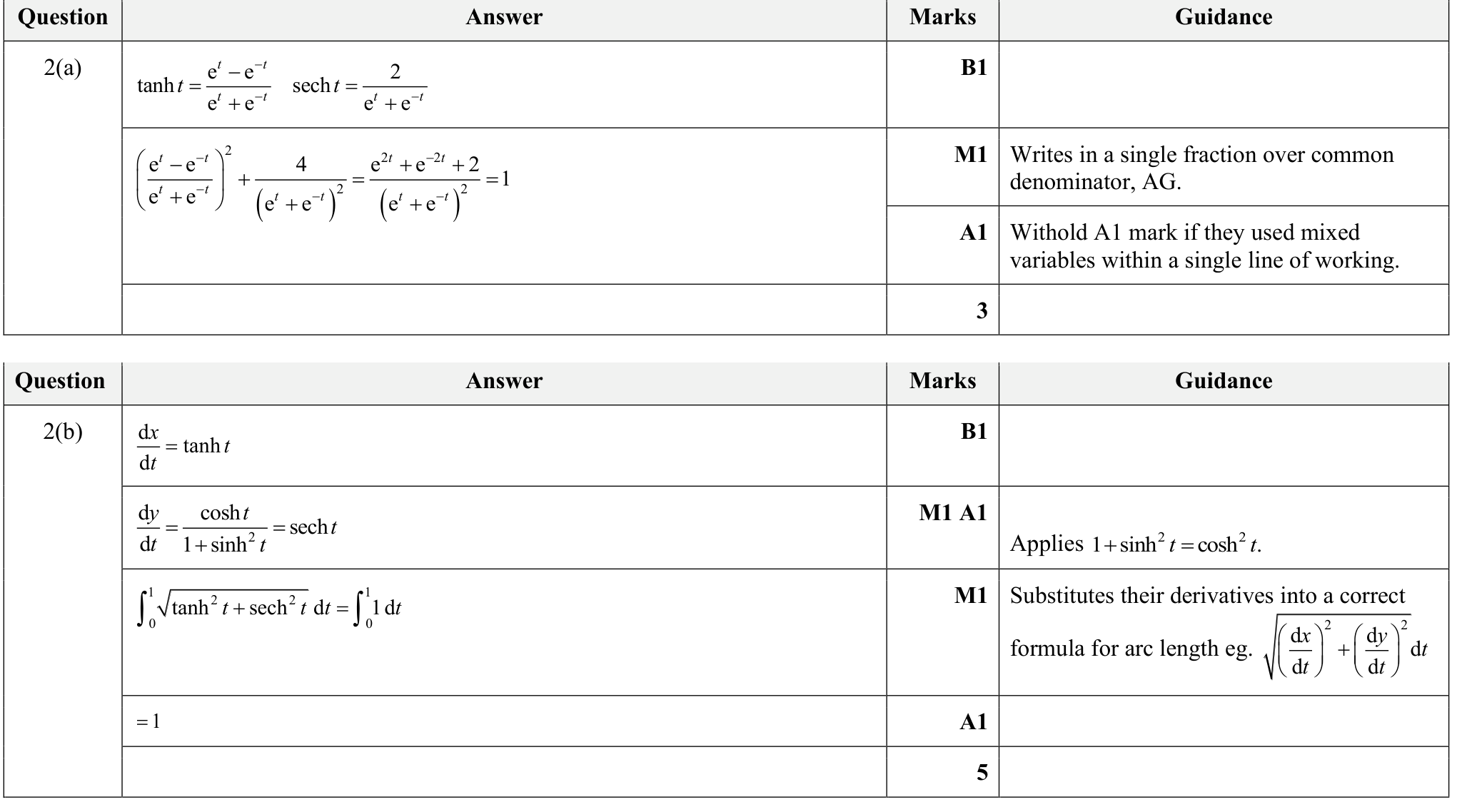
9231 P23 - Jun 2025 - Q2 - 8 marks
(a) Starting from the definitions of tanh and sech in terms of exponentials, prove that
\(\tanh ^{2} t+\operatorname{sech}^{2} t=1\)
(b) The curve \(C\) has parametric equations
\(x=\ln (\cosh t), \quad y=\tan ^{-1}(\sinh t), \quad \text { for } 0 \leqslant t \leqslant 1\)
Find the length of \(C\).
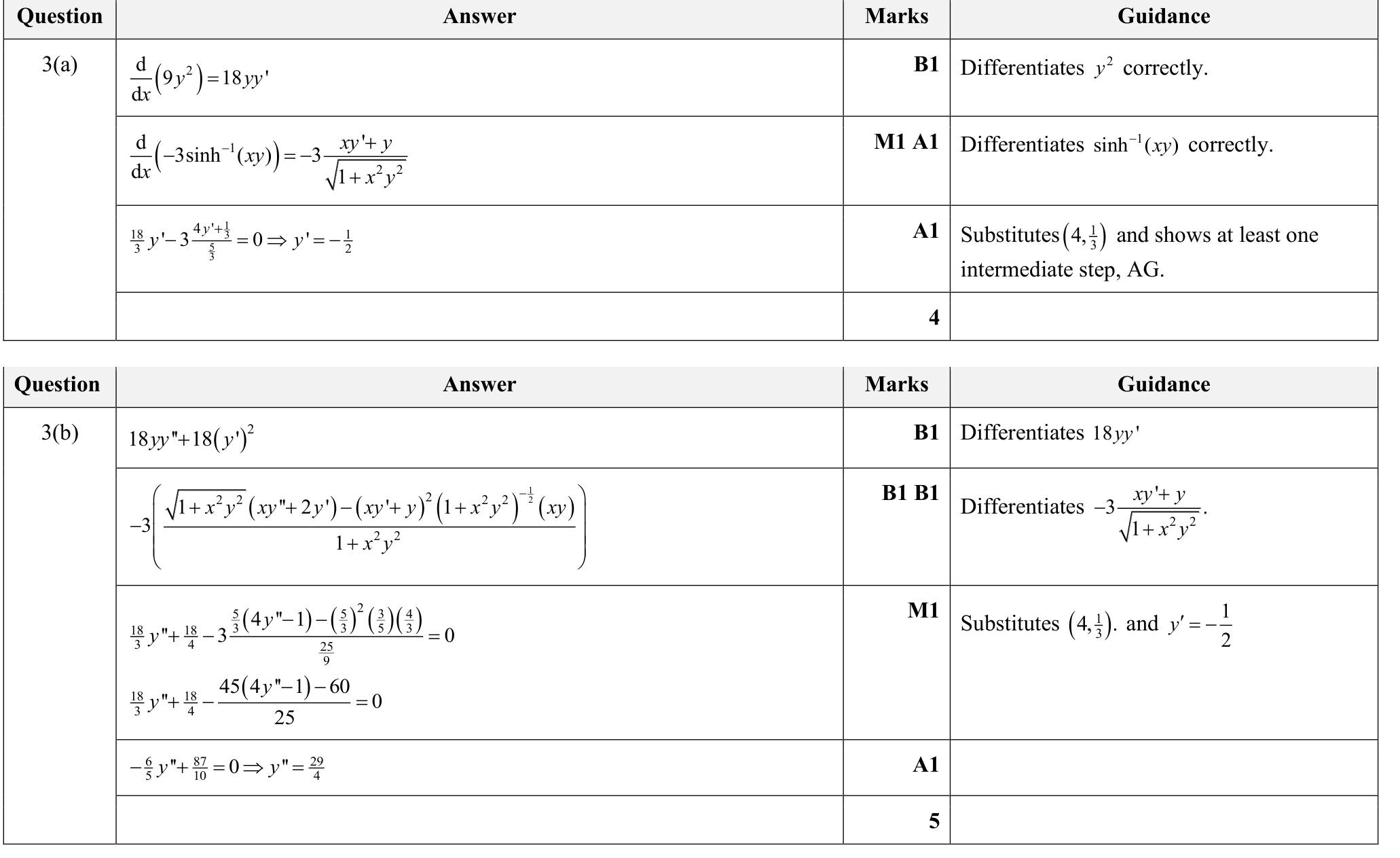
9231 P23 - Jun 2025 - Q3 - 9 marks
The curve \(C\) has equation
\(9 y^{2}-3 \sinh ^{-1}(x y)=1-3 \ln 3 .\)
(a) Show that, at the point \(\left(4, \frac{1}{3}\right)\) on \(C, \frac{\mathrm{~d} y}{\mathrm{~d} x}=-\frac{1}{2}\).
(b) Find the value of \(\frac{\mathrm{d}^{2} y}{\mathrm{~d} x^{2}}\) at the point \(\left(4, \frac{1}{3}\right)\).
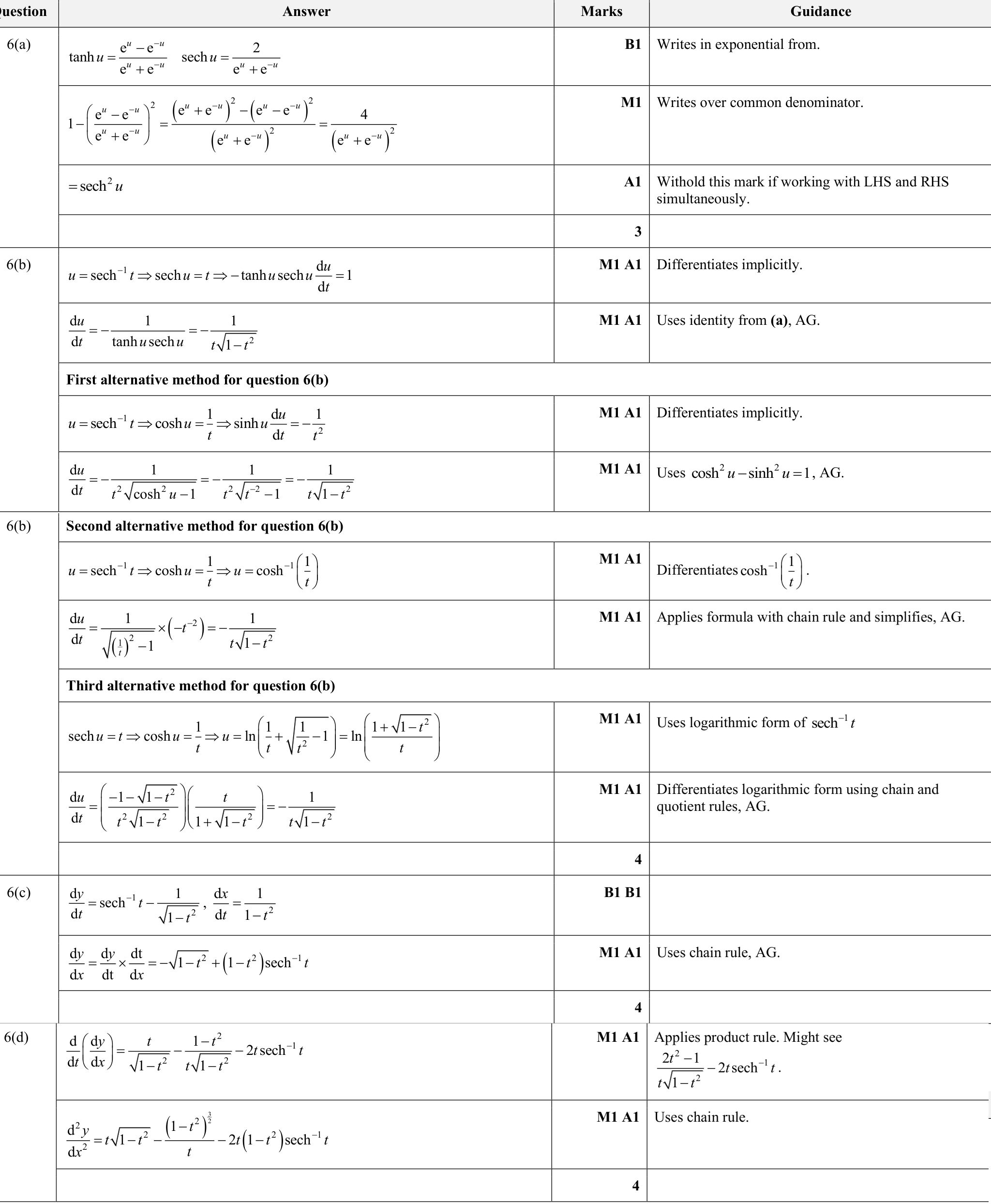
9231 P21 - Jun 2025 - Q6 - 15 marks
(a) Starting from the definitions of tanh and sech in terms of exponentials, prove that
\(1-\tanh ^{2} u=\operatorname{sech}^{2} u .\)
(b) Show that \(\frac{\mathrm{d}}{\mathrm{d} t}\left(\operatorname{sech}^{-1} t\right)=-\frac{1}{t \sqrt{1-t^{2}}}\).
It is given that
\(x=\tanh ^{-1} t \quad \text { and } \quad y=t \operatorname{sech}^{-1} t, \quad \text { for } 0<t<1 .\)
(c) Show that \(\frac{\mathrm{d} y}{\mathrm{~d} x}=-\sqrt{1-t^{2}}+\left(1-t^{2}\right) \operatorname{sech}^{-1} t\).
(d) Find \(\frac{\mathrm{d}^{2} y}{\mathrm{~d} x^{2}}\) in terms of \(t\).
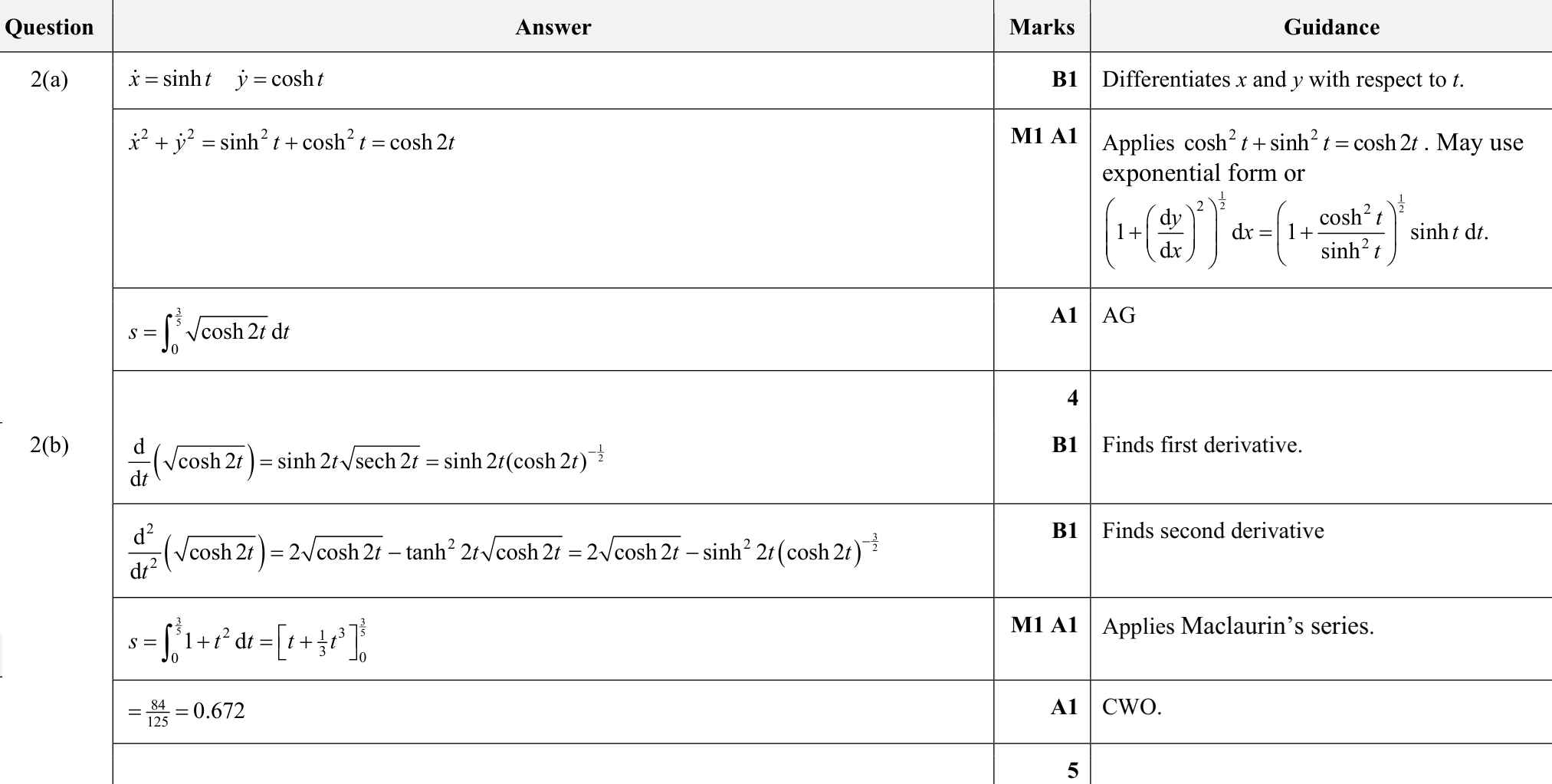
9231 P23 - Jun 2024 - Q2 - 9 marks
The curve \(C\) has parametric equations
\(x=\cosh t, \quad y=\sinh t, \quad \text { for } 0\lt t \leqslant \frac{3}{5} .\)
The length of \(C\) is denoted by \(s\).
(a) Show that \(s=\int_{0}^{\frac{3}{5}} \sqrt{\cosh 2 t} \mathrm{~d} t\).
(b) By finding the Maclaurin's series for \(\sqrt{\cosh 2 t}\) up to and including the term in \(t^{2}\), deduce an approximation to \(s\).
9231 P21 - Jun 2024 - Q6 - 12 marks
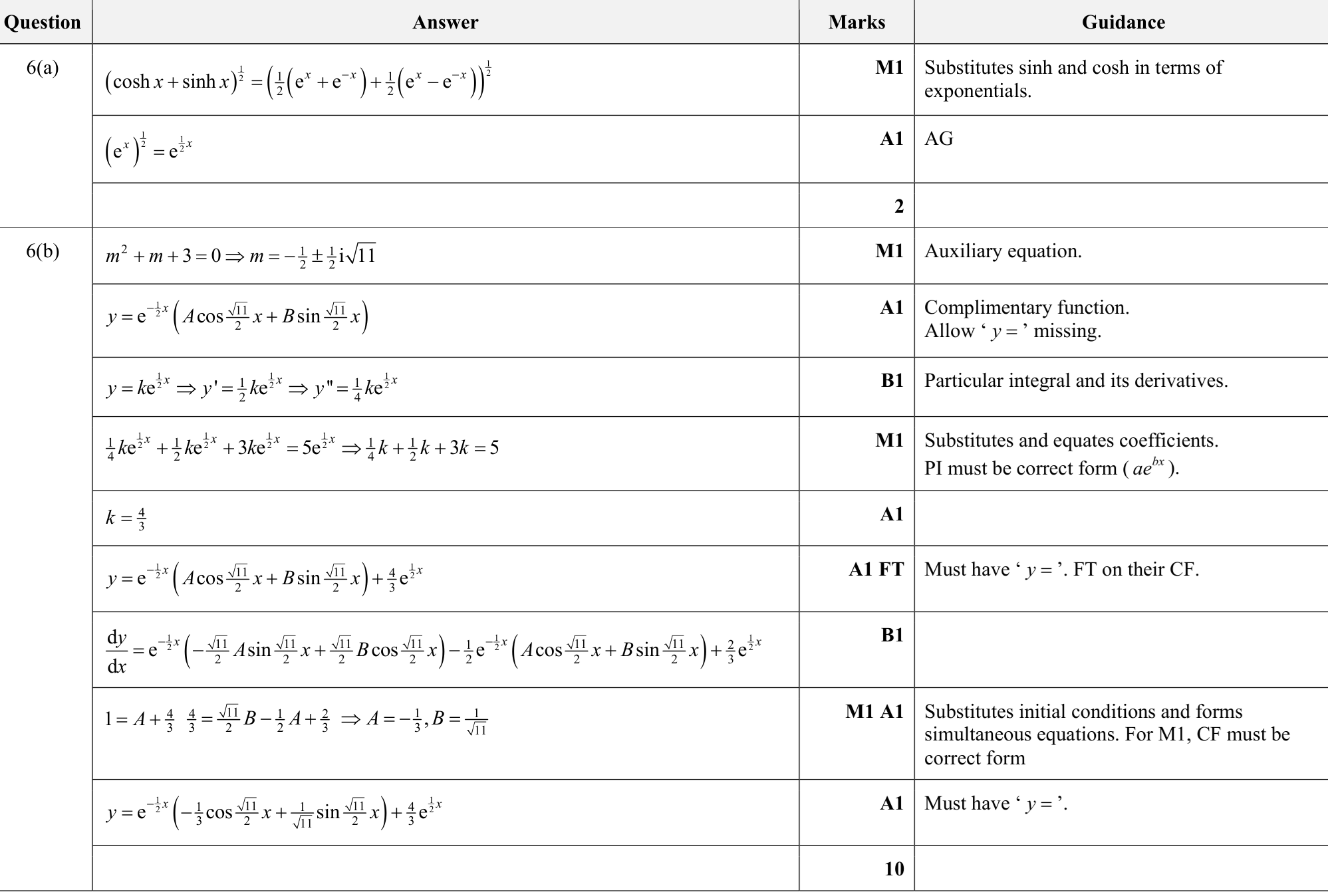
(a) Show that \((\cosh x+\sinh x)^{\frac{1}{2}}=\mathrm{e}^{\frac{1}{2} x}\).
(b) Find the particular solution of the differential equation
\(\frac{\mathrm{d}^{2} y}{\mathrm{~d} x^{2}}+\frac{\mathrm{d} y}{\mathrm{~d} x}+3 y=5(\cosh x+\sinh x)^{\frac{1}{2}}\)
given that, when \(x=0, y=1\) and \(\frac{\mathrm{d} y}{\mathrm{~d} x}=\frac{4}{3}\).
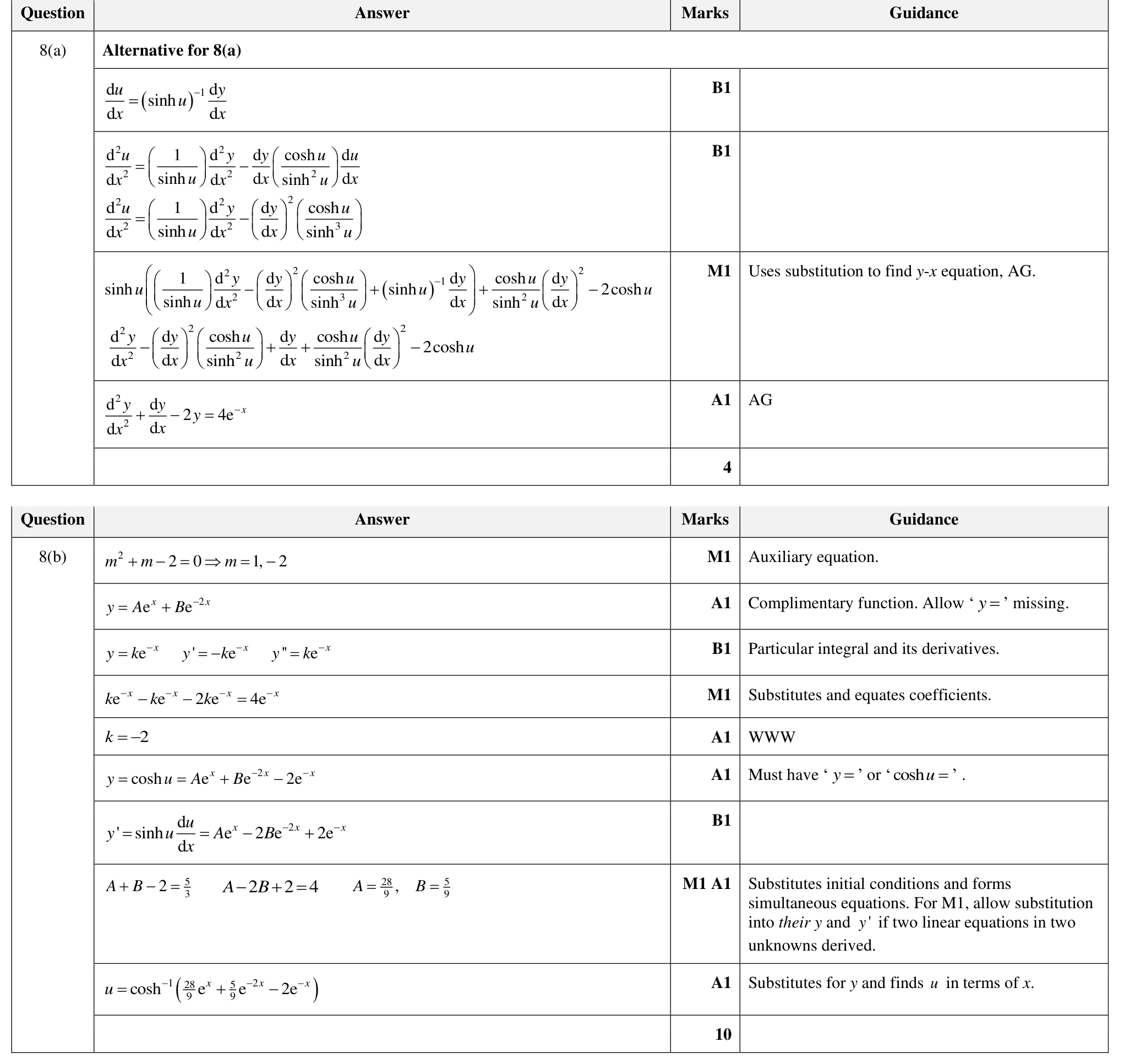
9231 P22 - Nov 2022 - Q8 - 14 marks
It is given that \(y=\cosh u\), where \(u\gt 0\), and
\(\sqrt{\cosh ^{2} u-1}\left(\frac{\mathrm{~d}^{2} u}{\mathrm{~d} x^{2}}+\frac{\mathrm{d} u}{\mathrm{~d} x}\right)+\cosh u\left(\frac{\mathrm{~d} u}{\mathrm{~d} x}\right)^{2}-2 \cosh u=4 \mathrm{e}^{-x}\)
(a) Show that
\(\frac{\mathrm{d}^{2} y}{\mathrm{~d} x^{2}}+\frac{\mathrm{d} y}{\mathrm{~d} x}-2 y=4 \mathrm{e}^{-x}\)
(b) Find \(u\) in terms of \(x\), given that, when \(x=0, u=\ln 3\) and \(\frac{\mathrm{d} u}{\mathrm{~d} x}=3\).