9231 P21 - Jun 2023 - Q8 - 14 marks
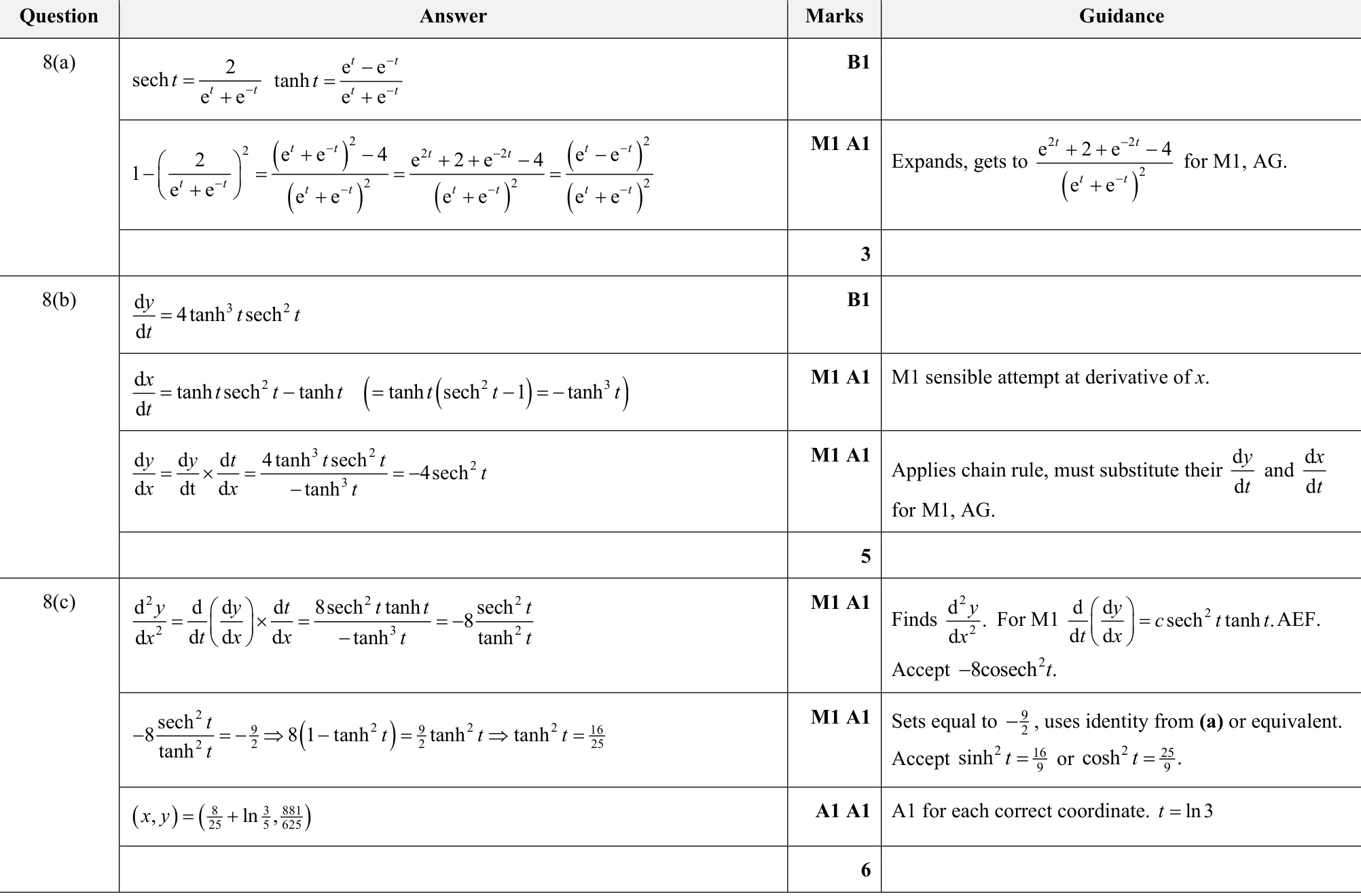
(a) Starting from the definitions of sech and tanh in terms of exponentials, prove that
\(1-\operatorname{sech}^{2} t=\tanh ^{2} t\)
The curve \(C\) has parametric equations
\(x=\frac{1}{2} \tanh ^{2} t+\ln \operatorname{sech} t, \quad y=1+\tanh ^{4} t, \quad \text { for } t\gt 0 .\)
(b) Show that \(\frac{\mathrm{d} y}{\mathrm{~d} x}=-4 \operatorname{sech}^{2} t\).
(c) Find the coordinates of the point on \(C\) with \(\frac{\mathrm{d}^{2} y}{\mathrm{~d} x^{2}}=-\frac{9}{2}\), giving your answer in the form \((a+\ln b, c)\) where \(a, b\) and \(c\) are rational numbers.
9231 P22 - Nov 2024 - Q3 - 7 marks
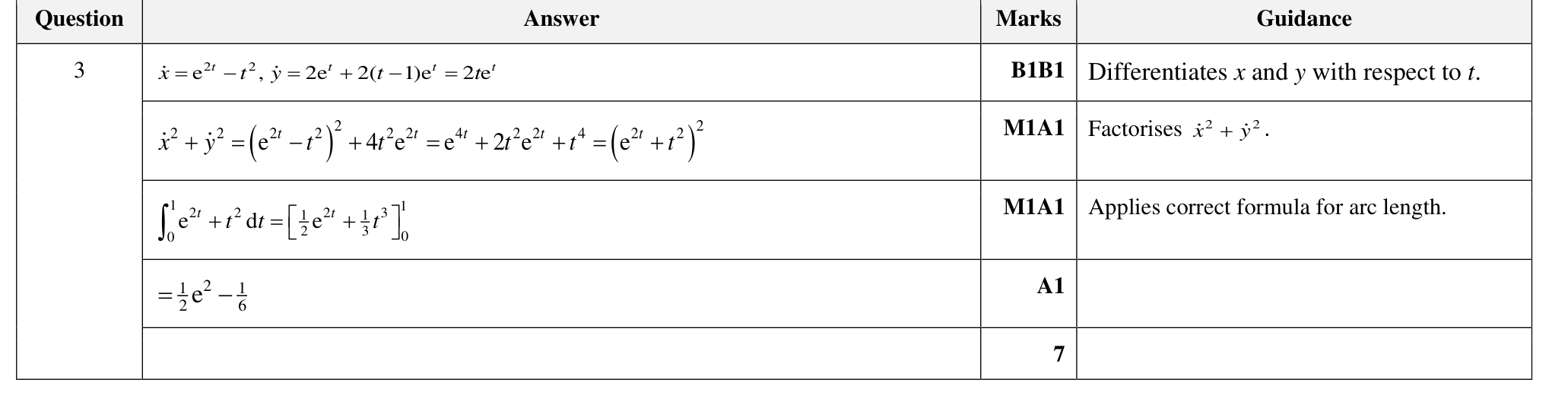
The curve \(C\) has parametric equations
\(x=\frac{1}{2} \mathrm{e}^{2 t}-\frac{1}{3} t^{3}-\frac{1}{2}, \quad y=2 \mathrm{e}^{t}(t-1), \quad \text { for } 0 \leqslant t \leqslant 1 .\)
Find the exact length of \(C\).
9231 P21 - Nov 2024 - Q2 - 6 marks
It is given that
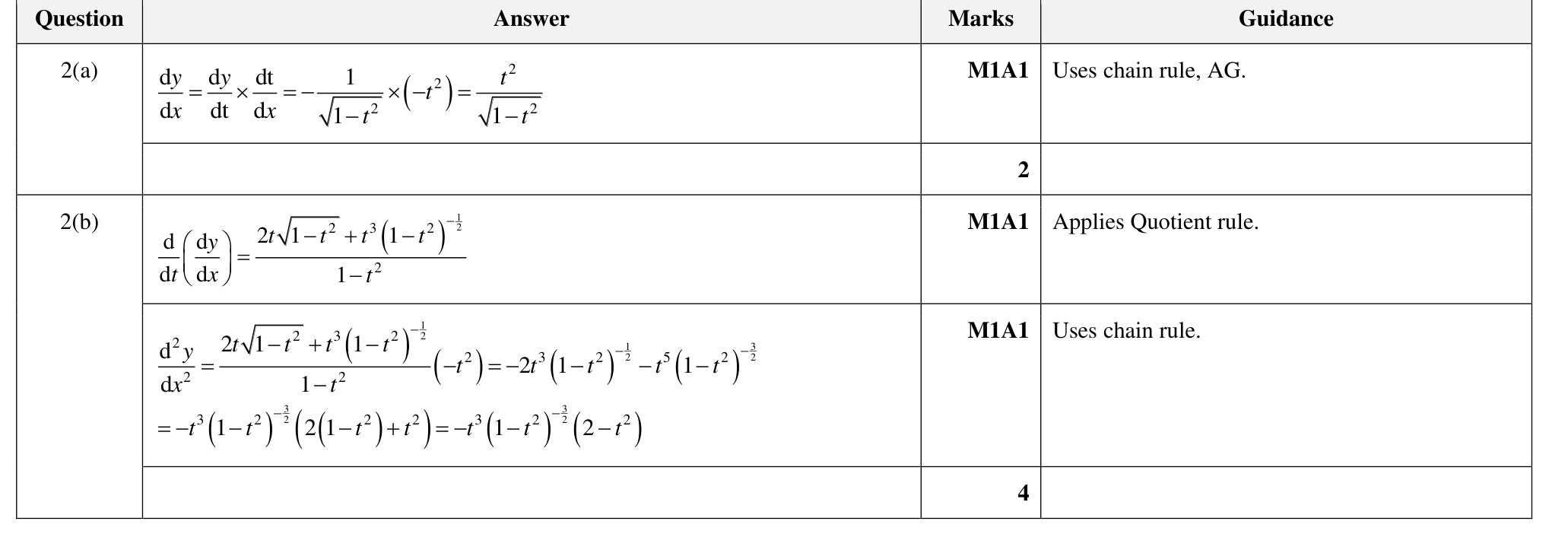
\(x=1+\frac{1}{t} \quad \text { and } \quad y=\cos ^{-1} t \quad \text { for } 0\lt t\lt 1 .\)
(a) Show that \(\frac{\mathrm{d} y}{\mathrm{~d} x}=\frac{t^{2}}{\sqrt{1-t^{2}}}\).
(b) Show that \(\frac{\mathrm{d}^{2} y}{\mathrm{~d} x^{2}}=-t^{a}\left(1-t^{2}\right)^{b}\left(2-t^{2}\right)\), where \(a\) and \(b\) are constants to be determined.
9231 P22 - Nov 2023 - Q2 - 7 marks
It is given that
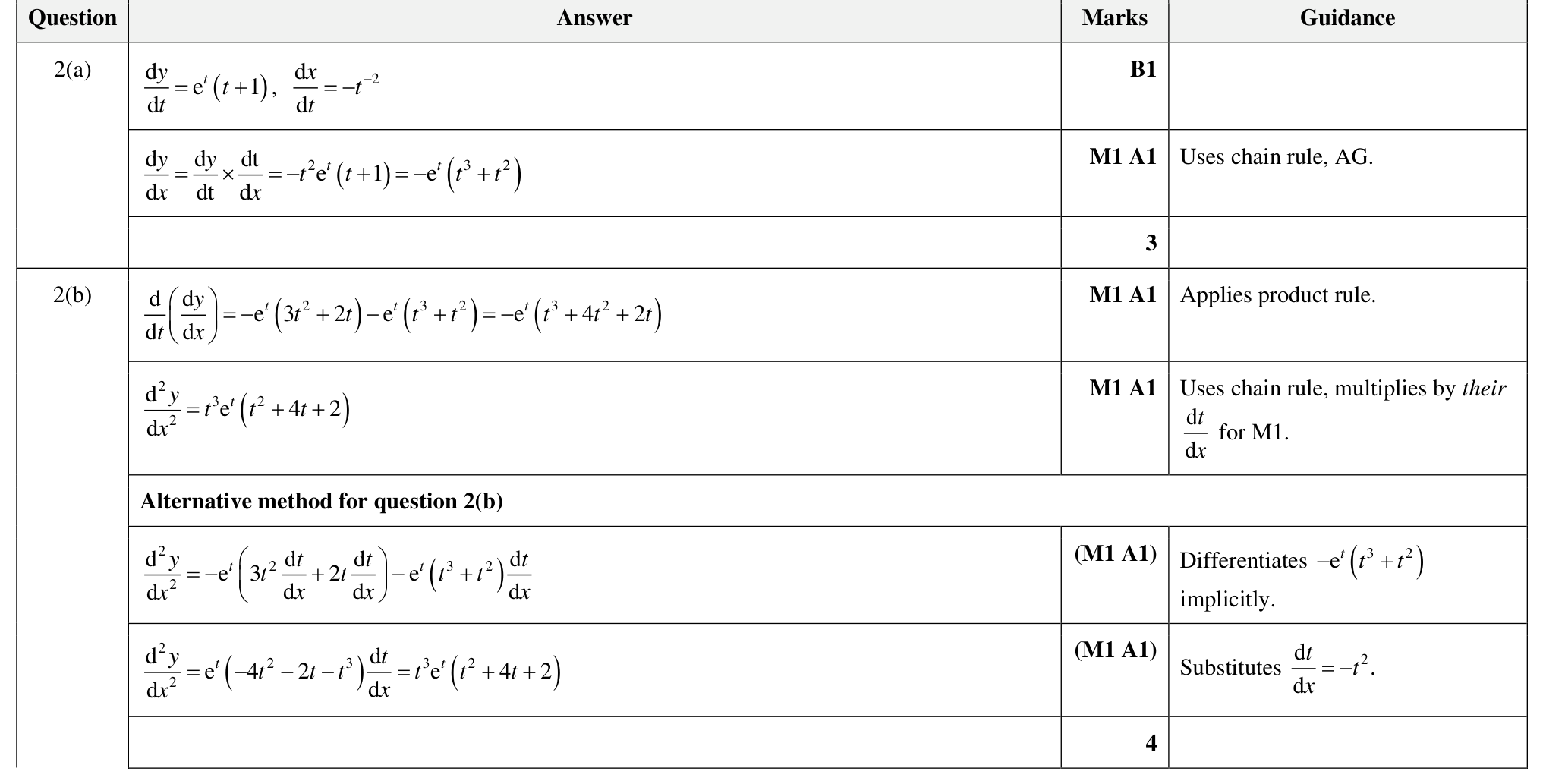
\(x=1+\frac{1}{t} \quad \text { and } \quad y=t \mathrm{e}^{t} .\)
(a) Show that \(\frac{\mathrm{d} y}{\mathrm{~d} x}=-\mathrm{e}^{t}\left(t^{3}+t^{2}\right)\).
(b) Find \(\frac{\mathrm{d}^{2} y}{\mathrm{~d} x^{2}}\) in terms of \(t\).
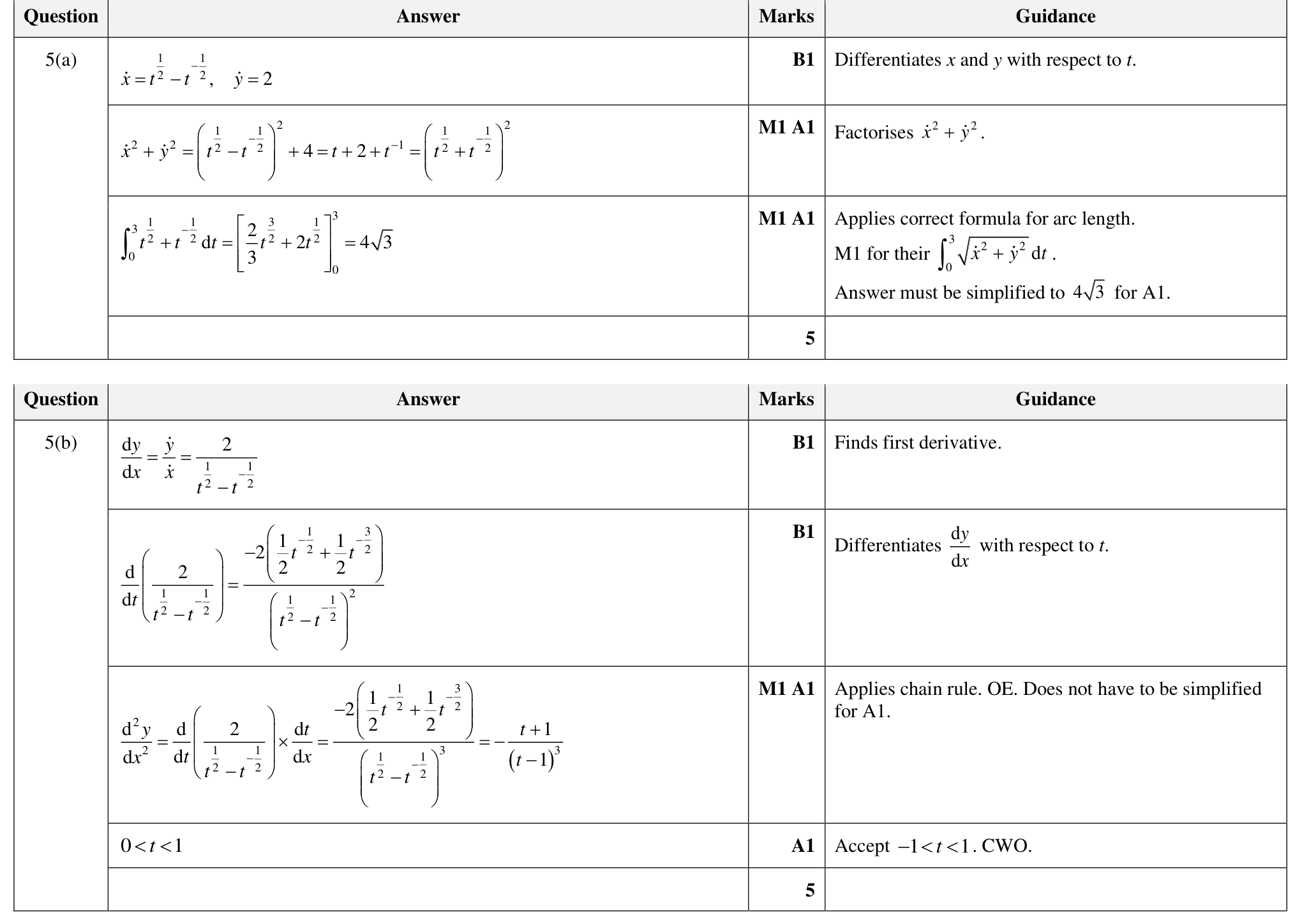
9231 P21 - Nov 2023 - Q5 - 10 marks
The curve \(C\) has parametric equations
\(x=\frac{2}{3} t^{\frac{3}{2}}-2 t^{\frac{1}{2}}, \quad y=2 t+5, \quad \text { for } 0\lt t \leqslant 3 .\)
(a) Find the exact length of \(C\).
(b) Find the set of values of \(t\) for which \(\frac{\mathrm{d}^{2} y}{\mathrm{~d} x^{2}}\gt 0\).
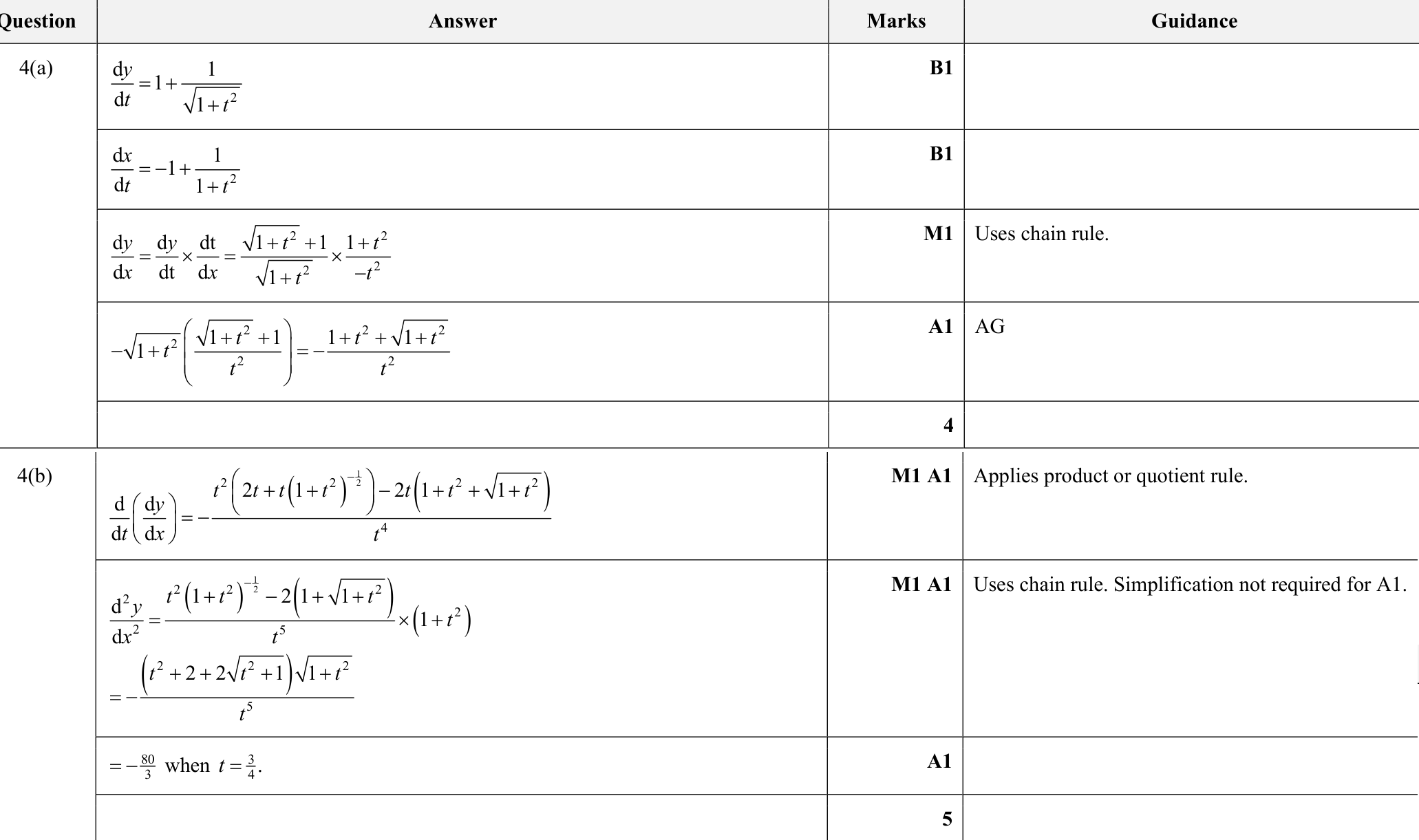
9231 P23 - Jun 2022 - Q4 - 9 marks
It is given that
\(x=-t+\tan ^{-1} t \quad \text { and } \quad y=t+\sinh ^{-1} t\)
(a) Show that \(\frac{\mathrm{d} y}{\mathrm{~d} x}=-\frac{t^{2}+1+\sqrt{t^{2}+1}}{t^{2}}\).
(b) Find the value of \(\frac{\mathrm{d}^{2} y}{\mathrm{~d} x^{2}}\) when \(t=\frac{3}{4}\).
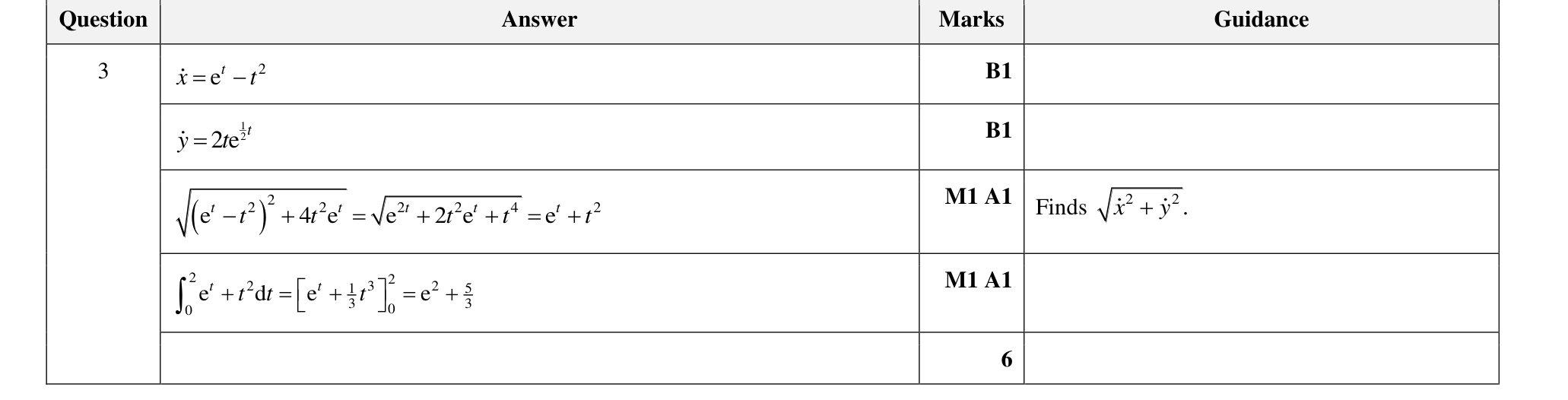
9231 P21 - Nov 2022 - Q3 - 6 marks
The curve \(C\) has parametric equations
\(x=\mathrm{e}^{t}-\frac{1}{3} t^{3}, \quad y=4 \mathrm{e}^{\frac{1}{2} t}(t-2), \quad \text { for } 0 \leqslant t \leqslant 2\)
Find, in terms of e , the length of \(C\).
9231 P23 - Jun 2020 - Q5 - 9 marks
The curve \(C\) has parametric equations
\[x=\frac{1}{2} t^{2}-\ln t, \quad y=2 t+1, \quad \text { for } \frac{1}{2} \leqslant t \leqslant 2 .\]
(a) Find the exact length of \(C\).
(b) Find \(\frac{\mathrm{d}^{2} y}{\mathrm{~d} x^{2}}\) in terms of \(t\), simplifying your answer.

9231 P22 - Nov 2021 - Q5 - 10 marks
The curve \(C\) has parametric equations
\[x=3 t+2 t^{-1}+a t^{3}, \quad y=4 t-\frac{3}{2} t^{-1}+b t^{3}, \quad \text { for } 1 \leqslant t \leqslant 2\]
where \(a\) and \(b\) are constants.
(a) It is given that \(a=\frac{2}{3}\) and \(b=-\frac{1}{2}\).
Show that \(\left(\frac{\mathrm{d} x}{\mathrm{~d} t}\right)^{2}+\left(\frac{\mathrm{d} y}{\mathrm{~d} t}\right)^{2}=\frac{25}{4}\left(t^{2}+t^{-2}\right)^{2}\) and find the exact length of \(C\).
(b) It is given instead that \(a=b=0\).
Find the value of \(\frac{\mathrm{d}^{2} y}{\mathrm{~d} x^{2}}\) when \(t=1\).

9231 P13 - Jun 2014 - Q7 - 10 marks
The curve \(C\) has parametric equations
\(x=\sin t, \quad y=\sin 2 t, \quad \text { for } 0 \leqslant t \leqslant \pi .\)
Find \(\frac{\mathrm{d}^{2} y}{\mathrm{~d} x^{2}}\) in terms of \(t\).
Hence, or otherwise, find the coordinates of the stationary points on \(C\) and determine their nature.