9231 P11 - Jun 2019 - Q1 - 6 marks
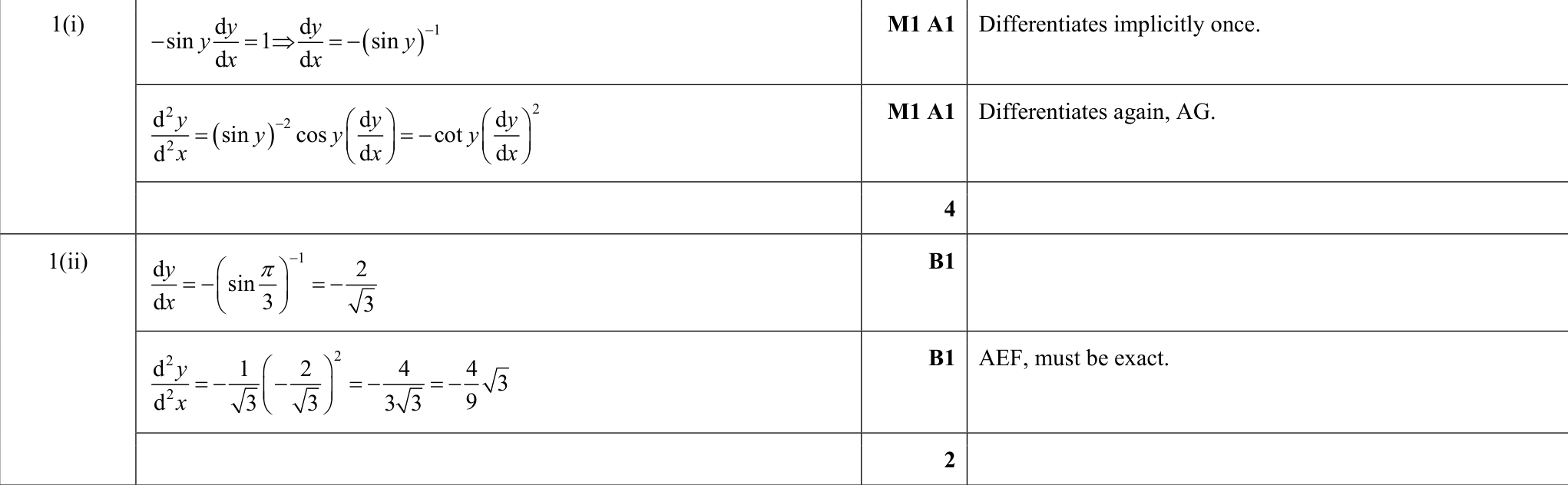
1 A curve \(C\) has equation \(\cos y=x\), for \(-\pi<x<\pi\).
(i) Use implicit differentiation to show that \(\dfrac{\mathrm d^2y}{\mathrm dx^2}=-\cot y\left(\dfrac{\mathrm dy}{\mathrm dx}\right)^2\).
(ii) Hence find the exact value of \(\dfrac{\mathrm d^2y}{\mathrm dx^2}\) at the point \(\left(\dfrac12,\dfrac{\pi}{3}\right)\) on \(C\).
9231 P11 - Nov 2019 - Q11 - 28 marks
Answer only one of the following two alternatives.
EITHER
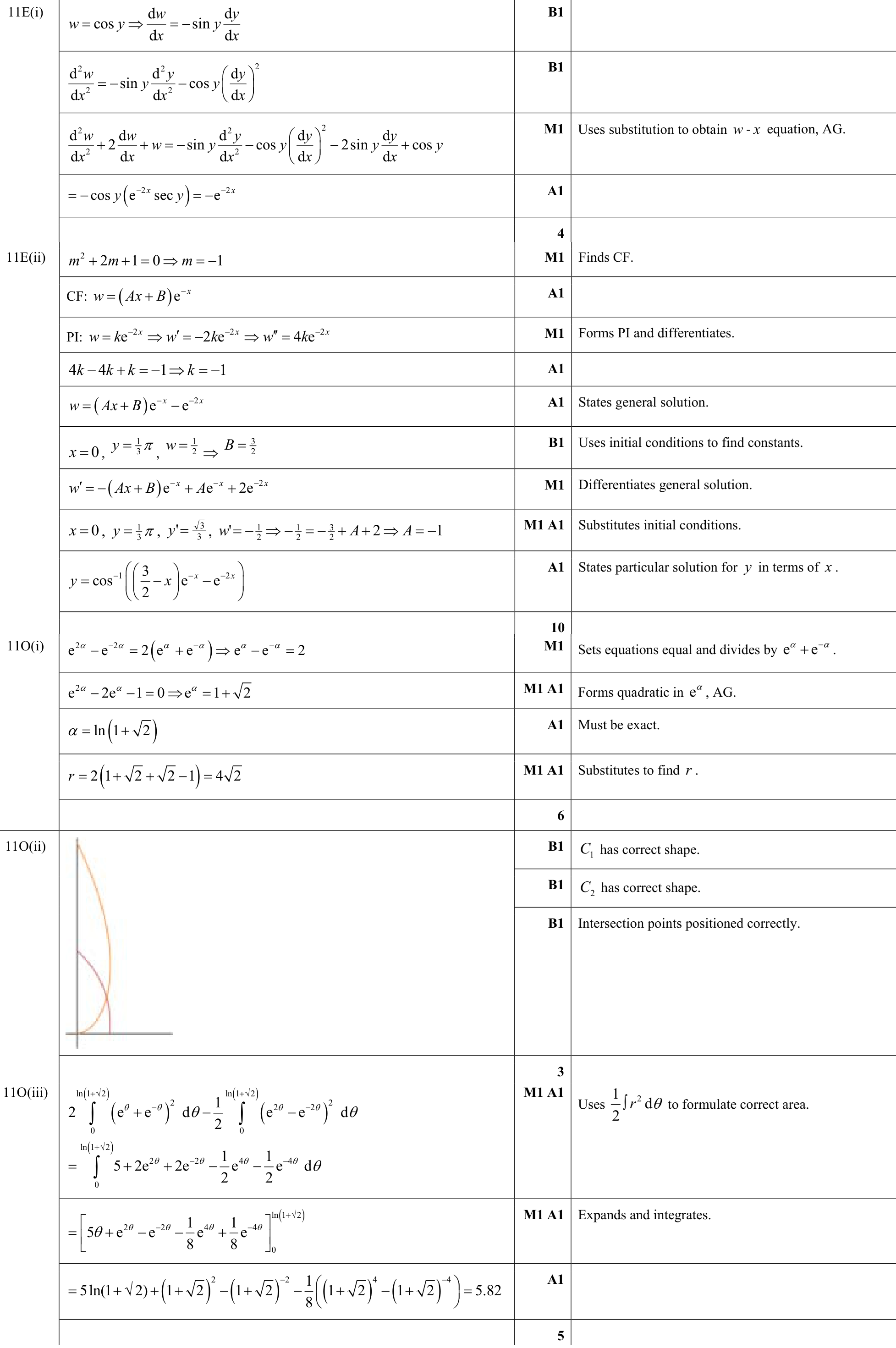
It is given that \(w=\cos y\) and
\(\tan y\,\dfrac{\mathrm d^2y}{\mathrm dx^2}+\left(\dfrac{\mathrm dy}{\mathrm dx}\right)^2+2\tan y\,\dfrac{\mathrm dy}{\mathrm dx}=1+\mathrm e^{-2x}\sec y\).
(i) Show that \(\dfrac{\mathrm d^2w}{\mathrm dx^2}+2\dfrac{\mathrm dw}{\mathrm dx}+w=-\mathrm e^{-2x}\).
(ii) Find the particular solution for \(y\) in terms of \(x\), given that when \(x=0\), \(y=\dfrac{\pi}{3}\) and \(\dfrac{\mathrm dy}{\mathrm dx}=\dfrac{1}{\sqrt3}\).
OR
The curves \(C_1\) and \(C_2\) have polar equations, for \(0\leq\theta\leq\dfrac{\pi}{2}\), as follows:
\(C_1: r=2\left(\mathrm e^{\theta}+\mathrm e^{-\theta}\right)\),
\(C_2: r=\mathrm e^{2\theta}-\mathrm e^{-2\theta}\).
The curves intersect at the point \(P\) where \(\theta=\alpha\).
(i) Show that \(\mathrm e^{2\alpha}-2\mathrm e^\alpha-1=0\). Hence find the exact value of \(\alpha\) and show that the value of \(r\) at \(P\) is \(4\sqrt2\).
(ii) Sketch \(C_1\) and \(C_2\) on the same diagram.
(iii) Find the area of the region enclosed by \(C_1\), \(C_2\) and the initial line, giving your answer correct to 3 significant figures.
9231 P11 - Jun 2018 - Q7 - 10 marks
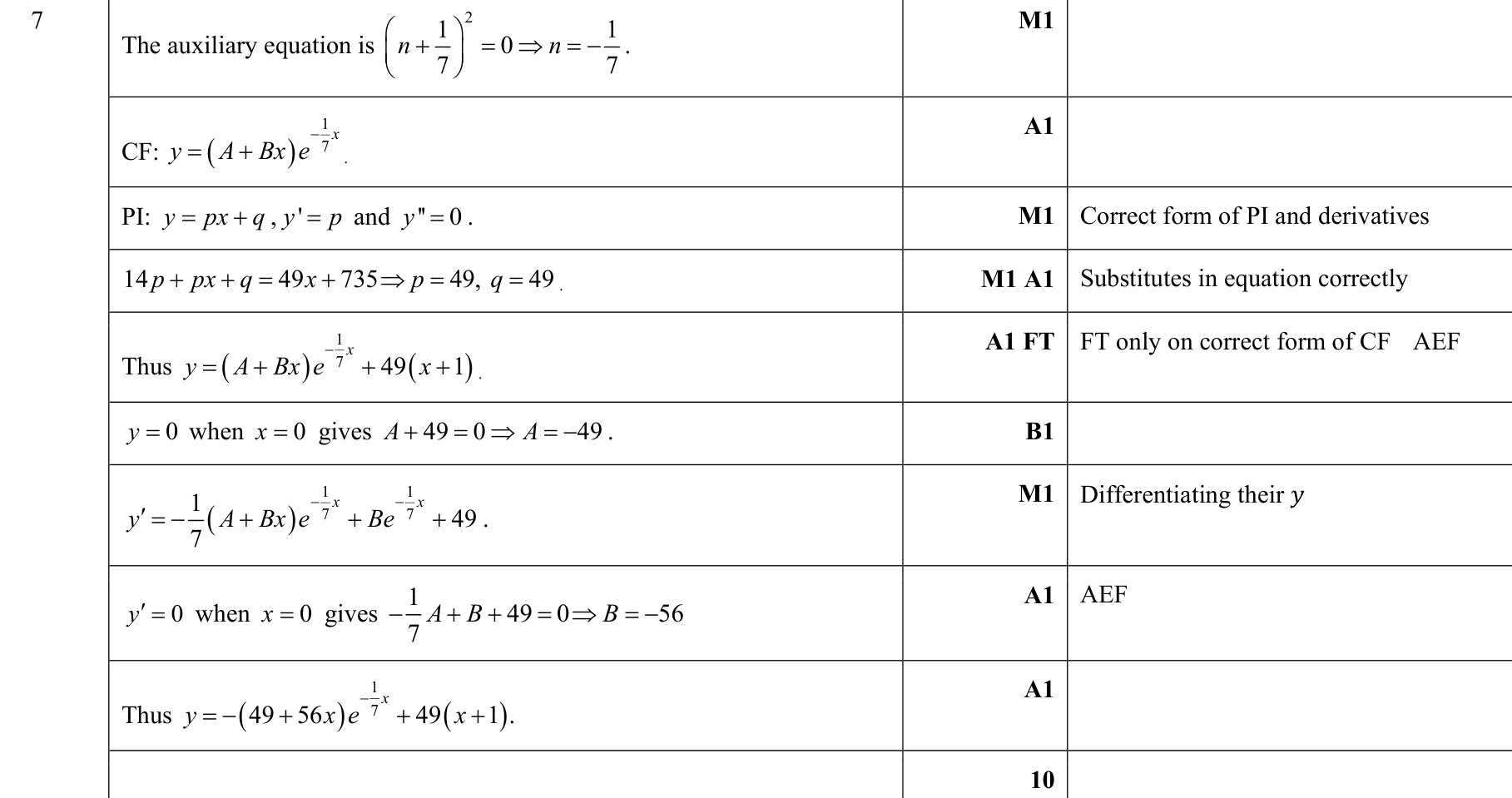
Find the particular solution of the differential equation
\(49 \frac{\mathrm{~d}^{2} y}{\mathrm{~d} x^{2}}+14 \frac{\mathrm{~d} y}{\mathrm{~d} x}+y=49 x+735,\)
given that when \(x=0, y=0\) and \(\frac{\mathrm{d} y}{\mathrm{~d} x}=0\).
9231 P13 - Jun 2018 - Q1 - 5 marks
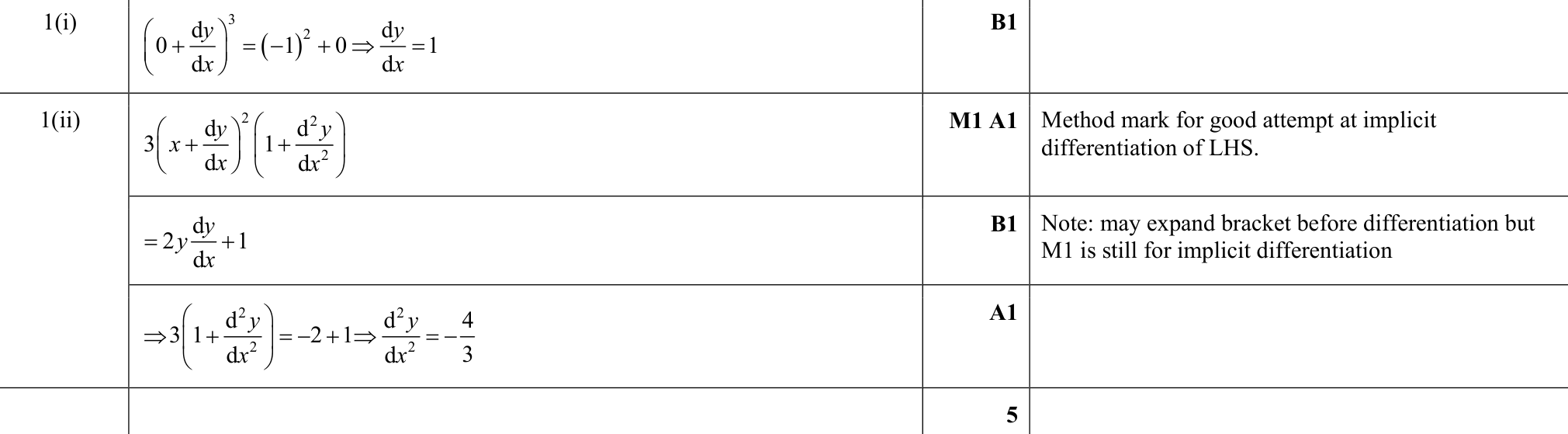
The variables \(x\) and \(y\) are such that \(y=-1\) when \(x=0\) and
\(\left(x+\frac{\mathrm{d} y}{\mathrm{~d} x}\right)^{3}=y^{2}+x\)
(i) Find the value of \(\frac{\mathrm{d} y}{\mathrm{~d} x}\) when \(x=0\).
(ii) Find also the value of \(\frac{\mathrm{d}^{2} y}{\mathrm{~d} x^{2}}\) when \(x=0\).
9231 P23 - Jun 2024 - Q3 - 8 marks
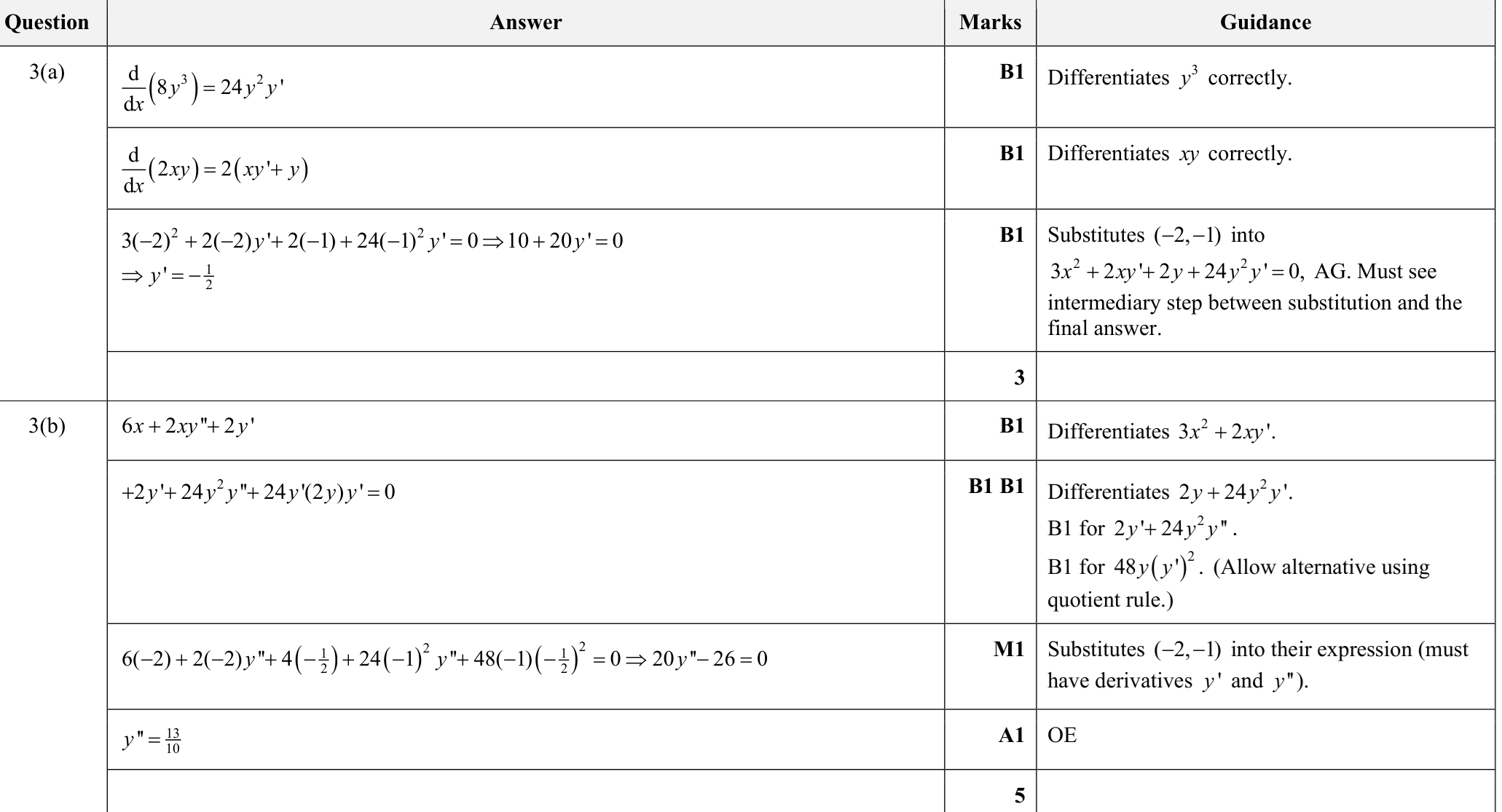
The curve \(C\) has equation
\(x^{3}+2 x y+8 y^{3}=-12\)
(a) Show that, at the point \((-2,-1)\) on \(C, \frac{\mathrm{~d} y}{\mathrm{~d} x}=-\frac{1}{2}\).
(b) Find the value of \(\frac{\mathrm{d}^{2} y}{\mathrm{~d} x^{2}}\) at the point \((-2,-1)\).
9231 P23 - Jun 2023 - Q4 - 8 marks
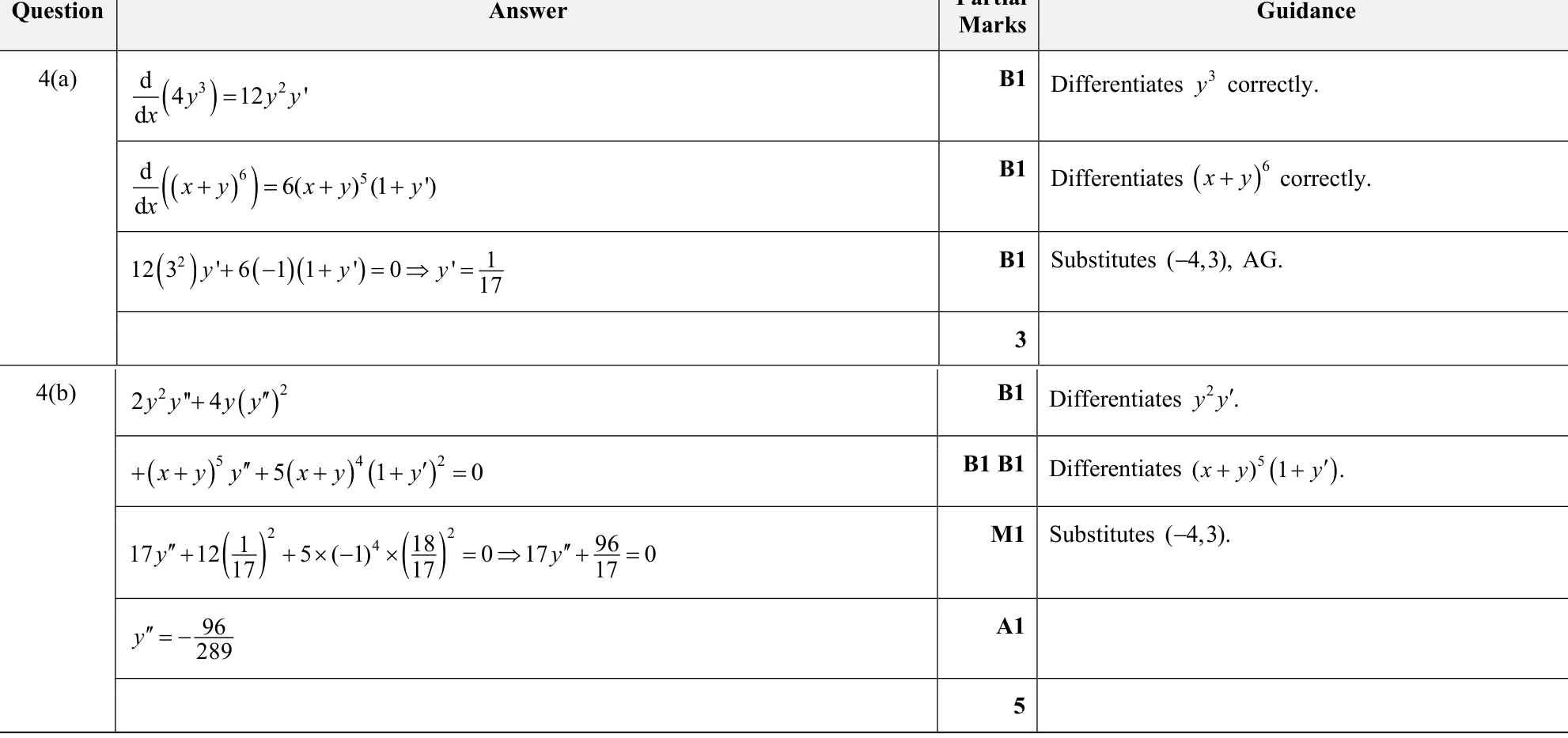
The curve \(C\) has equation
\(4 y^{3}+(x+y)^{6}=109 .\)
(a) Show that, at the point \((-4,3)\) on \(C, \frac{\mathrm{~d} y}{\mathrm{~d} x}=\frac{1}{17}\).
(b) Find the value of \(\frac{\mathrm{d}^{2} y}{\mathrm{~d} x^{2}}\) at the point \((-4,3)\).
9231 P22 - Nov 2024 - Q2 - 7 marks
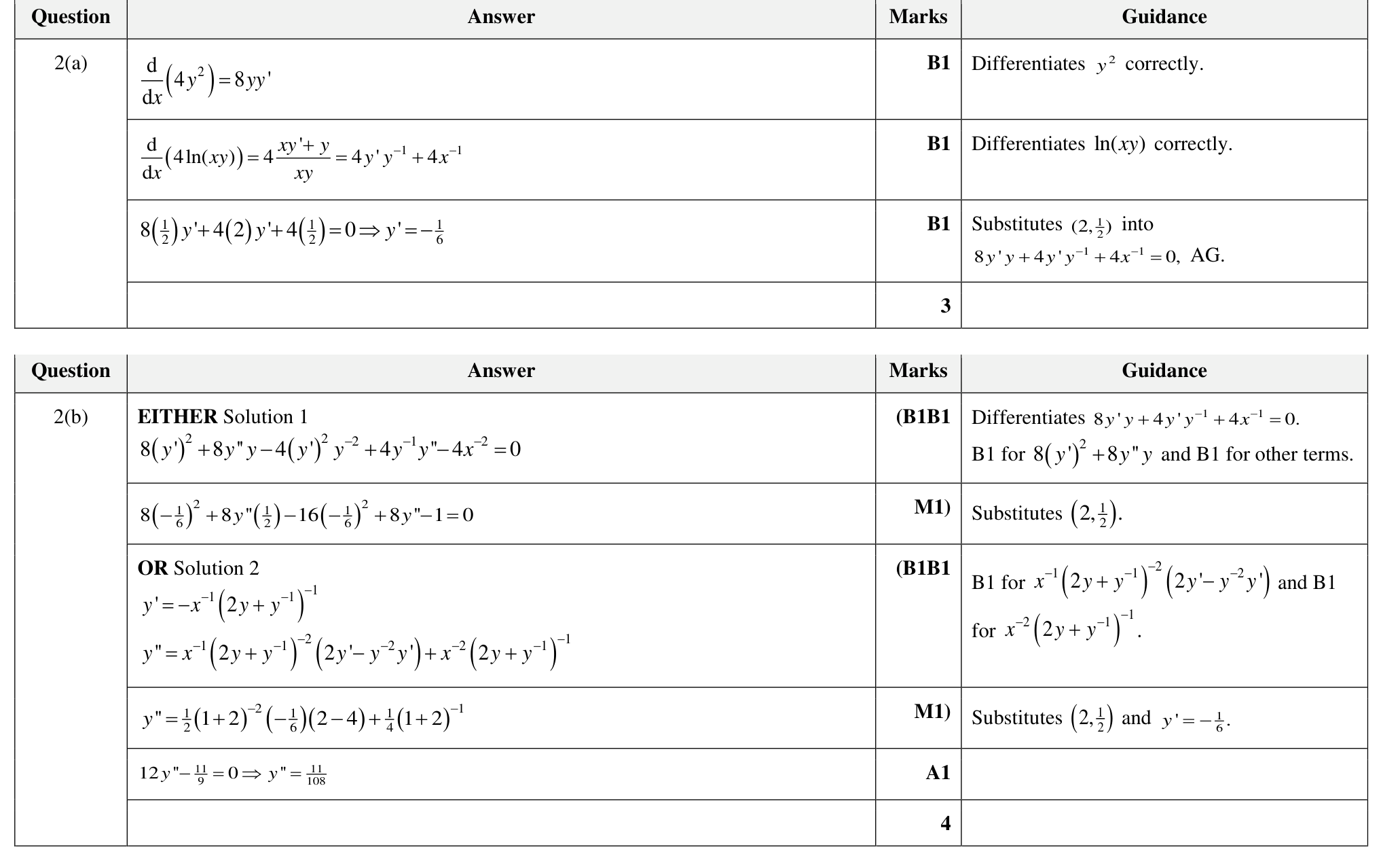
The curve \(C\) has equation
\(4 y^{2}+4 \ln (x y)=1 .\)
(a) Show that, at the point \(\left(2, \frac{1}{2}\right)\) on \(C, \frac{\mathrm{~d} y}{\mathrm{~d} x}=-\frac{1}{6}\).
(b) Find the value of \(\frac{\mathrm{d}^{2} y}{\mathrm{~d} x^{2}}\) at the point \(\left(2, \frac{1}{2}\right)\).
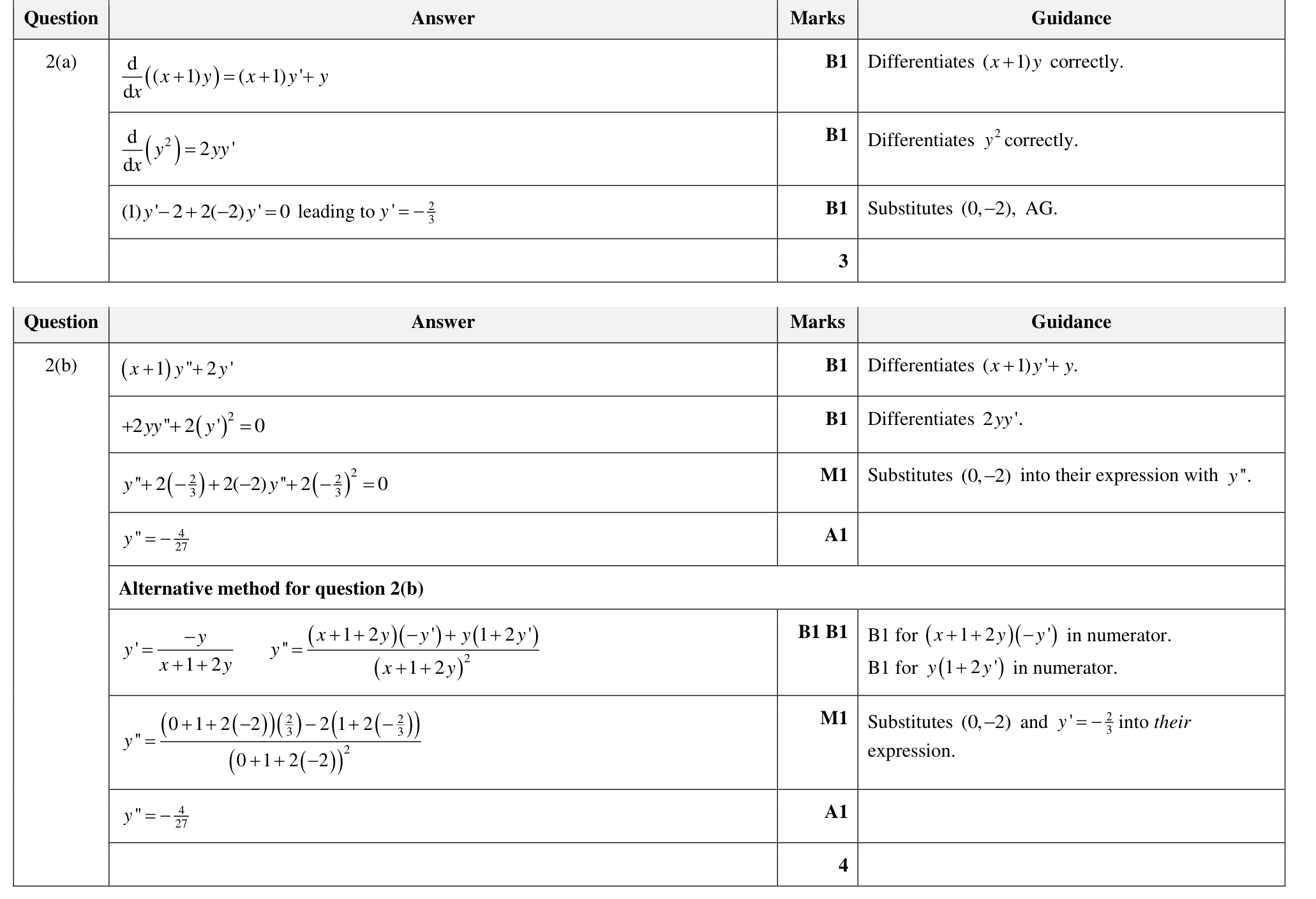
9231 P22 - Nov 2022 - Q2 - 7 marks
A curve has equation
\((x+1) y+y^{2}=2\)
(a) Show that \(\frac{\mathrm{d} y}{\mathrm{~d} x}=-\frac{2}{3}\) at the point \((0,-2)\).
(b) Find the value of \(\frac{\mathrm{d}^{2} y}{\mathrm{~d} x^{2}}\) at the point \((0,-2)\).
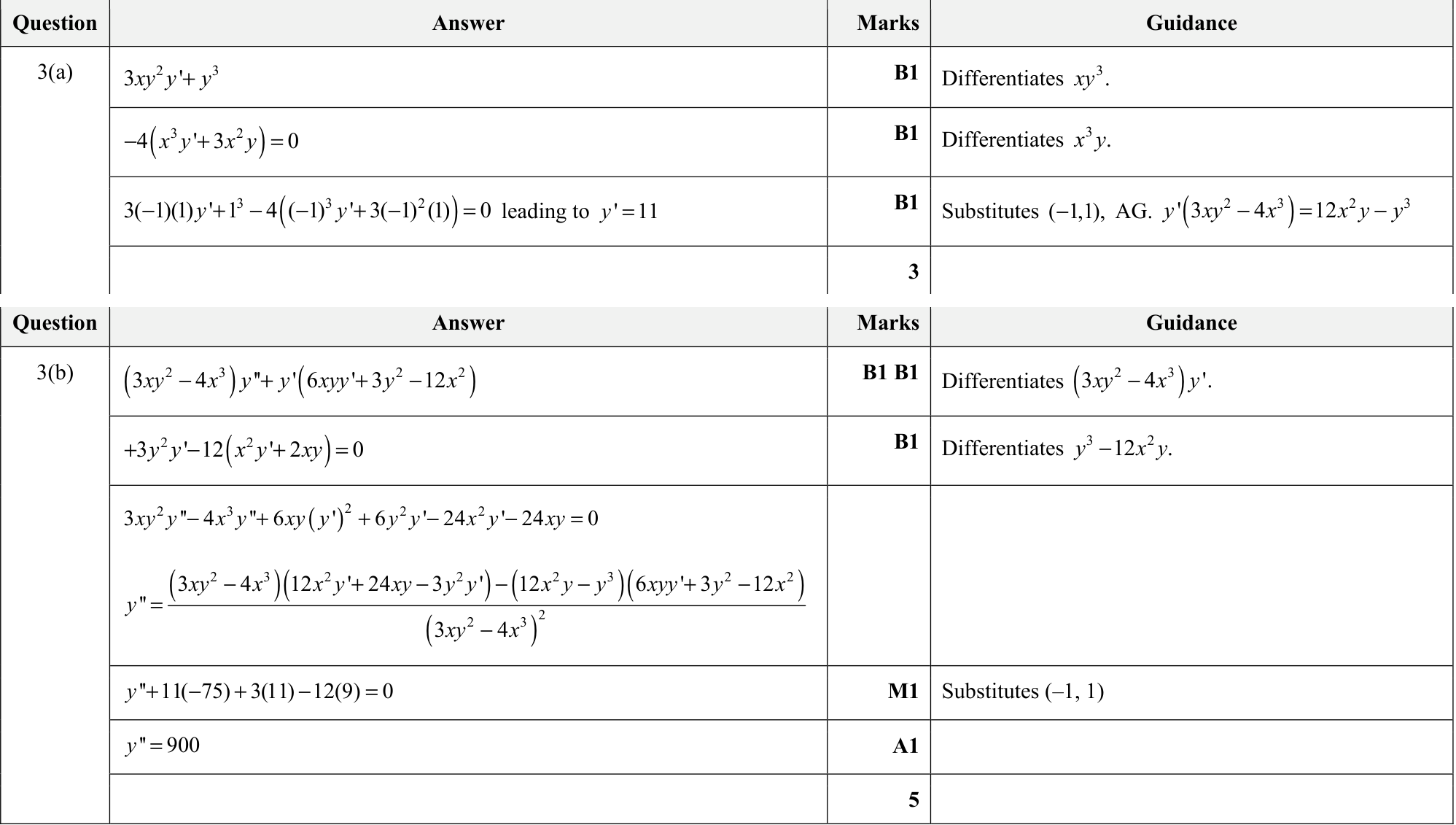
9231 P21 - Nov 2021 - Q3 - 8 marks
The curve \(C\) has equation
\(x y^{3}-4 x^{3} y=3 .\)
(a) Show that, at the point \((-1,1)\) on \(C, \frac{\mathrm{~d} y}{\mathrm{~d} x}=11\).
(b) Find the value of \(\frac{\mathrm{d}^{2} y}{\mathrm{~d} x^{2}}\) at the point \((-1,1)\).
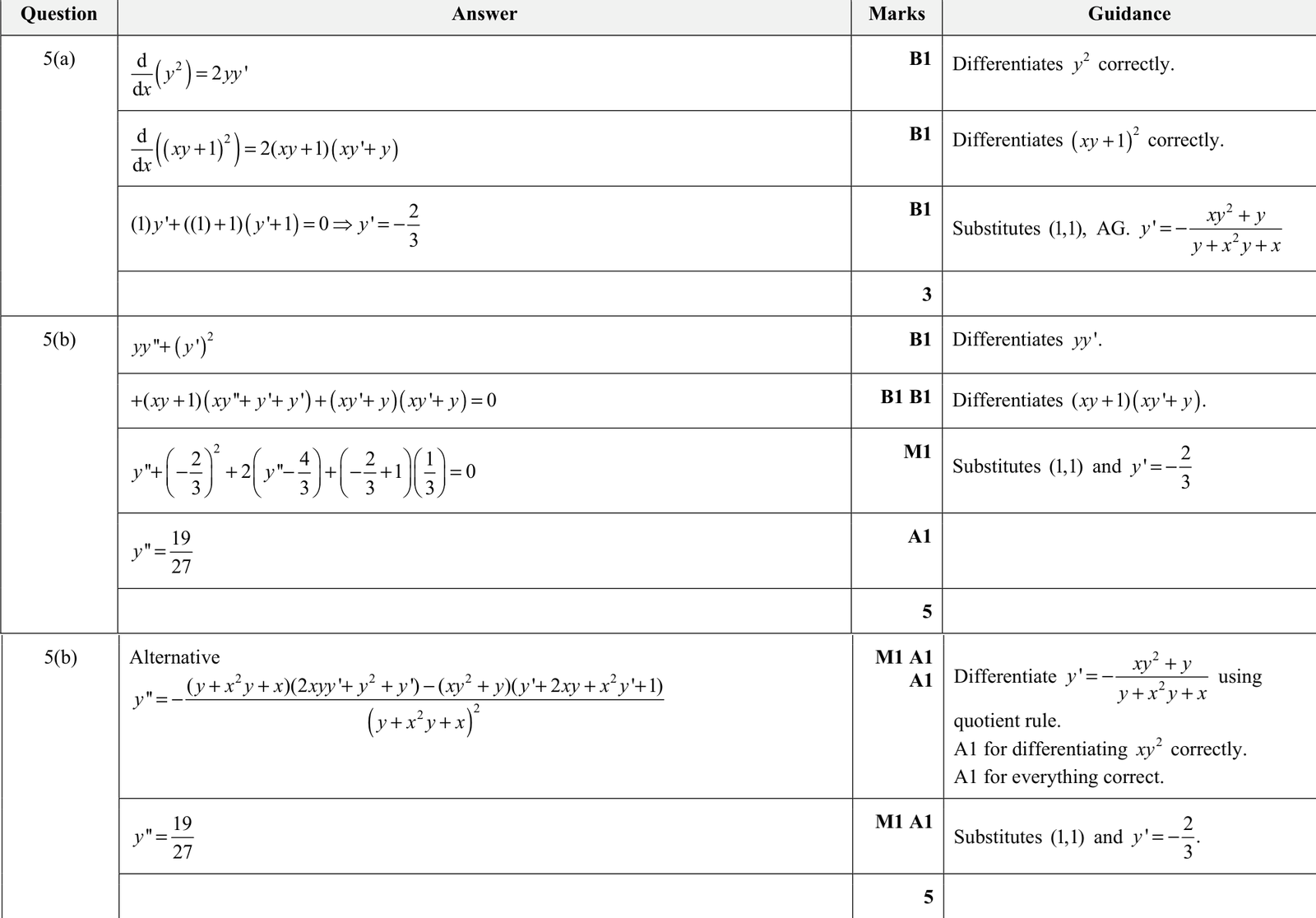
9231 P22 - Nov 2020 - Q5 - 8 marks
The curve \(C\) has equation
\[y^{2}+(x y+1)^{2}=5 .\]
(a) Show that, at the point \((1,1)\) on \(C, \frac{\mathrm{~d} y}{\mathrm{~d} x}=-\frac{2}{3}\).
(b) Find the value of \(\frac{\mathrm{d}^{2} y}{\mathrm{~d} x^{2}}\) at the point \((1,1)\).
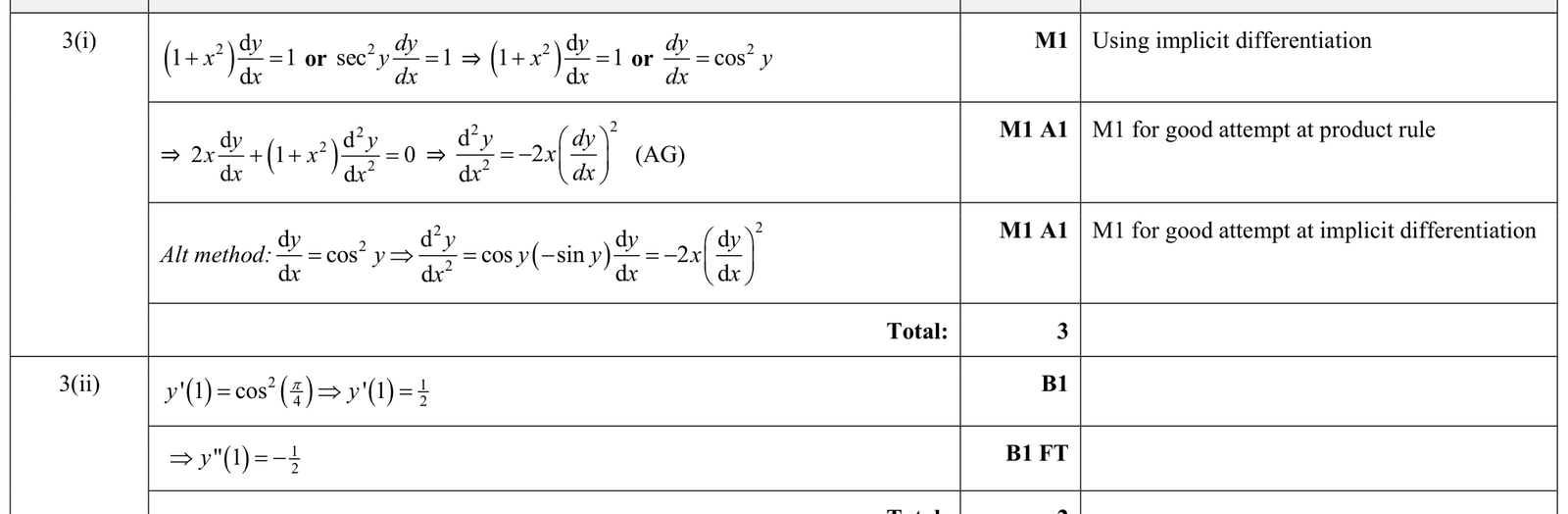
9231 P11 - Jun 2017 - Q3 - 5 marks
A curve \(C\) has equation \(\tan y=x\), for \(x\gt 0\).
(i) Use implicit differentiation to show that
\(\frac{\mathrm{d}^{2} y}{\mathrm{~d} x^{2}}=-2 x\left(\frac{\mathrm{~d} y}{\mathrm{~d} x}\right)^{2} .\)
(ii) Hence find the value of \(\frac{\mathrm{d}^{2} y}{\mathrm{~d} x^{2}}\) at the point \(\left(1, \frac{1}{4} \pi\right)\) on \(C\).
9231 P11 - Jun 2017 - Q9 - 11 marks
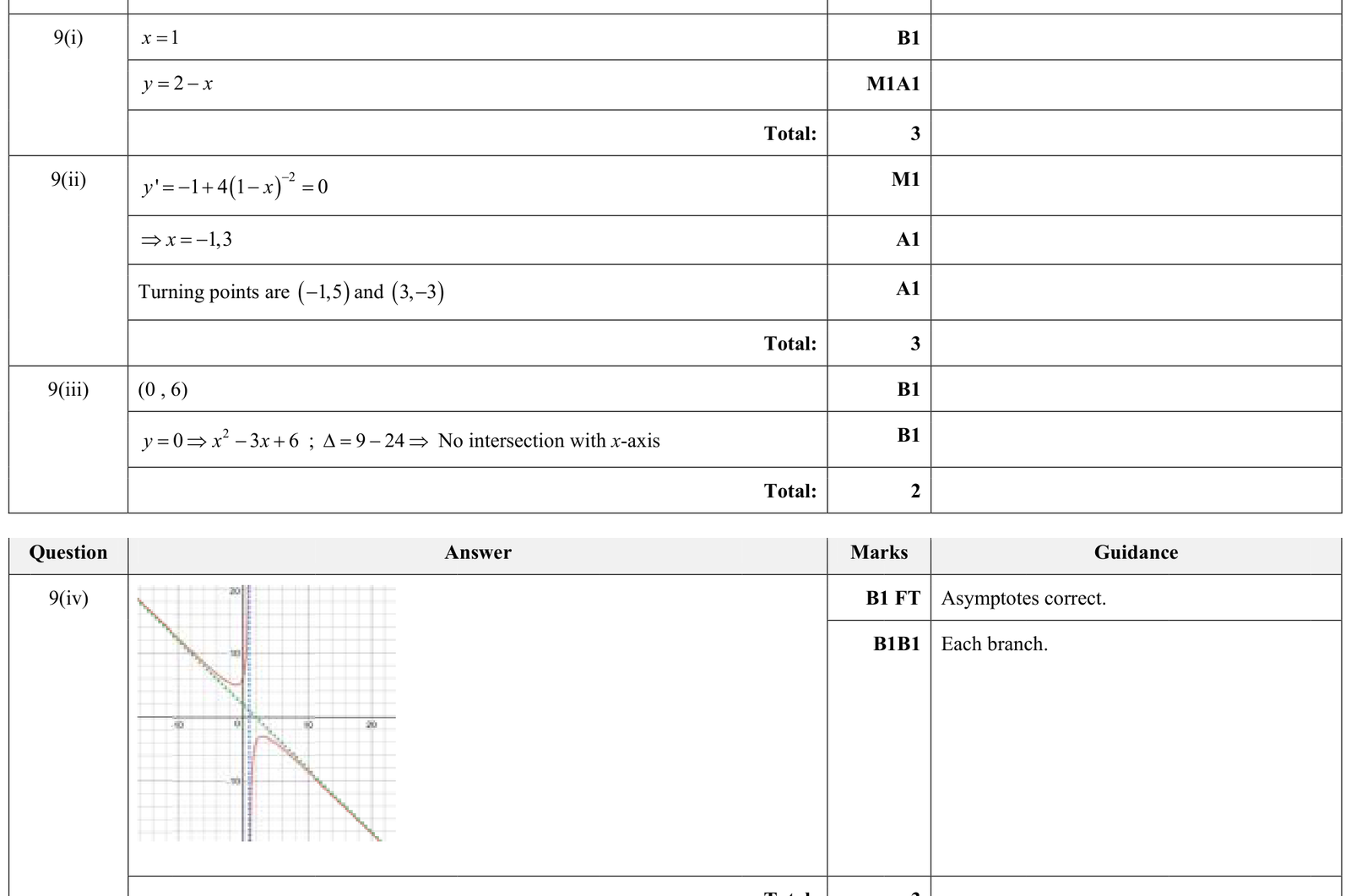
The curve \(C\) has equation \(y=\frac{x^{2}-3 x+6}{1-x}\).
(i) Find the equations of the asymptotes of \(C\).
(ii) Find the coordinates of the turning points of \(C\).
(iii) Find the coordinates of any intersections with the coordinate axes.
(iv) Sketch \(C\).
9231 P11 - Jun 2017 - Q10 - 11 marks
It is given that \(x=t^{\frac{1}{2}}\), where \(x\gt 0\) and \(t\gt 0\), and \(y\) is a function of \(x\).
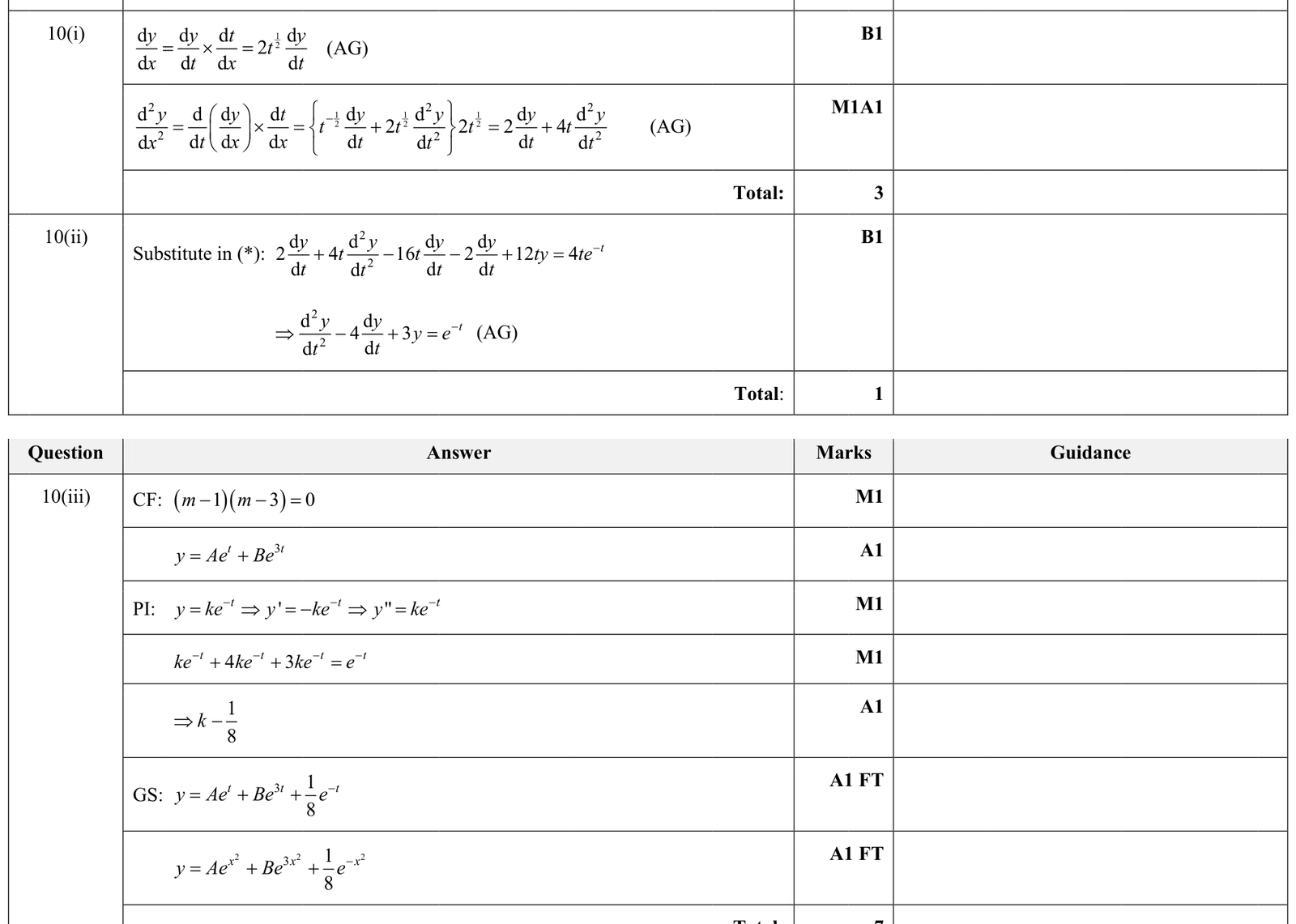
(i) Show that \(\frac{\mathrm{d} y}{\mathrm{~d} x}=2 t^{\frac{1}{2}} \frac{\mathrm{~d} y}{\mathrm{~d} t}\) and \(\frac{\mathrm{d}^{2} y}{\mathrm{~d} x^{2}}=2 \frac{\mathrm{~d} y}{\mathrm{~d} t}+4 t \frac{\mathrm{~d}^{2} y}{\mathrm{~d} t^{2}}\).
(ii) Hence show that the differential equation
\(\frac{\mathrm{d}^{2} y}{\mathrm{~d} x^{2}}-\left(8 x+\frac{1}{x}\right) \frac{\mathrm{d} y}{\mathrm{~d} x}+12 x^{2} y=4 x^{2} \mathrm{e}^{-x^{2}}\)
reduces to the differential equation
\(\frac{\mathrm{d}^{2} y}{\mathrm{~d} t^{2}}-4 \frac{\mathrm{~d} y}{\mathrm{~d} t}+3 y=\mathrm{e}^{-t} .\)
(iii) Find the general solution of \((*)\), giving \(y\) in terms of \(x\).
9231 P13 - Jun 2017 - Q4 - 7 marks
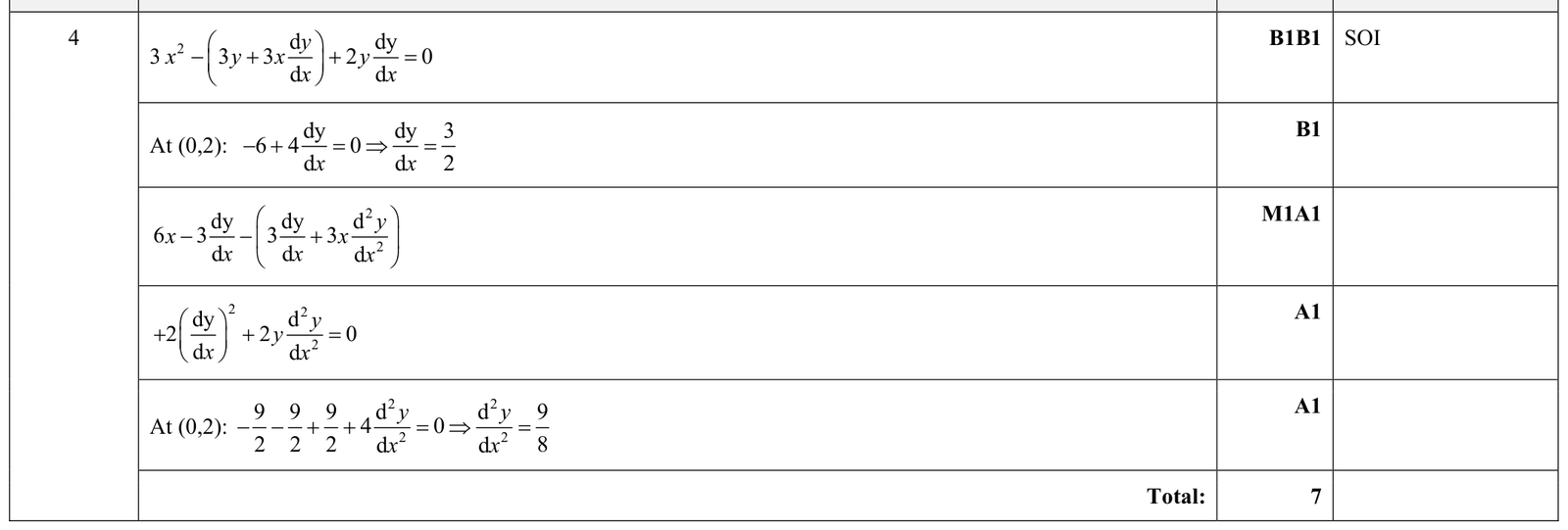
A curve \(C\) has equation \(x^{3}-3 x y+y^{2}=4\). Find the value of \(\frac{\mathrm{d}^{2} y}{\mathrm{~d} x^{2}}\) at the point \((0,2)\) of \(C\).
9231 P11 - Nov 2015 - Q1 - 4 marks
The curve \(C\) is defined parametrically by
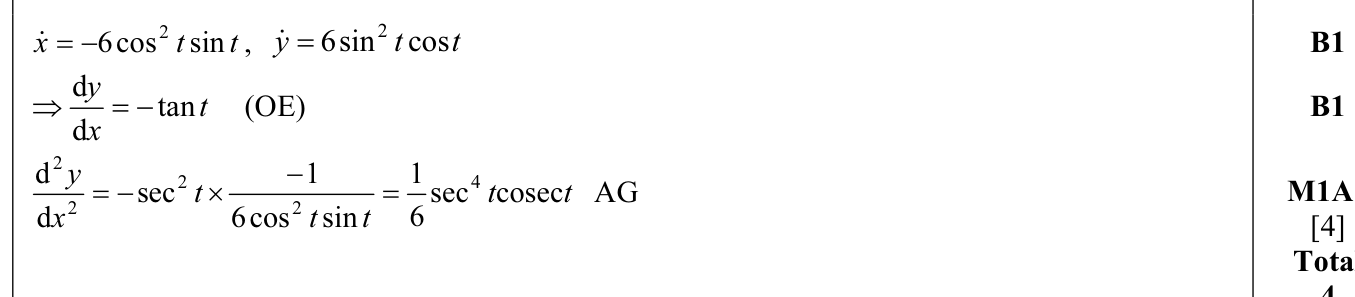
\(x=2 \cos ^{3} t \quad \text { and } \quad y=2 \sin ^{3} t, \quad \text { for } 0\lt t\lt \frac{1}{2} \pi .\)
Show that, at the point with parameter \(t\),
\(\frac{\mathrm{d}^{2} y}{\mathrm{~d} x^{2}}=\frac{1}{6} \sec ^{4} t \operatorname{cosec} t\)
9231 P13 - Jun 2015 - Q7 - 10 marks
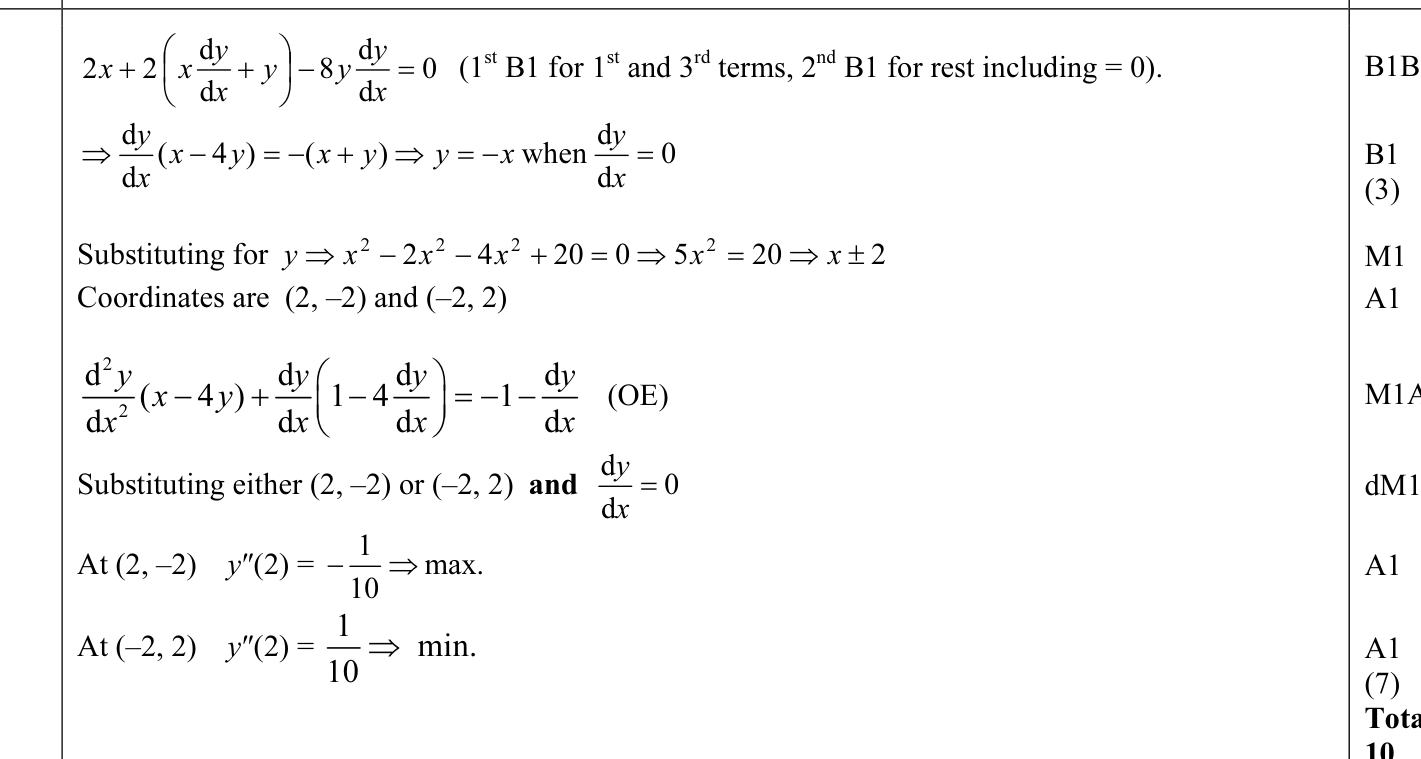
The curve \(C\) has equation \(x^{2}+2 x y-4 y^{2}+20=0\). Show that if the tangent to \(C\) at the point \((x, y)\) is parallel to the \(x\)-axis then \(x+y=0\).
Hence find the coordinates of the stationary points on \(C\), and determine their nature.
9231 P11 - Jun 2015 - Q6 - 9 marks
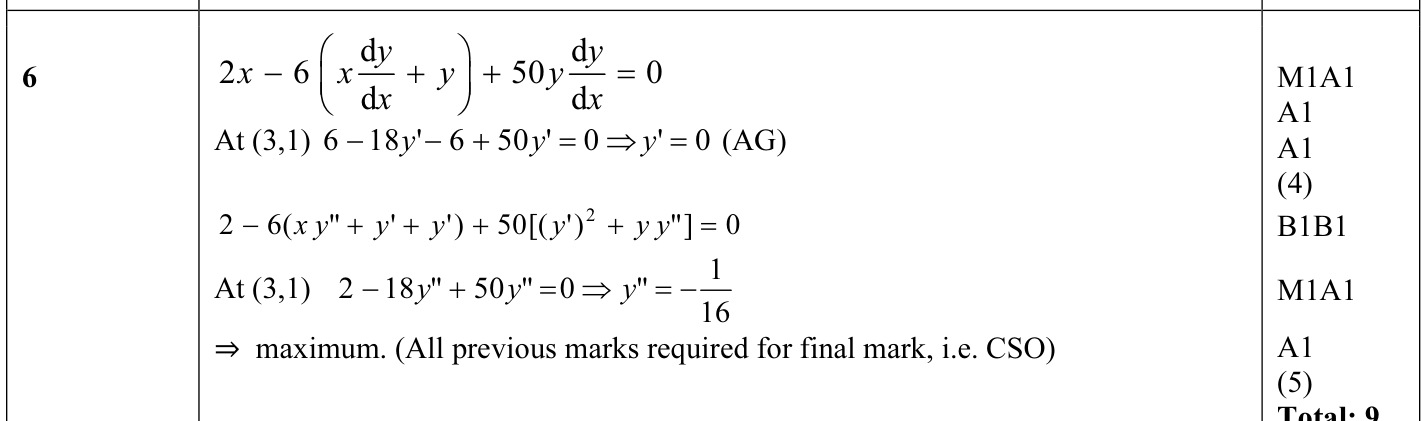
A curve has equation \(x^{2}-6 x y+25 y^{2}=16\). Show that \(\frac{\mathrm{d} y}{\mathrm{~d} x}=0\) at the point \((3,1)\).
By finding the value of \(\frac{\mathrm{d}^{2} y}{\mathrm{~d} x^{2}}\) at the point \((3,1)\), determine the nature of this turning point.
9231 P11 - Nov 2016 - Q8 - 11 marks
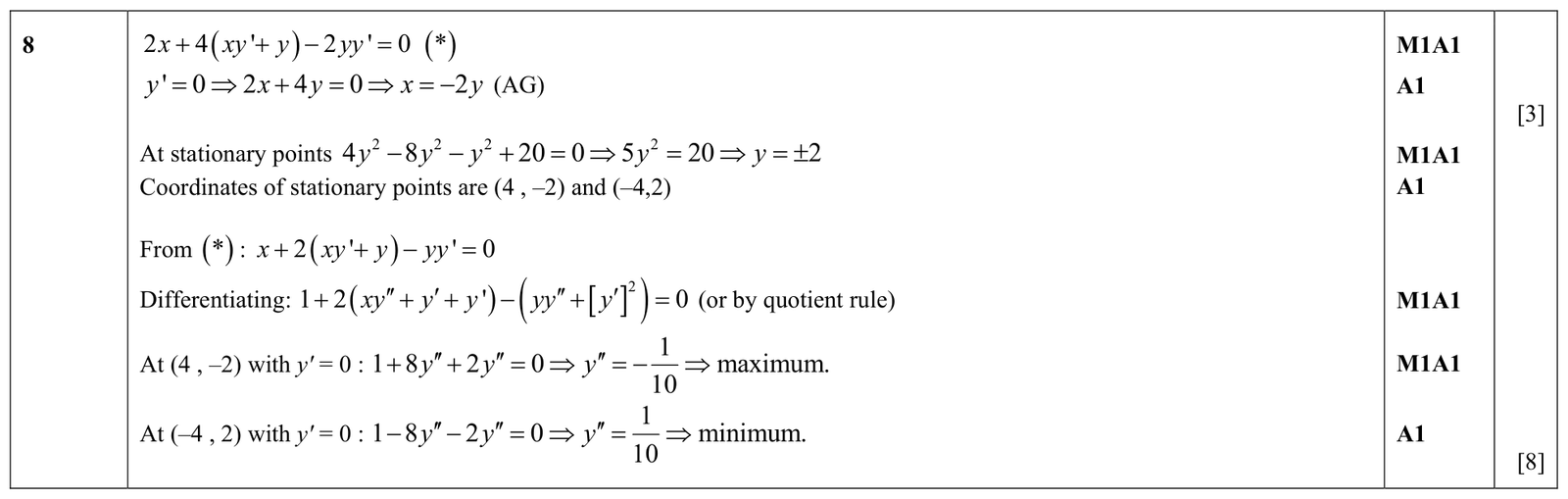
A curve \(C\) has equation \(x^{2}+4 x y-y^{2}+20=0\). Show that, at stationary points on \(C, x=-2 y\).
Find the coordinates of the stationary points on \(C\), and determine their nature by considering the value of \(\frac{\mathrm{d}^{2} y}{\mathrm{~d} x^{2}}\) at the stationary points.
9231 P11 - Nov 2017 - Q5 - 8 marks
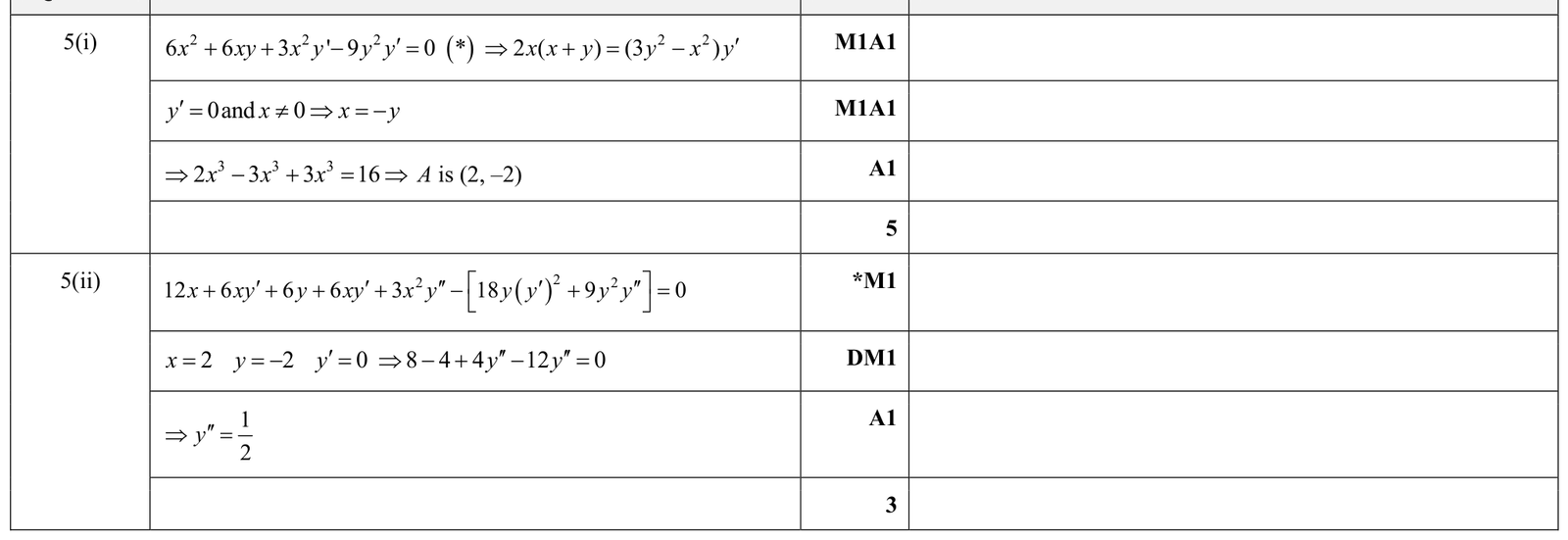
The curve \(C\) has equation \(2 x^{3}+3 x^{2} y-3 y^{3}-16=0\).
(i) Find the coordinates of the point \(A\) on \(C\) at which \(\frac{\mathrm{d} y}{\mathrm{~d} x}=0\) and \(x \neq 0\).
(ii) Find the value of \(\frac{\mathrm{d}^{2} y}{\mathrm{~d} x^{2}}\) at \(A\).
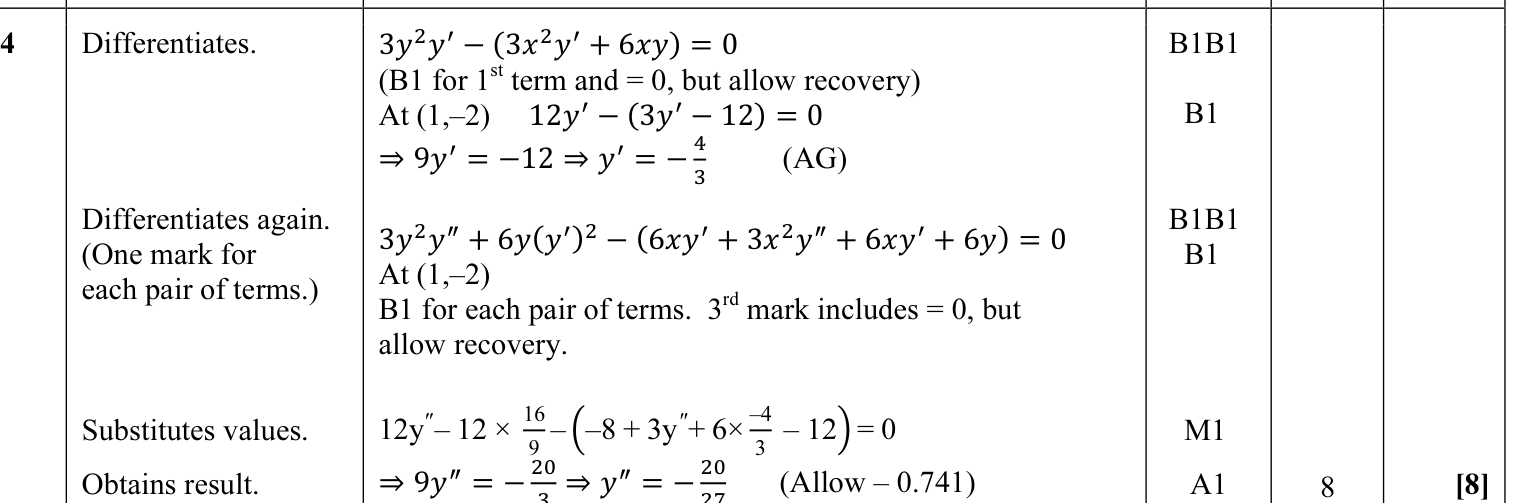
9231 P13 - Jun 2013 - Q4 - 8 marks
Show that \(\frac{\mathrm{d} y}{\mathrm{~d} x}=-\frac{4}{3}\) at the point \(A(1,-2)\) on the curve with equation
\(y^{3}-3 x^{2} y+2=0,\)
and find the value of \(\frac{\mathrm{d}^{2} y}{\mathrm{~d} x^{2}}\) at \(A\).
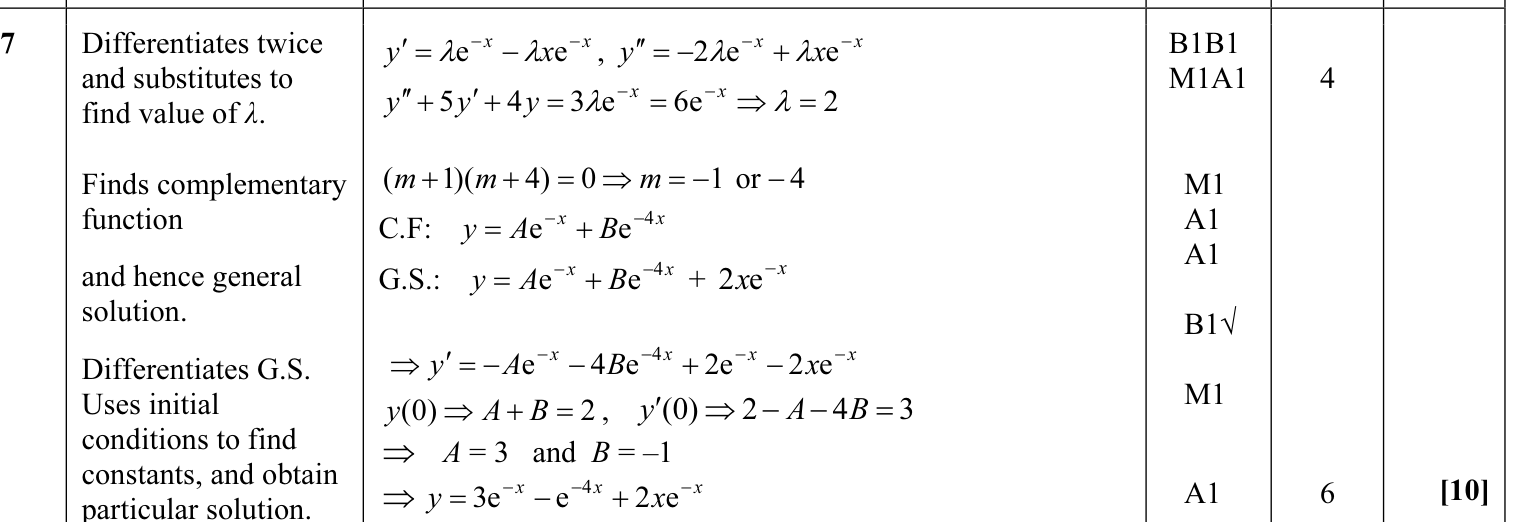
9231 P13 - Jun 2013 - Q7 - 10 marks
Find the value of the constant \(\lambda\) such that \(\lambda x \mathrm{e}^{-x}\) is a particular integral of the differential equation
\(\frac{\mathrm{d}^{2} y}{\mathrm{~d} x^{2}}+5 \frac{\mathrm{~d} y}{\mathrm{~d} x}+4 y=6 \mathrm{e}^{-x}\)
Find the solution of the differential equation for which \(y=2\) and \(\frac{\mathrm{d} y}{\mathrm{~d} x}=3\) when \(x=0\).
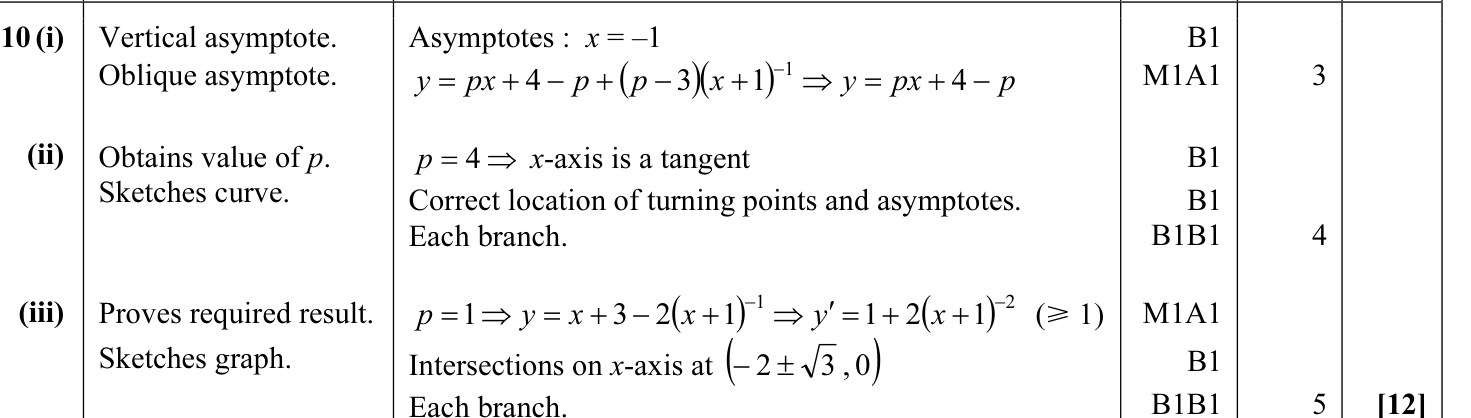
9231 P11 - Nov 2013 - Q10 - 12 marks
The curve \(C\) has equation
\(y=\frac{p x^{2}+4 x+1}{x+1},\)
where \(p\) is a positive constant and \(p \neq 3\).
(i) Obtain the equations of the asymptotes of \(C\).
(ii) Find the value of \(p\) for which the \(x\)-axis is a tangent to \(C\), and sketch \(C\) in this case.
(iii) For the case \(p=1\), show that \(C\) has no turning points, and sketch \(C\), giving the exact coordinates of the points of intersection of \(C\) with the \(x\)-axis.
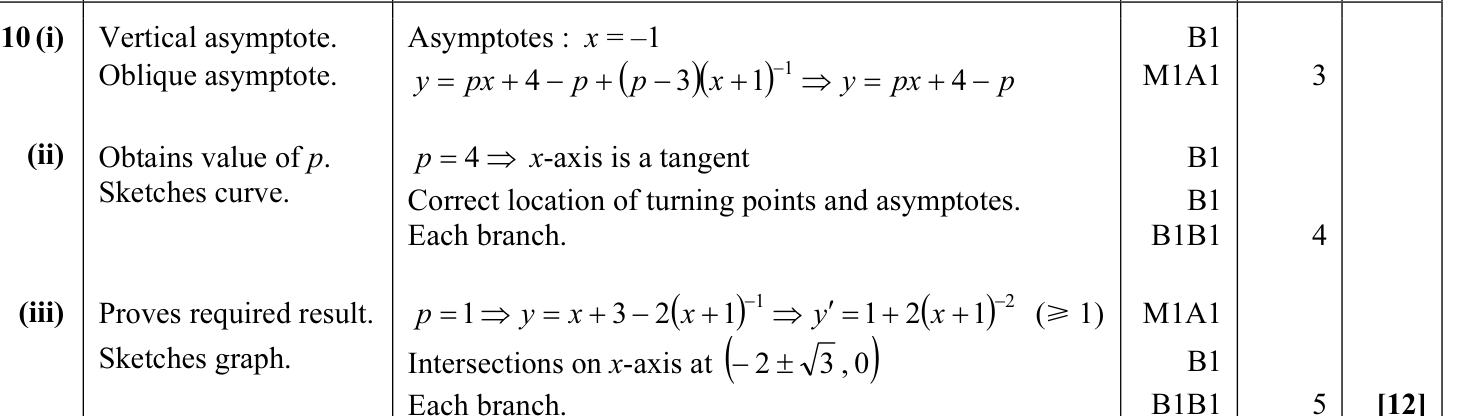
9231 P12 - Nov 2013 - Q10 - 12 marks
The curve \(C\) has equation
\(y=\frac{p x^{2}+4 x+1}{x+1}\)
where \(p\) is a positive constant and \(p \neq 3\).
(i) Obtain the equations of the asymptotes of \(C\).
(ii) Find the value of \(p\) for which the \(x\)-axis is a tangent to \(C\), and sketch \(C\) in this case.
(iii) For the case \(p=1\), show that \(C\) has no turning points, and sketch \(C\), giving the exact coordinates of the points of intersection of \(C\) with the \(x\)-axis.
9231 P13 - Nov 2013 - Q4 - 7 marks
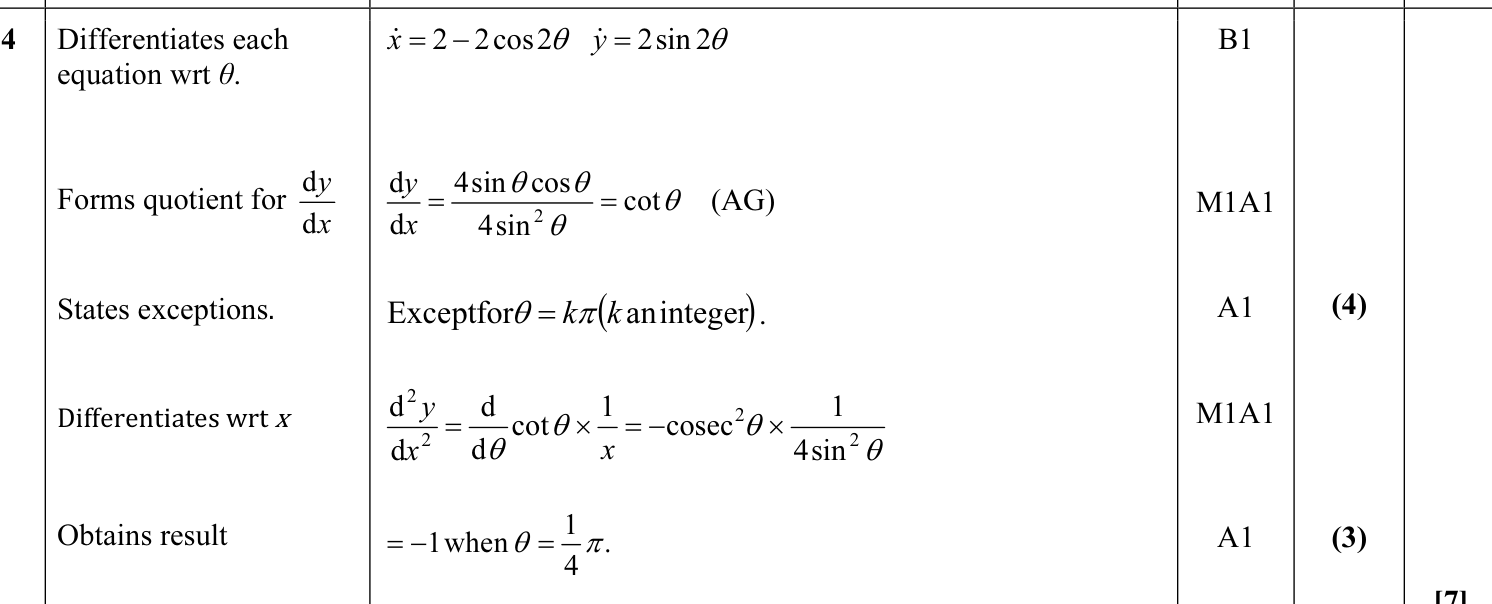
A curve has parametric equations
\(x=2 \theta-\sin 2 \theta, \quad y=1-\cos 2 \theta, \quad \text { for }-3 \pi \leqslant \theta \leqslant 3 \pi\)
Show that
\(\frac{\mathrm{d} y}{\mathrm{~d} x}=\cot \theta\)
except for certain values of \(\theta\), which should be stated.
Find the value of \(\frac{\mathrm{d}^{2} y}{\mathrm{~d} x^{2}}\) when \(\theta=\frac{1}{4} \pi\).
9231 P1 - Jun 2008 - Q6 - 8 marks
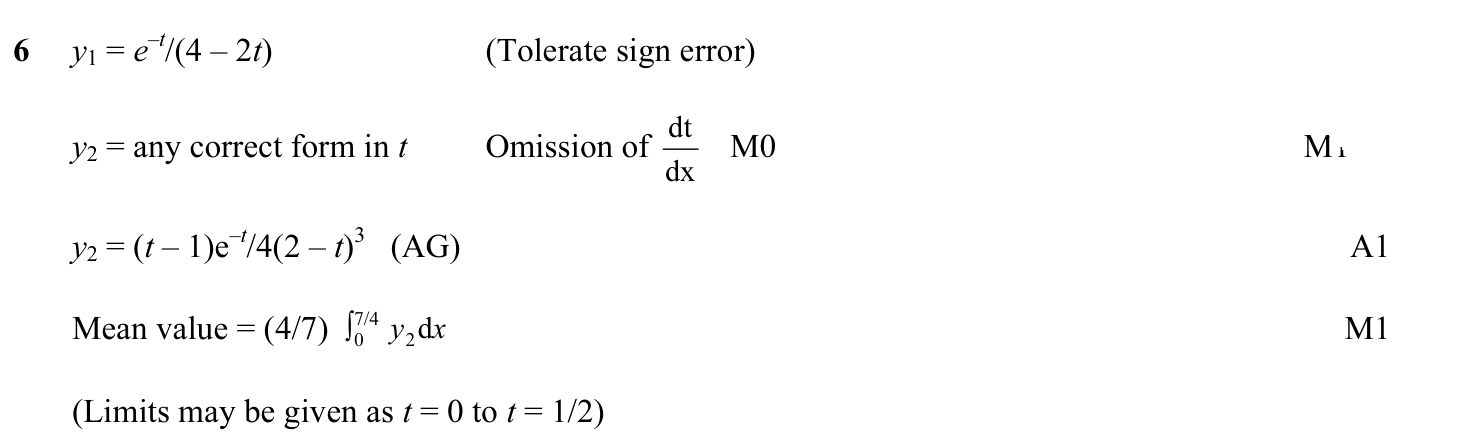
The curve \(C\) is defined parametrically by
\(x=4 t-t^{2} \quad \text { and } \quad y=1-\mathrm{e}^{-t}\)
where \(0 \leqslant t\lt 2\). Show that at all points of \(C\),
\(\frac{\mathrm{d}^{2} y}{\mathrm{~d} x^{2}}=\frac{(t-1) \mathrm{e}^{-t}}{4(2-t)^{3}}\)
Show that the mean value of \(\frac{\mathrm{d}^{2} y}{\mathrm{~d} x^{2}}\) with respect to \(x\) over the interval \(0 \leqslant x \leqslant \frac{7}{4}\) is
\(\frac{4 e^{-\frac{1}{2}}-3}{21} .\)
9231 P1 - Jun 2008 - Q11 - 11 marks
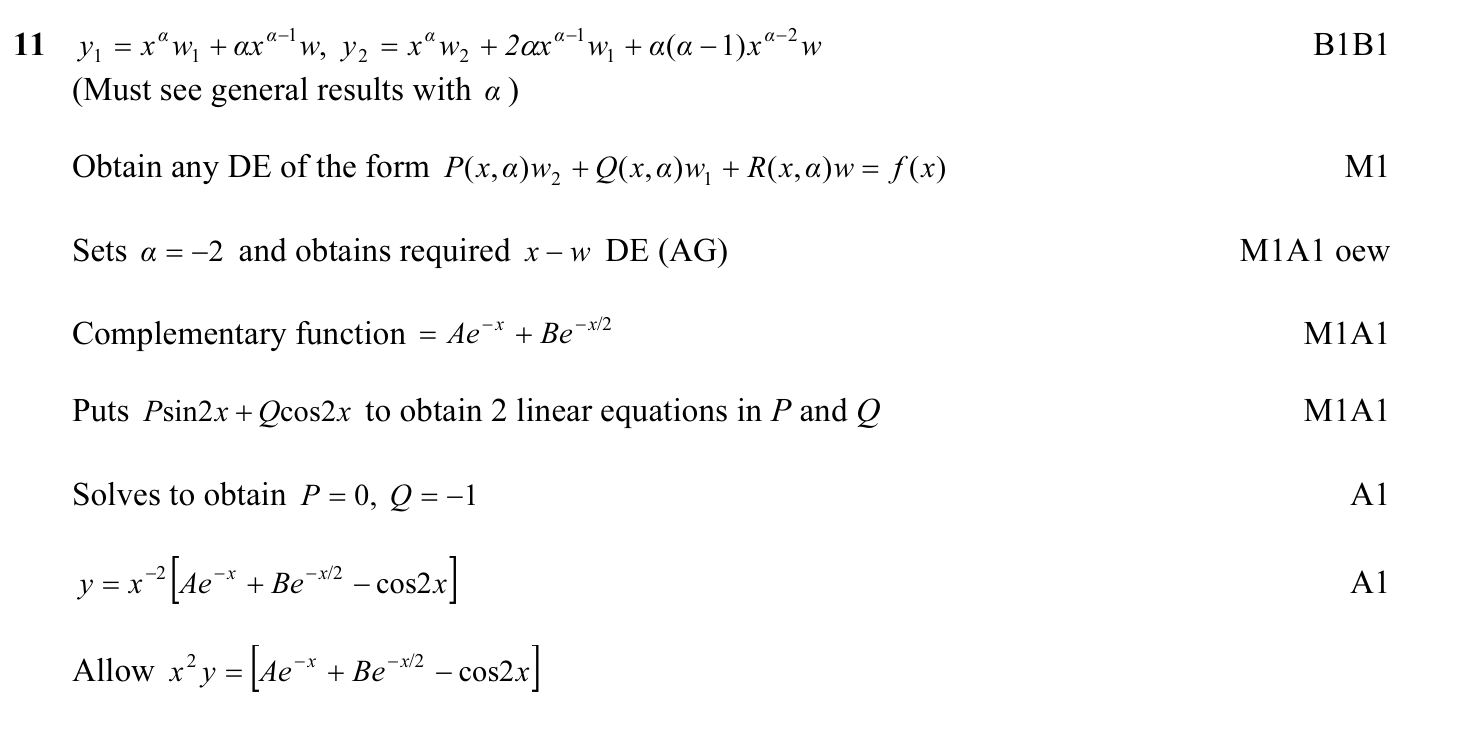
Show that, with a suitable value of the constant \(\alpha\), the substitution \(y=x^{\alpha} w\) reduces the differential equation
\(2 x^{2} \frac{\mathrm{~d}^{2} y}{\mathrm{~d} x^{2}}+\left(3 x^{2}+8 x\right) \frac{\mathrm{d} y}{\mathrm{~d} x}+\left(x^{2}+6 x+4\right) y=\mathrm{f}(x)\)
to
\(2 \frac{\mathrm{~d}^{2} w}{\mathrm{~d} x^{2}}+3 \frac{\mathrm{~d} w}{\mathrm{~d} x}+w=\mathrm{f}(x)\)
Find the general solution for \(y\) in the case where \(\mathrm{f}(x)=6 \sin 2 x+7 \cos 2 x\).
9231 P1 - Nov 2008 - Q5 - 7 marks
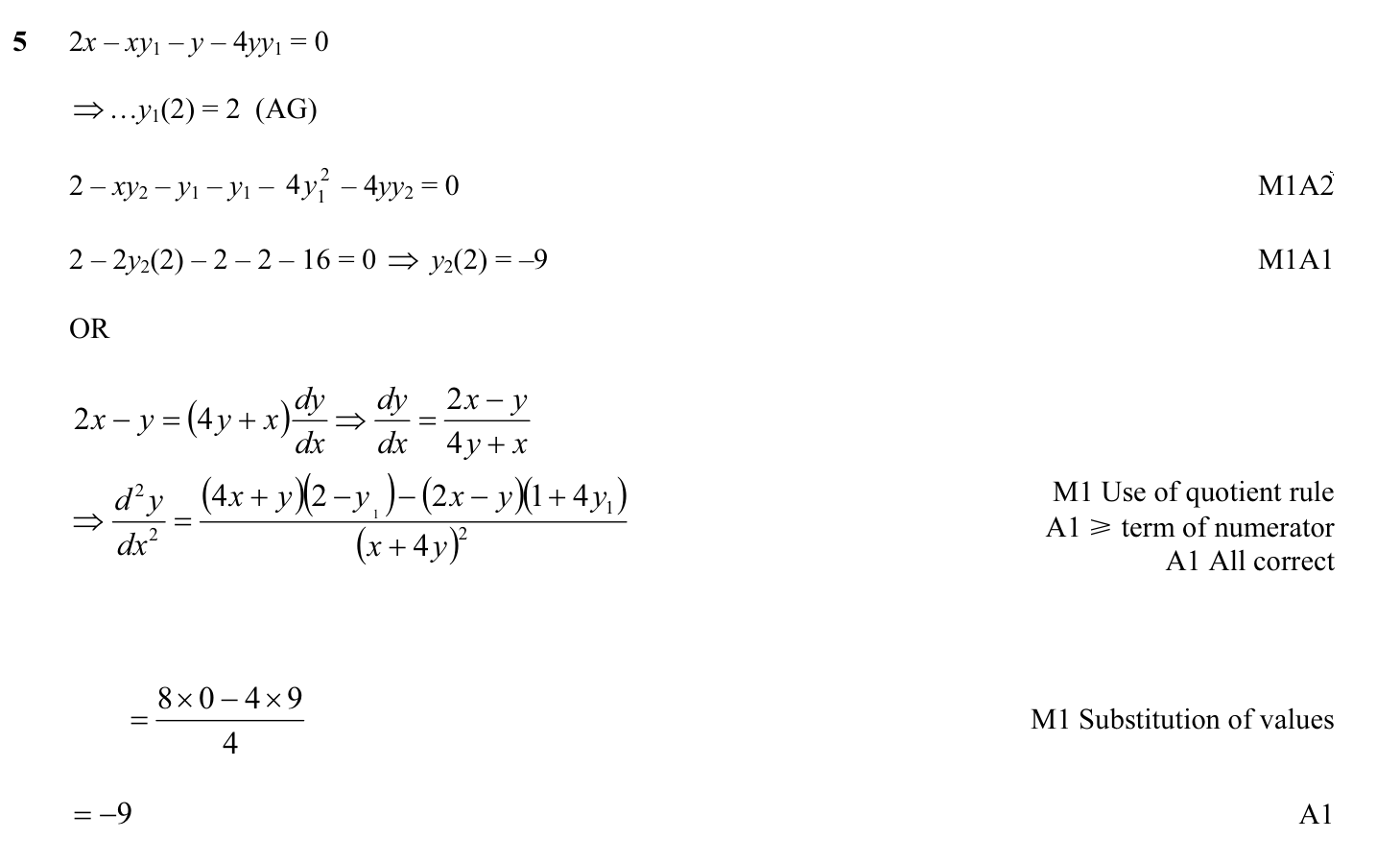
The curve \(C\) has equation
\(x^{2}-x y-2 y^{2}=4 .\)
Show that, at the point \(A(2,0)\) on \(C, \frac{\mathrm{~d} y}{\mathrm{~d} x}=2\).
Find the value of \(\frac{\mathrm{d}^{2} y}{\mathrm{~d} x^{2}}\) at \(A\).
9231 P13 - Jun 2012 - Q3 - 8 marks
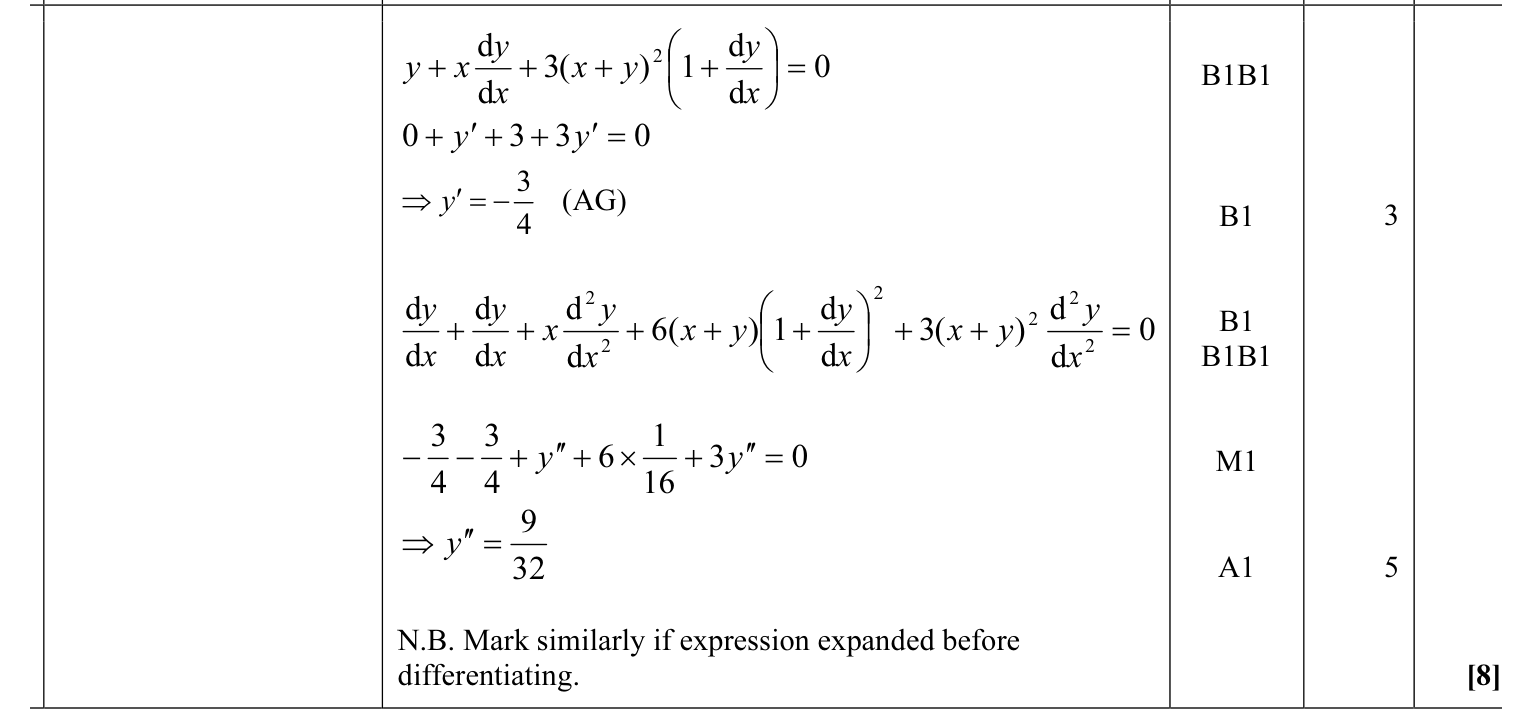
The curve \(C\) has equation
\(x y+(x+y)^{3}=1\)
Show that \(\frac{\mathrm{d} y}{\mathrm{~d} x}=-\frac{3}{4}\) at the point \(A(1,0)\) on \(C\).
Find the value of \(\frac{\mathrm{d}^{2} y}{\mathrm{~d} x^{2}}\) at \(A\).
9231 P13 - Jun 2012 - Q6 - 9 marks
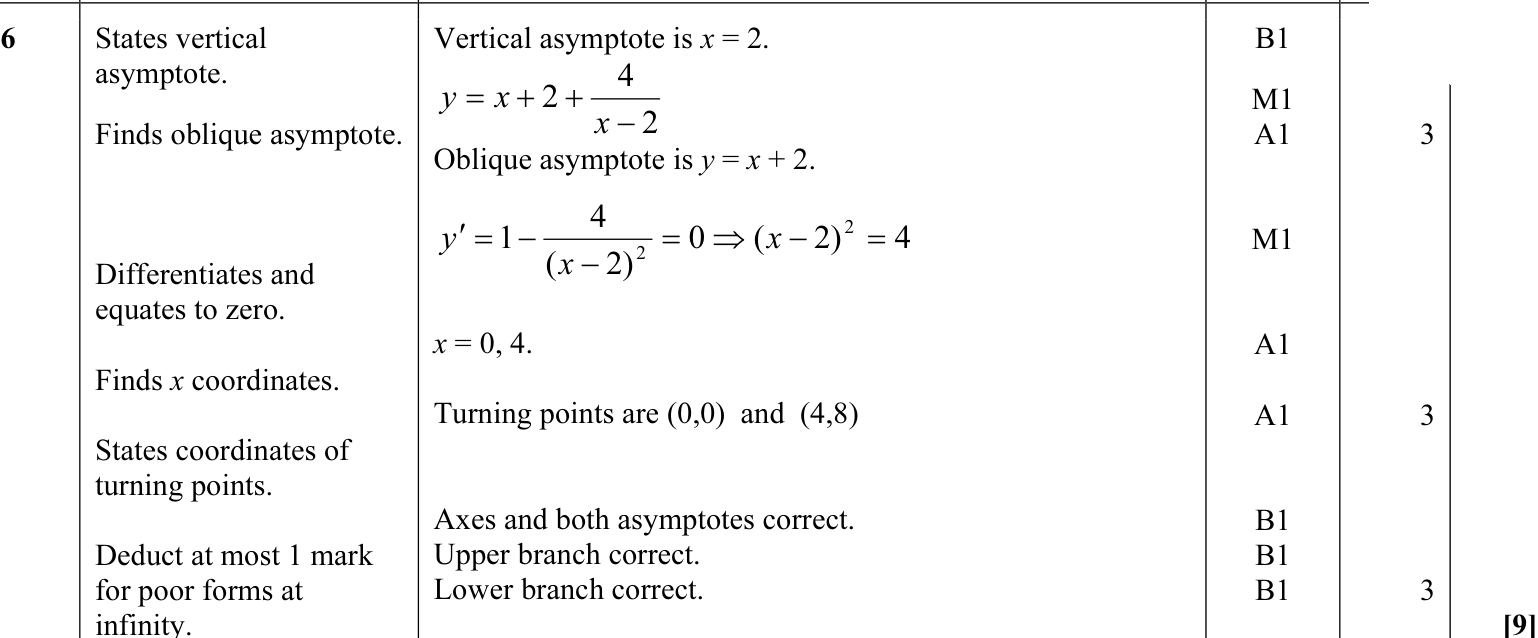
The curve \(C\) has equation \(y=\frac{x^{2}}{x-2}\). Find the equations of the asymptotes of \(C\).
Find the coordinates of the turning points on \(C\).
Draw a sketch of \(C\).
9231 P13 - Jun 2012 - Q11 - 28 marks
Answer only one of the following two alternatives.
EITHER
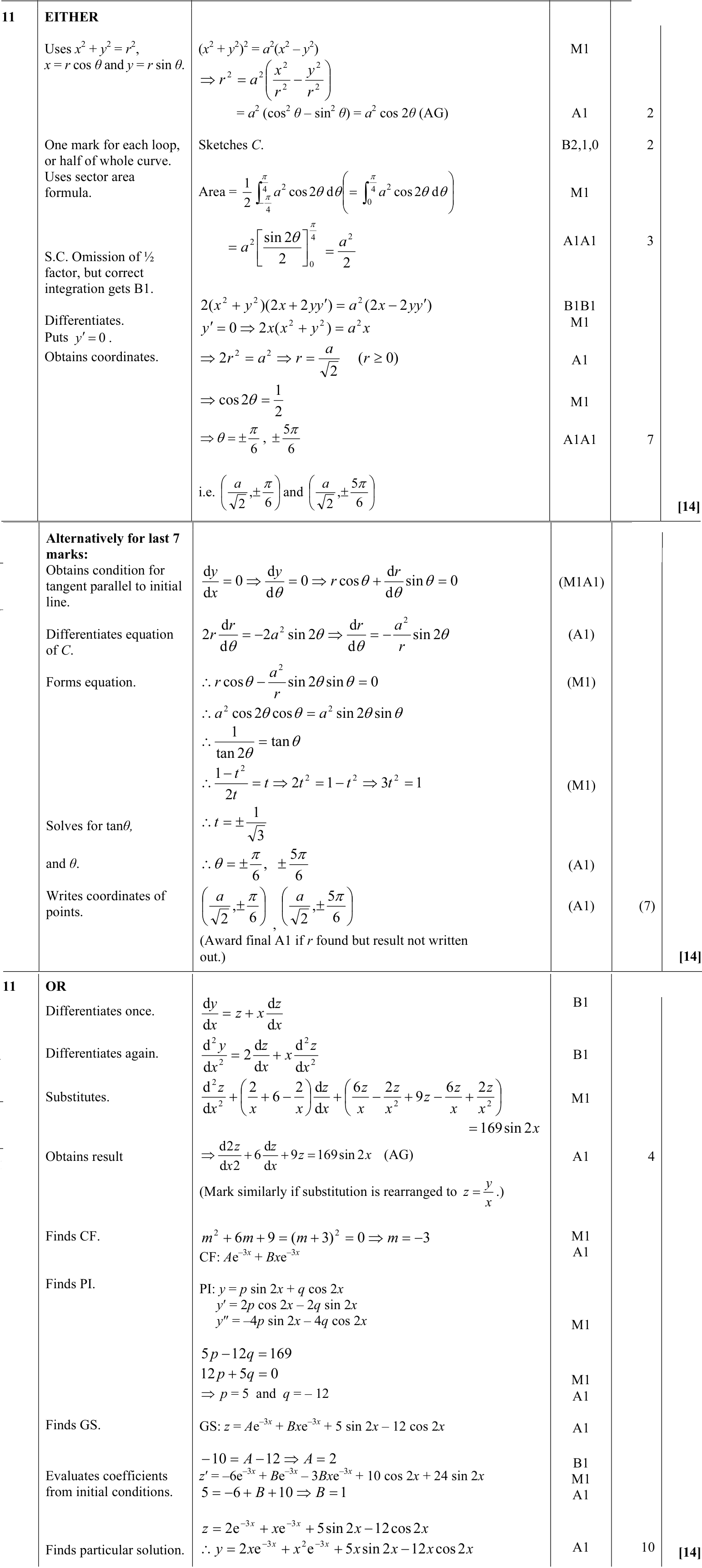
The curve \(C\) has cartesian equation
\(\left(x^{2}+y^{2}\right)^{2}=a^{2}\left(x^{2}-y^{2}\right),\)
where \(a\) is a positive constant. Show that \(C\) has polar equation
\(r^{2}=a^{2} \cos 2 \theta .\)
Sketch \(C\) for \(-\pi\lt \theta \leqslant \pi\).
Find the area of the sector between \(\theta=-\frac{1}{4} \pi\) and \(\theta=\frac{1}{4} \pi\).
Find the polar coordinates of all points of \(C\) where the tangent is parallel to the initial line.
OR
Show that the substitution \(y=x z\) reduces the differential equation
\(\frac{1}{x} \frac{\mathrm{~d}^{2} y}{\mathrm{~d} x^{2}}+\left(\frac{6}{x}-\frac{2}{x^{2}}\right) \frac{\mathrm{d} y}{\mathrm{~d} x}+\left(\frac{9}{x}-\frac{6}{x^{2}}+\frac{2}{x^{3}}\right) y=169 \sin 2 x\)
to the differential equation
\(\frac{\mathrm{d}^{2} z}{\mathrm{~d} x^{2}}+6 \frac{\mathrm{~d} z}{\mathrm{~d} x}+9 z=169 \sin 2 x .\)
Find the particular solution for \(y\) in terms of \(x\), given that when \(x=0, z=-10\) and \(\frac{\mathrm{d} z}{\mathrm{~d} x}=5\).
9231 P13 - Nov 2012 - Q9 - 12 marks
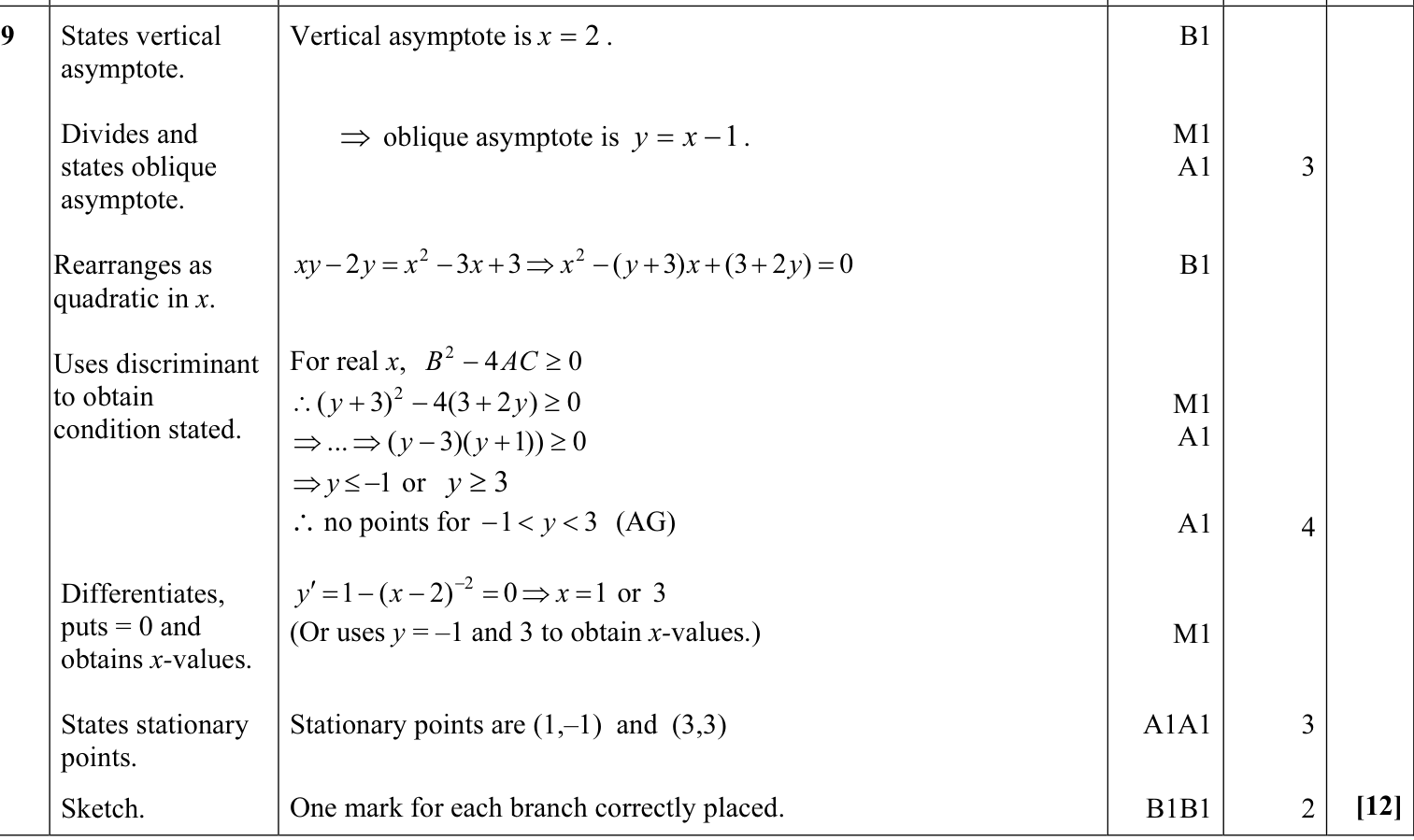
The curve \(C\) has equation \(y=\frac{x^{2}-3 x+3}{x-2}\). Find the equations of the asymptotes of \(C\).
Show that there are no points on \(C\) for which \(-1\lt y\lt 3\).
Find the coordinates of the turning points of \(C\).
Sketch \(C\).
9231 P13 - Nov 2012 - Q10 - 12 marks
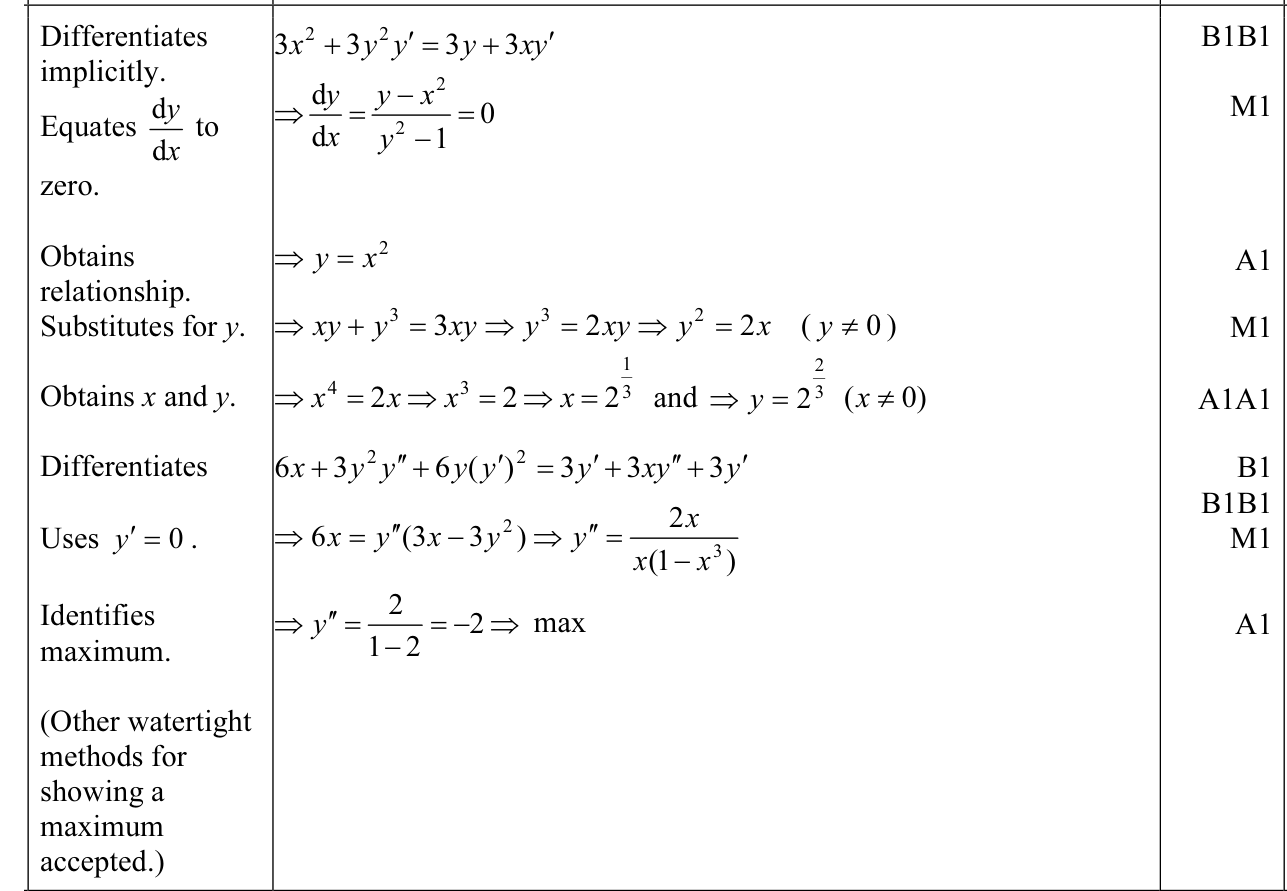
The curve \(C\) has equation \(x^{3}+y^{3}=3 x y\), for \(x\gt 0\) and \(y\gt 0\). Find a relationship between \(x\) and \(y\) when \(\frac{\mathrm{d} y}{\mathrm{~d} x}=0\).
Find the exact coordinates of the turning point of \(C\), and determine the nature of this turning point.
9231 P11 - Jun 2010 - Q1 - 5 marks
The variables \(x\) and \(y\) are such that \(y=-1\) when \(x=1\) and
\(x^{2}+y^{2}+\left(\frac{\mathrm{d} y}{\mathrm{~d} x}\right)^{3}=29\)
Find the values of \(\frac{\mathrm{d} y}{\mathrm{~d} x}\) and \(\frac{\mathrm{d}^{2} y}{\mathrm{~d} x^{2}}\) when \(x=1\).

9231 P11 - Jun 2010 - Q11 - 28 marks
Answer only one of the following two alternatives.
EITHER
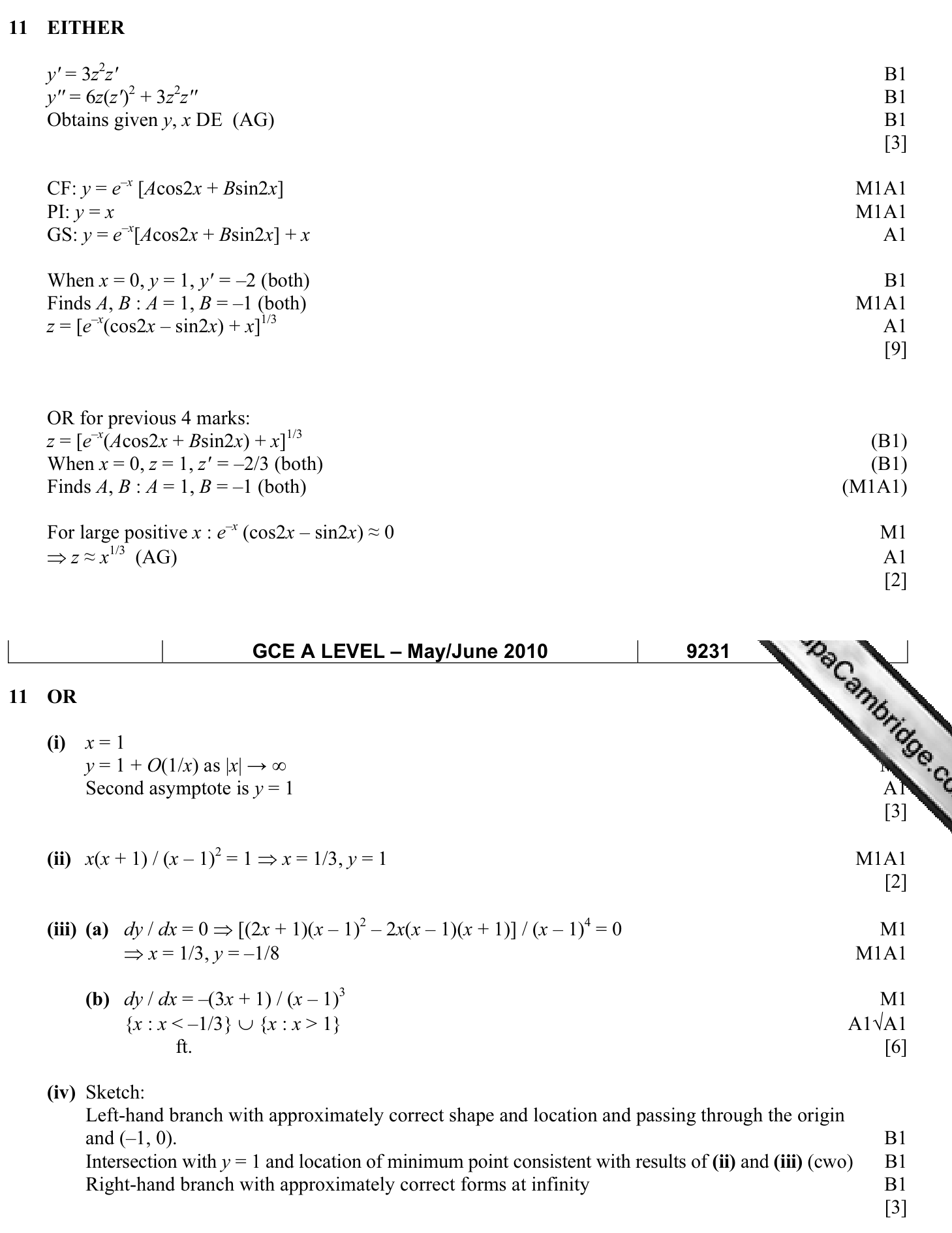
The variables \(z\) and \(x\) are related by the differential equation
\(3 z^{2} \frac{\mathrm{~d}^{2} z}{\mathrm{~d} x^{2}}+6 z^{2} \frac{\mathrm{~d} z}{\mathrm{~d} x}+6 z\left(\frac{\mathrm{~d} z}{\mathrm{~d} x}\right)^{2}+5 z^{3}=5 x+2 .\)
Use the substitution \(y=z^{3}\) to show that \(y\) and \(x\) are related by the differential equation
\(\frac{\mathrm{d}^{2} y}{\mathrm{~d} x^{2}}+2 \frac{\mathrm{~d} y}{\mathrm{~d} x}+5 y=5 x+2 .\)
Given that \(z=1\) and \(\frac{\mathrm{d} z}{\mathrm{~d} x}=-\frac{2}{3}\) when \(x=0\), find \(z\) in terms of \(x\).
Deduce that, for large positive values of \(x, z \approx x^{\frac{1}{3}}\).
OR
The curve \(C\) has equation
\(y=\frac{x(x+1)}{(x-1)^{2}} .\)
(i) Obtain the equations of the asymptotes of \(C\).
(ii) Show that there is exactly one point of intersection of \(C\) with the asymptotes and find its coordinates.
(iii) Find \(\frac{\mathrm{d} y}{\mathrm{~d} x}\) and hence
(a) find the coordinates of any stationary points of \(C\),
(b) state the set of values of \(x\) for which the gradient of \(C\) is negative.
(iv) Draw a sketch of \(C\).
9231 P13 - Jun 2011 - Q4 - 8 marks
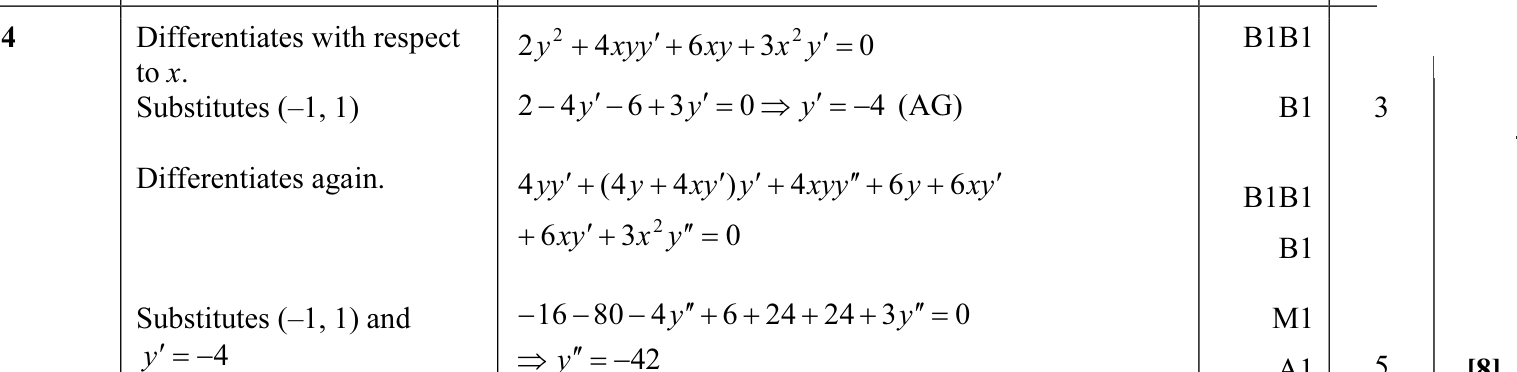
The curve \(C\) has equation
\(2 x y^{2}+3 x^{2} y=1 .\)
Show that, at the point \(A(-1,1)\) on \(C, \frac{\mathrm{~d} y}{\mathrm{~d} x}=-4\).
Find the value of \(\frac{\mathrm{d}^{2} y}{\mathrm{~d} x^{2}}\) at \(A\).
9231 P13 - Jun 2011 - Q9 - 11 marks
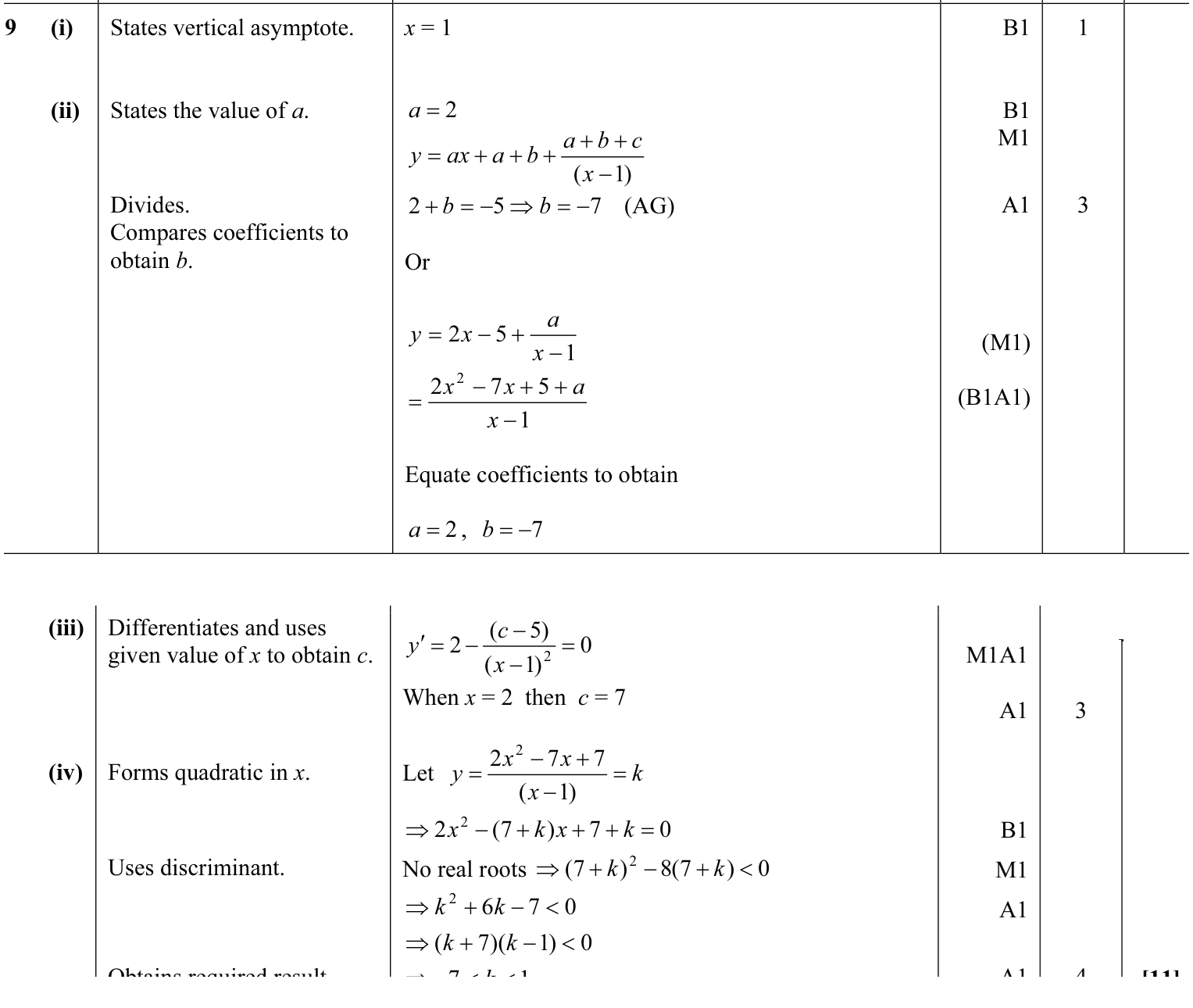
The curve \(C\) with equation
\(y=\frac{a x^{2}+b x+c}{x-1}\)
where \(a, b\) and \(c\) are constants, has two asymptotes. It is given that \(y=2 x-5\) is one of these asymptotes.
(i) State the equation of the other asymptote.
(ii) Find the value of \(a\) and show that \(b=-7\).
(iii) Given also that \(C\) has a turning point when \(x=2\), find the value of \(c\).
(iv) Find the set of values of \(k\) for which the line \(y=k\) does not intersect \(C\).
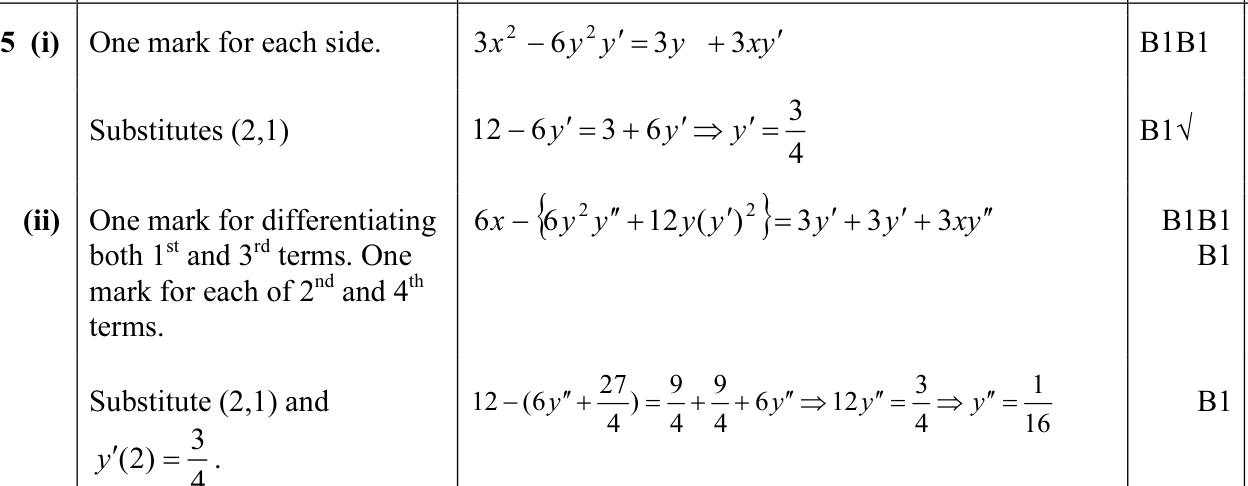
9231 P11 - Nov 2011 - Q5 - 7 marks
The point \(P(2,1)\) lies on the curve with equation
\(x^{3}-2 y^{3}=3 x y .\)
Find
(i) the value of \(\frac{\mathrm{d} y}{\mathrm{~d} x}\) at \(P\),
(ii) the value of \(\frac{\mathrm{d}^{2} y}{\mathrm{~d} x^{2}}\) at \(P\).
9231 P11 - Nov 2011 - Q7 - 11 marks
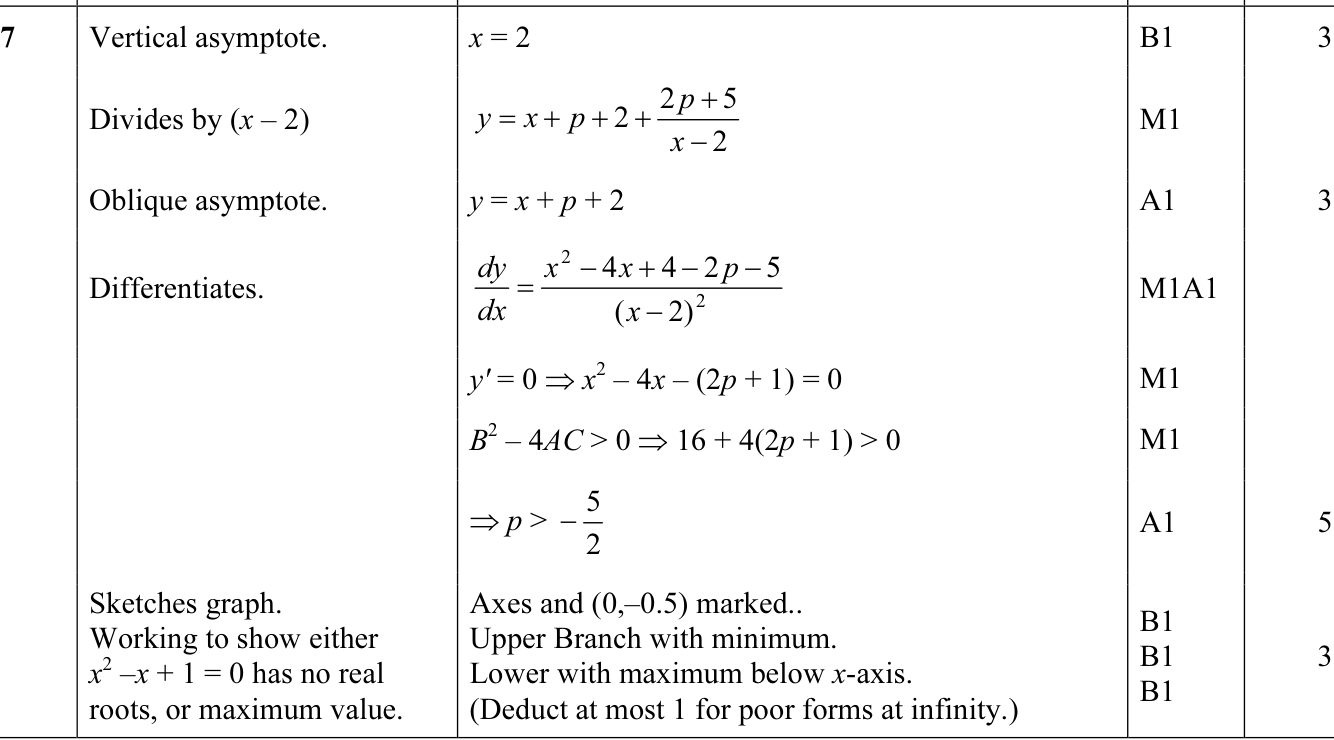
The curve \(C\) has equation \(y=\frac{x^{2}+p x+1}{x-2}\), where \(p\) is a constant. Given that \(C\) has two find the equation of each asymptote.
Find the set of values of \(p\) for which \(C\) has two distinct turning points.
Sketch \(C\) in the case \(p=-1\). Your sketch should indicate the coordinates of any intersections with the axes, but need not show the coordinates of any turning points.
9231 P11 - Nov 2011 - Q11 - 28 marks
Answer only one of the following two alternatives.
EITHER
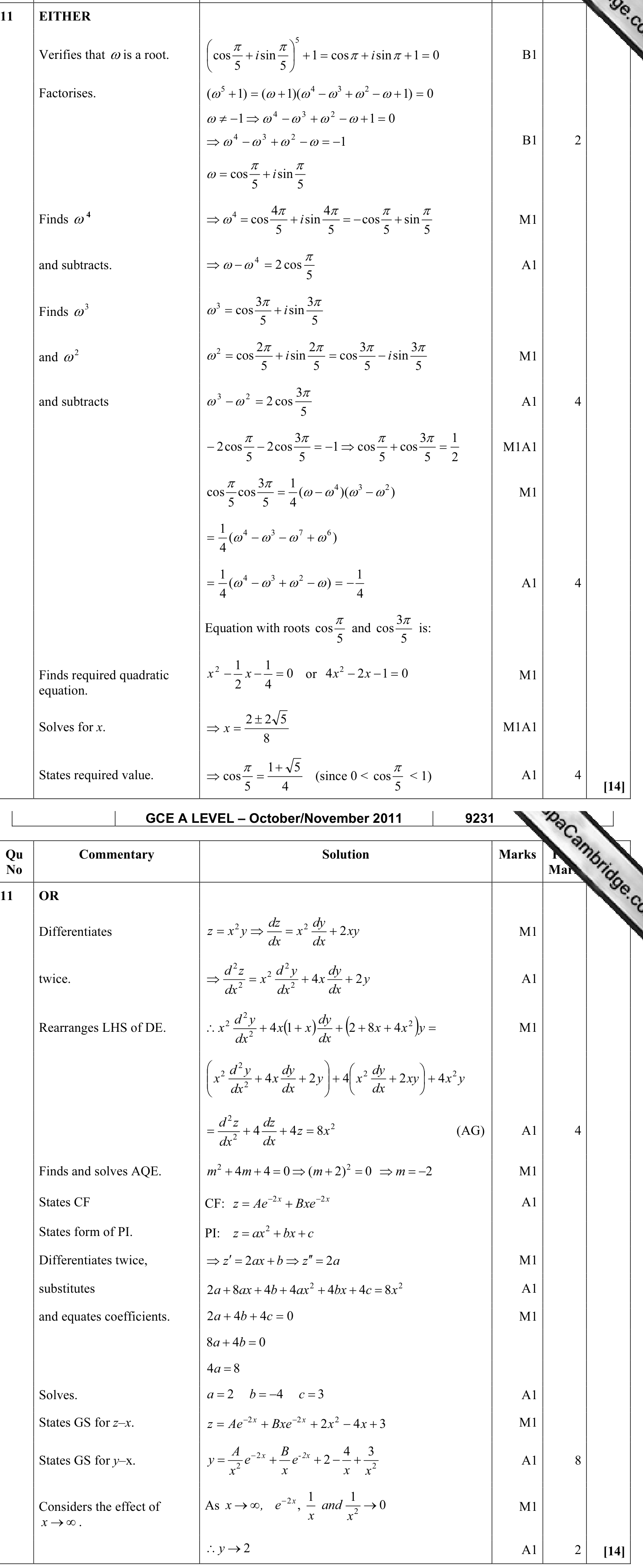
Let \(\omega=\cos \frac{1}{5} \pi+\mathrm{i} \sin \frac{1}{5} \pi\). Show that \(\omega^{5}+1=0\) and deduce that
\(\omega^{4}-\omega^{3}+\omega^{2}-\omega=-1\)
Show further that
\(\omega-\omega^{4}=2 \cos \frac{1}{5} \pi \quad \text { and } \quad \omega^{3}-\omega^{2}=2 \cos \frac{3}{5} \pi .\)
Hence find the values of
\(\cos \frac{1}{5} \pi+\cos \frac{3}{5} \pi \quad \text { and } \quad \cos \frac{1}{5} \pi \cos \frac{3}{5} \pi\)
Find a quadratic equation having roots \(\cos \frac{1}{5} \pi\) and \(\cos \frac{3}{5} \pi\) and deduce the exact value of \(\cos \frac{1}{5} \pi\).
OR
Given that
\(x^{2} \frac{\mathrm{~d}^{2} y}{\mathrm{~d} x^{2}}+4 x(1+x) \frac{\mathrm{d} y}{\mathrm{~d} x}+2\left(1+4 x+2 x^{2}\right) y=8 x^{2}\)
and that \(x^{2} y=z\), show that
\(\frac{\mathrm{d}^{2} z}{\mathrm{~d} x^{2}}+4 \frac{\mathrm{~d} z}{\mathrm{~d} x}+4 z=8 x^{2} .\)
Find the general solution for \(y\) in terms of \(x\).
Describe the behaviour of \(y\) as \(x \rightarrow \infty\).
9231 P13 - Nov 2011 - Q4 - 7 marks
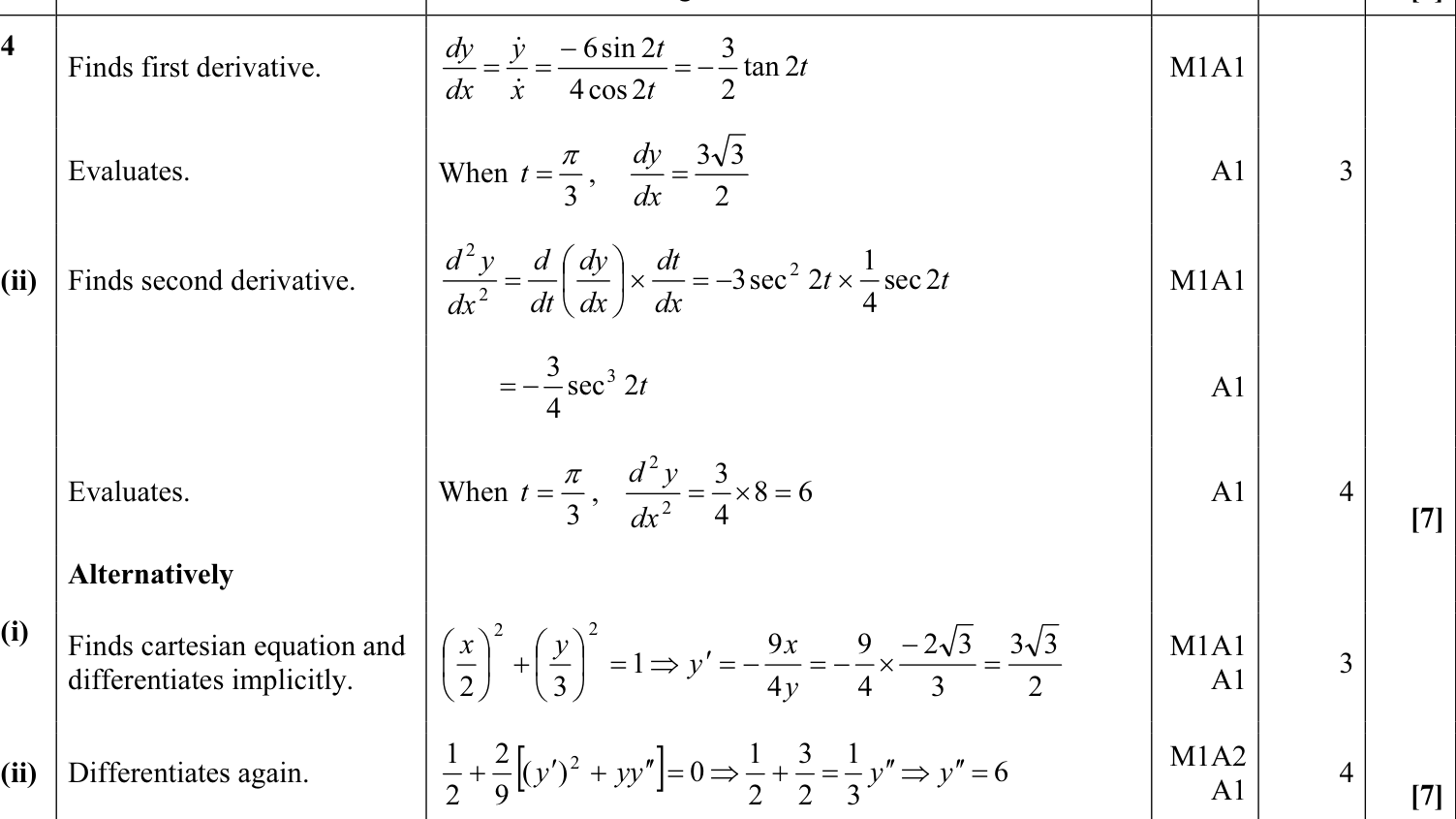
A curve has parametric equations
\(x=2 \sin 2 t, \quad y=3 \cos 2 t,\)
for \(0\lt t\lt \frac{1}{2} \pi\). For the point on the curve where \(t=\frac{1}{3} \pi\), find the value of
(i) \(\frac{\mathrm{d} y}{\mathrm{~d} x}\),
(ii) \(\frac{\mathrm{d}^{2} y}{\mathrm{~d} x^{2}}\).
9231 P13 - Nov 2011 - Q10 - 13 marks
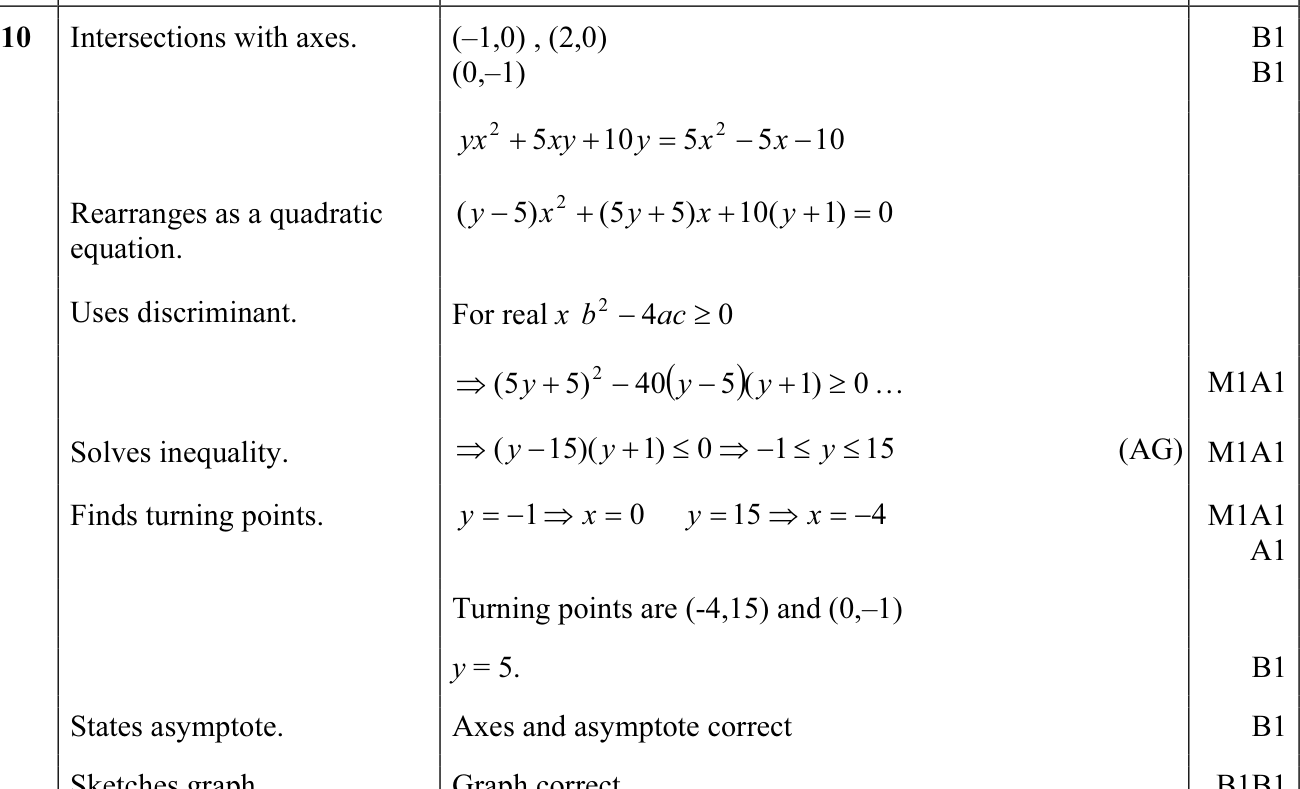
A curve \(C\) has equation
\(y=\frac{5\left(x^{2}-x-2\right)}{x^{2}+5 x+10} .\)
Find the coordinates of the points of intersection of \(C\) with the axes.
Show that, for all real values of \(x,-1 \leqslant y \leqslant 15\).
Sketch \(C\), stating the coordinates of any turning points and the equation of the horizontal asymptote.
[Question 11 is printed on the next page.]
9231 P1 - Jun 2009 - Q6 - 7 marks
A curve has equation
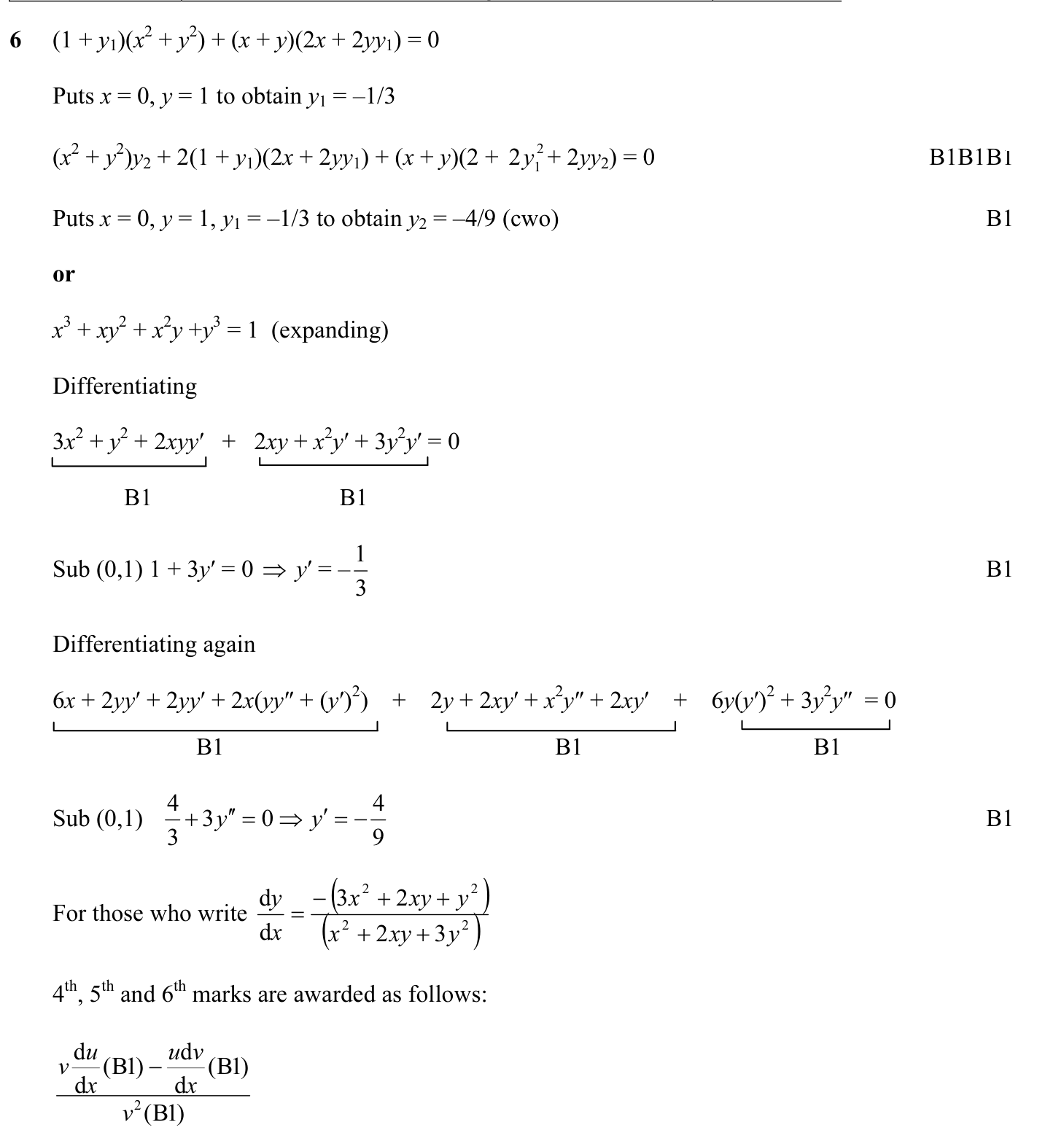
\((x+y)\left(x^{2}+y^{2}\right)=1 .\)
Find the values of \(\frac{\mathrm{d} y}{\mathrm{~d} x}\) and \(\frac{\mathrm{d}^{2} y}{\mathrm{~d} x^{2}}\) at the point \((0,1)\).
9231 P1 - Jun 2009 - Q10 - 11 marks
The curve \(C\) has equation
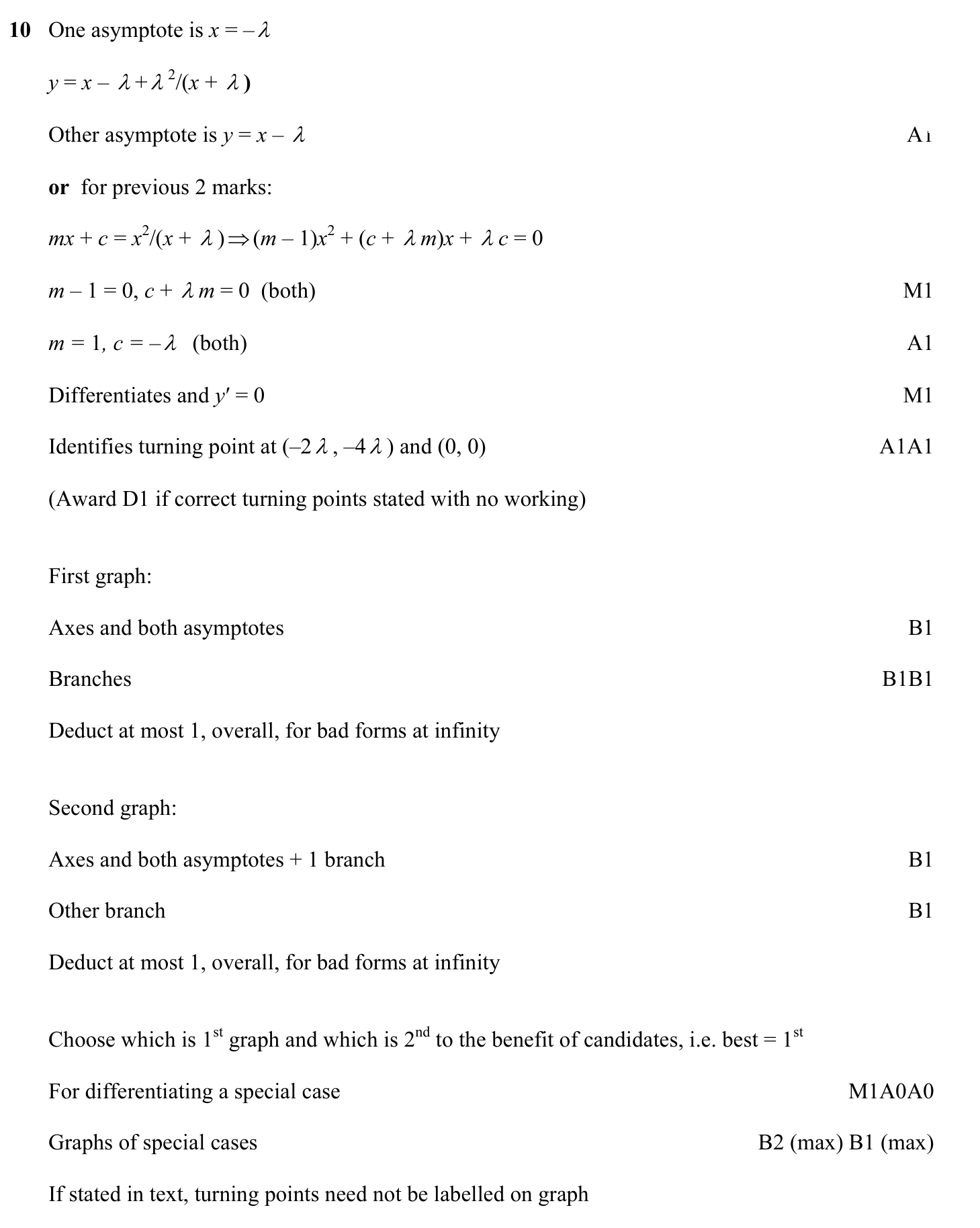
\(y=\frac{x^{2}}{x+\lambda}\)
where \(\lambda\) is a non-zero constant. Obtain the equation of each of the asymptotes of \(C\).
In separate diagrams, sketch \(C\) for the cases \(\lambda\gt 0\) and \(\lambda\lt 0\). In both cases the coordinates of the turning points must be indicated.
9231 P1 - Nov 2009 - Q9 - 11 marks
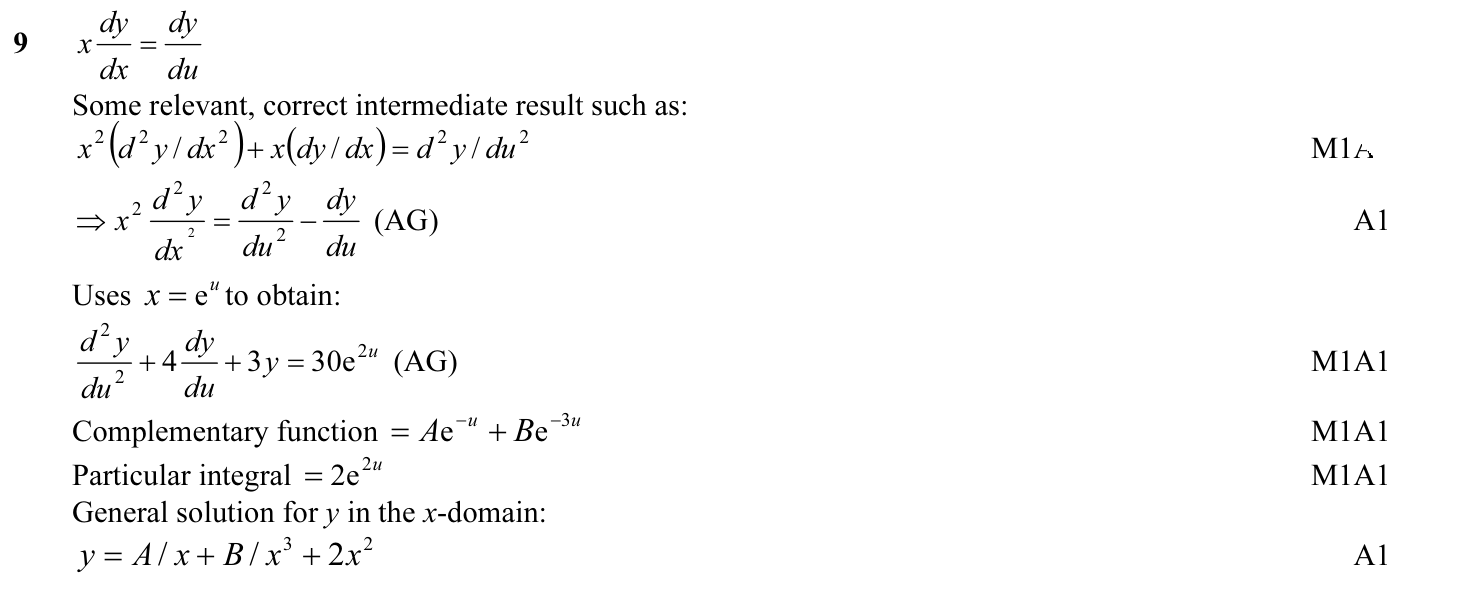
Show that if \(y\) depends on \(x\) and \(x=\mathrm{e}^{u}\) then
\(x^{2} \frac{\mathrm{~d}^{2} y}{\mathrm{~d} x^{2}}=\frac{\mathrm{d}^{2} y}{\mathrm{~d} u^{2}}-\frac{\mathrm{d} y}{\mathrm{~d} u} .\)
Given that \(y\) satisfies the differential equation
\(x^{2} \frac{\mathrm{~d}^{2} y}{\mathrm{~d} x^{2}}+5 x \frac{\mathrm{~d} y}{\mathrm{~d} x}+3 y=30 x^{2}\)
use the substitution \(x=\mathrm{e}^{u}\) to show that
\(\frac{\mathrm{d}^{2} y}{\mathrm{~d} u^{2}}+4 \frac{\mathrm{~d} y}{\mathrm{~d} u}+3 y=30 \mathrm{e}^{2 u}\)
Hence find the general solution for \(y\) in terms of \(x\).