9231 P23 - Jun 2025 - Q8 - 14 marks
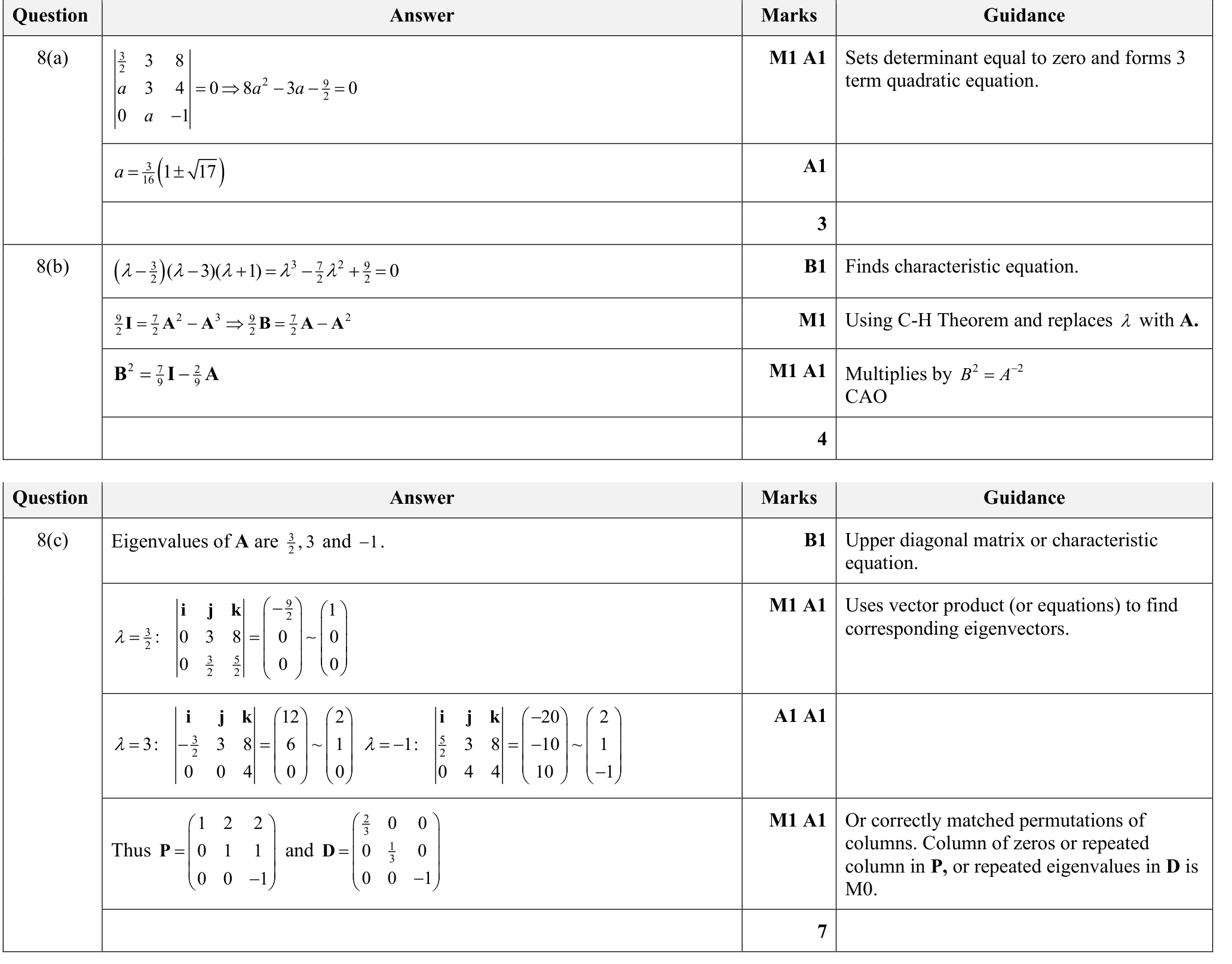
(a) Find the values of \(a\) for which the system of equations
\(\begin{aligned}\frac{3}{2}x+3y+8z&=1\\ax+3y+4z&=2\\ay-z&=3\end{aligned}\)
does not have a unique solution.
The matrix \(\mathbf{A}\) is given by
\(\mathbf{A}=\begin{pmatrix}\frac{3}{2}&3&8\\0&3&4\\0&0&-1\end{pmatrix}\).
(b) Given that \(\mathbf{B}=\mathbf{A}^{-1}\), use the characteristic equation of \(\mathbf{A}\) to show that \(\mathbf{B}^{2}=p\mathbf{I}+q\mathbf{A}\), where \(p\) and \(q\) are constants to be determined.
(c) Find a matrix \(\mathbf{P}\) and a diagonal matrix \(\mathbf{D}\) such that \(\mathbf{A}^{-1}=\mathbf{P}\mathbf{D}\mathbf{P}^{-1}\).
9231 P21 - Jun 2024 - Q8 - 16 marks
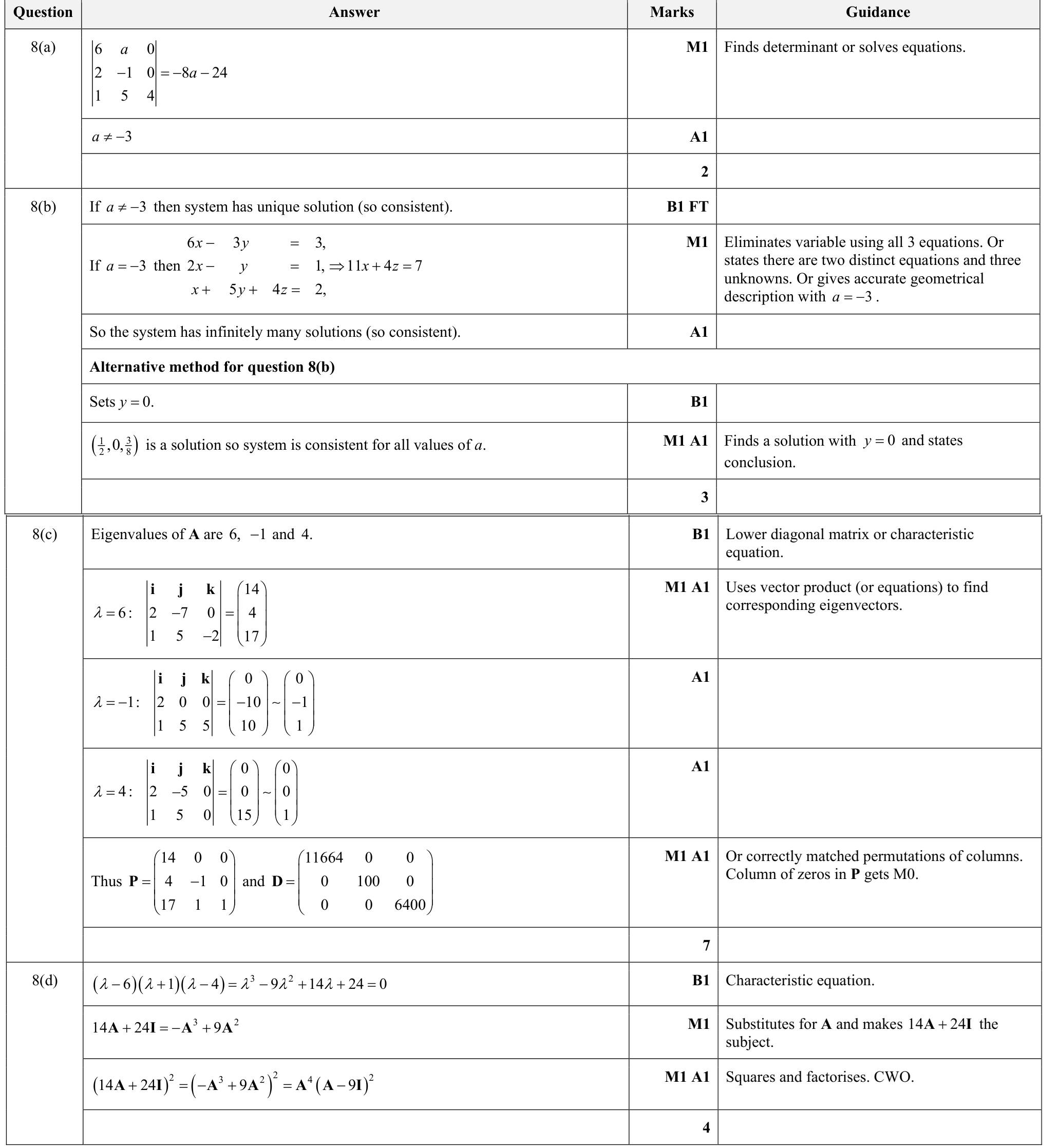
(a) Find the set of values of \(a\) for which the system of equations
\(\begin{array}{c} 6 x+a y=3 \\ 2 x-y=1 \\ x+5 y+4 z=2 \end{array}\)
has a unique solution.
(b) Show that the system of equations in part (a) is consistent for all values of \(a\).
The matrix \(\mathbf{A}\) is given by
\(\mathbf{A}=\left(\begin{array}{rrr} 6 & 0 & 0 \\ 2 & -1 & 0 \\ 1 & 5 & 4 \end{array}\right)\)
(c) Find a matrix \(\mathbf{P}\) and a diagonal matrix \(\mathbf{D}\) such that \((14 \mathbf{A}+24 \mathbf{I})^{2}=\mathbf{P D P}^{-1}\).
(d) Use the characteristic equation of \(\mathbf{A}\) to show that
\((14 \mathbf{A}+24 \mathbf{I})^{2}=\mathbf{A}^{4}(\mathbf{A}+b \mathbf{I})^{2}\)
where \(b\) is an integer to be determined.
9231 P21 - Nov 2023 - Q7 - 11 marks
The matrix \(\mathbf{A}\) is given by
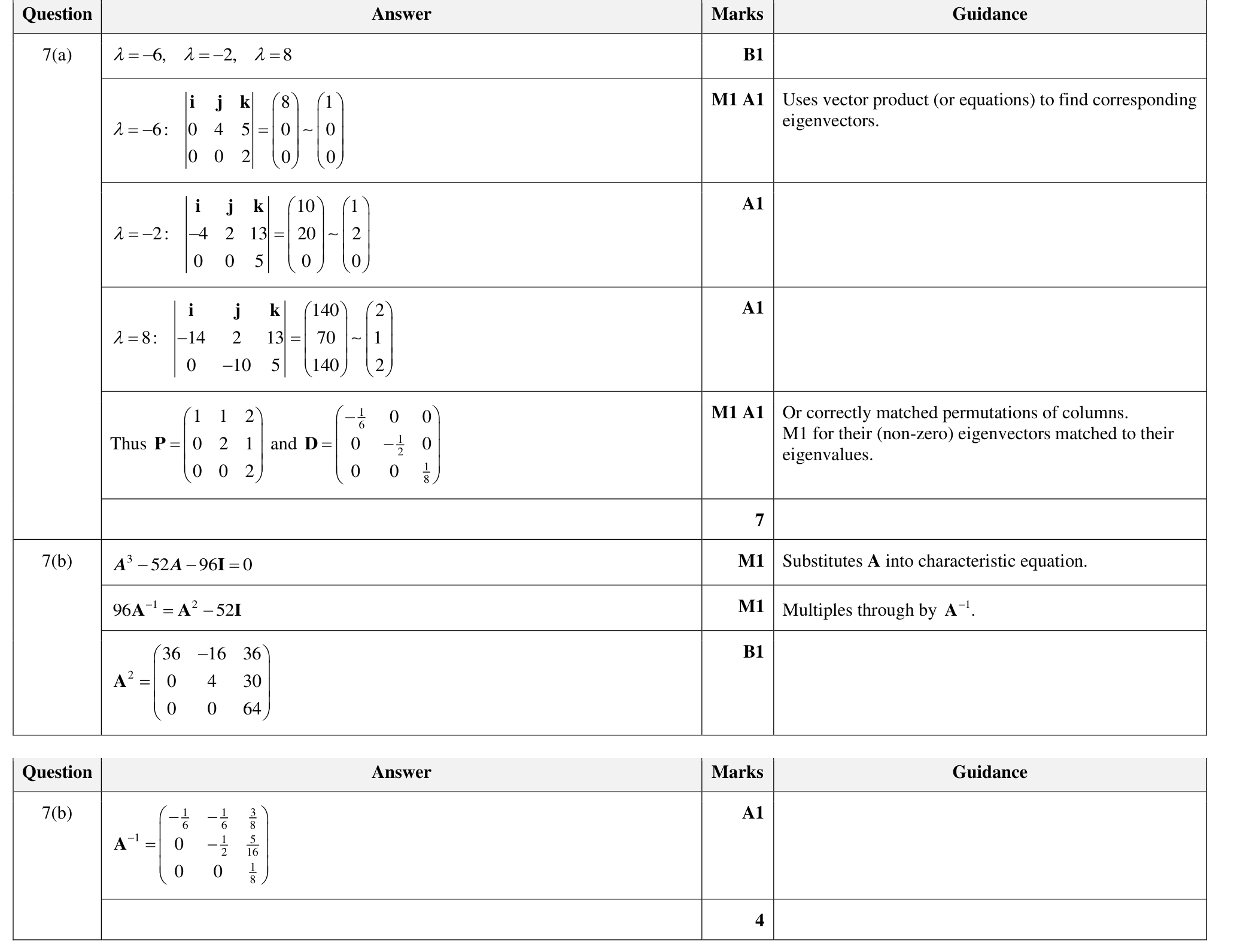
\(\mathbf{A}=\left(\begin{array}{rrr} -6 & 2 & 13 \\ 0 & -2 & 5 \\ 0 & 0 & 8 \end{array}\right) .\)
(a) Find a matrix \(\mathbf{P}\) and a diagonal matrix \(\mathbf{D}\) such that \(\mathbf{A}^{-1}=\mathbf{P D P} \mathbf{P}^{-1}\).
(b) Use the characteristic equation of \(\mathbf{A}\) to find \(\mathbf{A}^{-1}\).
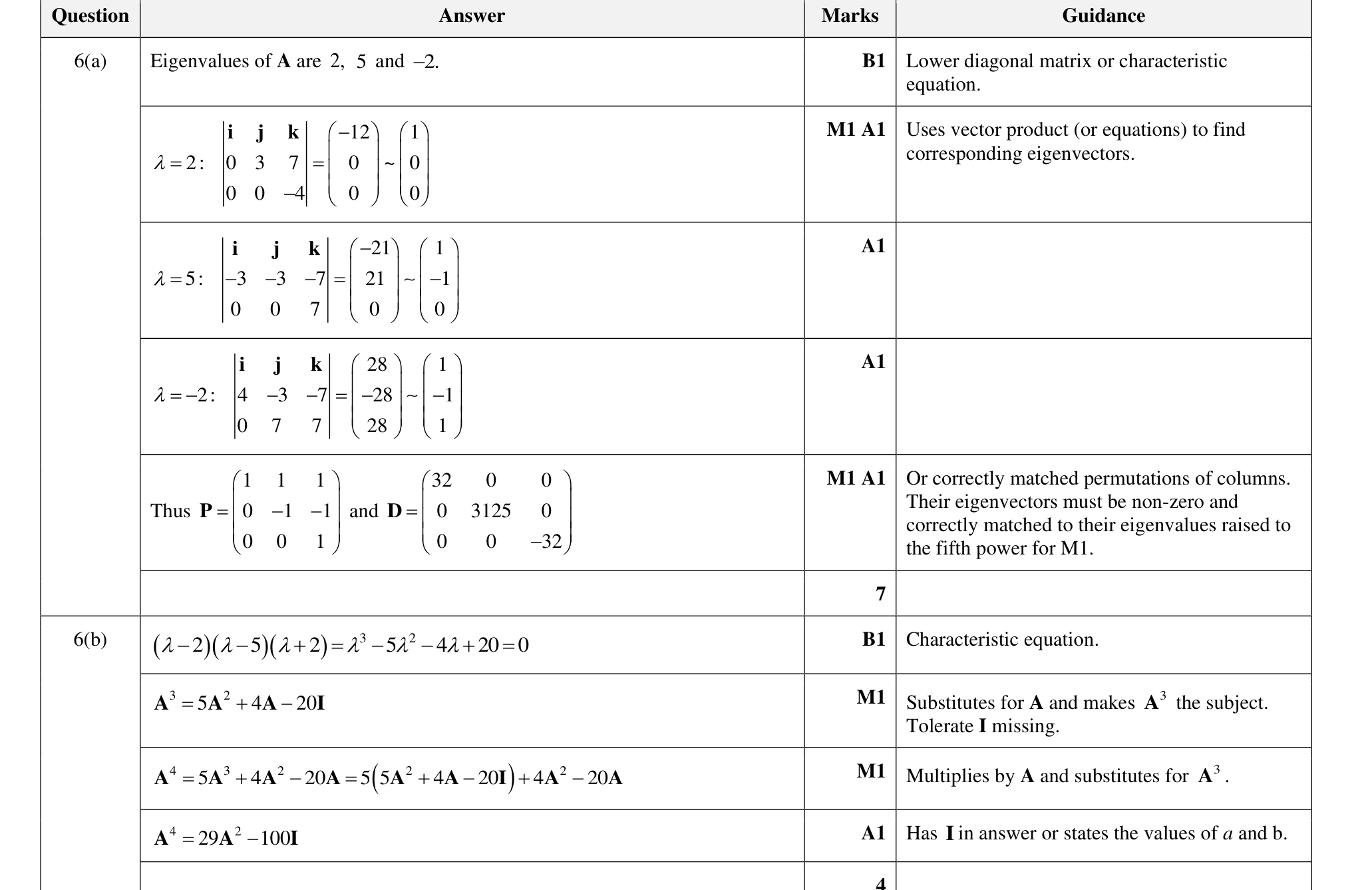
9231 P21 - Nov 2022 - Q6 - 11 marks
The matrix \(\mathbf{A}\) is given by
\(\mathbf{A}=\left(\begin{array}{rrr} 2 & -3 & -7 \\ 0 & 5 & 7 \\ 0 & 0 & -2 \end{array}\right) .\)
(a) Find a matrix \(\mathbf{P}\) and a diagonal matrix \(\mathbf{D}\) such that \(\mathbf{A}^{5}=\mathbf{P D P}^{-1}\).
(b) Use the characteristic equation of \(\mathbf{A}\) to show that
\(\mathbf{A}^{4}=a \mathbf{A}^{2}+b \mathbf{I},\)
where \(a\) and \(b\) are integers to be determined.
9231 P21 - Nov 2021 - Q2 - 6 marks
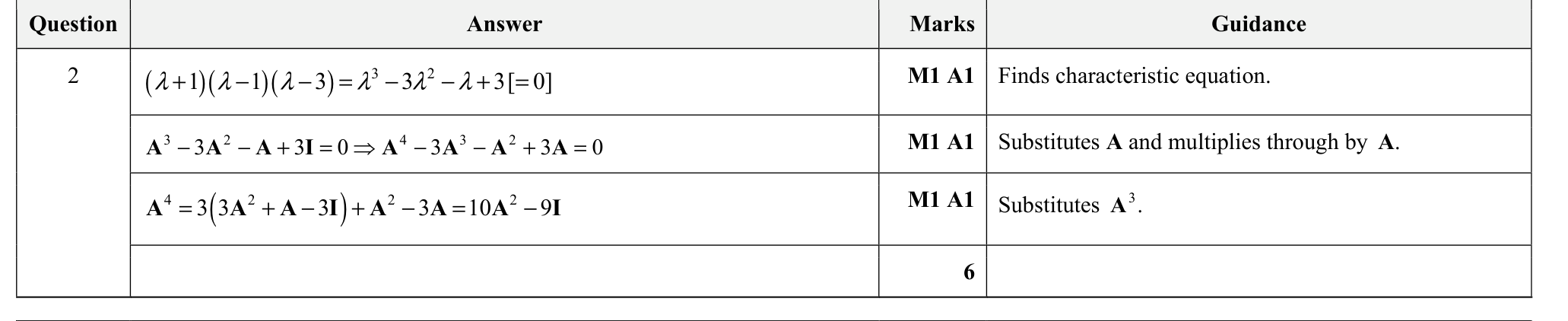
The matrix \(\mathbf{A}\) is given by
\(\mathbf{A}=\left(\begin{array}{rrr} -1 & 2 & 12 \\ 0 & 1 & 0 \\ 0 & 0 & 3 \end{array}\right) .\)
Use the characteristic equation of \(\mathbf{A}\) to show that
\(\mathbf{A}^{4}=p \mathbf{A}^{2}+q \mathbf{I},\)
where \(p\) and \(q\) are integers to be determined.
9231 P23 - Jun 2020 - Q3 - 8 marks
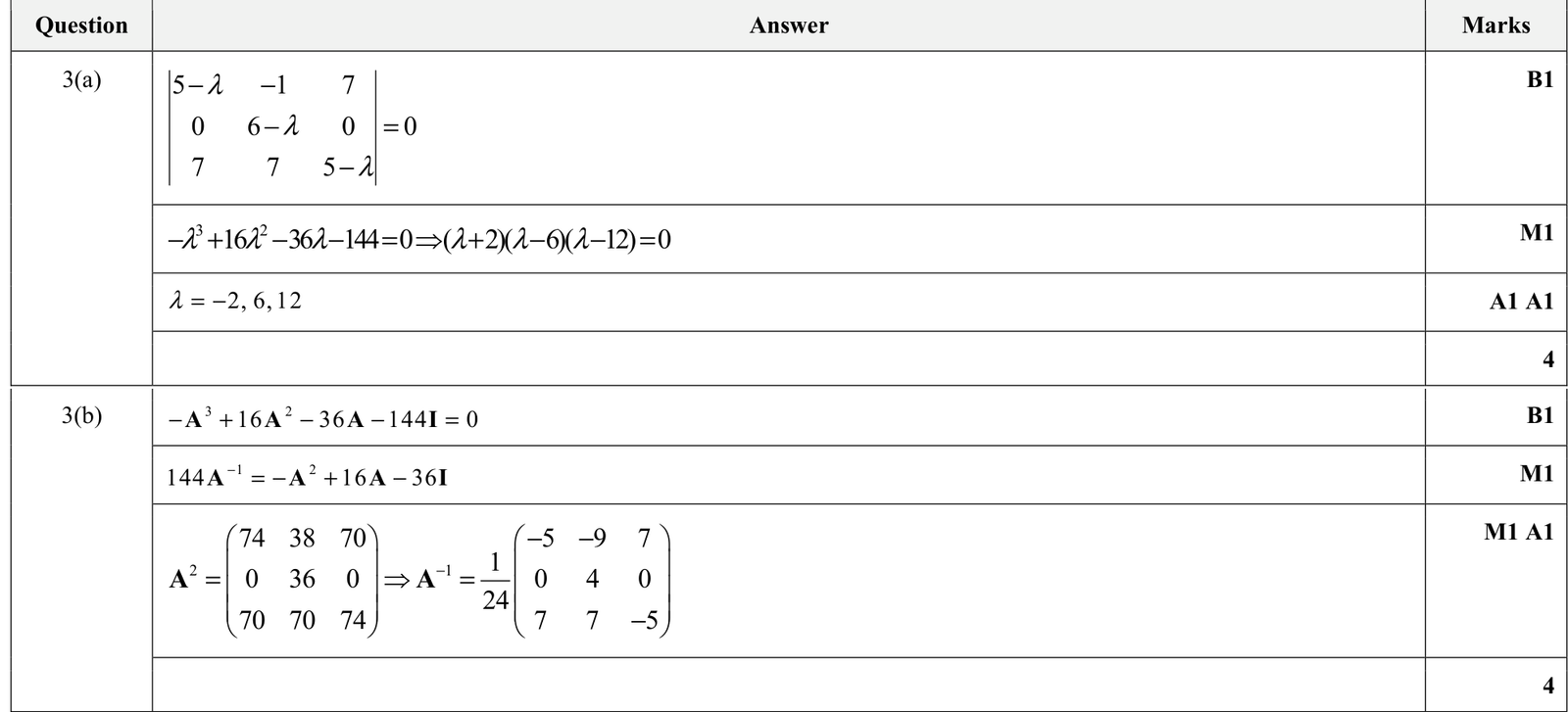
The matrix \(\mathbf{A}\) is given by
\[\mathbf{A}=\left(\begin{array}{rrr}
5 & -1 & 7 \\
0 & 6 & 0 \\
7 & 7 & 5
\end{array}\right)\]
(a) Find the eigenvalues of \(\mathbf{A}\).
(b) Use the characteristic equation of \(\mathbf{A}\) to find \(\mathbf{A}^{-1}\).
9231 P11 - Nov 2015 - Q7 - 10 marks
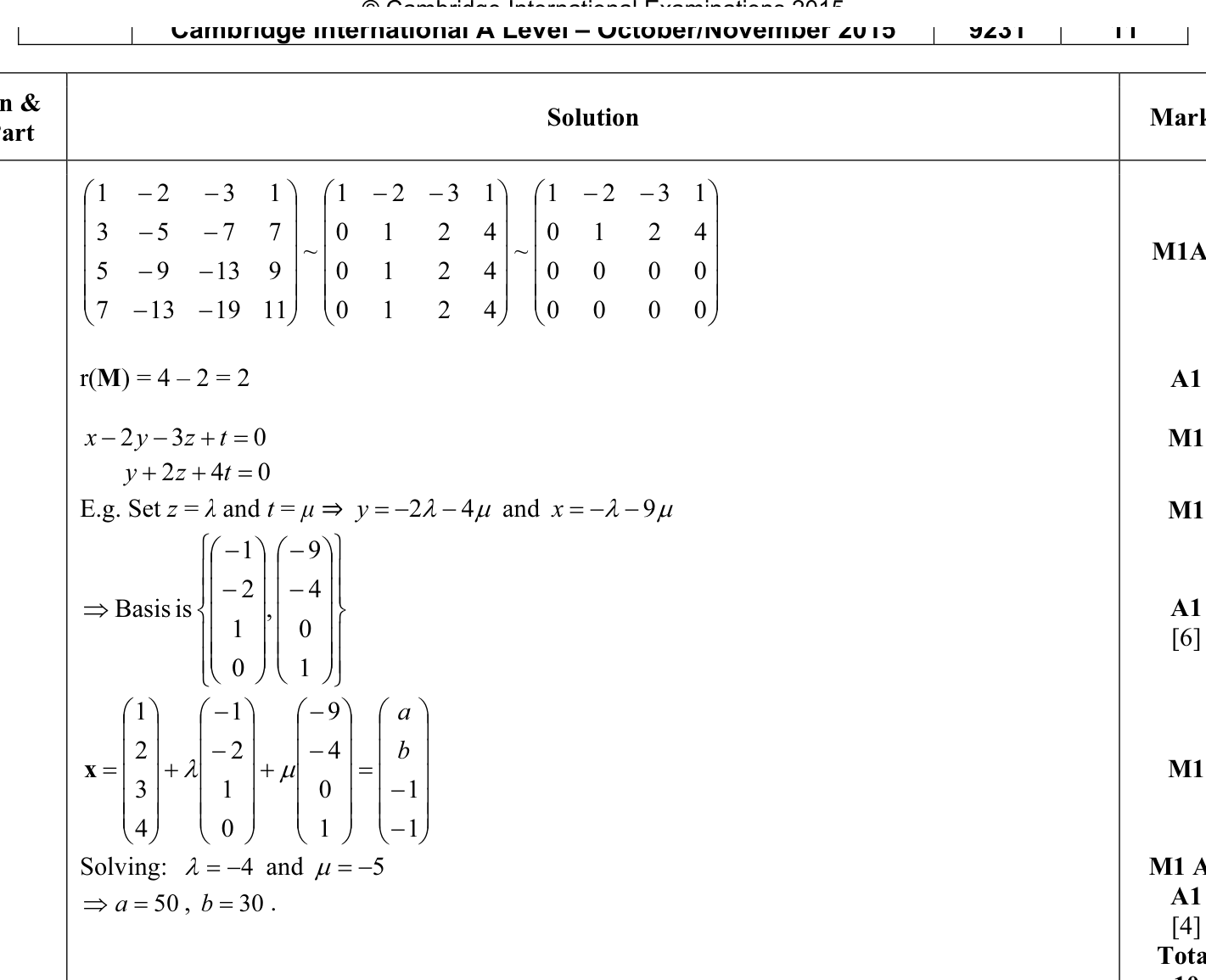
The linear transformation \(\mathrm{T}: \mathbb{R}^{4} \rightarrow \mathbb{R}^{4}\) is represented by the matrix \(\mathbf{M}\), where
\(\mathbf{M}=\left(\begin{array}{rrrr} 1 & -2 & -3 & 1 \\ 3 & -5 & -7 & 7 \\ 5 & -9 & -13 & 9 \\ 7 & -13 & -19 & 11 \end{array}\right) .\)
Find the rank of \(\mathbf{M}\) and a basis for the null space of T .
The vector \(\left(\begin{array}{l}1 \\ 2 \\ 3 \\ 4\end{array}\right)\) is denoted by \(\mathbf{e}\). Show that there is a solution of the equation \(\mathbf{M} \mathbf{x}=\mathbf{M e}\) of the form \(\mathbf{x}=\left(\begin{array}{c}a \\ b \\ -1 \\ -1\end{array}\right)\), where the constants \(a\) and \(b\) are to be found.
9231 P13 - Jun 2015 - Q11E - 14 marks
EITHER
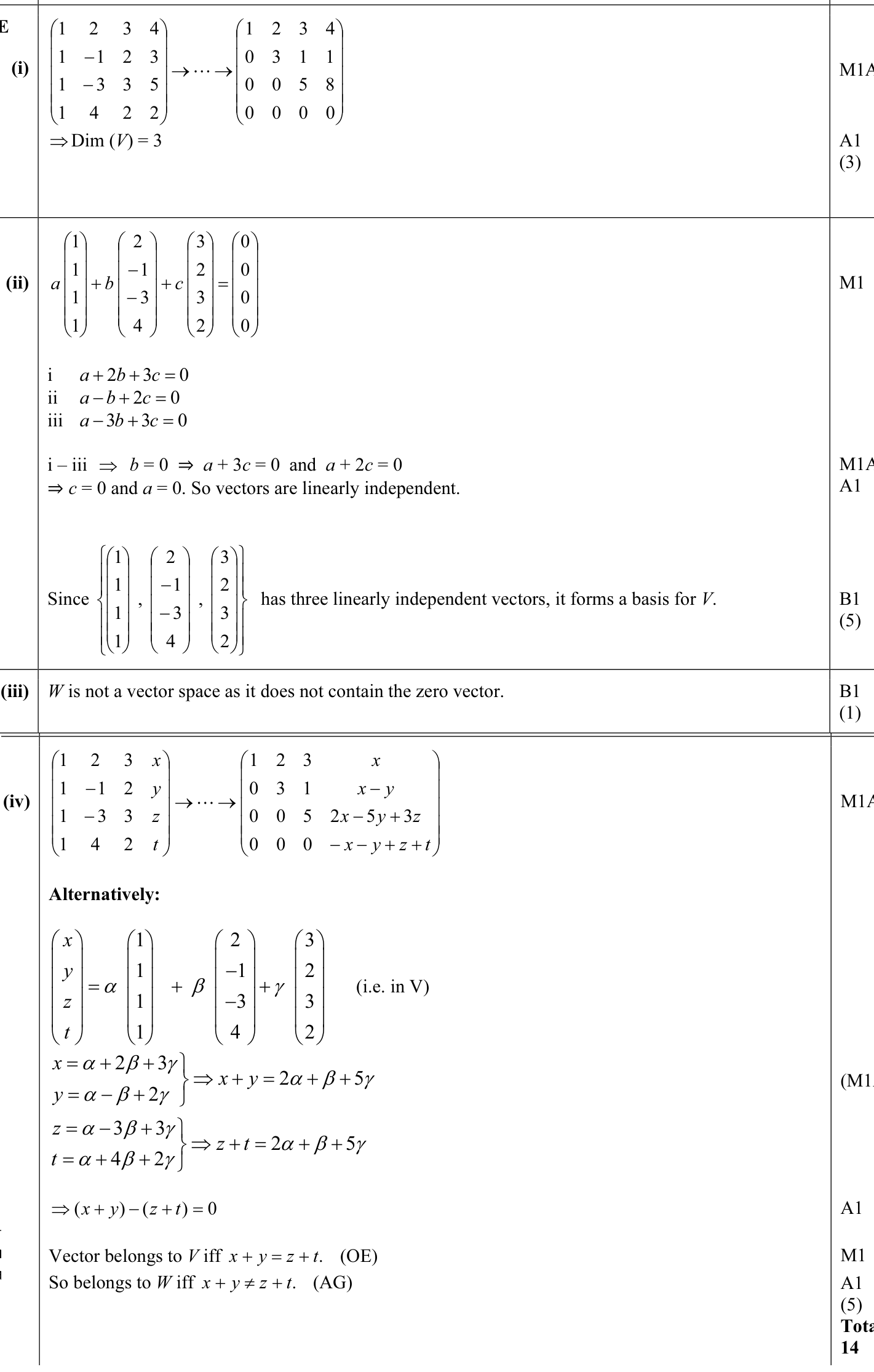
The linear transformation \(T:\mathbb R^4\to\mathbb R^4\) is represented by
\(\mathbf M=\begin{pmatrix}1&2&3&4\\1&-1&2&3\\1&-3&3&5\\1&4&2&2\end{pmatrix}\).
The range space of \(T\) is denoted by \(V\).
(i) Determine the dimension of \(V\).
(ii) Show that the vectors \(\begin{pmatrix}1\\1\\1\\1\end{pmatrix}\), \(\begin{pmatrix}2\\-1\\-3\\4\end{pmatrix}\), and \(\begin{pmatrix}3\\2\\3\\2\end{pmatrix}\) are a basis of \(V\).
The set of elements of \(\mathbb R^4\) which do not belong to \(V\) is denoted by \(W\).
(iii) State, with a reason, whether \(W\) is a vector space.
(iv) Show that if \(\begin{pmatrix}x\\y\\z\\t\end{pmatrix}\) belongs to \(W\), then \(x+y\ne z+t\).
9231 P11 - Nov 2016 - Q5 - 8 marks
The linear transformation \(\mathrm{T}: \mathbb{R}^{4} \rightarrow \mathbb{R}^{4}\) is represented by the matrix \(\mathbf{A}\), where
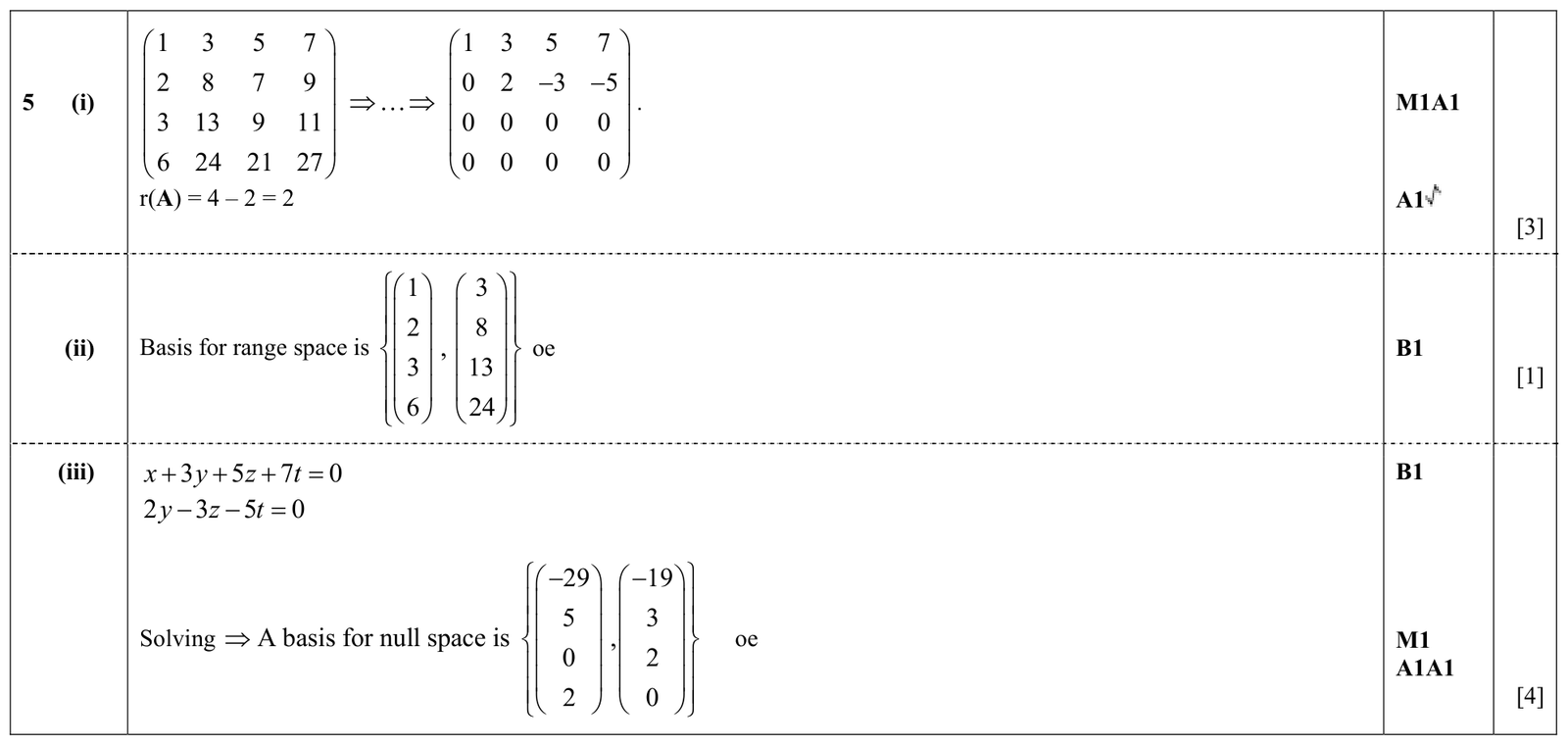
\(\mathbf{A}=\left(\begin{array}{rrrr} 1 & 3 & 5 & 7 \\ 2 & 8 & 7 & 9 \\ 3 & 13 & 9 & 11 \\ 6 & 24 & 21 & 27 \end{array}\right)\)
Find
(i) the rank of \(\mathbf{A}\),
(ii) a basis for the range space of T ,
(iii) a basis for the null space of T .