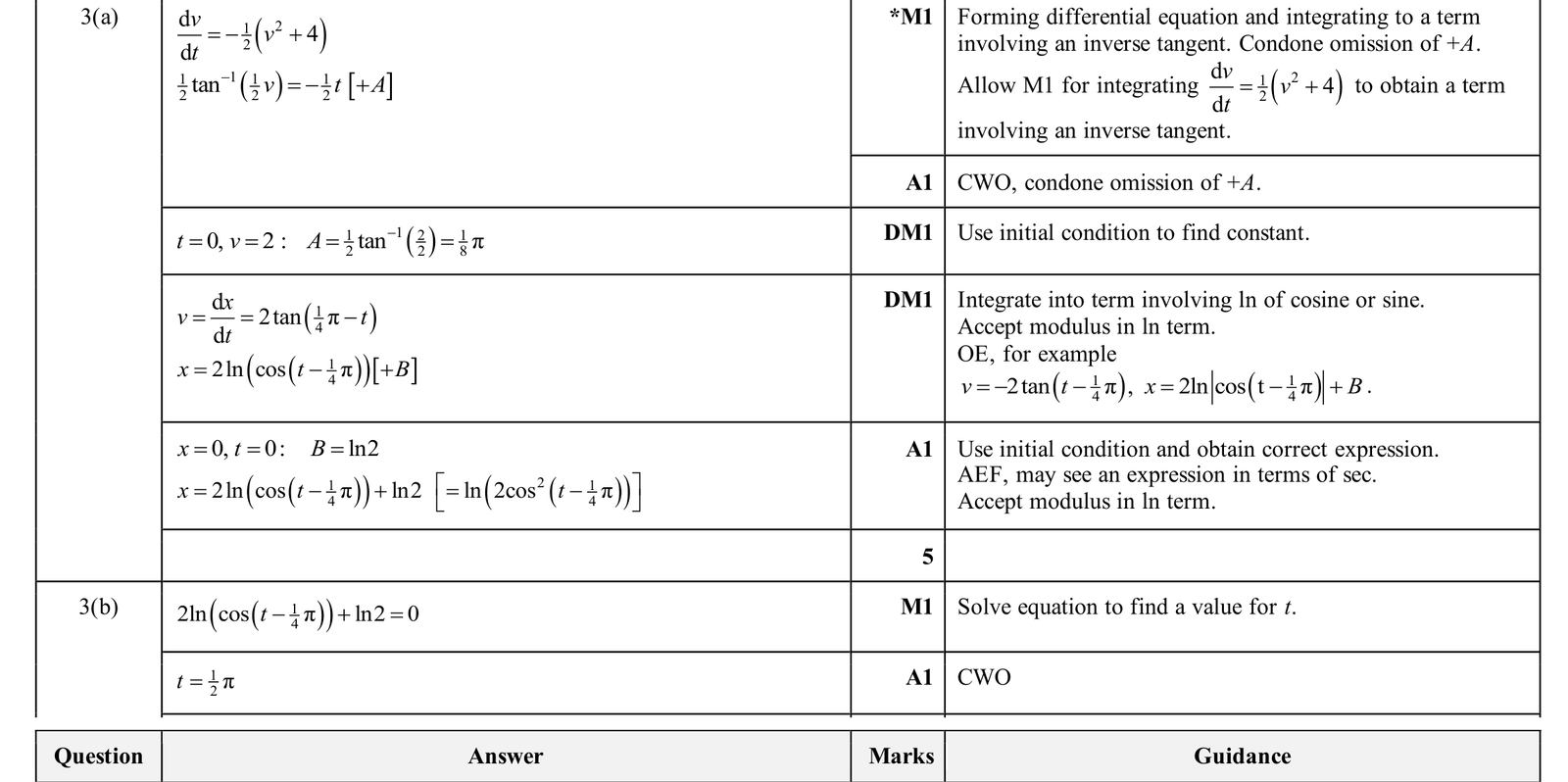
9231 P31 - Nov 2025 - Q3 - 7 marks
A particle \(P\) is moving in a straight horizontal line. At time \(t \mathrm{~s}\), the displacement of \(P\) from a fixed point \(O\) on the line is \(x \mathrm{~m}\) and the velocity of \(P\) is \(v \mathrm{~ms}^{-1}\). The acceleration of \(P\) is \(\frac{1}{2}\left(v^{2}+4\right) \mathrm{ms}^{-2}\) in the direction \(P O\). Initially \(P\) is at \(O\) and is moving with velocity \(2 \mathrm{~ms}^{-1}\). (a) Find an expression for \(x\) in terms of \(t\). (b) Find the time when \(P\) next goes through \(O\).
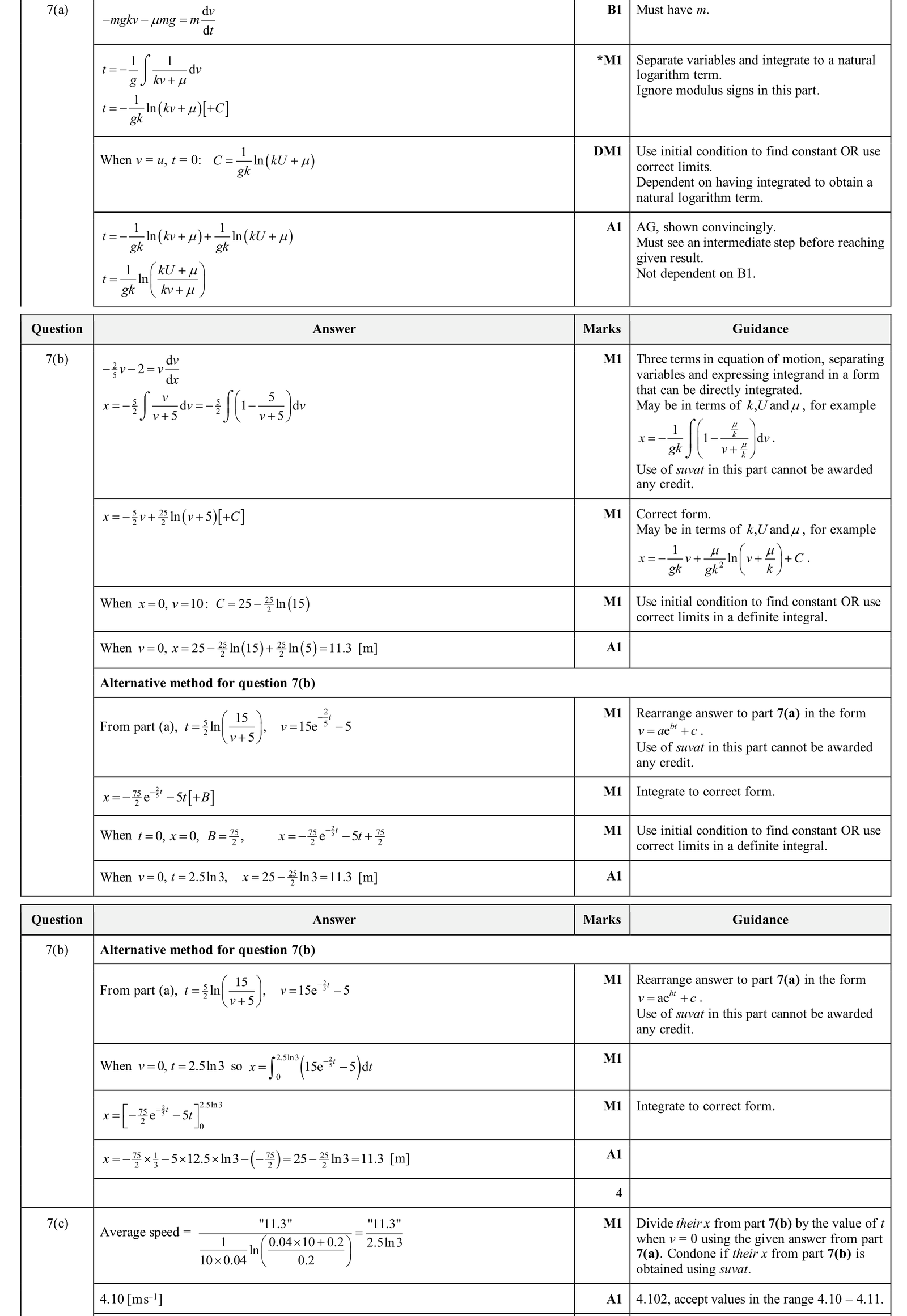
9231 P32 - Nov 2025 - Q7 - 10 marks
A particle \(P\) of mass \(m \mathrm{~kg}\) moving along a rough horizontal table has displacement \(x \mathrm{~m}\) from a fixed point \(O\) on the table and velocity \(v \mathrm{~ms}^{-1}\) at time \(t \mathrm{~s}\). The particle \(P\) is subject to a resistive force of magnitude \(m g k v \mathrm{~N}\), where \(k\) is a positive constant, and a frictional force of magnitude \(\mu m g\). The particle \(P\) is initially at \(O\) with speed \(U \mathrm{~ms}^{-1}\). (a) Show that \(t=\frac{1}{g k} \ln \left(\frac{k U+\mu}{k v+\mu}\right)\).
It is given that \(U=10, k=0.04\) and \(\mu=0.2\). (b) Find the distance \(P\) moves before coming to rest. (c) Find the average speed of \(P\) over the period it is moving.
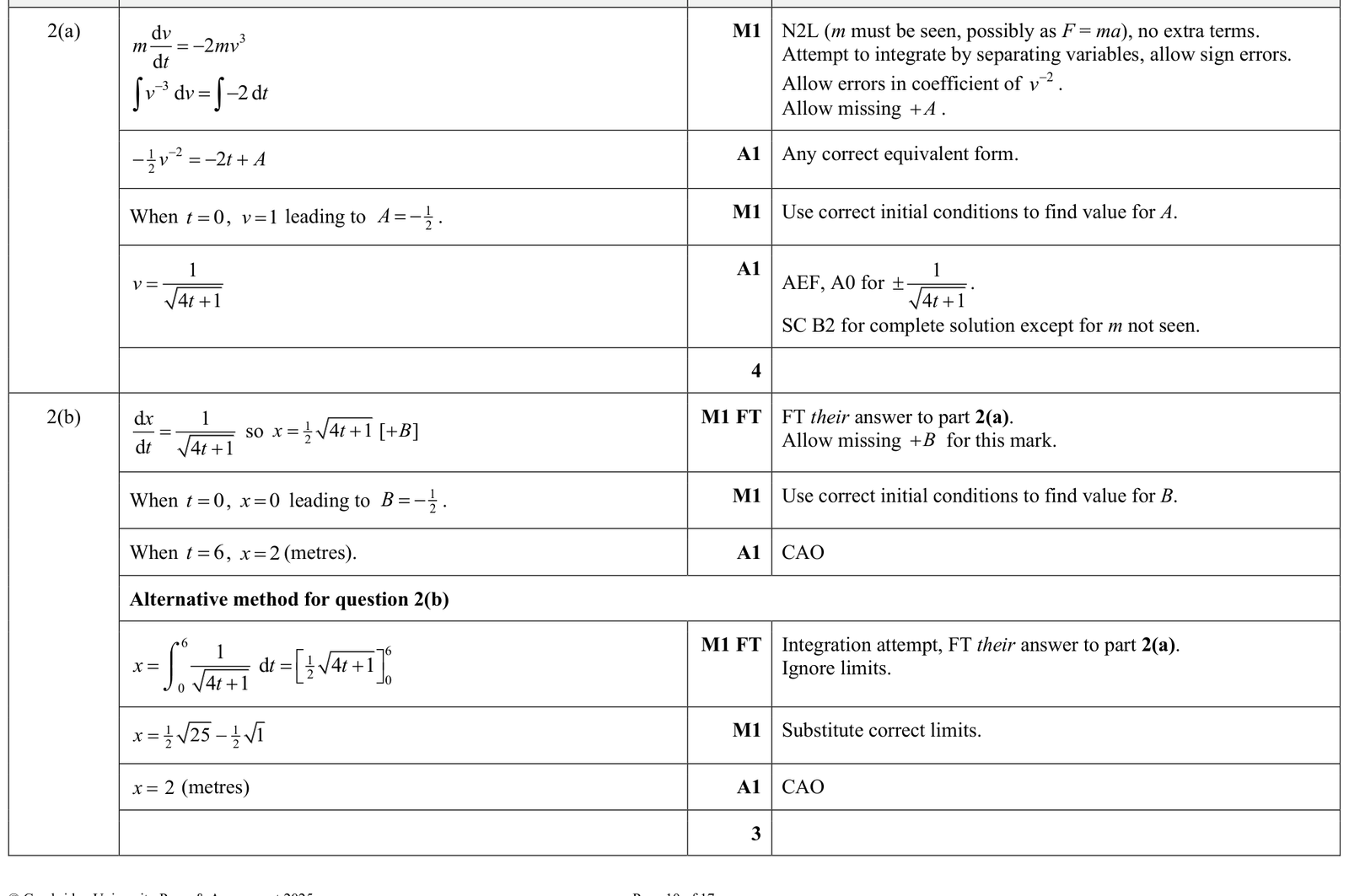
9231 P34 - Jun 2025 - Q2 - 7 marks
A particle \(P\) of mass \(m\,\text{kg}\) moves along a horizontal straight line against a resistive force of magnitude \(2mv^3\,\text{N}\), where \(v\,\text{m s}^{-1}\) is the velocity of \(P\) at time \(t\,\text{s}\). When \(t=0\), \(v=1\).
(a) Find an expression for \(v\) in terms of \(t\).
(b) Find the displacement of \(P\) from its initial position when \(t=6\).
9231 P31 - Nov 2024 - Q5 - 7 marks
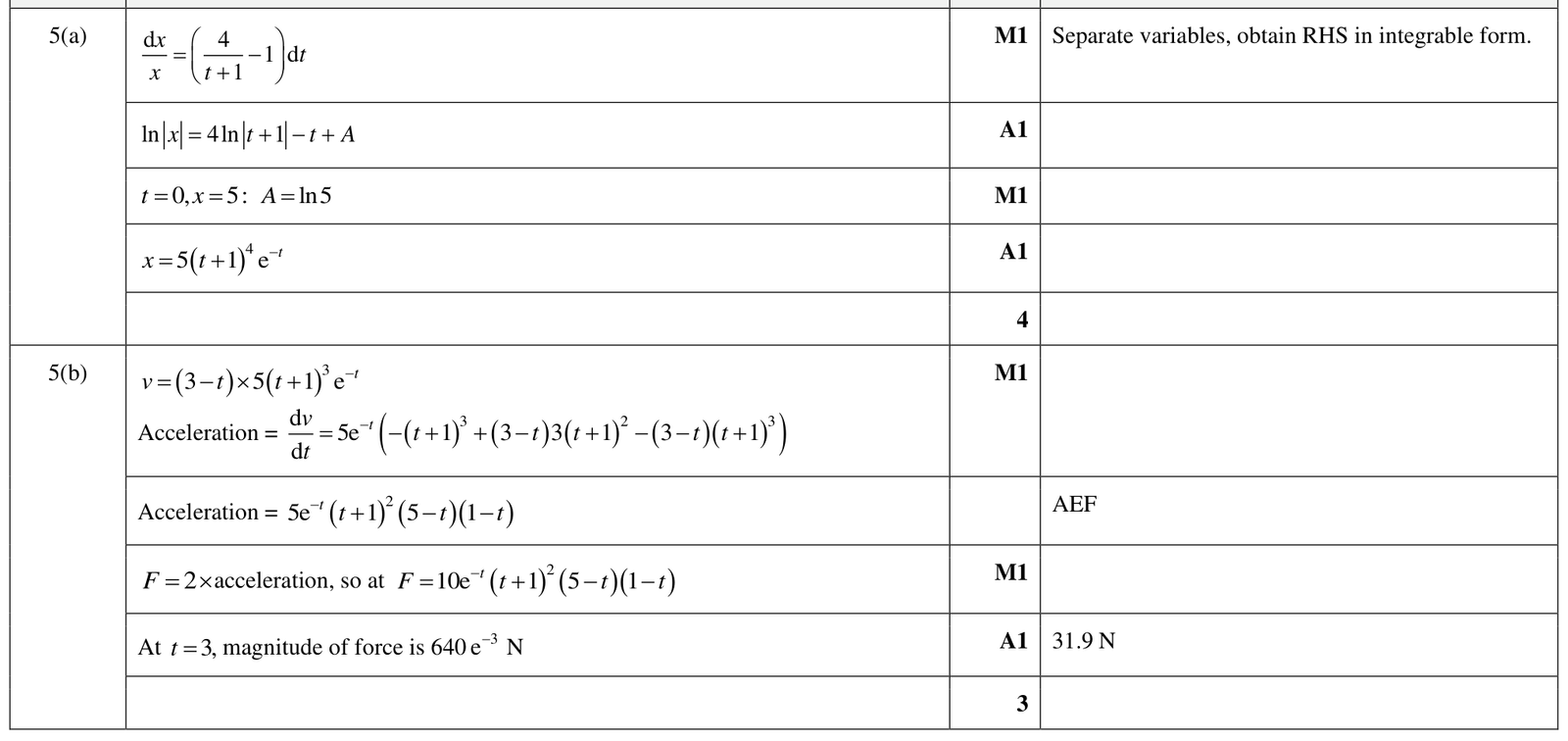
A particle \(P\) of mass \(2\,\text{kg}\) moves on a horizontal straight line. Its displacement from a fixed point \(O\) is \(x\) m and its velocity is \(v\,\text{m s}^{-1}\) at time \(t\) s.
The only horizontal force acting on \(P\) is a variable force \(F\) N which can be expressed as a function of \(t\). It is given that
and when \(t=0\), \(x=5\).
(a) Find an expression for \(x\) in terms of \(t\).
(b) Find the magnitude of \(F\) when \(t=3\).
9231 P31 - Jun 2024 - Q6 - 9 marks
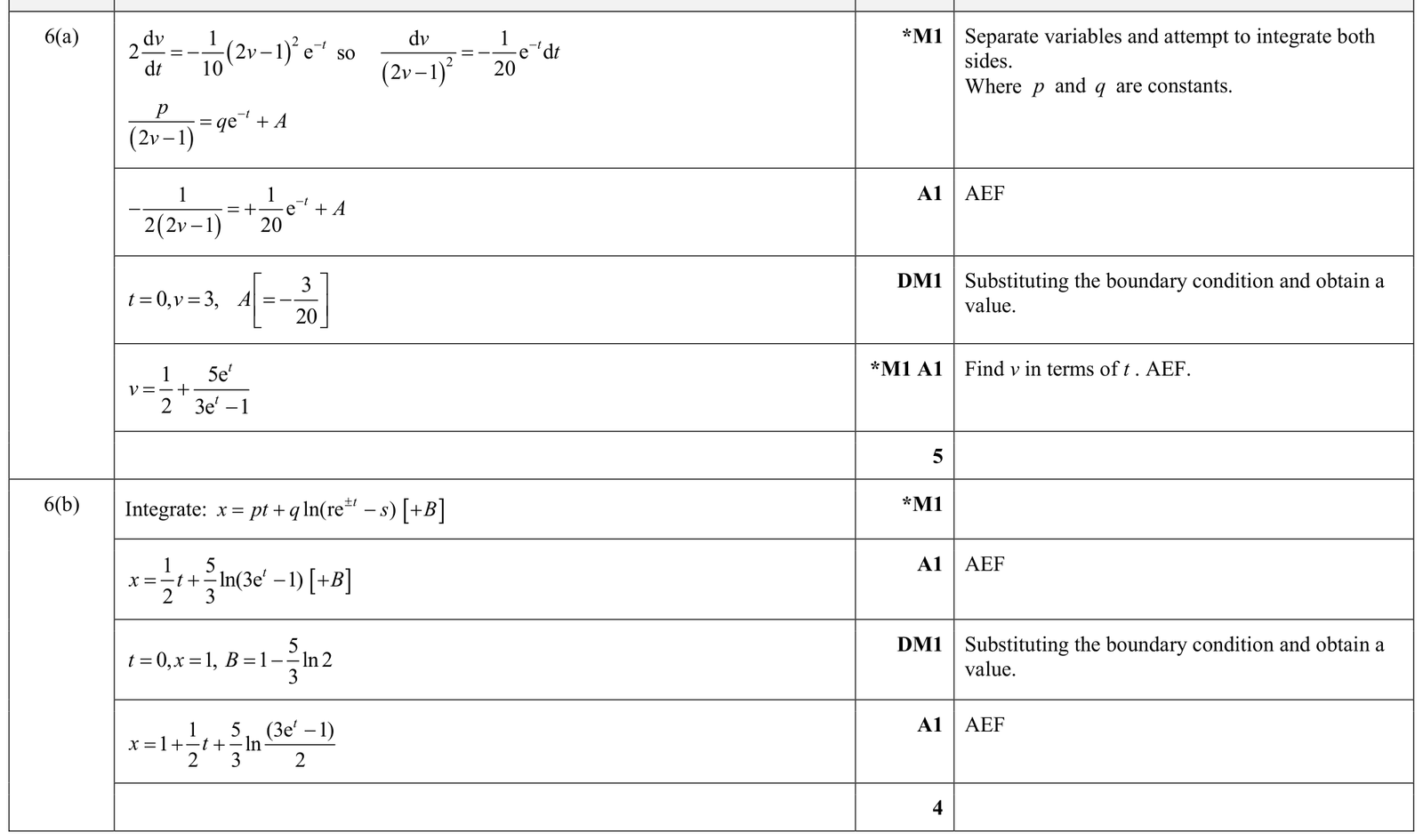
A particle \(P\) of mass \(2\,\text{kg}\) moving on a horizontal straight line has displacement \(x\) m from a fixed point \(O\) on the line and velocity \(v\,\text{m s}^{-1}\) at time \(t\) s.
The only horizontal force acting on \(P\) has magnitude \(\dfrac1{10}(2v-1)^2e^{-t}\) N and acts towards \(O\). When \(t=0\), \(x=1\) and \(v=3\).
(a) Find an expression for \(v\) in terms of \(t\).
(b) Find an expression for \(x\) in terms of \(t\).
9231 P33 - Jun 2024 - Q7 - 11 marks
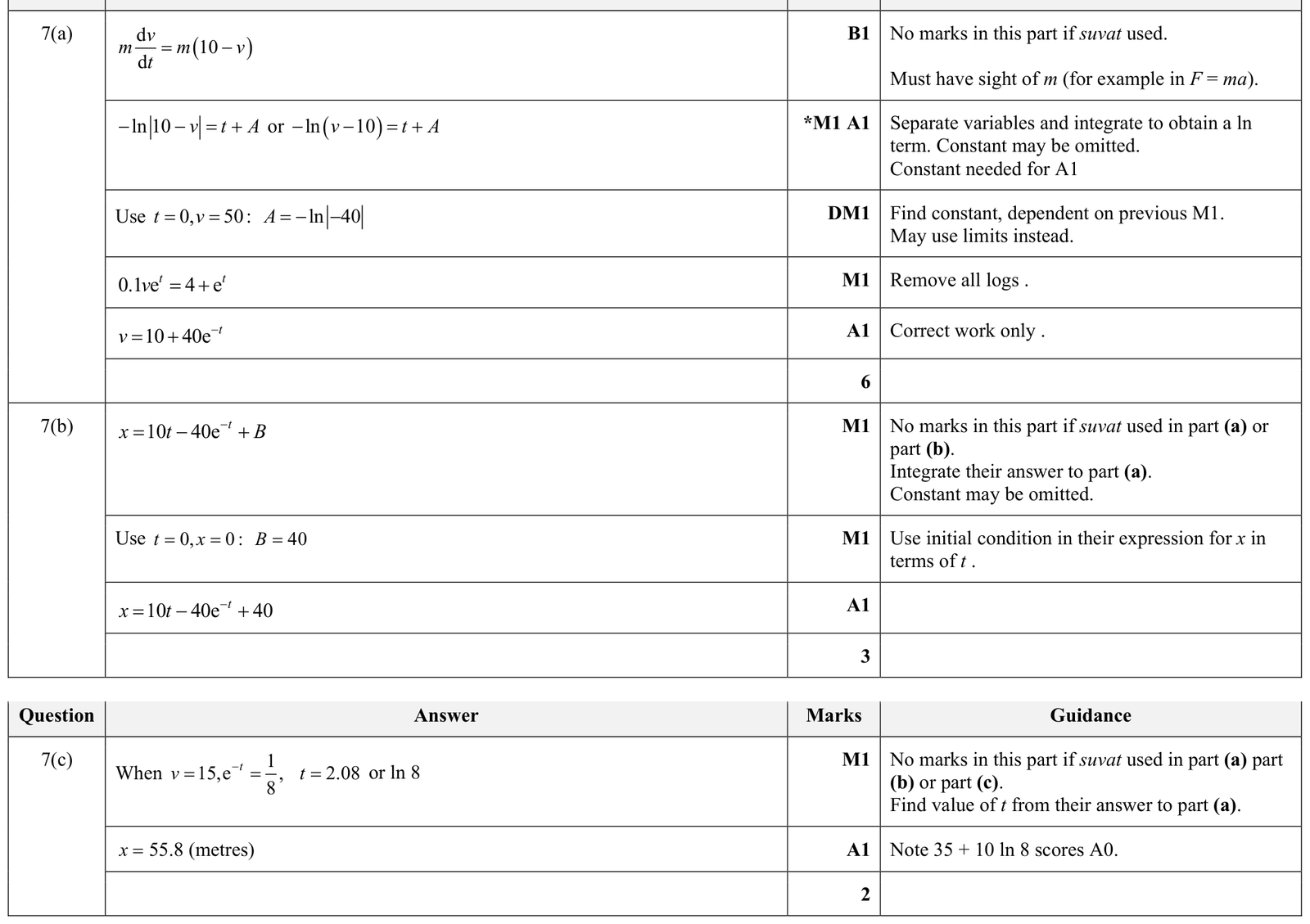
A parachutist of mass \(m\) kg opens his parachute when he is moving vertically downwards with speed \(50\,\text{m s}^{-1}\). At time \(t\) seconds after opening his parachute, he has fallen a distance \(x\) m from the point where he opened his parachute, and his speed is \(v\,\text{m s}^{-1}\).
The forces acting on him are his weight and a resistive force of magnitude \(mv\) N.
(a) Find an expression for \(v\) in terms of \(t\).
(b) Find an expression for \(x\) in terms of \(t\).
(c) Find the distance that the parachutist has fallen, since opening his parachute, when his speed is \(15\,\text{m s}^{-1}\).
9231 P31 - Nov 2023 - Q2 - 7 marks
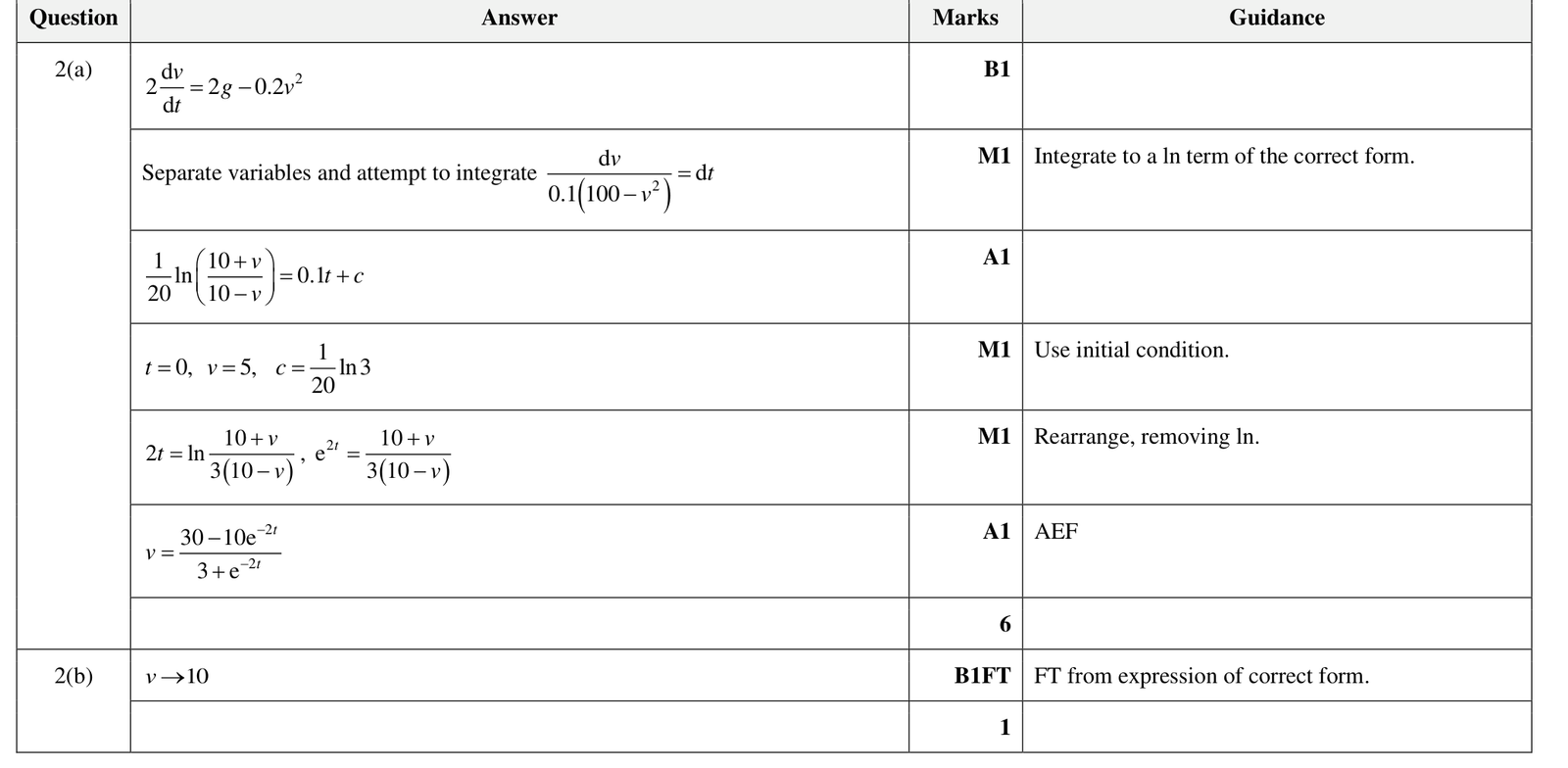
A ball of mass \(2\,\text{kg}\) is projected vertically downwards with speed \(5\,\text{m s}^{-1}\) through a liquid. At time \(t\) seconds after projection, the velocity of the ball is \(v\,\text{m s}^{-1}\), and its displacement from its starting point is \(x\) metres.
The forces acting on the ball are its weight and a resistive force of magnitude \(0.2v^2\,\text{N}\).
(a) Find an expression for \(v\) in terms of \(t\).
(b) Deduce what happens to \(v\) for large values of \(t\).
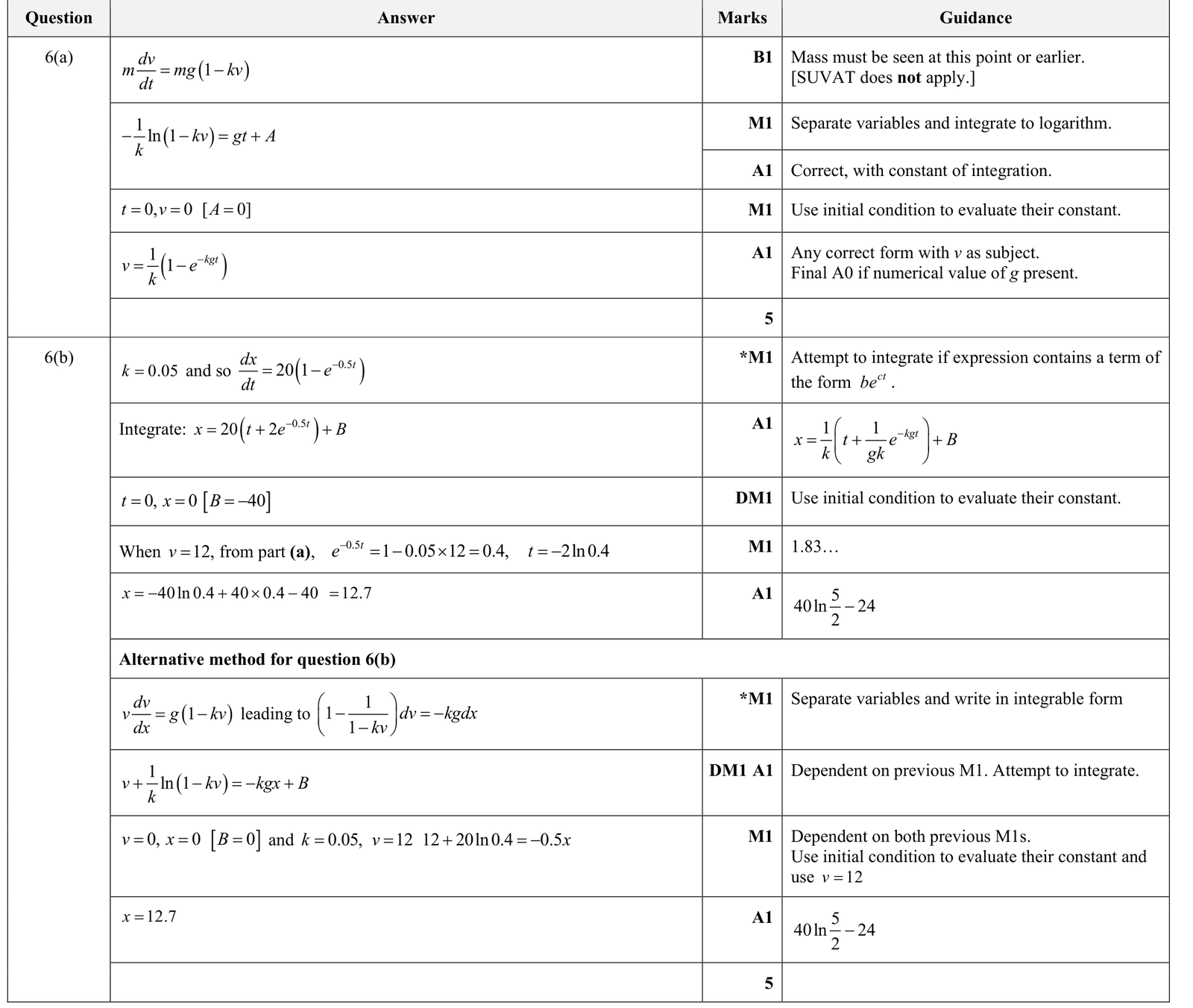
9231 P33 - Jun 2023 - Q6 - 10 marks
A particle of mass \(m \mathrm{~kg}\) falls vertically under gravity, from rest. At time \(t \mathrm{~s}, P\) has fallen \(x \mathrm{~m}\) and has velocity \(v \mathrm{~m} \mathrm{~s}^{-1}\). The only forces acting on \(P\) are its weight and a resistance of magnitude \(k m g v \mathrm{~N}\), where \(k\) is a constant.
(a) Find an expression for \(v\) in terms of \(t, g\) and \(k\).
(b) Given that \(k=0.05\), find, in metres, how far \(P\) has fallen when its speed is \(12 \mathrm{~m} \mathrm{~s}^{-1}\).
9231 P31 - Jun 2022 - Q3 - 5 marks
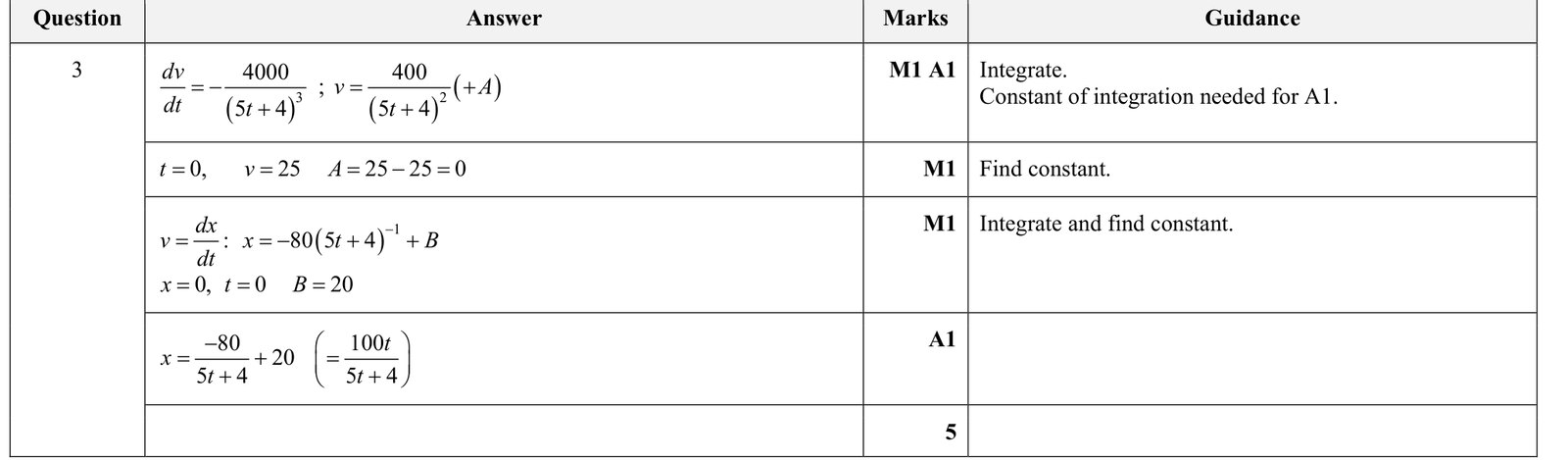
A particle \(P\) is moving in a horizontal straight line. Initially \(P\) is at the point \(O\) on the line and is moving with velocity \(25 \mathrm{~m} \mathrm{~s}^{-1}\). At time \(t \mathrm{~s}\) after passing through \(O\), the acceleration of \(P\) is \(\frac{4000}{(5 t+4)^{3}} \mathrm{~ms}^{-2}\) in the direction \(P O\). The displacement of \(P\) from \(O\) at time \(t\) is \(x \mathrm{~m}\).
Find an expression for \(x\) in terms of \(t\).
9231 P31 - Nov 2022 - Q4 - 8 marks
A particle of mass 0.5 kg moves along a horizontal straight line. Its velocity is \(v \mathrm{~m} \mathrm{~s}^{-1}\) at time \(t \mathrm{~s}\). The forces acting on the particle are a driving force of magnitude 50 N and a resistance of magnitude \(2 v^{2} \mathrm{~N}\). The initial velocity of the particle is \(3 \mathrm{~ms}^{-1}\).
(a) Find an expression for \(v\) in terms of \(t\).
(b) Deduce the limiting value of \(v\).

9231 P31 - Jun 2021 - Q1 - 5 marks
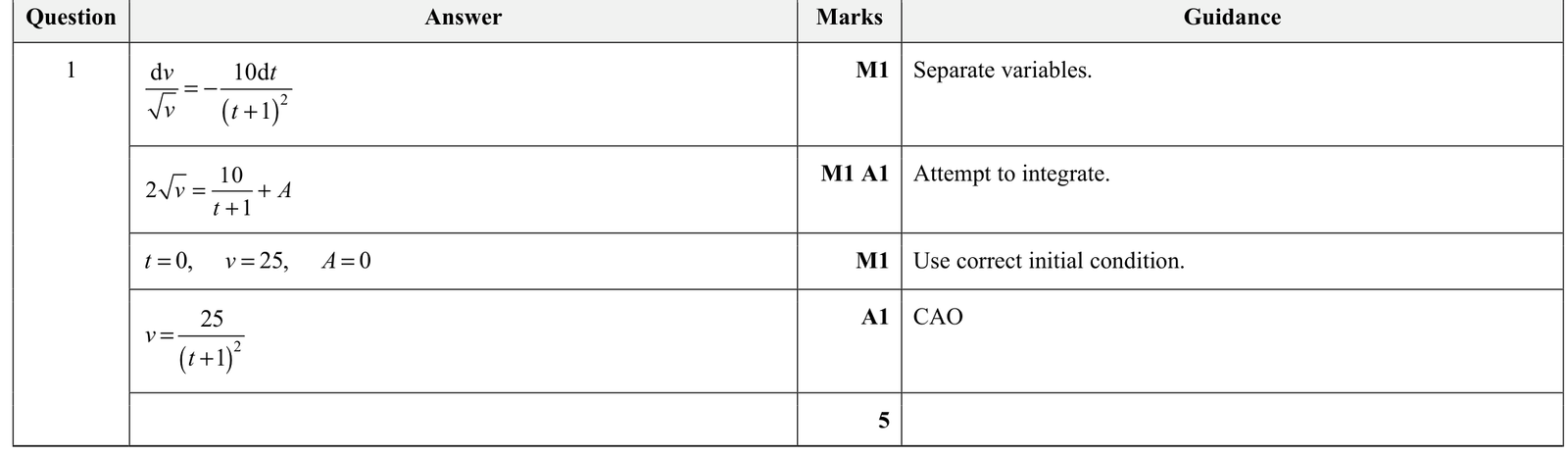
A particle \(P\) of mass 1 kg is moving along a straight line against a resistive force of magnitude \(\frac{10 \sqrt{v}}{(t+1)^{2}} \mathrm{~N}\), where \(v \mathrm{~m} \mathrm{~s}^{-1}\) is the speed of \(P\) at time \(t \mathrm{~s}\). When \(t=0, v=25\).
Find an expression for \(v\) in terms of \(t\).
9231 P33 - Jun 2021 - Q5 - 10 marks
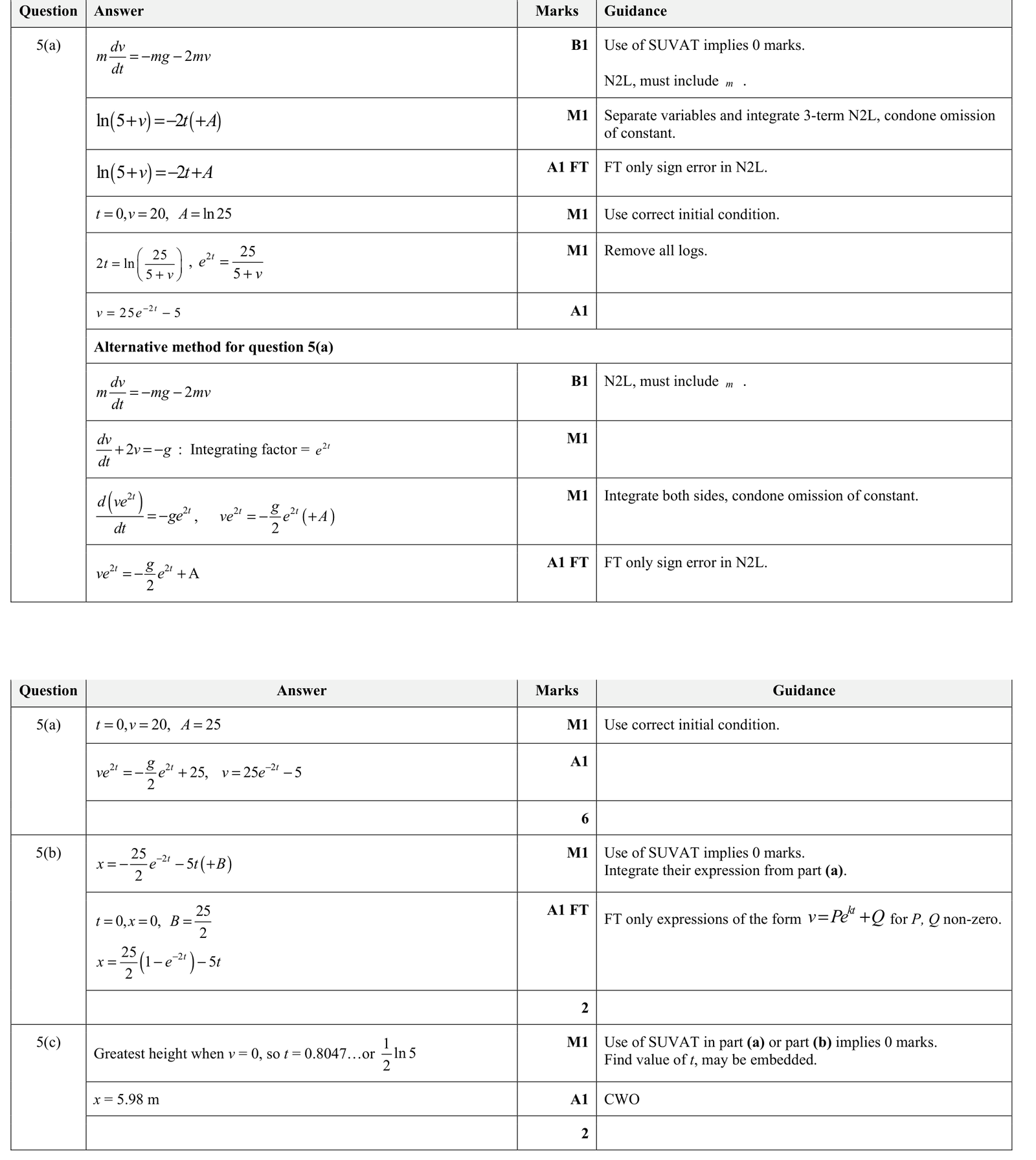
A particle \(P\) of mass \(m \mathrm{~kg}\) is projected vertically upwards from a point \(O\), with speed \(20 \mathrm{~ms}^{-1}\), and moves under gravity. There is a resistive force of magnitude \(2 m v \mathrm{~N}\), where \(v \mathrm{~ms}^{-1}\) is the speed of \(P\) at time \(t \mathrm{~s}\) after projection.
(a) Find an expression for \(v\) in terms of \(t\), while \(P\) is moving upwards.
The displacement of \(P\) from \(O\) is \(x \mathrm{~m}\) at time \(t \mathrm{~s}\).
(b) Find an expression for \(x\) in terms of \(t\), while \(P\) is moving upwards.
(c) Find, correct to 3 significant figures, the greatest height above \(O\) reached by \(P\).
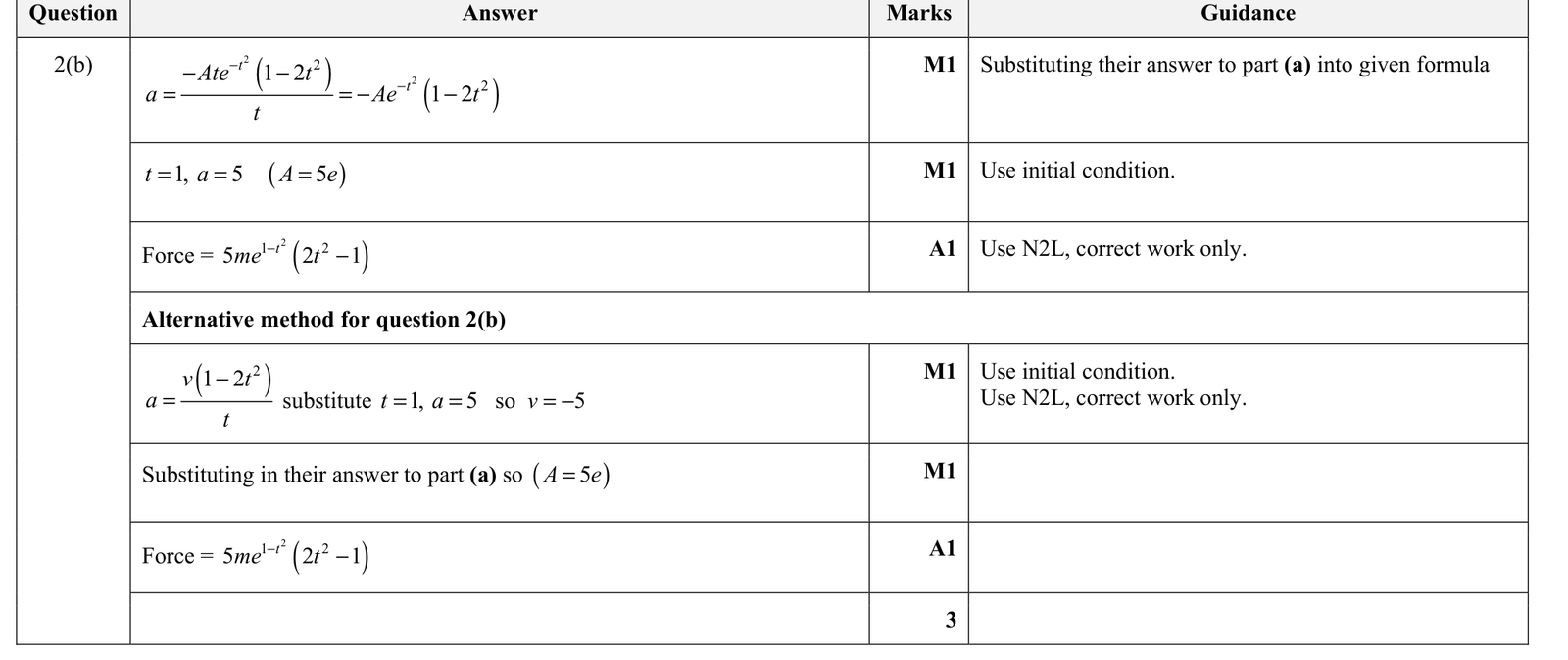
9231 P31 - Nov 2021 - Q2 - 6 marks
A particle \(P\) of mass \(m \mathrm{~kg}\) moves along a horizontal straight line with acceleration \(a \mathrm{~ms}^{-2}\) given by
\(a=\frac{v\left(1-2 t^{2}\right)}{t},\)
where \(v \mathrm{~m} \mathrm{~s}^{-1}\) is the velocity of \(P\) at time \(t \mathrm{~s}\).
(a) Find an expression for \(v\) in terms of \(t\) and an arbitrary constant.
(b) Given that \(a=5\) when \(t=1\), find an expression, in terms of \(m\) and \(t\), for the horizontal force acting on \(P\) at time \(t\).
9231 P31 - Jun 2020 - Q5 - 8 marks
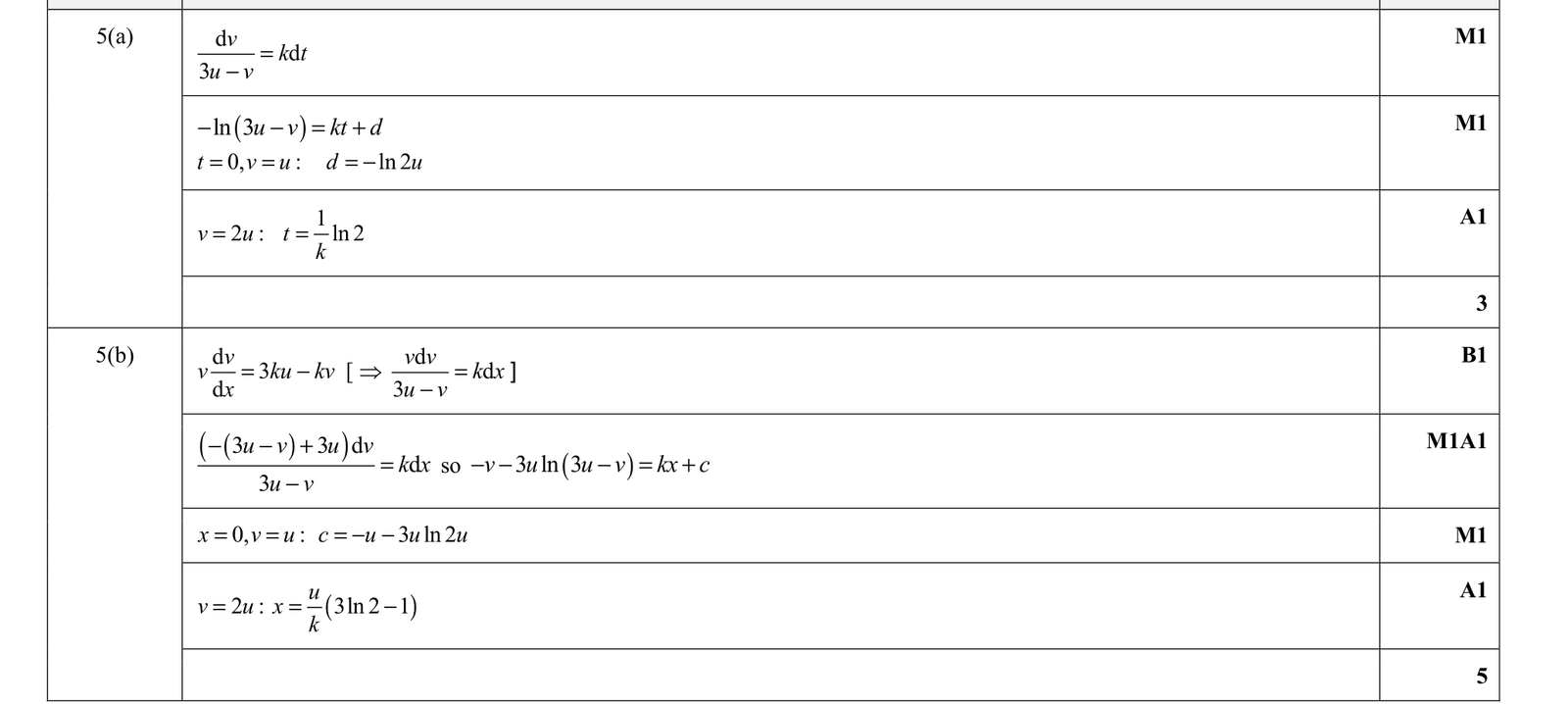
A particle \(P\) is moving along a straight line with acceleration \(3 k u-k v\) where \(v\) is its velocity at time \(t\), \(u\) is its initial velocity and \(k\) is a constant. The velocity and acceleration of \(P\) are both in the direction of increasing displacement from the initial position.
(a) Find the time taken for \(P\) to achieve a velocity of \(2 u\).
(b) Find an expression for the displacement of \(P\) from its initial position when its velocity is \(2 u\).
9231 P33 - Jun 2020 - Q2 - 6 marks
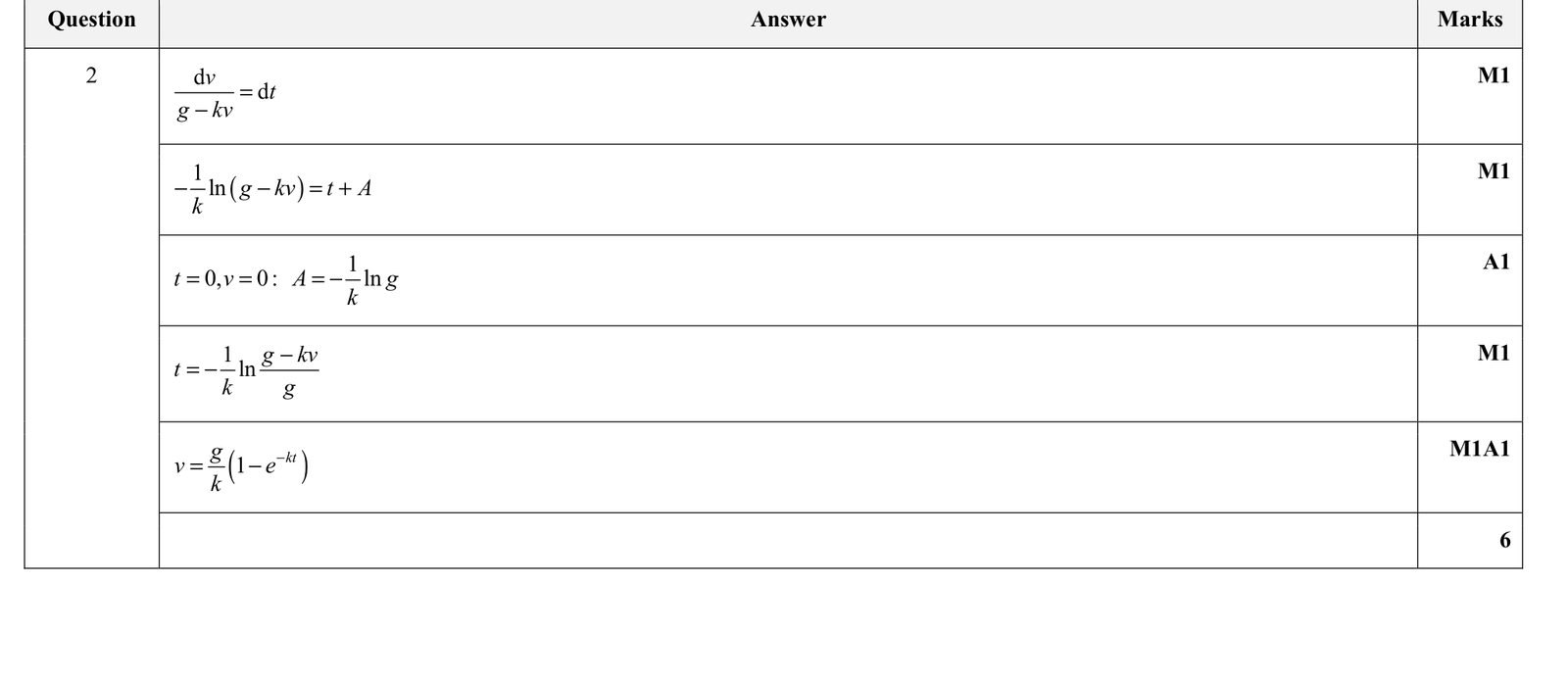
A particle \(Q\) of mass \(m \mathrm{~kg}\) falls from rest under gravity. The motion of \(Q\) is resisted by a force of magnitude \(m k v \mathrm{~N}\), where \(v \mathrm{~ms}^{-1}\) is the speed of \(Q\) at time \(t \mathrm{~s}\) and \(k\) is a positive constant.
Find an expression for \(v\) in terms of \(g, k\) and \(t\).