9231 P31 - Nov 2025 - Q4 - 6 marks
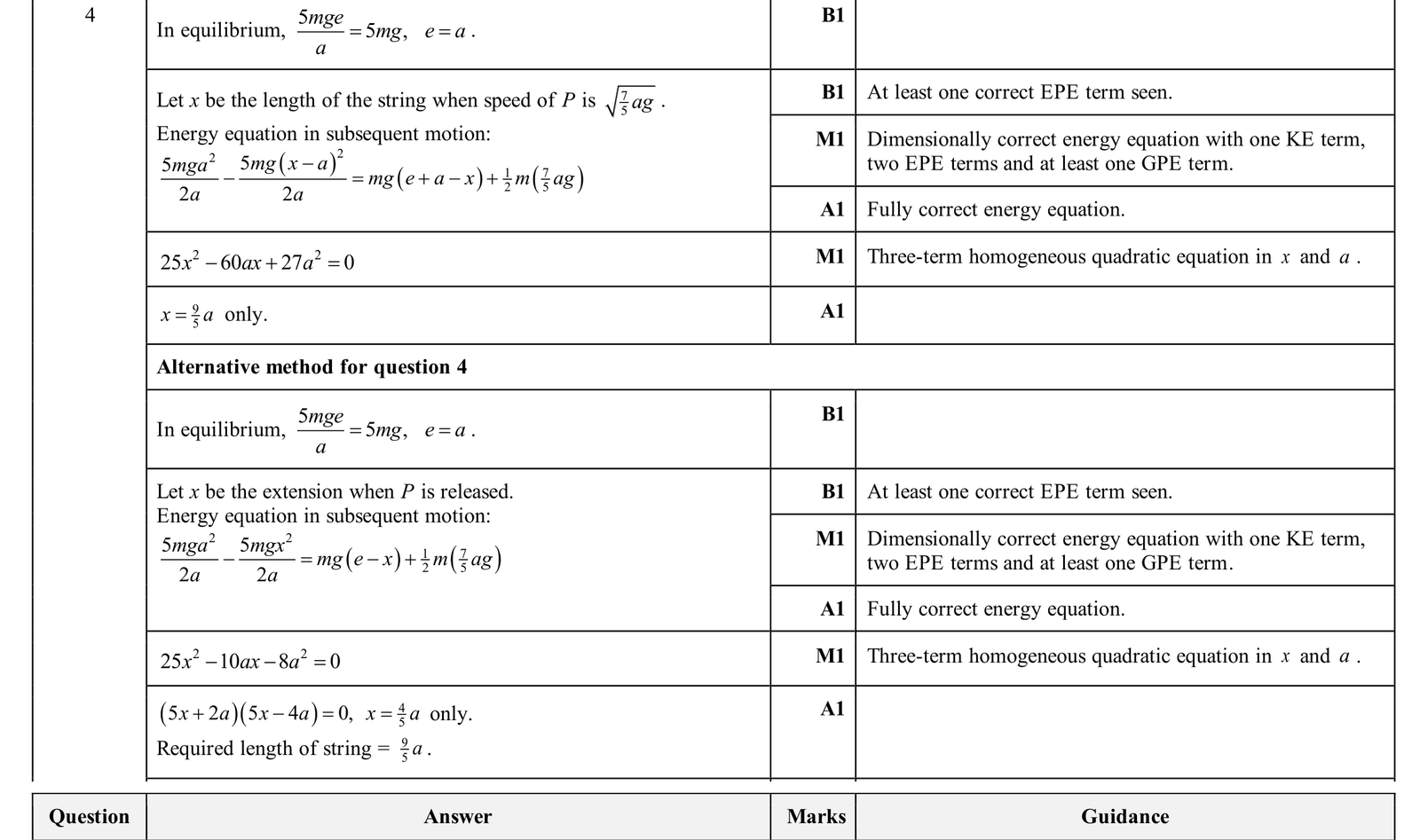
One end of a light elastic string of natural length \(a\) and modulus of elasticity 5 mg is attached to a fixed point \(O\). Two particles, \(P\) and \(Q\), of masses \(m\) and \(4 m\) respectively are attached to the other end of the string and they hang vertically in equilibrium. Particle \(Q\) is then detached from the string, hence releasing particle \(P\) from rest.
Find, in terms of \(a\), the length of the string when the speed of particle \(P\) is first equal to \(\sqrt{\frac{7}{5} a g}\).
9231 P31 - Jun 2025 - Q5 - 6 marks
One end of a light elastic string of natural length \(0.5\) m and modulus \(14\) N is attached to a fixed point \(A\) on a smooth plane. The plane makes an angle \(\alpha\) with the horizontal, where \(\tan\alpha=\frac{7}{24}\). A particle \(P\) of mass \(2\) kg is attached to the other end. The string lies along a line of greatest slope. Initially, \(P\) is held above the level of \(A\), where \(AP=0.8\) m, and is then released from rest.
Find the maximum velocity of \(P\) during the subsequent motion.

9231 P33 - Jun 2025 - Q2 - 8 marks
A particle \(P\) of mass \(m\) is attached to a light elastic string of natural length \(a\) and modulus \(mg\). The other end is fixed at \(O\) on a rough plane inclined at \(30^\circ\) to the horizontal. The particle is held at rest at \(O\) and released. The frictional force while it slides down the plane is \(\frac{11}{30}mg\).
(a) Find, in terms of \(a\), the distance moved down the plane before coming to rest.
(b) Given that \(P\) remains at rest in this new position, find the magnitude of the frictional force.

9231 P31 - Nov 2024 - Q3 - 8 marks
A particle \(P\) of mass \(m\,\text{kg}\) is attached to one end of a light elastic string of natural length \(2\) m and modulus of elasticity \(2mg\) N. The other end is attached to a fixed point \(O\). The particle hangs in equilibrium vertically below \(O\).
The particle is pulled vertically downwards a distance \(d\) m below its equilibrium position and released from rest.
(a) Given that the particle just reaches \(O\) in the subsequent motion, find \(d\).
(b) Hence find the speed of \(P\) when it is \(2\) m below \(O\).

9231 P31 - Jun 2024 - Q2 - 7 marks
The points \(A\) and \(B\) are at the same horizontal level and are \(4a\) apart. The ends of a light elastic string, of natural length \(4a\) and modulus of elasticity \(\lambda\), are attached to \(A\) and \(B\). A particle \(P\) of mass \(m\) is attached to the midpoint of the string.
The system is in equilibrium with \(P\) at a distance \(\dfrac32a\) below \(M\), the midpoint of \(AB\).
(a) Find \(\lambda\) in terms of \(m\) and \(g\).
The particle \(P\) is then pulled down vertically and released from rest at a distance \(\dfrac83a\) below \(M\).
(b) Find, in terms of \(a\) and \(g\), the speed of \(P\) as it passes through \(M\) in the subsequent motion.

9231 P33 - Jun 2024 - Q4 - 7 marks
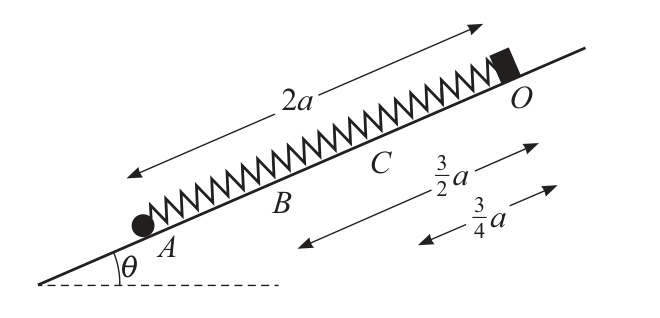
A light spring of natural length \(a\) and modulus of elasticity \(kmg\) is attached to a fixed point \(O\) on a smooth plane inclined at angle \(\theta\) to the horizontal, where \(\sin\theta=\dfrac34\). A particle of mass \(m\) is attached to the lower end of the spring and is held at point \(A\), where \(OA=2a\) and \(OA\) is along a line of greatest slope of the plane.
The particle is released from rest. It is moving with speed \(V\) when it passes through point \(B\), where \(OB=\dfrac32a\). Its speed is \(\dfrac12V\) when it passes through point \(C\), where \(OC=\dfrac34a\).
Find \(k\).

9231 P31 - Nov 2023 - Q4 - 8 marks
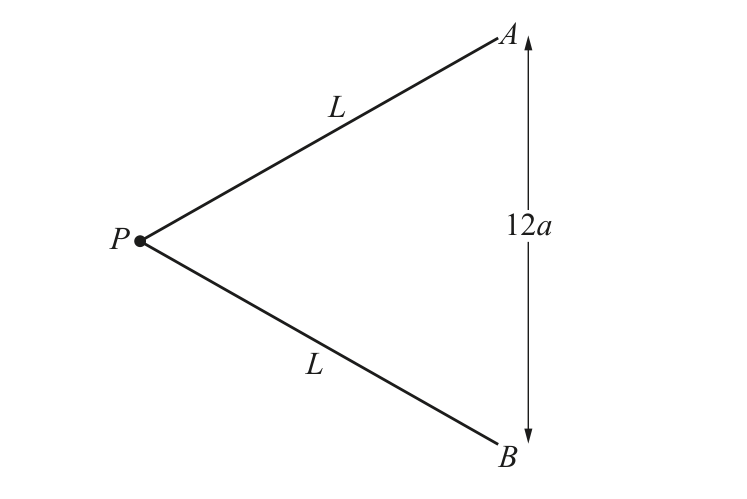
A light elastic string has natural length \(8a\) and modulus of elasticity \(5mg\). A particle \(P\) of mass \(m\) is attached to the midpoint of the string. The ends of the string are attached to points \(A\) and \(B\), which are a distance \(12a\) apart on a smooth horizontal table.
The particle \(P\) is held on the table so that \(AP=BP=L\). The particle \(P\) is released from rest. When \(P\) is at the midpoint of \(AB\), it has speed \(\sqrt{80ag}\).
(a) Find \(L\) in terms of \(a\).
(b) Find the initial acceleration of \(P\) in terms of \(g\).

9231 P32 - Nov 2023 - Q7 - 9 marks
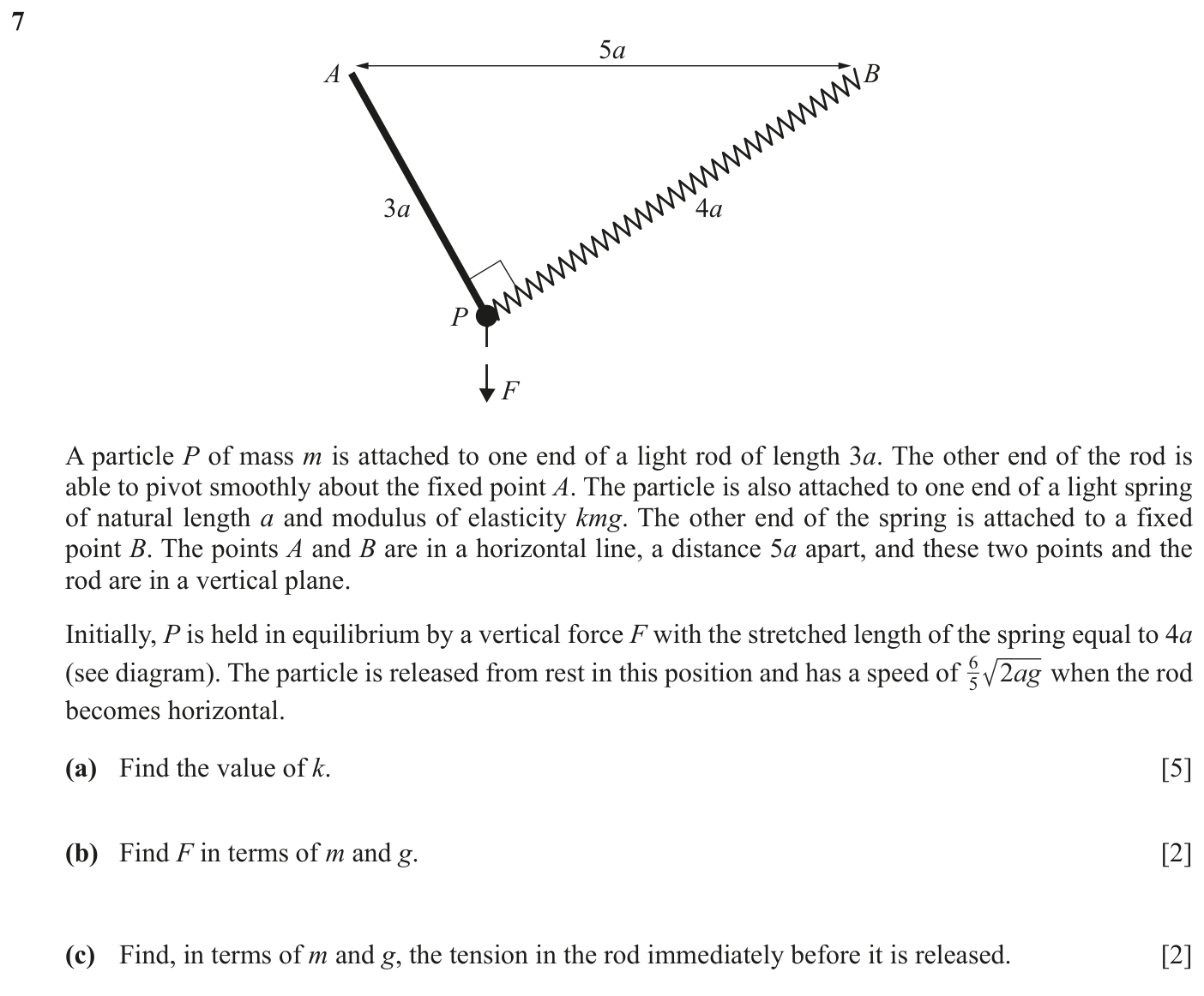
A particle \(P\) of mass \(m\) is attached to one end of a light rod of length \(3a\). The other end of the rod is able to pivot smoothly about the fixed point \(A\). The particle is also attached to one end of a light spring of natural length \(a\) and modulus of elasticity \(kmg\). The other end of the spring is attached to a fixed point \(B\).
The points \(A\) and \(B\) are in a horizontal line, a distance \(5a\) apart, and these two points and the rod are in a vertical plane.
Initially, \(P\) is held in equilibrium by a vertical force \(F\), with the stretched length of the spring equal to \(4a\). The particle is released from rest in this position and has a speed of \(\dfrac65\sqrt{2ag}\) when the rod becomes horizontal.
(a) Find the value of \(k\).
(b) Find \(F\) in terms of \(m\) and \(g\).
(c) Find, in terms of \(m\) and \(g\), the tension in the rod immediately before it is released.

9231 P31 - Jun 2023 - Q1 - 5 marks
One end of a light elastic string, of natural length \(a\) and modulus of elasticity \(3 m g\), is attached to a fixed point \(O\). The other end of the string is attached to a particle \(P\) of mass \(m\). The string hangs with \(P\) vertically below \(O\). The particle \(P\) is pulled vertically downwards so that the extension of the string is \(2 a\). The particle \(P\) is then released from rest.
(a) Find the speed of \(P\) when it is at a distance \(\frac{3}{4} a\) below \(O\).
(b) Find the initial acceleration of \(P\) when it is released from rest.

9231 P33 - Jun 2023 - Q2 - 4 marks
One end of a light elastic string, of natural length \(a\) and modulus of elasticity \(\lambda m g\), is attached to a fixed point \(O\). The string lies on a smooth horizontal surface. A particle \(P\) of mass \(m\) is attached to the other end of the string. The particle \(P\) is projected in the direction \(O P\). When the length of the string is \(\frac{4}{3} a\), the speed of \(P\) is \(\sqrt{2 a g}\). When the length of the string is \(\frac{5}{3} a\), the speed of \(P\) is \(\frac{1}{2} \sqrt{2 a g}\).
Find the value of \(\lambda\).

9231 P33 - Jun 2022 - Q2 - 5 marks
A particle \(P\) of mass \(m\) is attached to one end of a light elastic string of natural length \(a\) and modulus of elasticity \(\frac{4}{3} m g\). The other end of the string is attached to a fixed point \(O\) on a rough horizontal surface. The particle is at rest on the surface with the string at its natural length. The coefficient of friction between \(P\) and the surface is \(\frac{1}{3}\). The particle is projected along the surface in the direction \(O P\) with a speed of \(\frac{1}{2} \sqrt{g a}\).
Find the greatest extension of the string during the subsequent motion.

9231 P31 - Nov 2022 - Q2 - 6 marks
A light elastic string has natural length \(a\) and modulus of elasticity \(4 m g\). One end of the string is fixed to a point \(O\) on a smooth horizontal surface. A particle \(P\) of mass \(m\) is attached to the other end of the string. The particle \(P\) is projected along the surface in the direction \(O P\). When the length of the string is \(\frac{5}{4} a\), the speed of \(P\) is \(v\). When the length of the string is \(\frac{3}{2} a\), the speed of \(P\) is \(\frac{1}{2} v\).
(a) Find an expression for \(v\) in terms of \(a\) and \(g\).
(b) Find, in terms of \(g\), the acceleration of \(P\) when the stretched length of the string is \(\frac{3}{2} a\).

9231 P32 - Nov 2022 - Q3 - 6 marks
One end of a light elastic string, of natural length \(a\) and modulus of elasticity \(\frac{16}{3} M g\), is attached to a fixed point \(O\). A particle \(P\) of mass \(4 M\) is attached to the other end of the string and hangs vertically in equilibrium. Another particle of mass \(2 M\) is attached to \(P\) and the combined particle is then released from rest. The speed of the combined particle when it has descended a distance \(\frac{1}{4} a\) is \(v\).
Find an expression for \(v\) in terms of \(g\) and \(a\).

9231 P31 - Jun 2021 - Q3 - 7 marks
One end of a light elastic string, of natural length \(a\) and modulus of elasticity \(k m g\), is attached to a fixed point \(A\). The other end of the string is attached to a particle \(P\) of mass \(4 m\). The particle \(P\) hangs in equilibrium a distance \(x\) vertically below \(A\).
(a) Show that \(k=\frac{4 a}{x-a}\).
An additional particle, of mass \(2 m\), is now attached to \(P\) and the combined particle is released from rest at the original equilibrium position of \(P\). When the combined particle has descended a distance \(\frac{1}{3} a\), its speed is \(\frac{1}{3} \sqrt{g a}\).
(b) Find \(x\) in terms of \(a\).

9231 P33 - Jun 2021 - Q2 - 5 marks
One end of a light elastic string of natural length 0.8 m and modulus of elasticity 36 N is attached to a fixed point \(O\) on a smooth plane. The plane is inclined at an angle \(\alpha\) to the horizontal, where \(\sin \alpha=\frac{3}{5}\). A particle \(P\) of mass 2 kg is attached to the other end of the string. The string lies along a line of greatest slope of the plane with the particle below the level of \(O\). The particle is projected with speed \(\sqrt{2} \mathrm{~ms}^{-1}\) directly down the plane from the position where \(O P\) is equal to the natural length of the string.
Find the maximum extension of the string during the subsequent motion.

9231 P31 - Nov 2021 - Q3 - 6 marks
A light elastic string has natural length \(a\) and modulus of elasticity \(12 m g\). One end of the string is attached to a fixed point \(O\). The other end of the string is attached to a particle of mass \(m\). The particle hangs in equilibrium vertically below \(O\). The particle is pulled vertically down and released from rest with the extension of the string equal to \(e\), where \(e\gt \frac{1}{3} a\). In the subsequent motion the particle has speed \(\sqrt{2 g a}\) when it has ascended a distance \(\frac{1}{3} a\).
Find \(e\) in terms of \(a\).

9231 P32 - Nov 2021 - Q2 - 6 marks
A light spring \(A B\) has natural length \(a\) and modulus of elasticity \(5 m g\). The end \(A\) of the spring is attached to a fixed point on a smooth horizontal surface. A particle \(P\) of mass \(m\) is attached to the end \(B\) of the spring. The spring and particle \(P\) are at rest on the surface.
Another particle \(Q\) of mass \(k m\) is moving with speed \(\sqrt{4 g a}\) along the horizontal surface towards \(P\) in the direction \(B A\). The particles \(P\) and \(Q\) collide directly and coalesce. In the subsequent motion the greatest amount by which the spring is compressed is \(\frac{1}{5} a\).
Find the value of \(k\).

9231 P31 - Jun 2020 - Q3 - 7 marks
One end of a light elastic spring, of natural length \(a\) and modulus of elasticity 5 mg , is attached to a fixed point \(A\). The other end of the spring is attached to a particle \(P\) of mass \(m\). The spring hangs with \(P\) vertically below \(A\). The particle \(P\) is released from rest in the position where the extension of the spring is \(\frac{1}{2} a\).
(a) Show that the initial acceleration of \(P\) is \(\frac{3}{2} g\) upwards.
(b) Find the speed of \(P\) when the spring first returns to its natural length.

9231 P33 - Jun 2020 - Q7 - 10 marks
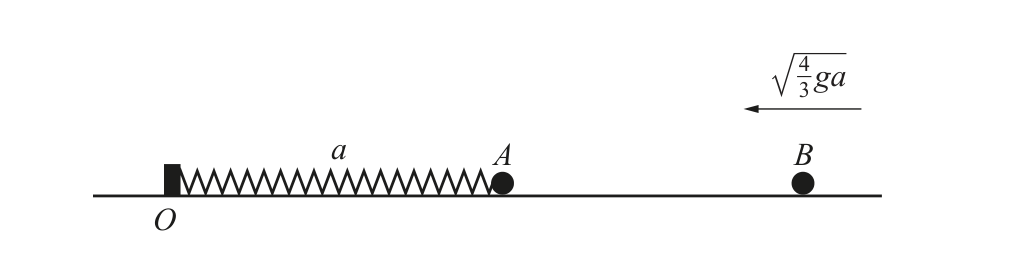
One end of a light spring of natural length \(a\) and modulus of elasticity \(4 m g\) is attached to a fixed point \(O\). The other end of the spring is attached to a particle \(A\) of mass \(k m\), where \(k\) is a constant. Initially the spring lies at rest on a smooth horizontal surface and has length \(a\). A second particle \(B\), of mass \(m\), is moving towards \(A\) with speed \(\sqrt{\frac{4}{3} g a}\) along the line of the spring from the opposite direction to \(O\) (see diagram).
The particles \(A\) and \(B\) collide and coalesce. At a point \(C\) in the subsequent motion, the length of the spring is \(\frac{3}{4} a\) and the speed of the combined particle is half of its initial speed.
(a) Find the value of \(k\).
At the point \(C\) the horizontal surface becomes rough, with coefficient of friction \(\mu\) between the combined particle and the surface. The deceleration of the combined particle at \(C\) is \(\frac{9}{20} g\).
(b) Find the value of \(\mu\).

9231 P31 - Nov 2020 - Q1 - 3 marks
A particle \(P\) of mass \(m\) is placed on a fixed smooth plane which is inclined at an angle \(\theta\) to the horizontal. A light spring, of natural length \(a\) and modulus of elasticity \(3 m g\), has one end attached to \(P\) and the other end attached to a fixed point \(O\) at the top of the plane. The spring lies along a line of greatest slope of the plane. The system is released from rest with the spring at its natural length.
Find, in terms of \(a\) and \(\theta\), an expression for the greatest extension of the spring in the subsequent motion.

9231 P32 - Nov 2020 - Q6 - 8 marks
One end of a light elastic string, of natural length \(a\) and modulus of elasticity \(k\), is attached to a particle \(P\) of mass \(m\). The other end of the string is attached to a fixed point \(Q\). The particle \(P\) is projected vertically upwards from \(Q\). When \(P\) is moving upwards and at a distance \(\frac{4}{3} a\) directly above \(Q\), it has a speed \(\sqrt{2 g a}\). At this point, its acceleration is \(\frac{7}{3} g\) downwards.
Show that \(k=4 m g\) and find in terms of \(a\) the greatest height above \(Q\) reached by \(P\).
