9231 P21 - Nov 2018 - Q11E - 12 marks
Question 11 EITHER alternative.
A particle \(P\) of mass \(m\) is free to move on the smooth inner surface of a fixed hollow sphere of radius \(a\). The centre of the sphere is \(O\) and the point \(C\) is on the inner surface of the sphere, vertically below \(O\). The points \(A\) and \(B\) on the inner surface of the sphere are the ends of a diameter of the sphere. The diameter \(AOB\) makes an acute angle \(\alpha\) with the vertical, where \(\cos\alpha=\frac45\), with \(A\) below the horizontal level of \(B\). The particle is projected from \(A\) with speed \(u\), and moves along the inner surface of the sphere towards \(C\). The normal reaction forces on the particle at \(A\) and \(C\) are in the ratio \(8:9\).
(i) Show that \(u^2=4ag\).
(ii) Determine whether \(P\) reaches \(B\) without losing contact with the inner surface of the sphere.

9231 P21 - Nov 2019 - Q4 - 9 marks
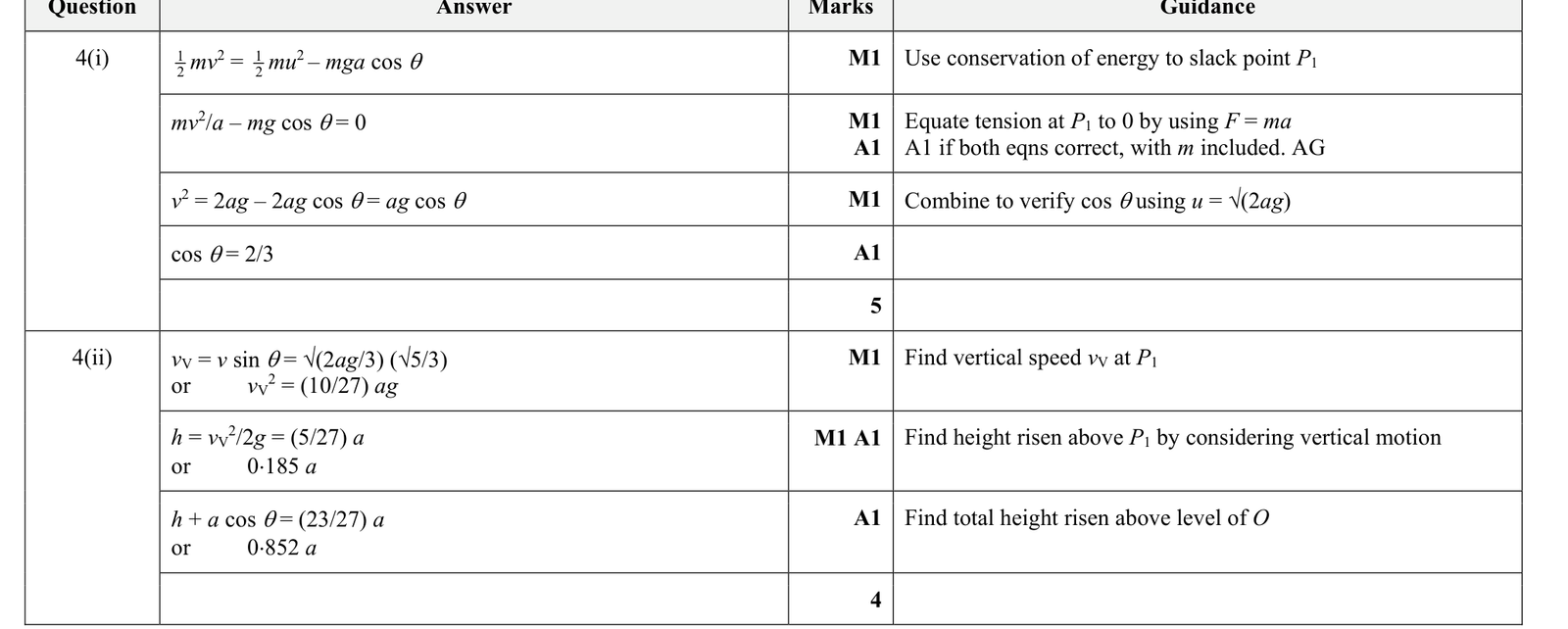
A particle \(P\) of mass \(m\) is attached to one end of a light inextensible string of length \(a\). The other end of the string is attached to a fixed point \(O\) and \(P\) is held with the string taut and horizontal. The particle \(P\) is projected vertically downwards with speed \(\sqrt{ }(2 a g)\) so that it begins to move along a circular path. The string becomes slack when \(O P\) makes an angle \(\theta\) with the upward vertical through \(O\).
(i) Show that \(\cos \theta=\frac{2}{3}\).
(ii) Find the greatest height, above the horizontal through \(O\), reached by \(P\) in its subsequent motion.
9231 P23 - Jun 2019 - Q2 - 8 marks
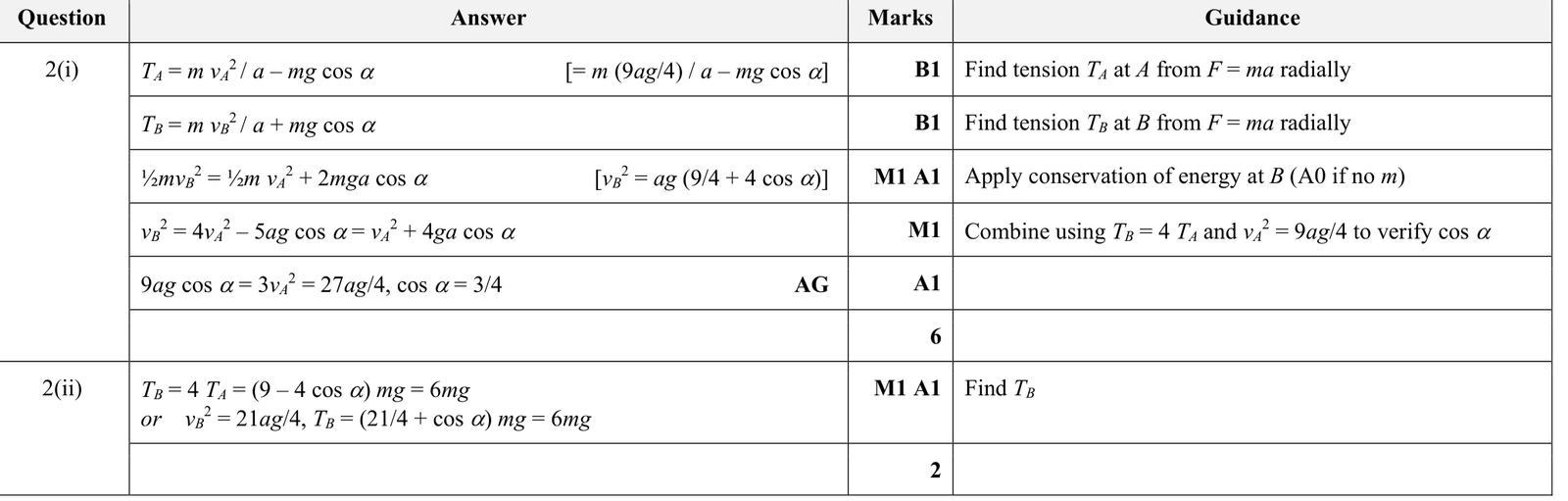
A particle \(P\) of mass \(m\) is attached to one end of a light inextensible string of length \(a\). The other end of the string is attached to a fixed point \(O\). The particle \(P\) is moving in a complete vertical circle about \(O\). The points \(A\) and \(B\) are on the circle, at opposite ends of a diameter, and such that \(O A\) makes an acute angle \(\alpha\) with the upward vertical through \(O\). The speed of \(P\) as it passes through \(A\) is \(\frac{3}{2} \sqrt{ }(a g)\). The tension in the string when \(P\) is at \(B\) is four times the tension in the string when \(P\) is at \(A\).
(i) Show that \(\cos \alpha=\frac{3}{4}\).
(ii) Find the tension in the string when \(P\) is at \(B\).
9231 P21 - Jun 2019 - Q11E - 12 marks
Question 11 EITHER alternative.
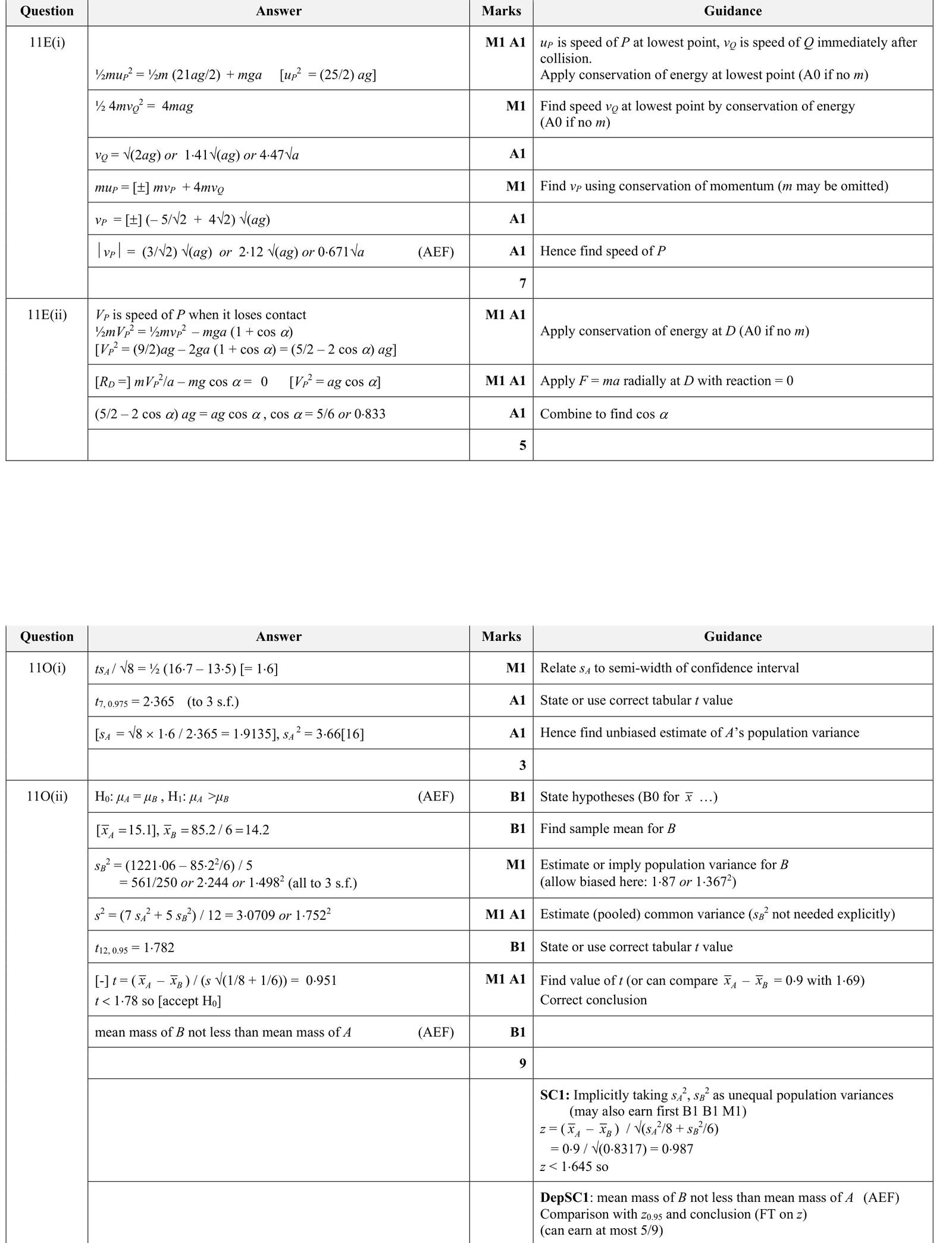
A particle \(P\), of mass \(m\), is able to move in a vertical circle on the smooth inner surface of a sphere with centre \(O\) and radius \(a\). Points \(A\) and \(B\) are on the inner surface of the sphere and \(AOB\) is a horizontal diameter. Initially, \(P\) is projected vertically downwards with speed \(\sqrt{\frac{21}{2}ag}\) from \(A\) and begins to move in a vertical circle. At the lowest point of its path, vertically below \(O\), the particle \(P\) collides with a stationary particle \(Q\), of mass \(4m\), and rebounds. The speed acquired by \(Q\), as a result of the collision, is just sufficient for it to reach the point \(B\).
(i) Find the speed of \(P\) and the speed of \(Q\) immediately after their collision.
In its subsequent motion, \(P\) loses contact with the inner surface of the sphere at the point \(D\), where the angle between \(OD\) and the upward vertical through \(O\) is \(\theta\).
(ii) Find \(\cos\theta\).
9231 P22 - Nov 2018 - Q3 - 9 marks
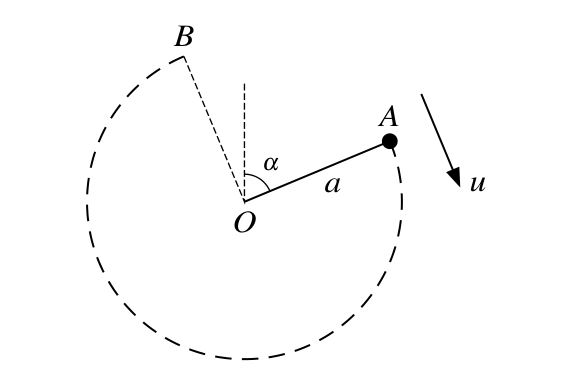
A particle of mass \(m\) is attached to one end of a light inextensible string of length \(a\). The other end of the string is attached to a fixed point \(O\). The point \(A\) is such that \(O A=a\) and \(O A\) makes an angle \(\alpha\) with the upward vertical, where \(\tan \alpha=\frac{12}{5}\). The particle is projected downwards from \(A\) with speed \(u\) perpendicular to the string and moves in a vertical plane (see diagram). The string becomes slack after the string has rotated through \(270^{\circ}\) from its initial position, with the particle now at the point \(B\).
(i) Show that \(u^{2}=2 a g\).
(ii) Find the maximum tension in the string as the particle moves from \(A\) to \(B\).

9231 P21 - Jun 2017 - Q5 - 12 marks
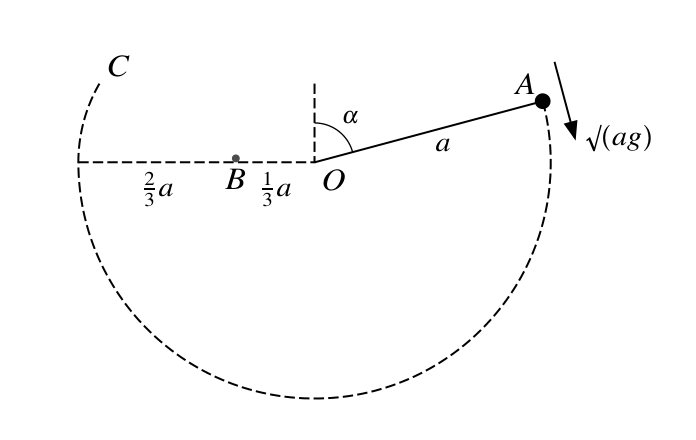
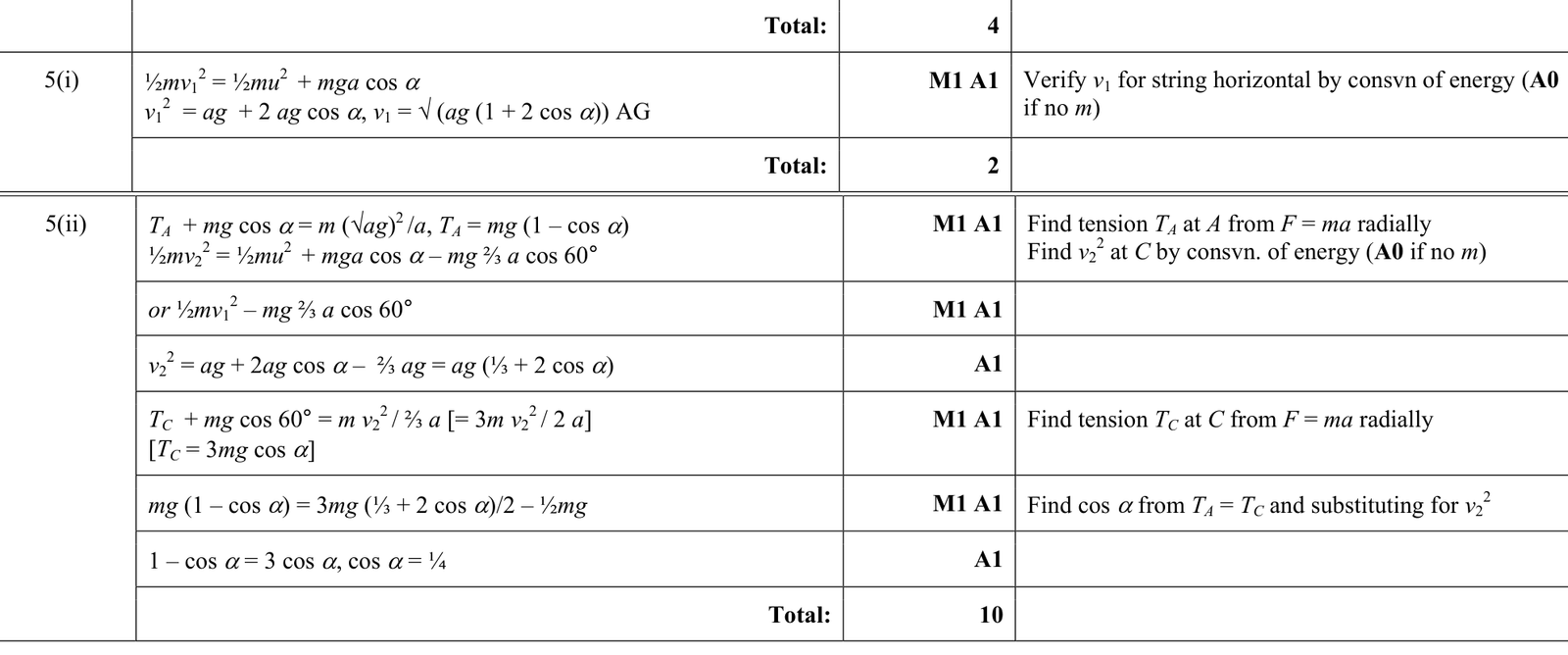
A particle of mass \(m\) is attached to one end of a light inextensible string of length \(a\). The other end of the string is attached to a fixed point \(O\). The point \(A\) is such that \(O A=a\) and \(O A\) makes an angle \(\alpha\) with the upward vertical through \(O\). The particle is held at \(A\) and then projected downwards with speed \(\sqrt{ }(a g)\) so that it begins to move in a vertical circle with centre \(O\). There is a small smooth peg at the point \(B\) which is at the same horizontal level as \(O\) and at a distance \(\frac{1}{3} a\) from \(O\) on the opposite side of \(O\) to \(A\) (see diagram).
(i) Show that, when the string first makes contact with the peg, the speed of the particle is
\[\sqrt{ }(a g(1+2 \cos \alpha)) .\]
The particle now begins to move in a vertical circle with centre \(B\). When the particle is at the point \(C\) where angle \(C B O=150^{\circ}\), the tension in the string is the same as it was when the particle was at the point \(A\).
(ii) Find the value of \(\cos \alpha\).
9231 P23 - Jun 2017 - Q5 - 10 marks
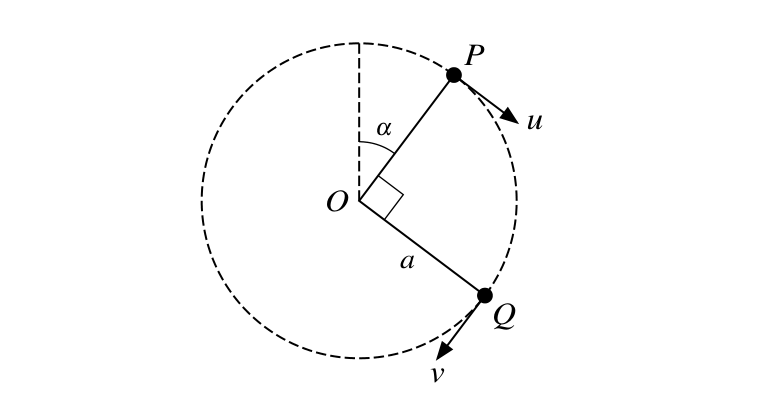
A particle of mass \(m\) is attached to one end of a light inextensible string of length \(a\). The other end of the string is attached to a fixed point \(O\). The particle is moving in complete vertical circles with the string taut. When the particle is at the point \(P\), where \(O P\) makes an angle \(\alpha\) with the upward vertical through \(O\), its speed is \(u\). When the particle is at the point \(Q\), where angle \(Q O P=90^{\circ}\), its speed is \(v\) (see diagram). It is given that \(\cos \alpha=\frac{4}{5}\).
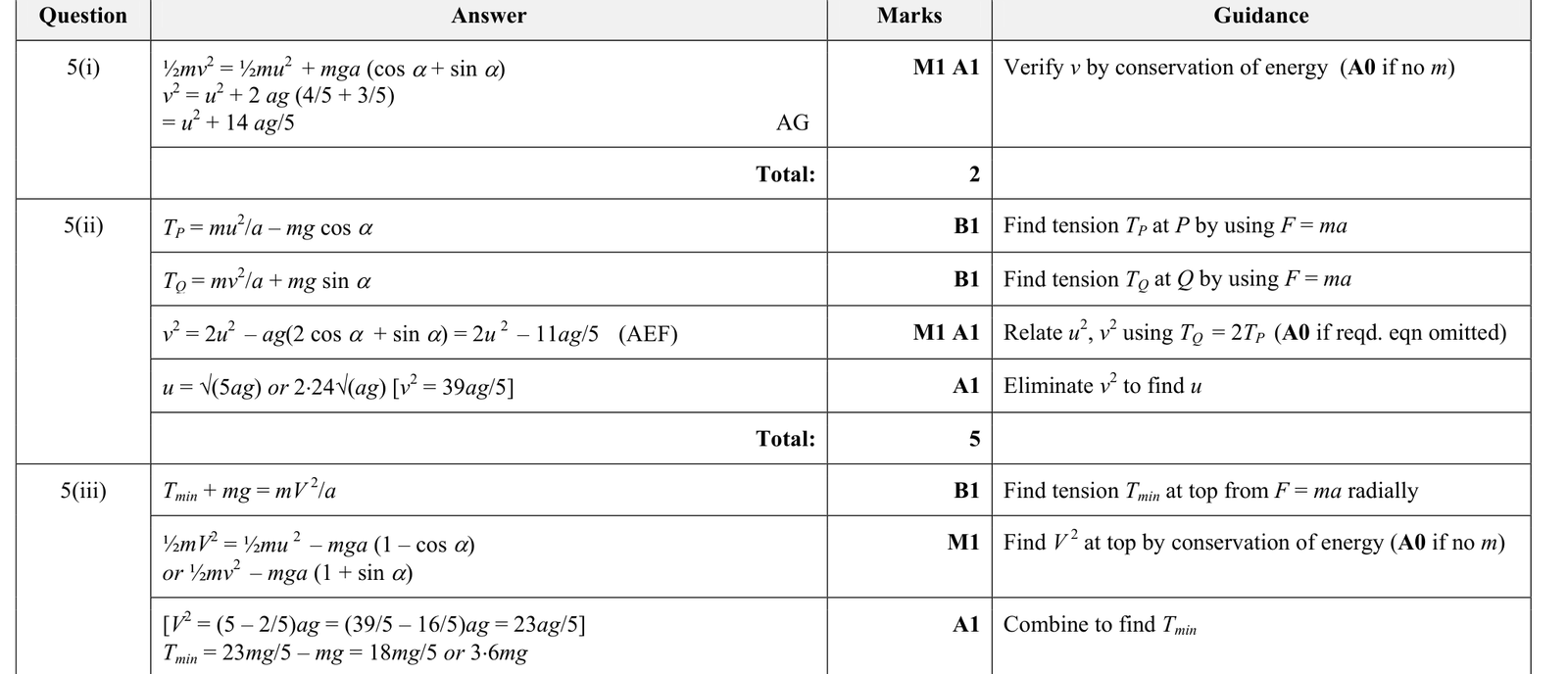
(i) Show that \(v^{2}=u^{2}+\frac{14}{5} a g\).
The tension in the string when the particle is at \(Q\) is twice the tension in the string when the particle is at \(P\).
(ii) Obtain another equation relating \(u^{2}, v^{2}, a\) and \(g\), and hence find \(u\) in terms of \(a\) and \(g\).
(iii) Find the least tension in the string during the motion.
9231 P21 - Nov 2017 - Q11E - 14 marks
Question 11 EITHER alternative.
A particle \(P\) of mass \(m\) is free to move on the smooth inner surface of a fixed hollow sphere of radius \(a\). The centre of the sphere is \(O\). The points \(A\) and \(A'\) are on the inner surface of the sphere, on opposite sides of the vertical through \(O\); the radius \(OA\) makes an angle \(\alpha\) with the downward vertical and the radius \(OA'\) makes an angle \(\beta\) with the upward vertical. The point \(B\) is on the inner surface of the sphere, vertically below \(O\). The point \(B'\) is on the inner surface of the sphere and such that \(OB'\) makes an angle \(2\beta\) with the upward vertical through \(O\). It is given that \(\cos\alpha=\frac{1}{16}\).
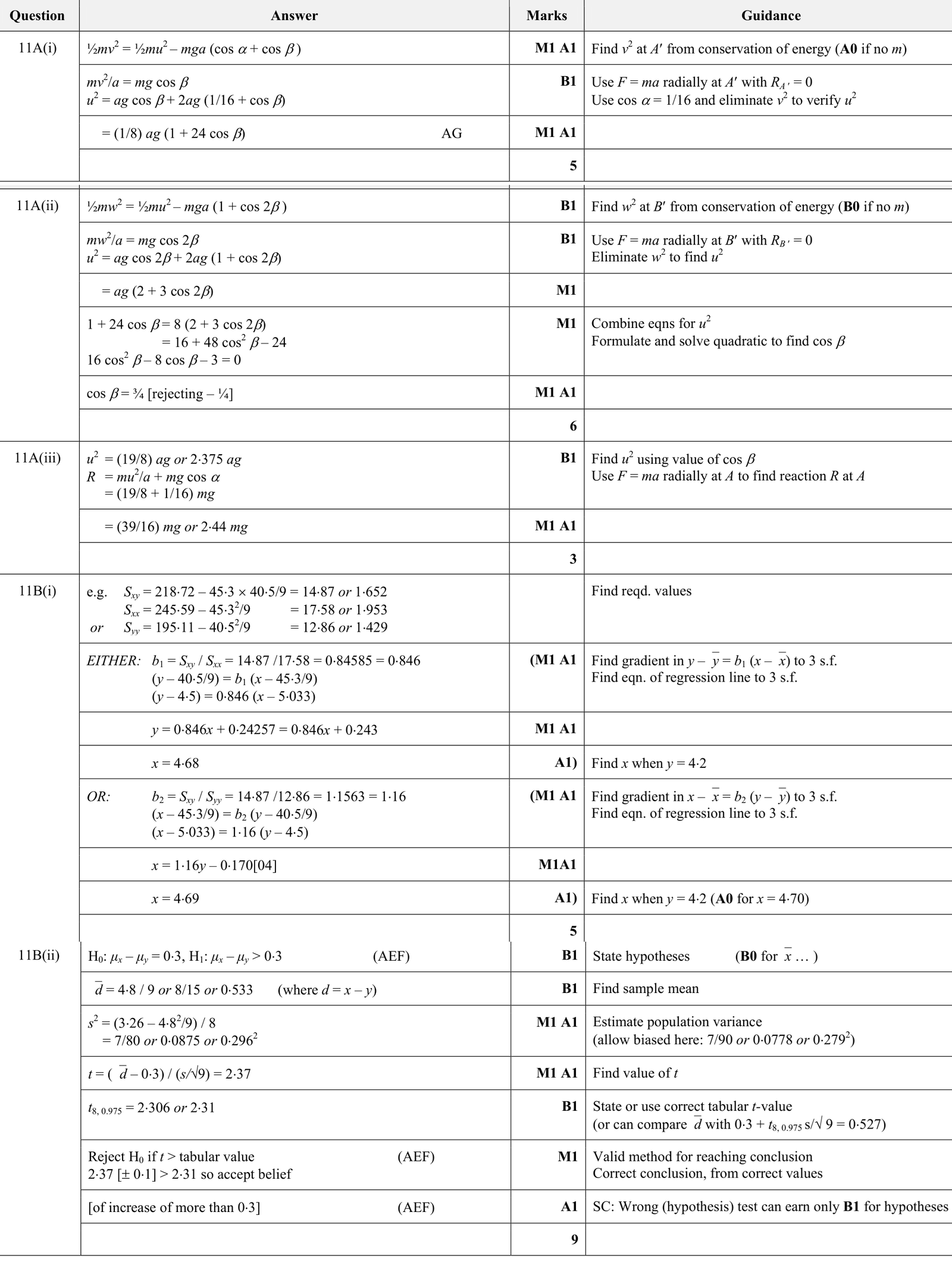
(i) \(P\) is projected from \(A\) with speed \(u\) along the surface of the sphere downwards towards \(B\). Subsequently it loses contact with the sphere at \(A'\). Show that \(u^2=\frac18ag(1+24\cos\beta)\).
(ii) \(P\) is now projected from \(B\) with speed \(u\) along the surface of the sphere towards \(B'\). Subsequently it loses contact with the sphere at \(B'\). Find \(\cos\beta\).
(iii) In part (i), the reaction of the sphere on \(P\) when it is initially projected at \(A\) is \(R\). Find \(R\) in terms of \(m\) and \(g\).
9231 P21 - Jun 2018 - Q11E - 12 marks
Question 11 EITHER alternative.
A particle \(P\) of mass \(m\) is attached to one end of a light inextensible string of length \(a\). The other end of the string is attached to a fixed point \(O\). The particle is held so that the string is taut, with \(OP\) horizontal. The particle is projected downwards with speed \(\sqrt{\frac{2}{5}ag}\) and begins to move in a vertical circle. The string breaks when its tension is equal to \(\frac{11}{5}mg\).
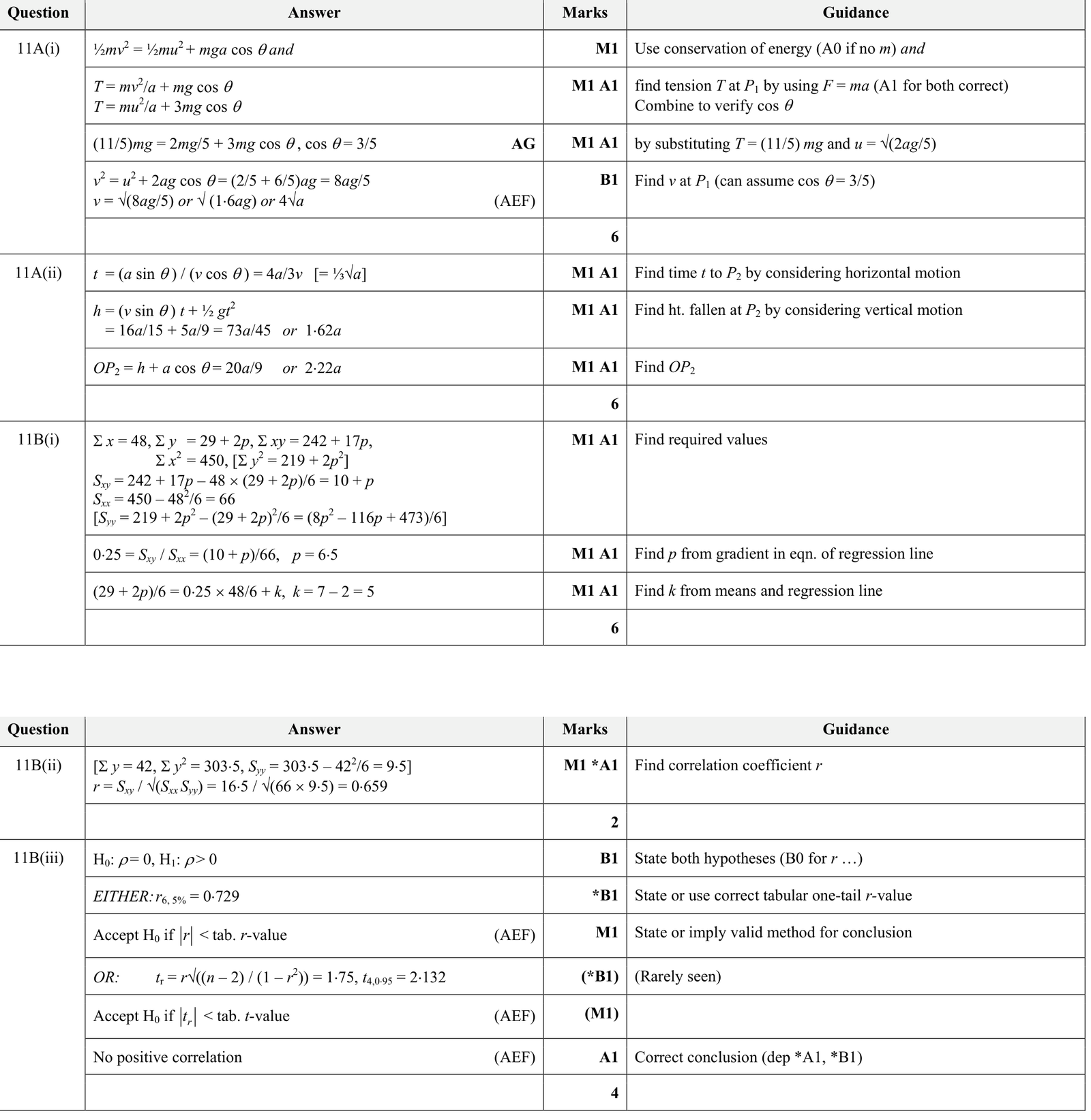
(i) Show that the string breaks when \(OP\) makes an angle \(\theta\) with the downward vertical through \(O\), where \(\cos\theta=\frac35\). Find the speed of \(P\) at this instant.
(ii) For the subsequent motion after the string breaks, find the distance \(OP\) when the particle \(P\) is vertically below \(O\).
9231 P23 - Jun 2018 - Q5 - 11 marks
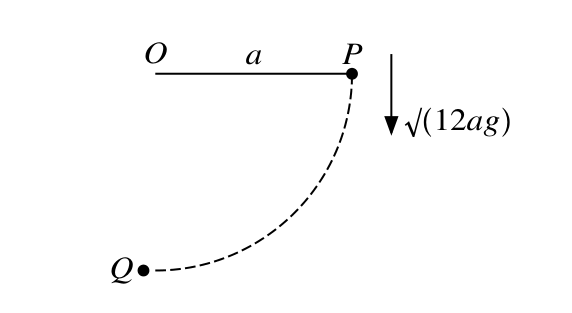
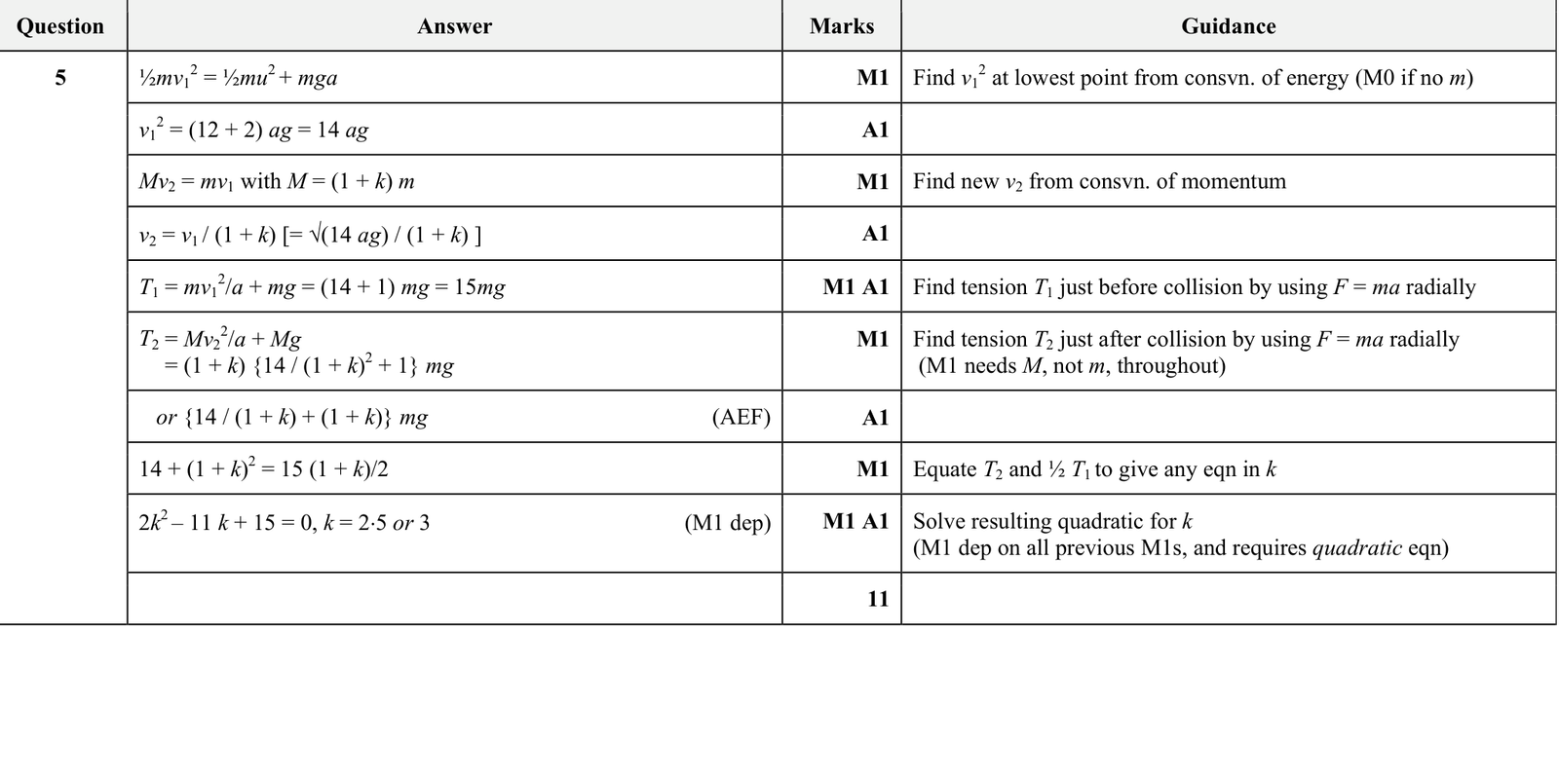
A particle \(P\) of mass \(m\) is attached to one end of a light inextensible string of length \(a\). The other end of the string is attached to a fixed point \(O\). The particle is held with the string taut and horizontal. It is projected downwards with speed \(\sqrt{ }(12 a g)\). At the lowest point of its motion, \(P\) collides directly with a particle \(Q\) of mass \(k m\) which is at rest (see diagram). In the collision, \(P\) and \(Q\) coalesce. The tension in the string immediately after the collision is half of its value immediately before the collision. Find the possible values of \(k\).
9231 P31 - Nov 2025 - Q6 - 8 marks
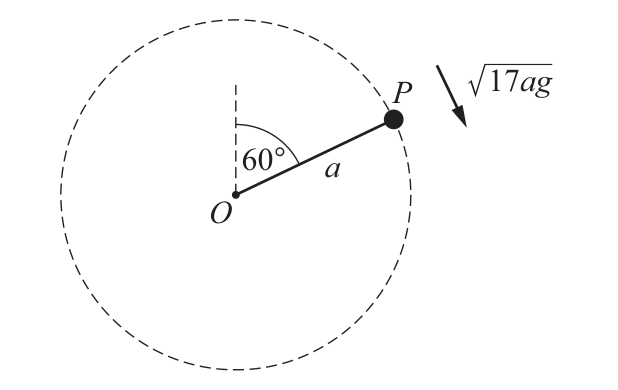
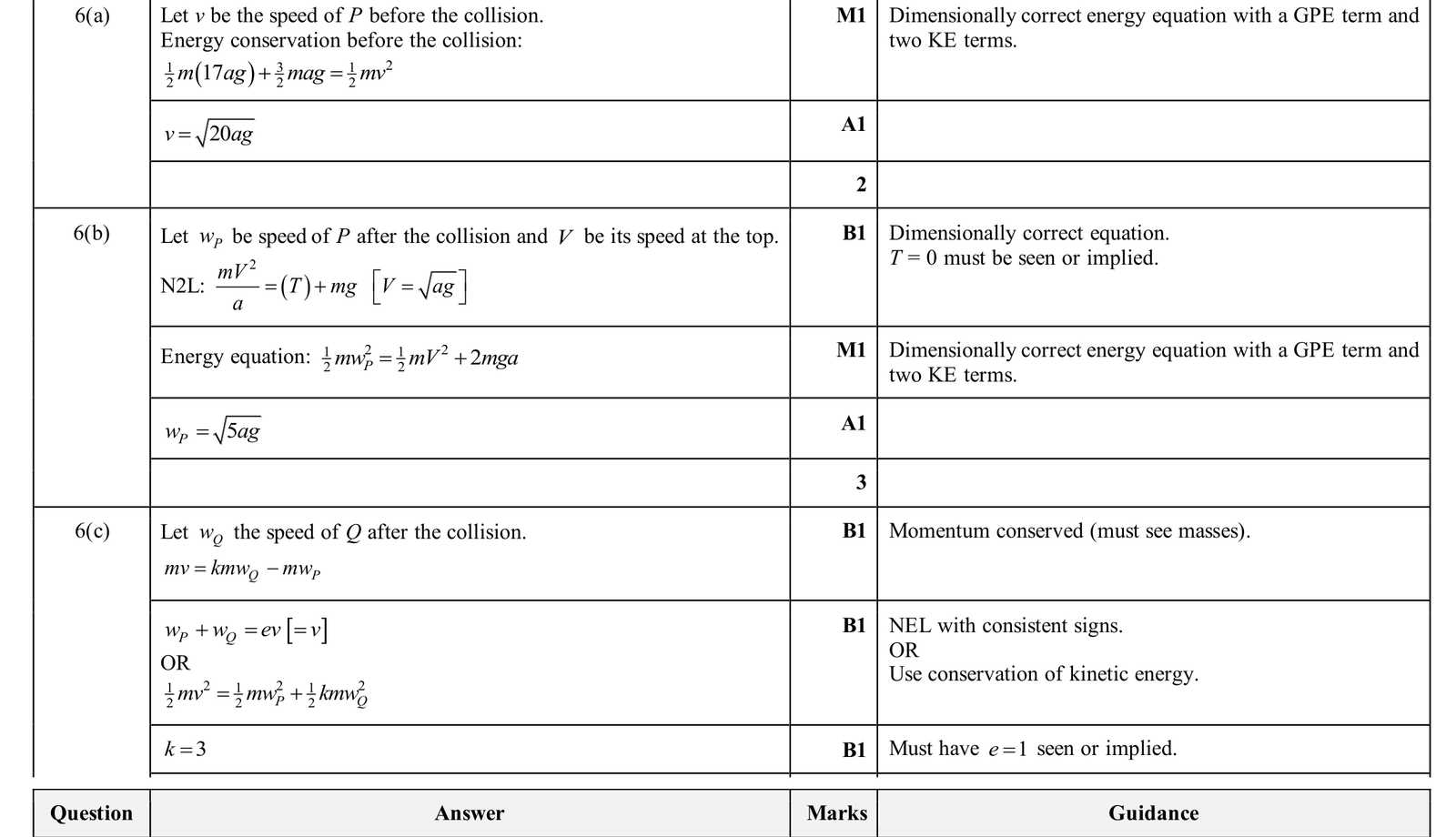
A particle \(P\) of mass \(m\) is attached to one end of a light inextensible string of length \(a\). The other end of the string is attached to a fixed point \(O\). Initially \(P\) is held with the string taut and making an angle of \(60^{\circ}\) with the upward vertical through \(O\). The particle \(P\) is projected perpendicular to the string in a downwards direction with speed \(\sqrt{17 a g}\). It then starts to move along a circular path in a vertical plane with centre \(O\) (see diagram). At the lowest point of its path, vertically below \(O\), the particle \(P\) collides with a stationary particle \(Q\). (a) Find, in terms of \(a\) and \(g\), an expression for the speed of \(P\) immediately before the collision with \(Q\).
As a result of the collision, \(P\) rebounds and moves back along a circular path with centre \(O\). The string becomes slack when \(P\) reaches the point on the circle vertically above \(O\). (b) Find, in terms of \(a\) and \(g\), an expression for the speed of \(P\) immediately after the collision with \(Q\).
The mass of particle \(Q\) is \(k m\) and the collision between \(P\) and \(Q\) is perfectly elastic. (c) Find the value of \(k\).
9231 P32 - Nov 2025 - Q6 - 8 marks
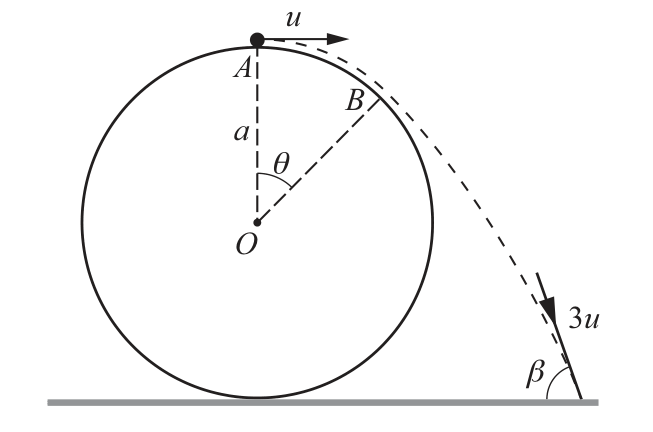
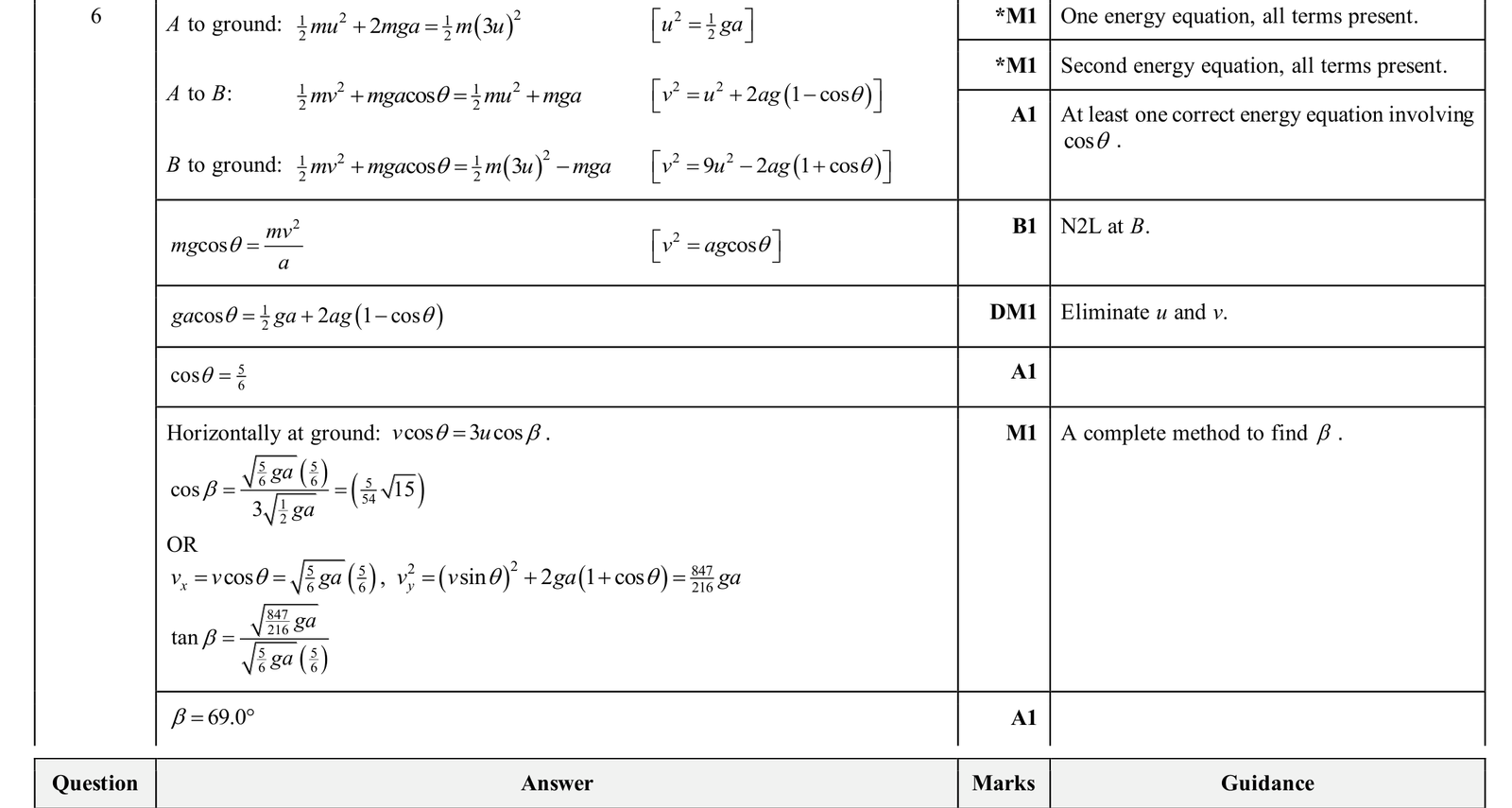
A fixed smooth sphere with radius \(a\) and centre \(O\) rests on horizontal ground. A particle is projected horizontally from the highest point, \(A\), of the sphere with speed \(u\). The particle begins to move in a vertical circle along the surface of the sphere. The particle loses contact with the sphere at the point \(B\), where the angle \(A O B\) is \(\theta\).
After leaving the surface of the sphere, the particle moves freely under gravity before striking the horizontal ground with speed \(3 u\) at an angle \(\beta\) to the horizontal (see diagram).
Find the value of \(\beta\).
9231 P34 - Nov 2025 - Q4 - 8 marks
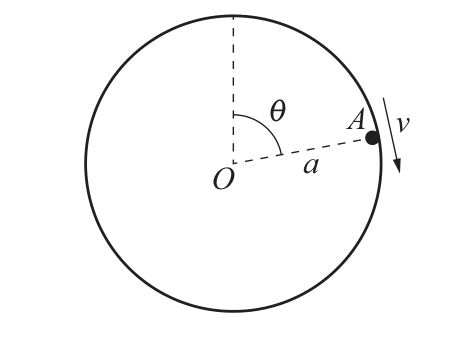
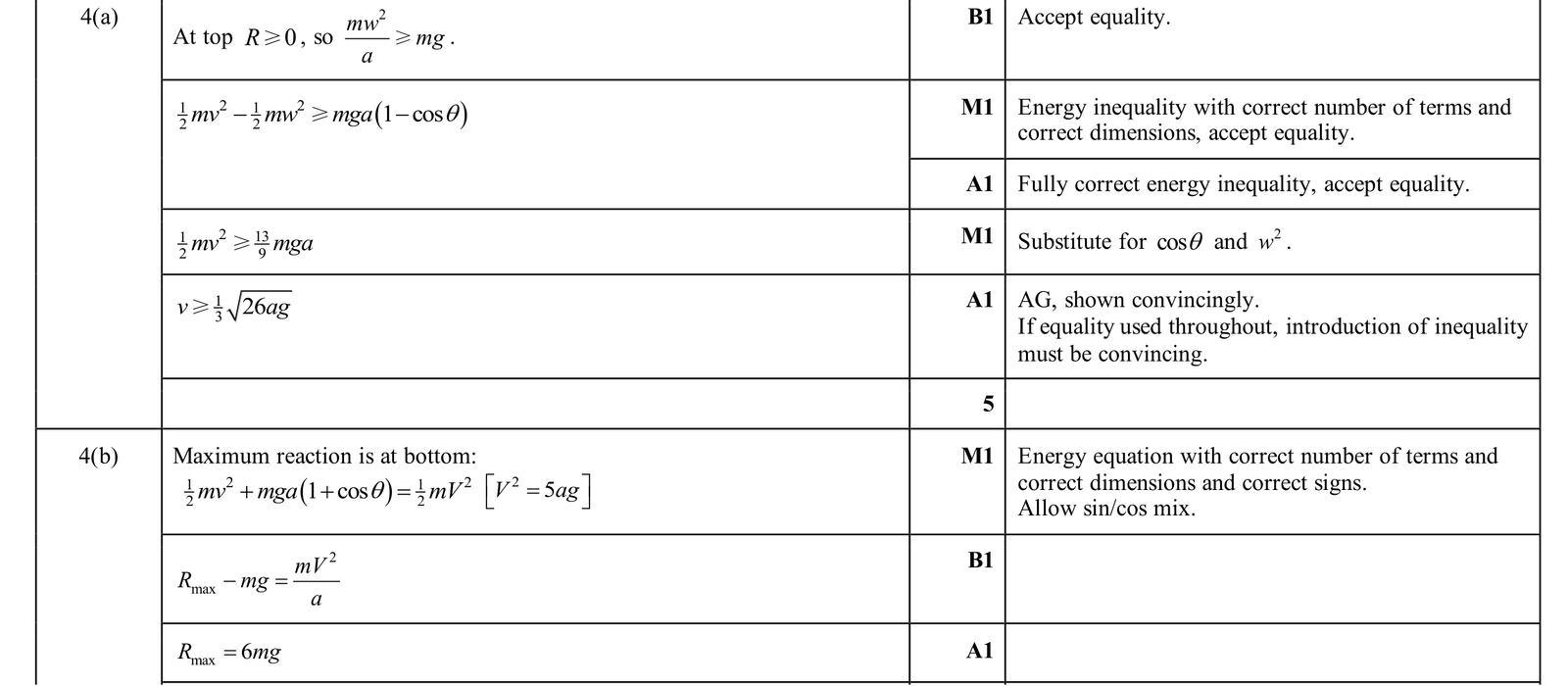
A fixed smooth spherical shell has centre \(O\) and radius \(a\). A particle of mass \(m\) moves in complete vertical circles on the smooth inner surface of the shell, where the plane of the circular motion is vertical and passes through \(O\). The particle has speed \(v\) when it is at point \(A\), where \(O A\) makes an angle \(\theta\) with the upward vertical through \(O\), and \(\cos \theta=\frac{1}{18}\) (see diagram). (a) Show that \(v \geqslant \frac{1}{3} \sqrt{26 a g}\).
It is given that \(v=\frac{1}{3} \sqrt{26 a g}\). (b) Find, in terms of \(m\) and \(g\), an expression for the greatest possible value of the normal reaction between the shell and the particle.
9231 P33 - Jun 2025 - Q5 - 8 marks
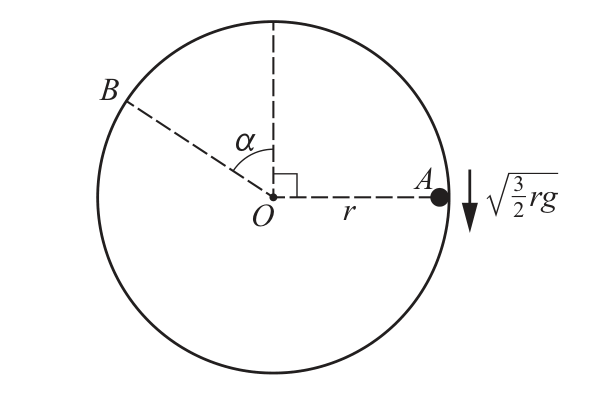
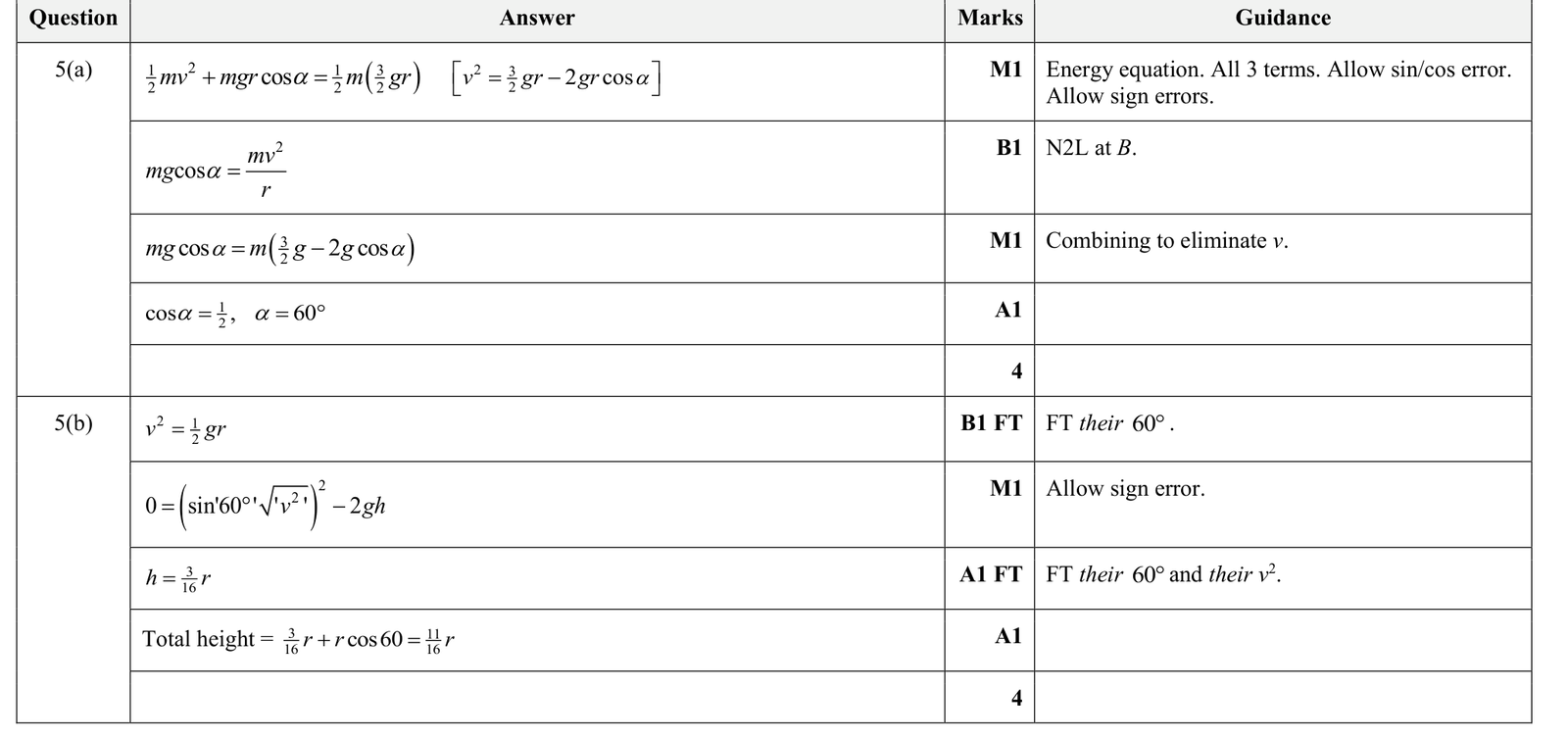
A hollow cylinder of radius \(r\) is fixed with its axis horizontal. Points \(A\), \(B\), and \(O\) lie in the same vertical plane, with \(A\) and \(B\) on the smooth inner surface and \(O\) on the axis. The particle is projected vertically downwards from \(A\) with speed \(\sqrt{\frac32rg}\). It moves inside the cylinder and loses contact at \(B\).
(a) Find \(\alpha\).
(b) In the subsequent motion, find the greatest height above \(O\) reached by the particle, in terms of \(r\).
9231 P34 - Jun 2025 - Q7 - 8 marks
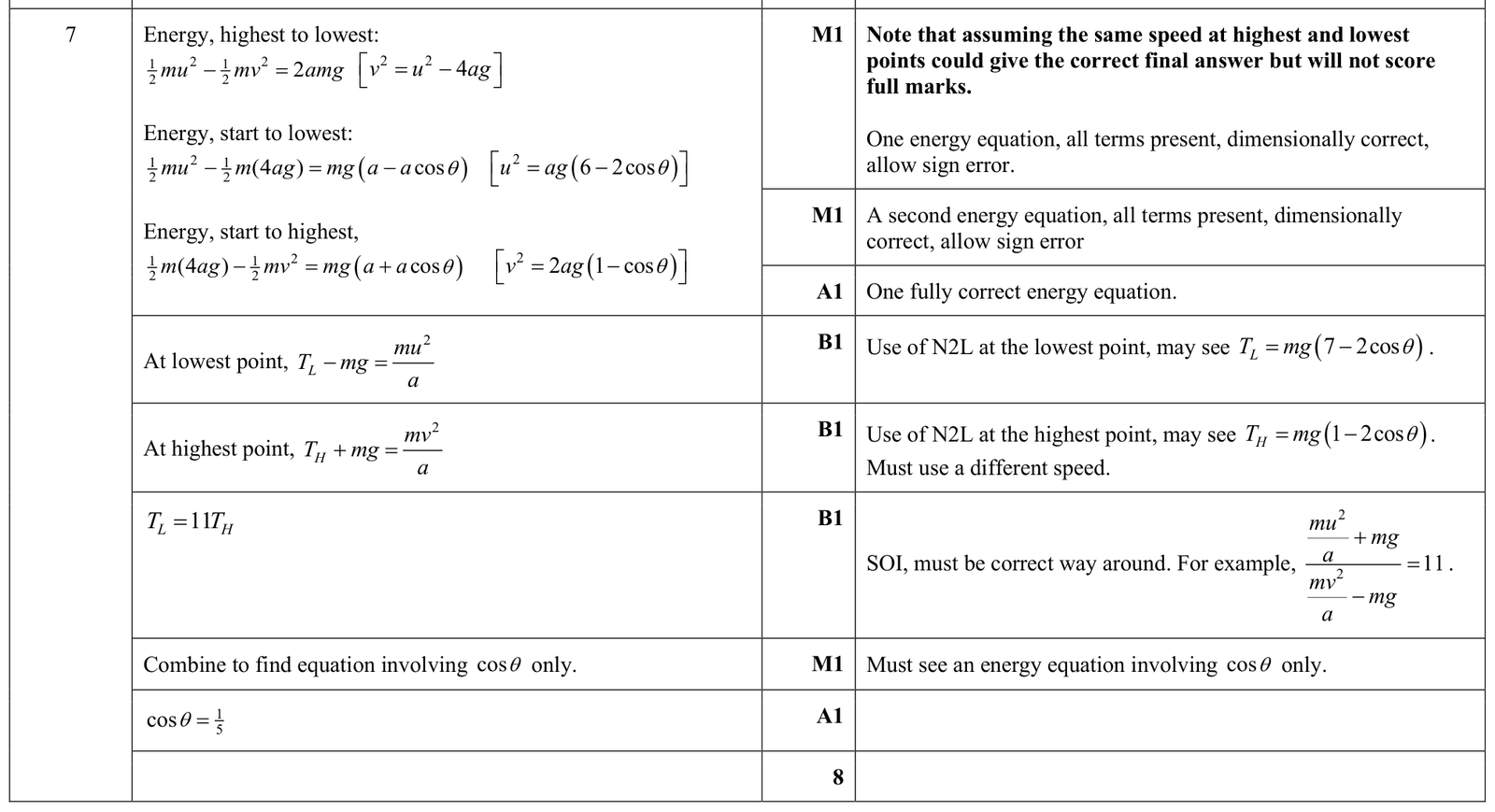
A particle \(P\) of mass \(m\) is attached to one end of a light inextensible string of length \(a\). The other end of the string is attached to a fixed point \(O\). The particle moves in complete vertical circles with centre \(O\), with the string taut.
When the string makes an angle \(\theta\) with the downward vertical through \(O\), the speed of \(P\) is \(\sqrt{4ag}\). The ratio of the greatest and least tensions in the string during the motion is \(11:1\).
Find the value of \(\cos\theta\).
9231 P31 - Nov 2024 - Q2 - 5 marks
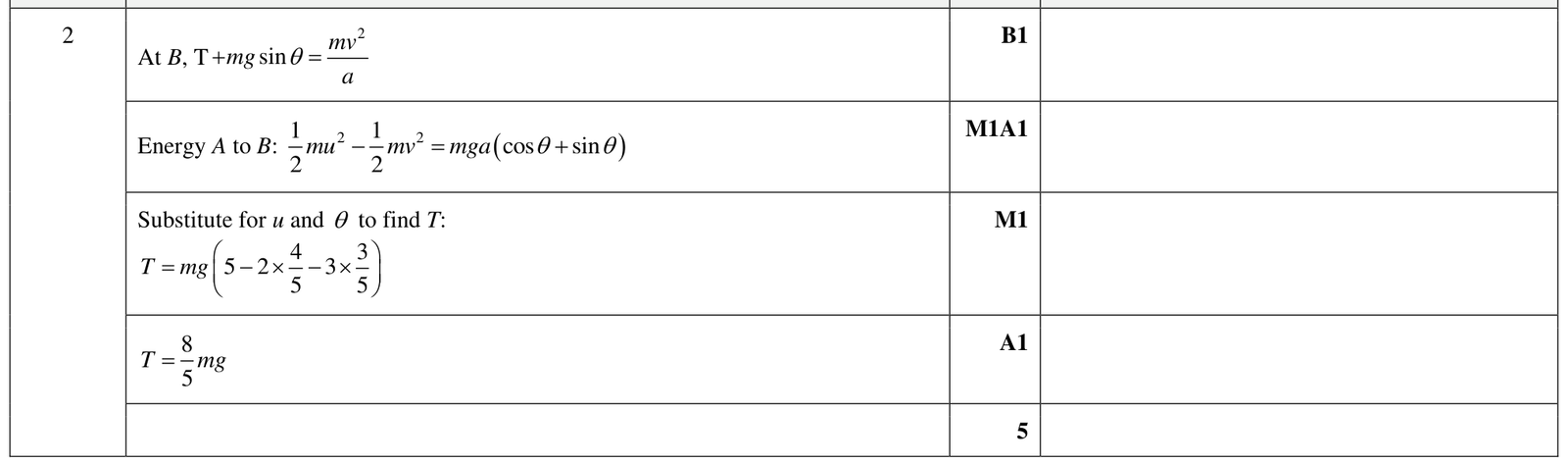
A particle \(P\) of mass \(m\) is attached to one end of a light inextensible string of length \(a\). The other end is attached to a fixed point \(O\). The particle is held at point \(A\) with the string taut.
The line \(OA\) makes an angle \(\theta\) with the downward vertical through \(O\), where \(\tan\theta=\dfrac34\). The particle is projected perpendicular to \(OA\) in an upwards direction with speed \(\sqrt{5ag}\), and it starts to move along a circular path in a vertical plane.
When \(P\) is at point \(B\), where \(\angle AOB=90^\circ\), the tension in the string is \(T\). Find \(T\) in terms of \(m\) and \(g\).
9231 P32 - Nov 2024 - Q6 - 10 marks
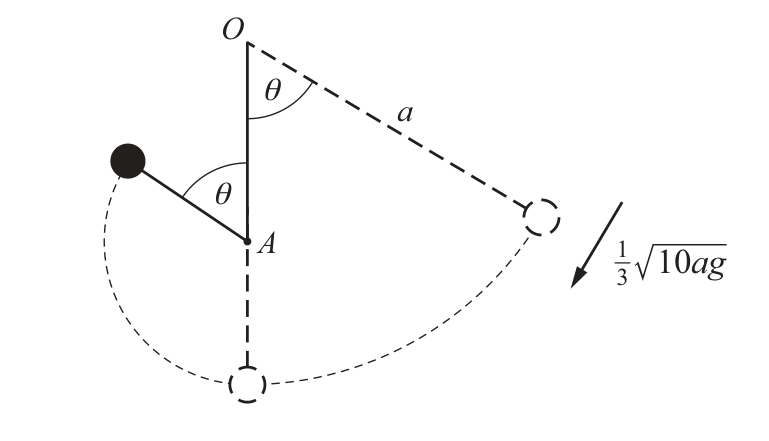
A particle \(P\) of mass \(m\) is attached to one end of a light inextensible string of length \(a\). The other end is attached to a fixed point \(O\). The particle is held with the string taut and making an angle \(\theta\) with the downward vertical through \(O\).
The particle is projected at right angles to the string with speed \(\dfrac13\sqrt{10ag}\) and begins to move downwards along a circular path. When the string is vertical, it strikes a small smooth peg at point \(A\), vertically below \(O\). The circle changes to have centre \(A\). When the string makes an angle \(\theta\) with the upward vertical through \(A\), the string becomes slack. The distance of \(A\) below \(O\) is \(\dfrac59a\).
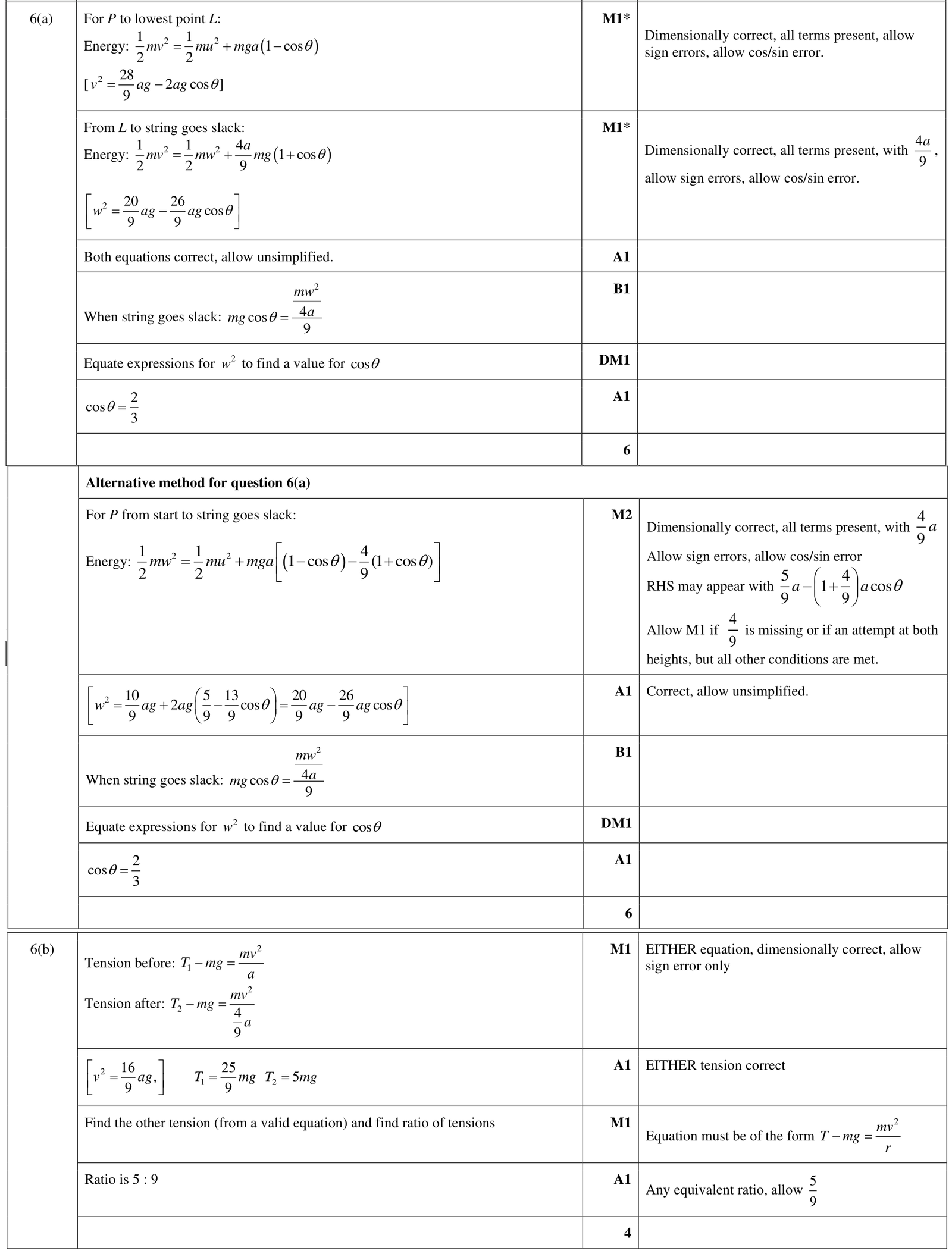
(a) Find \(\cos\theta\).
(b) Find the ratio of the tensions in the string immediately before and immediately after it strikes the peg.
9231 P31 - Jun 2024 - Q7 - 9 marks
A smooth sphere with centre \(O\) and radius \(a\) is fixed to a horizontal plane. A particle \(P\) of mass \(m\) is projected horizontally from the highest point of the sphere with speed \(u\), so that it begins to move along the surface of the sphere.
The particle loses contact with the sphere at the point \(Q\), where \(OQ\) makes an angle \(\theta\) with the upward vertical through \(O\).
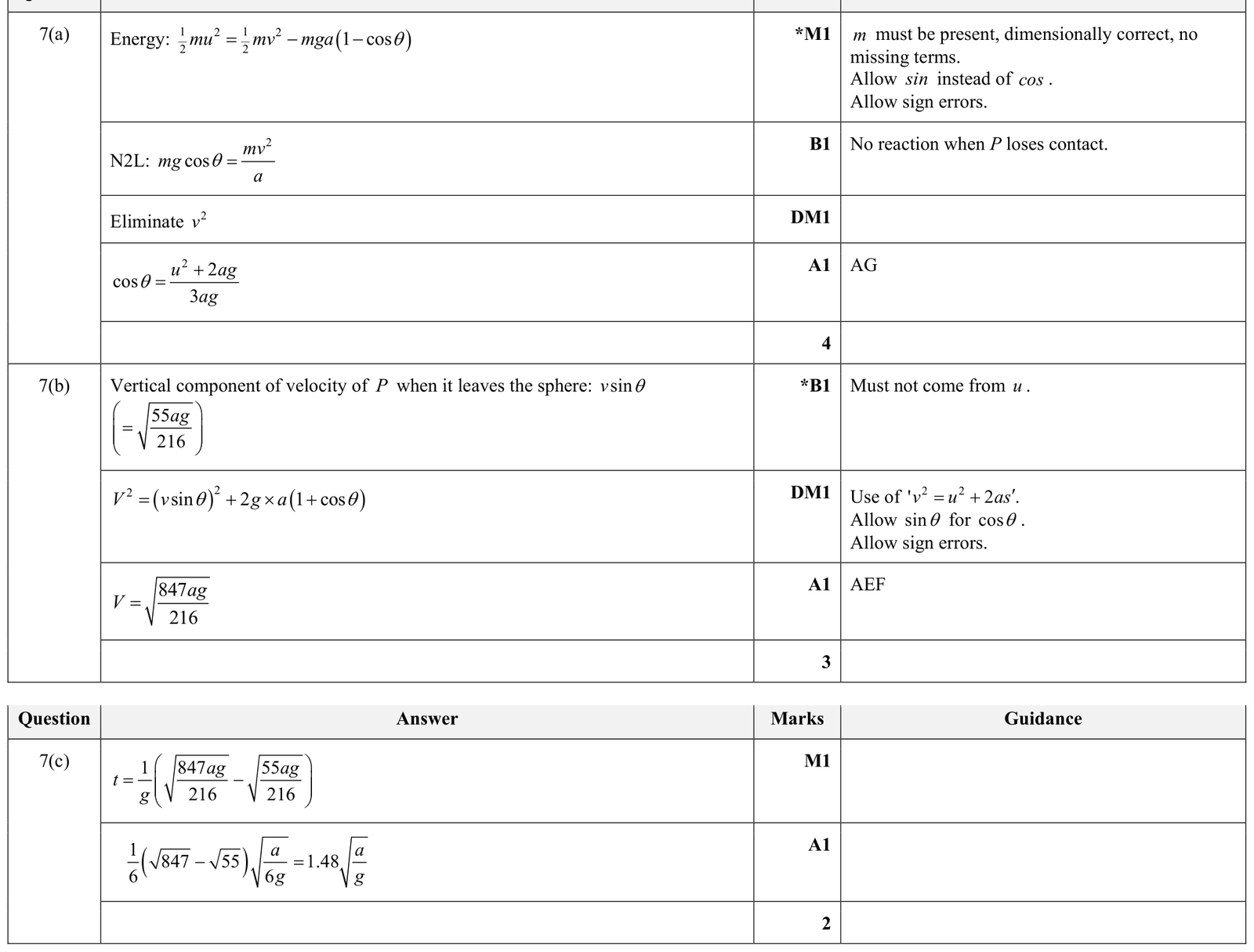
(a) Show that \(\cos\theta=\dfrac{u^2+2ag}{3ag}\).
It is given that \(\cos\theta=\dfrac56\).
(b) Find, in terms of \(a\) and \(g\), an expression for the vertical component of the velocity of \(P\) just before it hits the horizontal plane to which the sphere is fixed.
(c) Find an expression for the time taken by \(P\) to fall from \(Q\) to the plane. Give your answer in the form \(k\sqrt{\dfrac ag}\), with \(k\) correct to 3 significant figures.
9231 P33 - Jun 2024 - Q3 - 7 marks
A particle \(P\) of mass \(m\) is attached to one end of a light inextensible string of length \(a\). The other end is attached to a fixed point \(O\).
When the particle is hanging vertically below \(O\), it is projected horizontally with speed \(u\), so that it begins to move along a circular path. When \(P\) is at the lowest point of its motion, the tension in the string is \(T\). When \(OP\) makes an angle \(\theta\) with the upward vertical, the tension in the string is \(S\).
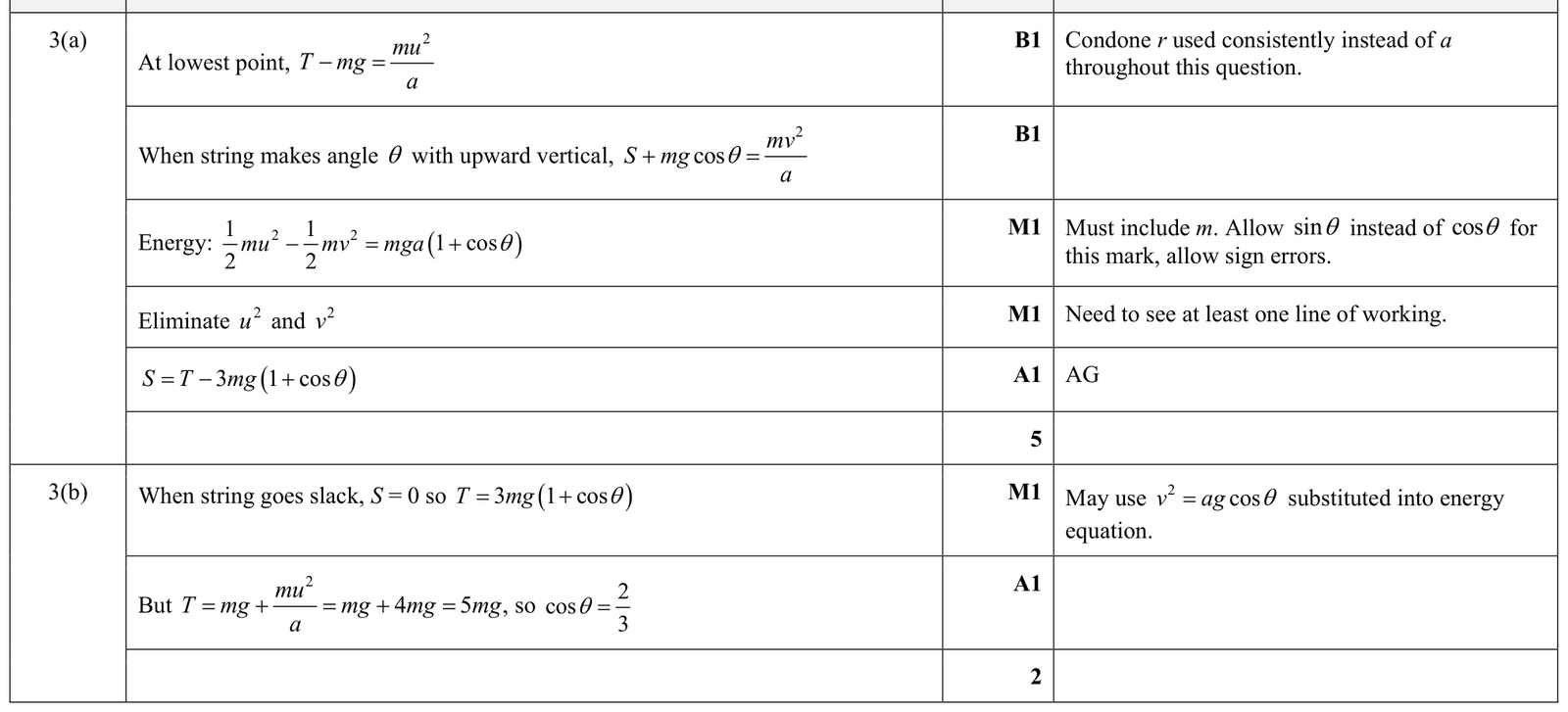
(a) Show that \(S=T-3mg(1+\cos\theta)\).
(b) Given that \(u=\sqrt{4ag}\), find \(\cos\theta\) when the string goes slack.
9231 P31 - Nov 2023 - Q6 - 11 marks
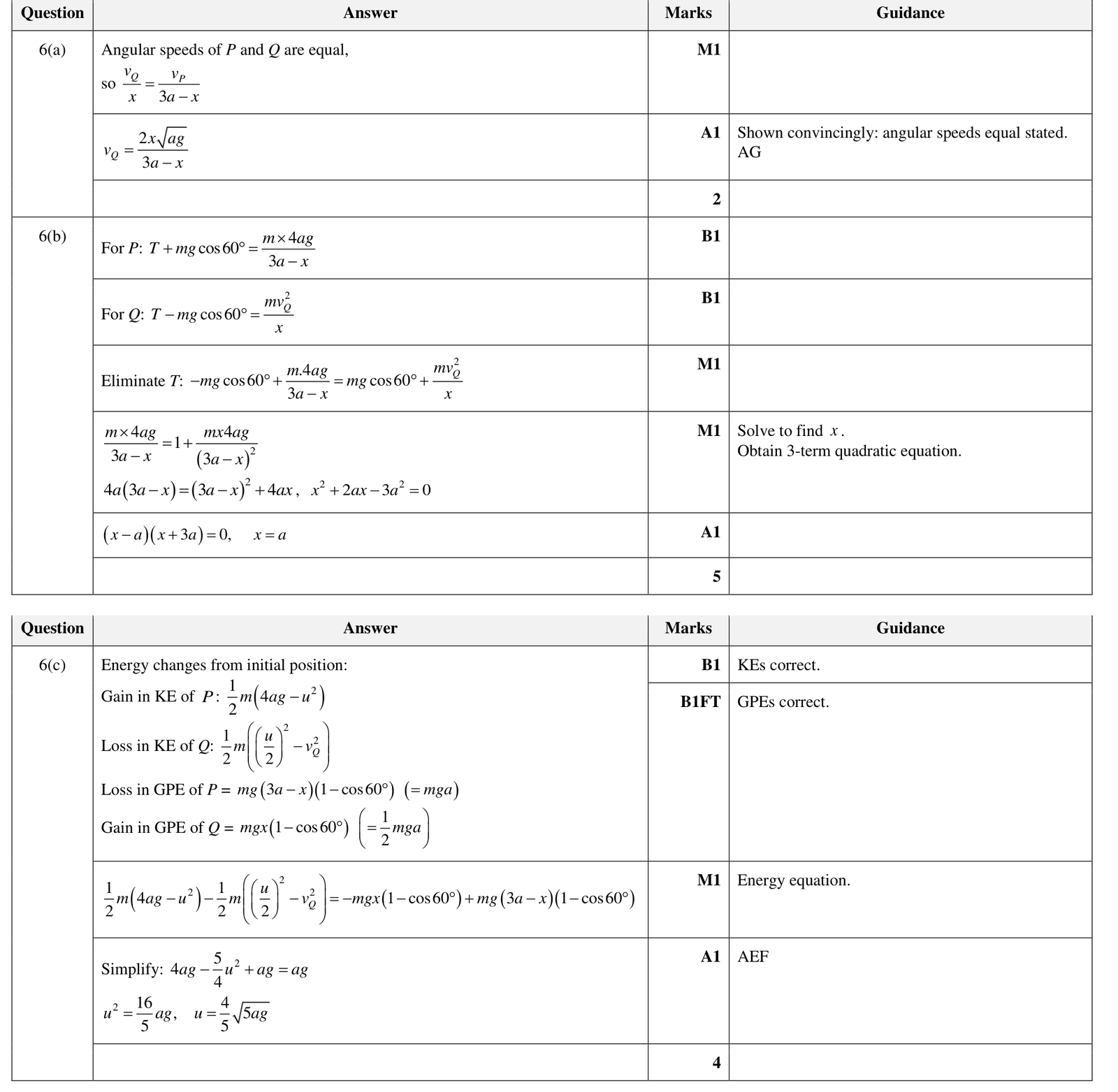
A particle \(P\) of mass \(m\) is attached to one end of a light inextensible rod of length \(3a\). An identical particle \(Q\) is attached to the other end of the rod. The rod is smoothly pivoted at a point \(O\) on the rod, where \(OQ=x\). The system, consisting of the rod and particles, rotates about \(O\) in a vertical plane.
At an instant when the rod is vertical, with \(P\) above \(Q\), the particle \(P\) is moving horizontally with speed \(u\). When the rod has turned through an angle of \(60^\circ\) from the vertical, the speed of \(P\) is \(2\sqrt{ag}\), and the tensions in the two parts of the rod, \(OP\) and \(OQ\), have equal magnitudes.
(a) Show that the speed of \(Q\) when the rod has turned through an angle of \(60^\circ\) from the vertical is \(\dfrac{2x}{3a-x}\sqrt{ag}\).
(b) Find \(x\) in terms of \(a\).
(c) Find \(u\) in terms of \(a\) and \(g\).
9231 P32 - Nov 2023 - Q5 - 8 marks
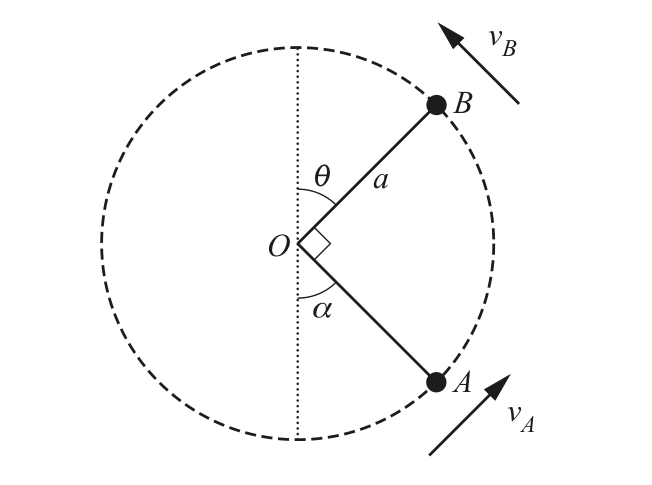
A bead of mass \(m\) moves on a smooth circular wire, with centre \(O\) and radius \(a\), in a vertical plane. The bead has speed \(v_A\) when it is at the point \(A\), where \(OA\) makes an angle \(\alpha\) with the downward vertical through \(O\), and \(\cos\alpha=\dfrac35\).
Subsequently, the bead has speed \(v_B\) at the point \(B\), where \(OB\) makes an angle \(\theta\) with the upward vertical through \(O\). Angle \(AOB\) is a right angle.
The reaction of the wire on the bead at \(B\) is in the direction \(OB\) and has magnitude equal to \(\dfrac16\) of the magnitude of the reaction when the bead is at \(A\).
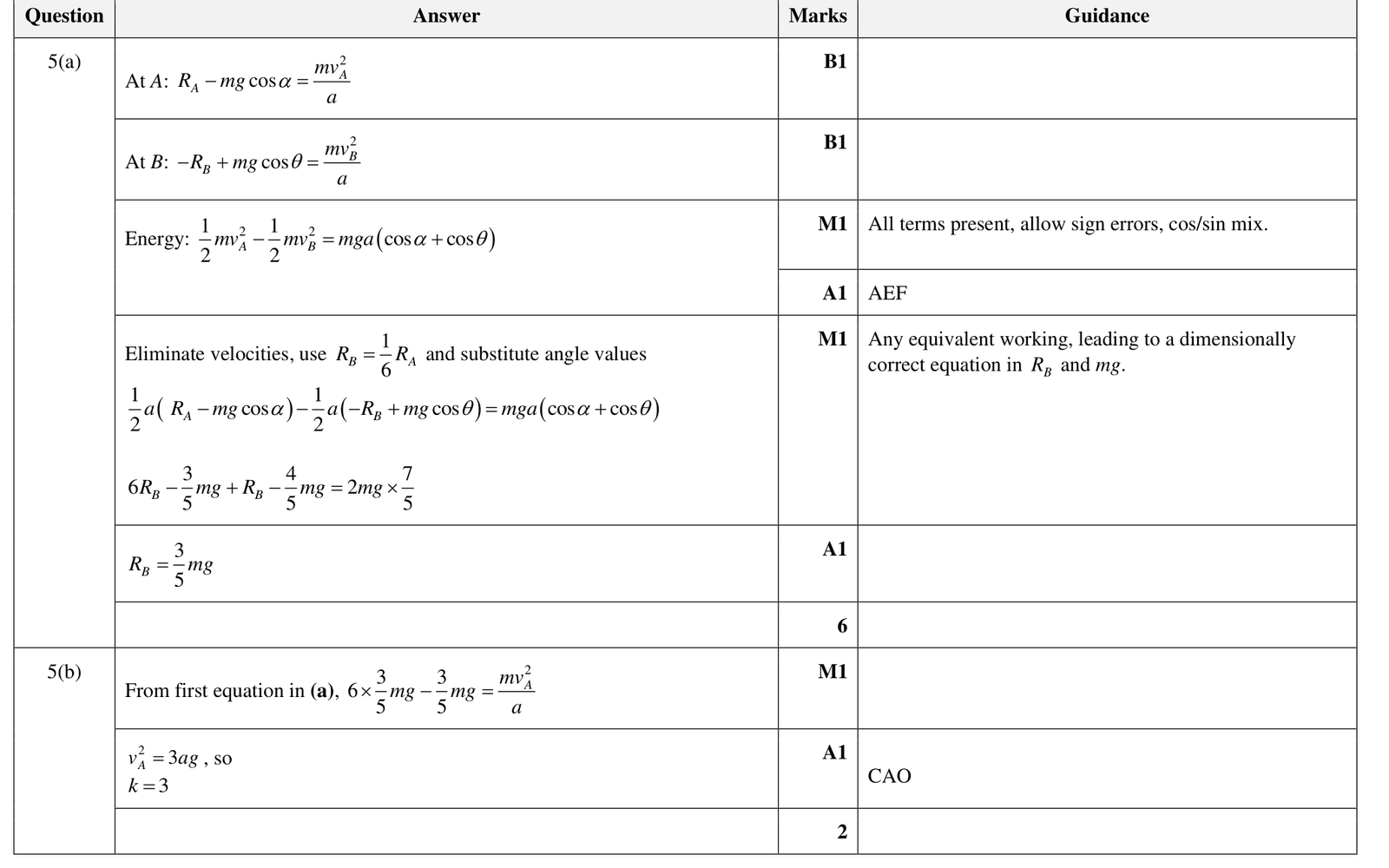
(a) Find, in terms of \(m\) and \(g\), the magnitude of the reaction at \(B\).
(b) Given that \(v_A=\sqrt{kag}\), find the value of \(k\).
9231 P31 - Jun 2023 - Q3 - 7 marks
A particle \(P\) of mass \(m\) is attached to one end of a light inextensible string of length \(a\). The other end of the string is attached to a fixed point \(O\). The particle \(P\) is held at the point \(A\), where \(O A\) makes an angle \(\theta\) with the downward vertical through \(O\), and with the string taut. The particle \(P\) is projected perpendicular to \(O A\) in an upwards direction with speed \(u\). It then starts to move along a circular path in a vertical plane. The string goes slack when \(P\) is at \(B\), where angle \(A O B\) is \(90^{\circ}\) and the speed of \(P\) is \(\sqrt{\frac{4}{5} a g}\).
(a) Find the value of \(\sin \theta\).
(b) Find, in terms of \(m\) and \(g\), the tension in the string when \(P\) is at \(A\).

9231 P33 - Jun 2023 - Q1 - 4 marks
A particle \(P\) of mass \(m\) is attached to one end of a light inextensible string of length \(a\). The other end of the string is attached to a fixed point \(O\). The particle \(P\) is held at the point \(A\), where \(O A\) makes an angle \(\alpha\) with the downward vertical through \(O\), and with the string taut. The particle \(P\) is projected perpendicular to \(O A\) in an upwards direction with speed \(\sqrt{3 a g}\). It then starts to move along a circular path in a vertical plane. The string goes slack when \(P\) is at \(B\), where \(O B\) makes an angle \(\theta\) with the upward vertical.
Given that \(\cos \alpha=\frac{4}{5}\), find the value of \(\cos \theta\).

9231 P31 - Jun 2022 - Q2 - 5 marks
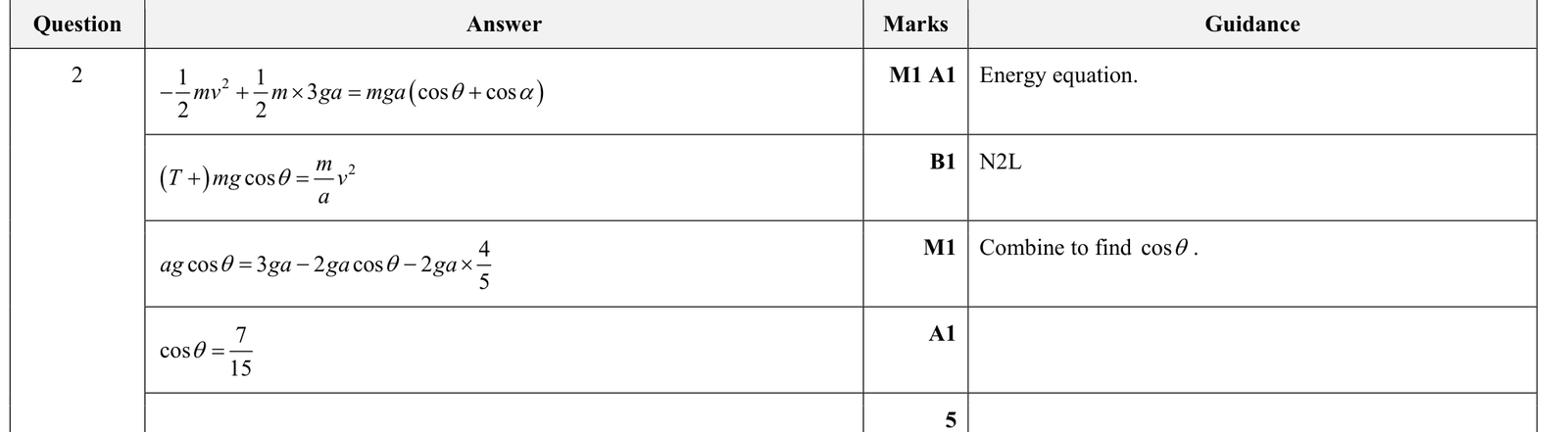
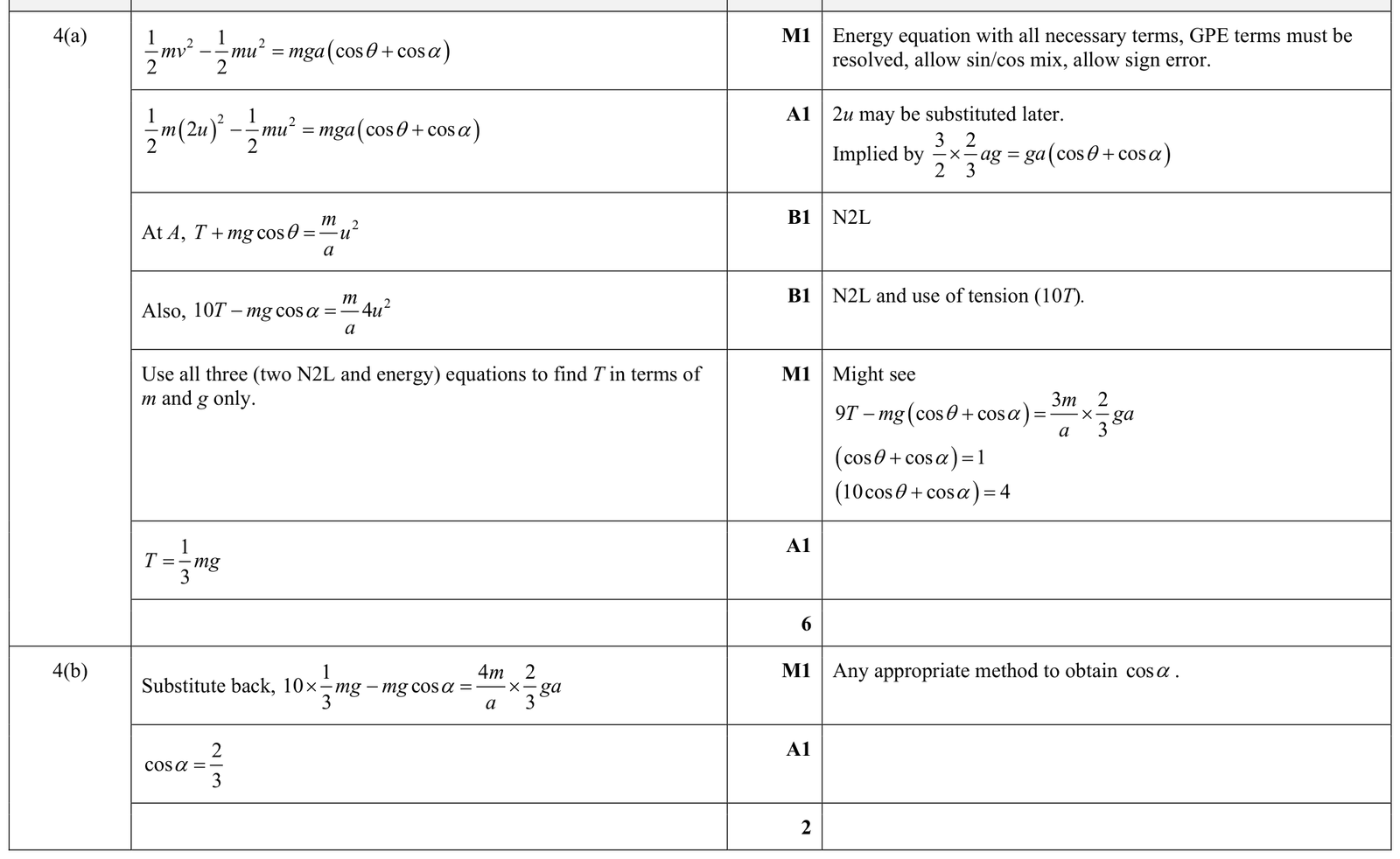
One end of a light inextensible string of length \(a\) is attached to a fixed point \(O\). A particle of mass \(m\) is attached to the other end of the string. The particle is held at the point \(A\) with the string taut. The angle between \(O A\) and the downward vertical is equal to \(\alpha\), where \(\cos \alpha=\frac{4}{5}\). The particle is projected from \(A\), perpendicular to the string in an upwards direction, with a speed \(\sqrt{3 g a}\). It then moves along a circular path in a vertical plane. The string first goes slack when it makes an angle \(\theta\) with the upward vertical through \(O\).
Find the value of \(\cos \theta\).
9231 P33 - Jun 2022 - Q4 - 8 marks
One end of a light inextensible string of length \(a\) is attached to a fixed point \(O\). A particle of mass \(m\) is attached to the other end of the string and is held with the string taut at the point \(A\). At \(A\) the string makes an angle \(\theta\) with the upward vertical through \(O\). The particle is projected perpendicular to the string in a downward direction from \(A\) with a speed \(u\). It moves along a circular path in the vertical plane.
When the string makes an angle \(\alpha\) with the downward vertical through \(O\), the speed of the particle is \(2 u\) and the magnitude of the tension in the string is 10 times its magnitude at \(A\).
It is given that \(u=\sqrt{\frac{2}{3} g a}\).
(a) Find, in terms of \(m\) and \(g\), the magnitude of the tension in the string at \(A\).
(b) Find the value of \(\cos \alpha\).
9231 P31 - Nov 2022 - Q5 - 8 marks
A particle \(P\) of mass \(m\) is attached to one end of a light inextensible string of length \(a\). The other end of the string is attached to a fixed point \(O\). The string is held taut with \(O P\) horizontal. The particle \(P\) is projected vertically downwards with speed \(\sqrt{\frac{1}{3} a g}\) and starts to move in a vertical circle. \(P\) passes through the lowest point of the circle and reaches the point \(Q\) where \(O Q\) makes an angle \(\theta\) with the downward vertical. At \(Q\) the speed of \(P\) is \(\sqrt{k a g}\) and the tension in the string is \(\frac{11}{6} m g\).
(a) Find the value of \(k\) and the value of \(\cos \theta\).
At \(Q\) the particle \(P\) becomes detached from the string.
(b) In the subsequent motion, find the greatest height reached by \(P\) above the level of the lowest point of the circle.

9231 P32 - Nov 2022 - Q1 - 4 marks
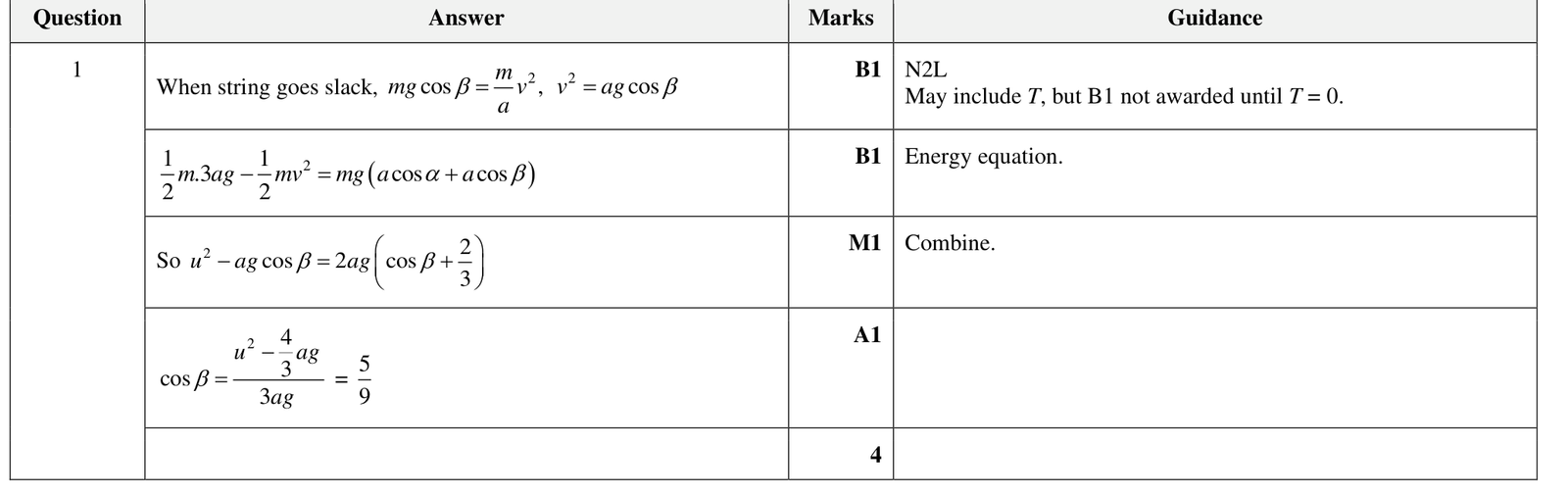
A particle \(P\) of mass \(m\) is attached to one end of a light inextensible string of length \(a\). The other end of the string is attached to a fixed point \(O\). The string is held taut with \(O P\) making an angle \(\alpha\) with the downward vertical, where \(\cos \alpha=\frac{2}{3}\). The particle \(P\) is projected perpendicular to \(O P\) in an upwards direction with speed \(\sqrt{3 a g}\). It then starts to move along a circular path in a vertical plane.
Find the cosine of the angle between the string and the upward vertical when the string first becomes slack.
9231 P31 - Jun 2021 - Q5 - 8 marks
A particle \(P\) of mass \(m\) is attached to one end of a light inextensible string of length \(a\). The other end of the string is attached to a fixed point \(O\). The particle completes vertical circles with centre \(O\). The points \(A\) and \(B\) are on the path of \(P\), both on the same side of the vertical through \(O . O A\) makes an angle \(\theta\) with the downward vertical through \(O\) and \(O B\) makes an angle \(\theta\) with the upward vertical through \(O\).
The speed of \(P\) when it is at \(A\) is \(u\) and the speed of \(P\) when it is at \(B\) is \(\sqrt{a g}\). The tensions in the string at \(A\) and \(B\) are \(T_{A}\) and \(T_{B}\) respectively. It is given that \(T_{A}=7 T_{B}\).
Find the value of \(\theta\) and find an expression for \(u\) in terms of \(a\) and \(g\).

9231 P33 - Jun 2021 - Q4 - 8 marks
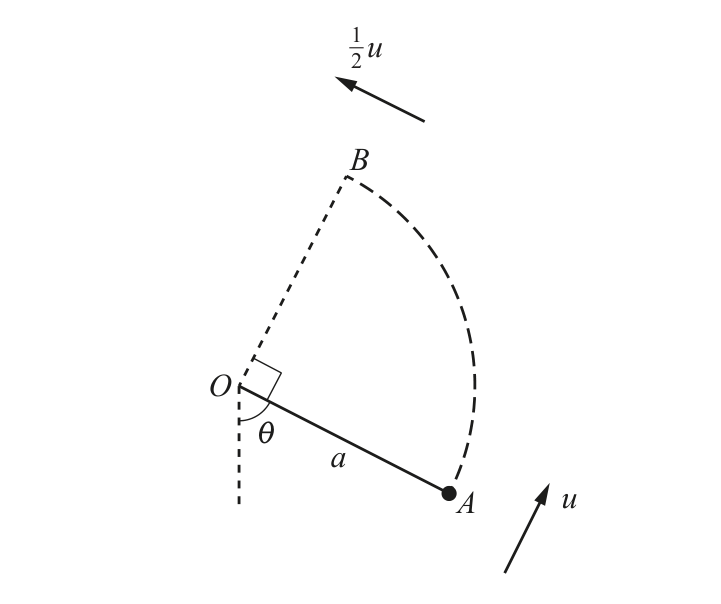
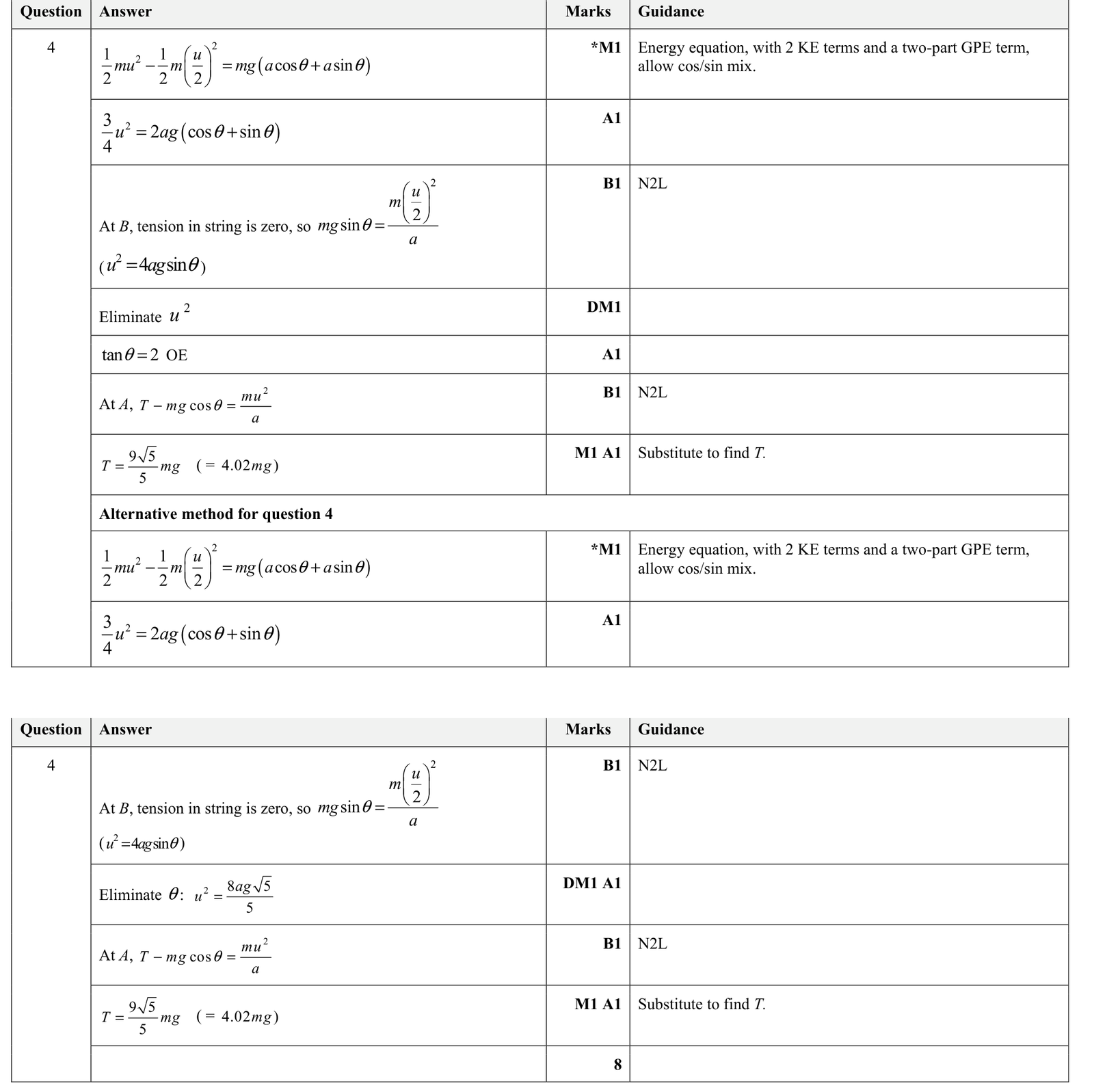
A particle of mass \(m\) is attached to one end of a light inextensible string of length \(a\). The other end of the string is attached to a fixed point \(O\). The particle is initially held with the string taut at the point \(A\), where \(O A\) makes an angle \(\theta\) with the downward vertical through \(O\). The particle is then projected with speed \(u\) perpendicular to \(O A\) and begins to move upwards in part of a vertical circle. The string goes slack when the particle is at the point \(B\) where angle \(A O B\) is a right angle. The speed of the particle when it is at \(B\) is \(\frac{1}{2} u\) (see diagram).
Find the tension in the string at \(A\), giving your answer in terms of \(m\) and \(g\).
9231 P31 - Nov 2021 - Q6 - 8 marks
A particle \(P\), of mass \(m\), is attached to one end of a light inextensible string of length \(a\). The other end of the string is attached to a fixed point \(O\). The particle \(P\) moves in complete vertical circles about \(O\) with the string taut. The points \(A\) and \(B\) are on the path of \(P\) with \(A B\) a diameter of the circle. \(O A\) makes an angle \(\theta\) with the downward vertical through \(O\) and \(O B\) makes an angle \(\theta\) with the upward vertical through \(O\). The speed of \(P\) when it is at \(A\) is \(\sqrt{5 a g}\).
The ratio of the tension in the string when \(P\) is at \(A\) to the tension in the string when \(P\) is at \(B\) is \(9: 5\).
(a) Find the value of \(\cos \theta\).
(b) Find, in terms of \(a\) and \(g\), the greatest speed of \(P\) during its motion.
9231 P31 - Jun 2020 - Q7 - 10 marks
A hollow cylinder of radius \(a\) is fixed with its axis horizontal. A particle \(P\), of mass \(m\), moves in part of a vertical circle of radius \(a\) and centre \(O\) on the smooth inner surface of the cylinder. The speed of \(P\) when it is at the lowest point \(A\) of its motion is \(\sqrt{\frac{7}{2} g a}\).
The particle \(P\) loses contact with the surface of the cylinder when \(O P\) makes an angle \(\theta\) with the upward vertical through \(O\).
(a) Show that \(\theta=60^{\circ}\).
(b) Show that in its subsequent motion \(P\) strikes the cylinder at the point \(A\).
9231 P33 - Jun 2020 - Q3 - 6 marks
A particle \(Q\) of mass \(m\) is attached to a fixed point \(O\) by a light inextensible string of length \(a\). The particle moves in complete vertical circles about \(O\). The points \(A\) and \(B\) are on the path of \(Q\) with \(A B\) a diameter of the circle. \(O A\) makes an angle of \(60^{\circ}\) with the downward vertical through \(O\) and \(O B\) makes an angle of \(60^{\circ}\) with the upward vertical through \(O\). The speed of \(Q\) when it is at \(A\) is \(2 \sqrt{a g}\).
Given that \(T_{A}\) and \(T_{B}\) are the tensions in the string at \(A\) and \(B\) respectively, find the ratio \(T_{A}: T_{B}\).
9231 P31 - Nov 2020 - Q2 - 5 marks
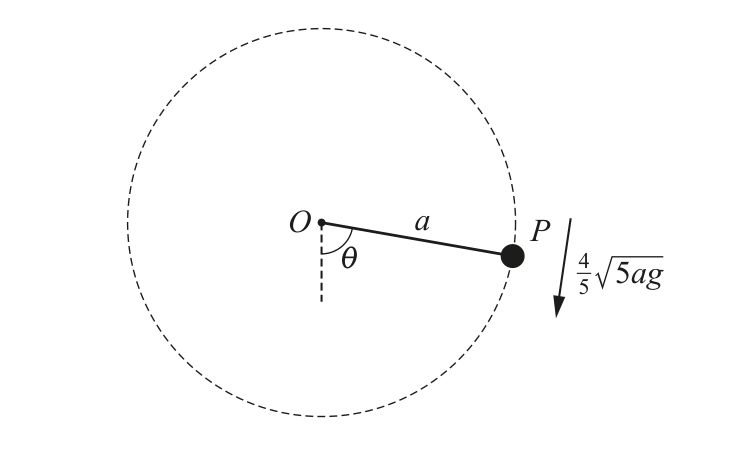
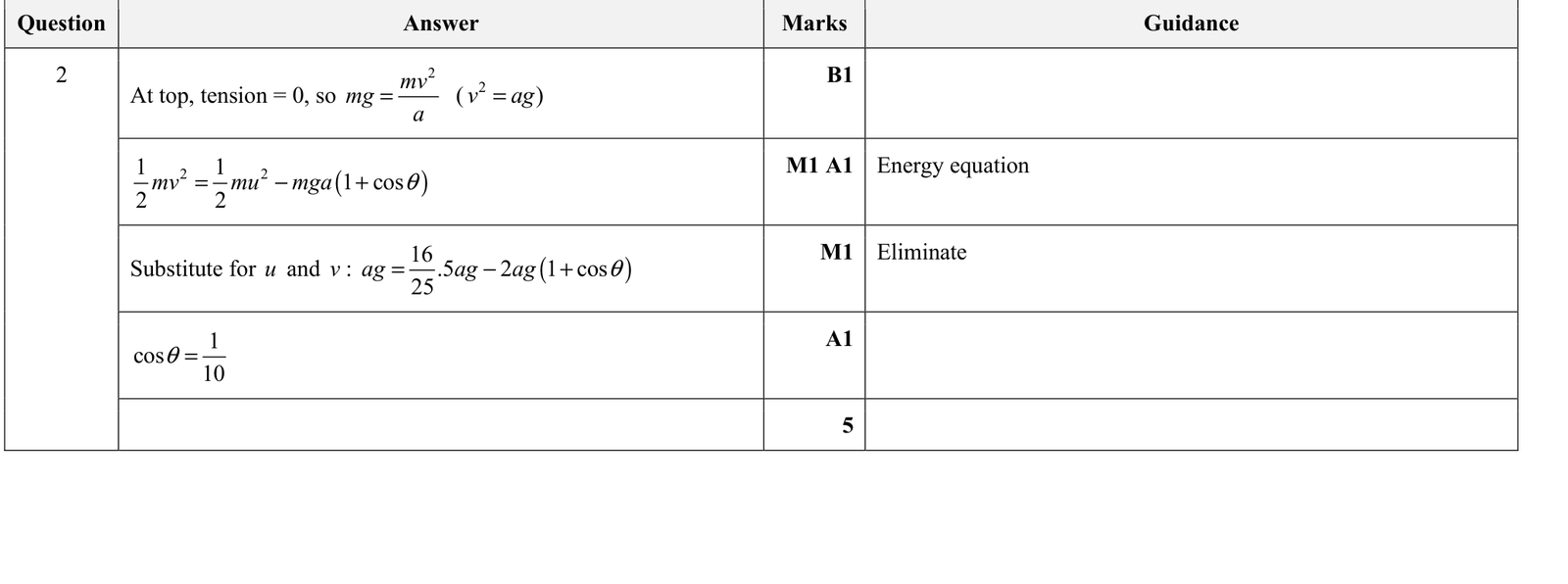
A particle \(P\) is attached to one end of a light inextensible string of length \(a\). The other end of the string is attached to a fixed point \(O\). The particle \(P\) is held with the string taut and making an angle \(\theta\) with the downward vertical. The particle \(P\) is then projected with speed \(\frac{4}{5} \sqrt{5 a g}\) perpendicular to the string and just completes a vertical circle (see diagram).
Find the value of \(\cos \theta\).
9231 P32 - Nov 2020 - Q1 - 5 marks
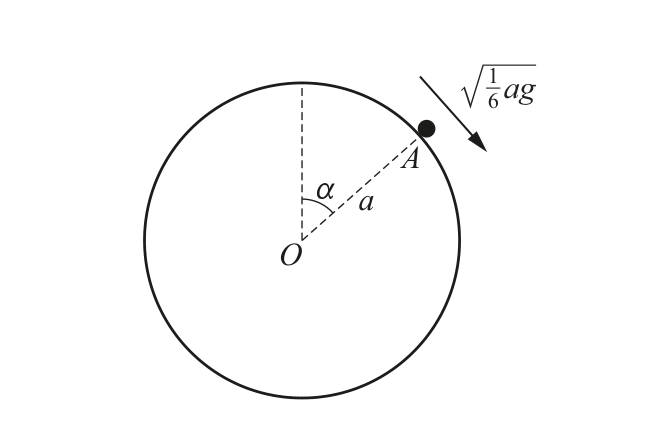
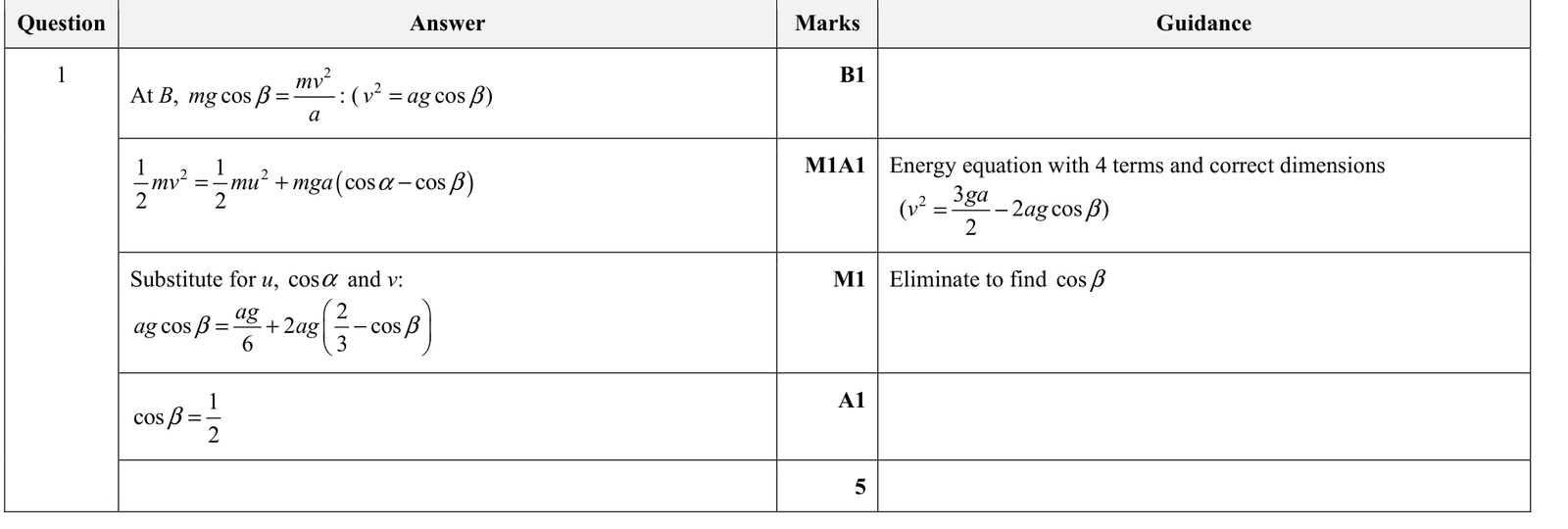
A fixed smooth solid sphere has centre \(O\) and radius \(a\). A particle of mass \(m\) is projected downwards with speed \(\sqrt{\frac{1}{6} a g}\) from the point \(A\) on the surface of the sphere, where \(O A\) makes an angle \(\alpha\) with the upward vertical through \(O\) (see diagram). The particle moves in part of a vertical circle on the surface of the sphere. It loses contact with the sphere at the point \(B\), where \(O B\) makes an angle \(\beta\) with the upward vertical through \(O\).
Given that \(\cos \alpha=\frac{2}{3}\), find the value of \(\cos \beta\).