9231 P31 - Jun 2025 - Q7 - 10 marks
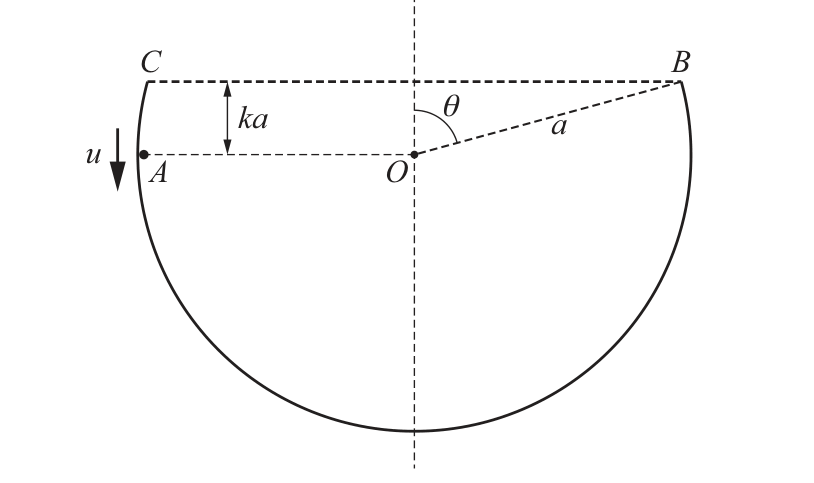
A fixed hollow sphere has radius \(a\) and centre \(O\). Points \(A\), \(B\), and \(C\) lie on the inner surface. The horizontal cut through \(B\) and \(C\) is at height \(ka\) above \(O\), where \(0\lt k\lt 1\). The angle between \(OB\) and the upward vertical is \(\theta\). A particle \(P\) of mass \(m\) moves on the smooth inner surface and is projected vertically downwards from \(A\) with speed \(u\).
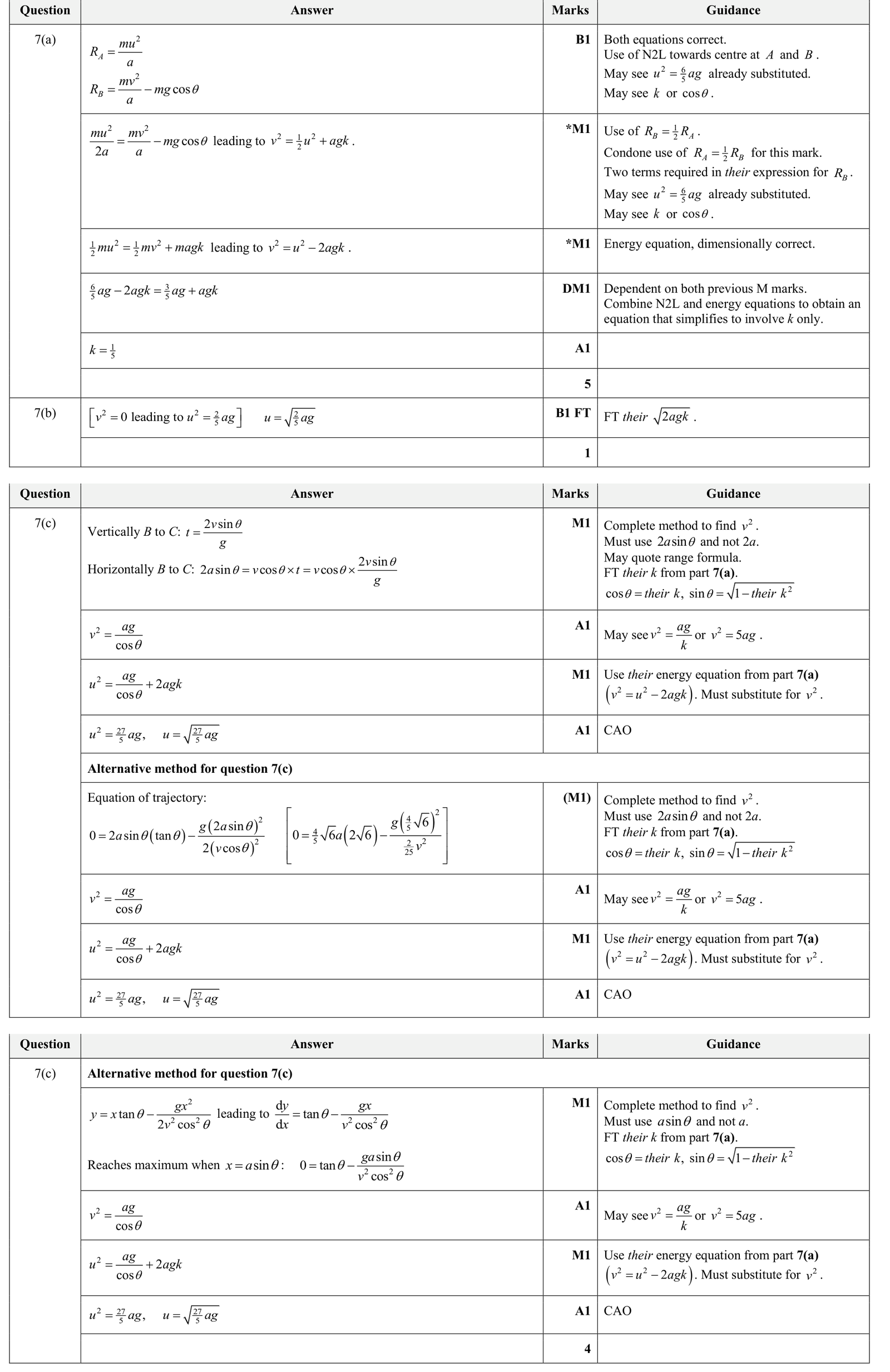
(a) If \(u=\sqrt{\frac65ga}\) and the reaction at \(B\) is half the reaction at \(A\), find \(k\).
(b) Find \(u\), in terms of \(a\) and \(g\), when the particle just reaches \(B\).
(c) Find \(u\), in terms of \(a\) and \(g\), when the particle passes through \(B\) and subsequently reaches \(C\).
9231 P31 - Jun 2022 - Q5 - 7 marks
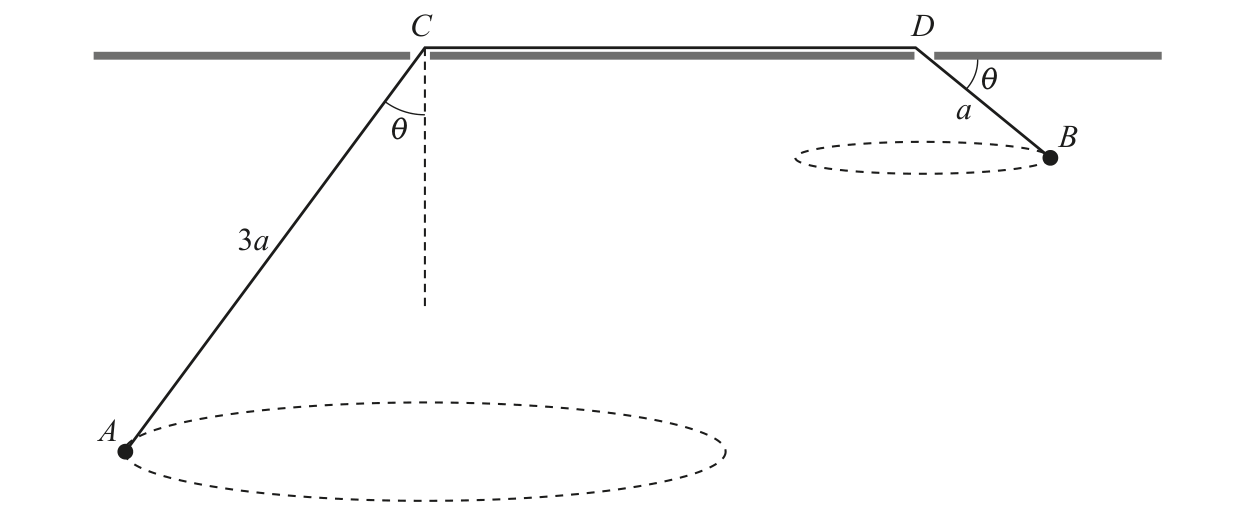
A light inextensible string \(A B\) passes through two small holes \(C\) and \(D\) in a smooth horizontal table where \(A C=3 a\) and \(D B=a\). A particle of mass \(m\) is attached at the end \(A\) and moves in a horizontal circle with angular velocity \(\omega\). A particle of mass \(\frac{3}{4} m\) is attached to the end \(B\) and moves in a horizontal circle with angular velocity \(k\omega\). \(AC\) makes an angle \(\theta\) with the downward vertical and \(D B\) makes an angle \(\theta\) with the horizontal (see diagram).
Find the value of \(k\).

9231 P32 - Nov 2022 - Q6 - 9 marks
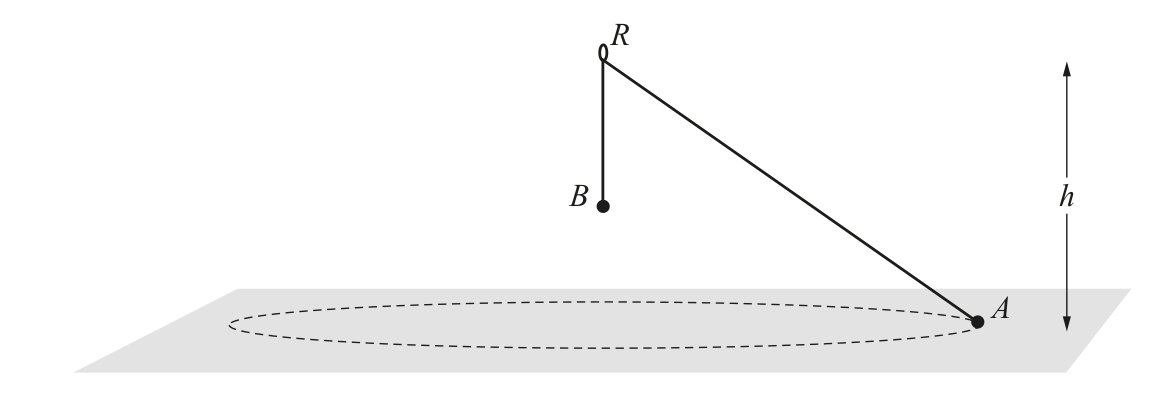
A light inextensible string is threaded through a fixed smooth ring \(R\) which is at a height \(h\) above a smooth horizontal surface. One end of the string is attached to a particle \(A\) of mass \(m\). The other end of the string is attached to a particle \(B\) of mass \(\frac{6}{7} m\). The particle \(A\) moves in a horizontal circle on the surface. The particle \(B\) hangs in equilibrium below the ring and above the surface (see diagram).
When \(A\) has constant angular speed \(\omega\), the angle between \(A R\) and \(B R\) is \(\theta\) and the normal reaction between \(A\) and the surface is \(N\).
When \(A\) has constant angular speed \(\frac{3}{2} \omega\), the angle between \(A R\) and \(B R\) is \(\alpha\) and the normal reaction between \(A\) and the surface is \(\frac{1}{2} N\).
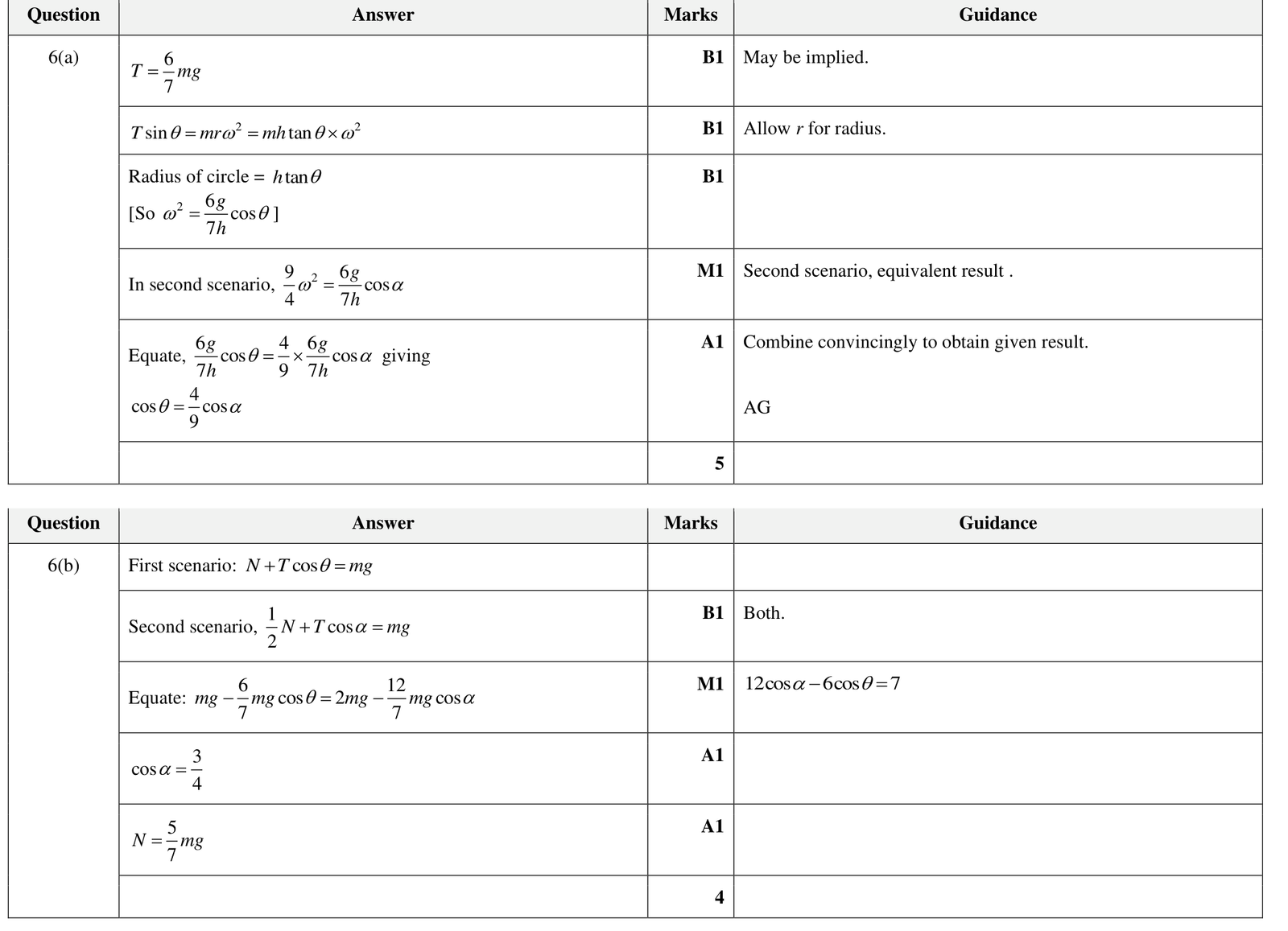
(a) Show that \(\cos \theta=\frac{4}{9} \cos \alpha\).
(b) Find \(N\) in terms of \(m\) and \(g\) and find the value of \(\cos \alpha\).