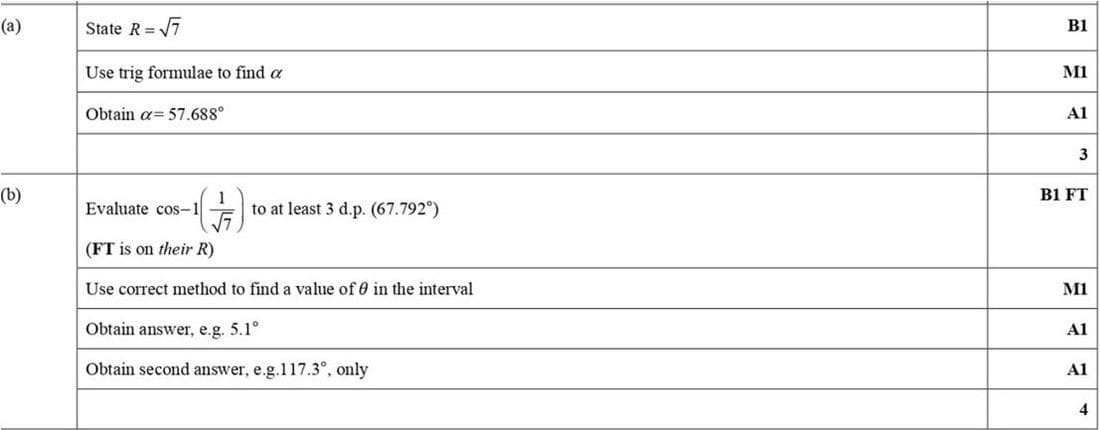
9709 P33 - Jun 2023 - Q6 - 8 marks
(a) Express \(3 \cos x + 2 \cos(x - 60^\circ)\) in the form \(R \cos(x - \alpha)\), where \(R > 0\) and \(0^\circ < \alpha < 90^\circ\). State the exact value of \(R\) and give \(\alpha\) correct to 2 decimal places.
(b) Hence solve the equation \(3 \cos 2\theta + 2 \cos(2\theta - 60^\circ) = 2.5\) for \(0^\circ < \theta < 180^\circ\).
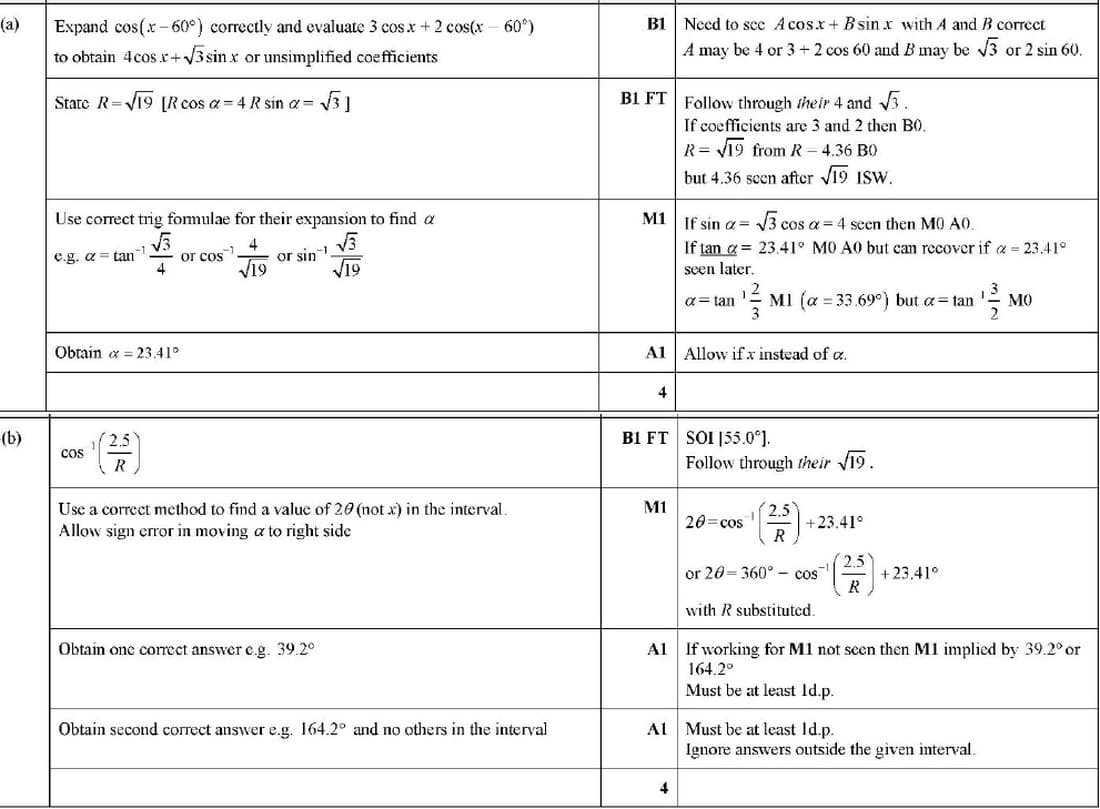
9709 P32 - Nov 2019 - Q4 - 7 marks
(i) Express \(\sqrt{6} \sin x + \cos x\) in the form \(R \sin(x + \alpha)\), where \(R > 0\) and \(0^\circ < \alpha < 90^\circ\). State the exact value of \(R\) and give \(\alpha\) correct to 3 decimal places.
(ii) Hence solve the equation \(\sqrt{6} \sin 2\theta + \cos 2\theta = 2\), for \(0^\circ < \theta < 180^\circ\).
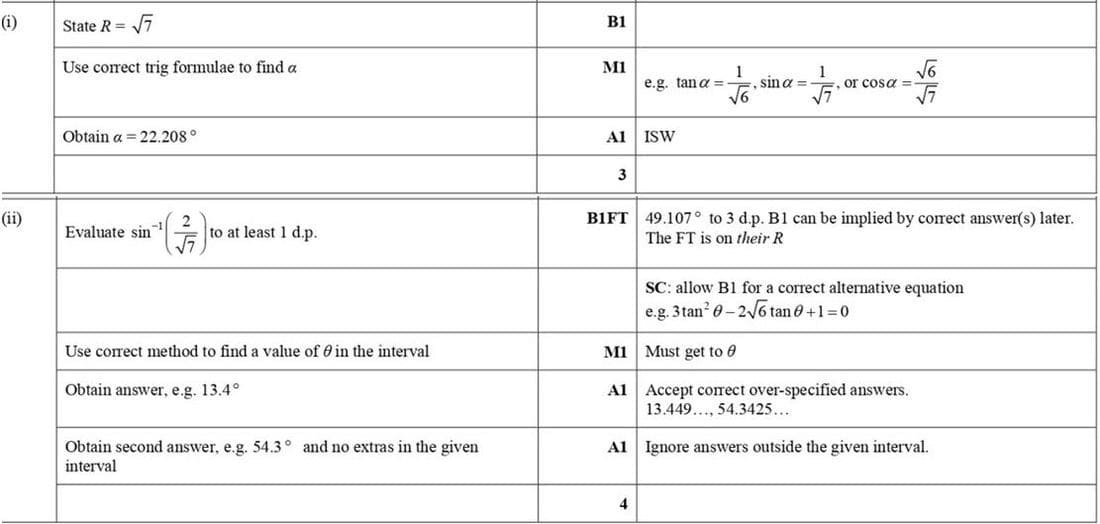
9709 P31 - Nov 2018 - Q6 - 8 marks
(i) Show that the equation \(\sqrt{2} \csc x + \cot x = \sqrt{3}\) can be expressed in the form \(R \sin(x - \alpha) = \sqrt{2}\), where \(R > 0\) and \(0^\circ < \alpha < 90^\circ\).
(ii) Hence solve the equation \(\sqrt{2} \csc x + \cot x = \sqrt{3}\), for \(0^\circ < x < 180^\circ\).
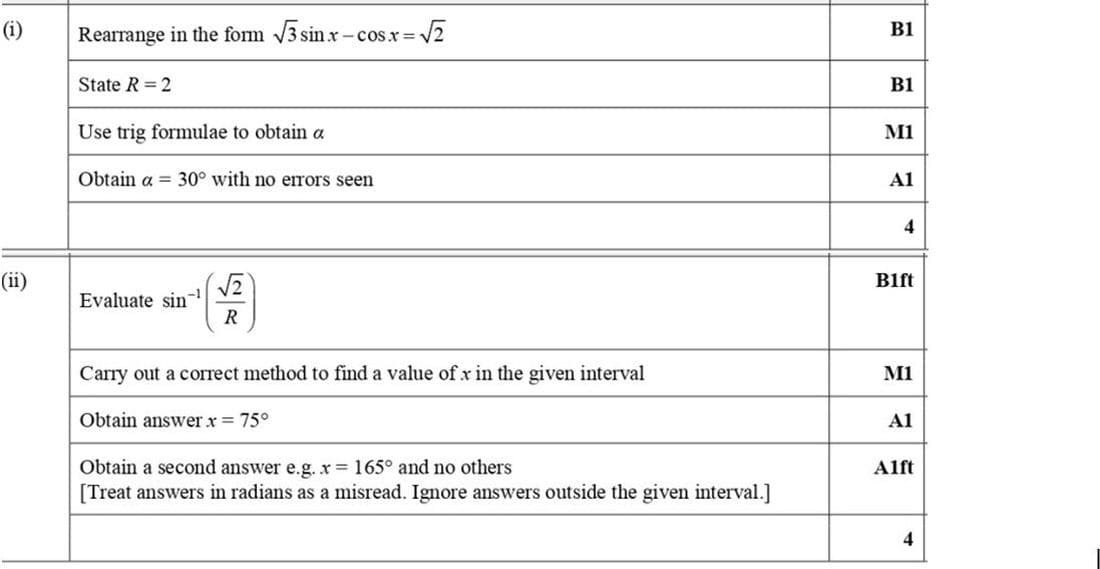
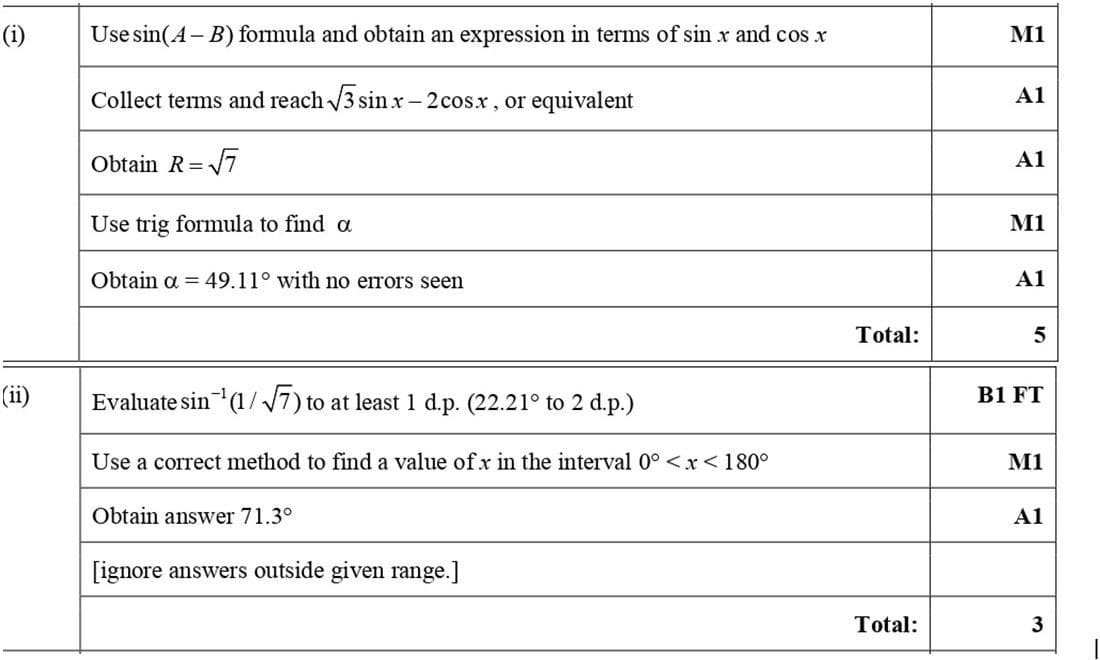
9709 P31 - Jun 2017 - Q8 - 8 marks
(i) By first expanding \(2 \sin(x - 30^\circ)\), express \(2 \sin(x - 30^\circ) - \cos x\) in the form \(R \sin(x - \alpha)\), where \(R > 0\) and \(0^\circ < \alpha < 90^\circ\). Give the exact value of \(R\) and the value of \(\alpha\) correct to 2 decimal places.
(ii) Hence solve the equation \(2 \sin(x - 30^\circ) - \cos x = 1\), for \(0^\circ < x < 180^\circ\).
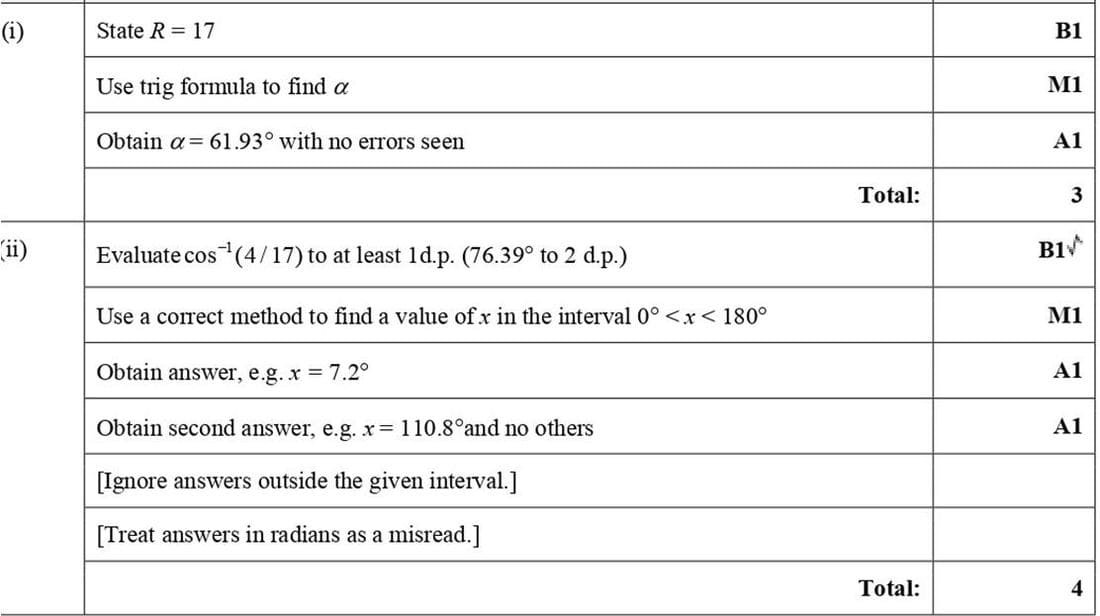
9709 P32 - Mar 2017 - Q4 - 7 marks
(i) Express \(8 \cos \theta - 15 \sin \theta\) in the form \(R \cos(\theta + \alpha)\), where \(R > 0\) and \(0^\circ < \alpha < 90^\circ\), stating the exact value of \(R\) and giving the value of \(\alpha\) correct to 2 decimal places.
(ii) Hence solve the equation \(8 \cos 2x - 15 \sin 2x = 4\), for \(0^\circ < x < 180^\circ\).
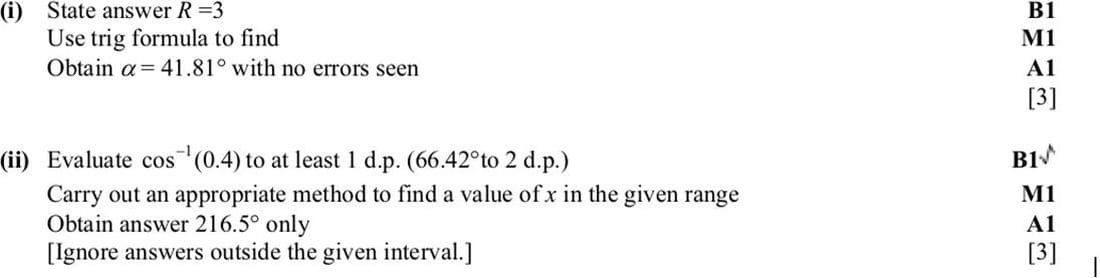
9709 P33 - Jun 2016 - Q3 - 6 marks
(i) Express \(\sqrt{5} \cos x + 2 \sin x\) in the form \(R \cos(x - \alpha)\), where \(R > 0\) and \(0^\circ < \alpha < 90^\circ\), giving the value of \(\alpha\) correct to 2 decimal places.
(ii) Hence solve the equation \(\sqrt{5} \cos \frac{1}{2}x + 2 \sin \frac{1}{2}x = 1.2\), for \(0^\circ < x < 360^\circ\).
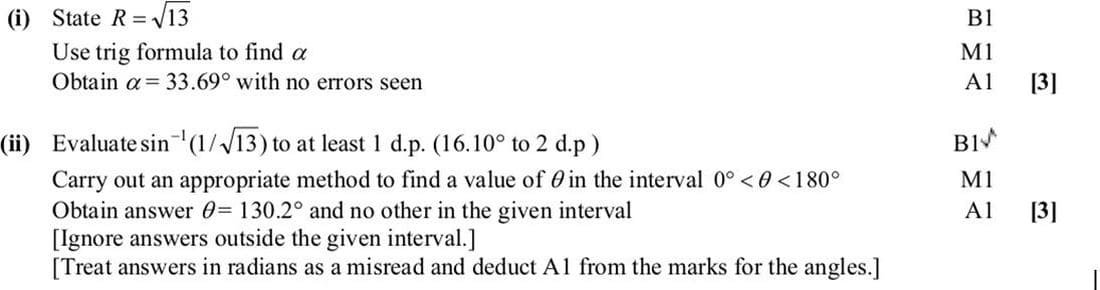
9709 P32 - Jun 2015 - Q4 - 6 marks
(i) Express \(3 \sin \theta + 2 \cos \theta\) in the form \(R \sin(\theta + \alpha)\), where \(R > 0\) and \(0^\circ < \alpha < 90^\circ\), stating the exact value of \(R\) and giving the value of \(\alpha\) correct to 2 decimal places.
(ii) Hence solve the equation \(3 \sin \theta + 2 \cos \theta = 1\), for \(0^\circ < \theta < 180^\circ\).
9709 P33 - Nov 2013 - Q7 - 10 marks
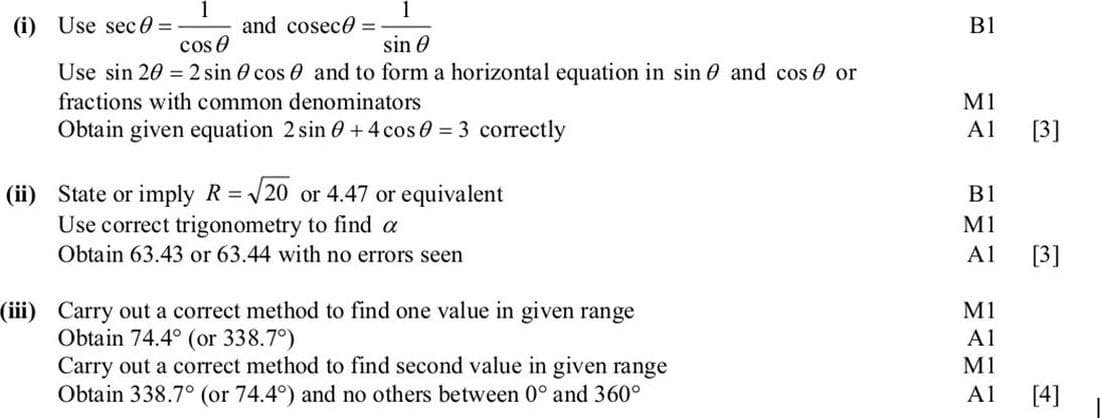
(i) Given that \(\sec \theta + 2 \csc \theta = 3 \csc 2\theta\), show that \(2 \sin \theta + 4 \cos \theta = 3\).
(ii) Express \(2 \sin \theta + 4 \cos \theta\) in the form \(R \sin(\theta + \alpha)\) where \(R > 0\) and \(0^\circ < \alpha < 90^\circ\), giving the value of \(\alpha\) correct to 2 decimal places.
(iii) Hence solve the equation \(\sec \theta + 2 \csc \theta = 3 \csc 2\theta\) for \(0^\circ < \theta < 360^\circ\).
9709 P32 - Jun 2013 - Q7 - 9 marks
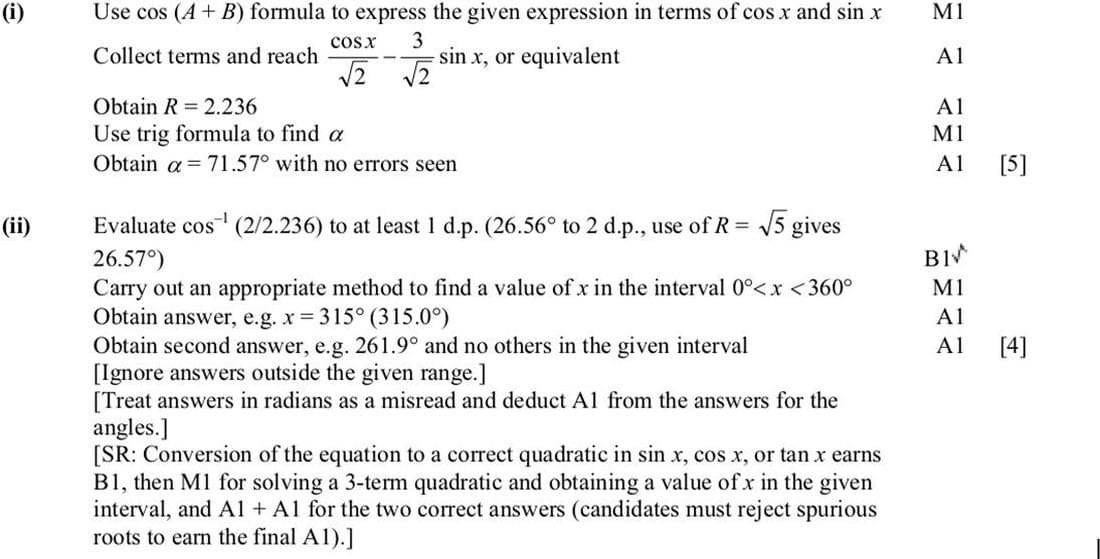
(i) Expand \(\cos(x + 45^\circ)\) and express \(\cos(x + 45^\circ) - (\sqrt{2}) \sin x\) in the form \(R \cos(x + \alpha)\), where \(R > 0\) and \(0^\circ < \alpha < 90^\circ\). Provide \(R\) to 4 significant figures and \(\alpha\) to 2 decimal places.
(ii) Solve the equation \(\cos(x + 45^\circ) - (\sqrt{2}) \sin x = 2\) for \(0^\circ < x < 360^\circ\).
9709 P33 - Nov 2012 - Q2 - 5 marks
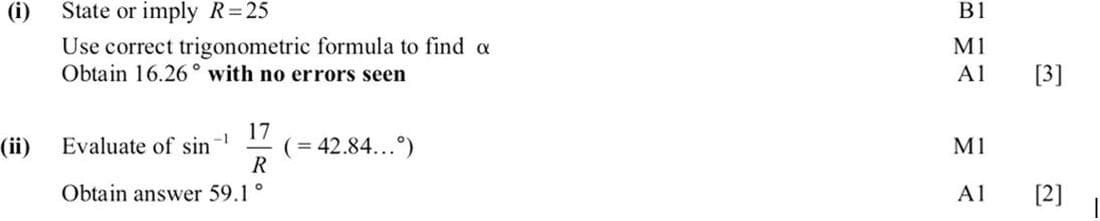
(i) Express \(24 \sin \theta - 7 \cos \theta\) in the form \(R \sin(\theta - \alpha)\), where \(R > 0\) and \(0^\circ < \alpha < 90^\circ\). Give the value of \(\alpha\) correct to 2 decimal places.
(ii) Hence find the smallest positive value of \(\theta\) satisfying the equation \(24 \sin \theta - 7 \cos \theta = 17\).
9709 P33 - Nov 2011 - Q3 - 7 marks
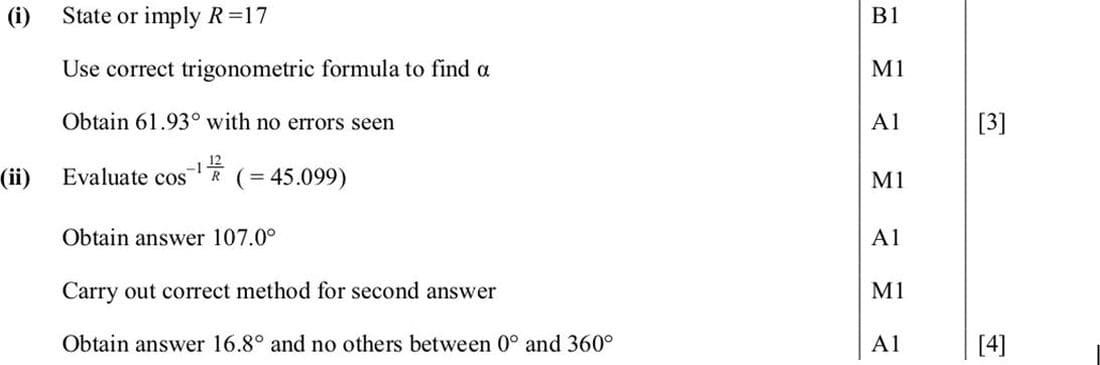
(i) Express \(8 \cos \theta + 15 \sin \theta\) in the form \(R \cos(\theta - \alpha)\), where \(R > 0\) and \(0^\circ < \alpha < 90^\circ\). Give the value of \(\alpha\) correct to 2 decimal places.
(ii) Hence solve the equation \(8 \cos \theta + 15 \sin \theta = 12\), giving all solutions in the interval \(0^\circ < \theta < 360^\circ\).
9709 P32 - Mar 2023 - Q6 - 7 marks
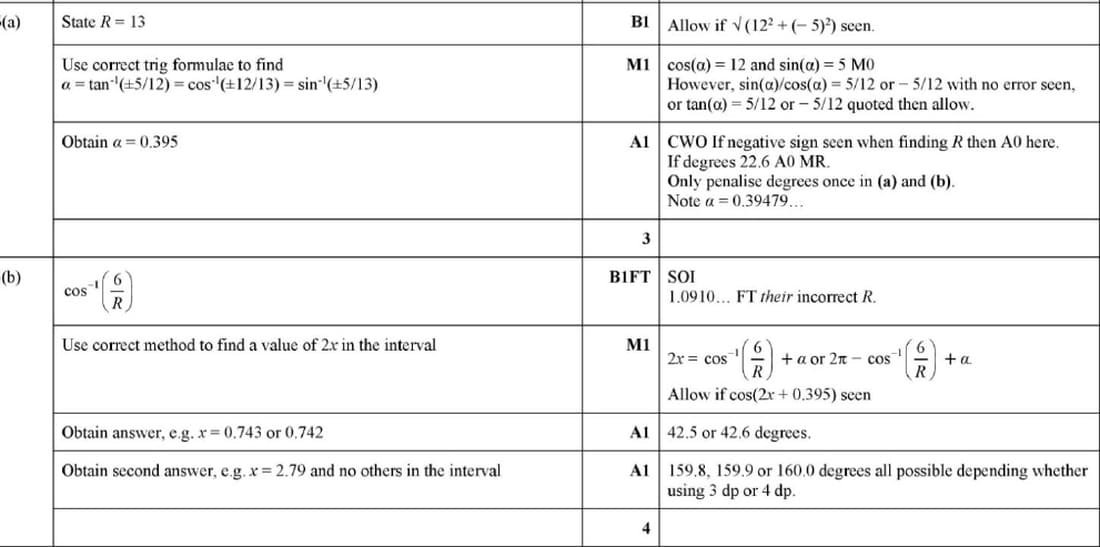
(a) Express \(5 \sin \theta + 12 \cos \theta\) in the form \(R \cos(\theta - \alpha)\), where \(R > 0\) and \(0 < \alpha < \frac{1}{2}\pi\).
(b) Hence solve the equation \(5 \sin 2x + 12 \cos 2x = 6\) for \(0 \leq x \leq \pi\).
9709 P31 - Nov 2011 - Q6 - 8 marks
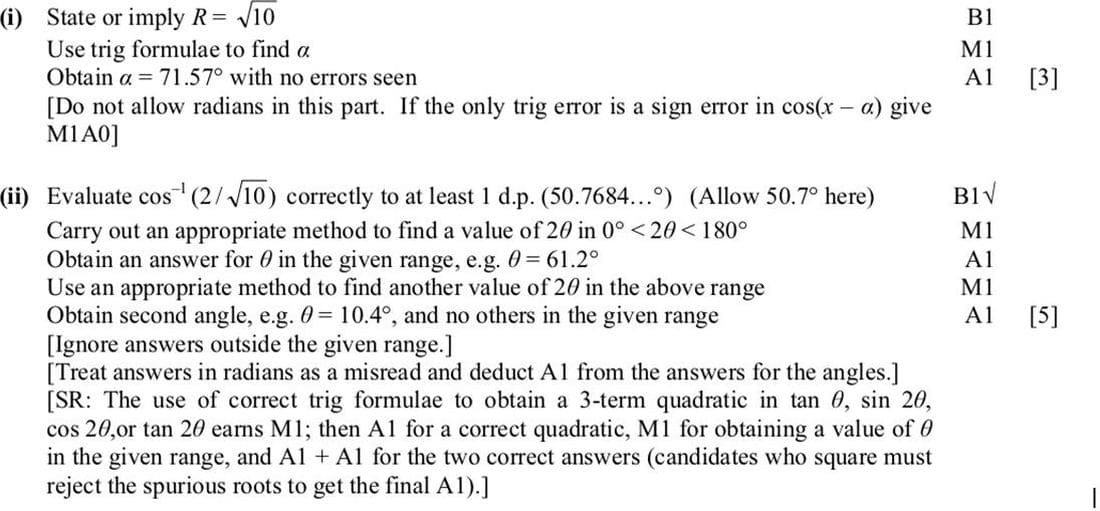
(i) Express \(\cos x + 3 \sin x\) in the form \(R \cos(x - \alpha)\), where \(R > 0\) and \(0^\circ < \alpha < 90^\circ\), giving the exact value of \(R\) and the value of \(\alpha\) correct to 2 decimal places.
(ii) Hence solve the equation \(\cos 2\theta + 3 \sin 2\theta = 2\), for \(0^\circ < \theta < 90^\circ\).
9709 P33 - Nov 2010 - Q8 - 9 marks
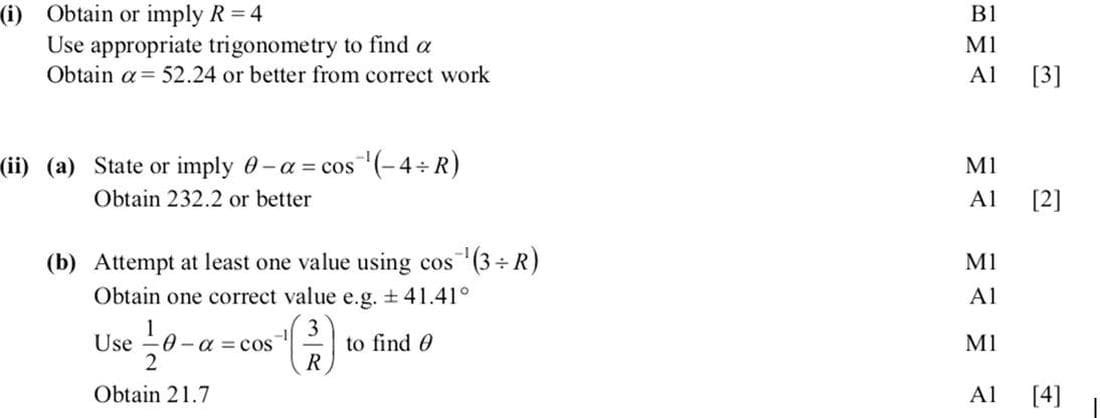
(i) Express \(\sqrt{6} \cos \theta + \sqrt{10} \sin \theta\) in the form \(R \cos(\theta - \alpha)\), where \(R > 0\) and \(0^\circ < \alpha < 90^\circ\). Give the value of \(\alpha\) correct to 2 decimal places.
(ii) Hence, in each of the following cases, find the smallest positive angle \(\theta\) which satisfies the equation:
(a) \(\sqrt{6} \cos \theta + \sqrt{10} \sin \theta = -4\)
(b) \(\sqrt{6} \cos \frac{1}{2} \theta + \sqrt{10} \sin \frac{1}{2} \theta = 3\)
9709 P3 - Nov 2008 - Q6 - 8 marks
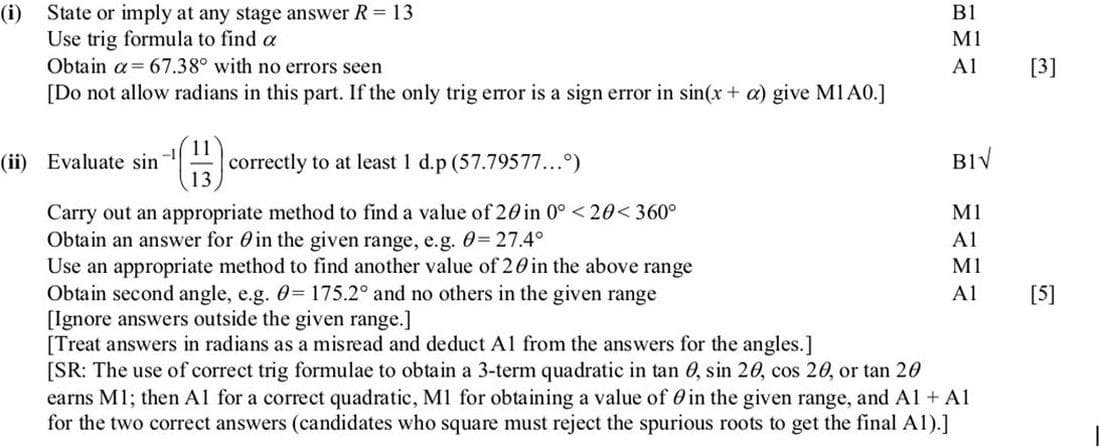
(i) Express \(5 \sin x + 12 \cos x\) in the form \(R \sin(x + \alpha)\), where \(R > 0\) and \(0^\circ < \alpha < 90^\circ\), giving the value of \(\alpha\) correct to 2 decimal places.
(ii) Hence solve the equation \(5 \sin 2\theta + 12 \cos 2\theta = 11\), giving all solutions in the interval \(0^\circ < \theta < 180^\circ\).
9709 P3 - Jun 2006 - Q4 - 7 marks
(i) Express \(7 \cos \theta + 24 \sin \theta\) in the form \(R \cos(\theta - \alpha)\), where \(R > 0\) and \(0^\circ < \alpha < 90^\circ\), giving the exact value of \(R\) and the value of \(\alpha\) correct to 2 decimal places.
(ii) Hence solve the equation \(7 \cos \theta + 24 \sin \theta = 15\), giving all solutions in the interval \(0^\circ \leq \theta \leq 360^\circ\).
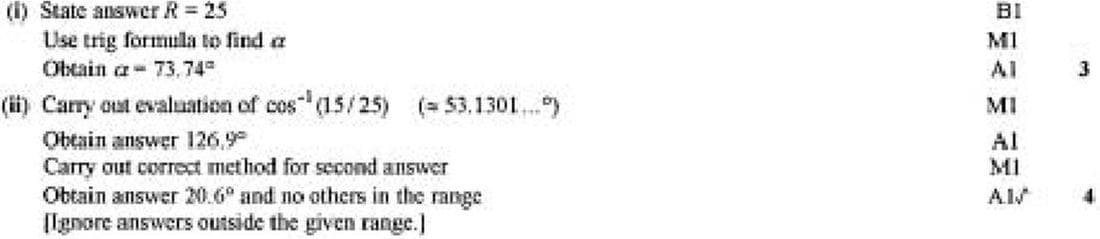
9709 P3 - Nov 2005 - Q5 - 7 marks
By expressing \(8 \sin \theta - 6 \cos \theta\) in the form \(R \sin(\theta - \alpha)\), solve the equation:
\(8 \sin \theta - 6 \cos \theta = 7,\)
for \(0^\circ \leq \theta \leq 360^\circ\).
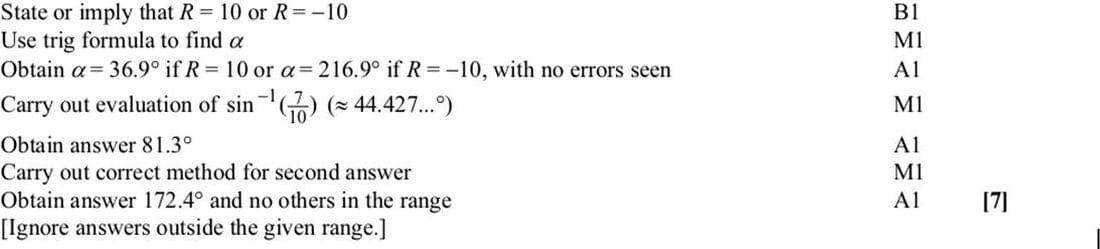
9709 P3 - Nov 2002 - Q5 - 8 marks
(i) Express \(4 \sin \theta - 3 \cos \theta\) in the form \(R \sin(\theta - \alpha)\), where \(R > 0\) and \(0^\circ < \alpha < 90^\circ\), stating the value of \(\alpha\) correct to 2 decimal places.
(ii) Solve the equation \(4 \sin \theta - 3 \cos \theta = 2\), giving all values of \(\theta\) such that \(0^\circ < \theta < 360^\circ\).
(iii) Write down the greatest value of \(\frac{1}{4 \sin \theta - 3 \cos \theta + 6}\).
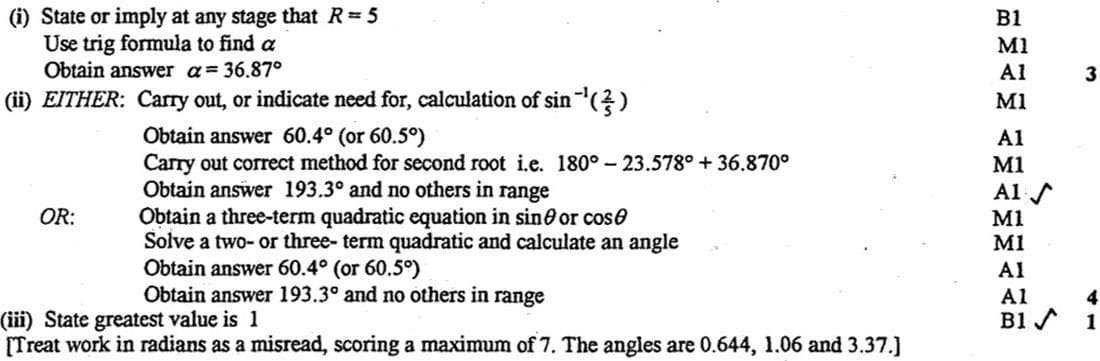
9709 P33 - Nov 2022 - Q7 - 8 marks
(a) Demonstrate that the equation \(\sqrt{5} \sec x + \tan x = 4\) can be rewritten as \(R \cos(x + \alpha) = \sqrt{5}\), where \(R > 0\) and \(0^\circ < \alpha < 90^\circ\). Provide the exact value of \(R\) and the value of \(\alpha\) to two decimal places.
(b) Solve the equation \(\sqrt{5} \sec 2x + \tan 2x = 4\) for \(0^\circ < x < 180^\circ\).
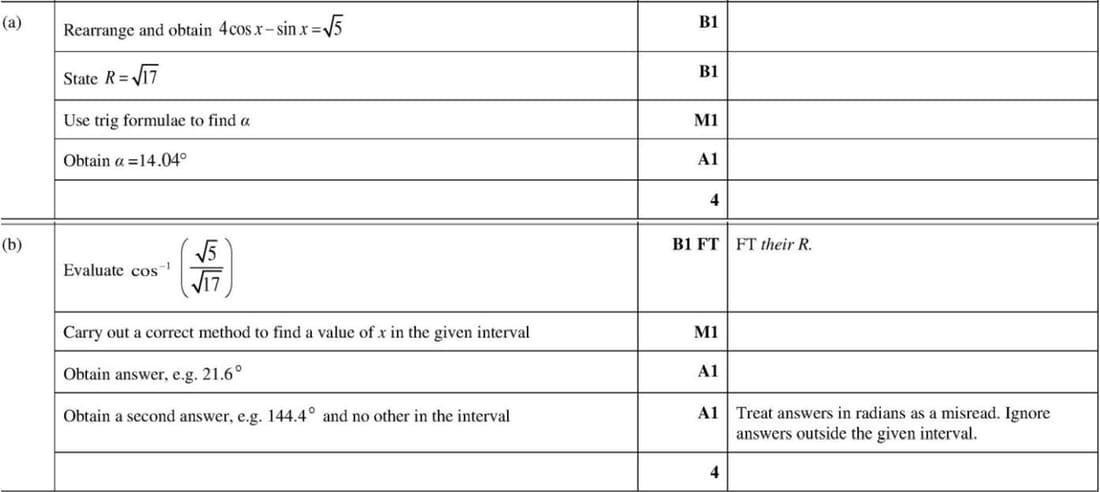
9709 P32 - Nov 2022 - Q4 - 8 marks
(a) Express \(4 \cos x - \sin x\) in the form \(R \cos(x + \alpha)\), where \(R > 0\) and \(0^\circ < \alpha < 90^\circ\). State the exact value of \(R\) and give \(\alpha\) correct to 2 decimal places.
(b) Hence solve the equation \(4 \cos 2x - \sin 2x = 3\) for \(0^\circ < x < 180^\circ\).
9709 P33 - Nov 2021 - Q6 - 7 marks
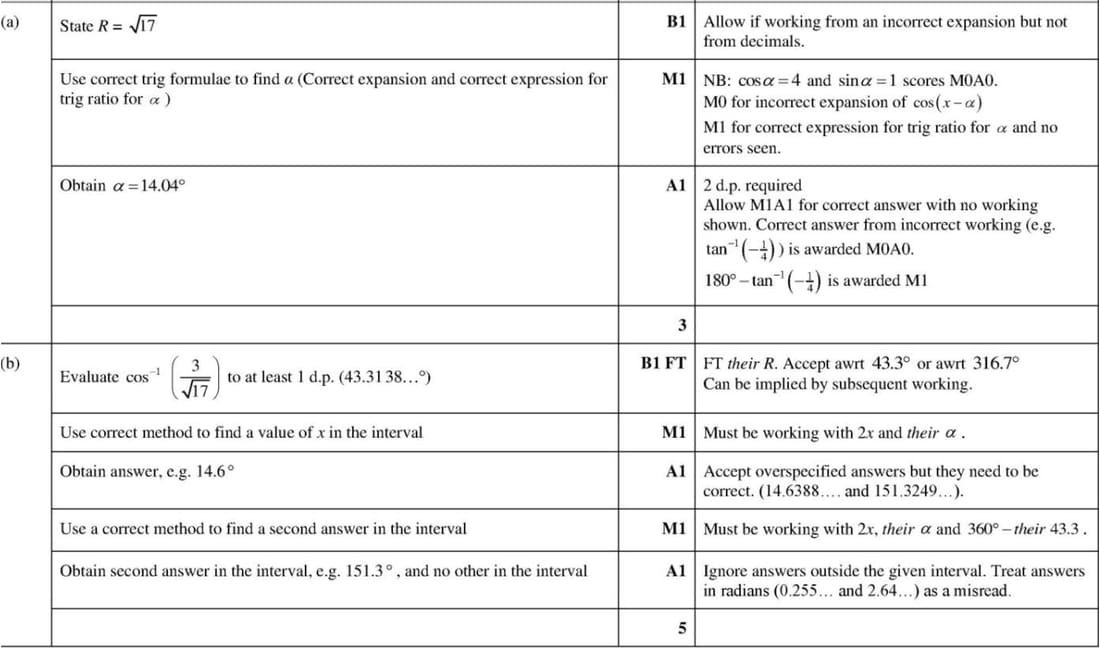
(a) By expanding \(\cos(x - 60^\circ)\), show that the expression \(2\cos(x - 60^\circ) + \cos x\) can be written in the form \(R\cos(x - \alpha)\), where \(R > 0\) and \(0^\circ < \alpha < 90^\circ\). Give the exact value of \(R\) and the value of \(\alpha\) correct to 2 decimal places.
(b) Hence find the value of \(x\) in the interval \(0^\circ < x < 360^\circ\) for which \(2\cos(x - 60^\circ) + \cos x\) takes its least possible value.
9709 P31 - Nov 2021 - Q2 - 5 marks
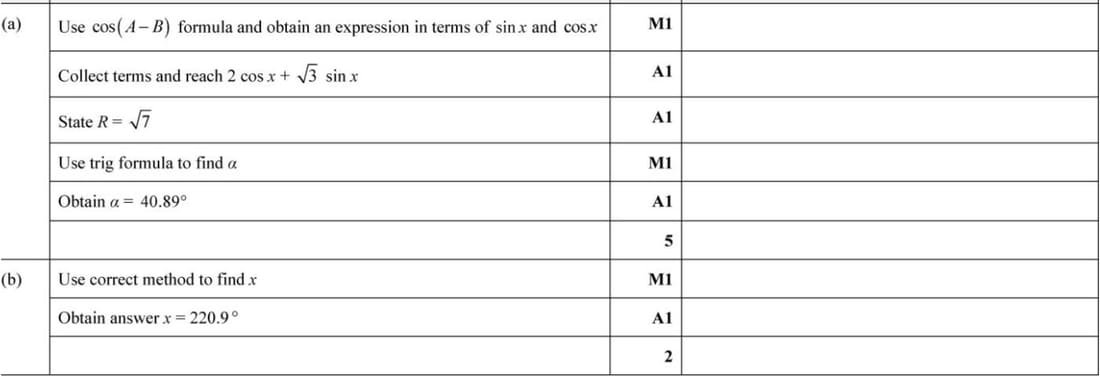
(a) Express \(5 \sin x - 3 \cos x\) in the form \(R \sin(x - \alpha)\), where \(R > 0\) and \(0 < \alpha < \frac{1}{2}\pi\). Give the exact value of \(R\) and give \(\alpha\) correct to 2 decimal places.
(b) Hence state the greatest and least possible values of \((5 \sin x - 3 \cos x)^2\).
9709 P32 - Mar 2021 - Q5 - 8 marks
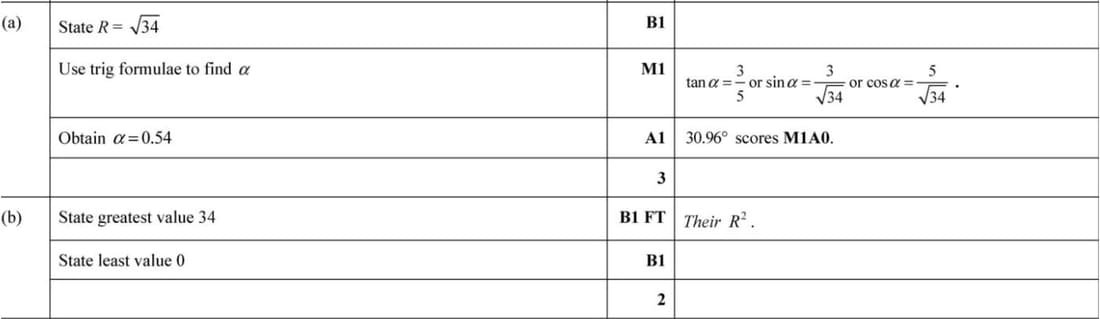
(a) Express \(\sqrt{7} \sin x + 2 \cos x\) in the form \(R \sin(x + \alpha)\), where \(R > 0\) and \(0^\circ < \alpha < 90^\circ\). State the exact value of \(R\) and give \(\alpha\) correct to 2 decimal places.
(b) Hence solve the equation \(\sqrt{7} \sin 2\theta + 2 \cos 2\theta = 1\), for \(0^\circ < \theta < 180^\circ\).
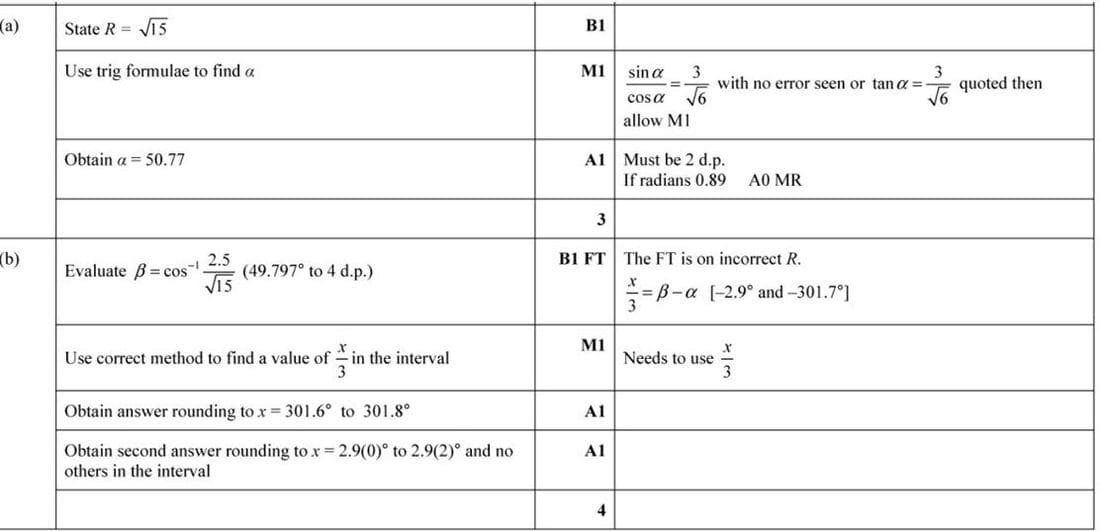
9709 P31 - Nov 2020 - Q6 - 7 marks
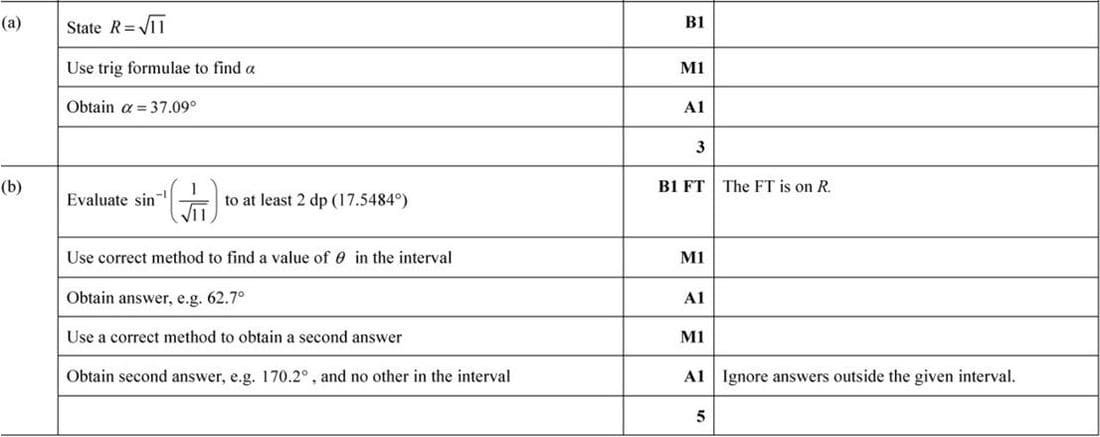
(a) Express \(\sqrt{6} \cos \theta + 3 \sin \theta\) in the form \(R \cos(\theta - \alpha)\), where \(R > 0\) and \(0^\circ < \alpha < 90^\circ\). State the exact value of \(R\) and give \(\alpha\) correct to 2 decimal places.
(b) Hence solve the equation \(\sqrt{6} \cos \frac{1}{3}x + 3 \sin \frac{1}{3}x = 2.5\), for \(0^\circ < x < 360^\circ\).
9709 P32 - Jun 2020 - Q5 - 7 marks
(a) Express \(\sqrt{2} \cos x - \sqrt{5} \sin x\) in the form \(R \cos(x + \alpha)\), where \(R > 0\) and \(0^\circ < \alpha < 90^\circ\). Give the exact value of \(R\) and the value of \(\alpha\) correct to 3 decimal places.
(b) Hence solve the equation \(\sqrt{2} \cos 2\theta - \sqrt{5} \sin 2\theta = 1\), for \(0^\circ < \theta < 180^\circ\).