9231 P21 - Nov 2018 - Q4 - 11 marks
A uniform rod \(A B\) of length \(4 a\) and weight \(W\) is smoothly hinged to a vertical wall at the end \(A\). The rod is held at an angle \(\theta\) above the horizontal by a light elastic string. One end of the string is attached to the point \(C\) on the rod, where \(A C=3 a\). The other end of the string is attached to a point \(D\) on the wall, with \(D\) vertically above \(A\) and such that angle \(A C D=2 \theta\). A particle of weight \(\frac{1}{2} W\) is attached to the rod at \(B\). It is given that \(\tan \theta=\frac{8}{15}\).
(i) Show that the tension in the string is \(\frac{17}{12} W\).
(ii) Find the magnitude and direction of the reaction at the hinge.
(iii) Given that the natural length of the string is \(2 a\), find its modulus of elasticity.

9231 P21 - Nov 2019 - Q2 - 8 marks
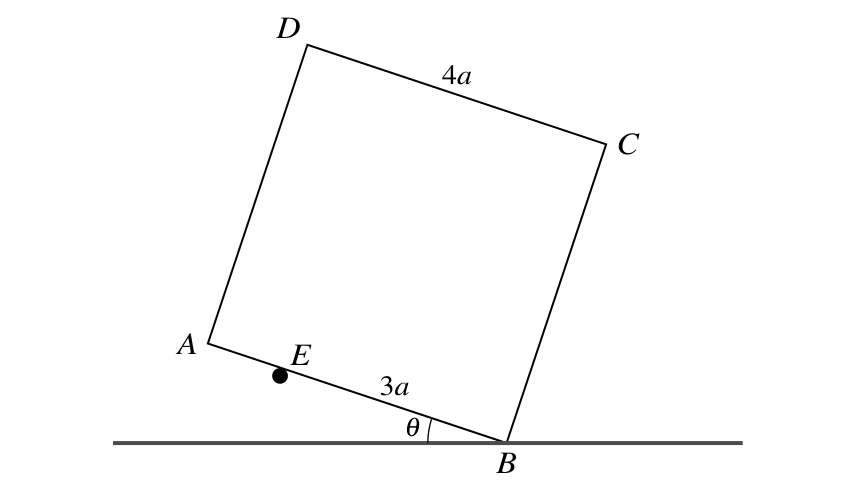
A uniform square lamina \(A B C D\) of side \(4 a\) and weight \(W\) rests in a vertical plane with the edge \(A B\) inclined at an angle \(\theta\) to the horizontal, where \(\tan \theta=\frac{1}{3}\). The vertex \(B\) is in contact with a rough horizontal surface for which the coefficient of friction is \(\mu\). The lamina is supported by a smooth peg at the point \(E\) on \(A B\), where \(B E=3 a\) (see diagram).
(i) Find expressions in terms of \(W\) for the normal reaction forces at \(E\) and \(B\).
(ii) Given that the lamina is about to slip, find the value of \(\mu\).

9231 P23 - Jun 2019 - Q5 - 12 marks
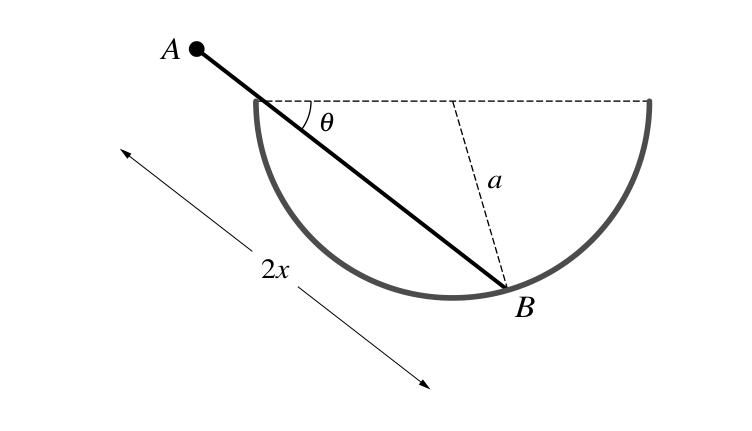
A uniform \(\operatorname{rod} A B\) of length \(2 x\) and weight \(W\) rests on the smooth rim of a fixed hemispherical bowl of radius \(a\). The end \(B\) of the rod is in contact with the rough inner surface of the bowl. The coefficient of friction between the rod and the bowl at \(B\) is \(\frac{1}{3}\). A particle of weight \(\frac{1}{4} W\) is attached to the end \(A\) of the rod. The end \(B\) is about to slip upwards when \(A B\) is inclined at an angle \(\theta\) to the horizontal, where \(\tan \theta=\frac{3}{4}\) (see diagram).
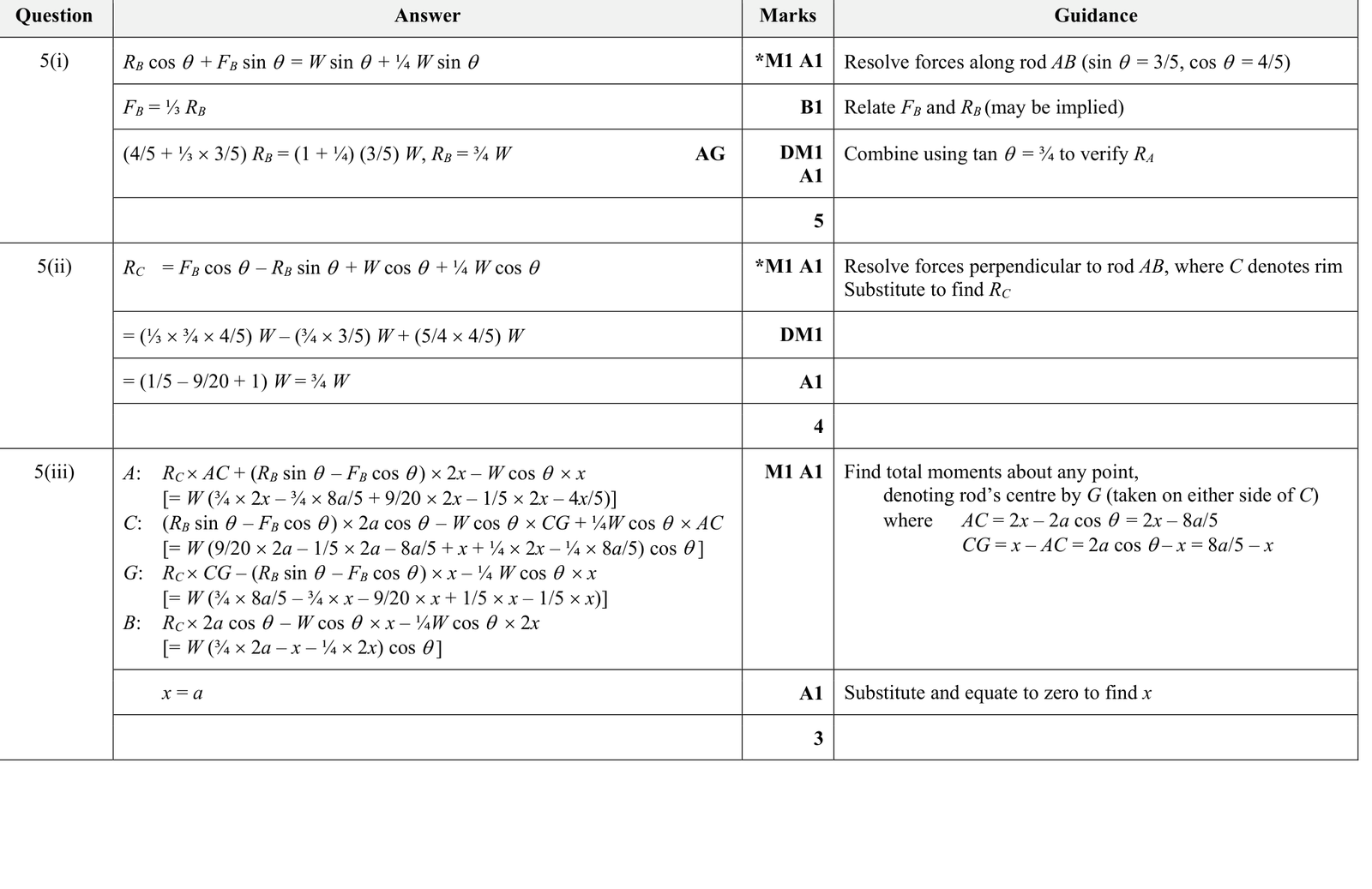
(i) By resolving parallel to the rod, show that the normal component of the reaction of the bowl on the rod at \(B\) is \(\frac{3}{4} W\).
(ii) Find, in terms of \(W\), the reaction between the rod and the smooth rim of the bowl.
(iii) Find \(x\) in terms of \(a\).
9231 P21 - Jun 2019 - Q4 - 10 marks
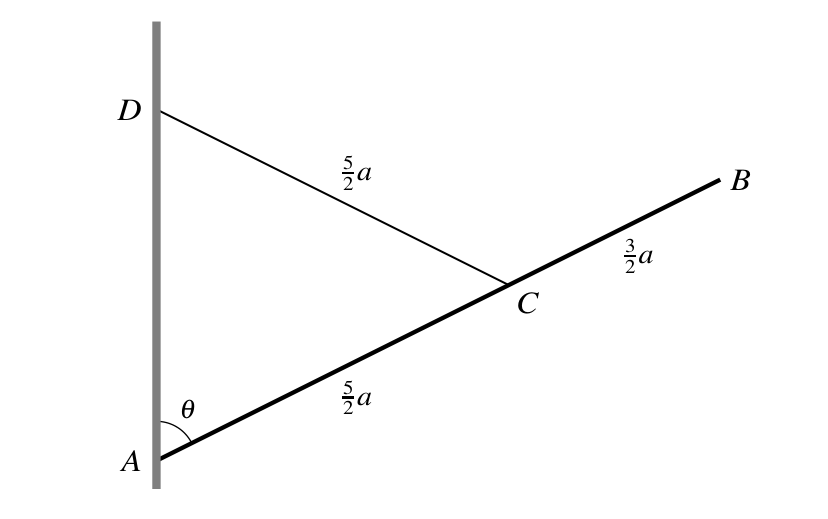
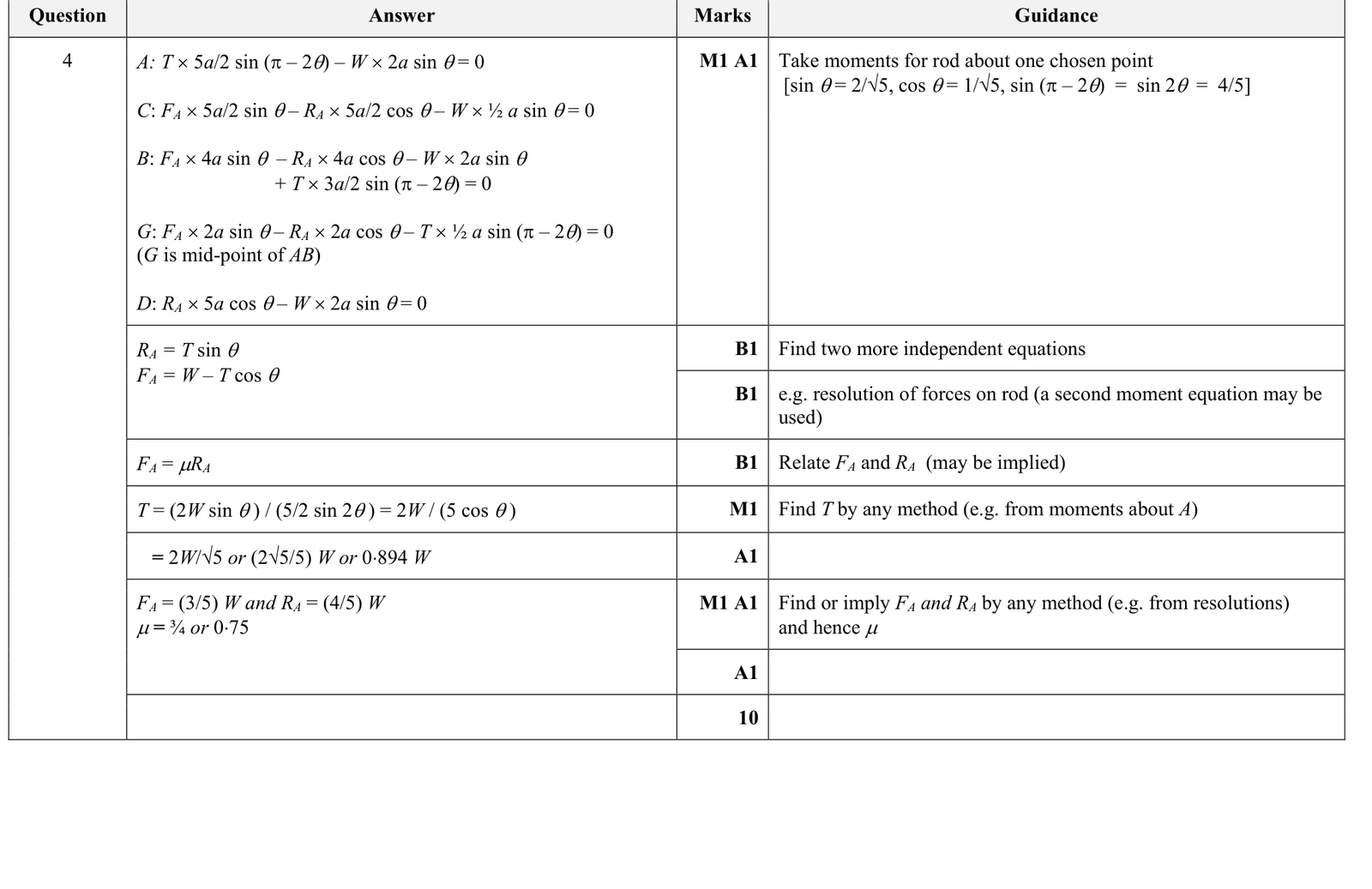
A uniform \(\operatorname{rod} A B\) of length \(4 a\) and weight \(W\) rests with the end \(A\) in contact with a rough vertical wall. A light inextensible string of length \(\frac{5}{2} a\) has one end attached to the point \(C\) on the rod, where \(A C=\frac{5}{2} a\). The other end of the string is attached to a point \(D\) on the wall, vertically above \(A\). The vertical plane containing the \(\operatorname{rod} A B\) is perpendicular to the wall. The angle between the rod and the wall is \(\theta\), where \(\tan \theta=2\) (see diagram). The end \(A\) of the rod is on the point of slipping down the wall and the coefficient of friction between the rod and the wall is \(\mu\).
Find, in either order, the tension in the string and the value of \(\mu\).
9231 P22 - Nov 2018 - Q4 - 11 marks
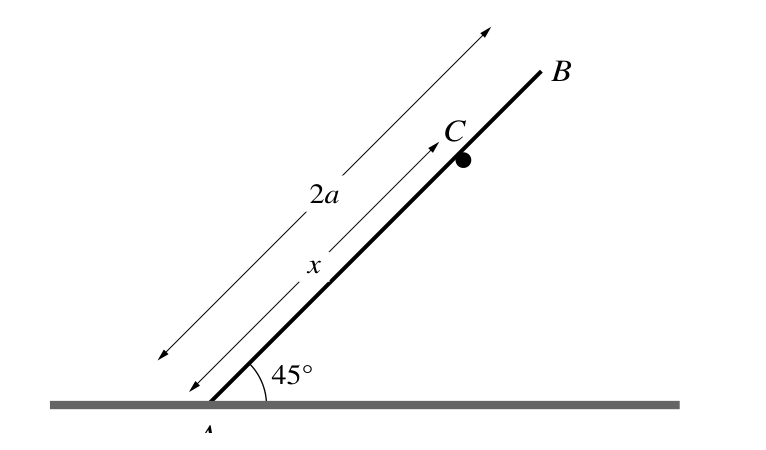
A uniform rod \(A B\) of length \(2 a\) and weight \(W\) rests against a smooth horizontal peg at a point \(C\) on the rod, where \(A C=x\). The lower end \(A\) of the rod rests on rough horizontal ground. The rod is in equilibrium inclined at an angle of \(45^{\circ}\) to the horizontal (see diagram). The coefficient of friction between the rod and the ground is \(\mu\). The rod is about to slip at \(A\).
(i) Find an expression for \(x\) in terms of \(a\) and \(\mu\).
(ii) Hence show that \(\mu \geqslant \frac{1}{3}\).
(iii) Given that \(x=\frac{3}{2} a\), find the value of \(\mu\) and the magnitude of the resultant force on the rod at \(A\).

9231 P21 - Jun 2017 - Q2 - 8 marks
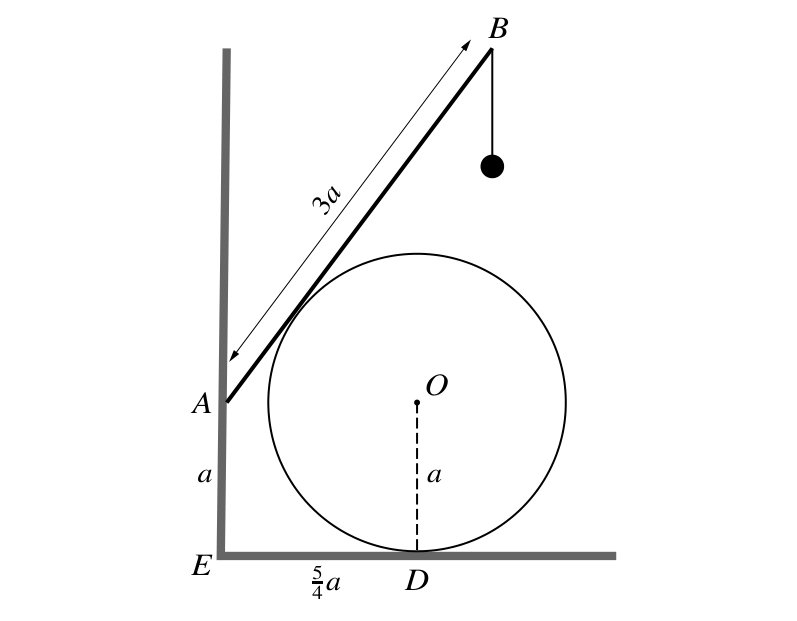
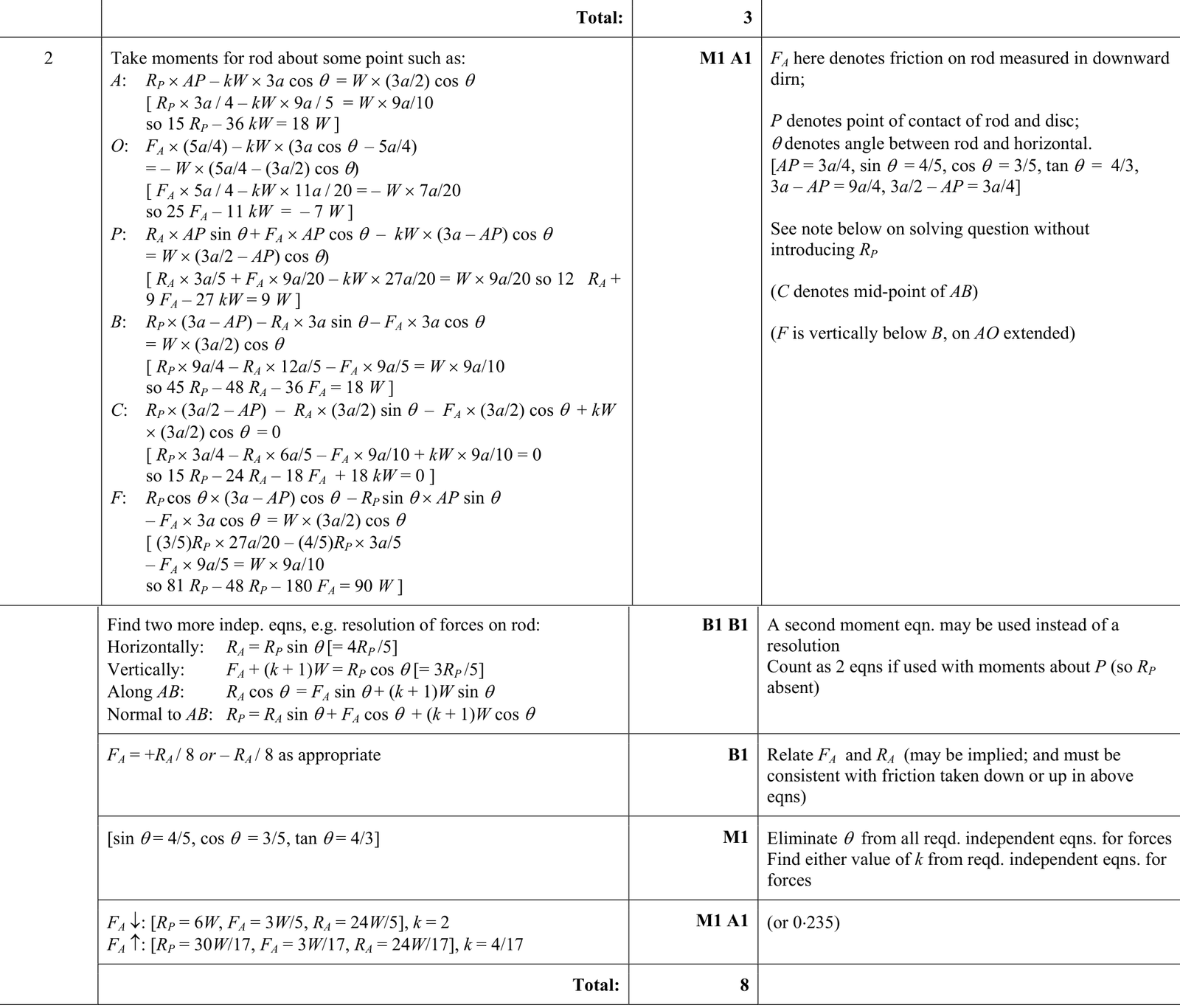
A uniform smooth disc with centre \(O\) and radius \(a\) is fixed at the point \(D\) on a horizontal surface. A uniform rod of length \(3 a\) and weight \(W\) rests on the disc with its end \(A\) in contact with a rough vertical wall. The rod and the disc lie in a vertical plane that is perpendicular to the wall. The wall meets the horizontal surface at the point \(E\) such that \(A E=a\) and \(E D=\frac{5}{4} a\). A particle of weight \(k W\) is hung from the rod at \(B\) (see diagram). The coefficient of friction between the rod and the wall is \(\frac{1}{8}\) and the system is in limiting equilibrium. Find the value of \(k\).
9231 P23 - Jun 2017 - Q4 - 10 marks
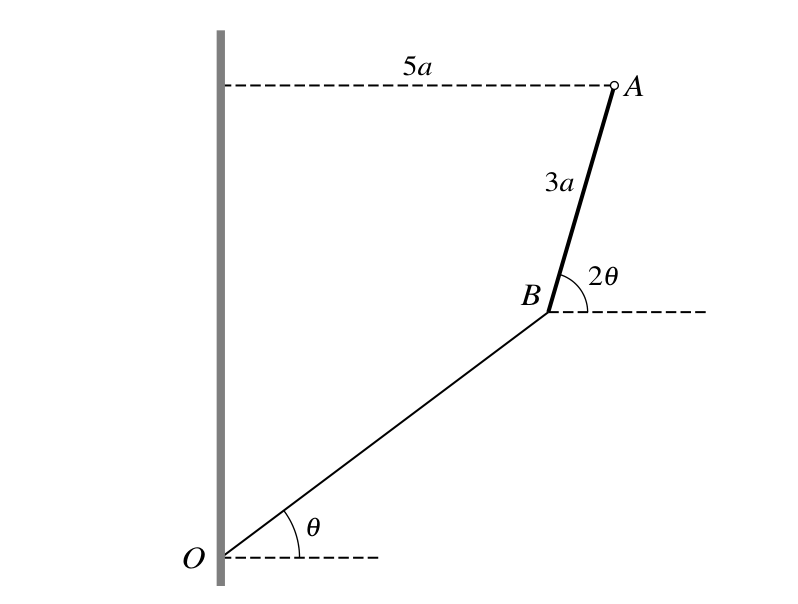
A uniform rod \(A B\) of length \(3 a\) and weight \(W\) is freely hinged to a fixed point at the end \(A\). The end \(B\) is below the level of \(A\) and is attached to one end of a light elastic string of natural length \(4 a\). The other end of the string is attached to a point \(O\) on a vertical wall. The horizontal distance between \(A\) and the wall is \(5 a\). The string and the rod make angles \(\theta\) and \(2 \theta\) respectively with the horizontal (see diagram). The system is in equilibrium with the rod and the string in the same vertical plane. It is given that \(\sin \theta=\frac{3}{5}\) and you may use the fact that \(\cos 2 \theta=\frac{7}{25}\).
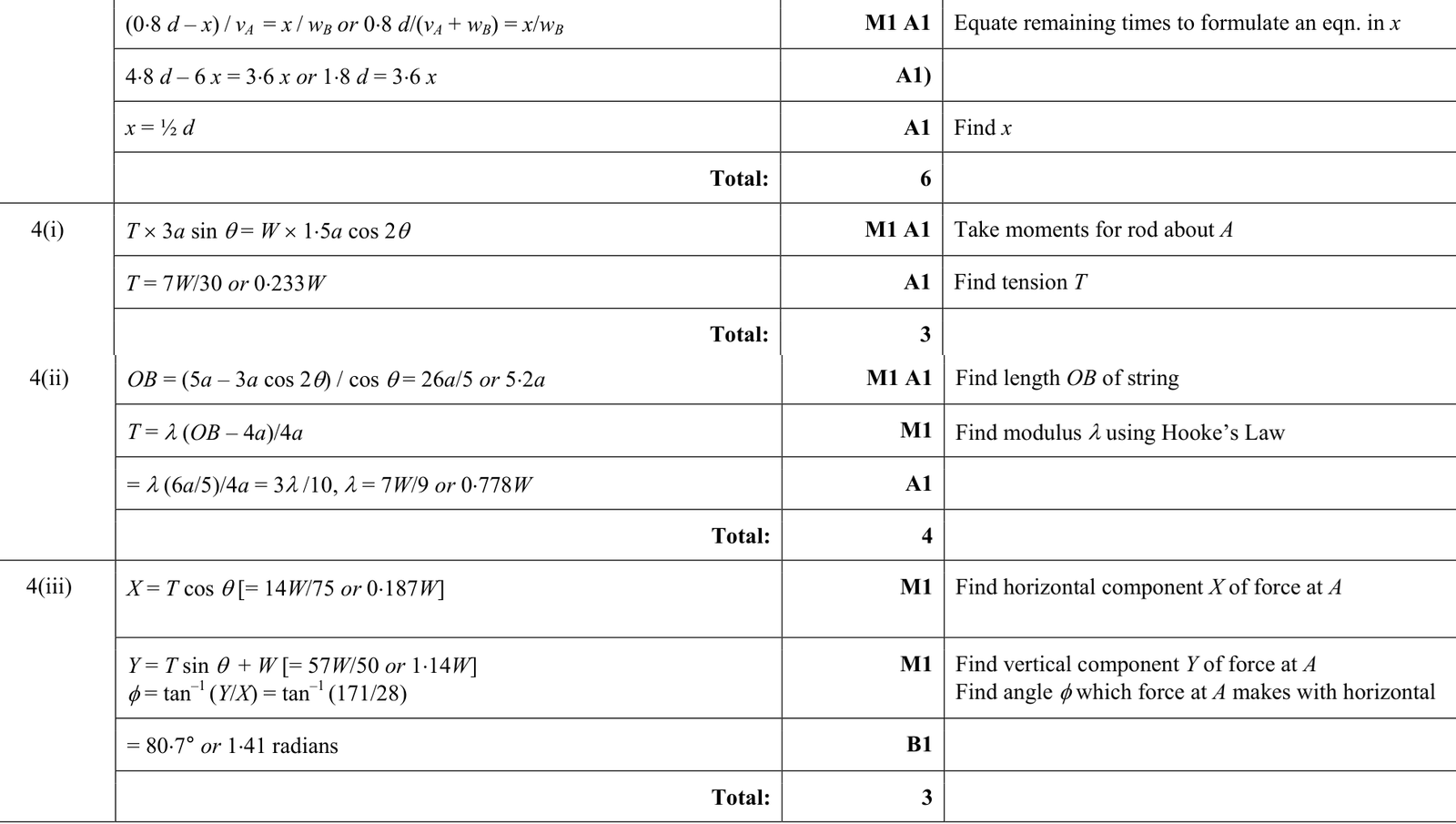
(i) Find the tension in the string in terms of \(W\).
(ii) Find the modulus of elasticity of the string in terms of \(W\).
(iii) Find the angle that the force acting on the \(\operatorname{rod}\) at \(A\) makes with the horizontal.
9231 P21 - Nov 2017 - Q4 - 10 marks
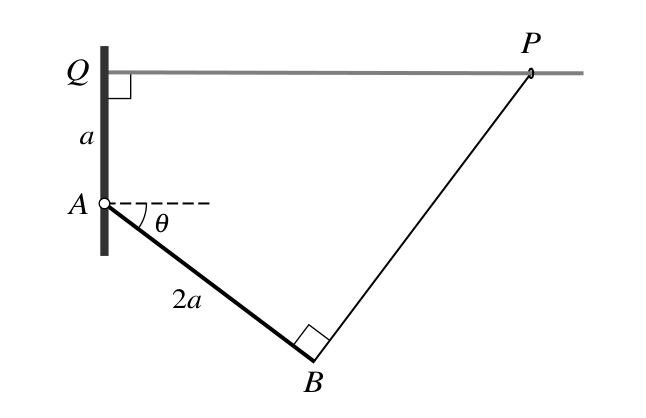
A small ring \(P\) of weight \(W\) is free to slide on a rough horizontal wire, one end of which is attached to a vertical wall at \(Q\). The end \(A\) of a thin uniform \(\operatorname{rod} A B\) of length \(2 a\) and weight \(\frac{5}{2} W\) is freely hinged to the wall at the point \(A\) which is a distance \(a\) vertically below \(Q\). A light elastic string of natural length \(2 a\) has one end attached to the ring \(P\) and the other end attached to the rod at \(B\). The string is at right angles to the rod and \(A, B, P\) and \(Q\) lie in a vertical plane. The system is in limiting equilibrium with \(A B\) making an angle \(\theta\) with the horizontal, where \(\sin \theta=\frac{3}{5}\) (see diagram).
(i) Find the tension in the string in terms of \(W\).
(ii) Find the coefficient of friction between the ring and the wire.
(iii) Find the magnitude of the resultant force on the rod at the hinge in terms of \(W\).
(iv) Find the modulus of elasticity of the string in terms of \(W\).
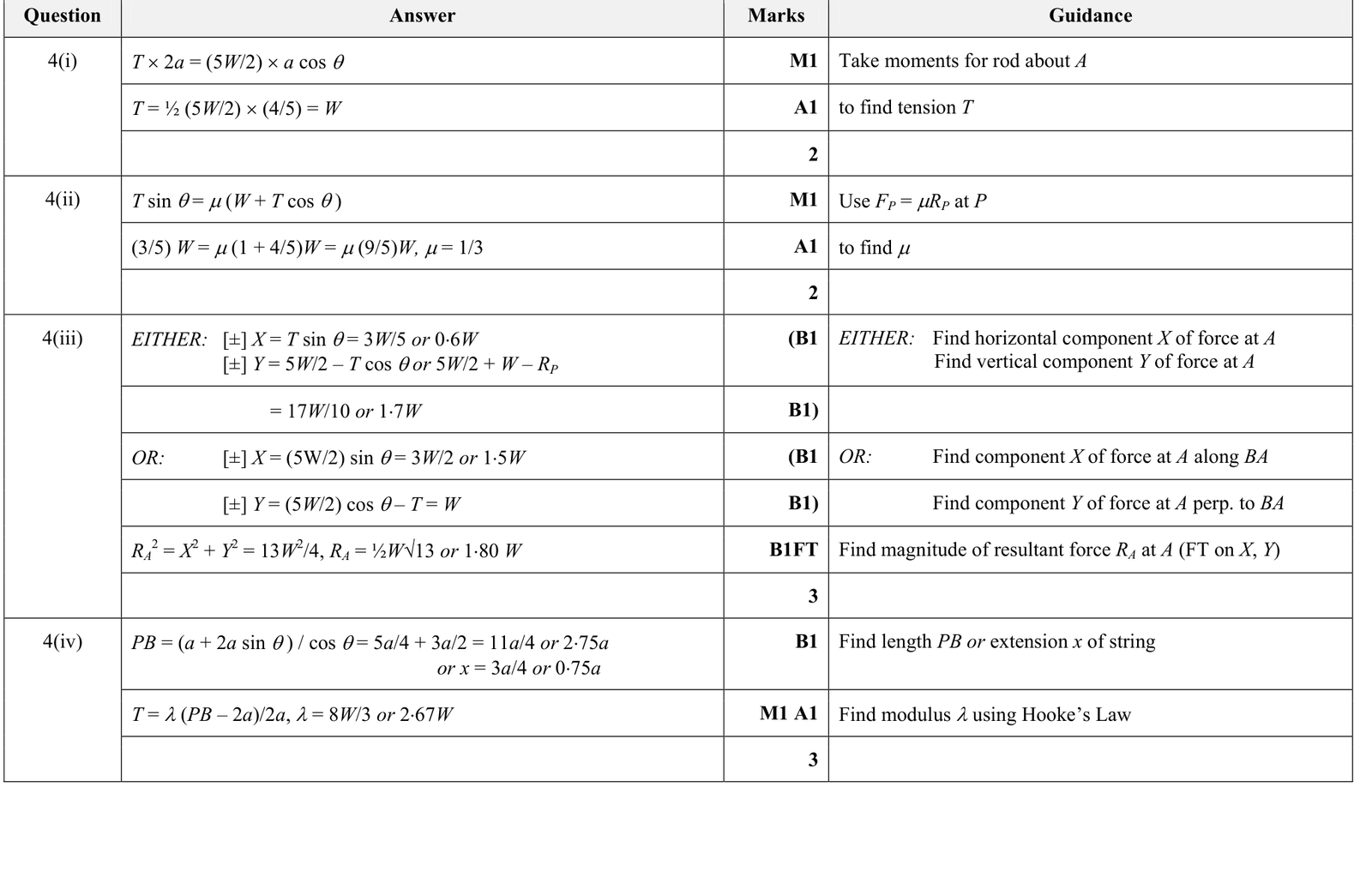
9231 P21 - Jun 2018 - Q4 - 11 marks
A uniform \(\operatorname{rod} A B\) has length \(2 a\) and weight \(W\). The end \(A\) rests on rough horizontal ground and the end \(B\) rests against a smooth vertical wall. The rod is in a vertical plane that is perpendicular to the wall. The angle between the rod and the horizontal is \(\theta\). A particle of weight \(5 W\) hangs from the rod at the point \(C\), with \(A C=x a\), where \(0<x<1\).
(i) By taking moments about \(A\), show that the magnitude of the normal reaction at \(B\) is \(\frac{W(5 x+1)}{2 \tan \theta}\).
The particle of weight \(5 W\) is now moved a distance \(a\) up the rod, so that \(A C=(x+1) a\). This results in the magnitude of the normal reaction at \(B\) being double its previous value. The system remains in equilibrium with the rod at angle \(\theta\) with the horizontal.
(ii) Show that \(x=\frac{4}{5}\).
The coefficient of friction between the rod and the ground is \(\frac{2}{3}\).
(iii) Given that the rod is about to slip when the particle of weight 5 W is in its second position, find the value of \(\tan \theta\).
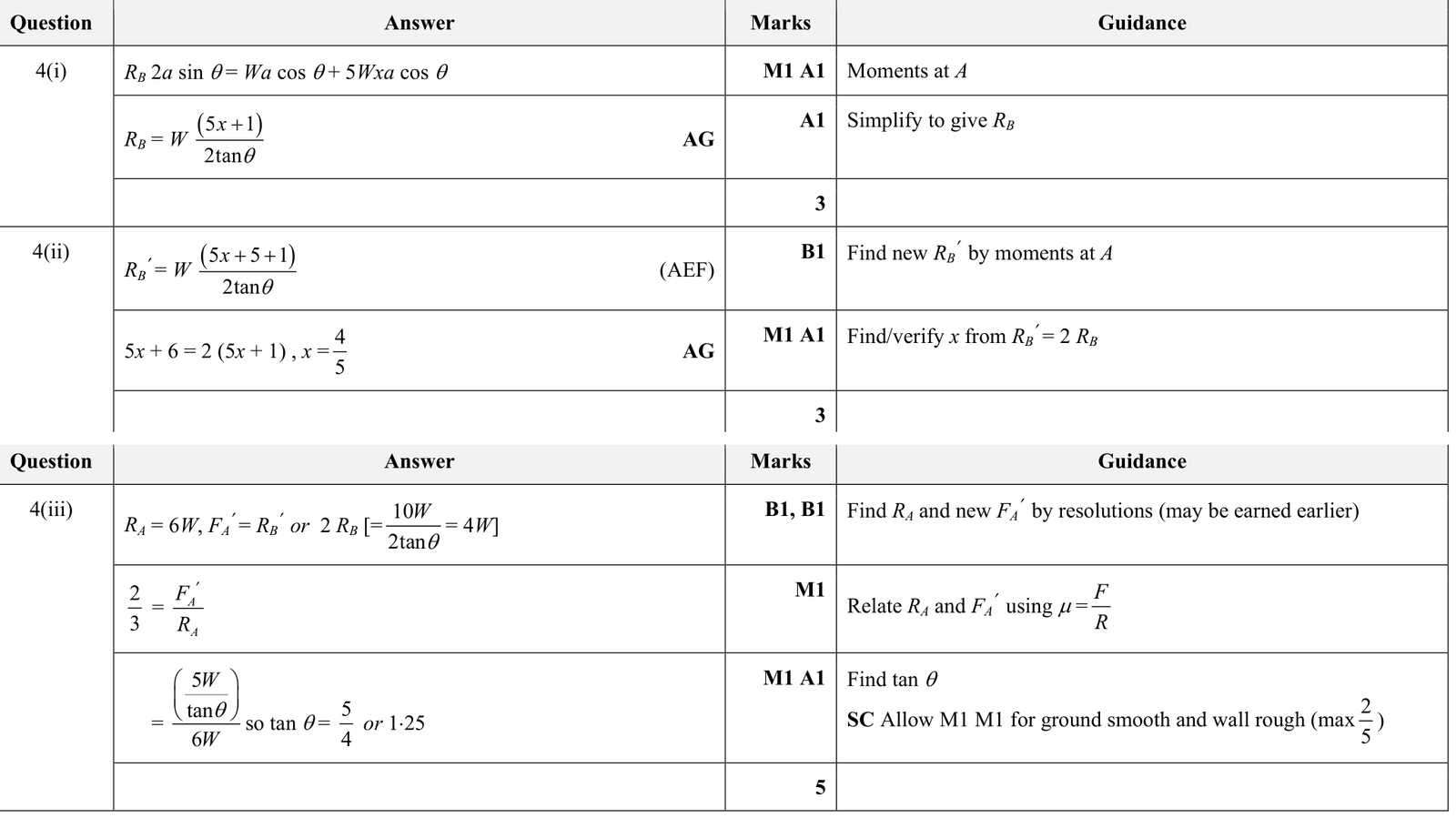
9231 P23 - Jun 2018 - Q4 - 10 marks
A uniform \(\operatorname{rod} A B\) has length \(2 a\) and weight \(W\). The end \(A\) rests on rough horizontal ground and the end \(B\) rests against a smooth vertical wall. The angle between the rod and the horizontal is \(\theta\), where \(\tan \theta=\frac{4}{3}\). One end of a light inextensible rope is attached to a point \(C\) on the rod. The other end is attached to a point where the vertical wall and the horizontal ground meet. The rope is taut and perpendicular to the rod. The rope and rod are in a vertical plane perpendicular to the wall.
(i) Show that \(A C=\frac{18}{25} a\).
The magnitude of the frictional force at \(A\) is equal to one quarter of the magnitude of the normal reaction force at \(A\).
(ii) Show that the tension in the rope is \(\frac{1}{4} W\).
(iii) Find expressions, in terms of \(W\), for the magnitudes of the normal reaction forces at \(A\) and \(B\).
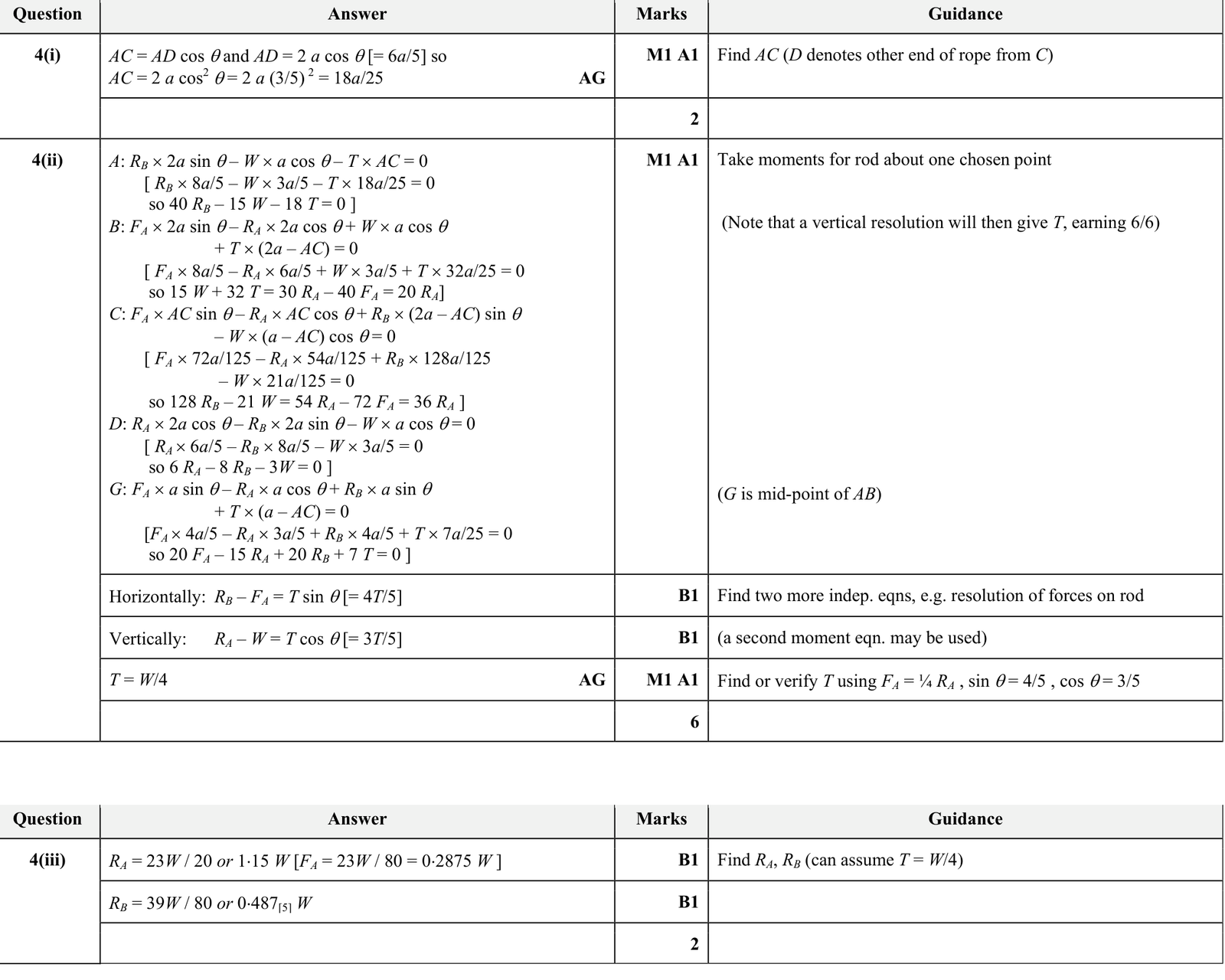
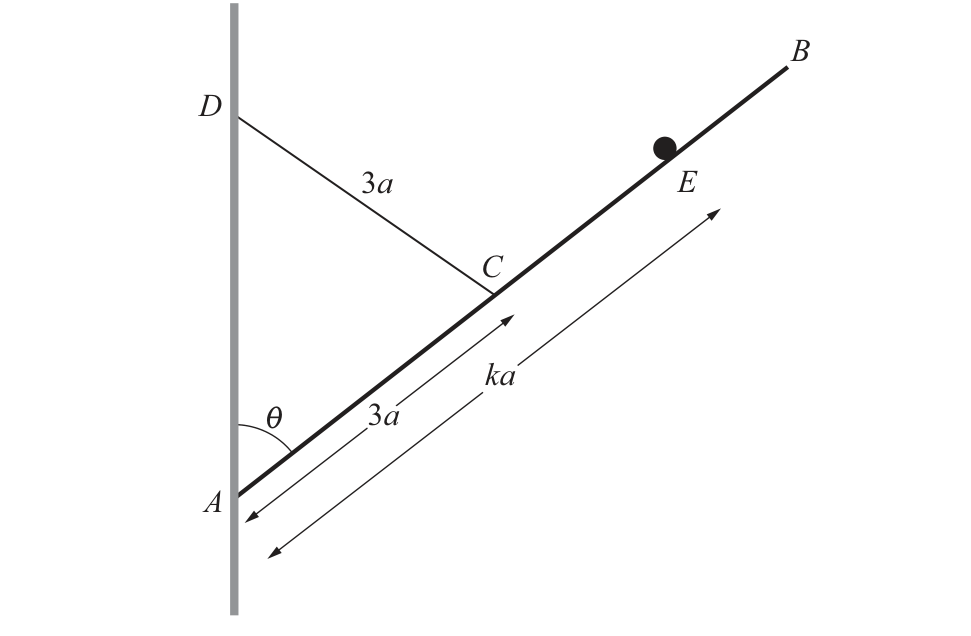
9231 P32 - Nov 2024 - Q4 - 7 marks
The end \(A\) of a uniform rod \(AB\), of length \(6a\) and weight \(W\), is in contact with a rough vertical wall. One end of a light inextensible string of length \(3a\) is attached to the midpoint \(C\) of the rod. The other end is attached to a point \(D\) on the wall, vertically above \(A\).
The rod is in equilibrium when the angle between the rod and the wall is \(\theta\), where \(\tan\theta=\dfrac32\). A particle of weight \(W\) is attached to the point \(E\) on the rod, where \(AE=ka\), with \(3\lt k\lt6\). The coefficient of friction between the rod and the wall is \(\dfrac13\). The rod is about to slip down the wall.
(a) Find \(k\).
(b) Find, in terms of \(W\), the magnitude of the frictional force between the rod and the wall.
9231 P31 - Jun 2024 - Q4 - 7 marks
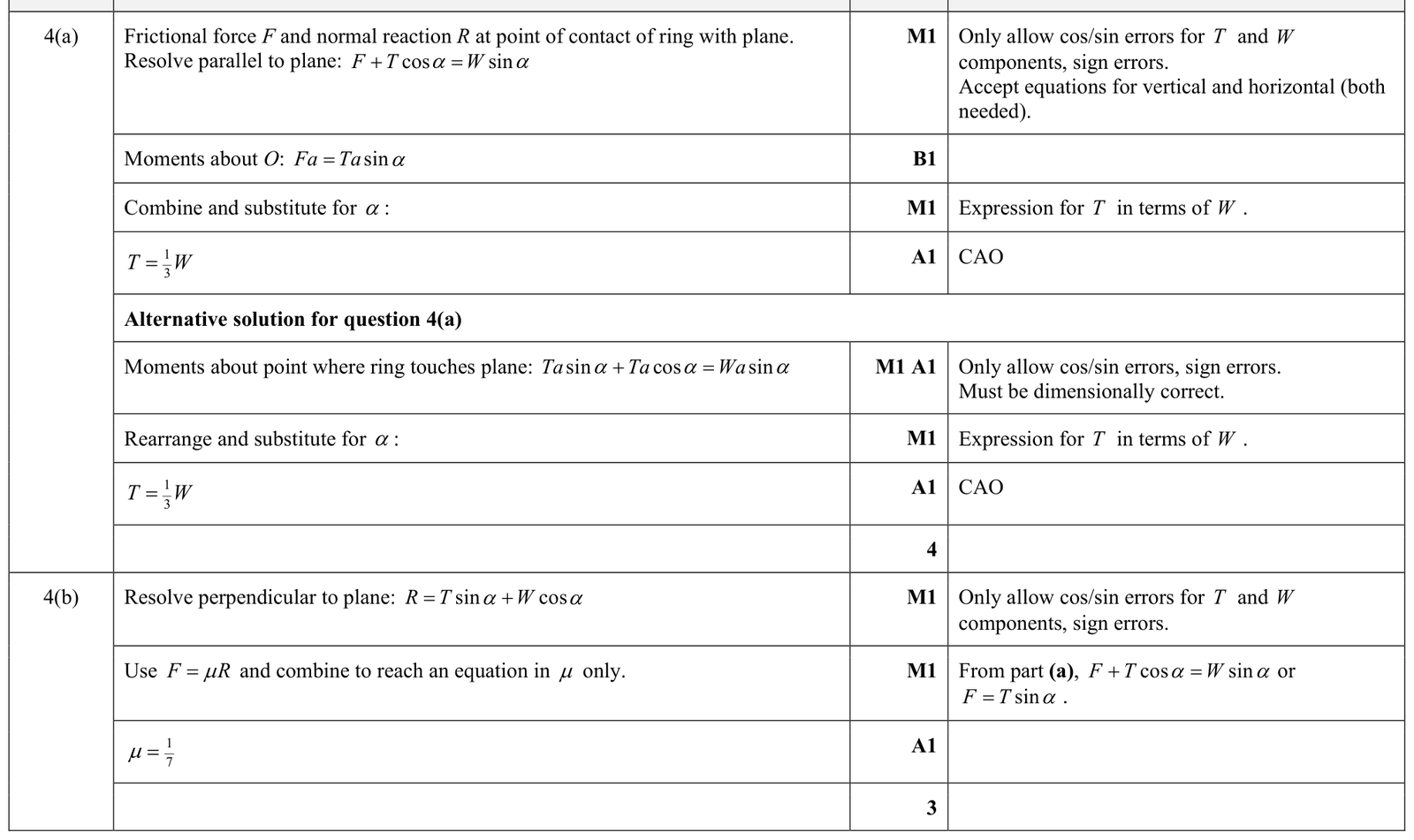
A ring of weight \(W\), radius \(a\) and centre \(O\), is at rest on a rough surface inclined at an angle \(\alpha\) to the horizontal, where \(\tan\alpha=\dfrac12\). The plane of the ring is perpendicular to the inclined surface and parallel to a line of greatest slope.
The point \(P\) on the circumference is such that \(OP\) is parallel to the surface. A light inextensible string is attached to \(P\) and to a point \(Q\) on the surface so that \(PQ\) is horizontal. The points \(O\), \(P\) and \(Q\) are in the same vertical plane. The system is in limiting equilibrium and the coefficient of friction between the ring and the surface is \(\mu\).
(a) Find, in terms of \(W\), the tension in the string \(PQ\).
(b) Find \(\mu\).
9231 P31 - Nov 2023 - Q3 - 8 marks
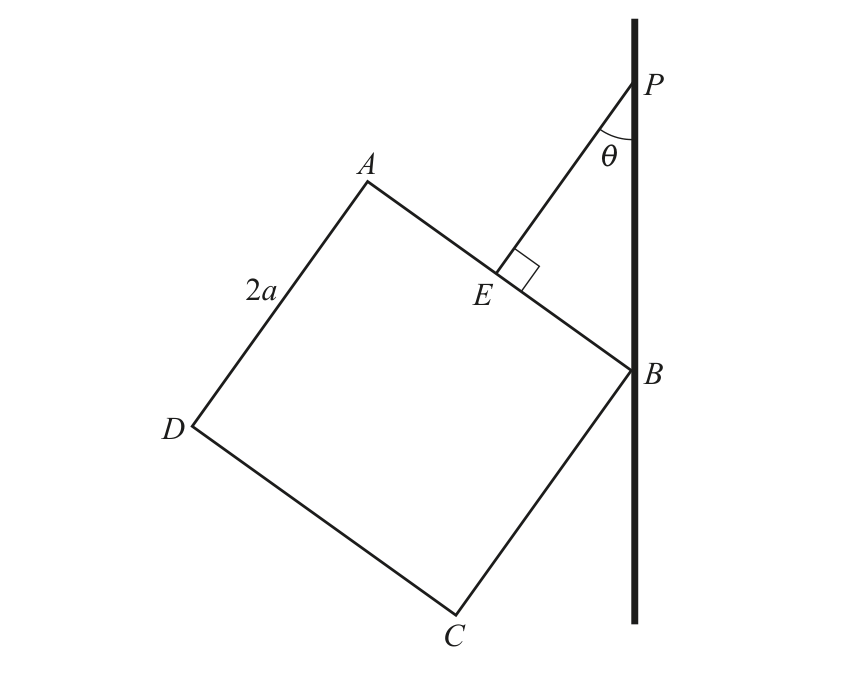
A uniform square lamina of side \(2a\) and weight \(W\) is suspended from a light inextensible string attached to the midpoint \(E\) of the side \(AB\). The other end of the string is attached to a fixed point \(P\) on a rough vertical wall.
The vertex \(B\) of the lamina is in contact with the wall. The string \(EP\) is perpendicular to the side \(AB\) and makes an angle \(\theta\) with the wall. The string and the lamina are in a vertical plane perpendicular to the wall.
The coefficient of friction between the wall and the lamina is \(\dfrac12\). Given that the vertex \(B\) is about to slip up the wall, find the value of \(\tan\theta\).

9231 P33 - Jun 2022 - Q7 - 9 marks
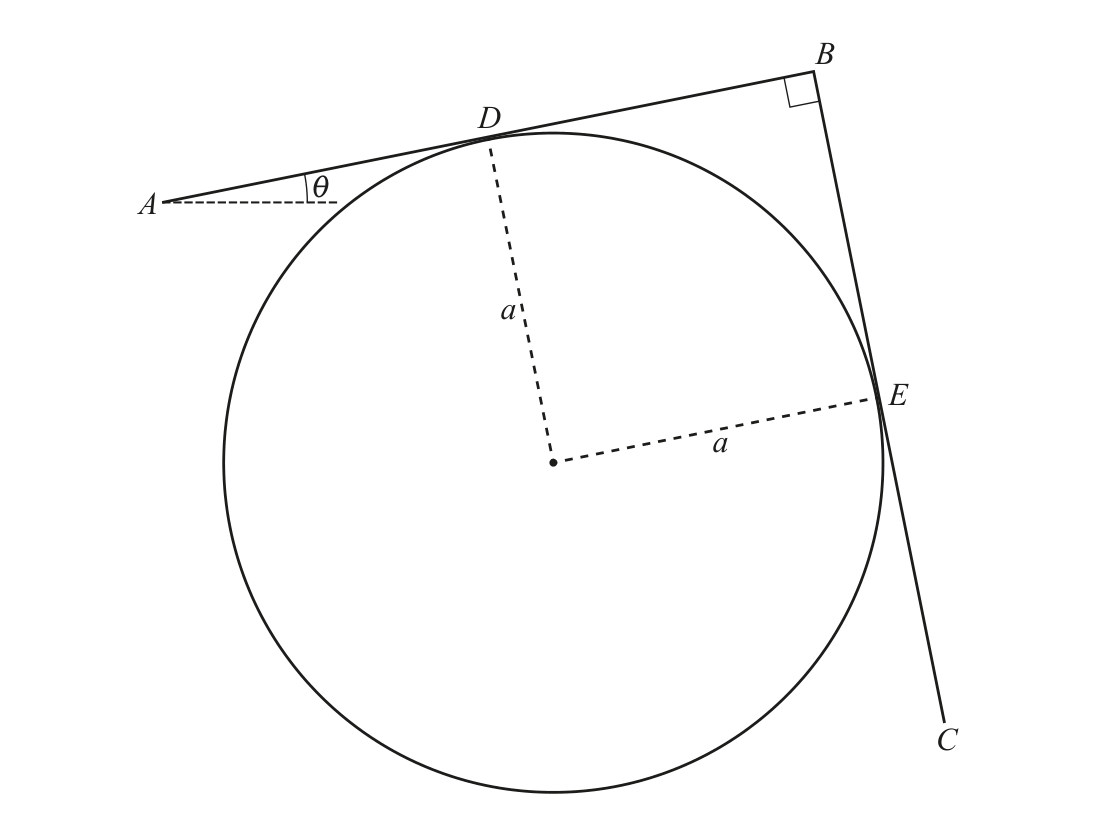
A uniform cylinder with a rough surface and of radius \(a\) is fixed with its axis horizontal. Two identical uniform rods \(A B\) and \(B C\), each of weight \(W\) and length \(2 a\), are rigidly joined at \(B\) with \(A B\) perpendicular to \(B C\). The rods rest on the cylinder in a vertical plane perpendicular to the axis of the cylinder with \(A B\) at an angle \(\theta\) to the horizontal. \(D\) and \(E\) are the midpoints of \(A B\) and \(B C\) respectively and also the points of contact of the rods with the cylinder (see diagram). The rods are about to slip in a clockwise direction. The coefficient of friction between each rod and the cylinder is \(\mu\).
The normal reaction between \(A B\) and the cylinder is \(R\) and the normal reaction between \(B C\) and the cylinder is \(N\).
(a) Find the ratio \(R: N\) in terms of \(\mu\).
(b) Given that \(\mu=\frac{1}{3}\), find the value of \(\tan \theta\).
Additional page
and to following page to complete the answer to any question, the question number must be clearly shown.

9231 P31 - Nov 2022 - Q3 - 7 marks
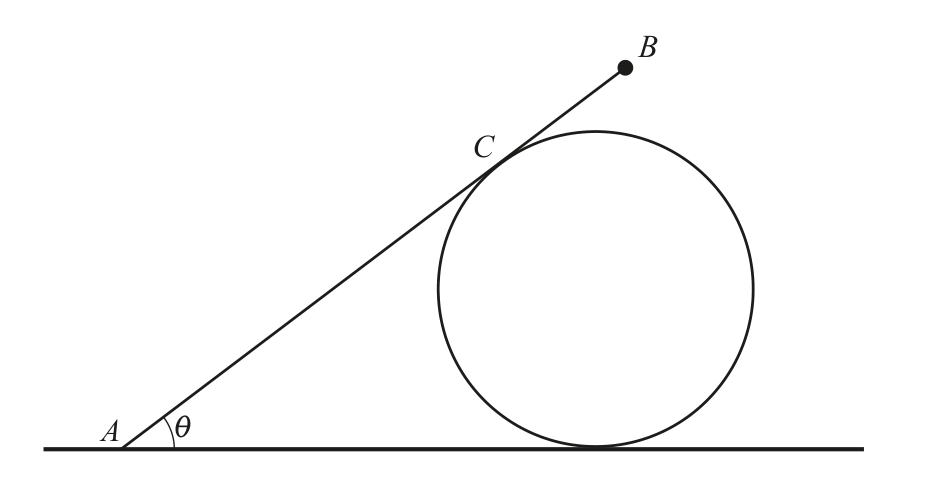
A smooth cylinder is fixed to a rough horizontal surface with its axis of symmetry horizontal. A uniform \(AB\), of length \(4 a\) and weight \(W\), rests against the surface of the cylinder. The end \(A\) of the rod is in contact with the horizontal surface. The vertical plane containing the \(AB\) is perpendicular to the axis of the cylinder. The point of contact between the rod and the cylinder is \(C\), where \(A C=3 a\). The angle between the rod and the horizontal surface is \(\theta\) where \(\tan \theta=\frac{3}{4}\) (see diagram). The coefficient of friction between the rod and the horizontal surface is \(\frac{6}{7}\).
A particle of weight \(k W\) is attached to the rod at \(B\). The rod is about to slip. The normal reaction between the rod and the cylinder is \(N\).
(a) Show that \(N=\frac{8}{15} W(1+2 k)\).
(b) Find the value of \(k\).