9231 P21 - Nov 2019 - Q5 - 12 marks
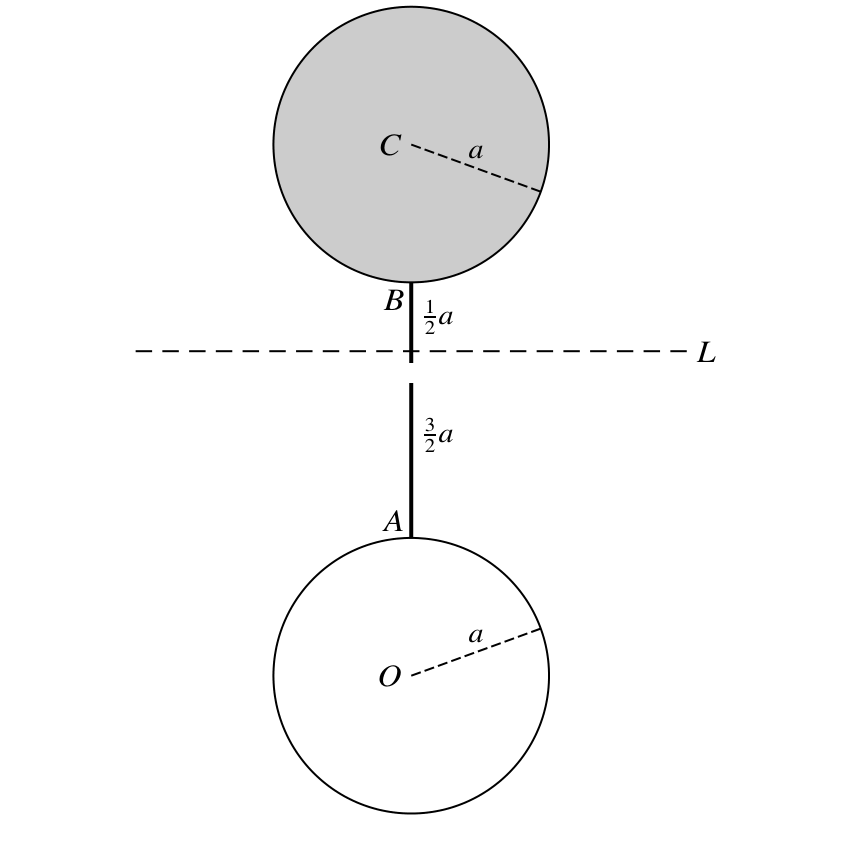
A thin uniform \(\operatorname{rod} A B\) has mass \(\lambda M\) and length \(2 a\). The end \(A\) of the rod is rigidly attached to the surface of a uniform hollow sphere (spherical shell) with centre \(O\), mass \(3 M\) and radius \(a\). The end \(B\) of the rod is rigidly attached to the surface of a uniform solid sphere with centre \(C\), mass \(5 M\) and radius \(a\). The rod lies along the line joining the centres of the spheres, so that \(C B A O\) is a straight line. The horizontal axis \(L\) is perpendicular to the rod and passes through the point of the rod that is a distance \(\frac{1}{2} a\) from \(B\) (see diagram). The object consisting of the rod and the two spheres can rotate freely about \(L\).
(i) Show that the moment of inertia of the object about \(L\) is \(\left(\frac{408+7 \lambda}{12}\right) M a^{2}\).
The period of small oscillations of the object about \(L\) is \(5 \pi \sqrt{ }\left(\frac{2 a}{g}\right)\).
(ii) Find the value of \(\lambda\).

9231 P23 - Jun 2019 - Q4 - 11 marks
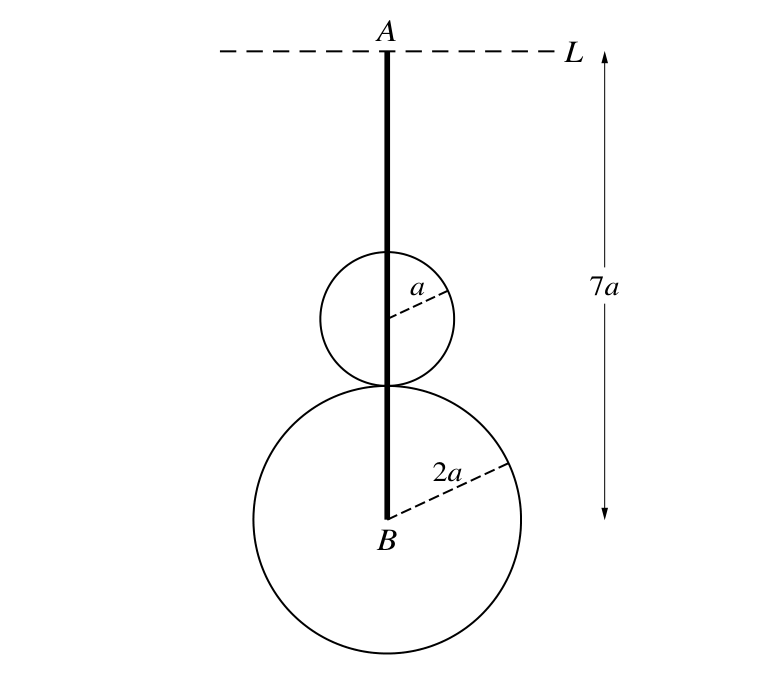
An object consists of two hollow spheres which touch each other, together with a thin uniform \(\operatorname{rod} A B\). The rod passes through small holes in the surfaces of the spheres. The rod is fixed to the spheres so that it passes through the centre of the smaller sphere. The end \(B\) of the rod is at the centre of the larger sphere. The larger sphere has radius \(2 a\) and mass \(M\), the smaller sphere has radius \(a\) and mass \(k M\), and the rod has length \(7 a\) and mass \(5 M\). A fixed horizontal axis \(L\) passes through \(A\) and is perpendicular to \(A B\) (see diagram).
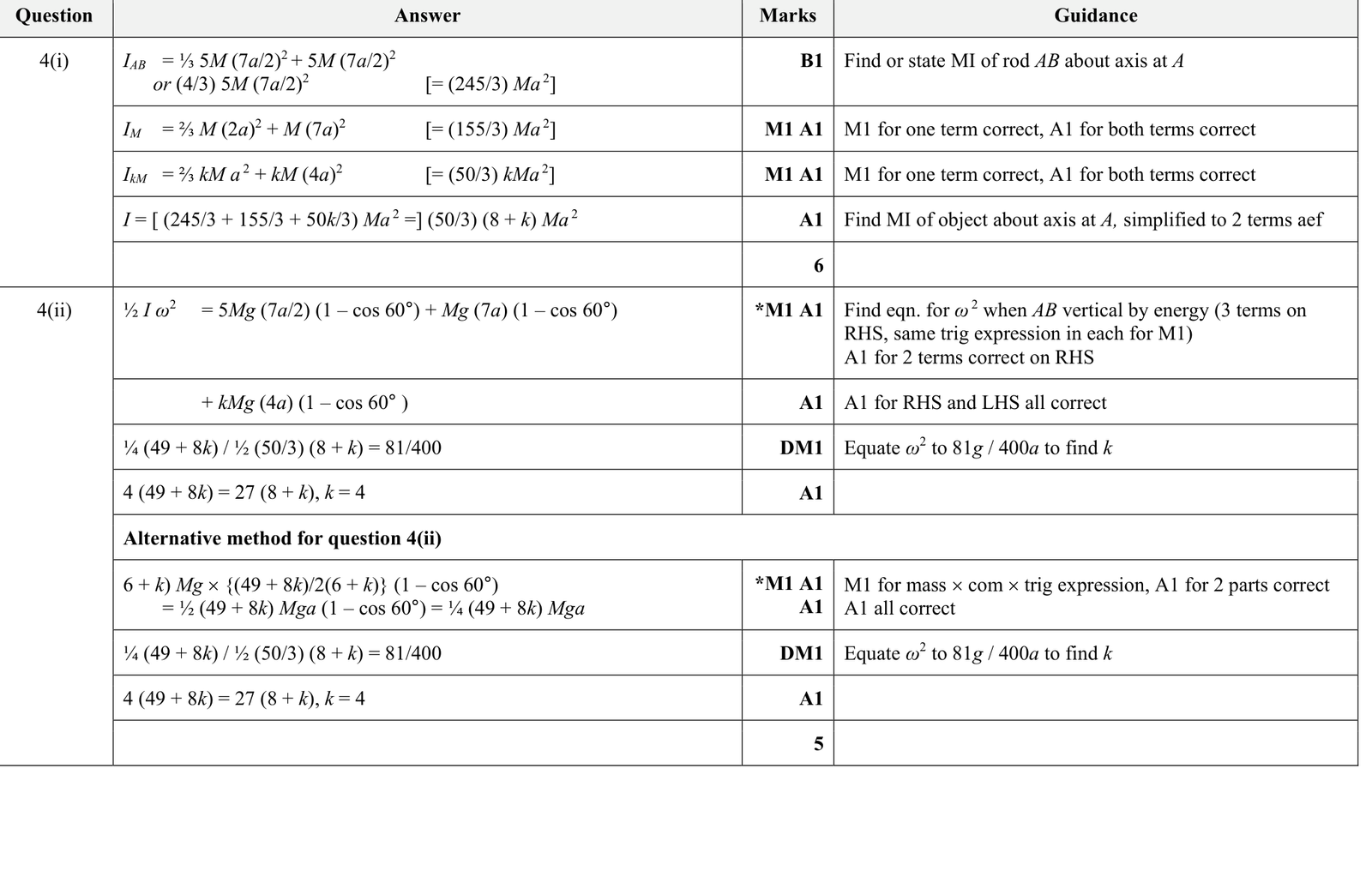
(i) Find the moment of inertia of the object, consisting of the rod and two spheres, about \(L\).
The object is pivoted at \(A\) so that it can rotate freely about \(L\). The object is released from rest with the rod making an angle of \(60^{\circ}\) to the downward vertical. The greatest angular speed attained by the object in the subsequent motion is \(\frac{9}{20} \sqrt{ }\left(\frac{g}{a}\right)\).
(ii) Find the value of \(k\).
9231 P21 - Jun 2019 - Q5 - 12 marks
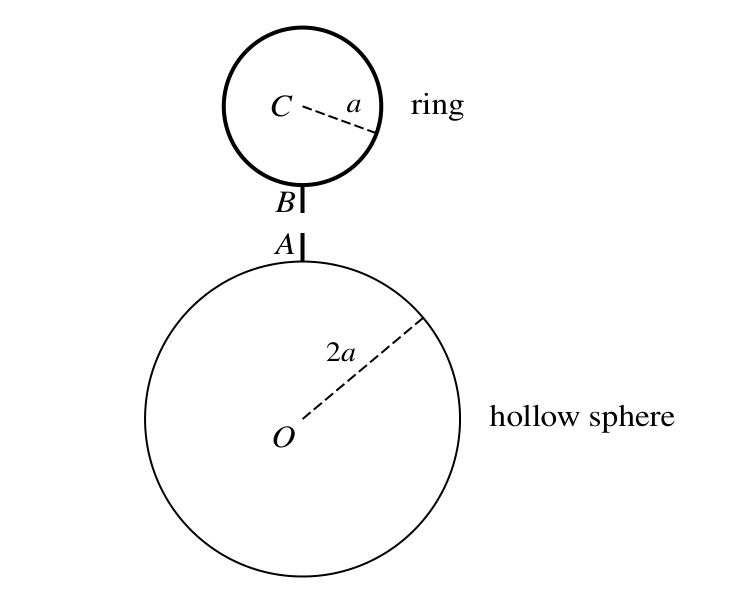
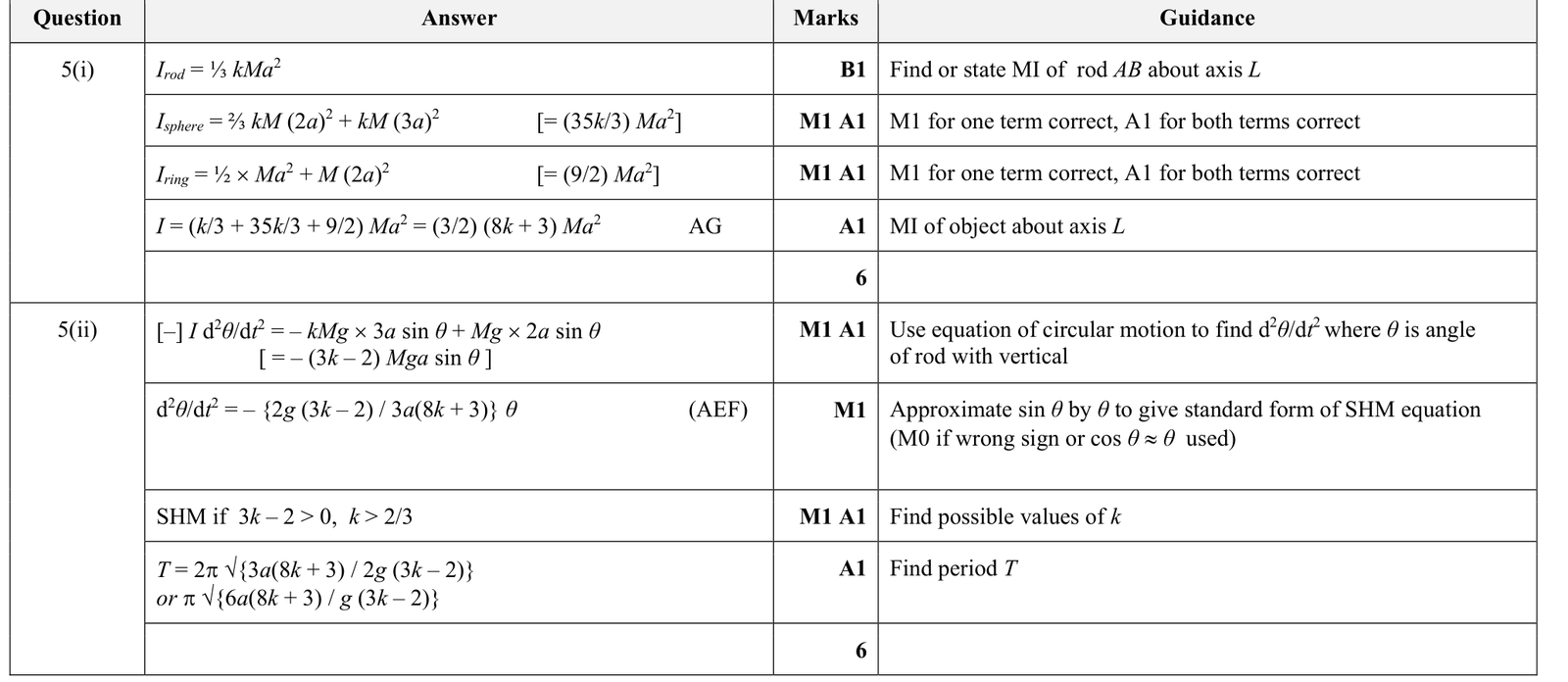
A thin uniform \(\operatorname{rod} A B\) has mass \(k M\) and length \(2 a\). The end \(A\) of the rod is rigidly attached to the surface of a uniform hollow sphere with centre \(O\), mass \(k M\) and radius \(2 a\). The end \(B\) of the rod is rigidly attached to the circumference of a uniform ring with centre \(C\), mass \(M\) and radius \(a\). The points \(C, B, A, O\) lie in a straight line. The horizontal axis \(L\) passes through the mid-point of the rod and is perpendicular to the rod and in the plane of the ring (see diagram). The object consisting of the rod, the ring and the hollow sphere can rotate freely about \(L\).
(i) Show that the moment of inertia of the object about \(L\) is \(\frac{3}{2}(8 k+3) M a^{2}\).
The object performs small oscillations about \(L\), with the ring above the sphere as shown in the diagram.
(ii) Find the set of possible values of \(k\) and the period of these oscillations in terms of \(k\).
9231 P23 - Jun 2017 - Q11E - 12 marks
Question 11 EITHER alternative.
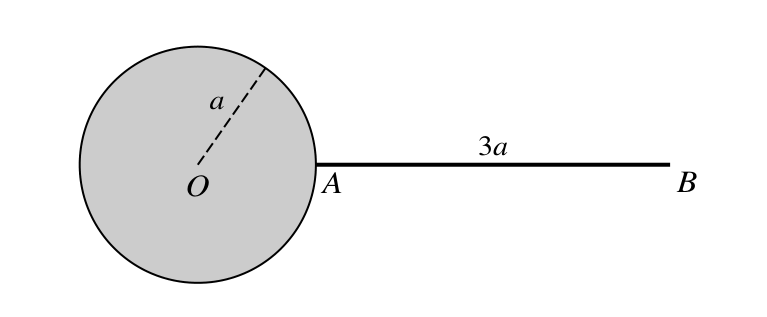
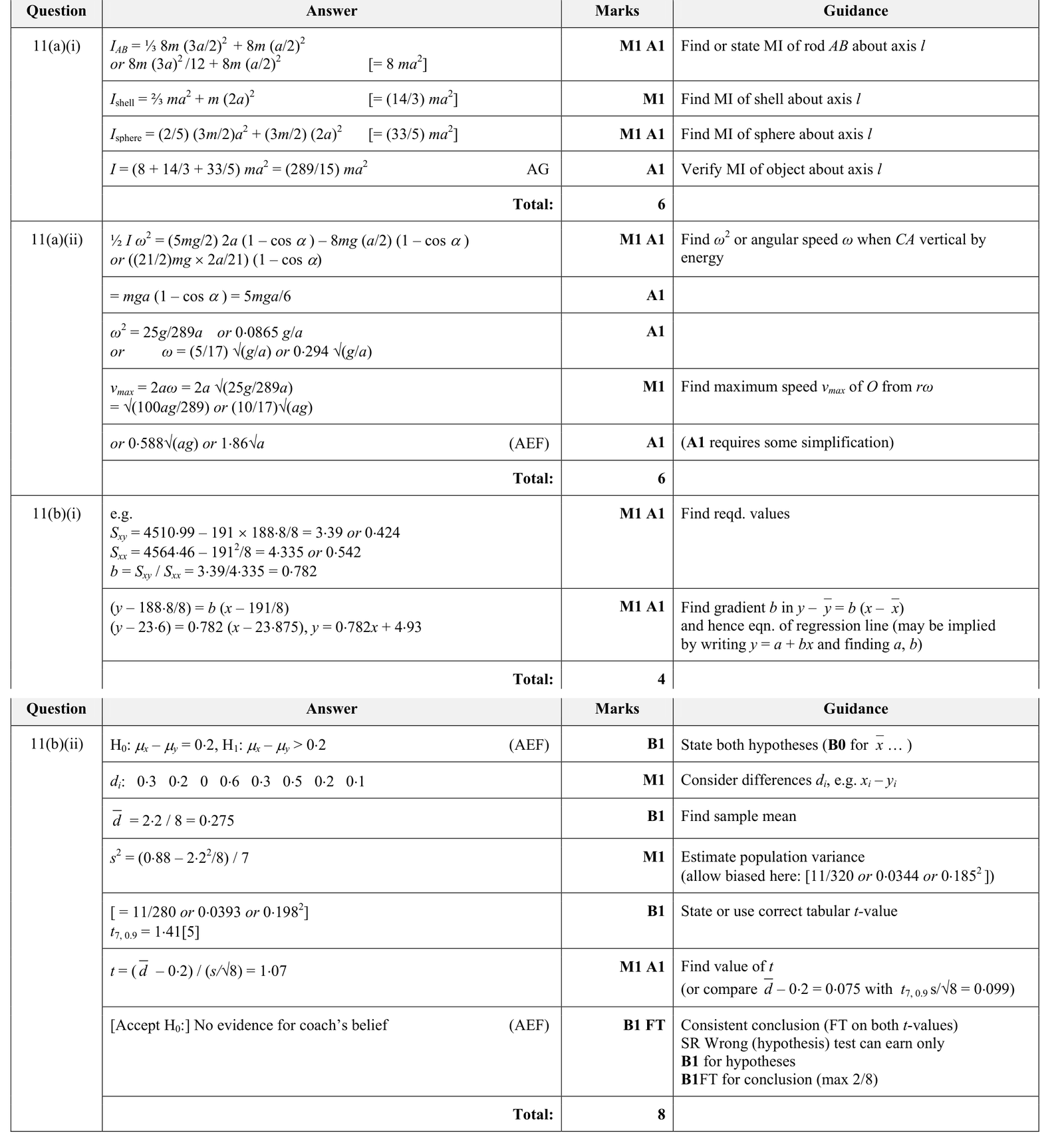
The diagram shows a uniform thin \(\operatorname{rod} A B\) of length \(3 a\) and mass \(8 m\). The end \(A\) is rigidly attached to the surface of a sphere with centre \(O\) and radius \(a\). The rod is perpendicular to the surface of the sphere. The sphere consists of two parts: an inner uniform solid sphere of mass \(\frac{3}{2} m\) and radius \(a\) surrounded by a thin uniform spherical shell of mass \(m\) and also of radius \(a\). The horizontal axis \(l\) is perpendicular to the rod and passes through the point \(C\) on the rod where \(A C=a\).
(i) Show that the moment of inertia of the object, consisting of rod, shell and inner sphere, about the axis \(l\) is \(\frac{289}{15} m a^{2}\).
The object is free to rotate about the axis \(l\). The object is held so that \(C A\) makes an angle \(\alpha\) with the downward vertical and is released from rest.
(ii) Given that \(\cos \alpha=\frac{1}{6}\), find the greatest speed achieved by the centre of the sphere in the subsequent motion.
9231 P31 - Jun 2025 - Q4 - 7 marks
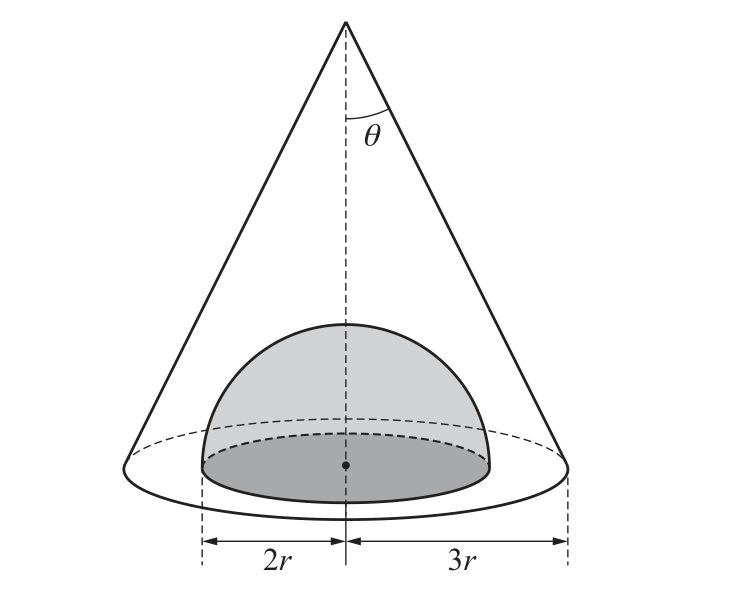
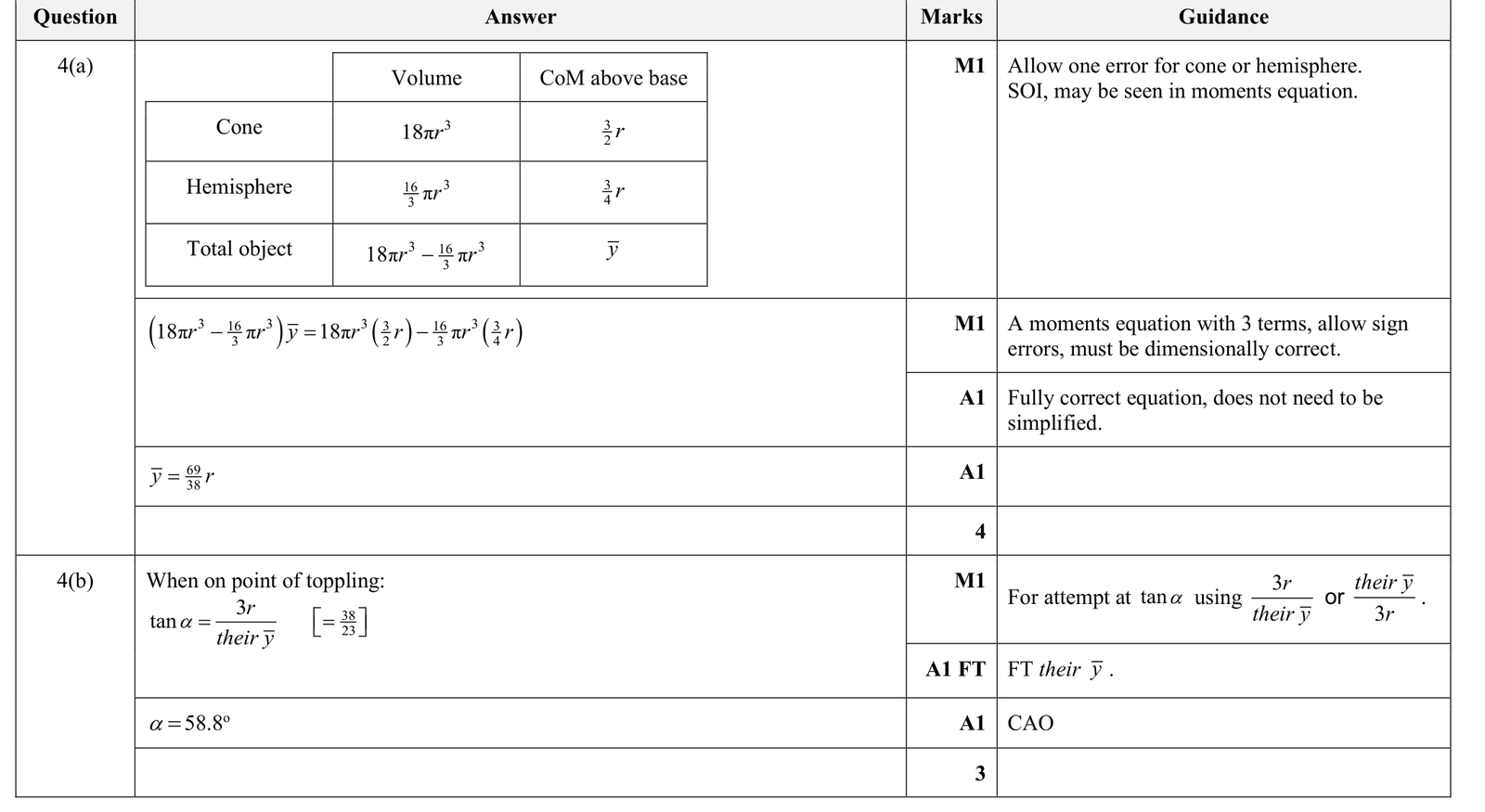
An object is formed by removing a solid hemisphere of radius \(2r\) from a uniform solid cone of radius \(3r\) and semi-vertical angle \(\theta\), where \(\tan\theta=\frac12\). The axes of symmetry coincide, and the cone and hemisphere have their bases in the same plane.
(a) Find, in terms of \(r\), the distance of the centre of mass of the object from its base.
(b) The object is placed with its circular base on a rough plane inclined at angle \(\alpha\). The object is on the point of toppling. Find \(\alpha\).
9231 P31 - Nov 2024 - Q4 - 7 marks
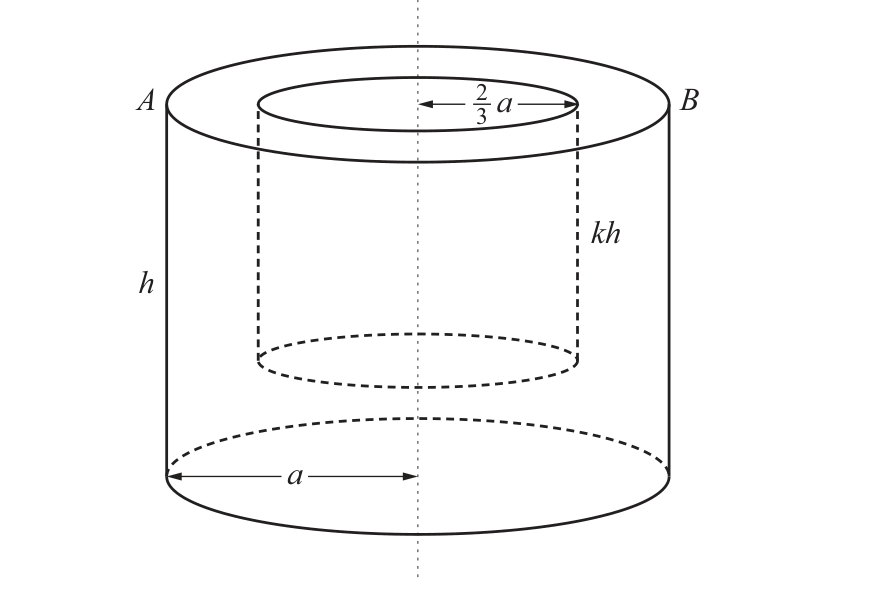
An object is formed by removing a cylinder of radius \(\dfrac23a\) and height \(kh\), where \(0\lt k\lt1\), from a uniform solid cylinder of radius \(a\) and height \(h\). The vertical axes of symmetry of the two cylinders coincide, and the upper faces are in the same plane.
The points \(A\) and \(B\) are opposite ends of a diameter of the upper face of the object.
(a) Find, in terms of \(h\) and \(k\), the distance of the centre of mass of the object from \(AB\).
When the object is suspended from \(A\), the angle between \(AB\) and the vertical is \(\theta\), where \(\tan\theta=\dfrac32\).
(b) Given that \(h=\dfrac83a\), find the possible values of \(k\).

9231 P31 - Jun 2023 - Q4 - 8 marks
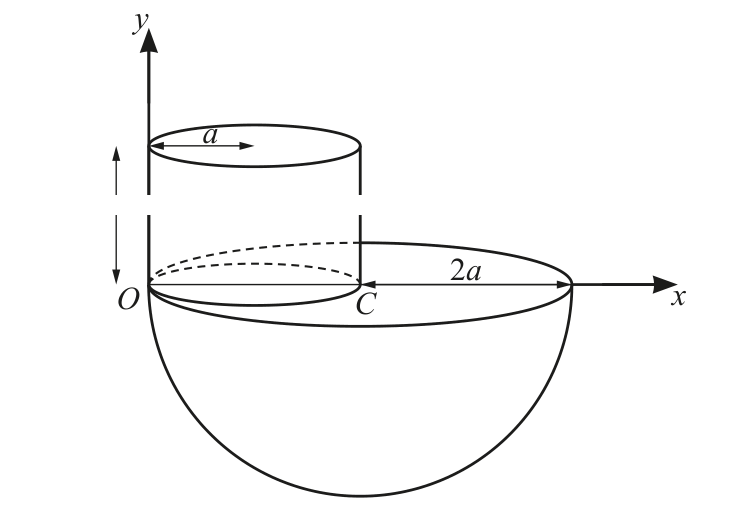
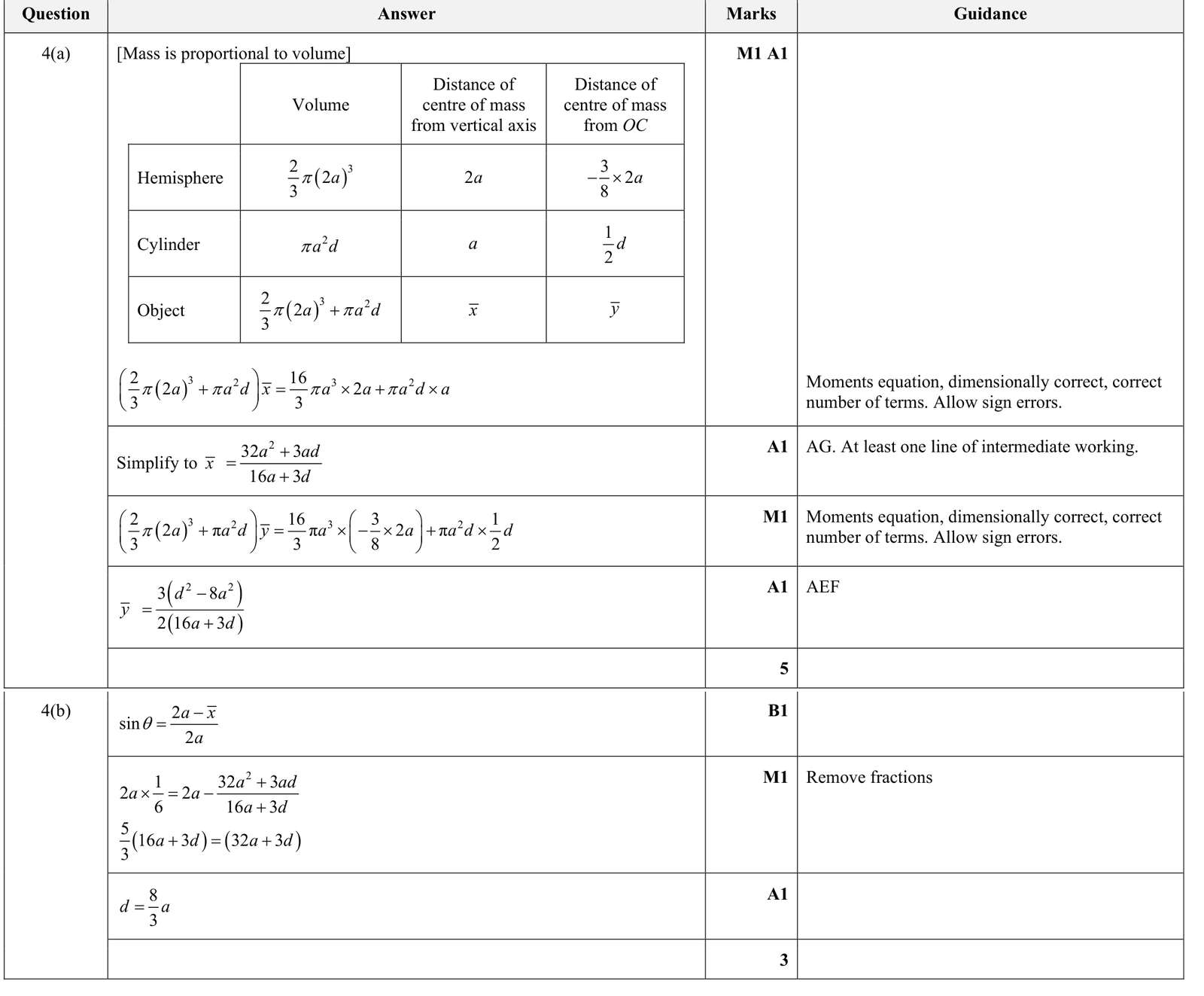
An object is formed from a solid hemisphere, of radius \(2 a\), and a solid cylinder, of radius \(a\) and height \(d\). The hemisphere and the cylinder are made of the same material. The cylinder is attached to the plane face of the hemisphere. The line \(O C\) forms a diameter of the base of the cylinder, where \(C\) is the centre of the plane face of the hemisphere and \(O\) is common to both circumferences (see diagram). Relative to axes through \(O\), parallel and perpendicular to \(O C\) as shown, the centre of mass of the object is \((\bar{x}, \bar{y})\).
(a) Show that \(\bar{x}=\frac{32 a^{2}+3 a d}{16 a+3 d}\) and find an expression, in terms of \(a\) and \(d\), for \(\bar{y}\).
The object is placed on a rough plane which is inclined to the horizontal at an angle \(\theta\) where \(\sin \theta=\frac{1}{6}\). The object is in equilibrium with \(C O\) horizontal, where \(C O\) lies in a vertical plane through a line of greatest slope.
(b) Find \(d\) in terms of \(a\).
9231 P31 - Jun 2022 - Q4 - 8 marks
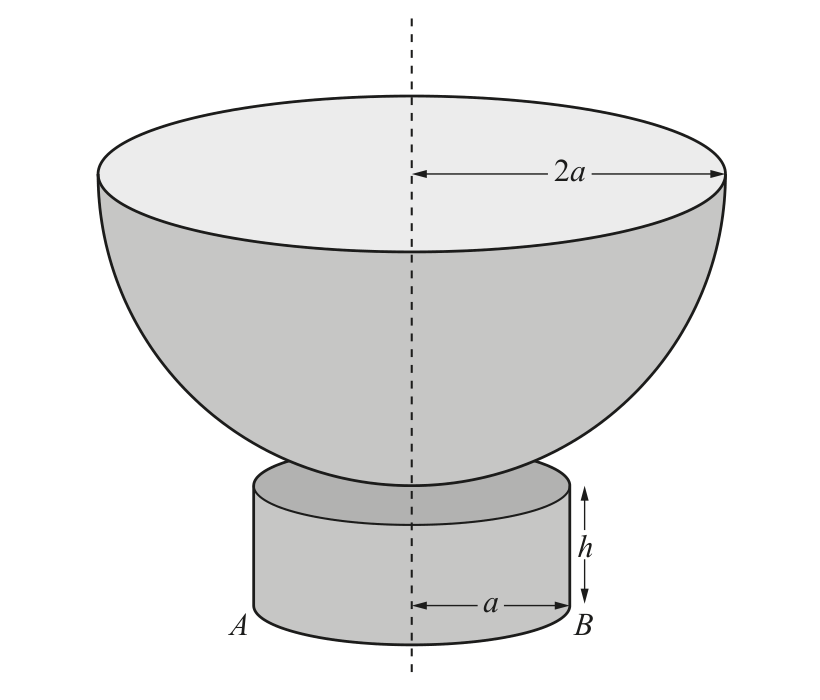
An object is composed of a hemispherical shell of radius \(2 a\) attached to a closed hollow circular cylinder of height \(h\) and base radius \(a\). The hemispherical shell and the hollow cylinder are made of the same uniform material. The axes of symmetry of the shell and the cylinder coincide. \(A B\) is a diameter of the lower end of the cylinder (see diagram).
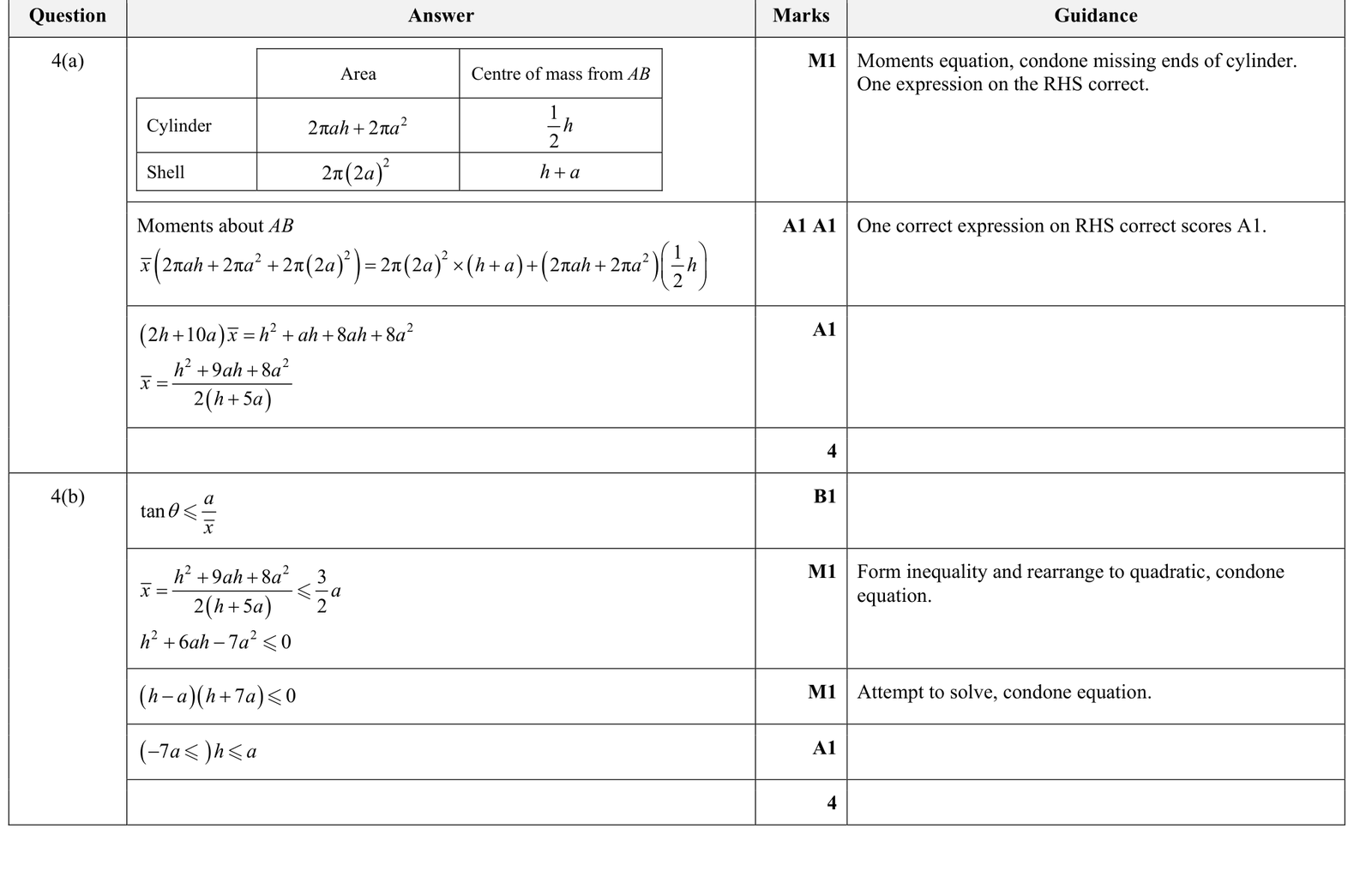
(a) Find, in terms of \(a\) and \(h\), an expression for the distance of the centre of mass of the object from \(A B\).
The object is placed on a rough plane which is inclined to the horizontal at an angle \(\theta\), where \(\tan \theta=\frac{2}{3}\). The object is in equilibrium with \(A B\) in contact with the plane and lying along a line of greatest slope of the plane.
(b) Find the set of possible values of \(h\), in terms of \(a\).
9231 P31 - Jun 2021 - Q4 - 7 marks
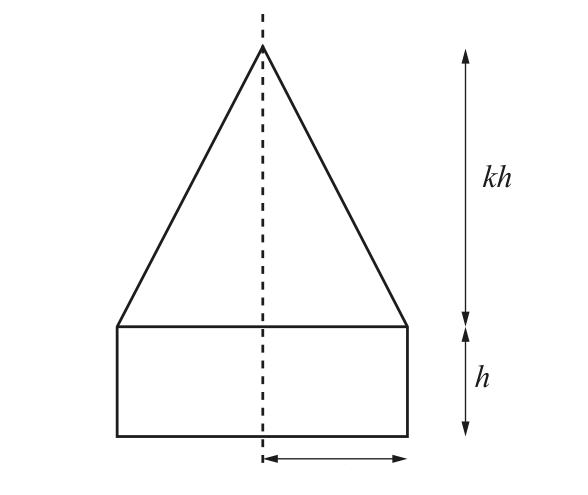
A uniform solid circular cone has vertical height \(k h\) and radius \(r\). A uniform solid cylinder has height \(h\) and radius \(r\). The base of the cone is joined to one of the circular faces of the cylinder so that the axes of symmetry of the two solids coincide (see diagram, which shows a cross-section). The cone and the cylinder are made of the same material.
(a) Show that the distance of the centre of mass of the combined solid from the base of the cylinder
\(\text { is } \frac{h\left(k^{2}+4 k+6\right)}{4(3+k)} .\)
The solid is placed on a plane that is inclined to the horizontal at an angle \(\theta\). The base of the cylinder is in contact with the plane. The plane is sufficiently rough to prevent sliding. It is given that \(3 h=2 r\) and that the solid is on the point of toppling when \(\tan \theta=\frac{4}{3}\).
(b) Find the value of \(k\).

9231 P32 - Nov 2021 - Q4 - 7 marks
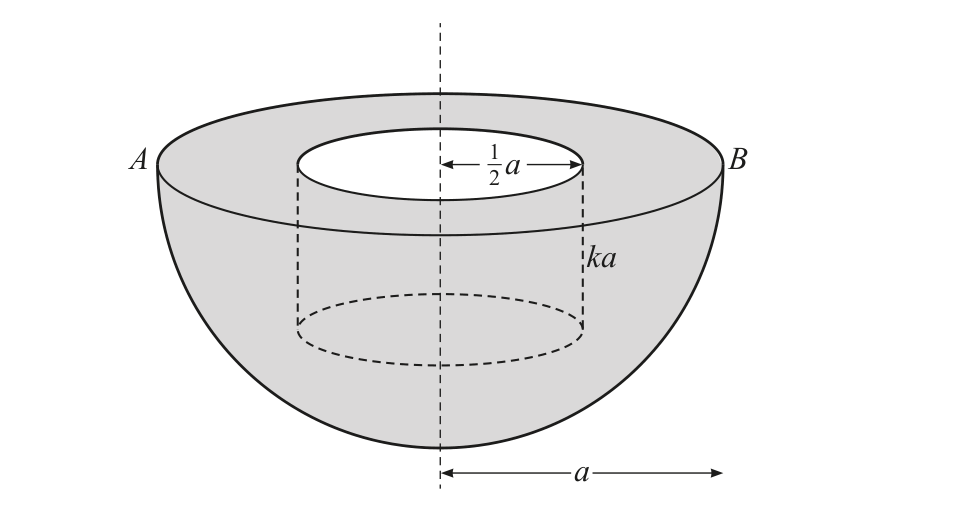
An object is formed by removing a solid cylinder, of height \(k a\) and radius \(\frac{1}{2} a\), from a uniform solid hemisphere of radius \(a\). The axes of symmetry of the hemisphere and the cylinder coincide and one circular face of the cylinder coincides with the plane face of the hemisphere. \(A B\) is a diameter of the circular face of the hemisphere (see diagram).
(a) Show that the distance of the centre of mass of the object from \(A B\) is \(\frac{3 a\left(2-k^{2}\right)}{2(8-3 k)}\).
When the object is freely suspended from the point \(A\), the line \(A B\) makes an angle \(\theta\) with the downward vertical, where \(\tan \theta=\frac{7}{18}\).
(b) Find the possible values of \(k\).

9231 P33 - Jun 2020 - Q4 - 8 marks
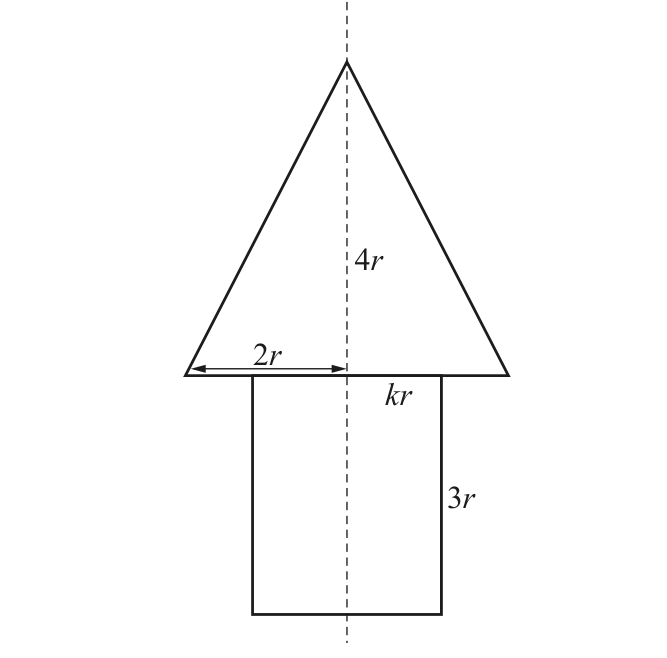
A uniform solid circular cone, of vertical height \(4 r\) and radius \(2 r\), is attached to a uniform solid cylinder, of height \(3 r\) and radius \(k r\), where \(k\) is a constant less than 2 . The base of the cone is joined to one of the circular faces of the cylinder so that the axes of symmetry of the two solids coincide (see diagram). The cone and the cylinder are made of the same material.
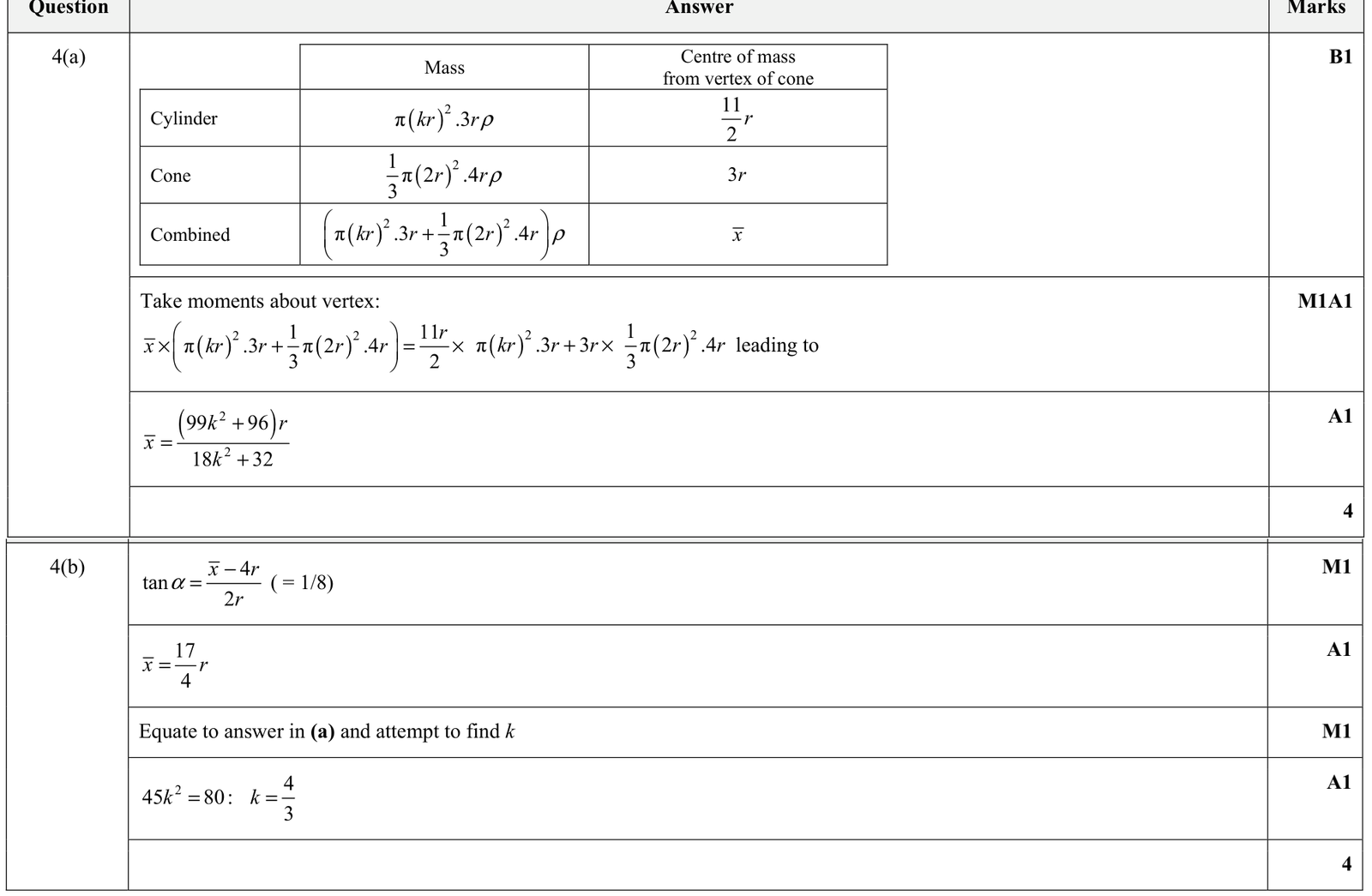
(a) Show that the distance of the centre of mass of the combined solid from the vertex of the cone is
\(\frac{\left(99 k^{2}+96\right) r}{18 k^{2}+32} .\)
The point \(C\) is on the circumference of the base of the cone. When the combined solid is freely suspended from \(C\) and hanging in equilibrium, the diameter through \(C\) makes an angle \(\alpha\) with the downward vertical, where \(\tan \alpha=\frac{1}{8}\).
(b) Given that the centre of mass of the combined solid is within the cylinder, find the value of \(k\).
9231 P31 - Nov 2020 - Q4 - 6 marks
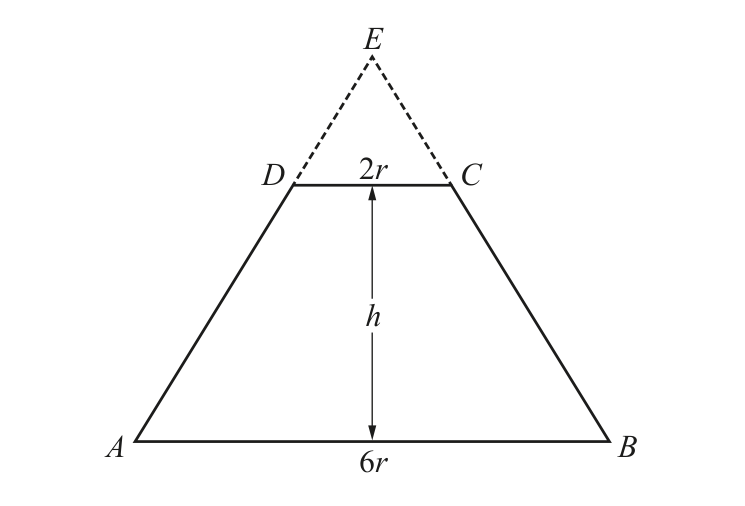
The diagram shows the cross-section \(A B C D\) of a uniform solid object which is formed by removing a cone with cross-section \(D C E\) from the top of a larger cone with cross-section \(A B E\). The perpendicular distance between \(A B\) and \(D C\) is \(h\), the diameter \(A B\) is \(6 r\) and the diameter \(D C\) is \(2 r\).
(a) Find an expression, in terms of \(h\), for the distance of the centre of mass of the solid object from \(A B\).
The object is freely suspended from the point \(B\) and hangs in equilibrium. The angle between \(A B\) and the downward vertical through \(B\) is \(\theta\).
(b) Given that \(h=\frac{13}{4} r\), find the value of \(\tan \theta\).

9231 P32 - Nov 2020 - Q3 - 7 marks
An object consists of a uniform solid circular cone, of vertical height \(4 r\) and radius \(3 r\), and a uniform solid cylinder, of height \(4 r\) and radius \(3 r\). The circular base of the cone and one of the circular faces of the cylinder are joined together so that they coincide. The cone and the cylinder are made of the same material.
(a) Find the distance of the centre of mass of the object from the end of the cylinder that is not attached to the cone.
(b) Show that the object can rest in equilibrium with the curved surface of the cone in contact with a horizontal surface.
