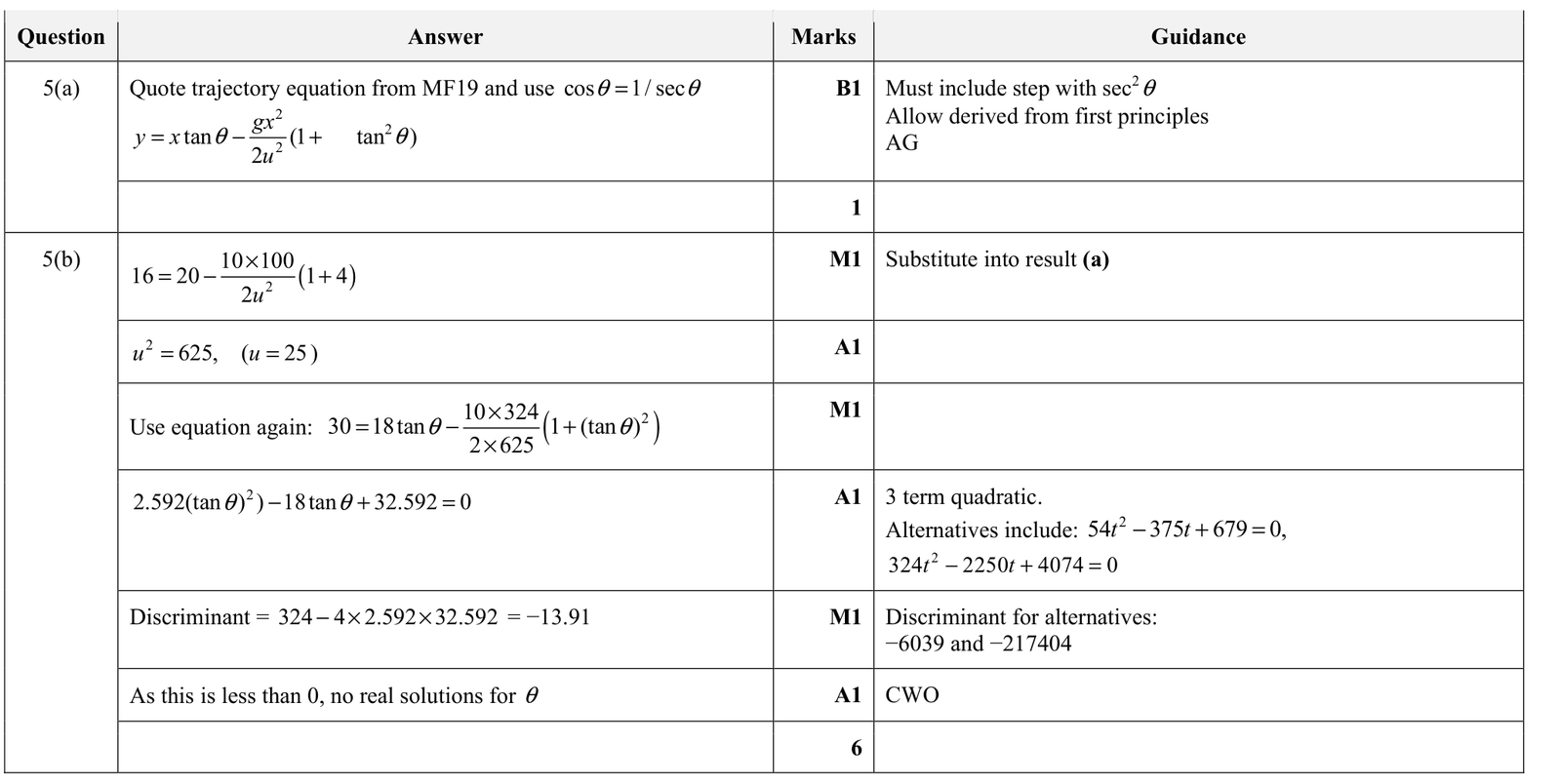
9231 P31 - Nov 2025 - Q7 - 12 marks
A particle \(P\) is projected from a point \(O\) on a horizontal plane and moves freely under gravity. The initial velocity of \(P\) is \(25 \mathrm{~ms}^{-1}\) at an angle \(\theta\) above the horizontal, where \(\tan \theta=\frac{4}{3}\). At point \(A\), the direction of motion of \(P\) makes an angle of \(45^{\circ}\) with the downward vertical through \(A\). (a) By differentiating the equation of the trajectory or otherwise, find the coordinates of \(A\).
At point \(A\), the particle strikes a fixed smooth barrier, rebounds, and lands on the horizontal plane. The barrier is inclined at an angle of \(45^{\circ}\) to the horizontal. (b) Find the speed of \(P\) immediately before it collides with the barrier. (c) Given that the coefficient of restitution between the barrier and the particle is \(\frac{1}{9}\), find the horizontal distance travelled by \(P\) after it strikes the barrier.
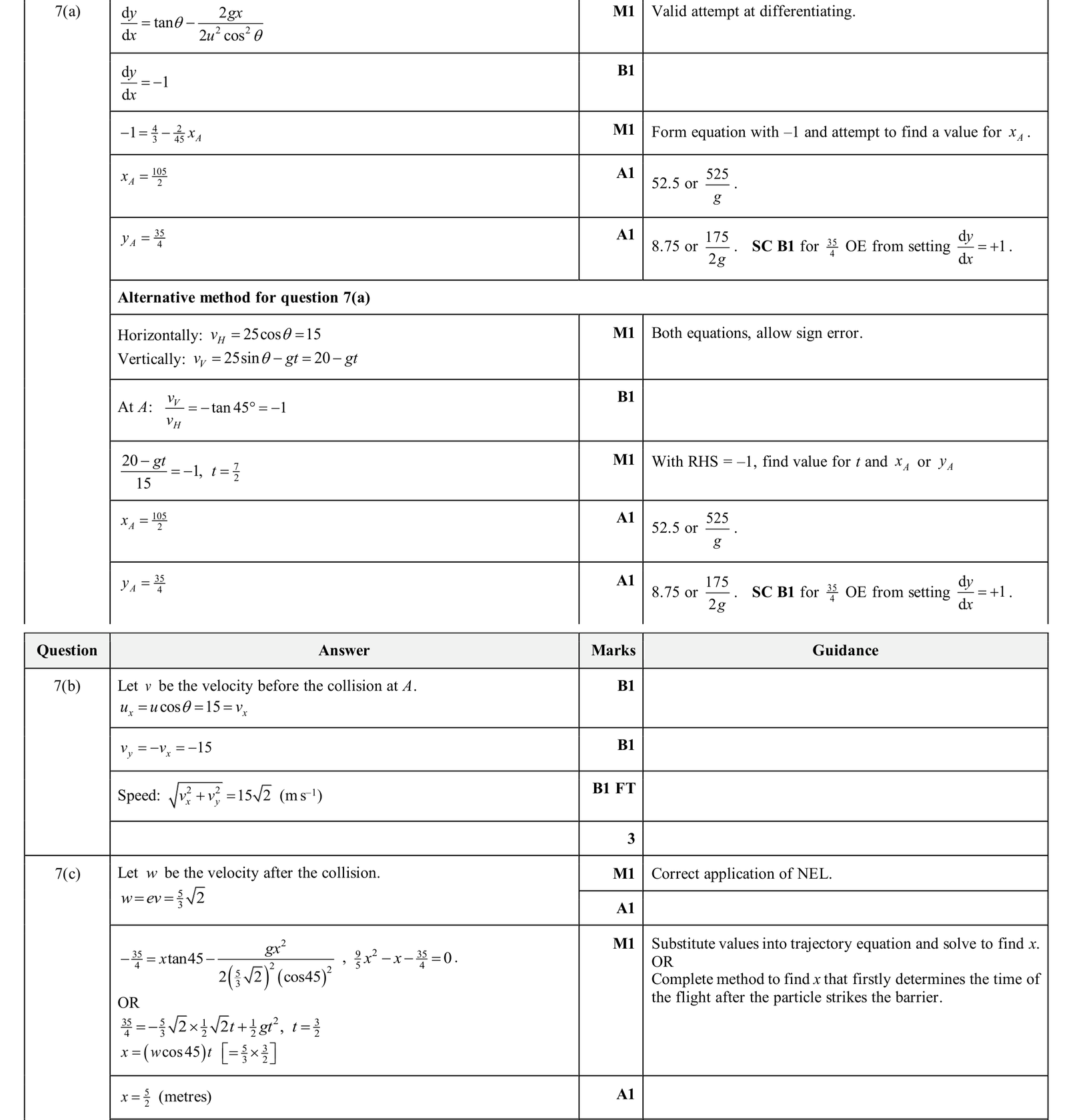
9231 P34 - Nov 2025 - Q2 - 6 marks
A particle \(P\) is projected with speed \(u \mathrm{~ms}^{-1}\) at an angle \(\theta\), where \(\tan \theta=2\), above the horizontal from a point \(O\) on a horizontal plane and moves freely under gravity. The horizontal and vertical displacements of \(P\) from \(O\) at a time \(t \mathrm{~s}\) are denoted by \(x \mathrm{~m}\) and \(y \mathrm{~m}\) respectively. (a) Use the equation of the trajectory given in the list of formulae (MF 19) to show that \(y=2 x-\frac{25 x^{2}}{u^{2}}\) (b) In the subsequent motion, \(P\) passes through the point with coordinates \((8,12)\). The particle then hits a fixed vertical barrier 7 m high that is at a horizontal distance of \(D \mathrm{~m}\) from the point of projection.
Find the set of possible values of \(D\).
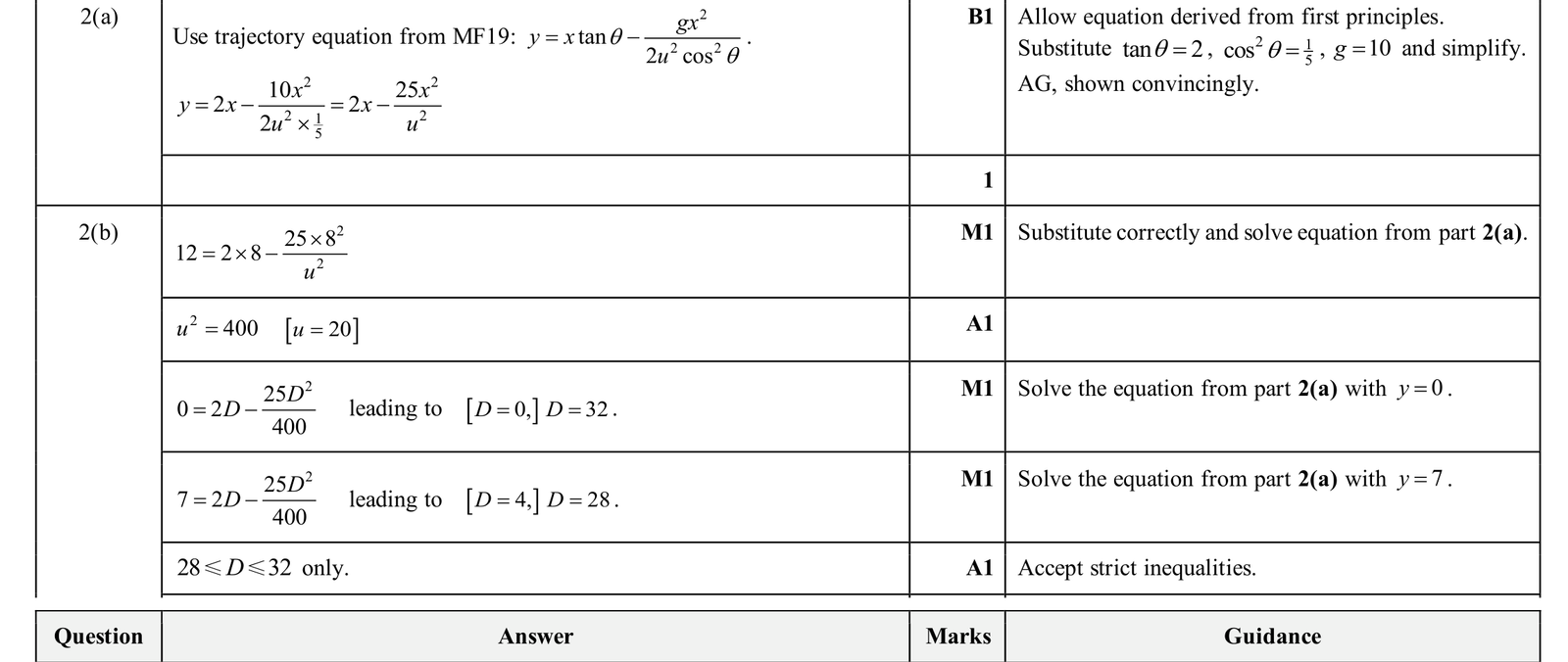
9231 P31 - Jun 2025 - Q2 - 6 marks
A particle \(P\) is projected with speed \(24\,\text{m s}^{-1}\) at an angle \(\theta^\circ\) above the horizontal from a point \(O\) on a horizontal plane. At a horizontal distance \(35\) m from \(O\), there is a vertical wall of height \(10\) m.
(a) Determine the two values of \(\theta\) for which \(P\) just clears the wall.
(b) Given that \(P\) clears the wall, find the minimum distance from \(O\) where \(P\) can land.
9231 P34 - Jun 2025 - Q3 - 7 marks
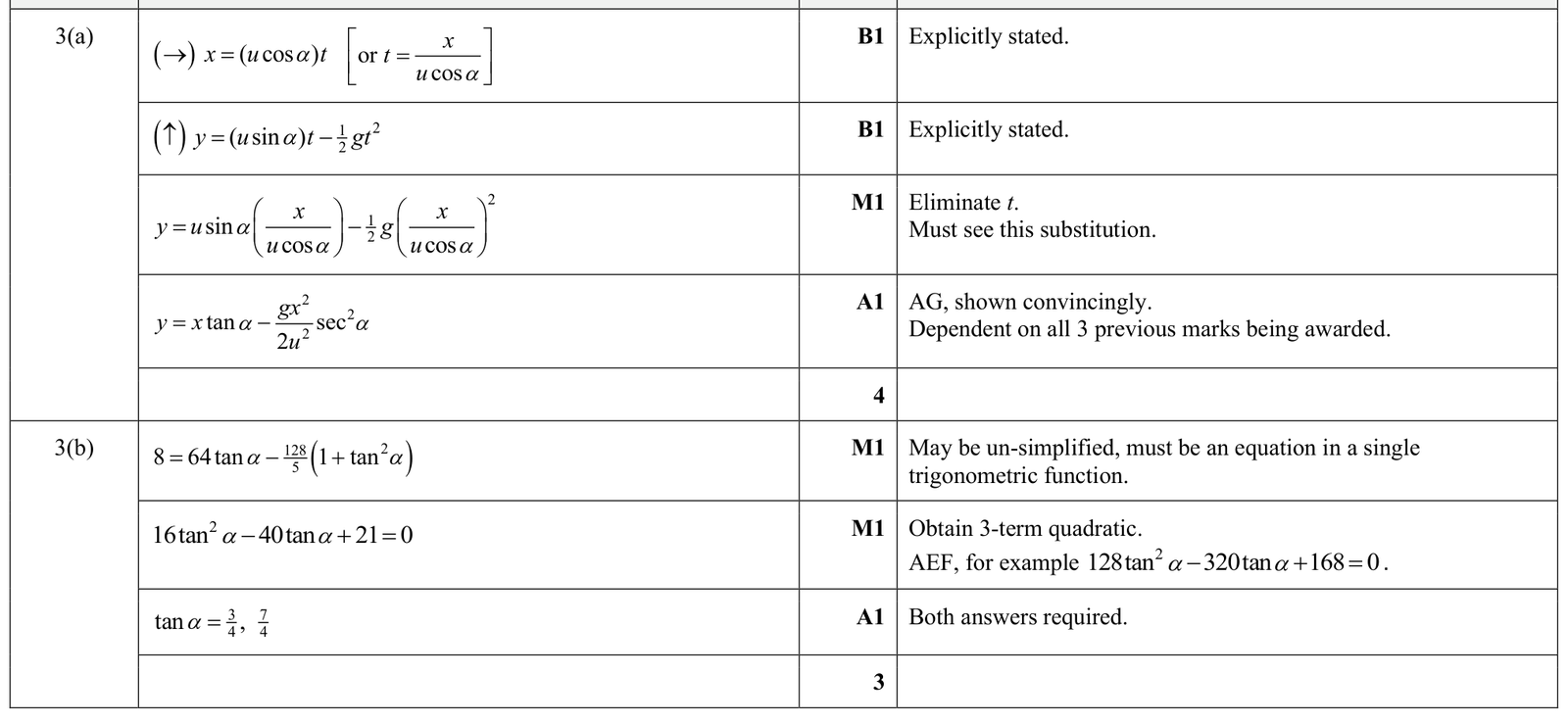
A particle \(P\) is projected with speed \(u\) at an angle \(\alpha\) above the horizontal from a point \(O\) on a horizontal plane and moves freely under gravity. The horizontal and vertical displacements of \(P\) from \(O\) at any subsequent time \(t\) are denoted by \(x\) and \(y\), respectively.
(a) Derive the equation of the trajectory of \(P\) in the form \(y=x\tan\alpha-\dfrac{gx^2}{2u^2}\sec^2\alpha\).
It is given that \(u=20\sqrt2\,\text{m s}^{-1}\) and that \(P\) passes through the point where \(x=64\,\text{m}\) and \(y=8\,\text{m}\).
(b) Find the possible values of \(\tan\alpha\).
9231 P31 - Nov 2024 - Q1 - 5 marks
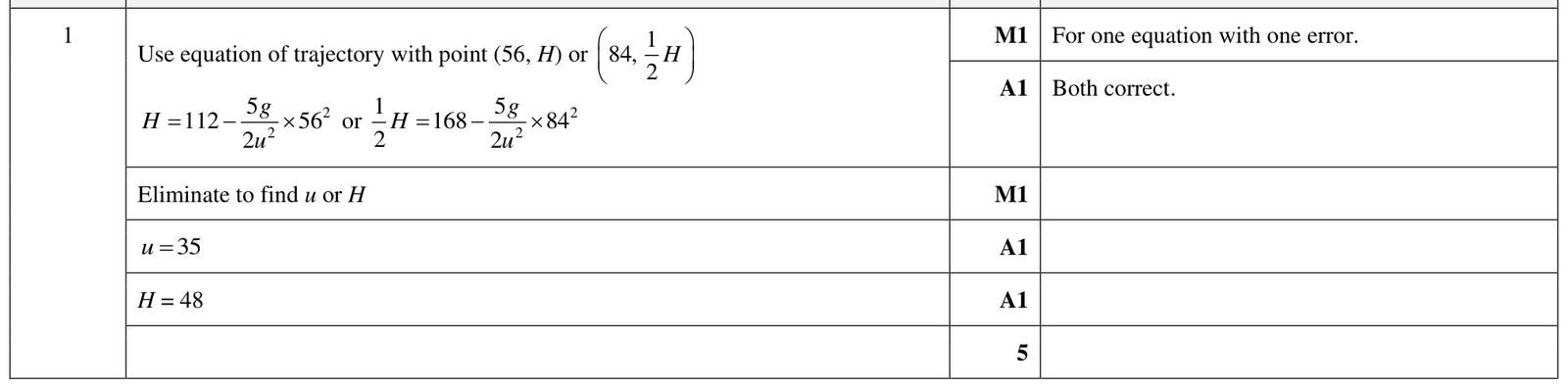
A particle \(P\) is projected with speed \(u\,\text{m s}^{-1}\) at an angle \(\tan^{-1}2\) above the horizontal from a point \(O\) on a horizontal plane. It moves freely under gravity.
When \(P\) has travelled \(56\) m horizontally from \(O\), it is at a vertical height \(H\) m above the plane. When \(P\) has travelled \(84\) m horizontally from \(O\), it is at a vertical height \(\dfrac12H\) m above the plane.
Find, in either order, the value of \(u\) and the value of \(H\).
9231 P32 - Nov 2024 - Q5 - 8 marks
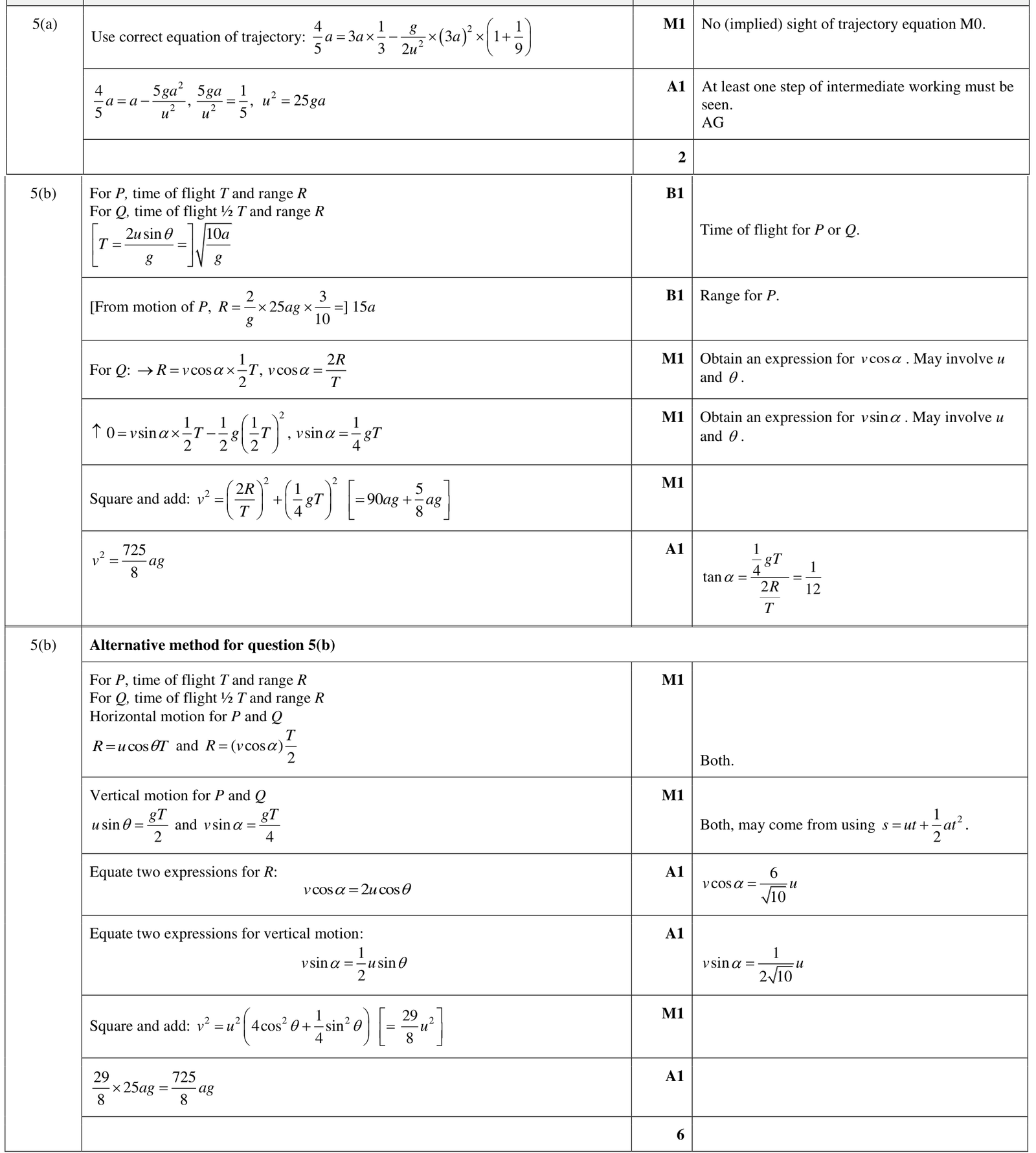
A particle \(P\) is projected from a point \(O\) on horizontal ground with speed \(u\) at an angle \(\theta\) above the horizontal, where \(\tan\theta=\dfrac13\). The particle moves freely under gravity and passes through the point with coordinates \(\left(3a,\dfrac45a\right)\), relative to horizontal and vertical axes through \(O\).
(a) Use the equation of the trajectory to show that \(u^2=25ag\).
At the instant when \(P\) is moving horizontally, a particle \(Q\) is projected from \(O\) with speed \(V\) at an angle \(\alpha\) above the horizontal. The particles \(P\) and \(Q\) reach the ground at the same point and at the same time.
(b) Express \(V^2\) in the form \(kag\), where \(k\) is a rational number.
9231 P31 - Nov 2023 - Q5 - 9 marks
A particle \(P\) is projected with speed \(u\,\text{m s}^{-1}\) at an angle \(\theta\) above the horizontal from a point \(O\) on a horizontal plane and moves freely under gravity.
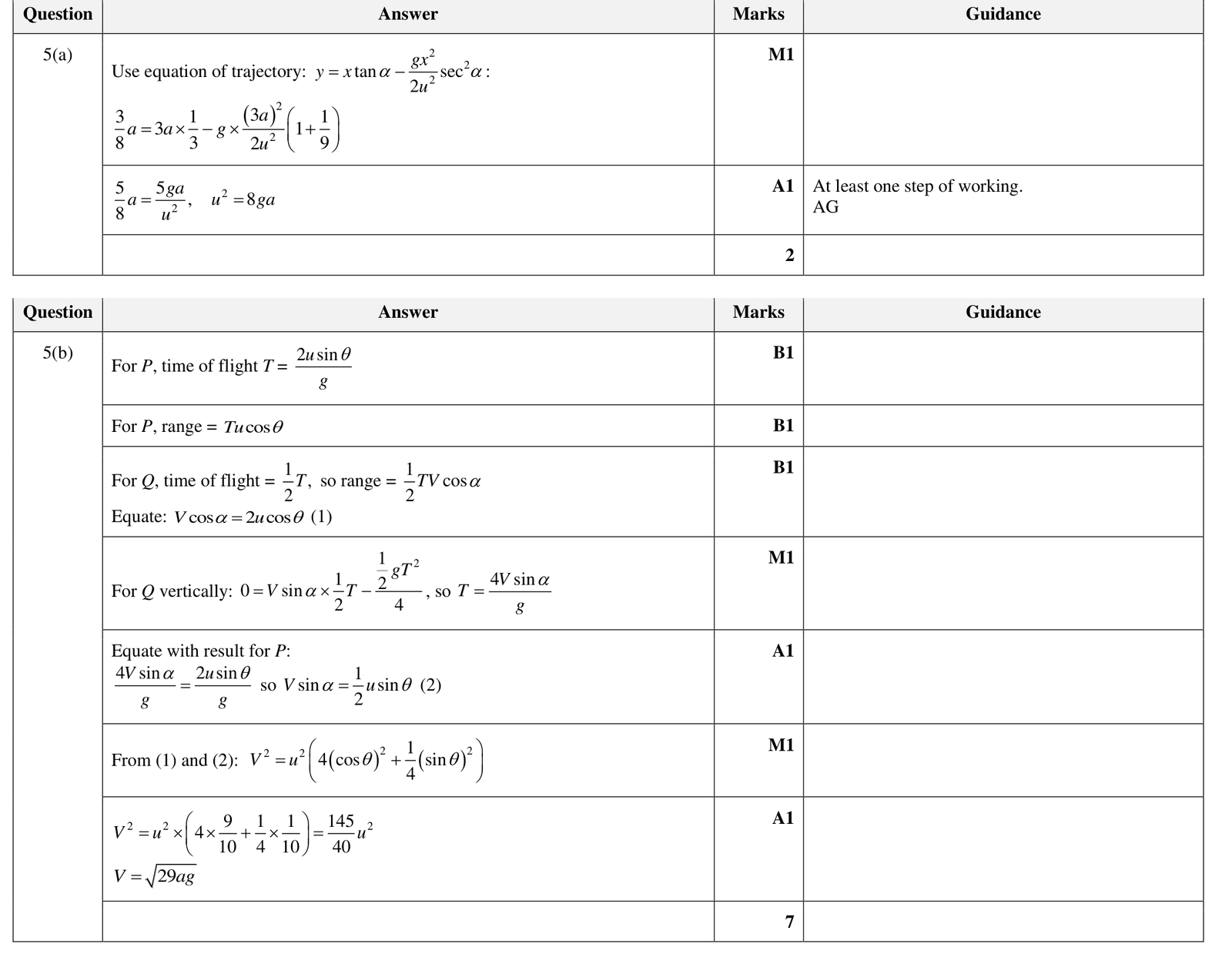
During its flight, \(P\) passes through the point which is a horizontal distance \(3a\) from \(O\) and a vertical distance \(\dfrac38a\) above the horizontal plane. It is given that \(\tan\theta=\dfrac13\).
(a) Show that \(u^2=8ag\).
A particle \(Q\) is projected with speed \(V\,\text{m s}^{-1}\) at an angle \(\alpha\) above the horizontal from \(O\) at the instant when \(P\) is at its highest point. Particles \(P\) and \(Q\) both land at the same point on the horizontal plane at the same time.
(b) Find \(V\) in terms of \(a\) and \(g\).
9231 P32 - Nov 2023 - Q6 - 9 marks
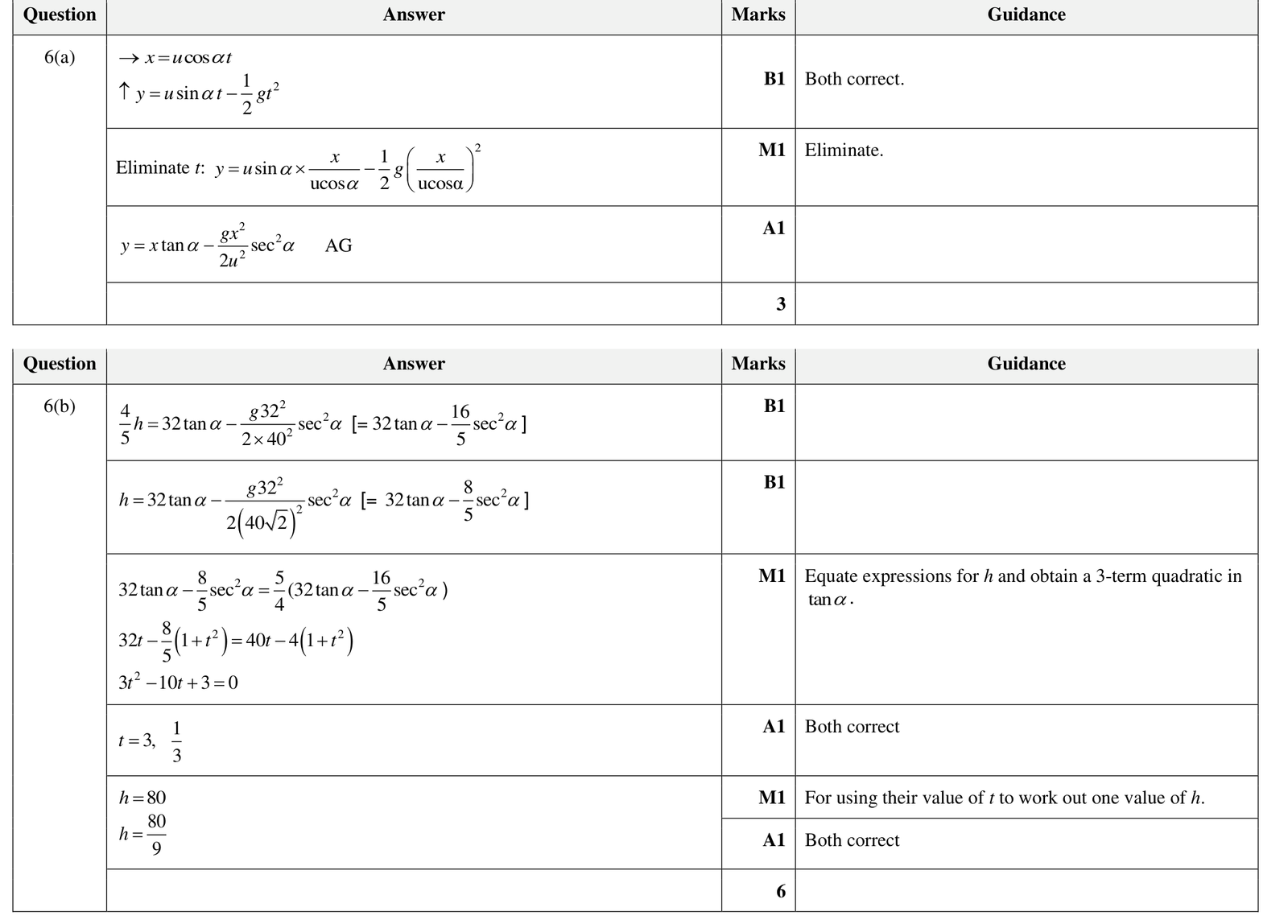
A particle \(P\) is projected with speed \(u\) at an angle \(\alpha\) above the horizontal from a point \(O\) on a horizontal plane and moves freely under gravity. The horizontal and vertical displacements of \(P\) from \(O\) at a subsequent time \(t\) are denoted by \(x\) and \(y\) respectively.
(a) Derive the equation of the trajectory of \(P\) in the form
During its flight, \(P\) must clear an obstacle of height \(h\) metres that is at a horizontal distance of \(32\) metres from the point of projection.
When \(u=40\sqrt2\,\text{m s}^{-1}\), \(P\) just clears the obstacle. When \(u=40\,\text{m s}^{-1}\), \(P\) only achieves \(80\%\) of the height required to clear the obstacle.
(b) Find the two possible values of \(h\).
9231 P32 - Nov 2022 - Q5 - 9 marks
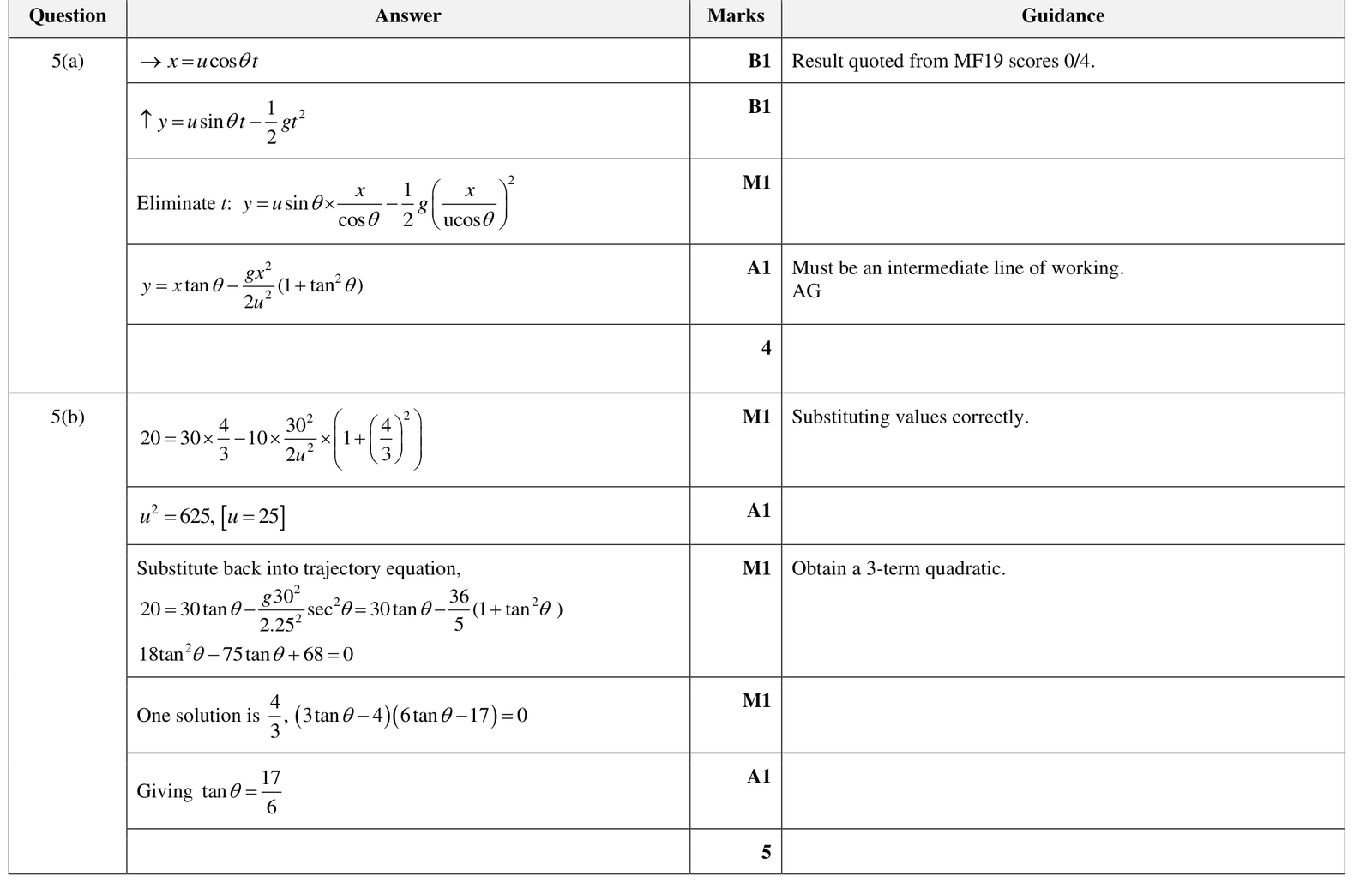
A particle \(P\) is projected with speed \(u \mathrm{~m} \mathrm{~s}^{-1}\) at an angle of \(\theta\) above the horizontal from a point \(O\) on a horizontal plane and moves freely under gravity. The horizontal and vertical displacements of \(P\) from \(O\) at a subsequent time \(t \mathrm{~s}\) are denoted by \(x \mathrm{~m}\) and \(y \mathrm{~m}\) respectively.
(a) Show that the equation of the trajectory is given by
\(y=x \tan \theta-\frac{g x^{2}}{2 u^{2}}\left(1+\tan ^{2} \theta\right) .\)
In the subsequent motion \(P\) passes through the point with coordinates \((30,20)\).
(b) Given that one possible value of \(\tan \theta\) is \(\frac{4}{3}\), find the other possible value of \(\tan \theta\).
9231 P33 - Jun 2021 - Q7 - 9 marks
A particle \(P\) is projected with speed \(u\) at an angle \(\theta\) above the horizontal from a point \(O\) on a horizontal plane and moves freely under gravity. The horizontal and vertical displacements of \(P\) from \(O\) at a subsequent time \(t\) are denoted by \(x\) and \(y\) respectively.
(a) Use the equation of the trajectory given in the List of formulae (MF19), together with the condition \(y=0\), to establish an expression for the range \(R\) in terms of \(u, \theta\) and \(g\).
(b) Deduce an expression for the maximum height \(H\), in terms of \(u, \theta\) and \(g\).
It is given that \(R=\frac{4 H}{\sqrt{3}}\).
(c) Show that \(\theta=60^{\circ}\).
It is given also that \(u=\sqrt{40} \mathrm{~ms}^{-1}\).
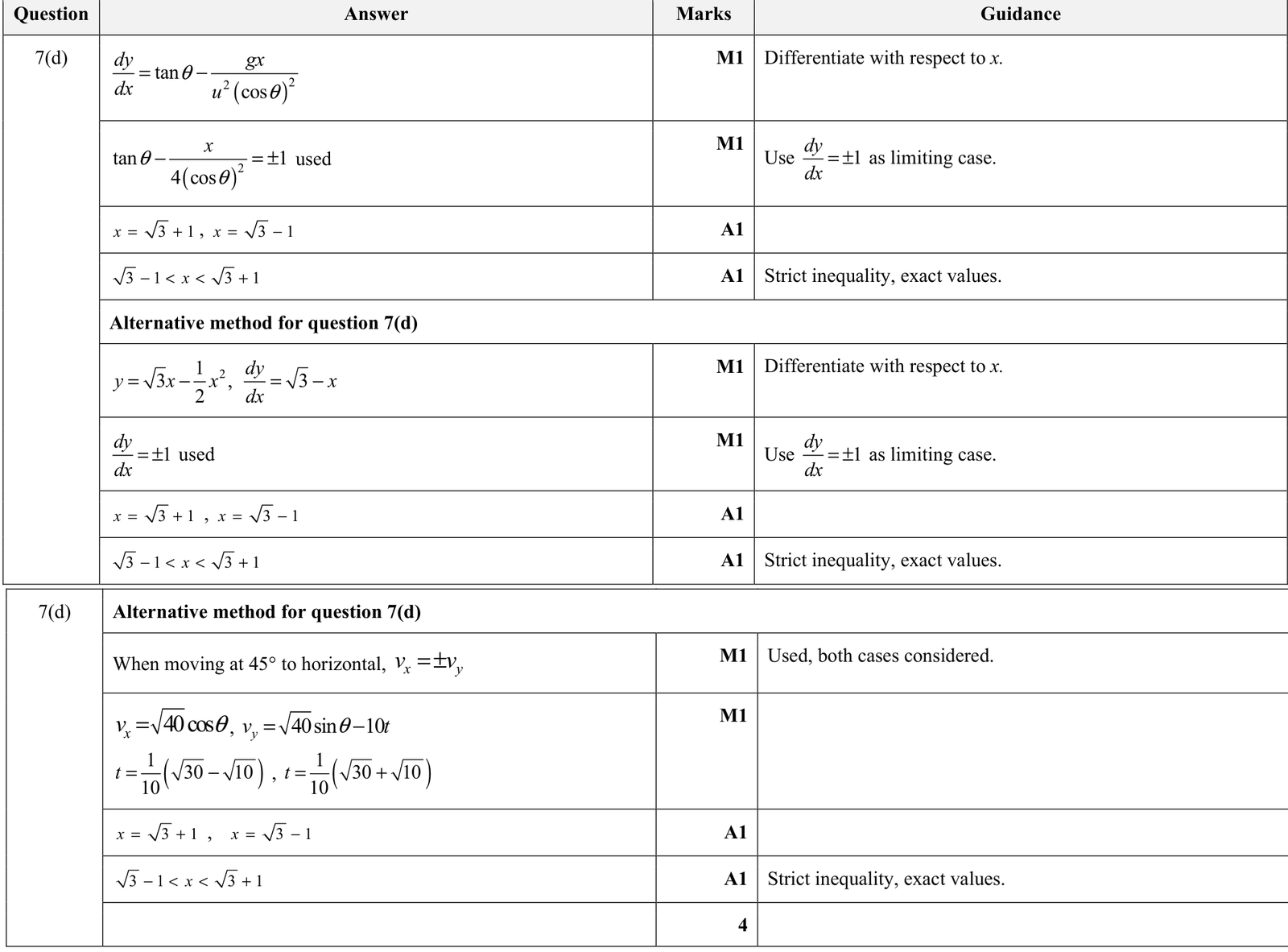
(d) Find, by differentiating the equation of the trajectory or otherwise, the set of values of \(x\) for which the direction of motion makes an angle of less than \(45^{\circ}\) with the horizontal.
9231 P32 - Nov 2021 - Q7 - 8 marks
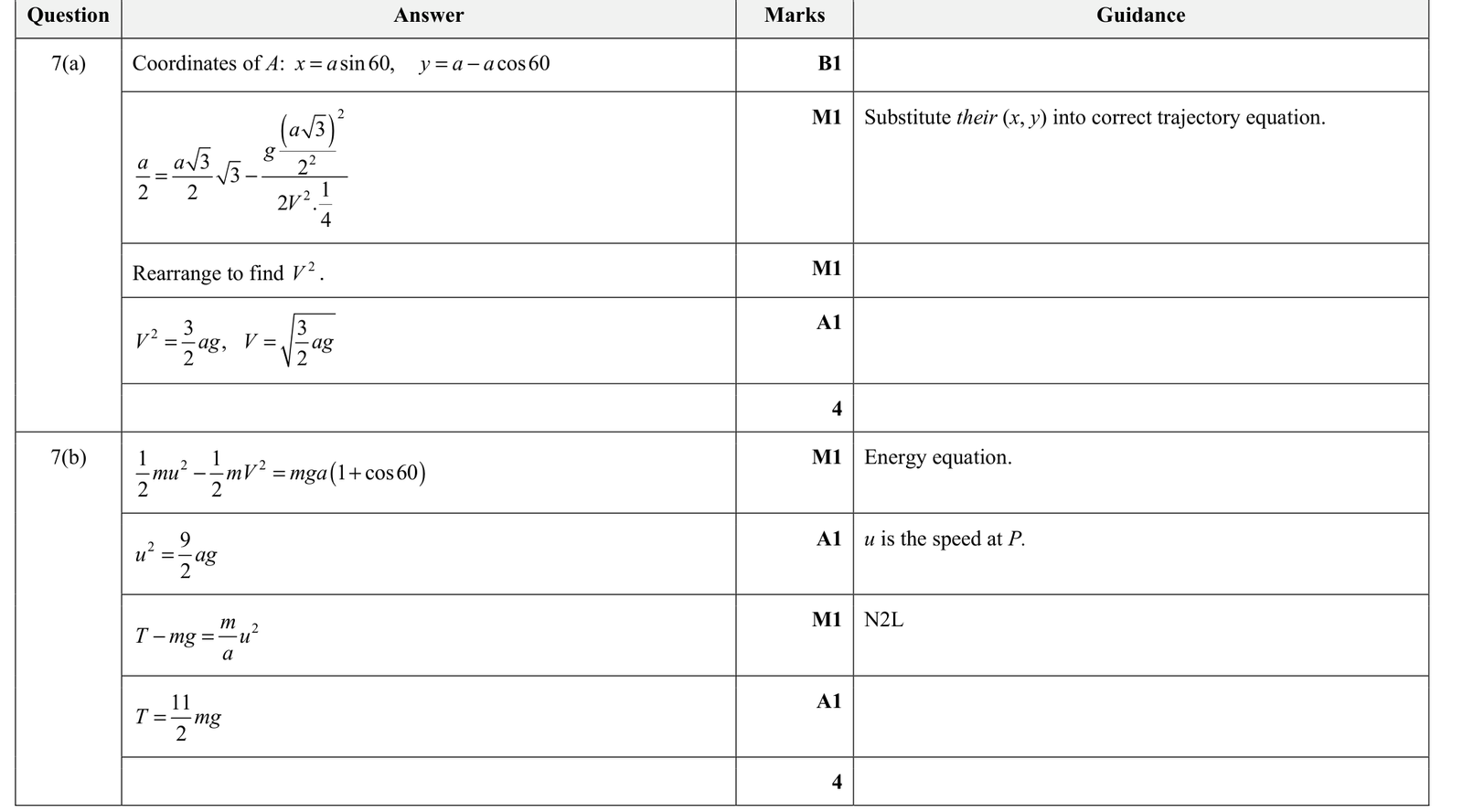
One end of a light inextensible string of length \(a\) is attached to a fixed point \(O\). The other end of the string is attached to a particle \(P\) of mass \(m\). The particle \(P\) is held vertically below \(O\) with the string taut and then projected horizontally. When the string makes an angle of \(60^{\circ}\) with the upward vertical, \(P\) becomes detached from the string. In its subsequent motion, \(P\) passes through the point \(A\) which is a distance \(a\) vertically above \(O\).
(a) The speed of \(P\) when it becomes detached from the string is \(V\). Use the equation of the trajectory of a projectile to find \(V\) in terms of \(a\) and \(g\).
(b) Find, in terms of \(m\) and \(g\), the tension in the string immediately after \(P\) is initially projected horizontally.
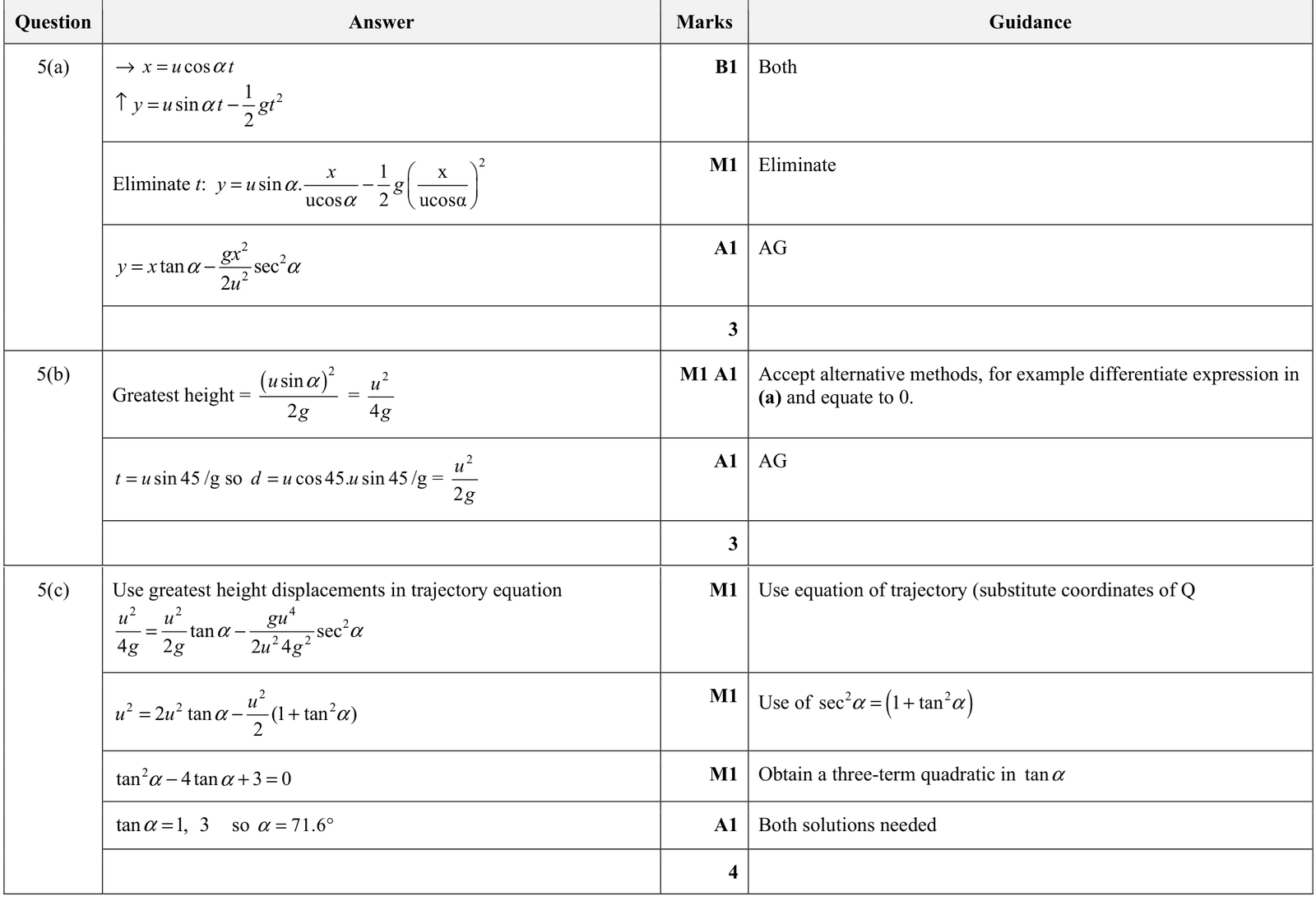
9231 P31 - Nov 2020 - Q5 - 10 marks
A particle \(P\) is projected with speed \(u\) at an angle \(\alpha\) above the horizontal from a point \(O\) on a horizontal plane and moves freely under gravity. The horizontal and vertical displacements of \(P\) from \(O\) at a subsequent time \(t\) are denoted by \(x\) and \(y\) respectively.
(a) Derive the equation of the trajectory of \(P\) in the form
\(y=x \tan \alpha-\frac{g x^{2}}{2 u^{2}} \sec ^{2} \alpha\)
The point \(Q\) is the highest point on the trajectory of \(P\) in the case where \(\alpha=45^{\circ}\).
(b) Show that the \(x\)-coordinate of \(Q\) is \(\frac{u^{2}}{2 g}\).
(c) Find the other value of \(\alpha\) for which \(P\) would pass through the point \(Q\).
9231 P32 - Nov 2020 - Q5 - 7 marks
A particle \(P\) is projected with speed \(u \mathrm{~m} \mathrm{~s}^{-1}\) at an angle of \(\theta\) above the horizontal from a point \(O\) on a horizontal plane and moves freely under gravity. The horizontal and vertical displacements of \(P\) from \(O\) at a subsequent time \(t \mathrm{~s}\) are denoted by \(x \mathrm{~m}\) and \(y \mathrm{~m}\) respectively.
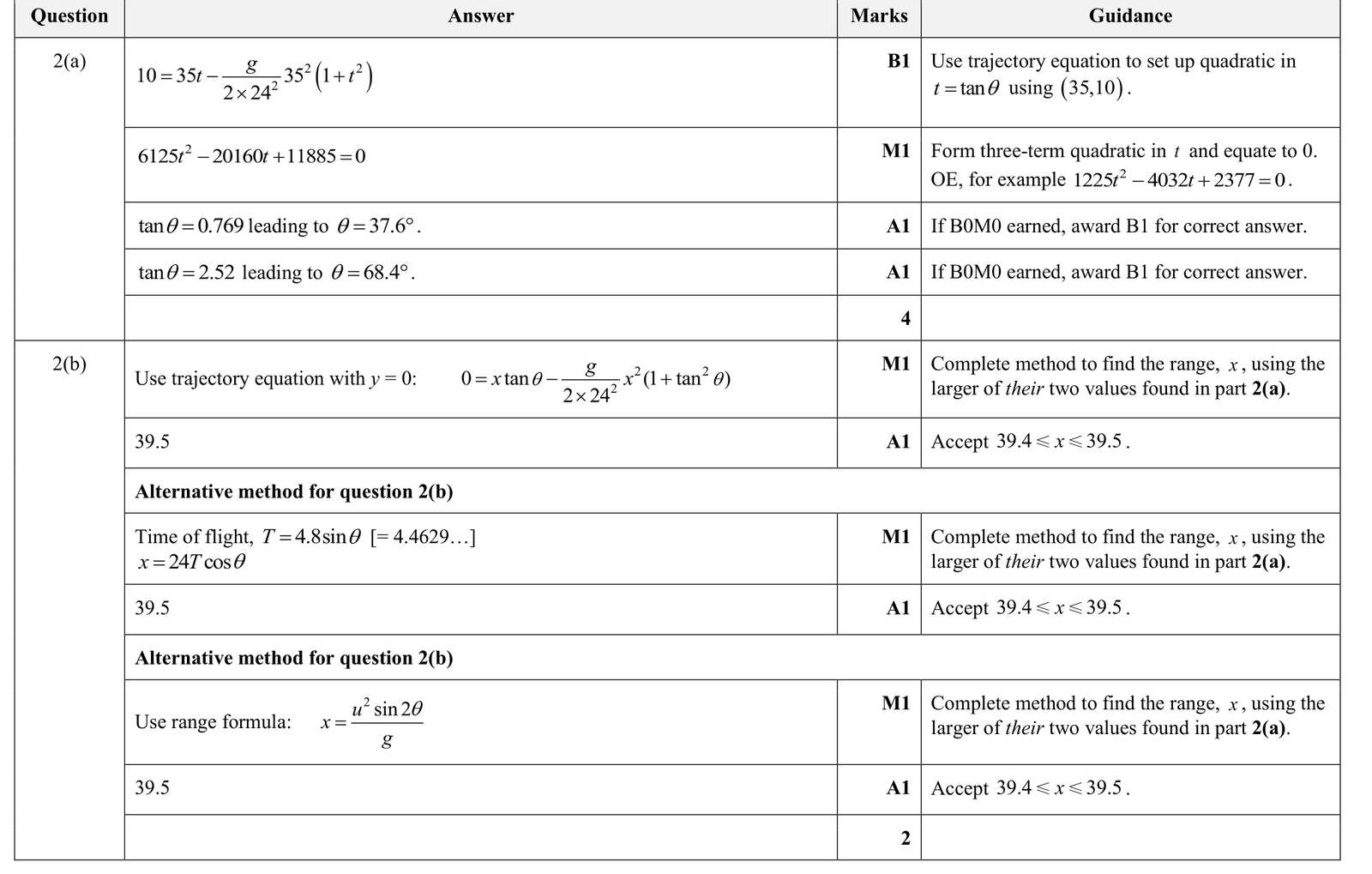
(a) Starting from the equation of the trajectory given in the List of formulae (MF19), show that
\(y=x \tan \theta-\frac{g x^{2}}{2 u^{2}}\left(1+\tan ^{2} \theta\right) .\)
When \(\theta=\tan ^{-1} 2, P\) passes through the point with coordinates \((10,16)\).
(b) Show that there is no value of \(\theta\) for which \(P\) can pass through the point with coordinates \((18,30)\).