9231 P41 - Nov 2025 - Q4 - 5 marks
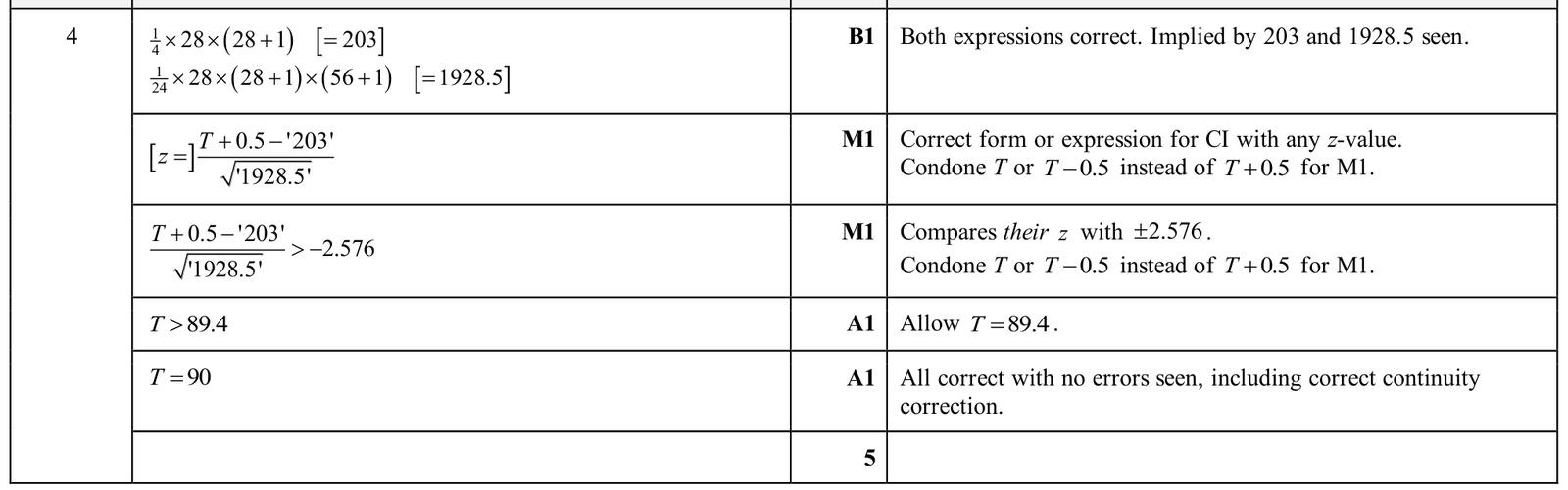
A researcher believes that the median \(m\) of a population has changed from its known previous value \(m_{0}\). The researcher collects a random sample of size 28 . She ranks the data and calculates a test statistic \(T\) using the Wilcoxon signed-rank test. The conclusion of the test carried out at a \(1 \%\) significance level is that there is not sufficient evidence to support her belief. Using a normal approximation, find the least possible value of \(T\).
9231 P41 - Jun 2024 - Q3 - 8 marks
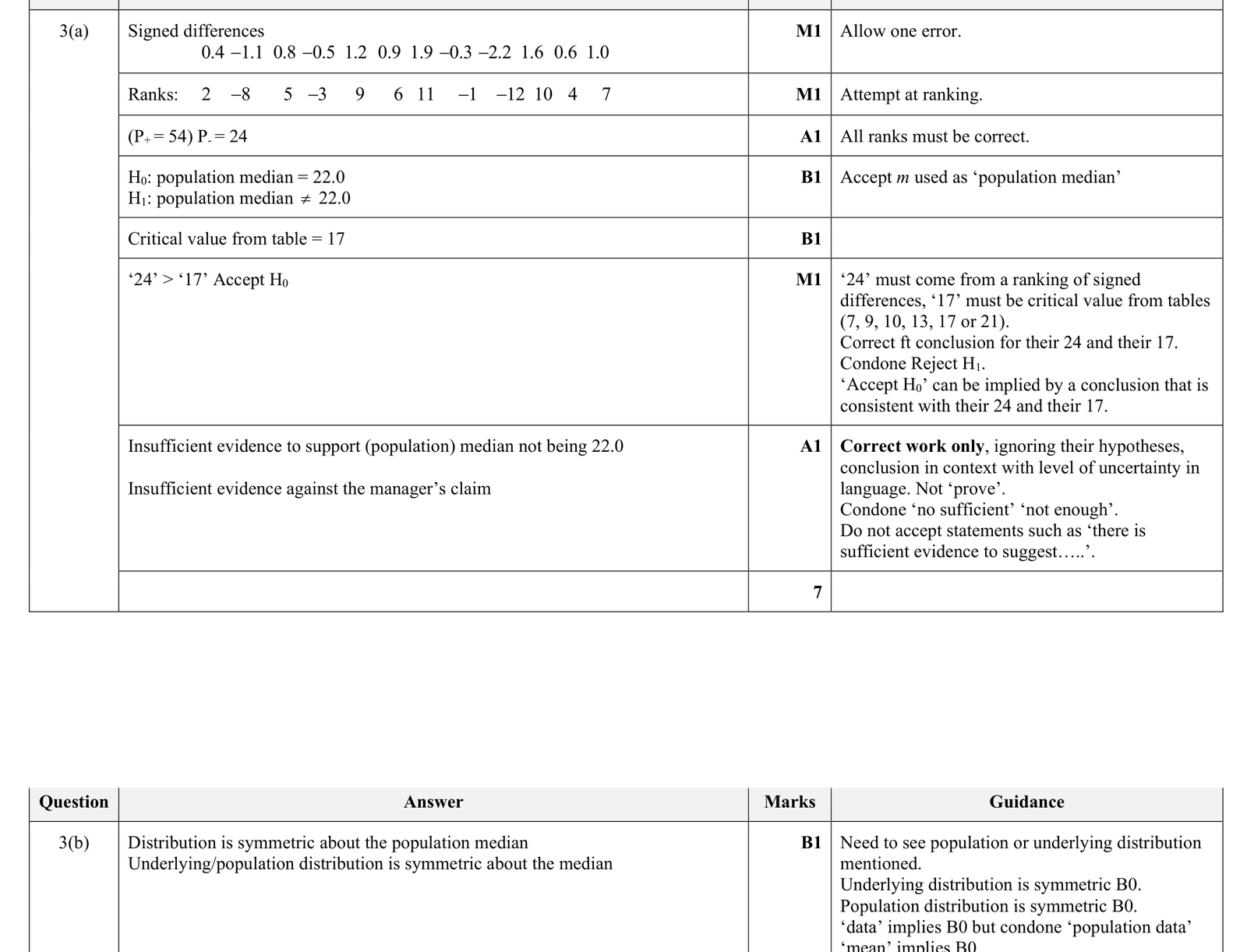
A factory produces metal discs. The manager claims that the diameters of these discs have a median of 22.0 mm . The diameters, in mm , of a random sample of 12 discs produced by this factory are as follows.
| 22.4 | 20.9 | 22.8 | 21.5 | 23.2 | 22.9 | 23.9 | 21.7 | 19.8 | 23.6 | 22.6 | 23.0 |
(a) Carry out a Wilcoxon signed-rank test, at the \(10 \%\) significance level, to test whether there is any evidence against the manager's claim.
(b) State an assumption that is necessary for this test to be valid.
9231 P41 - Nov 2023 - Q6 - 10 marks
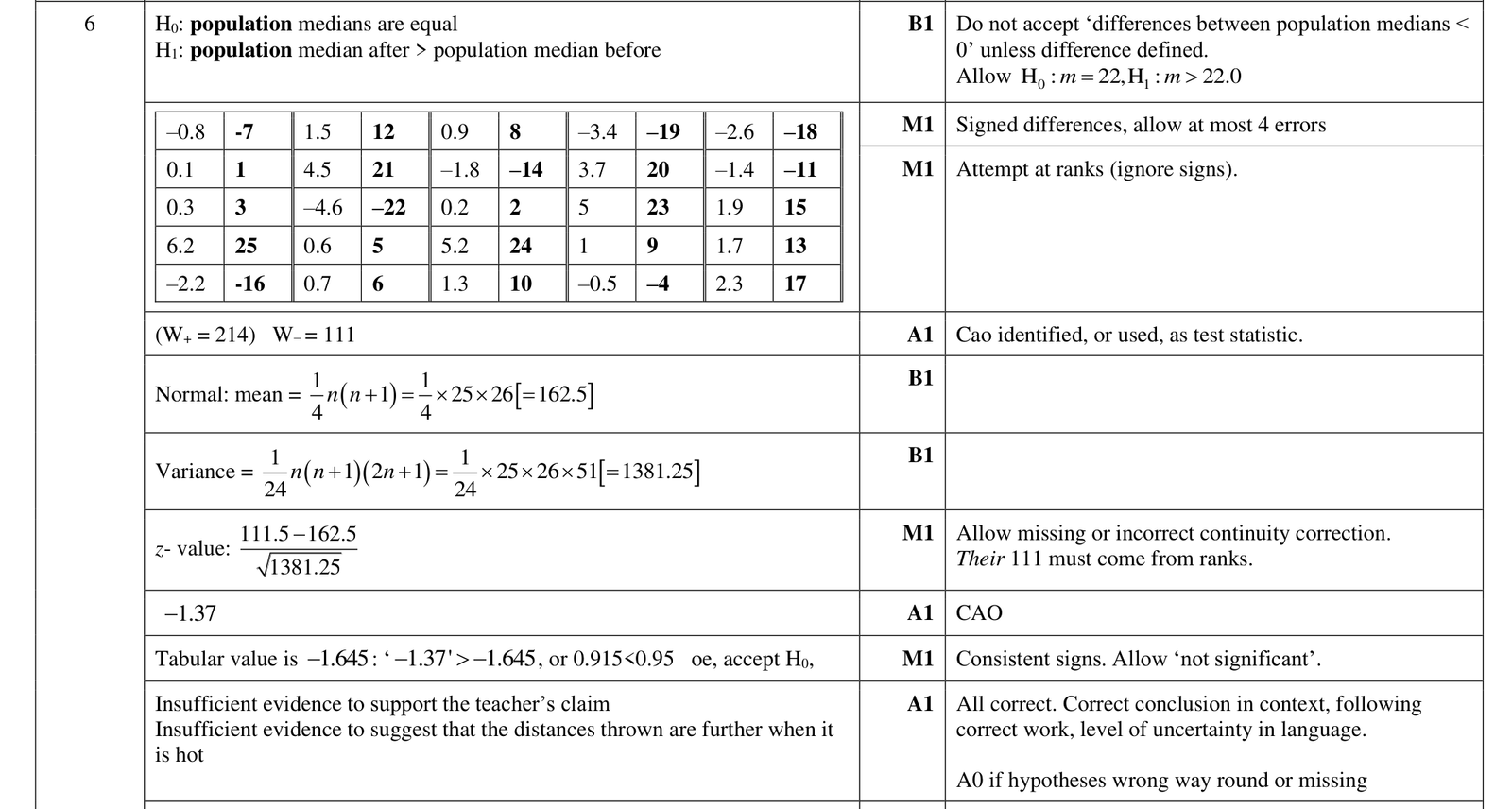
A school is conducting an experiment to see whether the distance that children can throw a ball increases in hot weather. On a cold day, all the children at the school were asked to throw a ball as far as possible. The distances thrown were measured and recorded. The median distance thrown by a random sample of 25 of the children was 22.0 m. The children were asked to throw the ball again on a hot day. The distances thrown by the same 25 children were measured and recorded and these distances, in m, are shown below.
| 21.2 | 23.5 | 22.9 | 18.6 | 19.4 |
| 22.1 | 26.5 | 20.2 | 25.7 | 20.6 |
| 22.3 | 17.4 | 22.2 | 27.0 | 23.9 |
| 28.2 | 22.6 | 27.2 | 23.0 | 23.7 |
| 19.8 | 22.7 | 23.3 | 21.5 | 24.3 |
The teacher claims that on average the distances thrown will be further when it is hot. Carry out a Wilcoxon signed-rank test, at the \(5\%\) significance level, to test whether the data supports the teacher's claim.
9231 P41 - Jun 2022 - Q6 - 10 marks
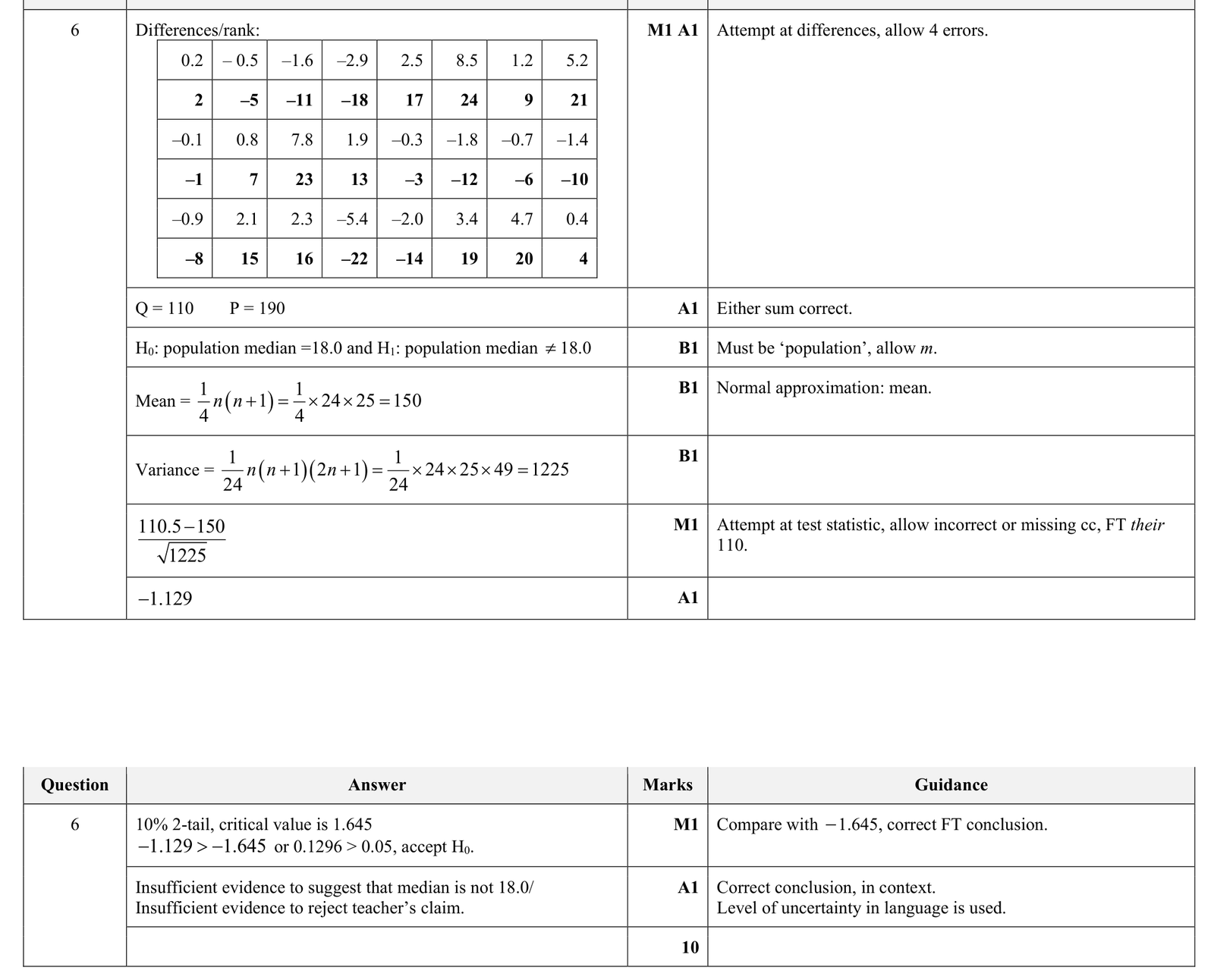
A teacher at a large college gave a mathematical puzzle to all the students. The median time taken by a random sample of 24 students to complete the puzzle was 18.0 minutes. The students were then given practice in solving puzzles. Two weeks later, the students were given another mathematical puzzle of the same type as the first. The times, in minutes, taken by the random sample of 24 students to complete this puzzle are as follows.
| 18.2 | 17.5 | 16.4 | 15.1 | 20.5 | 26.5 | 19.2 | 23.2 |
| 17.9 | 18.8 | 25.8 | 19.9 | 17.7 | 16.2 | 17.3 | 16.6 |
| 17.1 | 20.1 | 20.3 | 12.6 | 16.0 | 21.4 | 22.7 | 18.4 |
The teacher claims that the practice has not made any difference to the average time taken to complete a puzzle of this type.
Carry out a Wilcoxon signed-rank test, at the \(10\%\) significance level, to test whether there is sufficient evidence to reject the teacher's claim.
9231 P43 - Jun 2022 - Q5 - 9 marks
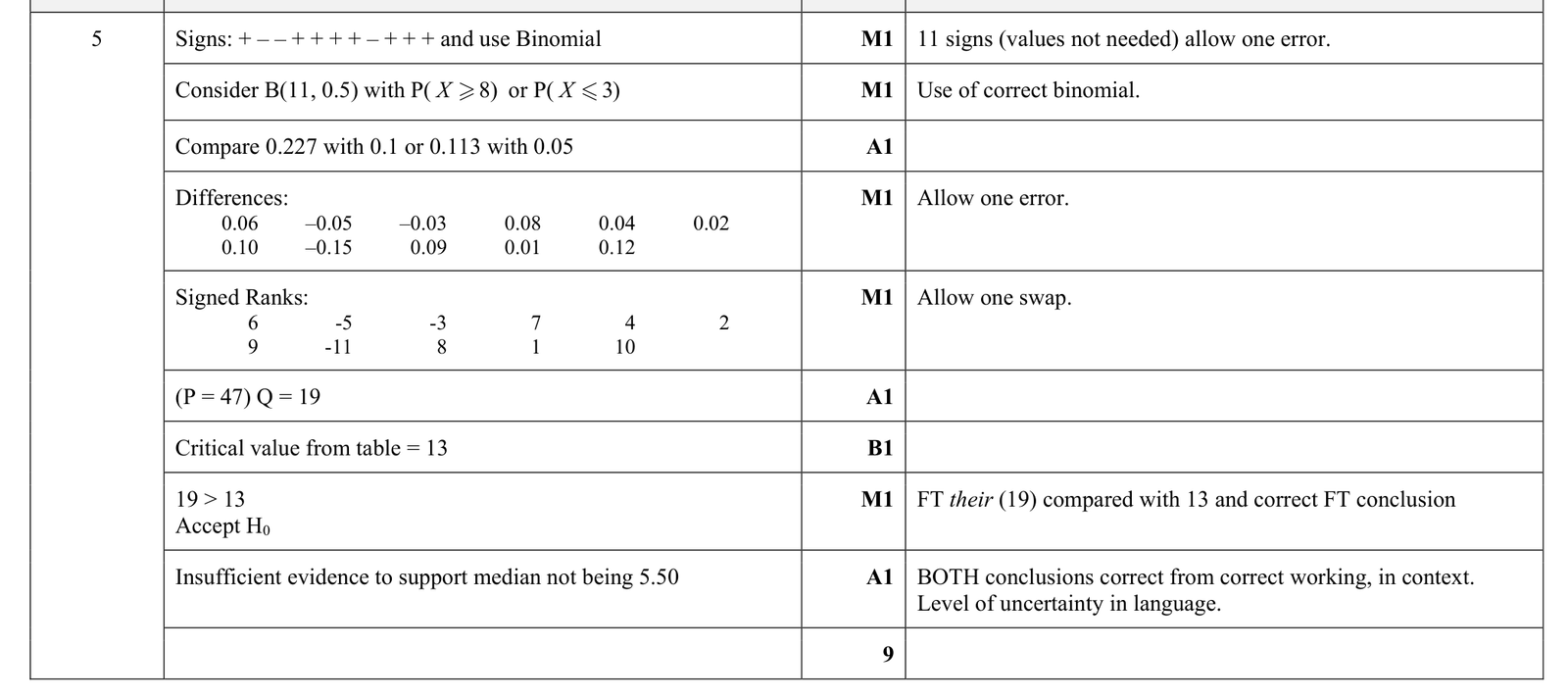
A manager claims that the lengths of the rubber tubes that his company produces have a median of 5.50 cm. The lengths, in cm, of a random sample of 11 tubes produced by this company are as follows.
| 5.56 | 5.45 | 5.47 | 5.58 | 5.54 | 5.52 | 5.60 | 5.35 | 5.59 | 5.51 | 5.62 |
It is required to test at the 10% significance level the null hypothesis that the population median length is 5.50 cm against the alternative hypothesis that the population median length is not equal to 5.50 cm.
Show that both a sign test and a Wilcoxon signed-rank test give the same conclusion and state this conclusion.
9231 P41 - Jun 2020 - Q2 - 7 marks
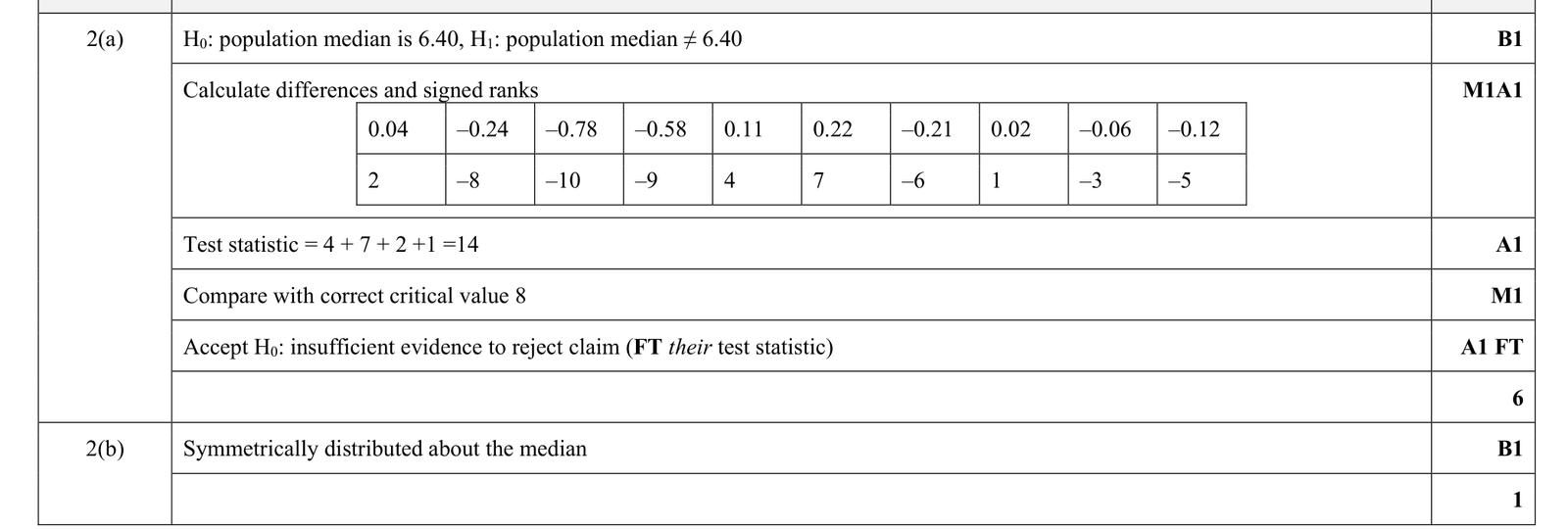
The times, in milliseconds, taken by a computer to perform a certain task were recorded on 10 randomly chosen occasions. The times were as follows.
| 6.44 | 6.16 | 5.62 | 5.82 | 6.51 | 6.62 | 6.19 | 6.42 | 6.34 | 6.28 |
It is claimed that the median time to complete the task is 6.4 milliseconds.
(a) Carry out a Wilcoxon signed-rank test at the \(5 \%\) significance level to test this claim.
(b) State an underlying assumption that is made when using a Wilcoxon signed-rank test.
9231 P41 - Nov 2020 - Q2 - 7 marks
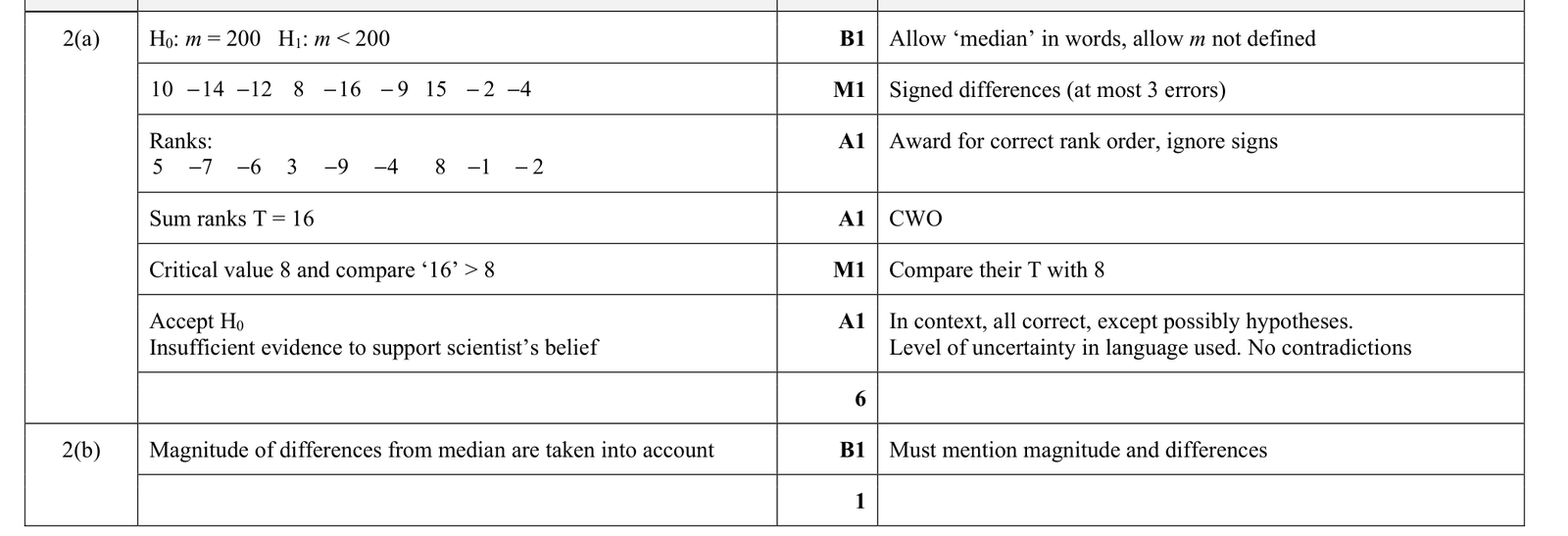
Metal rods produced by a certain factory are claimed to have a median breaking strength of 200 tonnes. For a random sample of 9 rods, the breaking strengths, measured in tonnes, were as follows.
| 210 | 186 | 188 | 208 | 184 | 191 | 215 | 198 | 196 |
A scientist believes that the median breaking strength of metal rods produced by this factory is less than 200 tonnes.
(a) Use a Wilcoxon signed-rank test, at the \(5 \%\) significance level, to test whether there is evidence to support the scientist's belief.
(b) Give a reason why a Wilcoxon signed-rank test is preferable to a sign test, when both are valid.
9231 P42 - Nov 2024 - Q6 - 9 marks
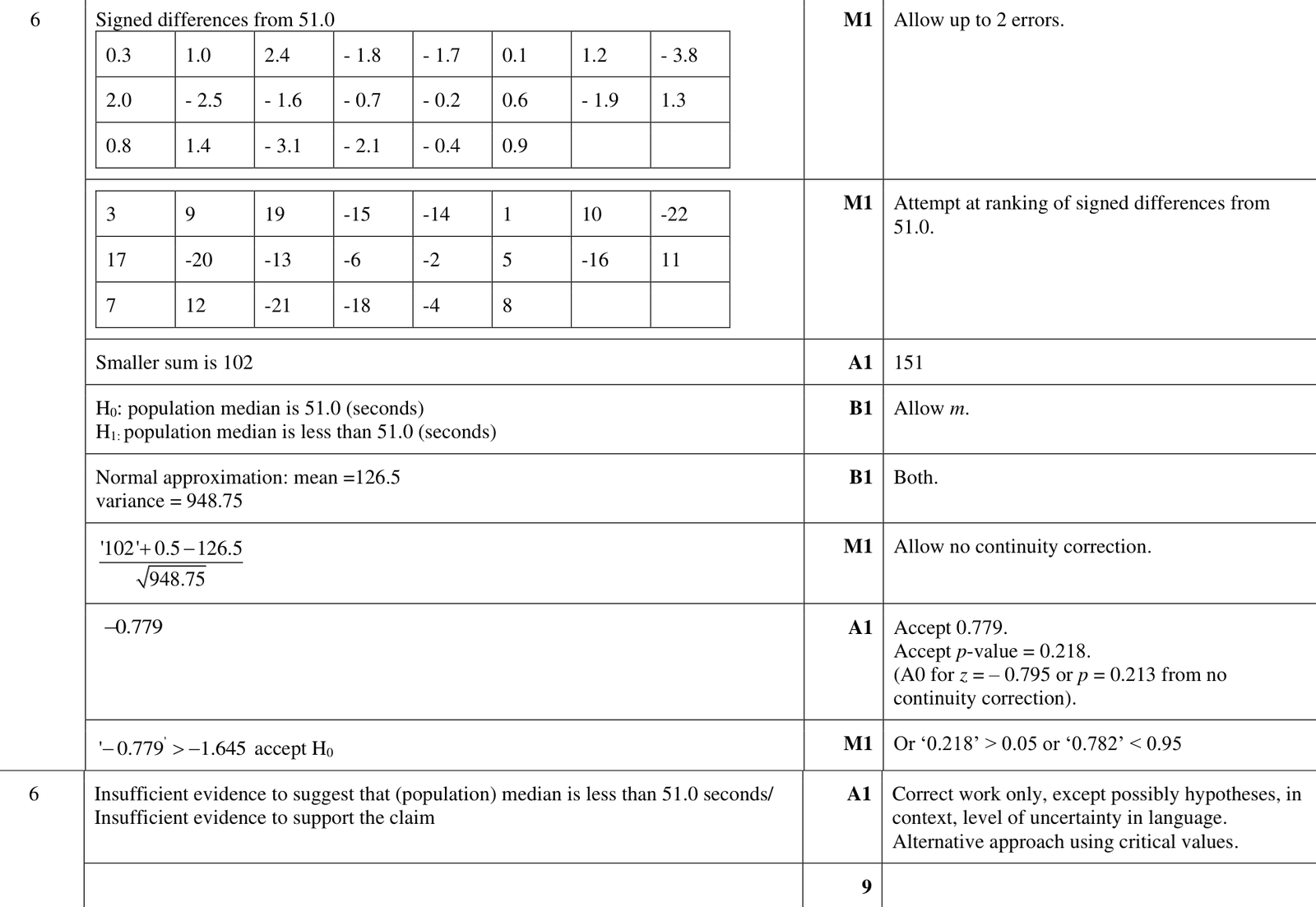
A sports college keeps records of the times taken by students to run one lap of a running track. The population median time taken is 51.0 seconds. After a month of intensive training, a random sample of 22 new students run one lap of the track, giving times, in seconds, as follows.
51.3 | 52.0 | 53.4 | 49.2 | 49.3 | 51.1 | 52.2 | 47.2 |
53.0 | 48.5 | 49.4 | 50.3 | 50.8 | 51.6 | 49.1 | 52.3 |
51.8 | 52.4 | 47.9 | 48.9 | 50.6 | 51.9 |
It is claimed that the intensive training has led to a decrease in the median time taken to run one lap of the track.
Carry out a Wilcoxon signed-rank test, at the \(5 \%\) significance level, to test whether there is sufficient evidence to support the claim.
9231 P44 - Jun 2025 - Q2 - 7 marks
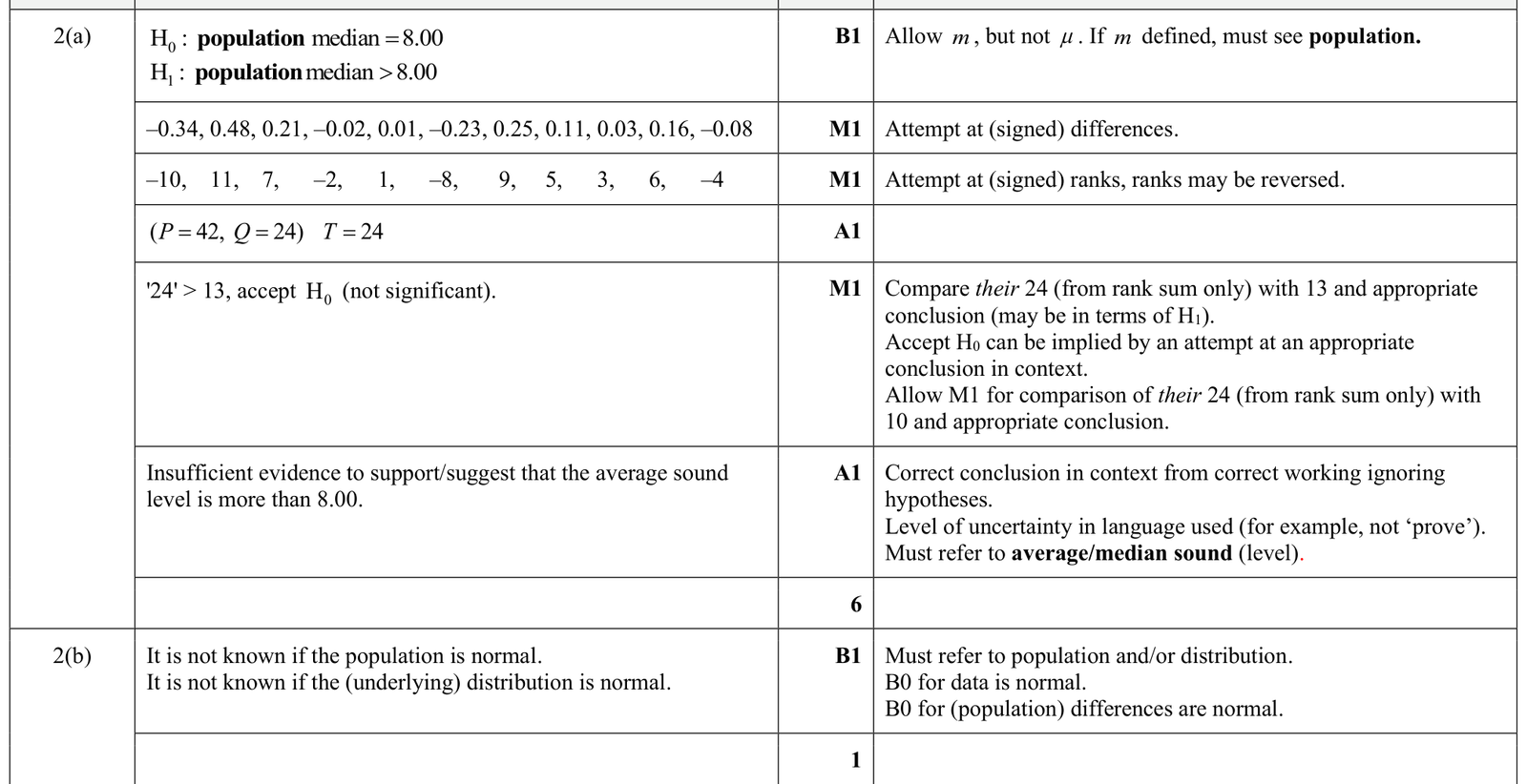
The level of sound produced by a particular type of machine was measured for a random sample of 11 such machines. The results, in suitable units, are shown below.
| Machine | \(A\) | \(B\) | \(C\) | \(D\) | \(E\) | \(F\) | \(G\) | \(H\) | \(I\) | \(J\) | \(K\) |
|---|---|---|---|---|---|---|---|---|---|---|---|
| Sound level | 7.66 | 8.48 | 8.21 | 7.98 | 8.01 | 7.77 | 8.25 | 8.11 | 8.03 | 8.16 | 7.92 |
(a) Use a Wilcoxon signed-rank test to test whether the average sound level produced by this type of machine is more than 8.00. Use a \(5 \%\) significance level.
(b) Give a reason why a Wilcoxon signed-rank test may be more appropriate than a \(t\)-test in this case.