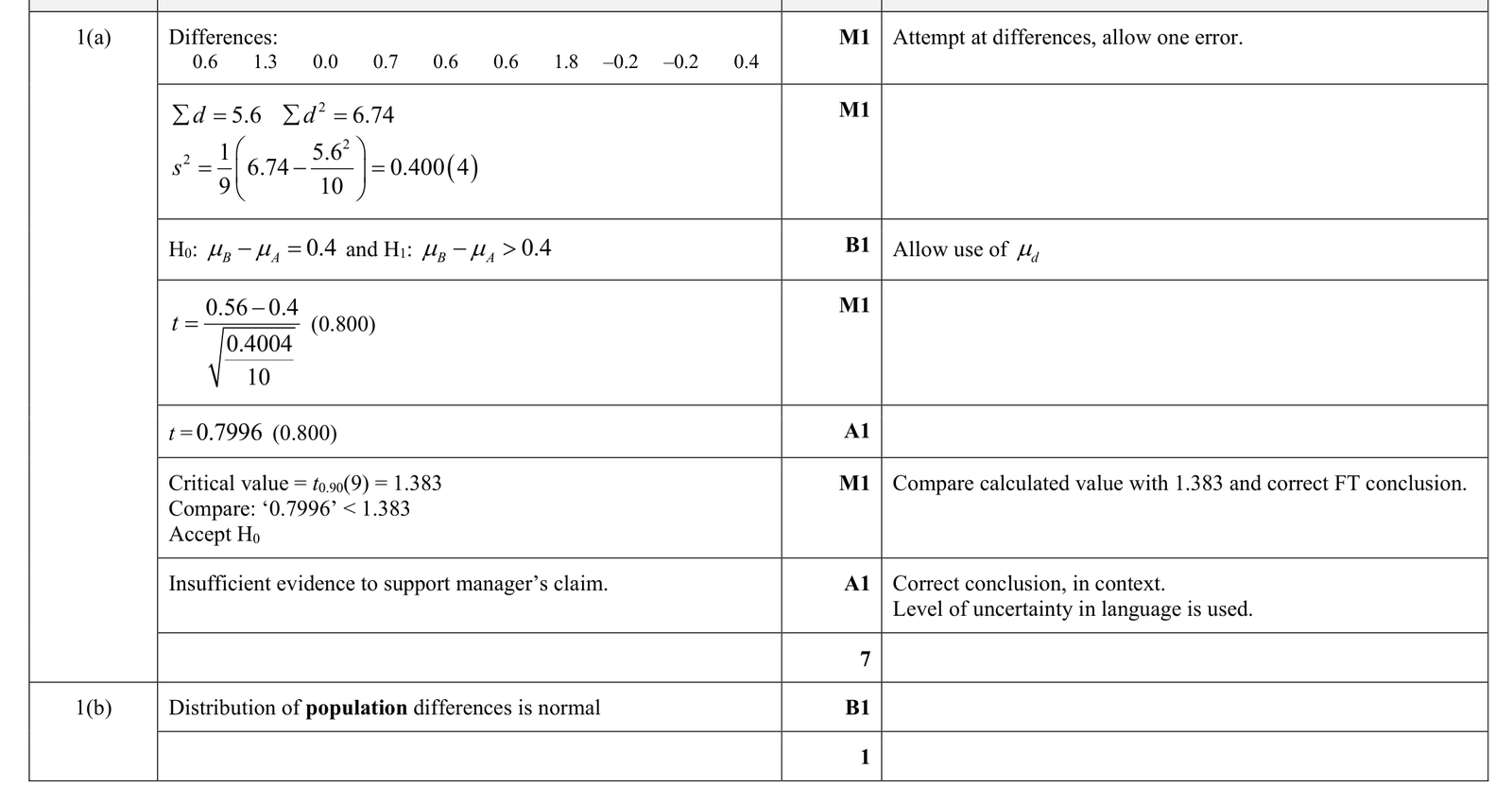
9231 P21 - Jun 2019 - Q8 - 8 marks
Question 11 OR alternative.
The times taken to run 200 metres at the beginning of the year and at the end of the year are recorded for each member of a large athletics club. The time taken, in seconds, at the beginning of the year is denoted by \(x\) and the time taken, in seconds, at the end of the year is denoted by \(y\). For a random sample of 8 members, the results are shown in the following table.
| Member | \(A\) | \(B\) | \(C\) | \(D\) | \(E\) | \(F\) | \(G\) | \(H\) |
|---|---|---|---|---|---|---|---|---|
| \(x\) | 24.2 | 23.8 | 22.8 | 25.1 | 24.5 | 24.0 | 23.8 | 22.8 |
| \(y\) | 23.9 | 23.6 | 22.8 | 24.5 | 24.2 | 23.5 | 23.6 | 22.7 |
\[ \left[\sum x=191,\quad \sum x^{2}=4564.46,\quad \sum y=188.8,\quad \sum y^{2}=4458.4,\quad \sum xy=4510.99\right] \]
(i) Find, showing all necessary working, the equation of the regression line of \(y\) on \(x\).
The athletics coach believes that, on average, the time taken by an athlete to run 200 metres decreases between the beginning and the end of the year by more than 0.2 seconds.
(ii) Stating suitable hypotheses and assuming a normal distribution, test the coach's belief at the \(10\%\) significance level.
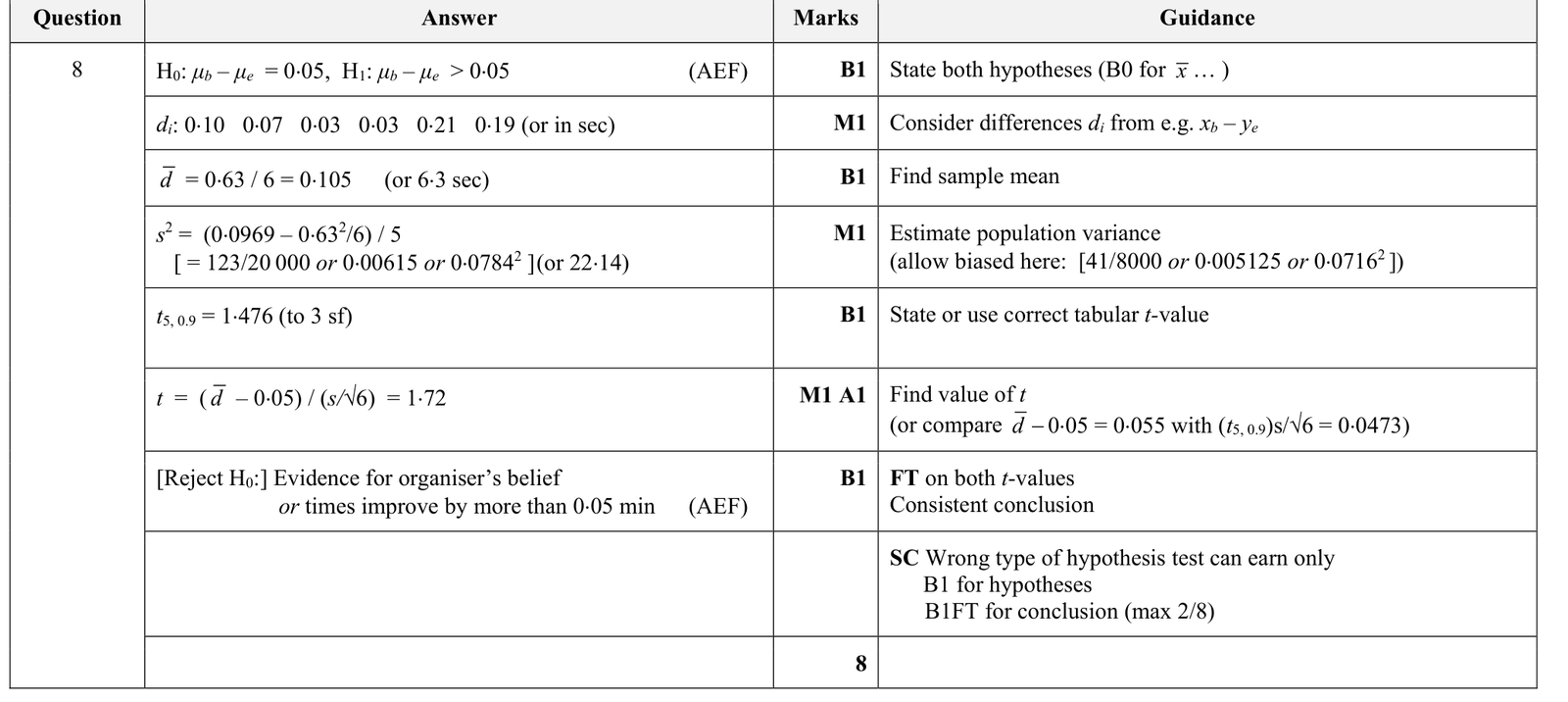
9231 P23 - Jun 2017 - Q11O - 12 marks
Question 11 OR alternative.
The times taken to run 200 metres at the beginning of the year and at the end of the year are recorded for each member of a large athletics club. The time taken, in seconds, at the beginning of the year is denoted by \(x\) and the time taken, in seconds, at the end of the year is denoted by \(y\). For a random sample of 8 members, the results are shown in the following table.
| Member | \(A\) | \(B\) | \(C\) | \(D\) | \(E\) | \(F\) | \(G\) | \(H\) |
|---|---|---|---|---|---|---|---|---|
| \(x\) | 24.2 | 23.8 | 22.8 | 25.1 | 24.5 | 24.0 | 23.8 | 22.8 |
| \(y\) | 23.9 | 23.6 | 22.8 | 24.5 | 24.2 | 23.5 | 23.6 | 22.7 |
\[ \left[\sum x=191,\quad \sum x^{2}=4564.46,\quad \sum y=188.8,\quad \sum y^{2}=4458.4,\quad \sum xy=4510.99\right] \]
(i) Find, showing all necessary working, the equation of the regression line of \(y\) on \(x\).
The athletics coach believes that, on average, the time taken by an athlete to run 200 metres decreases between the beginning and the end of the year by more than \(0.2\) seconds.
(ii) Stating suitable hypotheses and assuming a normal distribution, test the coach's belief at the \(10\%\) significance level.
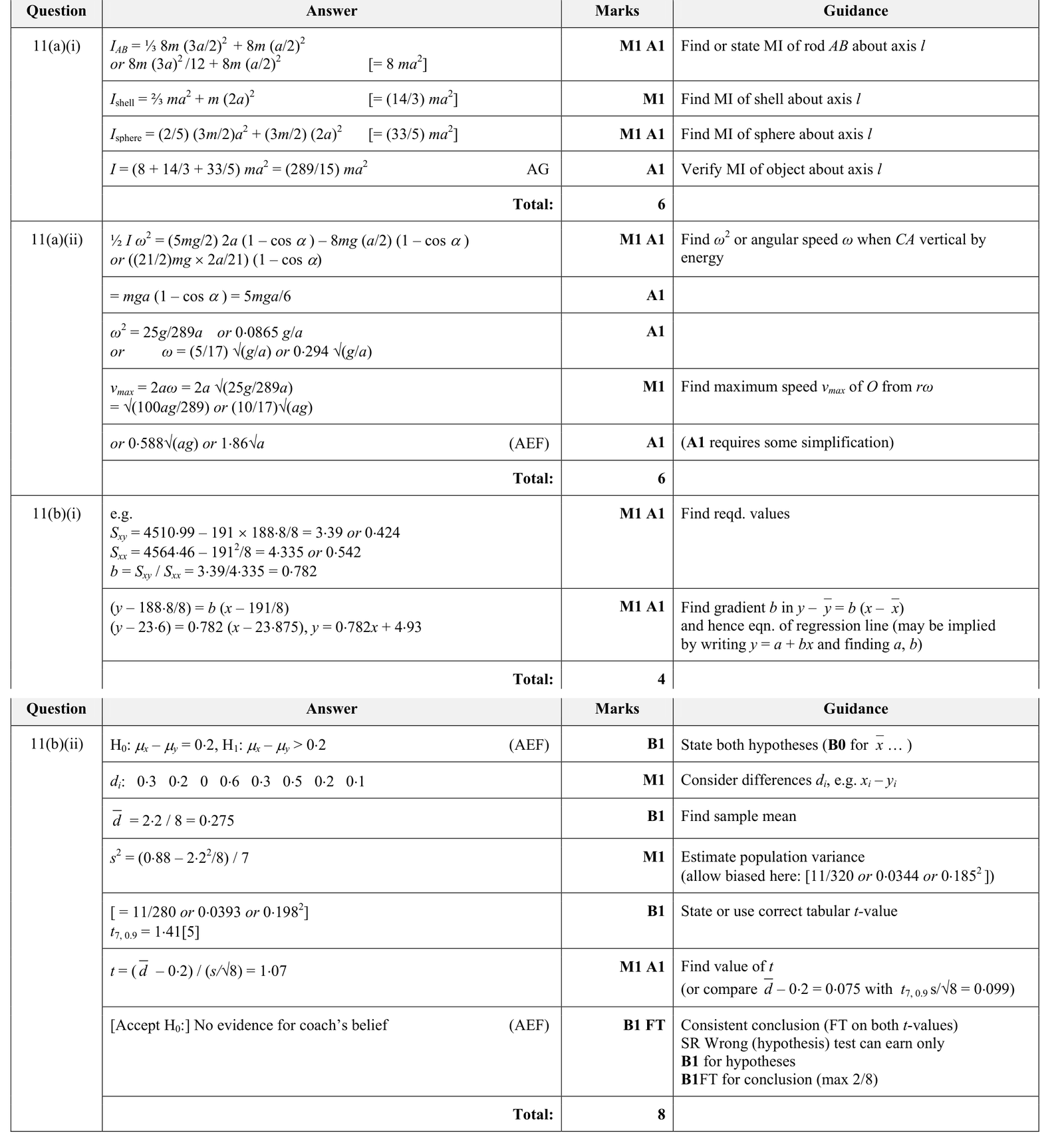
9231 P21 - Nov 2017 - Q11O - 14 marks
Question 11 OR alternative.
A large number of people attended a course to improve the speed of their logical thinking. The times taken to complete a particular type of logic puzzle at the beginning of the course and at the end of the course are recorded for each person. The time taken, in minutes, at the beginning of the course is denoted by \(x\) and the time taken, in minutes, at the end of the course is denoted by \(y\). For a random sample of 9 people, the results are summarised as follows.
\[\sum x=45.3,\quad \sum x^2=245.59,\quad \sum y=40.5,\quad \sum y^2=195.11,\quad \sum xy=218.72.\]
Ken attended the course, but his time to complete the puzzle at the beginning of the course was not recorded. His time to complete the puzzle at the end of the course was 4.2 minutes.
(i) By finding, showing all necessary working, the equation of a suitable regression line, find an estimate for the time that Ken would have taken to complete the puzzle at the beginning of the course.
The values of \(x-y\) for the sample of 9 people are as follows.
\[0.2,\quad 0.8,\quad 0.5,\quad 1.0,\quad 0.2,\quad 0.6,\quad 0.2,\quad 0.5,\quad 0.8.\]
The organiser of the course believes that, on average, the time taken to complete the puzzle decreases between the beginning and the end of the course by more than 0.3 minutes.
(ii) Stating suitable hypotheses and assuming a normal distribution, test the organiser's belief at the \(2\frac12\%\) significance level.
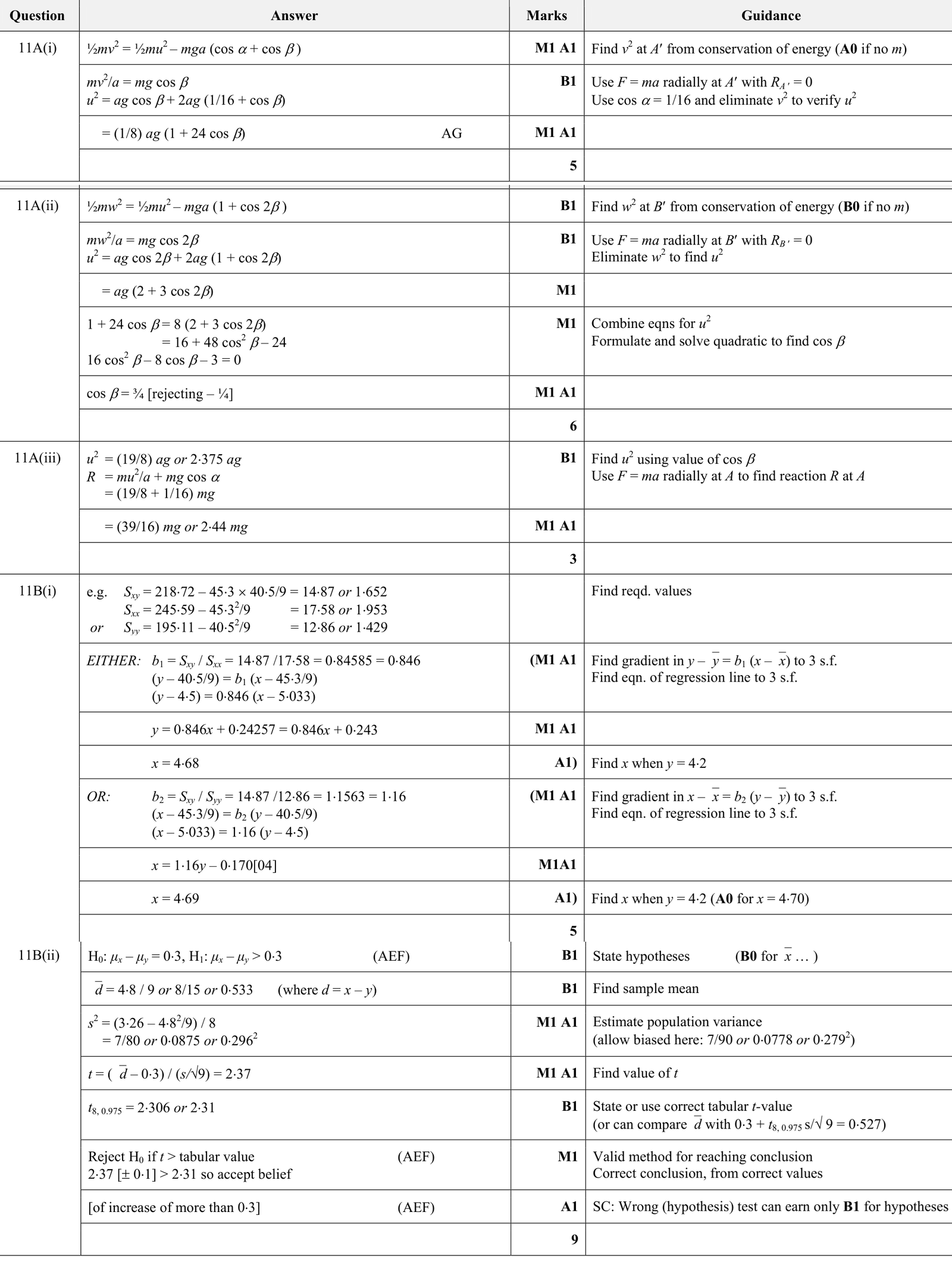
9231 P23 - Jun 2018 - Q10 - 12 marks
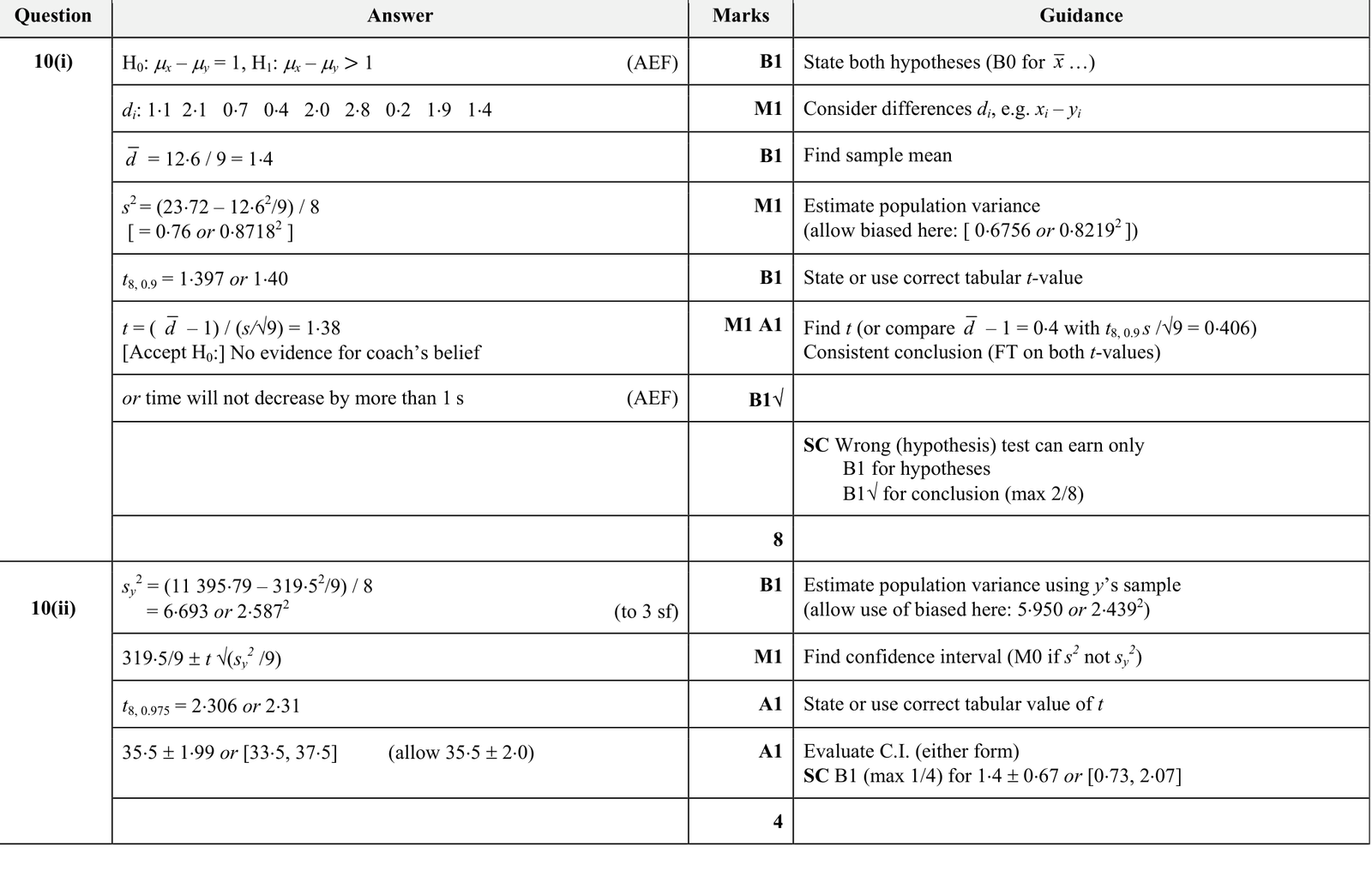
During the summer months, all members of a large swimming club take part in intensive training. The times taken to swim 50 metres at the beginning of the summer and at the end of the summer are recorded for each member of the club. The time taken, in seconds, at the beginning of the summer is denoted by \(x\) and the time taken at the end of the summer is denoted by \(y\). For a random sample of 9 members the results are shown in the following table.
| Member | \(A\) | \(B\) | \(C\) | \(D\) | \(E\) | \(F\) | \(G\) | \(H\) | \(I\) |
|---|---|---|---|---|---|---|---|---|---|
| \(x\) | 38.5 | 40.2 | 32.3 | 35.1 | 36.2 | 41.4 | 32.0 | 38.2 | 38.2 |
| \(y\) | 37.4 | 38.1 | 31.6 | 34.7 | 34.2 | 38.6 | 31.8 | 36.3 | 36.8 |
The swimming coach believes that, on average, the time taken by a swimmer to swim 50 metres will decrease by more than one second as a result of the intensive training.
(i) Stating suitable hypotheses and assuming a normal distribution, test the coach's belief at the \(10\%\) significance level.
(ii) Find a \(95\%\) confidence interval for the population mean time taken to swim 50 metres after the intensive training, assuming a normal distribution.
9231 P41 - Nov 2025 - Q6 - 9 marks
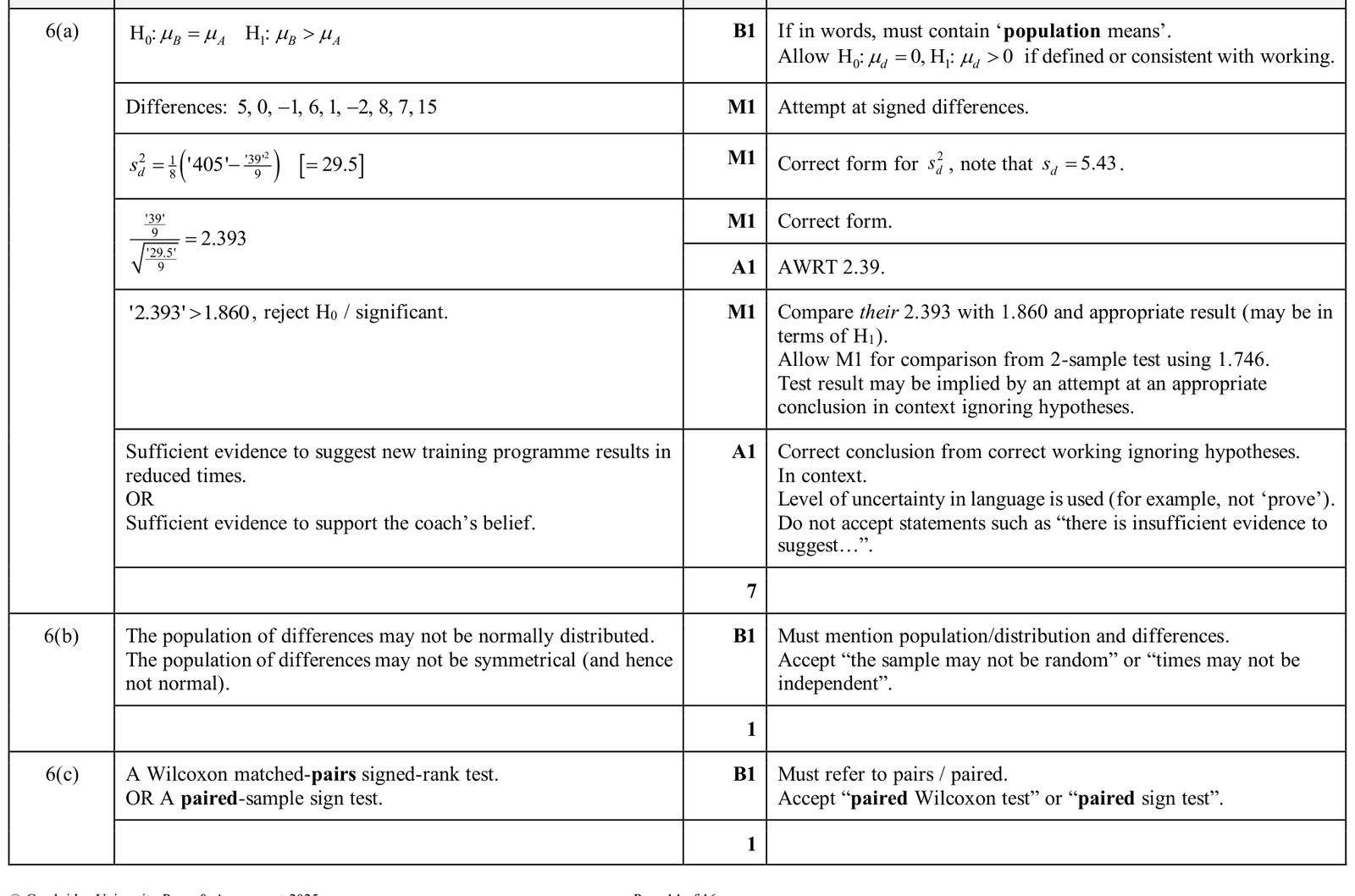
Nine athletes in a club have a new coach. The coach adopts a new training programme which he believes will reduce the race times of these athletes. Each athlete completes a 1500 m time trial before and after completing the new training programme. Their times, in seconds (s), are recorded.
| Athlete | \(A\) | \(B\) | \(C\) | \(D\) | \(E\) | \(F\) | \(G\) | \(H\) | \(I\) |
|---|---|---|---|---|---|---|---|---|---|
| Time before training (s) | \(250\) | \(251\) | \(252\) | \(267\) | \(276\) | \(291\) | \(310\) | \(320\) | \(335\) |
| Time after training (s) | \(245\) | \(251\) | \(253\) | \(261\) | \(275\) | \(293\) | \(302\) | \(313\) | \(320\) |
(a) Carry out a paired \(t\)-test at the \(5\%\) significance level to test the coach's belief.
Further research suggests that the effects of the training programme tend to reduce the times of the slower athletes by more than those of the faster athletes.
(b) Suggest a reason why the paired \(t\)-test used in part (a) may not have been an appropriate test in this case.
(c) Suggest a suitable alternative test that could have been used instead of a paired \(t\)-test.
9231 P44 - Nov 2025 - Q3 - 10 marks
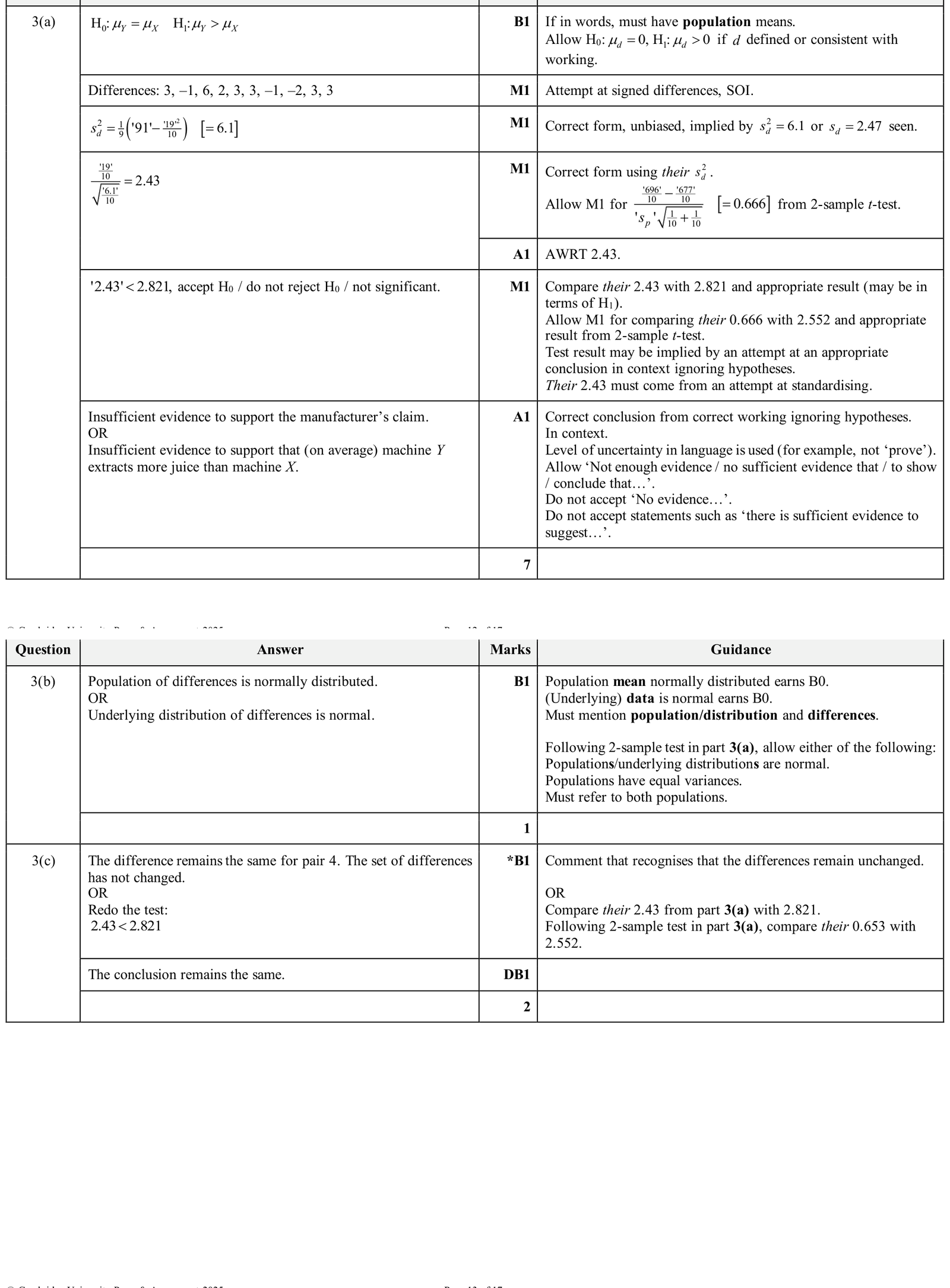
| \cline { 2 - 11 } | pair | |||||||||
|---|---|---|---|---|---|---|---|---|---|---|
| \cline { 2 - 11 } | 1 | 2 | 3 | 4 | 5 | 6 | 7 | 8 | 9 | 10 |
| machine \(X\) | 65 | 73 | 58 | 61 | 72 | 79 | 64 | 65 | 69 | 71 |
| machine \(Y\) | 68 | 72 | 64 | 63 | 75 | 82 | 63 | 63 | 72 | 74 |
9231 P41 - Jun 2024 - Q6 - 8 marks
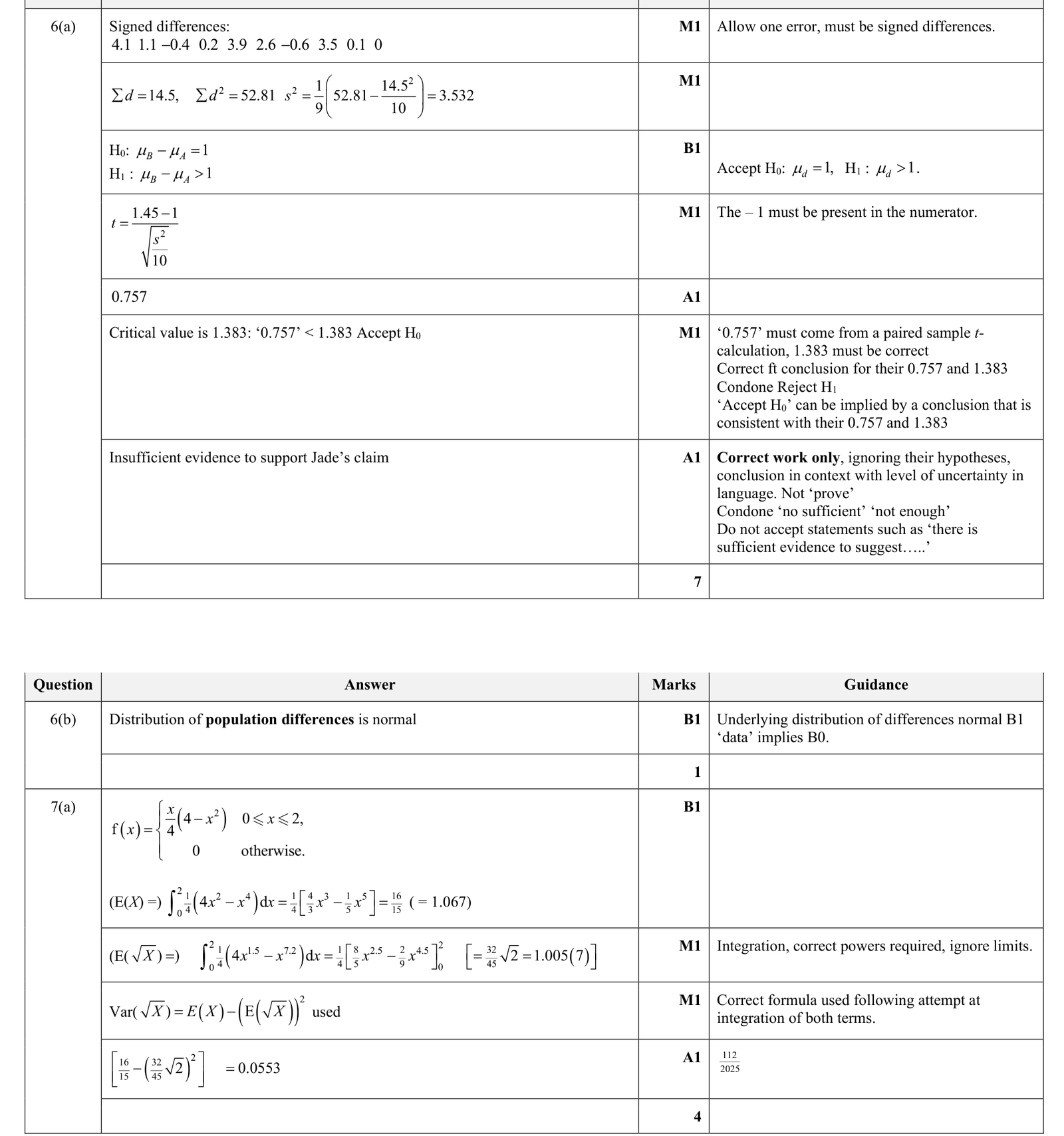
Jade is a swimming instructor at a sports college. She claims that, as a result of an intensive training course, the mean time taken by students to swim 50 metres has reduced by more than 1 second. She chooses a random sample of 10 students. The times taken, in seconds, before and after the training course are recorded in the table.
(a) Test, at the \(10 \%\) significance level, whether Jade's claim is justified.
(b) State an assumption that is necessary for this test to be valid.
9231 P41 - Nov 2023 - Q3 - 8 marks
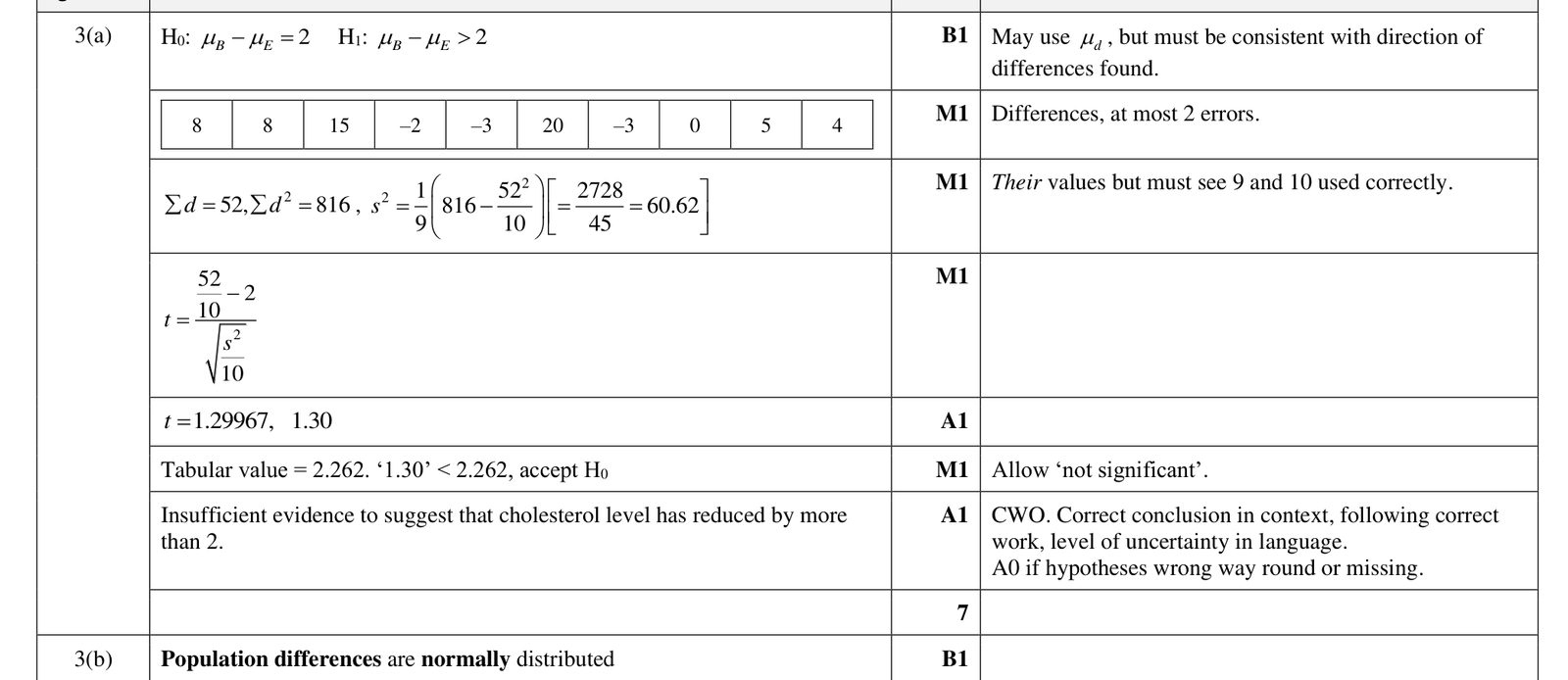
Scientists are studying the effects of exercise on LDL blood cholesterol levels. Over a three-month period, a large group of people exercised for 20 minutes each day. For a randomly chosen sample of 10 of these people, the LDL blood cholesterol levels were measured at the beginning and the end of the three-month period. The results, measured in suitable units, are as follows.
| Person | A | B | C | D | E | F | G | H | I | J |
|---|---|---|---|---|---|---|---|---|---|---|
| Beginning | 72 | 84 | 120 | 90 | 102 | 135 | 64 | 75 | 80 | 88 |
| End | 64 | 76 | 105 | 92 | 105 | 115 | 67 | 75 | 75 | 84 |
(a) Test, at the \(2.5\%\) significance level, whether there is evidence that the population mean LDL blood cholesterol level has reduced by more than 2 units after the three-month period.
(b) State any assumption that you have made in part (a).
9231 P41 - Jun 2022 - Q1 - 8 marks
A manager is investigating the times taken by employees to complete a particular task as a result of the introduction of new technology. He claims that the mean time taken to complete the task is reduced by more than 0.4 minutes. He chooses a random sample of 10 employees. The times taken, in minutes, before and after the introduction of the new technology are recorded in the table.
| Employee | A | B | C | D | E | F | G | H | I | J |
|---|---|---|---|---|---|---|---|---|---|---|
| Time before new technology | 10.2 | 9.8 | 12.4 | 11.6 | 10.8 | 11.2 | 14.6 | 10.6 | 12.3 | 11.0 |
| Time after new technology | 9.6 | 8.5 | 12.4 | 10.9 | 10.2 | 10.6 | 12.8 | 10.8 | 12.5 | 10.6 |
(a) Test at the \(10\%\) significance level whether the manager's claim is justified.
(b) State an assumption that is necessary for this test to be valid.