9231 P12 - Jun 2025 - Q04 - 9 marks
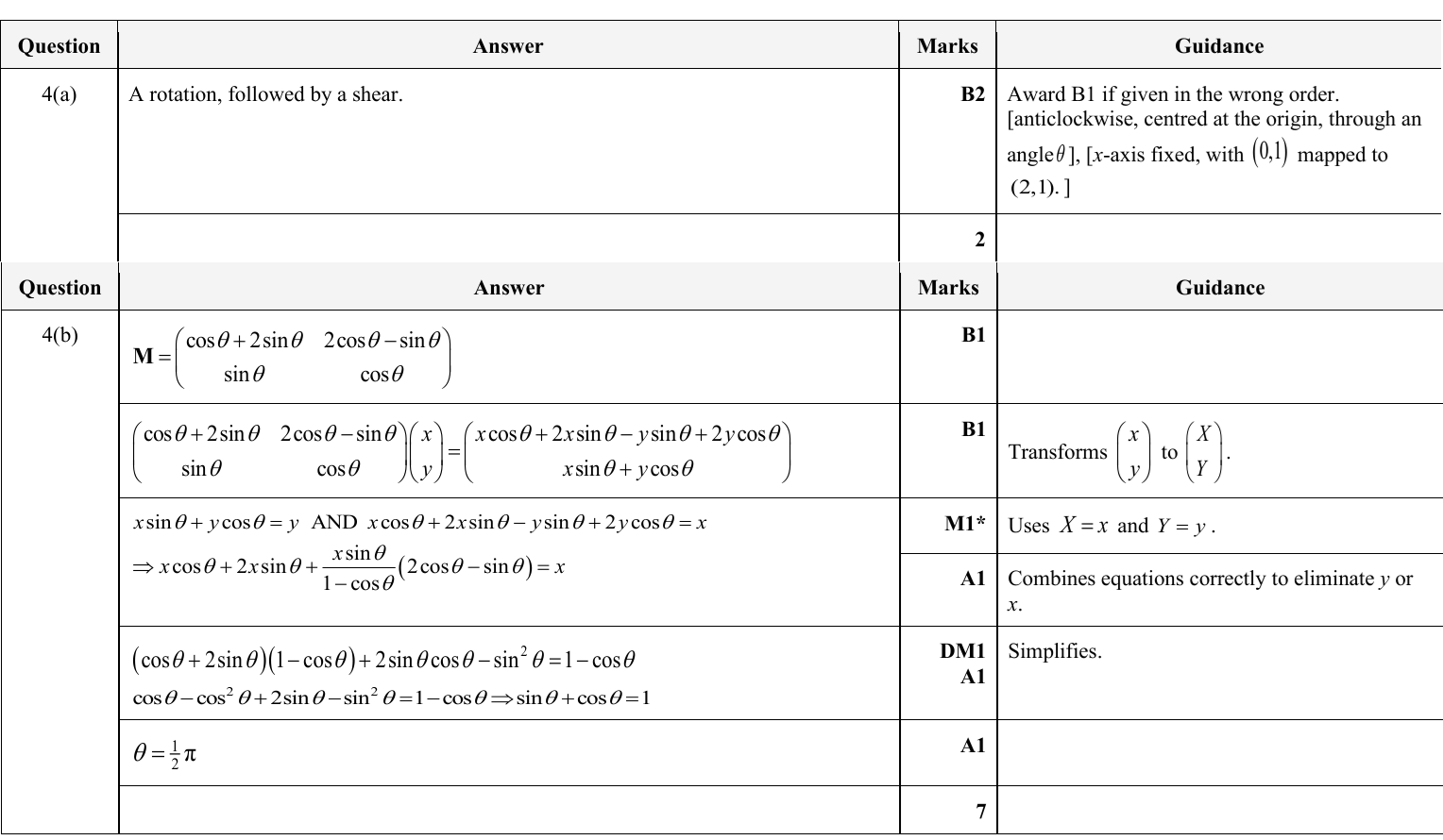
The matrix \(\mathbf{M}\) is given by \(\mathbf{M} = \begin{pmatrix} 1 & 2 \\ 0 & 1 \end{pmatrix} \begin{pmatrix} \cos \theta & -\sin \theta \\ \sin \theta & \cos \theta \end{pmatrix}\), where \(0 < \theta < 2\pi\).
(a) The matrix \(\mathbf{M}\) represents a sequence of two geometrical transformations in the \(x-y\) plane. State the type of each transformation, and make clear the order in which they are applied.
(b) Find the value of \(\theta\) for which the transformation represented by \(\mathbf{M}\) has a line of invariant points.
9231 P12 - Jun 2025 - Q06 - 16 marks
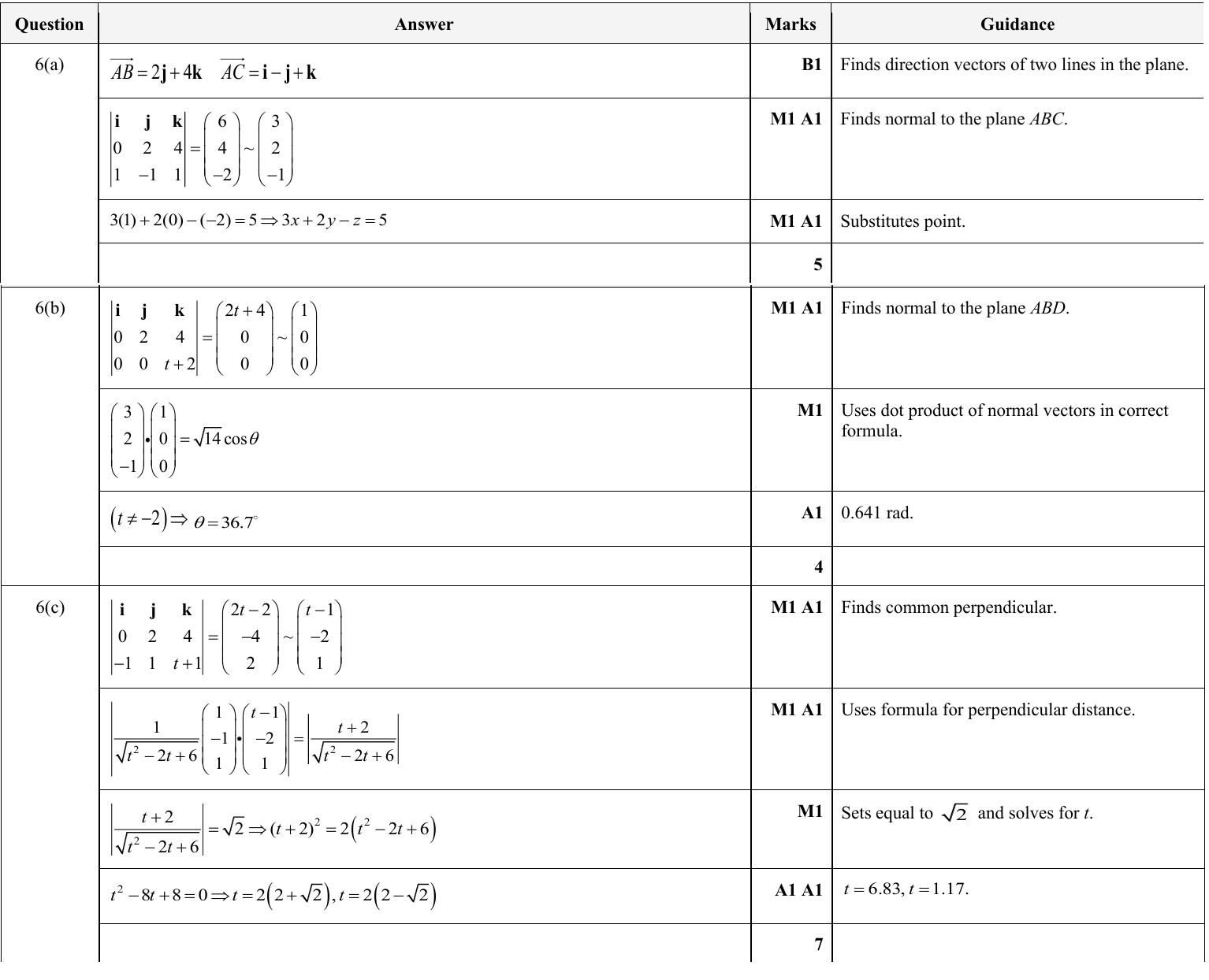
The points A, B, C have position vectors
\(\mathbf{i} - 2\mathbf{k}, \quad \mathbf{i} + 2\mathbf{j} + 2\mathbf{k}, \quad 2\mathbf{i} - \mathbf{j} - \mathbf{k},\)
respectively.
(a) Find the equation of the plane ABC, giving your answer in the form \(ax + by + cz = d\).
A point D has position vector \(\mathbf{i} + t\mathbf{k}\), where \(t \neq -2\).
(b) Find the acute angle between the planes ABC and ABD.
(c) Find the values of \(t\) such that the shortest distance between the lines AB and CD is \(\sqrt{2}\).
9231 P11 - Jun 2025 - Q04 - 9 marks
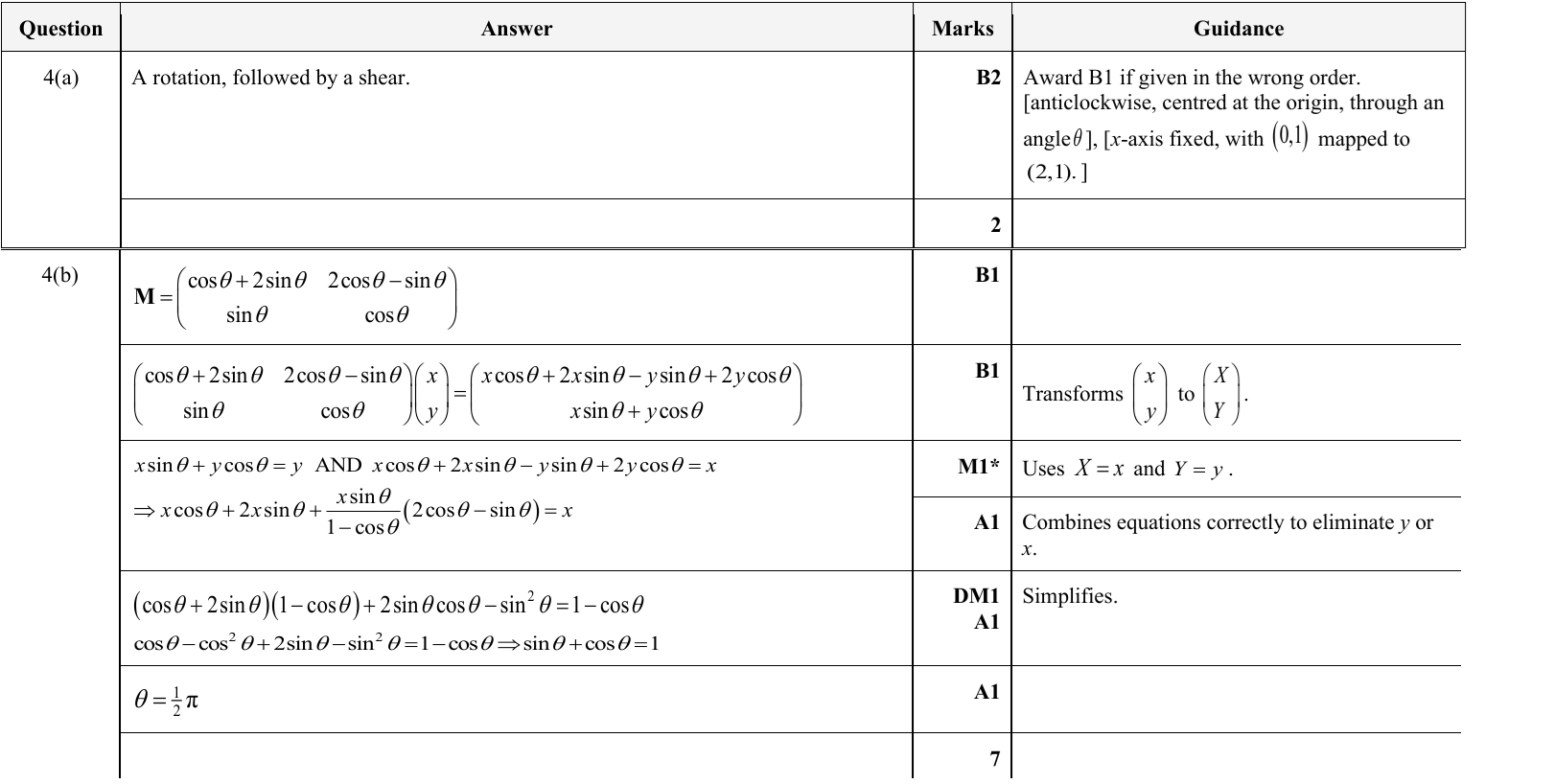
The matrix M is given by \(\mathbf{M} = \begin{pmatrix} 1 & 2 \\ 0 & 1 \end{pmatrix} \begin{pmatrix} \cos \theta & -\sin \theta \\ \sin \theta & \cos \theta \end{pmatrix}\), where \(0 < \theta < 2\pi\).
(a) The matrix M represents a sequence of two geometrical transformations in the x–y plane. State the type of each transformation, and make clear the order in which they are applied.
(b) Find the value of \(\theta\) for which the transformation represented by M has a line of invariant points.
9231 P11 - Jun 2025 - Q06 - 16 marks
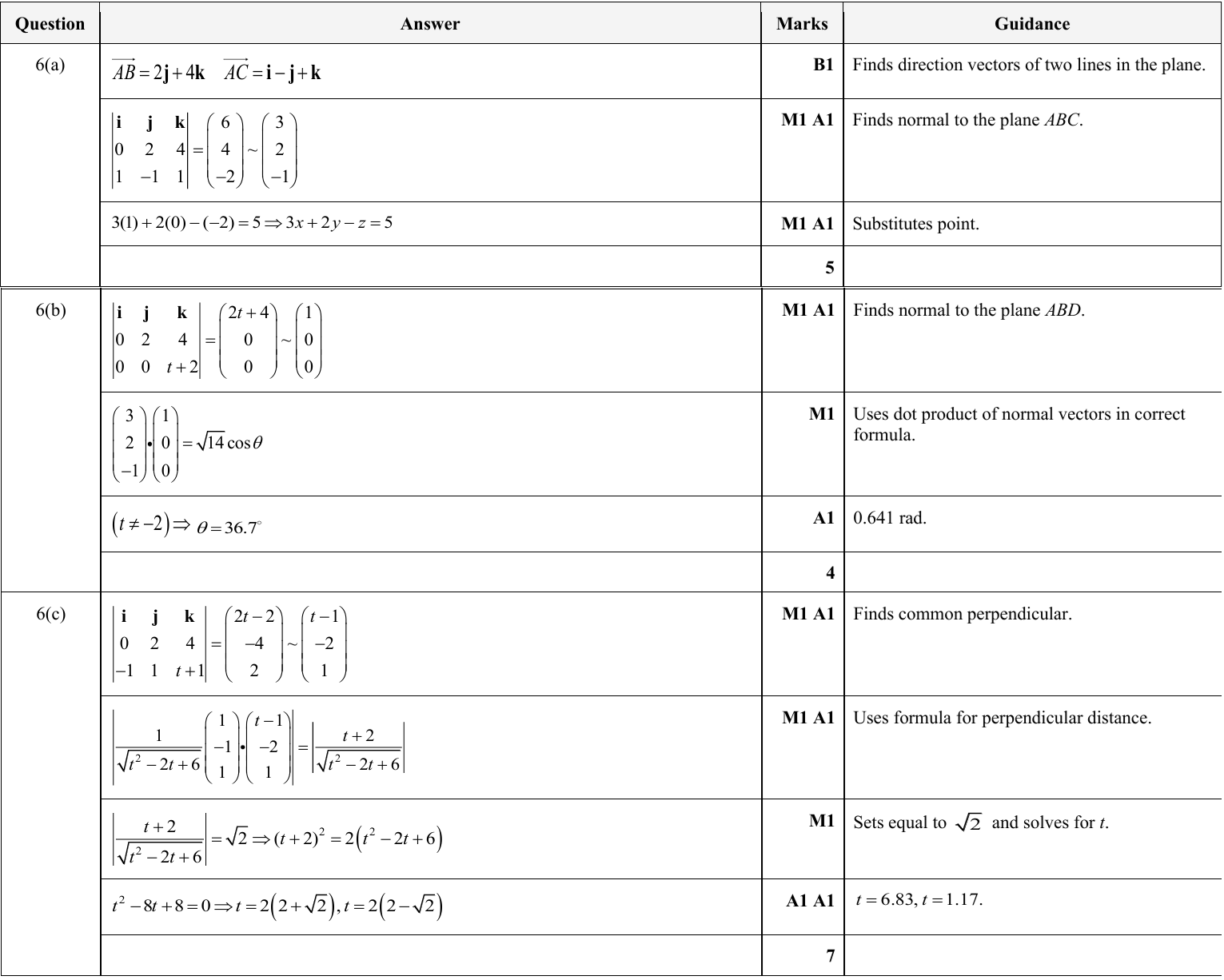
The points A, B, C have position vectors \(\mathbf{i} - 2\mathbf{k}, \mathbf{i} + 2\mathbf{j} + 2\mathbf{k}, 2\mathbf{i} - \mathbf{j} - \mathbf{k}\), respectively.
(a) Find the equation of the plane ABC, giving your answer in the form \(ax + by + cz = d\).
A point D has position vector \(\mathbf{i} + t\mathbf{k}\), where \(t \neq -2\).
(b) Find the acute angle between the planes ABC and ABD.
(c) Find the values of \(t\) such that the shortest distance between the lines AB and CD is \(\sqrt{2}\).
9231 P13 - Jun 2025 - Q01 - 11 marks
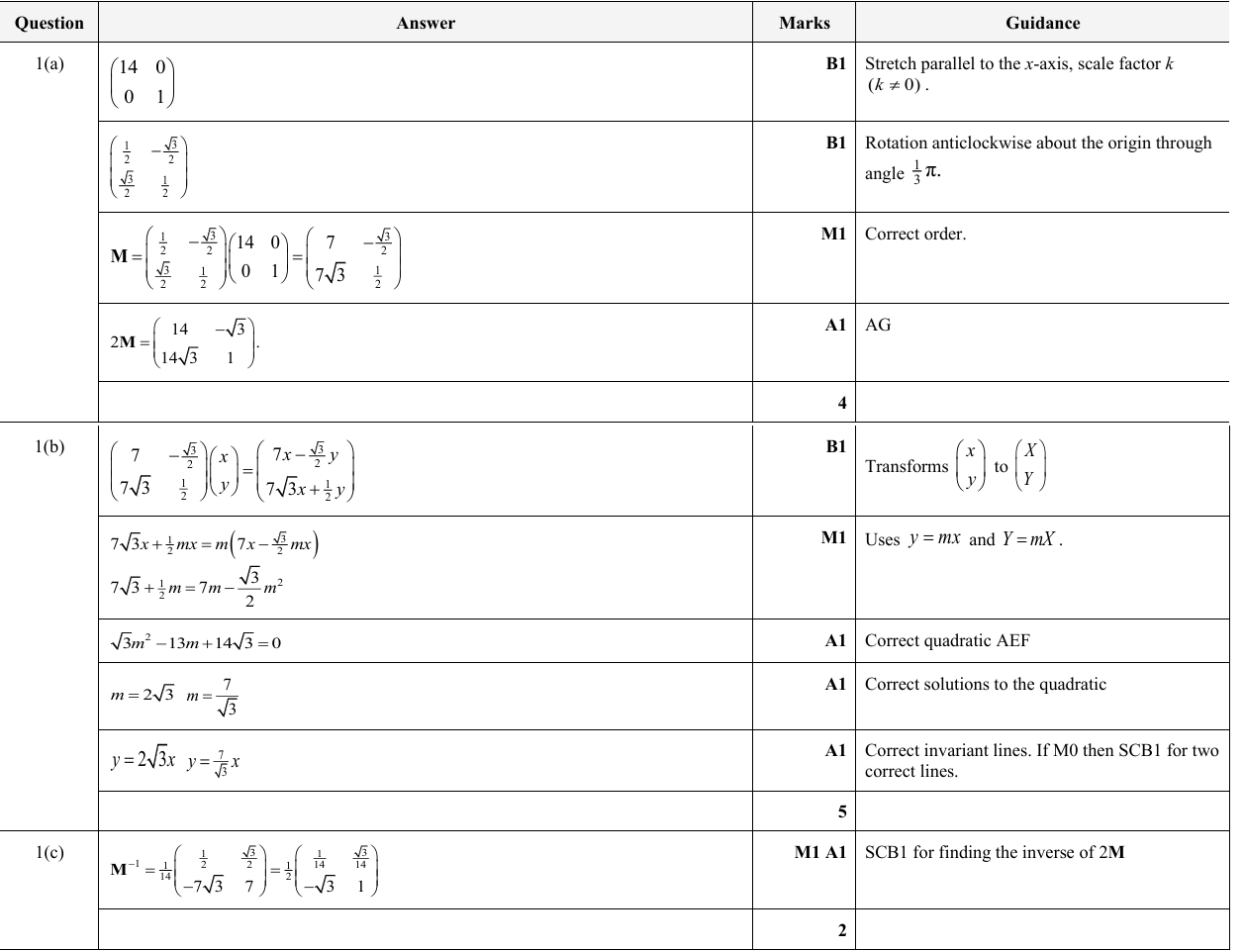
The matrix M represents the sequence of two transformations in the x-y plane given by a stretch parallel to the x-axis, scale factor 14, followed by a rotation anticlockwise about the origin through angle \(\frac{1}{3} \pi\).
(a) Show that \(2\mathbf{M} = \begin{pmatrix} 14 & -\sqrt{3} \\ 14\sqrt{3} & 1 \end{pmatrix}\).
(b) Find the equations of the invariant lines, through the origin, of the transformation in the x-y plane represented by M.
The unit square S in the x-y plane is transformed by M onto the rectangle P.
(c) Find the matrix which transforms P onto S.
9231 P13 - Jun 2025 - Q05 - 11 marks
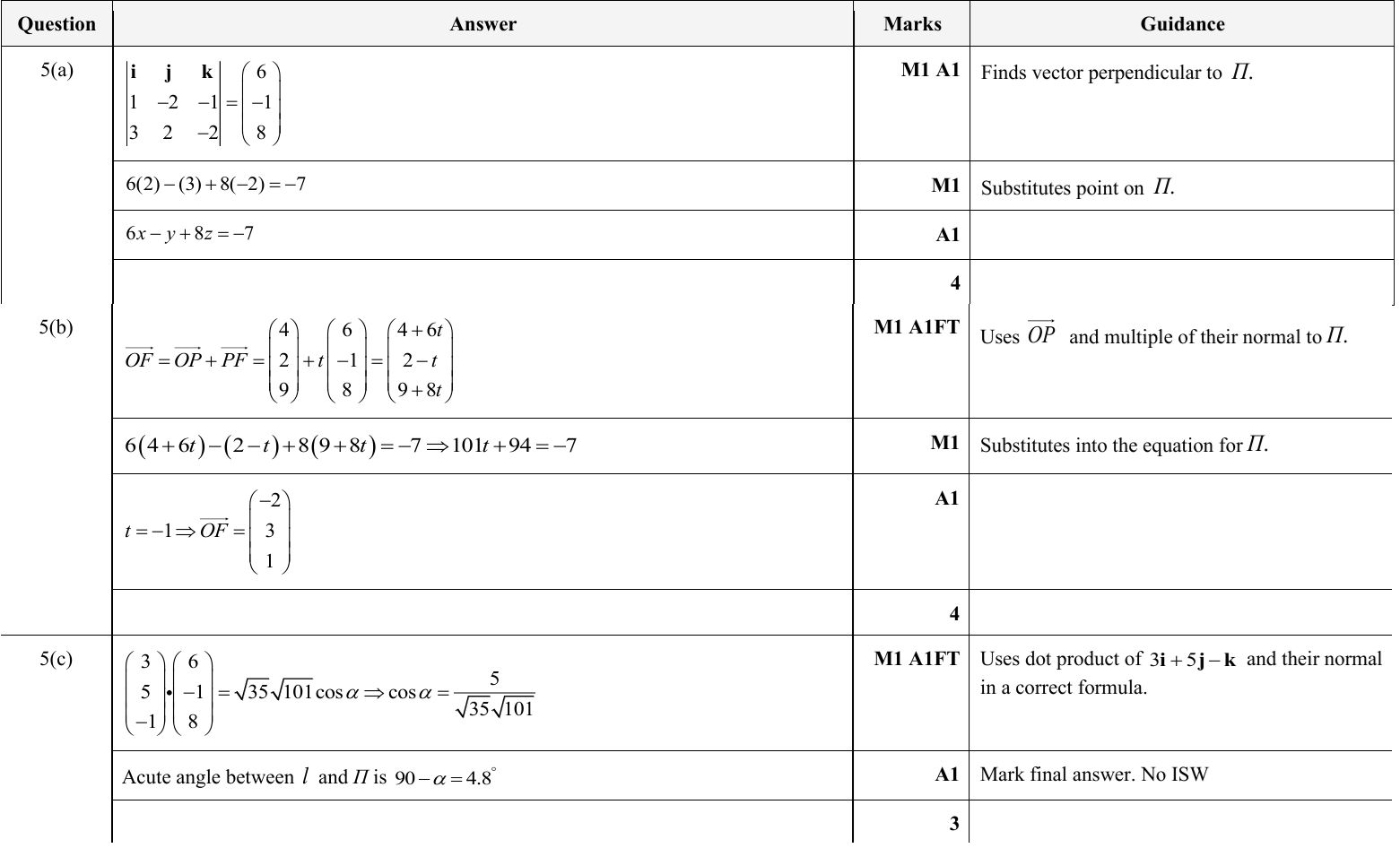
The plane \(\Pi\) has equation \(\mathbf{r} = 2\mathbf{i} + 3\mathbf{j} - 2\mathbf{k} + \lambda (\mathbf{i} - 2\mathbf{j} - \mathbf{k}) + \mu (3\mathbf{i} + 2\mathbf{j} - 2\mathbf{k})\).
(a) Find a Cartesian equation of \(\Pi\), giving your answer in the form \(ax + by + cz = d\).
The point \(P\) has position vector \(4\mathbf{i} + 2\mathbf{j} + 9\mathbf{k}\).
(b) Find the position vector of the foot of the perpendicular from \(P\) to \(\Pi\).
The line \(l\) is parallel to the vector \(3\mathbf{i} + 5\mathbf{j} - \mathbf{k}\).
(c) Find the acute angle between \(l\) and \(\Pi\).
9231 P14 - Jun 2025 - Q03 - 10 marks
The points A, B and C have position vectors
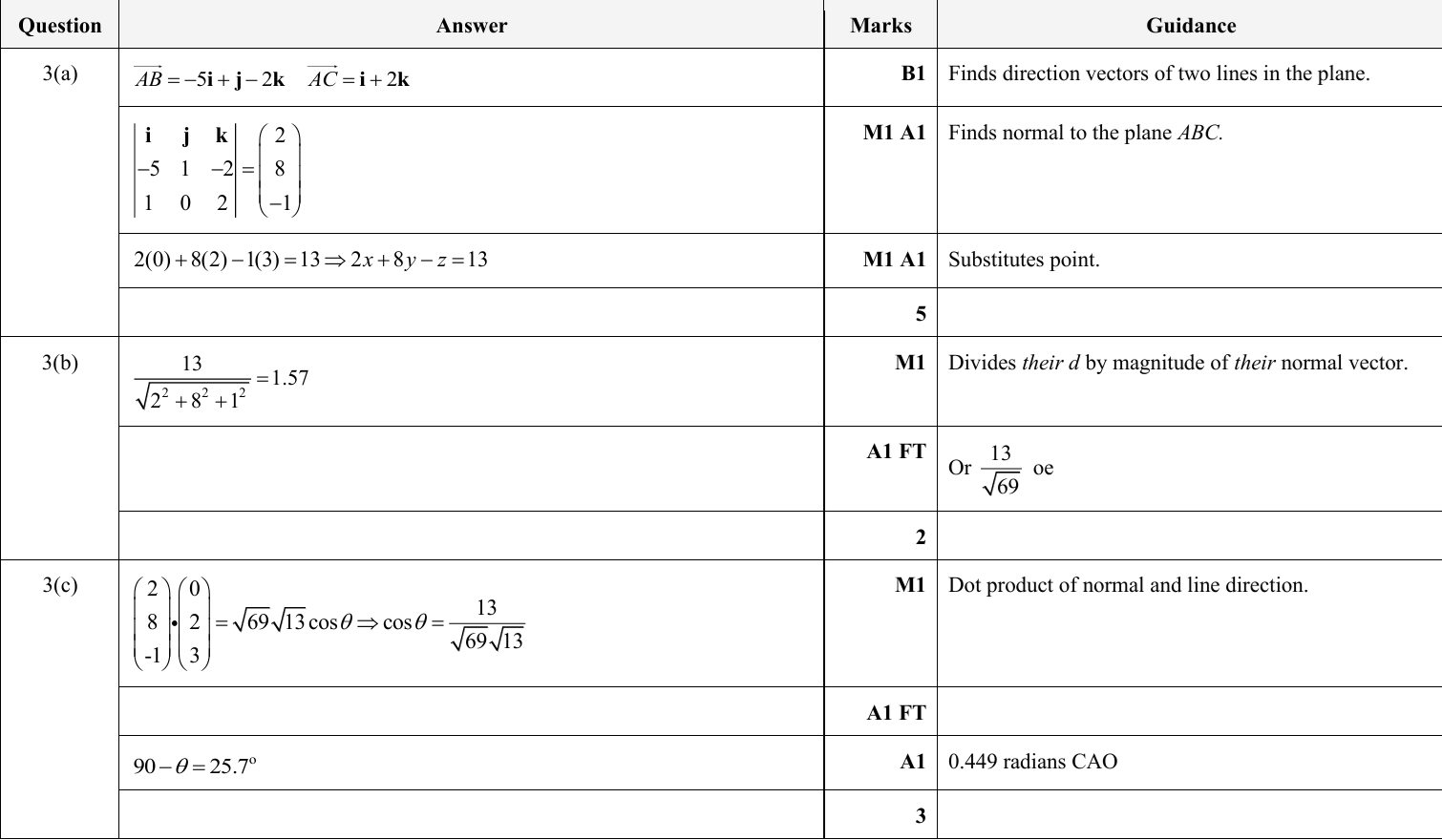
\(2\mathbf{j} + 3\mathbf{k}, \quad -5\mathbf{i} + 3\mathbf{j} + \mathbf{k} \quad \text{and} \quad \mathbf{i} + 2\mathbf{j} + 5\mathbf{k}\)
respectively, relative to the origin O.
(a) Find the equation of the plane ABC, giving your answer in the form \(ax + by + cz = d\).
(b) Find the perpendicular distance from O to the plane ABC.
(c) Find the acute angle between the line OA and the plane ABC.
9231 P14 - Jun 2025 - Q05 - 14 marks
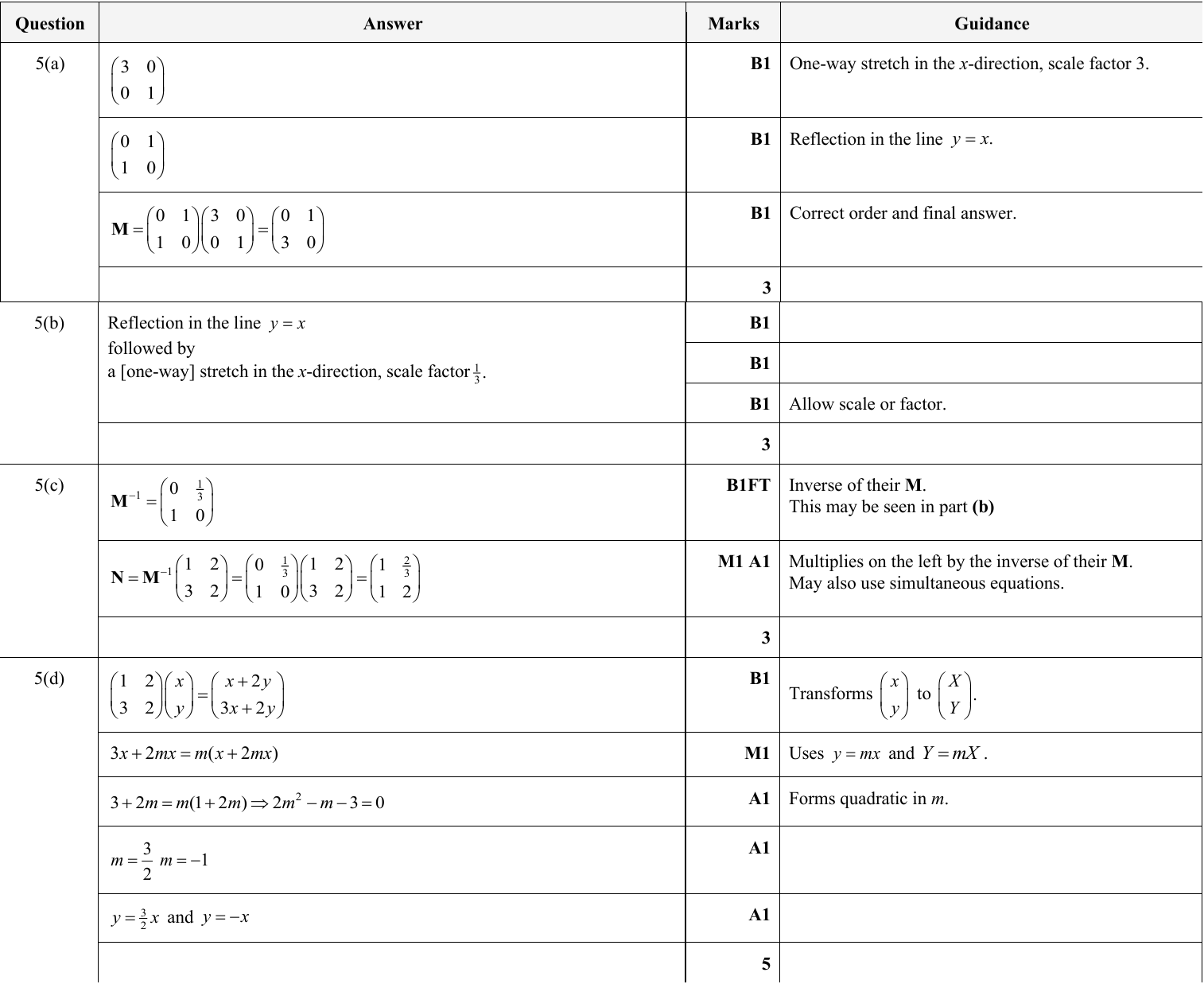
The matrix M represents a sequence of two transformations in the x-y plane given by a one-way stretch in the x-direction, scale factor 3, followed by a reflection in the line y = x.
(a) Find M.
(b) Give full details of the geometrical transformation in the x-y plane represented by M-1.
The matrix N is such that MN = \(\begin{pmatrix} 1 & 2 \\ 3 & 2 \end{pmatrix}\).
(c) Find N.
\((d) Find the equations of the invariant lines, through the origin, of the transformation in the x-y plane represented by MN.\)
9231 P11 - Nov 2024 - Q01 - 10 marks
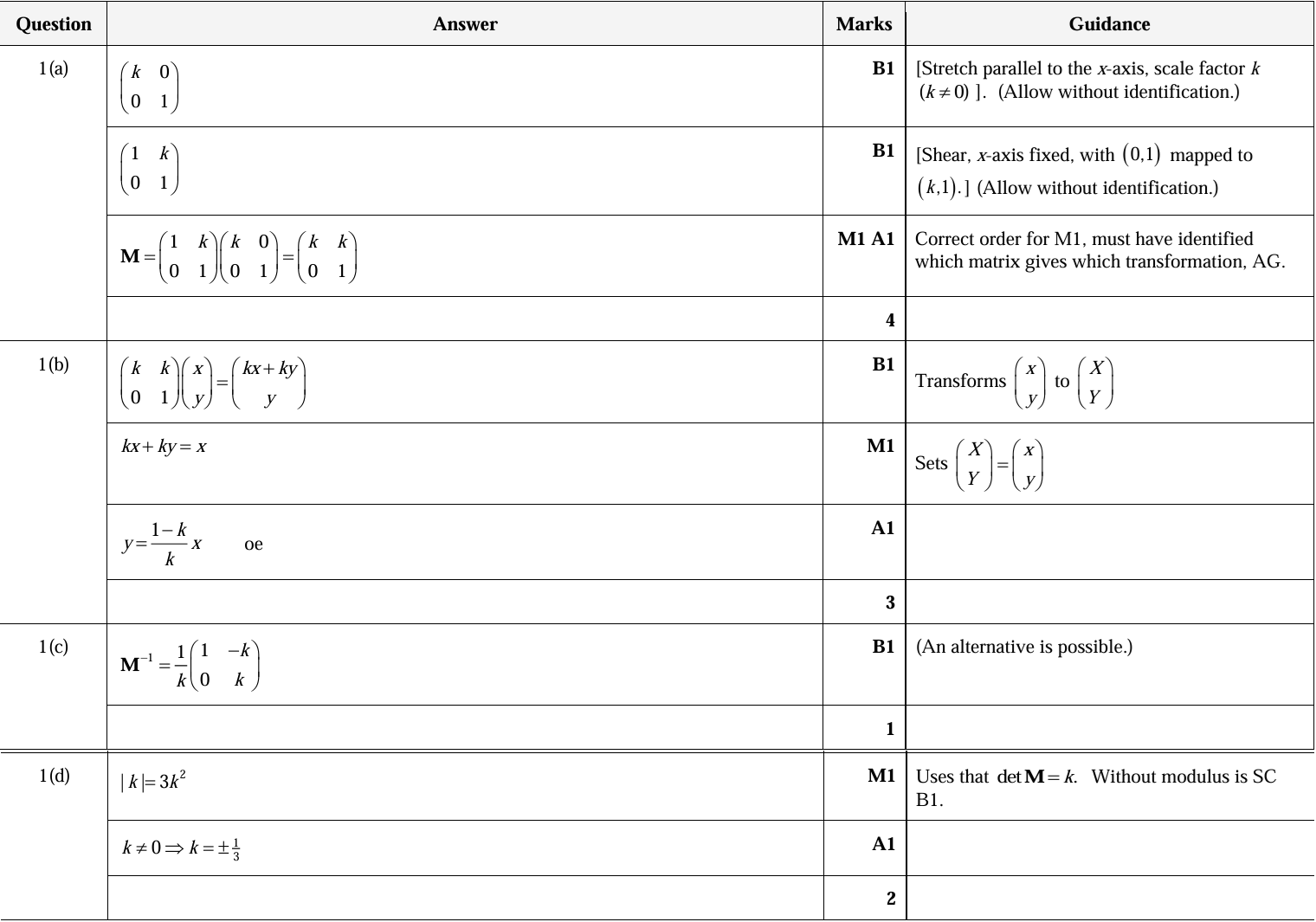
The matrix M represents the sequence of two transformations in the x-y plane given by a stretch parallel to the x-axis, scale factor k (k ≠ 0), followed by a shear, x-axis fixed, with (0, 1) mapped to (k, 1).
(a) Show that M = \(\begin{pmatrix} k & k \\ 0 & 1 \end{pmatrix}\).
\((b) The transformation represented by M has a line of invariant points. Find, in terms of k, the equation of this line.\)
The unit square S in the x-y plane is transformed by M onto the parallelogram P.
(c) Find, in terms of k, a matrix which transforms P onto S.
(d) Given that the area of P is \(3k^2\) units\(^2\), find the possible values of k.
9231 P11 - Nov 2024 - Q07 - 15 marks
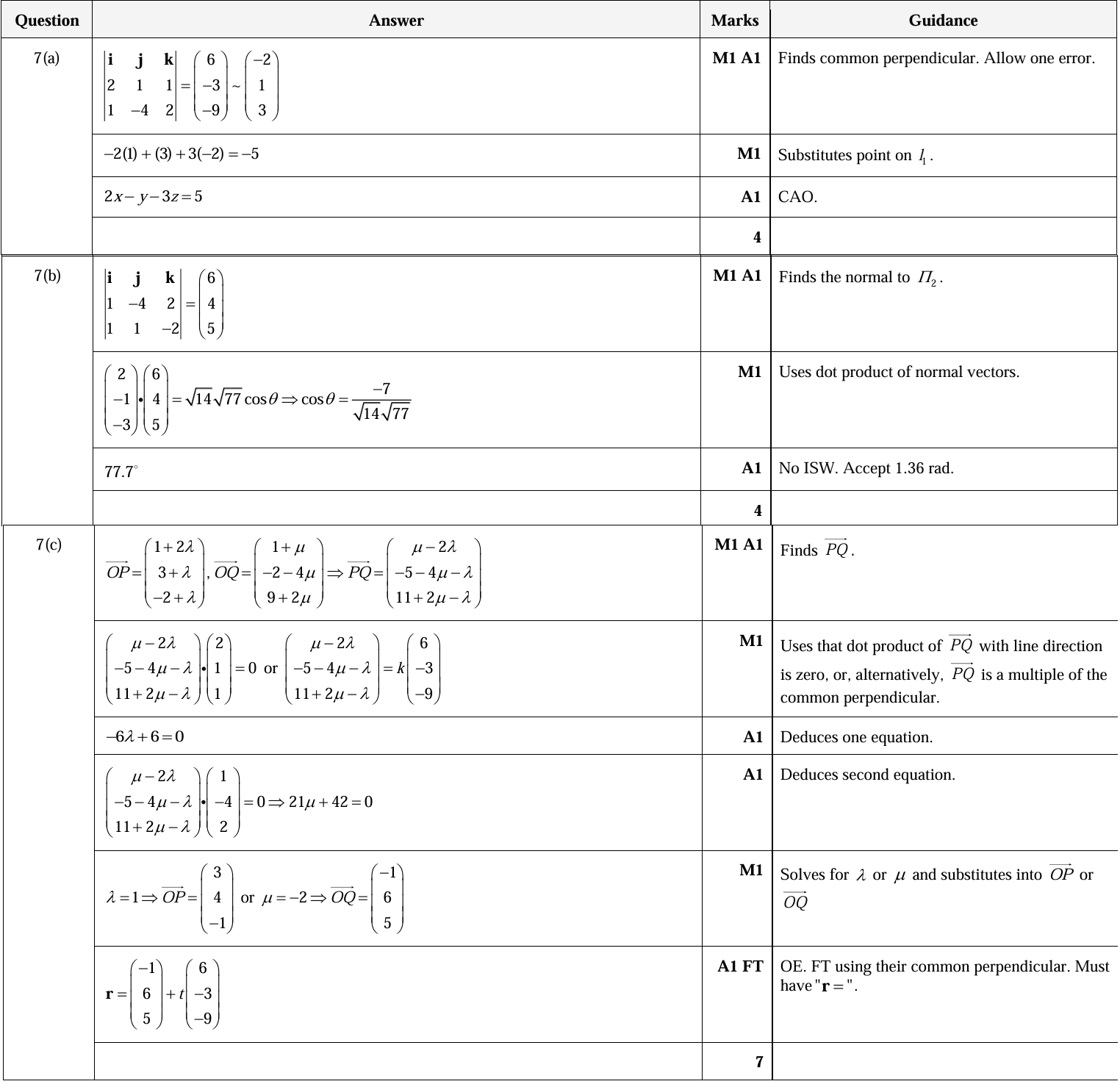
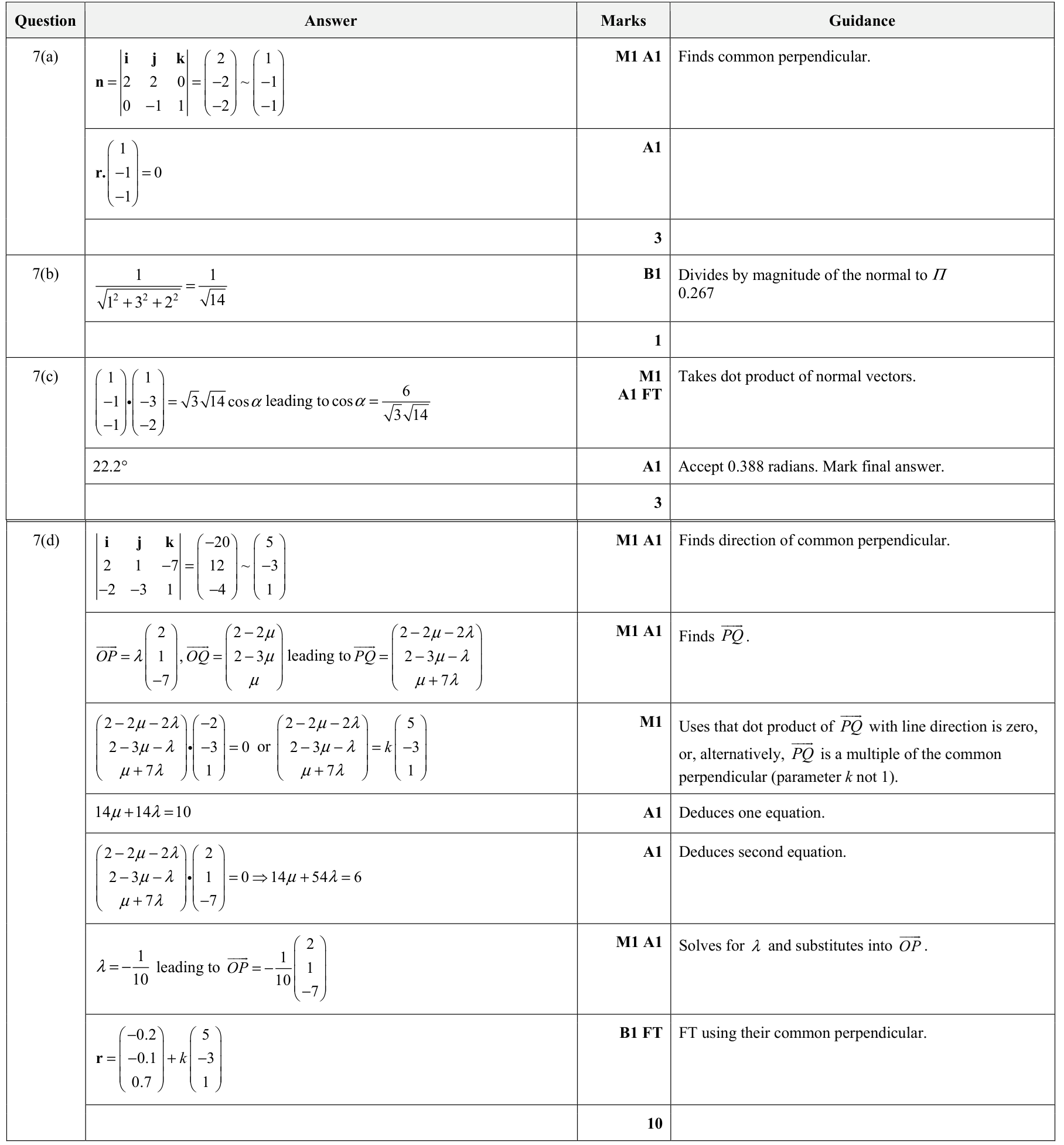
The lines \(l_1\) and \(l_2\) have equations \(\mathbf{r} = \mathbf{i} + 3\mathbf{j} - 2\mathbf{k} + \lambda(2\mathbf{i} + \mathbf{j} + \mathbf{k})\) and \(\mathbf{r} = \mathbf{i} - 2\mathbf{j} + 9\mathbf{k} + \mu(\mathbf{i} - 4\mathbf{j} + 2\mathbf{k})\) respectively. The plane \(\Pi_1\) contains \(l_1\) and is parallel to \(l_2\).
(a) Find the equation of \(\Pi_1\), giving your answer in the form \(ax + by + cz = d\).
The plane \(\Pi_2\) contains \(l_2\) and the point with coordinates \((2, -1, 7)\).
(b) Find the acute angle between \(\Pi_1\) and \(\Pi_2\).
The point \(P\) on \(l_1\) and the point \(Q\) on \(l_2\) are such that \(PQ\) is perpendicular to both \(l_1\) and \(l_2\).
(c) Find a vector equation for \(PQ\).
9231 P12 - Nov 2024 - Q02 - 7 marks
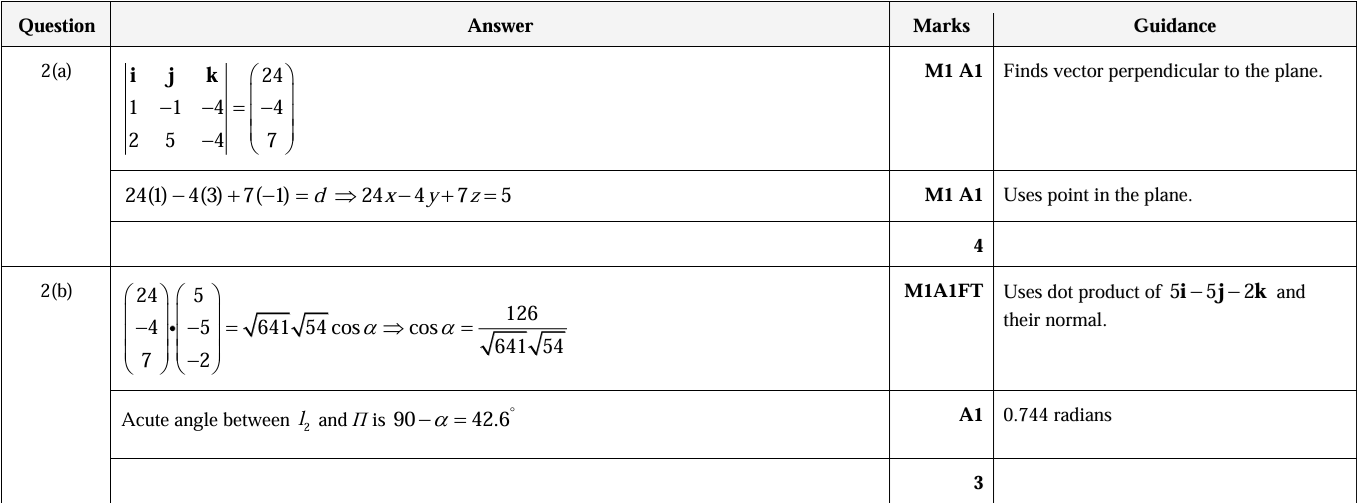
The line \(l_1\) has equation \(\mathbf{r} = \mathbf{i} + 3\mathbf{j} - \mathbf{k} + \lambda (\mathbf{i} - \mathbf{j} - 4\mathbf{k})\).
The plane \(\Pi\) contains \(l_1\) and is parallel to the vector \(2\mathbf{i} + 5\mathbf{j} - 4\mathbf{k}\).
(a) Find the equation of \(\Pi\), giving your answer in the form \(ax + by + cz = d\).
The line \(l_2\) is parallel to the vector \(5\mathbf{i} - 5\mathbf{j} - 2\mathbf{k}\).
(b) Find the acute angle between \(l_2\) and \(\Pi\).
9231 P12 - Nov 2024 - Q04 - 13 marks
The matrices A, B and C are given by
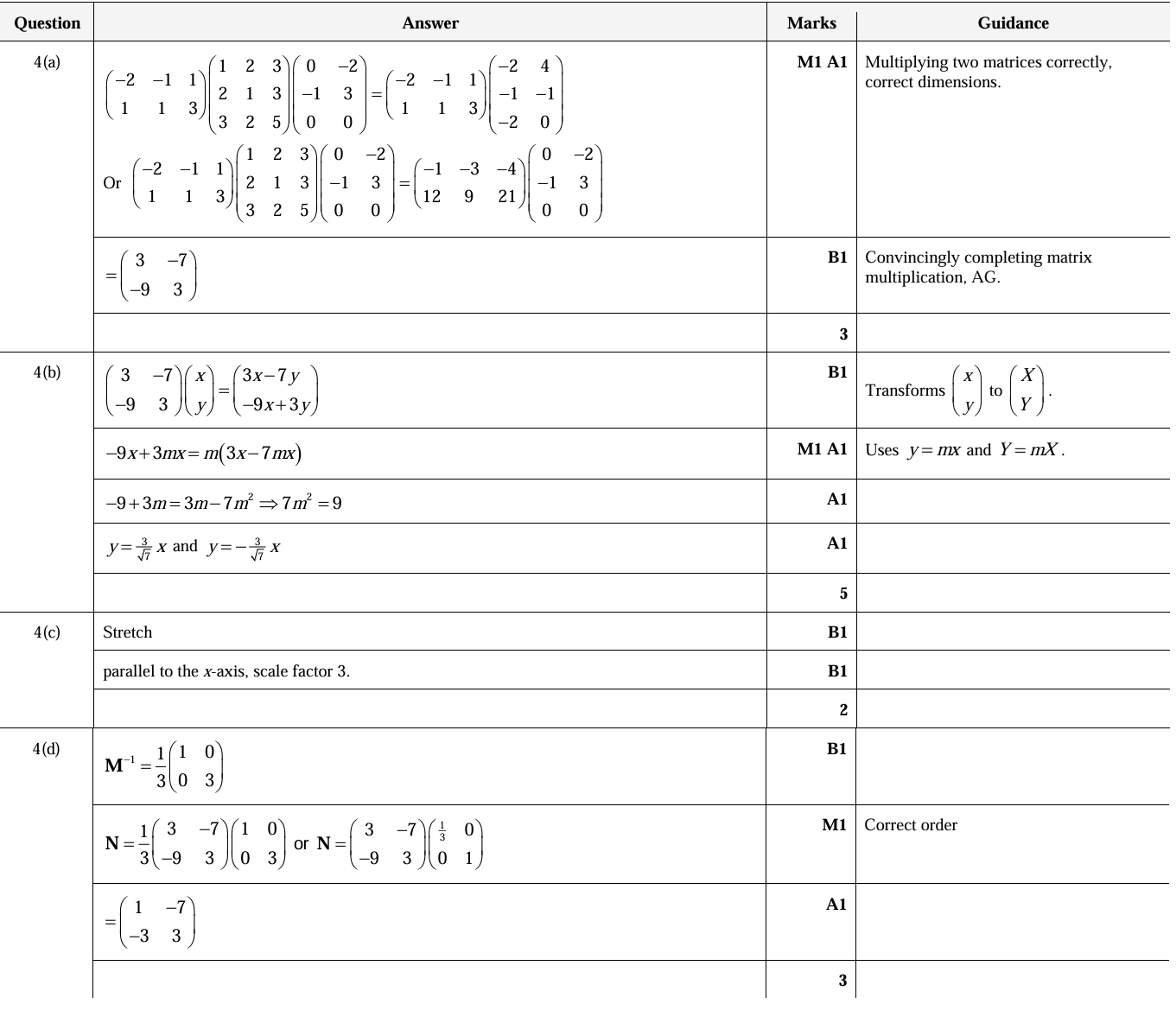
\(A = \begin{pmatrix} 1 & 2 & 3 \\ 2 & 1 & 3 \\ 3 & 2 & 5 \end{pmatrix}, \ B = \begin{pmatrix} 0 & -2 \\ -1 & 3 \\ 0 & 0 \end{pmatrix} \text{ and } C = \begin{pmatrix} -2 & -1 \\ 1 & 1 \end{pmatrix}.\)
(a) Show that \(CAB = \begin{pmatrix} 3 & -7 \\ -9 & 3 \end{pmatrix}.\) [3]
(b) Find the equations of the invariant lines, through the origin, of the transformation in the \(x-y\) plane represented by \(CAB.\) [5]
Let \(M = \begin{pmatrix} 3 & 0 \\ 0 & 1 \end{pmatrix}.\)
(c) Give full details of the transformation represented by \(M.\) [2]
(d) Find the matrix \(N\) such that \(NM = CAB.\) [3]
9231 P13 - Nov 2024 - Q01 - 10 marks
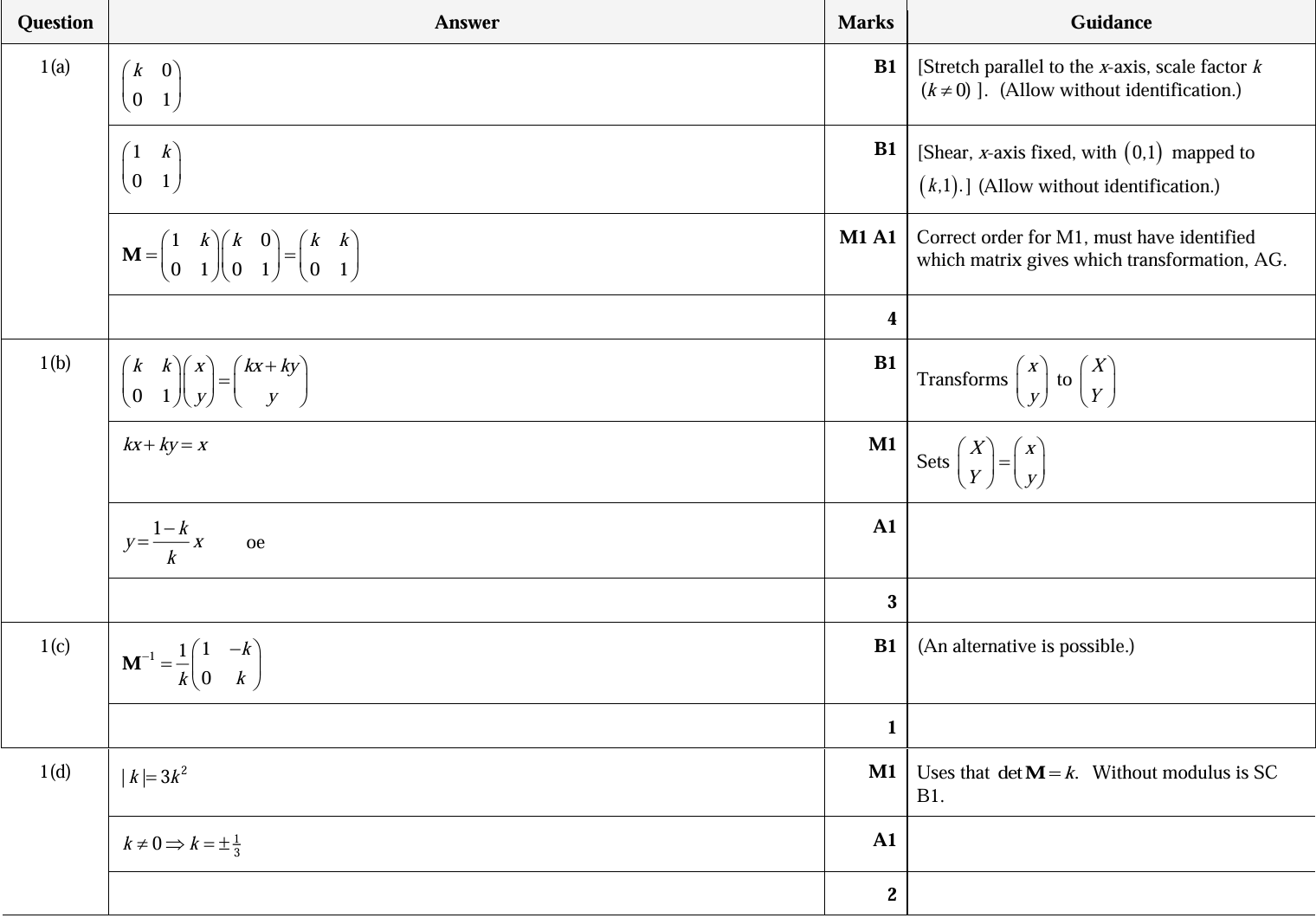
The matrix M represents the sequence of two transformations in the x-y plane given by a stretch parallel to the x-axis, scale factor k (k \neq 0), followed by a shear, x-axis fixed, with (0, 1) mapped to (k, 1).
(a) Show that M = \(\begin{pmatrix} k & k \\ 0 & 1 \end{pmatrix}\).
\((b) The transformation represented by M has a line of invariant points. Find, in terms of k, the equation of this line.\)
The unit square S in the x-y plane is transformed by M onto the parallelogram P.
(c) Find, in terms of k, a matrix which transforms P onto S.
(d) Given that the area of P is \(3k^2\) units\(^2\), find the possible values of k.
9231 P13 - Nov 2024 - Q07 - 15 marks
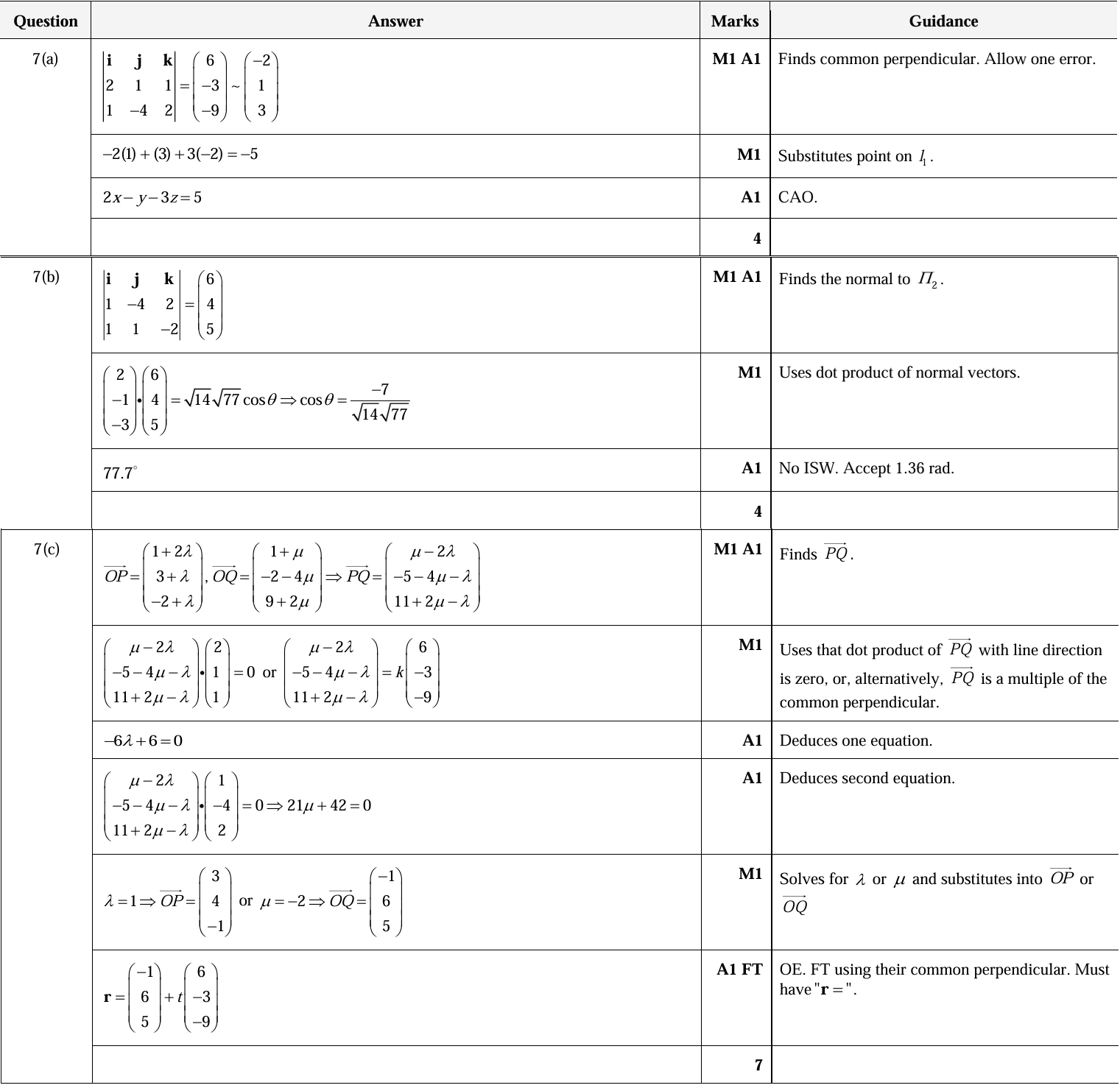
The lines \(l_1\) and \(l_2\) have equations \(\mathbf{r} = \mathbf{i} + 3\mathbf{j} - 2\mathbf{k} + \lambda (2\mathbf{i} + \mathbf{j} + \mathbf{k})\) and \(\mathbf{r} = \mathbf{i} - 2\mathbf{j} + 9\mathbf{k} + \mu (\mathbf{i} - 4\mathbf{j} + 2\mathbf{k})\) respectively. The plane \(\Pi_1\) contains \(l_1\) and is parallel to \(l_2\).
(a) Find the equation of \(\Pi_1\), giving your answer in the form \(ax + by + cz = d\).
The plane \(\Pi_2\) contains \(l_2\) and the point with coordinates \((2, -1, 7)\).
(b) Find the acute angle between \(\Pi_1\) and \(\Pi_2\).
The point \(P\) on \(l_1\) and the point \(Q\) on \(l_2\) are such that \(PQ\) is perpendicular to both \(l_1\) and \(l_2\).
(c) Find a vector equation for \(PQ\).
9231 P11 - Jun 2024 - Q04 - 13 marks
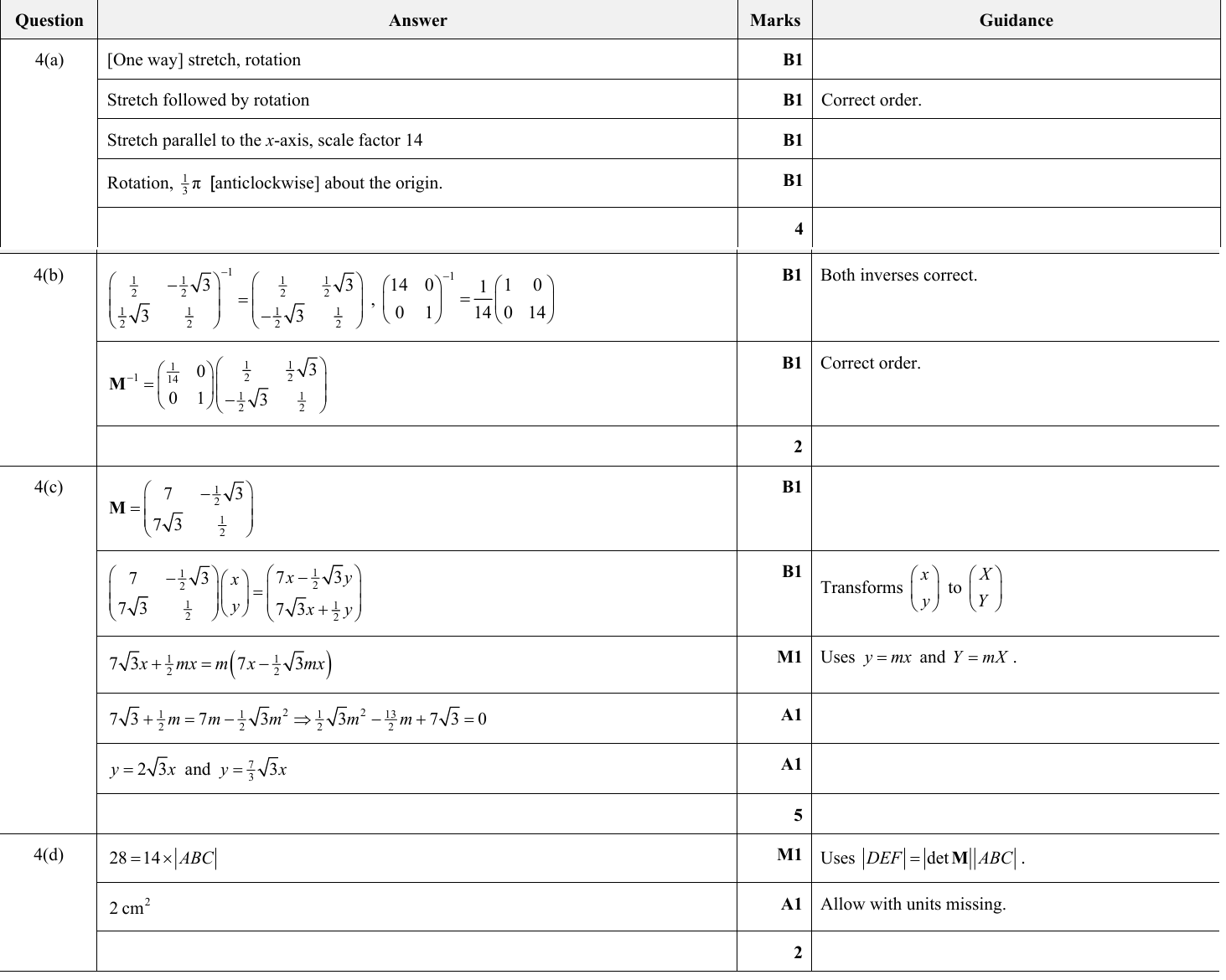
The matrix M is given by \(\mathbf{M} = \begin{pmatrix} \frac{1}{2} & -\frac{1}{2}\sqrt{3} & \begin{pmatrix} 14 & 0 \\ 0 & 1 \end{pmatrix} \\ \frac{1}{2}\sqrt{3} & \frac{1}{2} & \end{pmatrix}\).
- The matrix M represents a sequence of two geometrical transformations in the x-y plane. Give full details of each transformation, and make clear the order in which they are applied.
- Write \(\mathbf{M}^{-1}\) as the product of two matrices, neither of which is I.
- Find the equations of the invariant lines, through the origin, of the transformation represented by M.
- The triangle ABC in the x-y plane is transformed by M onto triangle DEF. Given that the area of triangle DEF is 28 cm2, find the area of triangle ABC.
9231 P11 - Jun 2024 - Q05 - 12 marks
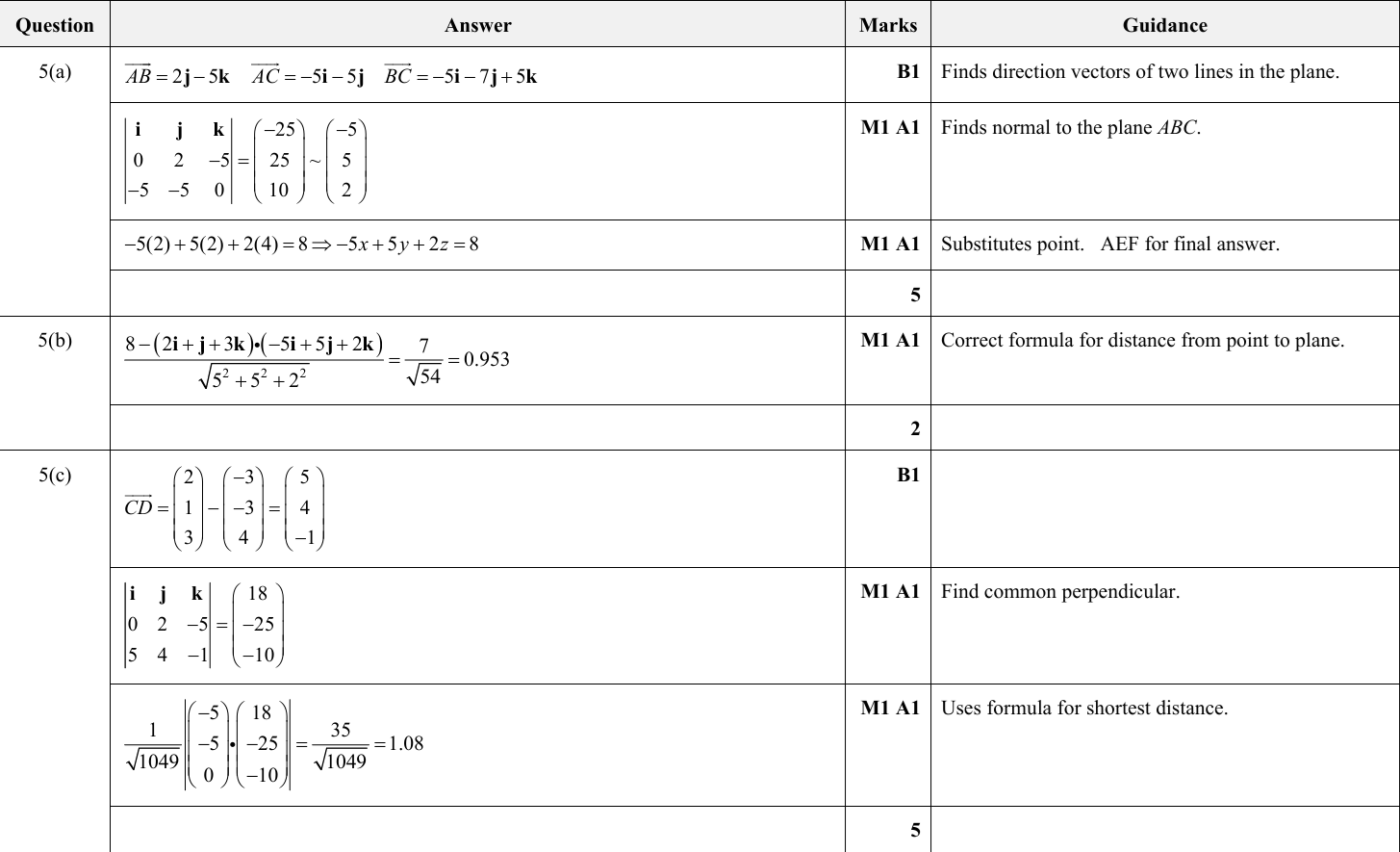
The points A, B, C have position vectors
\(2\mathbf{i} + 2\mathbf{j} + 4\mathbf{k}, \quad 2\mathbf{i} + 4\mathbf{j} - \mathbf{k}, \quad -3\mathbf{i} - 3\mathbf{j} + 4\mathbf{k},\)
respectively, relative to the origin O.
(a) Find the equation of the plane ABC, giving your answer in the form \(ax + by + cz = d\).
The point D has position vector \(2\mathbf{i} + \mathbf{j} + 3\mathbf{k}\).
(b) Find the perpendicular distance from D to the plane ABC.
(c) Find the shortest distance between the lines AB and CD.
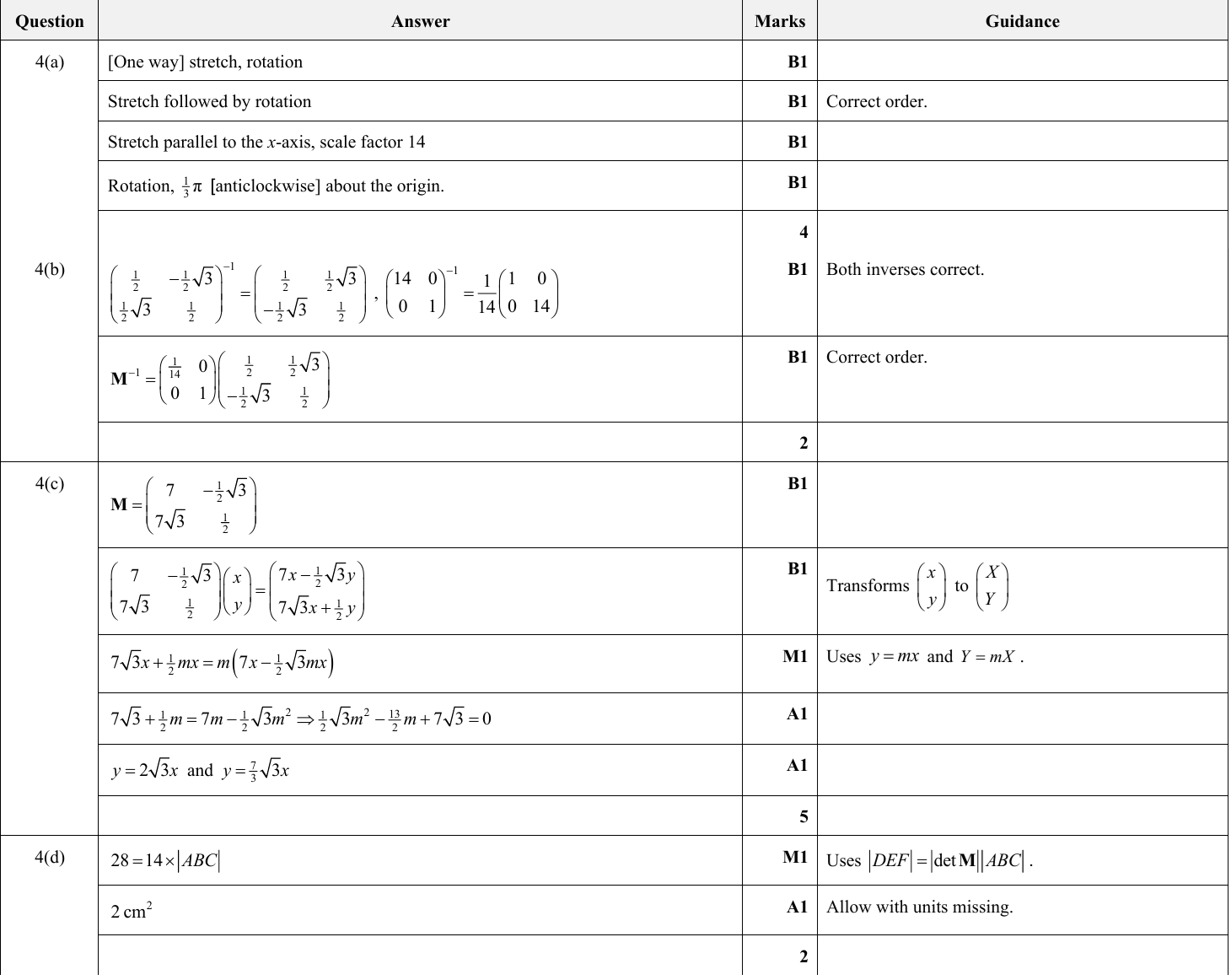
9231 P12 - Jun 2024 - Q04 - 13 marks
The matrix M is given by \(\mathbf{M} = \begin{pmatrix} \frac{1}{2} & -\frac{1}{2}\sqrt{3} \\ \frac{1}{2}\sqrt{3} & \frac{1}{2} \end{pmatrix} \begin{pmatrix} 14 & 0 \\ 0 & 1 \end{pmatrix}\).
(a) The matrix M represents a sequence of two geometrical transformations in the x-y plane. Give full details of each transformation, and make clear the order in which they are applied. [4]
(b) Write \(\mathbf{M}^{-1}\) as the product of two matrices, neither of which is I. [2]
\((c) Find the equations of the invariant lines, through the origin, of the transformation represented by M. [5]\)
(d) The triangle ABC in the x-y plane is transformed by M onto triangle DEF. Given that the area of triangle DEF is 28 cm2, find the area of triangle ABC. [2]
9231 P12 - Jun 2024 - Q05 - 12 marks
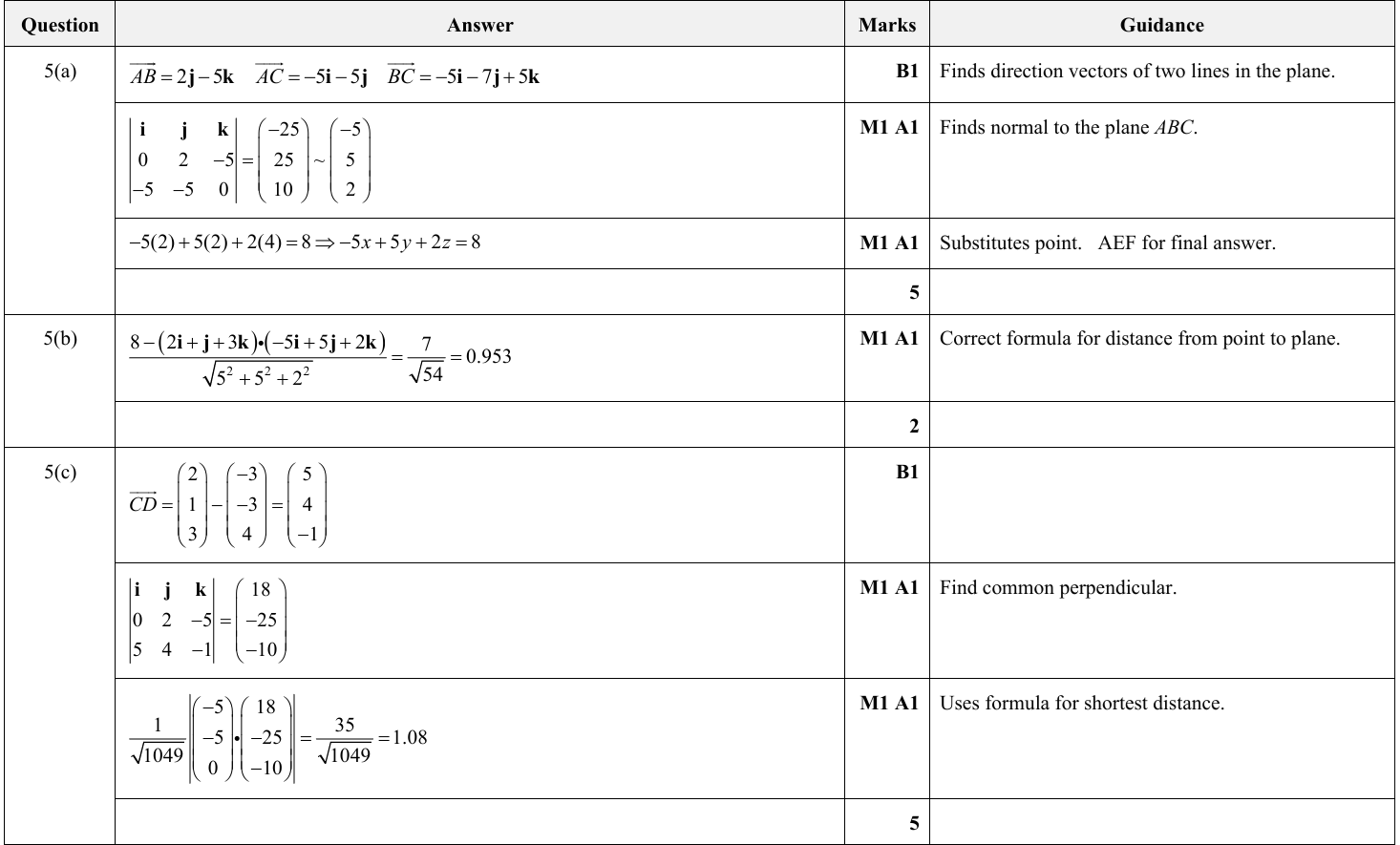
The points A, B, C have position vectors
\(2\mathbf{i} + 2\mathbf{j} + 4\mathbf{k}, \quad 2\mathbf{i} + 4\mathbf{j} - \mathbf{k}, \quad -3\mathbf{i} - 3\mathbf{j} + 4\mathbf{k},\)
respectively, relative to the origin O.
(a) Find the equation of the plane ABC, giving your answer in the form \(ax + by + cz = d\).
The point D has position vector \(2\mathbf{i} + \mathbf{j} + 3\mathbf{k}\).
(b) Find the perpendicular distance from D to the plane ABC.
(c) Find the shortest distance between the lines AB and CD.
9231 P13 - Jun 2024 - Q03 - 11 marks
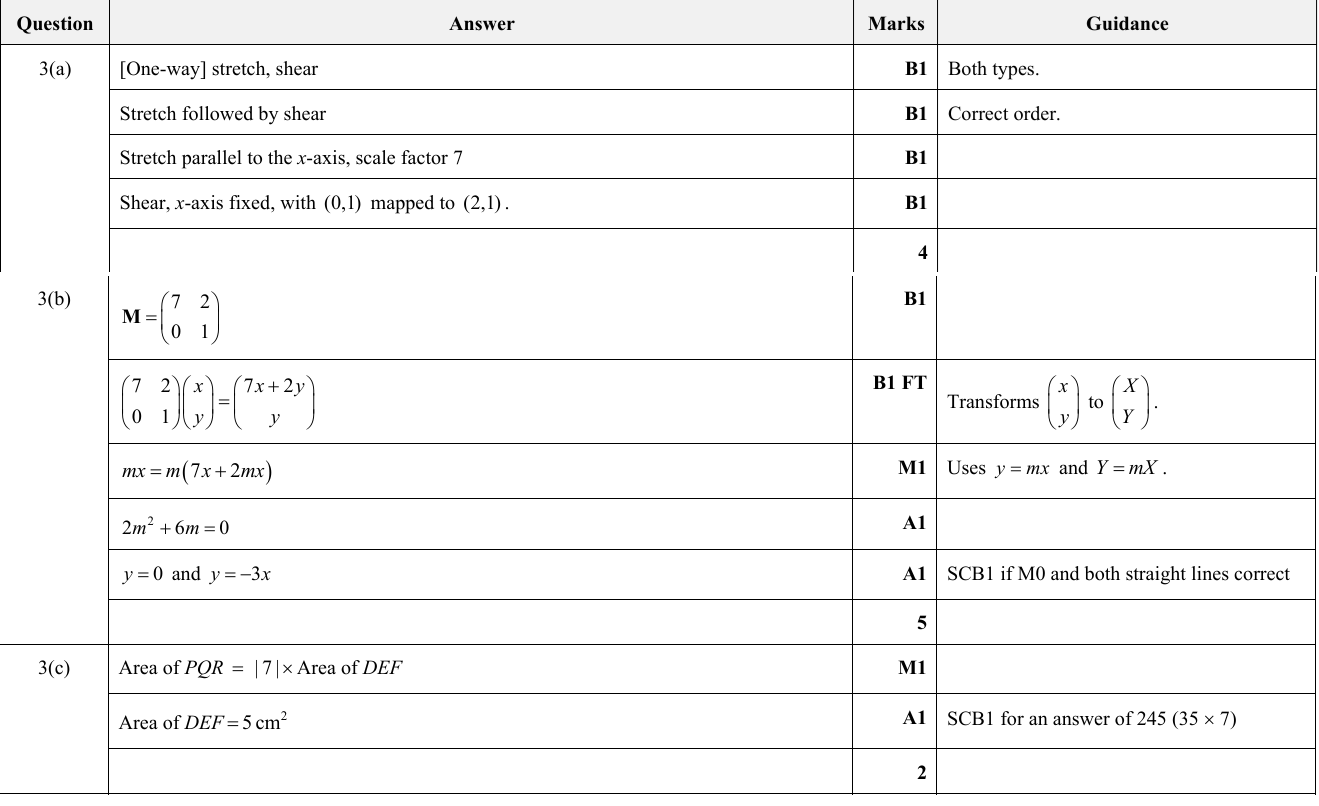
The matrix \(\mathbf{M}\) is given by \(\mathbf{M} = \begin{pmatrix} 1 & 2 \\ 0 & 1 \end{pmatrix} \begin{pmatrix} 7 & 0 \\ 0 & 1 \end{pmatrix}\).
(a) The matrix \(\mathbf{M}\) represents a sequence of two geometrical transformations in the \(x-y\) plane. Give full details of each transformation, and make clear the order in which they are applied.
(b) Find the equations of the invariant lines, through the origin, of the transformation represented by \(\mathbf{M}\).
The triangle \(DEF\) in the \(x-y\) plane is transformed by \(\mathbf{M}\) onto triangle \(PQR\).
(c) Given that the area of triangle \(PQR\) is \(35 \text{ cm}^2\), find the area of triangle \(DEF\).
9231 P13 - Jun 2024 - Q05 - 10 marks
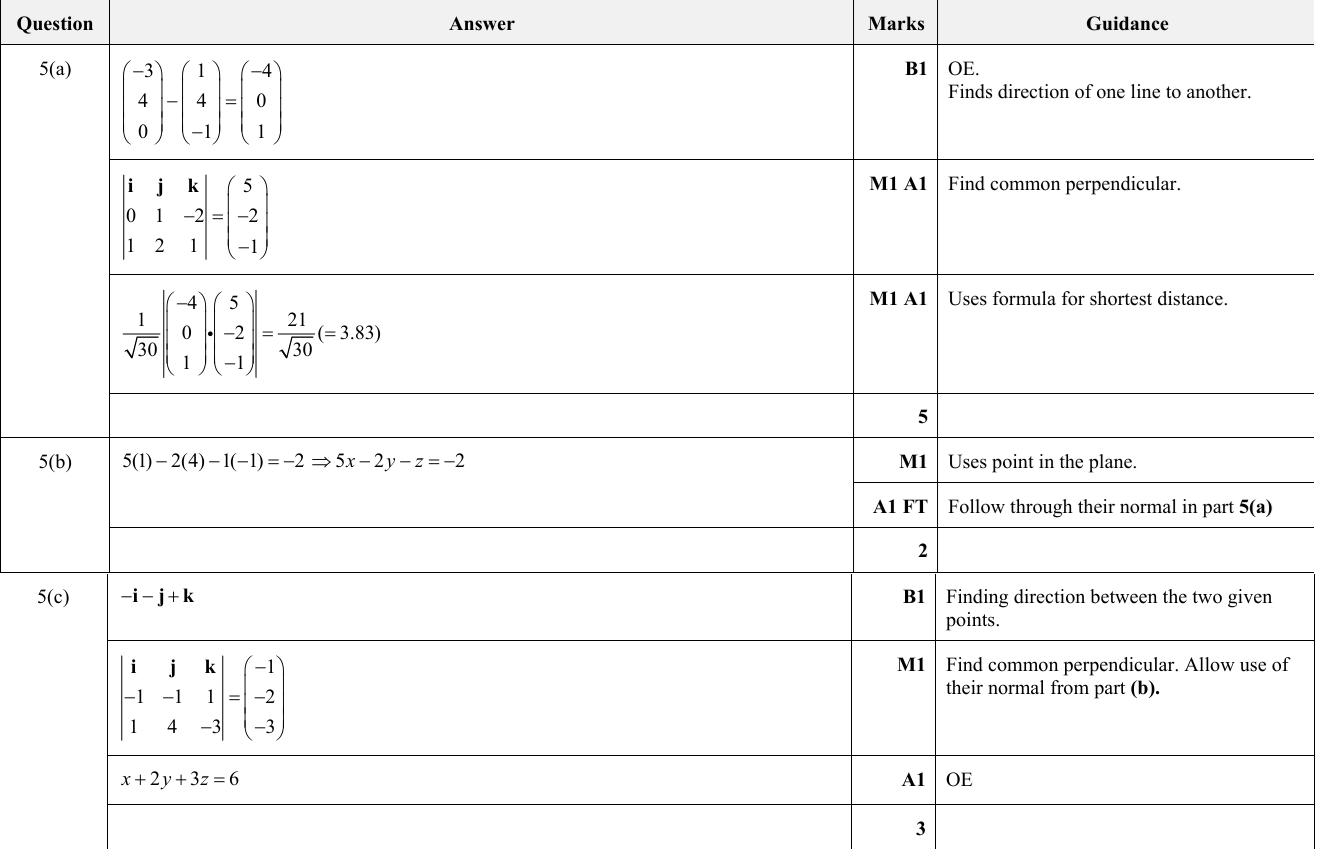
The lines \(l_1\) and \(l_2\) have equations \(\mathbf{r} = \mathbf{i} + 4\mathbf{j} - \mathbf{k} + \lambda (\mathbf{j} - 2\mathbf{k})\) and \(\mathbf{r} = -3\mathbf{i} + 4\mathbf{j} + \mu (\mathbf{i} + 2\mathbf{j} + \mathbf{k})\) respectively.
(a) Find the shortest distance between \(l_1\) and \(l_2\).
The plane \(\Pi_1\) contains \(l_1\) and is parallel to \(l_2\).
(b) Obtain an equation of \(\Pi_1\) in the form \(px + qy + rz = s\).
(c) The point \((1, 1, 1)\) lies on the plane \(\Pi_2\).
It is given that the line of intersection of the planes \(\Pi_1\) and \(\Pi_2\) passes through the point \((0, 0, 2)\) and is parallel to the vector \(\mathbf{i} + 4\mathbf{j} - 3\mathbf{k}\).
Obtain an equation of \(\Pi_2\) in the form \(ax + by + cz = d\).
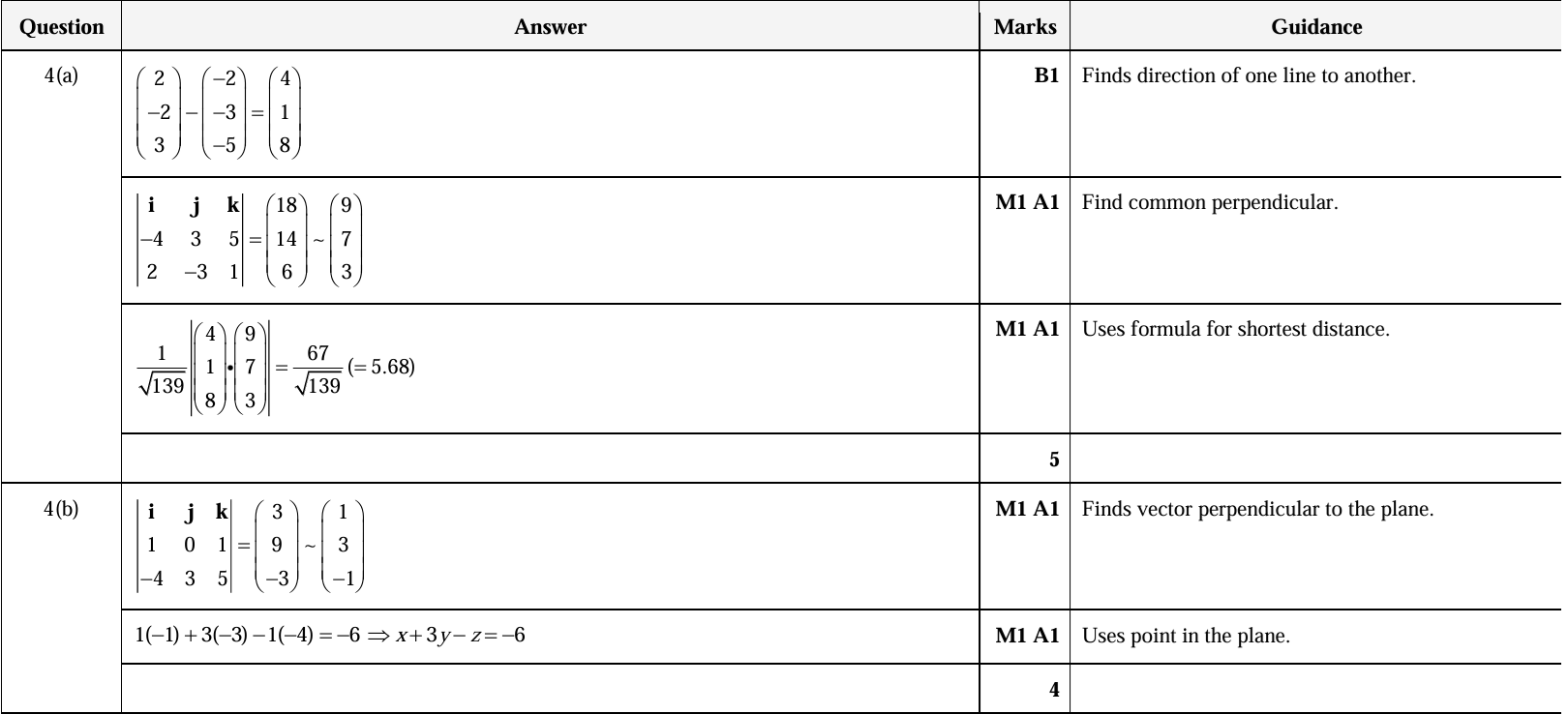
9231 P11 - Nov 2023 - Q04 - 9 marks
The lines \(l_1\) and \(l_2\) have equations
\(\mathbf{r} = -2\mathbf{i} - 3\mathbf{j} - 5\mathbf{k} + \lambda(-4\mathbf{i} + 3\mathbf{j} + 5\mathbf{k})\)
and
\(\mathbf{r} = 2\mathbf{i} - 2\mathbf{j} + 3\mathbf{k} + \mu(2\mathbf{i} - 3\mathbf{j} + \mathbf{k})\)
respectively.
(a) Find the shortest distance between \(l_1\) and \(l_2\).
The plane \(\Pi\) contains \(l_1\) and the point with position vector \(-\mathbf{i} - 3\mathbf{j} - 4\mathbf{k}\).
(b) Find an equation of \(\Pi\), giving your answer in the form \(ax + by + cz = d\).
9231 P11 - Nov 2023 - Q05 - 15 marks
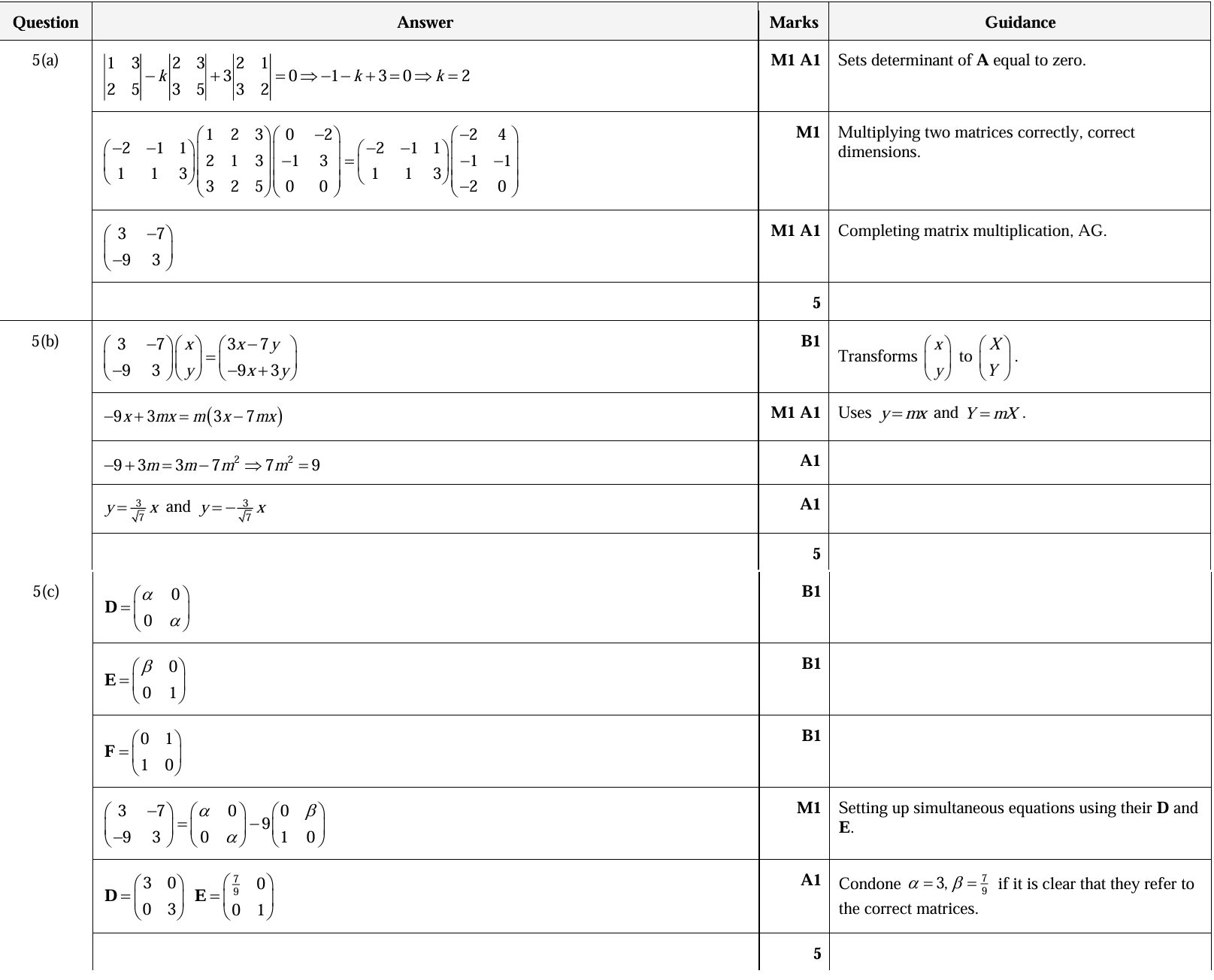
Let k be a constant. The matrices A, B and C are given by
\(\mathbf{A} = \begin{pmatrix} 1 & k & 3 \\ 2 & 1 & 3 \\ 3 & 2 & 5 \end{pmatrix}, \quad \mathbf{B} = \begin{pmatrix} 0 & -2 \\ -1 & 3 \\ 0 & 0 \end{pmatrix} \quad \text{and} \quad \mathbf{C} = \begin{pmatrix} -2 & -1 & 1 \\ 1 & 1 & 3 \end{pmatrix}.\)
It is given that A is singular.
(a) Show that \(\mathbf{CAB} = \begin{pmatrix} 3 & -7 \\ -9 & 3 \end{pmatrix}\).
(b) Find the equations of the invariant lines, through the origin, of the transformation in the x–y plane represented by CAB.
(c) The matrices D, E and F represent geometrical transformations in the x–y plane.
- D represents an enlargement, centre the origin.
- E represents a stretch parallel to the x-axis.
- F represents a reflection in the line y = x.
Given that \(\mathbf{CAB} = \mathbf{D} - 9\mathbf{EF}\), find D, E and F.
9231 P12 - Nov 2023 - Q03 - 8 marks
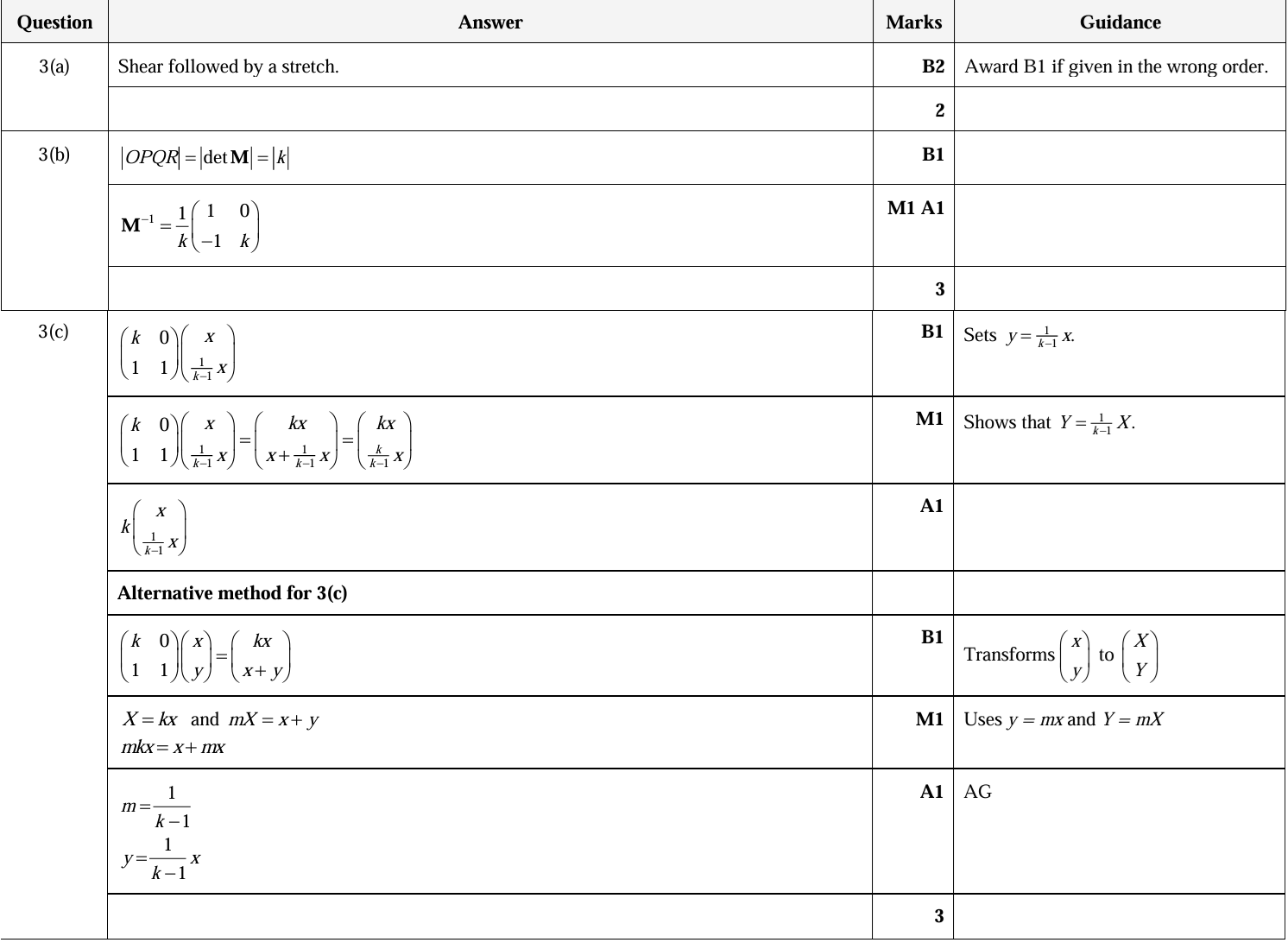
The matrix \(\mathbf{M}\) is given by \(\mathbf{M} = \begin{pmatrix} k & 0 \\ 0 & 1 \end{pmatrix} \begin{pmatrix} 1 & 0 \\ 1 & 1 \end{pmatrix}\), where \(k\) is a constant and \(k \neq 0\) and \(k \neq 1\).
(a) The matrix \(\mathbf{M}\) represents a sequence of two geometrical transformations. State the type of each transformation, and make clear the order in which they are applied. [2]
The unit square in the \(x-y\) plane is transformed by \(\mathbf{M}\) onto parallelogram \(OPQR\).
(b) Find, in terms of \(k\), the area of parallelogram \(OPQR\) and the matrix which transforms \(OPQR\) onto the unit square. [3]
(c) Show that the line through the origin with gradient \(\frac{1}{k-1}\) is invariant under the transformation in the \(x-y\) plane represented by \(\mathbf{M}\). [3]
9231 P12 - Nov 2023 - Q05 - 13 marks
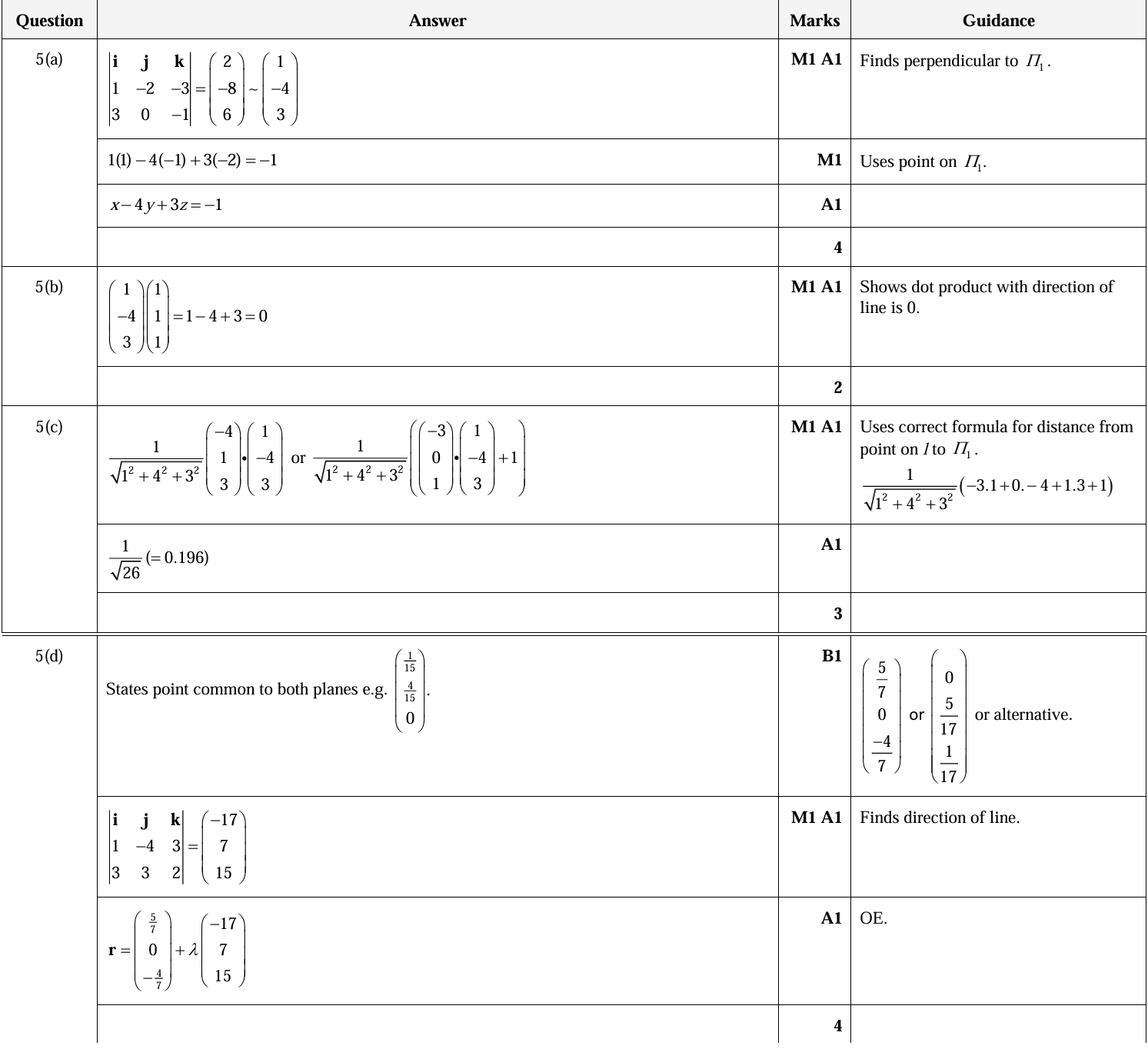
The plane \(\Pi_1\) has equation \(\mathbf{r} = \mathbf{i} - \mathbf{j} - 2\mathbf{k} + \lambda (\mathbf{i} - 2\mathbf{j} - 3\mathbf{k}) + \mu (3\mathbf{i} - \mathbf{k})\).
(a) Find an equation for \(\Pi_1\) in the form \(ax + by + cz = d\).
The line \(l\), which does not lie in \(\Pi_1\), has equation \(\mathbf{r} = -3\mathbf{i} + \mathbf{k} + t(\mathbf{i} + \mathbf{j} + \mathbf{k})\).
(b) Show that \(l\) is parallel to \(\Pi_1\).
(c) Find the distance between \(l\) and \(\Pi_1\).
(d) The plane \(\Pi_2\) has equation \(3x + 3y + 2z = 1\).
Find a vector equation of the line of intersection of \(\Pi_1\) and \(\Pi_2\).
9231 P13 - Nov 2023 - Q04 - 9 marks
The lines \(l_1\) and \(l_2\) have equations
\(\mathbf{r} = -2\mathbf{i} - 3\mathbf{j} - 5\mathbf{k} + \lambda(-4\mathbf{i} + 3\mathbf{j} + 5\mathbf{k})\) and \(\mathbf{r} = 2\mathbf{i} - 2\mathbf{j} + 3\mathbf{k} + \mu(2\mathbf{i} - 3\mathbf{j} + \mathbf{k})\)
respectively.
(a) Find the shortest distance between \(l_1\) and \(l_2\).
The plane \(\Pi\) contains \(l_1\) and the point with position vector \(-\mathbf{i} - 3\mathbf{j} - 4\mathbf{k}\).
(b) Find an equation of \(\Pi\), giving your answer in the form \(ax + by + cz = d\).
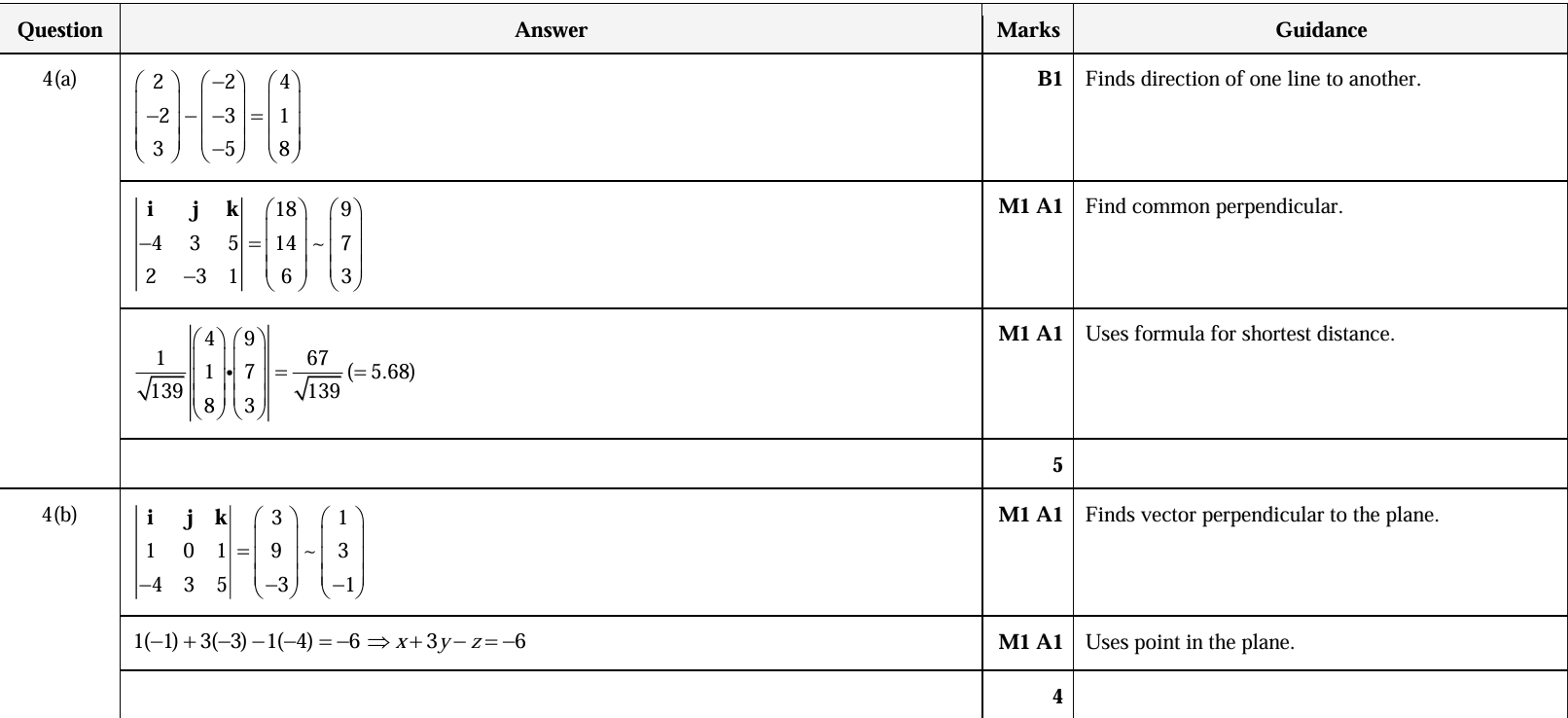
9231 P13 - Nov 2023 - Q05 - 15 marks
Let k be a constant. The matrices A, B and C are given by
\(\mathbf{A} = \begin{pmatrix} 1 & k & 3 \\ 2 & 1 & 3 \\ 3 & 2 & 5 \end{pmatrix}, \quad \mathbf{B} = \begin{pmatrix} 0 & -2 \\ -1 & 3 \\ 0 & 0 \end{pmatrix} \text{ and } \mathbf{C} = \begin{pmatrix} -2 & -1 \\ 1 & 1 \\ 1 & 3 \end{pmatrix}.\)
It is given that A is singular.
(a) Show that \(\mathbf{CAB} = \begin{pmatrix} 3 & -7 \\ -9 & 3 \end{pmatrix}.\)
(b) Find the equations of the invariant lines, through the origin, of the transformation in the x–y plane represented by CAB.
(c) The matrices D, E and F represent geometrical transformations in the x–y plane.
- D represents an enlargement, centre the origin.
- E represents a stretch parallel to the x-axis.
- F represents a reflection in the line y = x.
Given that \(\mathbf{CAB} = \mathbf{D} - 9\mathbf{EF},\) find D, E and F.
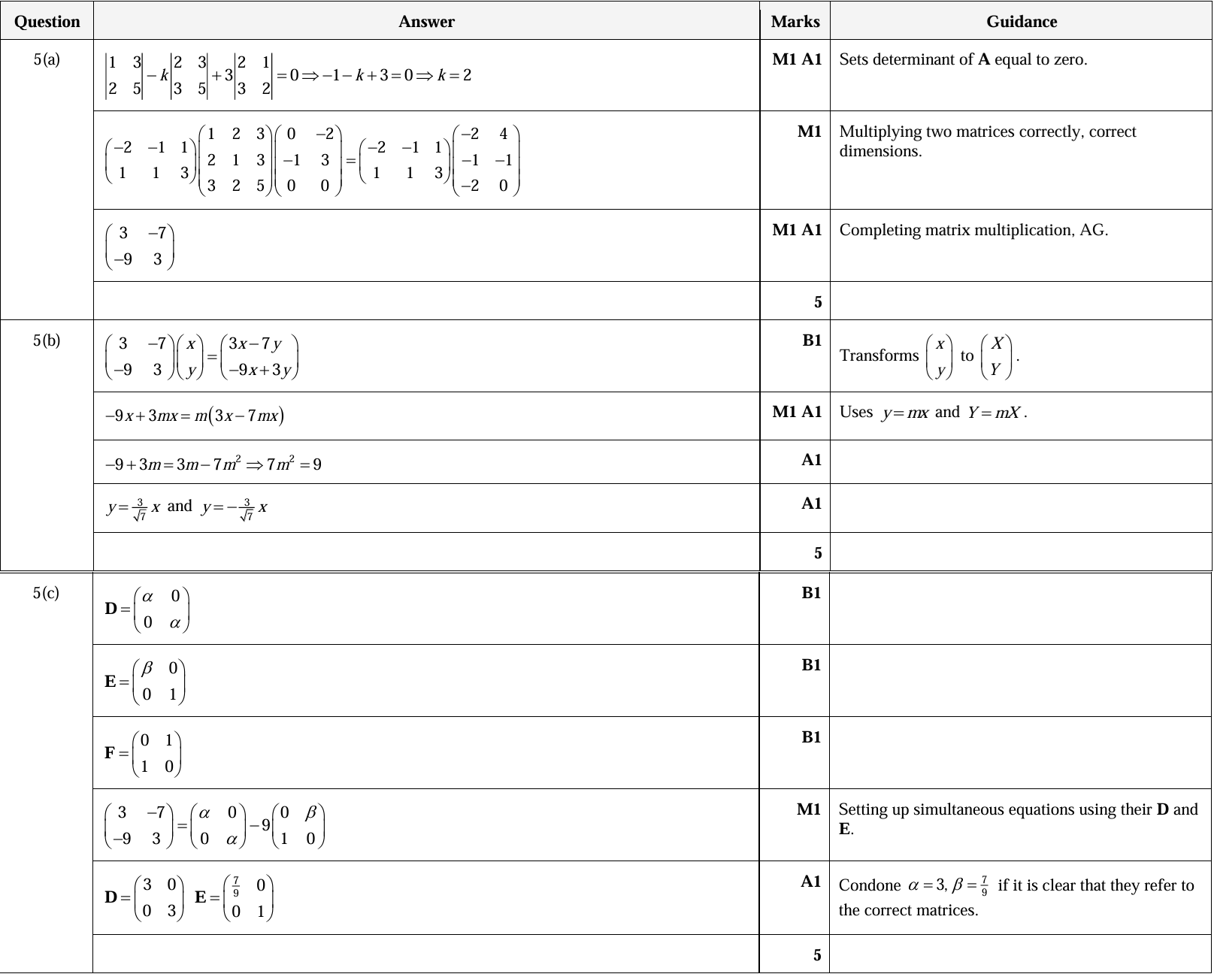
9231 P11 - Jun 2023 - Q04 - 12 marks
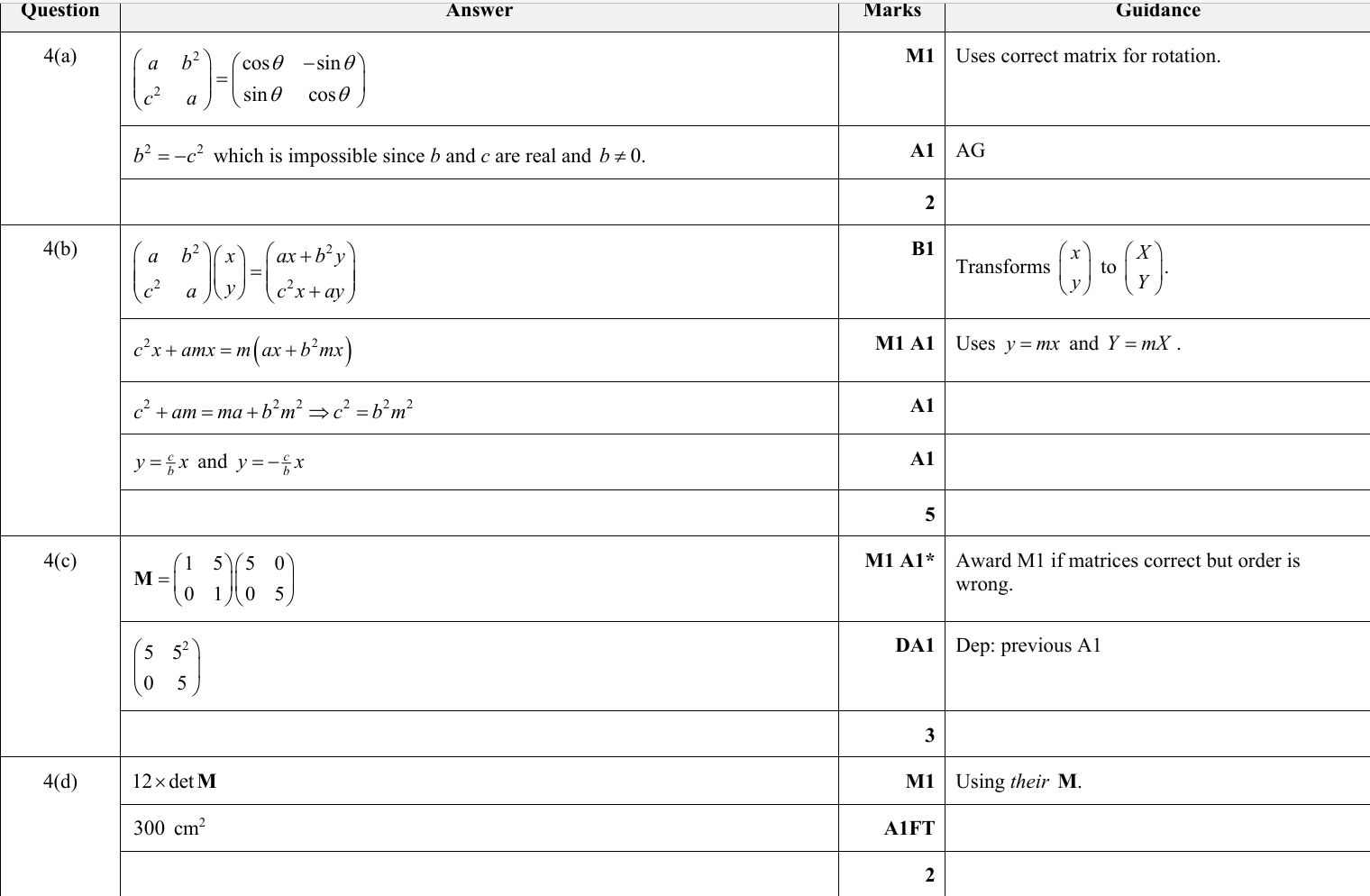
The matrix M is given by \(\mathbf{M} = \begin{pmatrix} a & b^2 \\ c^2 & a \end{pmatrix}\), where \(a, b, c\) are real constants and \(b \neq 0\).
- Show that M does not represent a rotation about the origin.
- Find the equations of the invariant lines, through the origin, of the transformation in the x–y plane represented by M.
It is given that M represents the sequence of two transformations in the x–y plane given by an enlargement, centre the origin, scale factor 5 followed by a shear, x-axis fixed, with (0, 1) mapped to (5, 1).
- Find M.
- The triangle DEF in the x–y plane is transformed by M onto triangle PQR. Given that the area of triangle DEF is 12 cm2, find the area of triangle PQR.
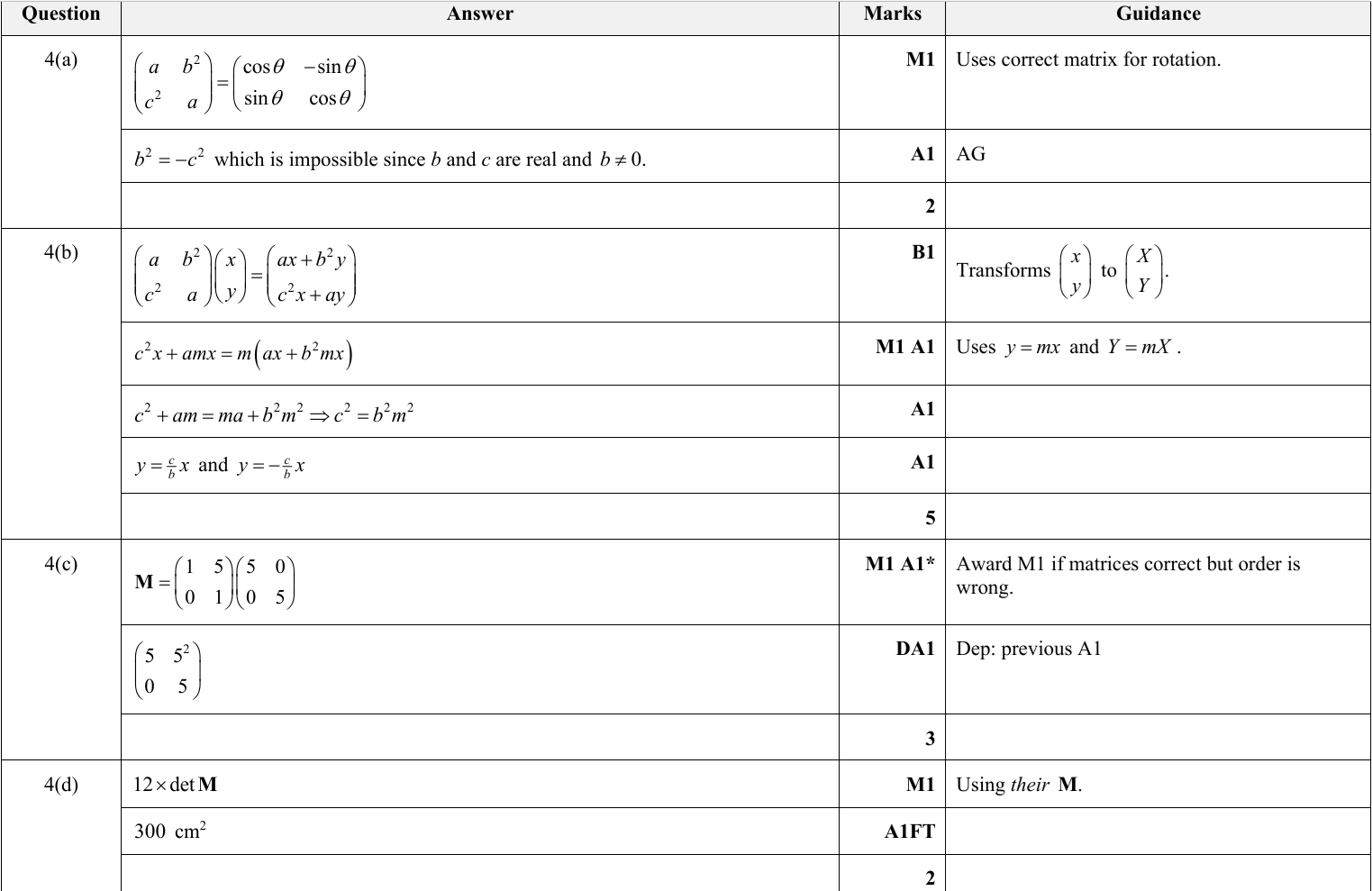
9231 P11 - Jun 2023 - Q07 - 14 marks
The plane \(\Pi_1\) has equation \(\mathbf{r} = -4\mathbf{j} - 3\mathbf{k} + \lambda (\mathbf{i} - \mathbf{j} + \mathbf{k}) + \mu (\mathbf{i} + \mathbf{j} - \mathbf{k})\).
- Obtain an equation of \(\Pi_1\) in the form \(px + qy + rz = d\).
- The plane \(\Pi_2\) has equation \(\mathbf{r} \cdot (-5\mathbf{i} + 3\mathbf{j} + 5\mathbf{k}) = 4\). Find a vector equation of the line of intersection of \(\Pi_1\) and \(\Pi_2\).
- The line \(l\) passes through the point \(A\) with position vector \(a\mathbf{i} + a\mathbf{j} + (a-7)\mathbf{k}\) and is parallel to \((1-b)\mathbf{i} + b\mathbf{j} + b\mathbf{k}\), where \(a\) and \(b\) are positive constants. Given that the perpendicular distance from \(A\) to \(\Pi_1\) is \(\sqrt{2}\), find the value of \(a\).
- Given that the obtuse angle between \(l\) and \(\Pi_1\) is \(\frac{3}{4}\pi\), find the exact value of \(b\).
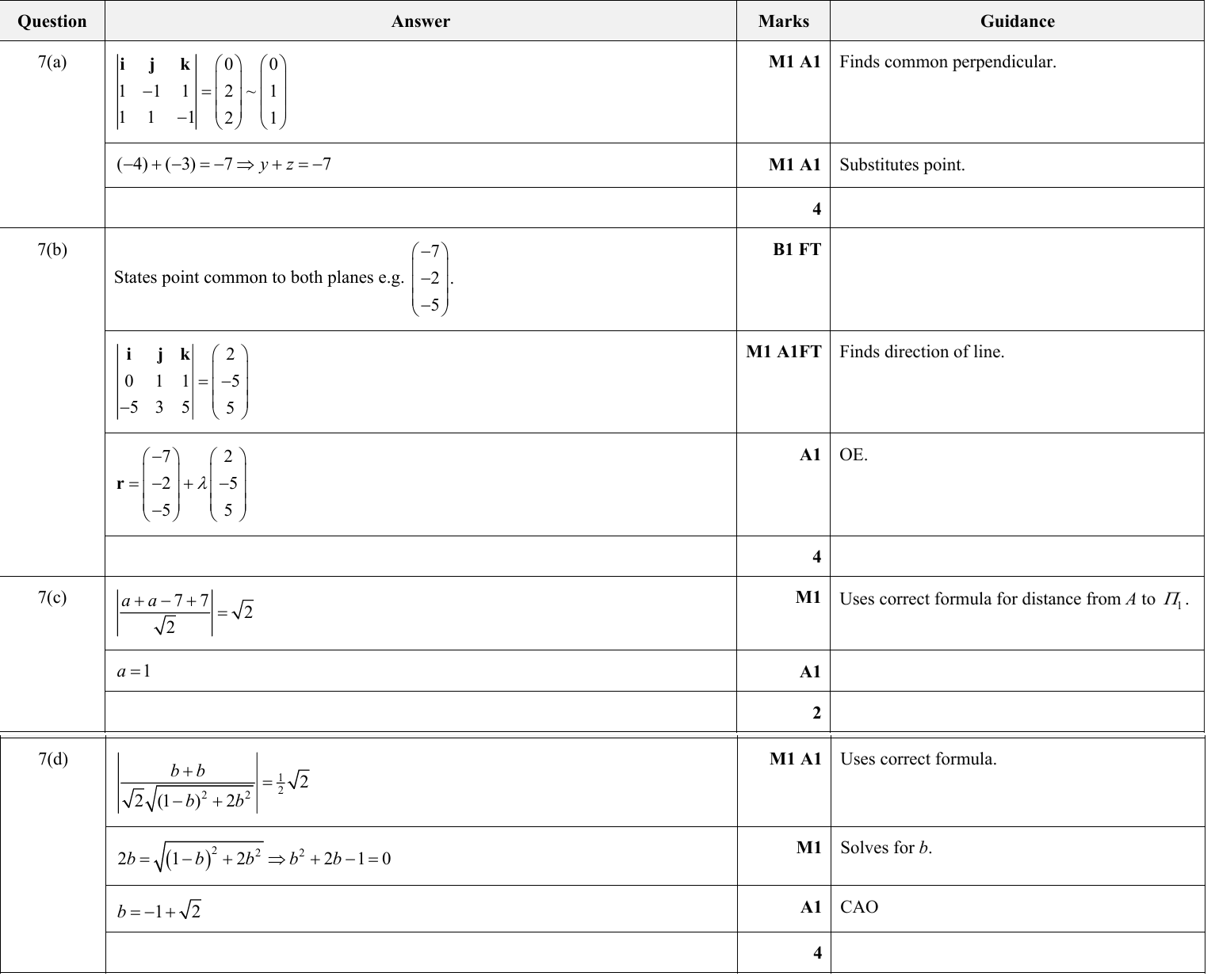
9231 P12 - Jun 2023 - Q04 - 12 marks
The matrix \(\mathbf{M}\) is given by \(\mathbf{M} = \begin{pmatrix} a & b^2 \\ c^2 & a \end{pmatrix}\), where \(a, b, c\) are real constants and \(b \neq 0\).
- Show that \(\mathbf{M}\) does not represent a rotation about the origin.
- Find the equations of the invariant lines, through the origin, of the transformation in the \(x-y\) plane represented by \(\mathbf{M}\).
- It is given that \(\mathbf{M}\) represents the sequence of two transformations in the \(x-y\) plane given by an enlargement, centre the origin, scale factor 5 followed by a shear, x-axis fixed, with \((0, 1)\) mapped to \((5, 1)\). Find \(\mathbf{M}\).
- The triangle \(DEF\) in the \(x-y\) plane is transformed by \(\mathbf{M}\) onto triangle \(PQR\). Given that the area of triangle \(DEF\) is \(12 \text{ cm}^2\), find the area of triangle \(PQR\).
9231 P12 - Jun 2023 - Q07 - 14 marks
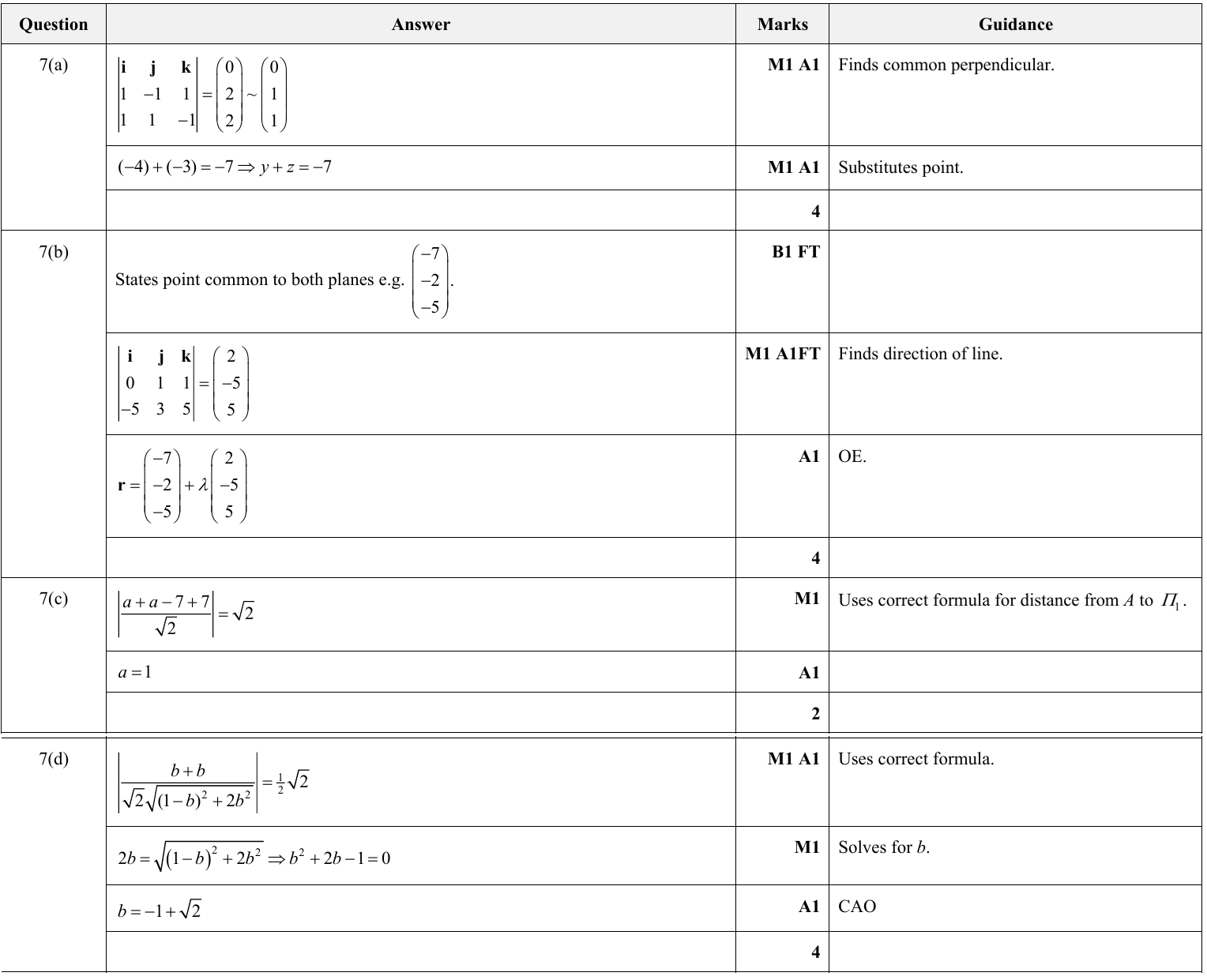
The plane \(\Pi_1\) has equation \(\mathbf{r} = -4\mathbf{j} - 3\mathbf{k} + \lambda (\mathbf{i} - \mathbf{j} + \mathbf{k}) + \mu (\mathbf{i} + \mathbf{j} - \mathbf{k})\).
(a) Obtain an equation of \(\Pi_1\) in the form \(px + qy + rz = d\).
(b) The plane \(\Pi_2\) has equation \(\mathbf{r} \cdot (-5\mathbf{i} + 3\mathbf{j} + 5\mathbf{k}) = 4\).
Find a vector equation of the line of intersection of \(\Pi_1\) and \(\Pi_2\).
The line \(l\) passes through the point \(A\) with position vector \(a\mathbf{i} + a\mathbf{j} + (a-7)\mathbf{k}\) and is parallel to \((1-b)\mathbf{i} + b\mathbf{j} + b\mathbf{k}\), where \(a\) and \(b\) are positive constants.
(c) Given that the perpendicular distance from \(A\) to \(\Pi_1\) is \(\sqrt{2}\), find the value of \(a\).
(d) Given that the obtuse angle between \(l\) and \(\Pi_1\) is \(\frac{3}{4}\pi\), find the exact value of \(b\).
9231 P13 - Jun 2023 - Q06 - 15 marks
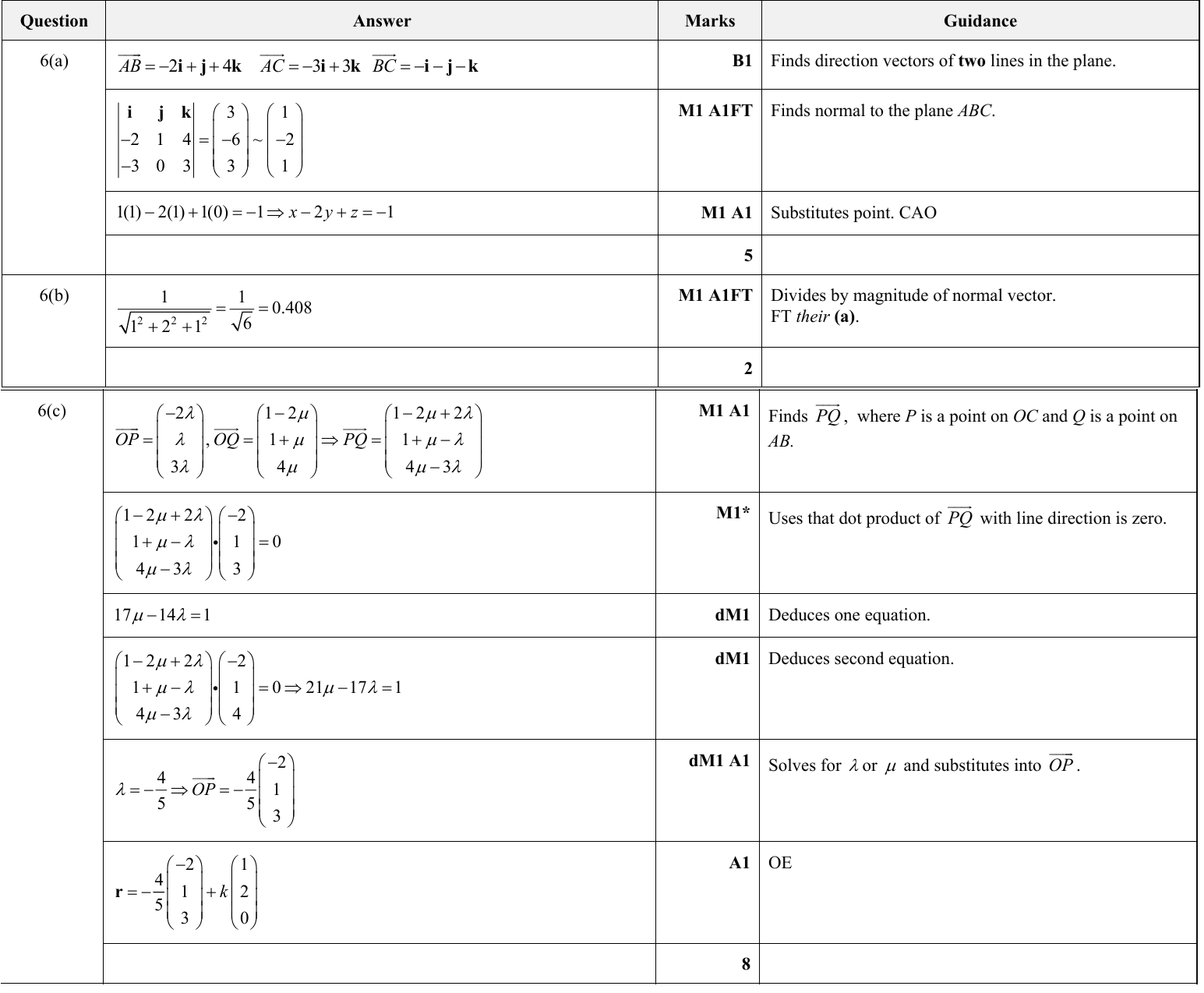
The points A, B, C have position vectors \(\mathbf{i} + \mathbf{j}, \ -\mathbf{i} + 2\mathbf{j} + 4\mathbf{k}, \ -2\mathbf{i} + \mathbf{j} + 3\mathbf{k}\), respectively, relative to the origin O.
(a) Find the equation of the plane ABC, giving your answer in the form \(ax + by + cz = d\).
(b) Find the perpendicular distance from O to the plane ABC.
(c) Find a vector equation of the common perpendicular to the lines OC and AB.
9231 P12 - Jun 2022 - Q02 - 10 marks
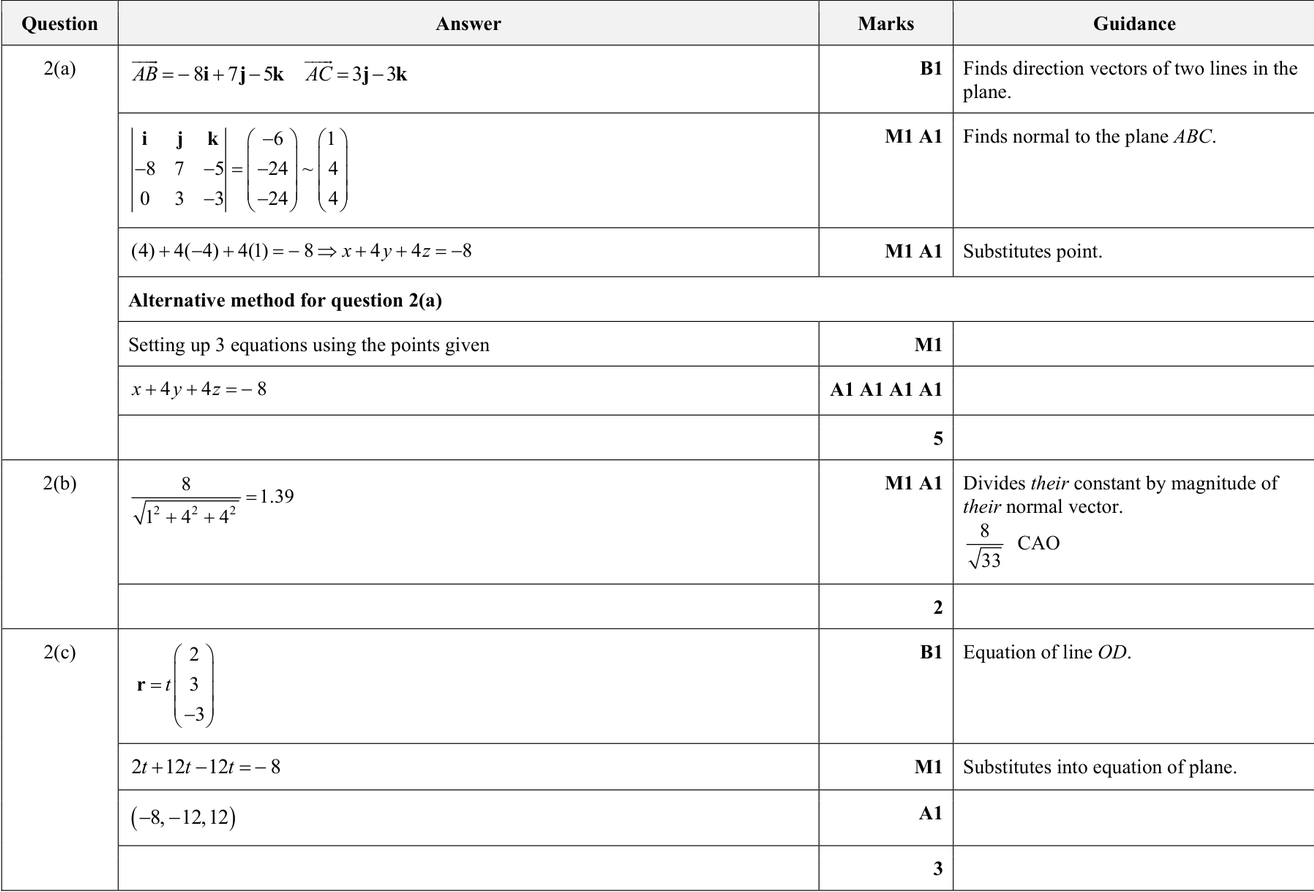
The points A, B, C have position vectors
\(4\mathbf{i} - 4\mathbf{j} + \mathbf{k}\),\( \quad -4\mathbf{i} + 3\mathbf{j} - 4\mathbf{k}\), \(\quad 4\mathbf{i} - \mathbf{j} - 2\mathbf{k}\),
respectively, relative to the origin O.
(a) Find the equation of the plane ABC, giving your answer in the form \(ax + by + cz = d\).
(b) Find the perpendicular distance from O to the plane ABC.
(c) The point D has position vector \(2\mathbf{i} + 3\mathbf{j} - 3\mathbf{k}\).
Find the coordinates of the point of intersection of the line OD with the plane ABC.
9231 P12 - Jun 2022 - Q07 - 17 marks
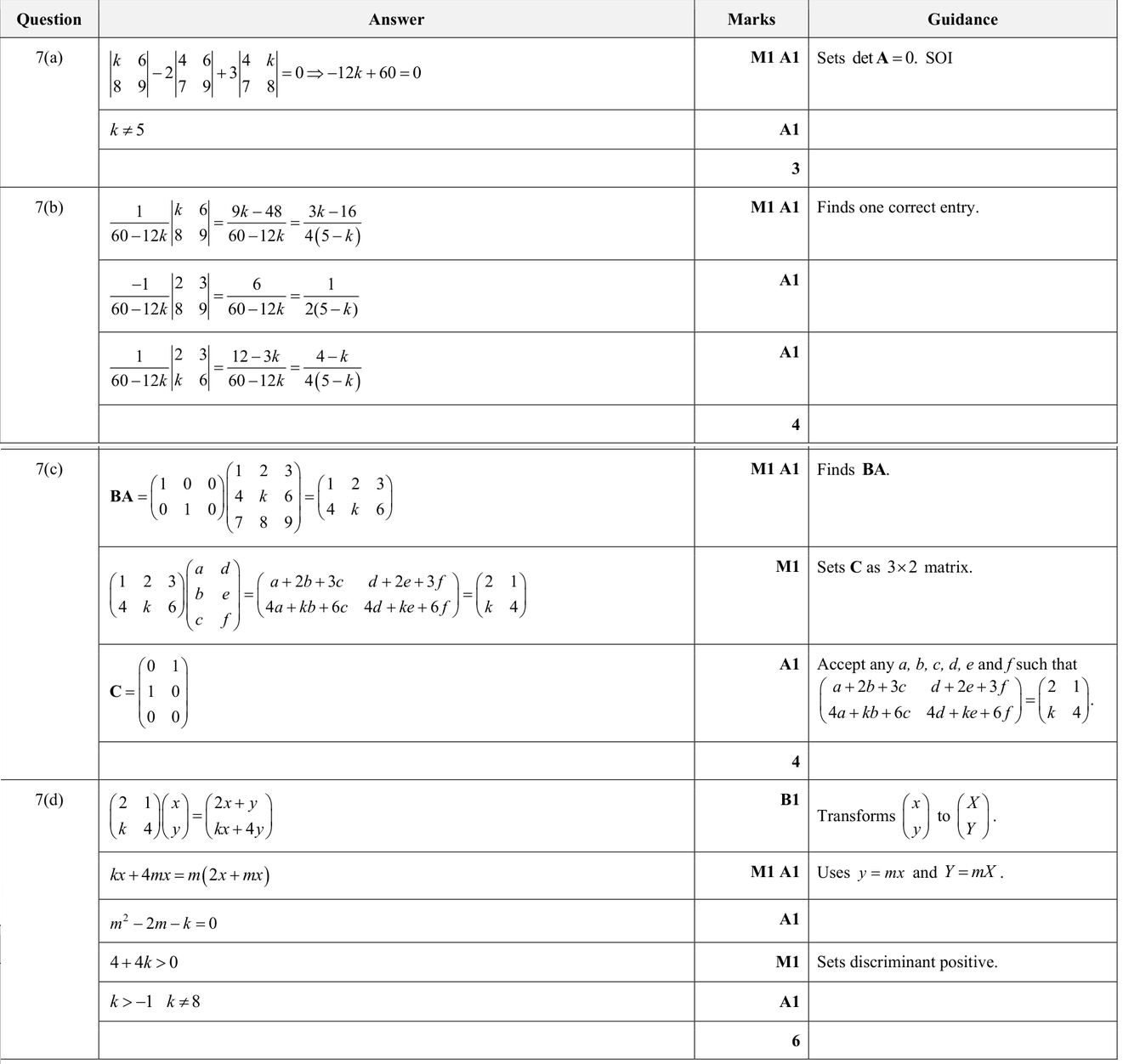
The matrix \(A\) is given by \(A = \begin{pmatrix} 1 & 2 & 3 \\ 4 & k & 6 \\ 7 & 8 & 9 \end{pmatrix}\).
- Find the set of values of \(k\) for which \(A\) is non-singular.
- Given that \(A\) is non-singular, find, in terms of \(k\), the entries in the top row of \(A^{-1}\).
- Given that \(B = \begin{pmatrix} 1 & 0 & 0 \\ 0 & 1 & 0 \end{pmatrix}\), give an example of a matrix \(C\) such that \(BAC = \begin{pmatrix} 2 & 1 \\ k & 4 \end{pmatrix}\).
- Find the set of values of \(k\) for which the transformation in the \(x-y\) plane represented by \(\begin{pmatrix} 2 & 1 \\ k & 4 \end{pmatrix}\) has two distinct invariant lines through the origin.
9231 P13 - Jun 2022 - Q07 - 18 marks
The position vectors of the points A, B, C, D are
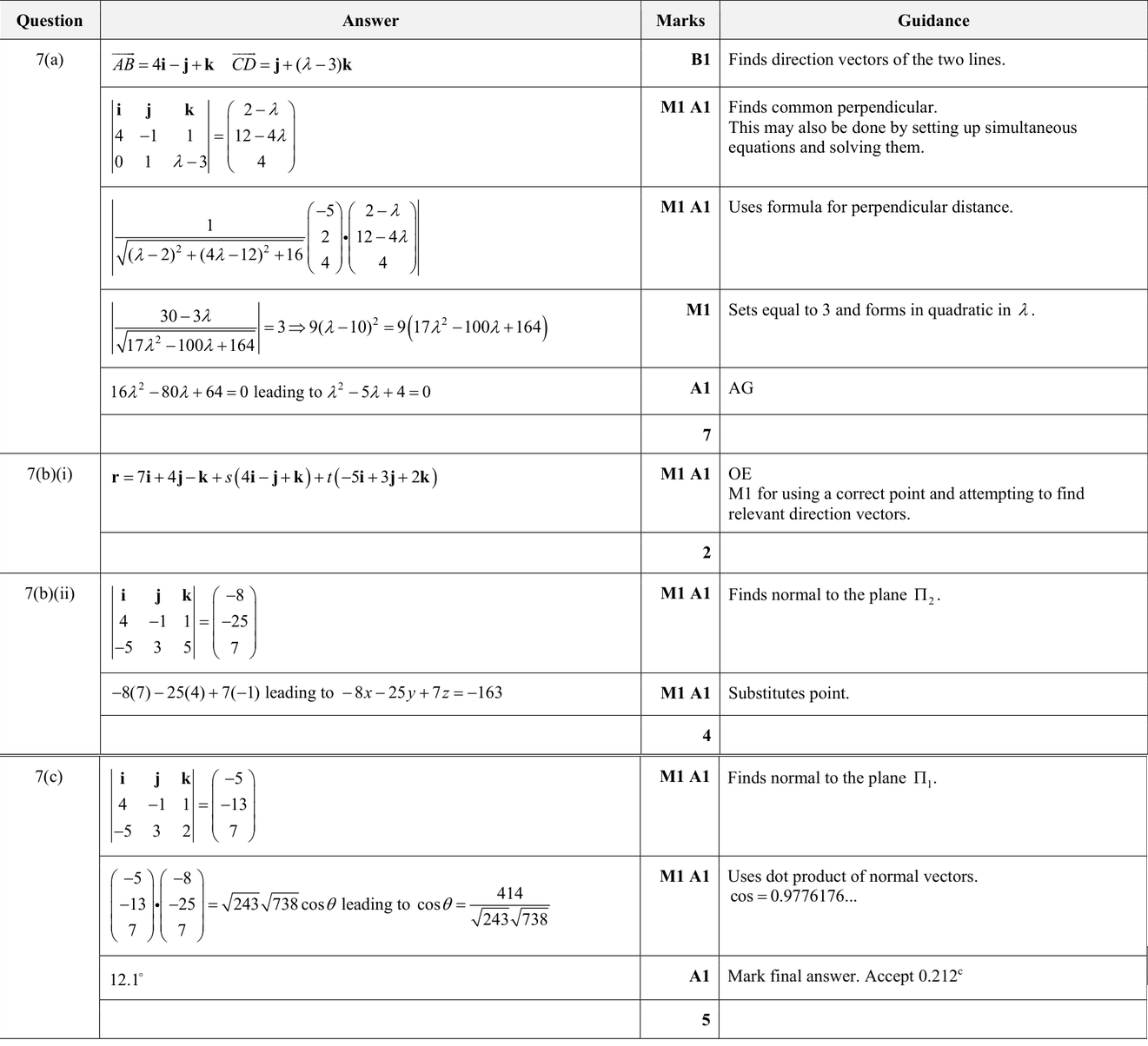
\(7\mathbf{i} + 4\mathbf{j} - \mathbf{k}, \quad 11\mathbf{i} + 3\mathbf{j}, \quad 2\mathbf{i} + 6\mathbf{j} + 3\mathbf{k}, \quad 2\mathbf{i} + 7\mathbf{j} + \lambda \mathbf{k}\)
respectively.
(a) Given that the shortest distance between the line AB and the line CD is 3, show that \(\lambda^2 - 5\lambda + 4 = 0\).
Let \(\Pi_1\) be the plane ABD when \(\lambda = 1\).
Let \(\Pi_2\) be the plane ABD when \(\lambda = 4\).
(b) (i) Write down an equation of \(\Pi_1\), giving your answer in the form \(\mathbf{r} = \mathbf{a} + s\mathbf{b} + t\mathbf{c}\).
(ii) Find an equation of \(\Pi_2\), giving your answer in the form \(ax + by + cz = d\).
(c) Find the acute angle between \(\Pi_1\) and \(\Pi_2\).
9231 P11 - Nov 2022 - Q04 - 11 marks
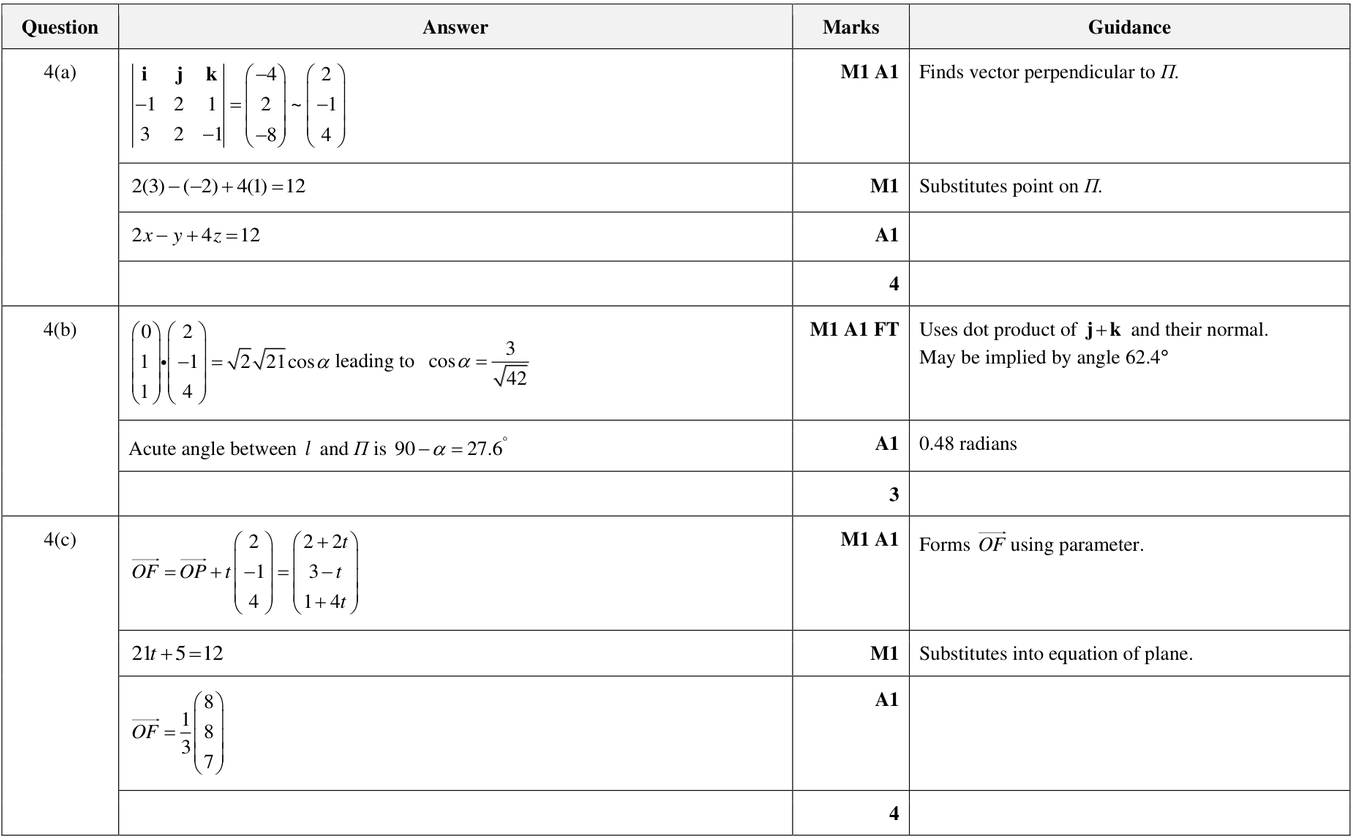
The plane \(\Pi\) contains the lines \(\mathbf{r} = 3\mathbf{i} - 2\mathbf{j} + \mathbf{k} + \lambda(-\mathbf{i} + 2\mathbf{j} + \mathbf{k})\) and \(\mathbf{r} = 4\mathbf{i} + 4\mathbf{j} + 2\mathbf{k} + \mu(3\mathbf{i} + 2\mathbf{j} - \mathbf{k})\).
(a) Find a Cartesian equation of \(\Pi\), giving your answer in the form \(ax + by + cz = d\). [4]
The line \(l\) passes through the point \(P\) with position vector \(2\mathbf{i} + 3\mathbf{j} + \mathbf{k}\) and is parallel to the vector \(\mathbf{j} + \mathbf{k}\).
(b) Find the acute angle between \(l\) and \(\Pi\). [3]
(c) Find the position vector of the foot of the perpendicular from \(P\) to \(\Pi\). [4]
9231 P11 - Nov 2022 - Q05 - 11 marks
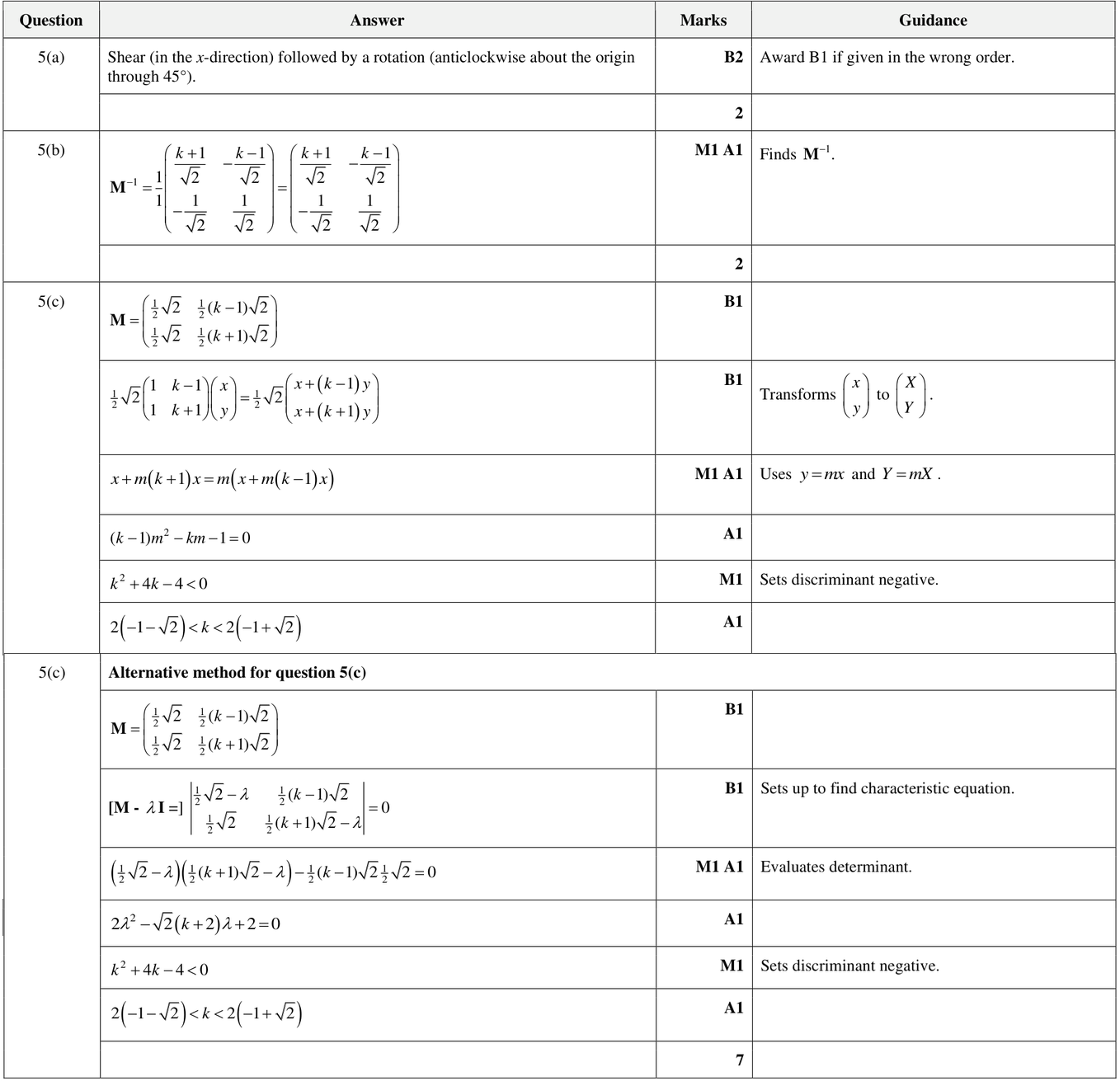
The matrix M is given by \(M = \begin{pmatrix} \frac{1}{2}\sqrt{2} & -\frac{1}{2}\sqrt{2} \\ \frac{1}{2} & \frac{1}{2}\sqrt{2} \end{pmatrix} \begin{pmatrix} 1 & k \\ 0 & 1 \end{pmatrix}\), where \(k\) is a constant.
(a) The matrix M represents a sequence of two geometrical transformations. State the type of each transformation, and make clear the order in which they are applied.
(b) The triangle ABC in the \(x-y\) plane is transformed by M onto triangle DEF. Find, in terms of \(k\), the single matrix which transforms triangle DEF onto triangle ABC.
(c) Find the set of values of \(k\) for which the transformation represented by M has no invariant lines through the origin.
9231 P12 - Nov 2022 - Q03 - 10 marks
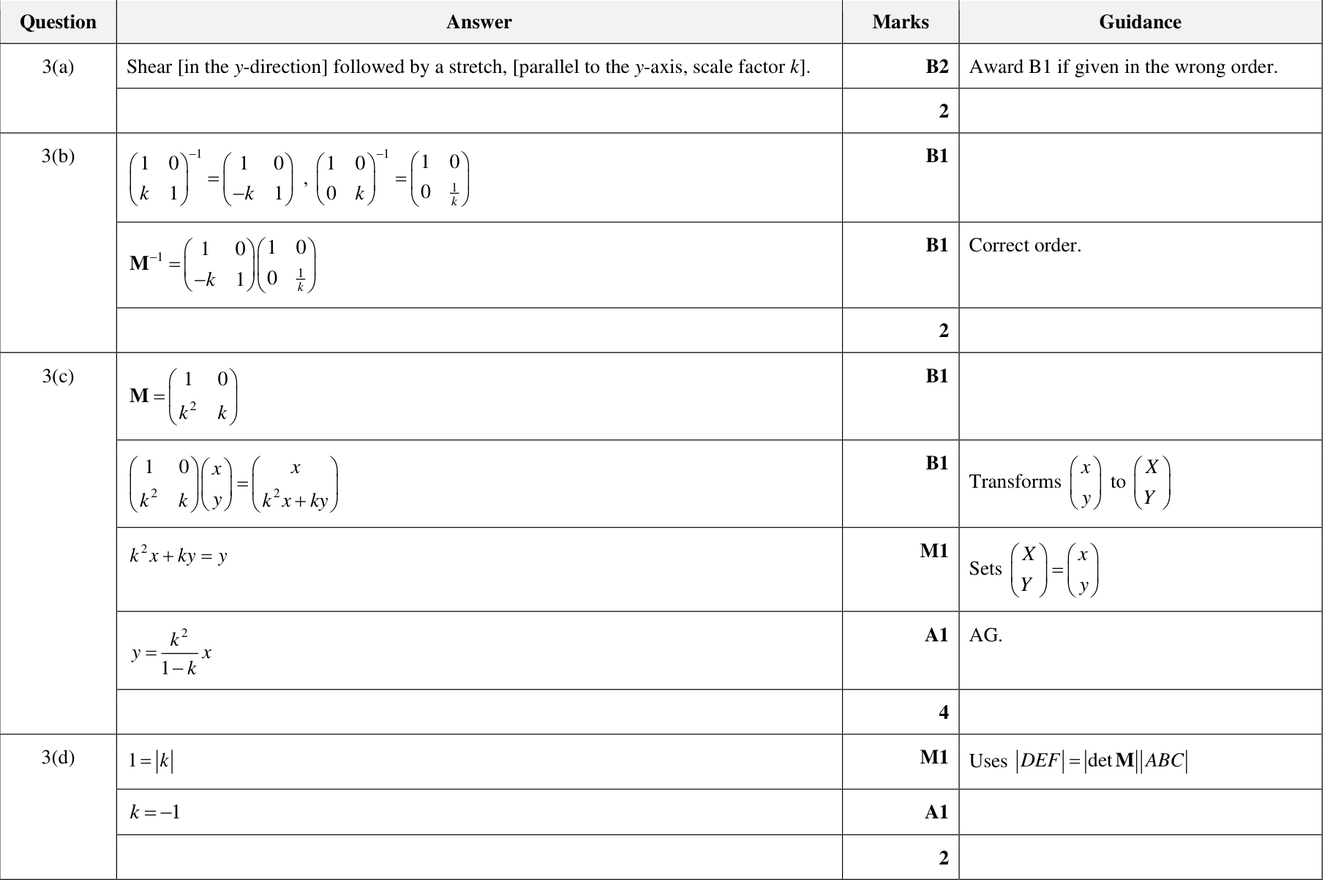
The matrix M is given by M = \(\begin{pmatrix} 1 & 0 \\ 0 & k \end{pmatrix} \begin{pmatrix} 1 & 0 \\ k & 1 \end{pmatrix}\), where \(k\) is a constant and \(k \neq 0\) or 1.
(a) The matrix M represents a sequence of two geometrical transformations. State the type of each transformation, and make clear the order in which they are applied. [2]
(b) Write M-1 as the product of two matrices, neither of which is I. [2]
(c) Show that the invariant points of the transformation represented by M lie on the line \(y = \frac{k^2}{1-k}x\). [4]
(d) The triangle ABC in the x-y plane is transformed by M onto triangle DEF. Find the value of \(k\) for which the area of triangle DEF is equal to the area of triangle ABC. [2]
9231 P12 - Nov 2022 - Q06 - 15 marks
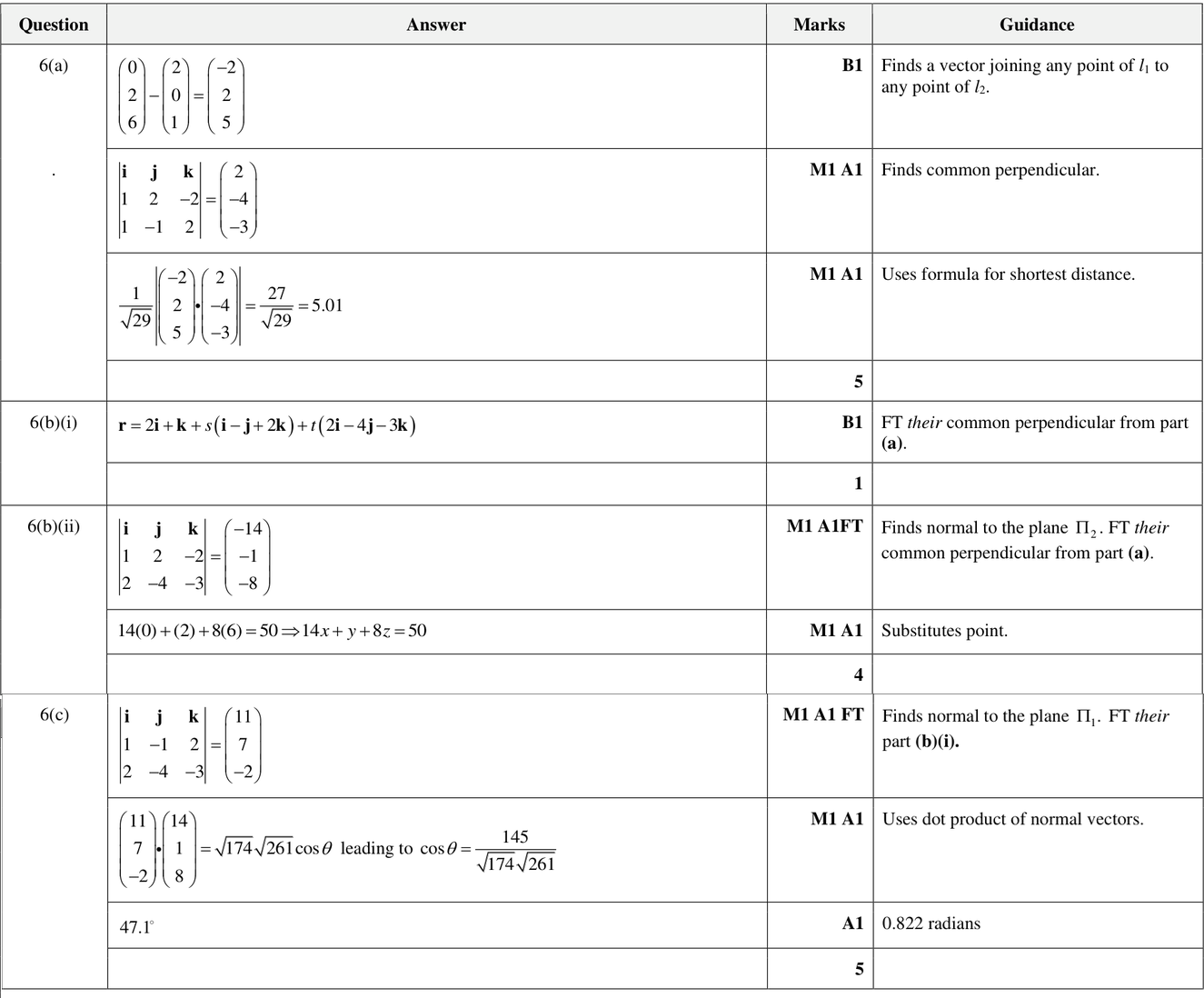
The lines \(l_1\) and \(l_2\) have equations \(\mathbf{r} = 2\mathbf{i} + \mathbf{k} + \lambda(\mathbf{i} - \mathbf{j} + 2\mathbf{k})\) and \(\mathbf{r} = 2\mathbf{j} + 6\mathbf{k} + \mu(\mathbf{i} + 2\mathbf{j} - 2\mathbf{k})\) respectively.
The point \(P\) on \(l_1\) and the point \(Q\) on \(l_2\) are such that \(PQ\) is perpendicular to both \(l_1\) and \(l_2\).
(a) Find the length \(PQ\). [5]
The plane \(\Pi_1\) contains \(PQ\) and \(l_1\).
The plane \(\Pi_2\) contains \(PQ\) and \(l_2\).
(b) (i) Write down an equation of \(\Pi_1\), giving your answer in the form \(\mathbf{r} = \mathbf{a} + s\mathbf{b} + t\mathbf{c}\). [1]
(ii) Find an equation of \(\Pi_2\), giving your answer in the form \(ax + by + cz = d\). [4]
(c) Find the acute angle between \(\Pi_1\) and \(\Pi_2\). [5]
9231 P12 - Jun 2021 - Q04 - 14 marks
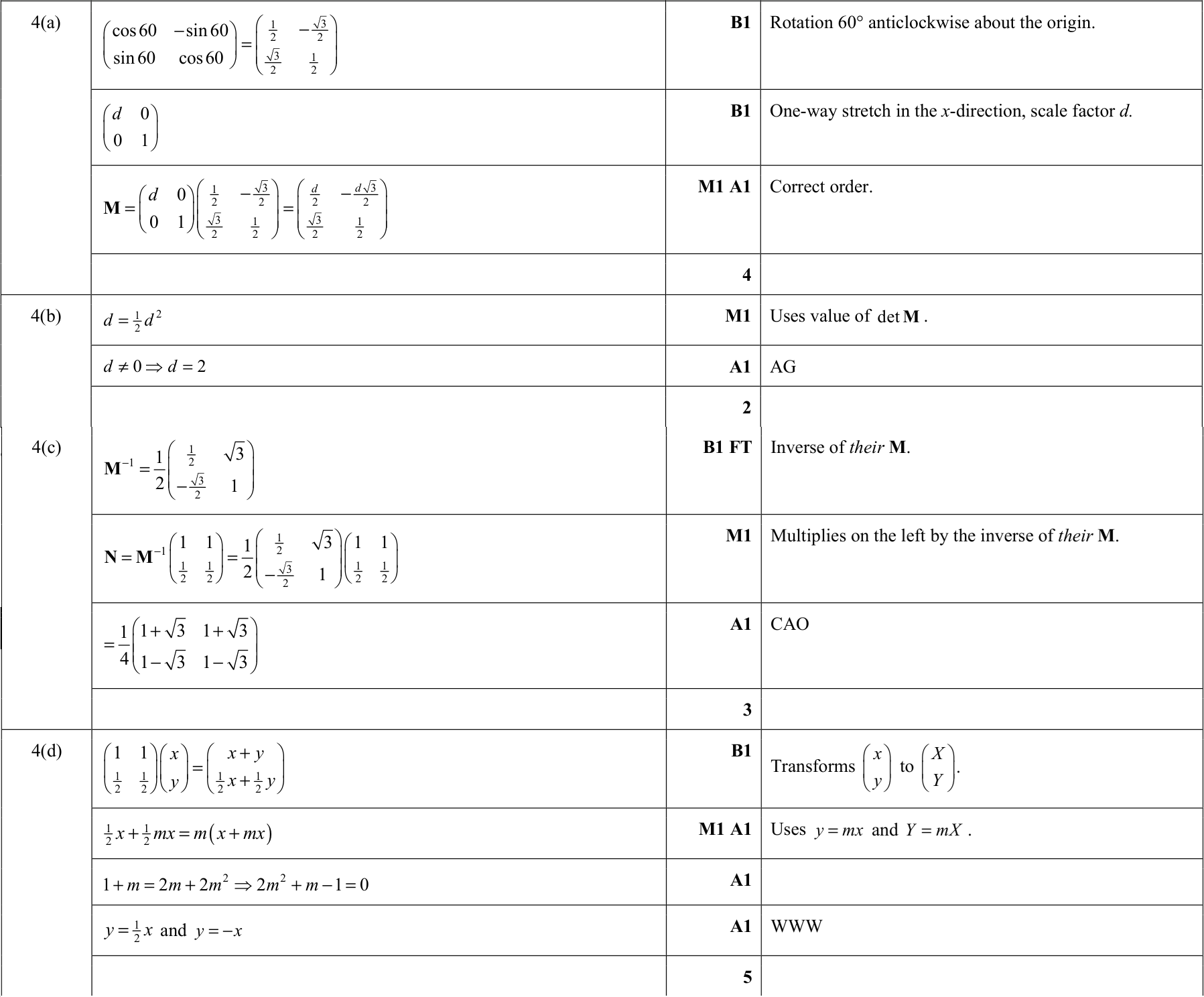
The matrix \(\mathbf{M}\) represents the sequence of two transformations in the \(x\)-\(y\) plane given by a rotation of \(60^\circ\) anticlockwise about the origin followed by a one-way stretch in the \(x\)-direction with scale factor \(d\) \((d \neq 0)\).
- Find \(\mathbf{M}\) in terms of \(d\).
- The unit square in the \(x\)-\(y\) plane is transformed by \(\mathbf{M}\) onto a parallelogram of area \(\tfrac{1}{2} d^2\) square units. Show that \(d = 2\).
- The matrix \(\mathbf{N}\) is such that \[ \mathbf{M}\mathbf{N} = \begin{pmatrix} 1 & 1 \\ \tfrac{1}{2} & \tfrac{1}{2} \end{pmatrix}. \] Find \(\mathbf{N}\).
- Find the equations of the invariant lines, through the origin, of the transformation in the \(x\)-\(y\) plane represented by \(\mathbf{M}\mathbf{N}\).
9231 P12 - Jun 2021 - Q06 - 12 marks
Let \(t\) be a positive constant.
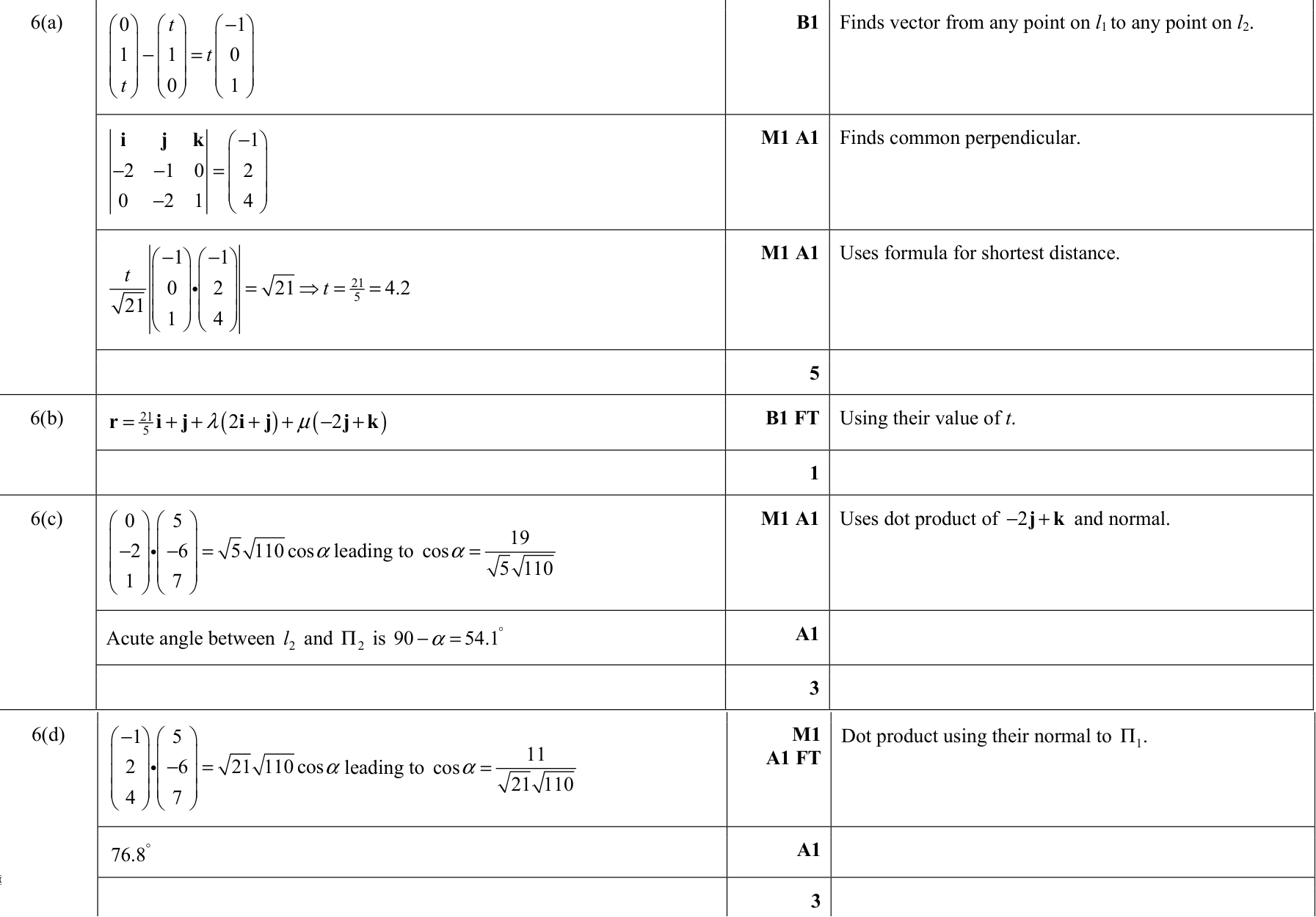
The line \(l_1\) passes through the point with position vector \(t\mathbf{i} + \mathbf{j}\) and is parallel to the vector \(-2\mathbf{i} - \mathbf{j}\).
The line \(l_2\) passes through the point with position vector \(\mathbf{j} + t\mathbf{k}\) and is parallel to the vector \(-2\mathbf{j} + \mathbf{k}\).
It is given that the shortest distance between the lines \(l_1\) and \(l_2\) is \(\sqrt{21}\).
(a) Find the value of \(t\). [5]
The plane \(\Pi_1\) contains \(l_1\) and is parallel to \(l_2\).
(b) Write down an equation of \(\Pi_1\), giving your answer in the form \(\mathbf{r} = \mathbf{a} + \lambda \mathbf{b} + \mu \mathbf{c}\).
The plane \(\Pi_2\) has Cartesian equation \(5x - 6y + 7z = 0\).
(c) Find the acute angle between \(l_2\) and \(\Pi_2\). [3]
(d) Find the acute angle between \(\Pi_1\) and \(\Pi_2\). [3]
9231 P13 - Jun 2021 - Q04 - 11 marks
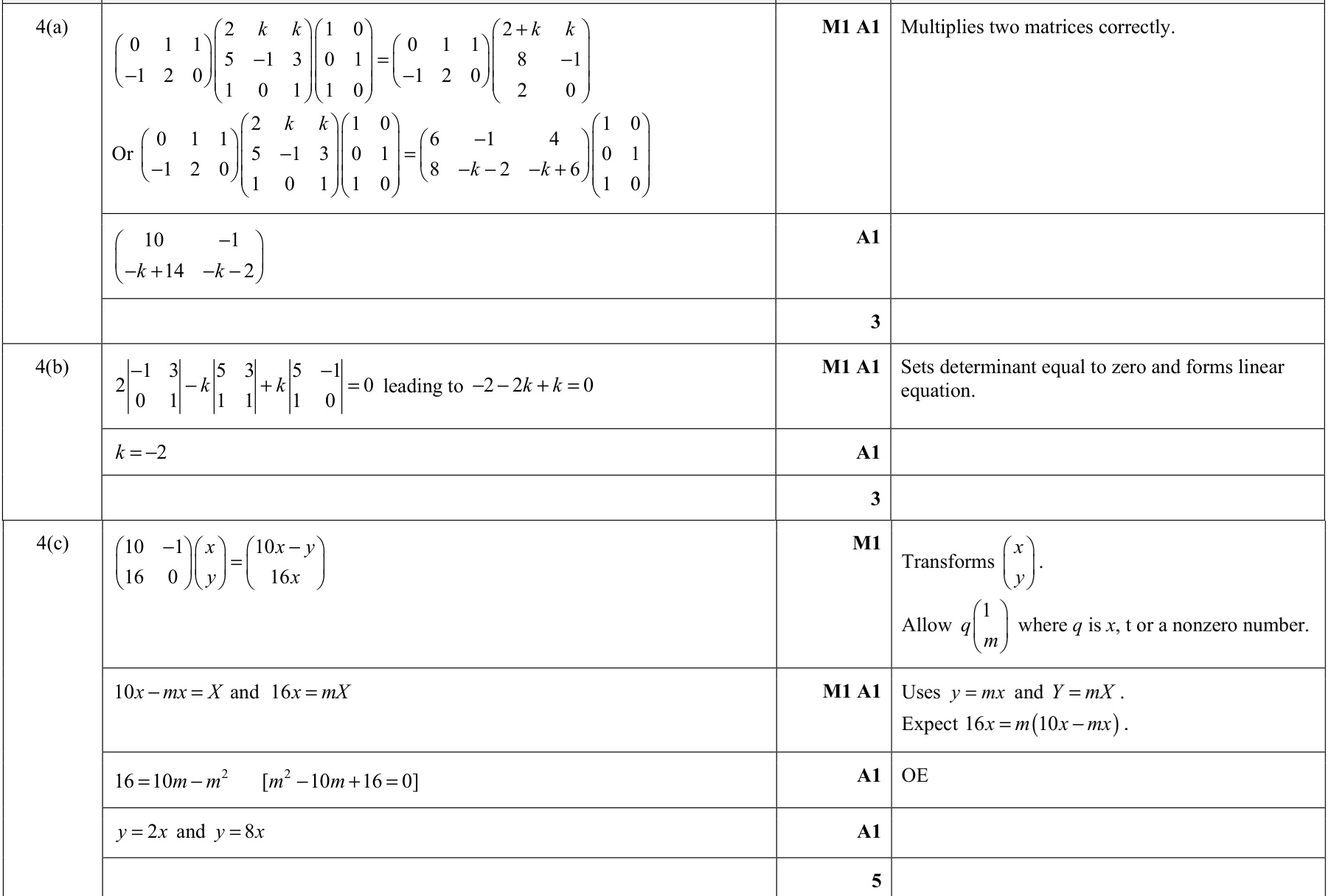
The matrices A, B and C are given by
\(A = \begin{pmatrix} 2 & k & k \\ 5 & -1 & 3 \\ 1 & 0 & 1 \end{pmatrix}, \quad B = \begin{pmatrix} 1 & 0 \\ 0 & 1 \\ 1 & 0 \end{pmatrix} \quad \text{and} \quad C = \begin{pmatrix} 0 & 1 & 1 \\ -1 & 2 & 0 \end{pmatrix},\)
where \(k\) is a real constant.
- Find \(CAB\).
- Given that \(A\) is singular, find the value of \(k\).
- Using the value of \(k\) from part (b), find the equations of the invariant lines, through the origin, of the transformation in the \(x-y\) plane represented by \(CAB\).
9231 P13 - Jun 2021 - Q06 - 15 marks
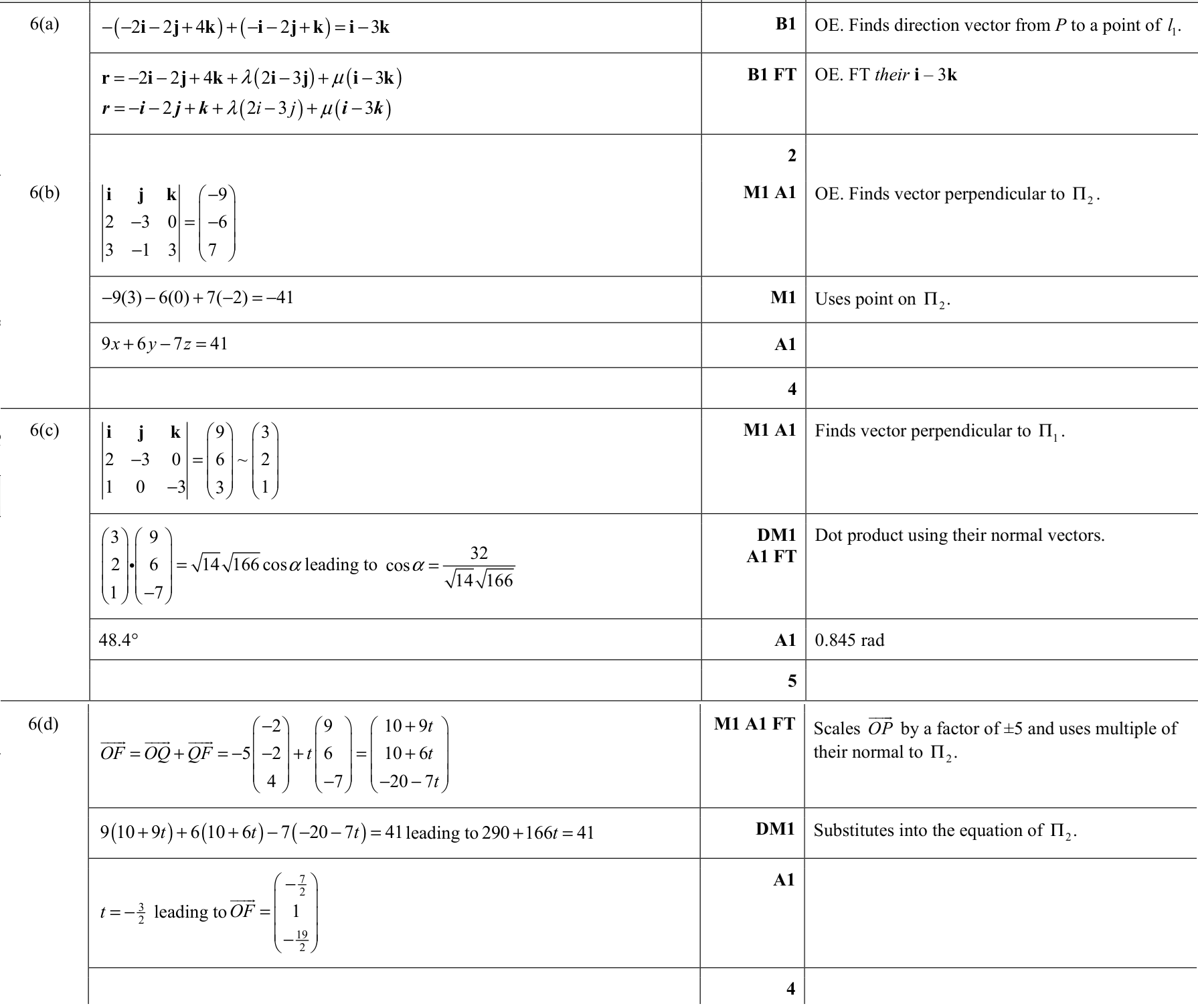
The lines \(l_1\) and \(l_2\) have equations \(\mathbf{r} = -\mathbf{i} - 2\mathbf{j} + \mathbf{k} + s(2\mathbf{i} - 3\mathbf{j})\) and \(\mathbf{r} = 3\mathbf{i} - 2\mathbf{k} + t(3\mathbf{i} - \mathbf{j} + 3\mathbf{k})\) respectively.
The plane \(\Pi_1\) contains \(l_1\) and the point \(P\) with position vector \(-2\mathbf{i} - 2\mathbf{j} + 4\mathbf{k}\).
- (a) Find an equation of \(\Pi_1\), giving your answer in the form \(\mathbf{r} = \mathbf{a} + \lambda \mathbf{b} + \mu \mathbf{c}\).
- (b) The plane \(\Pi_2\) contains \(l_2\) and is parallel to \(l_1\). Find an equation of \(\Pi_2\), giving your answer in the form \(ax + by + cz = d\).
- (c) Find the acute angle between \(\Pi_1\) and \(\Pi_2\).
- (d) The point \(Q\) is such that \(\overrightarrow{OQ} = -5\overrightarrow{OP}\). Find the position vector of the foot of the perpendicular from the point \(Q\) to \(\Pi_2\).
9231 P11 - Nov 2021 - Q05 - 13 marks
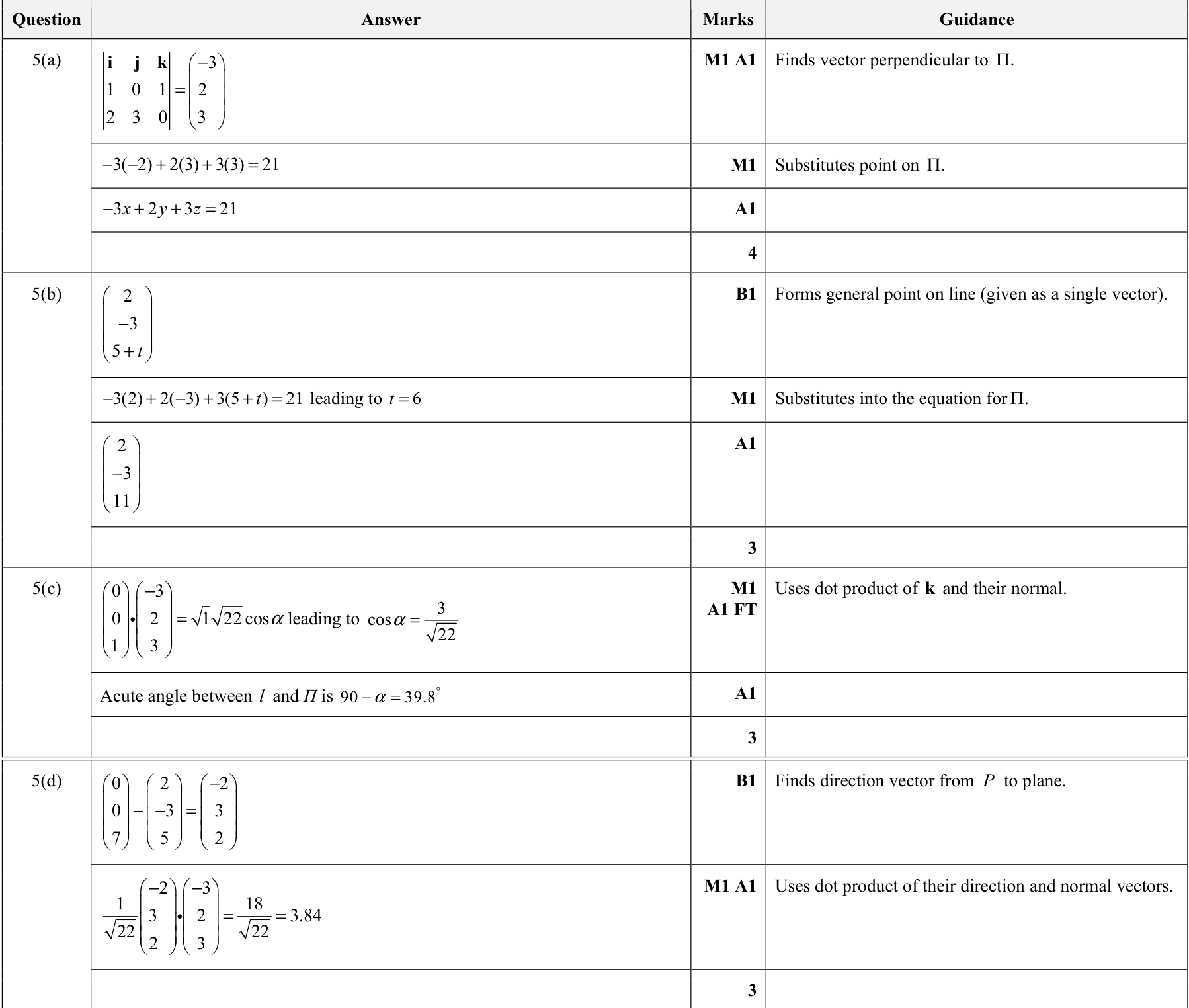
The plane \(\Pi\) has equation \(\mathbf{r} = -2\mathbf{i} + 3\mathbf{j} + 3\mathbf{k} + \lambda (\mathbf{i} + \mathbf{k}) + \mu (2\mathbf{i} + 3\mathbf{j})\).
- Find a Cartesian equation of \(\Pi\), giving your answer in the form \(ax + by + cz = d\).
- The line \(l\) passes through the point \(P\) with position vector \(2\mathbf{i} - 3\mathbf{j} + 5\mathbf{k}\) and is parallel to the vector \(\mathbf{k}\). Find the position vector of the point where \(l\) meets \(\Pi\).
- Find the acute angle between \(l\) and \(\Pi\).
- Find the perpendicular distance from \(P\) to \(\Pi\).
9231 P12 - Nov 2021 - Q01 - 9 marks
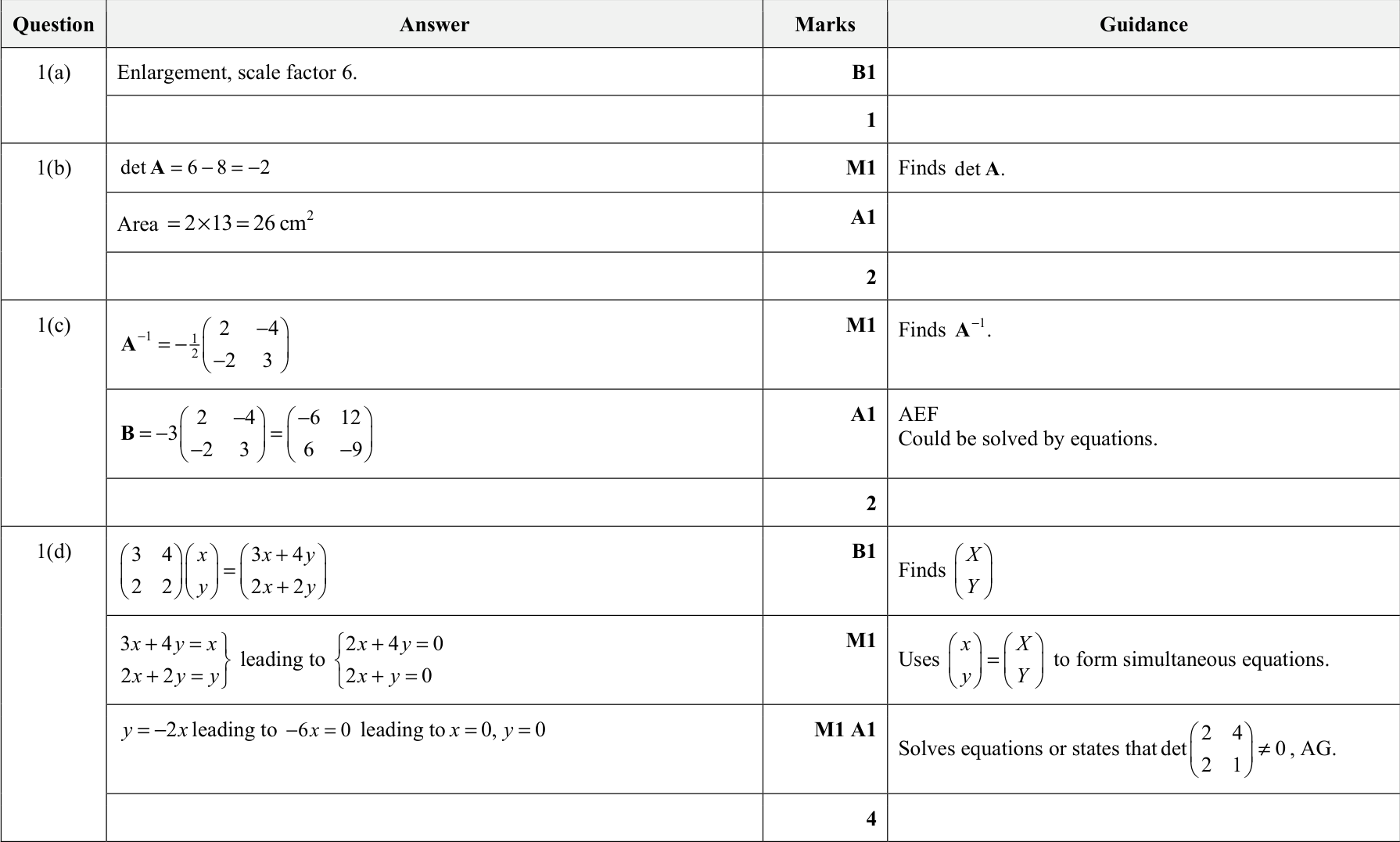
(a) Give full details of the geometrical transformation in the x-y plane represented by the matrix \(\begin{pmatrix} 6 & 0 \\ 0 & 6 \end{pmatrix}\).
Let \(\mathbf{A} = \begin{pmatrix} 3 & 4 \\ 2 & 2 \end{pmatrix}\).
(b) The triangle DEF in the x-y plane is transformed by \(\mathbf{A}\) onto triangle PQR. Given that the area of triangle DEF is 13 cm2, find the area of triangle PQR.
(c) Find the matrix \(\mathbf{B}\) such that \(\mathbf{AB} = \begin{pmatrix} 6 & 0 \\ 0 & 6 \end{pmatrix}\).
(d) Show that the origin is the only invariant point of the transformation in the x-y plane represented by \(\mathbf{A}\).
9231 P12 - Nov 2021 - Q07 - 17 marks
The points A, B, C have position vectors
\(2\mathbf{i} + 2\mathbf{j}, \quad -\mathbf{j} + \mathbf{k} \quad \text{and} \quad 2\mathbf{i} + \mathbf{j} - 7\mathbf{k}\)
respectively, relative to the origin O.
(a) Find an equation of the plane OAB, giving your answer in the form \(\mathbf{r} \cdot \mathbf{n} = p\).
The plane \(\Pi\) has equation \(x - 3y - 2z = 1\).
(b) Find the perpendicular distance of \(\Pi\) from the origin.
(c) Find the acute angle between the planes OAB and \(\Pi\).
(d) Find an equation for the common perpendicular to the lines OC and AB.
9231 P11 - Nov 2020 - Q4 - 11 marks
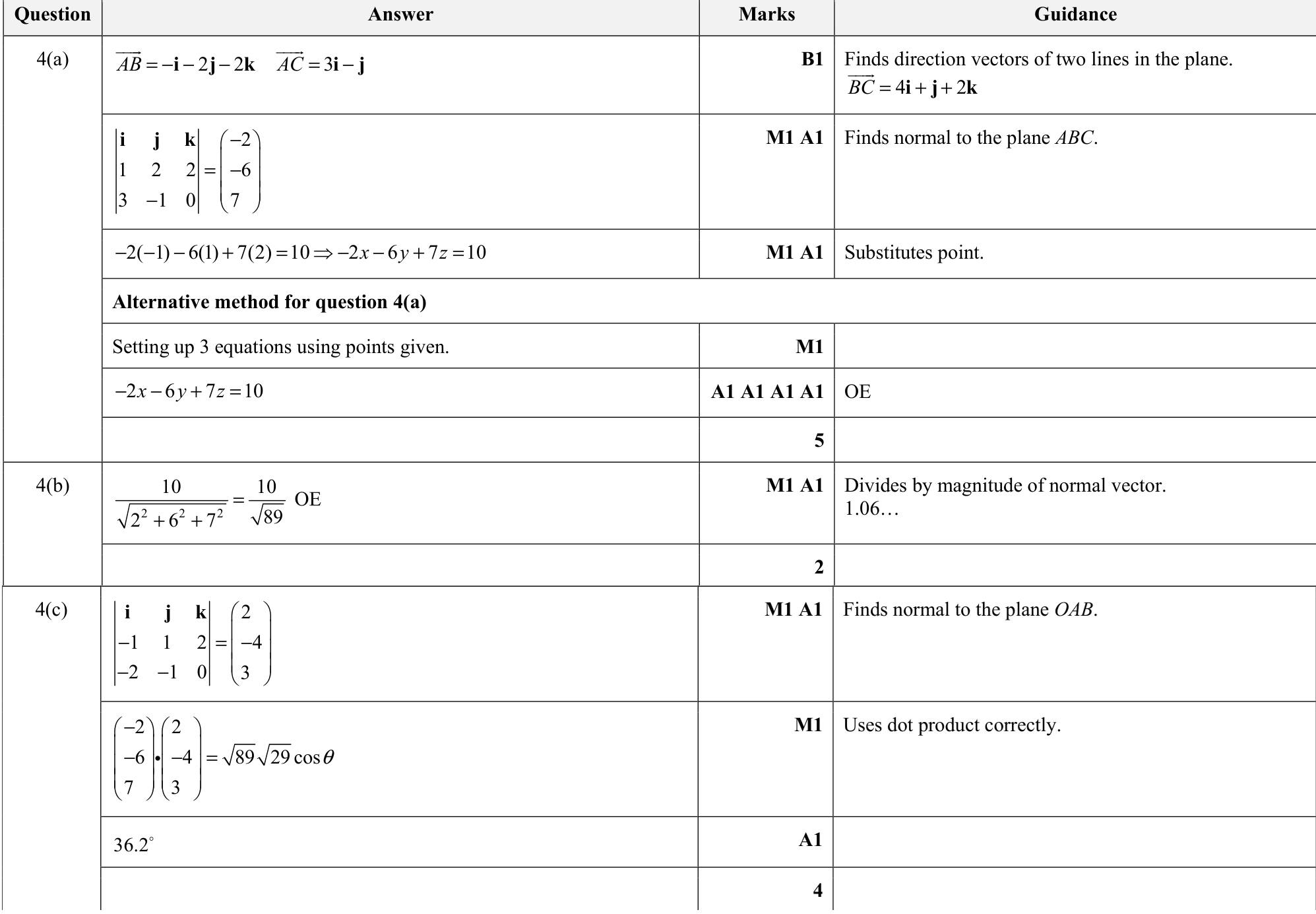
4 The points \(A, B, C\) have position vectors
\(-\mathbf{i}+\mathbf{j}+2 \mathbf{k}, \quad-2 \mathbf{i}-\mathbf{j}, \quad 2 \mathbf{i}+2 \mathbf{k},\)
respectively, relative to the origin \(O\).
(a) Find the equation of the plane \(A B C\), giving your answer in the form \(a x+b y+c z=d\).
(b) Find the perpendicular distance from \(O\) to the plane \(A B C\).
(c) Find the acute angle between the planes \(O A B\) and \(A B C\).
9231 P11 - Jun 2020 - Q5 - 12 marks
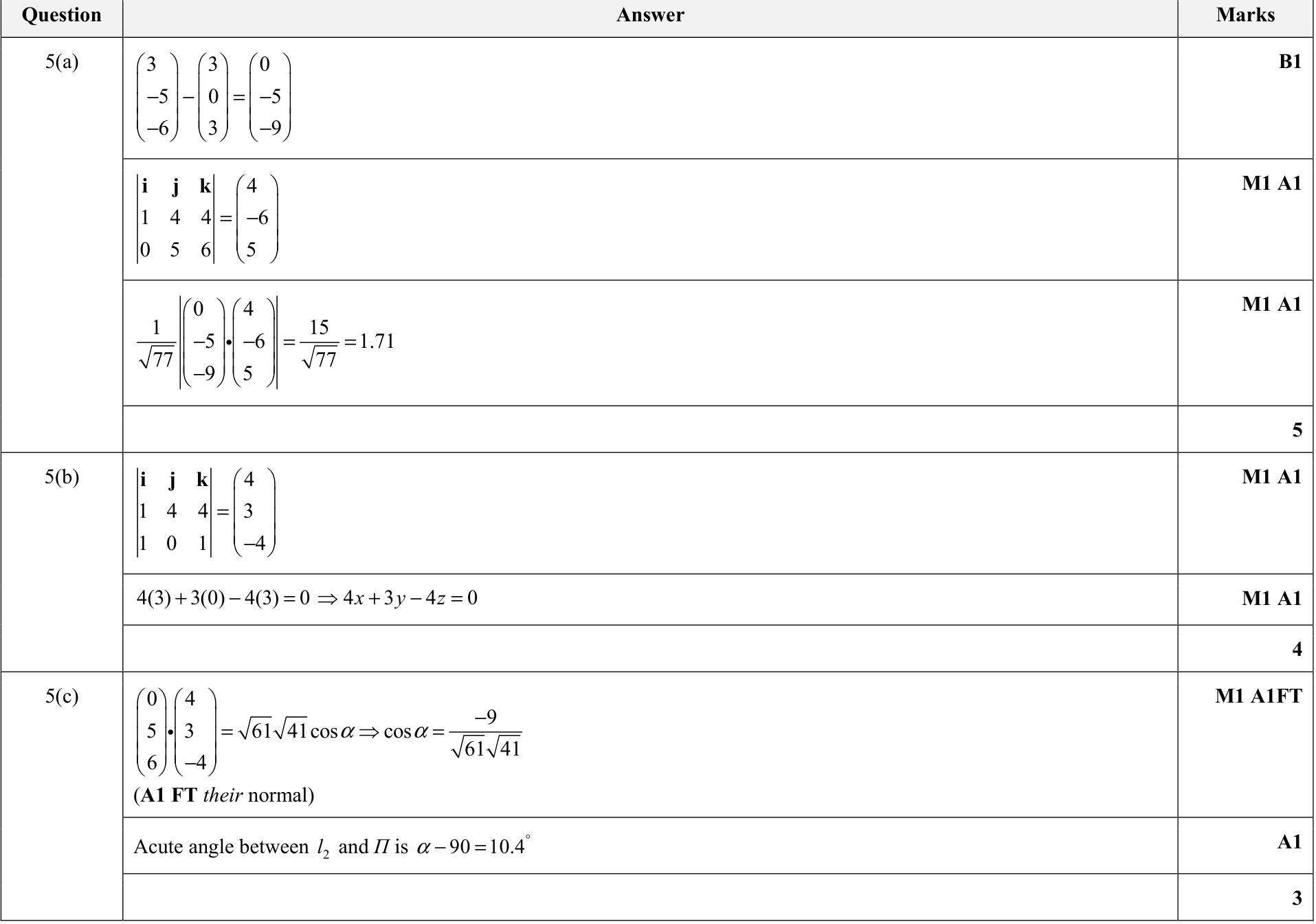
5 The lines \(l_{1}\) and \(l_{2}\) have equations \(\mathbf{r}=3 \mathbf{i}+3 \mathbf{k}+\lambda(\mathbf{i}+4 \mathbf{j}+4 \mathbf{k})\) and \(\mathbf{r}=3 \mathbf{i}-5 \mathbf{j}-6 \mathbf{k}+\mu(5 \mathbf{j}+6 \mathbf{k})\) respectively.
(a) Find the shortest distance between \(l_{1}\) and \(l_{2}\).
The plane \(\Pi\) contains \(l_{1}\) and is parallel to the vector \(\mathbf{i}+\mathbf{k}\).
(b) Find the equation of \(\Pi\), giving your answer in the form \(a x+b y+c z=d\).
(c) Find the acute angle between \(l_{2}\) and \(\Pi\).
9231 P13 - Jun 2019 - Q7 - 10 marks
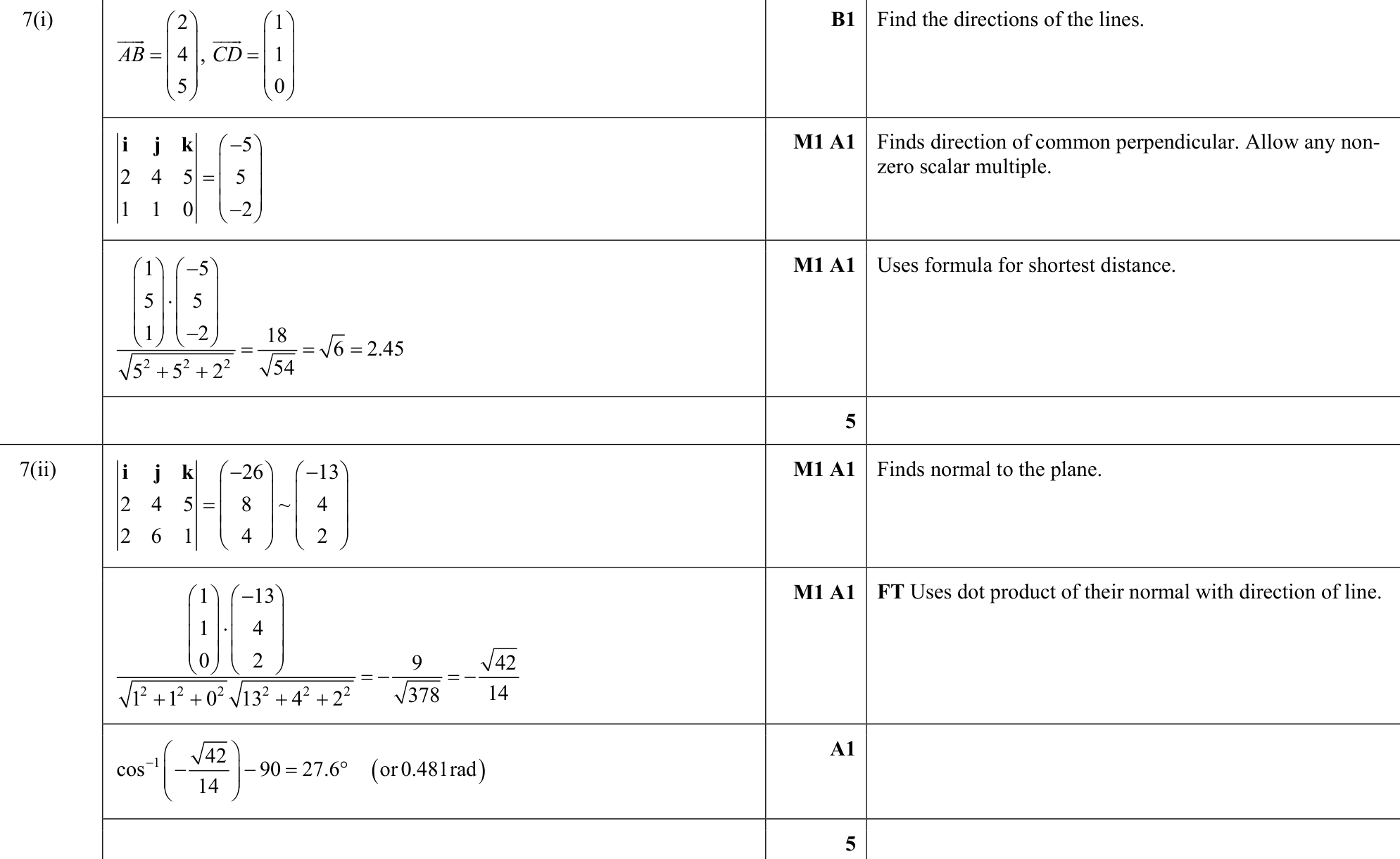
7 The line \(l_{1}\) passes through the points \(A(-3,1,4)\) and \(B(-1,5,9)\). The line \(l_{2}\) passes through the points \(C(-2,6,5)\) and \(D(-1,7,5)\).
(i) Find the shortest distance between the lines \(l_{1}\) and \(l_{2}\).
(ii) Find the acute angle between the line \(l_{2}\) and the plane containing \(A, B\) and \(D\).
9231 P11 - Nov 2019 - Q6 - 9 marks
With \(O\) as the origin, the points \(A, B, C\) have position vectors
\(\mathbf{i}-\mathbf{j}, \quad 2 \mathbf{i}+\mathbf{j}+7 \mathbf{k}, \quad \mathbf{i}-\mathbf{j}+\mathbf{k}\)
respectively.
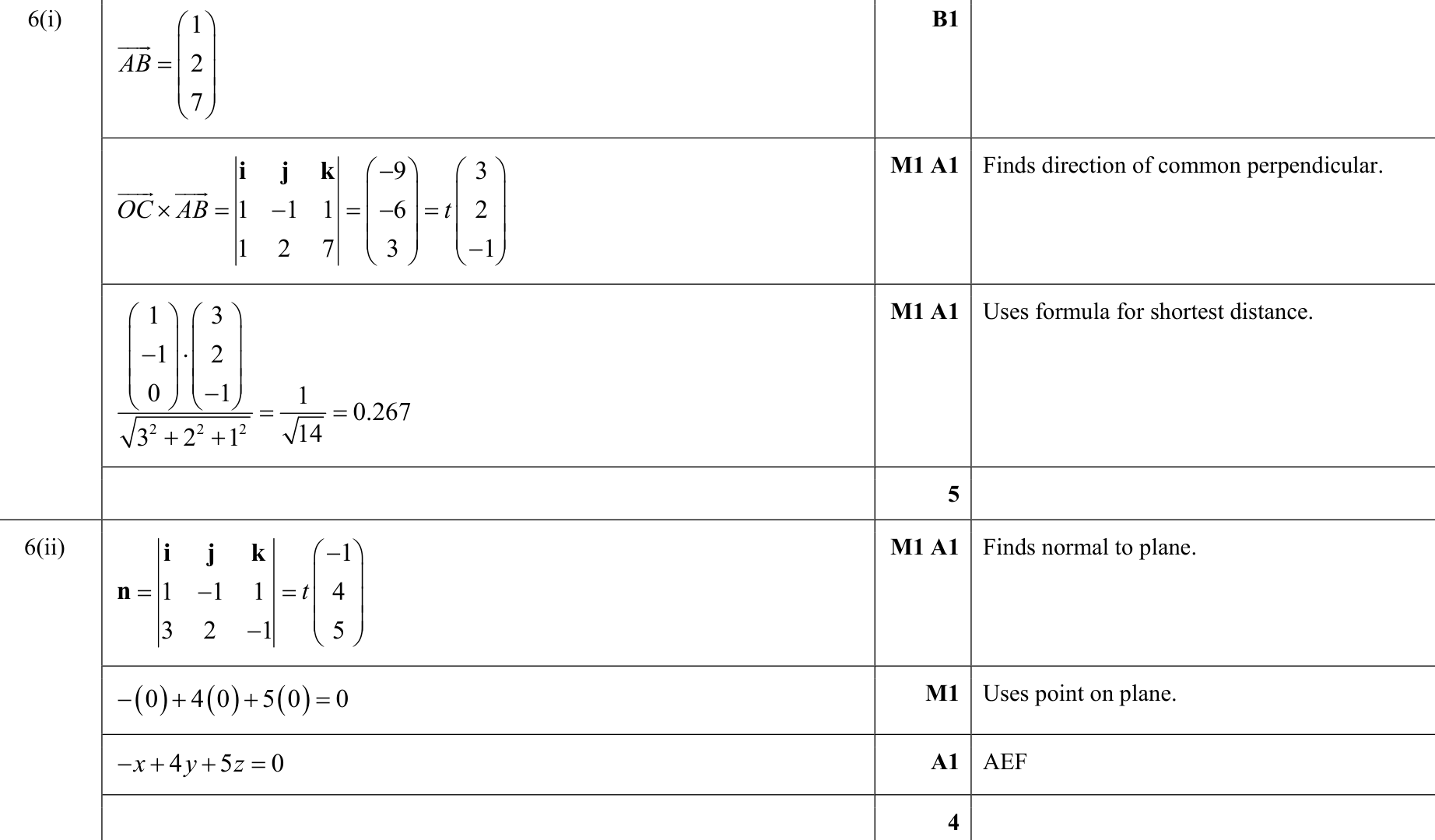
(i) Find the shortest distance between the lines \(O C\) and \(A B\).
(ii) Find the cartesian equation of the plane containing the line \(O C\) and the common perpendicular of the lines \(O C\) and \(A B\).
9231 P11 - Jun 2018 - Q10 - 12 marks
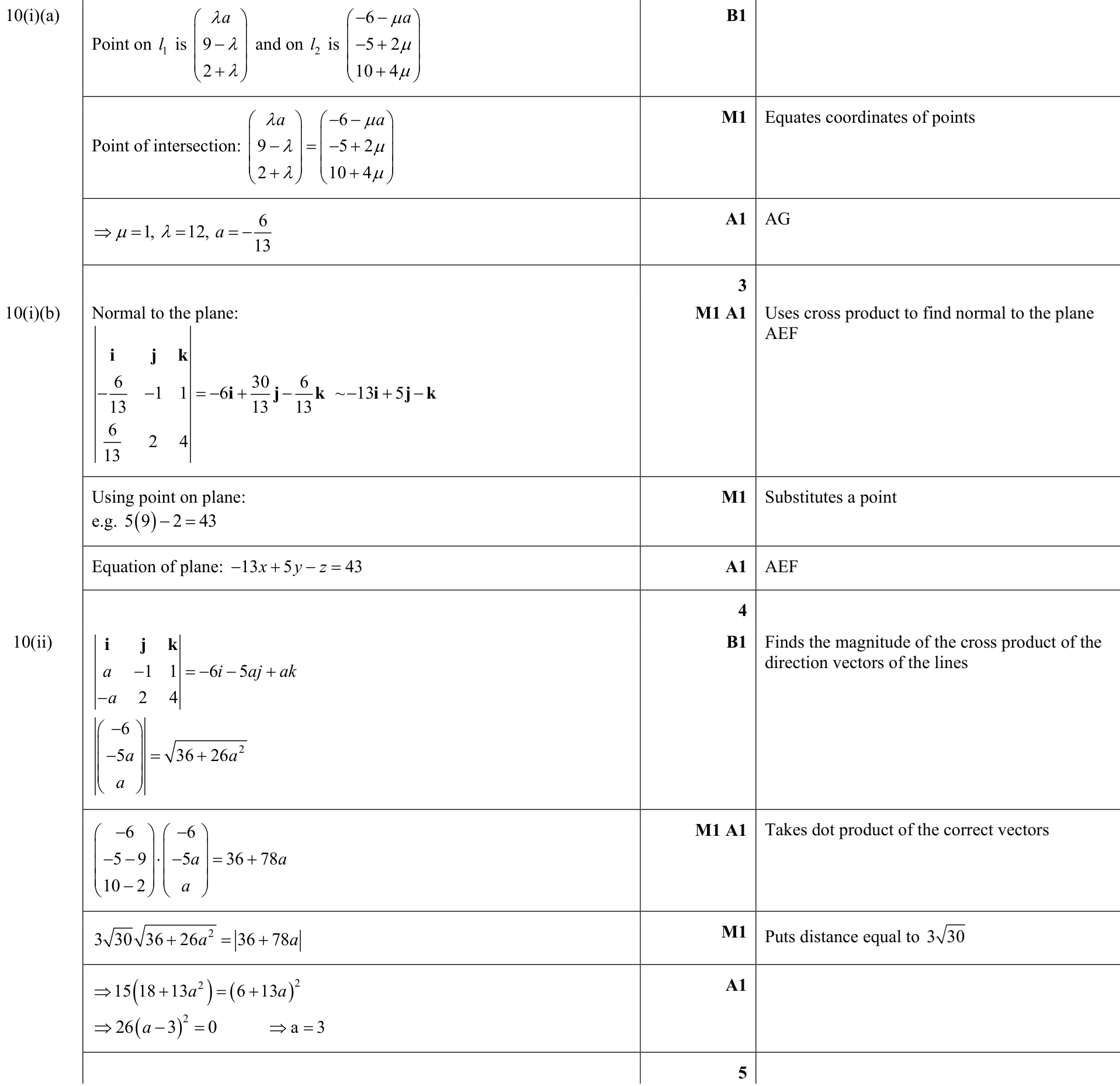
The line \(l_1\) is parallel to the vector \(a\mathbf i-\mathbf j+\mathbf k\), where \(a\) is a constant, and passes through the point whose position vector is \(9\mathbf j+2\mathbf k\). The line \(l_2\) is parallel to the vector \(-a\mathbf i+2\mathbf j+4\mathbf k\) and passes through the point whose position vector is \(-6\mathbf i-5\mathbf j+10\mathbf k\).
(i) It is given that \(l_1\) and \(l_2\) intersect.
(a) Show that \(a=-\frac{6}{13}\).
(b) Find a Cartesian equation of the plane containing \(l_1\) and \(l_2\).
(ii) Given instead that the perpendicular distance between \(l_1\) and \(l_2\) is \(3\sqrt{30}\), find the value of \(a\).
9231 P13 - Jun 2018 - Q7 - 11 marks
The lines \(l_{1}\) and \(l_{2}\) have vector equations
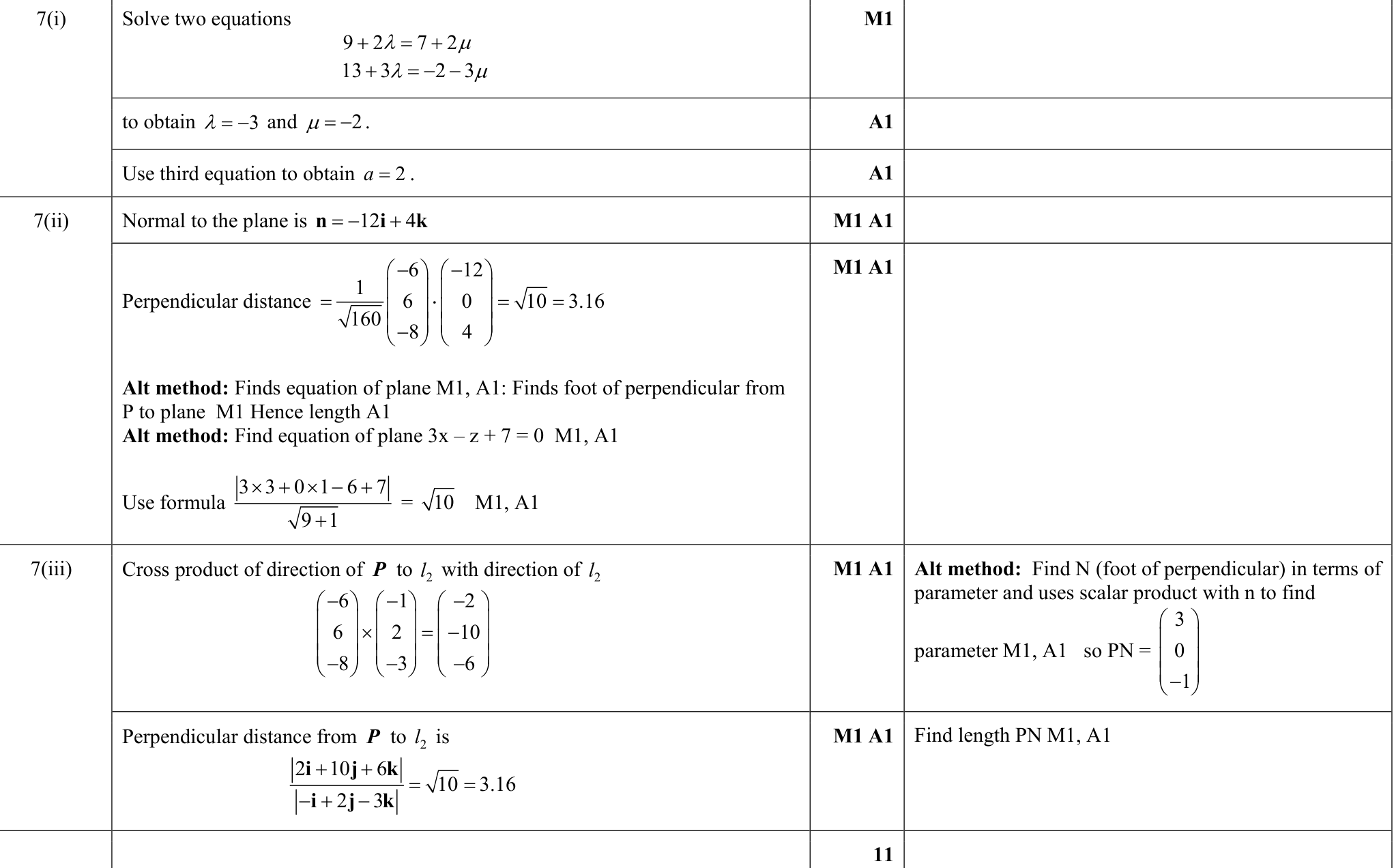
\(\mathbf{r}=a \mathbf{i}+9 \mathbf{j}+13 \mathbf{k}+\lambda(\mathbf{i}+2 \mathbf{j}+3 \mathbf{k}) \quad \text { and } \quad \mathbf{r}=-3 \mathbf{i}+7 \mathbf{j}-2 \mathbf{k}+\mu(-\mathbf{i}+2 \mathbf{j}-3 \mathbf{k})\)
respectively. It is given that \(l_{1}\) and \(l_{2}\) intersect.
(i) Find the value of the constant \(a\).
The point \(P\) has position vector \(3 \mathbf{i}+\mathbf{j}+6 \mathbf{k}\).
(ii) Find the perpendicular distance from \(P\) to the plane containing \(l_{1}\) and \(l_{2}\).
(iii) Find the perpendicular distance from \(P\) to \(l_{2}\).
9231 P11 - Nov 2018 - Q8 - 10 marks
The plane \(\Pi_1\) has equation
\(\mathbf r=\begin{pmatrix}5\\1\\0\end{pmatrix}+s\begin{pmatrix}-4\\1\\3\end{pmatrix}+t\begin{pmatrix}0\\1\\2\end{pmatrix}.\)
(i) Find a cartesian equation of \(\Pi_1\).
The plane \(\Pi_2\) has equation \(3x+y-z=3\).
(ii) Find the acute angle between \(\Pi_1\) and \(\Pi_2\), giving your answer in degrees.
(iii) Find an equation of the line of intersection of \(\Pi_1\) and \(\Pi_2\), giving your answer in the form \(\mathbf r=\mathbf a+\lambda\mathbf b\).

9231 P11 - Nov 2025 - Q5 - 11 marks
(a) The plane \(\Pi_1\) has equation \(\mathbf r=-3\mathbf i-\mathbf j-\mathbf k+\lambda(\mathbf j+2\mathbf k)+\mu(\mathbf i+3\mathbf j+\mathbf k)\). Find an equation for \(\Pi_1\) in the form \(ax+by+cz=d\).
(b) Find the perpendicular distance from the point with position vector \(-\mathbf i-2\mathbf k\) to \(\Pi_1\).
(c) The plane \(\Pi_2\) has equation \(3x+2y-z=14\). Find a vector equation of the line of intersection of \(\Pi_1\) and \(\Pi_2\).
9231 P12 - Nov 2025 - Q6 - 14 marks
(a) The plane \(\Pi\) has equation \(x+3y+2z=1\). Find the perpendicular distance from the origin \(O\) to \(\Pi\).
(b) Relative to \(O\), points \(A,B,C\) have position vectors \(-\mathbf j+2\mathbf k\), \(2\mathbf i-\mathbf k\), and \(2\mathbf i-\mathbf j-\mathbf k\). Find the acute angle between the planes \(OAB\) and \(\Pi\).
(c) Find an equation for the common perpendicular to the lines \(OC\) and \(AB\).
9231 P12 - Nov 2018 - Q10 - 12 marks
The position vectors of the points \(A, B, C, D\) are
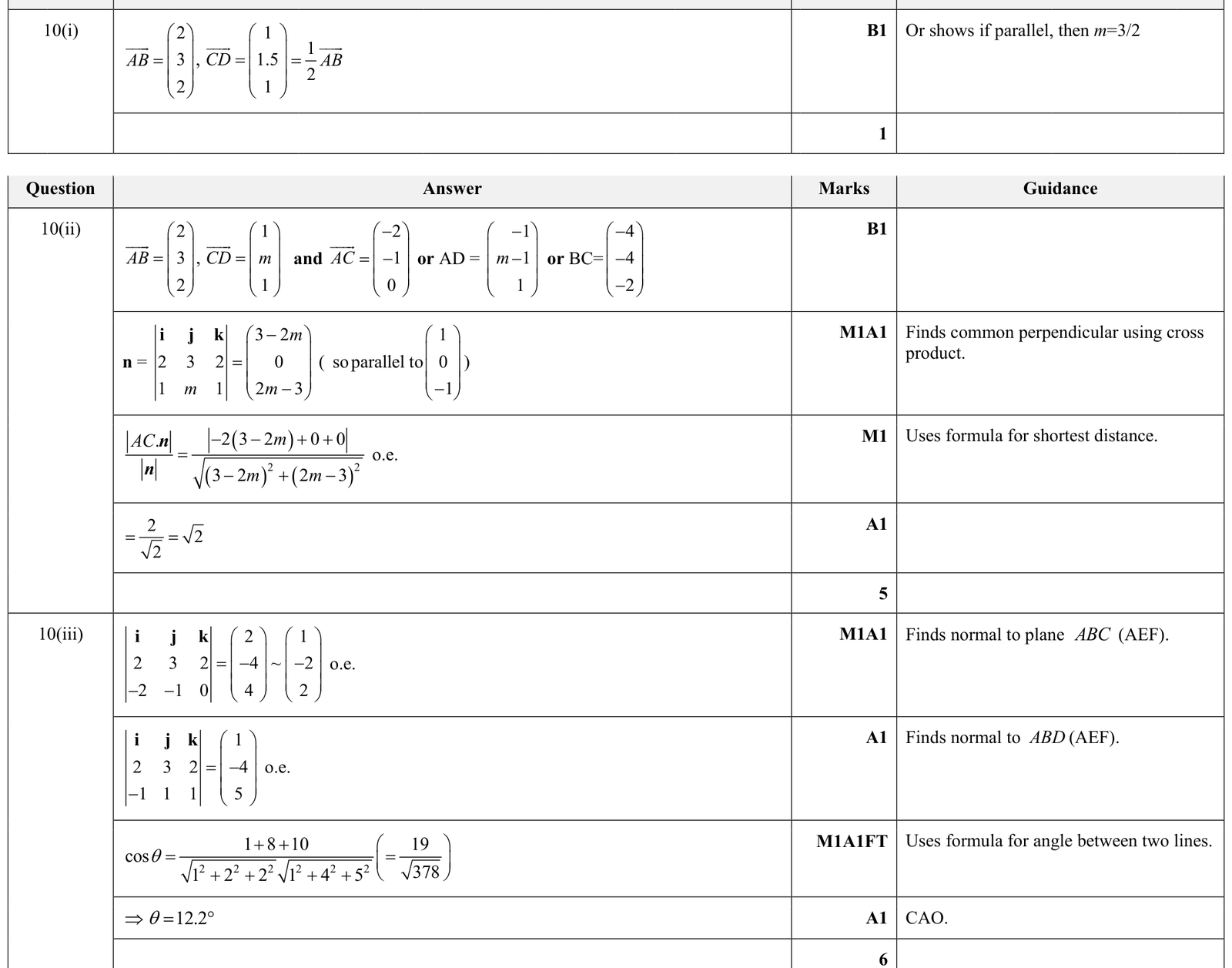
\(\mathbf{i}+\mathbf{j}+3 \mathbf{k}, \quad 3 \mathbf{i}+4 \mathbf{j}+5 \mathbf{k}, \quad-\mathbf{i}+3 \mathbf{k}, \quad m \mathbf{j}+4 \mathbf{k},\)
respectively, where \(m\) is a constant.
(i) Show that the lines \(A B\) and \(C D\) are parallel when \(m=\frac{3}{2}\).
(ii) Given that \(m \neq \frac{3}{2}\), find the shortest distance between the lines \(A B\) and \(C D\).
(iii) When \(m=2\), find the acute angle between the planes \(A B C\) and \(A B D\), giving your answer in degrees.
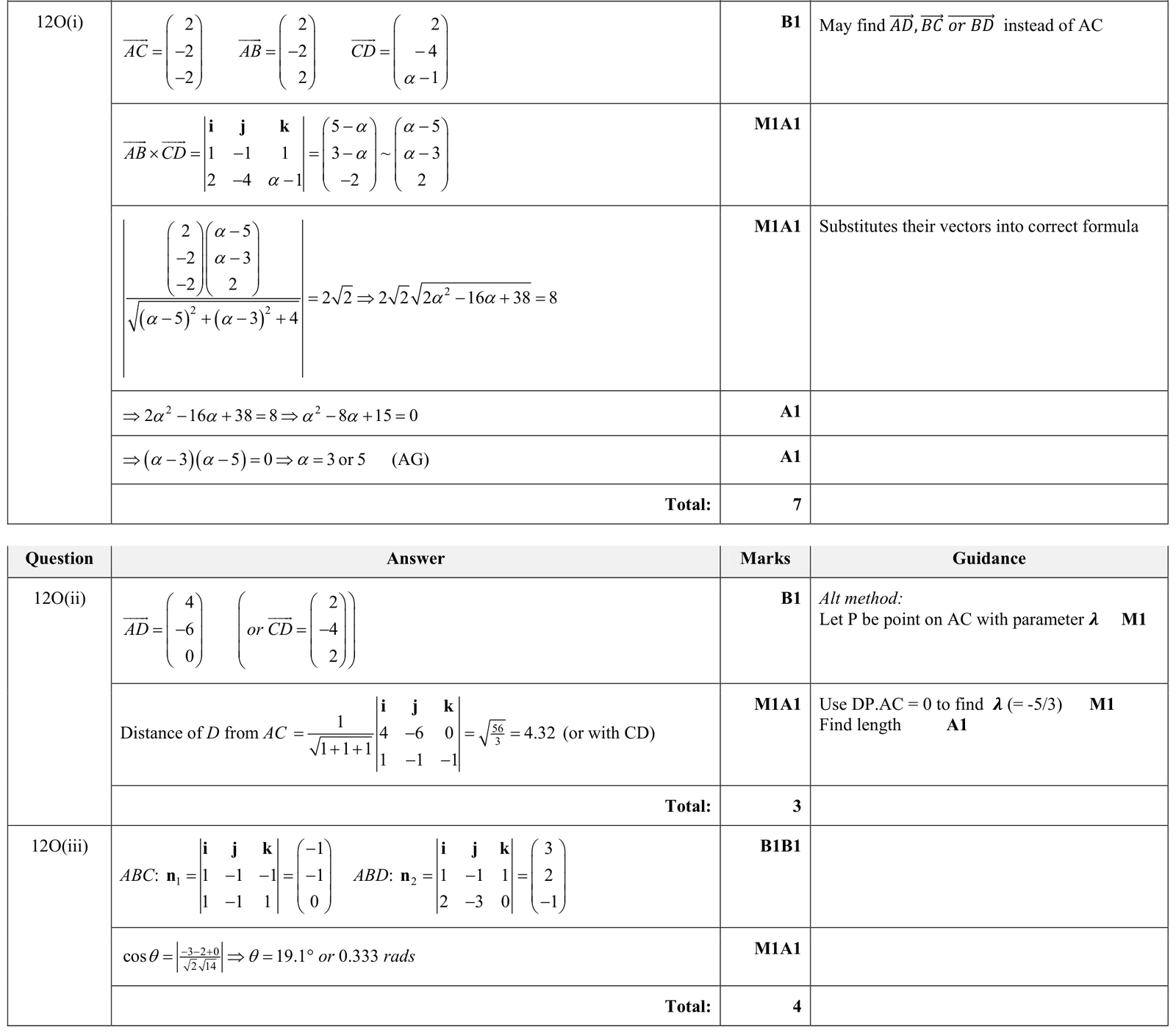
9231 P11 - Jun 2017 - Q12O - 14 marks
The position vectors of the points \(A\), \(B\), \(C\), \(D\) are \(\mathbf{i}+\mathbf{j}+3\mathbf{k}\), \(3\mathbf{i}-\mathbf{j}+5\mathbf{k}\), \(3\mathbf{i}-\mathbf{j}+\mathbf{k}\), and \(5\mathbf{i}-5\mathbf{j}+\alpha\mathbf{k}\), respectively, where \(\alpha\) is a positive integer.
It is given that the shortest distance between the line \(AB\) and the line \(CD\) is equal to \(2\sqrt2\).
(i) Show that the possible values of \(\alpha\) are \(3\) and \(5\).
(ii) Using \(\alpha=3\), find the shortest distance of the point \(D\) from the line \(AC\), giving your answer correct to 3 significant figures.
(iii) Using \(\alpha=3\), find the acute angle between the planes \(ABC\) and \(ABD\), giving your answer correct to 3 significant figures.
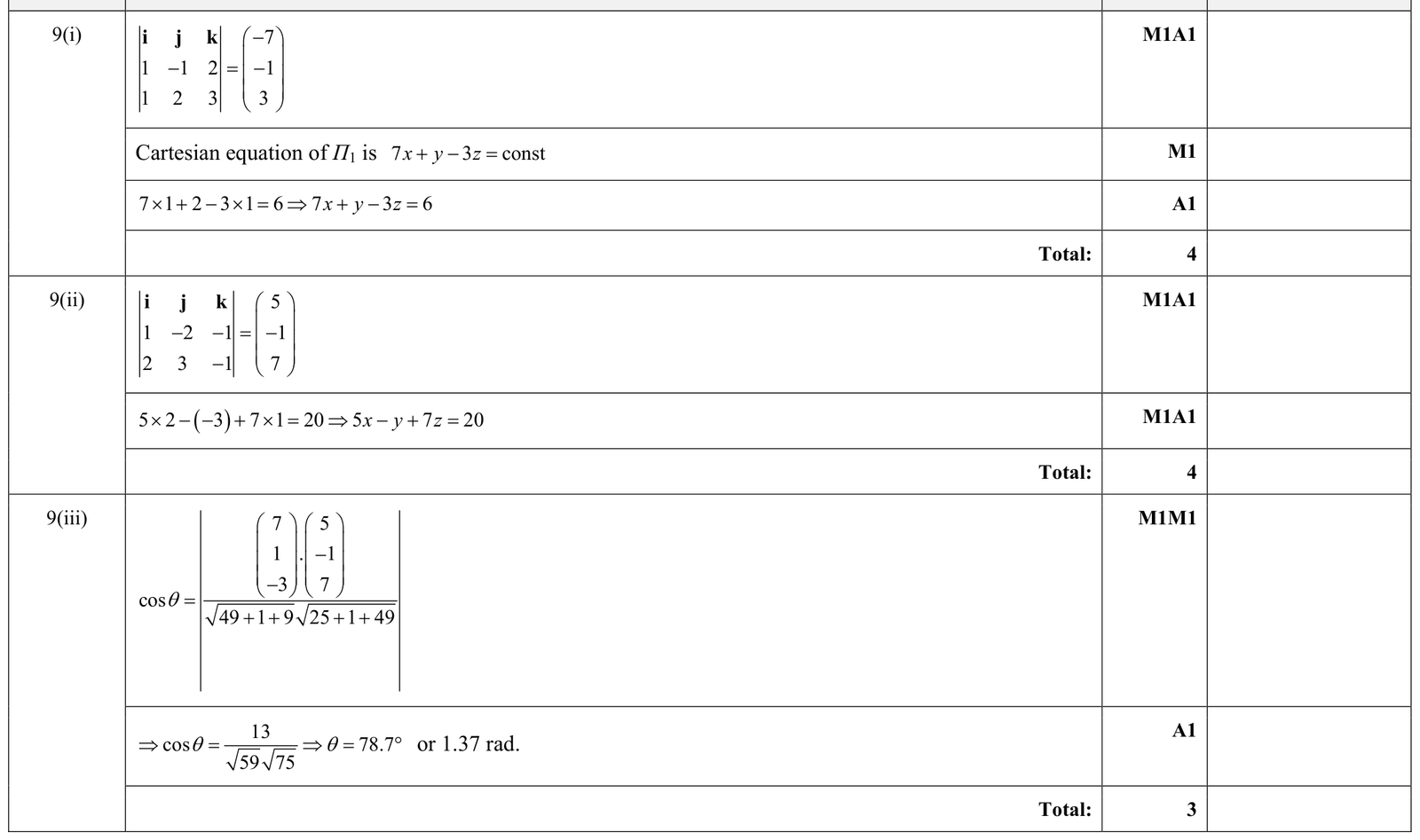
9231 P13 - Jun 2017 - Q9 - 11 marks
The plane \(\Pi_{1}\) passes through the points \((1,2,1)\) and \((5,-2,9)\) and is parallel to the vector \(\mathbf{i}+2 \mathbf{j}+3 \mathbf{k}\).
(i) Find the cartesian equation of \(\Pi_{1}\).
The plane \(\Pi_{2}\) contains the lines
\(\mathbf{r}=2 \mathbf{i}-3 \mathbf{j}+\mathbf{k}+\lambda(\mathbf{i}-2 \mathbf{j}-\mathbf{k}) \quad \text { and } \quad \mathbf{r}=2 \mathbf{i}-3 \mathbf{j}+\mathbf{k}+\mu(2 \mathbf{i}+3 \mathbf{j}-\mathbf{k}) .\)
(ii) Find the cartesian equation of \(\Pi_{2}\).
(iii) Find the acute angle between \(\Pi_{1}\) and \(\Pi_{2}\).
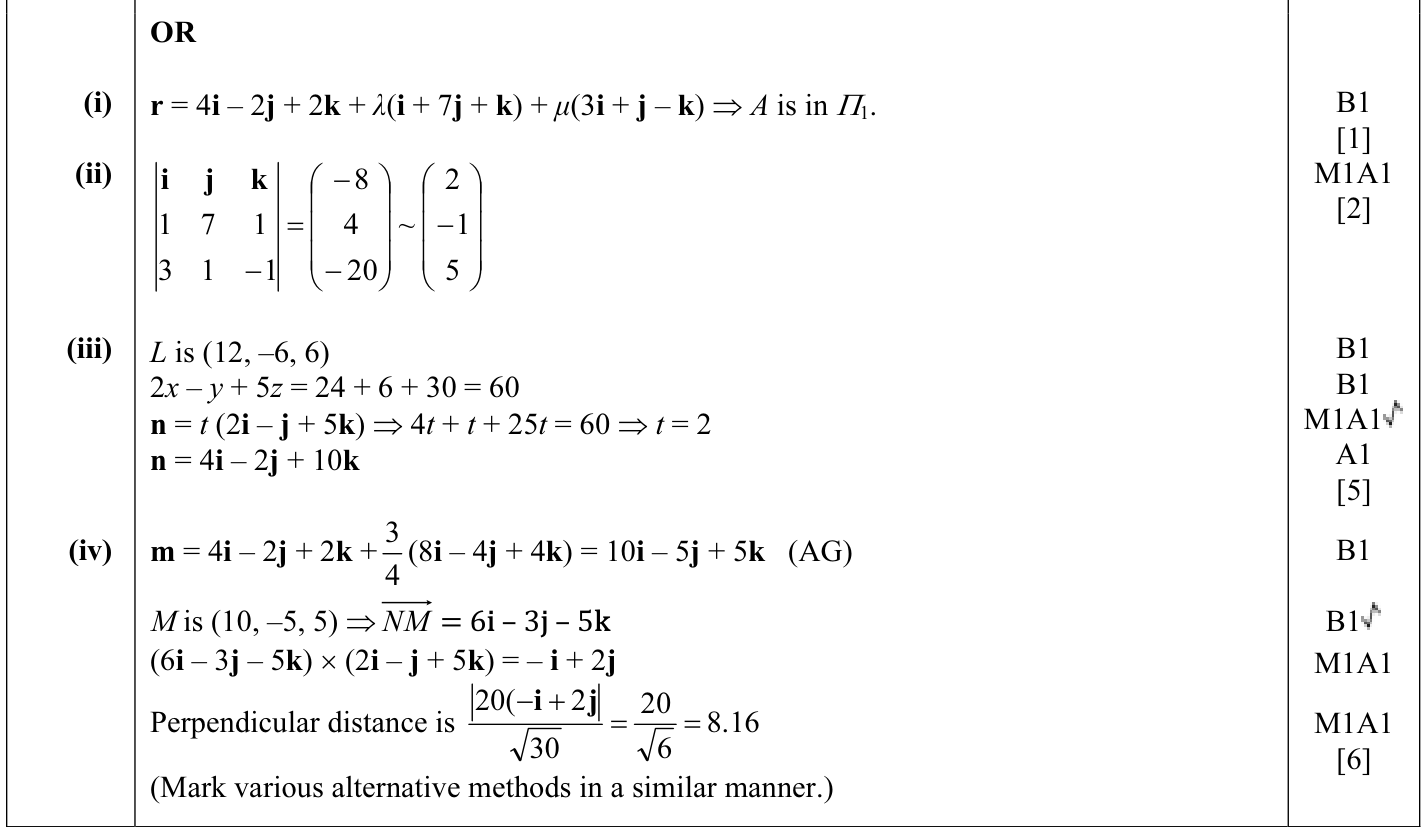
9231 P13 - Jun 2014 - Q11O - 14 marks
With respect to an origin \(O\), the point \(A\) has position vector \(4\mathbf{i}-2\mathbf{j}+2\mathbf{k}\) and the plane \(\Pi_1\) has equation
\(\mathbf{r}=(4+\lambda+3\mu)\mathbf{i}+(-2+7\lambda+\mu)\mathbf{j}+(2+\lambda-\mu)\mathbf{k},\)
where \(\lambda\) and \(\mu\) are real. The point \(L\) is such that \(\overrightarrow{OL}=3\overrightarrow{OA}\), and \(\Pi_2\) is the plane through \(L\) which is parallel to \(\Pi_1\). The point \(M\) is such that \(\overrightarrow{AM}=3\overrightarrow{ML}\).
(i) Show that \(A\) is in \(\Pi_1\).
(ii) Find a vector perpendicular to \(\Pi_2\).
(iii) Find the position vector of the point \(N\) in \(\Pi_2\) such that \(ON\) is perpendicular to \(\Pi_2\).
(iv) Show that the position vector of \(M\) is \(10\mathbf{i}-5\mathbf{j}+5\mathbf{k}\), and find the perpendicular distance of \(M\) from the line through \(O\) and \(N\), giving your answer correct to 3 significant figures.
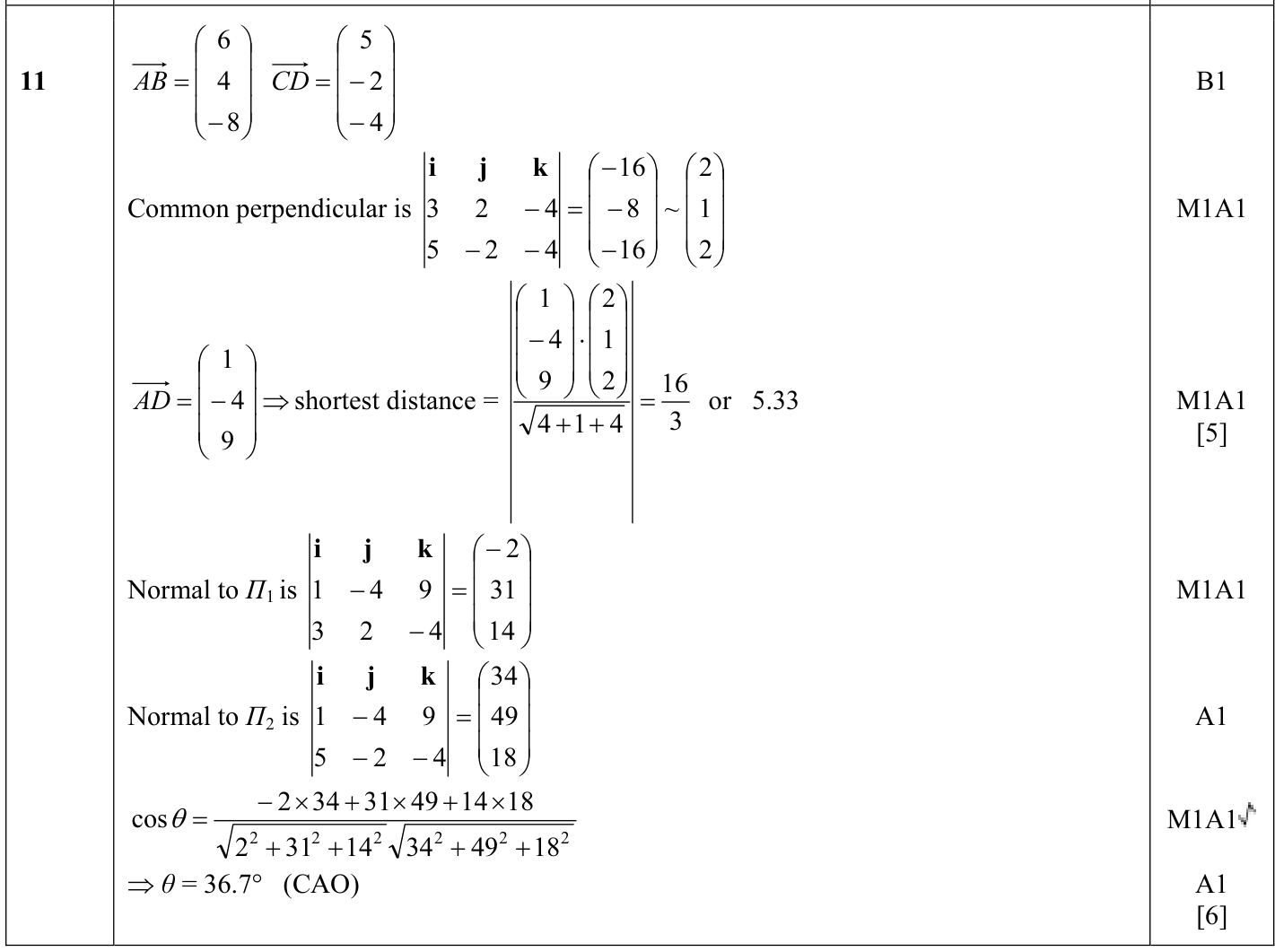
9231 P11 - Jun 2014 - Q11 - 11 marks
The line \(l_{1}\) passes through the points \(A(2,3,-5)\) and \(B(8,7,-13)\). The line \(l_{2}\) passes through the points \(C(-2,1,8)\) and \(D(3,-1,4)\). Find the shortest distance between the lines \(l_{1}\) and \(l_{2}\).
The plane \(\Pi_{1}\) passes through the points \(A, B\) and \(D\). The plane \(\Pi_{2}\) passes though the points \(A, C\) and \(D\). Find the acute angle between \(\Pi_{1}\) and \(\Pi_{2}\), giving your answer in degrees.
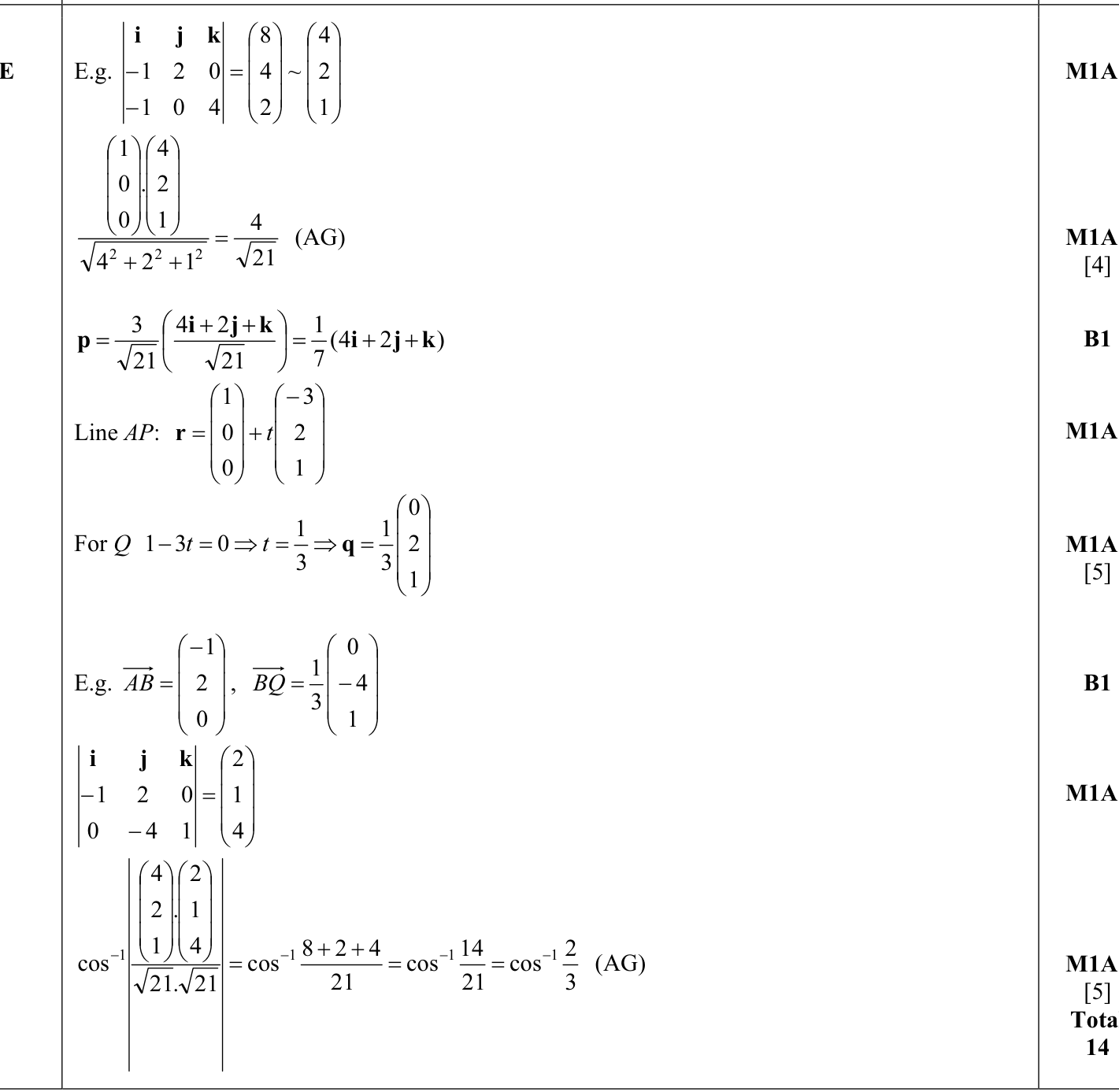
9231 P11 - Nov 2015 - Q11E - 14 marks
The points \(A\), \(B\) and \(C\) have position vectors \(\mathbf{i}\), \(2\mathbf{j}\) and \(4\mathbf{k}\) respectively, relative to an origin \(O\). The point \(N\) is the foot of the perpendicular from \(O\) to the plane \(ABC\). The point \(P\) on the line segment \(ON\) is such that \(OP=\frac{3}{4}ON\). The line \(AP\) meets the plane \(OBC\) at \(Q\).
Find a vector perpendicular to the plane \(ABC\), and show that the length of \(ON\) is \(\frac{4}{\sqrt{21}}\).
Find the position vector of \(Q\).
Show that the acute angle between the planes \(ABC\) and \(ABQ\) is \(\cos^{-1}\left(\frac{2}{3}\right)\).
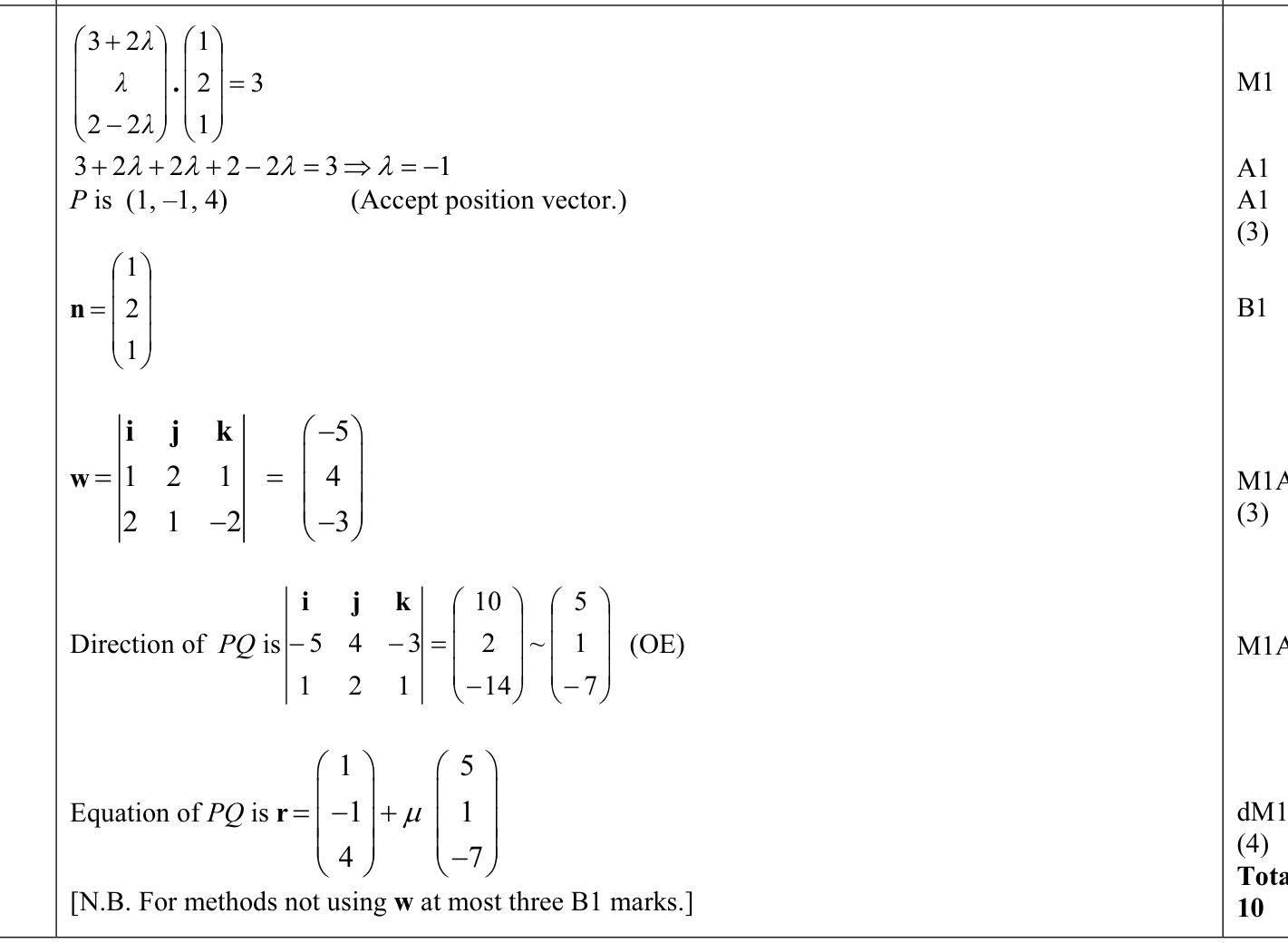
9231 P13 - Jun 2015 - Q8 - 10 marks
A line, passing through the point \(A(3,0,2)\), has vector equation \(\mathbf{r}=3 \mathbf{i}+2 \mathbf{k}+\lambda(2 \mathbf{i}+\mathbf{j}-2 \mathbf{k})\). It meets the plane \(\Pi\), which has equation \(\mathbf{r} \cdot(\mathbf{i}+2 \mathbf{j}+\mathbf{k})=3\), at the point \(P\). Find the coordinates of \(P\).
Write down a vector \(\mathbf{n}\) which is perpendicular to \(\Pi\), and calculate the vector \(\mathbf{w}\), where
\(\mathbf{w}=\mathbf{n} \times(2 \mathbf{i}+\mathbf{j}-2 \mathbf{k}) .\)
The point \(Q\) lies in \(\Pi\) and is the foot of the perpendicular from \(A\) to \(\Pi\). Use the vector \(\mathbf{w}\) to determine an equation of the line \(P Q\) in the form \(\mathbf{r}=\mathbf{u}+\mu \mathbf{v}\).
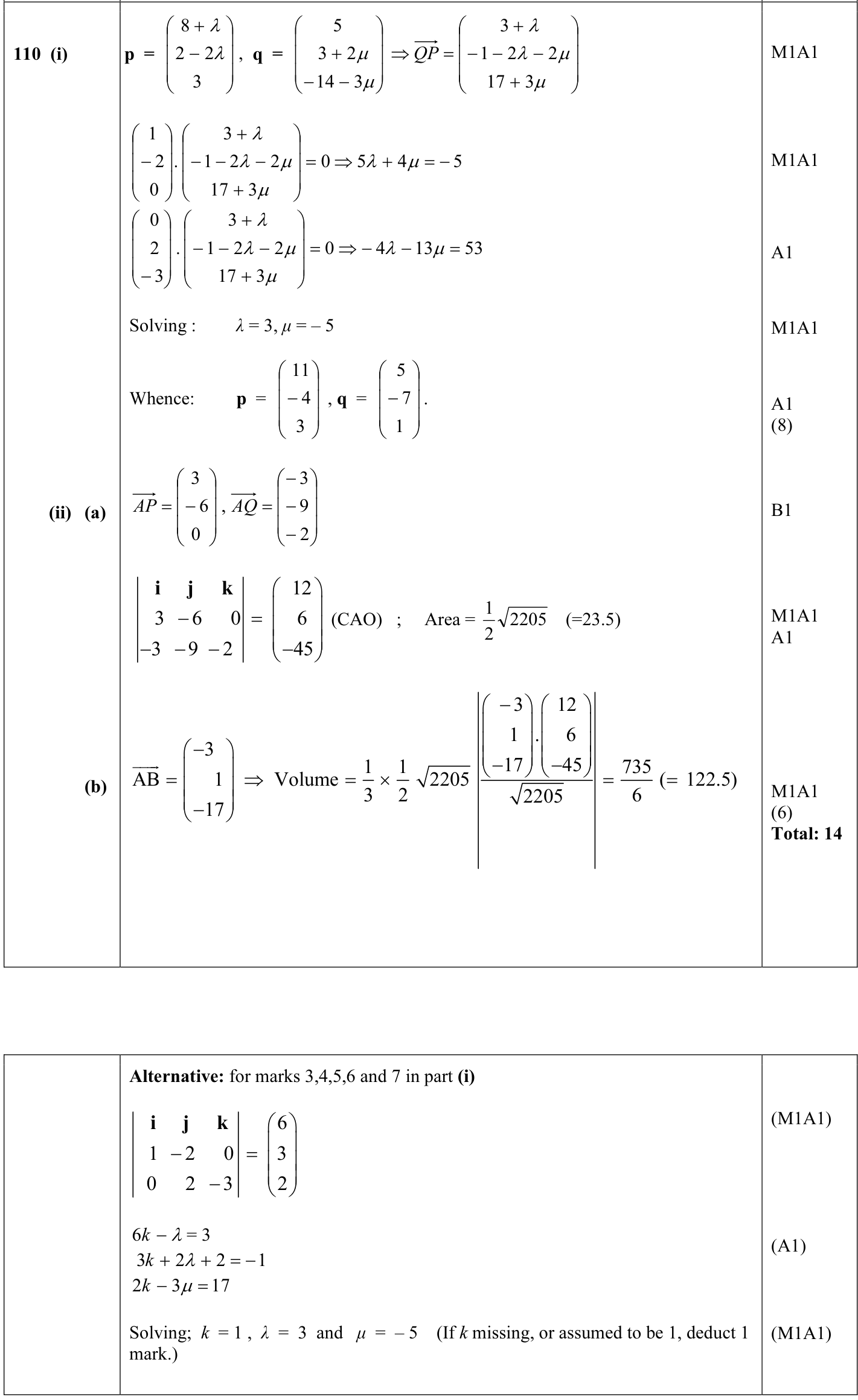
9231 P11 - Jun 2015 - Q11O - 14 marks
OR
The lines \(l_1\) and \(l_2\) have equations
\(\mathbf r=8\mathbf i+2\mathbf j+3\mathbf k+\lambda(\mathbf i-2\mathbf j)\)
and
\(\mathbf r=5\mathbf i+3\mathbf j-14\mathbf k+\mu(2\mathbf j-3\mathbf k)\).
The point \(P\) on \(l_1\) and the point \(Q\) on \(l_2\) are such that \(PQ\) is perpendicular to both \(l_1\) and \(l_2\). Find the position vector of \(P\) and the position vector of \(Q\).
The points with position vectors \(8\mathbf i+2\mathbf j+3\mathbf k\) and \(5\mathbf i+3\mathbf j-14\mathbf k\) are denoted by \(A\) and \(B\), respectively. Find
(i) \(\overrightarrow{AP}\times\overrightarrow{AQ}\) and hence the area of triangle \(APQ\),
(ii) the volume of the tetrahedron \(APQB\).
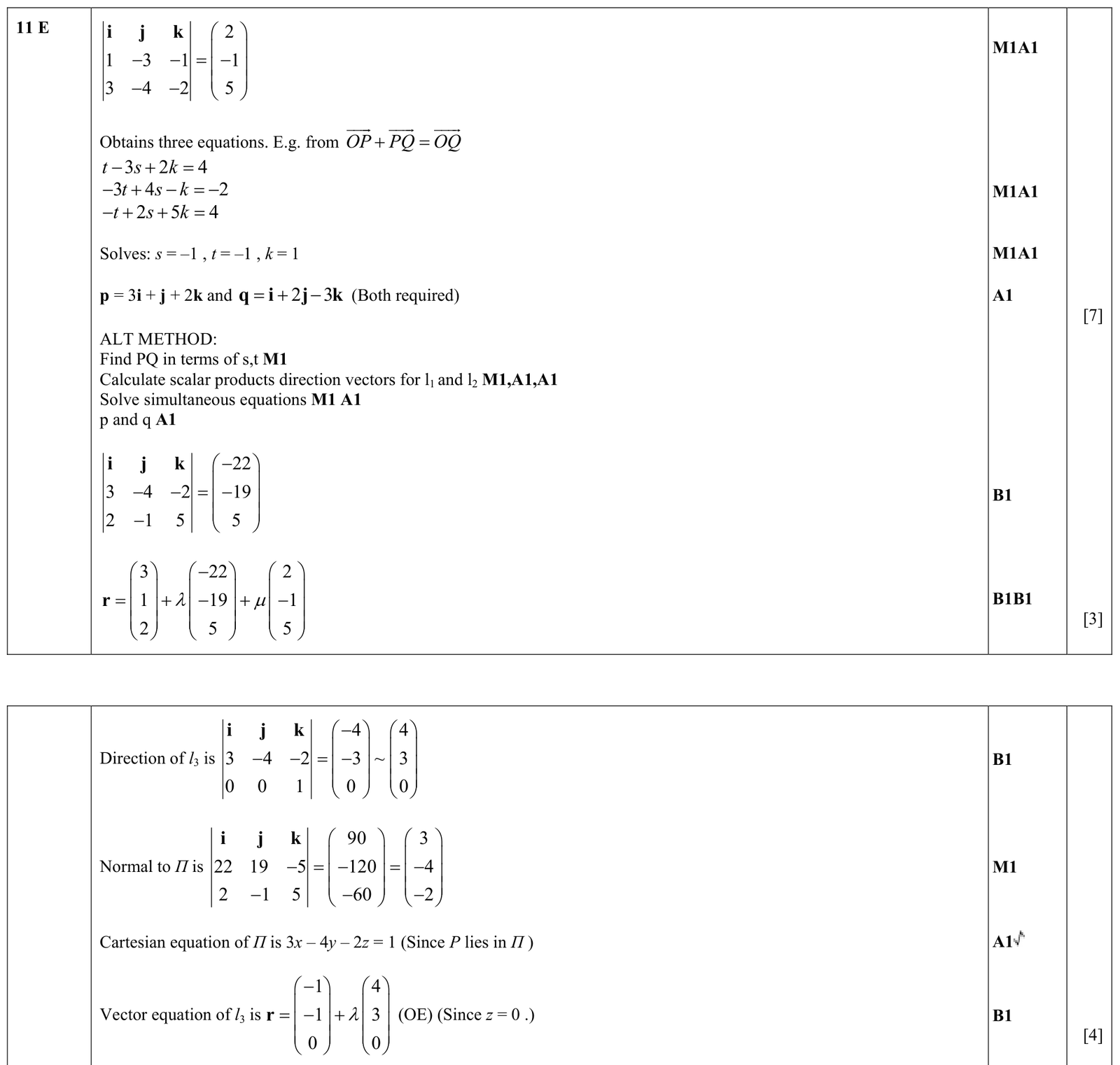
9231 P11 - Nov 2016 - Q11E - 14 marks
EITHER
The lines \(l_1\) and \(l_2\) have equations
\(\mathbf r=6\mathbf i-3\mathbf j+s(3\mathbf i-4\mathbf j-2\mathbf k)\quad\text{and}\quad \mathbf r=2\mathbf i-\mathbf j-4\mathbf k+t(\mathbf i-3\mathbf j-\mathbf k)\)
respectively. The point \(P\) on \(l_1\) and the point \(Q\) on \(l_2\) are such that \(PQ\) is perpendicular to both \(l_1\) and \(l_2\). Show that the position vector of \(P\) is \(3\mathbf i+\mathbf j+2\mathbf k\) and find the position vector of \(Q\).
Find, in the form \(\mathbf r=\mathbf a+\lambda\mathbf b+\mu\mathbf c\), an equation of the plane \(\Pi\) which passes through \(P\) and is perpendicular to \(l_1\).
The plane \(\Pi\) meets the plane \(\mathbf r=p\mathbf i+q\mathbf j\) in the line \(l_3\). Find a vector equation of \(l_3\).
9231 P13 - Jun 2016 - Q11O - 14 marks
OR
The position vectors of the points \(A\), \(B\), \(C\), and \(D\) are
\(\mathbf a=2\mathbf i+\lambda\mathbf j-3\mathbf k,\quad \mathbf b=6\mathbf i+3\mathbf j-2\mathbf k,\quad \mathbf c=\mathbf i+2\mathbf j-\mathbf k,\quad \mathbf d=\mathbf i+7\mathbf j+4\mathbf k\)
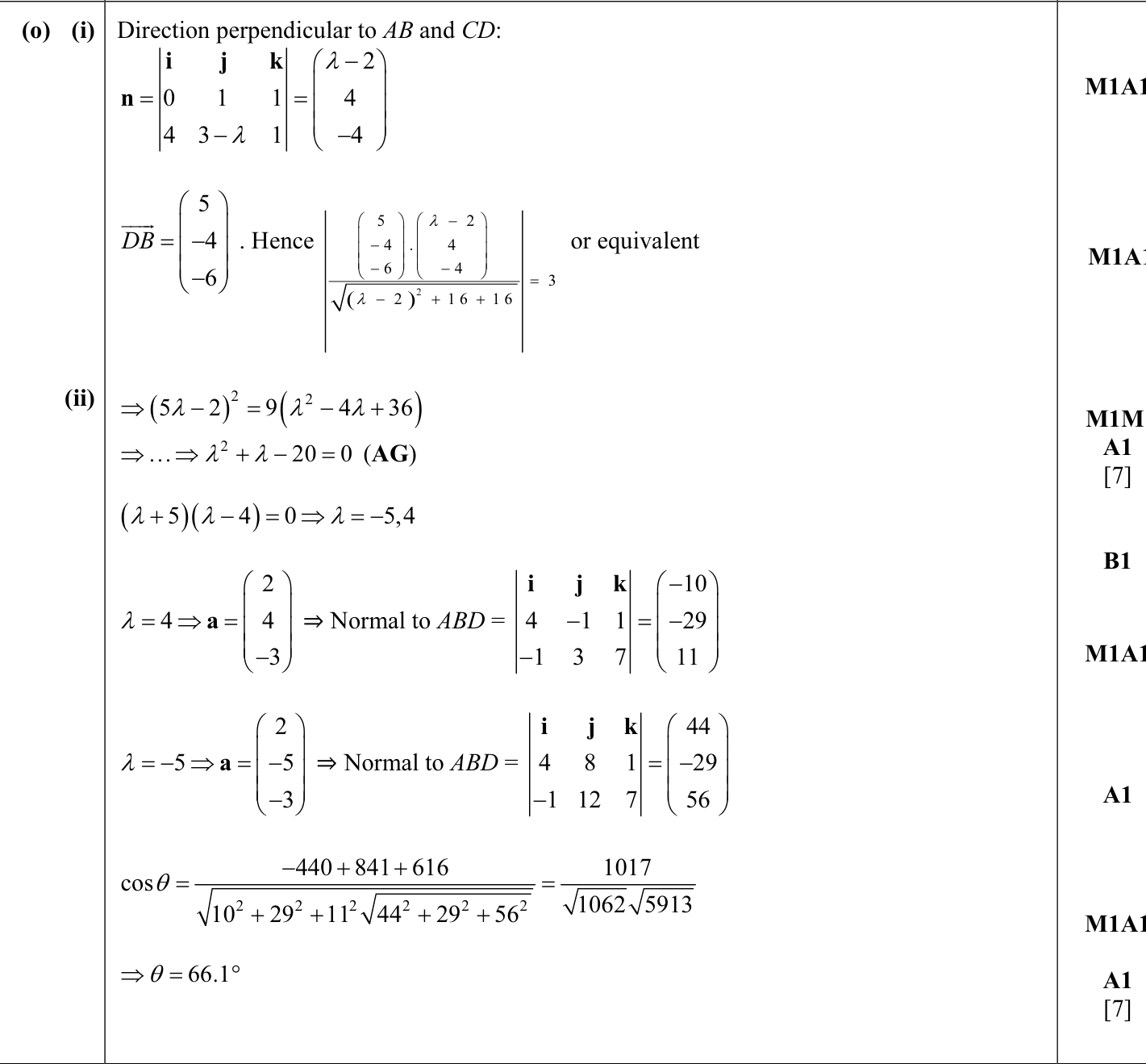
respectively. It is given that the shortest distance between the lines \(AB\) and \(CD\) is \(3\).
(i) Show that \(\lambda^2+\lambda-20=0\).
(ii) The planes \(p_1\) and \(p_2\) are the planes through \(A\), \(B\), and \(D\) corresponding to the two values of \(\lambda\) satisfying the equation in part (i). Find the acute angle between \(p_1\) and \(p_2\).
9231 P11 - Jun 2016 - Q8 - 14 marks
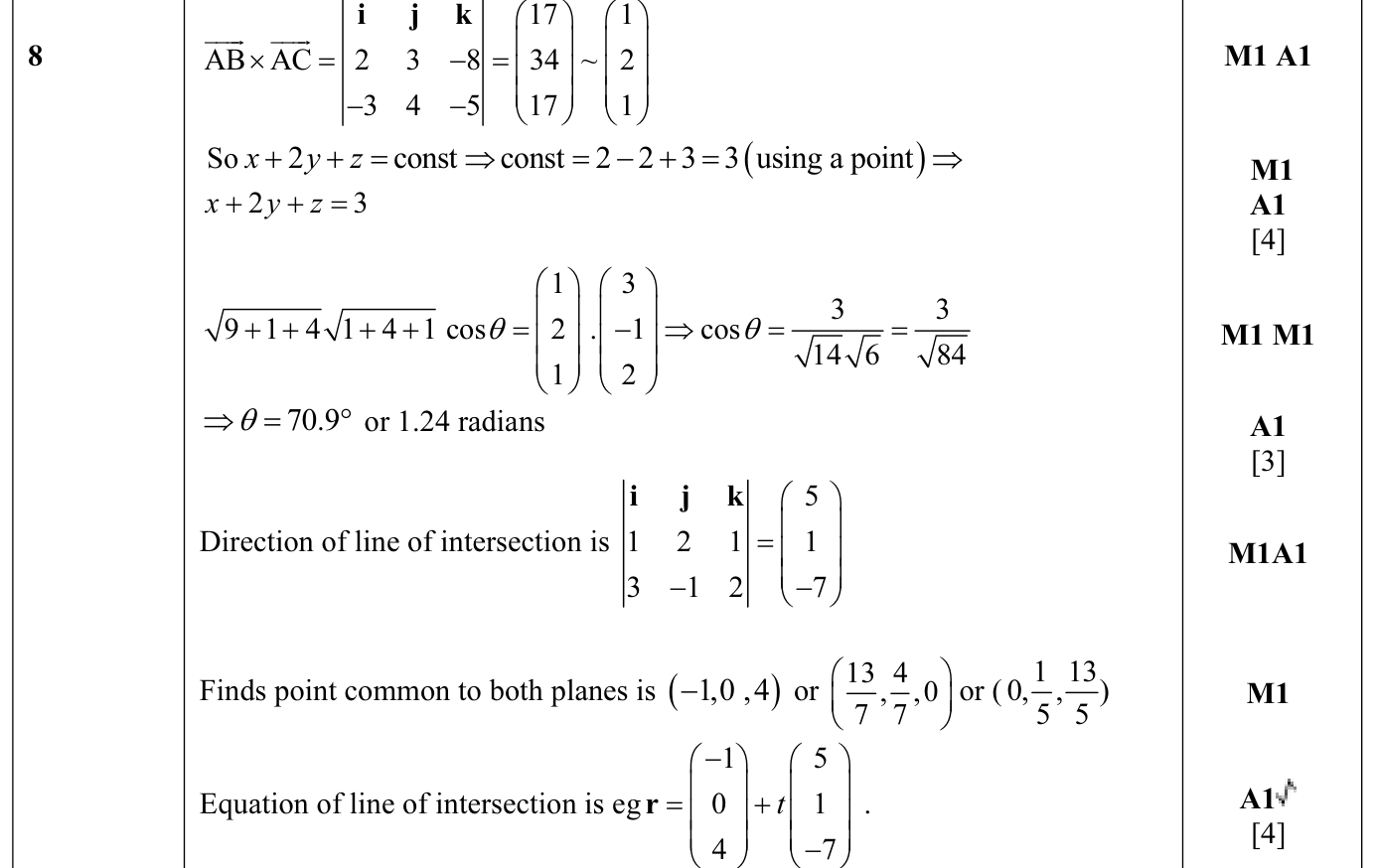
Find a cartesian equation of the plane \(\Pi_{1}\) passing through the points with coordinates \((2,-1,3)\), \((4,2,-5)\) and \((-1,3,-2)\).
The plane \(\Pi_{2}\) has cartesian equation \(3 x-y+2 z=5\). Find the acute angle between \(\Pi_{1}\) and \(\Pi_{2}\).
Find a vector equation of the line of intersection of the planes \(\Pi_{1}\) and \(\Pi_{2}\).
9231 P11 - Nov 2017 - Q6 - 9 marks
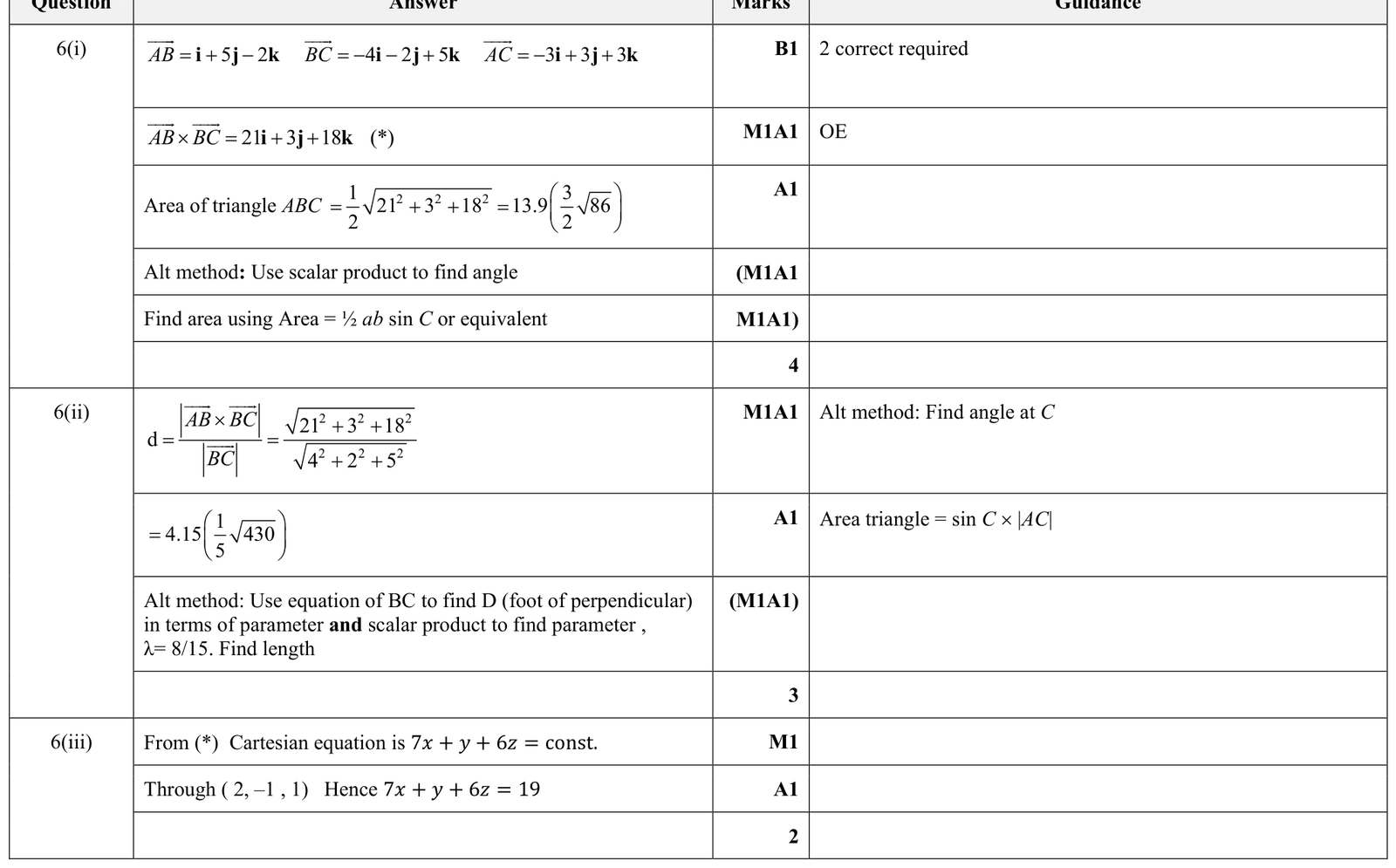
The points \(A, B\) and \(C\) have position vectors \(2 \mathbf{i}-\mathbf{j}+\mathbf{k}, 3 \mathbf{i}+4 \mathbf{j}-\mathbf{k}\) and \(-\mathbf{i}+2 \mathbf{j}+4 \mathbf{k}\) respectively.
(i) Find the area of the triangle \(A B C\).
(ii) Find the perpendicular distance of the point \(A\) from the line \(B C\).
(iii) Find the cartesian equation of the plane through \(A, B\) and \(C\).
9231 P12 - Nov 2014 - Q10 - 12 marks
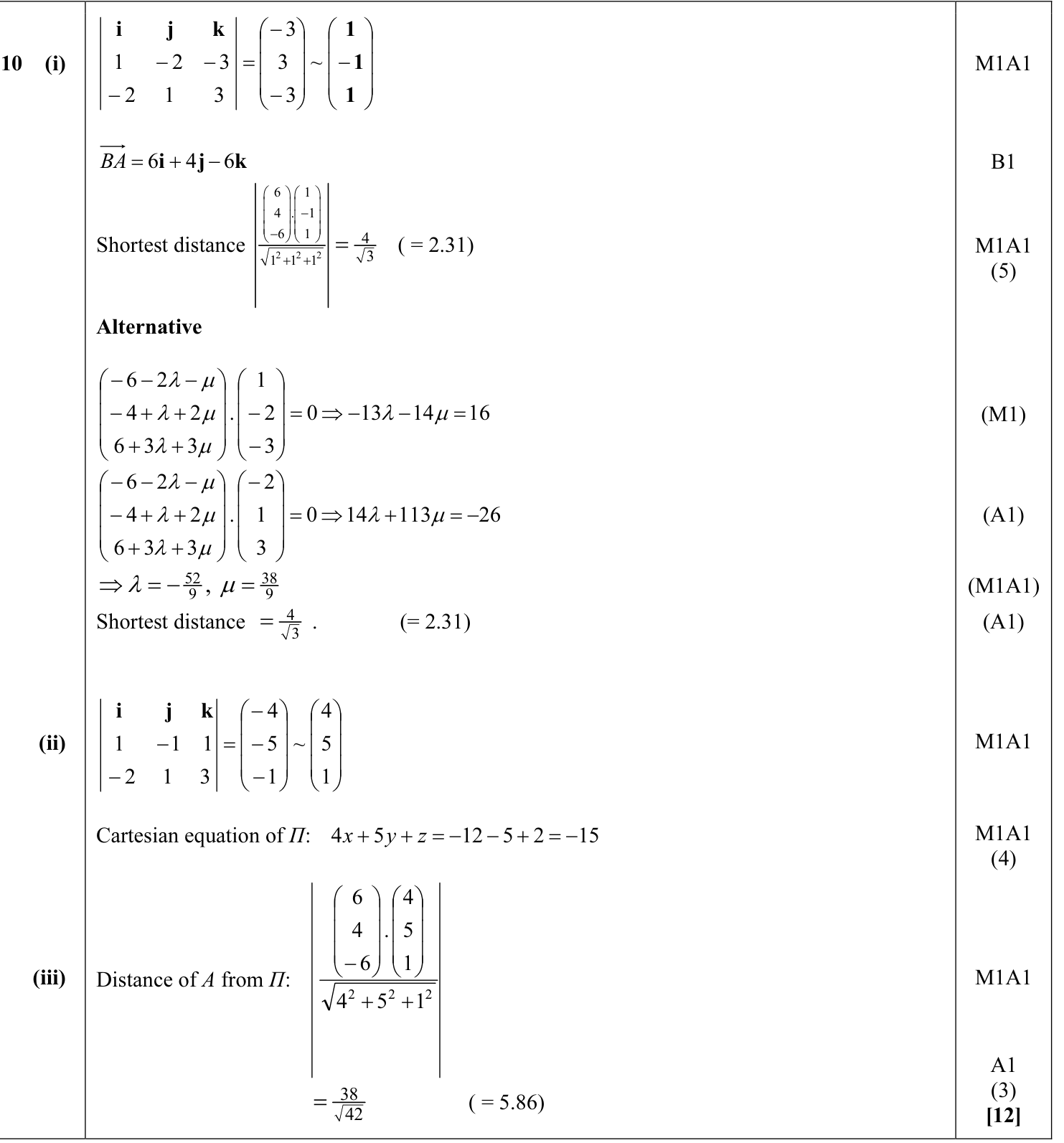
The line \(l_{1}\) is parallel to the vector \(\mathbf{i}-2 \mathbf{j}-3 \mathbf{k}\) and passes through the point \(A\), whose position vector is \(3 \mathbf{i}+3 \mathbf{j}-4 \mathbf{k}\). The line \(l_{2}\) is parallel to the vector \(-2 \mathbf{i}+\mathbf{j}+3 \mathbf{k}\) and passes through the point \(B\), whose position vector is \(-3 \mathbf{i}-\mathbf{j}+2 \mathbf{k}\). The point \(P\) on \(l_{1}\) and the point \(Q\) on \(l_{2}\) are such that \(P Q\) is perpendicular to both \(l_{1}\) and \(l_{2}\). Find
(i) the length \(P Q\),
(ii) the cartesian equation of the plane \(\Pi\) containing \(P Q\) and \(l_{2}\),
(iii) the perpendicular distance of \(A\) from \(\Pi\).
9231 P11 - Nov 2014 - Q10 - 12 marks
The line \(l_{1}\) is parallel to the vector \(\mathbf{i}-2 \mathbf{j}-3 \mathbf{k}\) and passes through the point \(A\), whose position vector is \(3 \mathbf{i}+3 \mathbf{j}-4 \mathbf{k}\). The line \(l_{2}\) is parallel to the vector \(-2 \mathbf{i}+\mathbf{j}+3 \mathbf{k}\) and passes through the point \(B\), whose position vector is \(-3 \mathbf{i}-\mathbf{j}+2 \mathbf{k}\). The point \(P\) on \(l_{1}\) and the point \(Q\) on \(l_{2}\) are such that \(P Q\) is perpendicular to both \(l_{1}\) and \(l_{2}\). Find
(i) the length \(P Q\),
(ii) the cartesian equation of the plane \(\Pi\) containing \(P Q\) and \(l_{2}\),
(iii) the perpendicular distance of \(A\) from \(\Pi\).
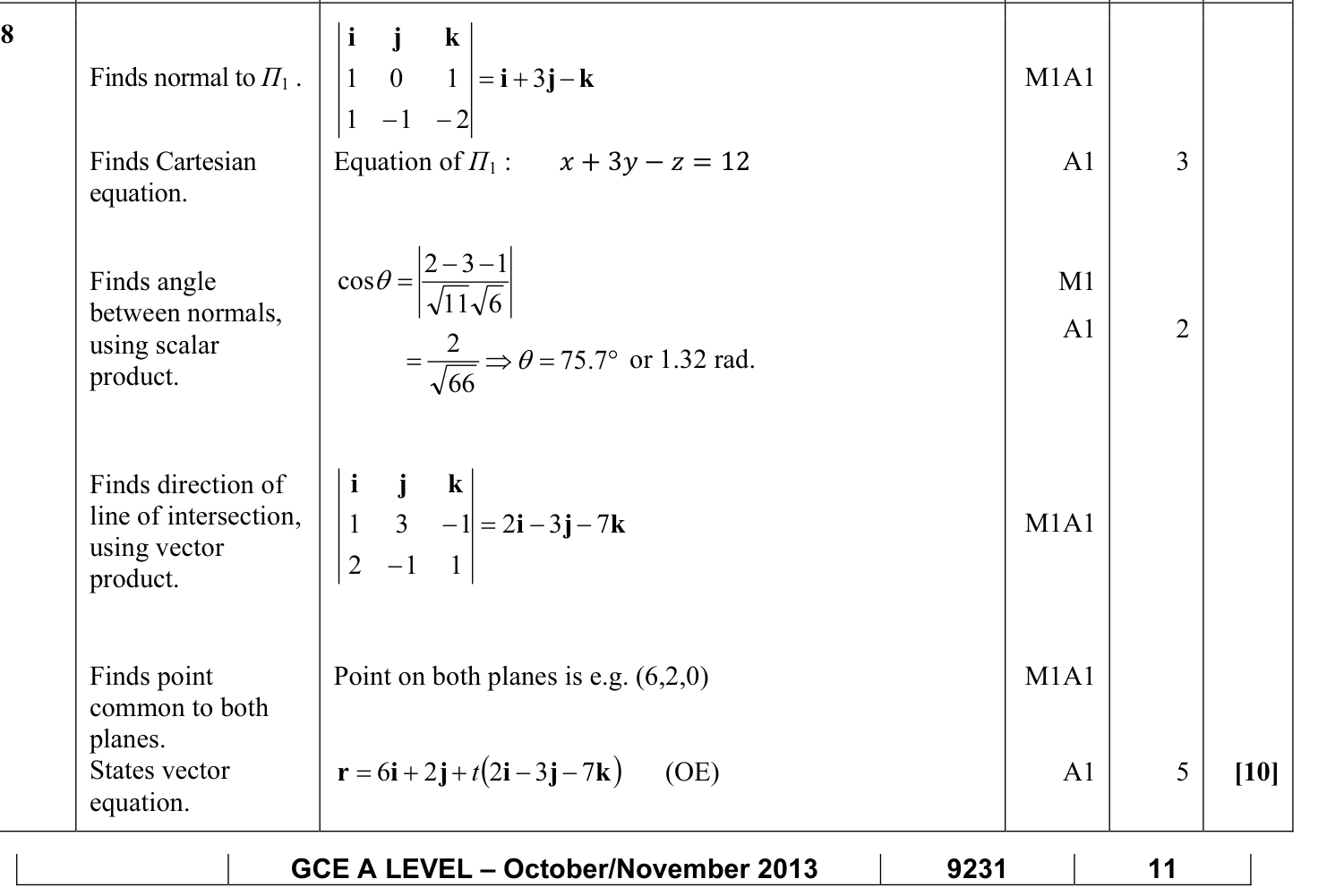
9231 P11 - Nov 2013 - Q8 - 10 marks
The plane \(\Pi_{1}\) has equation \(\mathbf{r}=\left(\begin{array}{r}2 \\ 3 \\ -1\end{array}\right)+s\left(\begin{array}{l}1 \\ 0 \\ 1\end{array}\right)+t\left(\begin{array}{r}1 \\ -1 \\ -2\end{array}\right)\). Find a cartesian equation of \(\Pi_{1}\).
The plane \(\Pi_{2}\) has equation \(2 x-y+z=10\). Find the acute angle between \(\Pi_{1}\) and \(\Pi_{2}\).
Find an equation of the line of intersection of \(\Pi_{1}\) and \(\Pi_{2}\), giving your answer in the form \(\mathbf{r}=\mathbf{a}+\lambda \mathbf{b}\).
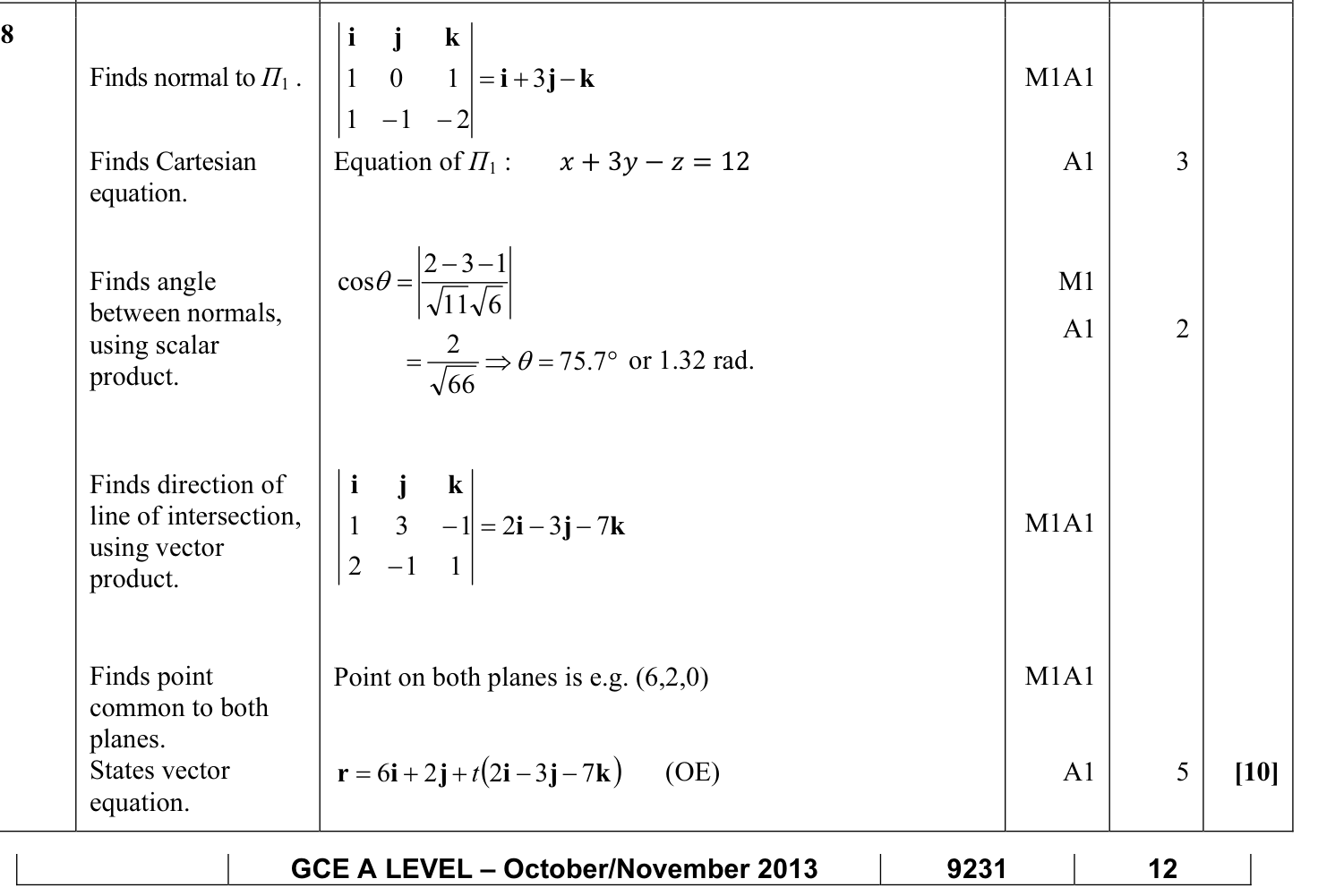
9231 P12 - Nov 2013 - Q8 - 10 marks
The plane \(\Pi_{1}\) has equation \(\mathbf{r}=\left(\begin{array}{r}2 \\ 3 \\ -1\end{array}\right)+s\left(\begin{array}{l}1 \\ 0 \\ 1\end{array}\right)+t\left(\begin{array}{r}1 \\ -1 \\ -2\end{array}\right)\). Find a cartesian equation of \(\Pi_{1}\).
The plane \(\Pi_{2}\) has equation \(2 x-y+z=10\). Find the acute angle between \(\Pi_{1}\) and \(\Pi_{2}\).
Find an equation of the line of intersection of \(\Pi_{1}\) and \(\Pi_{2}\), giving your answer in the form \(\mathbf{r}=\mathbf{a}+\lambda \mathbf{b}\).
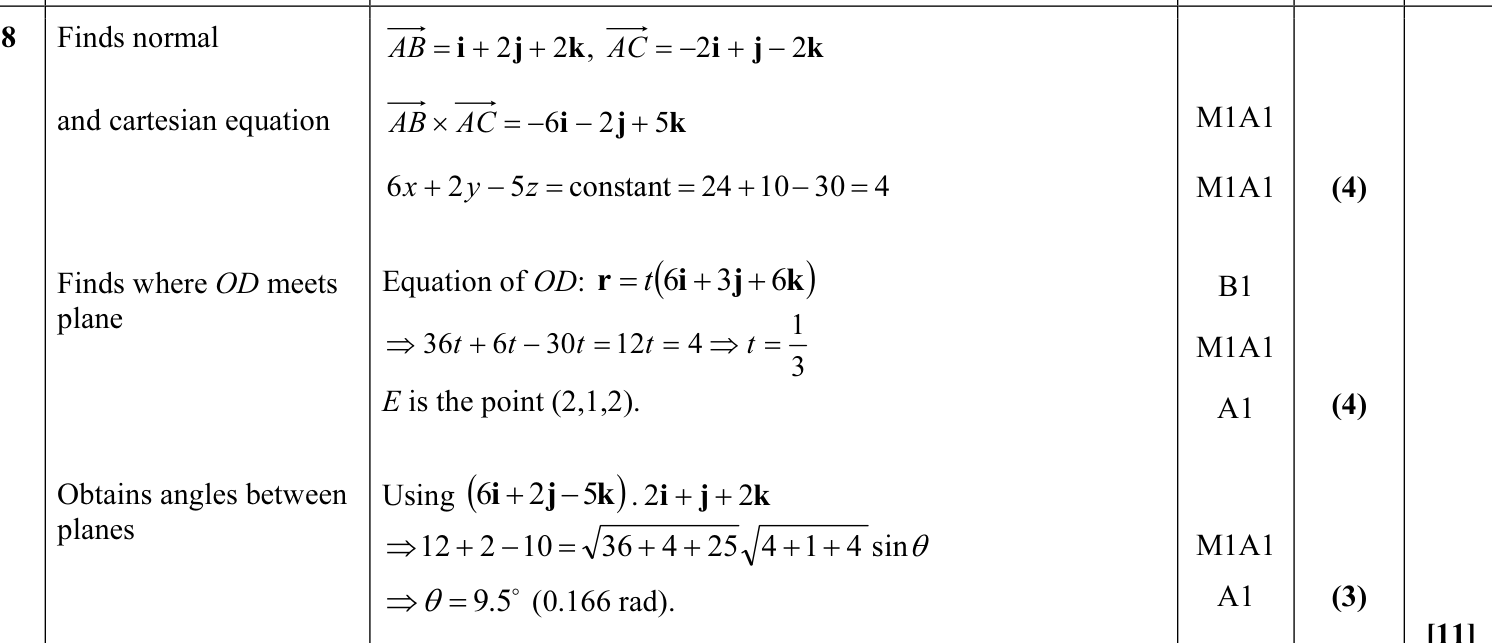
9231 P13 - Nov 2013 - Q8 - 11 marks
The points \(A, B, C\) have position vectors
\(4 \mathbf{i}+5 \mathbf{j}+6 \mathbf{k}, \quad 5 \mathbf{i}+7 \mathbf{j}+8 \mathbf{k}, \quad 2 \mathbf{i}+6 \mathbf{j}+4 \mathbf{k},\)
respectively, relative to the origin \(O\). Find a cartesian equation of the plane \(A B C\).
The point \(D\) has position vector \(6 \mathbf{i}+3 \mathbf{j}+6 \mathbf{k}\). Find the coordinates of \(E\), the point of intersection of the line \(O D\) with the plane \(A B C\).
Find the acute angle between the line \(E D\) and the plane \(A B C\).
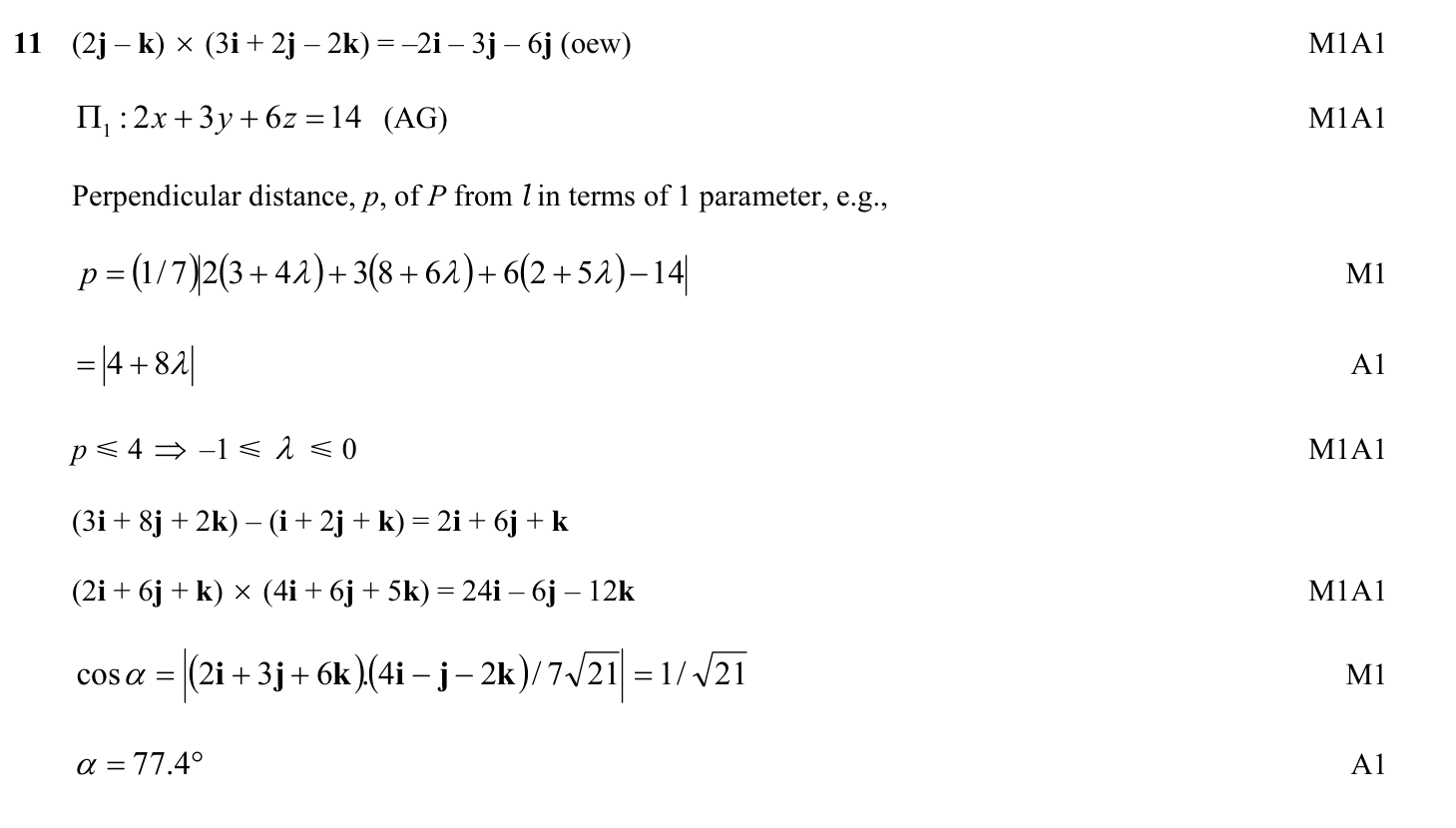
9231 P1 - Nov 2008 - Q11 - 12 marks
The plane \(\Pi_{1}\) has equation
\(\mathbf{r}=\mathbf{i}+2 \mathbf{j}+\mathbf{k}+\theta(2 \mathbf{j}-\mathbf{k})+\phi(3 \mathbf{i}+2 \mathbf{j}-2 \mathbf{k}) .\)
Find a vector normal to \(\Pi_{1}\) and hence show that the equation of \(\Pi_{1}\) can be written as \(2 x+3 y+6 z=14\).
The line \(l\) has equation
\(\mathbf{r}=3 \mathbf{i}+8 \mathbf{j}+2 \mathbf{k}+t(4 \mathbf{i}+6 \mathbf{j}+5 \mathbf{k})\)
The point on \(l\) where \(t=\lambda\) is denoted by \(P\). Find the set of values of \(\lambda\) for which the perpendicular distance of \(P\) from \(\Pi_{1}\) is not greater than 4 .
The plane \(\Pi_{2}\) contains \(l\) and the point with position vector \(\mathbf{i}+2 \mathbf{j}+\mathbf{k}\). Find the acute angle between \(\Pi_{1}\) and \(\Pi_{2}\).
9231 P12 - Jun 2014 - Q11 - 11 marks
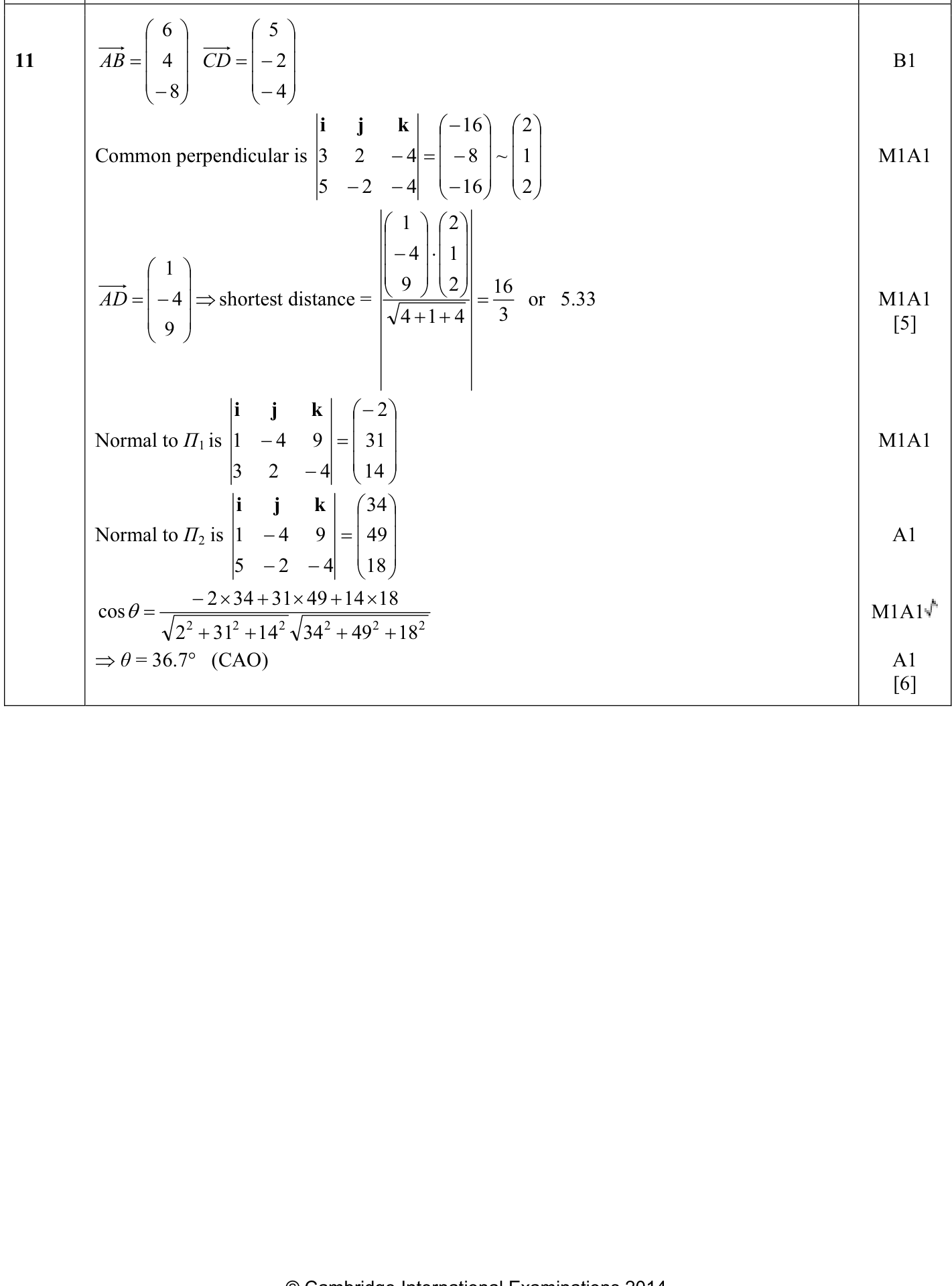
The line \(l_{1}\) passes through the points \(A(2,3,-5)\) and \(B(8,7,-13)\). The line \(l_{2}\) passes through the points \(C(-2,1,8)\) and \(D(3,-1,4)\). Find the shortest distance between the lines \(l_{1}\) and \(l_{2}\).
The plane \(\Pi_{1}\) passes through the points \(A, B\) and \(D\). The plane \(\Pi_{2}\) passes though the points \(A, C\) and \(D\). Find the acute angle between \(\Pi_{1}\) and \(\Pi_{2}\), giving your answer in degrees.
9231 P11 - Jun 2010 - Q7 - 10 marks
The lines \(l_{1}\) and \(l_{2}\) have vector equations
\(\mathbf{r}=4 \mathbf{i}-2 \mathbf{j}+\lambda(2 \mathbf{i}+\mathbf{j}-4 \mathbf{k}) \quad \text { and } \quad \mathbf{r}=4 \mathbf{i}-5 \mathbf{j}+2 \mathbf{k}+\mu(\mathbf{i}-\mathbf{j}-\mathbf{k})\)
respectively.
(i) Show that \(l_{1}\) and \(l_{2}\) intersect.
(ii) Find the perpendicular distance from the point \(P\) whose position vector is \(3 \mathbf{i}-5 \mathbf{j}+6 \mathbf{k}\) to the plane containing \(l_{1}\) and \(l_{2}\).
(iii) Find the perpendicular distance from \(P\) to \(l_{1}\).