9231 P11 - Jun 2019 - Q3 - 8 marks
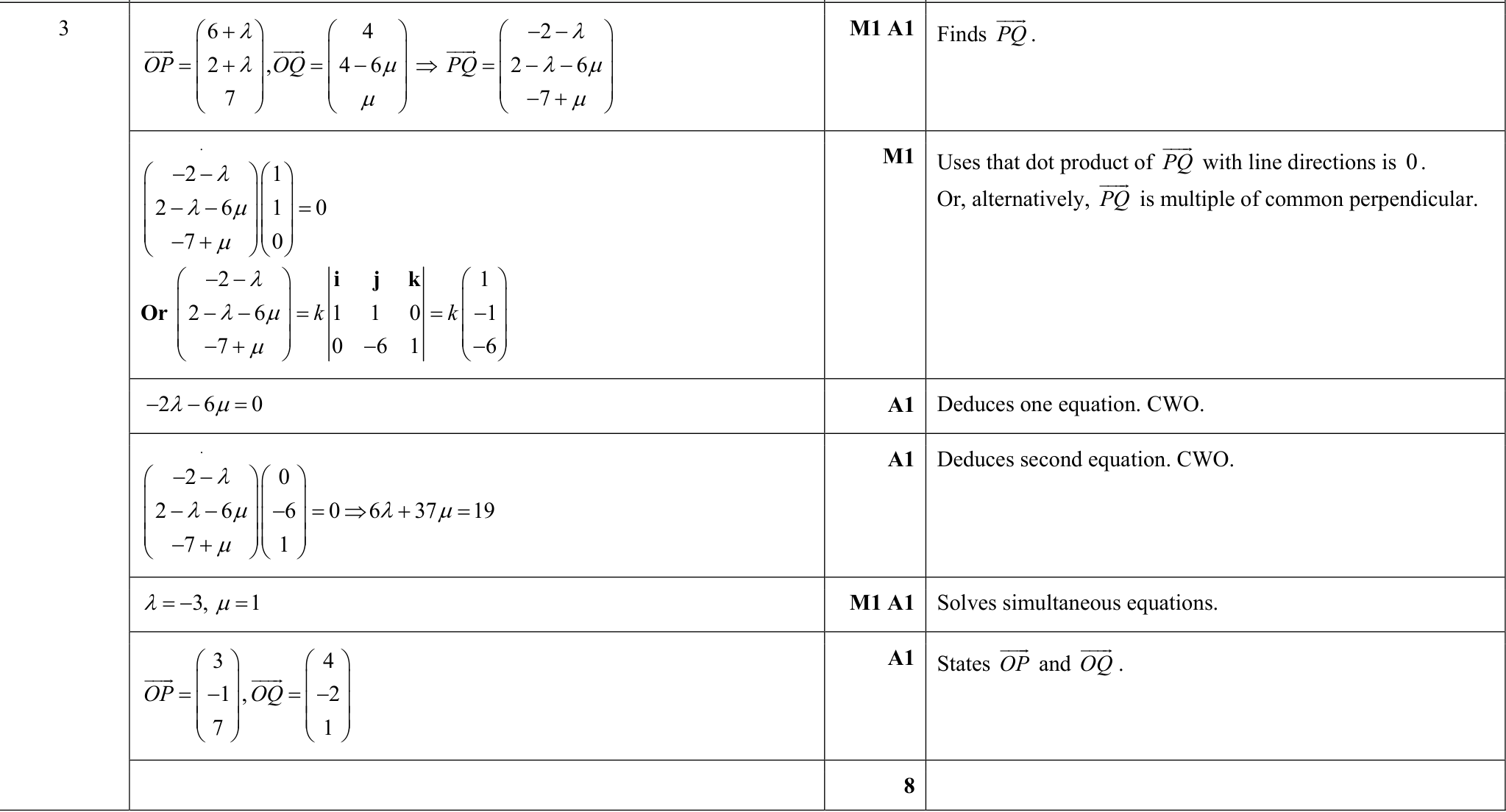
3 The lines \(l_{1}\) and \(l_{2}\) have equations \(\mathbf{r}=6 \mathbf{i}+2 \mathbf{j}+7 \mathbf{k}+\lambda(\mathbf{i}+\mathbf{j})\) and \(\mathbf{r}=4 \mathbf{i}+4 \mathbf{j}+\mu(-6 \mathbf{j}+\mathbf{k})\) respectively. The point \(P\) on \(l_{1}\) and the point \(Q\) on \(l_{2}\) are such that \(P Q\) is perpendicular to both \(l_{1}\) and \(l_{2}\). Find the position vectors of \(P\) and \(Q\).
9231 P11 - Jun 2011 - Q6 - 9 marks
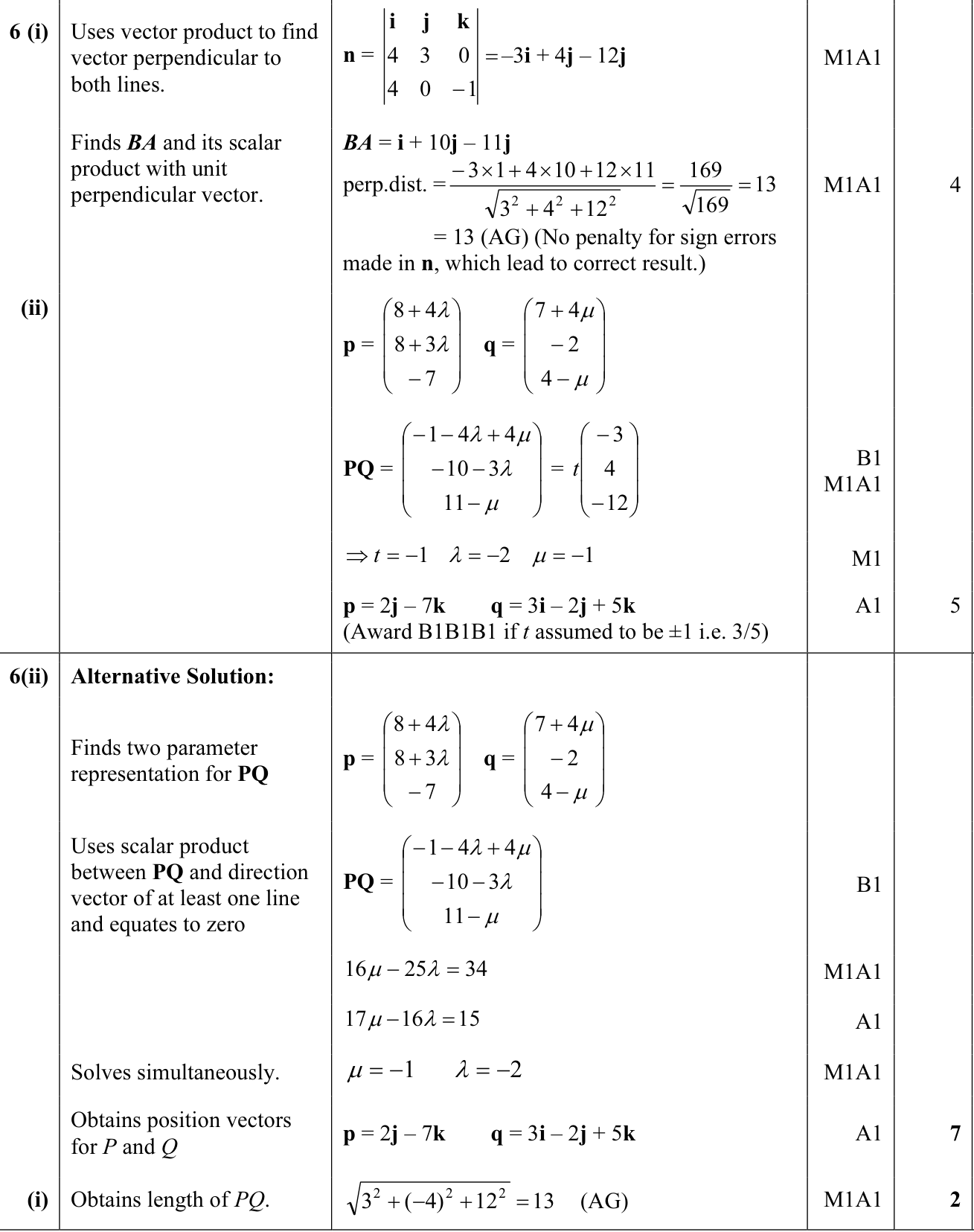
The line \(l_{1}\) passes through the point with position vector \(8 \mathbf{i}+8 \mathbf{j}-7 \mathbf{k}\) and is parallel to the vector \(4 \mathbf{i}+3 \mathbf{j}\). The line \(l_{2}\) passes through the point with position vector \(7 \mathbf{i}-2 \mathbf{j}+4 \mathbf{k}\) and is parallel to the vector \(4 \mathbf{i}-\mathbf{k}\). The point \(P\) on \(l_{1}\) and the point \(Q\) on \(l_{2}\) are such that \(P Q\) is perpendicular to both \(l_{1}\) and \(l_{2}\). In either order,
(i) show that \(P Q=13\),
(ii) find the position vectors of \(P\) and \(Q\).
9231 P1 - Nov 2009 - Q2 - 6 marks
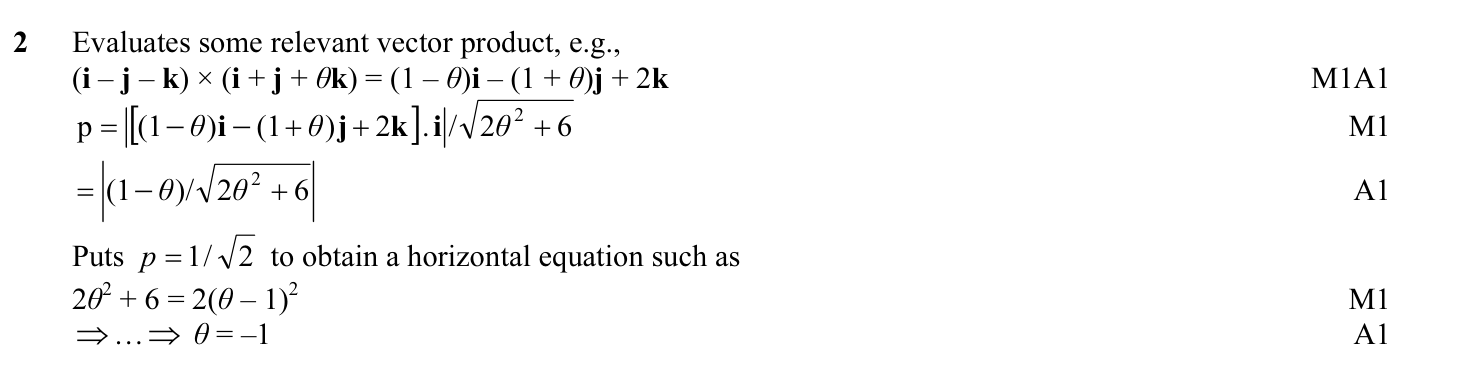
Relative to an origin \(O\), the points \(A, B, C\) have position vectors
\(\mathbf{i}, \quad \mathbf{j}+\mathbf{k}, \quad \mathbf{i}+\mathbf{j}+\theta \mathbf{k}\),
respectively. The shortest distance between the lines \(A B\) and \(O C\) is \(\frac{1}{\sqrt{2}}\). Find the value of \(\theta\).