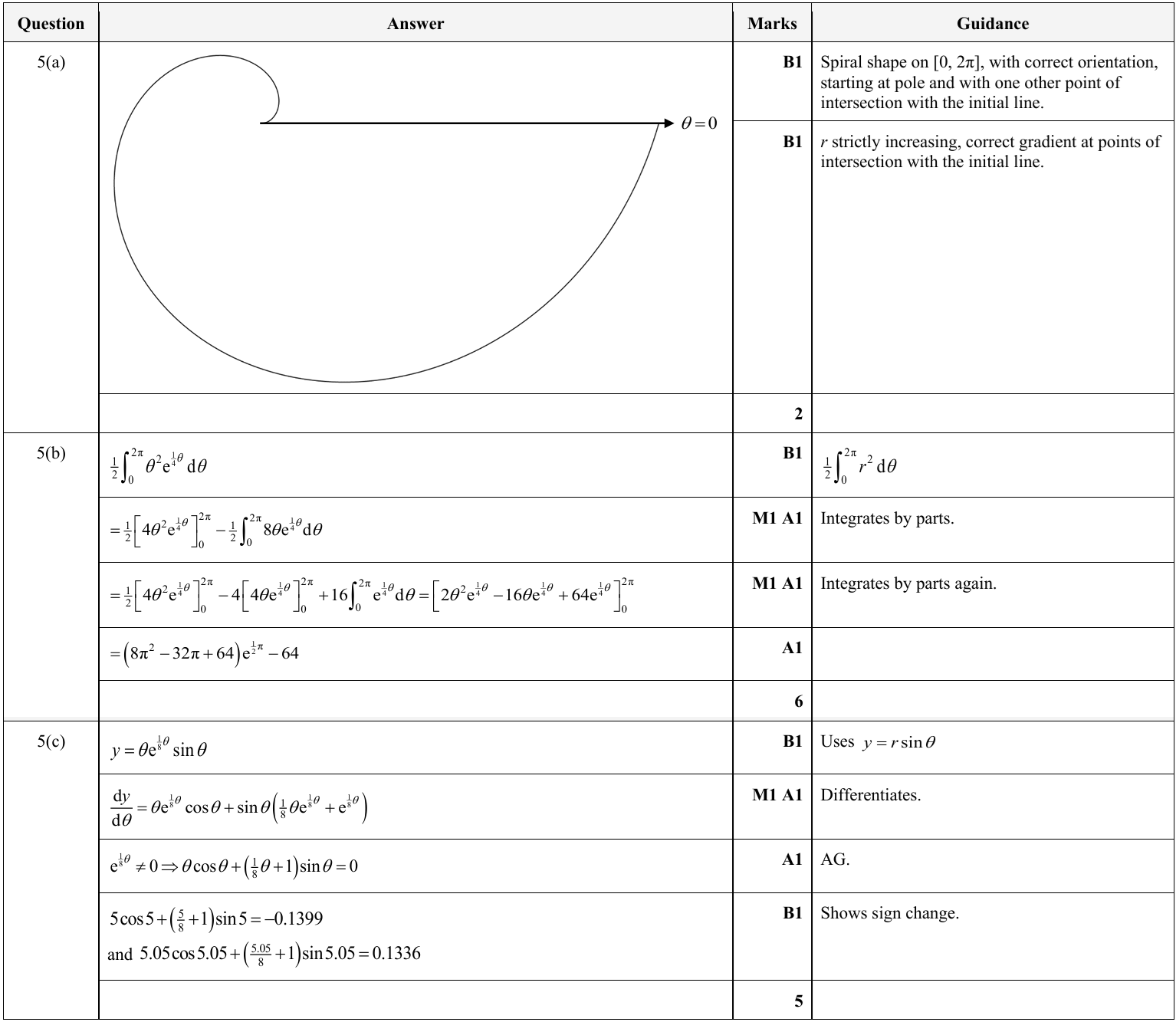
9231 P12 - Jun 2025 - Q05 - 13 marks
The curve C has polar equation \(r = \theta e^{\frac{1}{8}\theta}\), for \(0 \leq \theta \leq 2\pi\).
(a) Sketch C.
(b) Find the area of the region bounded by C and the initial line, giving your answer in the form \((p\pi^2 + q\pi + r)e^{\frac{1}{2}\pi} + s\), where \(p, q, r\) and \(s\) are integers to be determined.
(c) Show that, at the point of C furthest from the initial line,
\(\theta \cos \theta + \left( \frac{1}{8} \theta + 1 \right) \sin \theta = 0\)
and verify that this equation has a root between 5 and 5.05.
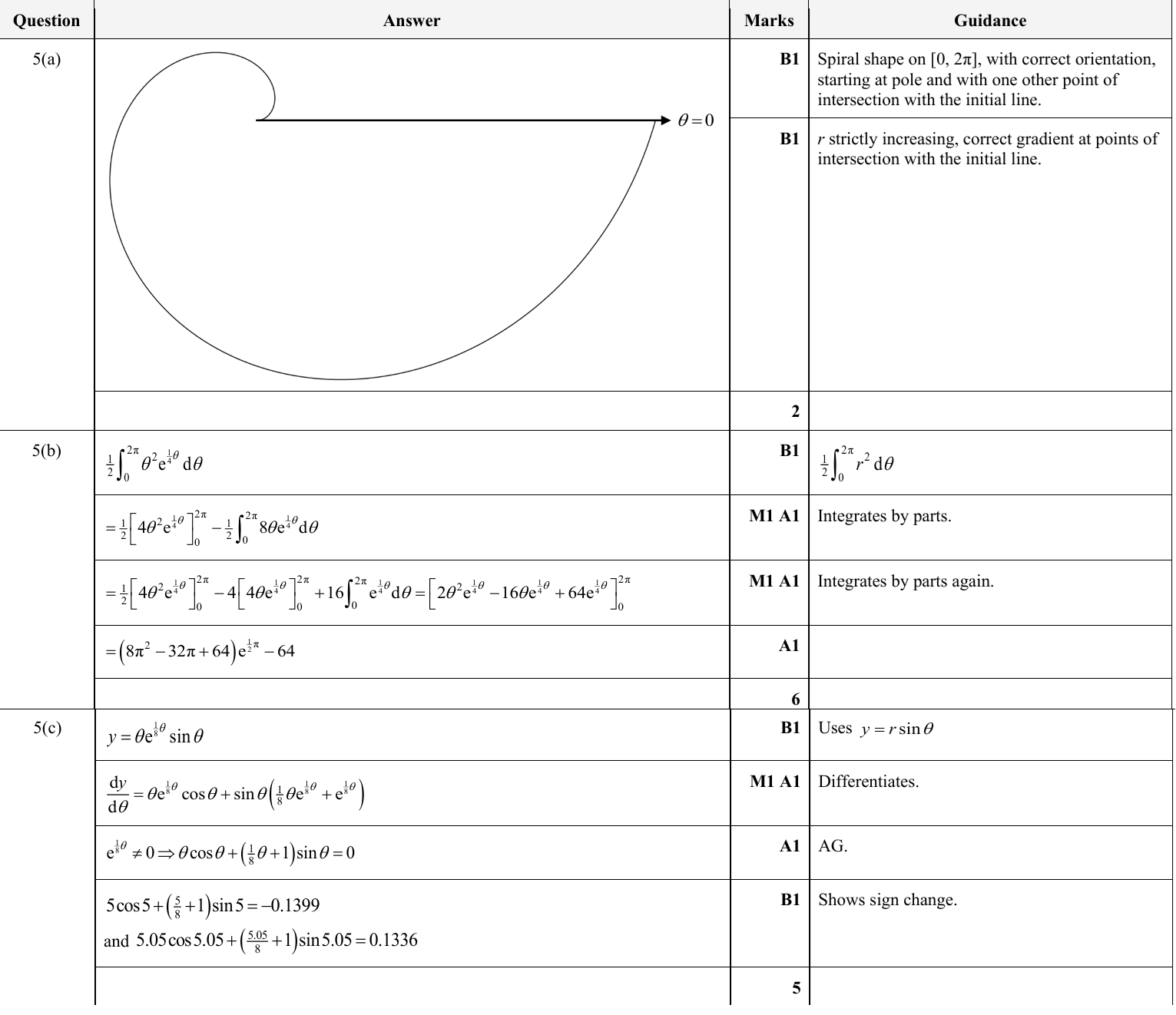
9231 P11 - Jun 2025 - Q05 - 13 marks
The curve C has polar equation \(r = \theta e^{\frac{1}{8} \theta}\), for \(0 \leq \theta \leq 2\pi\).
- Sketch C.
- Find the area of the region bounded by C and the initial line, giving your answer in the form \((p\pi^2 + q\pi + r)e^{\frac{1}{2}\pi} + s\), where \(p, q, r\) and \(s\) are integers to be determined.
- Show that, at the point of C furthest from the initial line, \(\theta \cos \theta + \left( \frac{1}{8} \theta + 1 \right) \sin \theta = 0\) and verify that this equation has a root between 5 and 5.05.
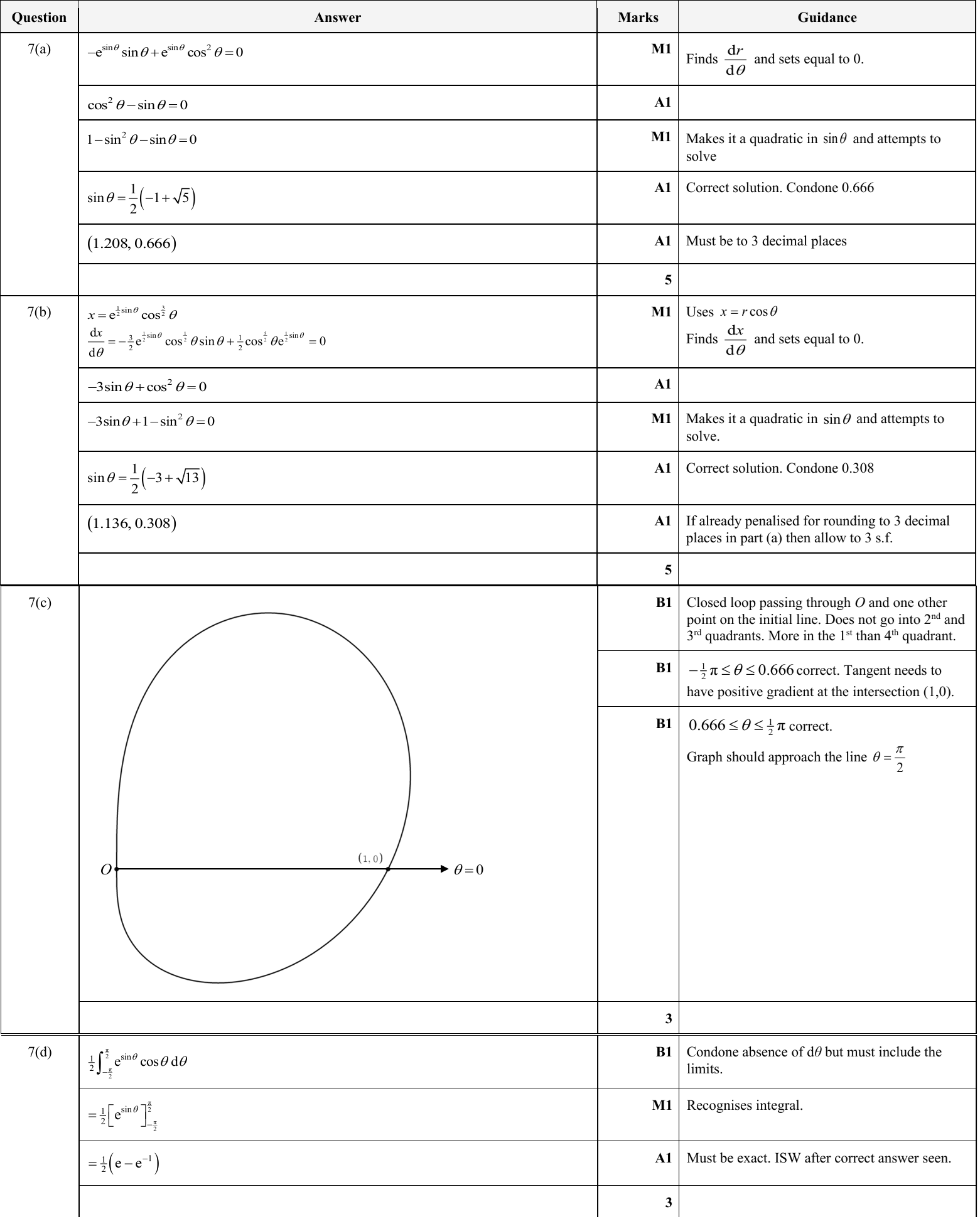
9231 P13 - Jun 2025 - Q07 - 16 marks
The curve C has polar equation \(r^2 = e^{\sin \theta} \cos \theta\), for \(-\frac{1}{2}\pi \leq \theta \leq \frac{1}{2}\pi\).
- Find the polar coordinates of the point on C that is furthest from the pole, giving your answers correct to 3 decimal places.
- Find the polar coordinates of the point on C that is furthest from the half-line \(\theta = \frac{1}{2}\pi\), giving your answers correct to 3 decimal places.
- Sketch C.
- Find the area of the region bounded by C, giving your answer in exact form.
9231 P14 - Jun 2025 - Q06 - 13 marks
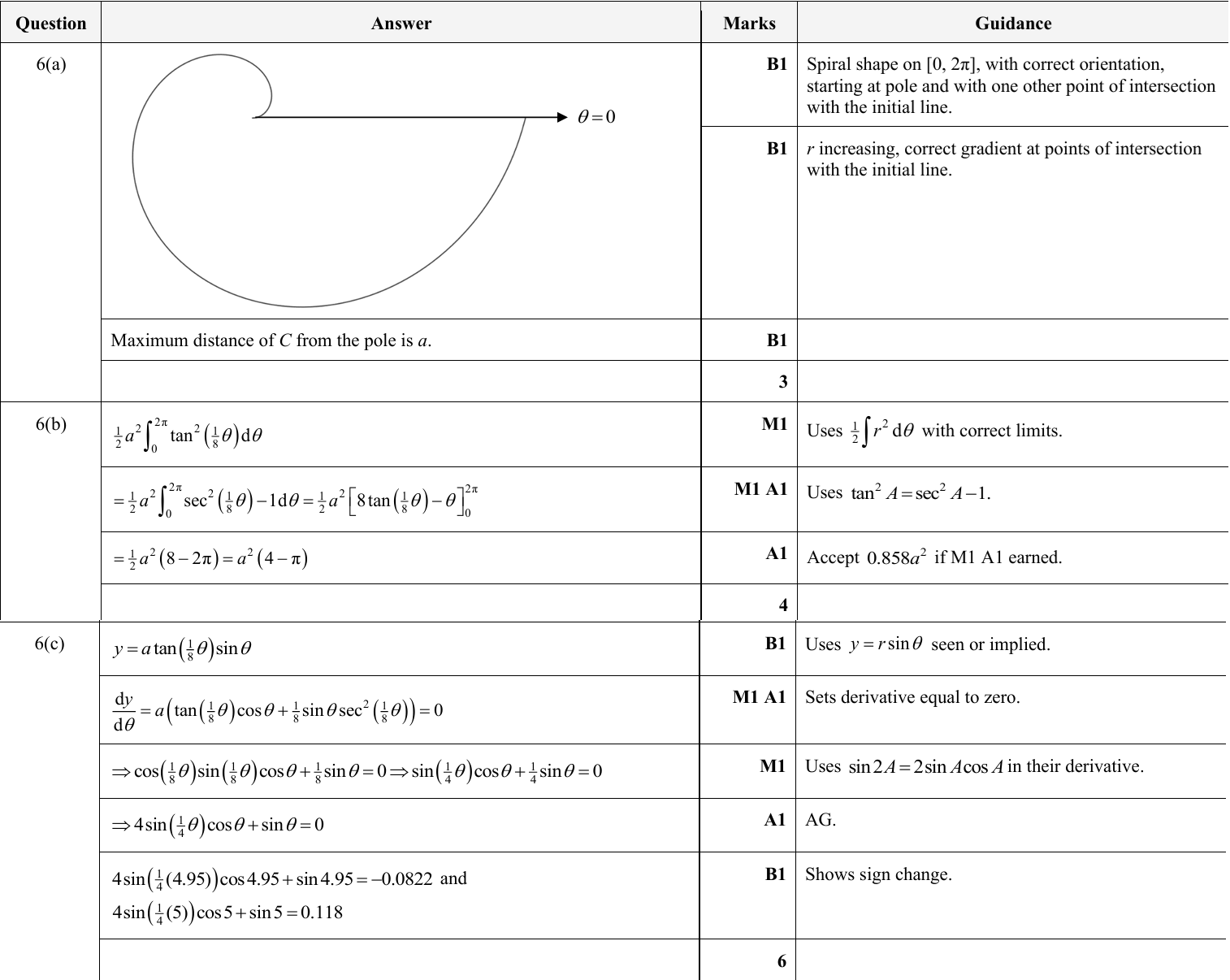
The curve C has polar equation \(r = a \tan\left(\frac{1}{8}\theta\right)\), where \(a\) is a positive constant and \(0 \leq \theta \leq 2\pi\).
(a) Sketch C and state, in terms of \(a\), the greatest distance of a point on C from the pole.
(b) Find, in terms of \(a\), the area of the region bounded by C and the initial line.
(c) Show that, at the point on C furthest from the initial line,
\(4 \sin\left(\frac{1}{4}\theta\right)\cos\theta + \sin\theta = 0\)
and verify that this equation has a root between 4.95 and 5.
9231 P11 - Nov 2024 - Q05 - 13 marks
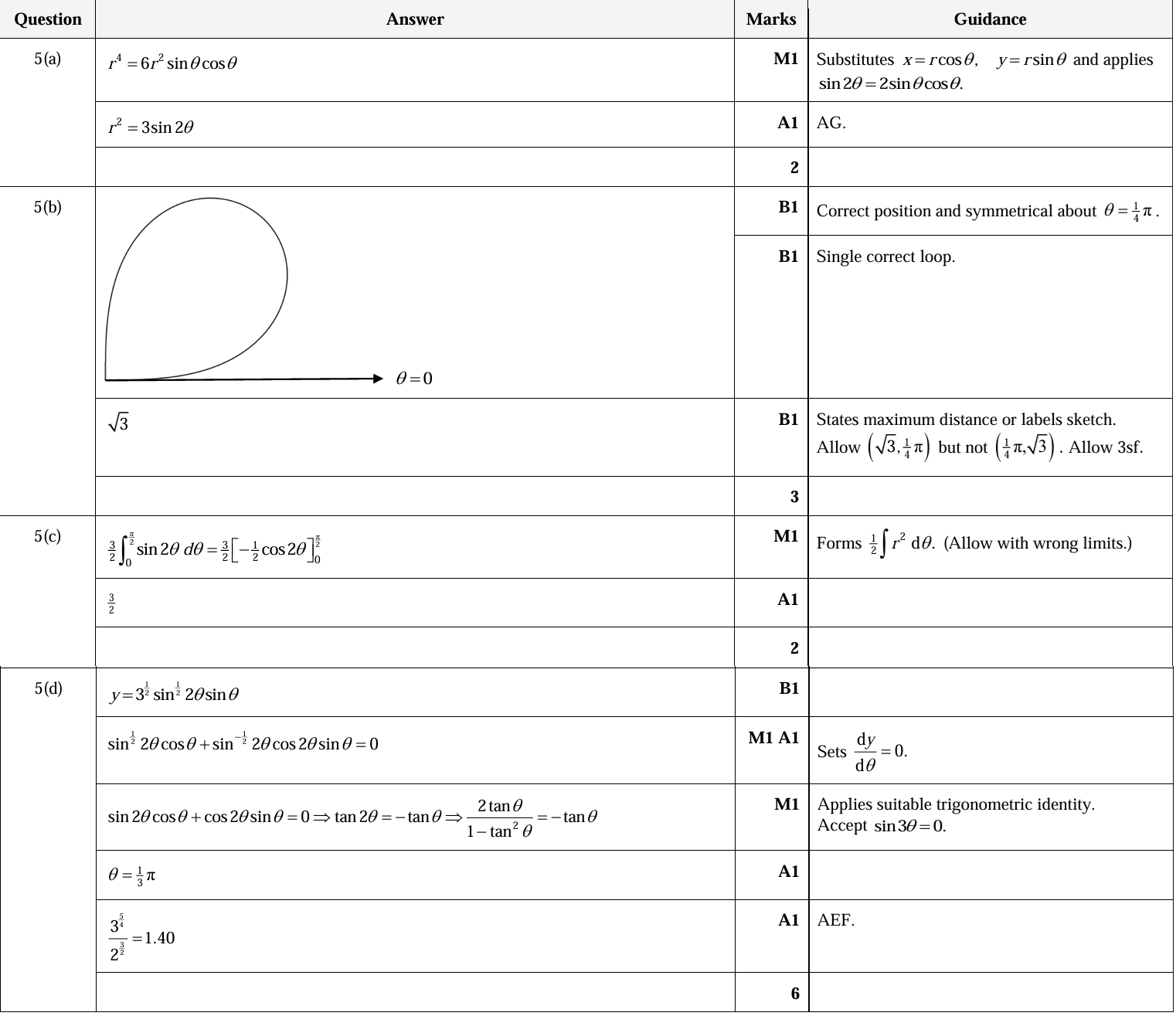
(a) Show that the curve with Cartesian equation \((x^2 + y^2)^2 = 6xy\) has polar equation \(r^2 = 3 \sin 2\theta\).
The curve \(C\) has polar equation \(r^2 = 3 \sin 2\theta\), for \(0 \leq \theta \leq \frac{1}{2}\pi\).
(b) Sketch \(C\) and state the maximum distance of a point on \(C\) from the pole.
(c) Find the area of the region enclosed by \(C\).
(d) Find the maximum distance of a point on \(C\) from the initial line.
9231 P12 - Nov 2024 - Q07 - 16 marks
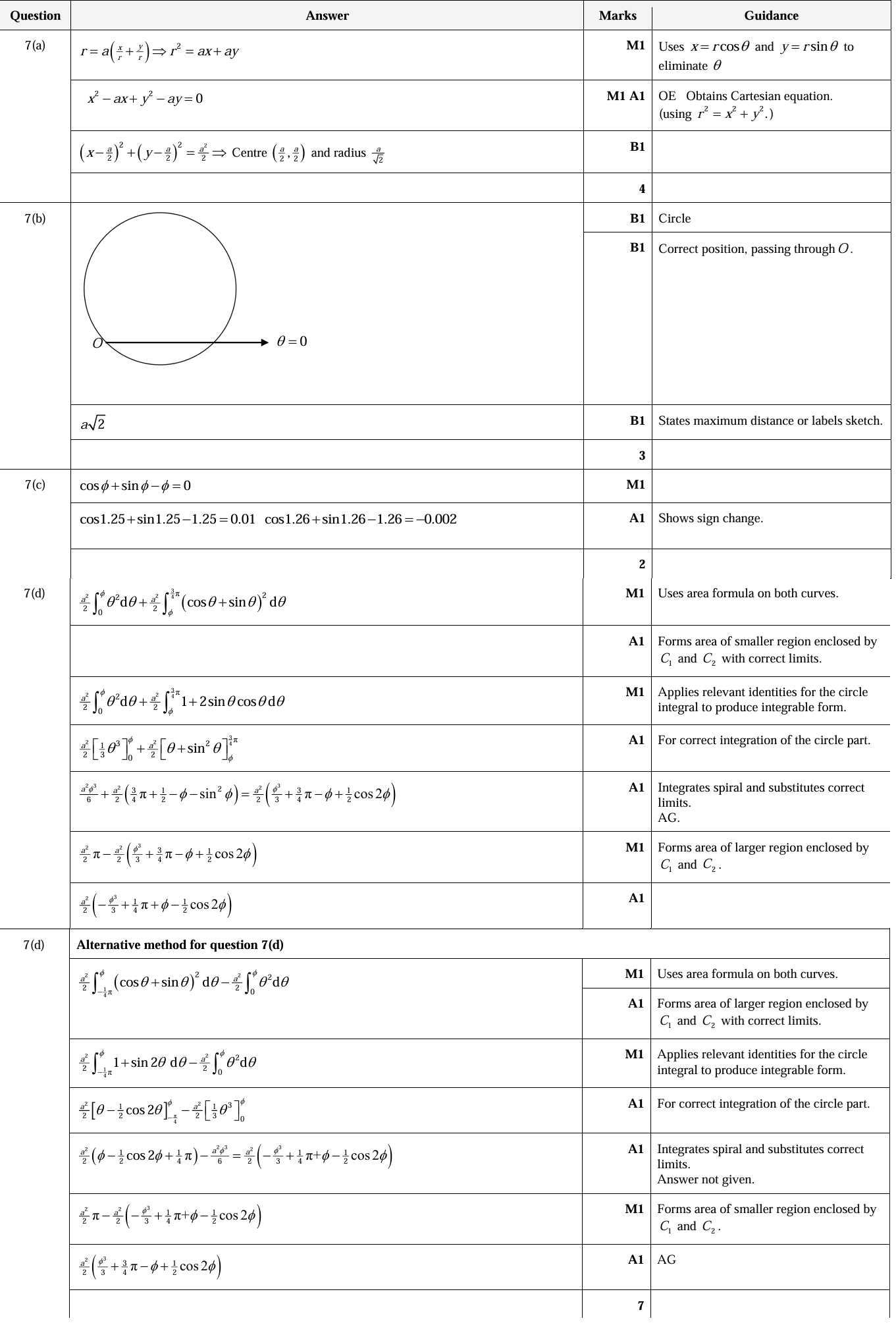
The curve \(C_1\) has polar equation \(r = a(\cos \theta + \sin \theta)\) for \(-\frac{1}{4}\pi \leq \theta \leq \frac{3}{4}\pi\), where \(a\) is a positive constant.
- Find a Cartesian equation for \(C_1\) and show that it represents a circle, stating its radius and the Cartesian coordinates of its centre.
- Sketch \(C_1\) and state the greatest distance of a point on \(C_1\) from the pole.
The curve \(C_2\) with polar equation \(r = a\theta\) intersects \(C_1\) at the pole and the point with polar coordinates \((a\phi, \phi)\).
- Verify that \(1.25 < \phi < 1.26\).
- Show that the area of the smaller region enclosed by \(C_1\) and \(C_2\) is equal to
\(\frac{1}{2}a^2 \left( \frac{3}{4}\pi + \frac{1}{3}\phi^3 - \phi + \frac{1}{2}\cos 2\phi \right)\)
and deduce, in terms of \(a\) and \(\phi\), the area of the larger region enclosed by \(C_1\) and \(C_2\).
9231 P13 - Nov 2024 - Q05 - 13 marks
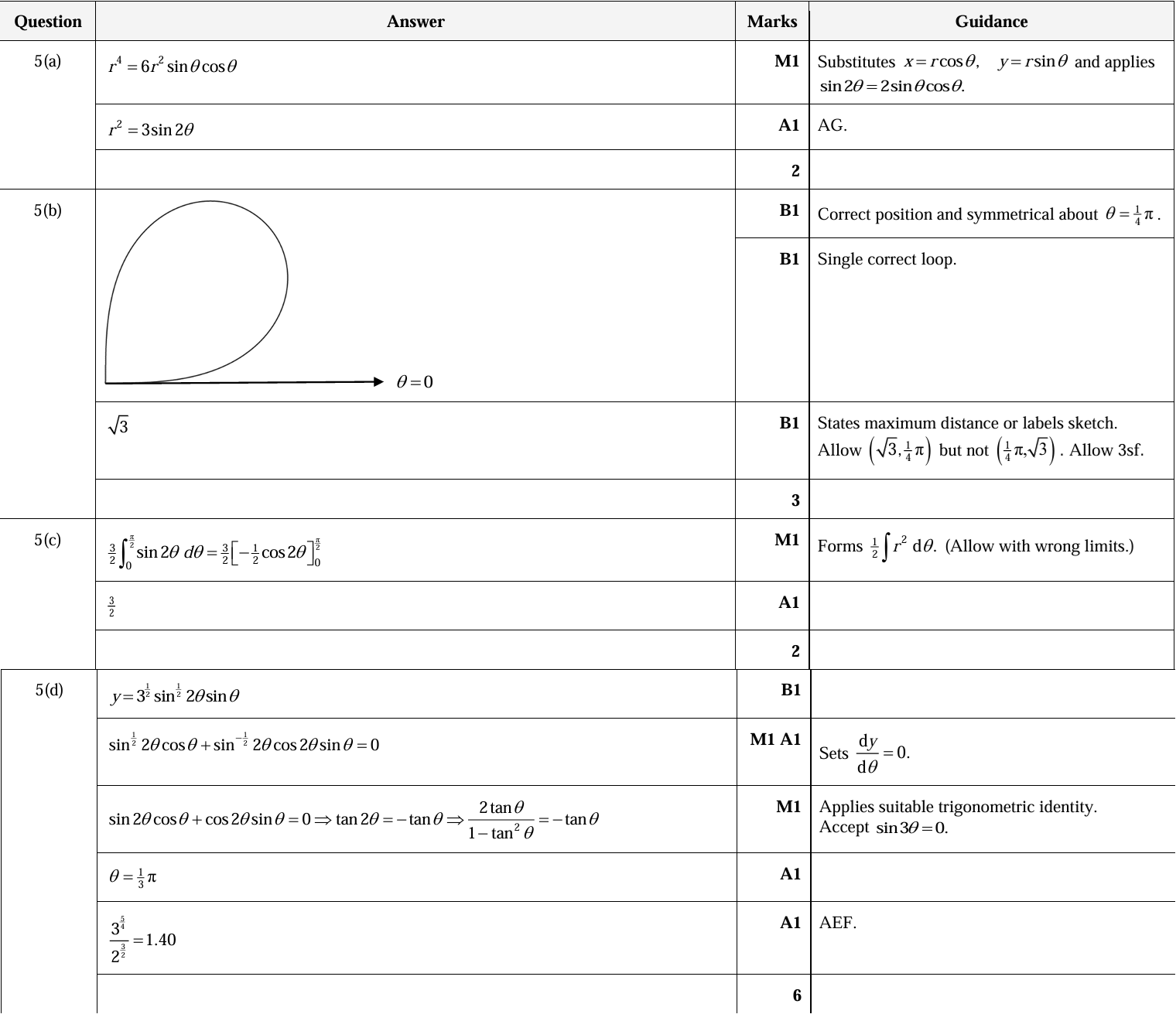
(a) Show that the curve with Cartesian equation \((x^2 + y^2)^2 = 6xy\) has polar equation \(r^2 = 3 \sin 2\theta\).
The curve \(C\) has polar equation \(r^2 = 3 \sin 2\theta\), for \(0 \leq \theta \leq \frac{1}{2}\pi\).
(b) Sketch \(C\) and state the maximum distance of a point on \(C\) from the pole.
(c) Find the area of the region enclosed by \(C\).
(d) Find the maximum distance of a point on \(C\) from the initial line.
9231 P11 - Jun 2024 - Q07 - 15 marks
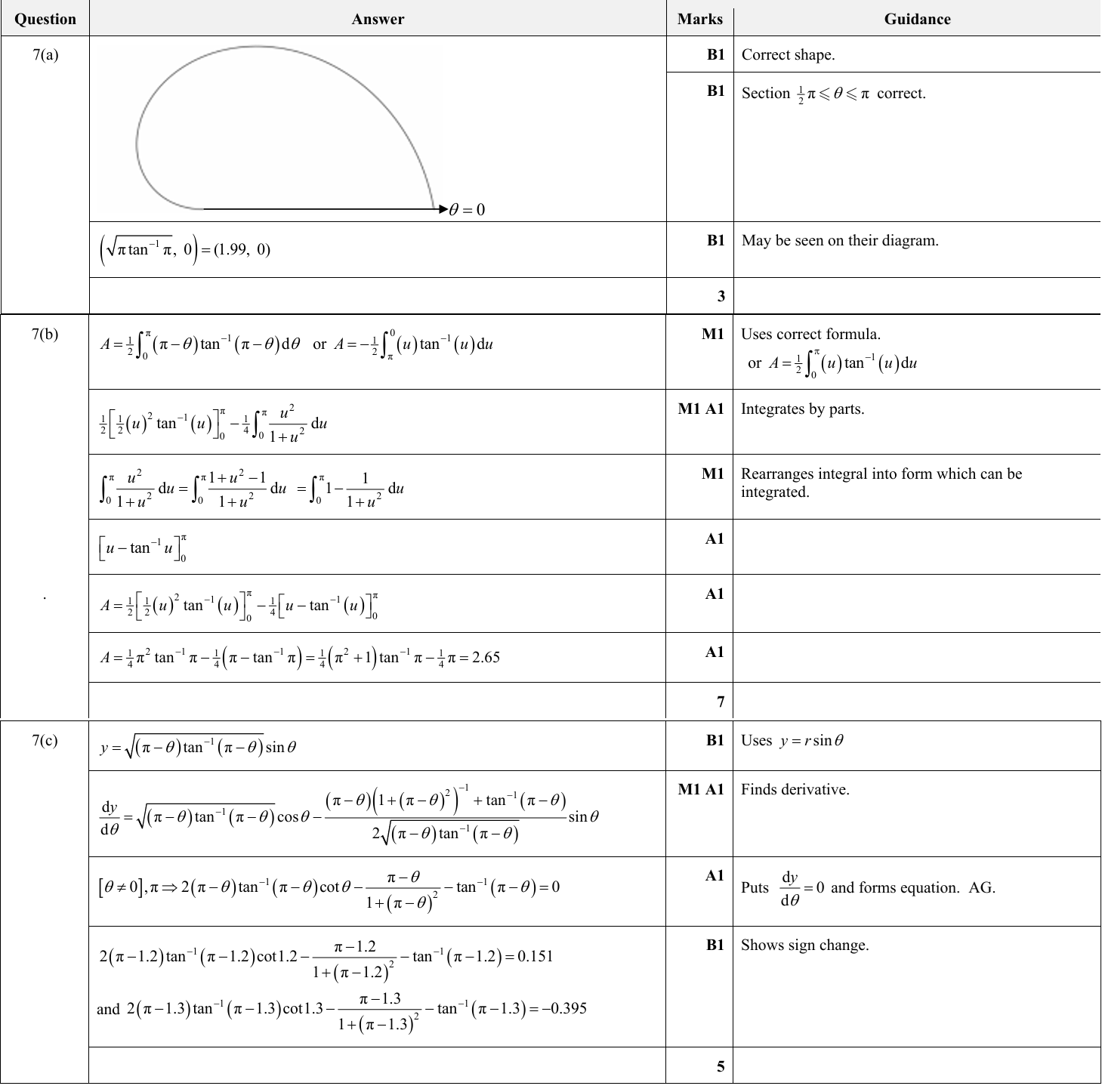
The curve C has polar equation \(r^2 = (\pi - \theta) \arctan(\pi - \theta)\), for \(0 \leq \theta \leq \pi\).
(a) Sketch C and state the polar coordinates of the point of C furthest from the pole. [3]
(b) Using the substitution \(u = \pi - \theta\), or otherwise, find the area of the region enclosed by C and the initial line. [7]
(c) Show that, at the point of C furthest from the initial line,
\(2(\pi - \theta) \arctan(\pi - \theta) \cot \theta - \frac{\pi - \theta}{1 + (\pi - \theta)^2} - \arctan(\pi - \theta) = 0\)
and verify that this equation has a root for \(\theta\) between 1.2 and 1.3. [5]
9231 P12 - Jun 2024 - Q07 - 15 marks
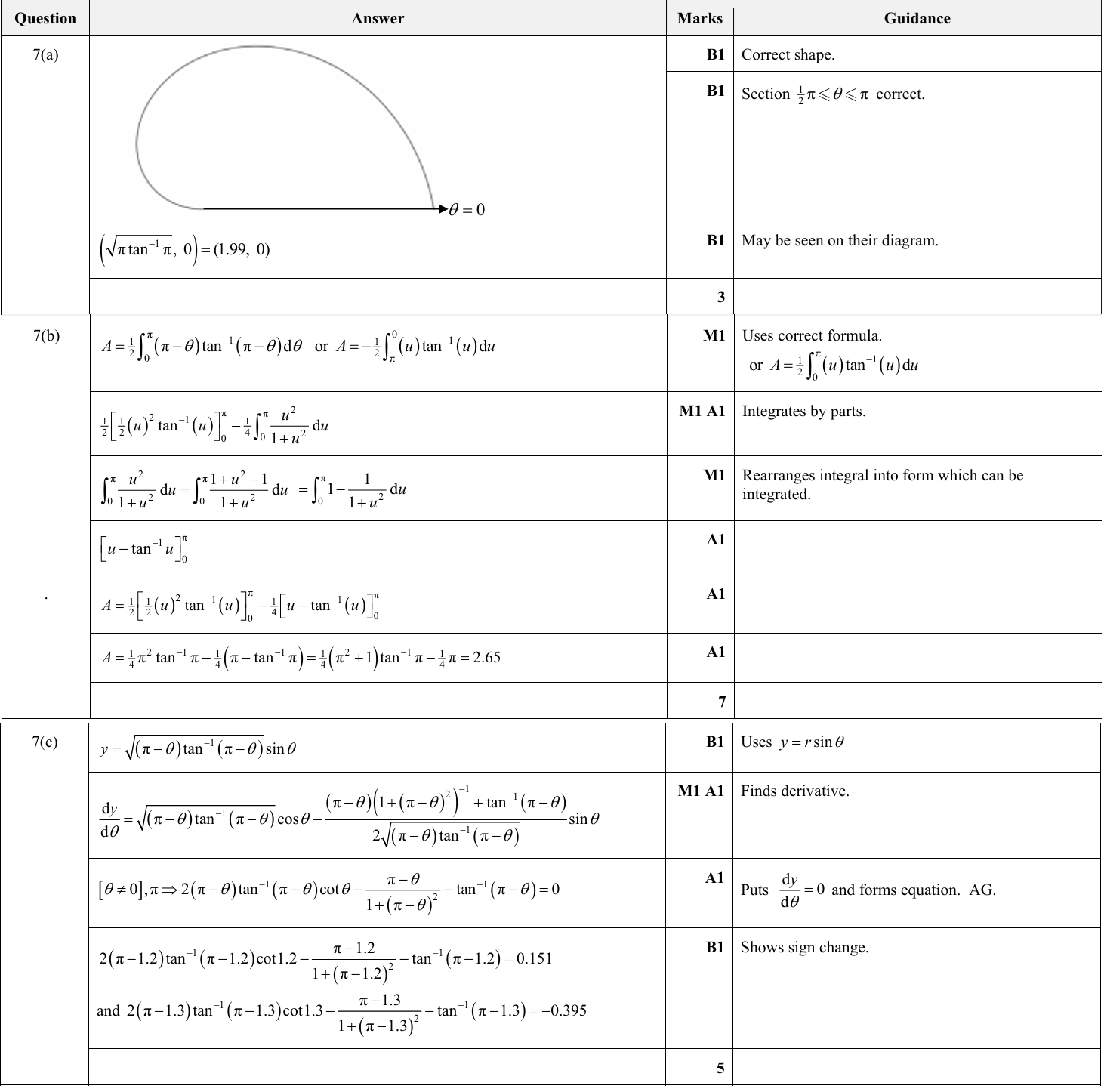
The curve C has polar equation \(r^2 = (\pi - \theta) \arctan(\pi - \theta)\), for \(0 \leq \theta \leq \pi\).
(a) Sketch C and state the polar coordinates of the point of C furthest from the pole. [3]
(b) Using the substitution \(u = \pi - \theta\), or otherwise, find the area of the region enclosed by C and the initial line. [7]
(c) Show that, at the point of C furthest from the initial line,
\(2(\pi - \theta) \arctan(\pi - \theta) \cot \theta - \frac{\pi - \theta}{1 + (\pi - \theta)^2} - \arctan(\pi - \theta) = 0\)
and verify that this equation has a root for \(\theta\) between 1.2 and 1.3. [5]
9231 P13 - Jun 2024 - Q07 - 16 marks
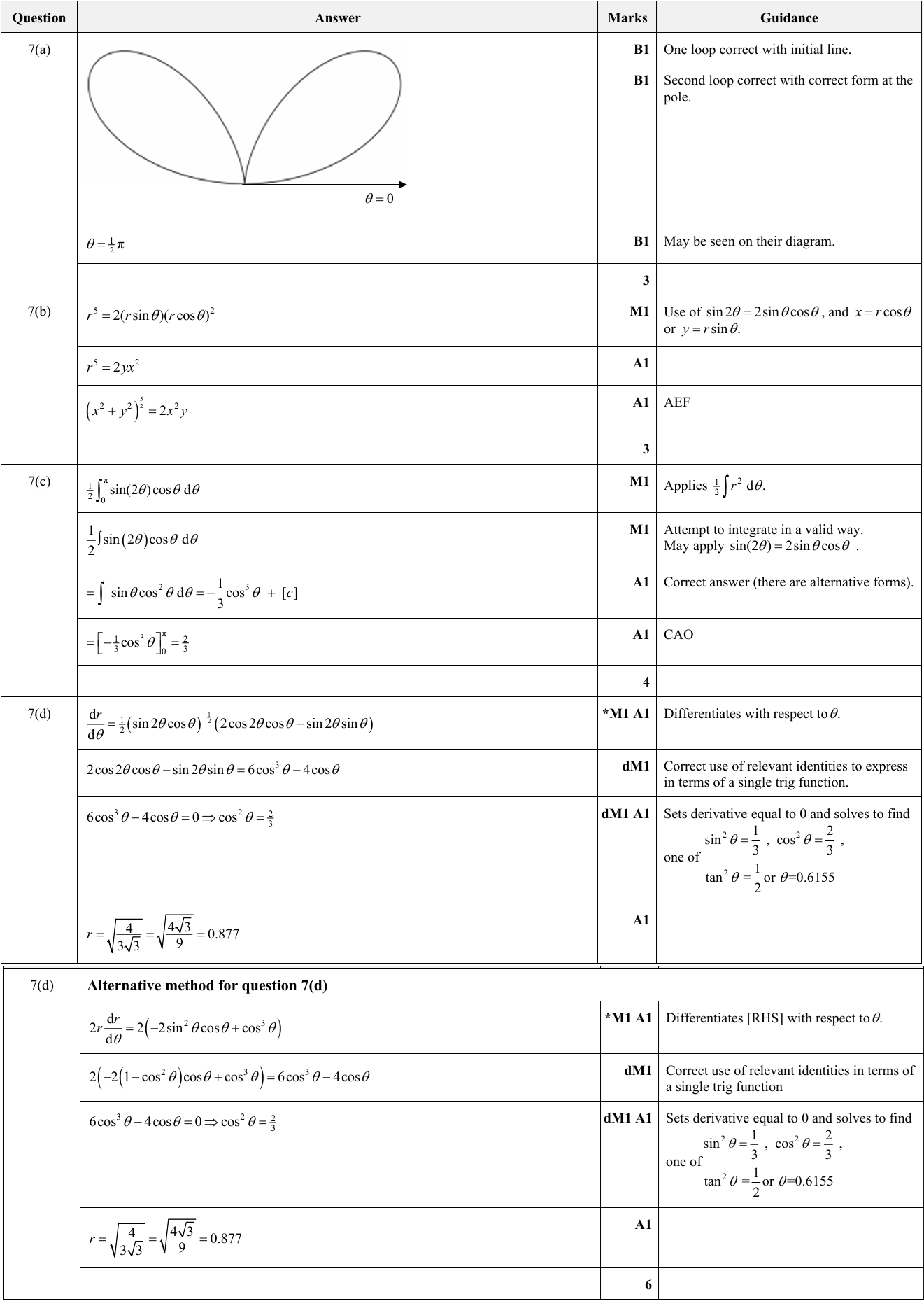
The curve C has polar equation \(r^2 = \sin 2\theta \cos \theta\), for \(0 \leq \theta \leq \pi\).
- Sketch C and state the equation of the line of symmetry.
- Find a Cartesian equation for C.
- Find the total area enclosed by C.
- Find the greatest distance of a point on C from the pole.
9231 P11 - Nov 2023 - Q06 - 15 marks
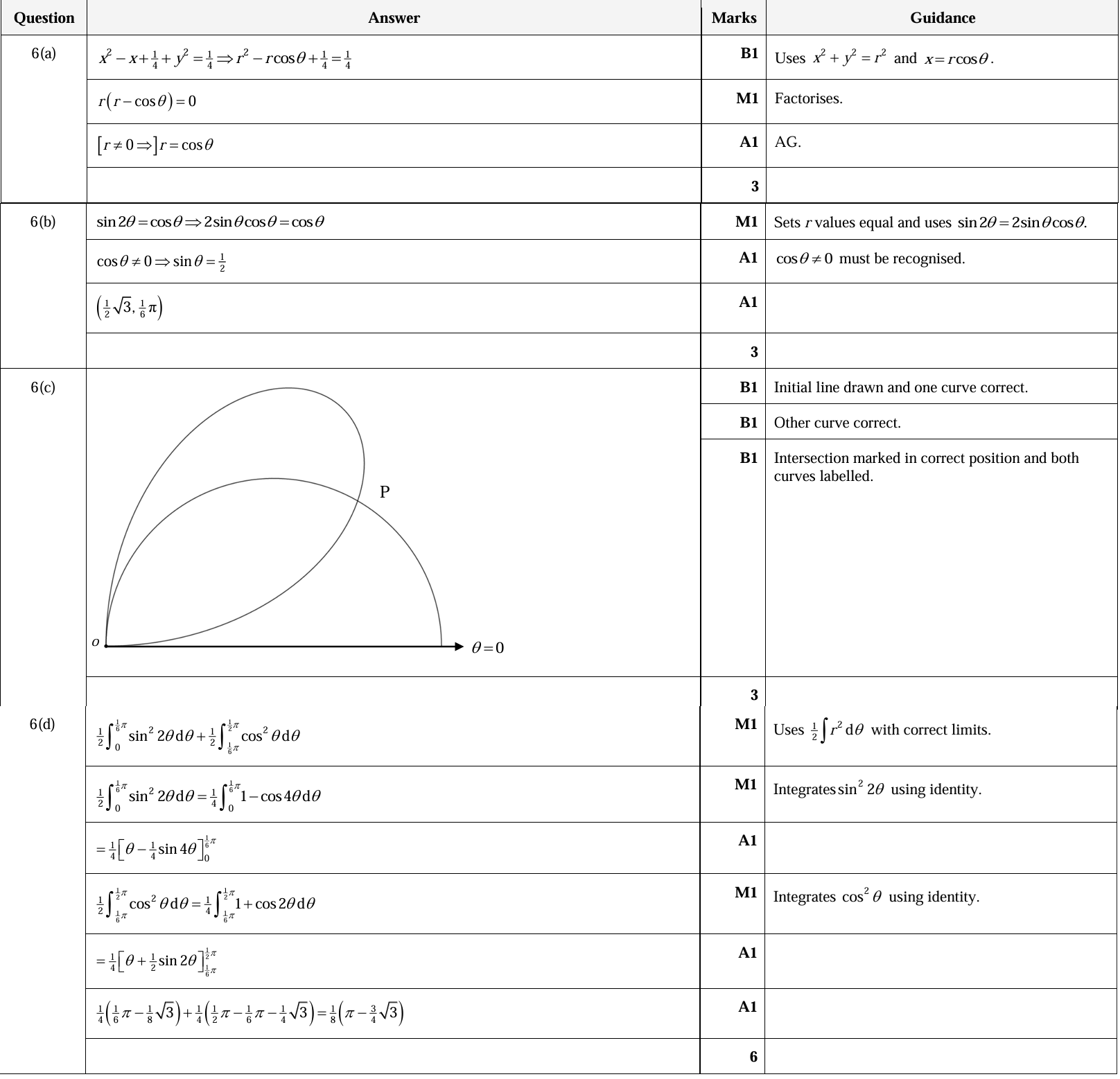
(a) Show that the curve with Cartesian equation \(\left( x - \frac{1}{2} \right)^2 + y^2 = \frac{1}{4}\) has polar equation \(r = \cos \theta\).
The curves \(C_1\) and \(C_2\) have polar equations \(r = \cos \theta\) and \(r = \sin 2\theta\) respectively, where \(0 \leq \theta \leq \frac{1}{2} \pi\). The curves \(C_1\) and \(C_2\) intersect at the pole and at another point \(P\).
(b) Find the polar coordinates of \(P\).
(c) In a single diagram sketch \(C_1\) and \(C_2\), clearly identifying each curve, and mark the point \(P\).
(d) The region \(R\) is enclosed by \(C_1\) and \(C_2\) and includes the line \(OP\). Find, in exact form, the area of \(R\).
9231 P12 - Nov 2023 - Q06 - 13 marks
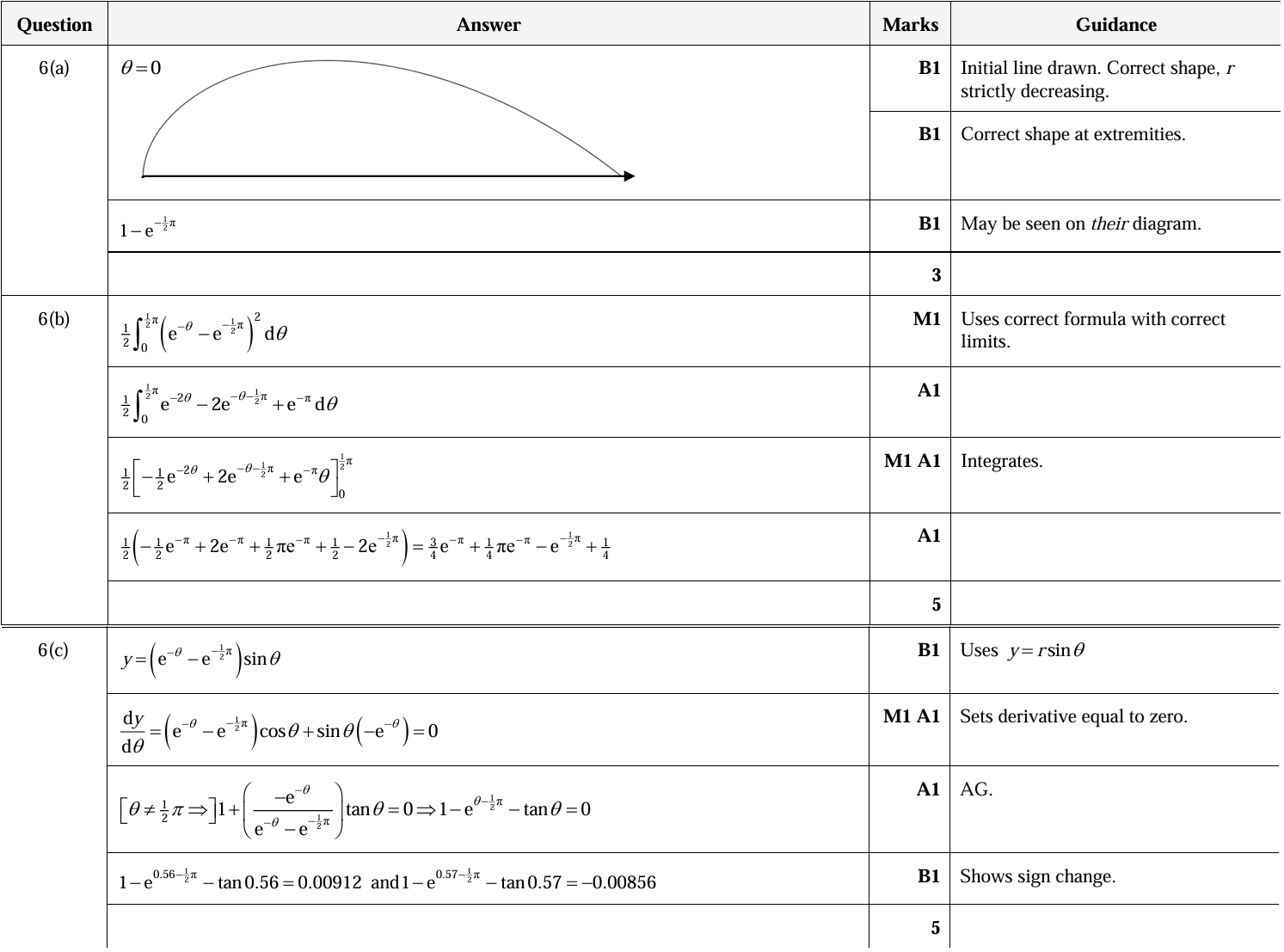
The curve C has polar equation \(r = e^{-\theta} - e^{-\frac{1}{2}\pi}\), where \(0 \leq \theta \leq \frac{1}{2}\pi\).
- Sketch C and state, in exact form, the greatest distance of a point on C from the pole.
- Find the exact value of the area of the region bounded by C and the initial line.
- Show that, at the point on C furthest from the initial line, \(1 - e^{\theta - \frac{1}{2}\pi} - \tan \theta = 0\) and verify that this equation has a root between 0.56 and 0.57.
9231 P13 - Nov 2023 - Q06 - 15 marks
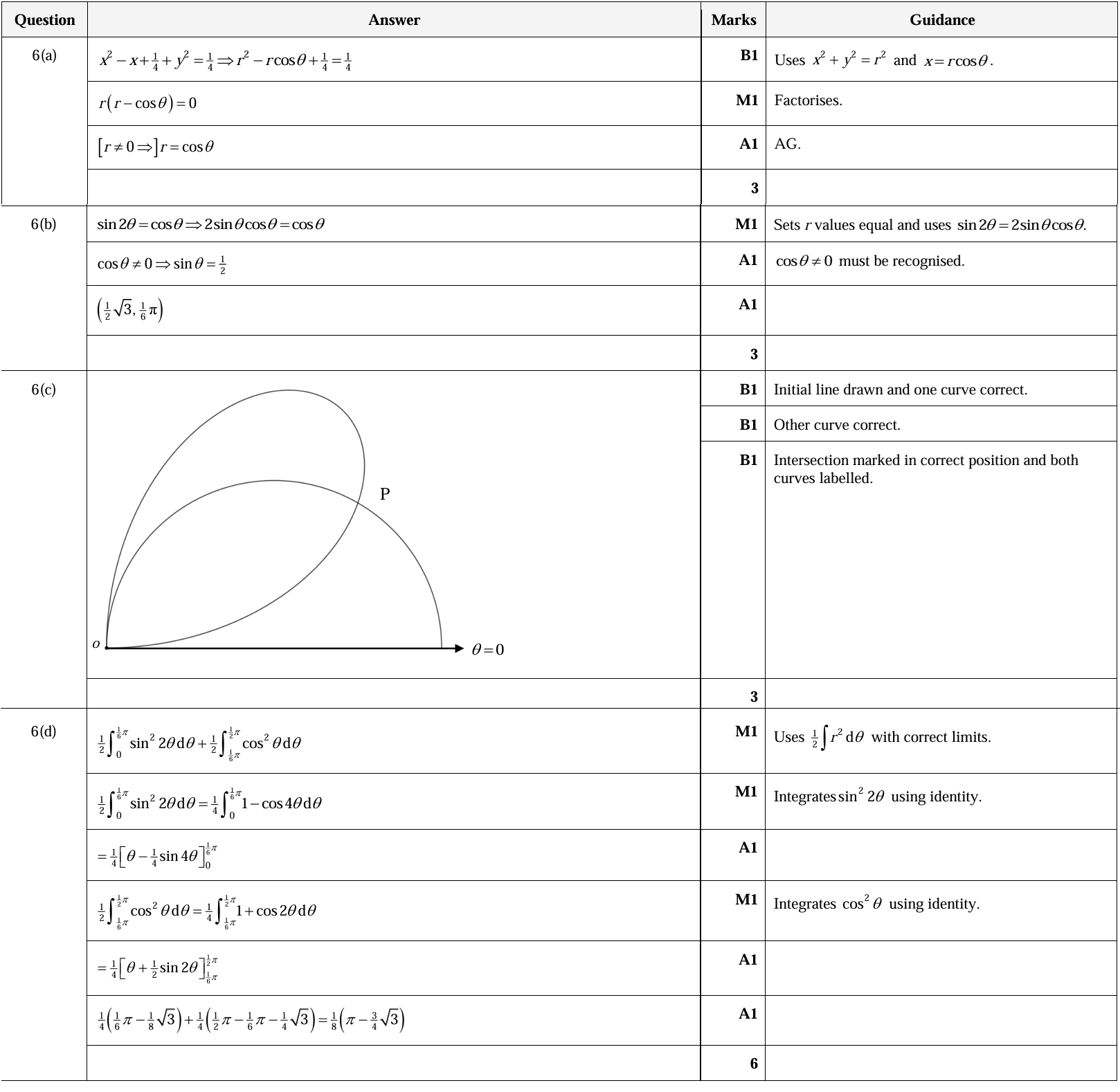
(a) Show that the curve with Cartesian equation \(\left( x - \frac{1}{2} \right)^2 + y^2 = \frac{1}{4}\) has polar equation \(r = \cos \theta\).
The curves \(C_1\) and \(C_2\) have polar equations \(r = \cos \theta\) and \(r = \sin 2\theta\) respectively, where \(0 \leq \theta \leq \frac{1}{2} \pi\). The curves \(C_1\) and \(C_2\) intersect at the pole and at another point \(P\).
(b) Find the polar coordinates of \(P\).
(c) In a single diagram sketch \(C_1\) and \(C_2\), clearly identifying each curve, and mark the point \(P\).
(d) The region \(R\) is enclosed by \(C_1\) and \(C_2\) and includes the line \(OP\). Find, in exact form, the area of \(R\).
9231 P11 - Jun 2023 - Q05 - 12 marks
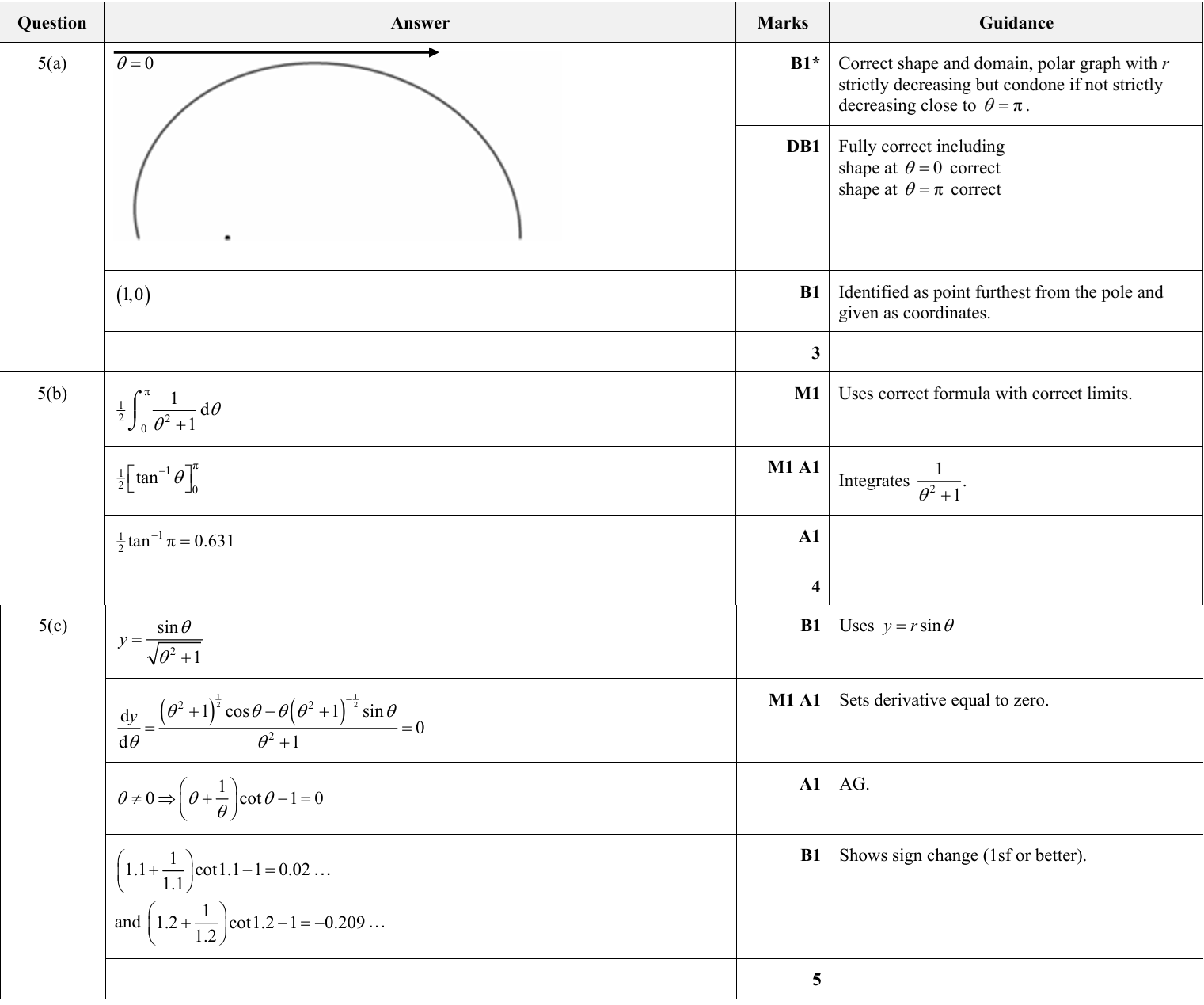
The curve \(C\) has polar equation \(r^2 = \frac{1}{\theta^2 + 1}\), for \(0 \leq \theta \leq \pi\).
- Sketch \(C\) and state the polar coordinates of the point of \(C\) furthest from the pole.
- Find the area of the region enclosed by \(C\), the initial line, and the half-line \(\theta = \pi\).
- Show that, at the point of \(C\) furthest from the initial line, \(\left( \theta + \frac{1}{\theta} \right) \cot \theta - 1 = 0\) and verify that this equation has a root between 1.1 and 1.2.
9231 P12 - Jun 2023 - Q05 - 12 marks
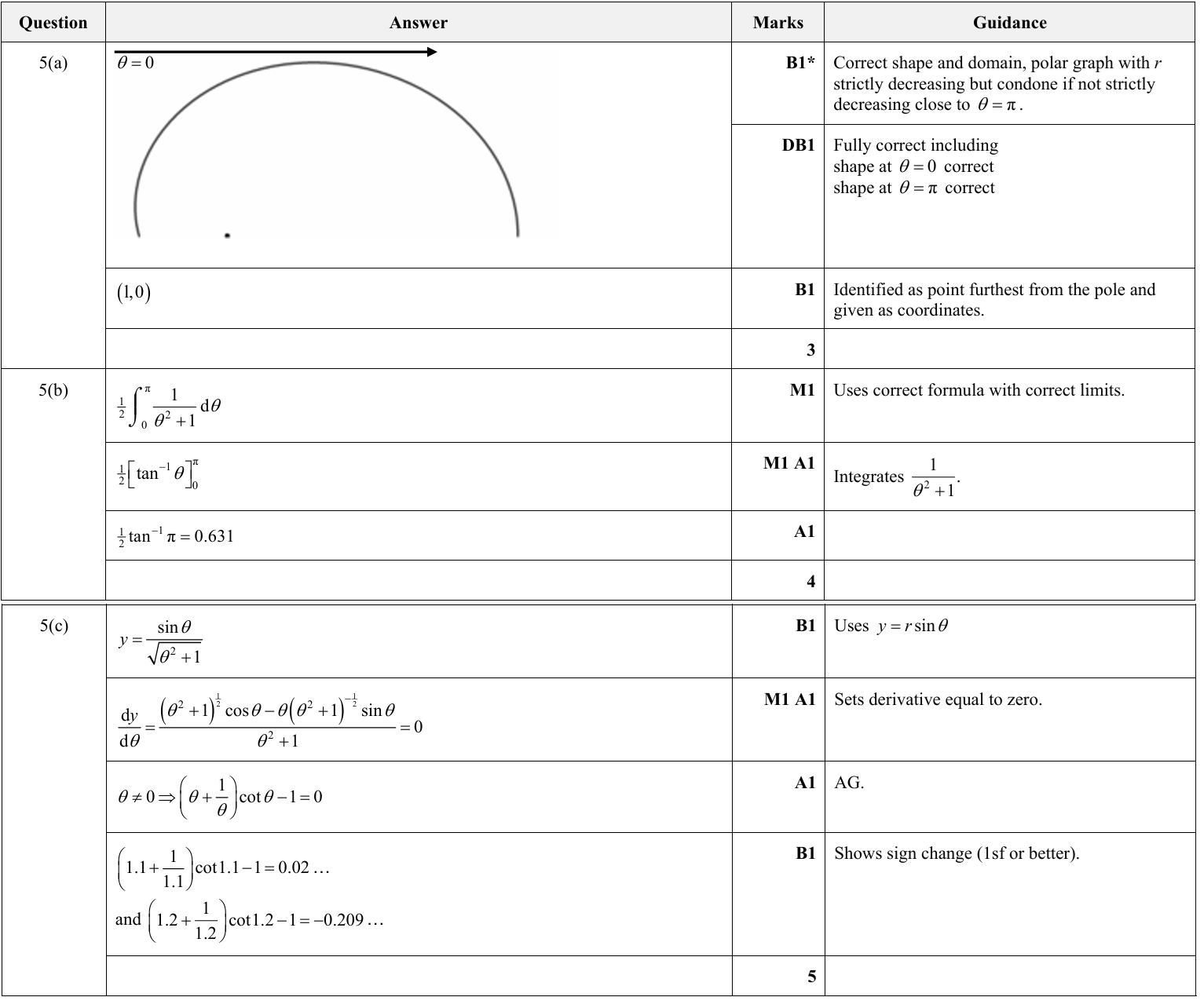
The curve C has polar equation \(r^2 = \frac{1}{\theta^2 + 1}\), for \(0 \leq \theta \leq \pi\).
- Sketch C and state the polar coordinates of the point of C furthest from the pole.
- Find the area of the region enclosed by C, the initial line, and the half-line \(\theta = \pi\).
- Show that, at the point of C furthest from the initial line, \(\left( \theta + \frac{1}{\theta} \right) \cot \theta - 1 = 0\) and verify that this equation has a root between 1.1 and 1.2.
9231 P13 - Jun 2023 - Q05 - 10 marks
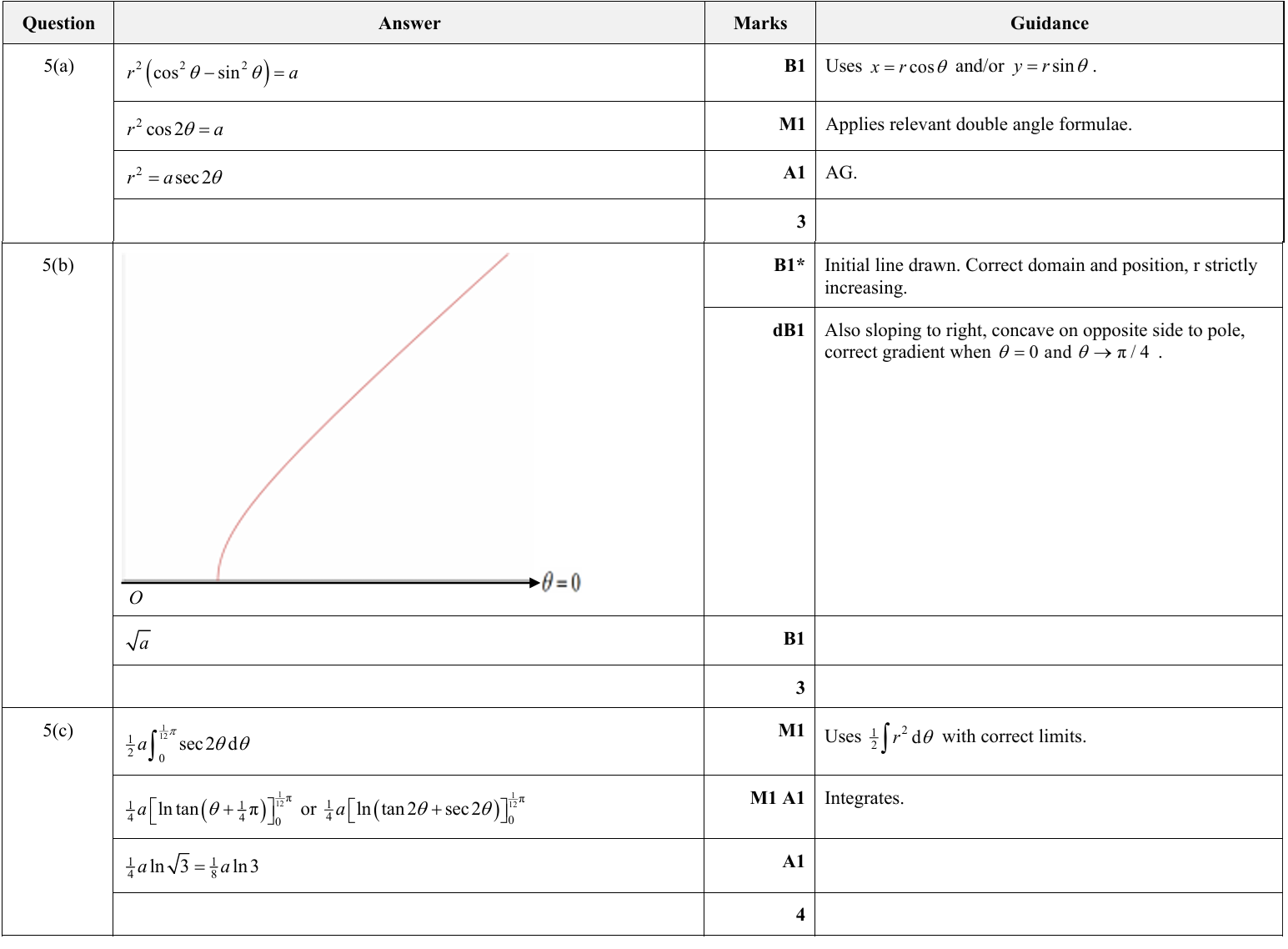
(a) Show that the curve with Cartesian equation \(x^2 - y^2 = a\), where \(a\) is a positive constant, has polar equation \(r^2 = a \sec 2\theta\).
The curve \(C\) has polar equation \(r^2 = a \sec 2\theta\), where \(a\) is a positive constant, for \(0 \leq \theta < \frac{1}{4}\pi\).
(b) Sketch \(C\) and state the minimum distance of \(C\) from the pole.
9231 P12 - Jun 2022 - Q06 - 13 marks
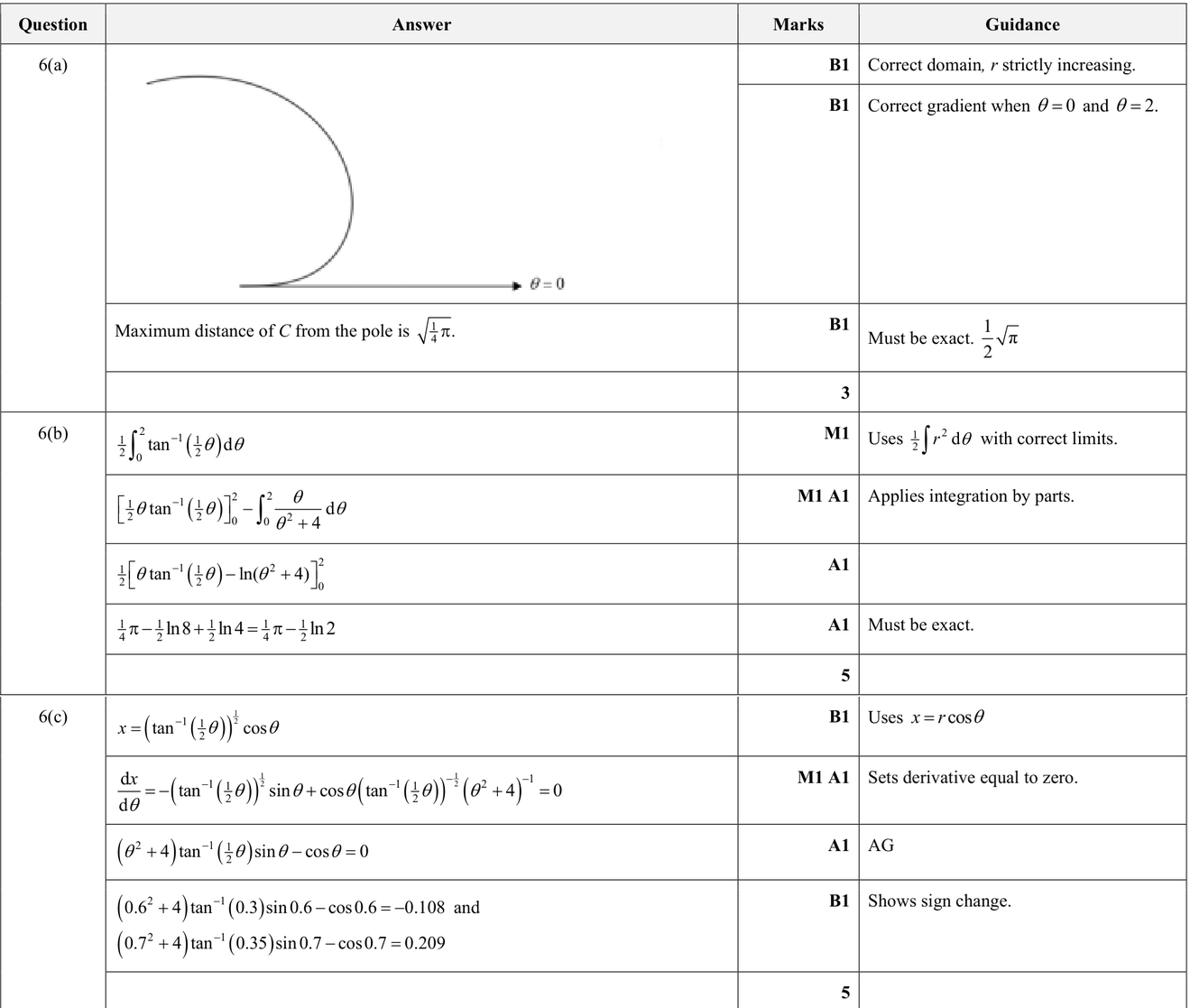
The curve C has polar equation \(r^2 = \arctan\left(\frac{1}{2}\theta\right)\), where \(0 \leq \theta \leq 2\).
(a) Sketch C and state, in exact form, the greatest distance of a point on C from the pole.
(b) Find the exact value of the area of the region bounded by C and the half-line \(\theta = 2\).
Now consider the part of C where \(0 \leq \theta \leq \frac{1}{2}\pi\).
(c) Show that, at the point furthest from the half-line \(\theta = \frac{1}{2}\pi\),
\((\theta^2 + 4)\arctan\left(\frac{1}{2}\theta\right)\sin\theta - \cos\theta = 0\)
and verify that this equation has a root between 0.6 and 0.7.
9231 P13 - Jun 2022 - Q06 - 13 marks
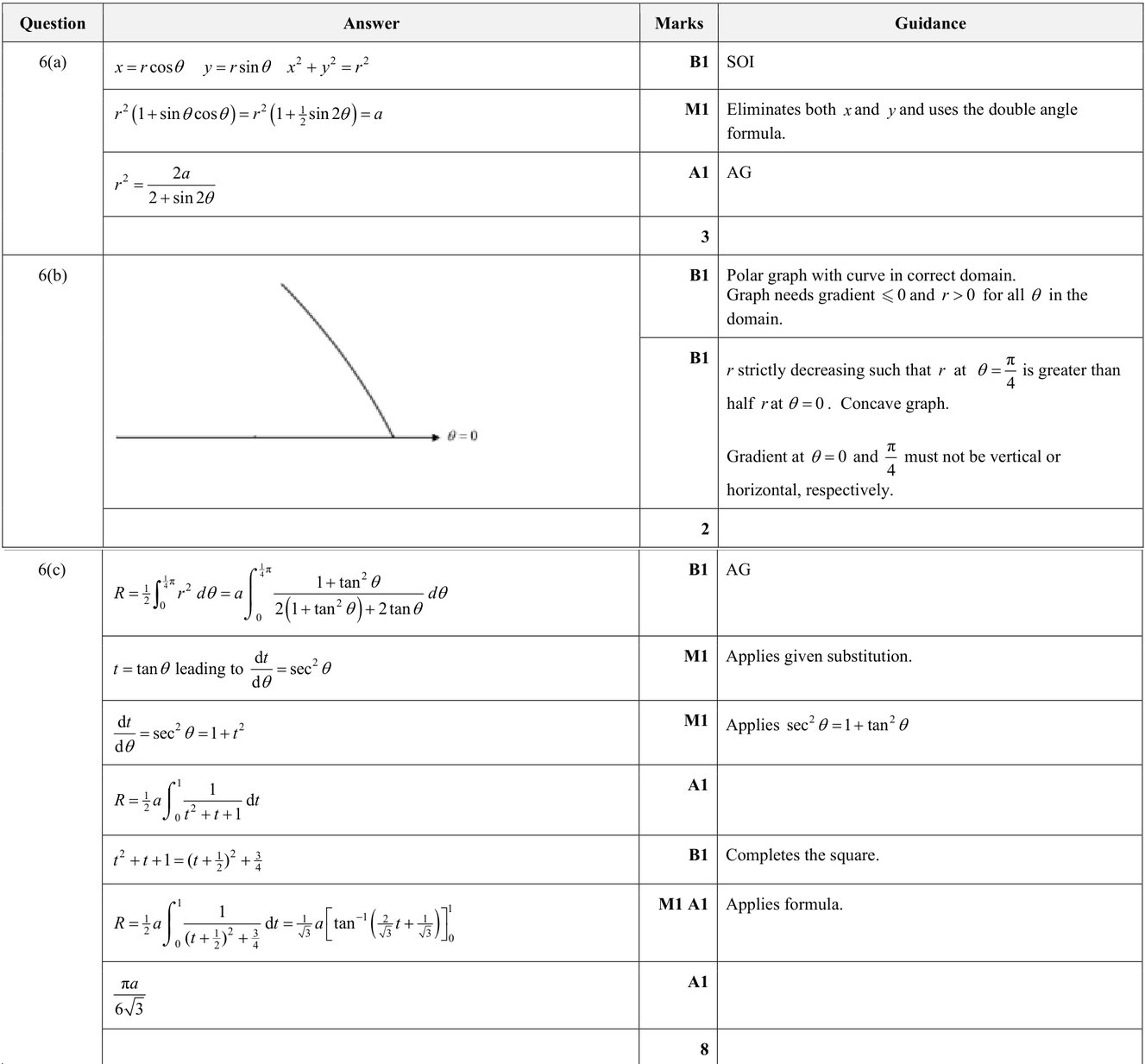
The curve C has Cartesian equation \(x^2 + xy + y^2 = a\), where \(a\) is a positive constant.
(a) Show that the polar equation of C is \(r^2 = \frac{2a}{2 + \sin 2\theta}\).
(b) Sketch the part of C for \(0 \leq \theta \leq \frac{1}{4}\pi\).
The region R is enclosed by this part of C, the initial line and the half-line \(\theta = \frac{1}{4}\pi\).
(c) It is given that \(\sin 2\theta\) may be expressed as \(\frac{2 \tan \theta}{1 + \tan^2 \theta}\). Use this result to show that the area of R is
\(\frac{1}{2} a \int_{0}^{\frac{1}{4}\pi} \frac{1 + \tan^2 \theta}{1 + \tan \theta + \tan^2 \theta} \, d\theta\)
and use the substitution \(t = \tan \theta\) to find the exact value of this area.
9231 P11 - Nov 2022 - Q06 - 14 marks
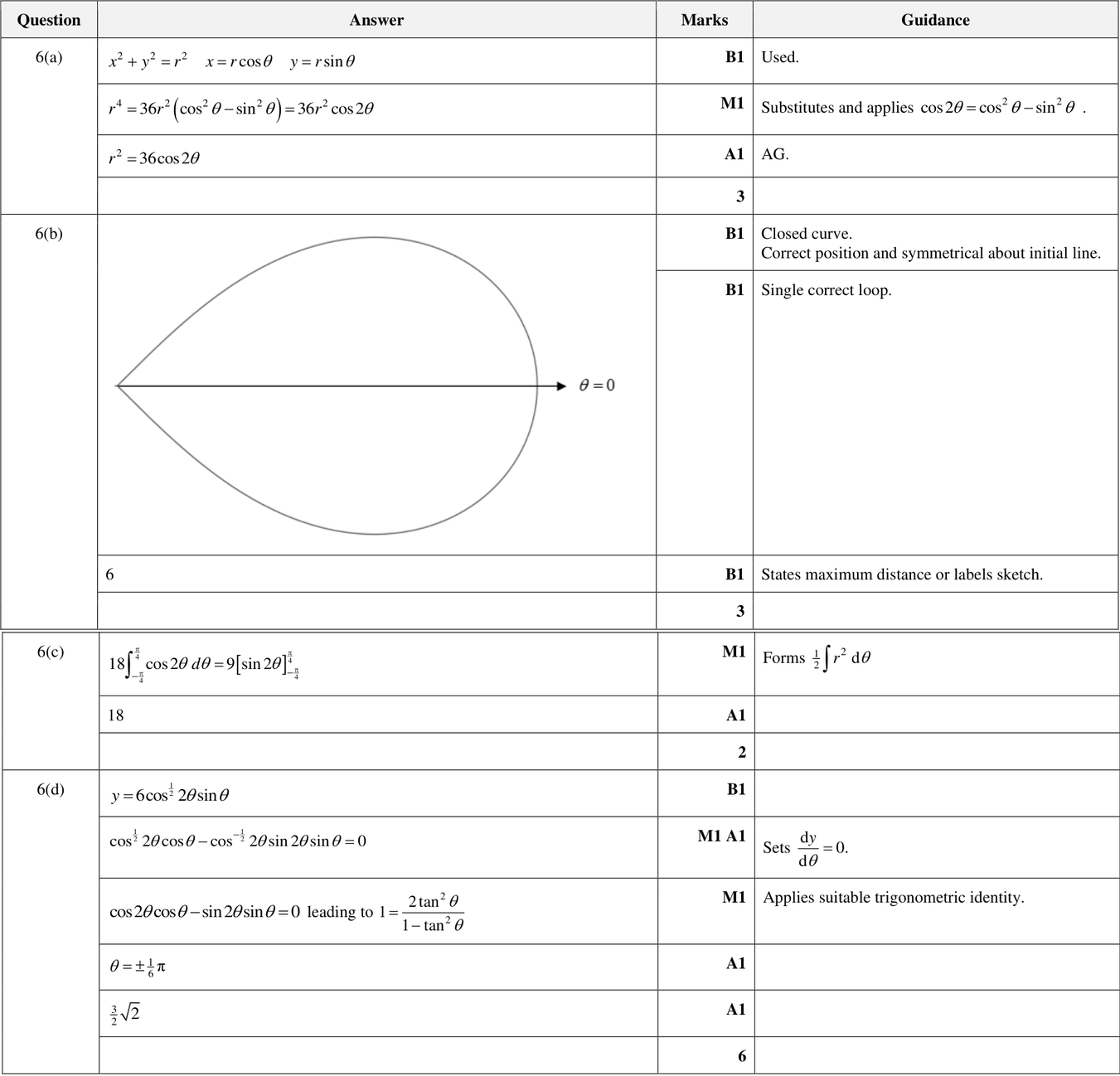
(a) Show that the curve with Cartesian equation \((x^2 + y^2)^2 = 36(x^2 - y^2)\) has polar equation \(r^2 = 36 \cos 2\theta\).
The curve \(C\) has polar equation \(r^2 = 36 \cos 2\theta\), for \(-\frac{1}{4}\pi \leq \theta \leq \frac{1}{4}\pi\).
(b) Sketch \(C\) and state the maximum distance of a point on \(C\) from the pole.
(c) Find the area of the region enclosed by \(C\).
(d) Find the maximum distance of a point on \(C\) from the initial line, giving the answer in exact form.
9231 P12 - Nov 2022 - Q05 - 12 marks
The curve C has polar equation \(r = a \sec^2 \theta\), where \(a\) is a positive constant and \(0 \leq \theta \leq \frac{1}{4} \pi\).
- Sketch C, stating the polar coordinates of the point of intersection of C with the initial line and also with the half-line \(\theta = \frac{1}{4} \pi\).
- Find the maximum distance of a point of C from the initial line.
- Find the area of the region enclosed by C, the initial line and the half-line \(\theta = \frac{1}{4} \pi\).
- Find, in the form \(y = f(x)\), the Cartesian equation of C.
9231 P12 - Jun 2021 - Q05 - 10 marks
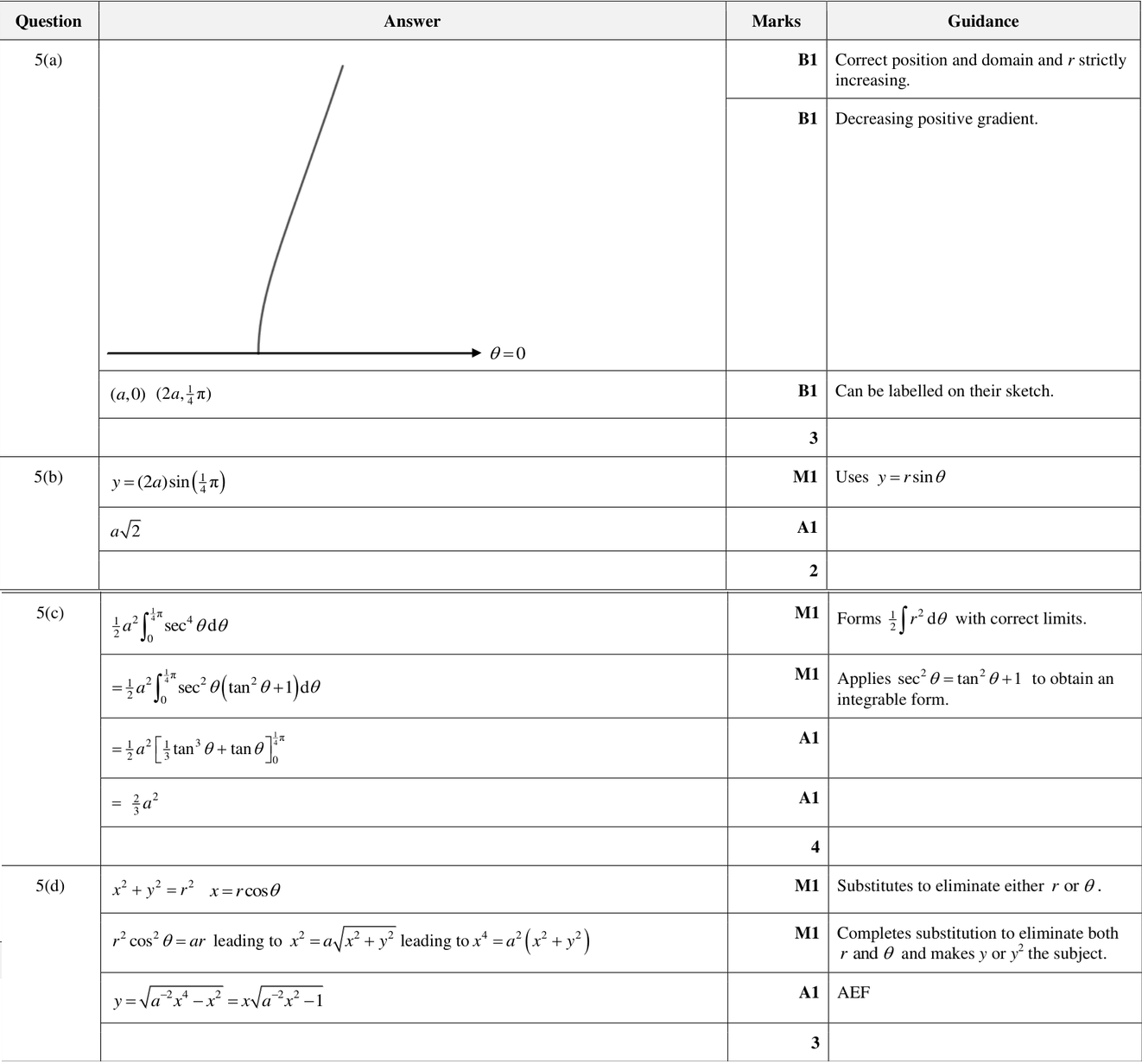
The curve C has polar equation \(r = a \cot\left(\frac{1}{3}\pi - \theta\right)\), where \(a\) is a positive constant and \(0 \leq \theta \leq \frac{1}{6}\pi\).
It is given that the greatest distance of a point on C from the pole is \(2\sqrt{3}\).
- Sketch C and show that \(a = 2\). [3]
- Find the exact value of the area of the region bounded by C, the initial line and the half-line \(\theta = \frac{1}{6}\pi\). [4]
- Show that C has Cartesian equation \(2(x + y\sqrt{3}) = (x\sqrt{3} - y)\sqrt{x^2 + y^2}\). [3]
9231 P13 - Jun 2021 - Q05 - 9 marks
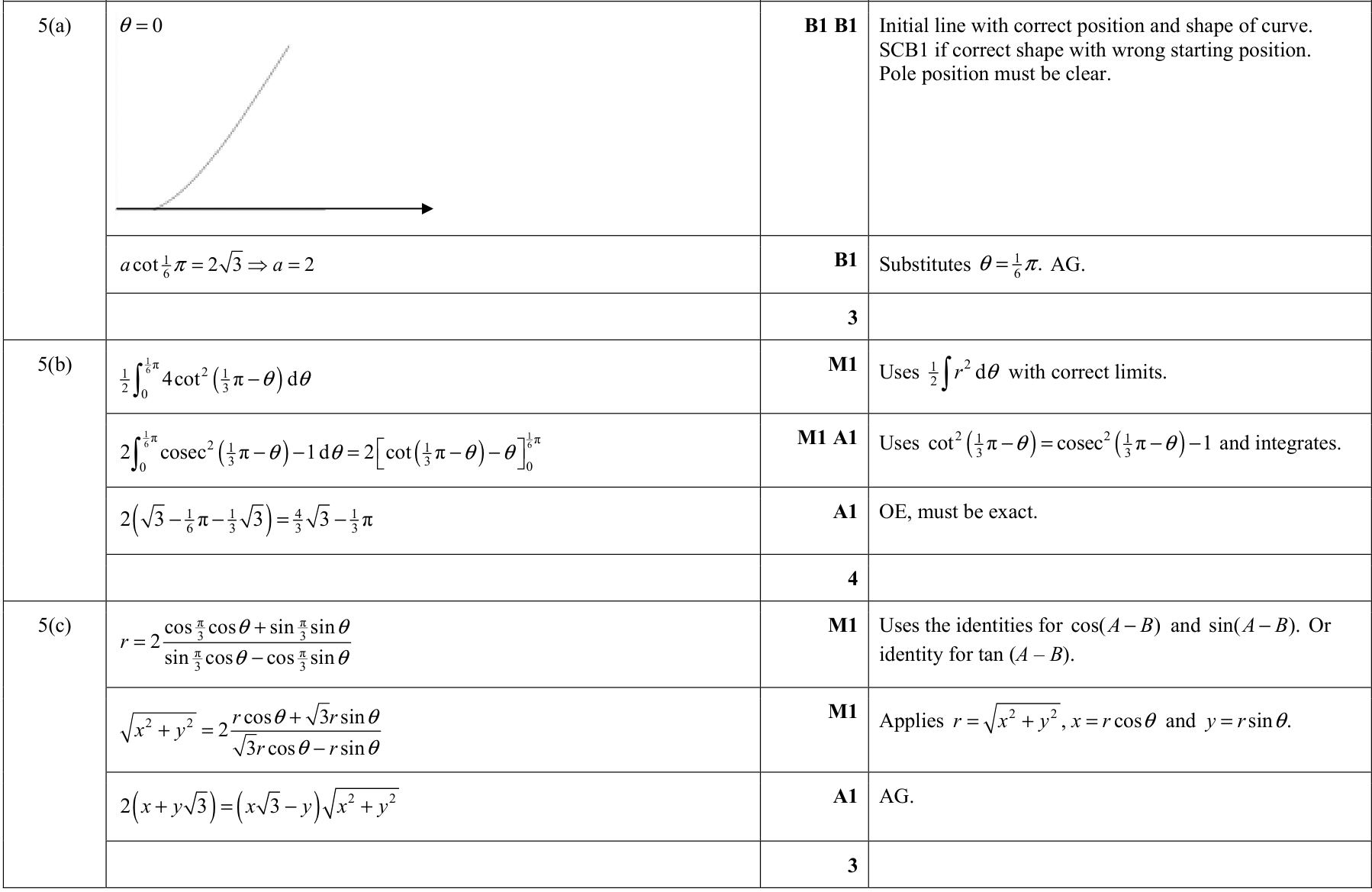
The curve C has polar equation \(r = \frac{1}{\pi - \theta} - \frac{1}{\pi}\), where \(0 \leq \theta \leq \frac{1}{2}\pi\).
(a) Sketch C.
(b) Show that the area of the region bounded by the half-line \(\theta = \frac{1}{2}\pi\) and C is \(\frac{3 - 4 \ln 2}{4\pi}\).
9231 P11 - Nov 2021 - Q06 - 13 marks
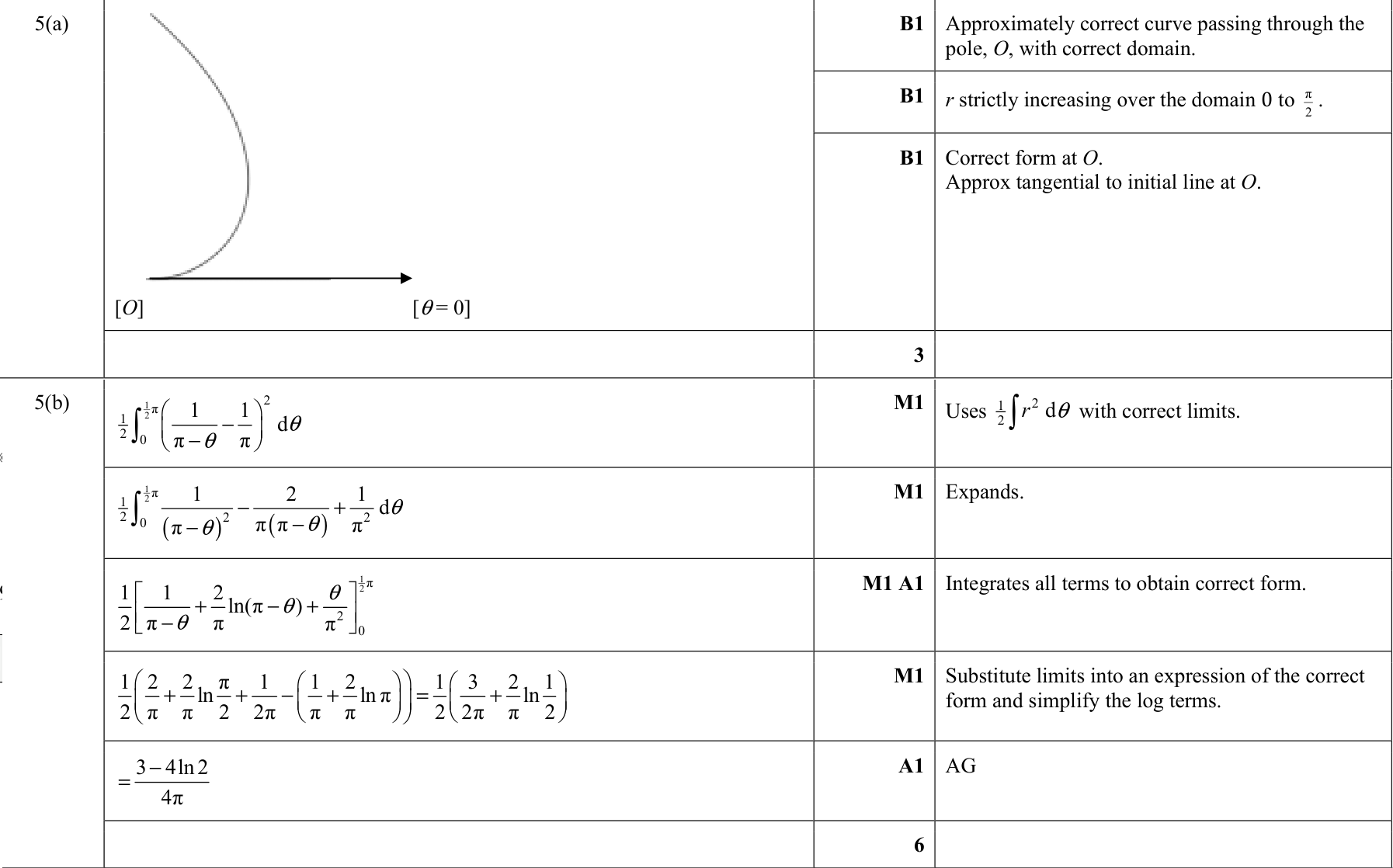
The curve C has polar equation \(r = 2 \cos \theta (1 + \sin \theta)\), for \(0 \leq \theta \leq \frac{1}{2} \pi\).
- Find the polar coordinates of the point on C that is furthest from the pole.
- Sketch C.
- Find the area of the region bounded by C and the initial line, giving your answer in exact form.
9231 P12 - Nov 2021 - Q05 - 12 marks
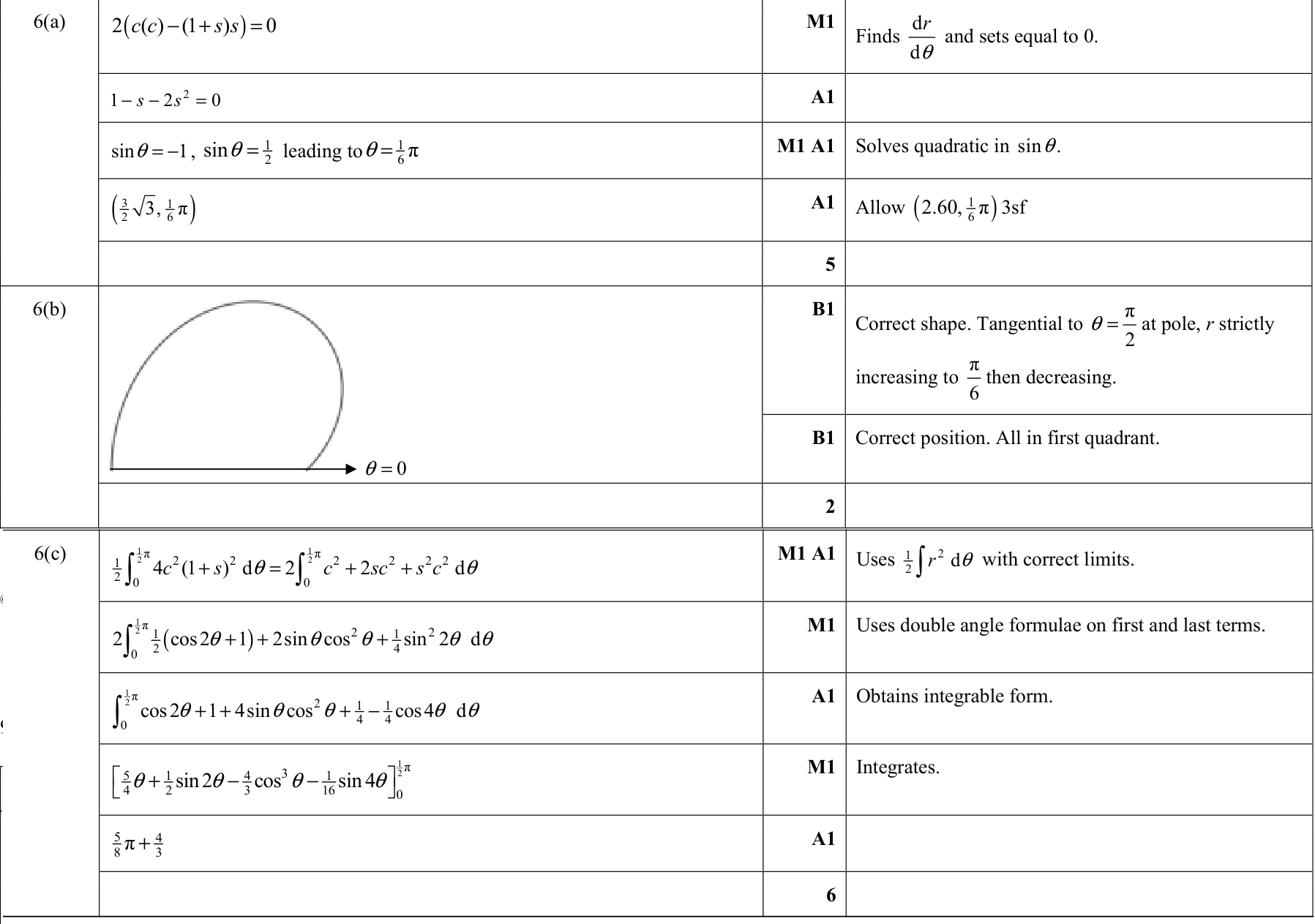
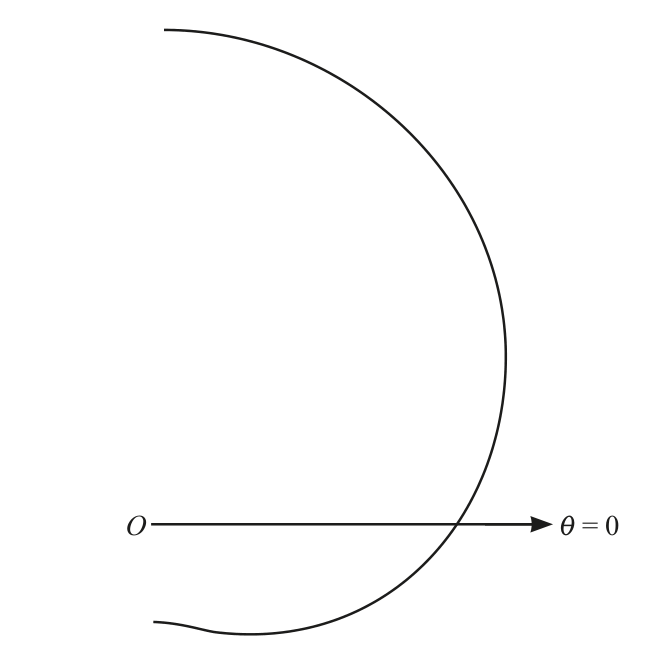
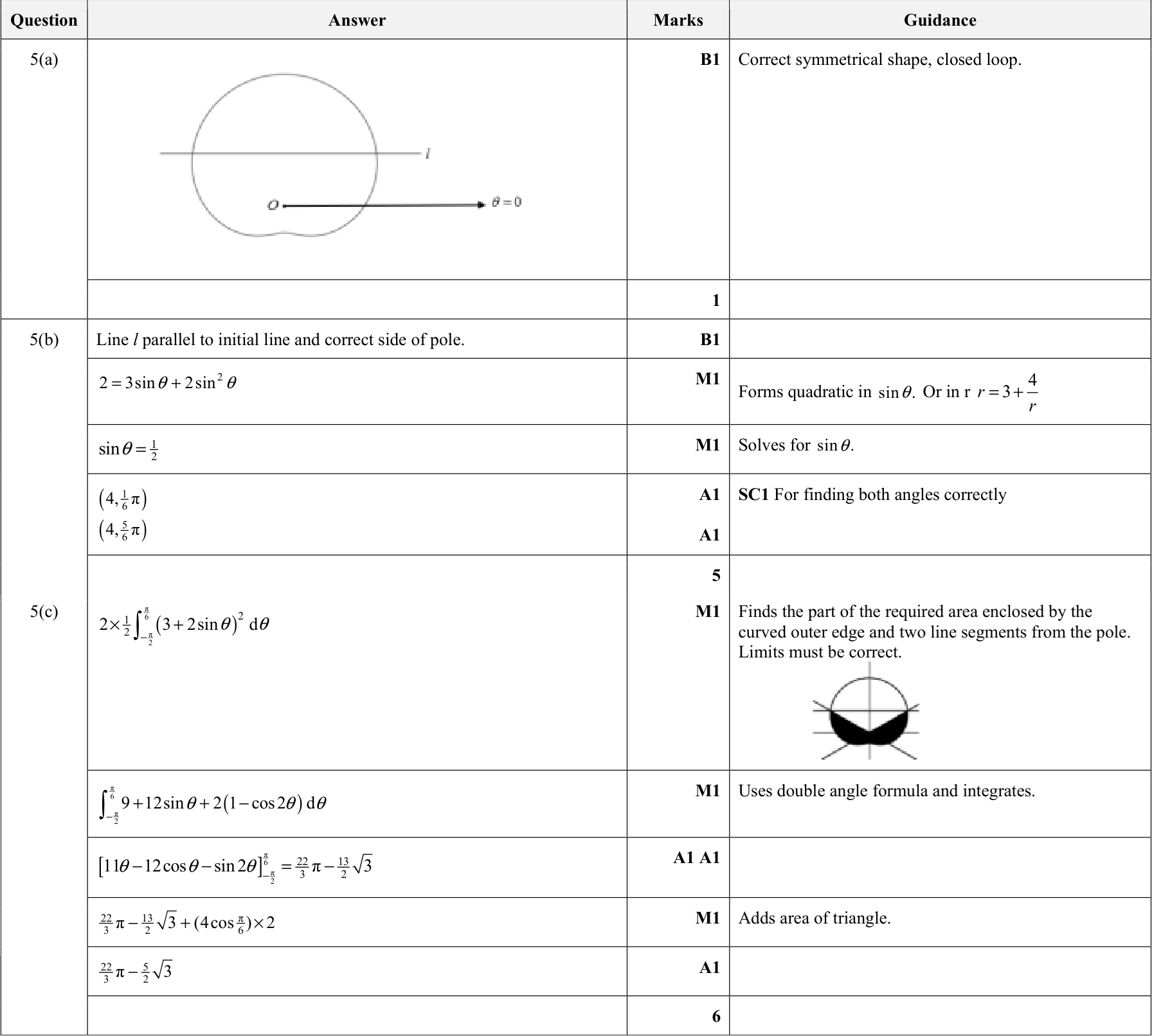
The curve C has polar equation \(r = 3 + 2 \sin \theta\), for \(-\pi < \theta \leq \pi\).
(a) The diagram shows part of C. Sketch the rest of C on the diagram.
The straight line l has polar equation \(r \sin \theta = 2\).
(b) Add l to the diagram in part (a) and find the polar coordinates of the points of intersection of C and l.
(c) The region R is enclosed by C and l, and contains the pole. Find the area of R, giving your answer in exact form.
9231 P11 - Nov 2020 - Q7 - 17 marks
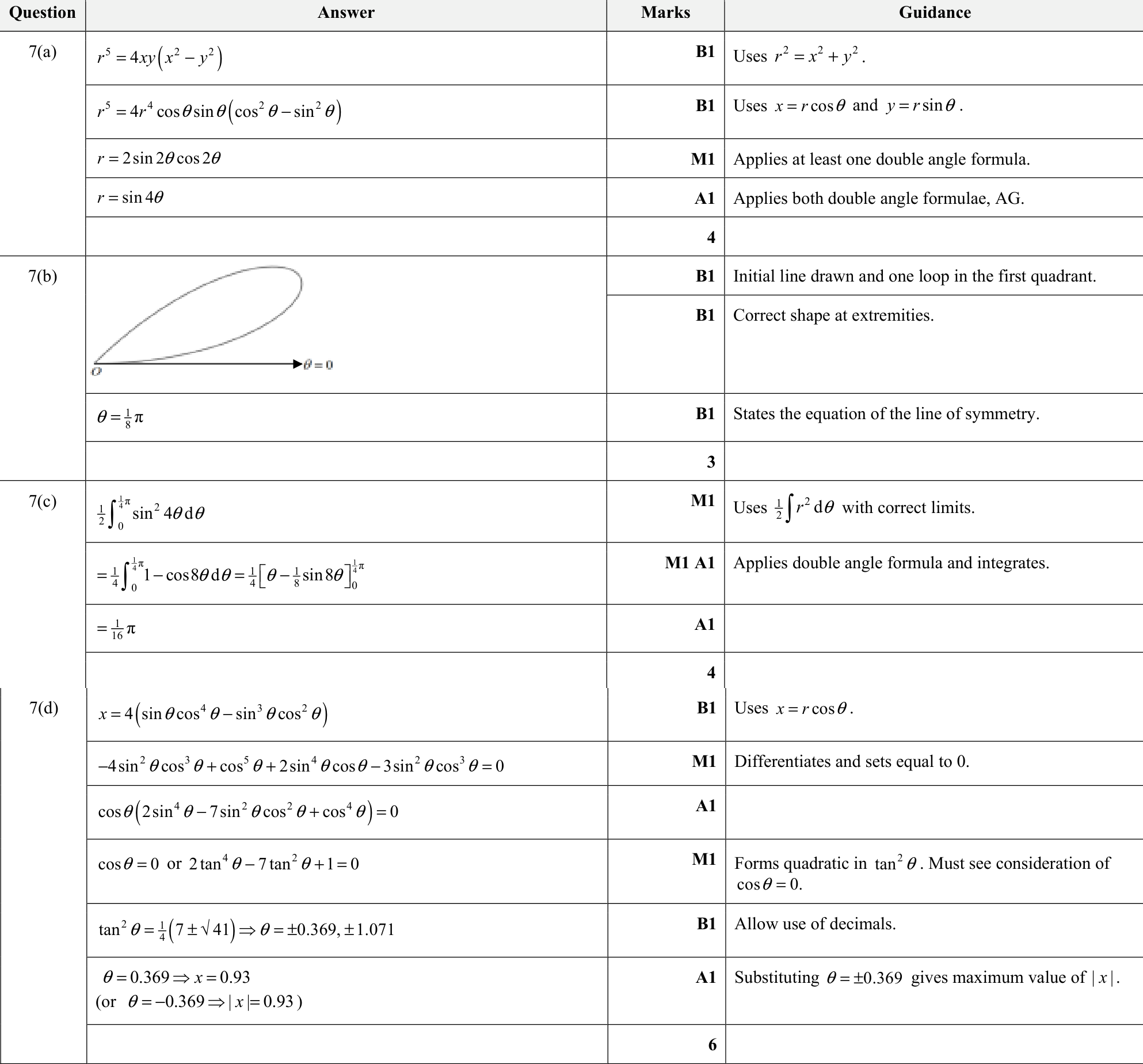
7 (a) Show that the curve with Cartesian equation
\(\left(x^{2}+y^{2}\right)^{\frac{5}{2}}=4 x y\left(x^{2}-y^{2}\right)\)
has polar equation \(r=\sin 4 \theta\).
The curve \(C\) has polar equation \(r=\sin 4 \theta\), for \(0 \leqslant \theta \leqslant \frac{1}{4} \pi\).
(b) Sketch \(C\) and state the equation of the line of symmetry.
(c) Find the exact value of the area of the region enclosed by \(C\).
(d) Using the identity \(\sin 4 \theta \equiv 4 \sin \theta \cos ^{3} \theta-4 \sin ^{3} \theta \cos \theta\), find the maximum distance of \(C\) from the line \(\theta=\frac{1}{2} \pi\). Give your answer correct to 2 decimal places.
9231 P11 - Jun 2020 - Q7 - 17 marks
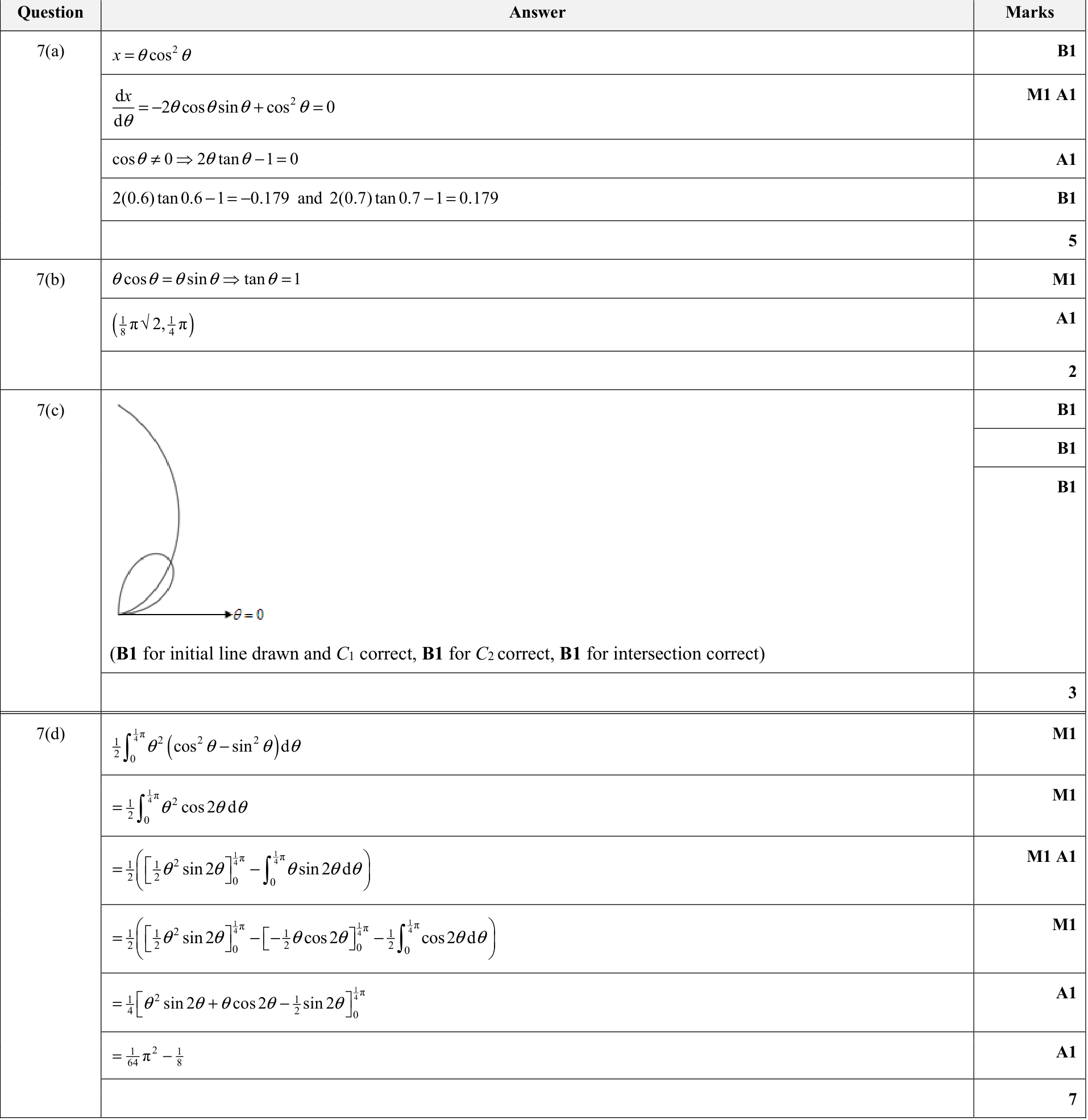
7 The curve \(C_{1}\) has polar equation \(r=\theta \cos \theta\), for \(0 \leqslant \theta \leqslant \frac{1}{2} \pi\).
(a) The point on \(C_{1}\) furthest from the line \(\theta=\frac{1}{2} \pi\) is denoted by \(P\). Show that, at \(P\),
\(2 \theta \tan \theta-1=0\)
and verify that this equation has a root between 0.6 and 0.7 .
The curve \(C_{2}\) has polar equation \(r=\theta \sin \theta\), for \(0 \leqslant \theta \leqslant \frac{1}{2} \pi\). The curves \(C_{1}\) and \(C_{2}\) intersect at the pole, denoted by \(O\), and at another point \(Q\).
(b) Find the polar coordinates of \(Q\), giving your answers in exact form.
(c) Sketch \(C_{1}\) and \(C_{2}\) on the same diagram.
(d) Find, in terms of \(\pi\), the area of the region bounded by the \(\operatorname{arc} O Q\) of \(C_{1}\) and the \(\operatorname{arc} O Q\) of \(C_{2}\). [7]
9231 P11 - Jun 2019 - Q11 - 28 marks
11 Answer only one of the following two alternatives.
EITHER
The curve \(C_1\) has polar equation \(r^2=2\theta\), for \(0\leq \theta\leq \dfrac{\pi}{2}\).
(i) The point on \(C_1\) furthest from the line \(\theta=\dfrac{\pi}{2}\) is denoted by \(P\). Show that, at \(P\), \(2\theta\tan\theta=1\), and verify that this equation has a root between \(0.6\) and \(0.7\).
The curve \(C_2\) has polar equation \(r^2=\theta\sec^2\theta\), for \(0\leq\theta\leq\dfrac{\pi}{4}\). The curves \(C_1\) and \(C_2\) intersect at the pole, denoted by \(O\), and at another point \(Q\).
(ii) Find the exact value of \(\theta\) at \(Q\).
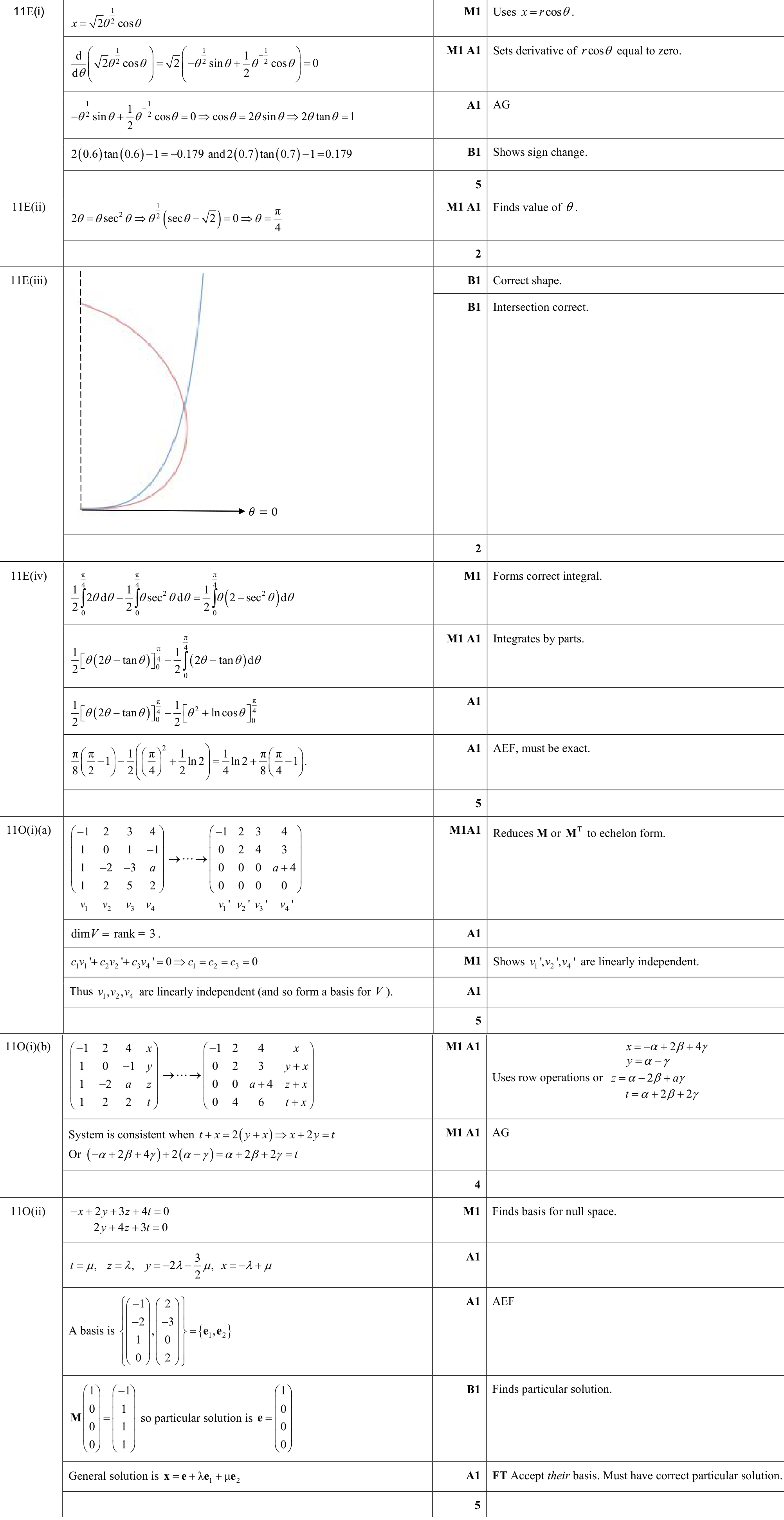
(iii) The diagram below shows the curve \(C_2\). Sketch \(C_1\) on this diagram.
(iv) Find, in exact form, the area of the region \(OPQ\) enclosed by \(C_1\) and \(C_2\).
9231 P13 - Jun 2019 - Q2 - 7 marks
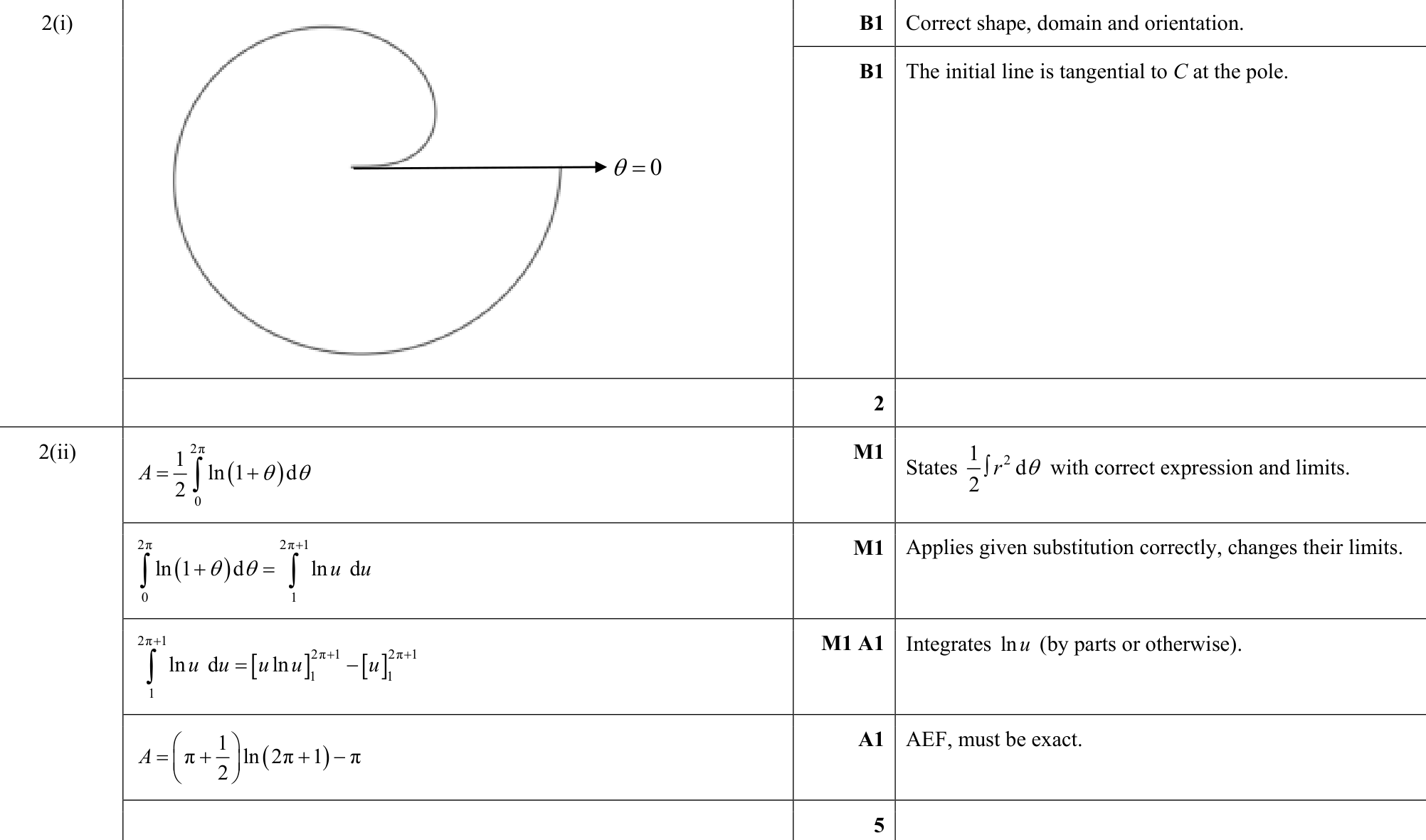
2 The curve \(C\) has polar equation \(r^{2}=\ln (1+\theta)\), for \(0 \leqslant \theta \leqslant 2 \pi\).
(i) Sketch \(C\).
(ii) Using the substitution \(u=1+\theta\), or otherwise, find the area of the region bounded by \(C\) and the initial line, leaving your answer in an exact form.
9231 P11 - Jun 2018 - Q3 - 8 marks
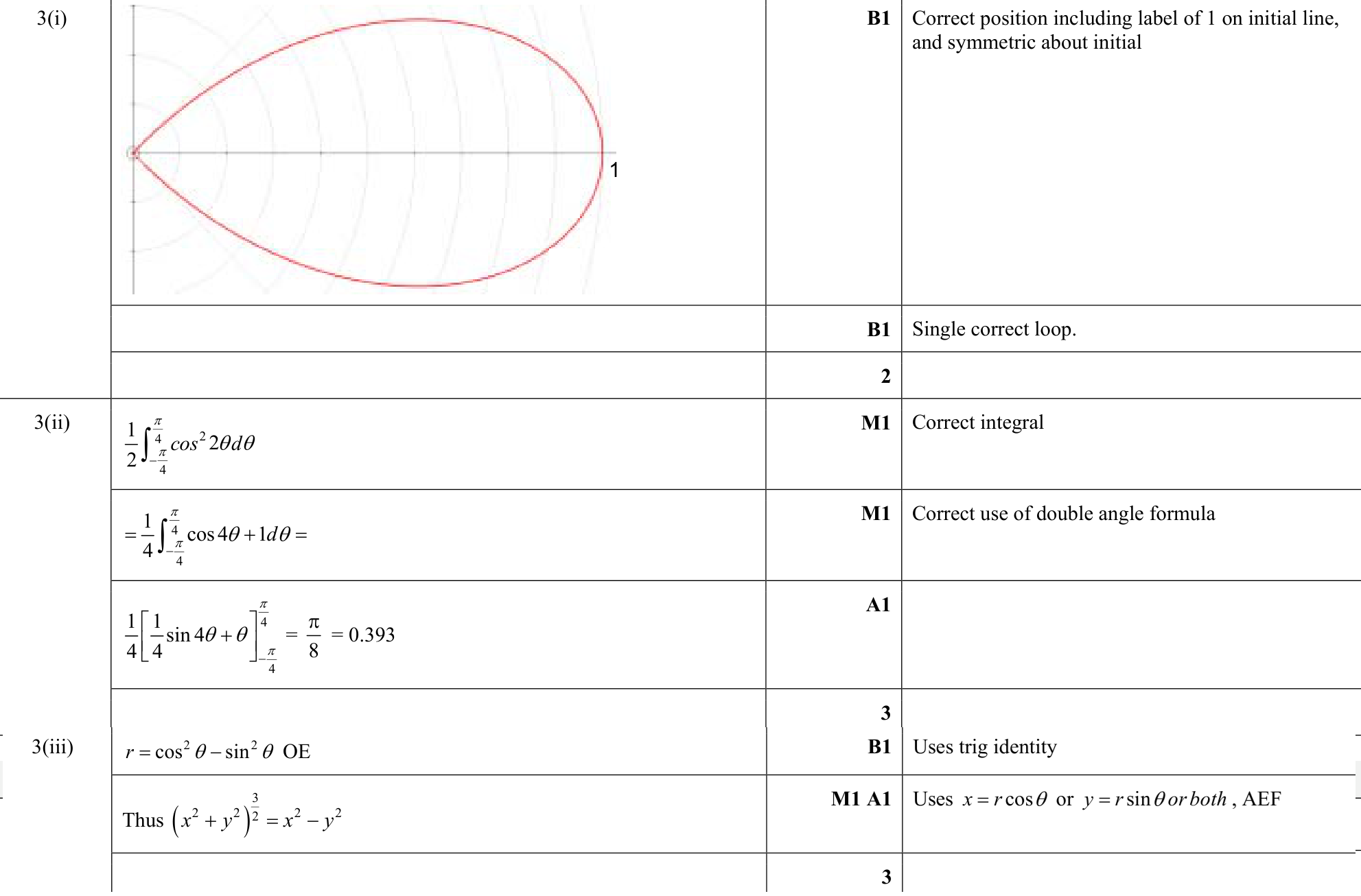
The curve \(C\) has polar equation \(r=\cos 2\theta\), for \(-\frac{\pi}{4}\leq \theta\leq \frac{\pi}{4}\).
(i) Sketch \(C\).
(ii) Find the area of the region enclosed by \(C\), showing full working.
(iii) Find a Cartesian equation of \(C\).
9231 P13 - Jun 2018 - Q8 - 10 marks
The curves \(C_{1}\) and \(C_{2}\) have polar equations, for \(0 \leqslant \theta \leqslant \pi\), as follows:
\(\begin{array}{l}
C_{1}: r=a \\
C_{2}: r=2 a|\cos \theta|
\end{array}\)
where \(a\) is a positive constant. The curves intersect at the points \(P_{1}\) and \(P_{2}\).
(i) Find the polar coordinates of \(P_{1}\) and \(P_{2}\).
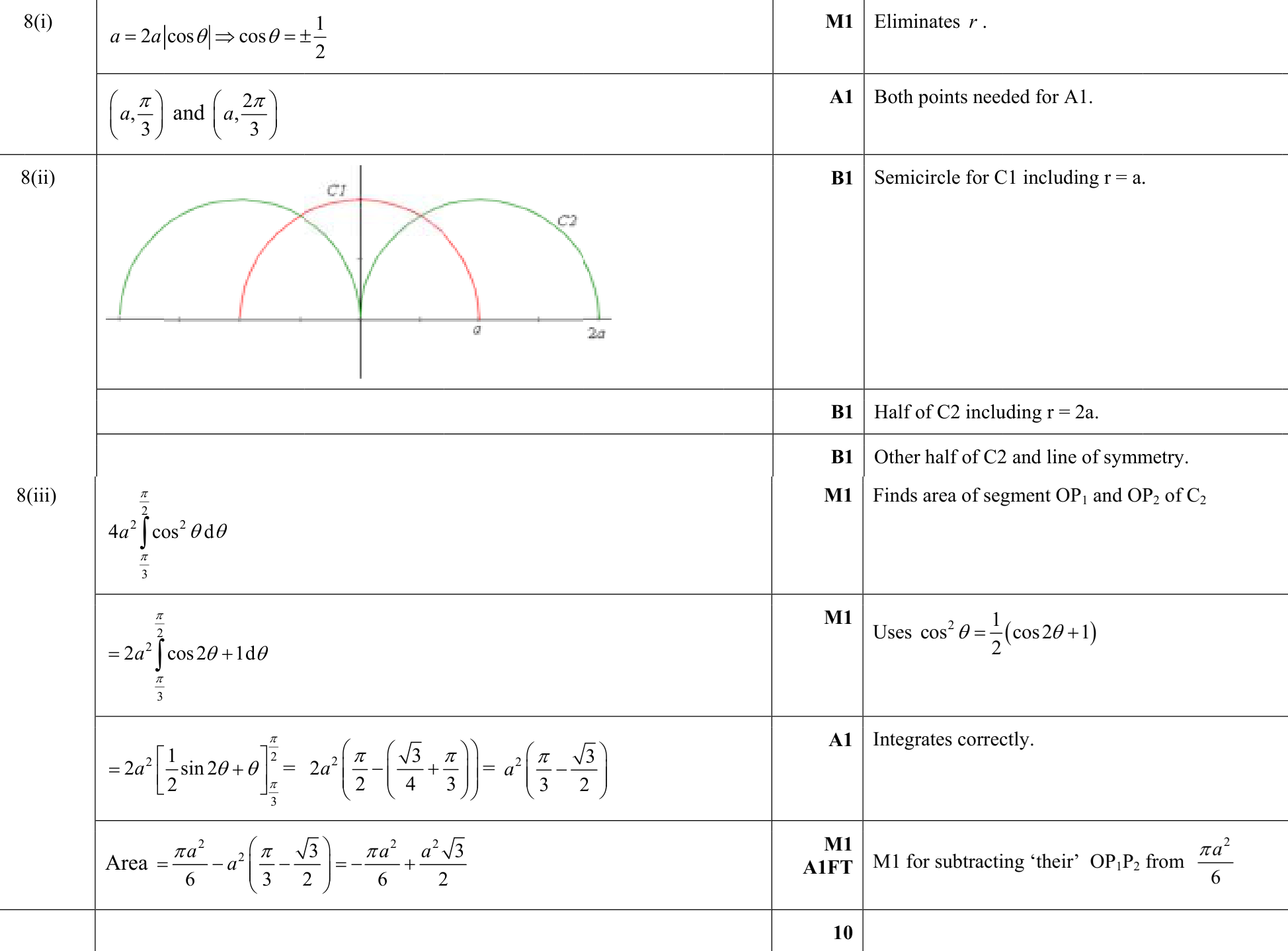
(ii) In a single diagram, sketch \(C_{1}, C_{2}\) and their line of symmetry.
(iii) The region \(R\) enclosed by \(C_{1}\) and \(C_{2}\) is bounded by the arcs \(O P_{1}, P_{1} P_{2}\) and \(P_{2} O\), where \(O\) is the pole. Find the area of \(R\), giving your answer in exact form.
9231 P11 - Nov 2018 - Q9 - 10 marks
The curve \(C\) has polar equation
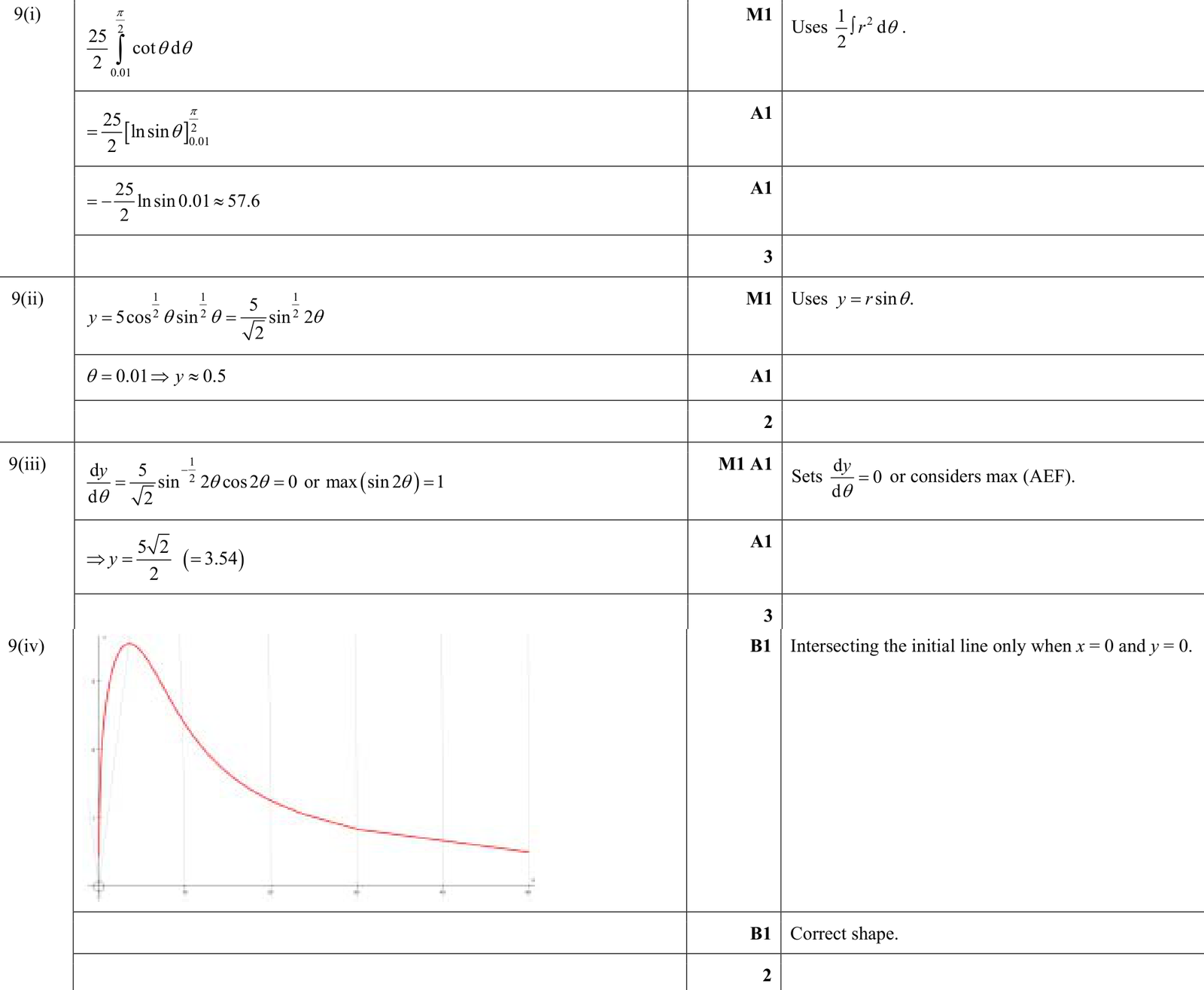
\(r=5\sqrt{\cot\theta},\qquad 0.01\le \theta\le \frac12\pi.\)
(i) Find the area of the finite region bounded by \(C\) and the line \(\theta=0.01\), showing full working. Give your answer correct to 1 decimal place.
Let \(P\) be the point on \(C\) where \(\theta=0.01\).
(ii) Find the distance of \(P\) from the initial line, giving your answer correct to 1 decimal place.
(iii) Find the maximum distance of \(C\) from the initial line.
(iv) Sketch \(C\).
9231 P11 - Nov 2025 - Q6 - 15 marks
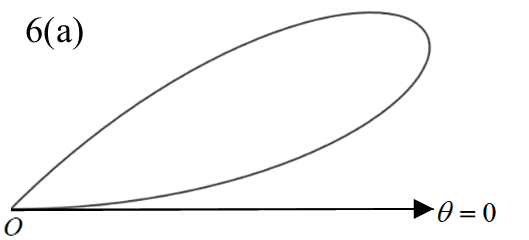
(a) The curve \(C\) has polar equation \(r=\sin3\theta\), for \(0\le\theta\le\frac13\pi\). Sketch \(C\) and state the equation of the line of symmetry.
(b) Find the exact value of the area of the region enclosed by \(C\).
(c) Using \(\sin3\theta=3\sin\theta-4\sin^3\theta\), find the maximum distance of a point on \(C\) from the initial line.
(d) Using \(\sin3\theta=3\sin\theta-4\sin^3\theta\), find a Cartesian equation for \(C\).
9231 P12 - Nov 2025 - Q5 - 12 marks
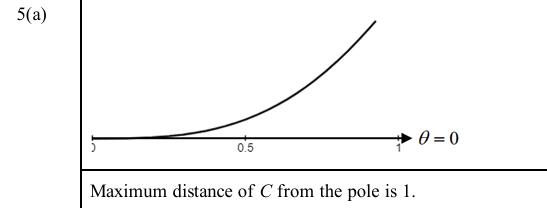
(a) The curve \(C\) has polar equation \(r^2=\tan 2\theta\), where \(0\le\theta\le\frac18\pi\). Sketch \(C\) and state the greatest distance of a point on \(C\) from the pole.
(b) Find the exact value of the area of the region bounded by \(C\) and the half-line \(\theta=\frac18\pi\).
(c) Show that \(C\) has Cartesian equation \(x^4-2xy-y^4=0\), given the first-quadrant restrictions from \(0\le\theta\le\frac18\pi\).
(d) Using your answer to part (b), deduce the exact value of the area bounded by \(C\), the \(x\)-axis and the line \(x=\cos\frac18\pi\).
9231 P21 - Jun 2022 - Q1 - 5 marks
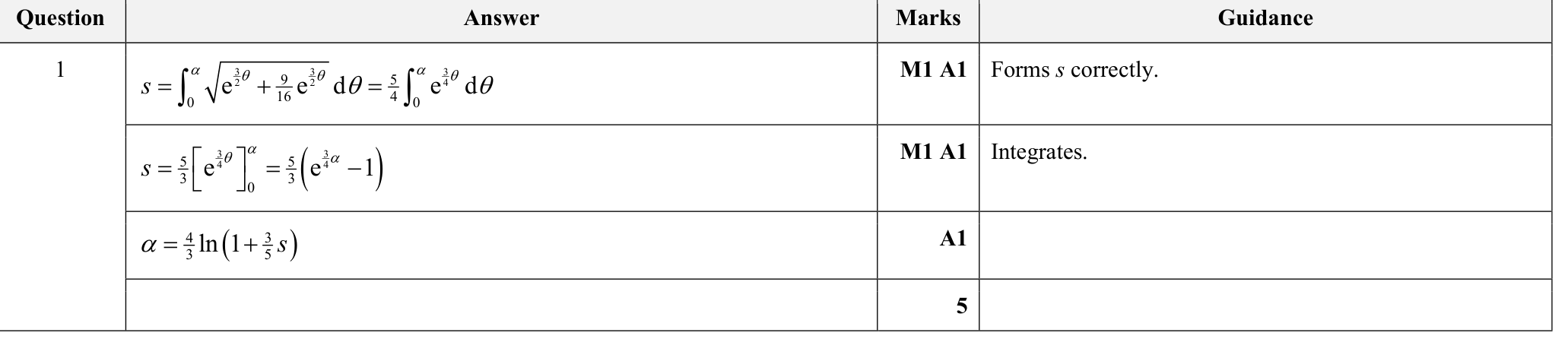
The curve \(C\) has polar equation \(r=\mathrm{e}^{\frac{3}{4} \theta}\) for \(0 \leqslant \theta \leqslant \alpha\).
Given that the length of \(C\) is \(s\), find \(\alpha\) in terms of \(s\).
9231 P12 - Nov 2018 - Q3 - 8 marks
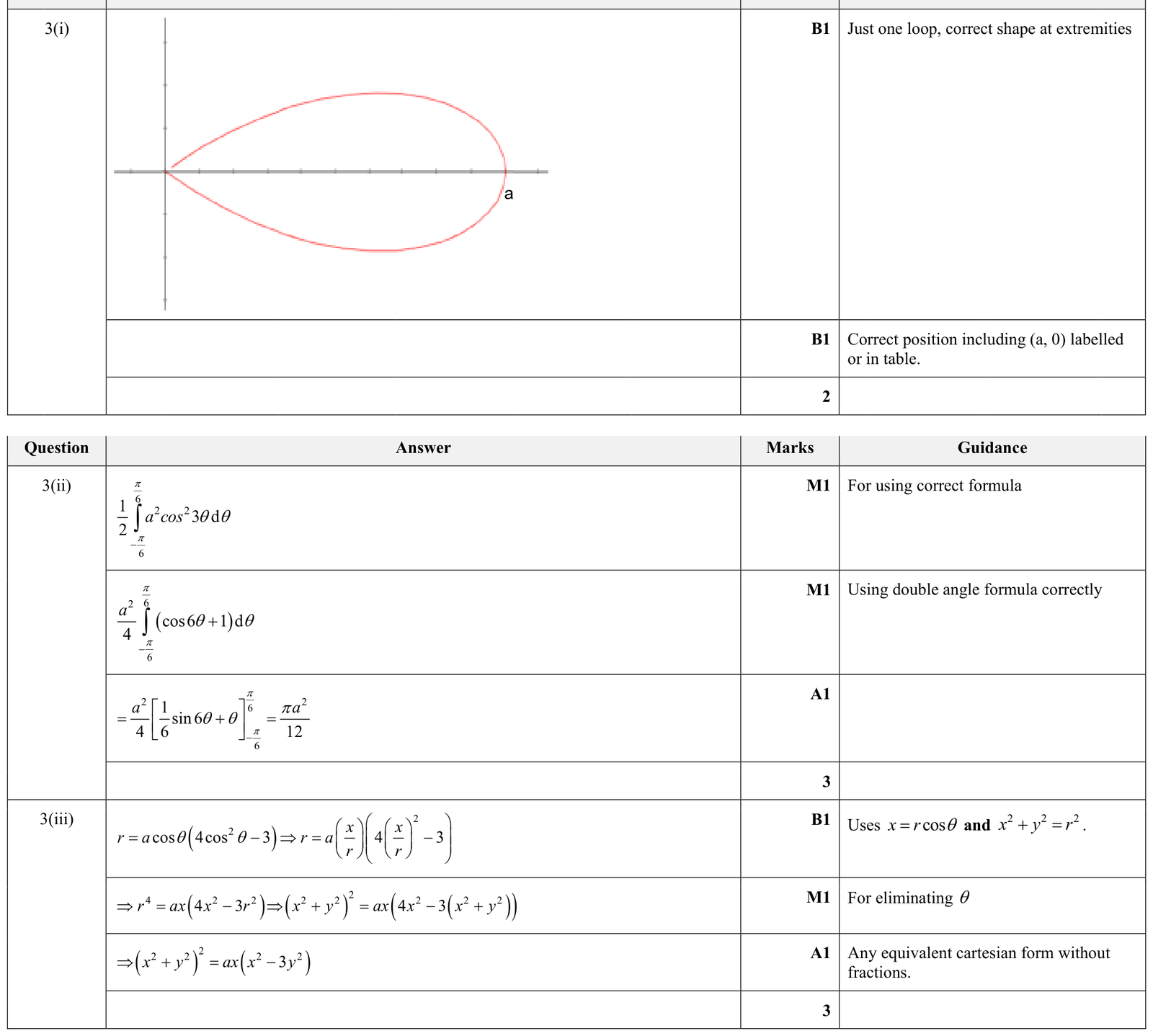
The curve \(C\) has polar equation \(r=a \cos 3 \theta\), for \(-\frac{1}{6} \pi \leqslant \theta \leqslant \frac{1}{6} \pi\), where \(a\) is a positive constant.
(i) Sketch \(C\).
(ii) Find the area of the region enclosed by \(C\), showing full working.
moninginntho
(iii) Using the identity \(\cos 3 \theta \equiv 4 \cos ^{3} \theta-3 \cos \theta\), find a cartesian equation of \(C\).
9231 P13 - Jun 2014 - Q4 - 7 marks
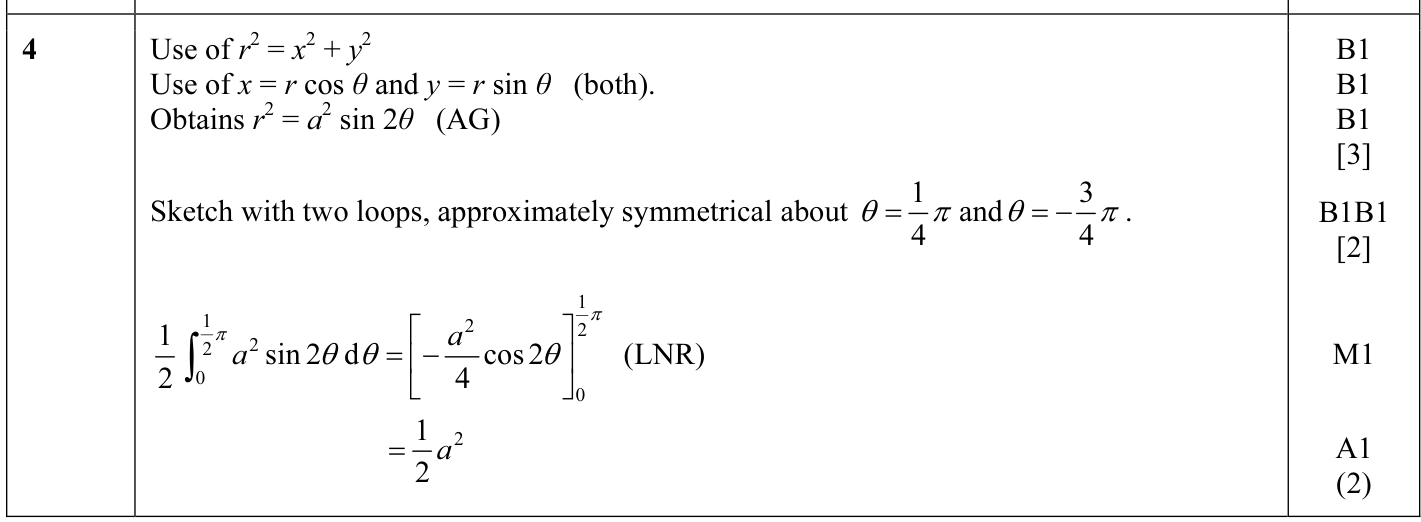
The curve \(C\) has cartesian equation \(\left(x^{2}+y^{2}\right)^{2}=2 a^{2} x y\), where \(a\) is a positive constant. Show that the polar equation of \(C\) is \(r^{2}=a^{2} \sin 2 \theta\).
Sketch \(C\) for \(-\pi\lt \theta \leqslant \pi\).
Find the area enclosed by one loop of \(C\).
9231 P11 - Jun 2014 - Q5 - 6 marks
The curve \(C\) has polar equation \(r=a(1+\sin \theta)\), where \(a\) is a positive constant and \(0 \leqslant \theta\lt 2 \pi\). Draw a sketch of \(C\).
Find the exact value of the area of the region enclosed by \(C\) and the half-lines \(\theta=\frac{1}{3} \pi\) and \(\theta=\frac{2}{3} \pi\).
9231 P11 - Nov 2015 - Q11O - 14 marks
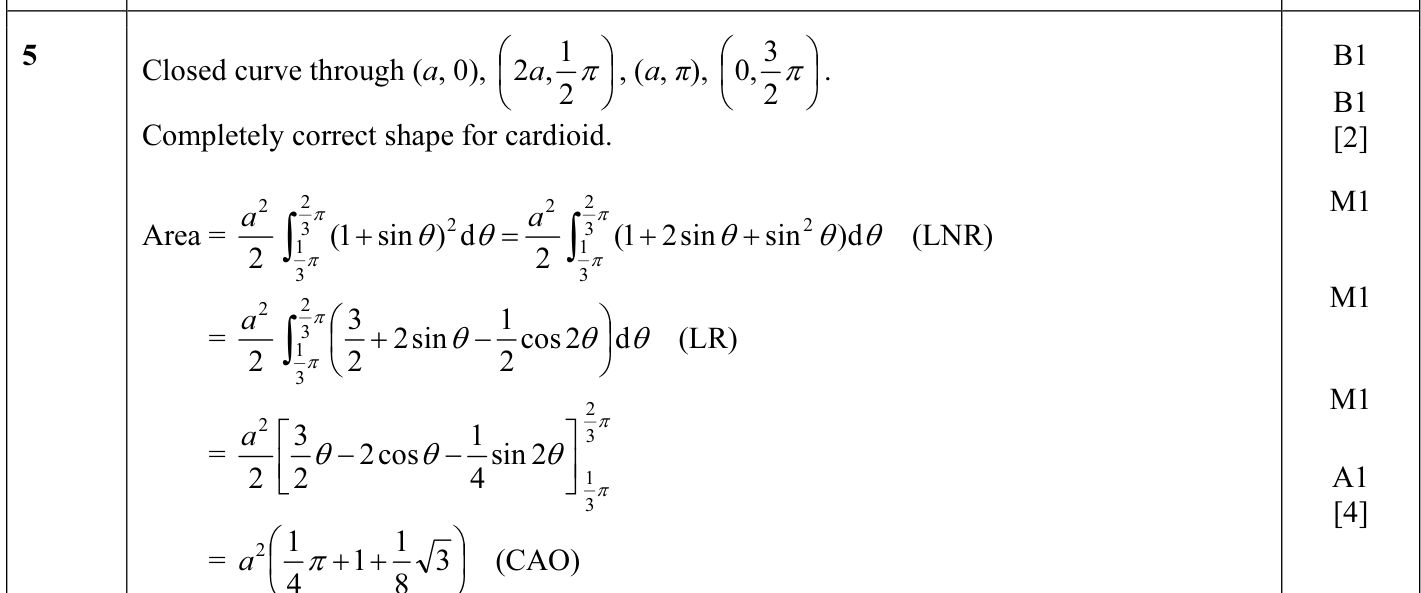
The curve \(C\) has polar equation
\(r=a(1-\cos\theta),\qquad 0\leq \theta\lt 2\pi.\)
Sketch \(C\).
Find the area of the region enclosed by the arc of \(C\) for which \(\frac{1}{2}\pi\leq\theta\leq\frac{3}{2}\pi\), the half-line \(\theta=\frac{1}{2}\pi\), and the half-line \(\theta=\frac{3}{2}\pi\).
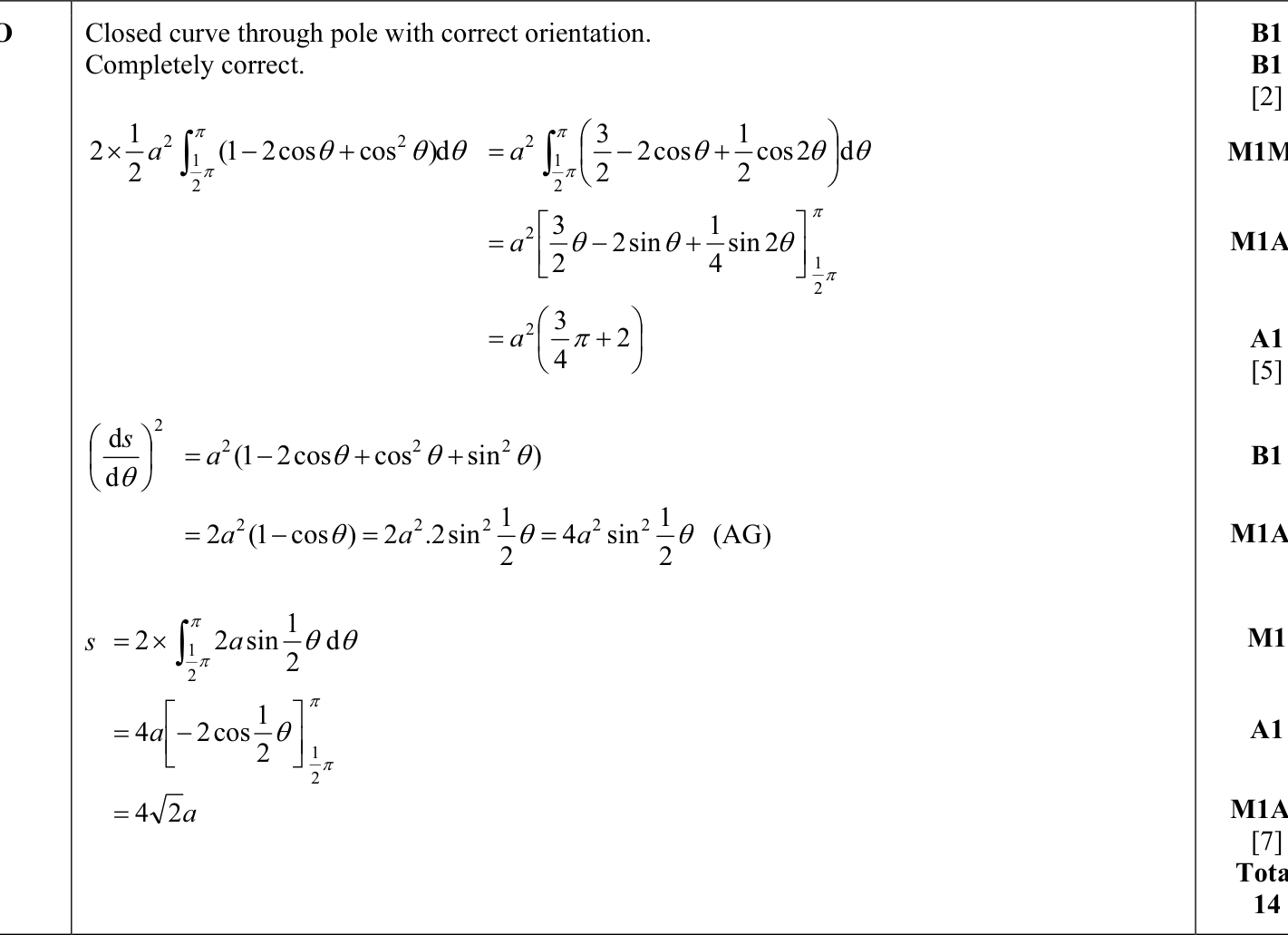
Show that
\(\left(\frac{ds}{d\theta}\right)^2=4a^2\sin^2\left(\frac{\theta}{2}\right),\)
where \(s\) denotes arc length, and find the length of the arc of \(C\) for which \(\frac{1}{2}\pi\leq\theta\leq\frac{3}{2}\pi\).
9231 P13 - Jun 2015 - Q2 - 6 marks
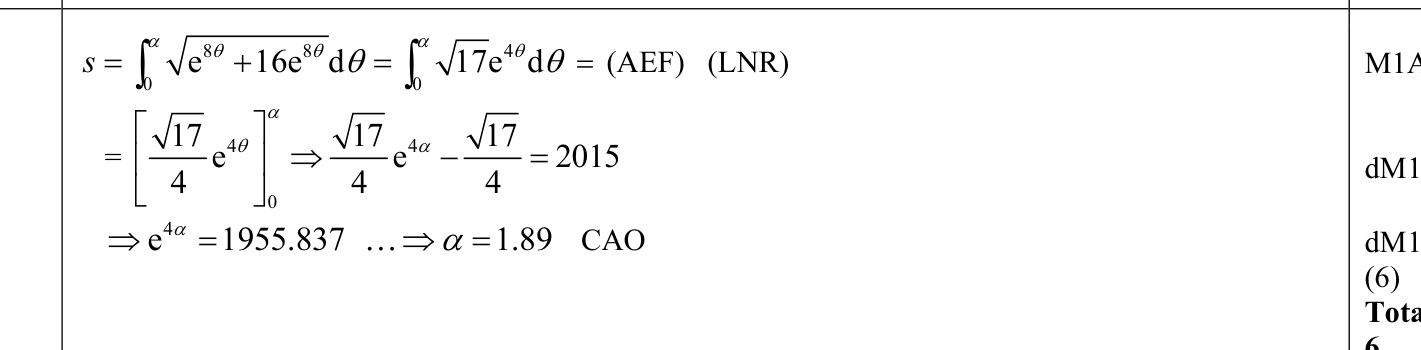
The curve \(C\) has polar equation \(r=\mathrm{e}^{4 \theta}\) for \(0 \leqslant \theta \leqslant \alpha\), where \(\alpha\) is measured in radians. The length of \(C\) is 2015 . Find the value of \(\alpha\).
9231 P11 - Jun 2015 - Q5 - 9 marks
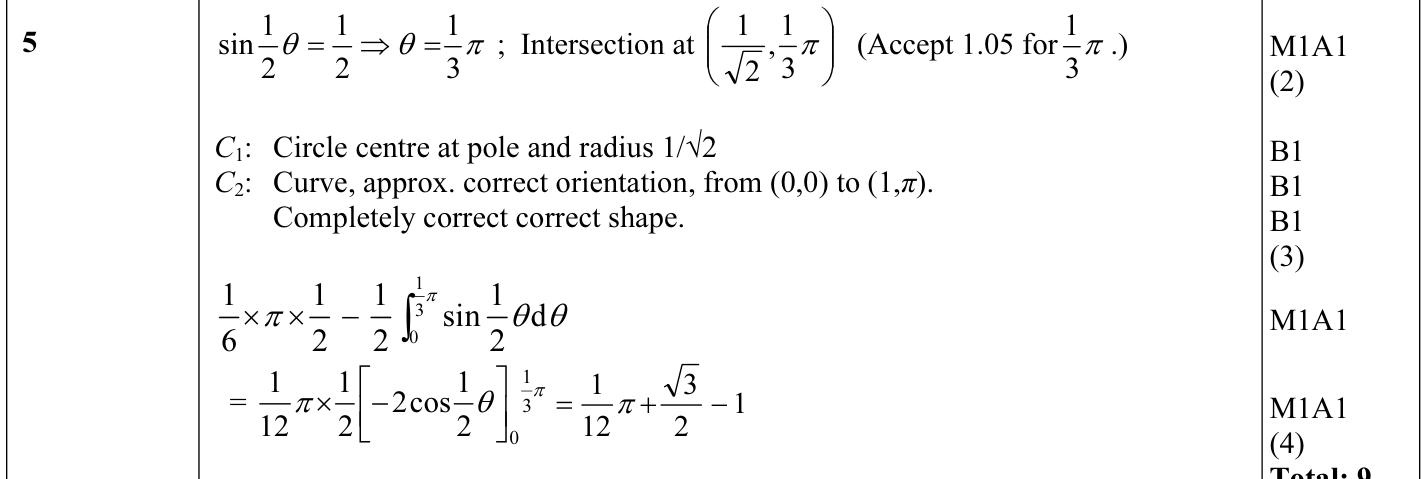
The curves \(C_1\) and \(C_2\) have polar equations
\(C_1:r=\frac1{\sqrt2}\), for \(0\leqslant\theta\lt2\pi\), and \(C_2:r=\sqrt{\sin\frac12\theta}\), for \(0\leqslant\theta\leqslant\pi\).
Find the polar coordinates of the point of intersection of \(C_1\) and \(C_2\).
Sketch \(C_1\) and \(C_2\) on the same diagram.
Find the exact value of the area of the region enclosed by \(C_1\), \(C_2\), and the half-line \(\theta=0\).
9231 P13 - Jun 2016 - Q7 - 9 marks
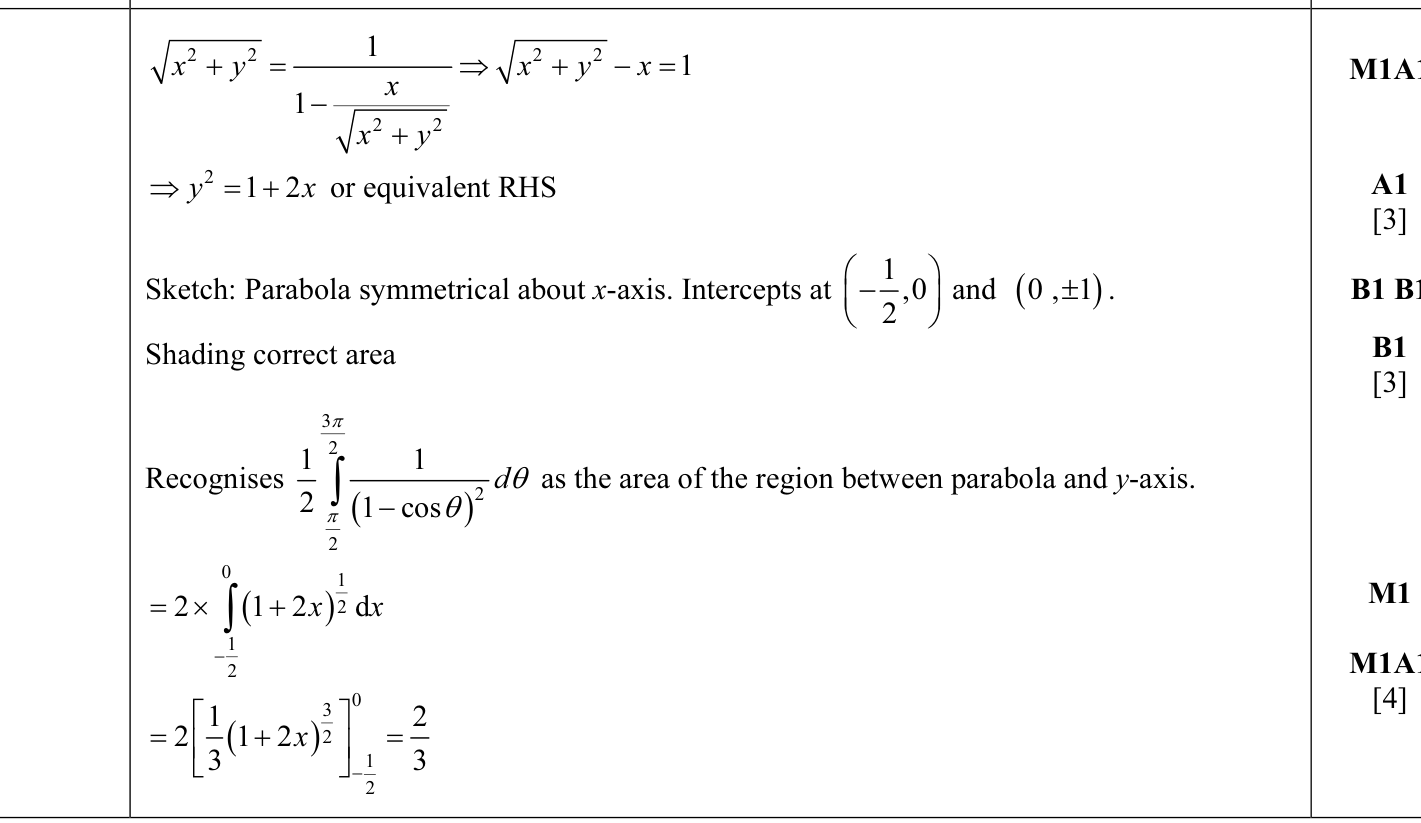
A curve has polar equation \(r=\dfrac{1}{1-\cos\theta}\), for \(0\lt\theta\lt 2\pi\). Find, in the form \(y^2=f(x)\), the cartesian equation of the curve.
Hence sketch the curve, and shade the region whose area is given by \(\dfrac12\int_{\pi/2}^{3\pi/2}\dfrac{1}{(1-\cos\theta)^2}\,d\theta\).
Using the cartesian equation of the curve, find the area of this region.
9231 P11 - Jun 2016 - Q4 - 8 marks
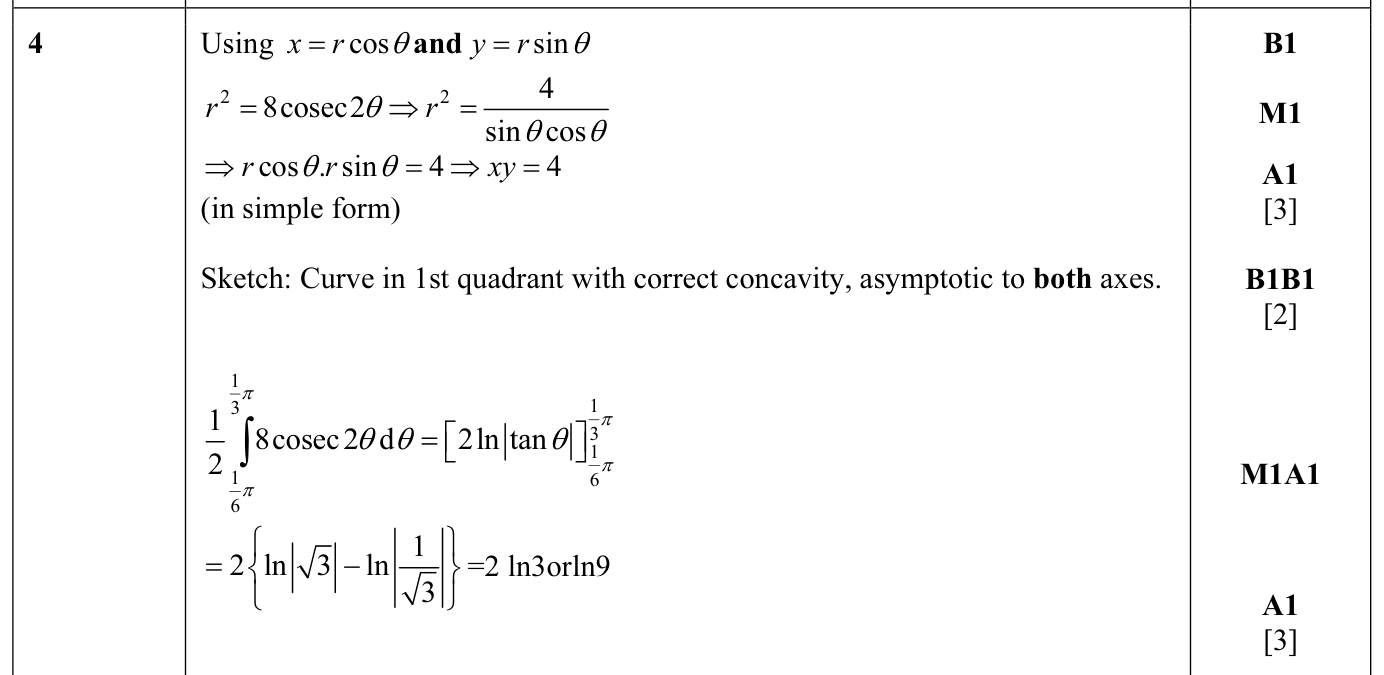
A curve \(C\) has polar equation \(r^{2}=8 \operatorname{cosec} 2 \theta\) for \(0\lt \theta\lt \frac{1}{2} \pi\). Find a cartesian equation of \(C\).
Sketch \(C\).
Determine the exact area of the sector bounded by the arc of \(C\) between \(\theta=\frac{1}{6} \pi\) and \(\theta=\frac{1}{3} \pi\), the half-line \(\theta=\frac{1}{6} \pi\) and the half-line \(\theta=\frac{1}{3} \pi\).
[It is given that \(\int \operatorname{cosec} x \mathrm{~d} x=\ln \left|\tan \frac{1}{2} x\right|+c\).]
9231 P11 - Nov 2017 - Q11O - 13 marks
OR
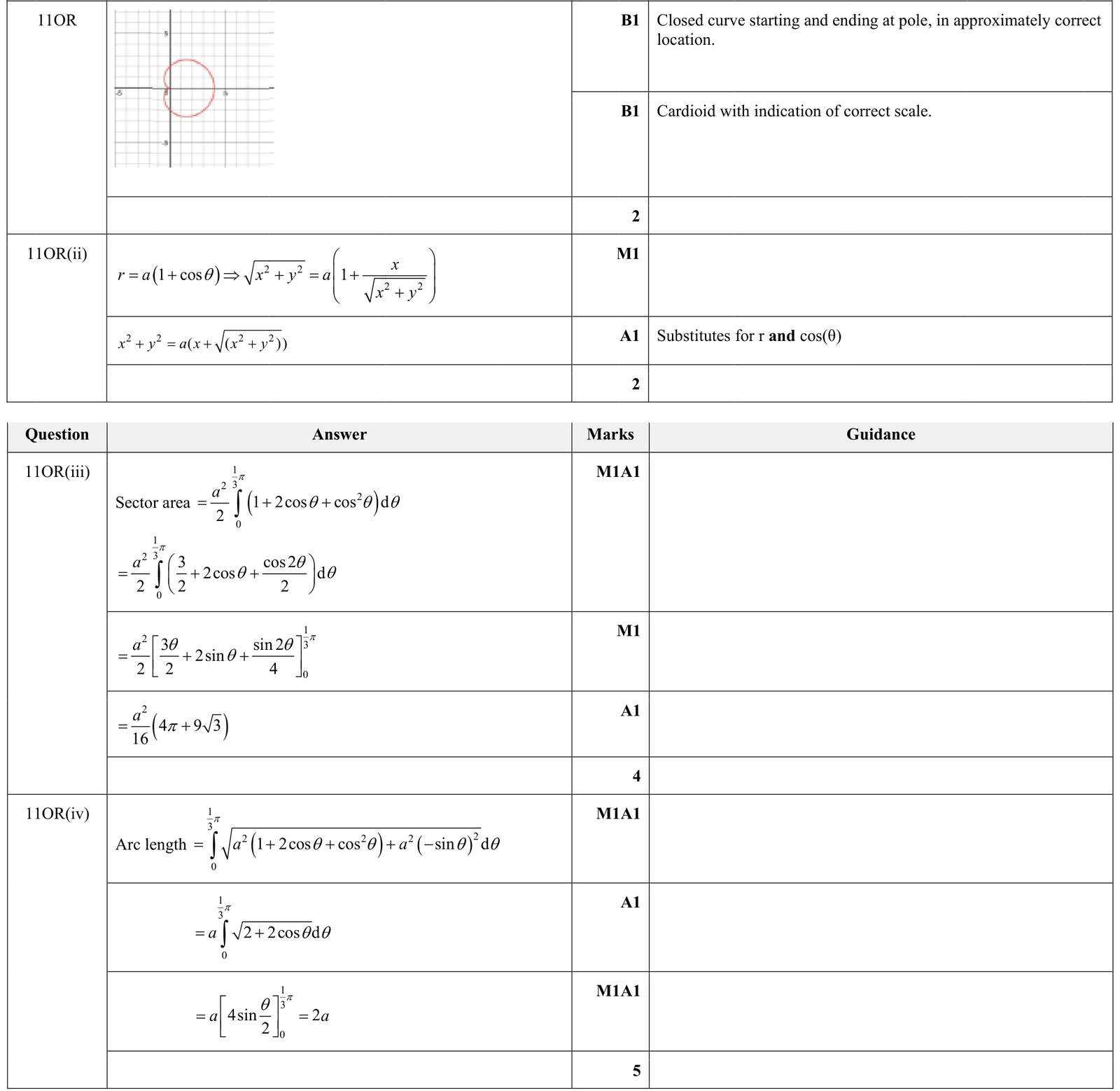
The polar equation of a curve \(C\) is \(r=a(1+\cos\theta)\), for \(0\leq\theta\lt 2\pi\), where \(a\) is a positive constant.
(i) Sketch \(C\).
(ii) Show that the Cartesian equation of \(C\) is
\(x^2+y^2=a\left(x+\sqrt{x^2+y^2}\right).\)
(iii) Find the area of the sector of \(C\) between \(\theta=0\) and \(\theta=\frac{\pi}{3}\).
(iv) Find the arc length of \(C\) between \(\theta=0\) and \(\theta=\frac{\pi}{3}\).
9231 P12 - Nov 2014 - Q8 - 11 marks
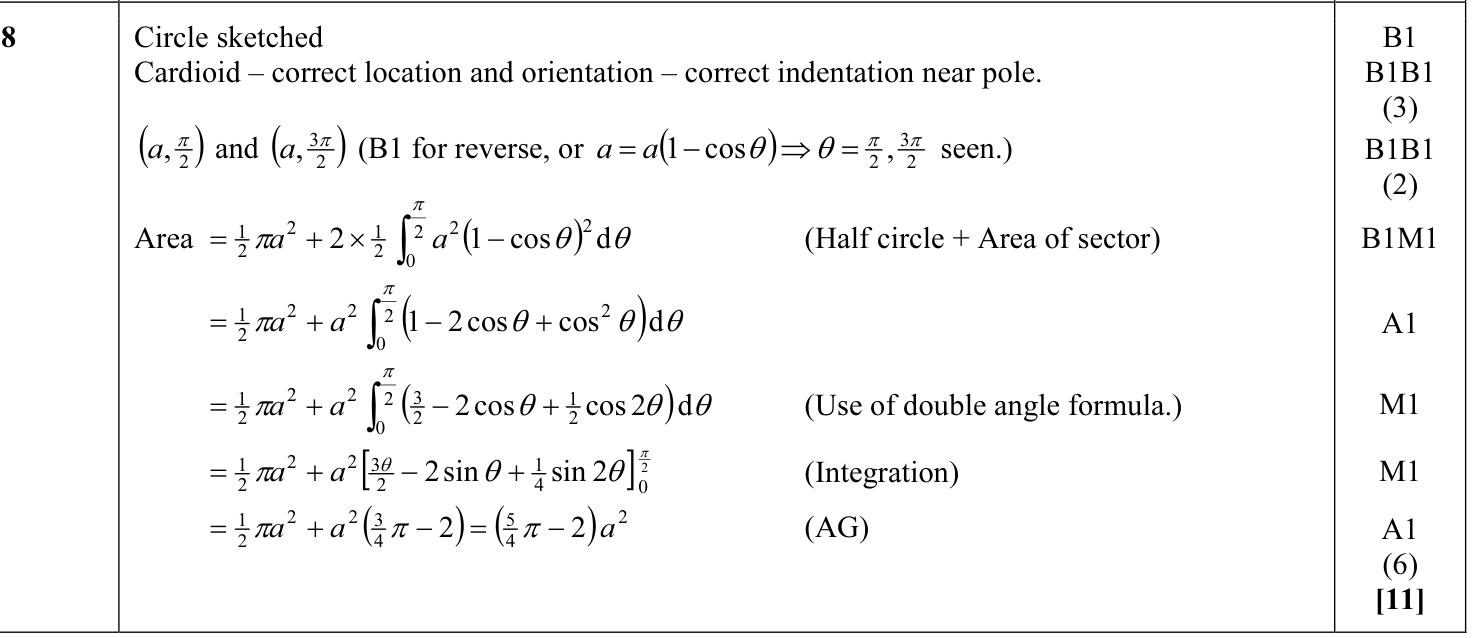
A circle has polar equation \(r=a\), for \(0 \leqslant \theta\lt 2 \pi\), and a cardioid has polar equation \(r=a(1-\cos \theta)\), for \(0 \leqslant \theta\lt 2 \pi\), where \(a\) is a positive constant. Draw sketches of the circle and the cardioid on the same diagram.
Write down the polar coordinates of the points of intersection of the circle and the cardioid.
Show that the area of the region that is both inside the circle and inside the cardioid is
\(\left(\frac{5}{4} \pi-2\right) a^{2} .\)
9231 P11 - Nov 2014 - Q8 - 11 marks
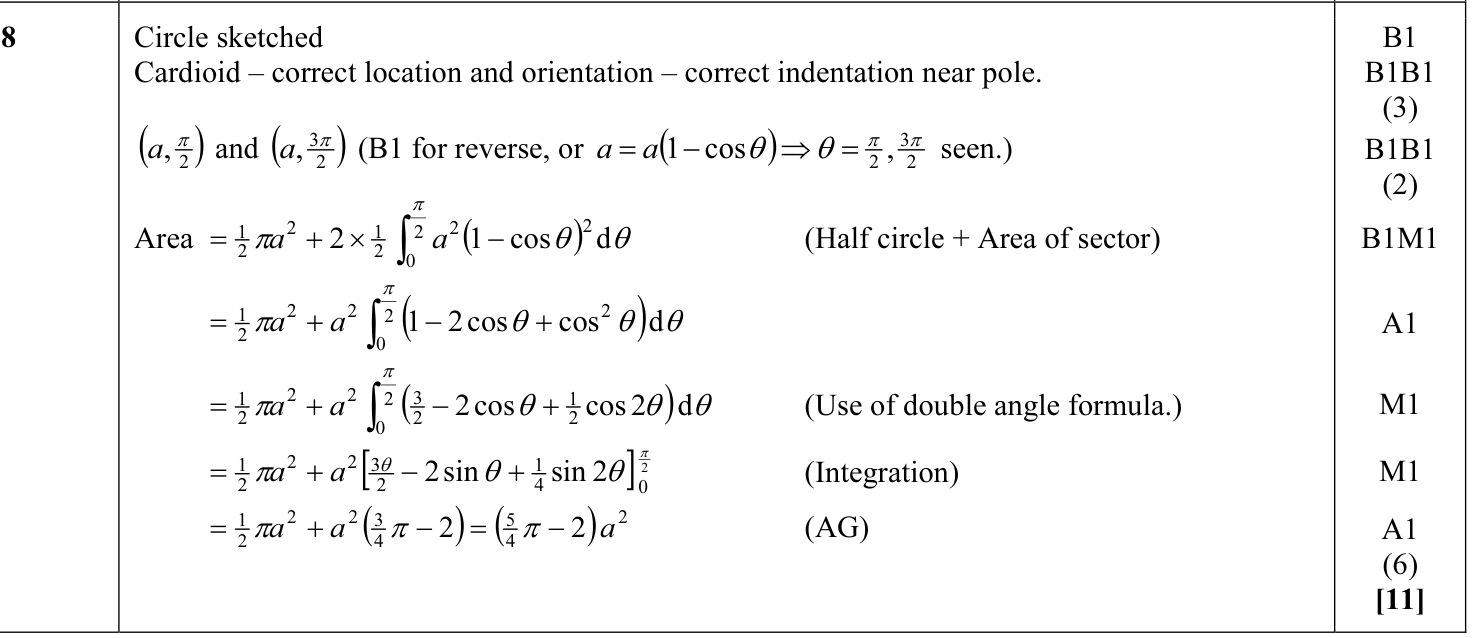
A circle has polar equation \(r=a\), for \(0 \leqslant \theta\lt 2 \pi\), and a cardioid has polar equation \(r=a(1-\cos \theta)\), for \(0 \leqslant \theta\lt 2 \pi\), where \(a\) is a positive constant. Draw sketches of the circle and the cardioid on the same diagram.
Write down the polar coordinates of the points of intersection of the circle and the cardioid.
Show that the area of the region that is both inside the circle and inside the cardioid is
\(\left(\frac{5}{4} \pi-2\right) a^{2} .\)
9231 P11 - Jun 2013 - Q1 - 4 marks
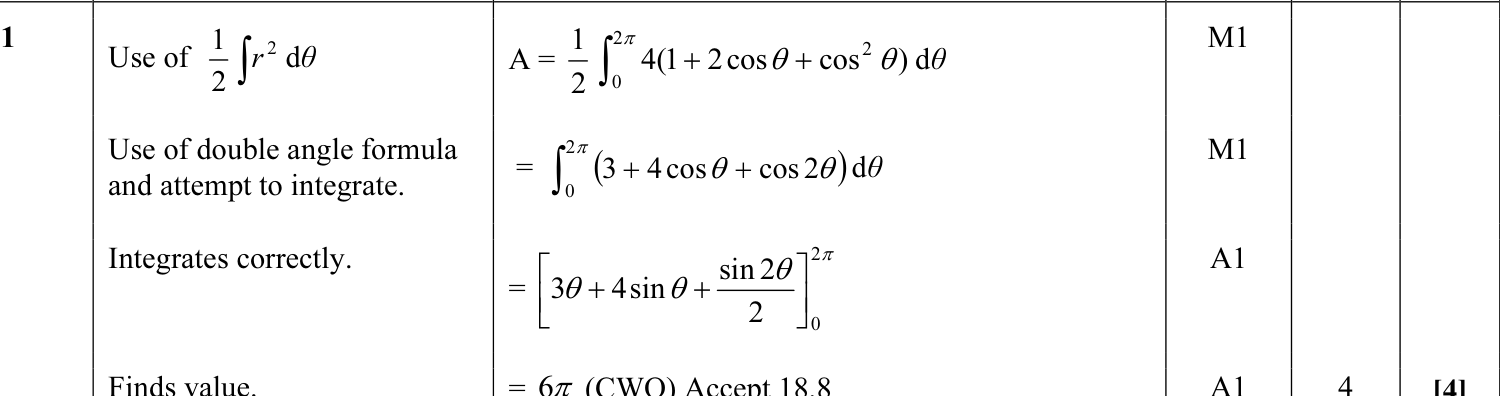
Find the area of the region enclosed by the curve with polar equation \(r=2(1+\cos \theta)\), for \(0 \leqslant \theta\lt 2 \pi\).
9231 P13 - Jun 2013 - Q10 - 12 marks
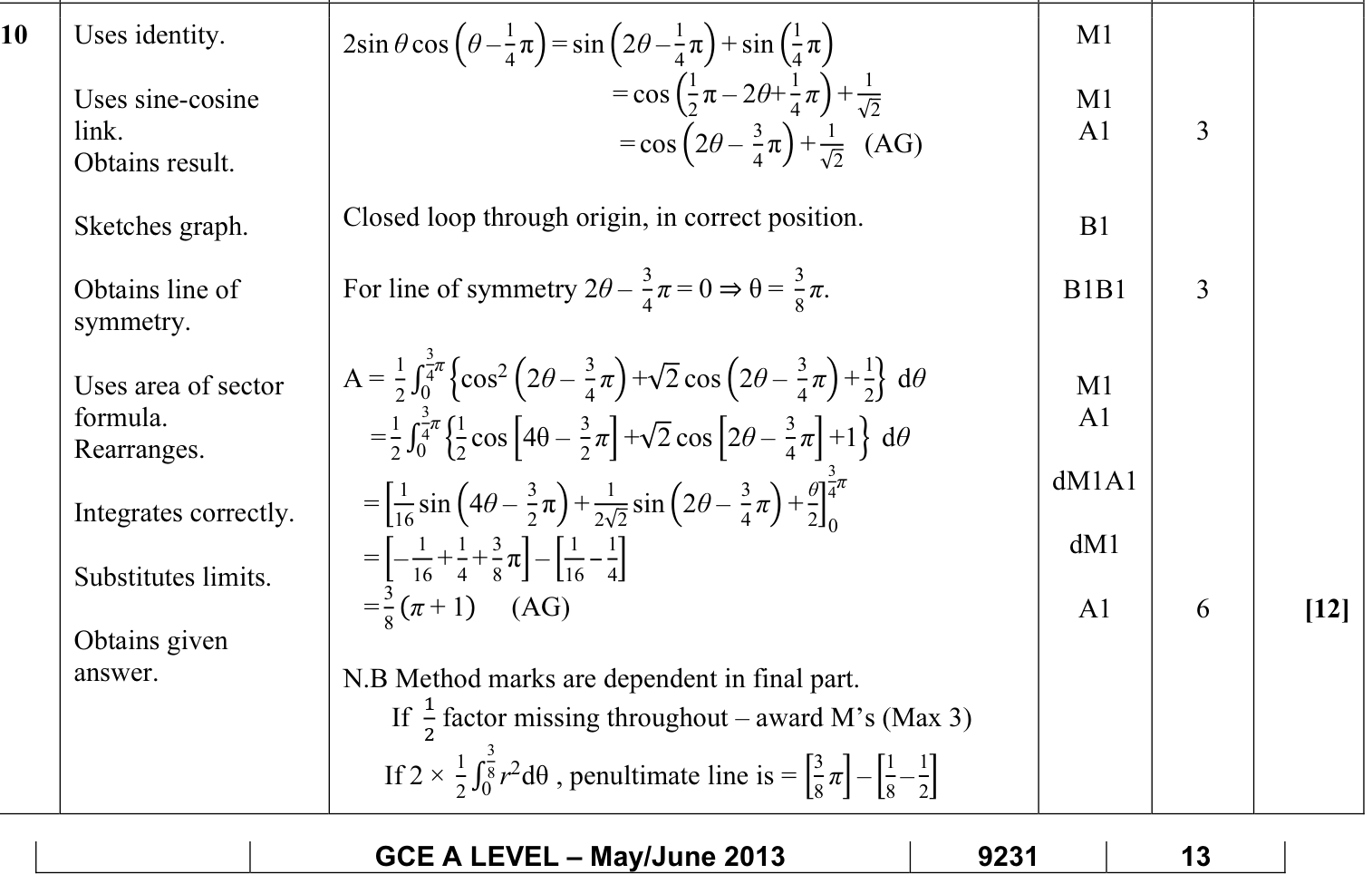
Use the identity \(2 \sin P \cos Q \equiv \sin (P+Q)+\sin (P-Q)\) to show that
\(2 \sin \theta \cos \left(\theta-\frac{1}{4} \pi\right) \equiv \cos \left(2 \theta-\frac{3}{4} \pi\right)+\frac{1}{\sqrt{2}}\)
A curve has polar equation \(r=2 \sin \theta \cos \left(\theta-\frac{1}{4} \pi\right)\), for \(0 \leqslant \theta \leqslant \frac{3}{4} \pi\). Sketch the curve and state the polar equation of its line of symmetry, justifying your answer.
Show that the area of the region enclosed by the curve is \(\frac{3}{8}(\pi+1)\).
[Question 11 is printed on the next page.]
9231 P11 - Nov 2013 - Q1 - 5 marks
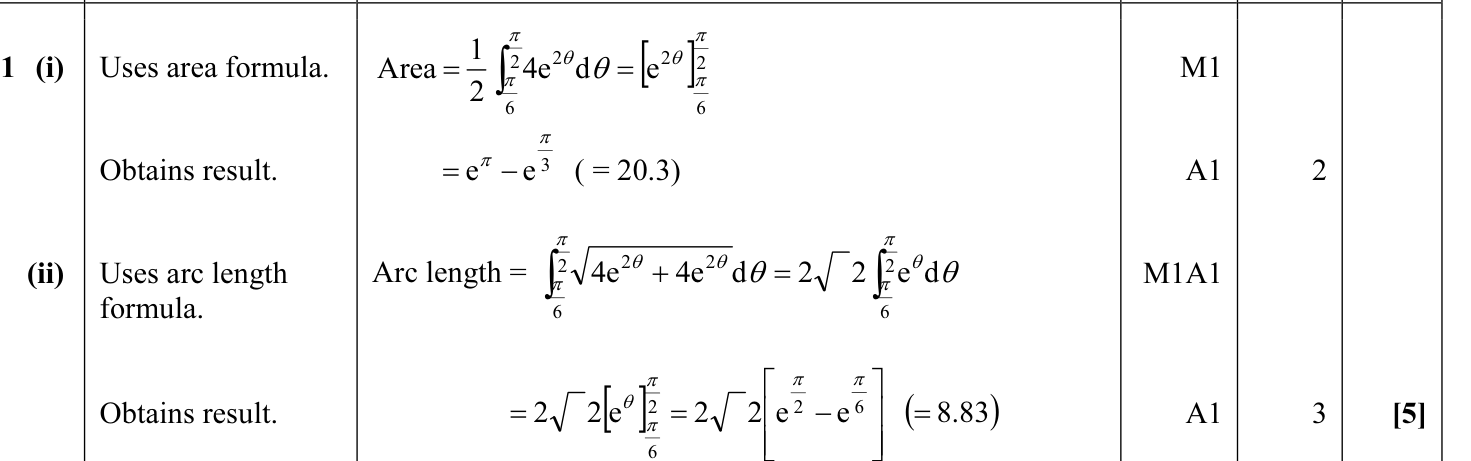
The curve \(C\) has polar equation \(r=2 \mathrm{e}^{\theta}\), for \(\frac{1}{6} \pi \leqslant \theta \leqslant \frac{1}{2} \pi\). Find
(i) the area of the region bounded by the half-lines \(\theta=\frac{1}{6} \pi, \theta=\frac{1}{2} \pi\) and \(C\),
(ii) the length of \(C\).
9231 P12 - Nov 2013 - Q1 - 5 marks
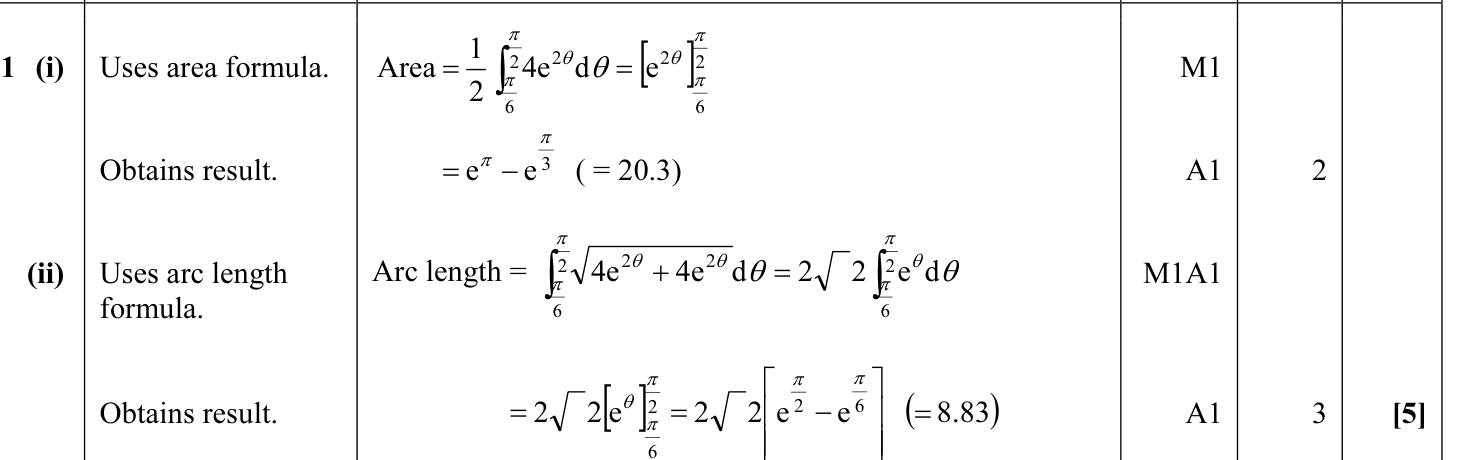
The curve \(C\) has polar equation \(r=2 \mathrm{e}^{\theta}\), for \(\frac{1}{6} \pi \leqslant \theta \leqslant \frac{1}{2} \pi\). Find
(i) the area of the region bounded by the half-lines \(\theta=\frac{1}{6} \pi, \theta=\frac{1}{2} \pi\) and \(C\),
(ii) the length of \(C\).
9231 P13 - Nov 2013 - Q10 - 13 marks
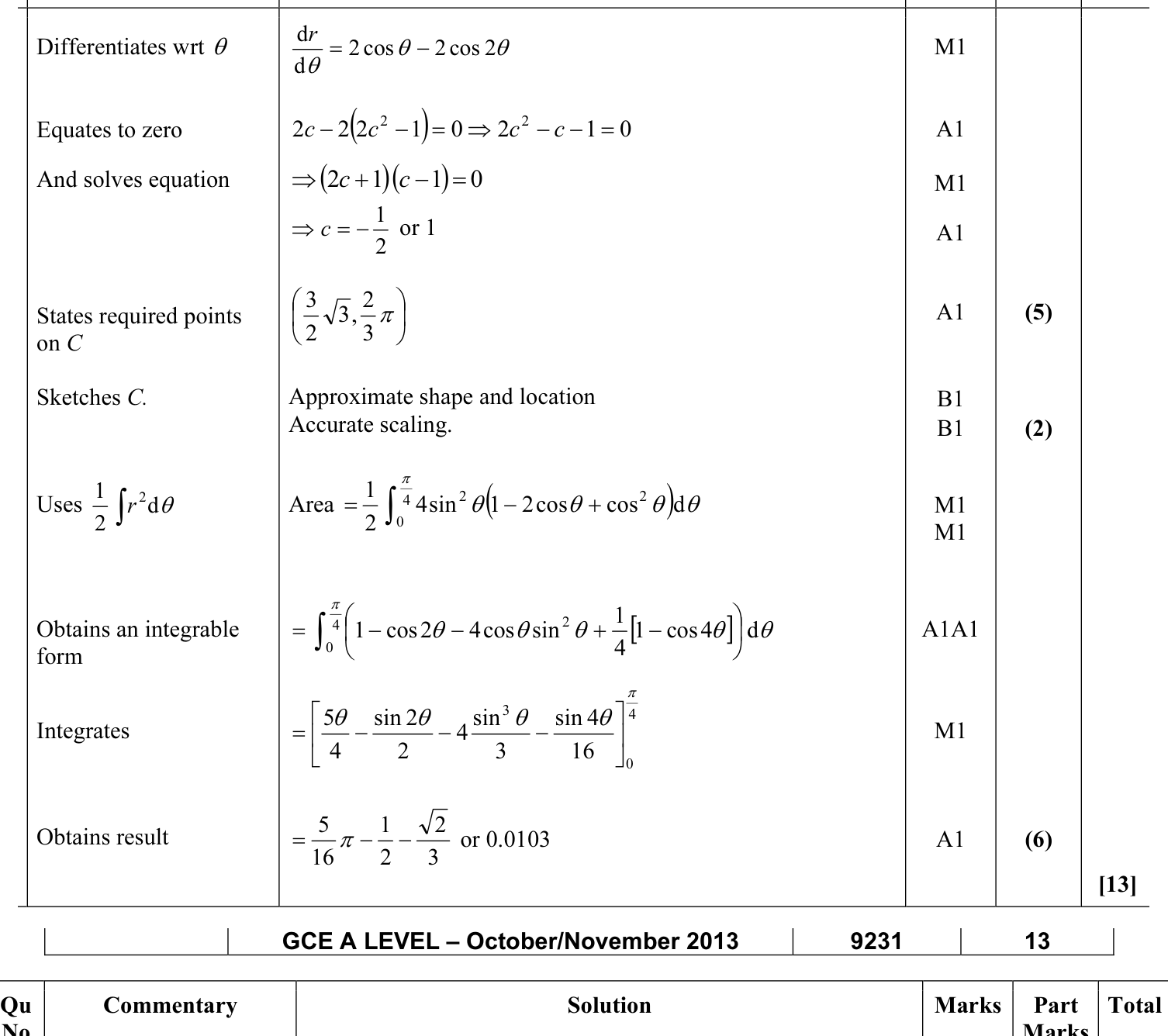
The curve \(C\) has polar equation \(r=2 \sin \theta(1-\cos \theta)\), for \(0 \leqslant \theta \leqslant \pi\). Find \(\frac{\mathrm{d} r}{\mathrm{~d} \theta}\) and hence find the polar coordinates of the point of \(C\) that is furthest from the pole.
Sketch \(C\).
Find the exact area of the sector from \(\theta=0\) to \(\theta=\frac{1}{4} \pi\).
[Question 11 is printed on the next page.]
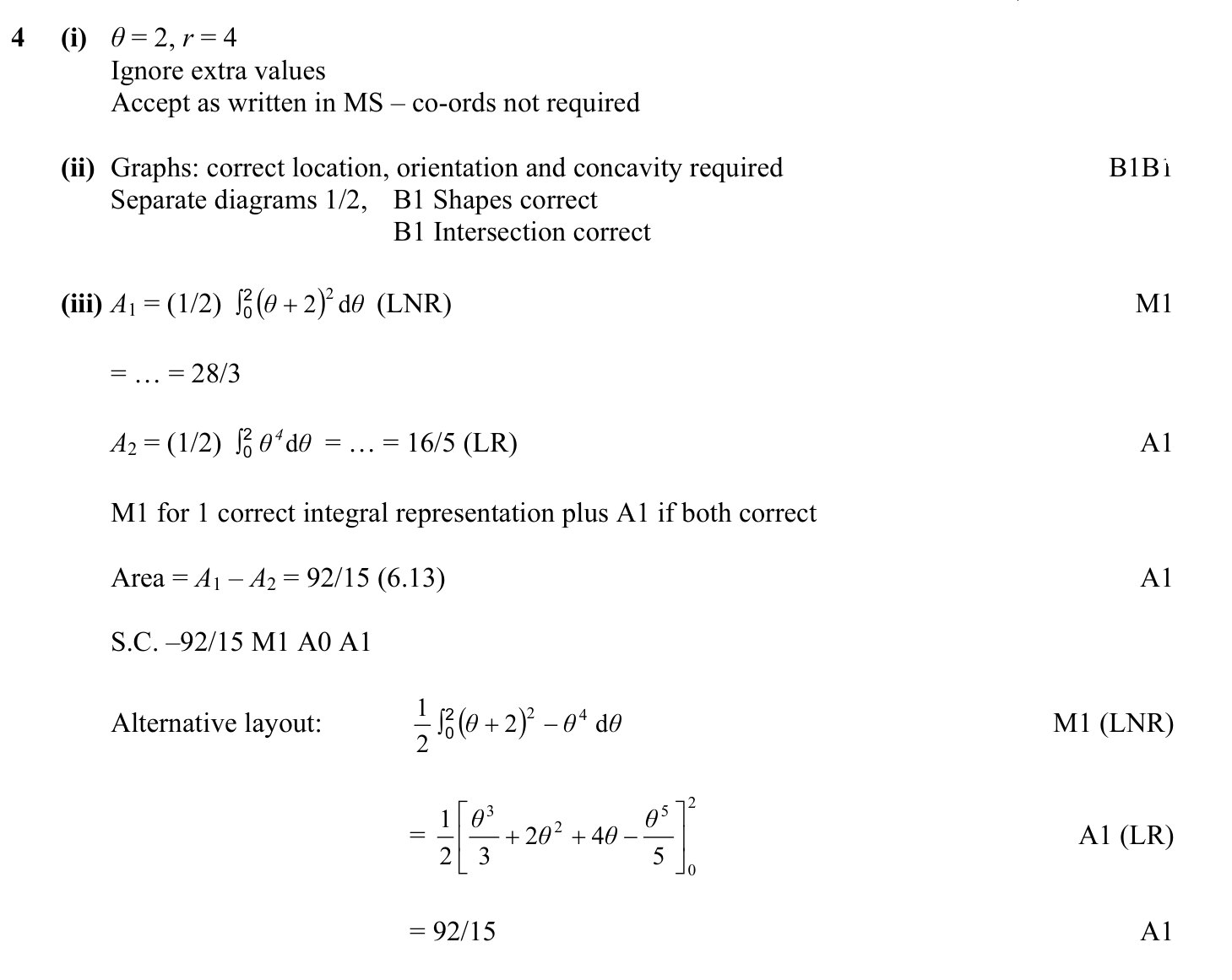
9231 P1 - Jun 2008 - Q4 - 7 marks
The curves \(C_{1}\) and \(C_{2}\) have polar equations
\(r=\theta+2 \quad \text { and } \quad r=\theta^{2}\)
respectively, where \(0 \leqslant \theta \leqslant \pi\).
(i) Find the polar coordinates of the point of intersection of \(C_{1}\) and \(C_{2}\).
(ii) Sketch \(C_{1}\) and \(C_{2}\) on the same diagram.
(iii) Find the area bounded by \(C_{1}, C_{2}\) and the line \(\theta=0\).
9231 P1 - Nov 2008 - Q3 - 6 marks
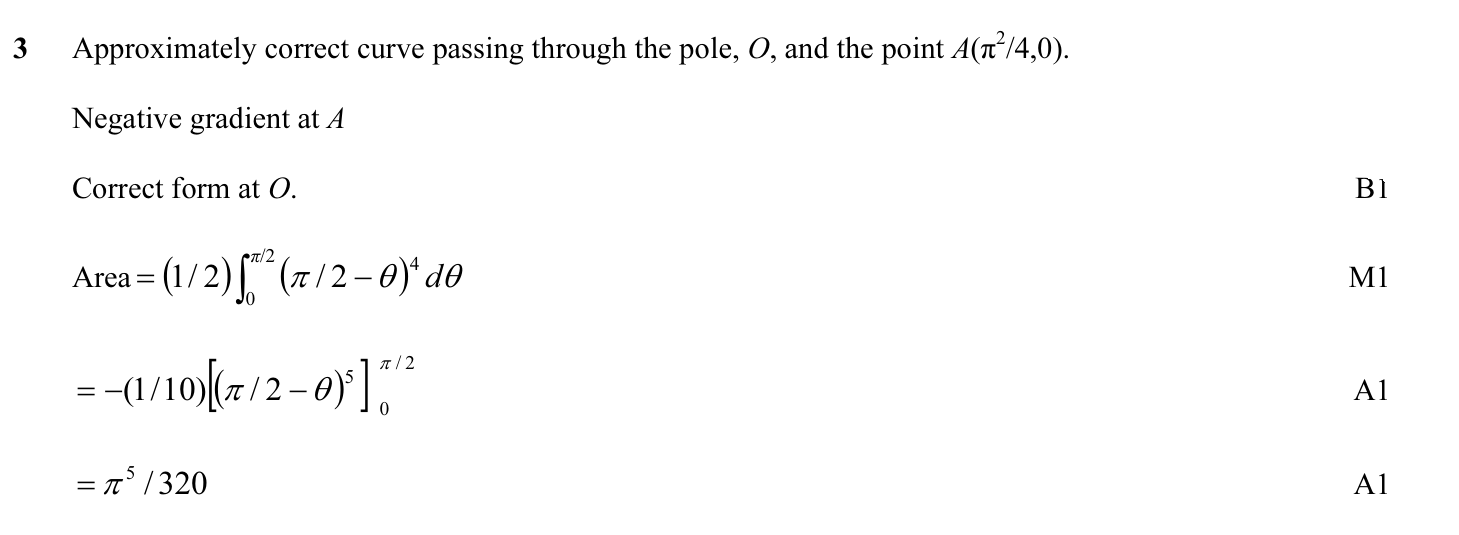
The curve \(C\) has polar equation
\(r=\left(\frac{1}{2} \pi-\theta\right)^{2},\)
where \(0 \leqslant \theta \leqslant \frac{1}{2} \pi\). Draw a sketch of \(C\).
Find the area of the region bounded by \(C\) and the initial line, leaving your answer in terms of \(\pi\).
9231 P11 - Jun 2011 - Q5 - 8 marks
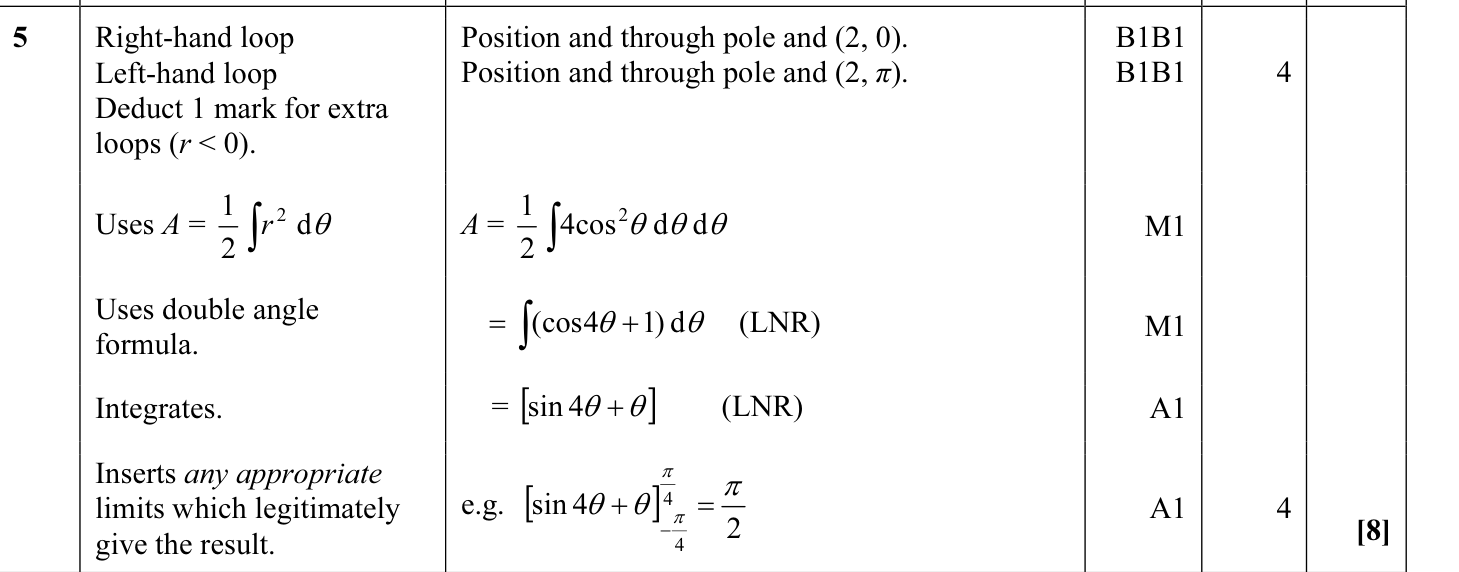
The curve \(C\) has polar equation \(r=2 \cos 2 \theta\). Sketch the curve for \(0 \leqslant \theta\lt 2 \pi\).
Find the exact area of one loop of the curve.
9231 P12 - Jun 2014 - Q5 - 6 marks
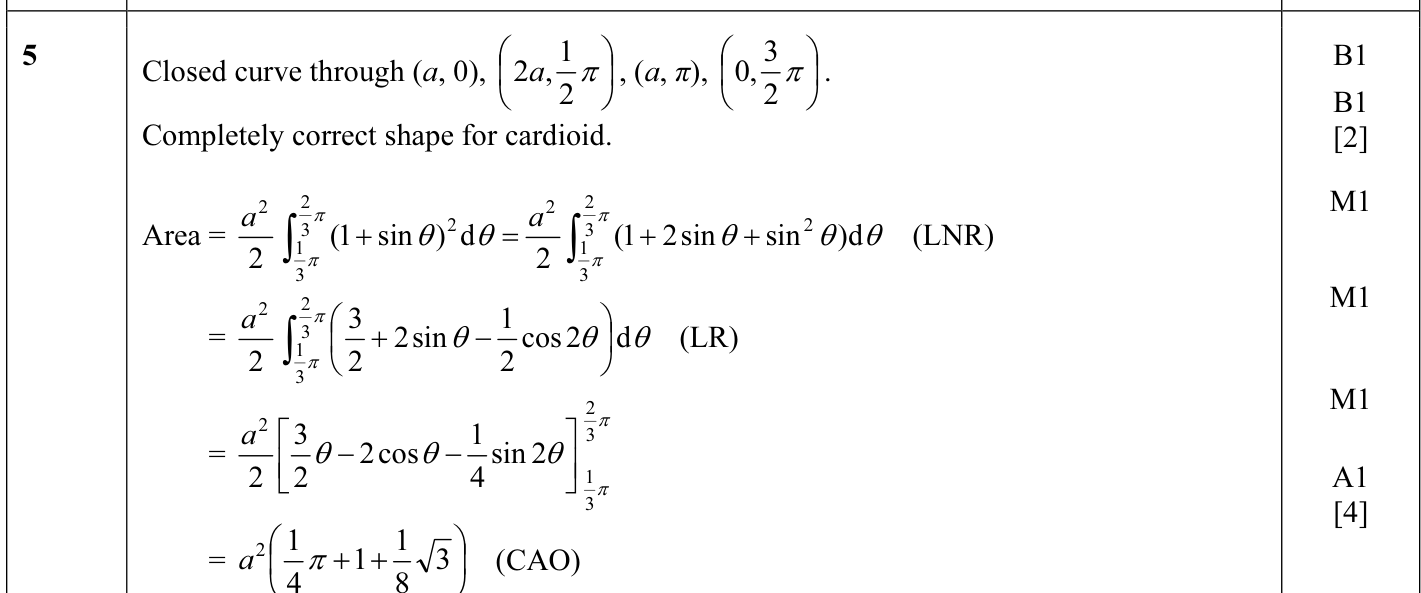
The curve \(C\) has polar equation \(r=a(1+\sin \theta)\), where \(a\) is a positive constant and \(0 \leqslant \theta\lt 2 \pi\). Draw a sketch of \(C\).
Find the exact value of the area of the region enclosed by \(C\) and the half-lines \(\theta=\frac{1}{3} \pi\) and \(\theta=\frac{2}{3} \pi\).
9231 P13 - Nov 2012 - Q5 - 6 marks
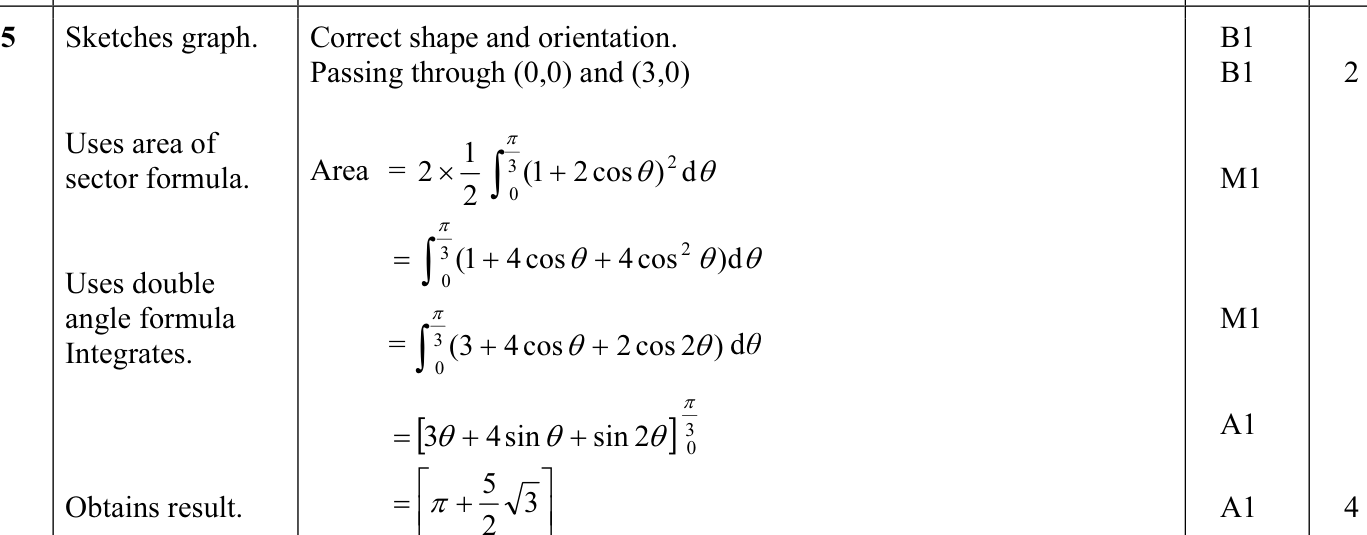
The curve \(C\) has polar equation \(r=1+2 \cos \theta\). Sketch the curve for \(-\frac{2}{3} \pi \leqslant \theta\lt \frac{2}{3} \pi\).
Find the area bounded by \(C\) and the half-lines \(\theta=-\frac{1}{3} \pi, \theta=\frac{1}{3} \pi\).
9231 P11 - Jun 2010 - Q2 - 7 marks
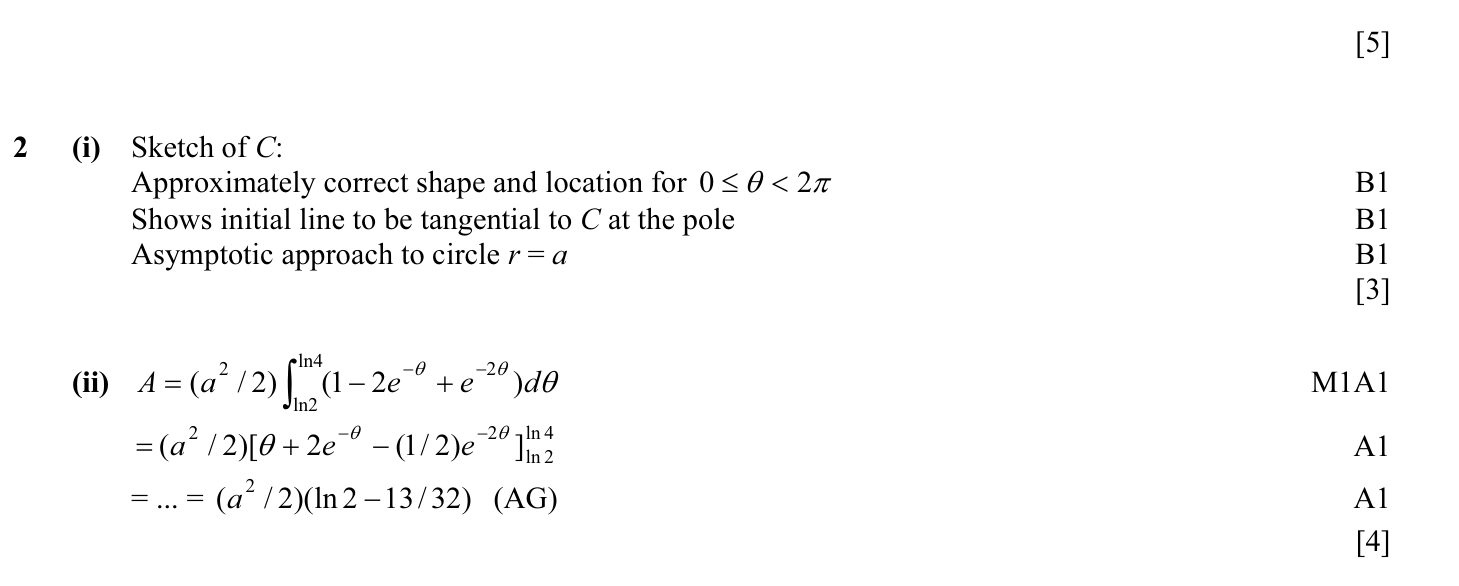
The curve \(C\) has polar equation
\(r=a\left(1-\mathrm{e}^{-\theta}\right),\)
where \(a\) is a positive constant and \(0 \leqslant \theta\lt 2 \pi\).
(i) Draw a sketch of \(C\).
(ii) Show that the area of the region bounded by \(C\) and the lines \(\theta=\ln 2\) and \(\theta=\ln 4\) is
\(\frac{1}{2} a^{2}\left(\ln 2-\frac{13}{32}\right) .\)
9231 P13 - Jun 2011 - Q6 - 8 marks
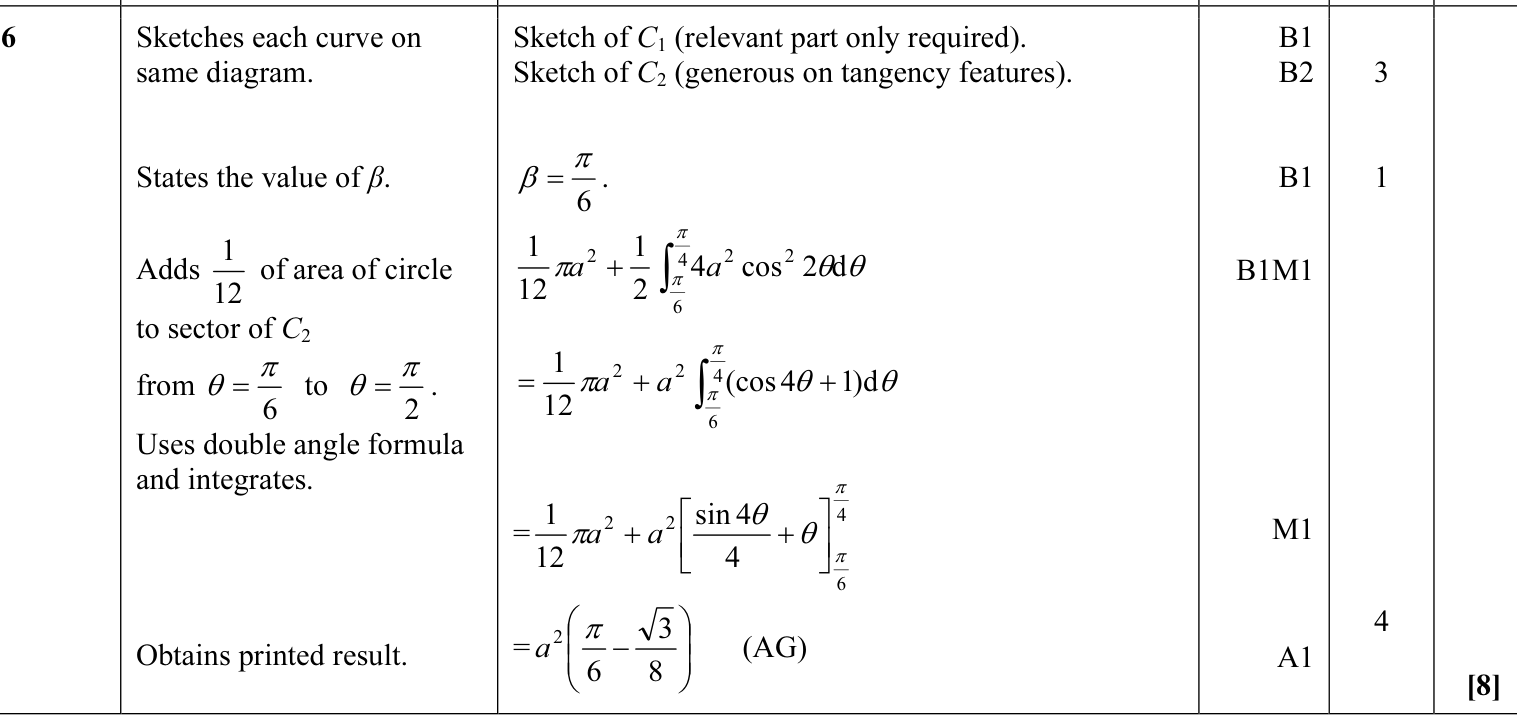
The curves \(C_{1}\) and \(C_{2}\) have polar equations
\(\begin{array}{ll} C_{1}: & r=a \\ C_{2}: & r=2 a \cos 2 \theta, \text { for } 0 \leqslant \theta \leqslant \frac{1}{4} \pi \end{array}\)
where \(a\) is a positive constant. Sketch \(C_{1}\) and \(C_{2}\) on the same diagram.
The curves \(C_{1}\) and \(C_{2}\) intersect at the point with polar coordinates \((a, \beta)\). State the value of \(\beta\).
Show that the area of the region bounded by the initial line, the arc of \(C_{1}\) from \(\theta=0\) to \(\theta=\beta\), and the \(\operatorname{arc}\) of \(C_{2}\) from \(\theta=\beta\) to \(\theta=\frac{1}{4} \pi\) is
\(a^{2}\left(\frac{1}{6} \pi-\frac{1}{8} \sqrt{ } 3\right) .\)
9231 P11 - Nov 2011 - Q10 - 13 marks
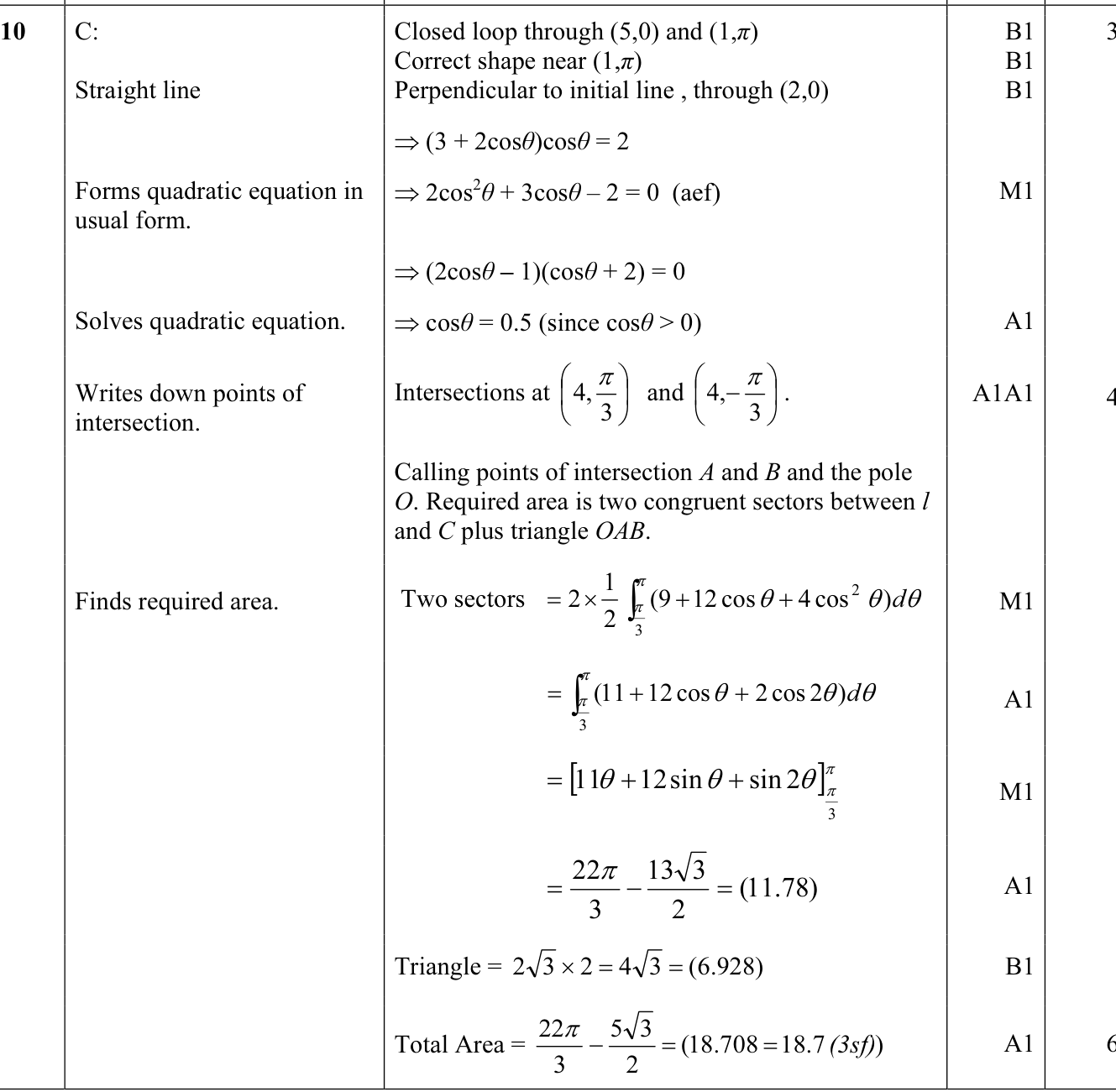
The curve \(C\) has polar equation \(r=3+2 \cos \theta\), for \(-\pi\lt \theta \leqslant \pi\). The straight line \(l\) has polar equation \(r \cos \theta=2\). Sketch both \(C\) and \(l\) on a single diagram.
Find the polar coordinates of the points of intersection of \(C\) and \(l\).
The region \(R\) is enclosed by \(C\) and \(l\), and contains the pole. Find the area of \(R\).
[Question 11 is printed on the next page.]
9231 P13 - Nov 2011 - Q8 - 10 marks
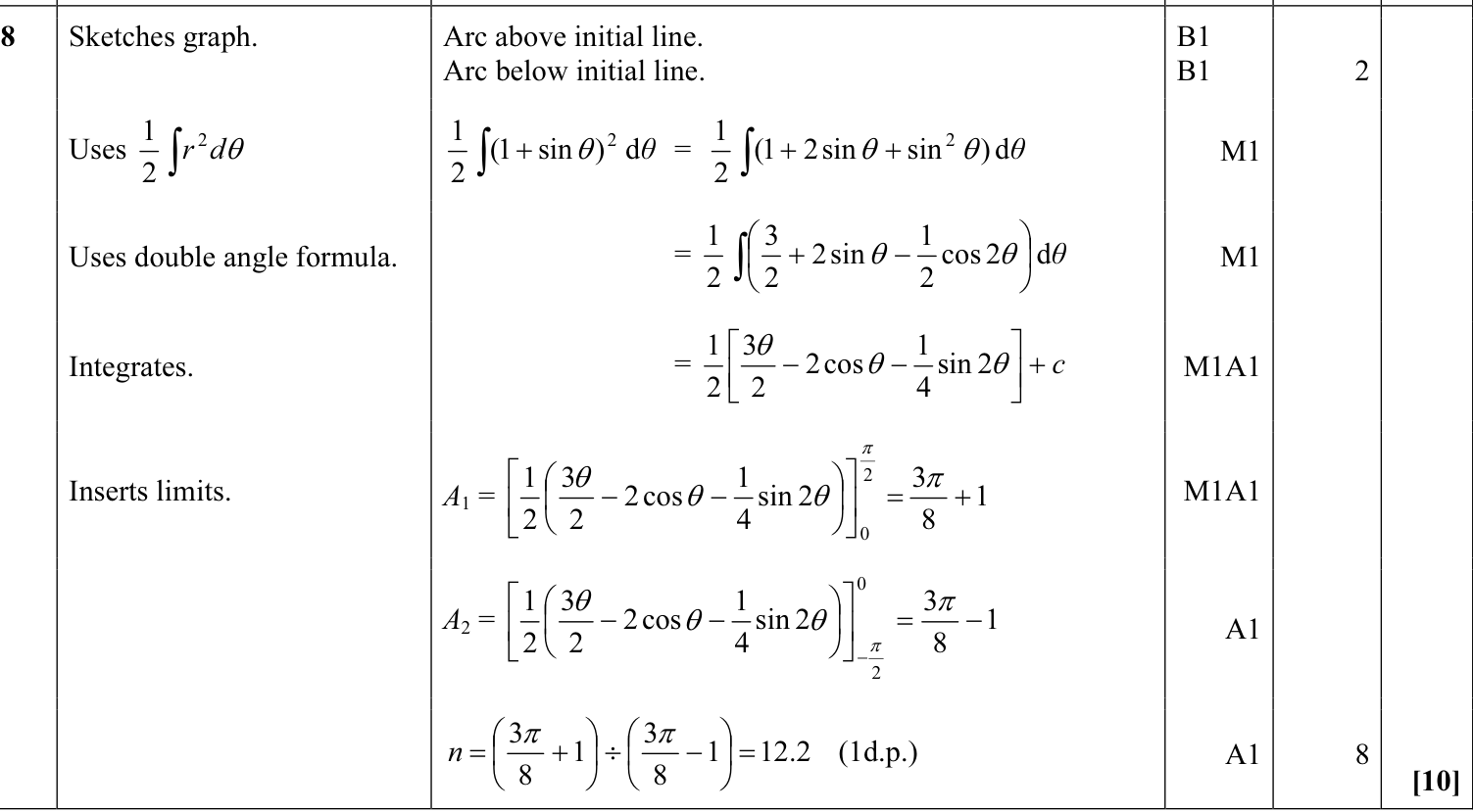
The curve \(C\) has polar equation \(r=1+\sin \theta\) for \(-\frac{1}{2} \pi \leqslant \theta \leqslant \frac{1}{2} \pi\). Draw a sketch of \(C\).
The area of the region enclosed by the initial line, the half-line \(\theta=\frac{1}{2} \pi\), and the part of \(C\) for which \(\theta\) is positive, is denoted by \(A_{1}\). The area of the region enclosed by the initial line, and the part of \(C\) for which \(\theta\) is negative, is denoted by \(A_{2}\). Find the ratio \(A_{1}: A_{2}\), giving your answer correct to 1 decimal place.
9231 P1 - Jun 2009 - Q5 - 7 marks
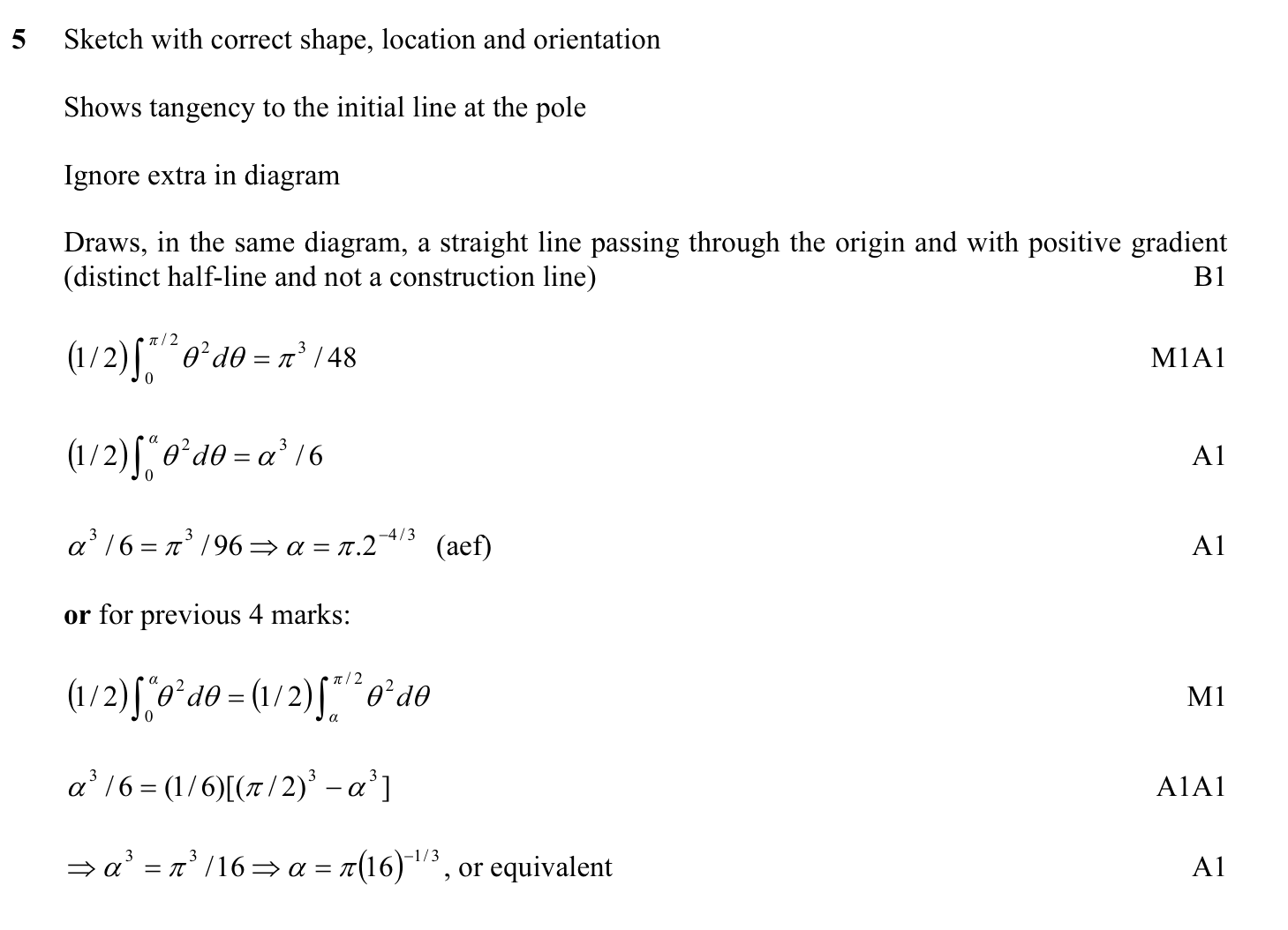
Draw a sketch of the curve \(C\) whose polar equation is \(r=\theta\), for \(0 \leqslant \theta \leqslant \frac{1}{2} \pi\).
On the same diagram draw the line \(\theta=\alpha\), where \(0\lt \alpha\lt \frac{1}{2} \pi\).
The region bounded by \(C\) and the line \(\theta=\frac{1}{2} \pi\) is denoted by \(R\). Find the exact value of \(\alpha\) for which the line \(\theta=\alpha\) divides \(R\) into two regions of equal area.
9231 P13 - Jun 2010 - Q11 - 12 marks
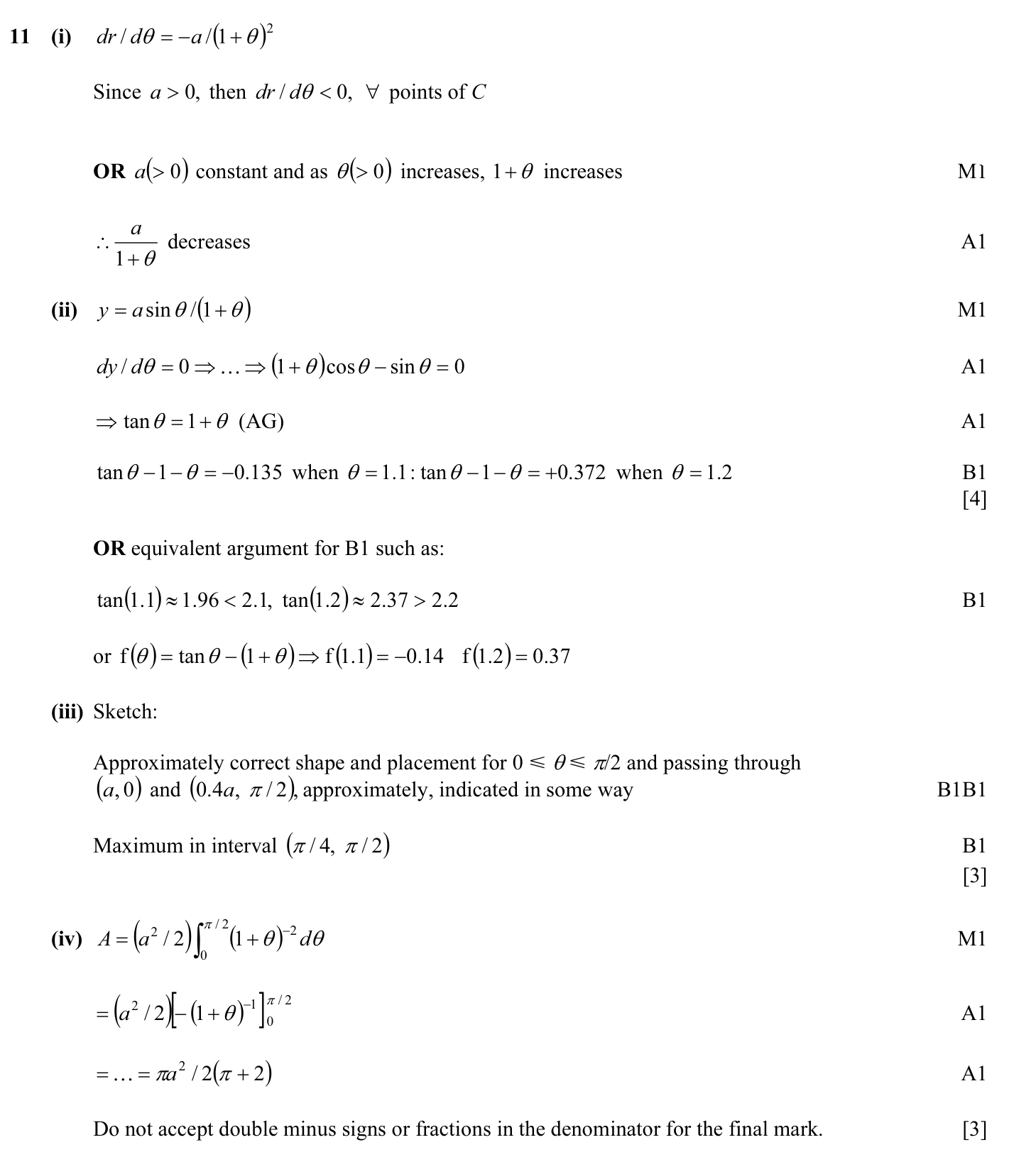
The curve \(C\) has polar equation
\(r=\frac{a}{1+\theta},\)
where \(a\) is a positive constant and \(0 \leqslant \theta \leqslant \frac{1}{2} \pi\).
(i) Show that \(r\) decreases as \(\theta\) increases.
(ii) The point \(P\) of \(C\) is further from the initial line than any other point of \(C\). Show that, at \(P\),
\(\tan \theta=1+\theta,\)
and verify that this equation has a root between 1.1 and 1.2.
(iii) Draw a sketch of \(C\).
(iv) Find the area of the region bounded by the initial line, the line \(\theta=\frac{1}{2} \pi\) and \(C\), leaving your answer in terms of \(\pi\) and \(a\).
9231 P1 - Nov 2009 - Q10 - 12 marks
The curve \(C\) has polar equation
\(r=a \sin 3 \theta\)
where \(0 \leqslant \theta \leqslant \frac{1}{3} \pi\).
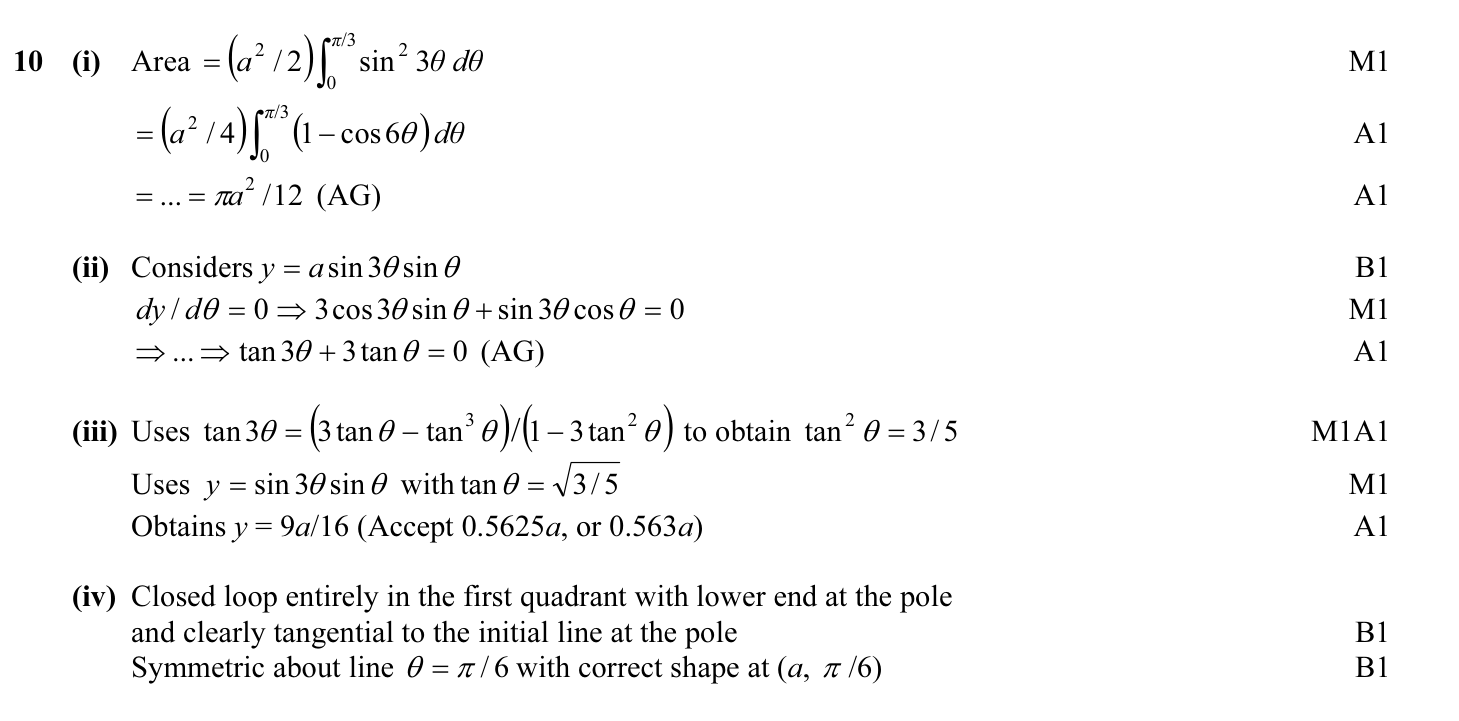
(i) Show that the area of the region enclosed by \(C\) is \(\frac{1}{12} \pi a^{2}\).
(ii) Show that, at the point of \(C\) at maximum distance from the initial line,
\(\tan 3 \theta+3 \tan \theta=0\)
(iii) Use the formula
\(\tan 3 \theta=\frac{3 \tan \theta-\tan ^{3} \theta}{1-3 \tan ^{2} \theta}\)
to find this maximum distance.
(iv) Draw a sketch of \(C\).