9231 P13 - Jun 2023 - Q04 - 14 marks
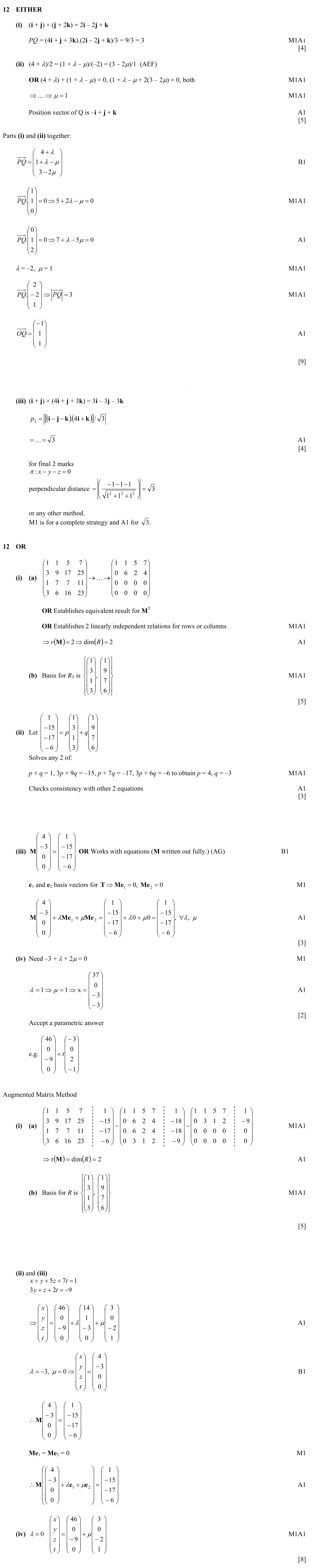
The matrix M is given by M = \(\begin{pmatrix} \cos 2\theta & -\sin 2\theta \\ \sin 2\theta & \cos 2\theta \end{pmatrix} \begin{pmatrix} 1 & k \\ 0 & 1 \end{pmatrix}\), where \(0 < \theta < \pi\) and \(k\) is a non-zero constant. The matrix M represents a sequence of two geometrical transformations, one of which is a shear.
- Describe fully the other transformation and state the order in which the transformations are applied. [3]
- Write M-1 as the product of two matrices, neither of which is I. [2]
- Find, in terms of \(k\), the value of \(\tan \theta\) for which M - I is singular. [5]
- Given that \(k = 2\sqrt{3}\) and \(\theta = \frac{1}{3}\pi\), show that the invariant points of the transformation represented by M lie on the line \(3y + \sqrt{3}x = 0\). [4]
9231 P11 - Nov 2021 - Q04 - 11 marks
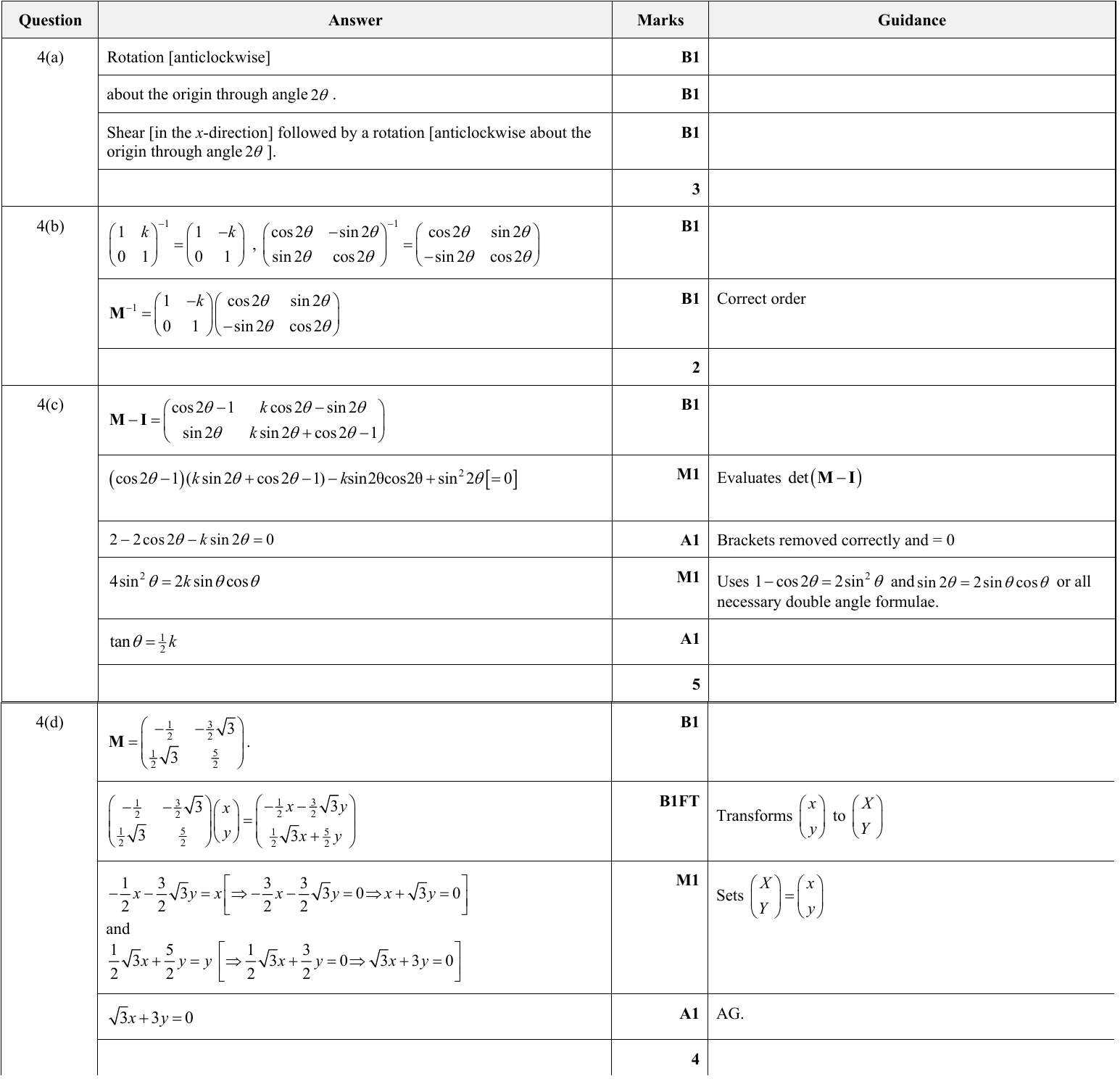
The matrix M is given by \(\mathbf{M} = \begin{pmatrix} \cos \theta & -\sin \theta \\ \sin \theta & \cos \theta \end{pmatrix} \begin{pmatrix} 3 & 0 \\ 0 & 1 \end{pmatrix}\).
(a) The matrix M represents a sequence of two geometrical transformations. State the type of each transformation, and make clear the order in which they are applied. [2]
(b) Find the values of \(\theta\), for \(0 \leq \theta \leq \pi\), for which the transformation represented by M has exactly one invariant line through the origin, giving your answers in terms of \(\pi\). [9]
9231 P11 - Nov 2020 - Q1 - 9 marks
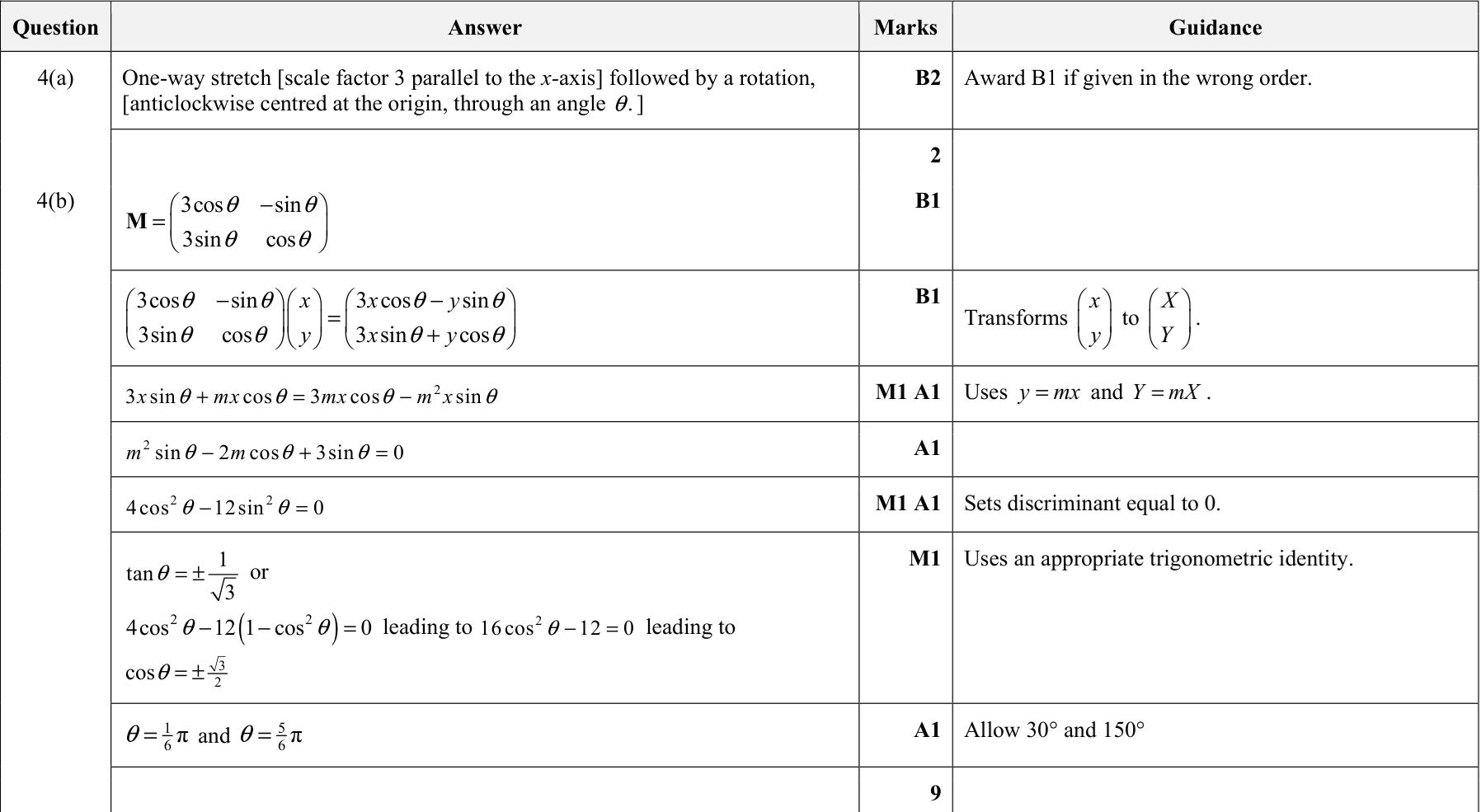
1 The matrix \(\mathbf{M}\) is given by \(\mathbf{M}=\left(\begin{array}{ll}1 & b \\ 0 & 1\end{array}\right)\left(\begin{array}{ll}a & 0 \\ 0 & 1\end{array}\right)\), where \(a\) and \(b\) are positive constants.
(a) The matrix \(\mathbf{M}\) represents a sequence of two geometrical transformations.
State the type of each transformation, and make clear the order in which they are applied.
The unit square in the \(x-y\) plane is transformed by \(\mathbf{M}\) onto parallelogram \(O P Q R\).
(b) Find, in terms of \(a\) and \(b\), the matrix which transforms parallelogram \(O P Q R\) onto the unit square.
It is given that the area of \(O P Q R\) is \(2 \mathrm{~cm}^{2}\) and that the line \(x+3 y=0\) is invariant under the transformation represented by \(\mathbf{M}\).
(c) Find the values of \(a\) and \(b\).
9231 P13 - Jun 2019 - Q5 - 8 marks
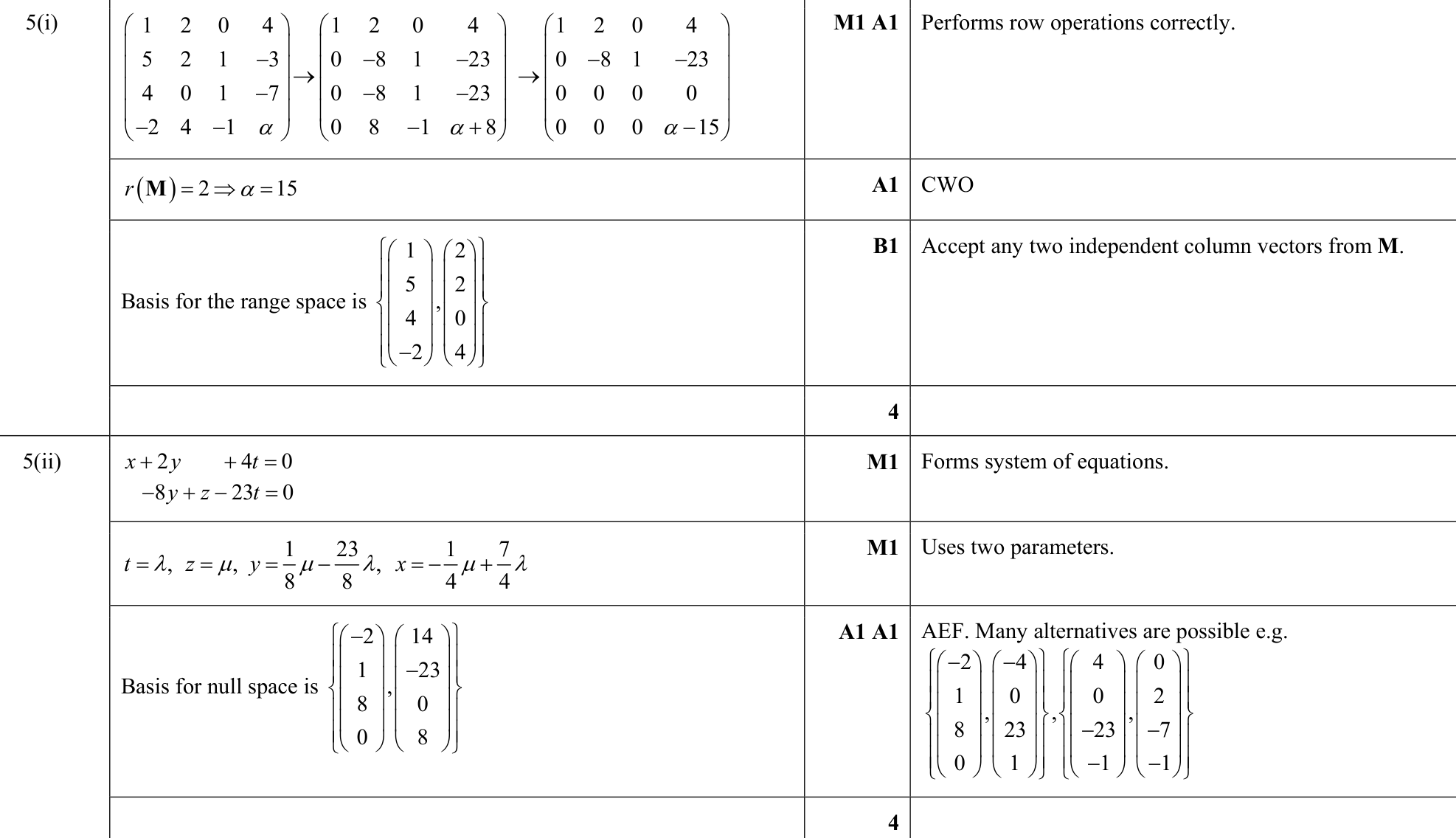
5 The linear transformation \(T:\mathbb{R}^4\to\mathbb{R}^4\) is represented by the matrix \(M\), where
\(M=\begin{pmatrix}1&2&0&4\\5&2&1&-3\\4&0&1&-7\\-2&4&-1&\alpha\end{pmatrix}\).
It is given that the rank of \(M\) is \(2\).
(i) Find the value of \(\alpha\) and state a basis for the range space of \(T\).
(ii) Obtain a basis for the null space of \(T\).
9231 P11 - Jun 2018 - Q8 - 10 marks
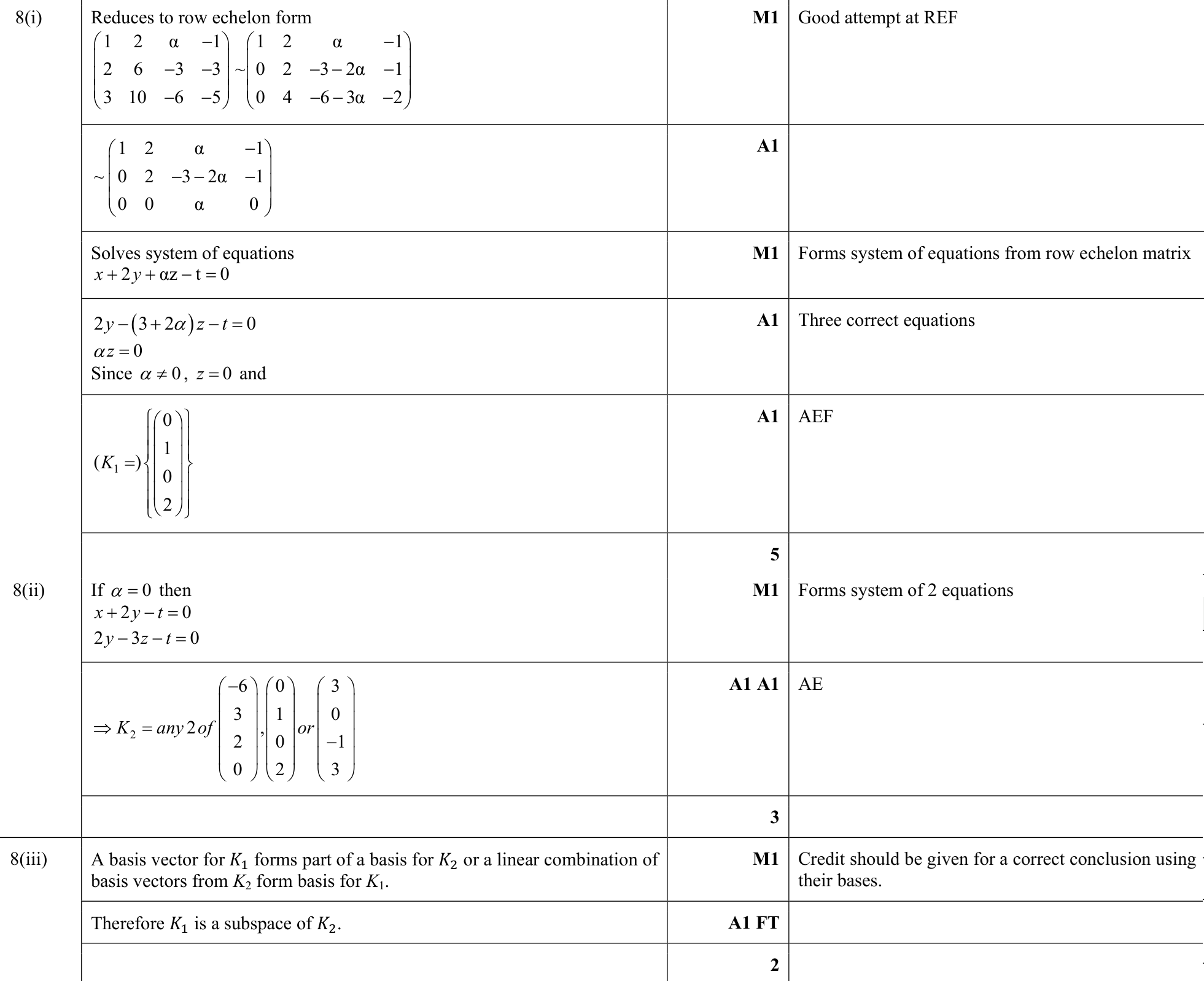
The linear transformation \(\mathrm{T}: \mathbb{R}^{4} \rightarrow \mathbb{R}^{3}\) is represented by the matrix \(\mathbf{M}\), where
\(\mathbf{M}=\left(\begin{array}{cccc}
1 & 2 & \alpha & -1 \\
2 & 6 & -3 & -3 \\
3 & 10 & -6 & -5
\end{array}\right)\)
and \(\alpha\) is a constant. When \(\alpha \neq 0\) the null space of T is denoted by \(K_{1}\).
(i) Find a basis for \(K_{1}\).
When \(\alpha=0\) the null space of T is denoted by \(K_{2}\).
(ii) Find a basis for \(K_{2}\).
(iii) Determine, justifying your answer, whether \(K_{1}\) is a subspace of \(K_{2}\).
9231 P11 - Nov 2025 - Q2 - 11 marks
(a) For \(A=\begin{pmatrix}1&\frac32\\0&1\end{pmatrix}\), give full details of the geometrical transformation represented by \(A\).
(b) For \(B=\begin{pmatrix}1&0\\\frac32&1\end{pmatrix}\), give full details of the geometrical transformation represented by \(B\).
(c) The triangle \(DEF\) is transformed by \(AB\) onto \(PQR\). Show that the triangles have the same area.
(d) Find the equations of the invariant lines through the origin of the transformation represented by \(AB\).
9231 P11 - Jun 2014 - Q6 - 8 marks
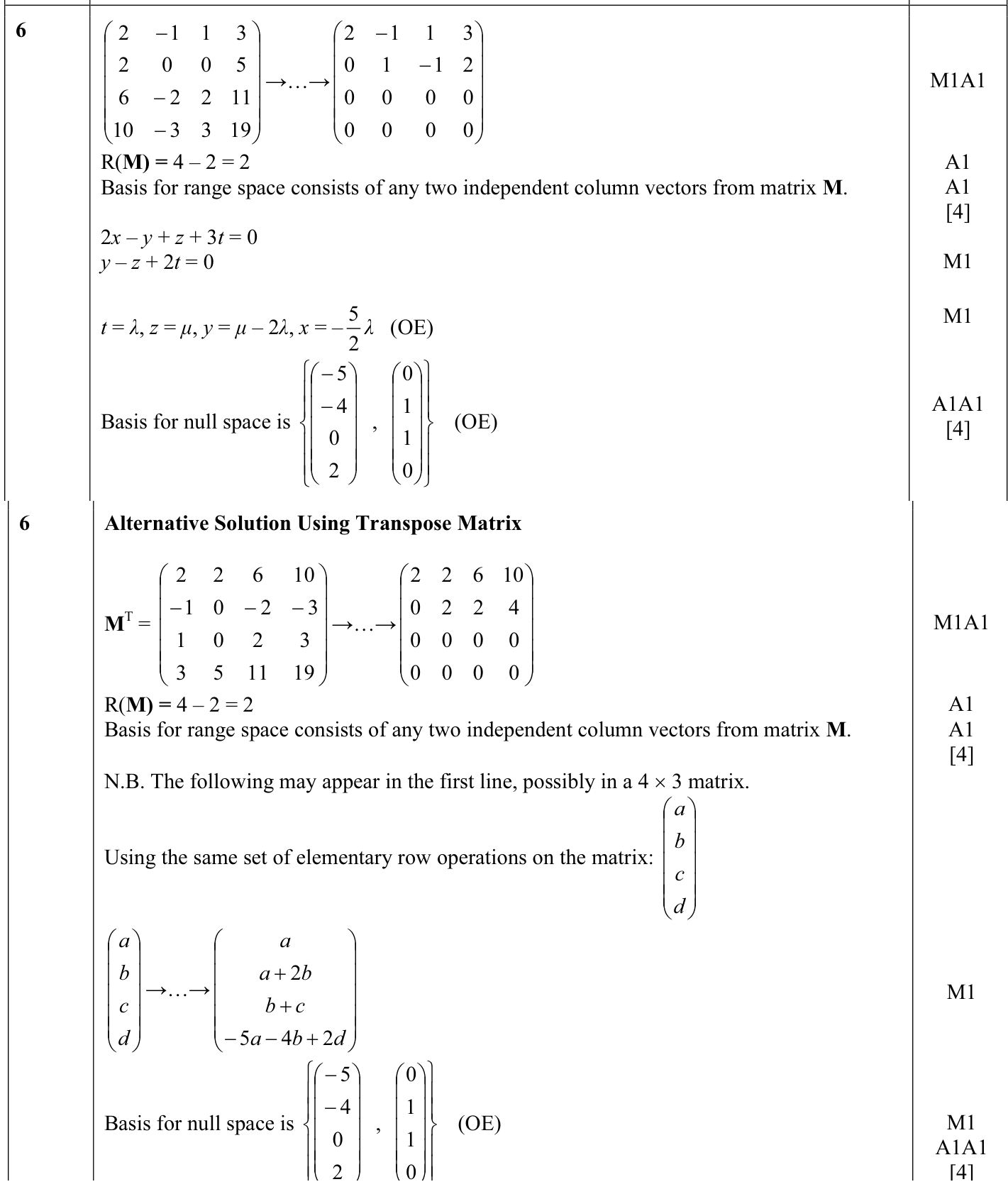
The linear transformation \(\mathrm{T}: \mathbb{R}^{4} \rightarrow \mathbb{R}^{4}\) is represented by the matrix \(\mathbf{M}\), where
\(\mathbf{M}=\left(\begin{array}{rrrr} 2 & -1 & 1 & 3 \\ 2 & 0 & 0 & 5 \\ 6 & -2 & 2 & 11 \\ 10 & -3 & 3 & 19 \end{array}\right) .\)
(i) Find the rank of \(\mathbf{M}\) and state a basis for the range space of T .
(ii) Obtain a basis for the null space of T .
9231 P11 - Jun 2013 - Q8 - 10 marks
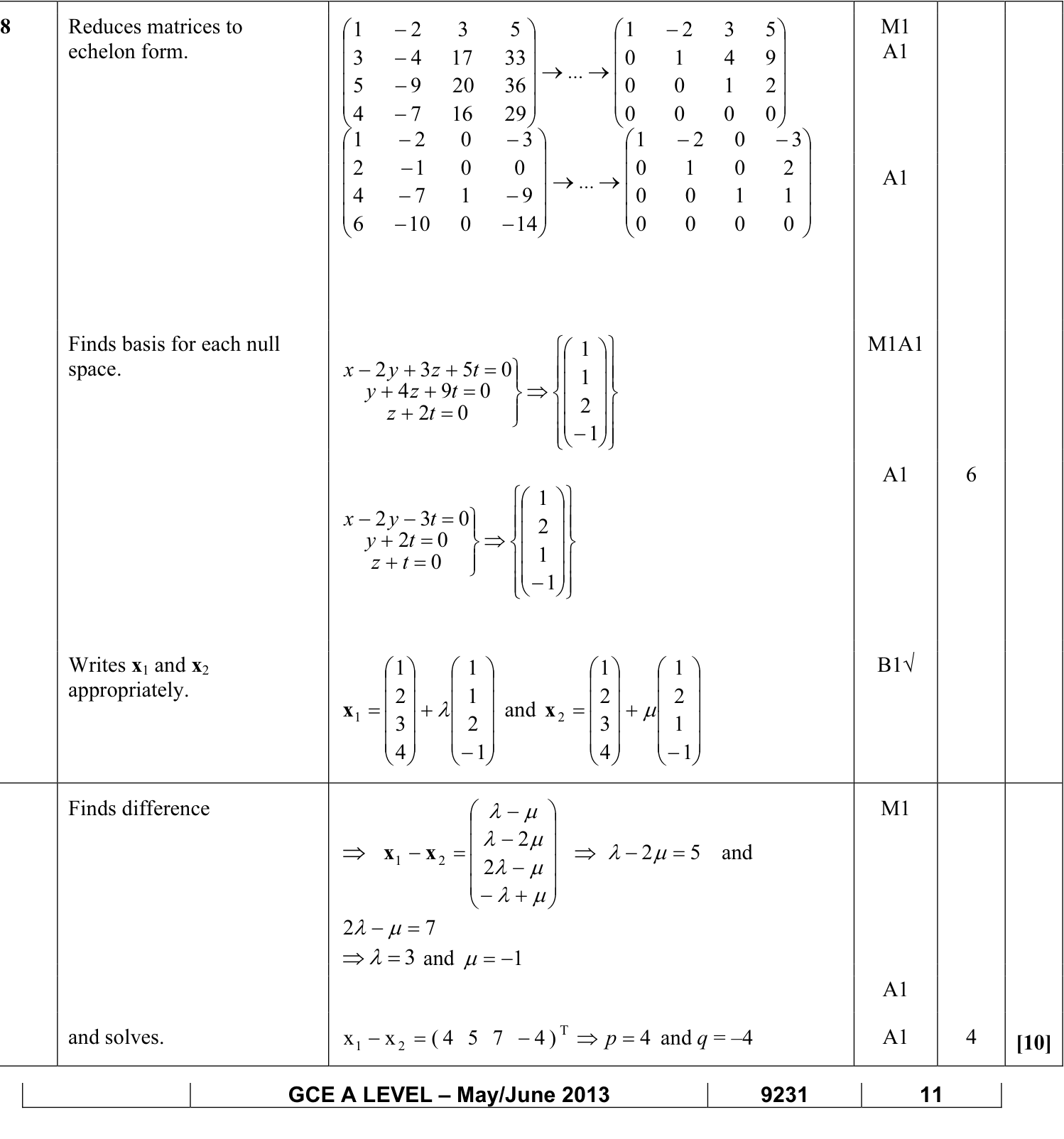
The linear transformations \(\mathrm{T}_{1}: \mathbb{R}^{4} \rightarrow \mathbb{R}^{4}\) and \(\mathrm{T}_{2}: \mathbb{R}^{4} \rightarrow \mathbb{R}^{4}\) are represented by the matrices \(\mathbf{M}_{1}\) and \(\mathbf{M}_{2}\) respectively, where
\(\mathbf{M}_{1}=\left(\begin{array}{rrrr} 1 & -2 & 3 & 5 \\ 3 & -4 & 17 & 33 \\ 5 & -9 & 20 & 36 \\ 4 & -7 & 16 & 29 \end{array}\right) \quad \text { and } \quad \mathbf{M}_{2}=\left(\begin{array}{rrrr} 1 & -2 & 0 & -3 \\ 2 & -1 & 0 & 0 \\ 4 & -7 & 1 & -9 \\ 6 & -10 & 0 & -14 \end{array}\right) .\)
The null spaces of \(\mathrm{T}_{1}\) and \(\mathrm{T}_{2}\) are denoted by \(K_{1}\) and \(K_{2}\) respectively. Find a basis for \(K_{1}\) and a basis for \(K_{2}\).
It is given that \(\mathbf{a}=\left(\begin{array}{l}1 \\ 2 \\ 3 \\ 4\end{array}\right)\). The vectors \(\mathbf{x}_{1}\) and \(\mathbf{x}_{2}\) are such that \(\mathbf{M}_{1} \mathbf{x}_{1}=\mathbf{M}_{1} \mathbf{a}\) and \(\mathbf{M}_{2} \mathbf{x}_{2}=\mathbf{M}_{2} \mathbf{a}\). Given that \(\mathbf{x}_{1}-\mathbf{x}_{2}=\left(\begin{array}{c}p \\ 5 \\ 7 \\ q\end{array}\right)\), find \(p\) and \(q\).
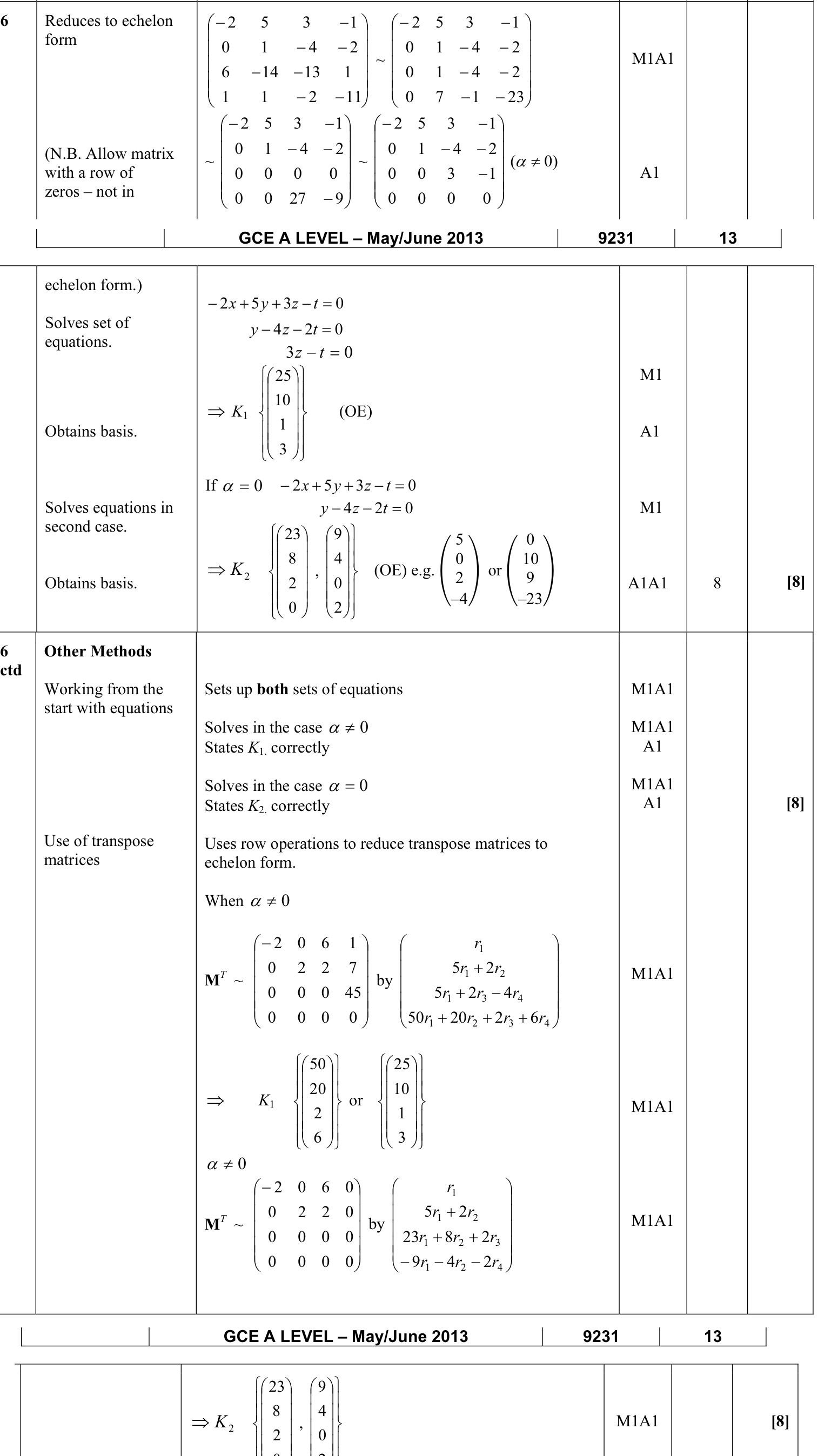
9231 P13 - Jun 2013 - Q6 - 8 marks
The linear transformation \(\mathrm{T}: \mathbb{R}^{4} \rightarrow \mathbb{R}^{4}\) is represented by the matrix \(\mathbf{M}\), where
\(\mathbf{M}=\left(\begin{array}{rrrr} -2 & 5 & 3 & -1 \\ 0 & 1 & -4 & -2 \\ 6 & -14 & -13 & 1 \\ \alpha & \alpha & -2 \alpha & -11 \alpha \end{array}\right)\)
and \(\alpha\) is a constant. The null space of T is denoted by \(K_{1}\) when \(\alpha \neq 0\), and by \(K_{2}\) when \(\alpha=0\). Find a basis for \(K_{1}\) and a basis for \(K_{2}\).
9231 P11 - Nov 2013 - Q6 - 9 marks
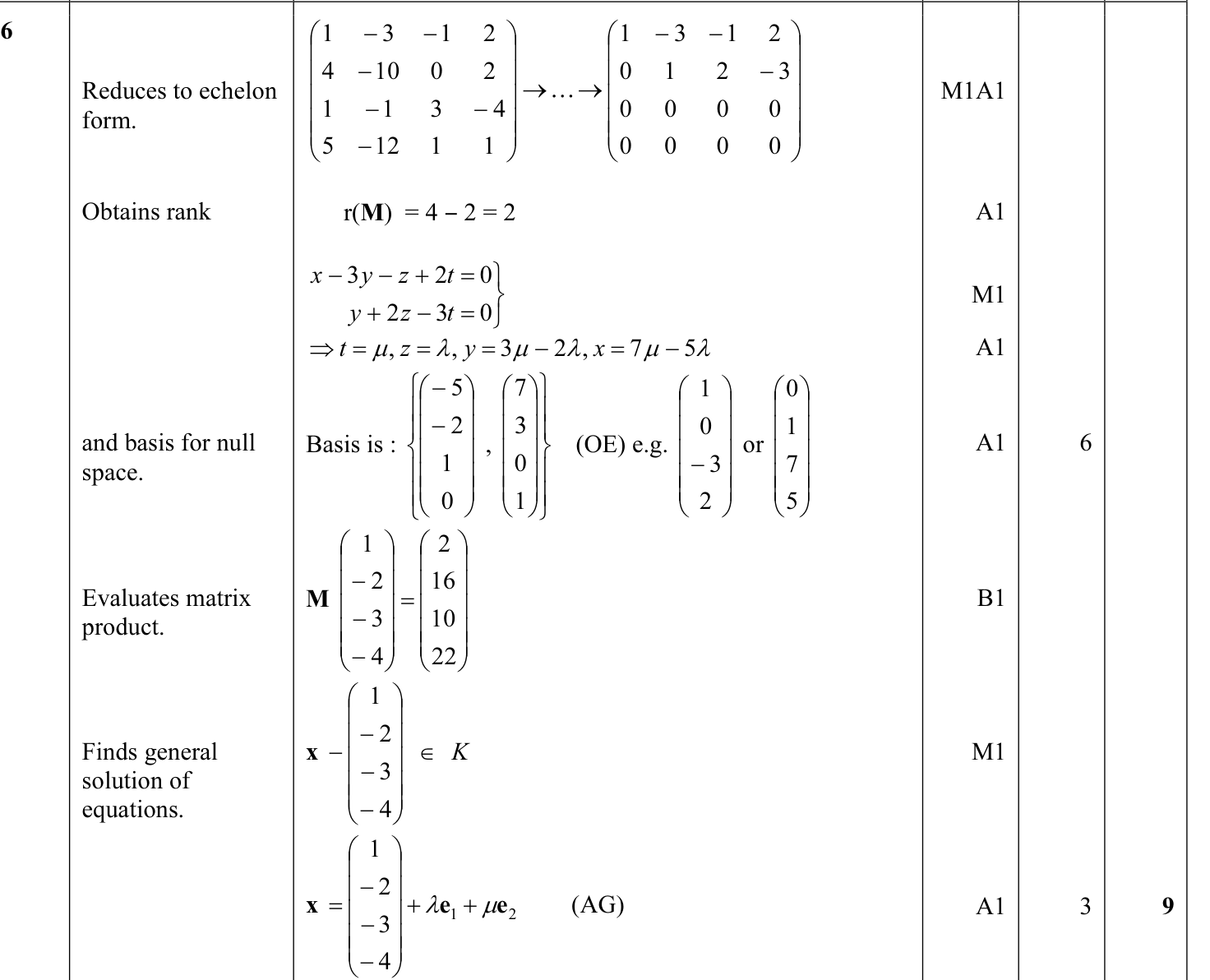
The linear transformation \(\mathrm{T}: \mathbb{R}^{4} \rightarrow \mathbb{R}^{4}\) is represented by the matrix \(\mathbf{M}\), where
\(\mathbf{M}=\left(\begin{array}{rrrr} 1 & -3 & -1 & 2 \\ 4 & -10 & 0 & 2 \\ 1 & -1 & 3 & -4 \\ 5 & -12 & 1 & 1 \end{array}\right) .\)
Find, in either order, the rank of \(\mathbf{M}\) and a basis for the null space \(K\) of T .
Evaluate
\(\mathbf{M}\left(\begin{array}{r} 1 \\ -2 \\ -3 \\ -4 \end{array}\right),\)
and hence show that every solution of
\(\mathbf{M x}=\left(\begin{array}{r} 2 \\ 16 \\ 10 \\ \end{array}\right)\)
has the form
\(\mathbf{x}=\left(\begin{array}{r} 1 \\ -2 \\ -3 \\ -4 \end{array}\right)+\lambda \mathbf{e}_{1}+\mu \mathbf{e}_{2},\)
where \(\lambda\) and \(\mu\) are real numbers and \(\left\{\mathbf{e}_{1}, \mathbf{e}_{2}\right\}\) is a basis for \(K\).
9231 P12 - Nov 2013 - Q6 - 9 marks
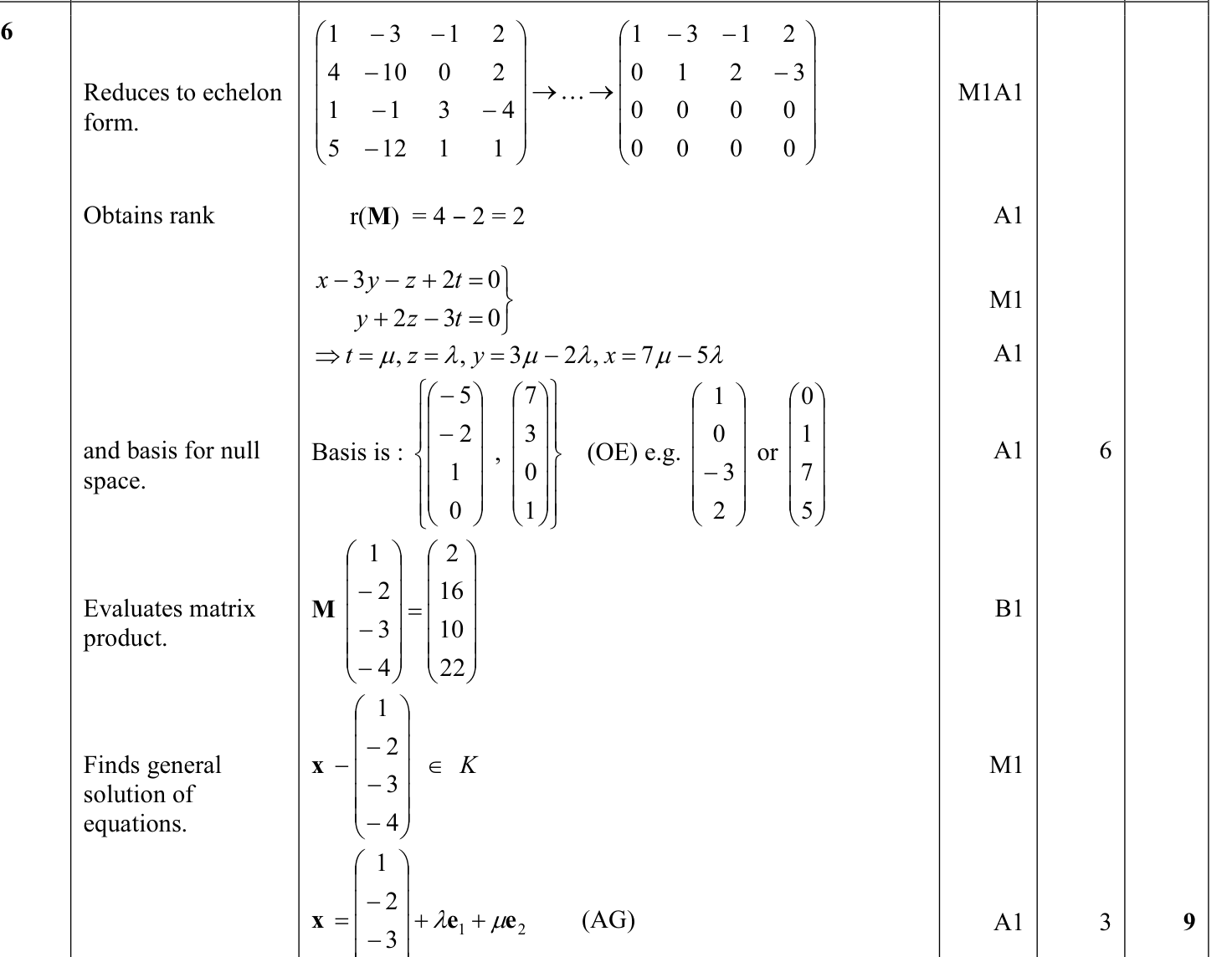
The linear transformation \(\mathrm{T}: \mathbb{R}^{4} \rightarrow \mathbb{R}^{4}\) is represented by the matrix \(\mathbf{M}\), where
\(\mathbf{M}=\left(\begin{array}{rrrr} 1 & -3 & -1 & 2 \\ 4 & -10 & 0 & 2 \\ 1 & -1 & 3 & -4 \\ 5 & -12 & 1 & 1 \end{array}\right) .\)
Find, in either order, the rank of \(\mathbf{M}\) and a basis for the null space \(K\) of T .
Evaluate
\(\mathbf{M}\left(\begin{array}{r} 1 \\ -2 \\ -3 \\ -4 \end{array}\right),\)
and hence show that every solution of
\(\mathbf{M} \mathbf{x}=\left(\begin{array}{r} 2 \\ 16 \\ 10 \\ \end{array}\right)\)
has the form
\(\mathbf{x}=\left(\begin{array}{r} 1 \\ -2 \\ -3 \\ -4 \end{array}\right)+\lambda \mathbf{e}_{1}+\mu \mathbf{e}_{2},\)
where \(\lambda\) and \(\mu\) are real numbers and \(\left\{\mathbf{e}_{1}, \mathbf{e}_{2}\right\}\) is a basis for \(K\).
9231 P11 - Jun 2011 - Q3 - 6 marks
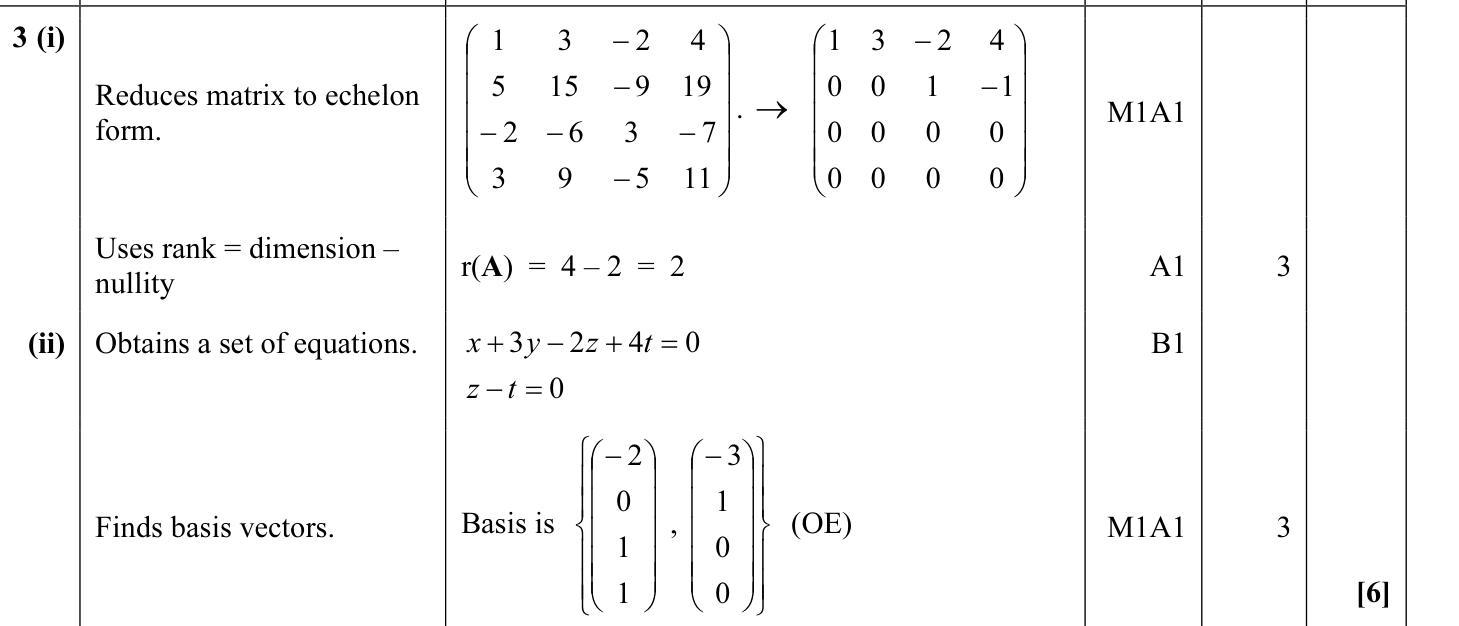
The linear transformation \(\mathrm{T}: \mathbb{R}^{4} \rightarrow \mathbb{R}^{4}\) is represented by the matrix \(\mathbf{M}=\left(\begin{array}{rrrr}1 & 3 & -2 & 4 \\ 5 & 15 & -9 & 19 \\ -2 & -6 & 3 & -7 \\ 3 & 9 & -5 & 11\end{array}\right)\).
(i) Find the rank of \(\mathbf{M}\).
(ii) Obtain a basis for the null space of T .
9231 P12 - Jun 2014 - Q6 - 8 marks
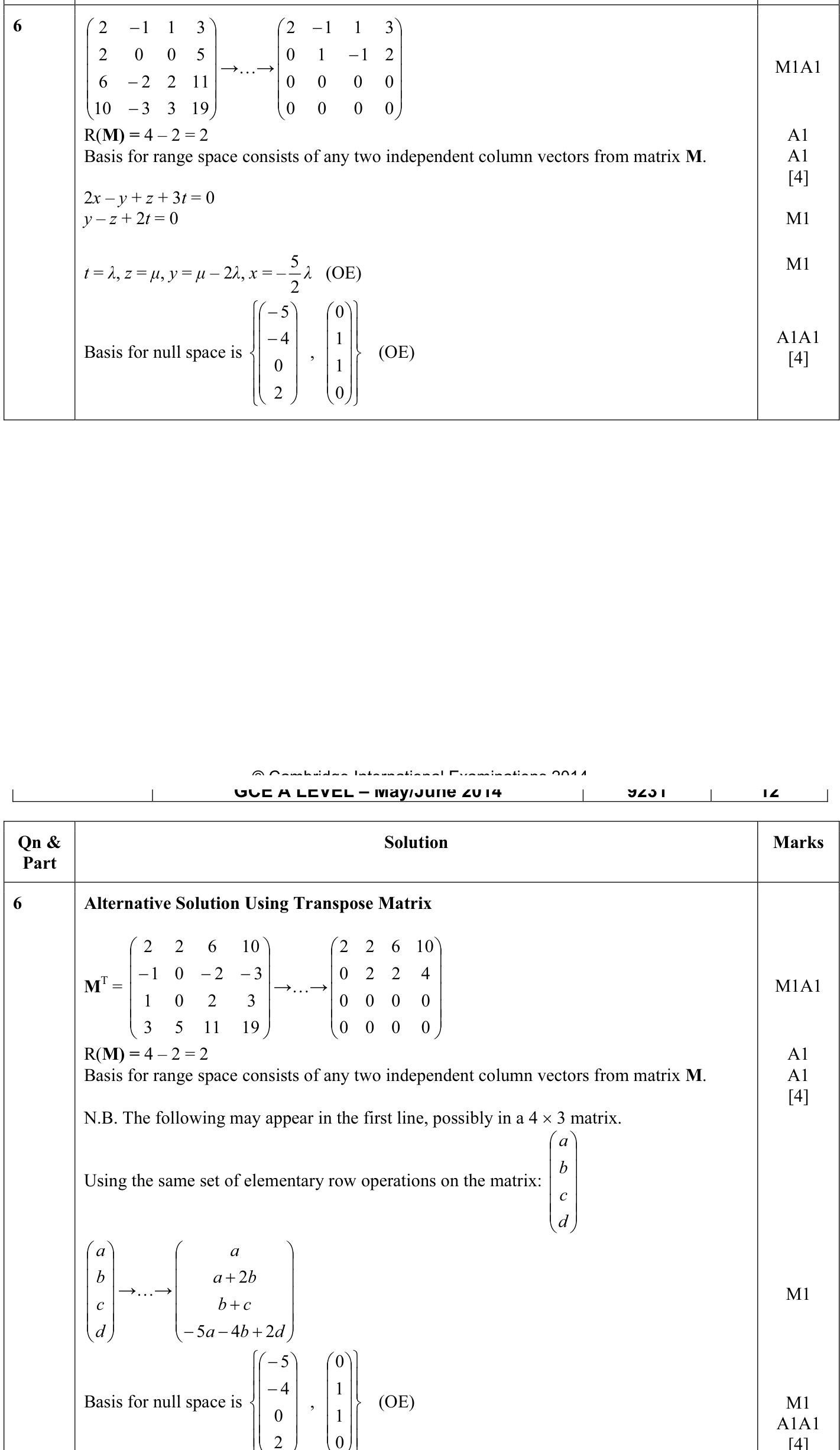
The linear transformation \(\mathrm{T}: \mathbb{R}^{4} \rightarrow \mathbb{R}^{4}\) is represented by the matrix \(\mathbf{M}\), where
\(\mathbf{M}=\left(\begin{array}{rrrr} 2 & -1 & 1 & 3 \\ 2 & 0 & 0 & 5 \\ 6 & -2 & 2 & 11 \\ 10 & -3 & 3 & 19 \end{array}\right) .\)
(i) Find the rank of \(\mathbf{M}\) and state a basis for the range space of T .
(ii) Obtain a basis for the null space of T .
9231 P11 - Nov 2011 - Q4 - 7 marks
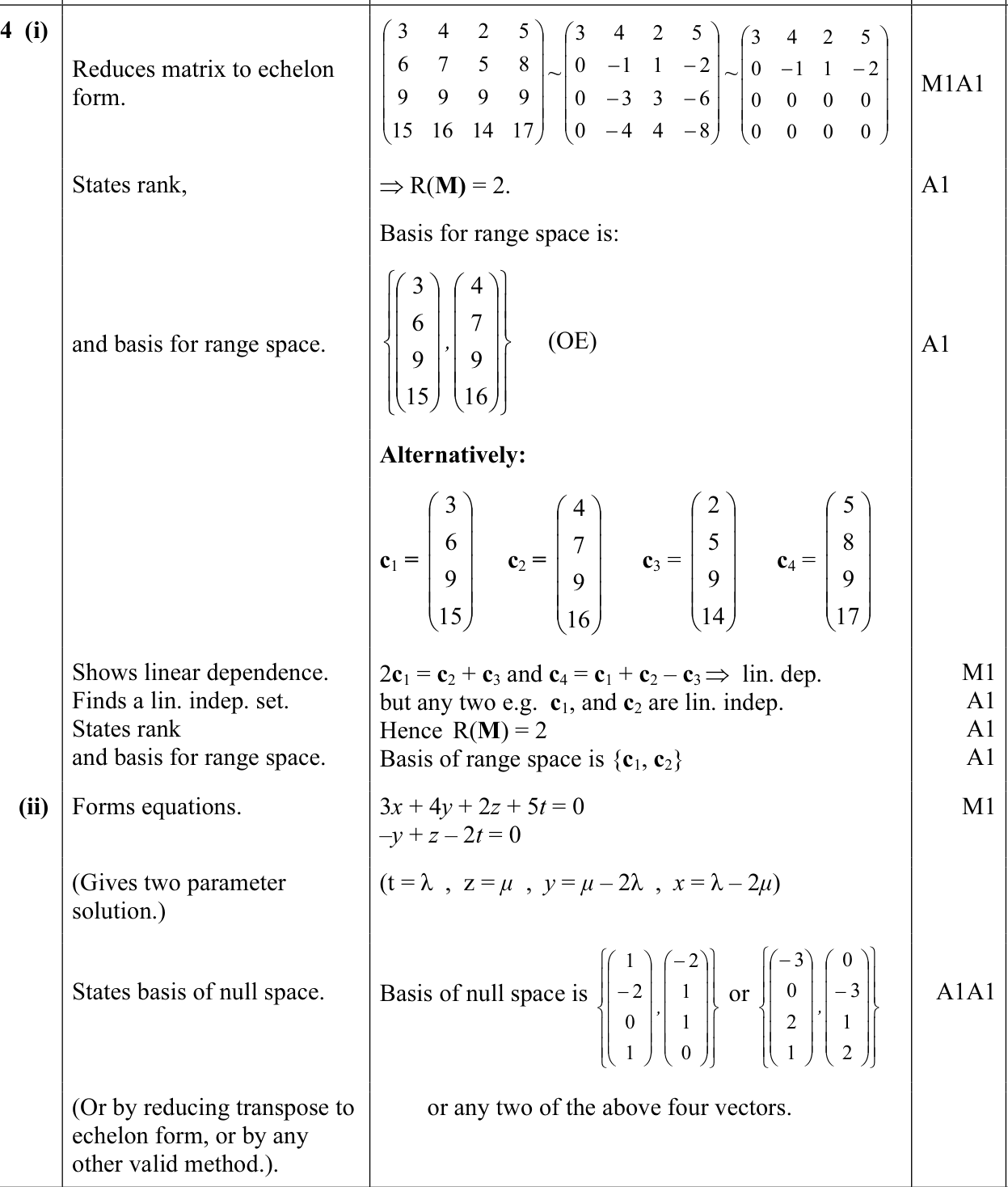
The linear transformation \(\mathrm{T}: \mathbb{R}^{4} \rightarrow \mathbb{R}^{4}\) is represented by the matrix \(\mathbf{M}\), where
\(\mathbf{M}=\left(\begin{array}{rrrr} 3 & 4 & 2 & 5 \\ 6 & 7 & 5 & 8 \\ 9 & 9 & 9 & 9 \\ 15 & 16 & 14 & 17 \end{array}\right) .\)
Find
(i) the rank of \(\mathbf{M}\) and a basis for the range space of T ,
(ii) a basis for the null space of T .
9231 P1 - Jun 2009 - Q12 - 26 marks
Answer only one of the following two alternatives.
EITHER
By considering \(\sum_{k=0}^{n-1}(1+\mathrm{i} \tan \theta)^{k}\), show that
\(\sum_{k=0}^{n-1} \cos k \theta \sec ^{k} \theta=\cot \theta \sin n \theta \sec ^{n} \theta,\)
provided \(\theta\) is not an integer multiple of \(\frac{1}{2} \pi\).
Hence or otherwise show that
\(\sum_{k=0}^{n-1} 2^{k} \cos \left(\frac{1}{3} k \pi\right)=\frac{2^{n}}{\sqrt{ } 3} \sin \left(\frac{1}{3} n \pi\right) .\)
Given that \(0\lt x\lt 1\), show that
\(\sum_{k=0}^{n-1} \frac{\cos \left(k \cos ^{-1} x\right)}{x^{k}}=\frac{\sin \left(n \cos ^{-1} x\right)}{x^{n-1} \sqrt{ }\left(1-x^{2}\right)} .\)
OR
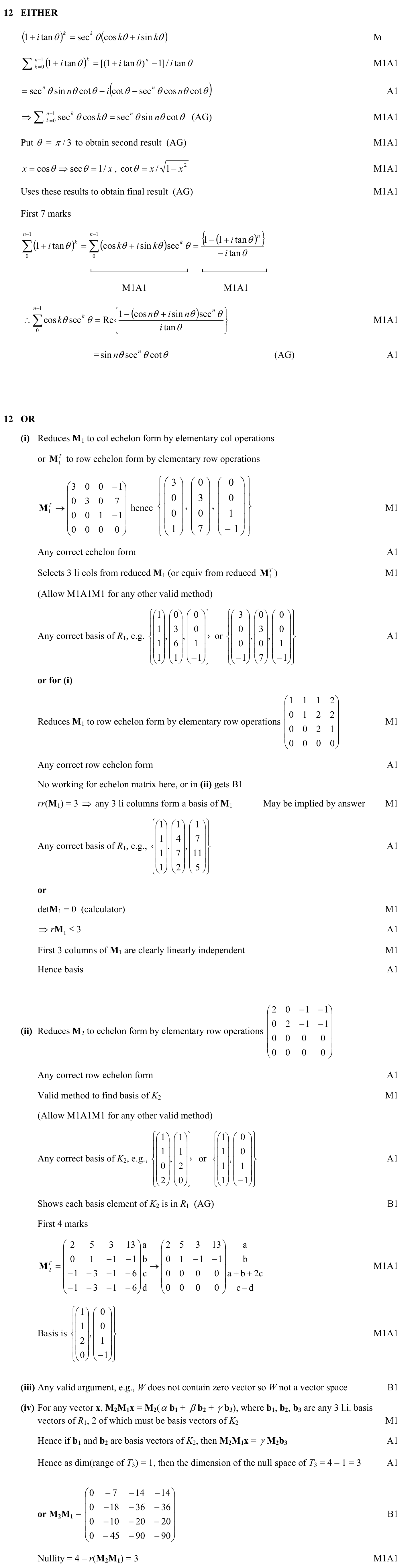
The linear transformations \(\mathrm{T}_{1}: \mathbb{R}^{4} \rightarrow \mathbb{R}^{4}\) and \(\mathrm{T}_{2}: \mathbb{R}^{4} \rightarrow \mathbb{R}^{4}\) are represented by the matrices \(\mathbf{M}_{1}\) and \(\mathbf{M}_{2}\), respectively, where
\(\mathbf{M}_{1}=\left(\begin{array}{rrrr} 1 & 1 & 1 & 2 \\ 1 & 4 & 7 & 8 \\ 1 & 7 & 11 & 13 \\ 1 & 2 & 5 & 5 \end{array}\right), \quad \mathbf{M}_{2}=\left(\begin{array}{rrrr} 2 & 0 & -1 & -1 \\ 5 & 1 & -3 & -3 \\ 3 & -1 & -1 & -1 \\ 13 & -1 & -6 & -6 \end{array}\right) .\)
(i) Find a basis for \(R_{1}\), the range space of \(\mathrm{T}_{1}\).
(ii) Find a basis for \(K_{2}\), the null space of \(\mathrm{T}_{2}\), and hence show that \(K_{2}\) is a subspace of \(R_{1}\).
The set of vectors which belong to \(R_{1}\) but do not belong to \(K_{2}\) is denoted by \(W\).
(iii) State whether \(W\) is a vector space, justifying your answer.
The linear transformation \(\mathrm{T}_{3}: \mathbb{R}^{4} \rightarrow \mathbb{R}^{4}\) is the result of applying \(\mathrm{T}_{1}\) and then \(\mathrm{T}_{2}\), in that order.
(iv) Find the dimension of the null space of \(\mathrm{T}_{3}\).
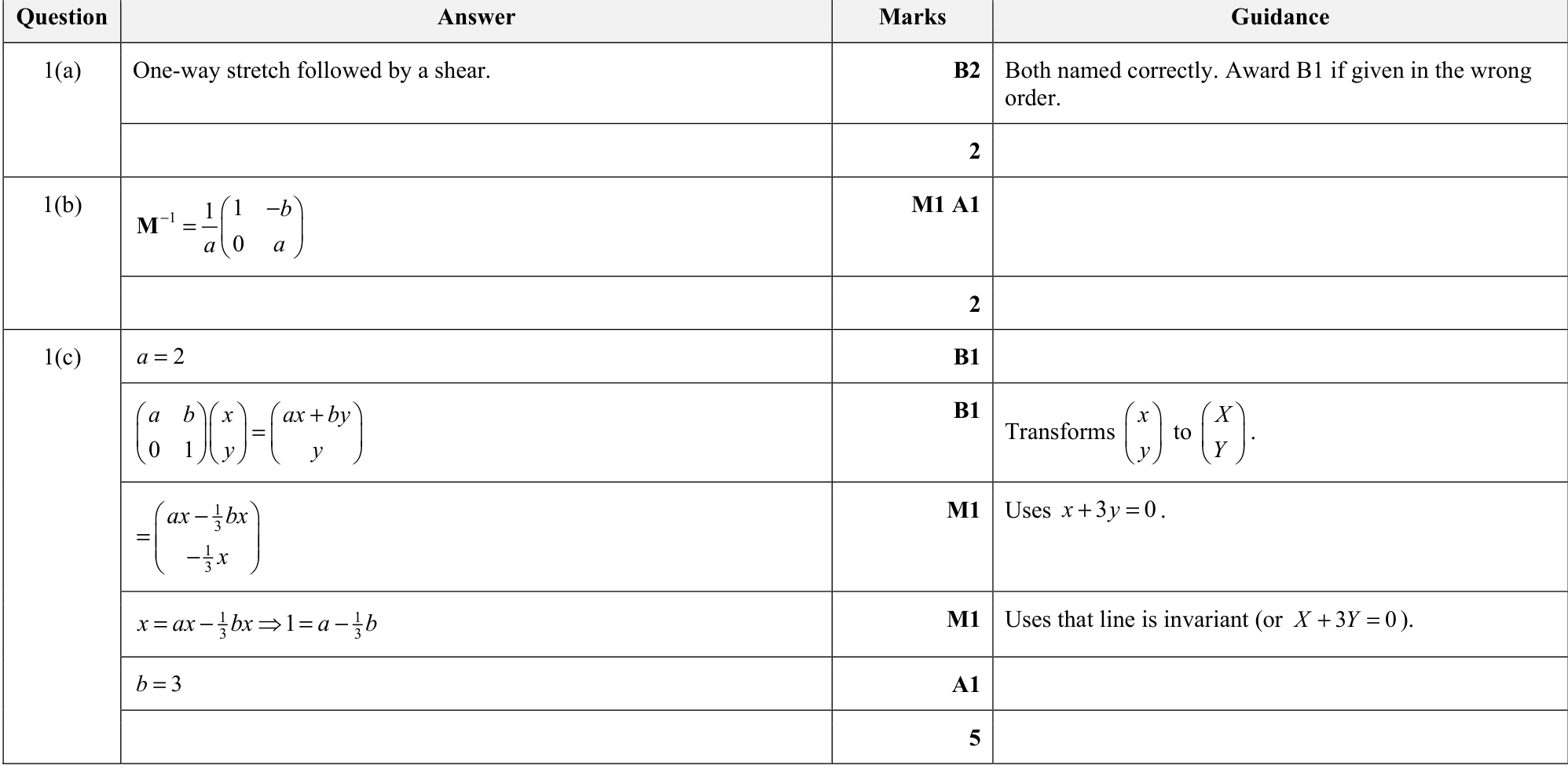
9231 P13 - Jun 2010 - Q12 - 28 marks
Answer only one of the following two alternatives.
EITHER
The line \(l_{1}\) passes through the point \(A\) whose position vector is \(3 \mathbf{i}+\mathbf{j}+2 \mathbf{k}\) and is parallel to the vector \(\mathbf{i}+\mathbf{j}\). The line \(l_{2}\) passes through the point \(B\) whose position vector is \(-\mathbf{i}-\mathbf{k}\) and is parallel to the vector \(\mathbf{j}+2 \mathbf{k}\). The point \(P\) is on \(l_{1}\) and the point \(Q\) is on \(l_{2}\) and \(P Q\) is perpendicular to both \(l_{1}\) and \(l_{2}\).
(i) Find the length of \(P Q\).
(ii) Find the position vector of \(Q\).
(iii) Show that the perpendicular distance from \(Q\) to the plane containing \(A B\) and the line \(l_{1}\) is \(\sqrt{ } 3\).
OR
The linear transformation \(\mathrm{T}: \mathbb{R}^{4} \rightarrow \mathbb{R}^{4}\) is represented by the matrix \(\mathbf{M}=\left(\begin{array}{rrrr}1 & 1 & 5 & 7 \\ 3 & 9 & 17 & 25 \\ 1 & 7 & 7 & 11 \\ 3 & 6 & 16 & 23\end{array}\right)\).
(i) In either order,
(a) show that the dimension of \(R\), the range space of T , is equal to 2 ,
(b) obtain a basis for \(R\).
(ii) Show that the vector \(\left(\begin{array}{r}1 \\ -15 \\ -17 \\ -6\end{array}\right)\) belongs to \(R\).
(iii) It is given that \(\left\{\mathbf{e}_{1}, \mathbf{e}_{2}\right\}\) is a basis for the null space of T , where \(\mathbf{e}_{1}=\left(\begin{array}{r}14 \\ 1 \\ -3 \\ 0\end{array}\right)\) and \(\mathbf{e}_{2}=\left(\begin{array}{r}19 \\ 2 \\ 0 \\ -3\end{array}\right)\). Show that, for all \(\lambda\) and \(\mu\),
\(\mathbf{x}=\left(\begin{array}{r} 4 \\ -3 \\ 0 \\ \end{array}\right)+\lambda \mathbf{e}_{1}+\mu \mathbf{e}_{2}\)
is a solution of
\(\mathbf{M x}=\left(\begin{array}{r} 1 \\ -15 \\ -17 \\ -6 \end{array}\right) .\)
(iv) Hence find a solution of \((*)\) of the form \(\left(\begin{array}{l}\alpha \\ 0 \\ \gamma \\ \delta\end{array}\right)\).