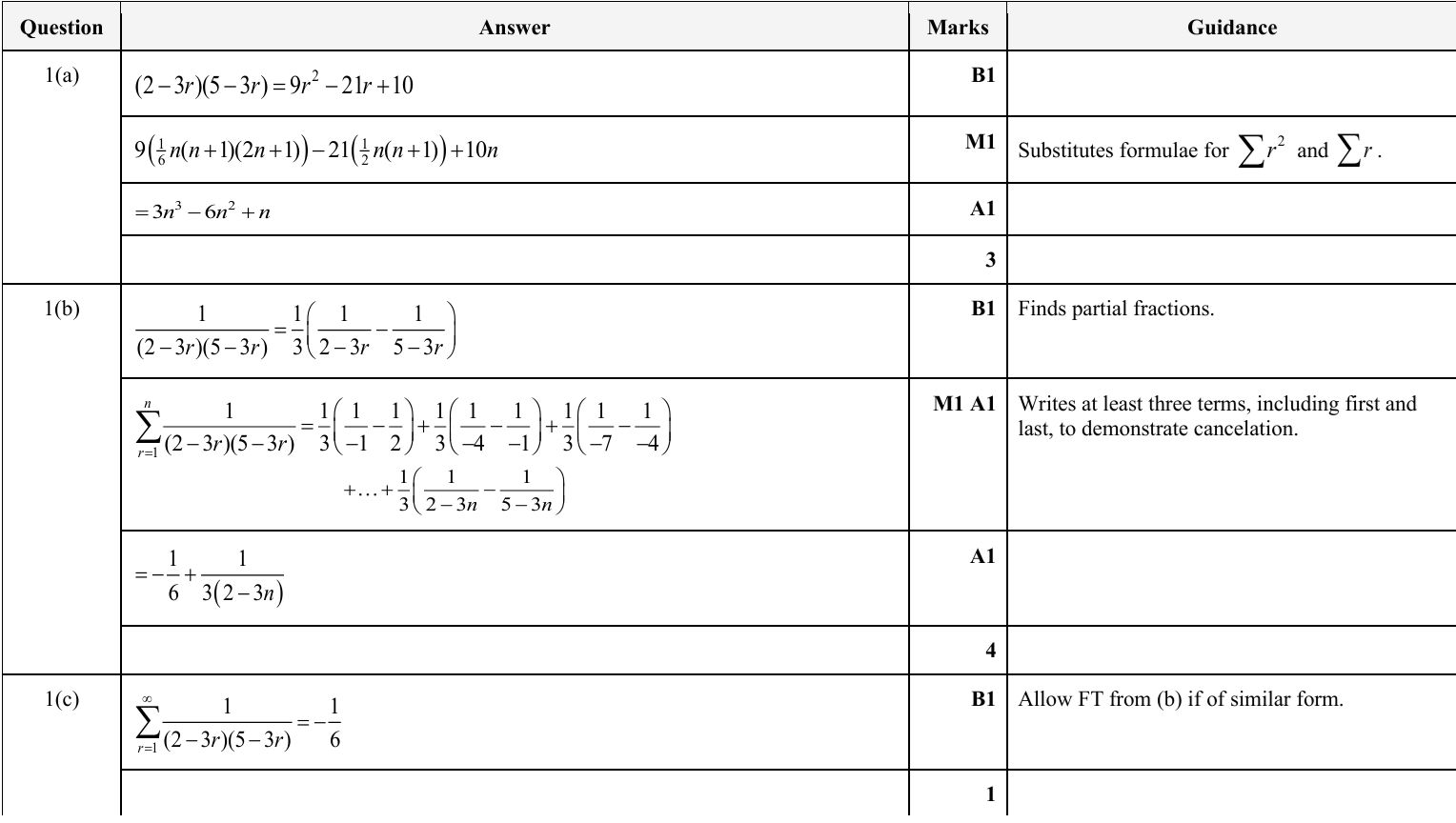
9231 P12 - Jun 2025 - Q01 - 8 marks
(a) Use standard results from the list of formulae (MF19) to show that
\(\sum_{r=1}^{n} (2-3r)(5-3r) = an^3 + bn^2 + cn,\)
where \(a, b\) and \(c\) are integers to be determined.
(b) Use the method of differences to find \(\sum_{r=1}^{n} \frac{1}{(2-3r)(5-3r)}\) in terms of \(n\).
(c) Deduce the value of \(\sum_{r=1}^{\infty} \frac{1}{(2-3r)(5-3r)}\).
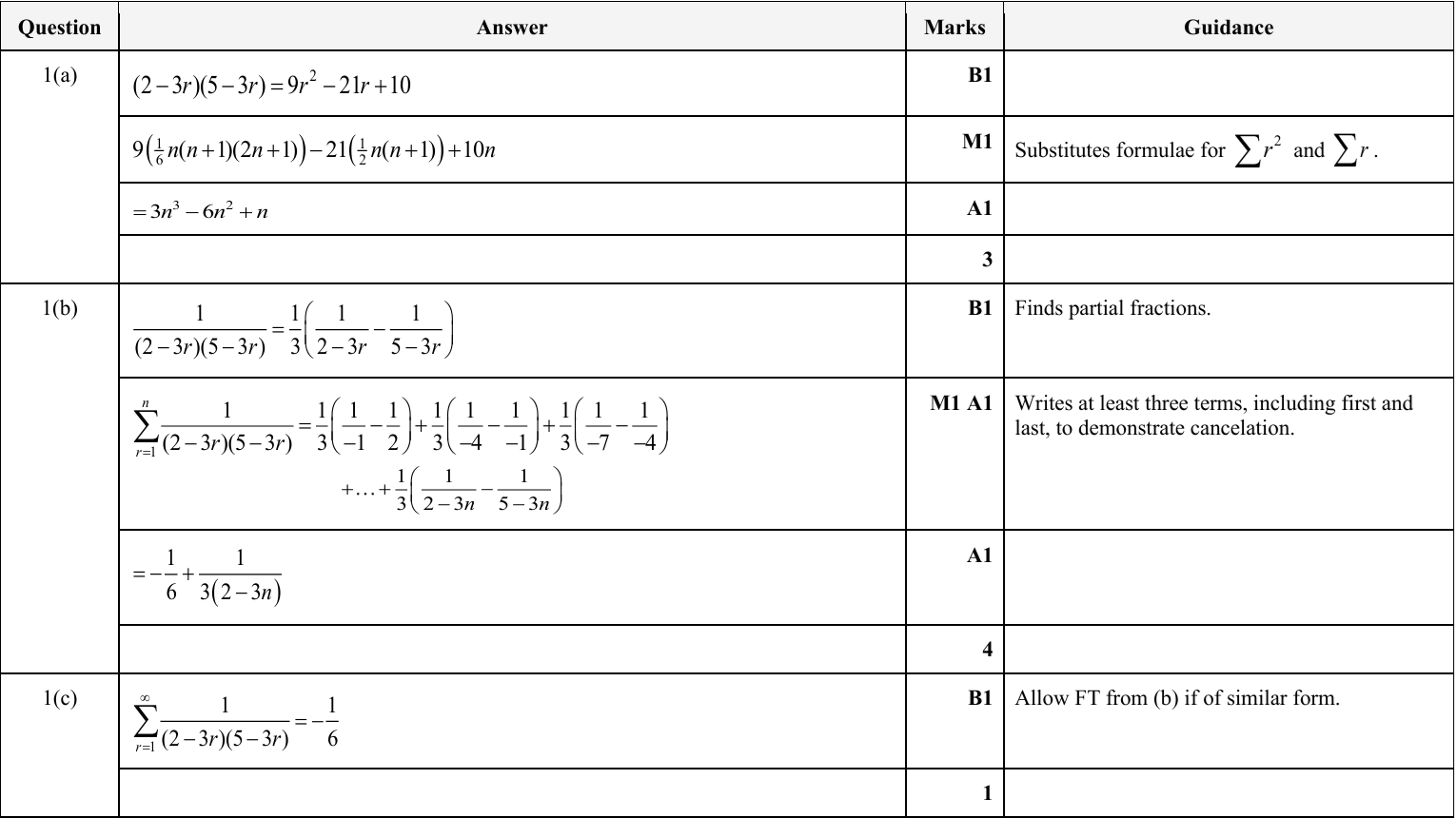
9231 P11 - Jun 2025 - Q01 - 8 marks
(a) Use standard results from the list of formulae (MF19) to show that
\(\sum_{r=1}^{n} (2-3r)(5-3r) = an^3 + bn^2 + cn,\)
where \(a, b\) and \(c\) are integers to be determined.
(b) Use the method of differences to find \(\sum_{r=1}^{n} \frac{1}{(2-3r)(5-3r)}\) in terms of \(n\).
(c) Deduce the value of \(\sum_{r=1}^{\infty} \frac{1}{(2-3r)(5-3r)}\).
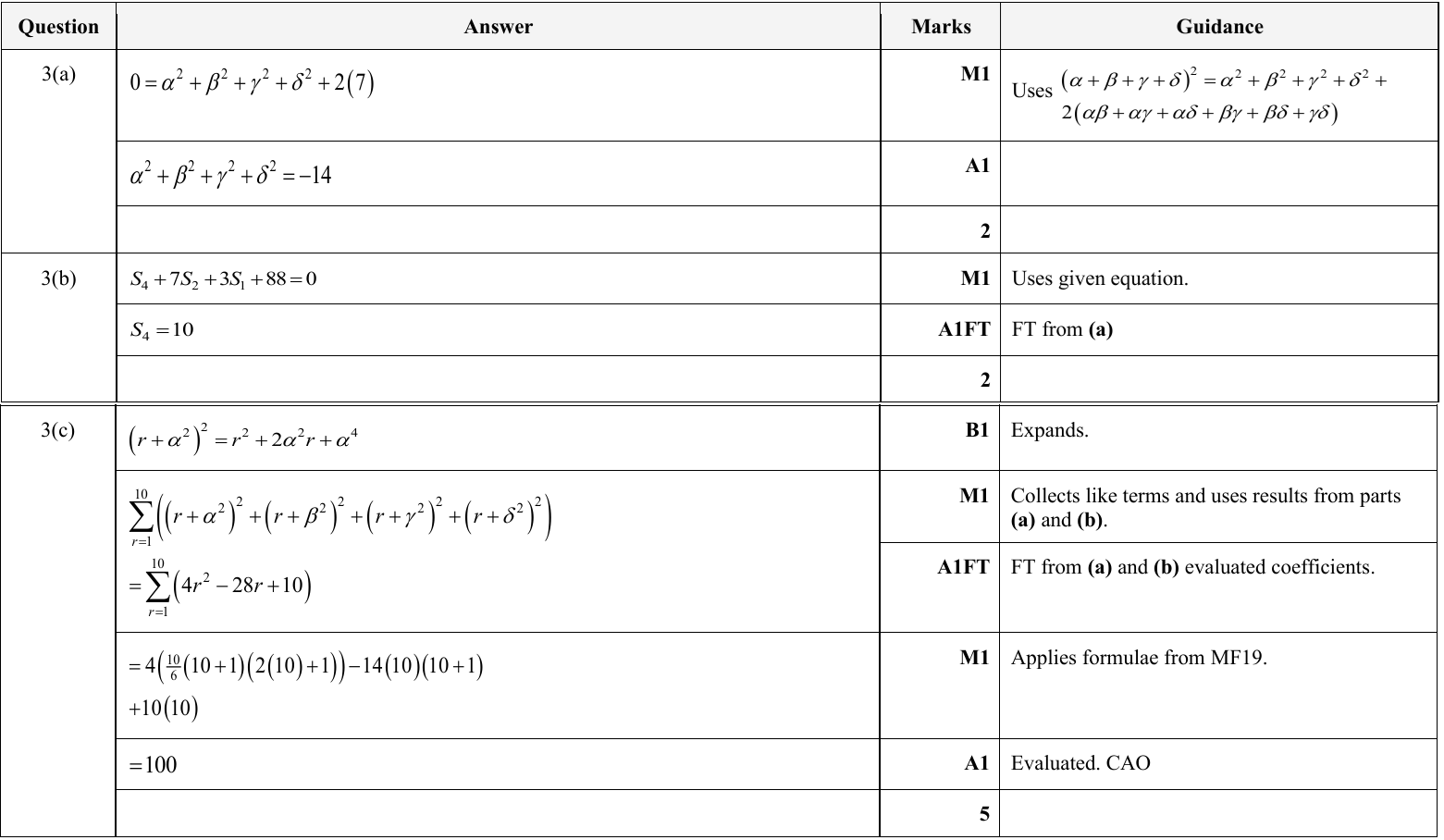
9231 P13 - Jun 2025 - Q03 - 9 marks
The quartic equation \(x^4 + 7x^2 + 3x + 22 = 0\) has roots \(\alpha, \beta, \gamma, \delta\).
(a) Find the value of \(\alpha^2 + \beta^2 + \gamma^2 + \delta^2\).
(b) Find the value of \(\alpha^4 + \beta^4 + \gamma^4 + \delta^4\).
(c) Use standard results from the list of formulae (MF19) to find the value of \(\sum_{r=1}^{10} ((\alpha^2 + r)^2 + (\beta^2 + r)^2 + (\gamma^2 + r)^2 + (\delta^2 + r)^2)\).
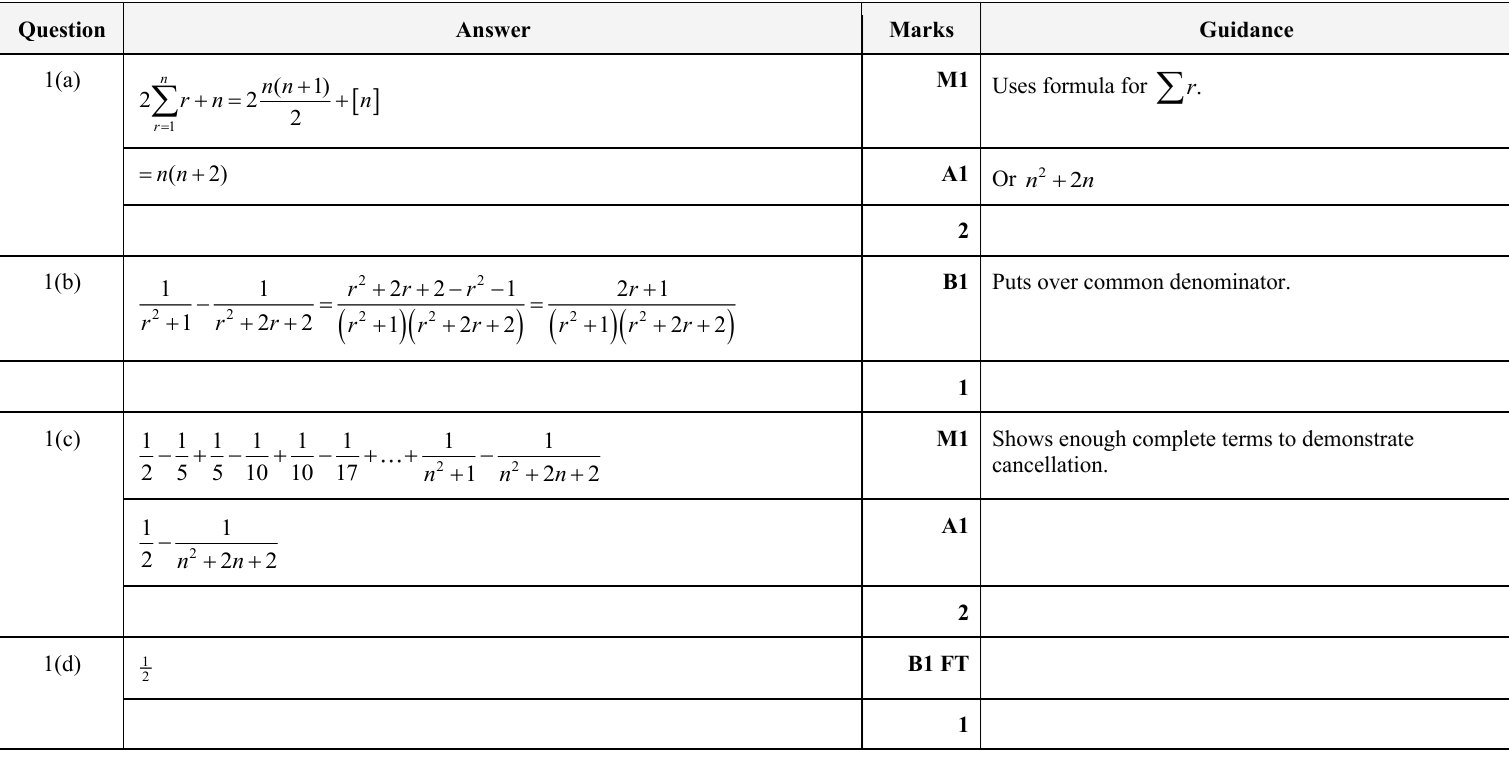
9231 P14 - Jun 2025 - Q01 - 6 marks
- Use the List of formulae (MF19) to find \(\sum_{r=1}^{n} (2r+1)\) in terms of \(n\), simplifying your answer.
- Show that \(\frac{2r+1}{(r^2+1)(r^2+2r+2)} = \frac{1}{r^2+1} - \frac{1}{r^2+2r+2}\).
- Use the method of differences to find \(\sum_{r=1}^{n} \frac{2r+1}{(r^2+1)(r^2+2r+2)}\).
- Deduce the value of \(\sum_{r=1}^{\infty} \frac{2r+1}{(r^2+1)(r^2+2r+2)}\).
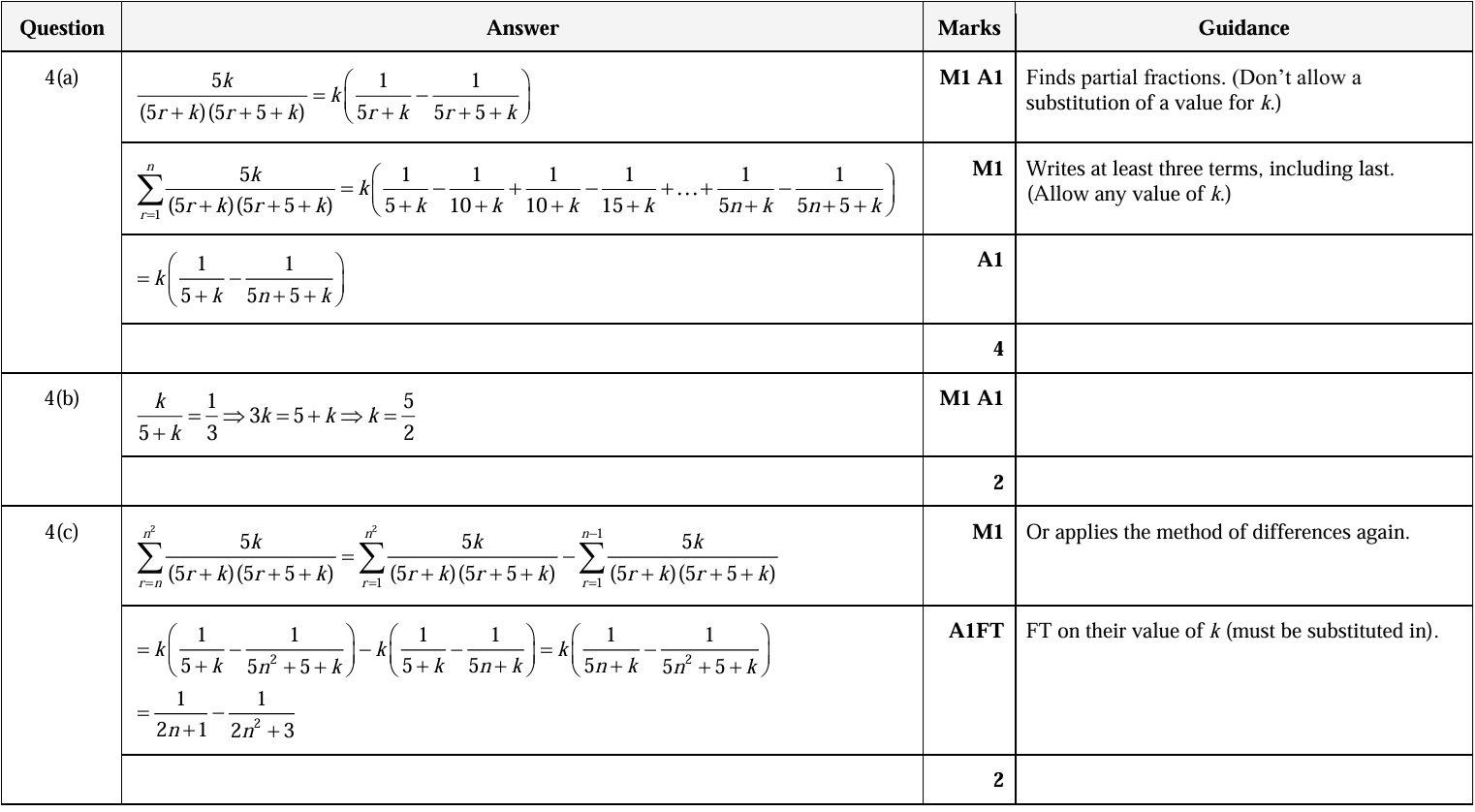
9231 P11 - Nov 2024 - Q04 - 8 marks
(a) Use the method of differences to find \(\sum_{r=1}^{n} \frac{5k}{(5r+k)(5r+5+k)}\) in terms of \(n\) and \(k\), where \(k\) is a positive constant.
It is given that \(\sum_{r=1}^{\infty} \frac{5k}{(5r+k)(5r+5+k)} = \frac{1}{3}\).
(b) Find the value of \(k\).
(c) Hence find \(\sum_{r=n}^{n^2} \frac{5k}{(5r+k)(5r+5+k)}\) in terms of \(n\).
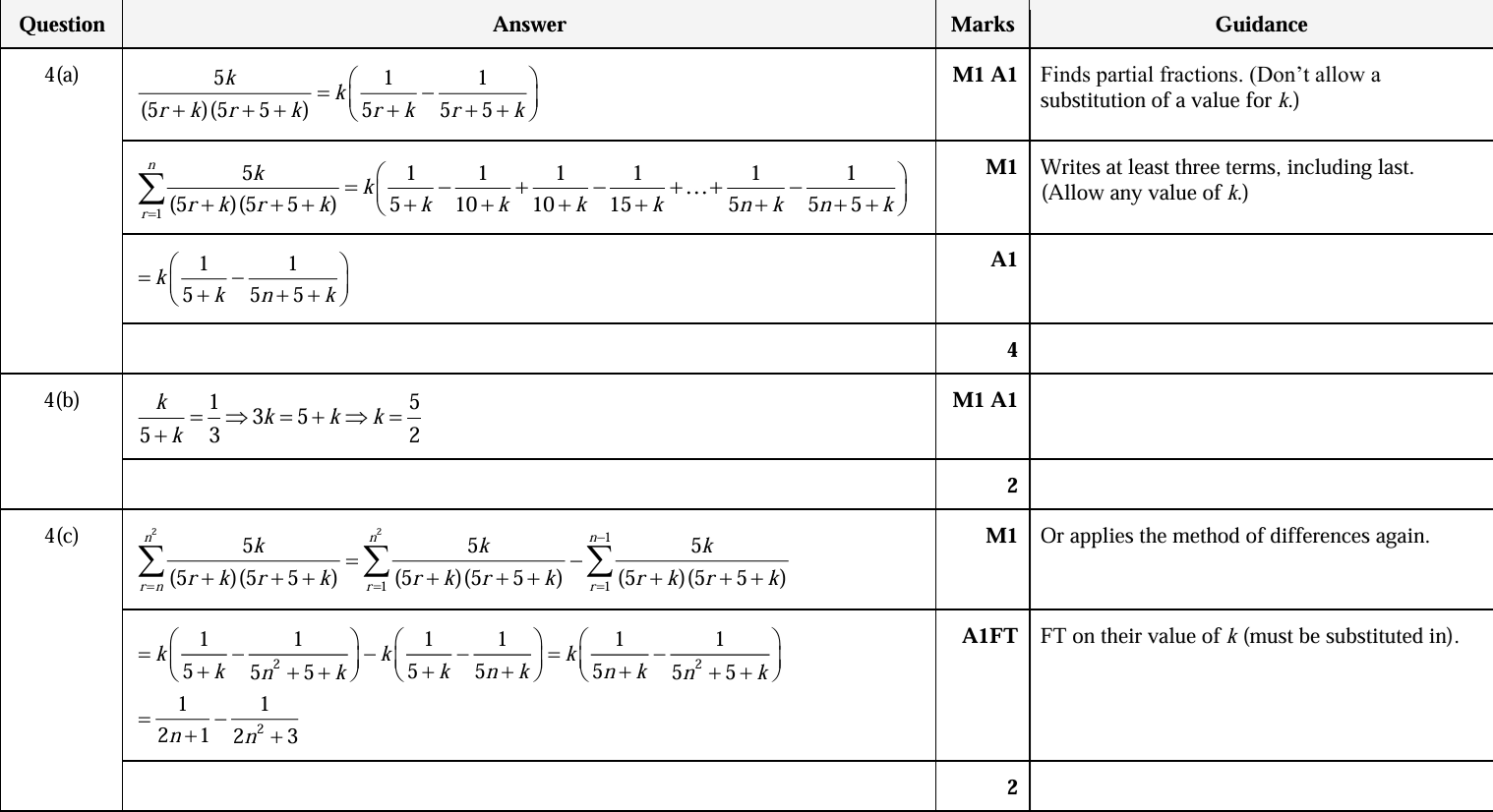
9231 P13 - Nov 2024 - Q04 - 8 marks
(a) Use the method of differences to find \(\sum_{r=1}^{n} \frac{5k}{(5r+k)(5r+5+k)}\) in terms of \(n\) and \(k\), where \(k\) is a positive constant.
It is given that \(\sum_{r=1}^{\infty} \frac{5k}{(5r+k)(5r+5+k)} = \frac{1}{3}\).
(b) Find the value of \(k\).
(c) Hence find \(\sum_{r=n}^{n^2} \frac{5k}{(5r+k)(5r+5+k)}\) in terms of \(n\).
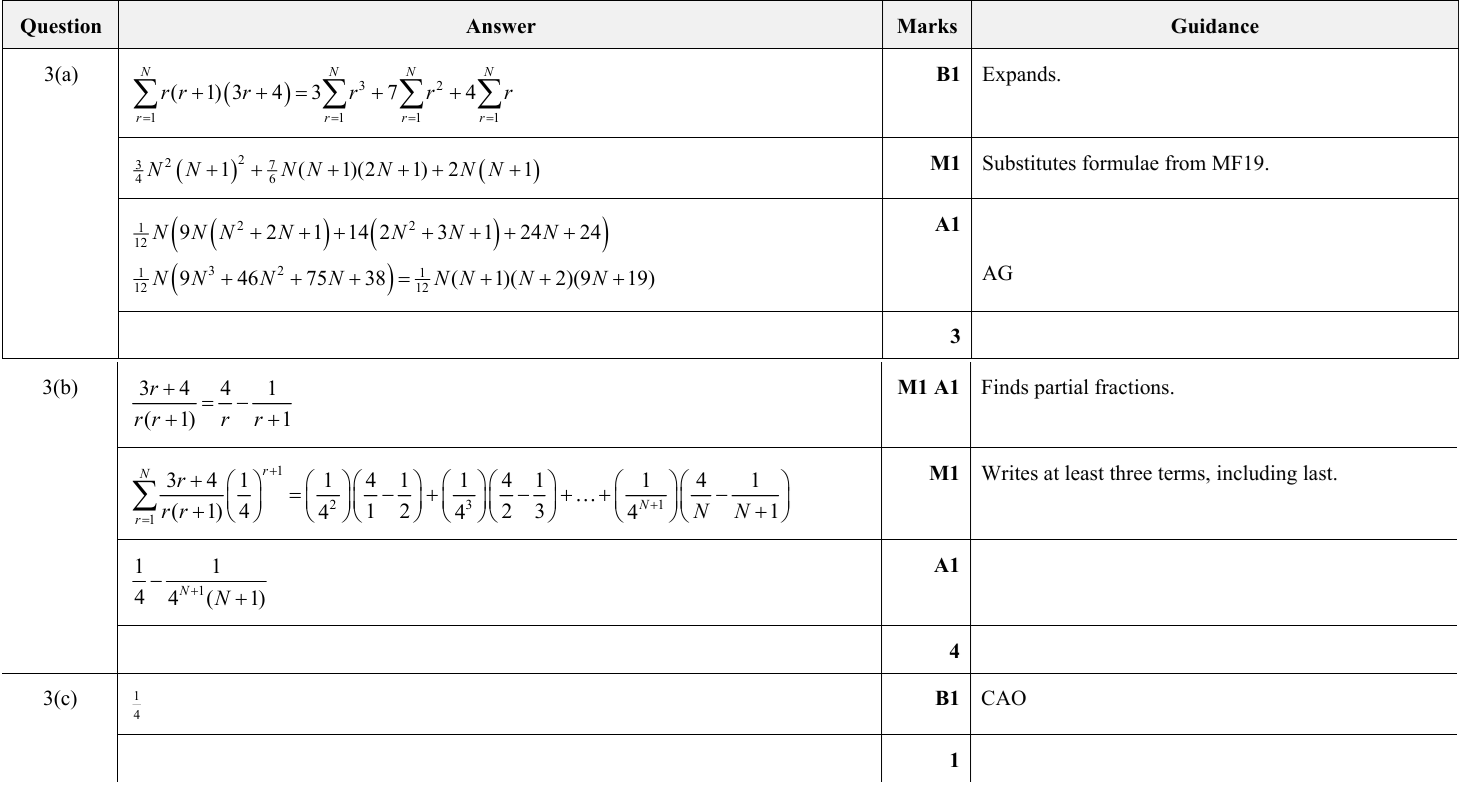
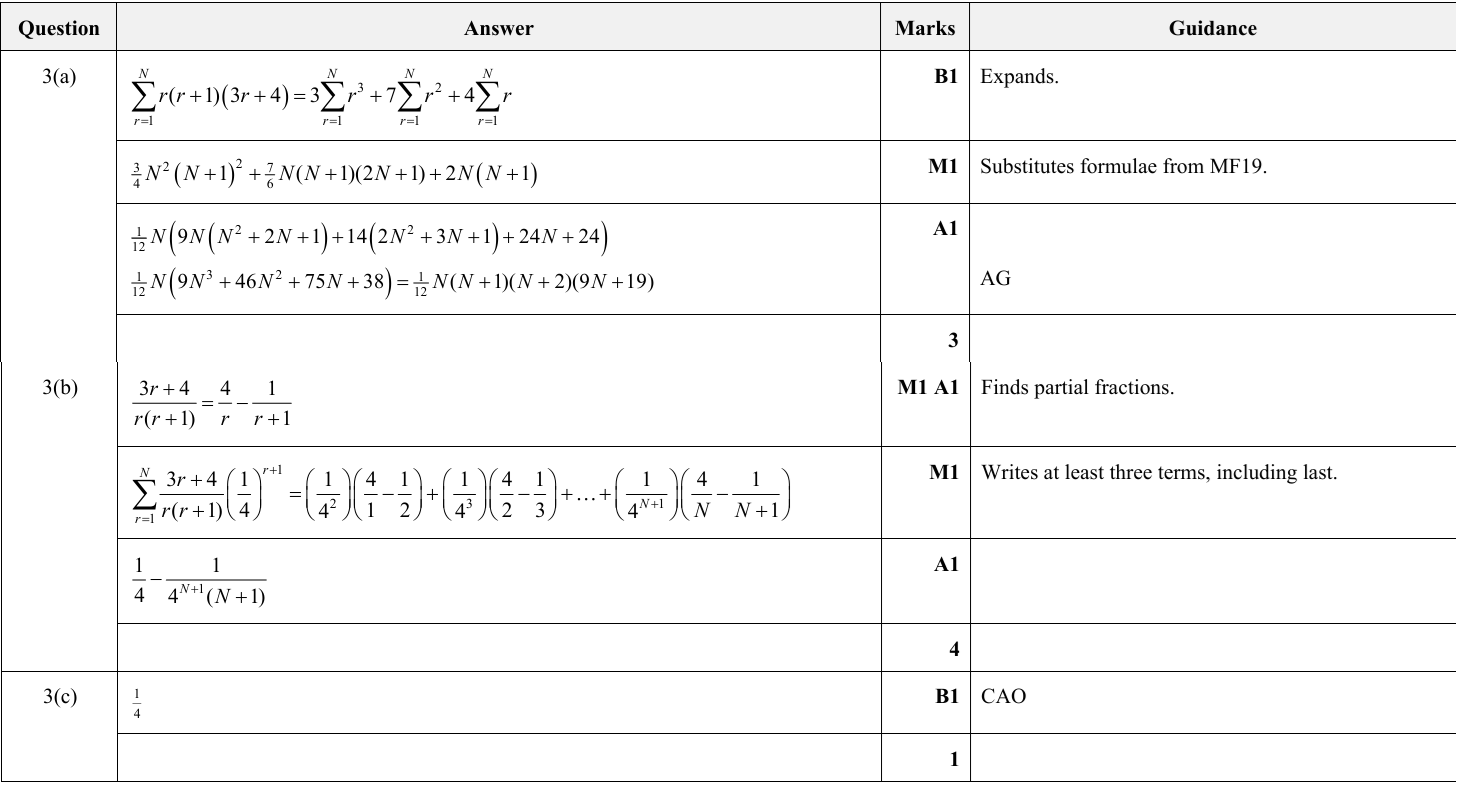
9231 P11 - Jun 2024 - Q03 - 8 marks
(a) Use standard results from the list of formulae (MF19) to show that
\(\sum_{r=1}^{N} r(r+1)(3r+4) = \frac{1}{12}N(N+1)(N+2)(9N+19).\)
(b) Express \(\frac{3r+4}{r(r+1)}\) in partial fractions and hence use the method of differences to find
\(\sum_{r=1}^{N} \frac{3r+4}{r(r+1)} \left( \frac{1}{4} \right)^{r+1}\)
in terms of \(N\).
(c) Deduce the value of
\(\sum_{r=1}^{\infty} \frac{3r+4}{r(r+1)} \left( \frac{1}{4} \right)^{r+1}.\)
9231 P12 - Jun 2024 - Q03 - 8 marks
(a) Use standard results from the list of formulae (MF19) to show that
\(\sum_{r=1}^{N} r(r+1)(3r+4) = \frac{1}{12}N(N+1)(N+2)(9N+19).\)
(b) Express \(\frac{3r+4}{r(r+1)}\) in partial fractions and hence use the method of differences to find
\(\sum_{r=1}^{N} \frac{3r+4}{r(r+1)} \left( \frac{1}{4} \right)^{r+1}\)
in terms of \(N\).
(c) Deduce the value of
\(\sum_{r=1}^{\infty} \frac{3r+4}{r(r+1)} \left( \frac{1}{4} \right)^{r+1}.\)
9231 P11 - Nov 2023 - Q01 - 7 marks
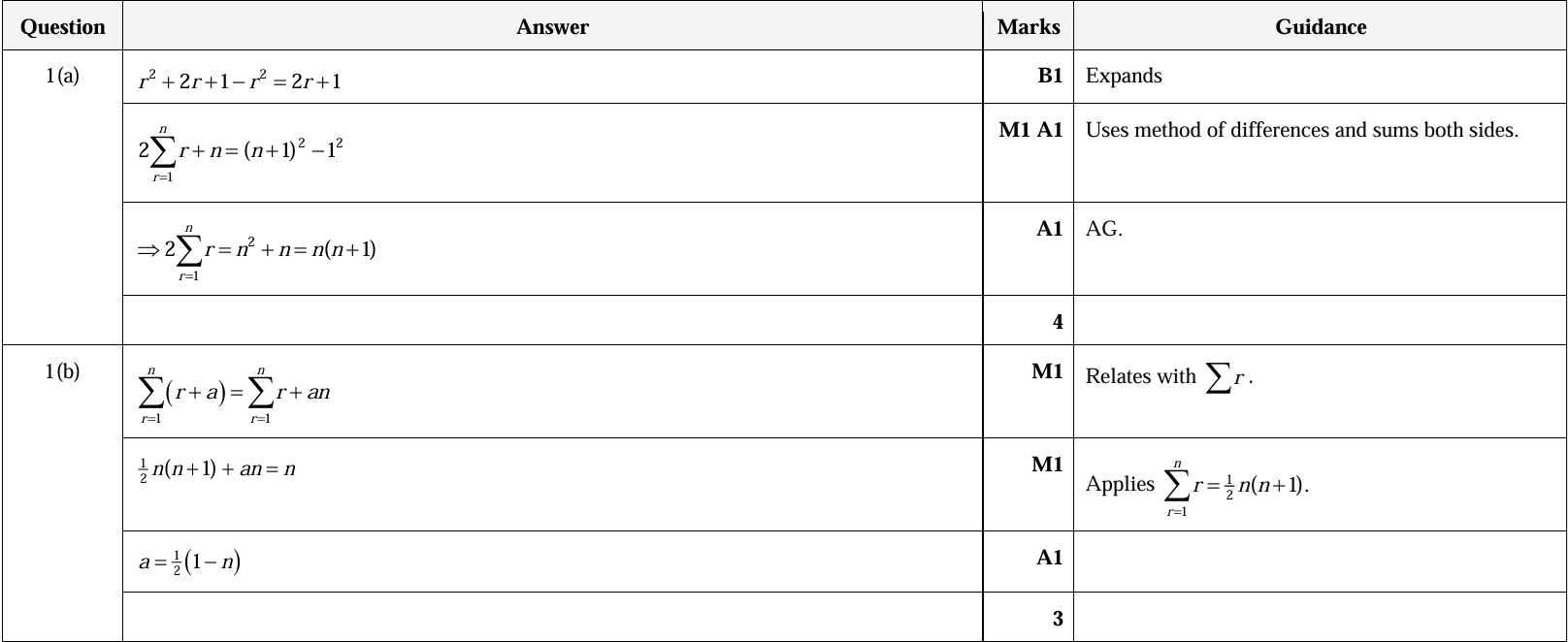
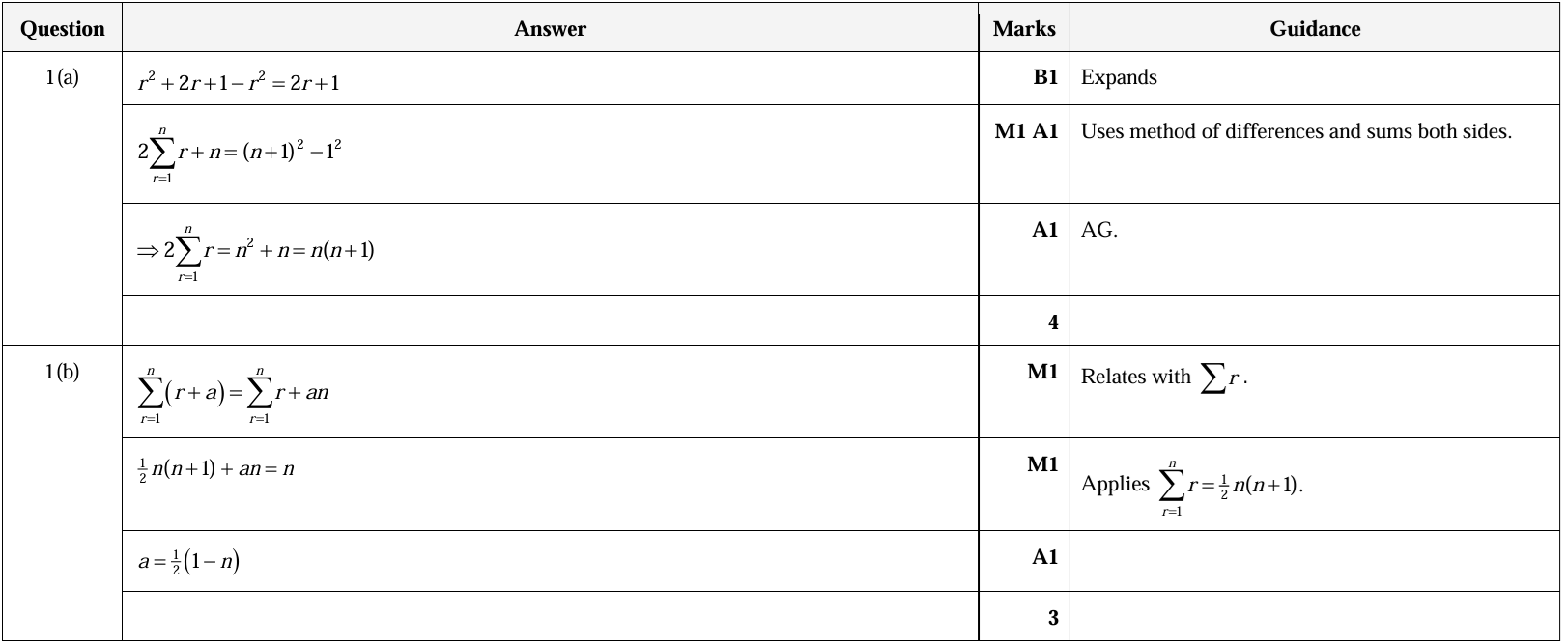
(a) By considering \((r+1)^2 - r^2\), use the method of differences to prove that
\(\sum_{r=1}^{n} r = \frac{1}{2} n(n+1).\)
(b) Given that \(\sum_{r=1}^{n} (r+a) = n\), find \(a\) in terms of \(n\).
9231 P12 - Nov 2023 - Q01 - 9 marks
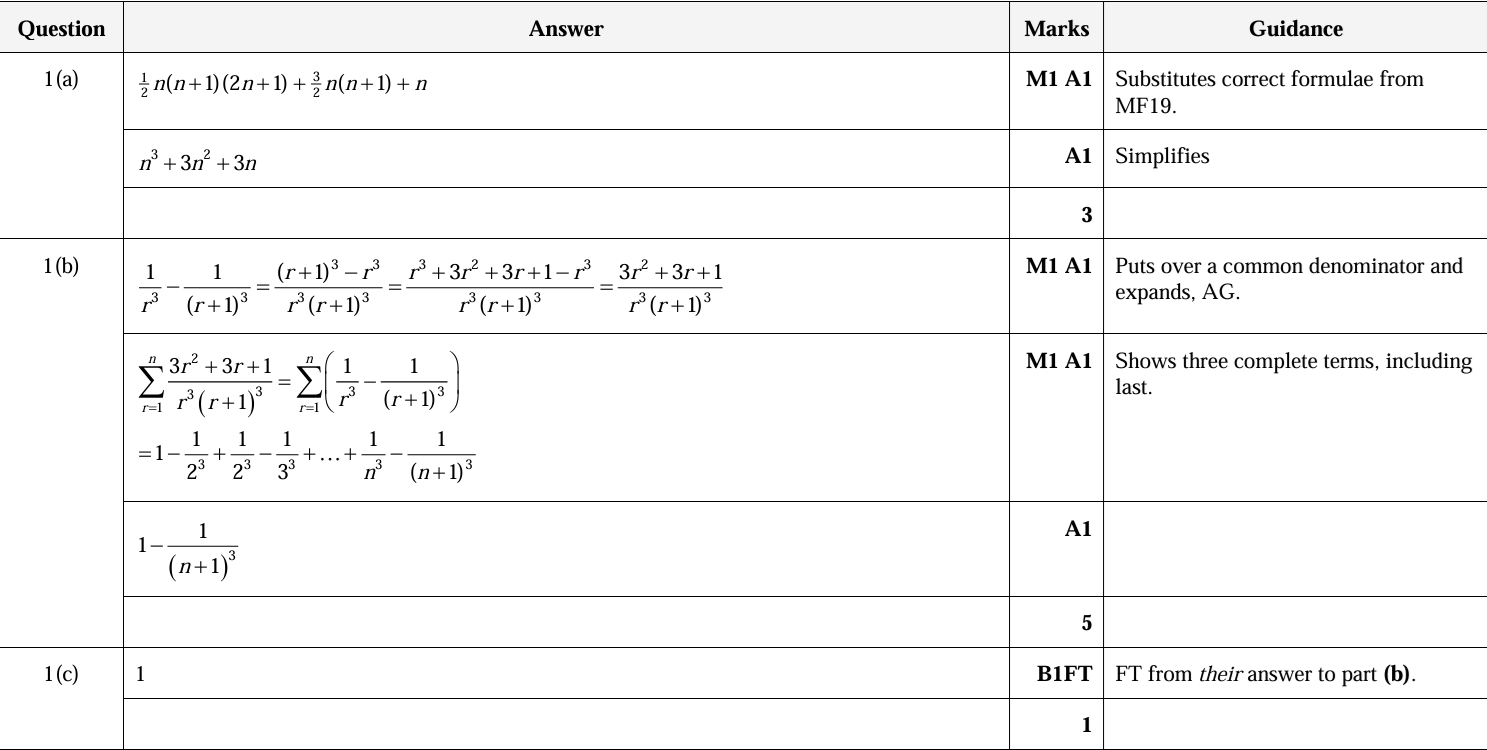
(a) Use standard results from the list of formulae (MF19) to find \(\sum_{r=1}^{n} (3r^2 + 3r + 1)\) in terms of \(n\), simplifying your answer.
(b) Show that \(\frac{1}{r^3} - \frac{1}{(r+1)^3} = \frac{3r^2 + 3r + 1}{r^3 (r+1)^3}\) and hence use the method of differences to find \(\sum_{r=1}^{n} \frac{3r^2 + 3r + 1}{r^3 (r+1)^3}\).
(c) Deduce the value of \(\sum_{r=1}^{\infty} \frac{3r^2 + 3r + 1}{r^3 (r+1)^3}\).
9231 P12 - Nov 2023 - Q04 - 10 marks
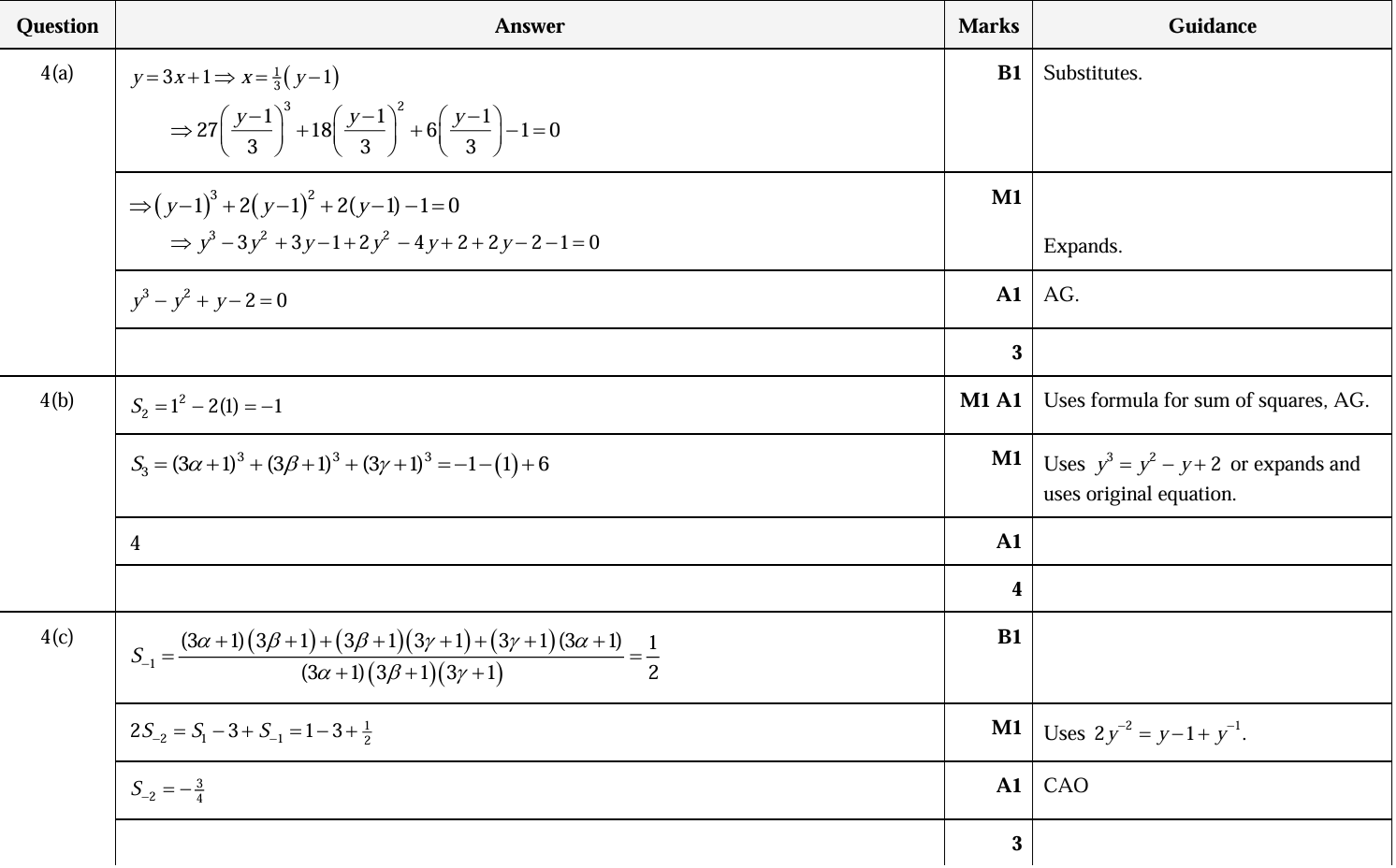
The cubic equation \(27x^3 + 18x^2 + 6x - 1 = 0\) has roots \(\alpha, \beta, \gamma\).
(a) Show that a cubic equation with roots \(3\alpha + 1, 3\beta + 1, 3\gamma + 1\) is \(y^3 - y^2 + y - 2 = 0\).
The sum \((3\alpha + 1)^n + (3\beta + 1)^n + (3\gamma + 1)^n\) is denoted by \(S_n\).
(b) Find the values of \(S_2\) and \(S_3\).
(c) Find the values of \(S_{-1}\) and \(S_{-2}\).
9231 P13 - Nov 2023 - Q01 - 7 marks
(a) By considering \((r+1)^2 - r^2\), use the method of differences to prove that
\(\sum_{r=1}^{n} r = \frac{1}{2} n(n+1).\)
(b) Given that \(\sum_{r=1}^{n} (r+a) = n\), find \(a\) in terms of \(n\).
9231 P11 - Jun 2023 - Q02 - 8 marks
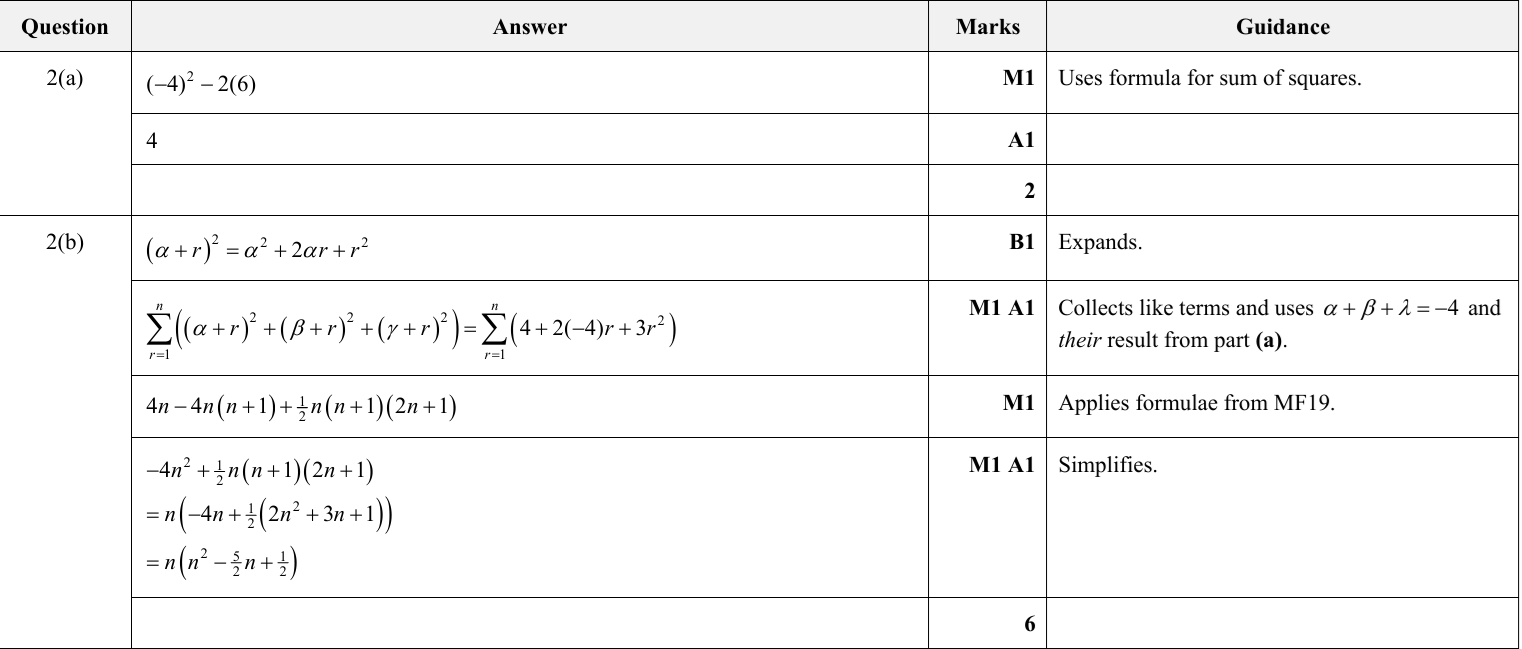
The cubic equation \(x^3 + 4x^2 + 6x + 1 = 0\) has roots \(\alpha, \beta, \gamma\).
(a) Find the value of \(\alpha^2 + \beta^2 + \gamma^2\).
(b) Use standard results from the list of formulae (MF19) to show that
\(\sum_{r=1}^{n} ((\alpha + r)^2 + (\beta + r)^2 + (\gamma + r)^2) = n(n^2 + an + b),\)
where \(a\) and \(b\) are constants to be determined.
9231 P11 - Jun 2023 - Q03 - 7 marks
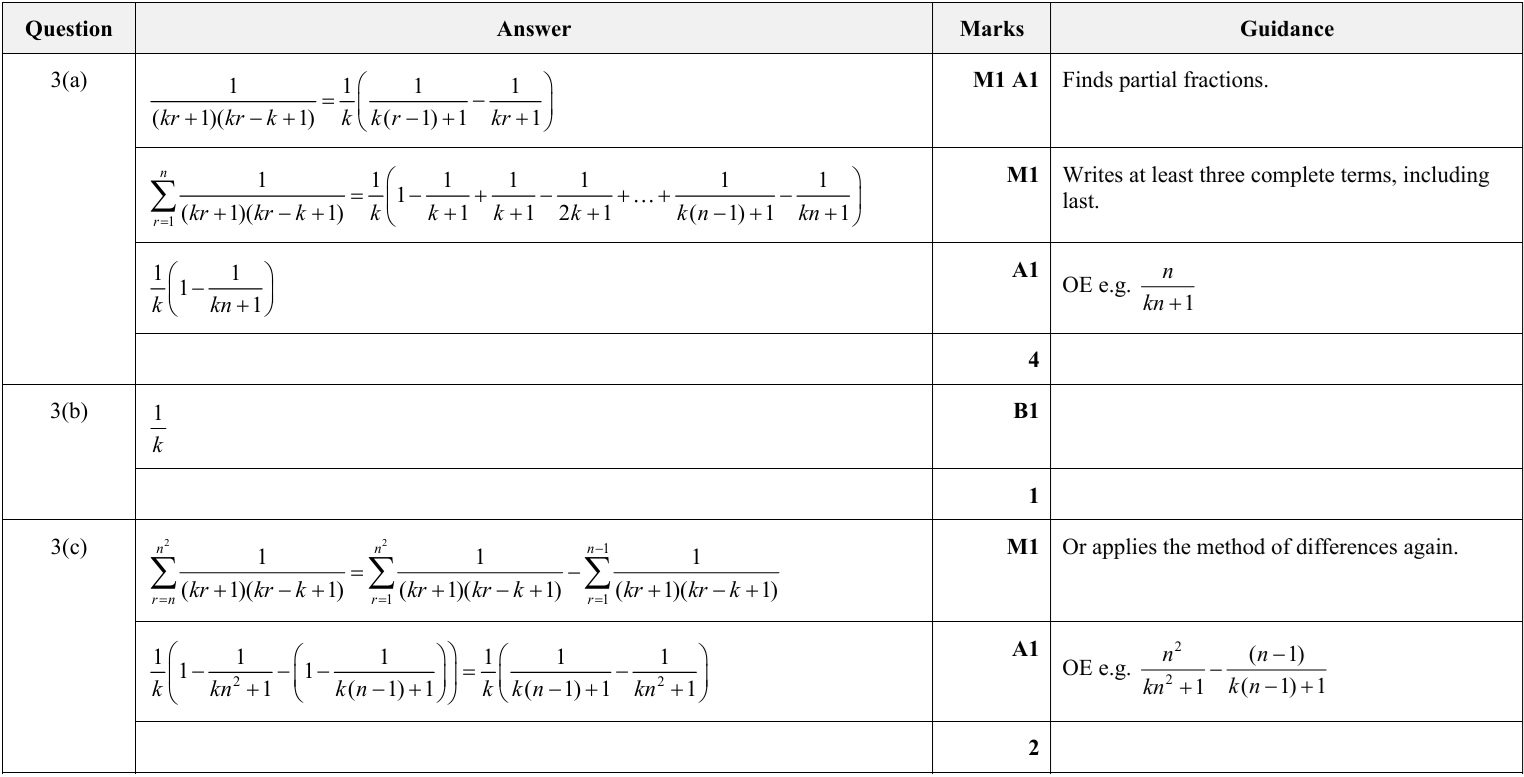
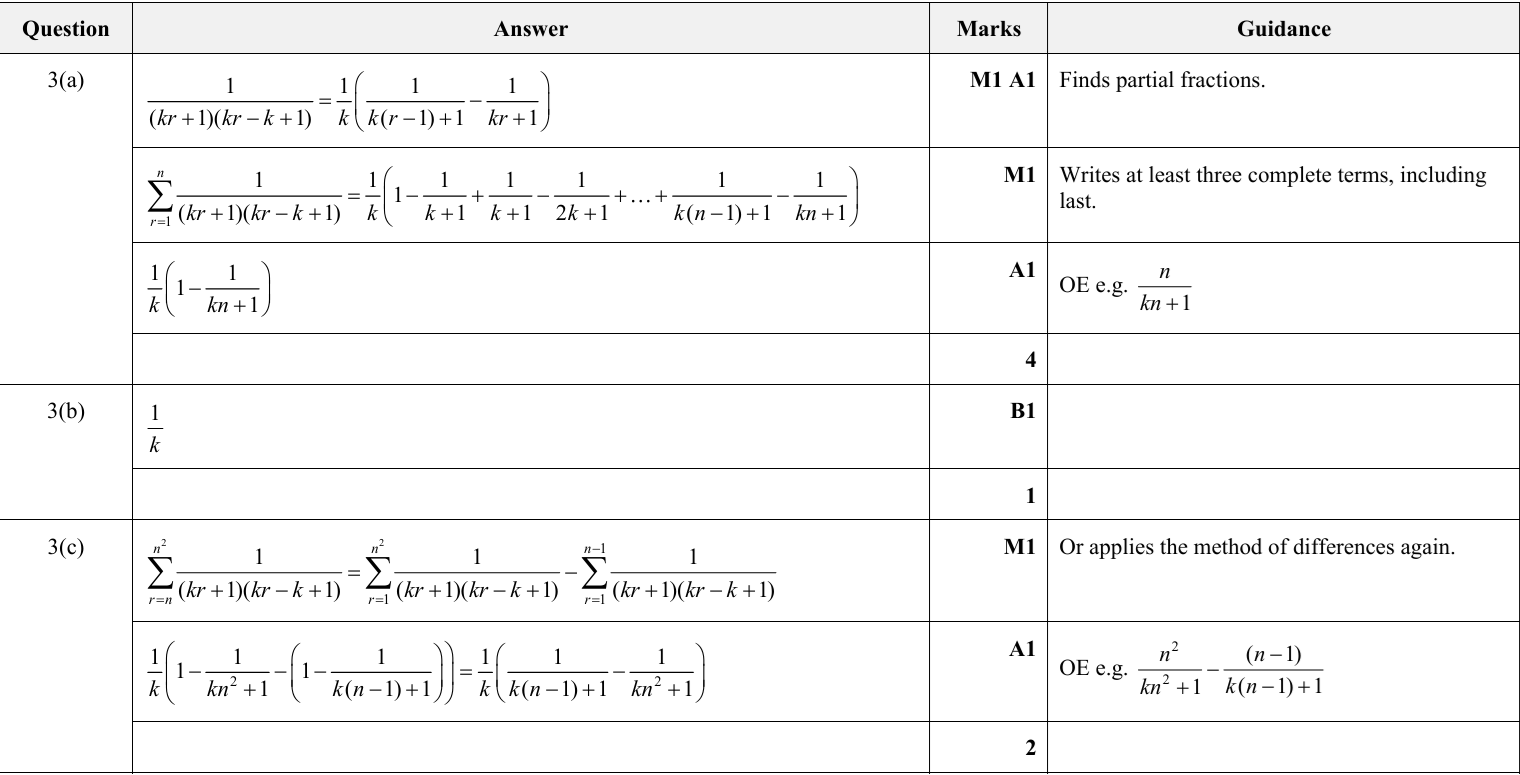
3 (a) Use the method of differences to find \(\sum_{r=1}^{n} \frac{1}{(kr+1)(kr-k+1)}\) in terms of \(n\) and \(k\), where \(k\) is a positive constant.
(b) Deduce the value of \(\sum_{r=1}^{\infty} \frac{1}{(kr+1)(kr-k+1)}\).
(c) Find also \(\sum_{r=n}^{n^2} \frac{1}{(kr+1)(kr-k+1)}\) in terms of \(n\) and \(k\).
9231 P12 - Jun 2023 - Q02 - 8 marks
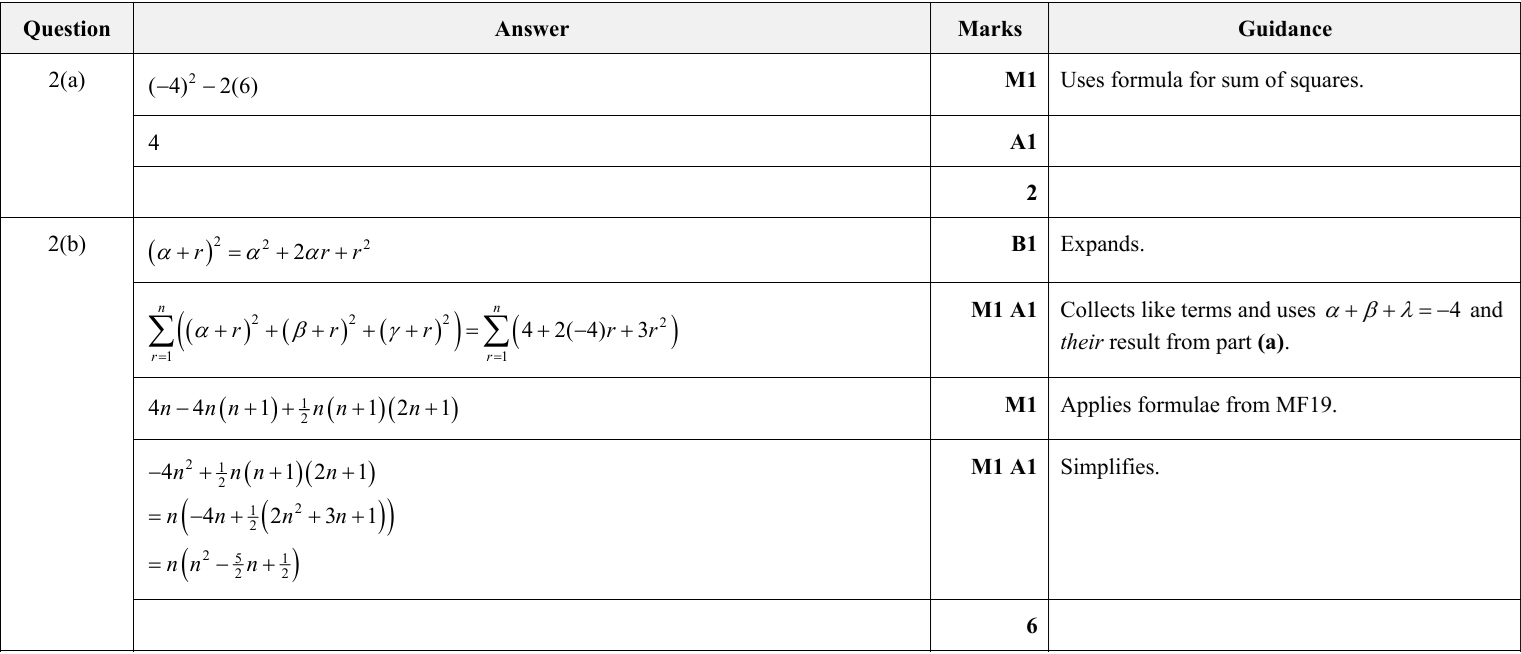
The cubic equation \(x^3 + 4x^2 + 6x + 1 = 0\) has roots \(\alpha, \beta, \gamma\).
(a) Find the value of \(\alpha^2 + \beta^2 + \gamma^2\).
(b) Use standard results from the list of formulae (MF19) to show that
\(\sum_{r=1}^{n} ((\alpha + r)^2 + (\beta + r)^2 + (\gamma + r)^2) = n(n^2 + an + b),\)
where \(a\) and \(b\) are constants to be determined.
9231 P12 - Jun 2023 - Q03 - 7 marks
3 (a) Use the method of differences to find \(\sum_{r=1}^{n} \frac{1}{(kr+1)(kr-k+1)}\) in terms of \(n\) and \(k\), where \(k\) is a positive constant.
(b) Deduce the value of \(\sum_{r=1}^{\infty} \frac{1}{(kr+1)(kr-k+1)}\).
(c) Find also \(\sum_{r=n}^{n^2} \frac{1}{(kr+1)(kr-k+1)}\) in terms of \(n\) and \(k\).
9231 P13 - Jun 2023 - Q02 - 8 marks
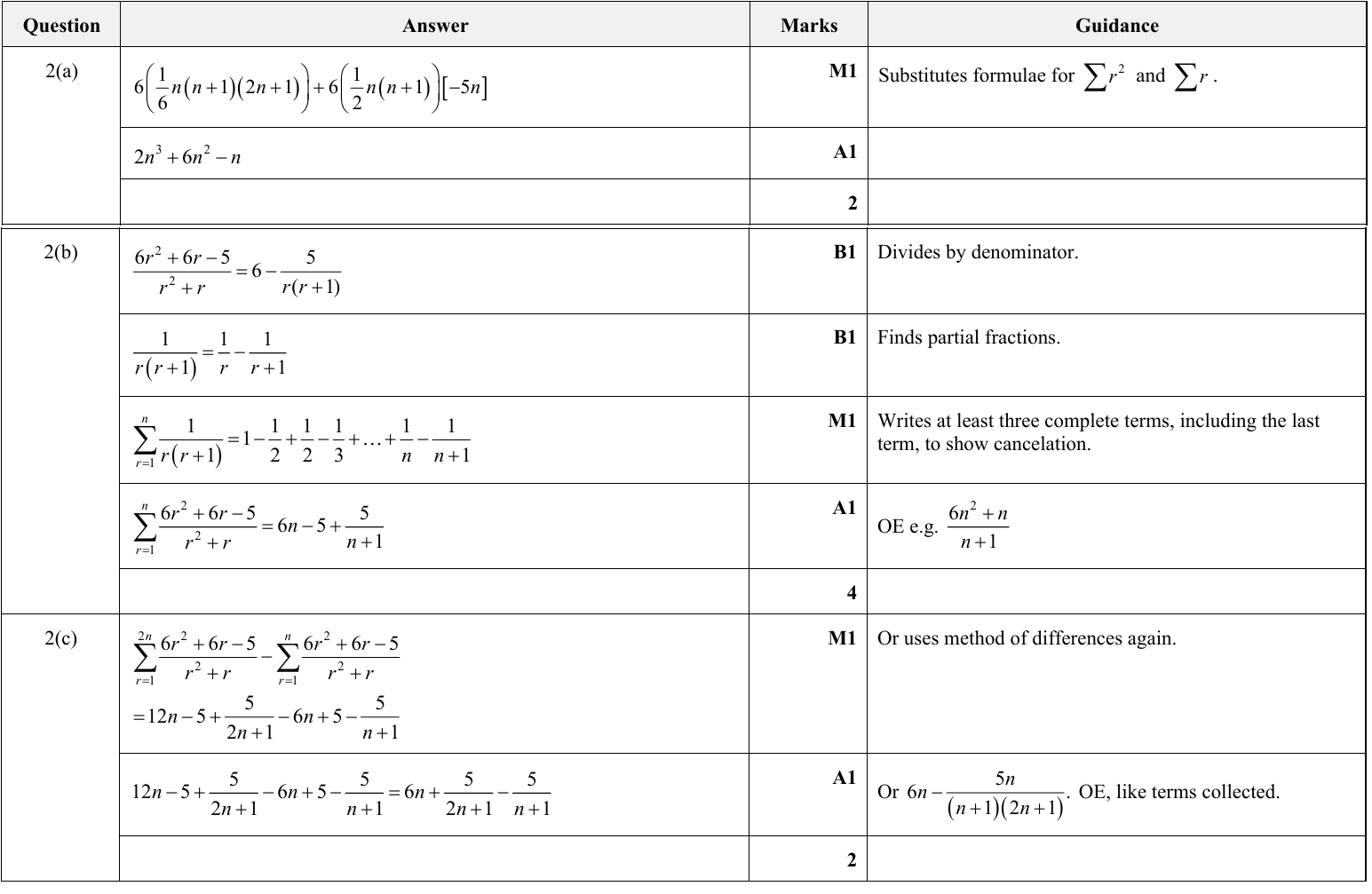
2 (a) Use standard results from the list of formulae (MF19) to show that
\(\sum_{r=1}^{n} (6r^2 + 6r - 5) = an^3 + bn^2 + cn\),
where \(a, b\) and \(c\) are integers to be determined.
(b) Use the method of differences to find \(\sum_{r=1}^{n} \frac{6r^2 + 6r - 5}{r^2 + r}\) in terms of \(n\).
(c) Find also \(\sum_{r=n+1}^{2n} \frac{6r^2 + 6r - 5}{r^2 + r}\) in terms of \(n\).
9231 P12 - Jun 2022 - Q01 - 7 marks
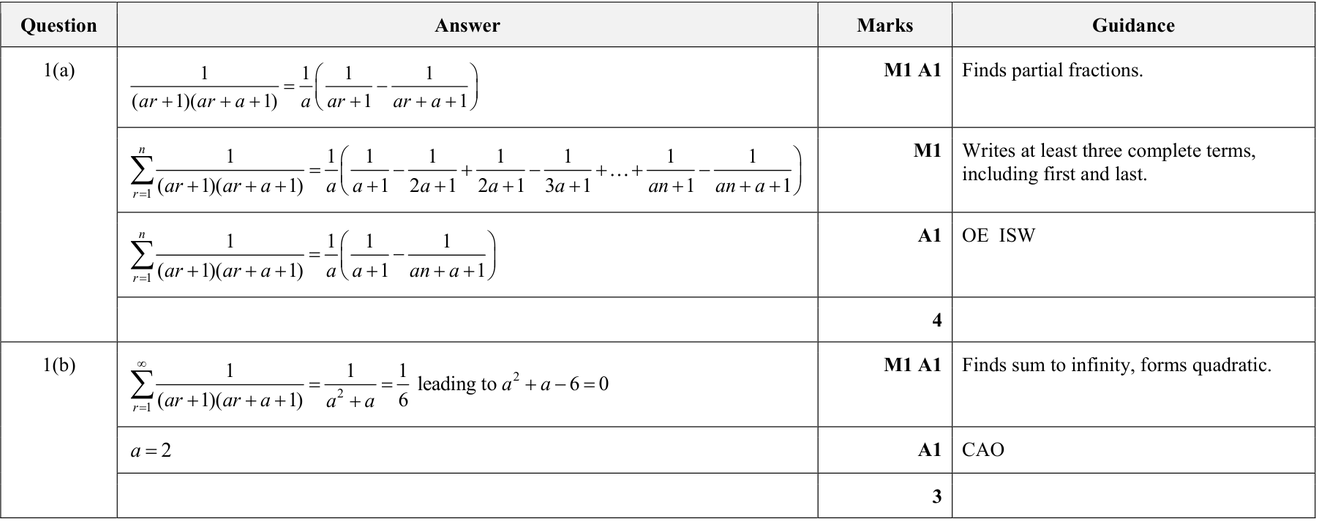
Let \(a\) be a positive constant.
(a) Use the method of differences to find \(\sum_{r=1}^{n} \frac{1}{(ar+1)(ar+a+1)}\) in terms of \(n\) and \(a\).
(b) Find the value of \(a\) for which \(\sum_{r=1}^{\infty} \frac{1}{(ar+1)(ar+a+1)} = \frac{1}{6}\).
9231 P11 - Nov 2022 - Q03 - 9 marks
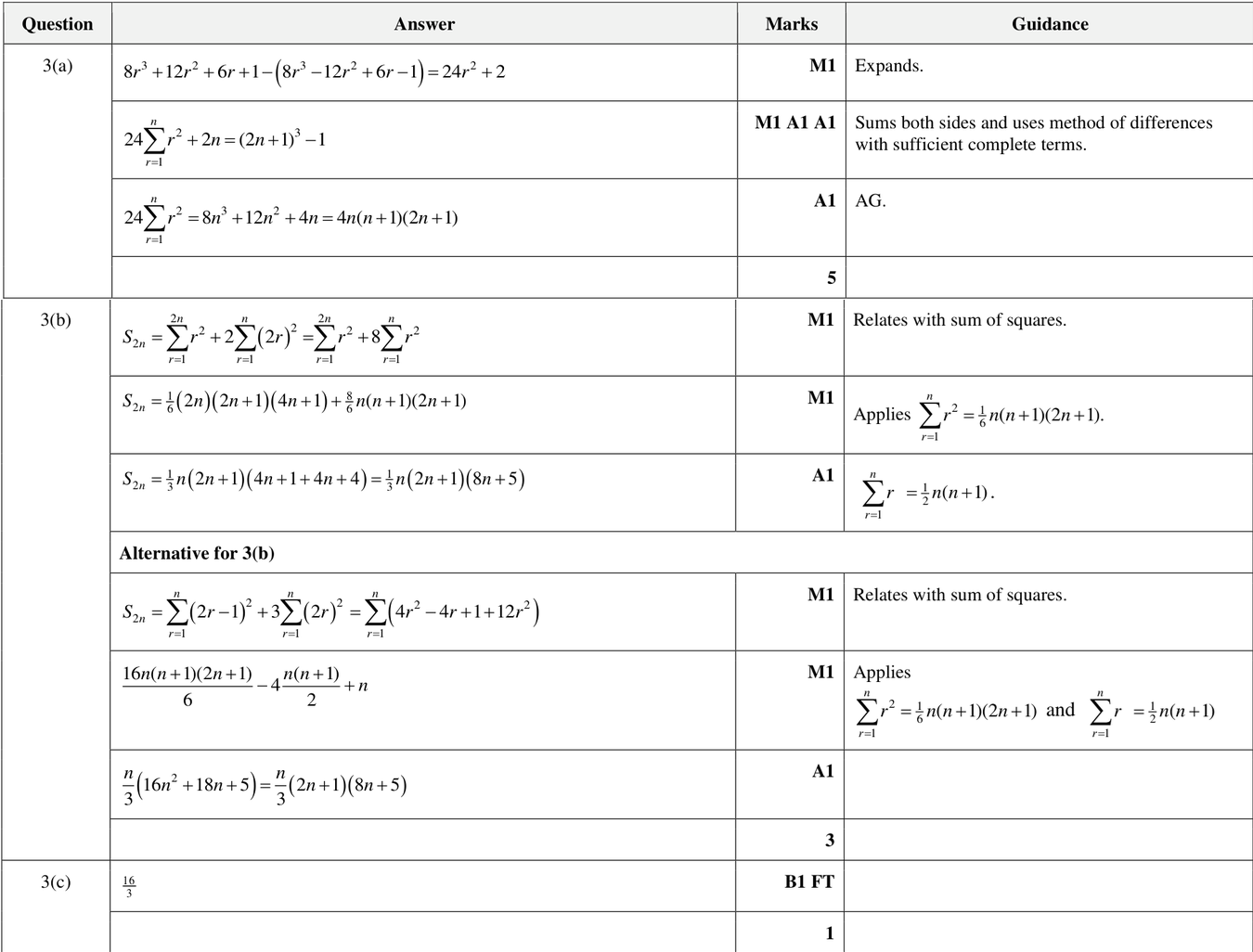
(a) By considering \((2r+1)^3 - (2r-1)^3\), use the method of differences to prove that \(\sum_{r=1}^{n} r^2 = \frac{1}{6}n(n+1)(2n+1)\).
Let \(S_n = 1^2 + 3 \times 2^2 + 3^2 + 3 \times 4^2 + 5^2 + 3 \times 6^2 + \ldots + \left(2 + (-1)^n\right)n^2\).
(b) Show that \(S_{2n} = \frac{1}{3}n(2n+1)(an+b)\), where \(a\) and \(b\) are integers to be determined.
(c) State the value of \(\lim_{n \to \infty} \frac{S_{2n}}{n^3}\).
9231 P12 - Nov 2022 - Q01 - 7 marks
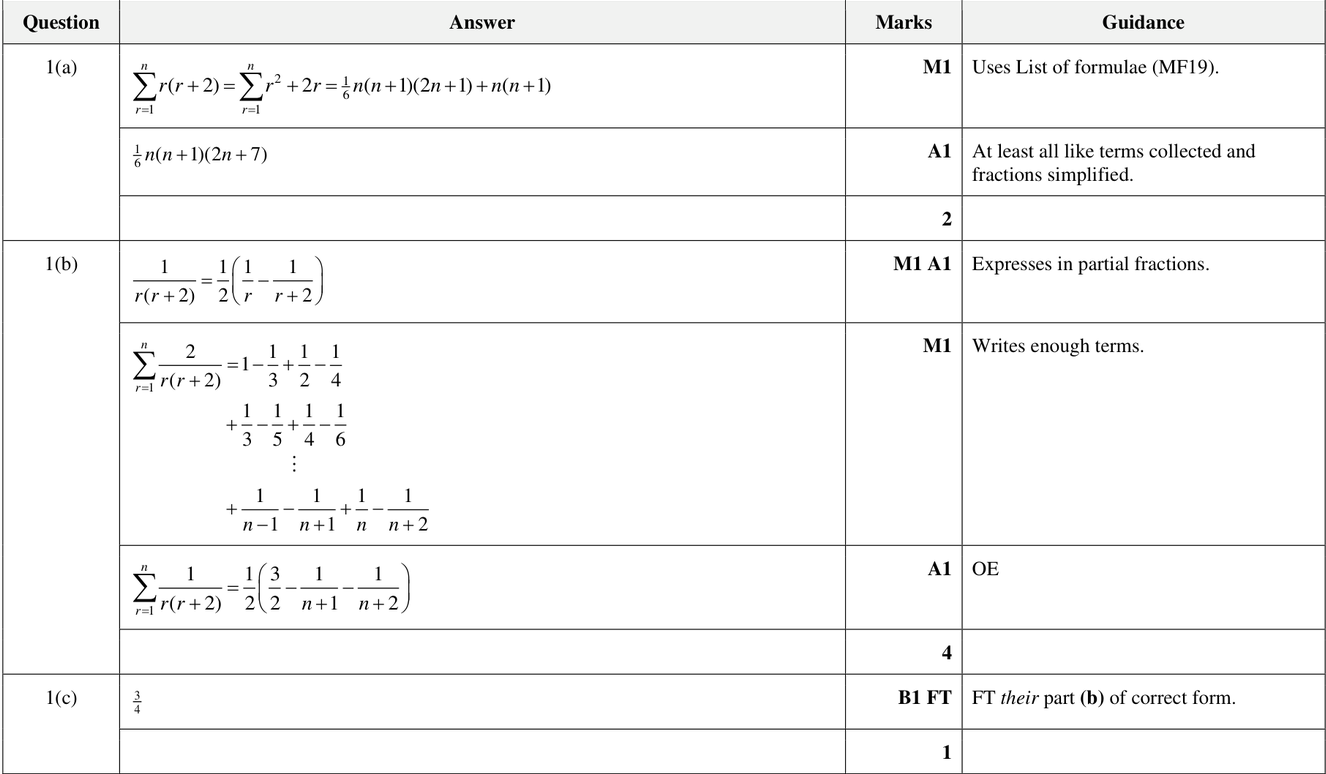
(a) Use the list of formulae (MF19) to find \(\sum_{r=1}^{n} r(r+2)\) in terms of \(n\), simplifying your answer.
(b) Express \(\frac{1}{r(r+2)}\) in partial fractions and hence find \(\sum_{r=1}^{n} \frac{1}{r(r+2)}\) in terms of \(n\).
(c) Deduce the value of \(\sum_{r=1}^{\infty} \frac{1}{r(r+2)}\).
9231 P12 - Jun 2021 - Q02 - 9 marks
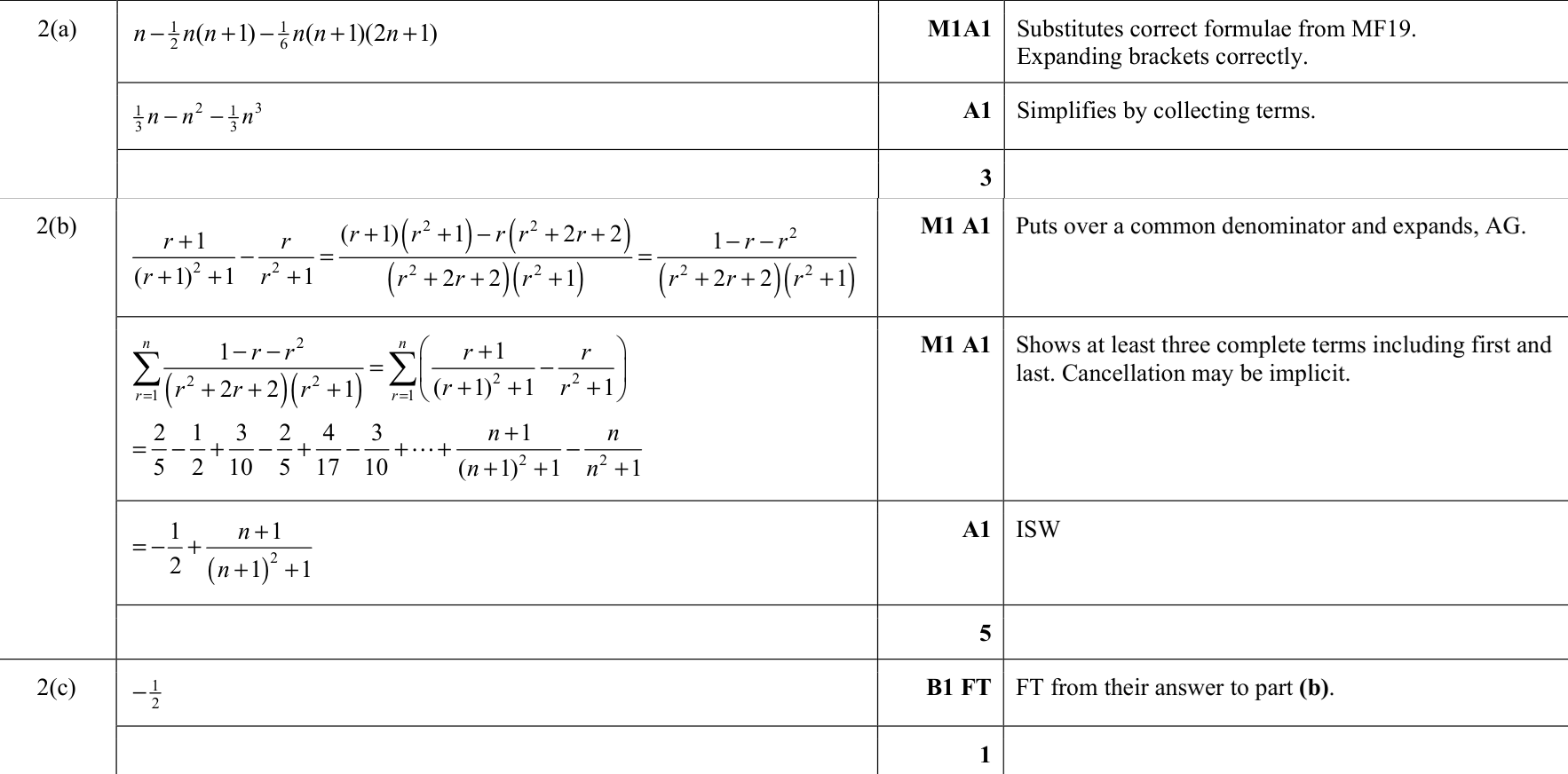
(a) Use standard results from the List of formulae (MF19) to find \(\sum_{r=1}^{n} (1 - r - r^2)\) in terms of \(n\), simplifying your answer.
(b) Show that \(\frac{1 - r - r^2}{(r^2 + 2r + 2)(r^2 + 1)} = \frac{r + 1}{(r+1)^2 + 1} - \frac{r}{r^2 + 1}\) and hence use the method of differences to find \(\sum_{r=1}^{n} \frac{1 - r - r^2}{(r^2 + 2r + 2)(r^2 + 1)}\).
9231 P11 - Nov 2021 - Q02 - 9 marks
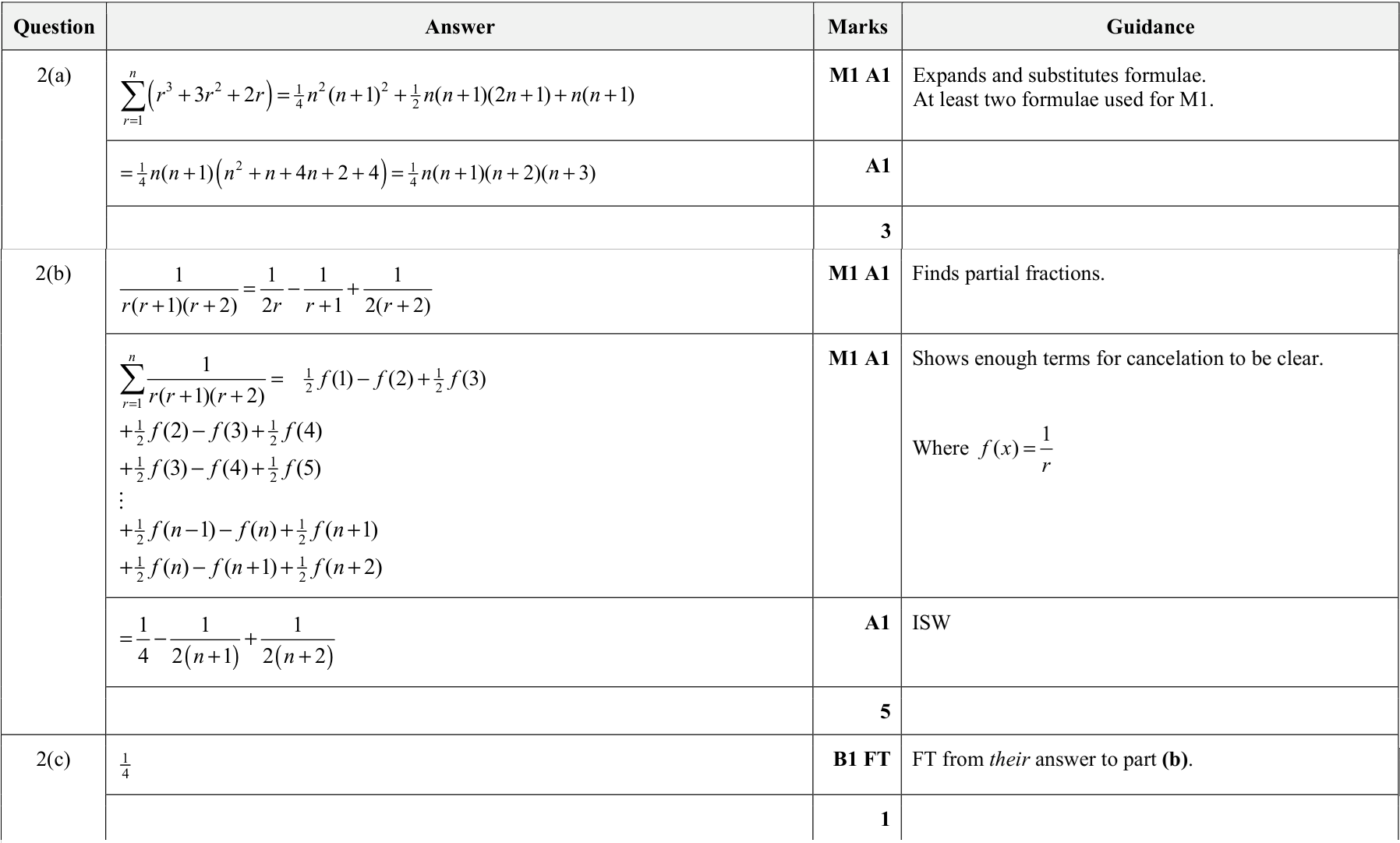
(a) Use standard results from the list of formulae (MF19) to find \(\sum_{r=1}^{n} r(r+1)(r+2)\) in terms of \(n\), fully factorising your answer.
(b) Express \(\frac{1}{r(r+1)(r+2)}\) in partial fractions and hence use the method of differences to find \(\sum_{r=1}^{n} \frac{1}{r(r+1)(r+2)}\).
(c) Deduce the value of \(\sum_{r=1}^{\infty} \frac{1}{r(r+1)(r+2)}\).
9231 P12 - Nov 2021 - Q04 - 10 marks
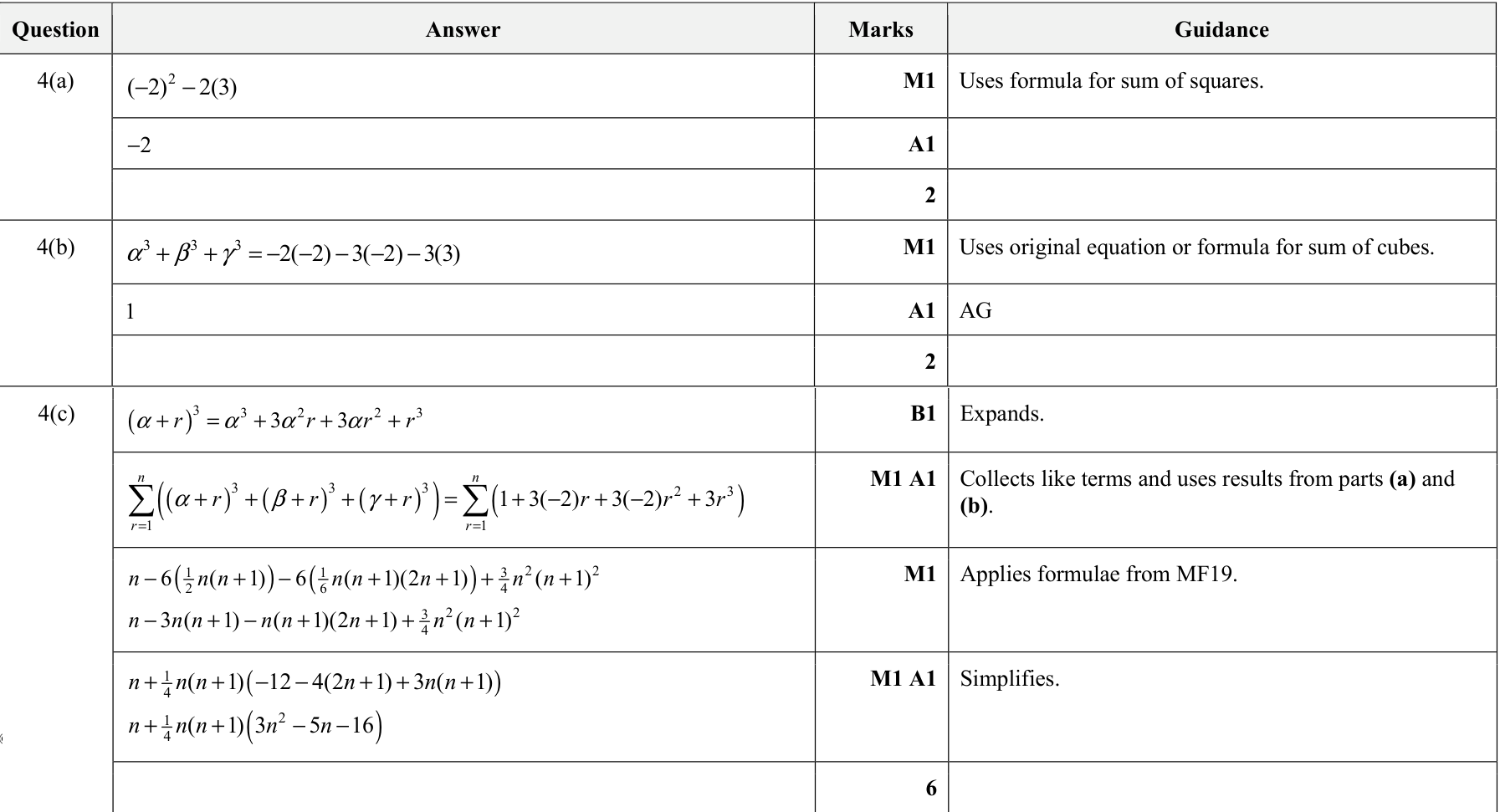
The cubic equation \(x^3 + 2x^2 + 3x + 3 = 0\) has roots \(\alpha, \beta, \gamma\).
(a) Find the value of \(\alpha^2 + \beta^2 + \gamma^2\).
(b) Show that \(\alpha^3 + \beta^3 + \gamma^3 = 1\).
(c) Use standard results from the list of formulae (MF19) to show that
\(\sum_{r=1}^{n} ((\alpha + r)^3 + (\beta + r)^3 + (\gamma + r)^3) = n + \frac{1}{4}n(n+1)(an^2 + bn + c),\)
where \(a, b, c\) are constants to be determined.
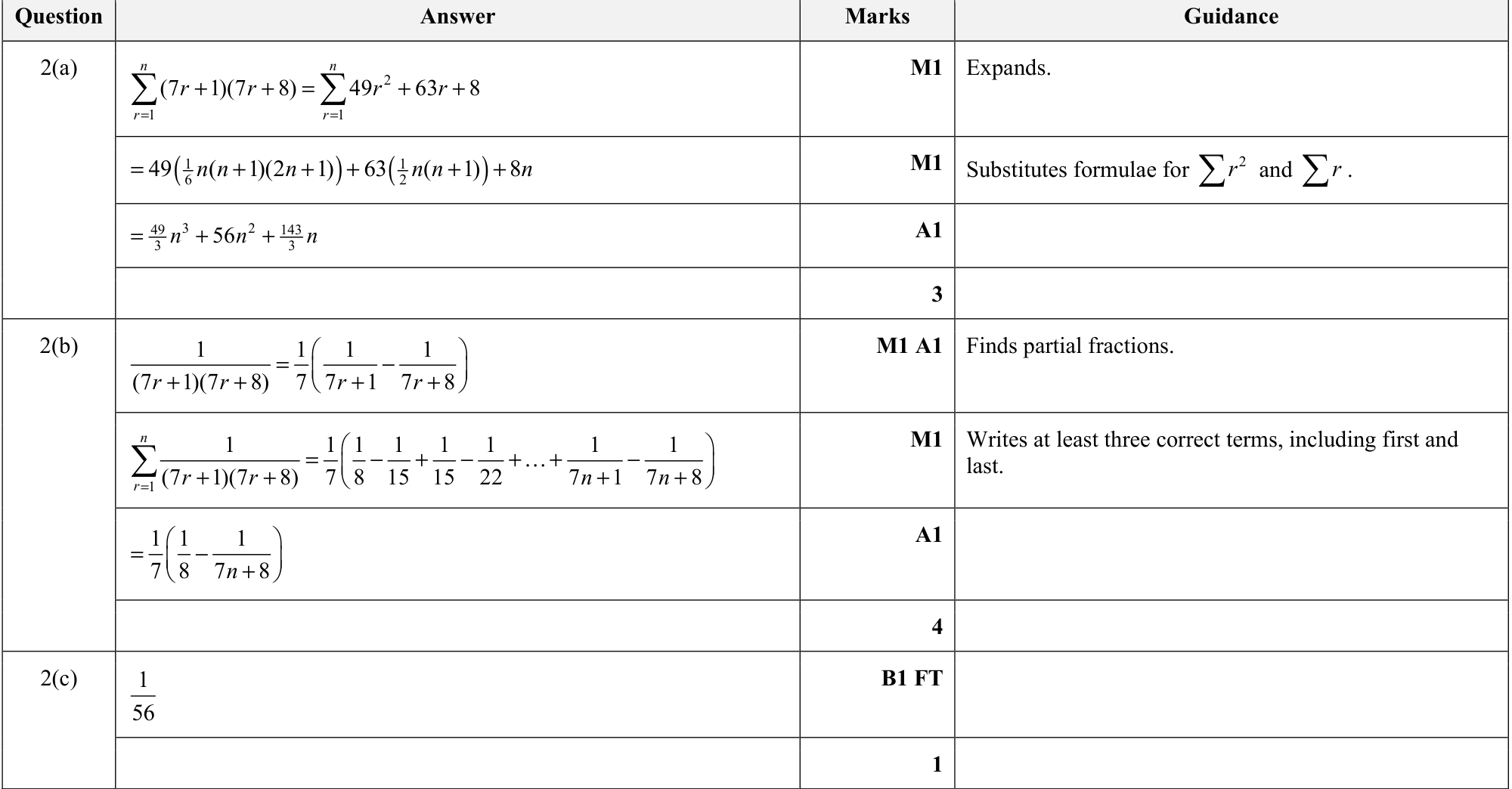
9231 P11 - Nov 2020 - Q2 - 8 marks
2 (a) Use standard results from the List of Formulae (MF19) to show that
\(\sum_{r=1}^{n}(7 r+1)(7 r+8)=a n^{3}+b n^{2}+c n\)
where \(a, b\) and \(c\) are constants to be determined.
(b) Use the method of differences to find \(\sum_{r=1}^{n} \frac{1}{(7 r+1)(7 r+8)}\) in terms of \(n\).
(c) Deduce the value of \(\sum_{r=1}^{\infty} \frac{1}{(7 r+1)(7 r+8)}\).
9231 P11 - Jun 2020 - Q4 - 10 marks
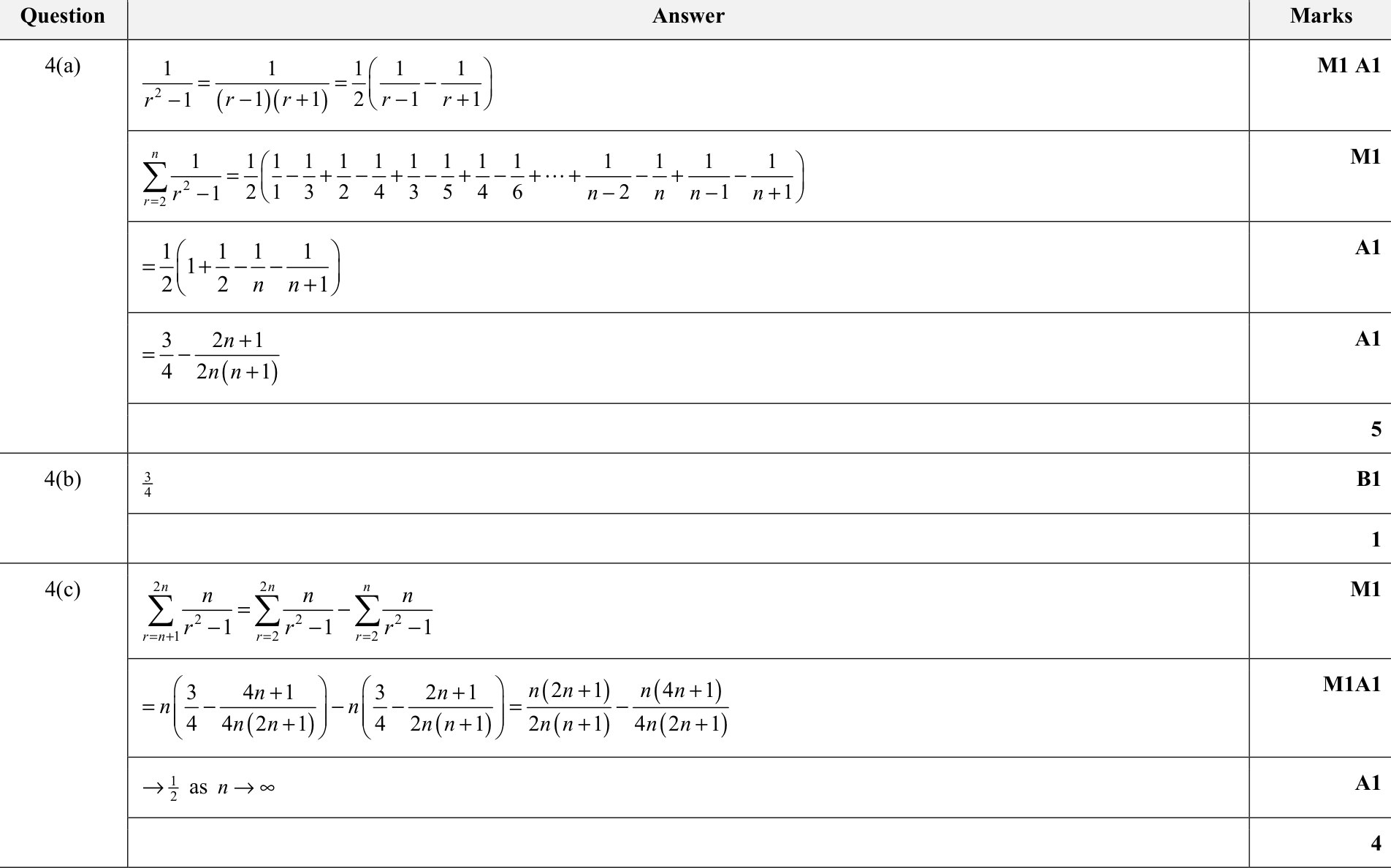
4 (a) By first expressing \(\frac{1}{r^{2}-1}\) in partial fractions, show that
\(\sum_{r=2}^{n} \frac{1}{r^{2}-1}=\frac{3}{4}-\frac{a n+b}{2 n(n+1)},\)
where \(a\) and \(b\) are integers to be found.
(b) Deduce the value of \(\sum_{r=2}^{\infty} \frac{1}{r^{2}-1}\).
(c) Find the limit, as \(n \rightarrow \infty\), of \(\sum_{r=n+1}^{2 n} \frac{n}{r^{2}-1}\).
9231 P13 - Jun 2019 - Q4 - 8 marks
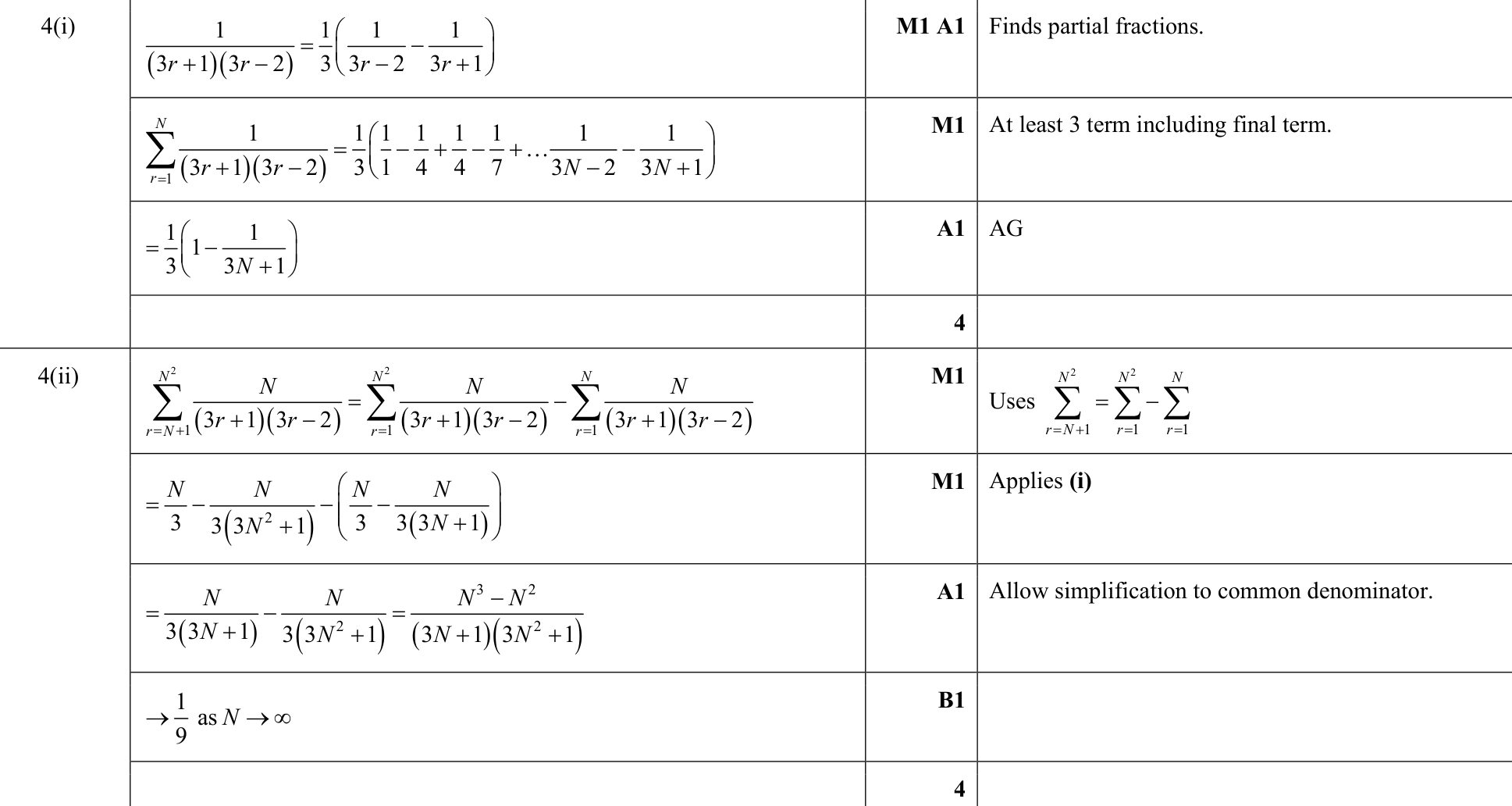
4 (i) Use the method of differences to show that \(\sum_{r=1}^{N} \frac{1}{(3 r+1)(3 r-2)}=\frac{1}{3}-\frac{1}{3(3 N+1)}\).
(ii) Find the limit, as \(N \rightarrow \infty\), of \(\sum_{r=N+1}^{N^{2}} \frac{N}{(3 r+1)(3 r-2)}\).
9231 P11 - Nov 2019 - Q5 - 9 marks
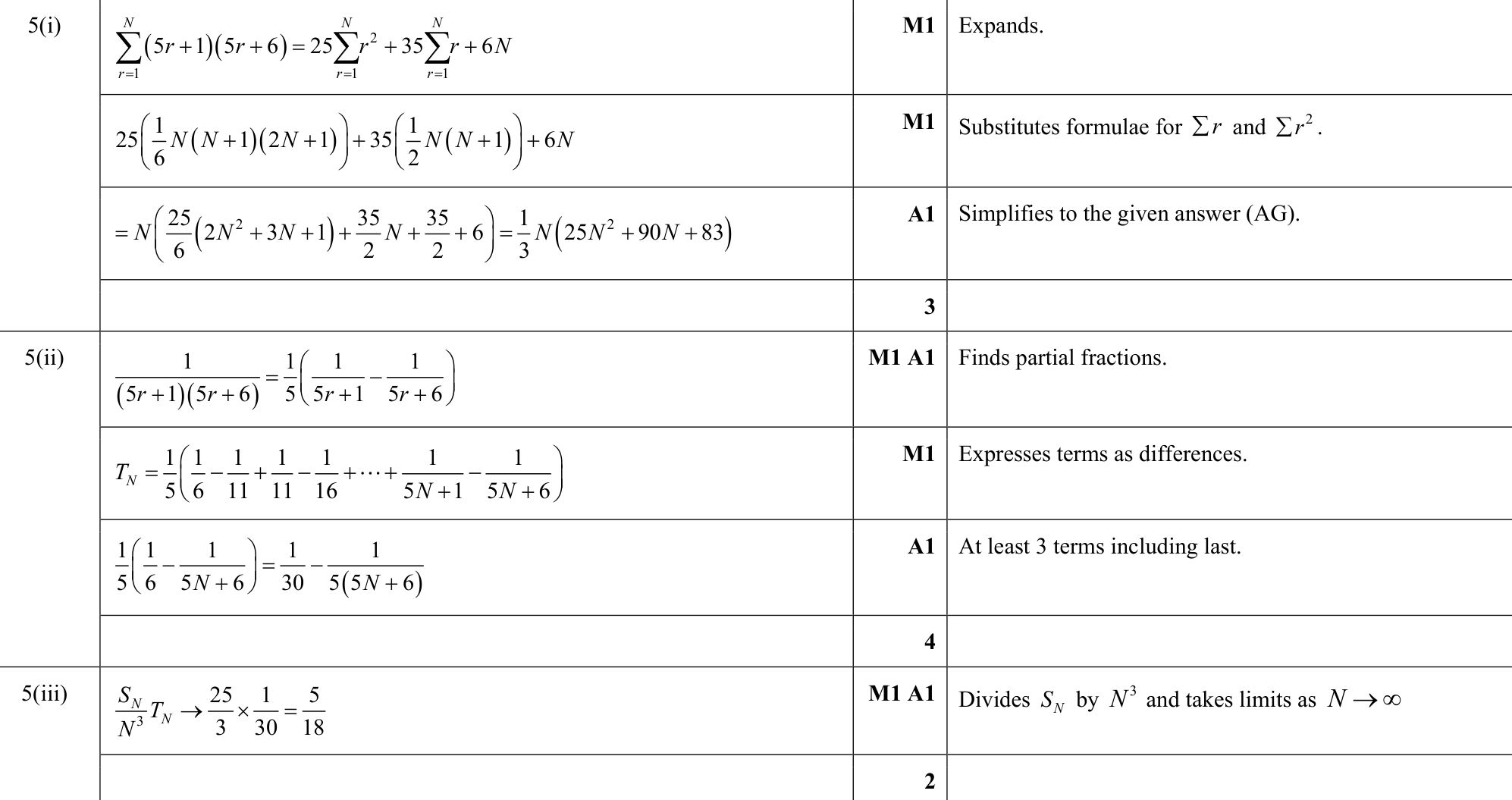
\(5 \quad\) Let \(S_{N}=\sum_{r=1}^{N}(5 r+1)(5 r+6)\) and \(T_{N}=\sum_{r=1}^{N} \frac{1}{(5 r+1)(5 r+6)}\).
(i) Use standard results from the List of Formulae (MF10) to show that
\(S_{N}=\frac{1}{3} N\left(25 N^{2}+90 N+83\right)\)
(ii) Use the method of differences to express \(T_{N}\) in terms of \(N\).
monisinatin
(iii) Find \(\lim _{N \rightarrow \infty}\left(N^{-3} S_{N} T_{N}\right)\).
9231 P11 - Jun 2018 - Q5 - 8 marks
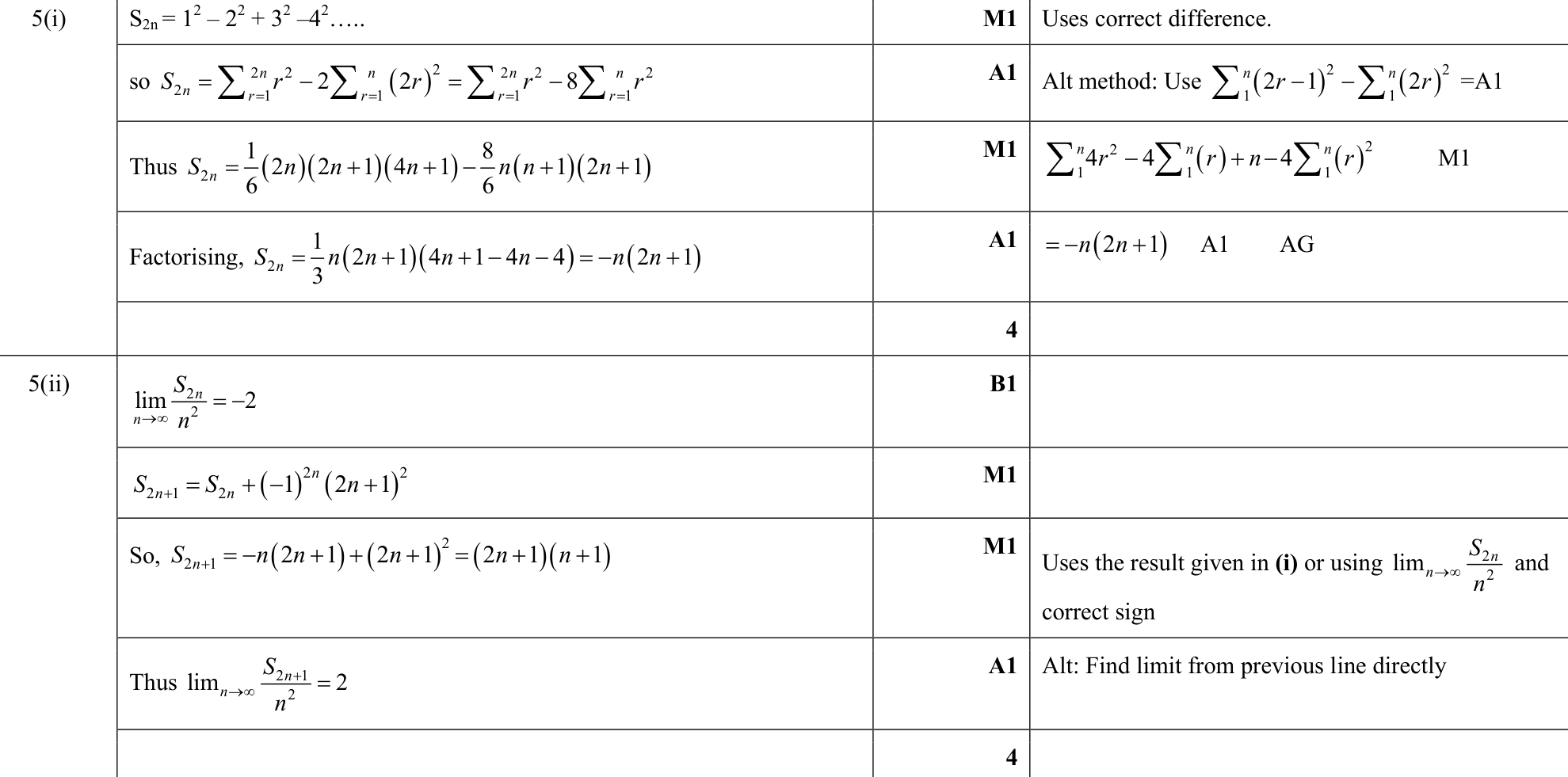
Let \(S_{n}=\sum_{r=1}^{n}(-1)^{r-1} r^{2}\).
(i) Use the standard result for \(\sum_{r=1}^{n} r^{2}\) given in the List of Formulae (MF10) to show that
\(S_{2 n}=-n(2 n+1) .\)
(ii) State the value of \(\lim _{n \rightarrow \infty} \frac{S_{2 n}}{n^{2}}\) and find \(\lim _{n \rightarrow \infty} \frac{S_{2 n+1}}{n^{2}}\).
9231 P11 - Jun 2018 - Q11 - 28 marks
Answer only one of the following two alternatives.
EITHER
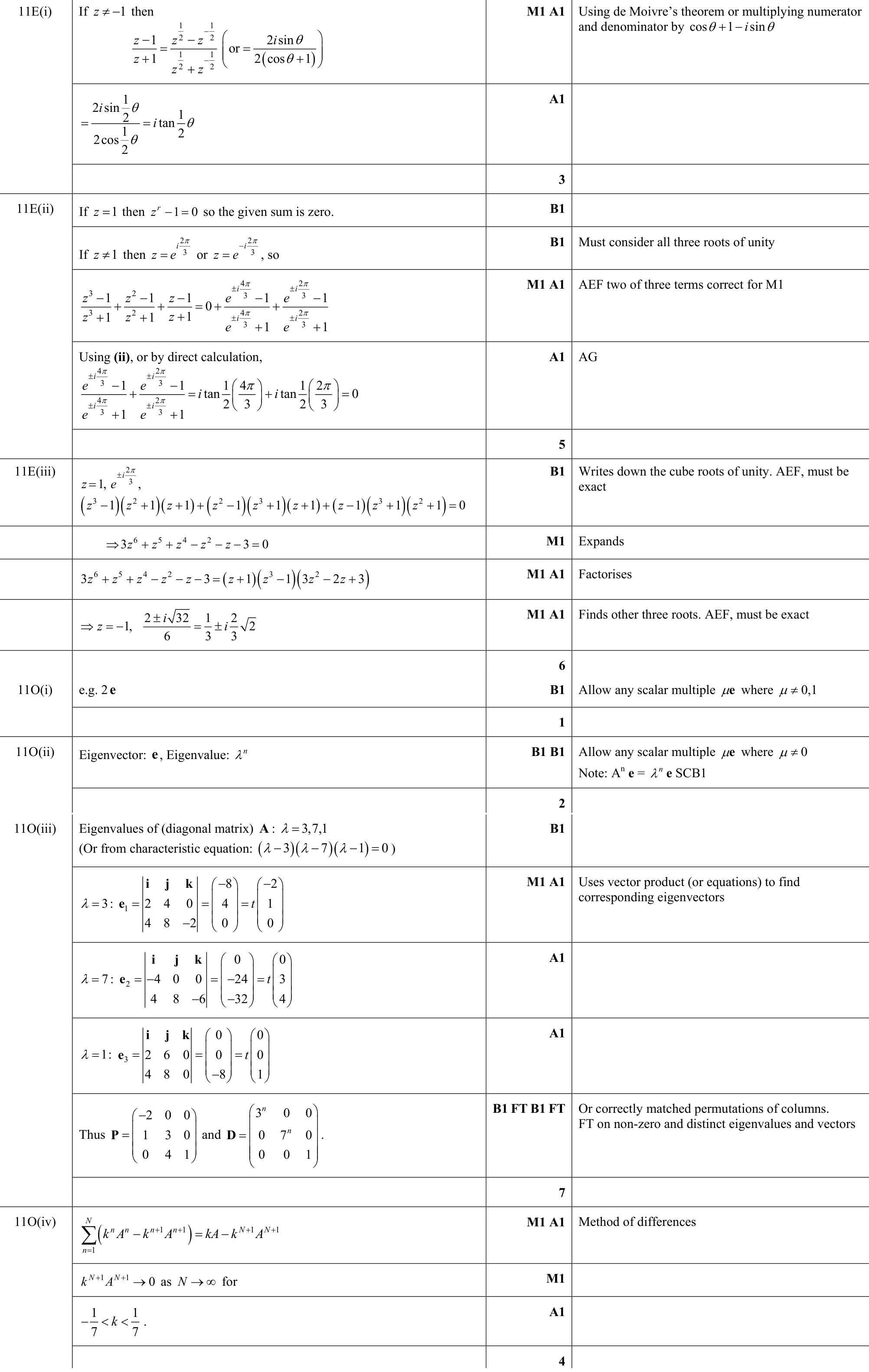
(i) Show that if \(z=e^{i\theta}\) and \(z\neq -1\), then \(\frac{z-1}{z+1}=i\tan\frac{\theta}{2}\).
(ii) Hence, or otherwise, show that if \(z\) is a cube root of unity, then
\(\frac{z^3-1}{z^3+1}+\frac{z^2-1}{z^2+1}+\frac{z-1}{z+1}=0.\)
(iii) Hence write down three roots of
\((z^3-1)(z^2+1)(z+1)+(z^2-1)(z^3+1)(z+1)+(z-1)(z^3+1)(z^2+1)=0\)
and find the other three roots. Give your answers in an exact form.
OR
It is given that \(\mathbf e\) is an eigenvector of \(\mathbf A\), with corresponding eigenvalue \(\lambda\).
(i) Write down another eigenvector of \(\mathbf A\) corresponding to \(\lambda\).
(ii) Write down an eigenvector and corresponding eigenvalue of \(\mathbf A^n\), where \(n\) is a positive integer.
Let \(\mathbf A=\begin{pmatrix}3&0&0\\2&7&0\\4&8&1\end{pmatrix}\).
(iii) Find a matrix \(\mathbf P\) and a diagonal matrix \(\mathbf D\) such that \(\mathbf A^n=\mathbf P\mathbf D\mathbf P^{-1}\).
(iv) Determine the set of values of the real constant \(k\) such that \(\sum_{n=1}^{\infty} k^n(\mathbf A^n-k\mathbf A^{n+1})=k\mathbf A\).
9231 P13 - Jun 2018 - Q2 - 6 marks
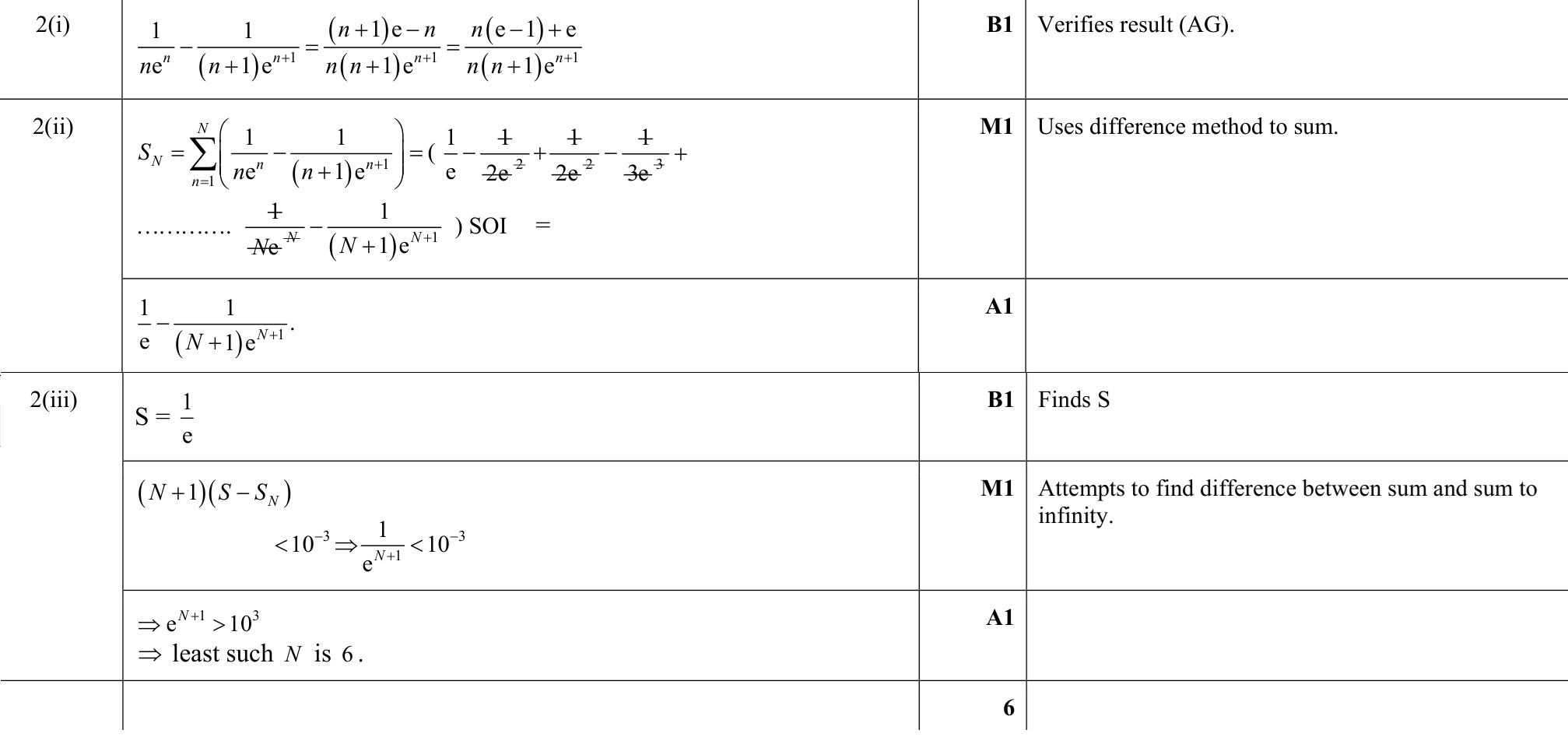
(i) Verify that
\(\frac{n(\mathrm{e}-1)+\mathrm{e}}{n(n+1) \mathrm{e}^{n+1}}=\frac{1}{n \mathrm{e}^{n}}-\frac{1}{(n+1) \mathrm{e}^{n+1}} .\)
Let \(S_{N}=\sum_{n=1}^{N} \frac{n(\mathrm{e}-1)+\mathrm{e}}{n(n+1) \mathrm{e}^{n+1}}\).
(ii) Express \(S_{N}\) in terms of \(N\) and e.
Let \(S=\lim _{N \rightarrow \infty} S_{N}\).
(iii) Find the least value of \(N\) such that \((N+1)\left(S-S_{N}\right)\lt10^{-3}\).
9231 P12 - Nov 2018 - Q7 - 10 marks
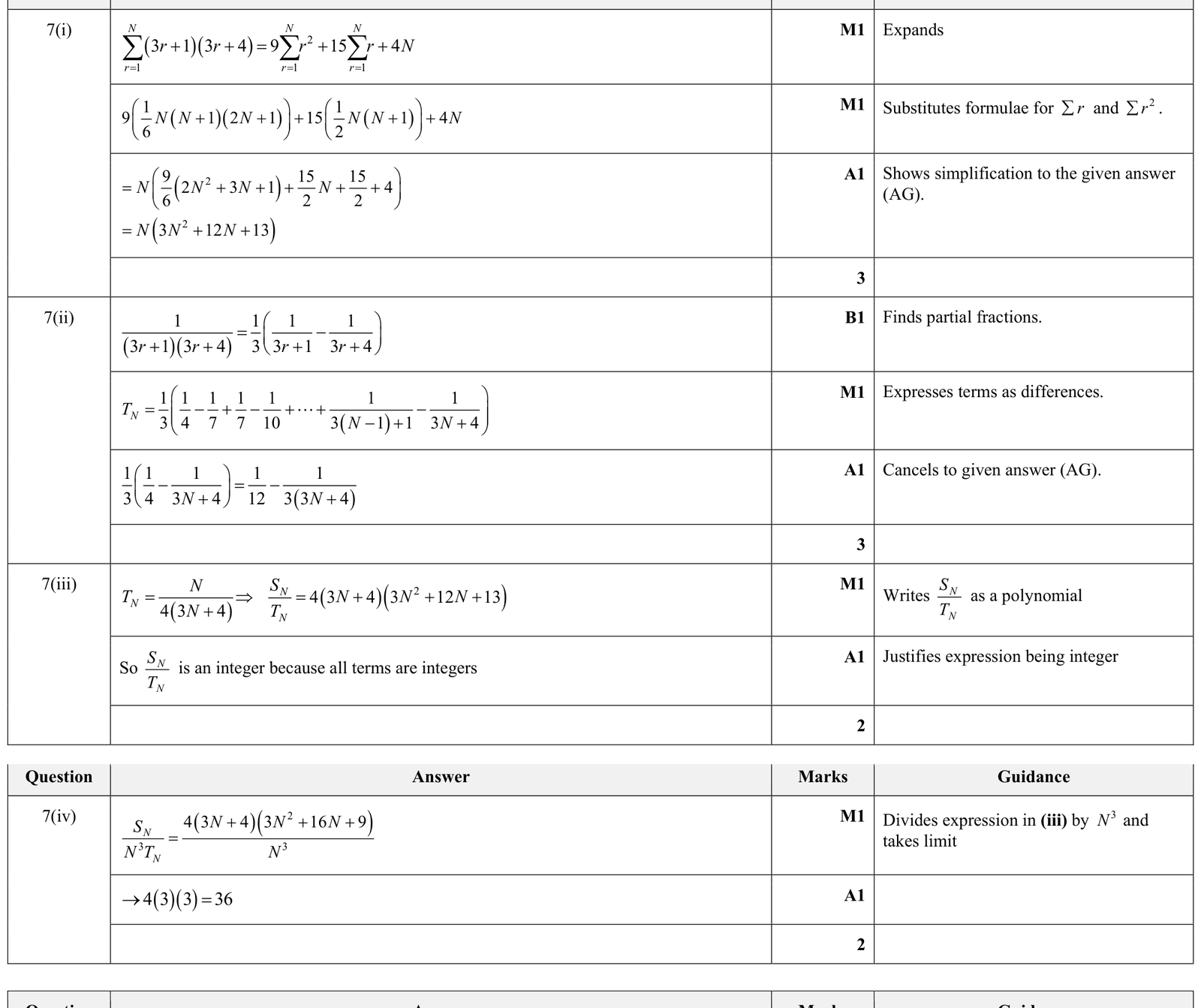
Let
\(S_{N}=\sum_{r=1}^{N}(3 r+1)(3 r+4) \quad \text { and } \quad T_{N}=\sum_{r=1}^{N} \frac{1}{(3 r+1)(3 r+4)} .\)
(i) Use standard results from the List of Formulae (MF10) to show that
\(S_{N}=N\left(3 N^{2}+12 N+13\right)\)
(ii) Use the method of differences to show that
\(T_{N}=\frac{1}{12}-\frac{1}{3(3 N+4)}\)
(iii) Deduce that \(\frac{S_{N}}{T_{N}}\) is an integer.
(iv) Find \(\lim _{N \rightarrow \infty} \frac{S_{N}}{N^{3} T_{N}}\).
9231 P11 - Jun 2017 - Q1 - 5 marks
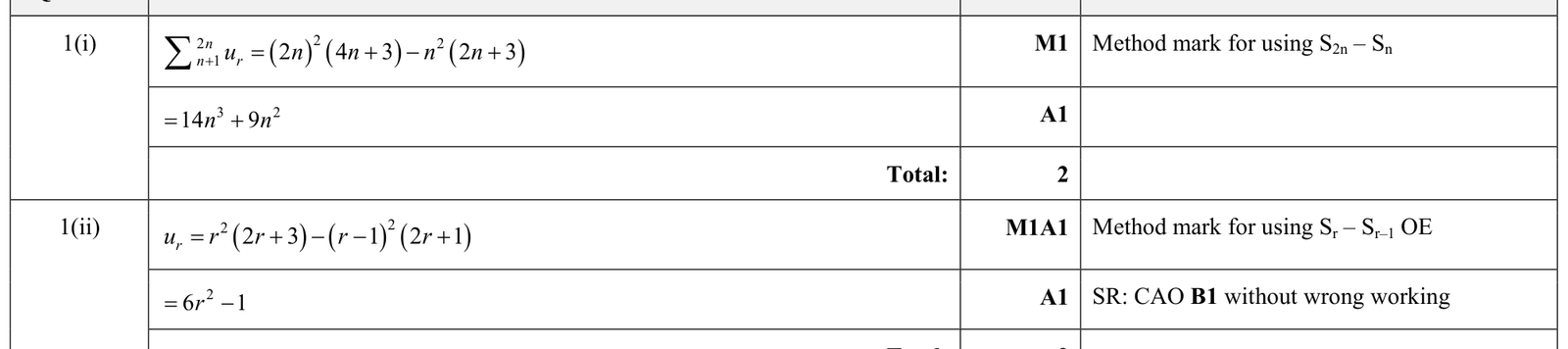
It is given that \(\sum_{r=1}^{n} u_{r}=n^{2}(2 n+3)\), where \(n\) is a positive integer.
(i) Find \(\sum_{r=n+1}^{2 n} u_{r}\).
(ii) Find \(u_{r}\).
9231 P13 - Jun 2017 - Q2 - 6 marks
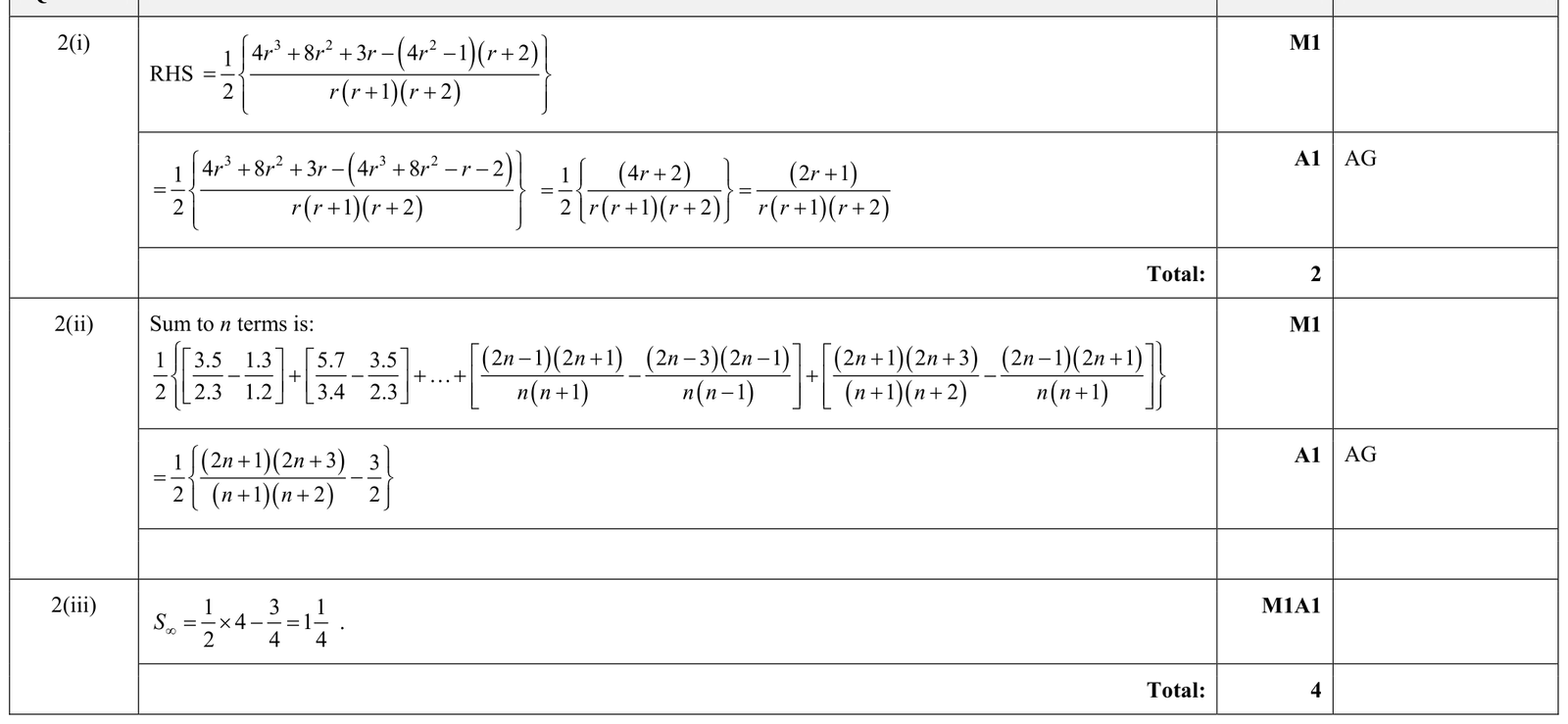
(i) Verify that \(\frac{2 r+1}{r(r+1)(r+2)}=\frac{1}{2}\left\{\frac{(2 r+1)(2 r+3)}{(r+1)(r+2)}-\frac{(2 r-1)(2 r+1)}{r(r+1)}\right\}\).
(ii) Hence show that \(\sum_{r=1}^{n} \frac{2 r+1}{r(r+1)(r+2)}=\frac{1}{2}\left\{\frac{(2 n+1)(2 n+3)}{(n+1)(n+2)}-\frac{3}{2}\right\}\).
(iii) Deduce the value of \(\sum_{r=1}^{\infty} \frac{2 r+1}{r(r+1)(r+2)}\).
9231 P11 - Jun 2014 - Q2 - 5 marks
Expand and simplify \((r+1)^{4}-r^{4}\).
Use the method of differences together with the standard results for \(\sum_{r=1}^{n} r\) and \(\sum_{r=1}^{n} r^{2}\) to show that
\(\sum_{r=1}^{n} r^{3}=\frac{1}{4} n^{2}(n+1)^{2} .\)

9231 P11 - Jun 2015 - Q1 - 4 marks
Use the List of Formulae (MF10) to show that \(\sum_{r=1}^{13}\left(3 r^{2}-5 r+1\right)\) and \(\sum_{r=0}^{9}\left(r^{3}-1\right)\) have the same numerical value.

9231 P11 - Nov 2016 - Q1 - 5 marks
Use the method of differences to find \(\sum_{r=1}^{n} \frac{1}{(2 r)^{2}-1}\).
Deduce the value of \(\sum_{r=1}^{\infty} \frac{1}{(2 r)^{2}-1}\).

9231 P13 - Jun 2016 - Q1 - 6 marks
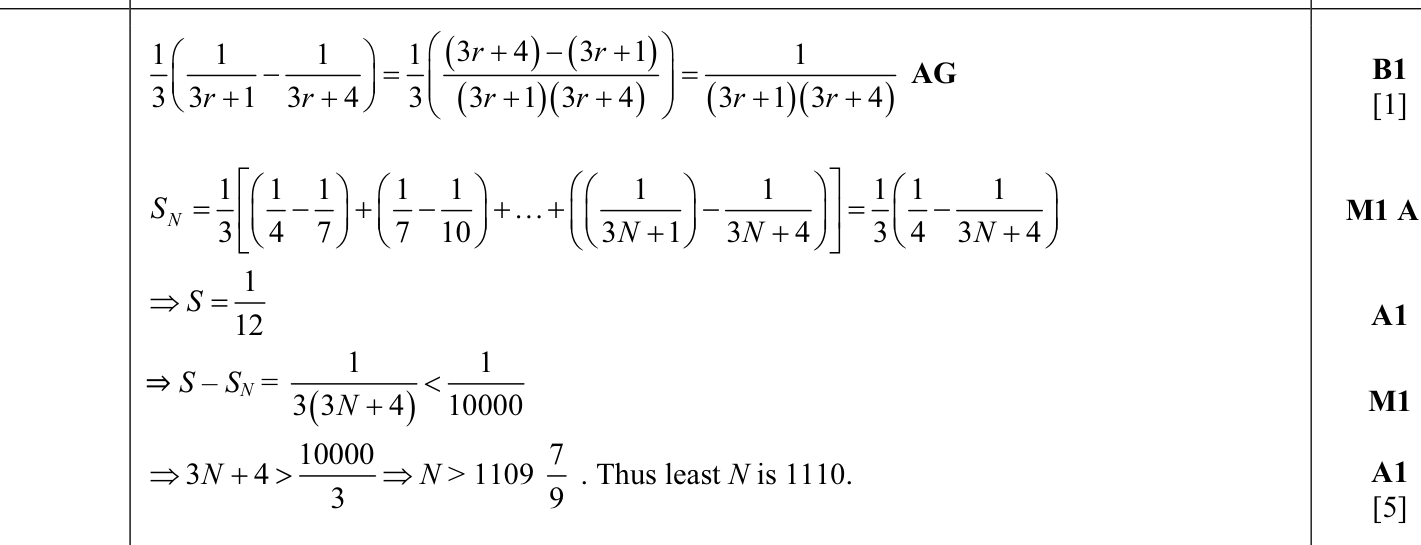
Verify that \(\dfrac{1}{(3r+1)(3r+4)}=\dfrac{1}{3}\left(\dfrac{1}{3r+1}-\dfrac{1}{3r+4}\right)\).
Let \(S_N\) denote \(\sum_{r=1}^{N}\dfrac{1}{(3r+1)(3r+4)}\) and let \(S\) denote \(\sum_{r=1}^{\infty}\dfrac{1}{(3r+1)(3r+4)}\). Find the least value of \(N\) such that \(S-S_N\lt\dfrac{1}{10000}\).
9231 P11 - Jun 2016 - Q2 - 6 marks
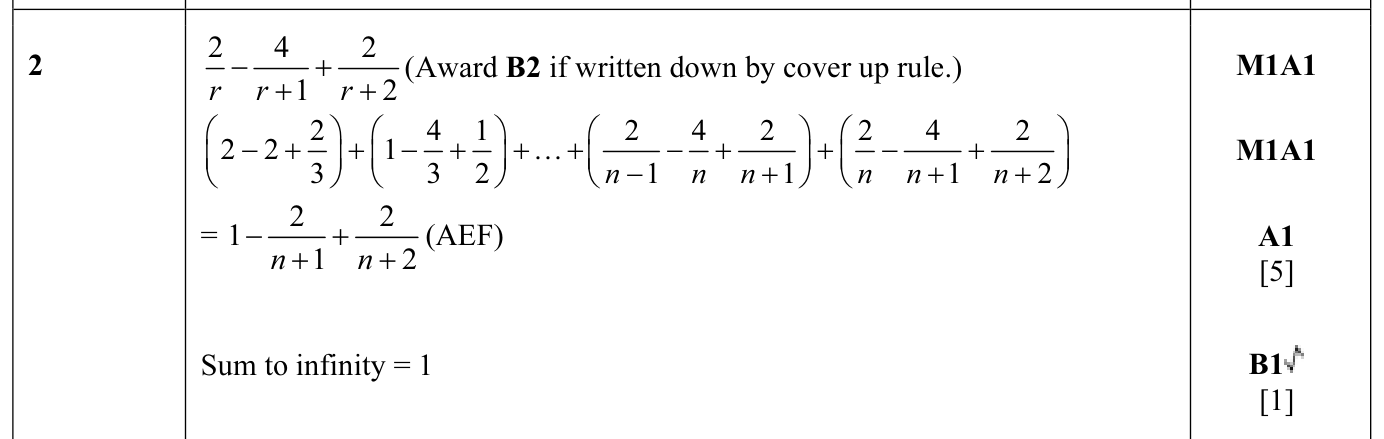
Express \(\frac{4}{r(r+1)(r+2)}\) in partial fractions and hence find \(\sum_{r=1}^{n} \frac{4}{r(r+1)(r+2)}\).
Deduce the value of \(\sum_{r=1}^{\infty} \frac{4}{r(r+1)(r+2)}\).
9231 P11 - Nov 2017 - Q1 - 4 marks
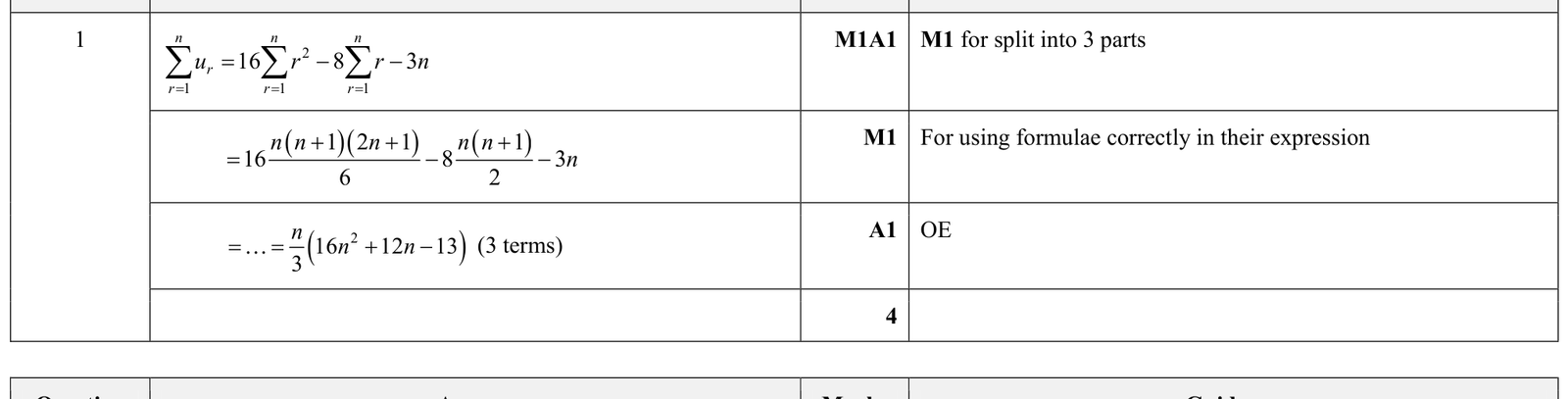
Find \(\sum_{r=1}^{n}(4 r-3)(4 r+1)\), giving your answer in its simplest form.
9231 P12 - Nov 2014 - Q1 - 5 marks
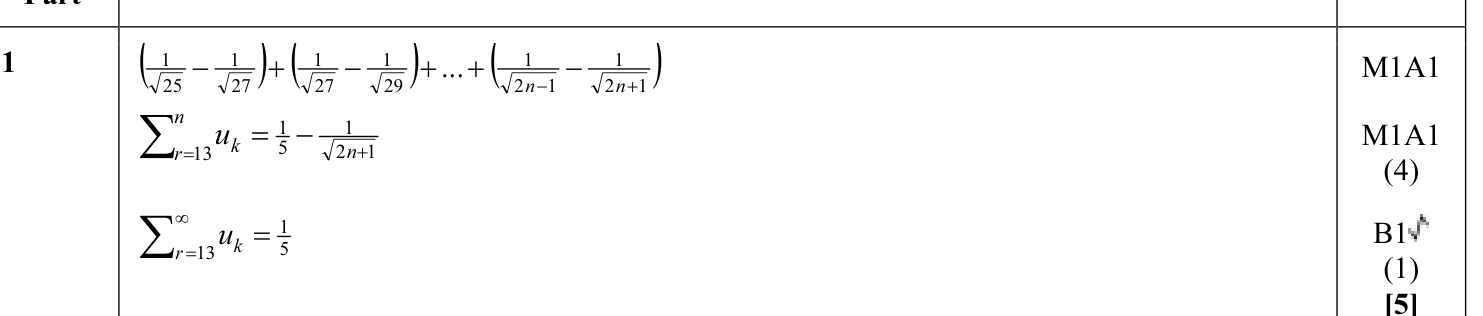
Given that
\(u_{k}=\frac{1}{\sqrt{2 k-1}}-\frac{1}{\sqrt{2 k+1}},\)
express \(\sum_{k=13}^{n} u_{k}\) in terms of \(n\).
Deduce the value of \(\sum_{k=13}^{\infty} u_{k}\).
9231 P11 - Nov 2014 - Q1 - 5 marks
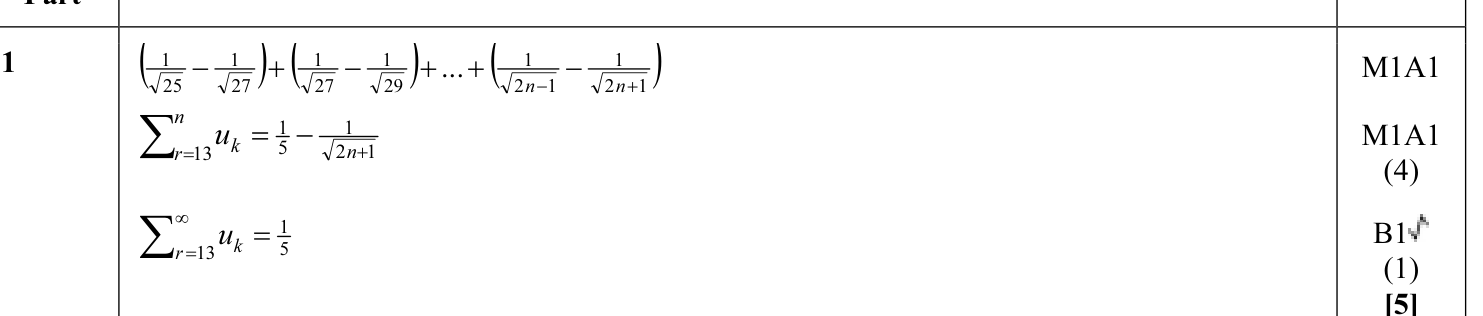
Given that
\(u_{k}=\frac{1}{\sqrt{2 k-1}}-\frac{1}{\sqrt{2 k+1}},\)
express \(\sum_{k=13}^{n} u_{k}\) in terms of \(n\).
Deduce the value of \(\sum_{k=13}^{\infty} u_{k}\).
9231 P11 - Jun 2013 - Q5 - 9 marks
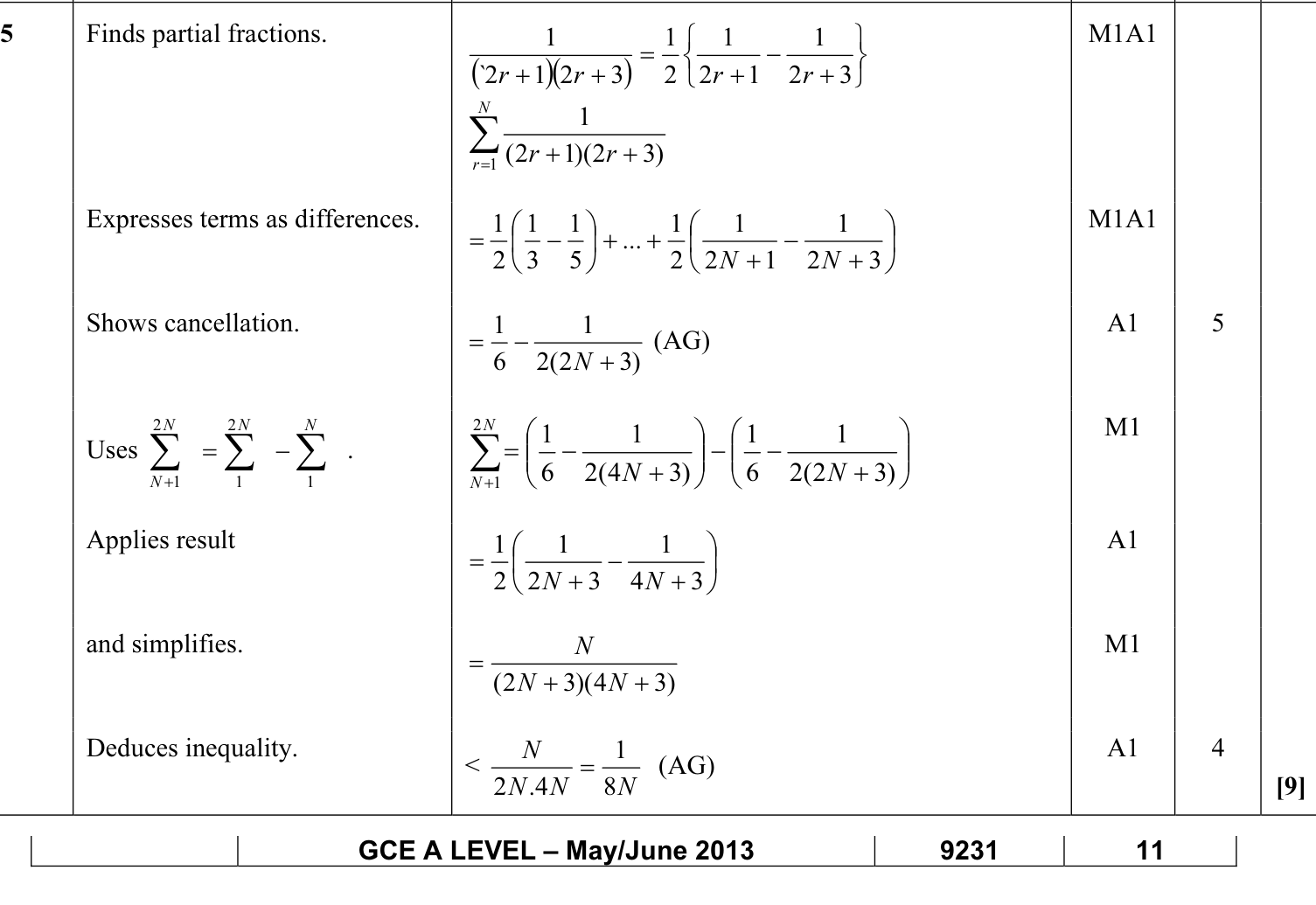
Use the method of differences to show that \(\sum_{r=1}^{N} \frac{1}{(2 r+1)(2 r+3)}=\frac{1}{6}-\frac{1}{2(2 N+3)}\).
Deduce that \(\sum_{r=N+1}^{2 N} \frac{1}{(2 r+1)(2 r+3)}\lt \frac{1}{8 N}\).
9231 P13 - Jun 2013 - Q1 - 5 marks
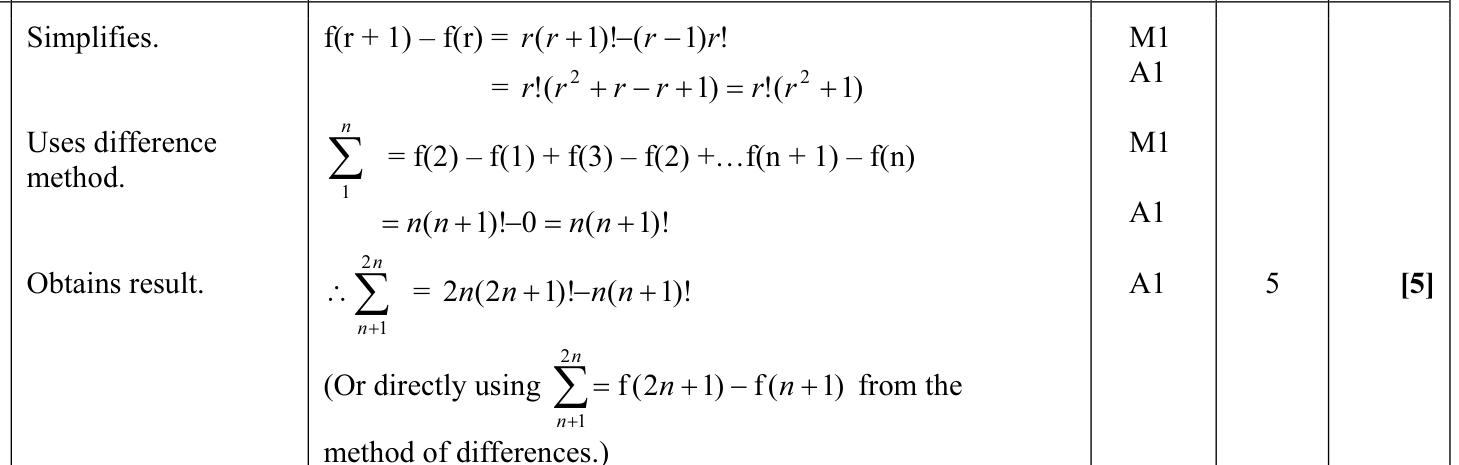
Let \(\mathrm{f}(r)=r!(r-1)\). Simplify \(\mathrm{f}(r+1)-\mathrm{f}(r)\) and hence find \(\sum_{r=n+1}^{2 n} r!\left(r^{2}+1\right)\).
9231 P11 - Nov 2013 - Q3 - 7 marks
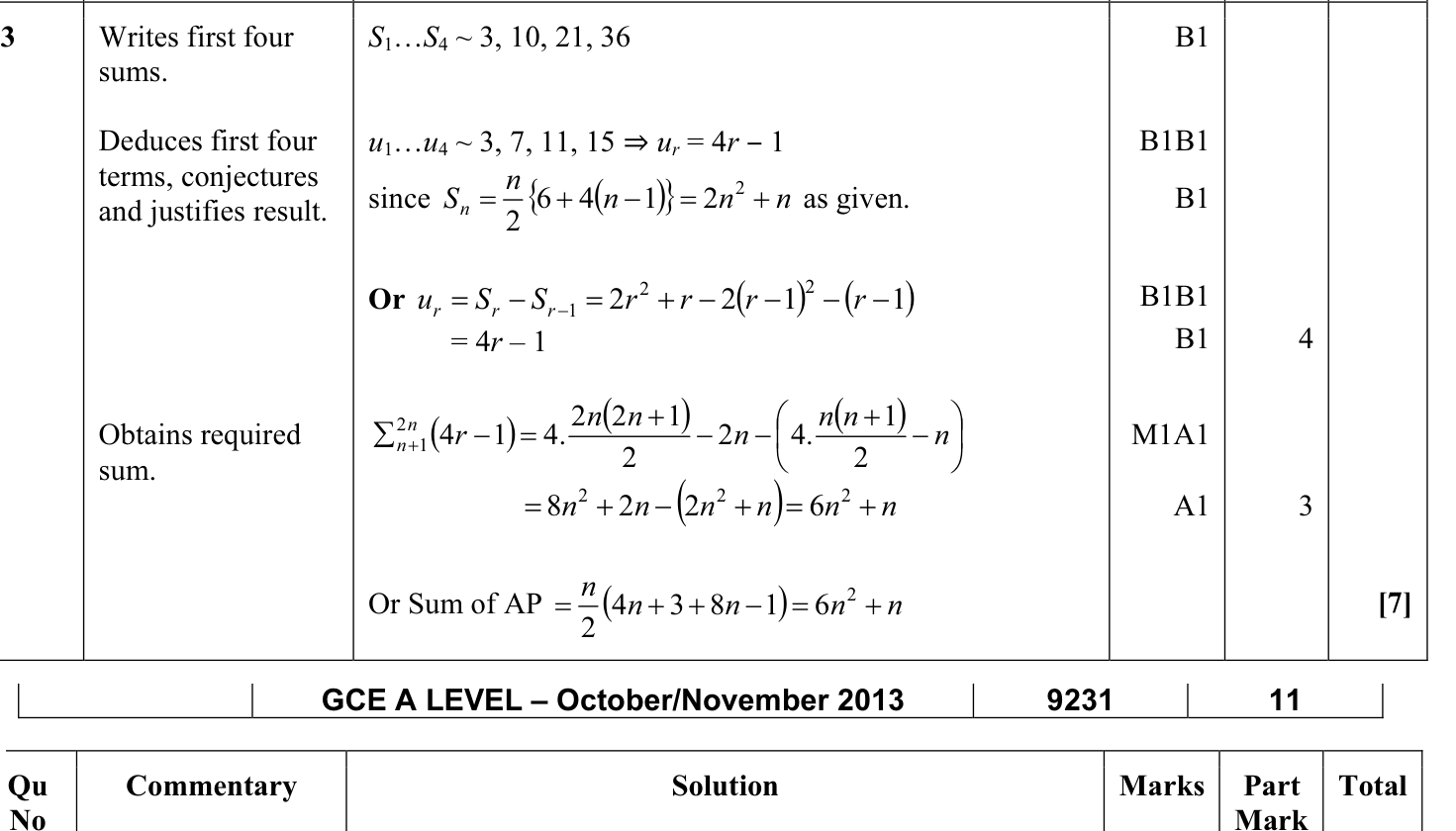
It is given that
\(S_{n}=\sum_{r=1}^{n} u_{r}=2 n^{2}+n\)
Write down the values of \(S_{1}, S_{2}, S_{3}, S_{4}\). Express \(u_{r}\) in terms of \(r\), justifying your answer.
Find
\(\sum_{r=n+1}^{2 n} u_{r} .\)
9231 P12 - Nov 2013 - Q3 - 7 marks
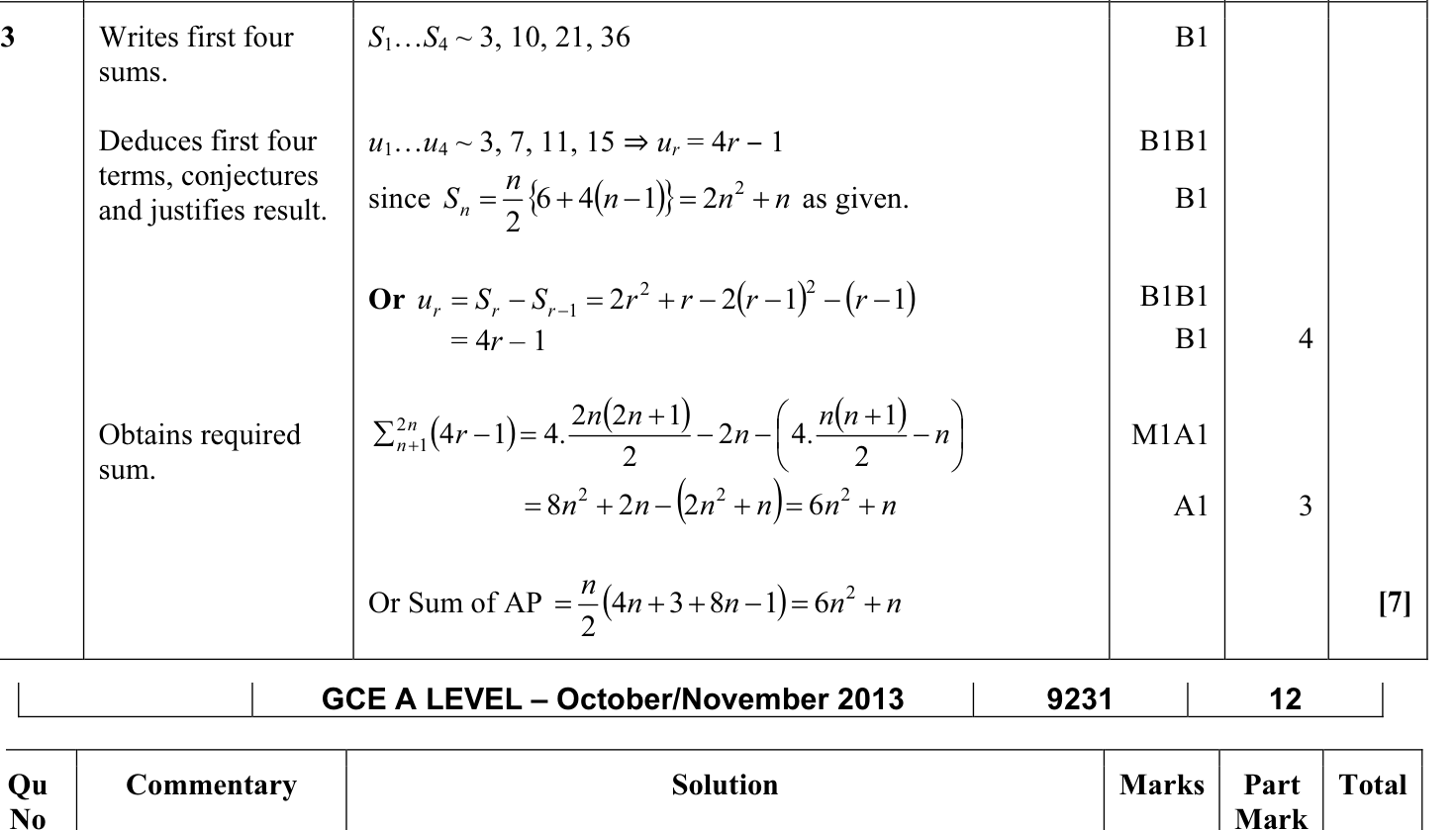
It is given that
\(S_{n}=\sum_{r=1}^{n} u_{r}=2 n^{2}+n\)
Write down the values of \(S_{1}, S_{2}, S_{3}, S_{4}\). Express \(u_{r}\) in terms of \(r\), justifying your answer.
Find
\(\sum_{r=n+1}^{2 n} u_{r} .\)
9231 P13 - Nov 2013 - Q1 - 6 marks
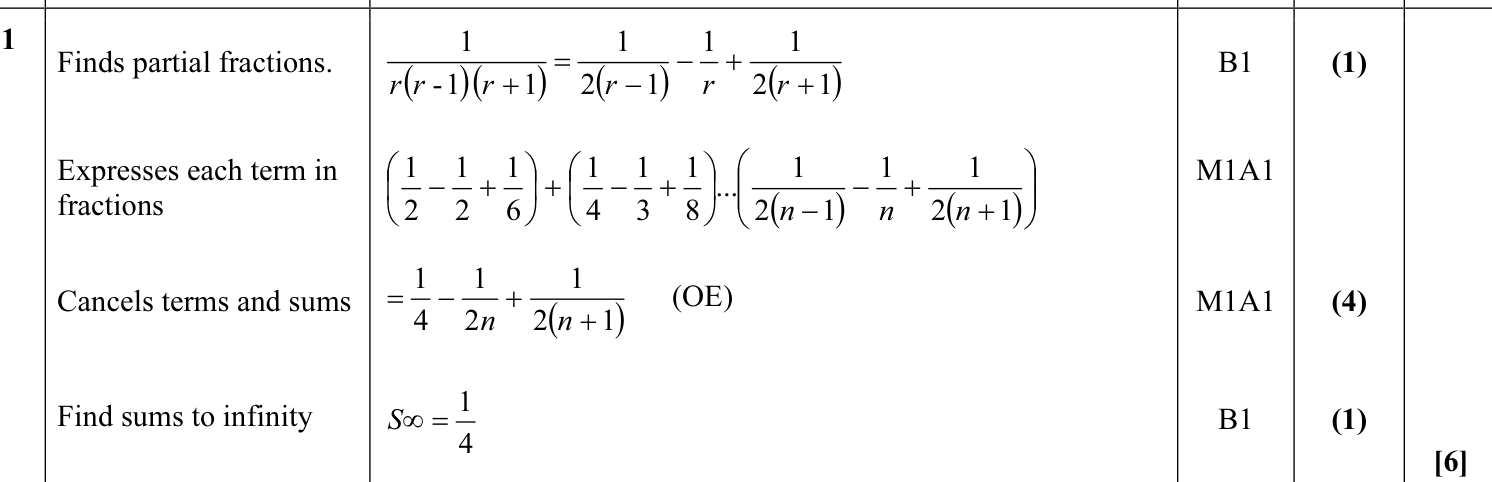
Express \(\frac{1}{r(r+1)(r-1)}\) in partial fractions.
Find
\(\sum_{r=2}^{n} \frac{1}{r(r+1)(r-1)}\)
State the value of
\(\sum_{r=2}^{\infty} \frac{1}{r(r+1)(r-1)} .\)
9231 P1 - Nov 2008 - Q9 - 10 marks
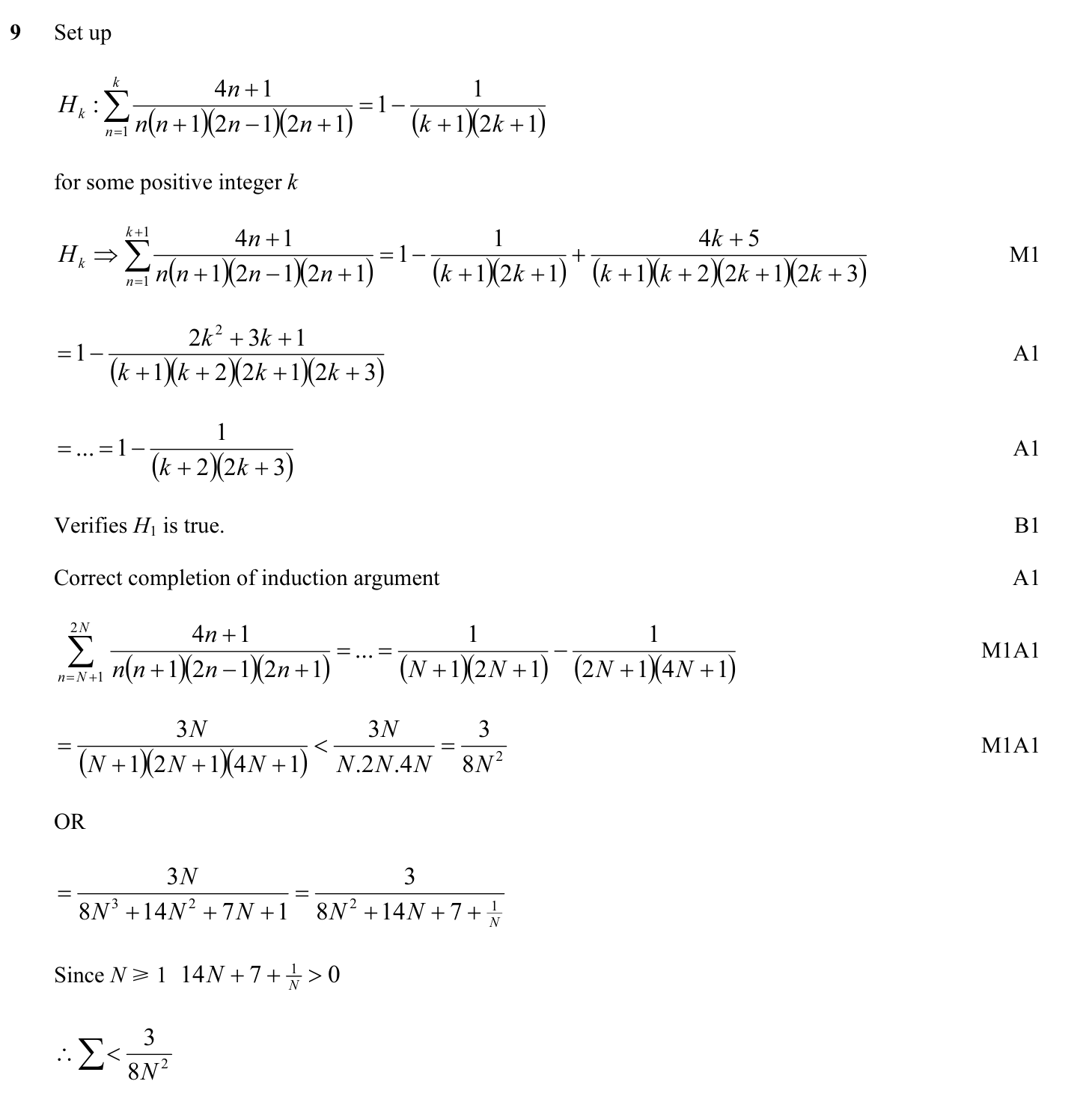
Use induction to prove that
\(\sum_{n=1}^{N} \frac{4 n+1}{n(n+1)(2 n-1)(2 n+1)}=1-\frac{1}{(N+1)(2 N+1)}\)
Show that
\(\sum_{n=N+1}^{2 N} \frac{4 n+1}{n(n+1)(2 n-1)(2 n+1)}\lt \frac{3}{8 N^{2}} .\)
9231 P11 - Jun 2011 - Q1 - 5 marks
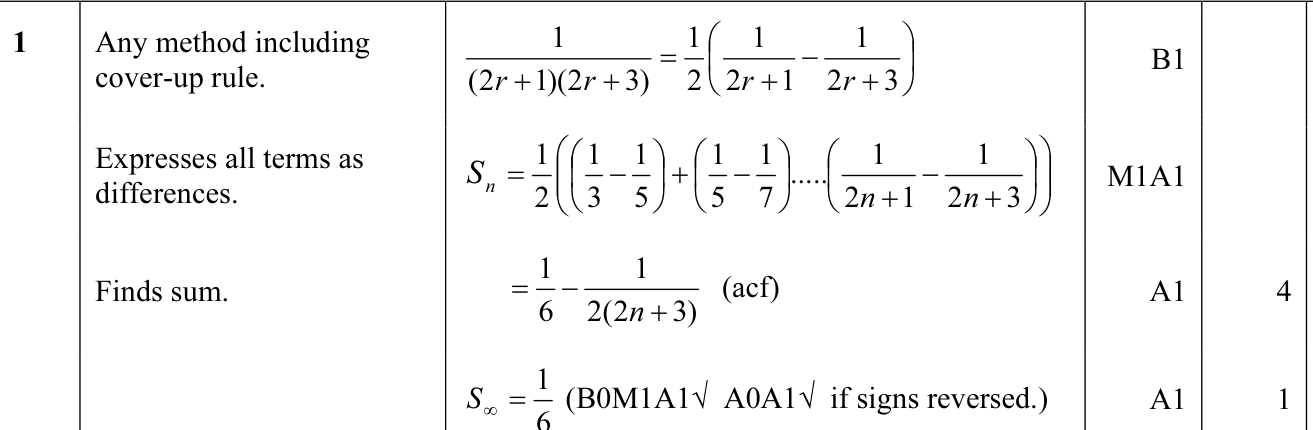
Express \(\frac{1}{(2 r+1)(2 r+3)}\) in partial fractions and hence use the method of differences to
\(\sum_{r=1}^{n} \frac{1}{(2 r+1)(2 r+3)}\)
Deduce the value of
\(\sum_{r=1}^{\infty} \frac{1}{(2 r+1)(2 r+3)}\)
9231 P12 - Jun 2014 - Q2 - 5 marks
Expand and simplify \((r+1)^{4}-r^{4}\).
Use the method of differences together with the standard results for \(\sum_{r=1}^{n} r\) and \(\sum_{r=1}^{n} r^{2}\) to show that
\(\sum_{r=1}^{n} r^{3}=\frac{1}{4} n^{2}(n+1)^{2} .\)

9231 P13 - Nov 2012 - Q1 - 4 marks
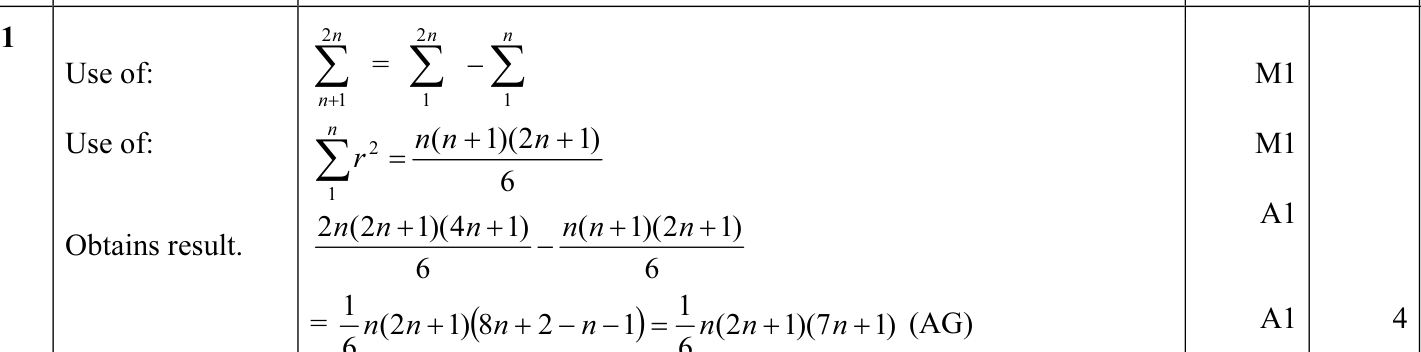
Show that \(\sum_{r=n+1}^{2 n} r^{2}=\frac{1}{6} n(2 n+1)(7 n+1)\).
9231 P11 - Jun 2010 - Q4 - 7 marks
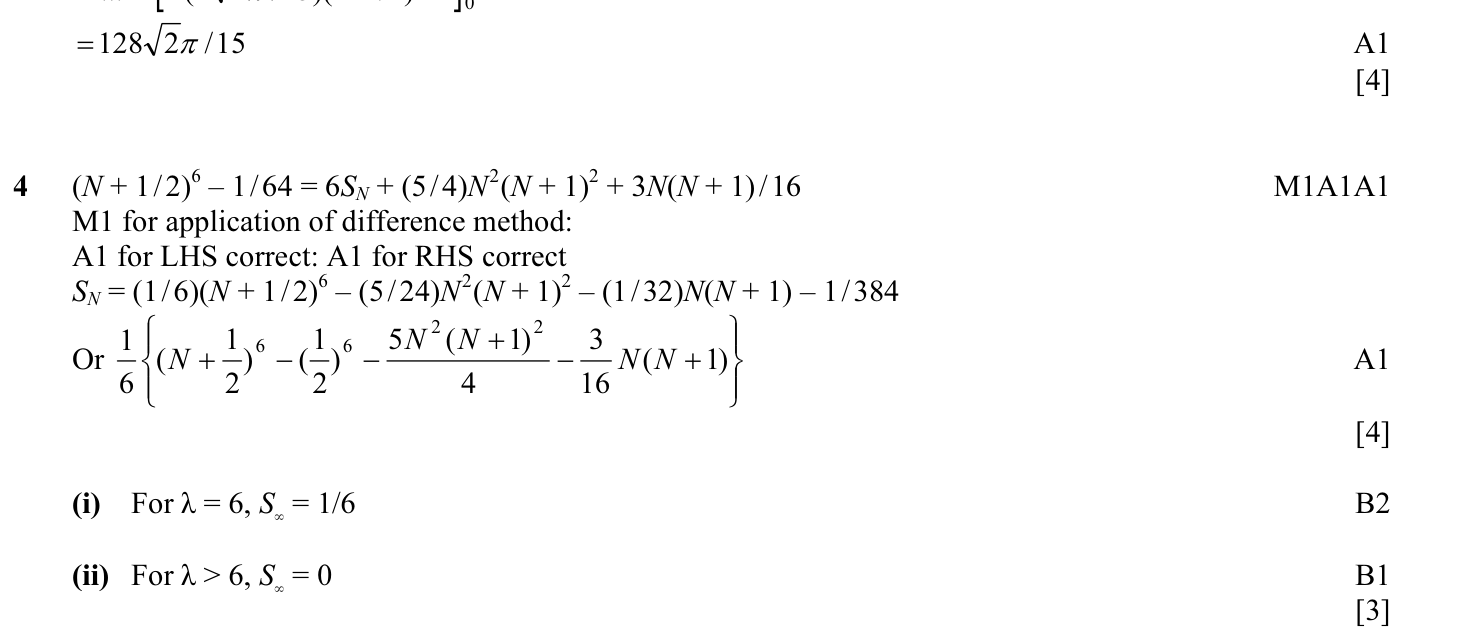
The sum \(S_{N}\) is defined by \(S_{N}=\sum_{n=1}^{N} n^{5}\). Using the identity
\(\left(n+\frac{1}{2}\right)^{6}-\left(n-\frac{1}{2}\right)^{6} \equiv 6 n^{5}+5 n^{3}+\frac{3}{8} n\)
find \(S_{N}\) in terms of \(N\). [You need not simplify your result.]
Hence find \(\lim _{N \rightarrow \infty} N^{-\lambda} S_{N}\), for each of the two cases
(i) \(\lambda=6\),
(ii) \(\lambda\gt 6\).
9231 P13 - Jun 2011 - Q1 - 5 marks
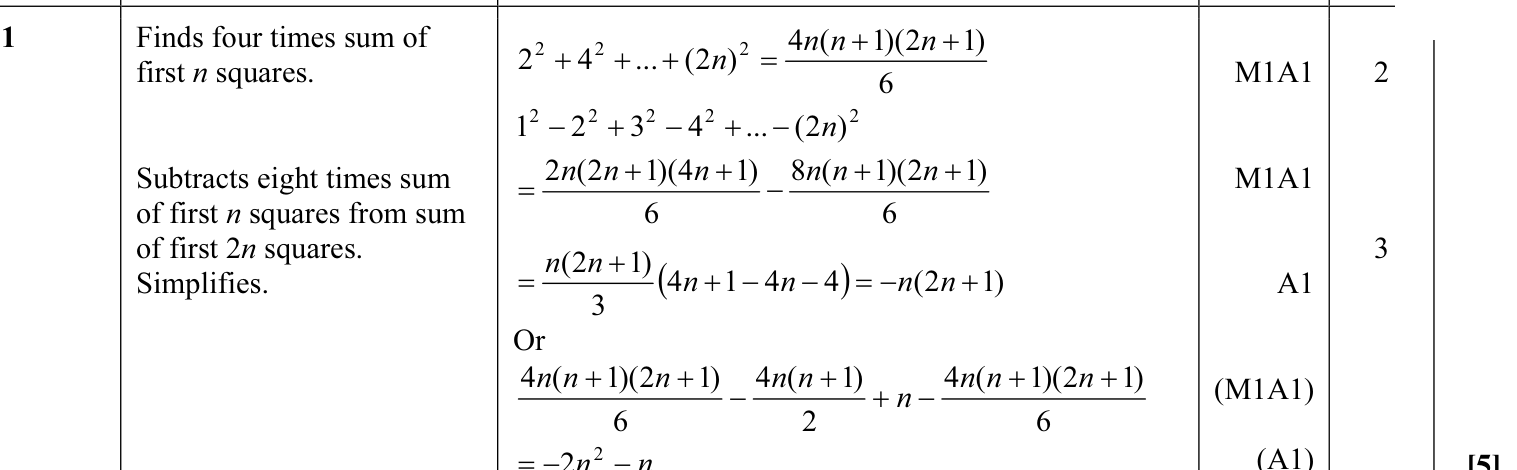
Find \(2^{2}+4^{2}+\ldots+(2 n)^{2}\).
Hence find \(1^{2}-2^{2}+3^{2}-4^{2}+\ldots-(2 n)^{2}\), simplifying your answer.
9231 P13 - Nov 2011 - Q1 - 6 marks
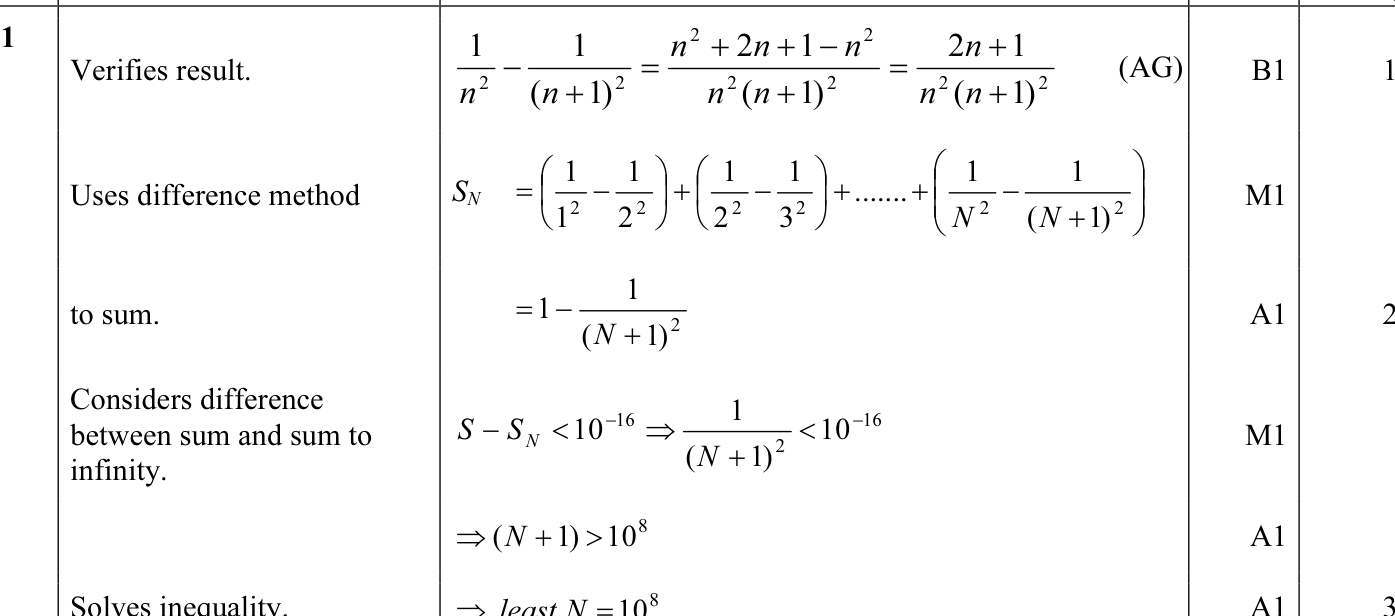
\(\mathbf{1}\) Verify that \(\frac{1}{n^{2}}-\frac{1}{(n+1)^{2}}=\frac{2 n+1}{n^{2}(n+1)^{2}}\).
Let \(S_{N}=\sum_{r=1}^{N} \frac{2 r+1}{r^{2}(r+1)^{2}}\). Express \(S_{N}\) in terms of \(N\).
Let \(S=\lim _{N \rightarrow \infty} S_{N}\). Find the least value of \(N\) such that \(S-S_{N}\lt 10^{-16}\).