9231 P12 - Nov 2023 - Q07 - 16 marks
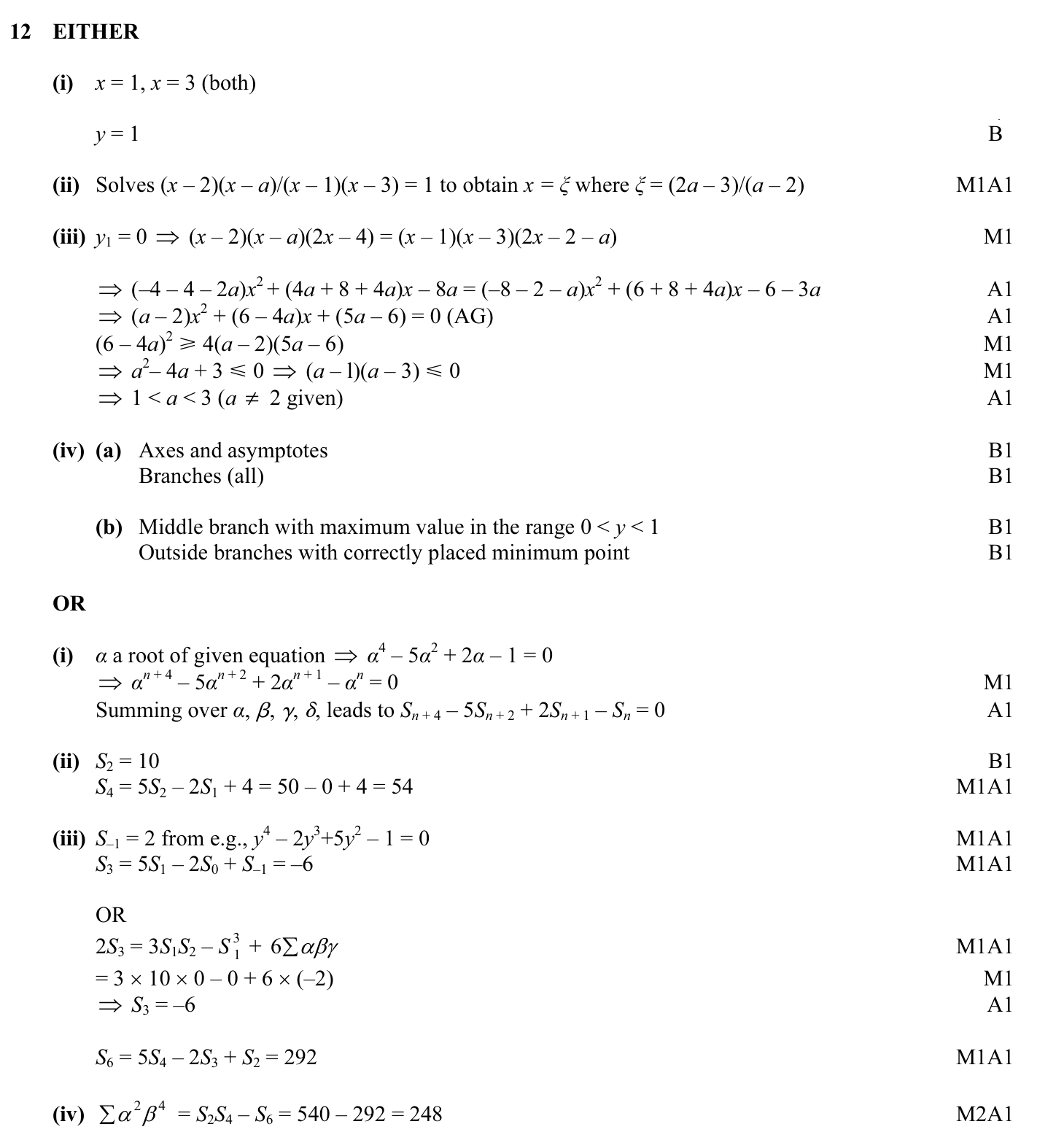
The curve C has equation \(y = f(x)\), where \(f(x) = \frac{x^2}{x+1}\).
- Find the equations of the asymptotes of C.
- Find the coordinates of any stationary points on C.
- Sketch C.
- Find the coordinates of any stationary points on the curve with equation \(y = \frac{1}{f(x)}\).
- Sketch the curve with equation \(y = \frac{1}{f(x)}\) and find, in exact form, the set of values for which \(\frac{1}{f(x)} > f(x)\).
9231 P11 - Nov 2022 - Q07 - 16 marks
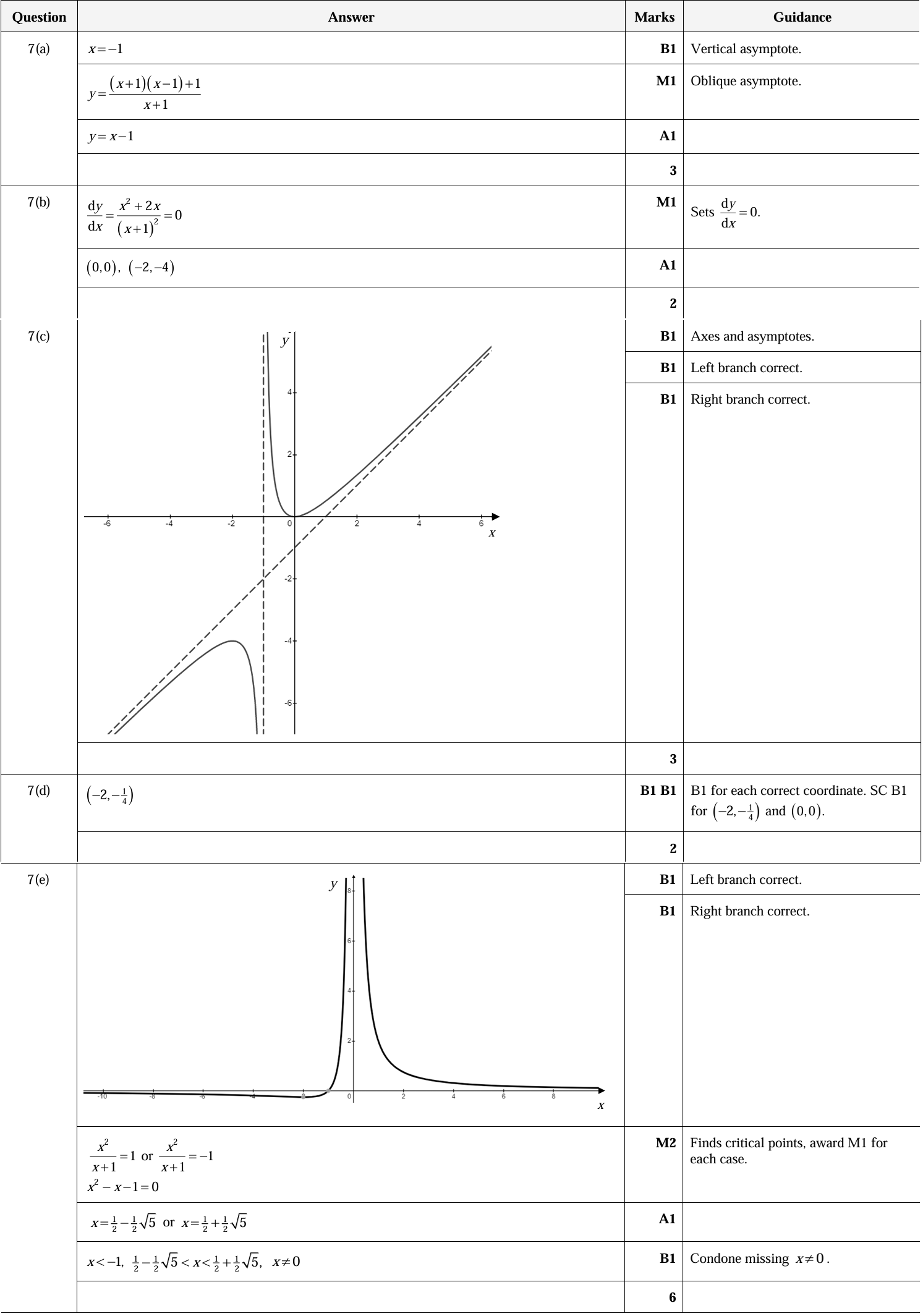
The curve \(C\) has equation \(y = \frac{5x^2}{5x-2}\).
- Find the equations of the asymptotes of \(C\).
- Find the coordinates of the stationary points on \(C\).
- Sketch \(C\).
- Sketch the curve with equation \(y = \left| \frac{5x^2}{5x-2} \right|\) and find in exact form the set of values of \(x\) for which \(\left| \frac{5x^2}{5x-2} \right| < 2\).
9231 P11 - Jun 2020 - Q1 - 6 marks
1 Let \(a\) be a positive constant.
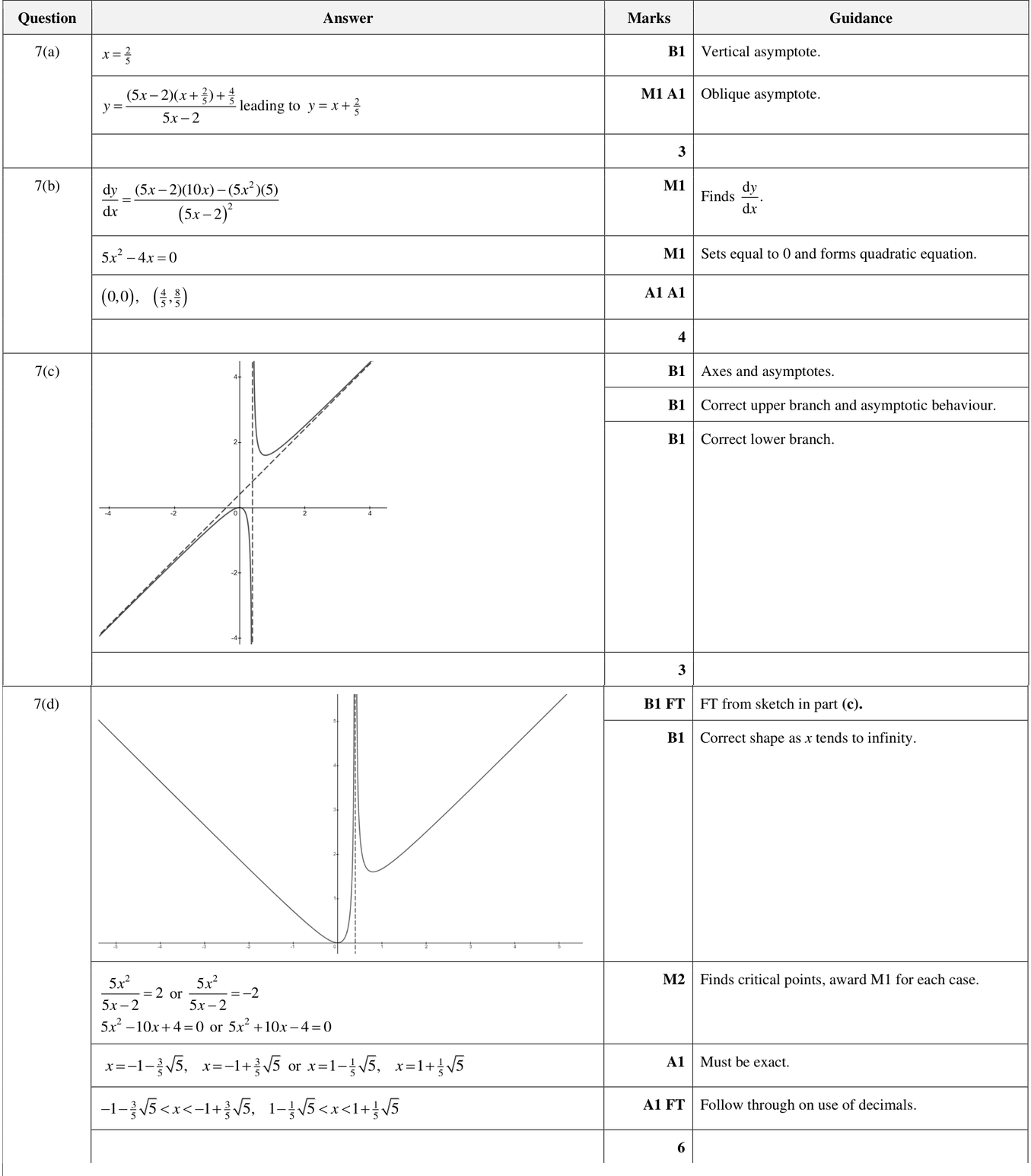
(a) Sketch the curve with equation \(y=\frac{a x}{x+7}\).
(b) Sketch the curve with equation \(y=\left|\frac{a x}{x+7}\right|\) and find the set of values of \(x\) for which \(\left|\frac{a x}{x+7}\right|>\frac{a}{2}\).
9231 P11 - Nov 2025 - Q7 - 14 marks
(a) The curve \(C\) has equation \(y=\frac{x+2}{x^2+3x+1}\). Find the equations of the asymptotes of \(C\).
(b) Show that \(C\) has no stationary points.
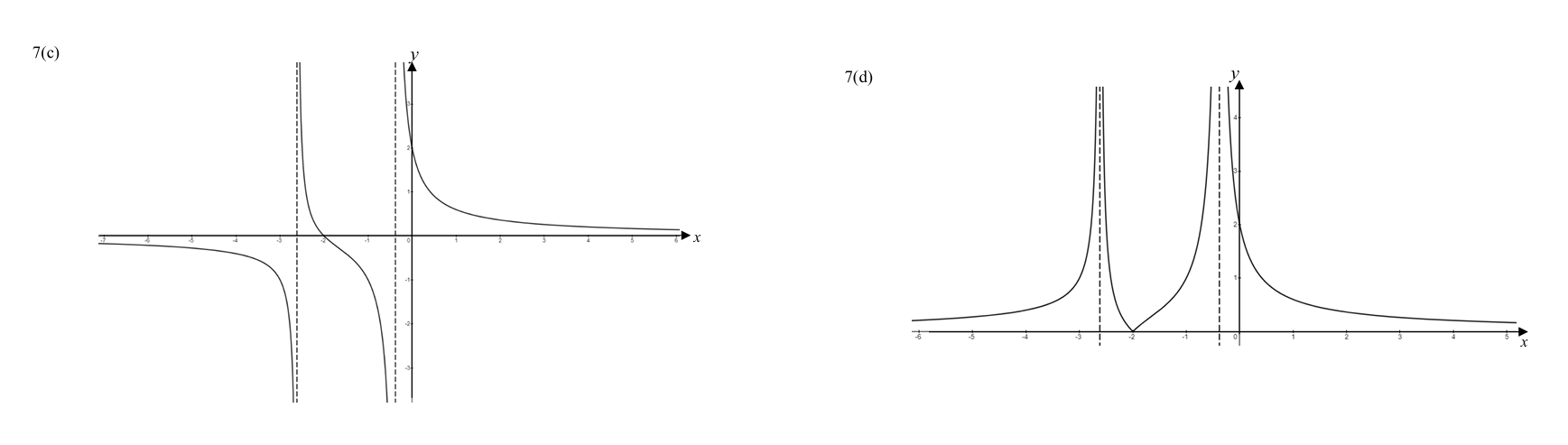
(c) Sketch \(C\), stating the coordinates of the intersections with the axes.
(d) Sketch the curve \(y=\left|\frac{x+2}{x^2+3x+1}\right|\).
(e) Find in exact form the set of values of \(x\) for which \(\left|\frac{x+2}{x^2+3x+1}\right|>2\).
9231 P12 - Nov 2025 - Q7 - 14 marks
(a) The curve \(C\) has equation \(y=\dfrac{x^2+x+1}{x+1}\). Find the equations of the asymptotes of \(C\).
(b) Find the coordinates of any stationary points on \(C\).
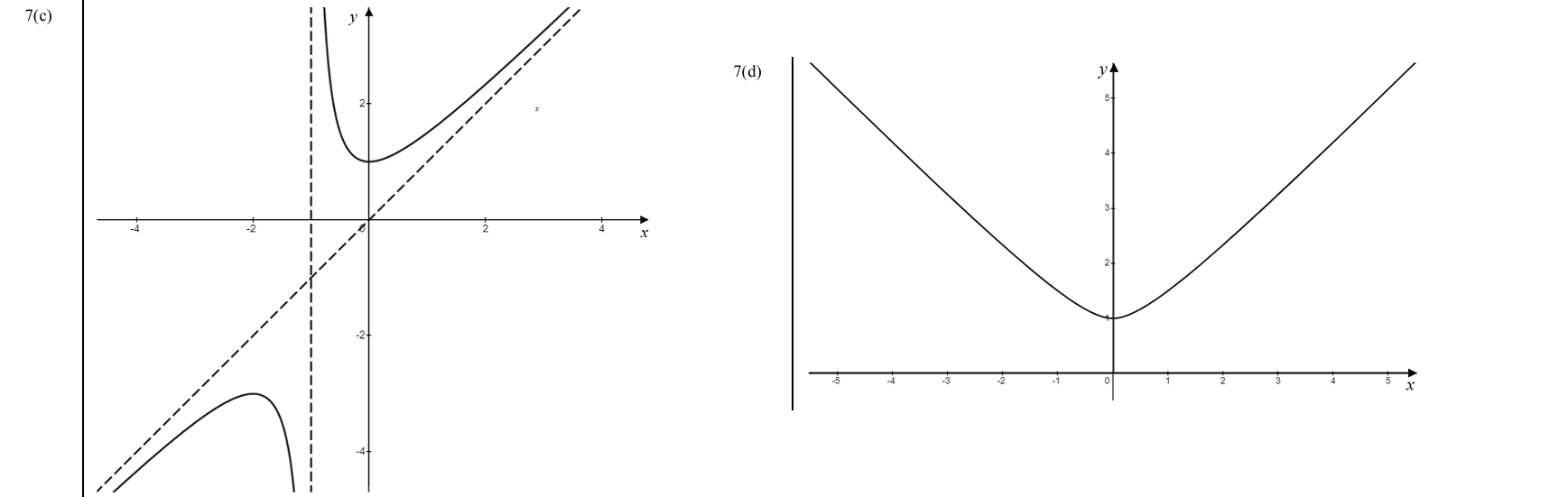
(c) Sketch \(C\).
(d) Sketch the curve with equation \(y=\dfrac{|x|^2+|x|+1}{|x|+1}\).
(e) Find, in exact form, the set of values of \(x\) for which \(\dfrac{|x|^2+|x|+1}{|x|+1}<3\).
9231 P11 - Nov 2015 - Q8 - 11 marks
The curve \(C\) has equation \(y=\frac{2 x^{2}+k x}{x+1}\), where \(k\) is a constant. Find the set of values of \(k\) for which \(C\) has no stationary points.
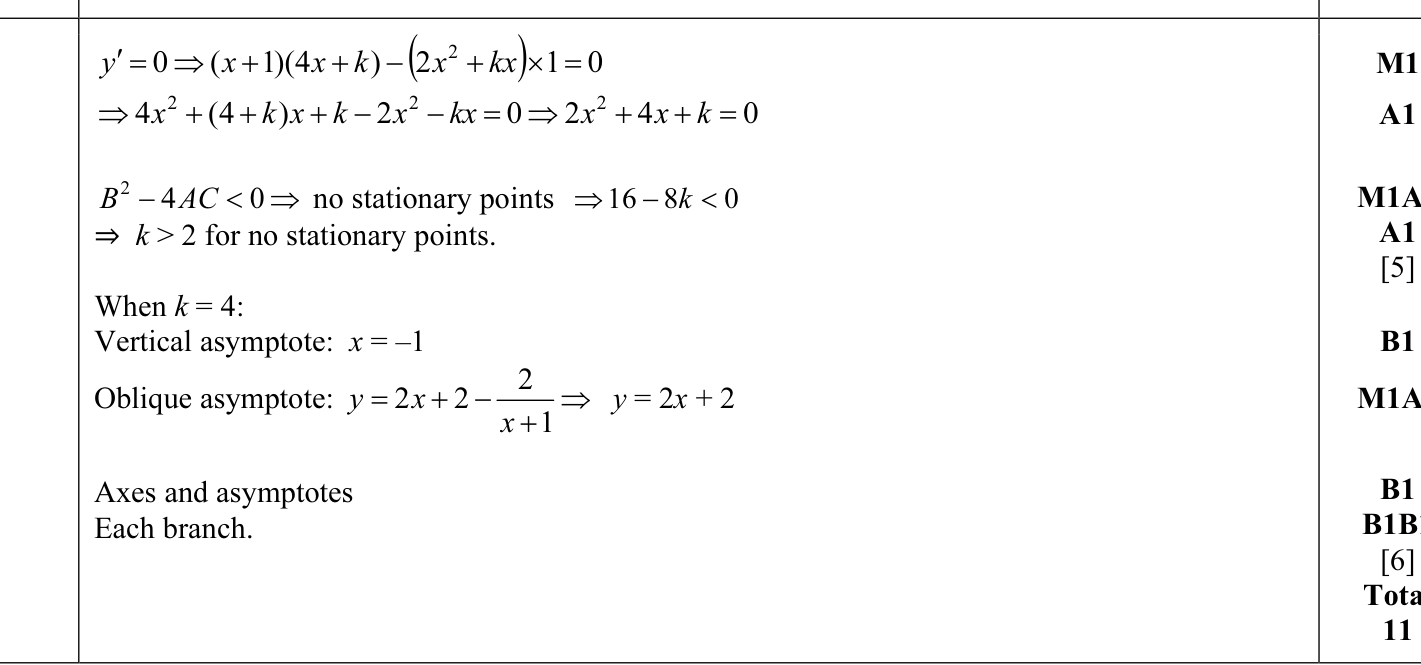
For the case \(k=4\), find the equations of the asymptotes of \(C\) and sketch \(C\), indicating the coordinates of the points where \(C\) intersects the coordinate axes.
9231 P13 - Jun 2015 - Q10 - 11 marks
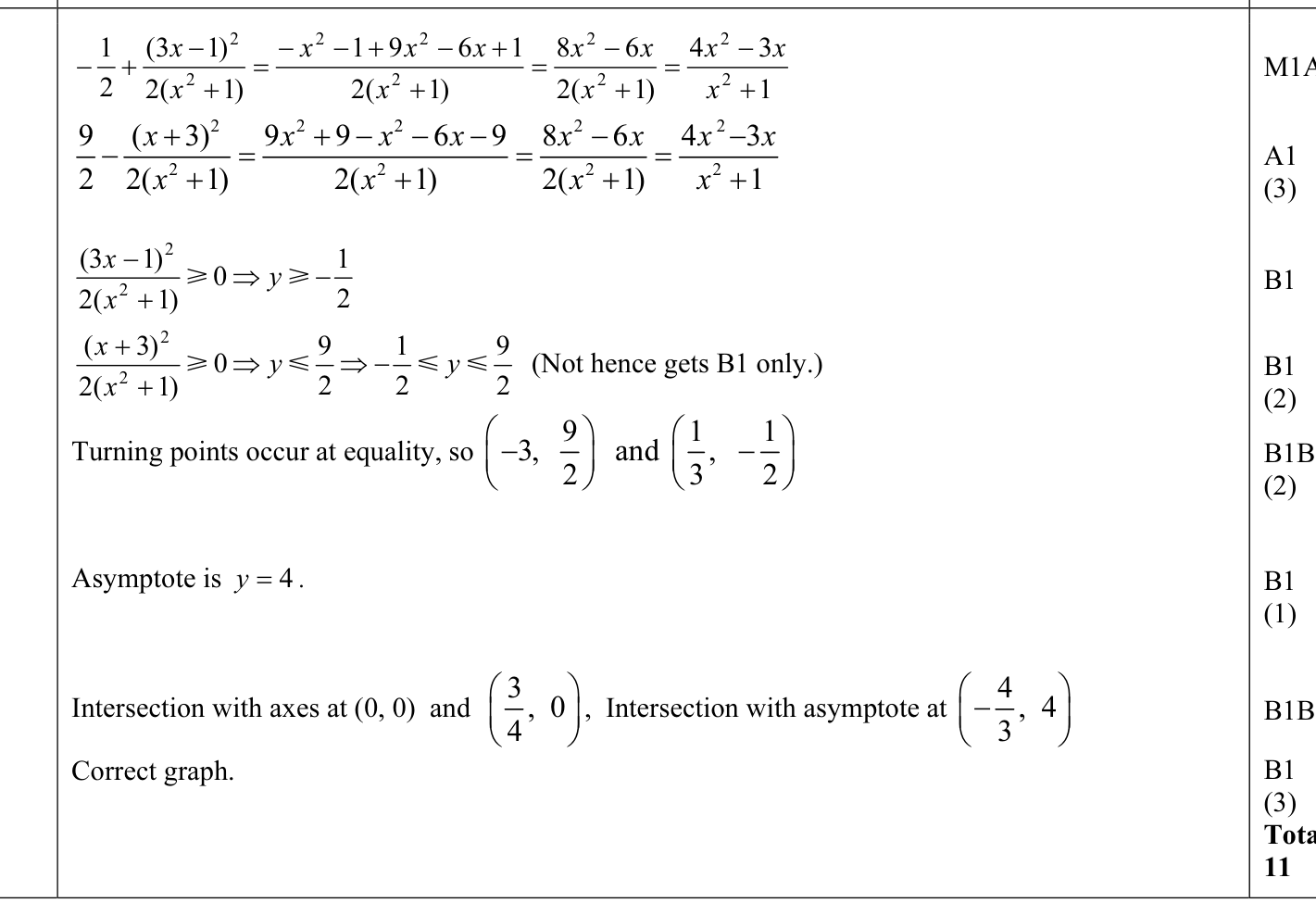
The curve \(C\) has equation \(y=\frac{4 x^{2}-3 x}{x^{2}+1}\). Verify that the equation of \(C\) may be written in the form \(y=-\frac{1}{2}+\frac{(3 x-1)^{2}}{2\left(x^{2}+1\right)}\) and also in the form \(y=\frac{9}{2}-\frac{(x+3)^{2}}{2\left(x^{2}+1\right)}\).
Hence show that \(-\frac{1}{2} \leqslant y \leqslant \frac{9}{2}\).
Without differentiating, write down the coordinates of the turning points of \(C\).
State the equation of the asymptote of \(C\).
Sketch the graph of \(C\), stating the coordinates of the intersections with the coordinate axes and the asymptote.
[Question 11 is printed on the next page.]
9231 P1 - Nov 2008 - Q12 - 28 marks
Answer only one of the following two alternatives.
EITHER
The curve \(C\) has equation
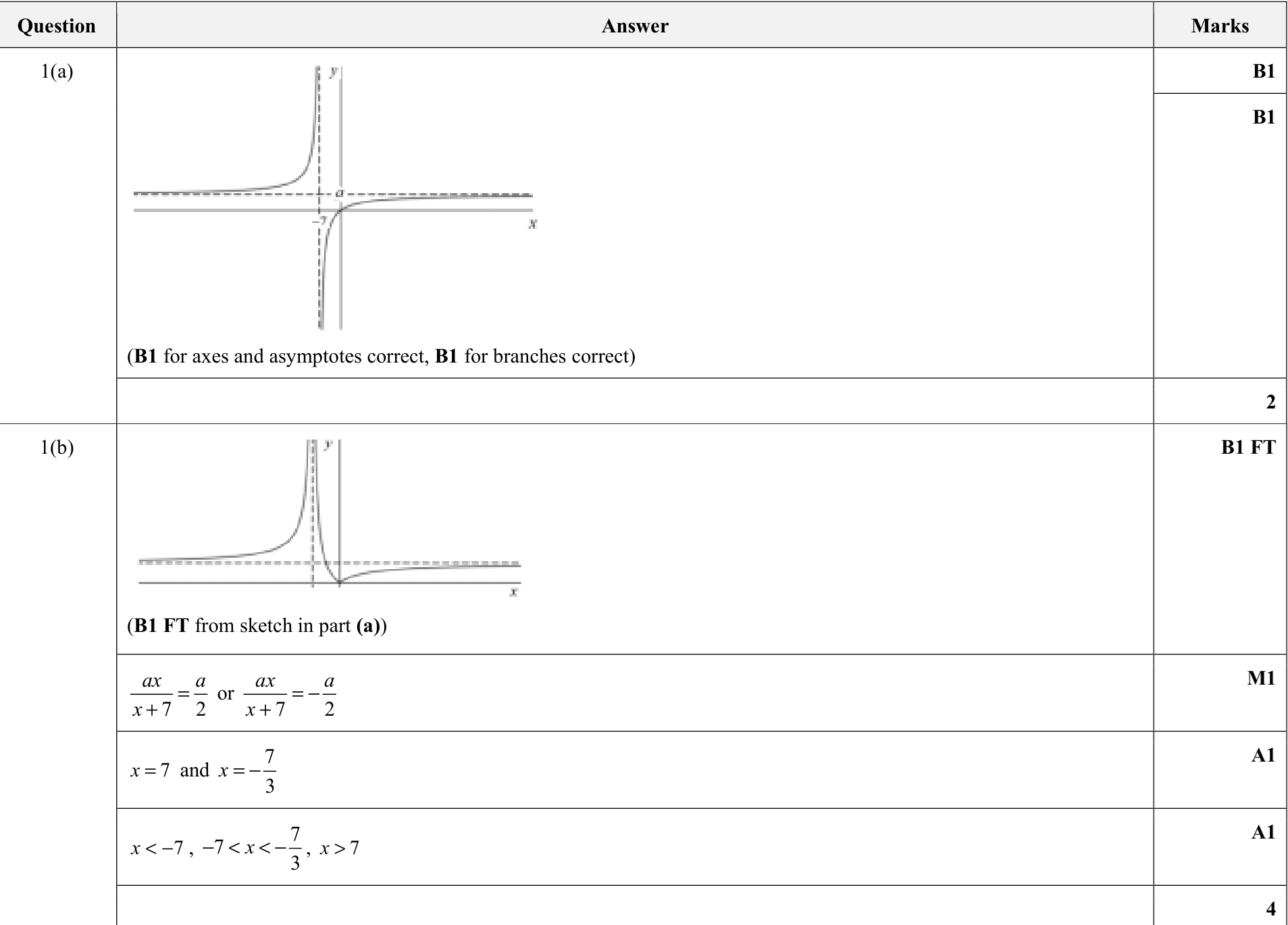
\(y=\frac{(x-2)(x-a)}{(x-1)(x-3)}\)
where \(a\) is a constant not equal to 1,2 or 3 .
(i) Write down the equations of the asymptotes of \(C\).
(ii) Show that \(C\) meets the asymptote parallel to the \(x\)-axis at the point where \(x=\frac{2 a-3}{a-2}\).
(iii) Show that the \(x\)-coordinates of any stationary points on \(C\) satisfy
\((a-2) x^{2}+(6-4 a) x+(5 a-6)=0\)
and hence find the set of values of \(a\) for which \(C\) has stationary points.
(iv) Sketch the graph of \(C\) for
(a) \(a\gt 3\),
(b) \(2\lt a\lt 3\).
OR
The roots of the equation
\(x^{4}-5 x^{2}+2 x-1=0\)
are \(\alpha, \beta, \gamma, \delta\). Let \(S_{n}=\alpha^{n}+\beta^{n}+\gamma^{n}+\delta^{n}\).
(i) Show that
\(S_{n+4}-5 S_{n+2}+2 S_{n+1}-S_{n}=0\)
(ii) Find the values of \(S_{2}\) and \(S_{4}\).
(iii) Find the value of \(S_{3}\) and hence find the value of \(S_{6}\).
(iv) Hence find the value of
\(\alpha^{2}\left(\beta^{4}+\gamma^{4}+\delta^{4}\right)+\beta^{2}\left(\gamma^{4}+\delta^{4}+\alpha^{4}\right)+\gamma^{2}\left(\delta^{4}+\alpha^{4}+\beta^{4}\right)+\delta^{2}\left(\alpha^{4}+\beta^{4}+\gamma^{4}\right) .\)