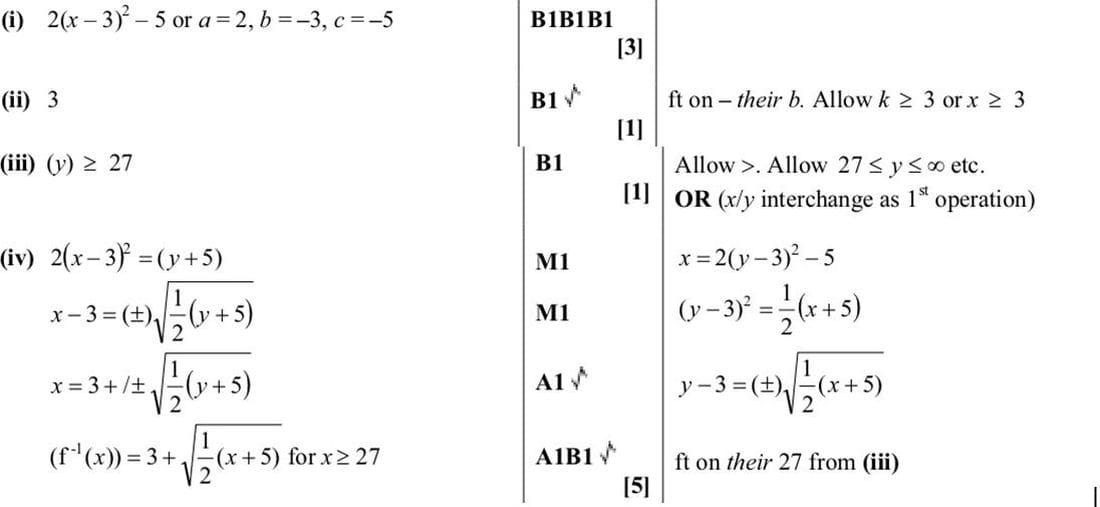
9709 P13 - Nov 2023 - Q7
The function \(f\) is defined by \(f(x) = 1 + \frac{3}{x-2}\) for \(x > 2\).
(a) State the range of \(f\).
(b) Obtain an expression for \(f^{-1}(x)\) and state the domain of \(f^{-1}\).
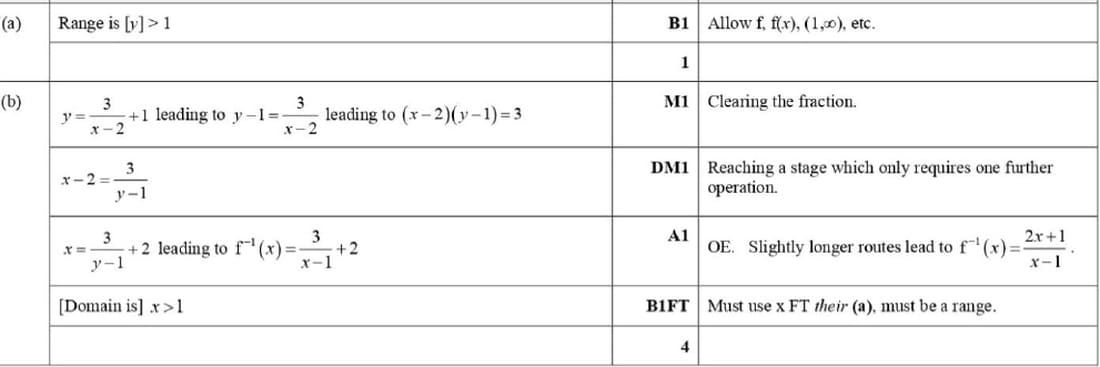
9709 P12 - Nov 2012 - Q2
A function \(f\) is such that \(f(x) = \sqrt{\frac{x+3}{2}} + 1\), for \(x \geq -3\). Find
(i) \(f^{-1}(x)\) in the form \(ax^2 + bx + c\), where \(a, b\) and \(c\) are constants,
(ii) the domain of \(f^{-1}\).
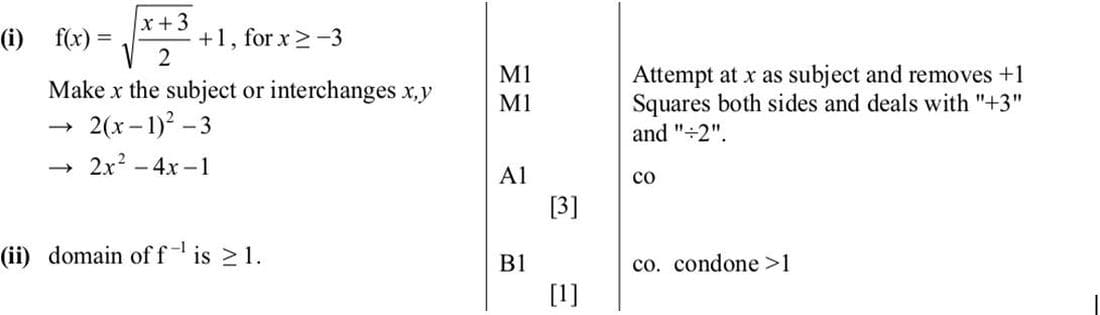
9709 P11 - Nov 2012 - Q10
The function f is defined by \(f(x) = 4x^2 - 24x + 11\), for \(x \in \mathbb{R}\).
(i) Express \(f(x)\) in the form \(a(x-b)^2 + c\) and hence state the coordinates of the vertex of the graph of \(y = f(x)\). [4]
The function g is defined by \(g(x) = 4x^2 - 24x + 11\), for \(x \leq 1\).
(ii) State the range of \(g\). [2]
(iii) Find an expression for \(g^{-1}(x)\) and state the domain of \(g^{-1}\). [4]
9709 P12 - Nov 2009 - Q8
The function \(f\) is such that \(f(x) = \frac{3}{2x+5}\) for \(x \in \mathbb{R}, x \neq -2.5\).
Obtain an expression for \(f^{-1}(x)\).

9709 P1 - Jun 2008 - Q6
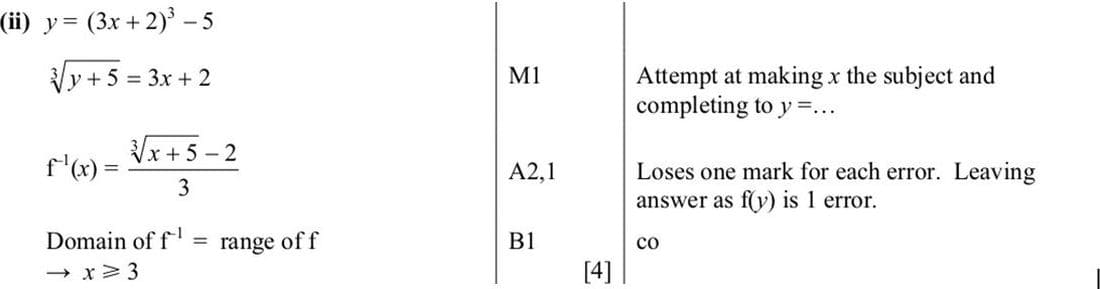
The function \(f\) is such that \(f(x) = (3x + 2)^3 - 5\) for \(x \geq 0\).
Obtain an expression for \(f^{-1}(x)\) and state the domain of \(f^{-1}\).
9709 P1 - Nov 2007 - Q11
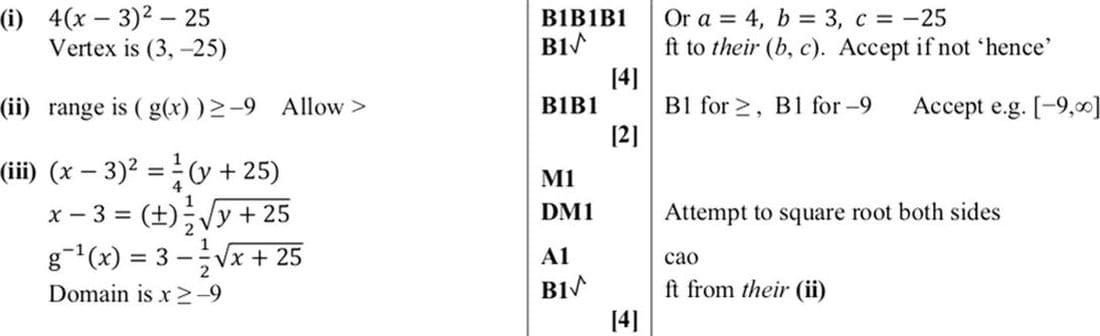
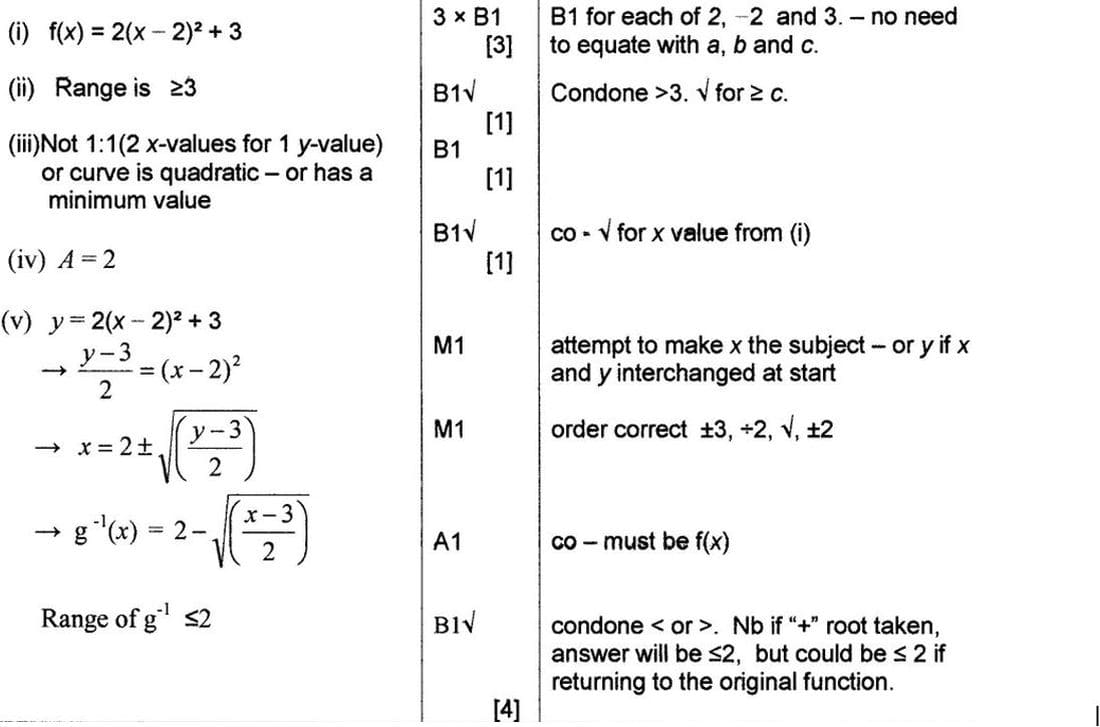
The function f is defined by \(f : x \mapsto 2x^2 - 8x + 11\) for \(x \in \mathbb{R}\).
(i) Express \(f(x)\) in the form \(a(x + b)^2 + c\), where \(a, b\) and \(c\) are constants.
(ii) State the range of \(f\).
(iii) Explain why \(f\) does not have an inverse.
The function \(g\) is defined by \(g : x \mapsto 2x^2 - 8x + 11\) for \(x \leq A\), where \(A\) is a constant.
(iv) State the largest value of \(A\) for which \(g\) has an inverse.
(v) When \(A\) has this value, obtain an expression, in terms of \(x\), for \(g^{-1}(x)\) and state the range of \(g^{-1}\).
9709 P1 - Nov 2005 - Q8
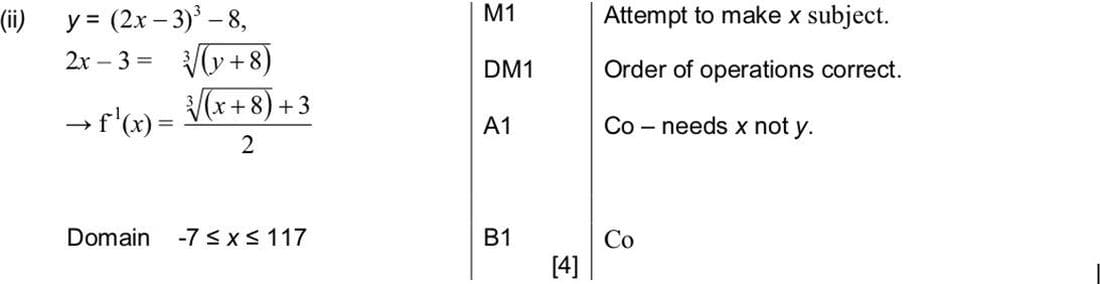
A function f is defined by f : x ↦ (2x − 3)3 − 8, for 2 ≤ x ≤ 4.
Find an expression, in terms of x, for f−1(x) and find the domain of f−1.
9709 P1 - Nov 2004 - Q9
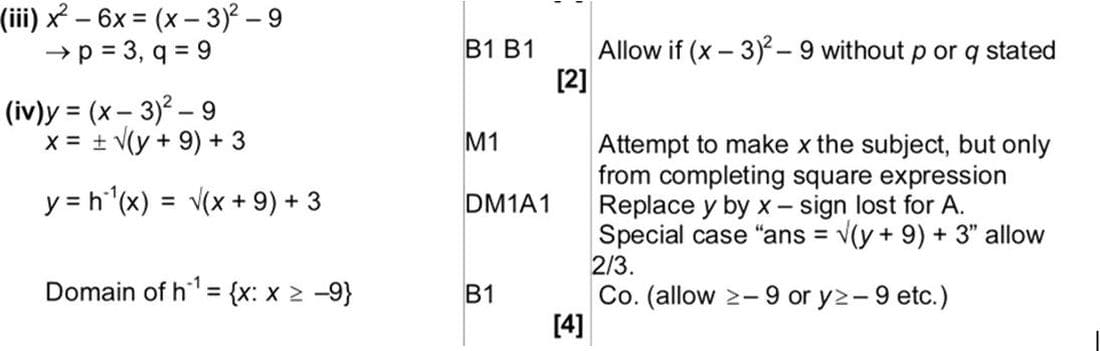
The function \(h : x \mapsto x^2 - 6x\) is defined for the domain \(x \geq 3\).
(iii) Express \(x^2 - 6x\) in the form \((x-p)^2 - q\), where \(p\) and \(q\) are constants.
(iv) Find an expression for \(h^{-1}(x)\) and state the domain of \(h^{-1}\).
9709 P1 - Jun 2003 - Q11
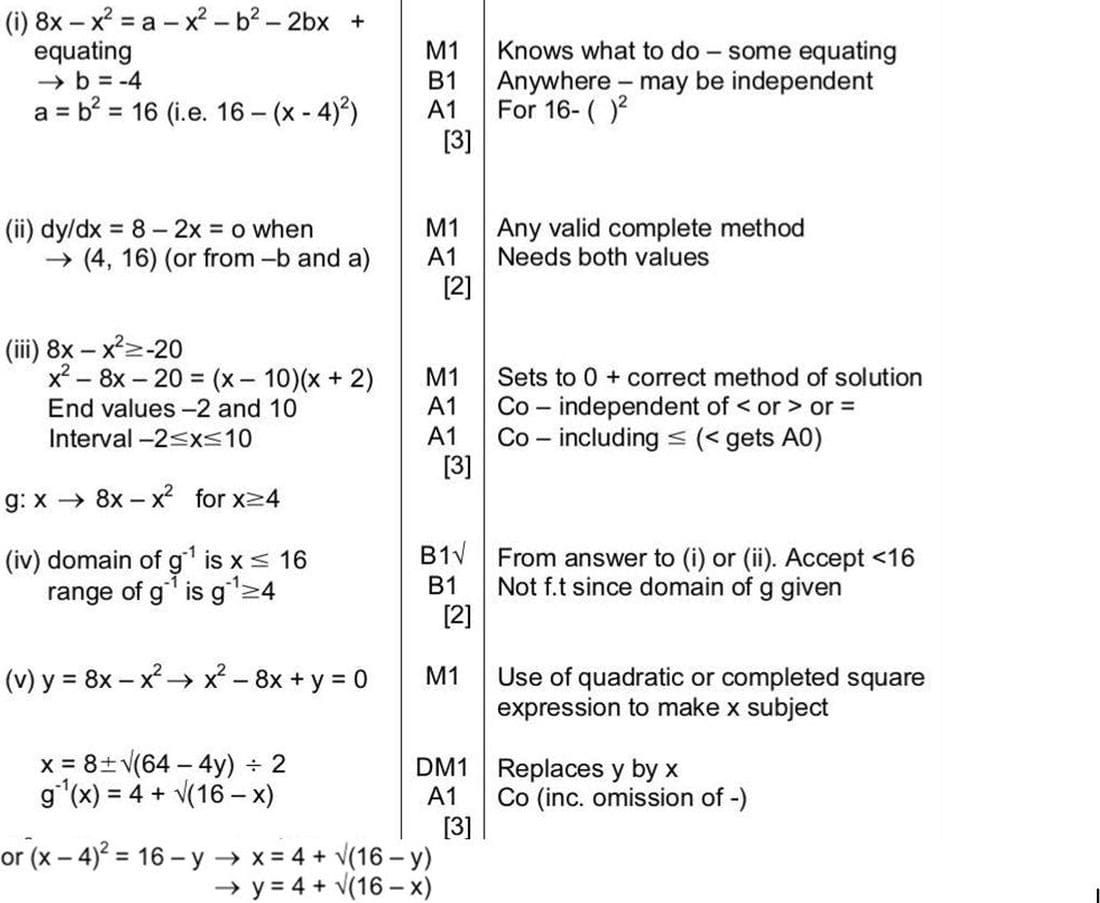
The equation of a curve is \(y = 8x - x^2\).
(i) Express \(8x - x^2\) in the form \(a - (x + b)^2\), stating the numerical values of \(a\) and \(b\).
(ii) Hence, or otherwise, find the coordinates of the stationary point of the curve.
(iii) Find the set of values of \(x\) for which \(y \geq -20\).
The function \(g\) is defined by \(g : x \mapsto 8x - x^2\), for \(x \geq 4\).
(iv) State the domain and range of \(g^{-1}\).
(v) Find an expression, in terms of \(x\), for \(g^{-1}(x)\).
9709 P12 - Nov 2023 - Q8
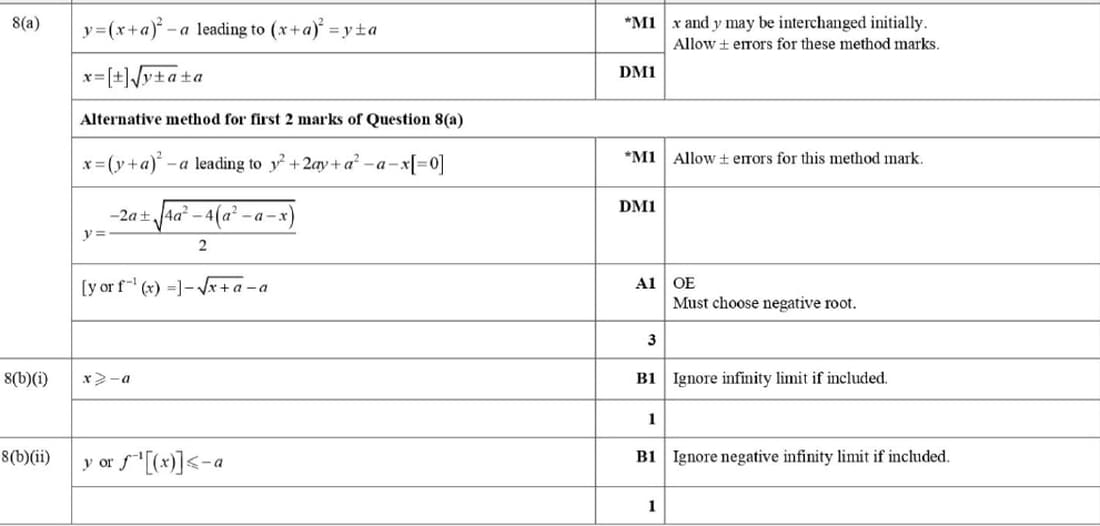
Given the function \(f(x) = (x + a)^2 - a\) for \(x \leq -a\), where \(a\) is a positive constant:
(a) Find an expression for \(f^{-1}(x)\).
(b) (i) State the domain of the function \(f^{-1}\).
(ii) State the range of the function \(f^{-1}\).
9709 P13 - Jun 2023 - Q7
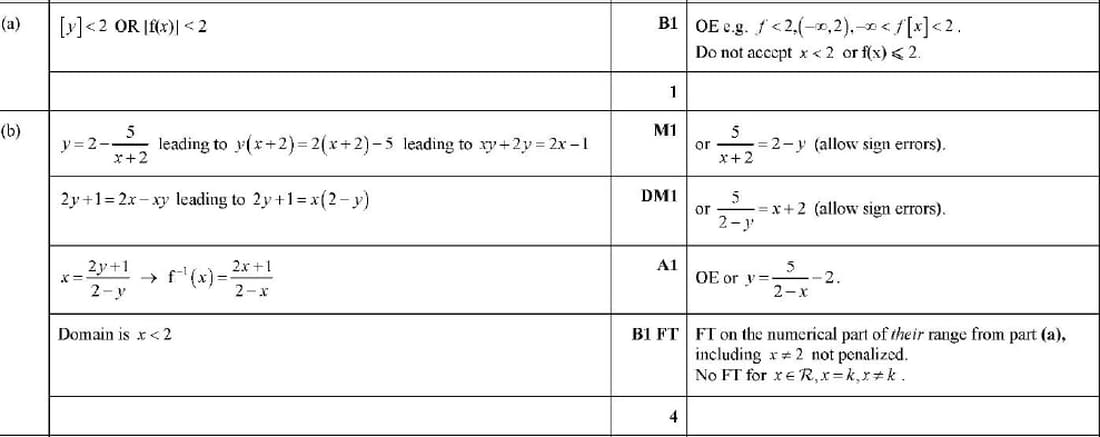
The function \(f\) is defined by \(f(x) = 2 - \frac{5}{x+2}\) for \(x > -2\).
(a) State the range of \(f\).
(b) Obtain an expression for \(f^{-1}(x)\) and state the domain of \(f^{-1}\).
9709 P13 - Nov 2019 - Q2
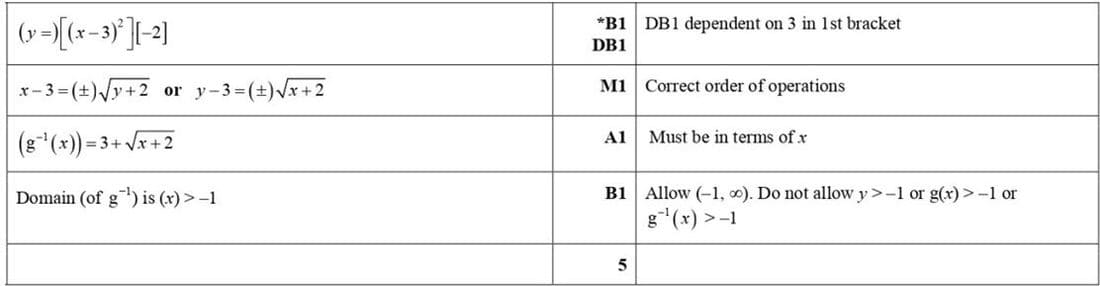
The function \(g\) is defined by \(g(x) = x^2 - 6x + 7\) for \(x > 4\). By first completing the square, find an expression for \(g^{-1}(x)\) and state the domain of \(g^{-1}\).
9709 P13 - Jun 2017 - Q9
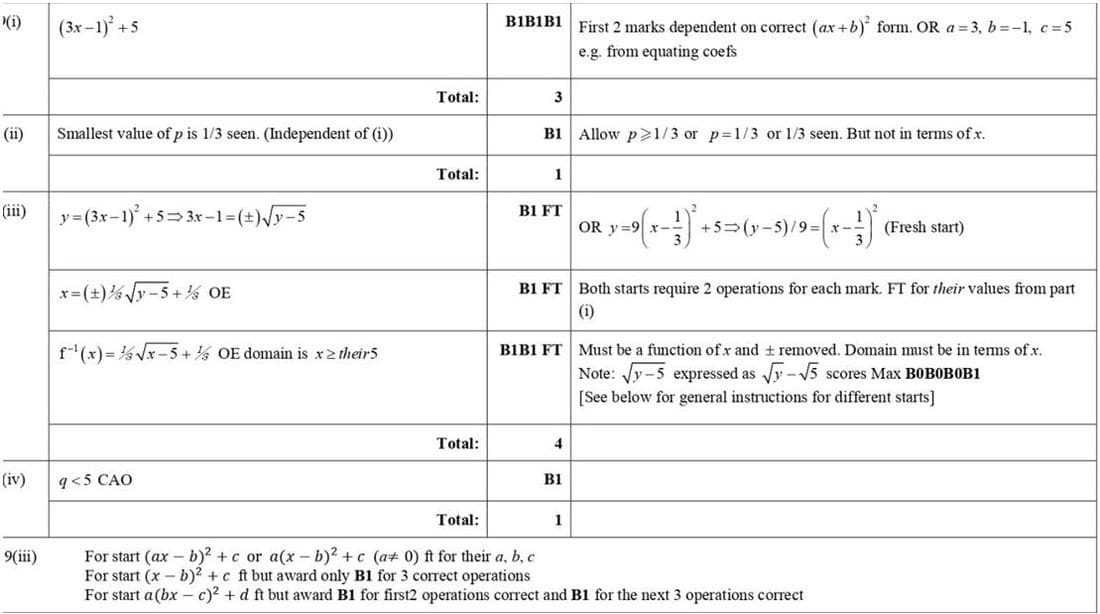
(i) Express \(9x^2 - 6x + 6\) in the form \((ax + b)^2 + c\), where \(a, b\) and \(c\) are constants.
The function \(f\) is defined by \(f(x) = 9x^2 - 6x + 6\) for \(x \geq p\), where \(p\) is a constant.
(ii) State the smallest value of \(p\) for which \(f\) is a one-one function.
(iii) For this value of \(p\), obtain an expression for \(f^{-1}(x)\), and state the domain of \(f^{-1}\).
(iv) State the set of values of \(q\) for which the equation \(f(x) = q\) has no solution.
9709 P11 - Nov 2015 - Q9
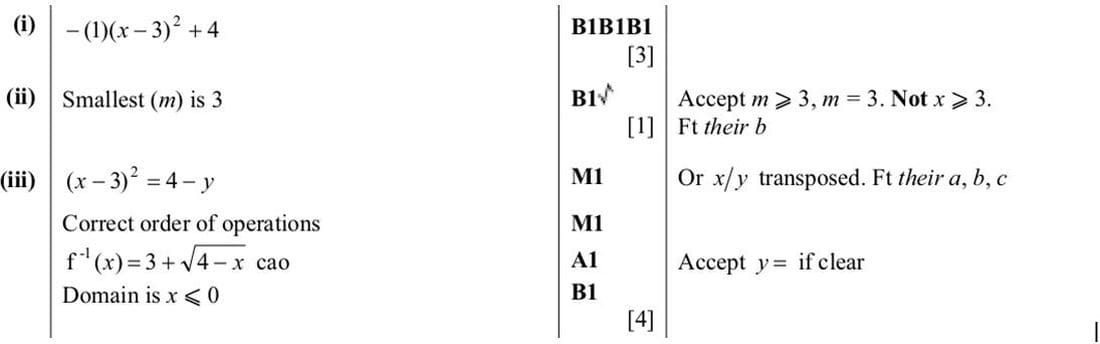
(i) Express \(-x^2 + 6x - 5\) in the form \(a(x + b)^2 + c\), where \(a, b\) and \(c\) are constants.
The function \(f : x \mapsto -x^2 + 6x - 5\) is defined for \(x \geq m\), where \(m\) is a constant.
(ii) State the smallest value of \(m\) for which \(f\) is one-one.
(iii) For the case where \(m = 5\), find an expression for \(f^{-1}(x)\) and state the domain of \(f^{-1}\).
9709 P13 - Jun 2014 - Q5
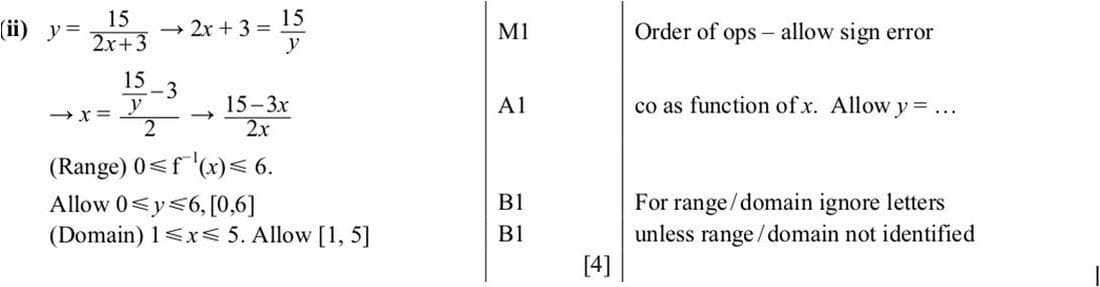
A function \(f\) is such that \(f(x) = \frac{15}{2x+3}\) for \(0 \leq x \leq 6\).
Find an expression for \(f^{-1}(x)\), and state the domain and range of \(f^{-1}\).
9709 P12 - Jun 2013 - Q9
A function \(f\) is defined by \(f(x) = \frac{5}{1 - 3x}\), for \(x \geq 1\).
Find an expression for \(f^{-1}(x)\), and state the domain and range of \(f^{-1}\).

9709 P11 - Jun 2013 - Q8
(i) Express \(2x^2 - 12x + 13\) in the form \(a(x + b)^2 + c\), where \(a, b\) and \(c\) are constants.
(ii) The function \(f\) is defined by \(f(x) = 2x^2 - 12x + 13\) for \(x \geq k\), where \(k\) is a constant. It is given that \(f\) is a one-one function. State the smallest possible value of \(k\).
The value of \(k\) is now given to be 7.
(iii) Find the range of \(f\).
(iv) Find an expression for \(f^{-1}(x)\) and state the domain of \(f^{-1}\).