9709 P42 - Jun 2026 - Q1
A car of mass \(960\text{ kg}\) is moving on a straight horizontal road. There is a constant force of magnitude \(620\text{ N}\) resisting the motion of the car.
(a) Calculate the power developed by the engine of the car when it is moving at a constant speed of \(25\text{ m s}^{-1}\).
(b) Given that the power is suddenly increased by \(12\text{ kW}\), find the instantaneous acceleration of the car.
9709 P42 - Jun 2026 - Q2
Two particles, \(A\) and \(B\), of masses \(2.5\text{ kg}\) and \(3.5\text{ kg}\) respectively are at rest on a straight smooth horizontal track. Particle \(B\) is situated \(9\text{ m}\) from a vertical wall which is fixed at right angles to the track.
Particle \(A\) is projected directly towards \(B\) with a speed of \(3\text{ m s}^{-1}\). In the subsequent motion, \(A\) collides and coalesces with \(B\) to form particle \(C\). Particle \(C\) then collides directly with the wall and rebounds. The collision of \(C\) with the wall reduces the speed of \(C\) by \(25\%\).
(a) Find the speed of \(C\) after it rebounds from the wall.
(b) Hence find the time from the instant at which \(A\) and \(B\) collide until \(C\) is once again a distance of \(9\text{ m}\) from the wall.
9709 P42 - Jun 2026 - Q3
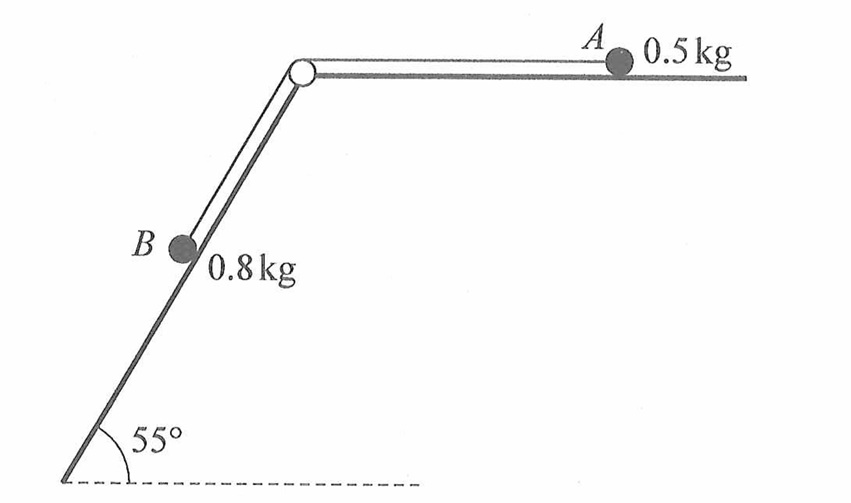
Two particles, \(A\) and \(B\), of masses \(0.5\text{ kg}\) and \(0.8\text{ kg}\) respectively are attached to the ends of a light inextensible string. The string passes over a small smooth pulley fixed at the end of a rough horizontal plane and to the top of a smooth inclined plane. Particle \(A\) is held on the horizontal plane, while \(B\) lies on the inclined plane, which makes an angle of \(55^\circ\) with the horizontal. The string is in the same vertical plane as a line of greatest slope of the inclined plane (see diagram).
Particle \(A\) is released from rest with the string taut. Particle \(B\) moves \(0.3\text{ m}\) down the inclined plane in \(0.4\text{ s}\).
(a) Find the tension in the string.
(b) Find the coefficient of friction between \(A\) and the horizontal plane.
(c) After \(B\) has been moving for \(0.4\text{ s}\), the string suddenly breaks. Given that \(A\) subsequently comes to rest on the horizontal plane, find the work done by the frictional force in bringing \(A\) to rest.
You may assume that \(A\) does not reach the pulley.
9709 P42 - Jun 2026 - Q4
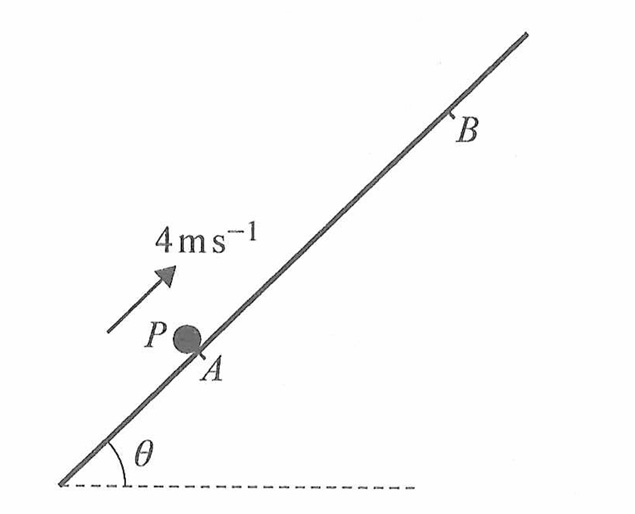
A particle \(P\) is projected from a point \(A\) with speed \(4\text{ m s}^{-1}\) up a line of greatest slope of a rough plane inclined at an angle \(\theta\) to the horizontal, where \(\tan\theta=\frac43\).
\(P\) comes to instantaneous rest at a point \(B\) on the plane (see diagram).
The coefficient of friction between \(P\) and the plane is \(\frac13\).
(a) Using an energy method, show that the distance \(AB\) is \(0.8\text{ m}\).
(b) After coming to instantaneous rest at \(B\), the particle slides down the plane.
Find the total time from the instant at which \(P\) is projected from \(A\) until it returns to \(A\).
9709 P42 - Jun 2026 - Q5
The points \(A\) and \(B\) are at the same vertical height \(h\text{ m}\) above horizontal ground. A particle \(P\) is released from rest from \(A\). One second later, a particle \(Q\) is projected vertically downwards from \(B\) with speed \(18\text{ m s}^{-1}\).
Given that \(P\) and \(Q\) reach the ground at the same time, find the value of \(h\).
9709 P42 - Jun 2026 - Q6
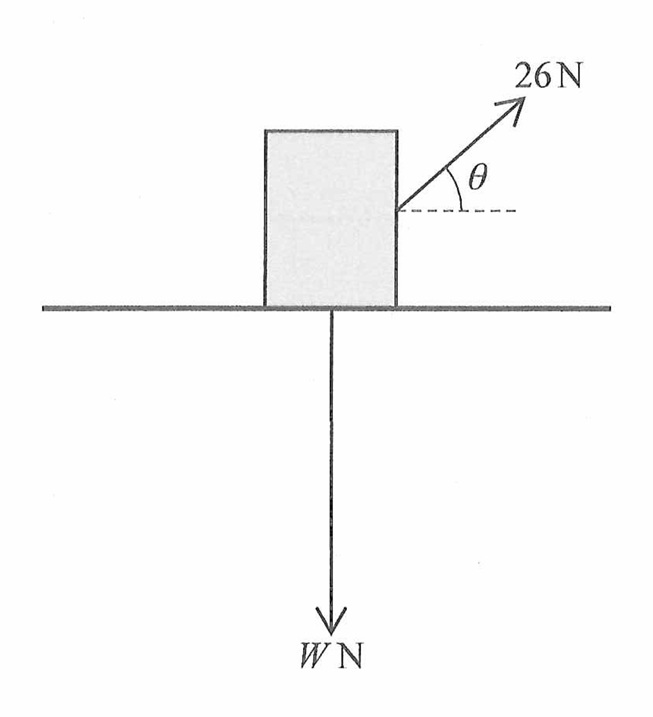
A crate of weight \(W\text{ N}\) is at rest on rough horizontal ground. The crate is pulled at a constant acceleration of \(1.5\text{ m s}^{-2}\) along the ground in a straight line by a light rope. The rope is inclined at an angle of \(\theta\) to the horizontal, where \(\theta=\sin^{-1}\frac5{13}\). The tension in the rope is \(26\text{ N}\) (see diagram). The coefficient of friction between the crate and the ground is \(0.25\).
(a) Find the value of \(W\).
(b) When the crate reaches a point \(A\), the rope is removed. The speed of the crate at \(A\) is \(8\text{ m s}^{-1}\).
The crate comes to rest at a point \(B\).
Find the distance \(AB\).
9709 P42 - Jun 2026 - Q7
A particle \(P\) moves in a straight line. The velocity \(v\text{ m s}^{-1}\) of \(P\) at time \(t\text{ s}\), where \(t\geq0\), is given by
\[ v=k_1(4t+1)^{\frac12}-\frac14(2t+1)^2+k_2, \]
where \(k_1\) and \(k_2\) are constants. When \(t=1.25\) the deceleration of \(P\) is \(0.5\text{ m s}^{-2}\).
(a) Find the value of \(k_1\).
(b) Given that \(P\) is only at instantaneous rest when \(t=3.5\), find the distance travelled by \(P\) in the interval \(0\leq t\leq1\).