9709 P32 - Mar 2026 - Q1
Solve the equation \(4\times2^{x+2}-5\times2^{2-x}=3\). Give your answer correct to \(3\) significant figures.
9709 P32 - Mar 2026 - Q2
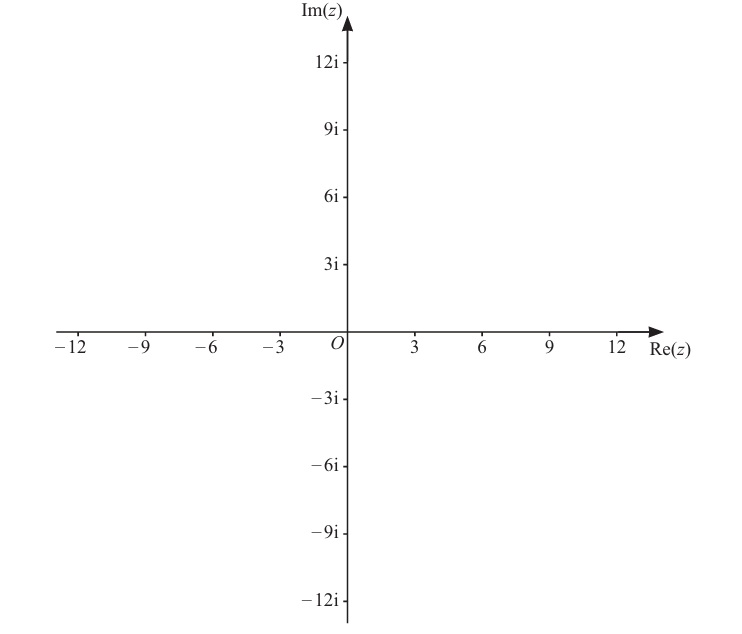
The complex number \(z\) satisfies \(|z|=9\) and \(\frac12\pi\leq \arg z<\pi\).
(a) On the Argand diagram, sketch the locus of the points representing \(z\).
(b) On the same diagram, sketch the locus of the points representing \(z^*+3\).
9709 P32 - Mar 2026 - Q3
Find the exact value of
\[ \int_{\frac14\pi}^{\frac13\pi} 3\sin x\sin2x\,dx. \]
Give your answer in the form \(p\sqrt3+q\sqrt2\), where \(p\) and \(q\) are rational.
9709 P32 - Mar 2026 - Q4
The coefficient of \(x^3\) in the expansion of \((1-ax)^{\frac25}\) is \(1\).
(a) Find the value of \(a\).
(b) Hence, find the coefficient of \(x^4\) in the expansion of \((2x+1)(1-ax)^{\frac25}\).
(c) State the set of values of \(x\) for which the expansion in 4(b) is valid.
9709 P32 - Mar 2026 - Q5
It is given that \(z=\frac{3+\lambda i}{\lambda+2i}\), where \(\lambda\) is a real constant.
(a) Find the value of \(\lambda\) for which \(\arg z=\frac14\pi\).
(b) When \(\lambda\) has the value found in 5(a), find the exact value of \(|z|\), making your method clear.
9709 P32 - Mar 2026 - Q6
The polynomial \(2x^4+ax^3+4x^2+bx-3\) is denoted by \(p(x)\).
It is given that \((x^2+x+1)\) is a factor of \(p(x)\).
(a) Find the values of \(a\) and \(b\).
(b) Hence, show that \((x+3)\) is a factor of \(p(x)\).
9709 P32 - Mar 2026 - Q7
(a) By sketching a suitable pair of graphs, show that the equation \(\ln x=\operatorname{cosec}\frac12x\) has exactly one root in the interval \(0<x<\pi\).
(b) Verify by calculation that this root lies between \(2.6\) and \(2.9\).
(c) Use the iterative formula \(x_{n+1}=\exp\left(\operatorname{cosec}\frac12x_n\right)\) to determine the root correct to \(3\) decimal places.
Give the result of each iteration to \(5\) decimal places.
\([\exp(x)\text{ is an alternative notation for }e^x.]\)
9709 P32 - Mar 2026 - Q8
The variables \(x\) and \(y\) satisfy the differential equation
\[ ye^{3x}\frac{dy}{dx}=x(y+5). \]
It is given that \(y=0\) when \(x=0\).
Solve the differential equation to obtain an equation in \(x\) and \(y\).
9709 P32 - Mar 2026 - Q9
Let
\[ I=\int_1^3\frac{x^3}{3+x^2}\,dx. \]
(a) Using the substitution \(x=\sqrt3\tan u\), show that \(I=\int_{\frac16\pi}^{\frac13\pi}3\tan^3u\,du\).
(b) Hence, or otherwise, find the exact value of \(I\). Give your answer in the form \(p+q\ln r\), where \(p\), \(q\) and \(r\) are rational.
9709 P32 - Mar 2026 - Q10
The variables \(x\) and \(y\) satisfy the equation \(y^2=k\frac{x-2}{x+2}\), where \(k\) is a constant.
(a) Show that \(\frac{dy}{dx}=\frac{2y}{x^2-4}\).
(b) Given that \(k=5\), find the angle between the tangents to the curve when \(x=3\).
Give your answer in the form \(a\tan^{-1}\left(\frac bc\right)\), where \(a\), \(b\) and \(c\) are integers.
9709 P32 - Mar 2026 - Q11
The points \(A\) and \(B\) have position vectors \(\overrightarrow{OA}=2i+2j-k\) and \(\overrightarrow{OB}=4i+2j+4k\) relative to the origin, \(O\).
(a) Show that the perpendicular distance from \(A\) to the line through \(O\) and \(B\) is \(\frac13\sqrt{65}\).
(b) The point \(C\) has position vector \(\overrightarrow{OC}=3i+pj+qk\), where \(p\) and \(q\) are constants.
Given that
- \(\overrightarrow{OC}\) is perpendicular to \(\overrightarrow{AB}\) and
- angle \(AOC=\) angle \(COB\),
find the values of \(p\) and \(q\).