P12 June q1
The equation of a curve is such that \( \frac{dy}{dx}=2x-6x^{\frac12} \). The curve passes through the point \( (4,-9) \).
Find the equation of the curve.
P12 June q2
(a) Describe fully a sequence of two transformations which transforms the graph of \( y=f(x) \) to the graph of \( y=f(4-x) \).
(b) The curve with equation \( y=x^3-3x-4 \) is stretched with scale factor \( \frac12 \) in the \(x\)-direction and then translated by \( \begin{pmatrix}0\\-3\end{pmatrix} \).
Find and simplify the equation of the transformed curve.
P12 June q3
The equation of a curve is \( y=kx^2-5x-6 \), and the equation of a line is \( y=3x-7k \).
Find the set of values of the constant \(k\) for which the line intersects the curve.
P12 June q4
The coefficient of \(x^2\) in the expansion of \( (2-qx)^4-\left(1+\frac8q x\right)^6 \) is \(324\).
Find the possible values of the constant \(q\).
P12 June q5
(a) Prove the identity
\( \frac{1-\sin\theta}{\cos\theta}+\frac{\cos\theta}{1-\sin\theta}=\frac2{\cos\theta} \).
(b) Hence, solve the equation
\( \frac{1-\sin\theta}{\cos\theta}+\frac{\cos\theta}{1-\sin\theta}=\frac{\tan^3\theta}{\sin\theta} \)
for \(0^\circ\leq \theta \leq 360^\circ\).
P12 June q6
The coordinates of three points, \(P\), \(Q\) and \(R\), are \( (0,p) \), \( (8,6) \) and \( (r,10) \) respectively, where \(p\) and \(r\) are constants. It is given that \(PQ\) is perpendicular to \(QR\).
(a) Show that \(p=2r-10\).
It is further given that the length of \(PR\) is \( \sqrt{85} \).
(b) Find the possible values of \(p\) and \(r\).
P12 June q7
A curve has equation
\( y=3x^{-\frac12}-2x^{-\frac32} \).
The curve has a single stationary point when \(x=k\), where \(k>0\).
(a) Find the value of \(k\).
(b) Find \( \frac{d^2y}{dx^2} \), and hence determine whether the stationary point is a maximum or a minimum.
(c) Find the area enclosed by the curve, the \(x\)-axis and the lines \(x=k\) and \(x=4\). Give your answer in the form \(a+b\sqrt c\), where \(a\), \(b\) and \(c\) are integers to be found.
P12 June q8
An arithmetic progression has first term \(20\) and common difference \(d\). A geometric progression also has first term \(20\) and common ratio \(r\), where \(r>0\).
The third term of the geometric progression is \(5\) more than the third term of the arithmetic progression. The fifth term of the geometric progression is \(30\) more than the fifth term of the arithmetic progression.
(a) Find the value of \(r\) and the value of \(d\).
(b) Show that the ninth term of the geometric progression is \(4\) times the ninth term of the arithmetic progression.
P12 June q9
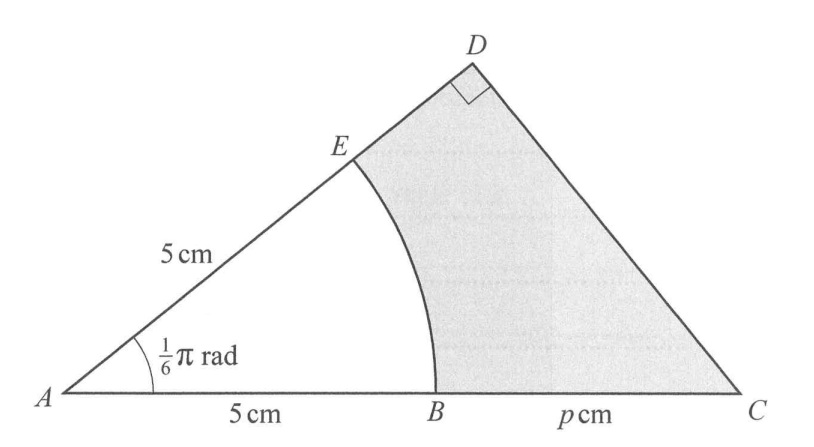
The diagram shows a triangle \(ACD\) in which \(AD\) is perpendicular to \(CD\). The arc \(BE\) of a circle with centre \(A\) and radius \(5\) cm meets \(AC\) at \(B\) and \(AD\) at \(E\). Angle \(BAE\) is \( \frac16\pi \) radians and the length \(BC=p\) cm.
(a) Given that the value of \(p\) is \(4\), find the exact perimeter of the shaded region. Give your answer in terms of \( \pi \) and \( \sqrt3 \).
(b) Given instead that the area of the shaded region is \( 8\sqrt3-\frac{25}{12}\pi \text{ cm}^2 \), find the value of \(p\).
P12 June q10
Functions \(f\) and \(g\) are defined as follows:
\( f(x)=3x-6 \quad \text{for } x>0, \)
\( g(x)=\frac4{(ax-3)^2} \quad \text{for } x>\frac3a, \)
where \(a\) is a positive constant.
(a) State the range of \(f\).
(b) Find \(g^{-1}(x)\).
(c) Given that \(a=2\), solve the equation \(g^{-1}(x)=4\).
(d) Given instead that \(fg(8)=6\), find the value of \(a\), justifying your answer.
P12 June q11
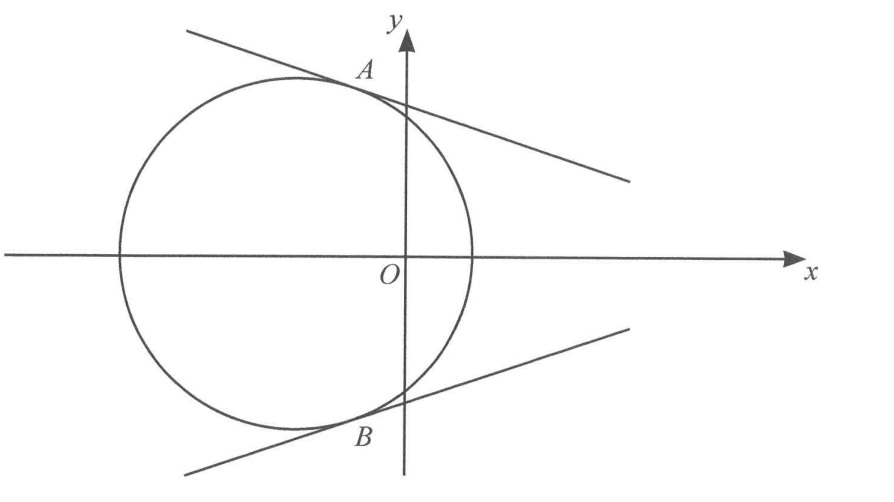
A tangent to a circle passes through the points \( (1,5) \) and \( (4,4) \) and meets the circle at the point \(A\). Another tangent to the circle has equation \(x-3y=16\) and meets the circle at the point \(B\).
(a) Find the coordinates of the point of intersection of the two tangents.
It is given that the coordinates of the centre of the circle are \( (a,0) \), where \(a<0\).
(b) Find an equation of the normal to the circle which passes through \(A\). Give your answer in terms of \(a\).
(c) It is further given that the radius of the circle is \( \sqrt{40} \).
Find an equation of the circle.