9709 P42 - Mar 2026 - Q1
A block of mass \(200\text{ kg}\) is pulled along rough horizontal ground at a constant speed of \(v\text{ m s}^{-1}\) by a horizontal rope attached to a winch. The coefficient of friction between the block and the ground is \(0.8\). The winch is working at a constant rate of \(4000\text{ W}\).
Find the value of \(v\).
9709 P42 - Mar 2026 - Q2
A cyclist starts from rest and moves in a straight line with acceleration \(0.5\text{ m s}^{-2}\) for \(10\text{ s}\). They then accelerate at \(1.5\text{ m s}^{-2}\) for a distance of \(13\text{ m}\), reaching a speed of \(v\text{ m s}^{-1}\). They then travel at speed \(v\text{ m s}^{-1}\) for \(5\text{ s}\). They then travel a distance of \(28\text{ m}\) whilst decelerating uniformly to rest.
(a) Find the value of \(v\).
(b)(i) Find the total distance travelled by the cyclist.
(b)(ii) Find the average speed of the cyclist for the whole of their motion.
9709 P42 - Mar 2026 - Q3
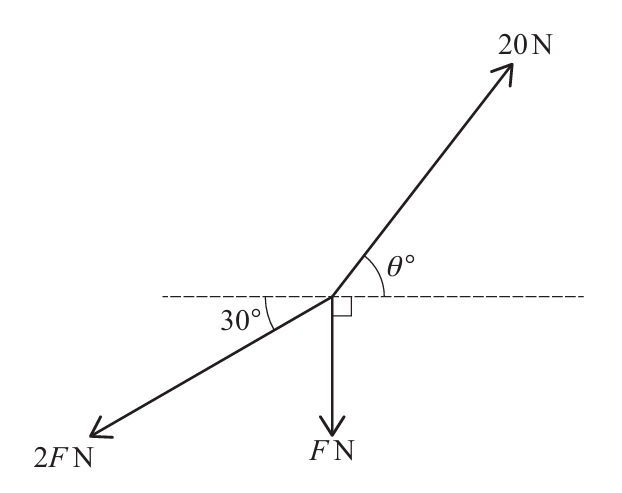
Coplanar forces of magnitudes \(F\text{ N}\), \(2F\text{ N}\) and \(20\text{ N}\) act at a point, as shown in the diagram.
Given that the forces are in equilibrium, find the value of \(F\) and the value of \(\theta\).
9709 P42 - Mar 2026 - Q4
A car of mass \(1600\text{ kg}\) passes through points \(A\) and \(B\) with speeds \(10\text{ m s}^{-1}\) and \(12\text{ m s}^{-1}\) respectively. The distance \(AB\) is \(2\text{ km}\). The heights of \(A\) and \(B\) above sea level are \(250\text{ m}\) and \(200\text{ m}\) respectively. The car’s engine does no work in moving from \(A\) to \(B\). There are two forces resisting the motion of the car, a braking force and an additional constant force of magnitude \(150\text{ N}\).
Use an energy method to find the work done by the braking force as the car moves from \(A\) to \(B\).
9709 P42 - Mar 2026 - Q5
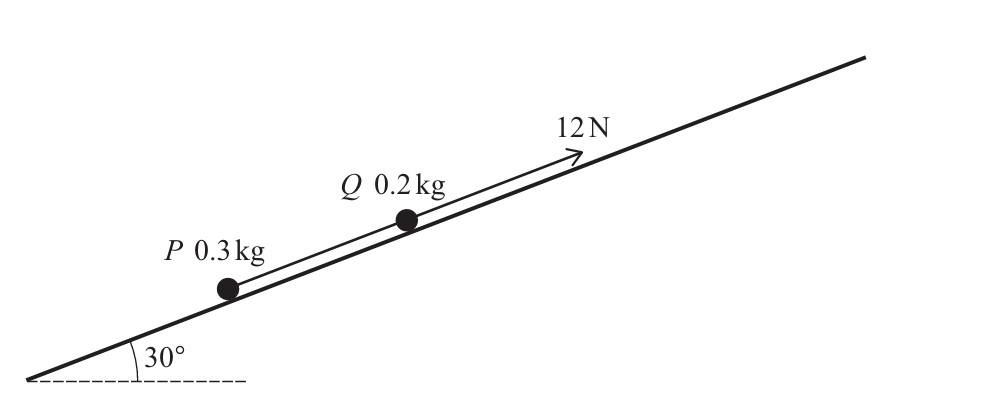
A particle \(P\) of mass \(0.3\text{ kg}\) is connected by a light inextensible string to a particle \(Q\) of mass \(0.2\text{ kg}\). The string joining the two particles is taut and is parallel to a line of greatest slope of a rough plane which is inclined at an angle of \(30^\circ\) to the horizontal. A constant force of magnitude \(12\text{ N}\) acts on \(Q\) and pulls the particles up the plane. The \(12\text{ N}\) force acts parallel to a line of greatest slope of the plane (see diagram). The coefficient of friction between each of the particles and the plane is \(0.4\).
(a) Find the magnitude of the acceleration of the particles and the tension in the string.
(b) At the instant when the speed of the particles is \(2\text{ m s}^{-1}\), the string breaks.
Find the time it takes from the instant the string breaks until \(P\) comes to instantaneous rest.
9709 P42 - Mar 2026 - Q6
Two particles \(P\) and \(Q\) of masses \(4m\text{ kg}\) and \(3m\text{ kg}\) respectively are at rest on smooth horizontal ground. \(P\) is projected directly towards \(Q\) with speed \(6.5\text{ m s}^{-1}\). After the particles collide, they move in the same direction and the speeds of \(P\) and \(Q\) are \(2\text{ m s}^{-1}\) and \(v\text{ m s}^{-1}\) respectively.
(a)(i) Show that \(v=6\).
(a)(ii) Given that the energy lost in the collision between \(P\) and \(Q\) is \(45\text{ J}\), find the value of \(m\).
After \(Q\) has moved a distance of \(9\text{ m}\) from the point at which \(P\) and \(Q\) first collided, it hits a vertical wall perpendicular to the direction of motion of \(Q\) and rebounds. The speed of \(Q\) after hitting the wall is \(0.5\text{ m s}^{-1}\).
(b) Find the distance from the wall to the point at which the second collision between \(P\) and \(Q\) occurs.
9709 P42 - Mar 2026 - Q7
A particle \(P\) travels in a straight line. The velocity of \(P\) at time \(t\text{ s}\) is \(v\text{ m s}^{-1}\), where
\[ v=t-7t^{\frac12}+12. \]
(a) Find the acceleration of \(P\) at \(t=4\).
(b) Find the values of \(t\) at which \(P\) is instantaneously at rest.
(c) Find the total distance travelled by \(P\) in the interval \(0\leq t\leq25\).