9709 P41 - Nov 2014 - Q2
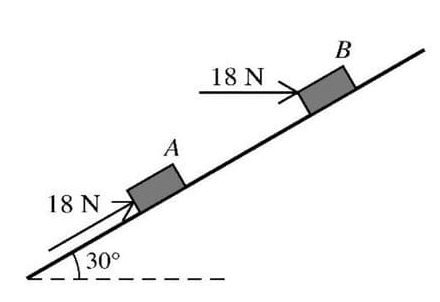
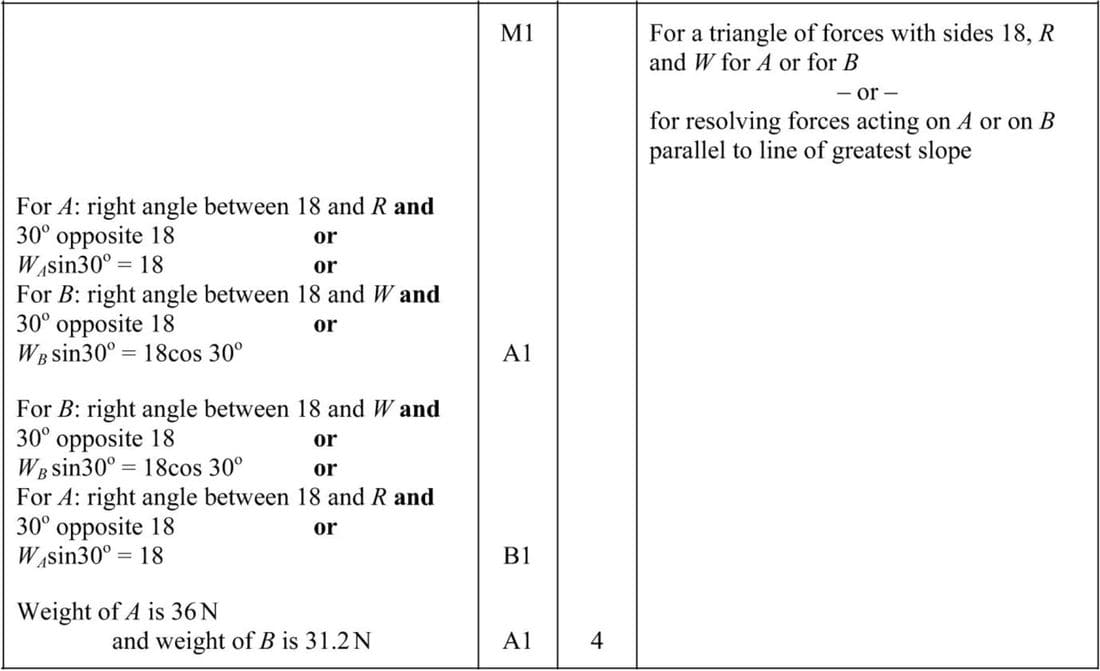
Small blocks A and B are held at rest on a smooth plane inclined at 30° to the horizontal. Each is held in equilibrium by a force of magnitude 18 N. The force on A acts upwards parallel to a line of greatest slope of the plane, and the force on B acts horizontally in the vertical plane containing a line of greatest slope (see diagram). Find the weight of A and the weight of B.
9709 P42 - Nov 2013 - Q1
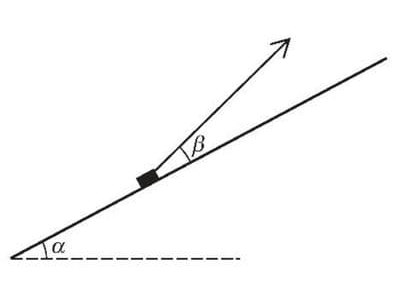
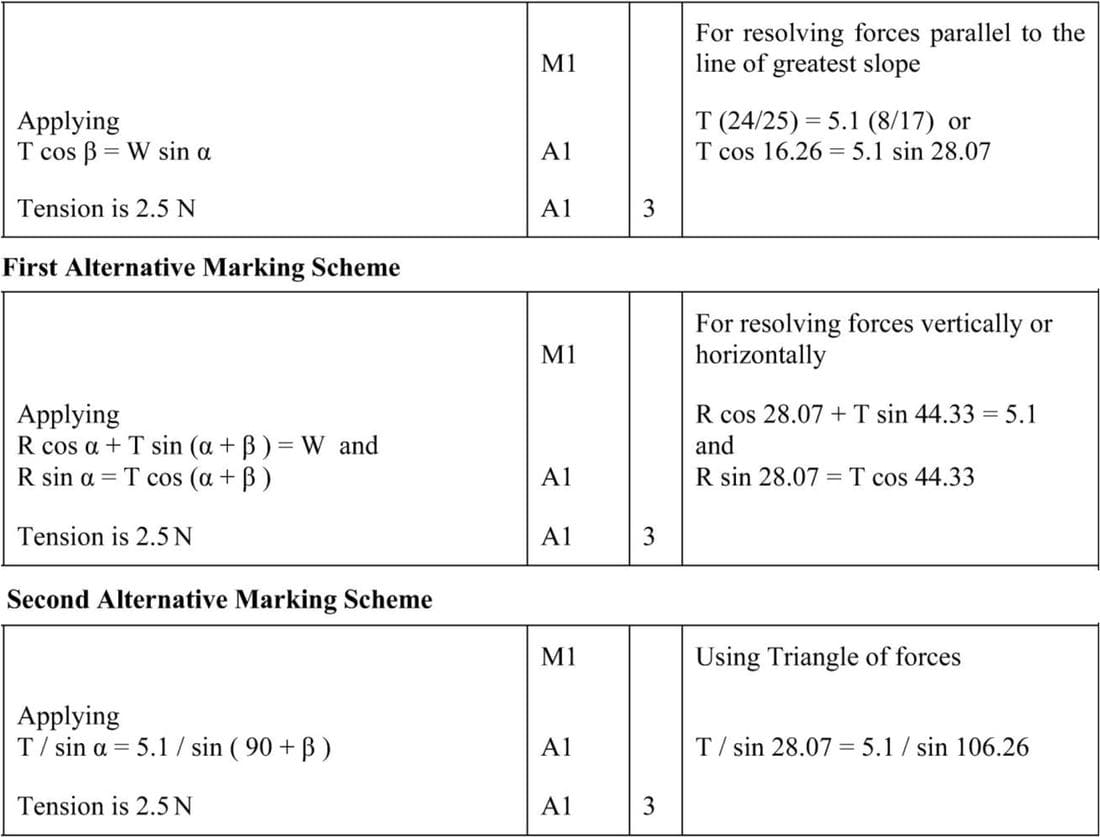
A small block of weight 5.1 N rests on a smooth plane inclined at an angle \(\alpha\) to the horizontal, where \(\sin \alpha = \frac{8}{17}\). The block is held in equilibrium by means of a light inextensible string. The string makes an angle \(\beta\) above the line of greatest slope on which the block rests, where \(\sin \beta = \frac{7}{25}\) (see diagram). Find the tension in the string.
9709 P42 - Nov 2009 - Q1
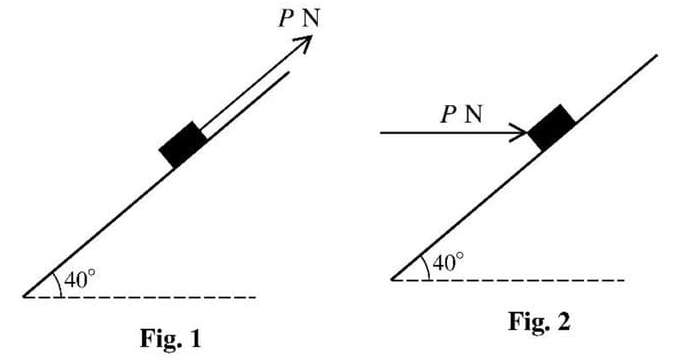
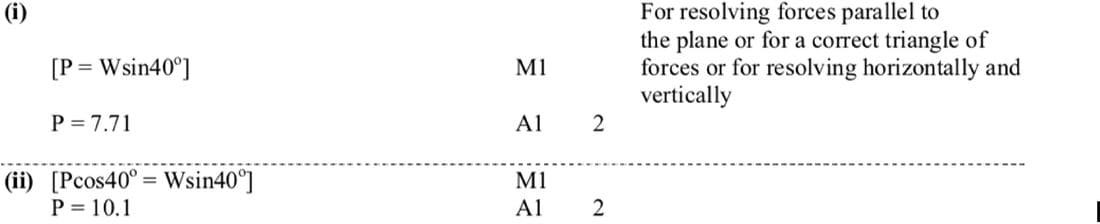
A small block of weight 12 N is at rest on a smooth plane inclined at 40° to the horizontal. The block is held in equilibrium by a force of magnitude P N. Find the value of P when
- the force is parallel to the plane as in Fig. 1,
- the force is horizontal as in Fig. 2.
9709 P4 - Nov 2004 - Q2
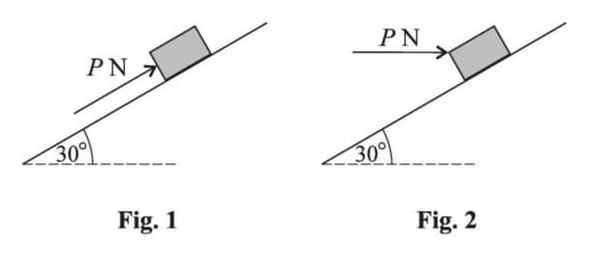
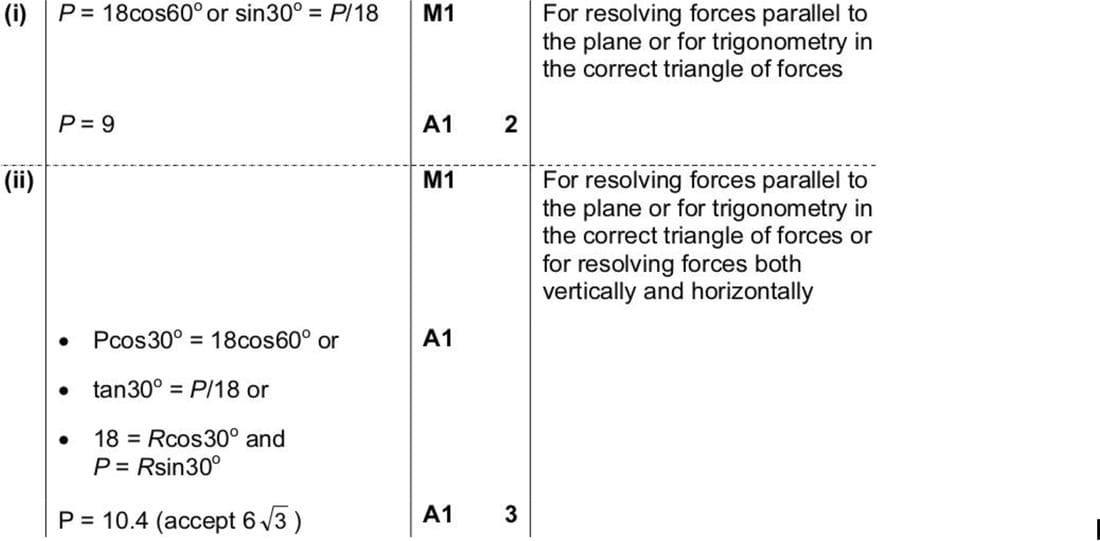
A small block of weight 18 N is held at rest on a smooth plane inclined at 30° to the horizontal, by a force of magnitude \(P\) N. Find
- the value of \(P\) when the force is parallel to the plane, as in Fig. 1,
- the value of \(P\) when the force is horizontal, as in Fig. 2.
9709 P42 - Nov 2022 - Q5
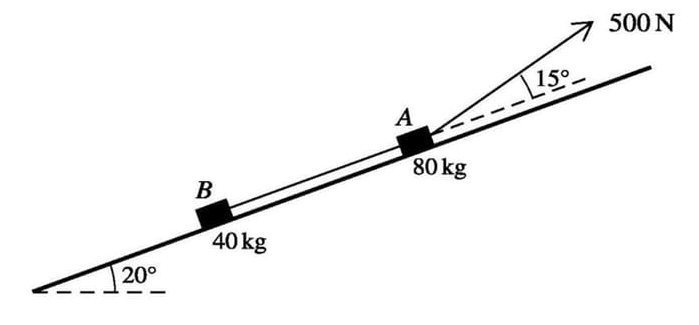
A block A of mass 80 kg is connected by a light, inextensible rope to a block B of mass 40 kg. The rope joining the two blocks is taut and is parallel to a line of greatest slope of a plane which is inclined at an angle of 20° to the horizontal. A force of magnitude 500 N inclined at an angle of 15° above the same line of greatest slope acts on A (see diagram). The blocks move up the plane and there is a resistance force of 50 N on B, but no resistance force on A.
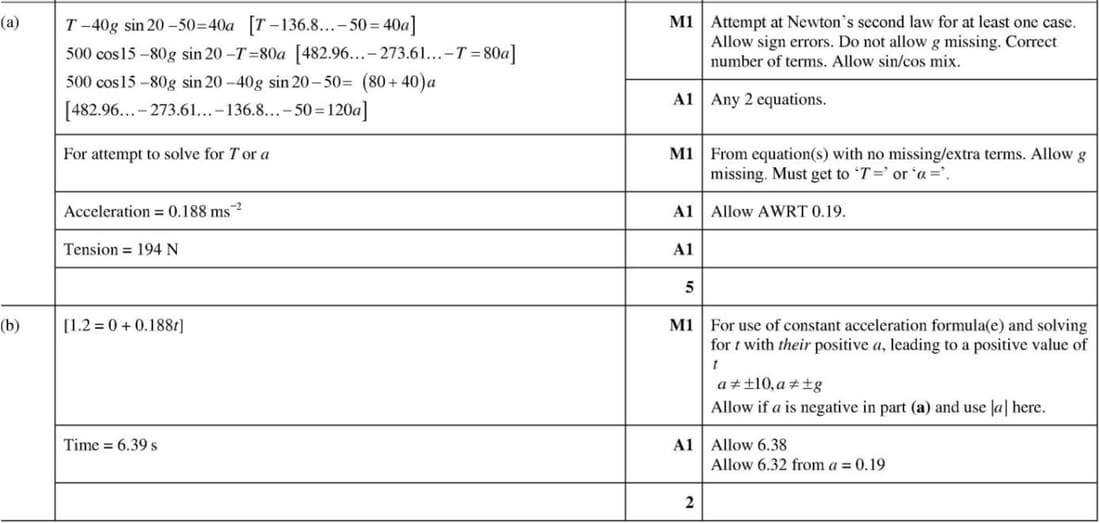
(a) Find the acceleration of the blocks and the tension in the rope. [5]
(b) Find the time that it takes for the blocks to reach a speed of 1.2 m/s-1 from rest. [2]
9709 P41 - Nov 2019 - Q4
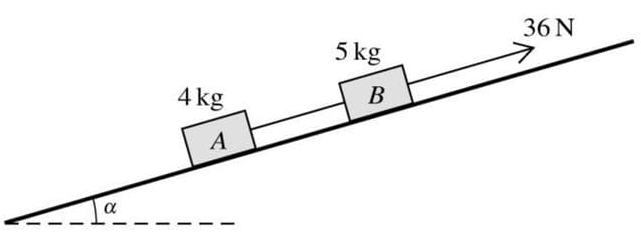
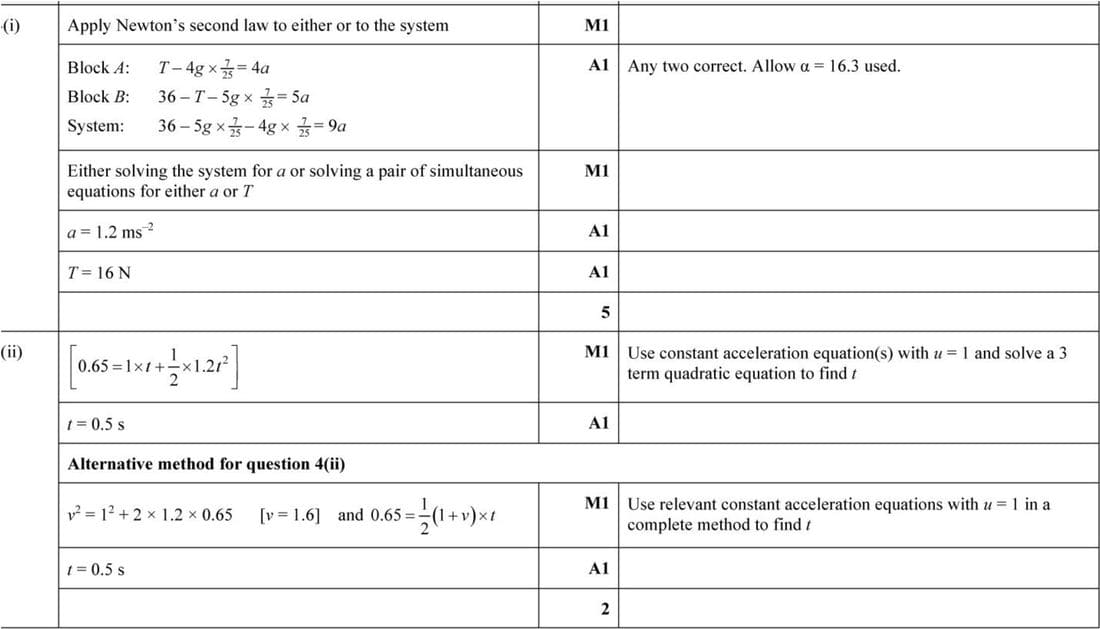
Two blocks A and B of masses 4 kg and 5 kg respectively are joined by a light inextensible string. The blocks rest on a smooth plane inclined at an angle \(\alpha\) to the horizontal, where \(\tan \alpha = \frac{7}{24}\). The string is parallel to a line of greatest slope of the plane with B above A. A force of magnitude 36 N acts on B, parallel to a line of greatest slope of the plane (see diagram).
- Find the acceleration of the blocks and the tension in the string. [5]
- At a particular instant, the speed of the blocks is 1 m s-1. Find the time, after this instant, that it takes for the blocks to travel 0.65 m. [2]
9709 P41 - Jun 2018 - Q3
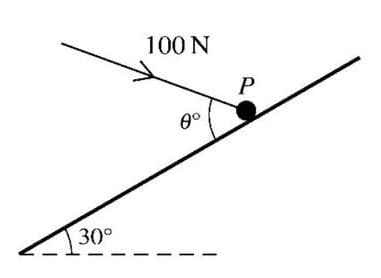
A particle P of mass 8 kg is on a smooth plane inclined at an angle of 30° to the horizontal. A force of magnitude 100 N, making an angle of θ° with a line of greatest slope and lying in the vertical plane containing the line of greatest slope, acts on P (see diagram).
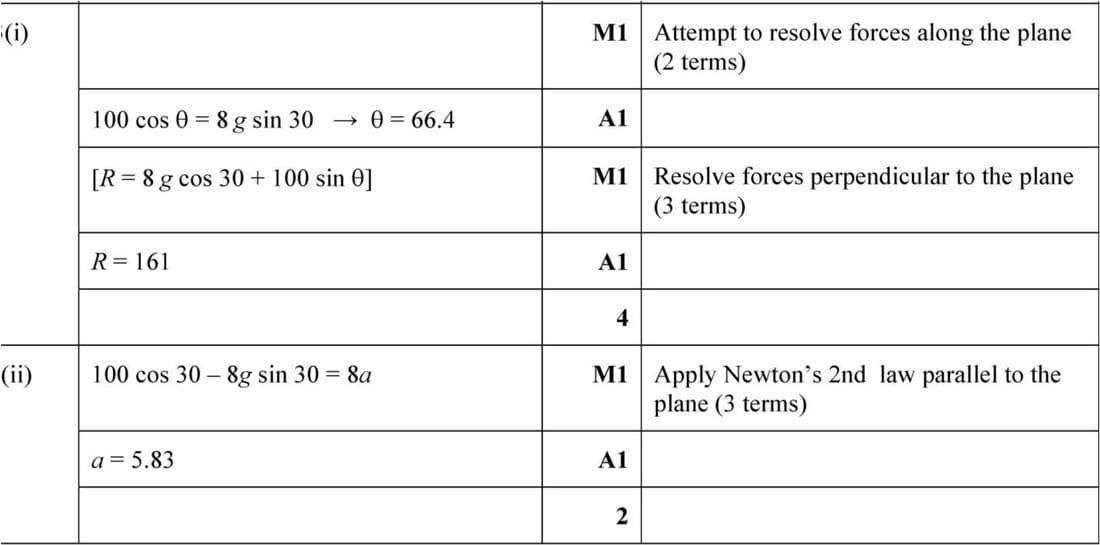
(i) Given that P is in equilibrium, show that θ = 66.4, correct to 1 decimal place, and find the normal reaction between the plane and P. [4]
\((ii) Given instead that θ = 30, find the acceleration of P. [2]\)
9709 P4 - Jun 2007 - Q1
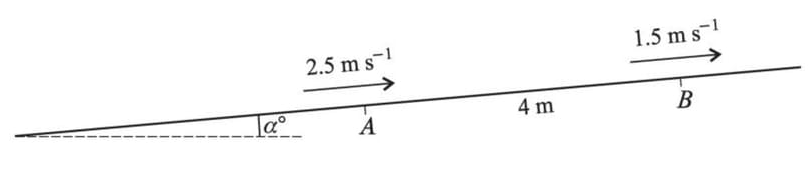
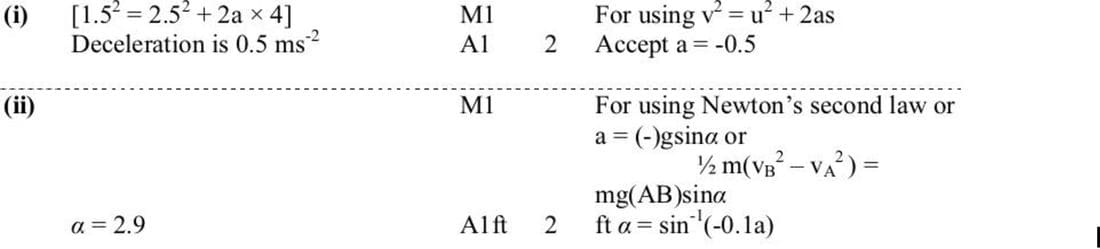
A particle slides up a line of greatest slope of a smooth plane inclined at an angle \(\alpha^\circ\) to the horizontal. The particle passes through the points \(A\) and \(B\) with speeds 2.5 m s\(^{-1}\) and 1.5 m s\(^{-1}\) respectively. The distance \(AB\) is 4 m (see diagram). Find
- the deceleration of the particle,
- the value of \(\alpha\).
9709 P4 - Jun 2006 - Q7
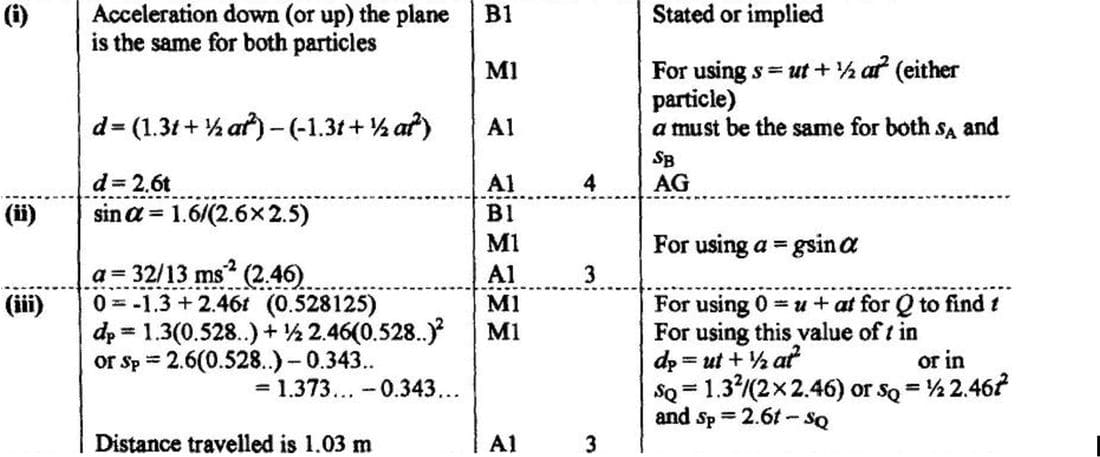
Two particles P and Q move on a line of greatest slope of a smooth inclined plane. The particles start at the same instant and from the same point, each with speed 1.3 m s-1. Initially P moves down the plane and Q moves up the plane. The distance between the particles t seconds after they start to move is d m.
- Show that d = 2.6t.
\(When t = 2.5 the difference in the vertical height of the particles is 1.6 m. Find\)
- the acceleration of the particles down the plane,
- the distance travelled by P when Q is at its highest point.
9709 P41 - Nov 2011 - Q4
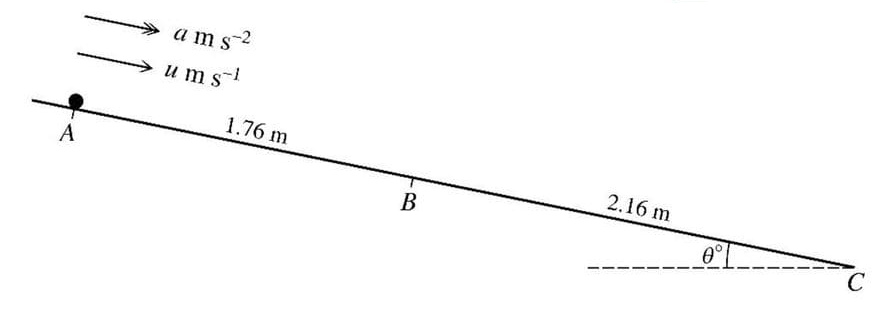
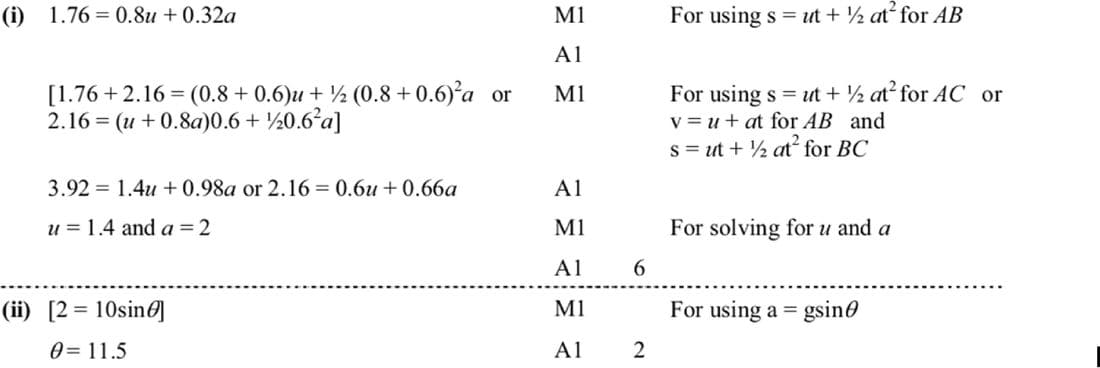
A, B, and C are three points on a line of greatest slope of a smooth plane inclined at an angle of \(\theta^\circ\) to the horizontal. A is higher than B and B is higher than C, and the distances AB and BC are 1.76 m and 2.16 m respectively. A particle slides down the plane with constant acceleration \(a \, \text{m s}^{-2}\). The speed of the particle at A is \(u \, \text{m s}^{-1}\) (see diagram). The particle takes 0.8 s to travel from A to B and takes 1.4 s to travel from A to C. Find
- the values of \(u\) and \(a\),
- the value of \(\theta\).
9709 P43 - Jun 2011 - Q3
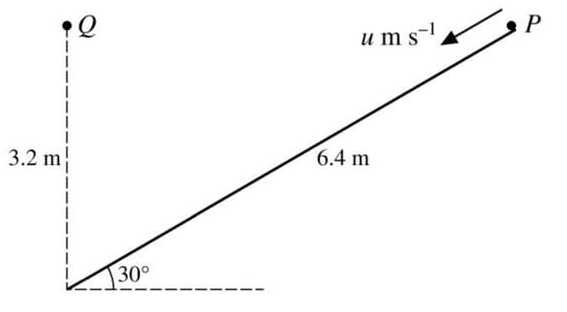
A particle P is projected from the top of a smooth ramp with speed u m s-1, and travels down a line of greatest slope. The ramp has length 6.4 m and is inclined at 30° to the horizontal. Another particle Q is released from rest at a point 3.2 m vertically above the bottom of the ramp, at the same instant that P is projected (see diagram). Given that P and Q reach the bottom of the ramp simultaneously, find
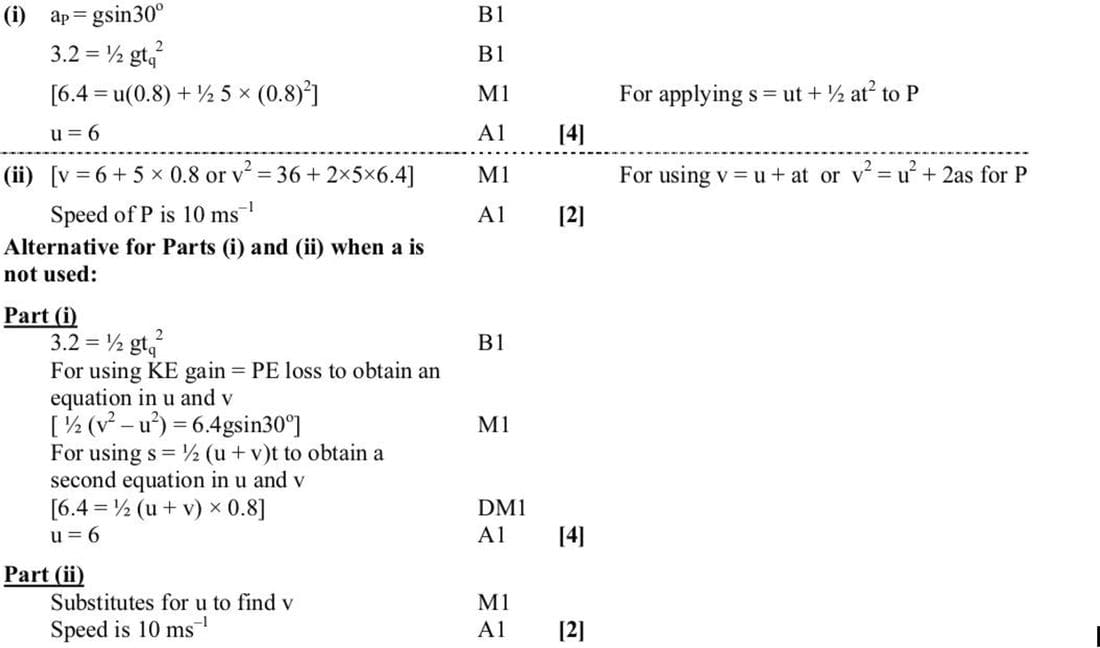
- the value of u,
- the speed with which P reaches the bottom of the ramp.
9709 P43 - Nov 2010 - Q1
A particle P is released from rest at a point on a smooth plane inclined at 30° to the horizontal. Find the speed of P
- when it has travelled 0.9 m,
- 0.8 s after it is released.

9709 P43 - Jun 2010 - Q6
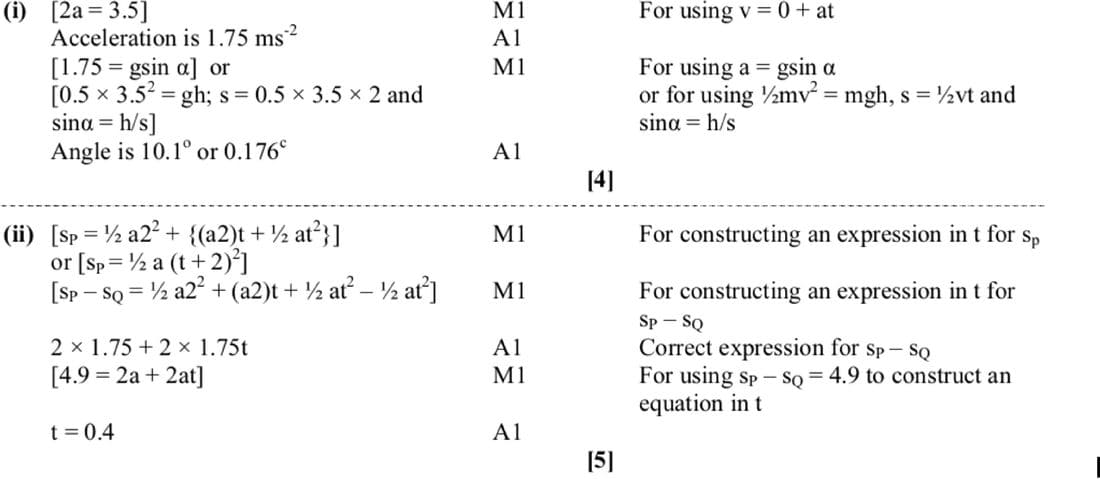
Particles P and Q move on a line of greatest slope of a smooth inclined plane. P is released from rest at a point O on the line and 2 s later passes through the point A with speed 3.5 m s-1.
(i) Find the acceleration of P and the angle of inclination of the plane.
At the instant that P passes through A the particle Q is released from rest at O. At time t s after Q is released from O, the particles P and Q are 4.9 m apart.
(ii) Find the value of t.
9709 P4 - Jun 2008 - Q1
A particle slides down a smooth plane inclined at an angle of \(\alpha^\circ\) to the horizontal. The particle passes through the point \(A\) with speed \(1.5 \text{ m s}^{-1}\), and \(1.2\) s later it passes through the point \(B\) with speed \(4.5 \text{ m s}^{-1}\). Find
- the acceleration of the particle,
- the value of \(\alpha\).

9709 P43 - Nov 2023 - Q2
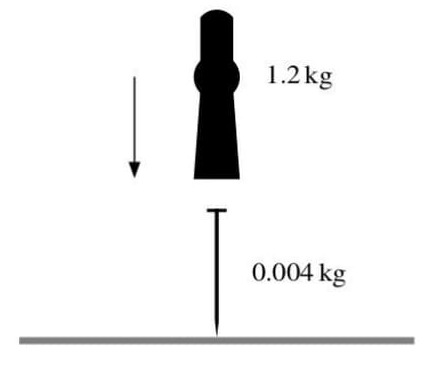
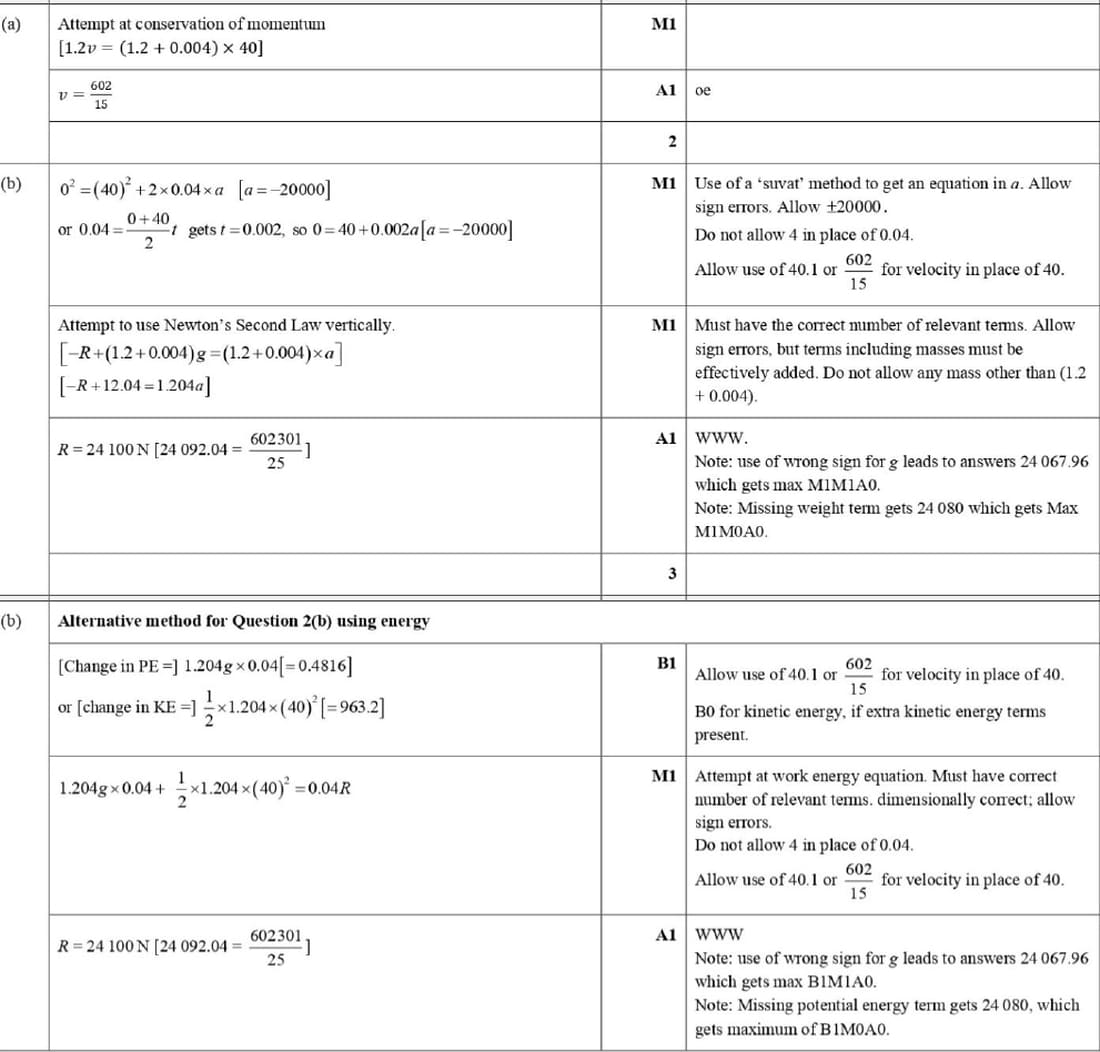
A machine for driving a nail into a block of wood causes a hammerhead to drop vertically onto the top of a nail. The mass of the hammerhead is 1.2 kg and the mass of the nail is 0.004 kg (see diagram). The hammerhead hits the nail with speed \(v \text{ m s}^{-1}\) and remains in contact with the nail after the impact. The combined hammerhead and nail move immediately after the impact with speed 40 \(\text{ m s}^{-1}\).
(a) Calculate \(v\), giving your answer as an exact fraction.
(b) The nail is driven 4 cm into the wood. Find the constant force resisting the motion.
9709 P43 - Jun 2023 - Q6
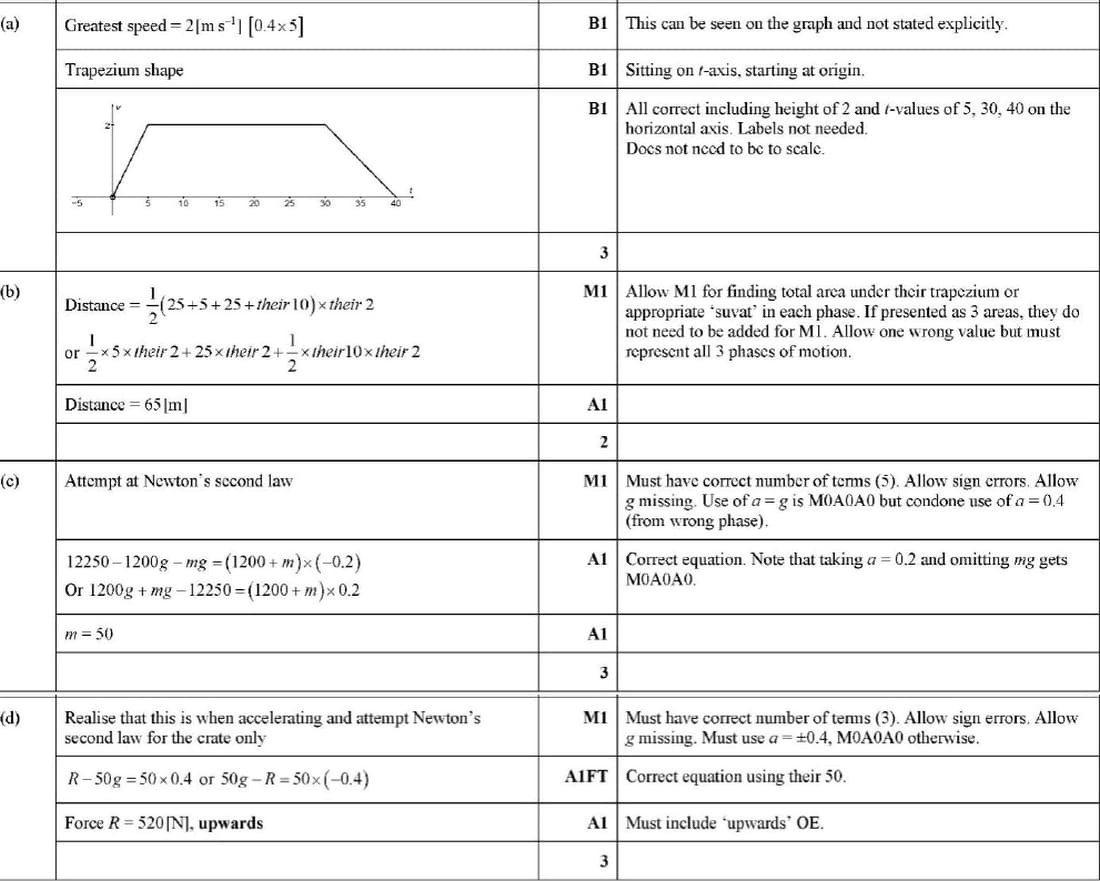
An elevator is pulled vertically upwards by a cable. The elevator accelerates at 0.4 m/s2 for 5 s, then travels at constant speed for 25 s. The elevator then decelerates at 0.2 m/s2 until it comes to rest.
(a) Find the greatest speed of the elevator and hence draw a velocity-time graph for the motion of the elevator.
(b) Find the total distance travelled by the elevator.
The mass of the elevator is 1200 kg and there is a crate of mass m kg resting on the floor of the elevator.
(c) Given that the tension in the cable when the elevator is decelerating is 12250 N, find the value of m.
(d) Find the greatest magnitude of the force exerted on the crate by the floor of the elevator, and state its direction.

9709 P42 - Mar 2021 - Q4
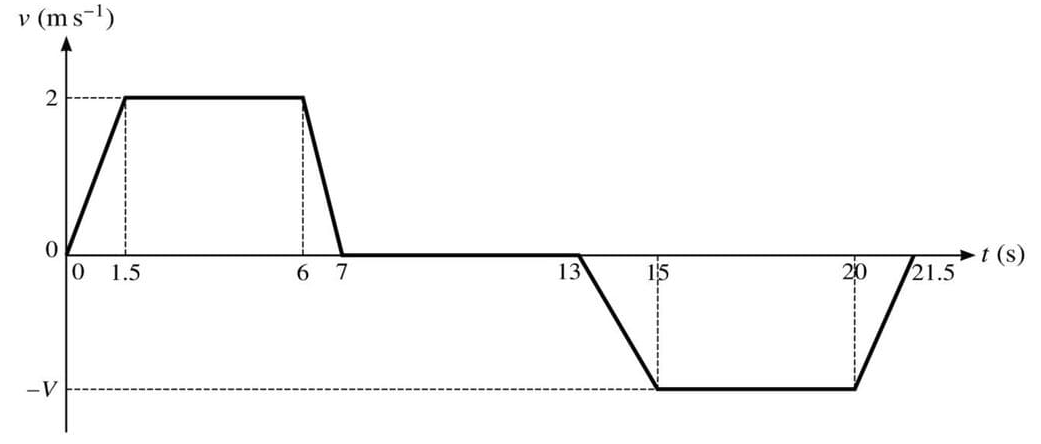
An elevator moves vertically, supported by a cable. The diagram shows a velocity-time graph which models the motion of the elevator. The graph consists of 7 straight line segments.
The elevator accelerates upwards from rest to a speed of 2 m/s-1 over a period of 1.5 s and then travels at this speed for 4.5 s, before decelerating to rest over a period of 1 s.
The elevator then remains at rest for 6 s, before accelerating to a speed of V m/s-1 downwards over a period of 2 s. The elevator travels at this speed for a period of 5 s, before decelerating to rest over a period of 1.5 s.
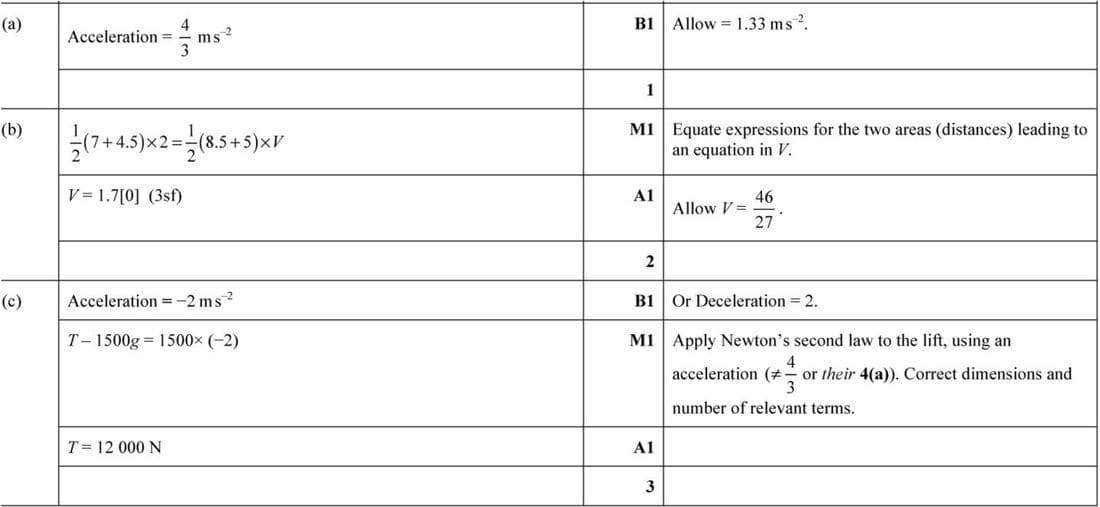
(a) Find the acceleration of the elevator during the first 1.5 s.
(b) Given that the elevator starts and finishes its journey on the ground floor, find V.
(c) The combined weight of the elevator and passengers on its upward journey is 1500 kg. Assuming that there is no resistance to motion, find the tension in the elevator cable on its upward journey when the elevator is decelerating.
9709 P41 - Nov 2019 - Q6
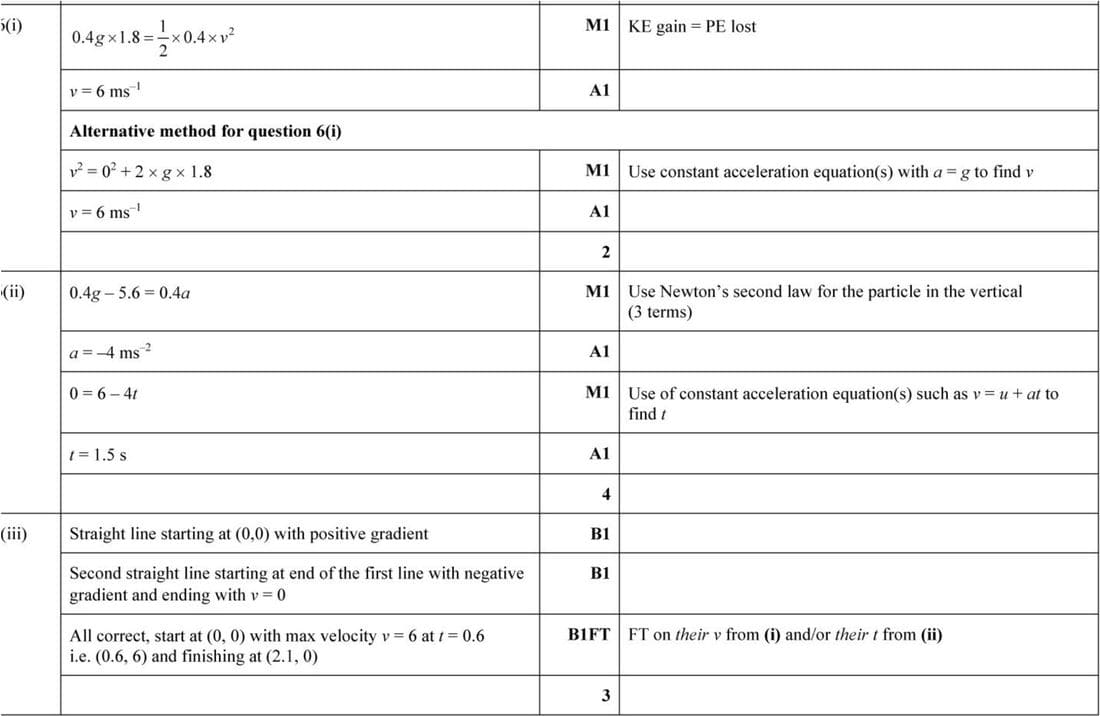
A particle of mass 0.4 kg is released from rest at a height of 1.8 m above the surface of the water in a tank. There is no instantaneous change of speed when the particle enters the water. The water exerts an upward force of 5.6 N on the particle when it is in the water.
(i) Find the velocity of the particle at the instant when it reaches the surface of the water.
(ii) Find the time that it takes from the instant when the particle enters the water until it comes to instantaneous rest in the water. You may assume that the tank is deep enough so that the particle does not reach the bottom of the tank.
(iii) Sketch a velocity-time graph for the motion of the particle from the instant at which it is released until it comes to instantaneous rest in the water.
9709 P41 - Nov 2014 - Q6
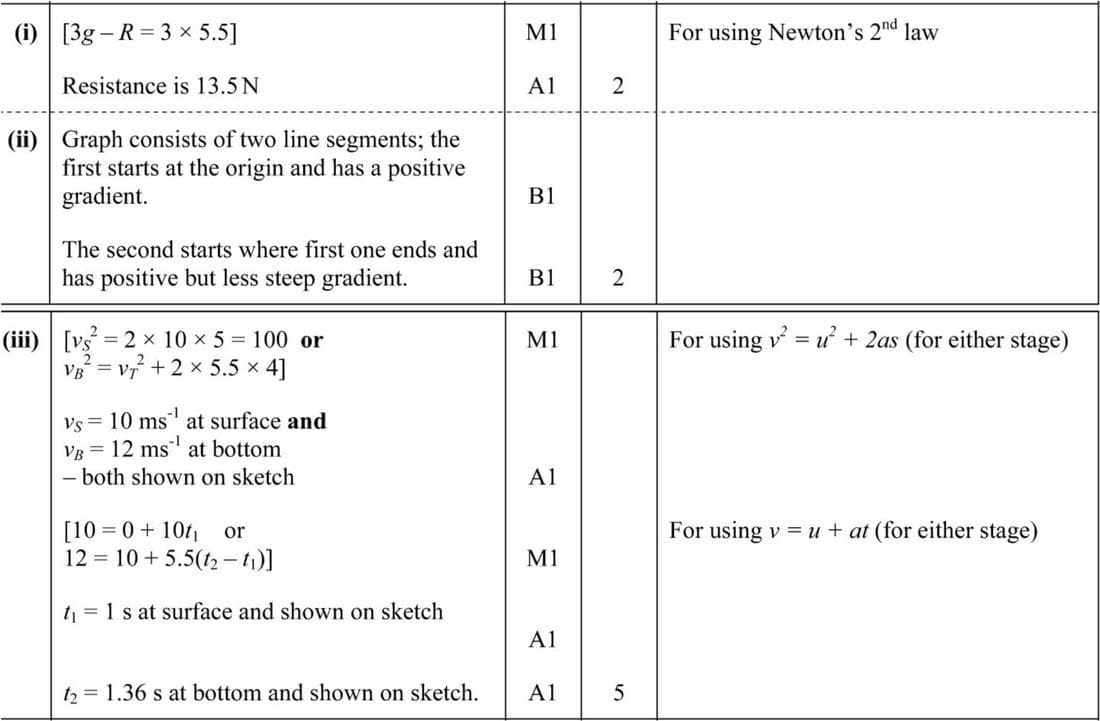
A particle of mass 3 kg falls from rest at a point 5 m above the surface of a liquid which is in a container. There is no instantaneous change in speed of the particle as it enters the liquid. The depth of the liquid in the container is 4 m. The downward acceleration of the particle while it is moving in the liquid is 5.5 m s-2.
- Find the resistance to motion of the particle while it is moving in the liquid.
- Sketch the velocity-time graph for the motion of the particle, from the time it starts to move until the time it reaches the bottom of the container. Show on your sketch the velocity and the time when the particle enters the liquid, and when the particle reaches the bottom of the container.
9709 P42 - Nov 2013 - Q7
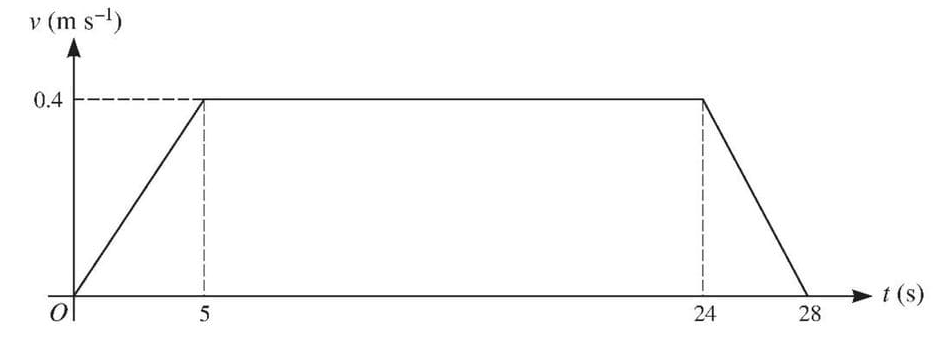
An elevator is pulled vertically upwards by a cable. The velocity-time graph for the motion is shown above. Find
- the distance travelled by the elevator,
- the acceleration during the first stage and the deceleration during the third stage.
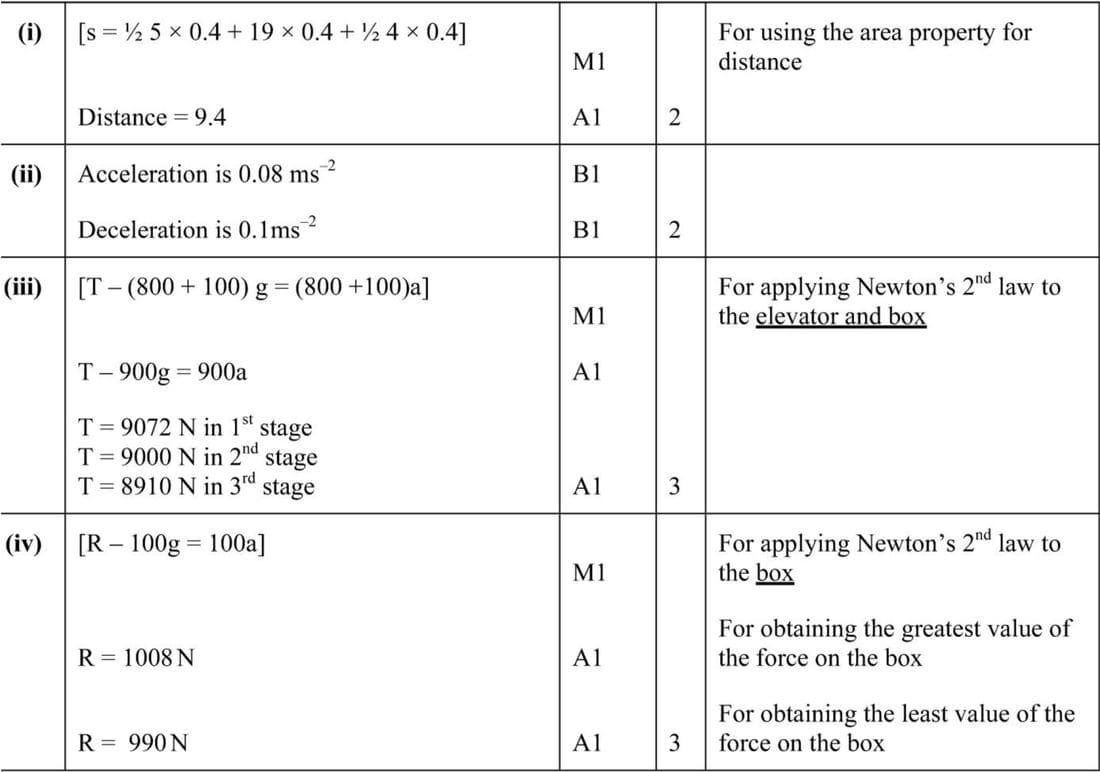
The mass of the elevator is 800 kg and there is a box of mass 100 kg on the floor of the elevator.
- Find the tension in the cable in each of the three stages of the motion.
- Find the greatest and least values of the magnitude of the force exerted on the box by the floor of the elevator.
9709 P42 - Jun 2011 - Q3
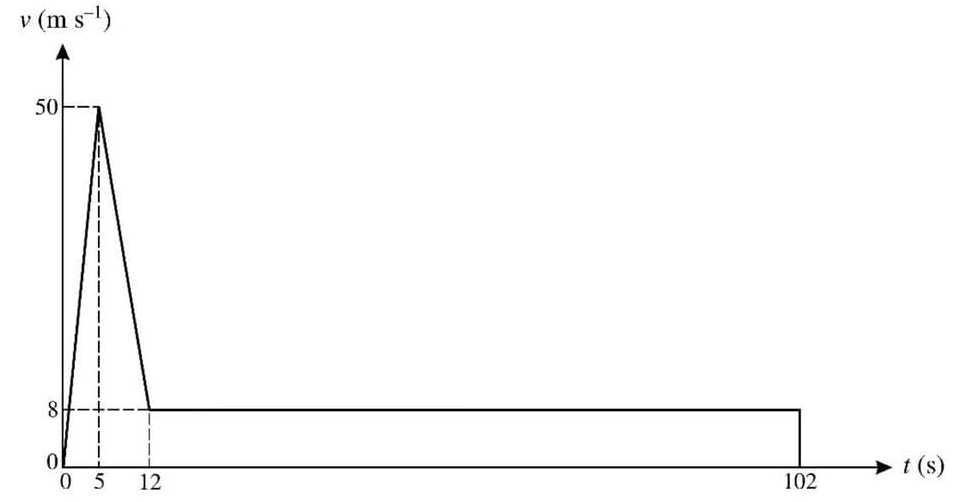
The velocity-time graph shown models the motion of a parachutist falling vertically. There are four stages in the motion:
- falling freely with the parachute closed,
- decelerating at a constant rate with the parachute open,
- falling with constant speed with the parachute open,
- coming to rest instantaneously on hitting the ground.
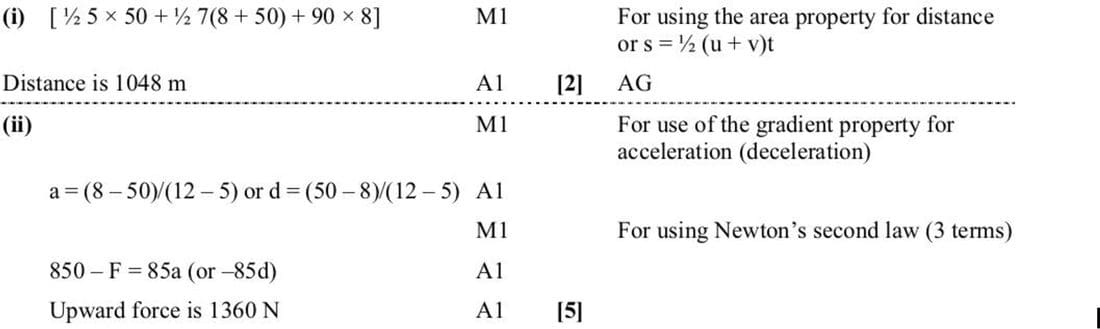
(i) Show that the total distance fallen is 1048 m.
The weight of the parachutist is 850 N.
(ii) Find the upward force on the parachutist due to the parachute, during the second stage.
9709 P4 - Jun 2006 - Q4
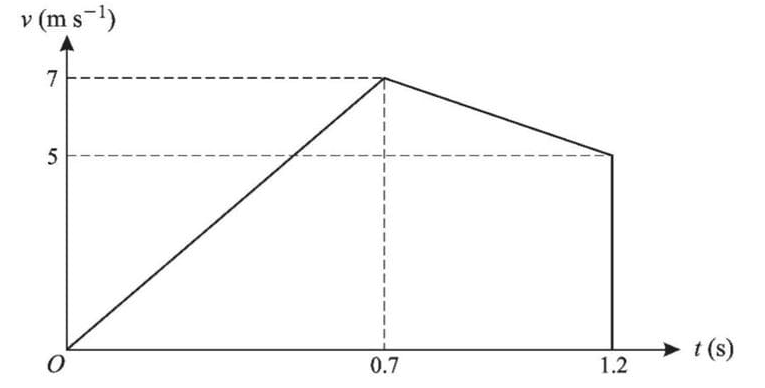
The diagram shows the velocity-time graph for the motion of a small stone which falls vertically from rest at a point A above the surface of liquid in a container. The downward velocity of the stone t s after leaving A is v m s-1. The stone hits the surface of the liquid with velocity 7 m s-1 when t = 0.7. It reaches the bottom of the container with velocity 5 m s-1 when t = 1.2.
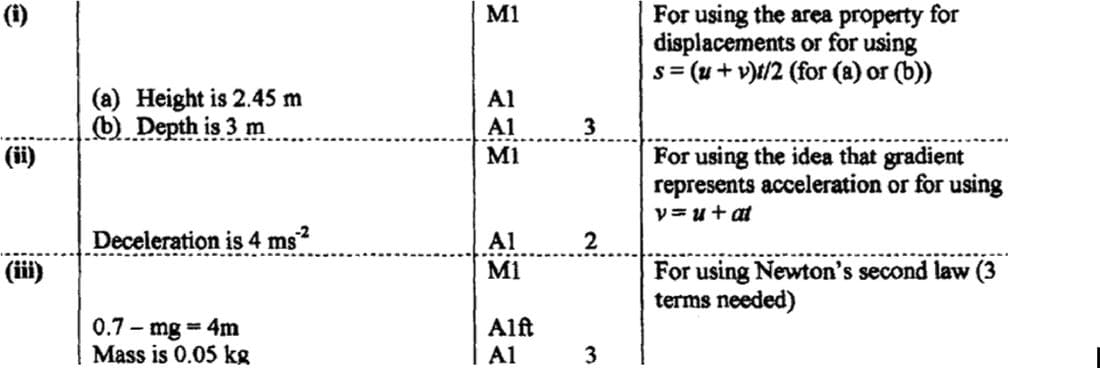
(i) Find
- (a) the height of A above the surface of the liquid,
- (b) the depth of liquid in the container.
(ii) Find the deceleration of the stone while it is moving in the liquid.
(iii) Given that the resistance to motion of the stone while it is moving in the liquid has magnitude 0.7 N, find the mass of the stone.
9709 P43 - Nov 2022 - Q3
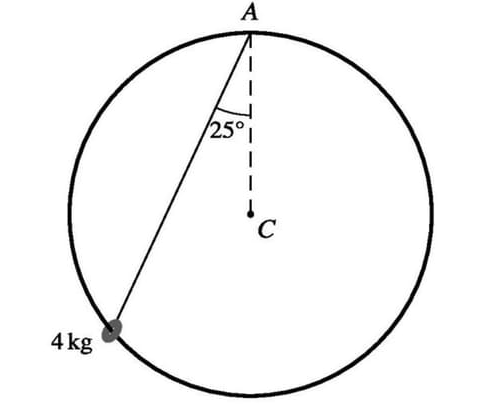
A ring of mass 4 kg is threaded on a smooth circular rigid wire with centre C. The wire is fixed in a vertical plane and the ring is kept at rest by a light string connected to A, the highest point of the circle. The string makes an angle of 25° to the vertical (see diagram).
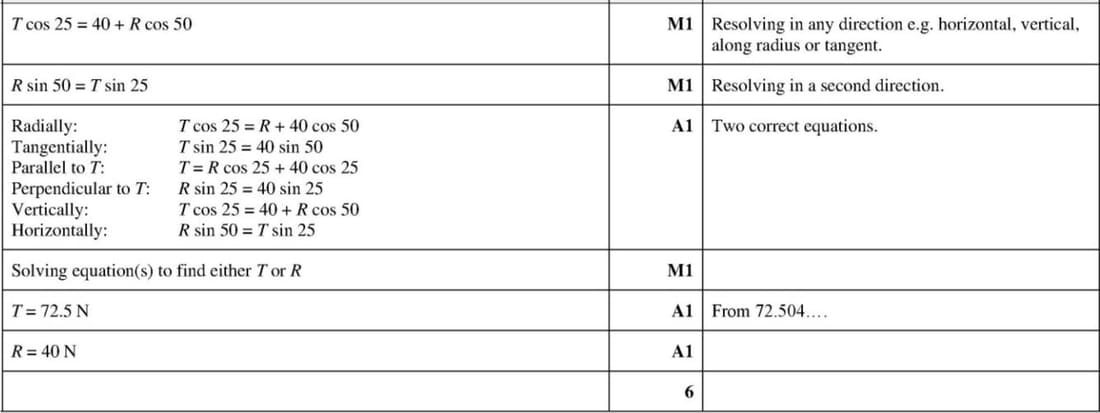
Find the tension in the string and the magnitude of the normal reaction of the wire on the ring.
9709 P43 - Jun 2022 - Q4
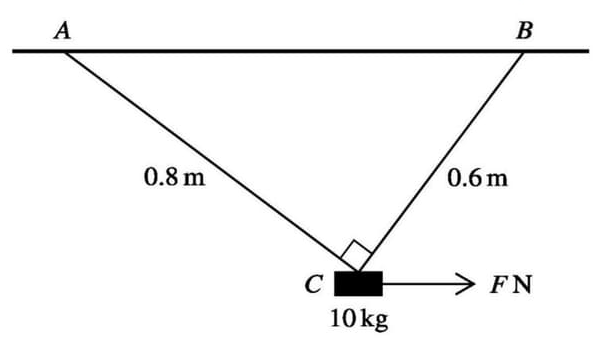
The diagram shows a block of mass 10 kg suspended below a horizontal ceiling by two strings AC and BC, of lengths 0.8 m and 0.6 m respectively, attached to fixed points on the ceiling. Angle ACB = 90°. There is a horizontal force of magnitude F N acting on the block. The block is in equilibrium.
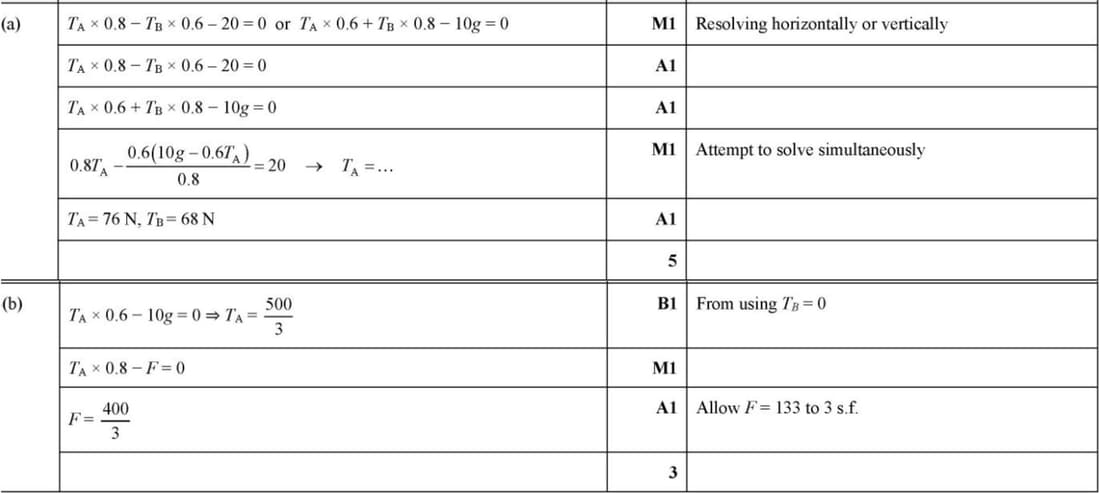
\((a) In the case where F = 20, find the tensions in each of the strings.\)
(b) Find the greatest value of F for which the block remains in equilibrium in the position shown.
9709 P42 - Jun 2015 - Q7
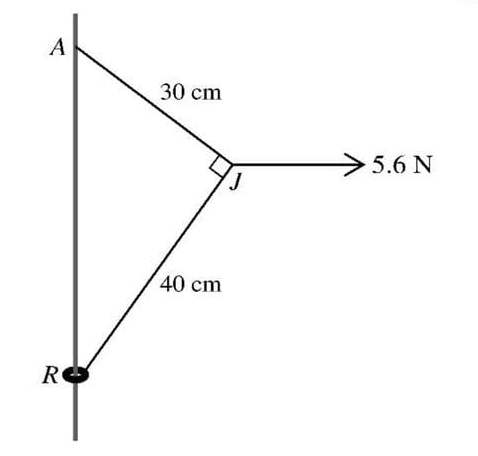
A small ring R is attached to one end of a light inextensible string of length 70 cm. A fixed rough vertical wire passes through the ring. The other end of the string is attached to a point A on the wire, vertically above R. A horizontal force of magnitude 5.6 N is applied to the point J of the string 30 cm from A and 40 cm from R. The system is in equilibrium with each of the parts AJ and JR of the string taut and angle AJR equal to 90° (see diagram).
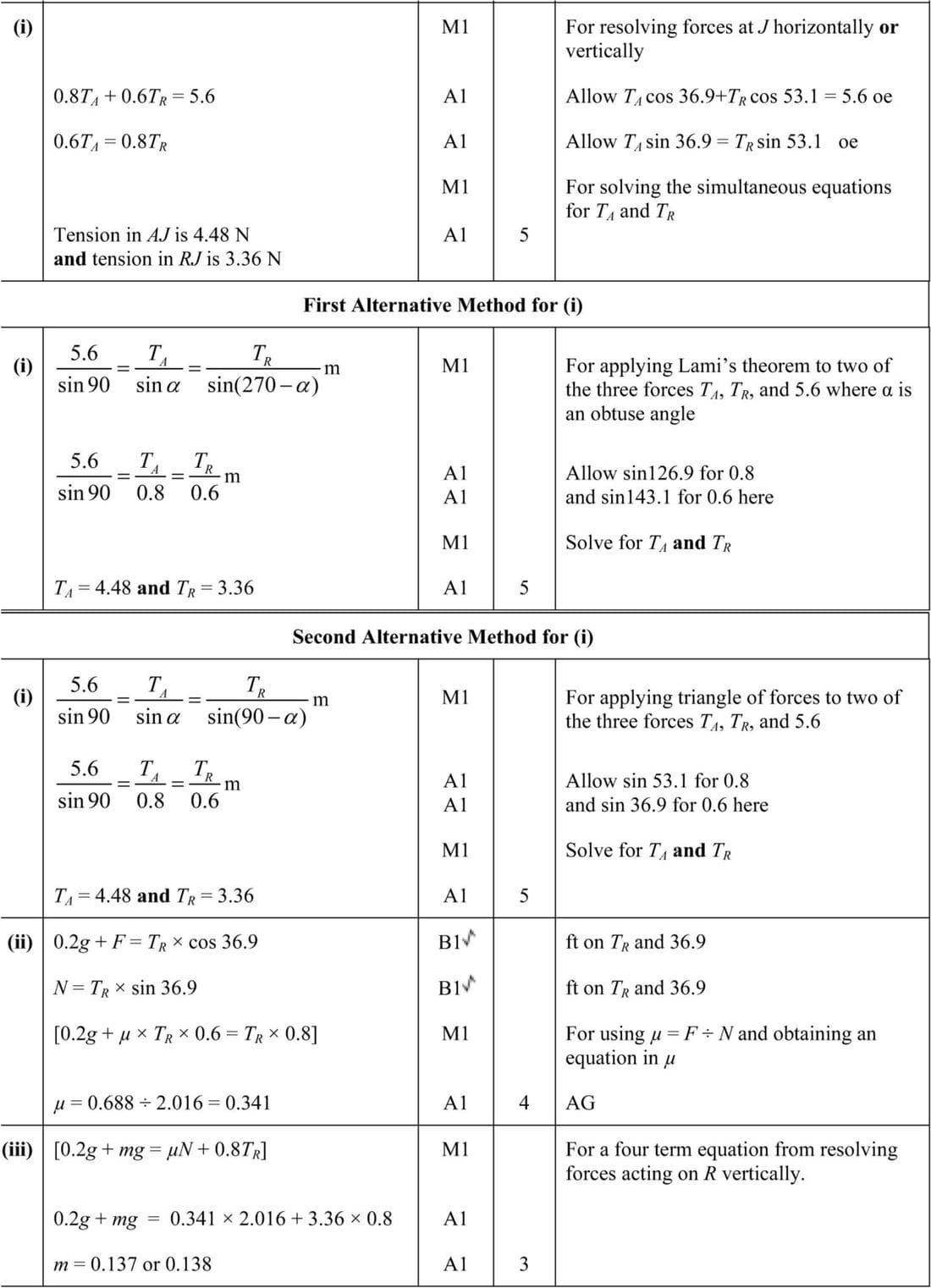
- Find the tension in the part AJ of the string, and find the tension in the part JR of the string. [5]
- The ring R has mass 0.2 kg and is in limiting equilibrium, on the point of moving up the wire.
- Show that the coefficient of friction between R and the wire is 0.341, correct to 3 significant figures. [4]
- A particle of mass m kg is attached to R and R is now in limiting equilibrium, on the point of moving down the wire.
- Given that the coefficient of friction is unchanged, find the value of m. [3]
9709 P41 - Jun 2012 - Q7
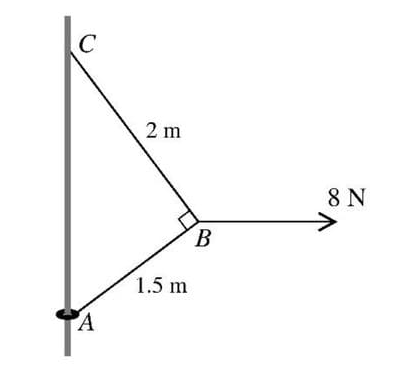
A small ring of mass 0.2 kg is threaded on a fixed vertical rod. The end A of a light inextensible string is attached to the ring. The other end C of the string is attached to a fixed point of the rod above A. A horizontal force of magnitude 8 N is applied to the point B of the string, where AB = 1.5 m and BC = 2 m. The system is in equilibrium with the string taut and AB at right angles to BC (see diagram).
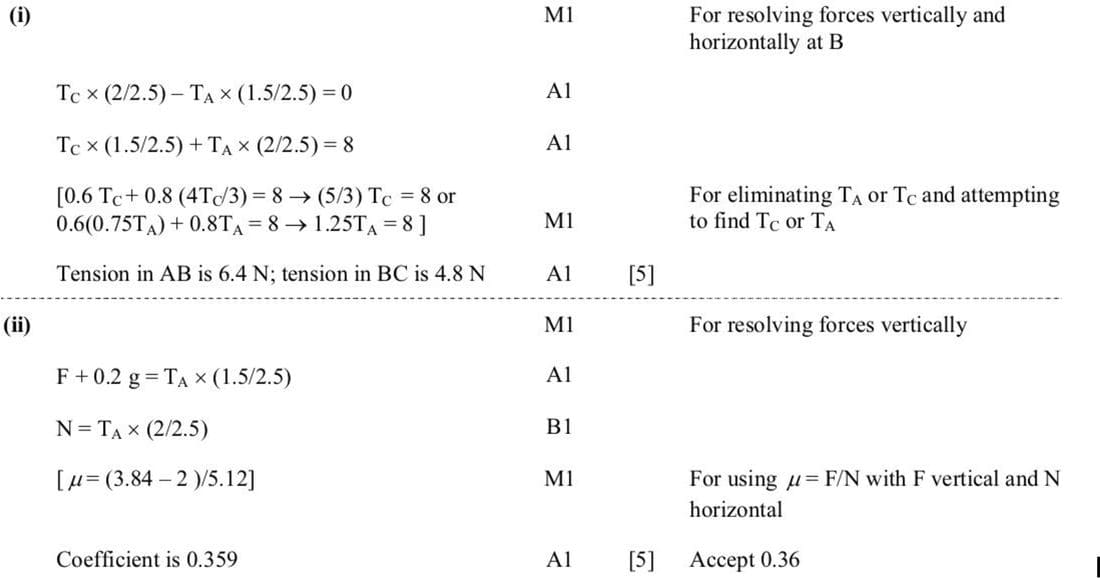
- Find the tension in the part AB of the string and the tension in the part BC of the string.
- The equilibrium is limiting with the ring on the point of sliding up the rod. Find the coefficient of friction between the ring and the rod.
9709 P42 - Jun 2011 - Q6
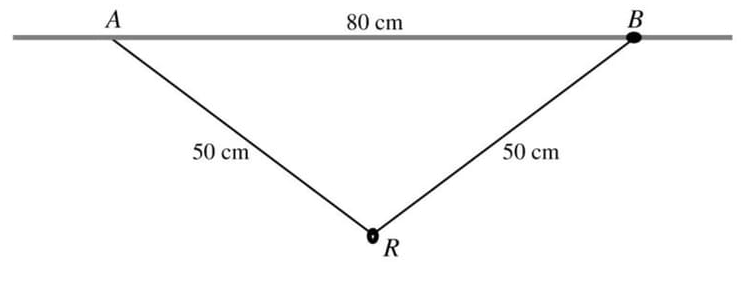
A small smooth ring R, of mass 0.6 kg, is threaded on a light inextensible string of length 100 cm. One end of the string is attached to a fixed point A. A small bead B of mass 0.4 kg is attached to the other end of the string, and is threaded on a fixed rough horizontal rod which passes through A. The system is in equilibrium with B at a distance of 80 cm from A (see diagram).
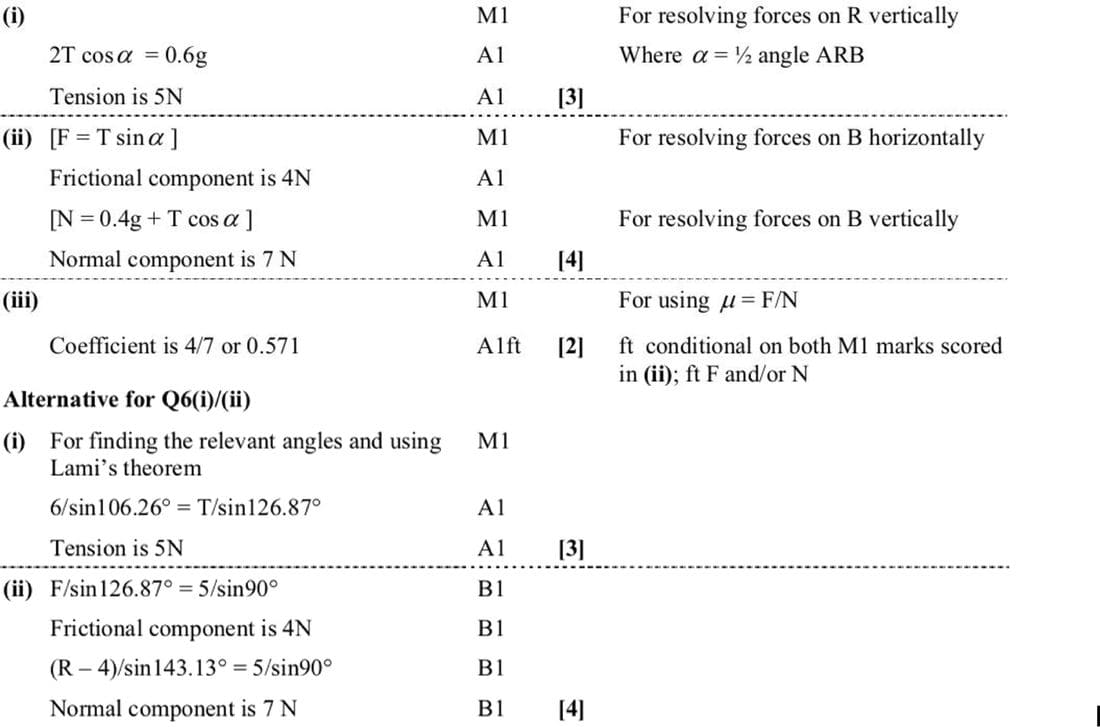
- Find the tension in the string.
- Find the frictional and normal components of the contact force acting on B.
- Given that the equilibrium is limiting, find the coefficient of friction between the bead and the rod.
9709 P41 - Nov 2009 - Q4
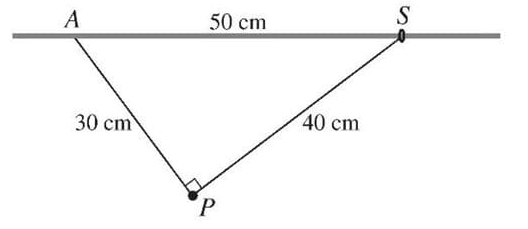
A particle P of weight 5 N is attached to one end of each of two light inextensible strings of lengths 30 cm and 40 cm. The other end of the shorter string is attached to a fixed point A of a rough rod which is fixed horizontally. A small ring S of weight W N is attached to the other end of the longer string and is threaded on to the rod. The system is in equilibrium with the strings taut and AS = 50 cm (see diagram).
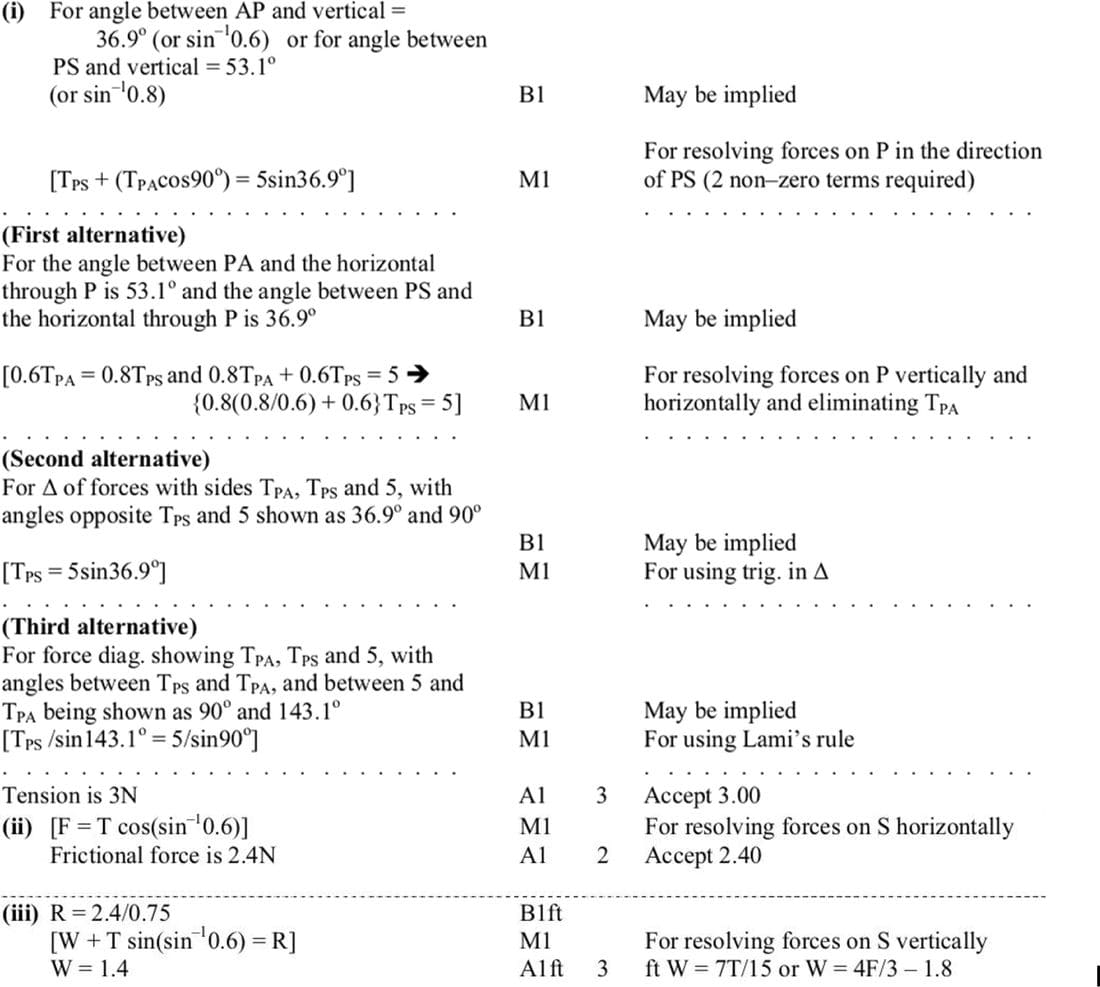
- By resolving the forces acting on P in the direction of PS, or otherwise, find the tension in the longer string. [3]
- Find the magnitude of the frictional force acting on S. [2]
- Given that the coefficient of friction between S and the rod is 0.75, and that S is in limiting equilibrium, find the value of W. [3]
9709 P4 - Nov 2003 - Q6
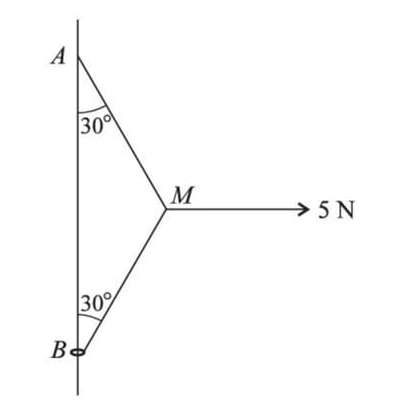
One end of a light inextensible string is attached to a fixed point A of a fixed vertical wire. The other end of the string is attached to a small ring B, of mass 0.2 kg, through which the wire passes. A horizontal force of magnitude 5 N is applied to the mid-point M of the string. The system is in equilibrium with the string taut, with B below A, and with angles ∠ABM and ∠BAM equal to 30° (see diagram).
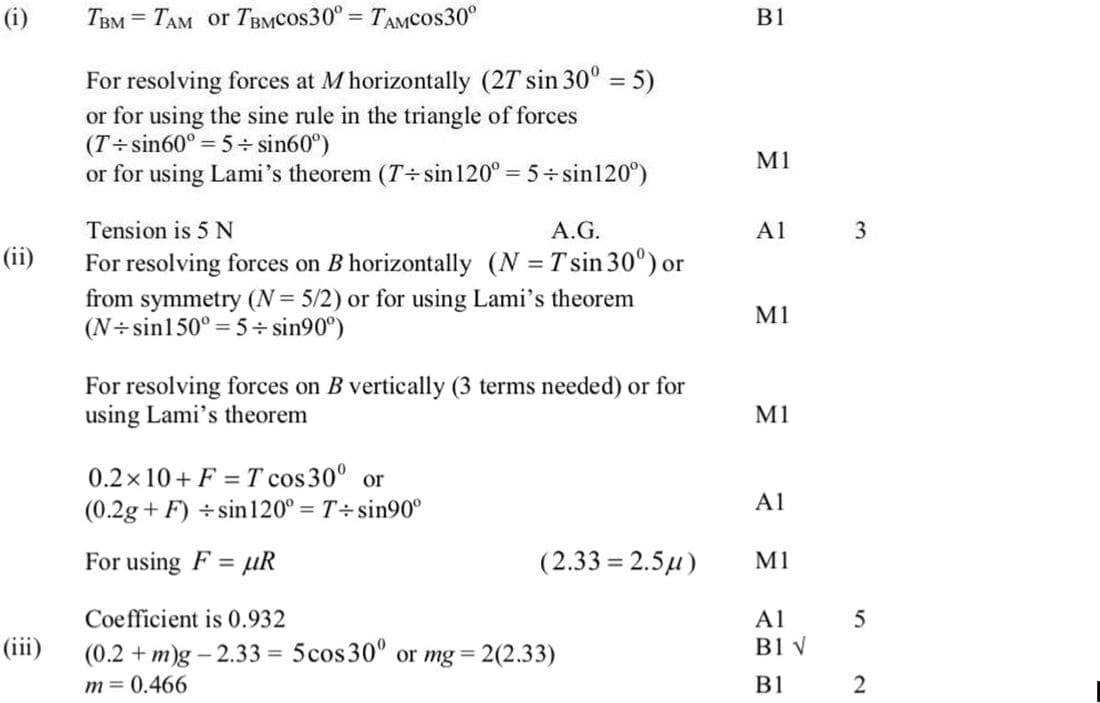
(i) Show that the tension in BM is 5 N.
(ii) The ring is on the point of sliding up the wire. Find the coefficient of friction between the ring and the wire.
(iii) A particle of mass m kg is attached to the ring. The ring is now on the point of sliding down the wire. Given that the coefficient of friction between the ring and the wire is unchanged, find the value of m.
9709 P43 - Nov 2015 - Q2
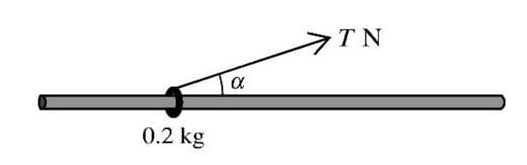
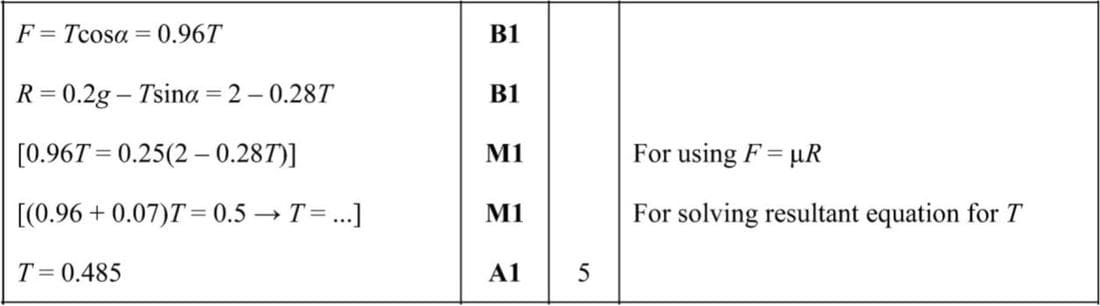
A ring of mass 0.2 kg is threaded on a fixed rough horizontal rod and a light inextensible string is attached to the ring at an angle \(\alpha\) above the horizontal, where \(\cos \alpha = 0.96\). The ring is in limiting equilibrium with the tension in the string \(T\) N (see diagram). Given that the coefficient of friction between the ring and the rod is 0.25, find the value of \(T\).
9709 P42 - Jun 2012 - Q4
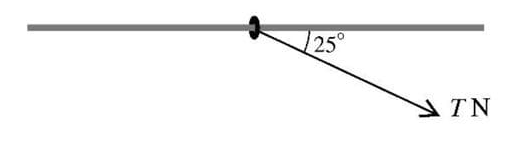
A ring of mass 4 kg is attached to one end of a light string. The ring is threaded on a fixed horizontal rod and the string is pulled at an angle of 25° below the horizontal (see diagram). With a tension in the string of \(T\) N the ring is in equilibrium.
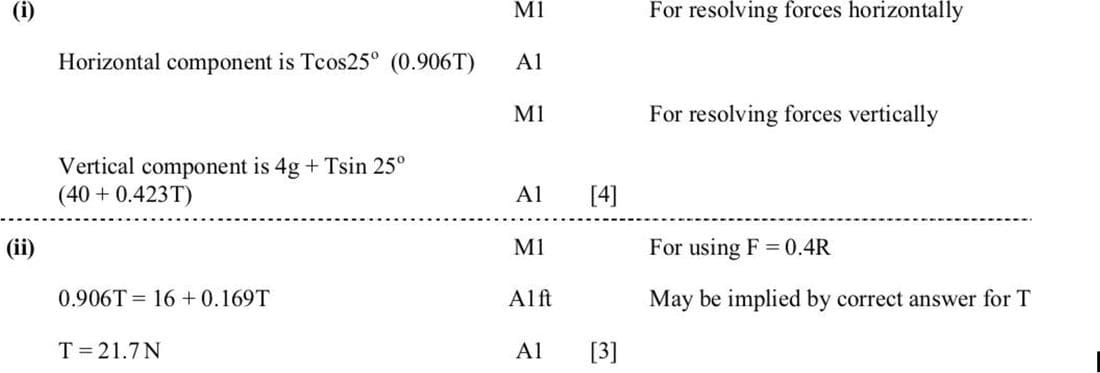
(i) Find, in terms of \(T\), the horizontal and vertical components of the force exerted on the ring by the rod.
The coefficient of friction between the ring and the rod is 0.4.
(ii) Given that the equilibrium is limiting, find the value of \(T\).
9709 P41 - Jun 2010 - Q3
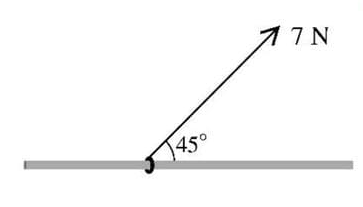
A small ring of mass 0.8 kg is threaded on a rough rod which is fixed horizontally. The ring is in equilibrium, acted on by a force of magnitude 7 N pulling upwards at 45° to the horizontal (see diagram).
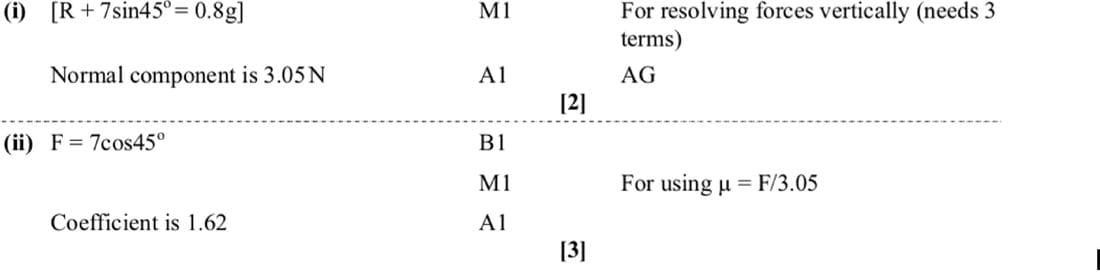
(i) Show that the normal component of the contact force acting on the ring has magnitude 3.05 N, correct to 3 significant figures.
(ii) The ring is in limiting equilibrium. Find the coefficient of friction between the ring and the rod.
9709 P4 - Jun 2004 - Q1
A ring of mass 1.1 kg is threaded on a fixed rough horizontal rod. A light string is attached to the ring and the string is pulled with a force of magnitude 13 N at an angle \(\alpha\) below the horizontal, where \(\tan \alpha = \frac{5}{12}\) (see diagram). The ring is in equilibrium.
(i) Find the frictional component of the contact force on the ring.
(ii) Find the normal component of the contact force on the ring.
(iii) Given that the equilibrium of the ring is limiting, find the coefficient of friction between the ring and the rod.
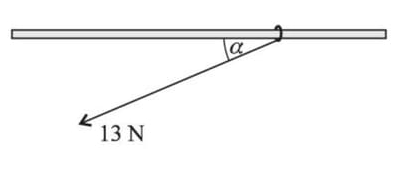

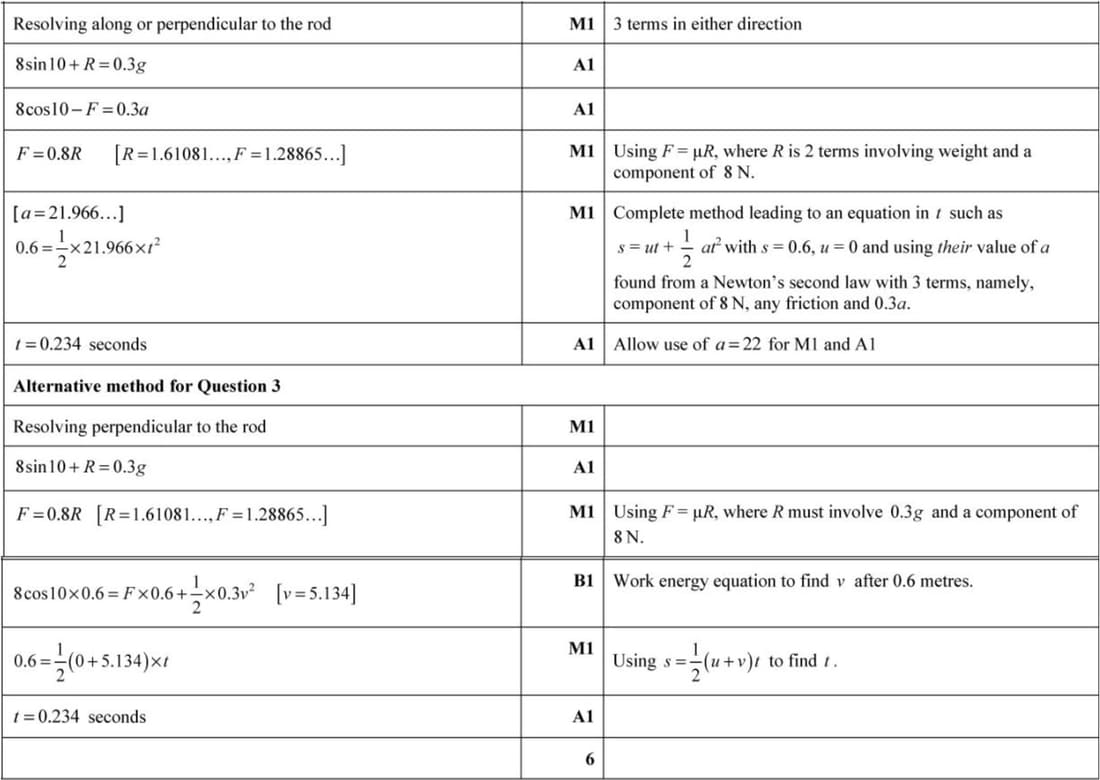
9709 P42 - Jun 2021 - Q3
A ring of mass 0.3 kg is threaded on a horizontal rough rod. The coefficient of friction between the ring and the rod is 0.8. A force of magnitude 8 N acts on the ring. This force acts at an angle of 10° above the horizontal in the vertical plane containing the rod.
Find the time taken for the ring to move, from rest, 0.6 m along the rod.
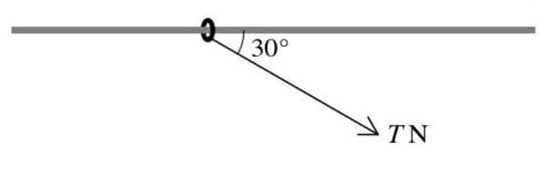
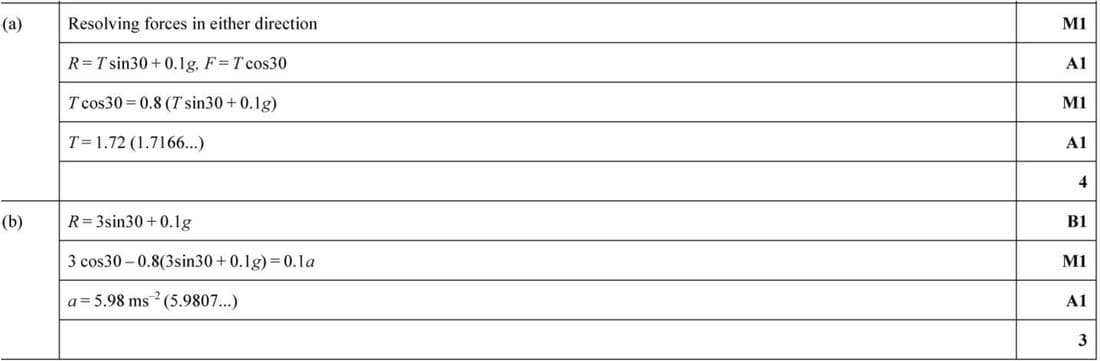
9709 P41 - Jun 2020 - Q4
The diagram shows a ring of mass 0.1 kg threaded on a fixed horizontal rod. The rod is rough and the coefficient of friction between the ring and the rod is 0.8. A force of magnitude \(T \text{ N}\) acts on the ring in a direction at \(30^\circ\) to the rod, downwards in the vertical plane containing the rod. Initially the ring is at rest.
(a) Find the greatest value of \(T\) for which the ring remains at rest. [4]
(b) Find the acceleration of the ring when \(T = 3\). [3]
9709 P42 - Nov 2015 - Q6
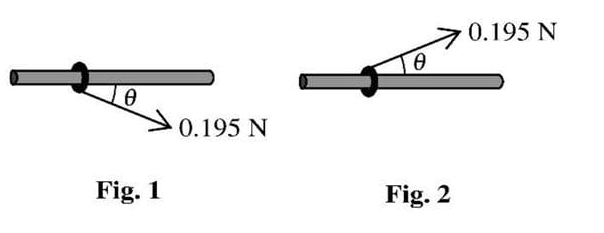
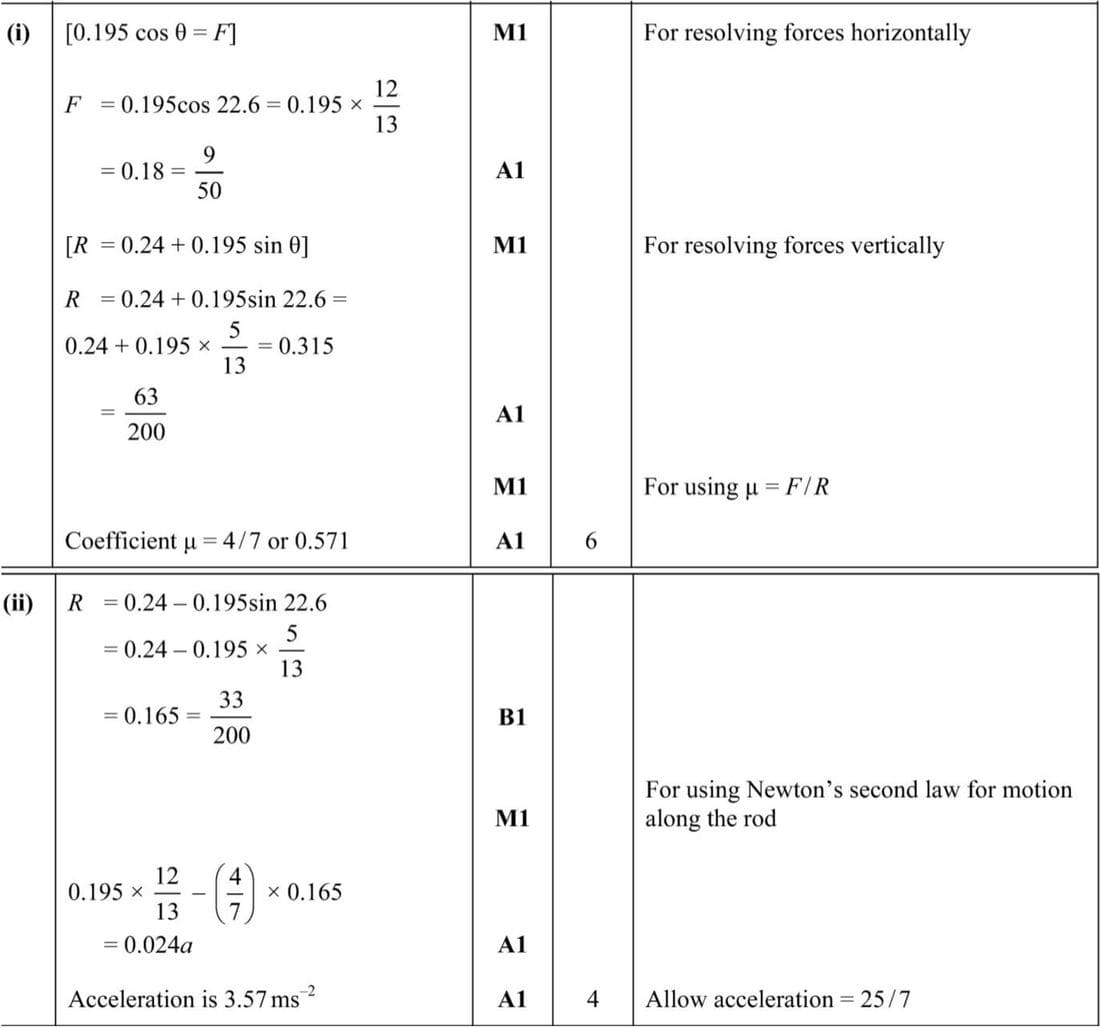
A small ring of mass 0.024 kg is threaded on a fixed rough horizontal rod. A light inextensible string is attached to the ring and the string is pulled with a force of magnitude 0.195 N at an angle of \(\theta\) with the horizontal, where \(\sin \theta = \frac{5}{13}\). When the angle \(\theta\) is below the horizontal (see Fig. 1) the ring is in limiting equilibrium.
(i) Find the coefficient of friction between the ring and the rod.
When the angle \(\theta\) is above the horizontal (see Fig. 2) the ring moves.
(ii) Find the acceleration of the ring.
9709 P42 - Nov 2009 - Q5
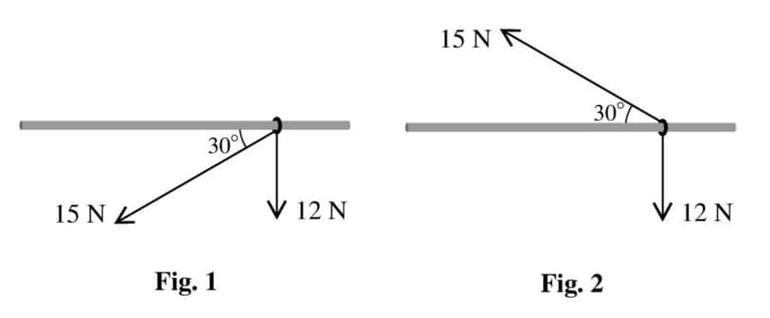
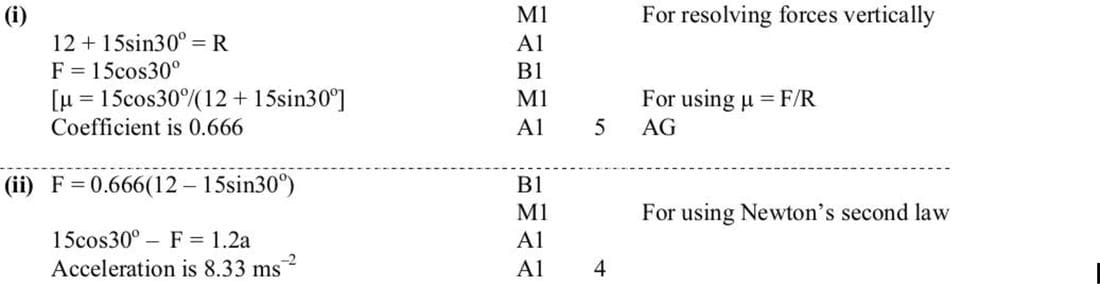
A small ring of weight 12 N is threaded on a fixed rough horizontal rod. A light string is attached to the ring and the string is pulled with a force of 15 N at an angle of 30° to the horizontal.
(i) When the angle of 30° is below the horizontal (see Fig. 1), the ring is in limiting equilibrium. Show that the coefficient of friction between the ring and the rod is 0.666, correct to 3 significant figures.
(ii) When the angle of 30° is above the horizontal (see Fig. 2), the ring is moving with acceleration a m s−2. Find the value of a.
9709 P42 - Mar 2019 - Q1
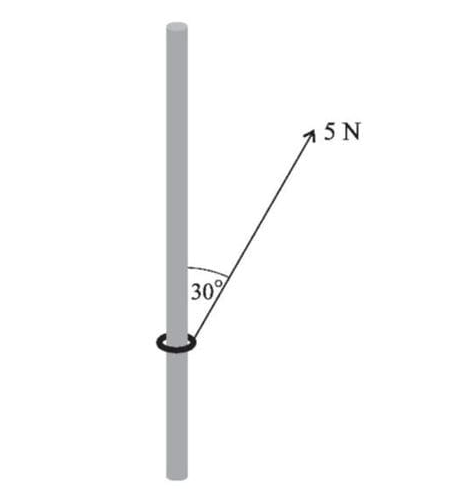
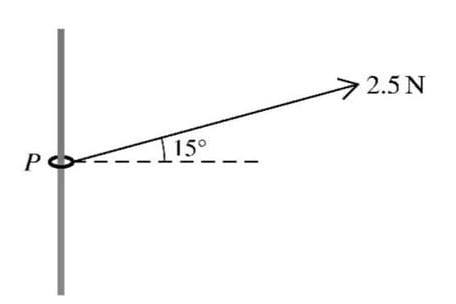
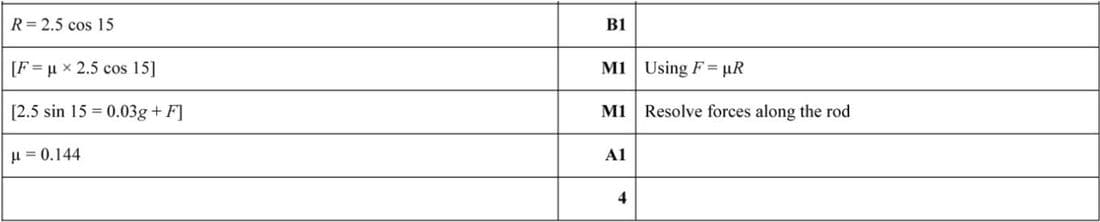
A small ring P of mass 0.03 kg is threaded on a rough vertical rod. A light inextensible string is attached to the ring and is pulled upwards at an angle of 15° to the horizontal. The tension in the string is 2.5 N (see diagram). The ring is in limiting equilibrium and on the point of sliding up the rod. Find the coefficient of friction between the ring and the rod.
9709 P43 - Nov 2011 - Q6
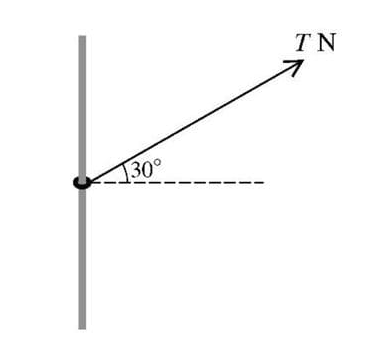
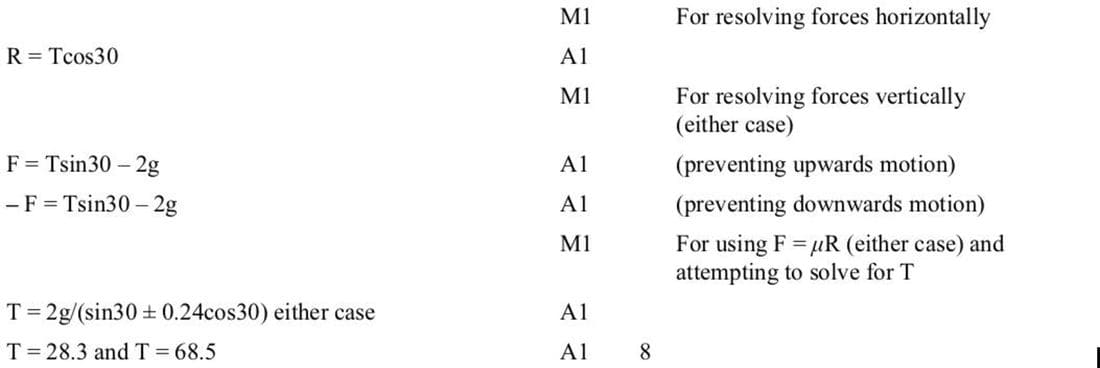
The diagram shows a ring of mass 2 kg threaded on a fixed rough vertical rod. A light string is attached to the ring and is pulled upwards at an angle of 30° to the horizontal. The tension in the string is \(T\) N. The coefficient of friction between the ring and the rod is 0.24. Find the two values of \(T\) for which the ring is in limiting equilibrium.
9709 P4 - Nov 2007 - Q5
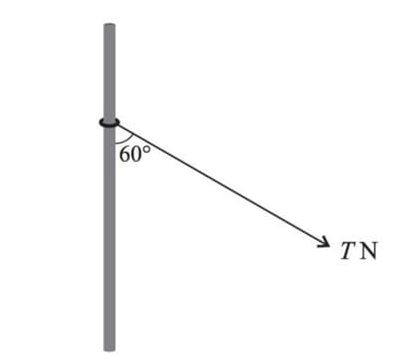
A ring of mass 4 kg is threaded on a fixed rough vertical rod. A light string is attached to the ring, and is pulled with a force of magnitude \(T\) N acting at an angle of \(60^\circ\) to the downward vertical (see diagram). The ring is in equilibrium.
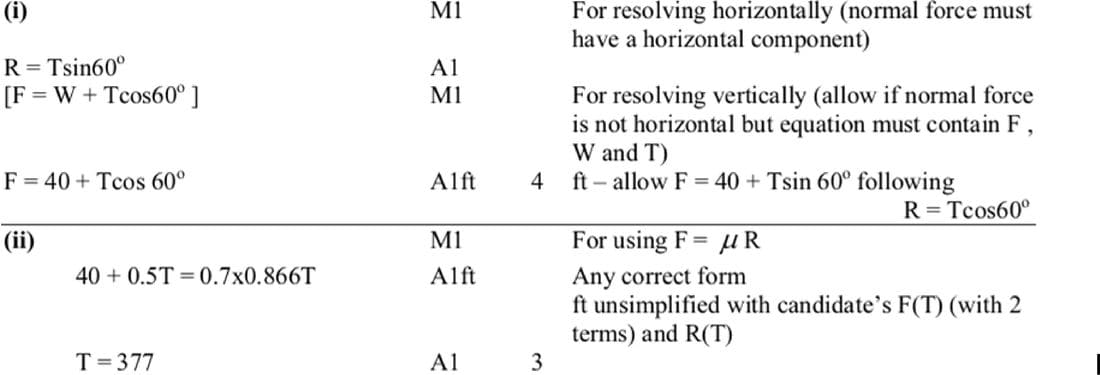
(i) The normal and frictional components of the contact force exerted on the ring by the rod are \(R\) N and \(F\) N respectively. Find \(R\) and \(F\) in terms of \(T\).
(ii) The coefficient of friction between the rod and the ring is 0.7. Find the value of \(T\) for which the ring is about to slip.
9709 P4 - Nov 2006 - Q2
A small ring of mass 0.6 kg is threaded on a rough rod which is fixed vertically. The ring is in equilibrium, acted on by a force of magnitude 5 N pulling upwards at 30° to the vertical (see diagram).
- Show that the frictional force acting on the ring has magnitude 1.67 N, correct to 3 significant figures.
- The ring is on the point of sliding down the rod. Find the coefficient of friction between the ring and the rod.