9709 P42 - Nov 2023 - Q3
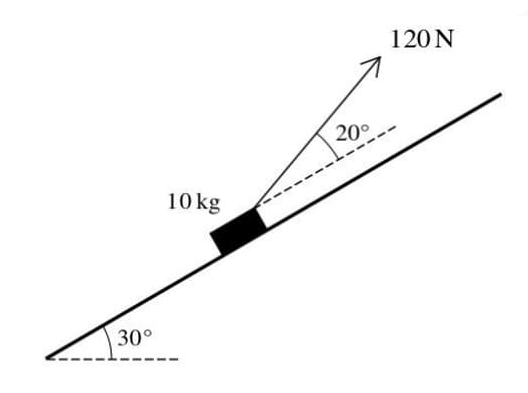
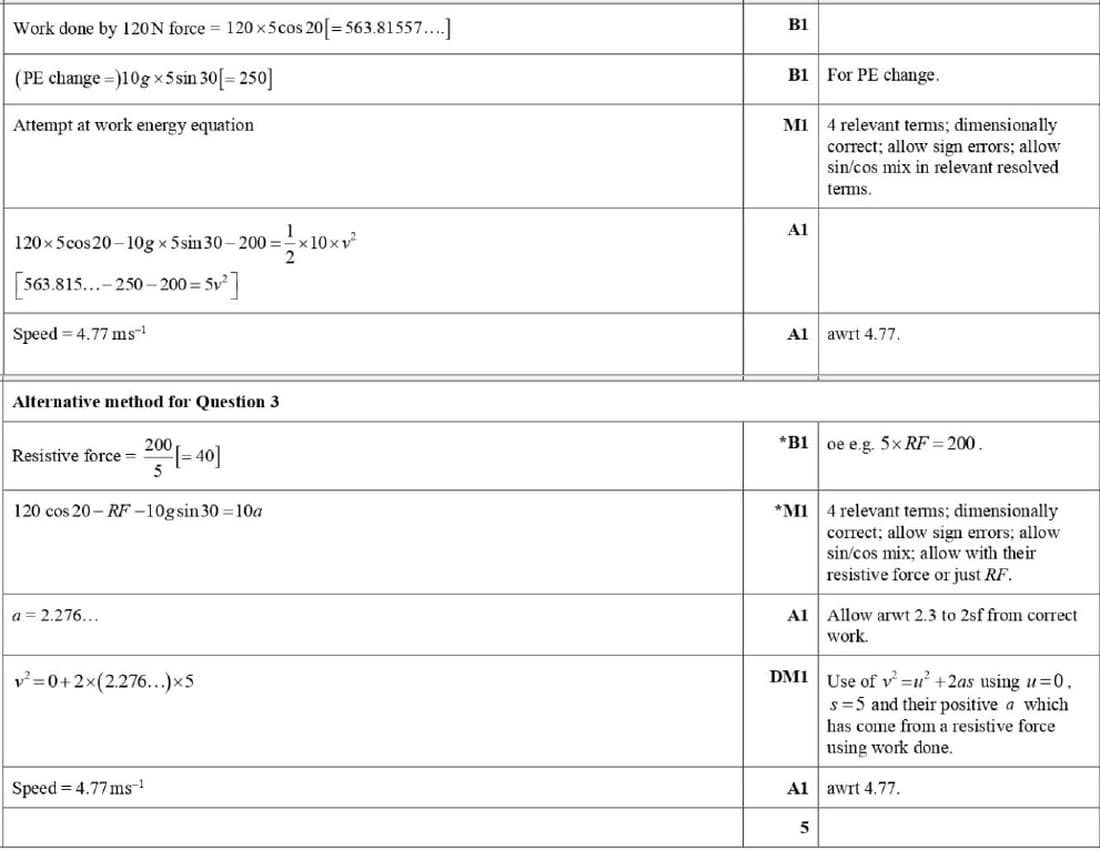
A block of mass 10 kg is at rest on a rough plane inclined at an angle of 30° to the horizontal. A force of 120 N is applied to the block at an angle of 20° above a line of greatest slope (see diagram). There is a force resisting the motion of the block and 200 J of work is done against this force when the block has moved a distance of 5 m up the plane from rest.
Find the speed of the block when it has moved a distance of 5 m up the plane from rest.
9709 P42 - Jun 2018 - Q1
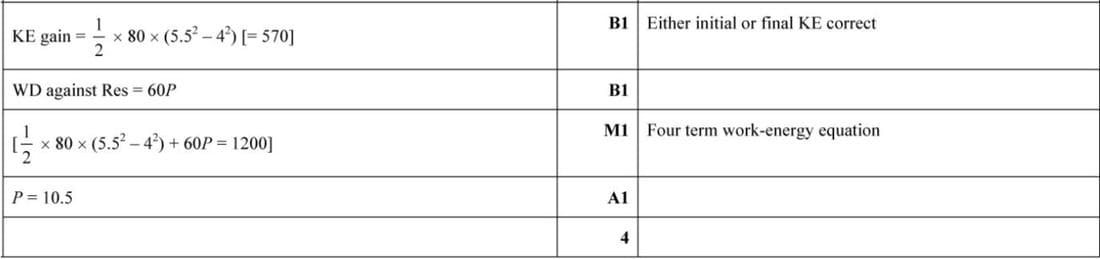
A man has mass 80 kg. He runs along a horizontal road against a constant resistance force of magnitude \(P\) N. The total work done by the man in increasing his speed from 4 m s\(^{-1}\) to 5.5 m s\(^{-1}\) while running a distance of 60 metres is 1200 J. Find the value of \(P\).
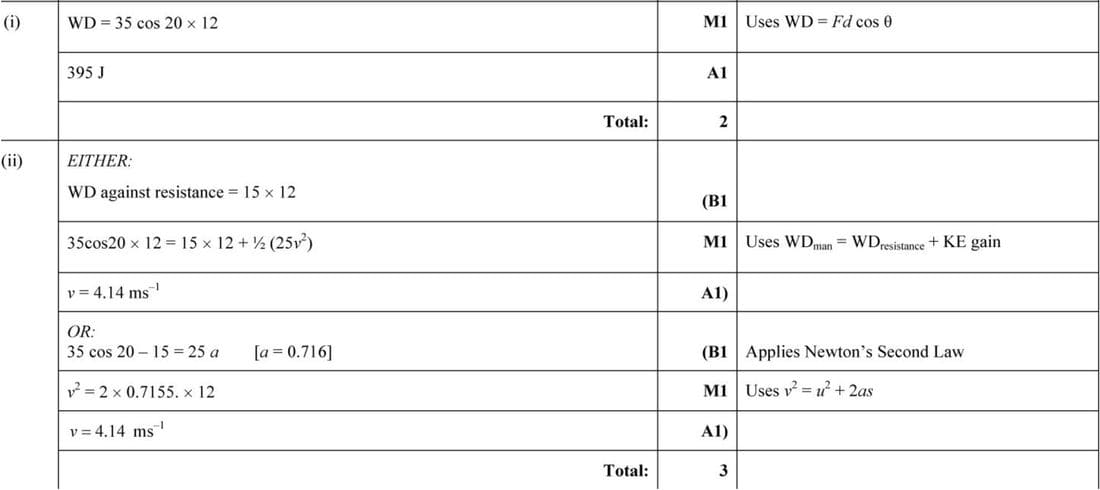
9709 P43 - Jun 2017 - Q1
A man pushes a wheelbarrow of mass 25 kg along a horizontal road with a constant force of magnitude 35 N at an angle of 20° below the horizontal. There is a constant resistance to motion of 15 N. The wheelbarrow moves a distance of 12 m from rest.
(i) Find the work done by the man.
(ii) Find the speed attained by the wheelbarrow after 12 m.
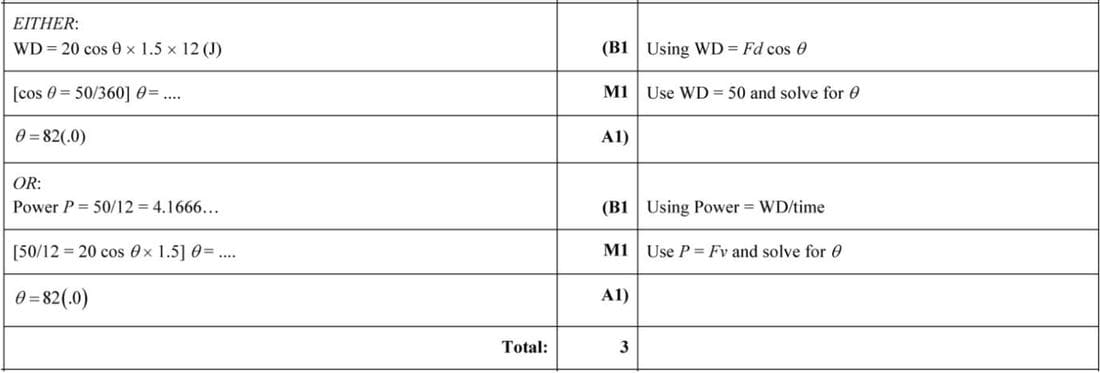
9709 P42 - Jun 2017 - Q1
One end of a light inextensible string is attached to a block. The string makes an angle of \(\theta^\circ\) with the horizontal. The tension in the string is 20 N. The string pulls the block along a horizontal surface at a constant speed of 1.5 m s\(^{-1}\) for 12 s. The work done by the tension in the string is 50 J. Find \(\theta\).
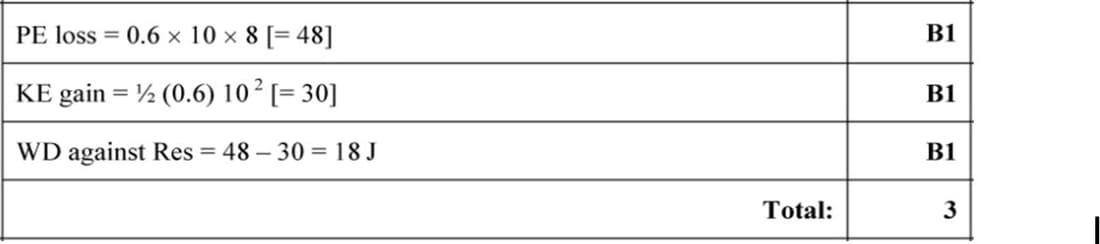
9709 P41 - Jun 2017 - Q1
A particle of mass 0.6 kg is dropped from a height of 8 m above the ground. The speed of the particle at the instant before hitting the ground is 10 m s-1. Find the work done against air resistance.
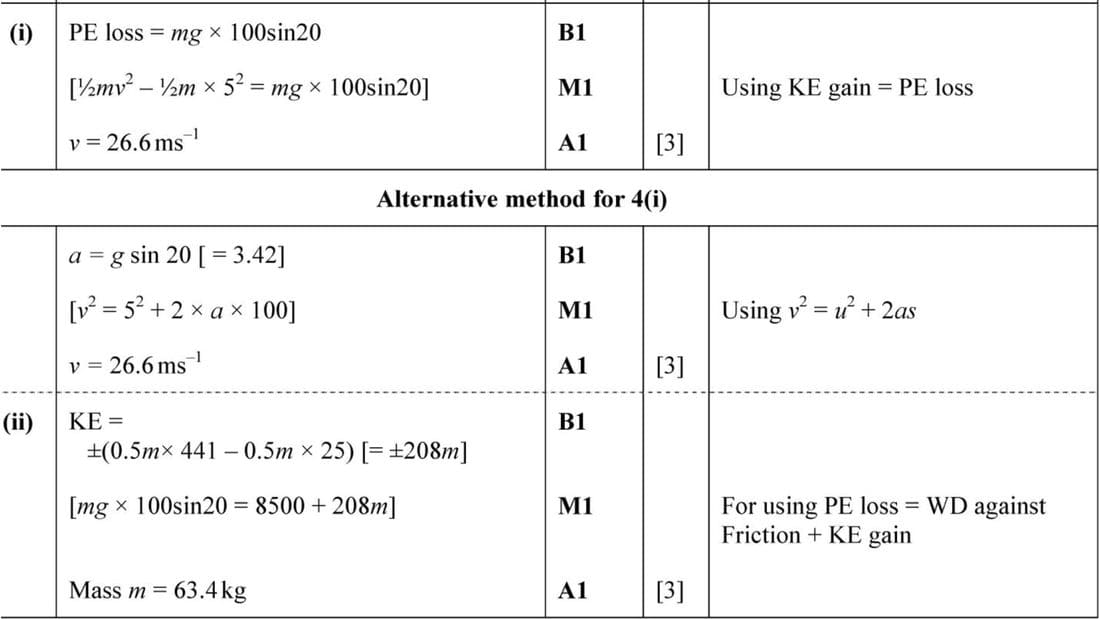
9709 P42 - Nov 2016 - Q4
A girl on a sledge starts, with a speed of 5 m/s, at the top of a slope of length 100 m which is at an angle of 20° to the horizontal. The sledge slides directly down the slope.
- Given that there is no resistance to the sledge’s motion, find the speed of the sledge at the bottom of the slope.
- It is given instead that the sledge experiences a resistance to motion such that the total work done against the resistance is 8500 J, and the speed of the sledge at the bottom of the slope is 21 m/s. Find the total mass of the girl and the sledge.
9709 P42 - Mar 2016 - Q1
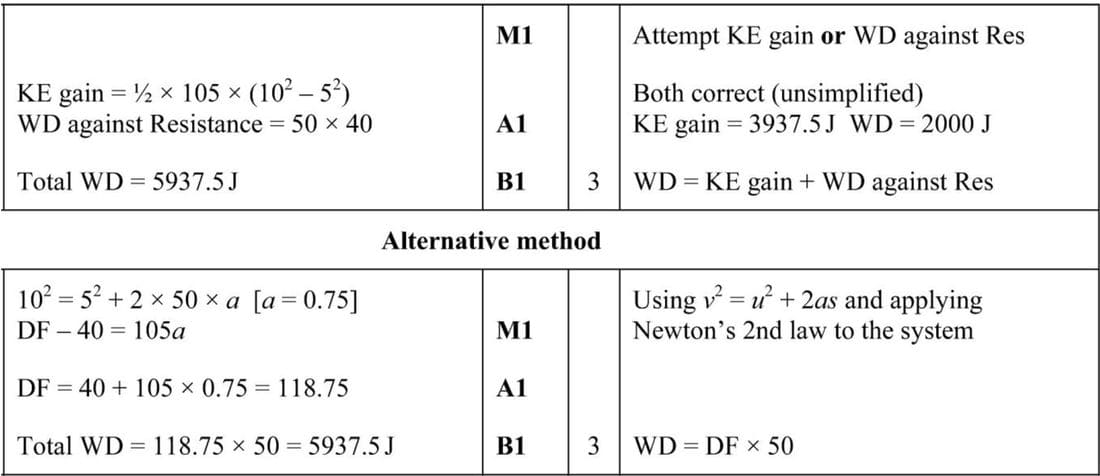
A cyclist has mass 85 kg and rides a bicycle of mass 20 kg. The cyclist rides along a horizontal road against a total resistance force of 40 N. Find the total work done by the cyclist in increasing his speed from 5 m s-1 to 10 m s-1 while travelling a distance of 50 m.
9709 P42 - Jun 2015 - Q1
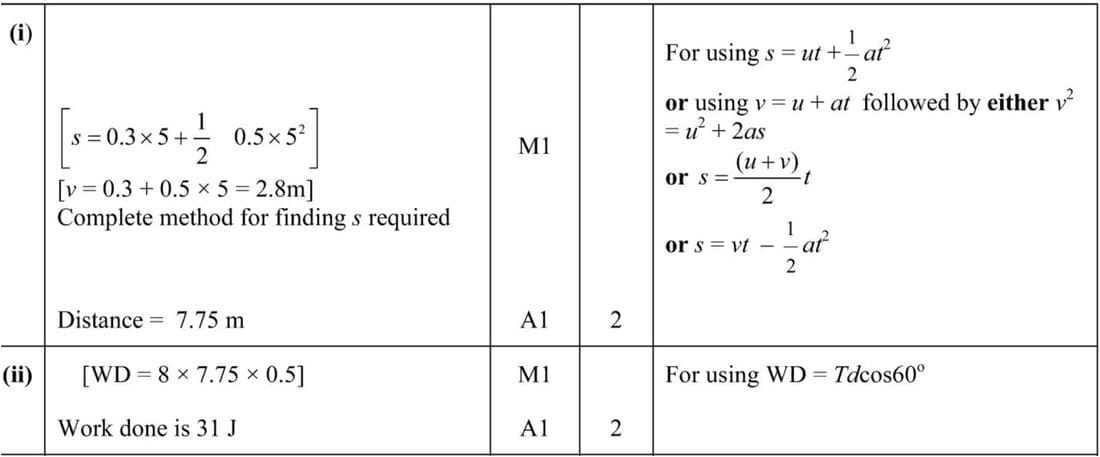
One end of a light inextensible string is attached to a block. The string makes an angle of 60° above the horizontal and is used to pull the block in a straight line on a horizontal floor with acceleration 0.5 m/s². The tension in the string is 8 N. The block starts to move with speed 0.3 m/s. For the first 5 s of the block’s motion, find
- the distance travelled,
- the work done by the tension in the string.
9709 P41 - Jun 2015 - Q1
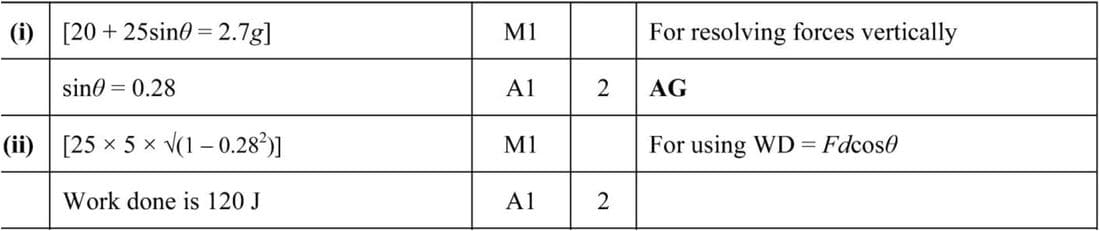
A block B of mass 2.7 kg is pulled at constant speed along a straight line on a rough horizontal floor. The pulling force has magnitude 25 N and acts at an angle of \(\theta\) above the horizontal. The normal component of the contact force acting on B has magnitude 20 N.
(i) Show that \(\sin \theta = 0.28\).
(ii) Find the work done by the pulling force in moving the block a distance of 5 m.
9709 P43 - Nov 2014 - Q7
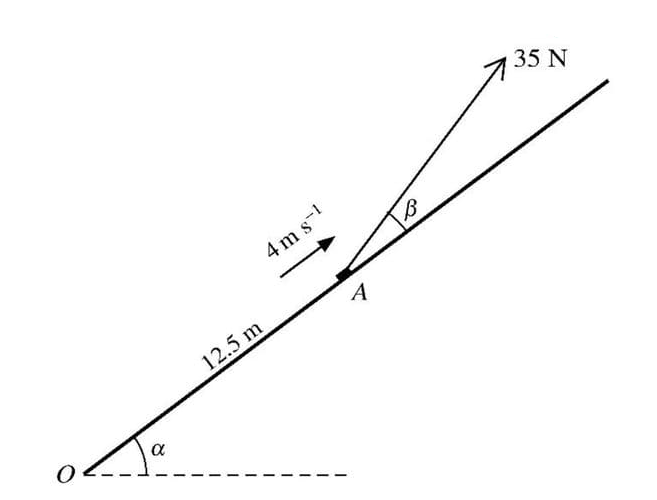
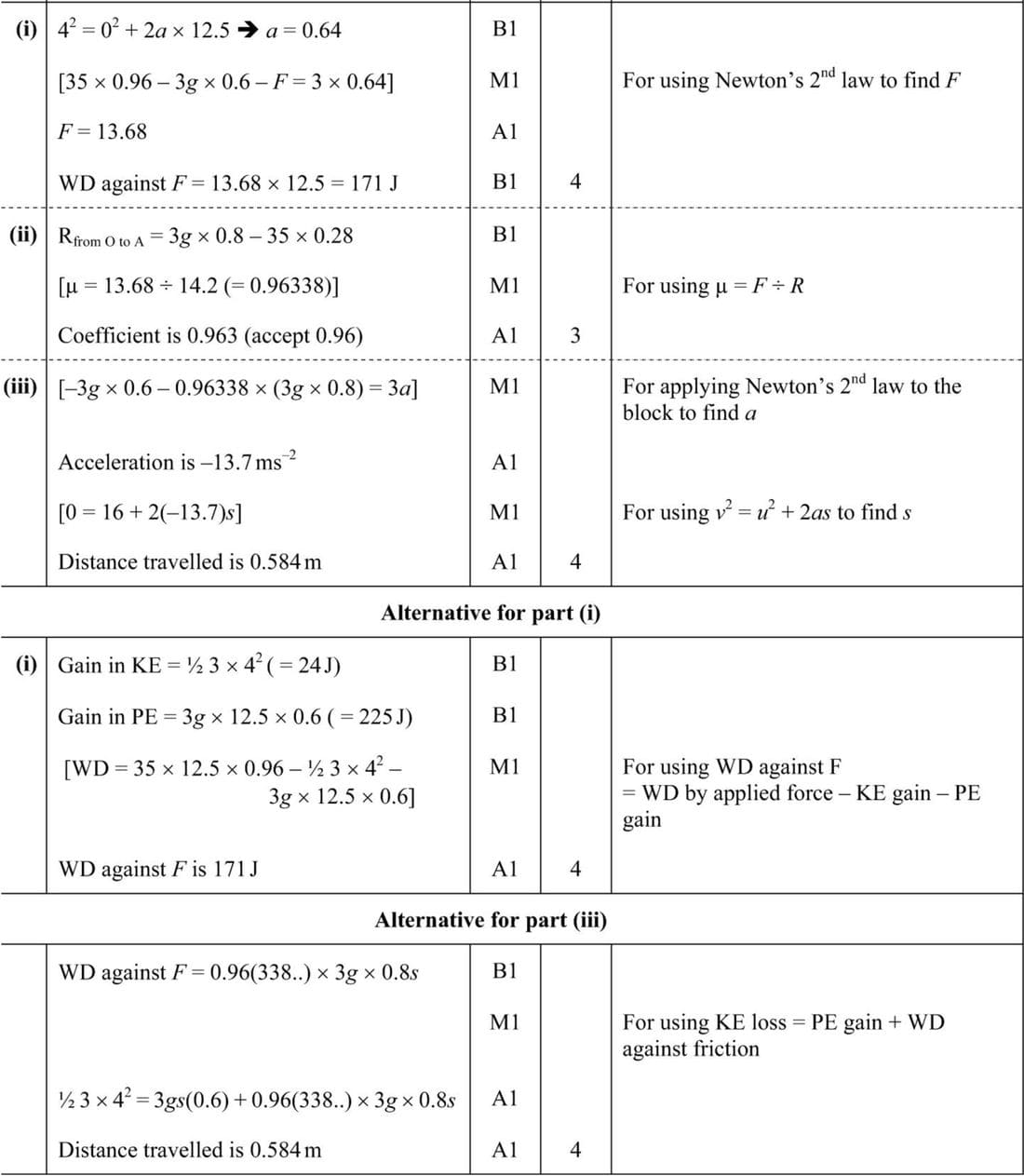
A small block of mass 3 kg is initially at rest at the bottom O of a rough plane inclined at an angle \(\alpha\) to the horizontal, where \(\sin \alpha = 0.6\) and \(\cos \alpha = 0.8\). A force of magnitude 35 N acts on the block at an angle \(\beta\) above the plane, where \(\sin \beta = 0.28\) and \(\cos \beta = 0.96\). The block starts to move up a line of greatest slope of the plane and passes through a point A with speed 4 m s\(^{-1}\). The distance \(OA\) is 12.5 m (see diagram).
(i) For the motion of the block from \(O\) to \(A\), find the work done against the frictional force acting on the block.
(ii) Find the coefficient of friction between the block and the plane.
At the instant that the block passes through \(A\) the force of magnitude 35 N ceases to act.
(iii) Find the distance the block travels up the plane after passing through \(A\).
9709 P42 - Nov 2013 - Q6
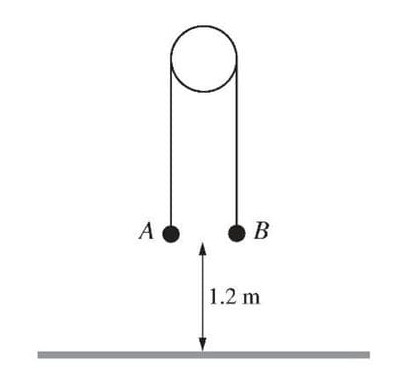
Particles A of mass 0.4 kg and B of mass 1.6 kg are attached to the ends of a light inextensible string which passes over a fixed smooth pulley. A is held at rest and B hangs freely, with both straight parts of the string vertical and both particles at a height of 1.2 m above the floor (see diagram). A is released and both particles start to move.
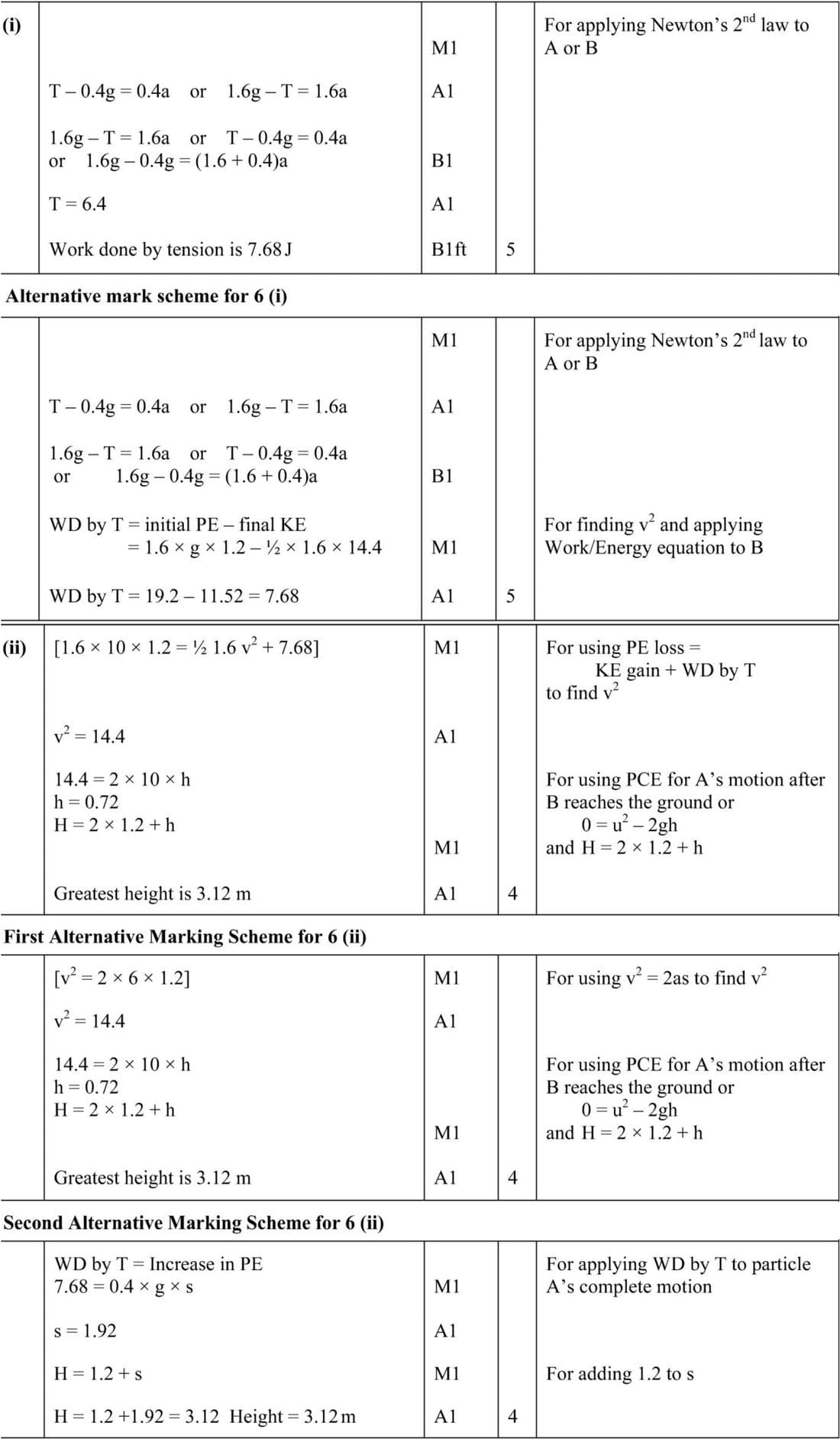
- Find the work done on B by the tension in the string, as B moves to the floor.
- When particle B reaches the floor it remains at rest. Particle A continues to move upwards. Find the greatest height above the floor reached by particle A.
9709 P42 - Nov 2023 - Q1
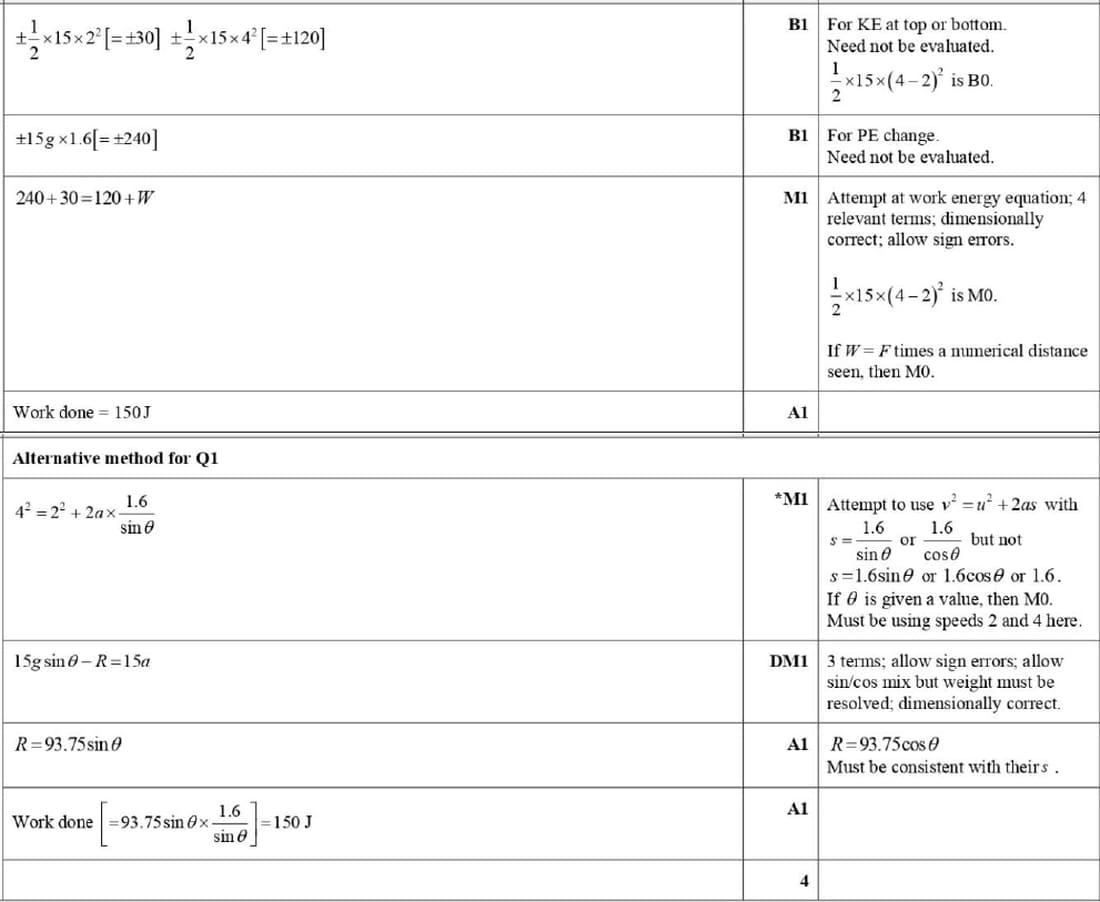
A block of mass 15 kg slides down a line of greatest slope of an inclined plane. The top of the plane is at a vertical height of 1.6 m above the level of the bottom of the plane. The speed of the block at the top of the plane is 2 m/s-1 and the speed of the block at the bottom of the plane is 4 m/s-1.
Find the work done against the resistance to motion of the block.
9709 P42 - Nov 2013 - Q2
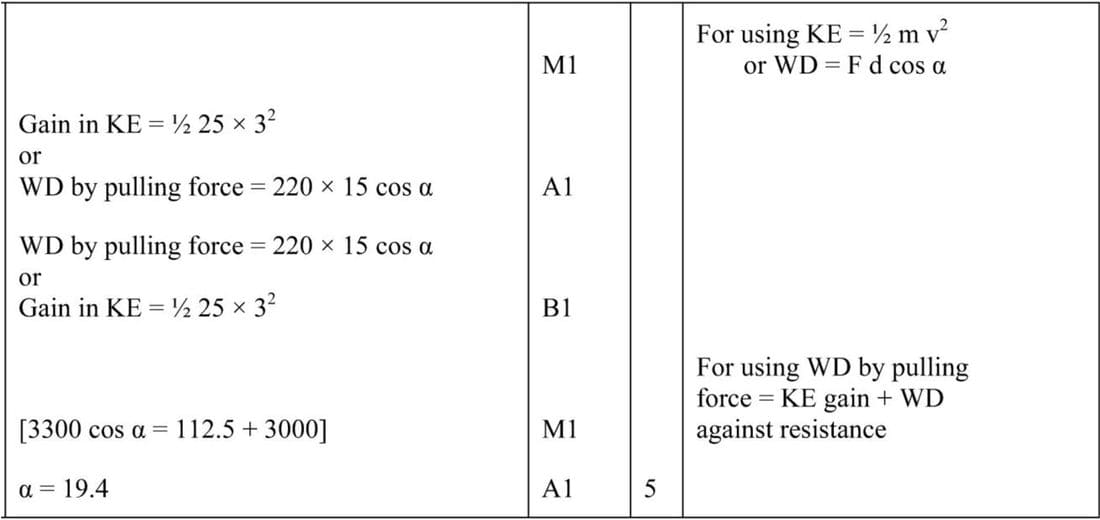
A box of mass 25 kg is pulled in a straight line along a horizontal floor. The box starts from rest at a point A and has a speed of 3 m/s when it reaches a point B. The distance AB is 15 m. The pulling force has magnitude 220 N and acts at an angle of \(\alpha^\circ\) above the horizontal. The work done against the resistance to motion acting on the box, as the box moves from A to B, is 3000 J. Find the value of \(\alpha\).
9709 P41 - Nov 2013 - Q5
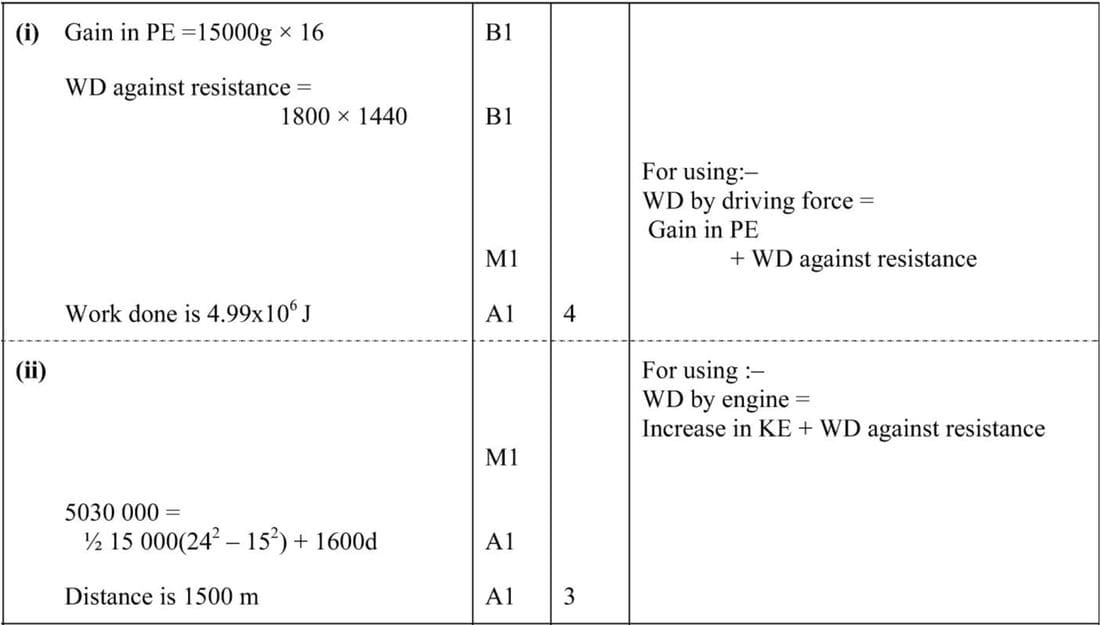
A lorry of mass 15,000 kg climbs from the bottom to the top of a straight hill, of length 1440 m, at a constant speed of 15 m s-1. The top of the hill is 16 m above the level of the bottom of the hill. The resistance to motion is constant and equal to 1800 N.
(i) Find the work done by the driving force.
On reaching the top of the hill the lorry continues on a straight horizontal road and passes through a point P with speed 24 m s-1. The resistance to motion is constant and is now equal to 1600 N. The work done by the lorry’s engine from the top of the hill to the point P is 5030 kJ.
(ii) Find the distance from the top of the hill to the point P.
9709 P41 - Nov 2013 - Q2
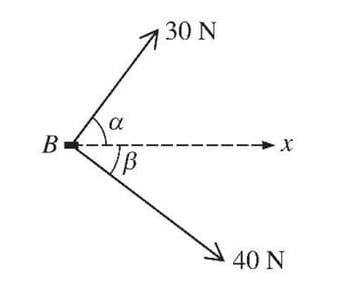
A block B lies on a rough horizontal plane. Horizontal forces of magnitudes 30 N and 40 N, making angles of \(\alpha\) and \(\beta\) respectively with the x-direction, act on B as shown in the diagram, and B is moving in the x-direction with constant speed. It is given that \(\cos \alpha = 0.6\) and \(\cos \beta = 0.8\).
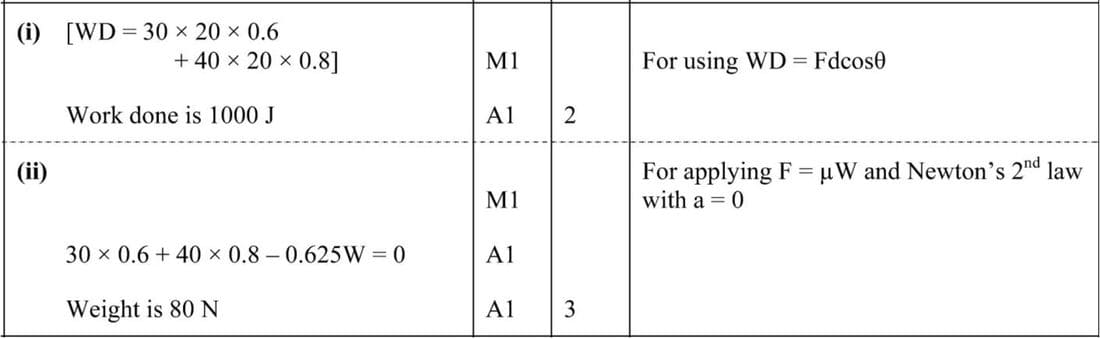
(i) Find the total work done by the forces shown in the diagram when B has moved a distance of 20 m.
(ii) Given that the coefficient of friction between the block and the plane is \(\frac{5}{8}\), find the weight of the block.
9709 P42 - Jun 2013 - Q2
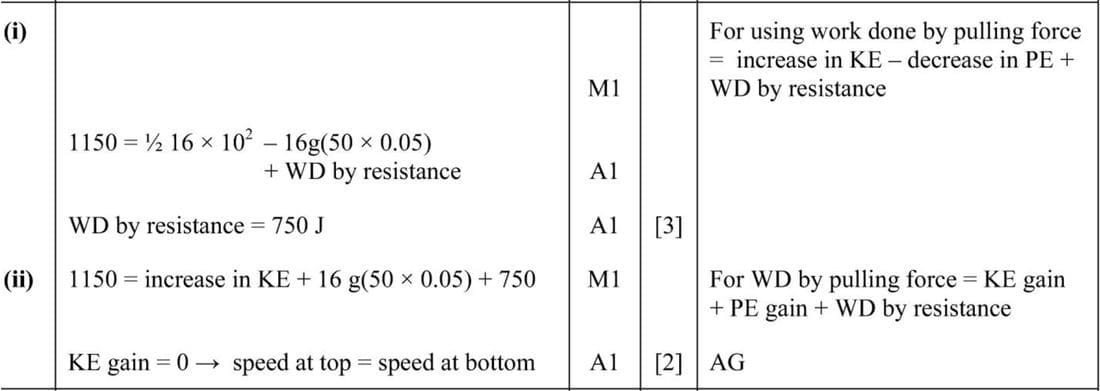
A and B are two points 50 metres apart on a straight path inclined at an angle \(\theta\) to the horizontal, where \(\sin \theta = 0.05\), with A above the level of B. A block of mass 16 kg is pulled down the path from A to B. The block starts from rest at A and reaches B with a speed of 10 m s-1. The work done by the pulling force acting on the block is 1150 J.
- Find the work done against the resistance to motion.
The block is now pulled up the path from B to A. The work done by the pulling force and the work done against the resistance to motion are the same as in the case of the downward motion.
- Show that the speed of the block when it reaches A is the same as its speed when it started at B.
9709 P41 - Jun 2013 - Q2
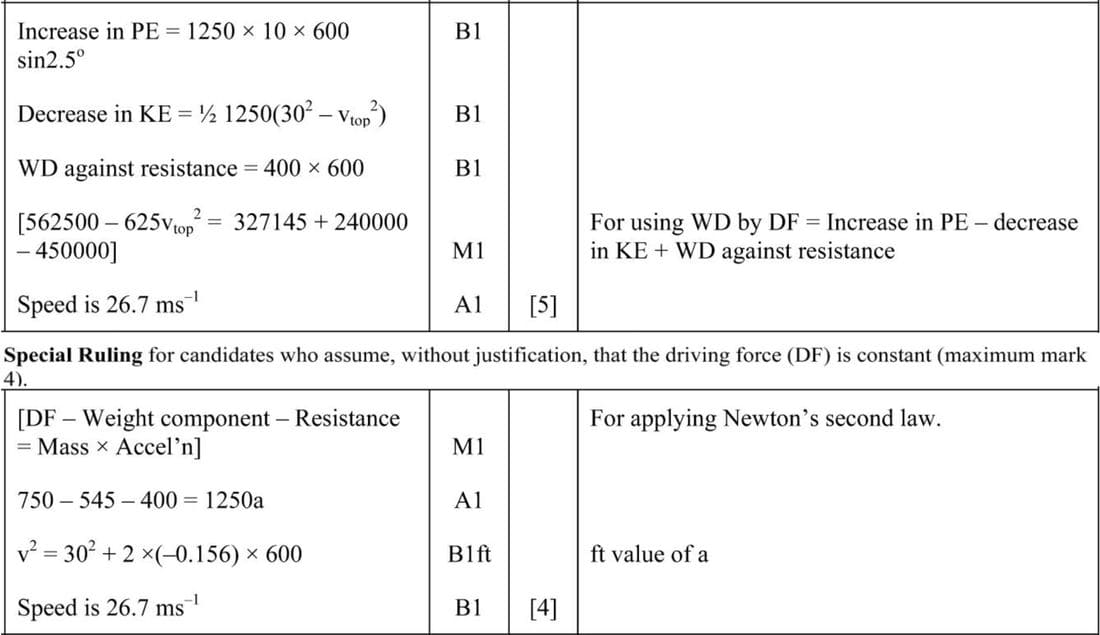
A car of mass 1250 kg travels from the bottom to the top of a straight hill of length 600 m, which is inclined at an angle of 2.5° to the horizontal. The resistance to motion of the car is constant and equal to 400 N. The work done by the driving force is 450 kJ. The speed of the car at the bottom of the hill is 30 m s-1. Find the speed of the car at the top of the hill.
9709 P42 - Nov 2012 - Q1
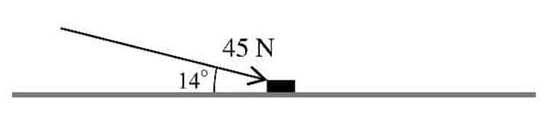
A block is pushed along a horizontal floor by a force of magnitude 45 N acting at an angle of 14° to the horizontal (see diagram). Find the work done by the force in moving the block a distance of 25 m.

9709 P43 - Jun 2012 - Q1
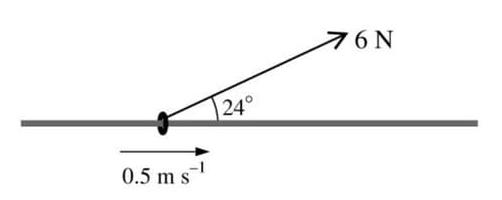
A ring is threaded on a fixed horizontal bar. The ring is attached to one end of a light inextensible string which is used to pull the ring along the bar at a constant speed of 0.5 m s-1. The string makes a constant angle of 24° with the bar and the tension in the string is 6 N (see diagram). Find the work done by the tension in a period of 8 s.

9709 P42 - Jun 2012 - Q1
A block is pulled in a straight line along horizontal ground by a force of constant magnitude acting at an angle of 60° above the horizontal. The work done by the force in moving the block a distance of 5 m is 75 J. Find the magnitude of the force.

9709 P41 - Nov 2011 - Q1
One end of a light inextensible string is attached to a block. The string is used to pull the block along a horizontal surface with a speed of 2 m s-1. The string makes an angle of 20° with the horizontal and the tension in the string is 25 N. Find the work done by the tension in a period of 8 seconds.

9709 P43 - Jun 2011 - Q1
A block is pulled for a distance of 50 m along a horizontal floor, by a rope that is inclined at an angle of \(\alpha^\circ\) to the floor. The tension in the rope is 180 N and the work done by the tension is 8200 J. Find the value of \(\alpha\).

9709 P42 - Jun 2023 - Q1
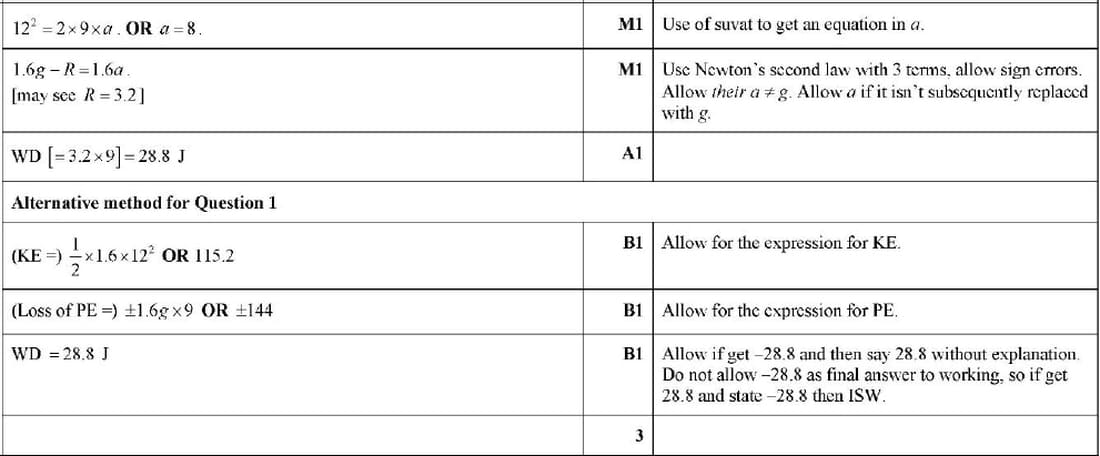
A particle of mass 1.6 kg is dropped from a height of 9 m above horizontal ground. The speed of the particle at the instant before hitting the ground is 12 m/s-1.
Find the work done against air resistance.
9709 P41 - Nov 2010 - Q5
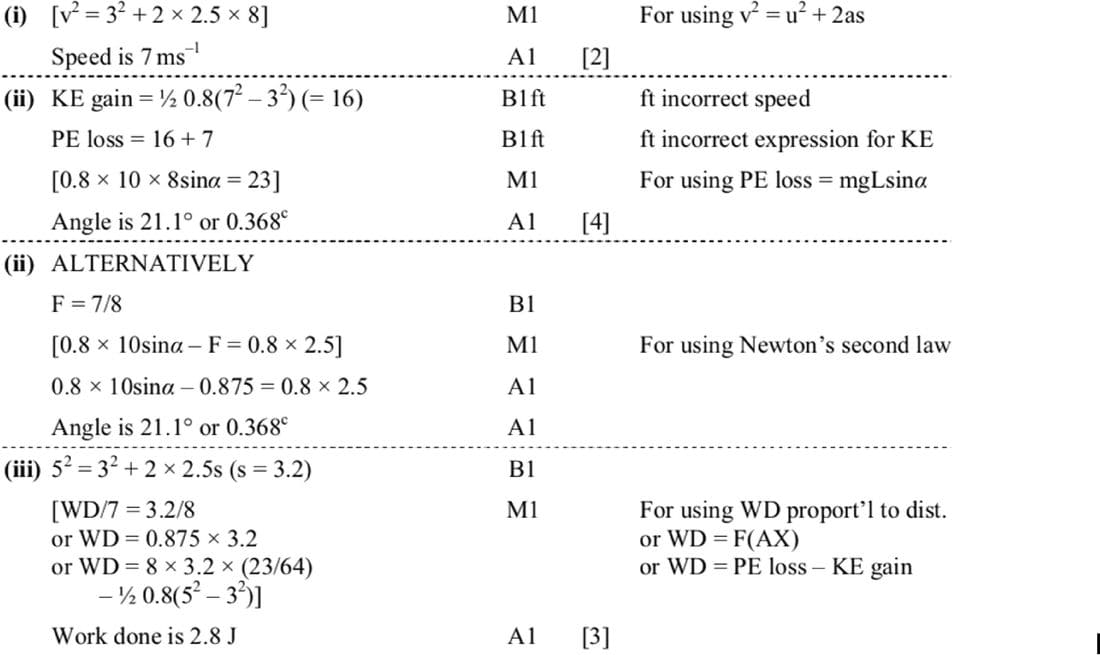
A particle of mass 0.8 kg slides down a rough inclined plane along a line of greatest slope AB. The distance AB is 8 m. The particle starts at A with speed 3 m/s and moves with constant acceleration 2.5 m/s2.
- Find the speed of the particle at the instant it reaches B.
- Given that the work done against the frictional force as the particle moves from A to B is 7 J, find the angle of inclination of the plane.
- When the particle is at the point X its speed is the same as the average speed for the motion from A to B. Find the work done by the frictional force for the particle’s motion from A to X.
9709 P4 - Nov 2008 - Q4
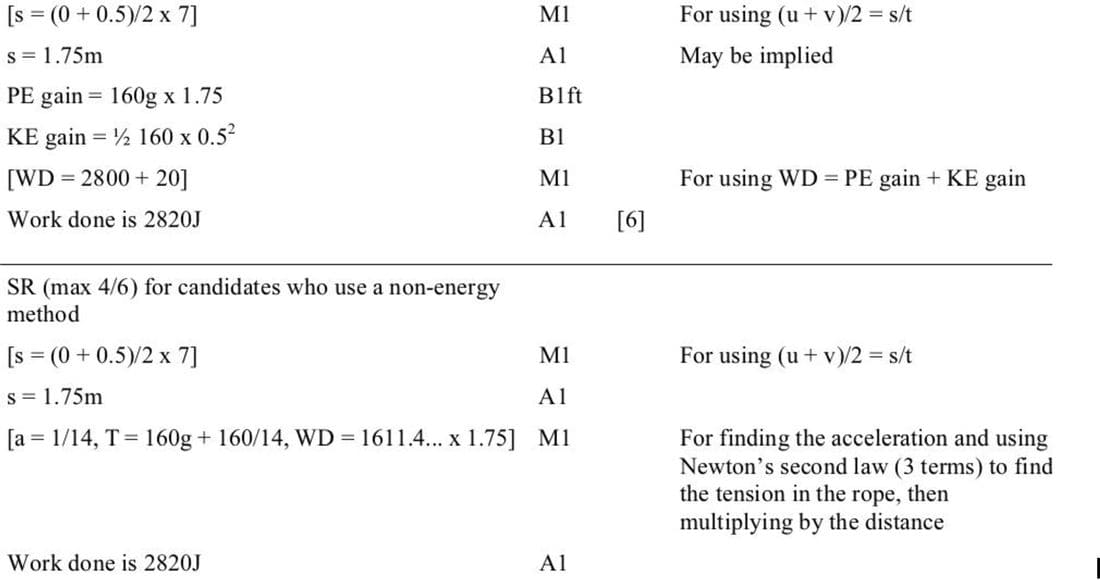
A load of mass 160 kg is lifted vertically by a crane, with constant acceleration. The load starts from rest at the point O. After 7 s, it passes through the point A with speed 0.5 m s-1. By considering energy, find the work done by the crane in moving the load from O to A.
9709 P4 - Jun 2008 - Q6
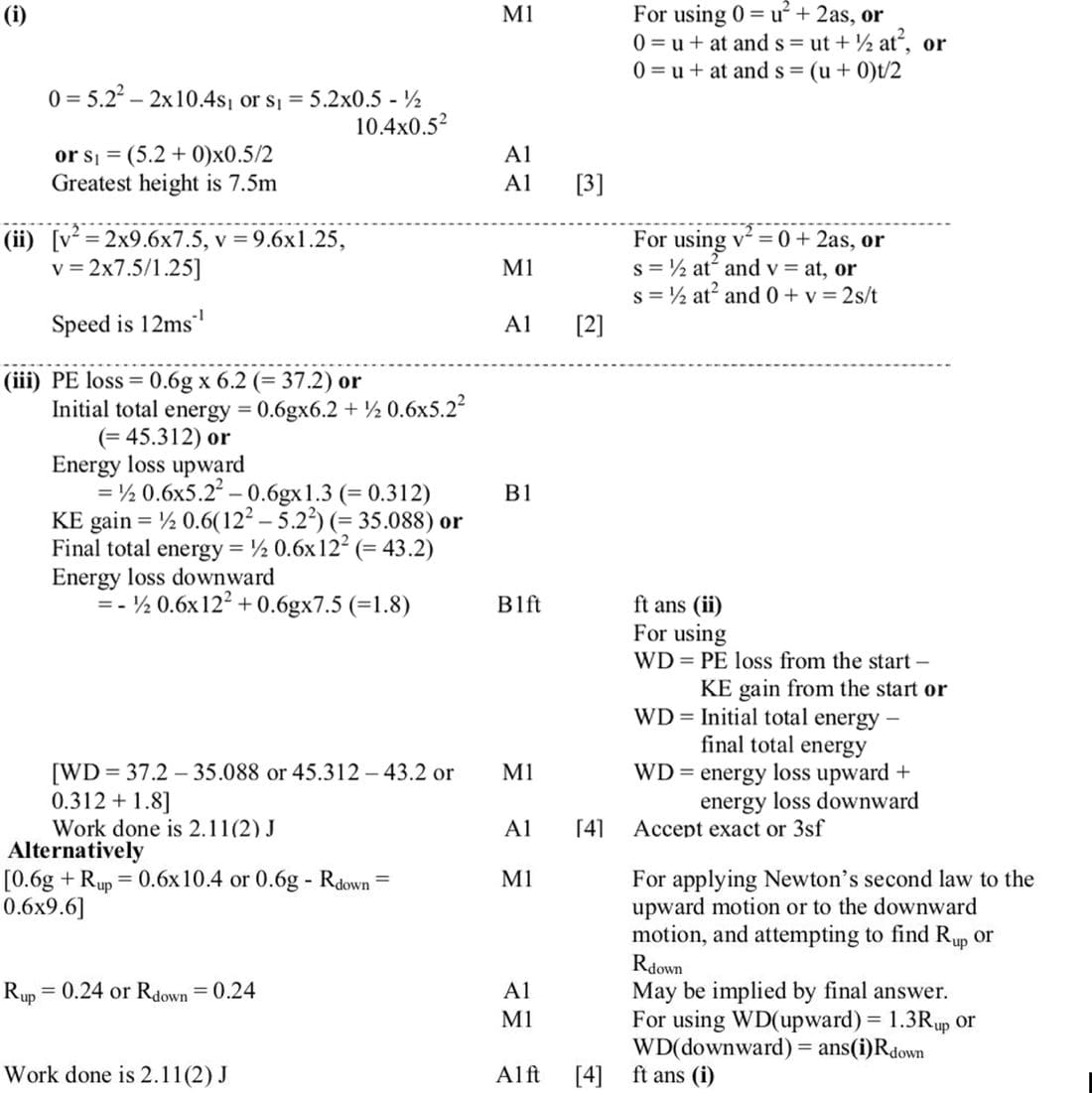
A particle P of mass 0.6 kg is projected vertically upwards with speed 5.2 m/s-1 from a point O which is 6.2 m above the ground. Air resistance acts on P so that its deceleration is 10.4 m/s-2 when P is moving upwards, and its acceleration is 9.6 m/s-2 when P is moving downwards. Find
- the greatest height above the ground reached by P,
- the speed with which P reaches the ground,
- the total work done on P by the air resistance.
9709 P4 - Jun 2005 - Q1
A small block is pulled along a rough horizontal floor at a constant speed of 1.5 m s-1 by a constant force of magnitude 30 N acting at an angle of \(\theta^\circ\) upwards from the horizontal. Given that the work done by the force in 20 s is 720 J, calculate the value of \(\theta\).

9709 P4 - Nov 2003 - Q3
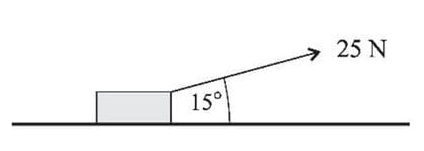
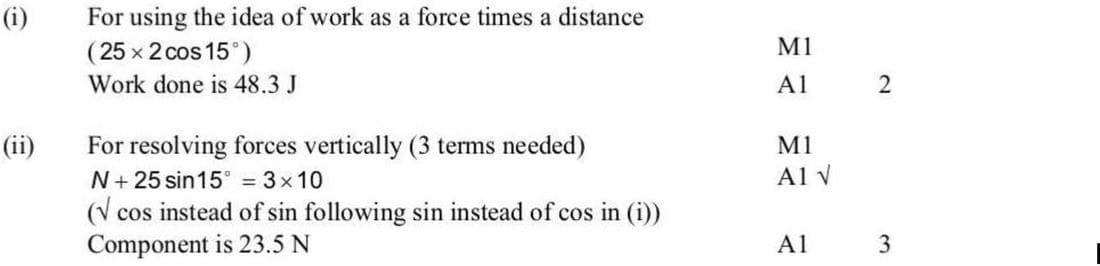
A crate of mass 3 kg is pulled at constant speed along a horizontal floor. The pulling force has magnitude 25 N and acts at an angle of 15° to the horizontal, as shown in the diagram. Find
- the work done by the pulling force in moving the crate a distance of 2 m,
- the normal component of the contact force on the crate.
9709 P42 - Nov 2022 - Q1
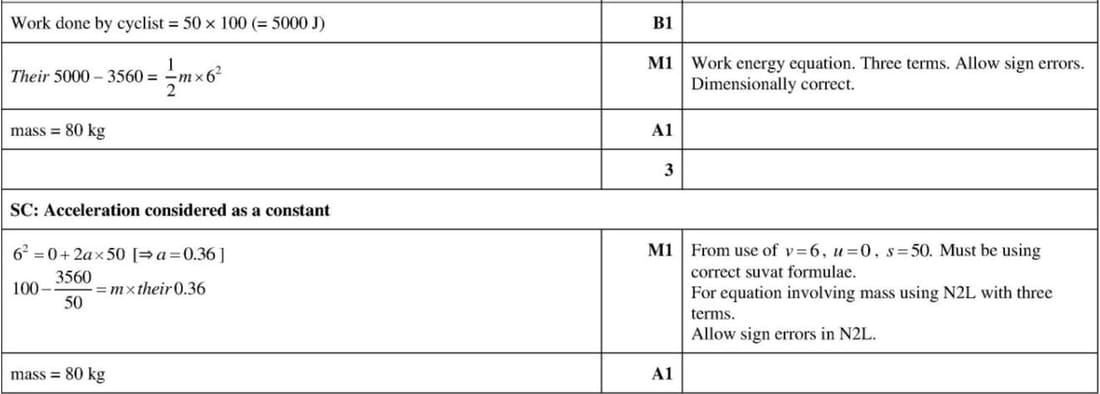
A cyclist is riding a bicycle along a straight horizontal road AB of length 50 m. The cyclist starts from rest at A and reaches a speed of 6 m s-1 at B. The cyclist produces a constant driving force of magnitude 100 N. There is a resistance force, and the work done against the resistance force from A to B is 3560 J.
Find the total mass of the cyclist and bicycle.
9709 P41 - Jun 2021 - Q1
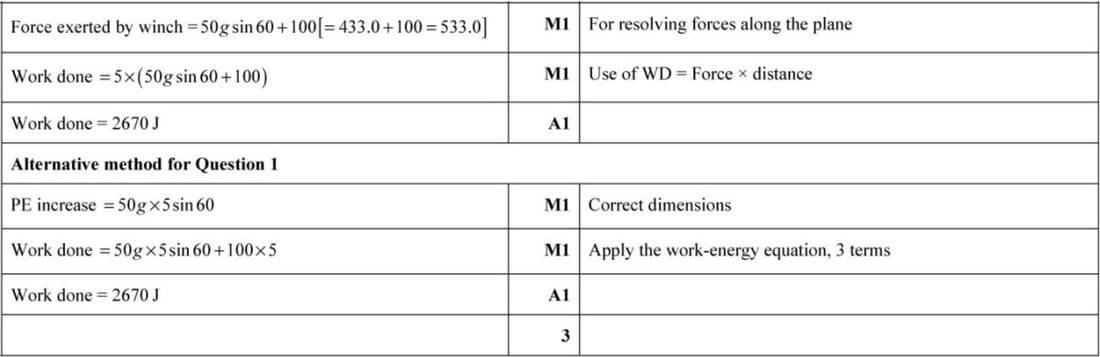
A winch operates by means of a force applied by a rope. The winch is used to pull a load of mass 50 kg up a line of greatest slope of a plane inclined at 60° to the horizontal. The winch pulls the load a distance of 5 m up the plane at constant speed. There is a constant resistance to motion of 100 N.
Find the work done by the winch.
9709 P42 - Jun 2019 - Q3
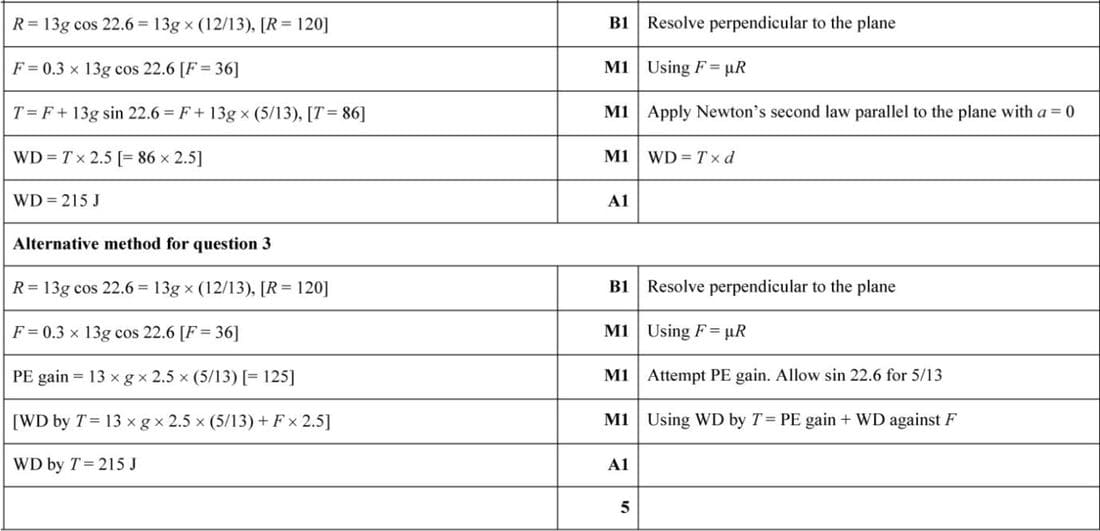
A particle of mass 13 kg is on a rough plane inclined at an angle of \(\theta\) to the horizontal, where \(\tan \theta = \frac{5}{12}\). The coefficient of friction between the particle and the plane is 0.3. A force of magnitude \(T\) N, acting parallel to a line of greatest slope, moves the particle a distance of 2.5 m up the plane at a constant speed. Find the work done by this force.
9709 P41 - Jun 2019 - Q4
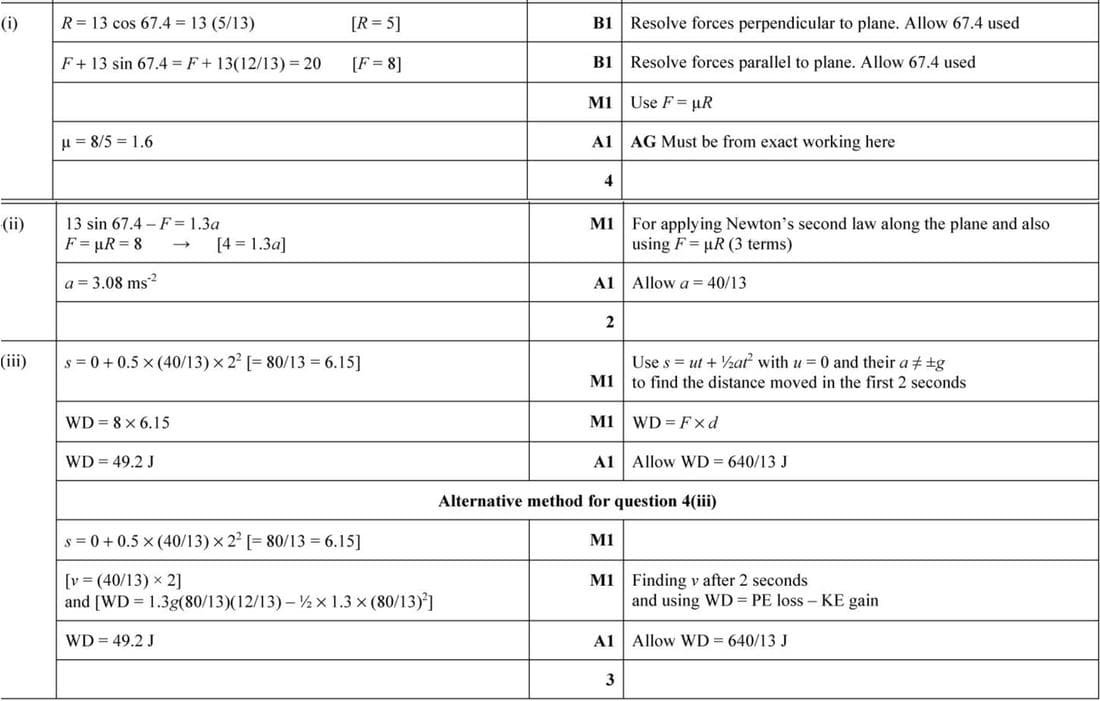
A particle of mass 1.3 kg rests on a rough plane inclined at an angle \(\theta\) to the horizontal, where \(\tan \theta = \frac{12}{5}\). The coefficient of friction between the particle and the plane is \(\mu\).
(i) A force of magnitude 20 N parallel to a line of greatest slope of the plane is applied to the particle and the particle is on the point of moving up the plane. Show that \(\mu = 1.6\). [4]
The force of magnitude 20 N is now removed.
(ii) Find the acceleration of the particle. [2]
(iii) Find the work done against friction during the first 2 s of motion. [3]
9709 P43 - Nov 2018 - Q3
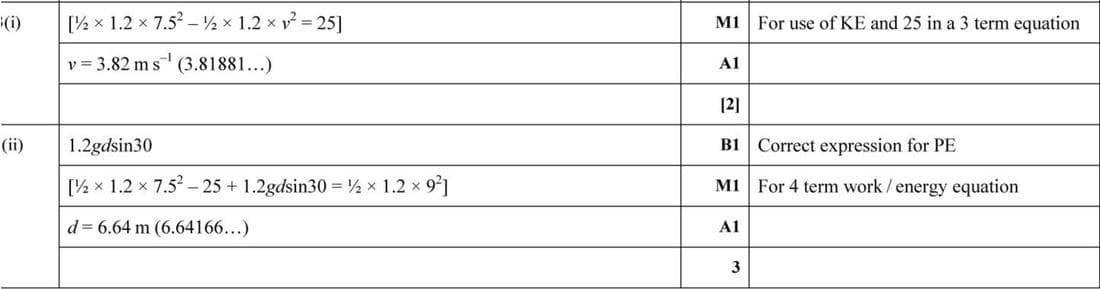
A particle of mass 1.2 kg moves in a straight line AB. It is projected with speed 7.5 m s-1 from A towards B and experiences a resistance force. The work done against this resistance force in moving from A to B is 25 J.
- Given that AB is horizontal, find the speed of the particle at B.
- It is given instead that AB is inclined at 30° below the horizontal and that the speed of the particle at B is 9 m s-1. The work done against the resistance force remains the same. Find the distance AB.
9709 P41 - Nov 2018 - Q3
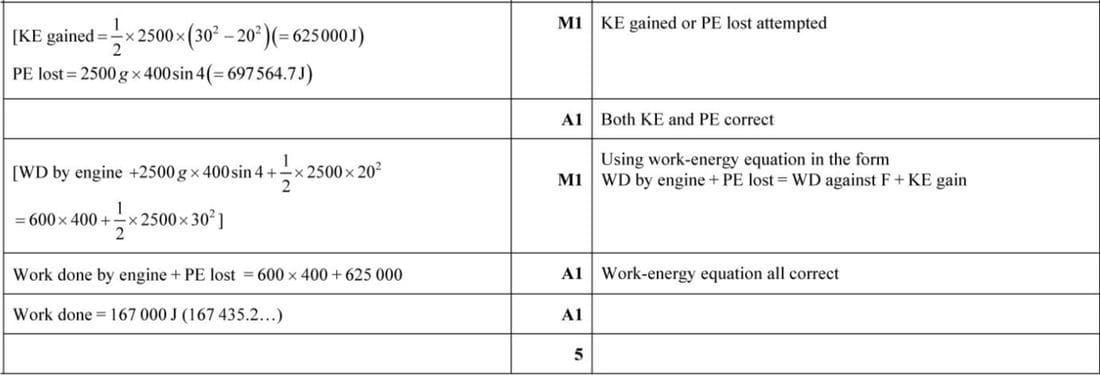
A van of mass 2500 kg descends a hill of length 0.4 km inclined at 4° to the horizontal. There is a constant resistance to motion of 600 N and the speed of the van increases from 20 m/s to 30 m/s as it descends the hill. Find the work done by the van’s engine as it descends the hill.