9709 P43 - Nov 2021 - Q3 - 6 marks
A ball of mass 1.6 kg is released from rest at a point 5 m above horizontal ground. When the ball hits the ground it instantaneously loses 8 J of kinetic energy and starts to move upwards.
Use \(g=10\mathrm{\ m\,s^{-2}}\).
(a) Use an energy method to find the greatest height that the ball reaches after hitting the ground. [3]
(b) Find the total time taken, from the initial release of the ball until it reaches this greatest height. [3]

9709 P42 - Nov 2021 - Q3 - 5 marks

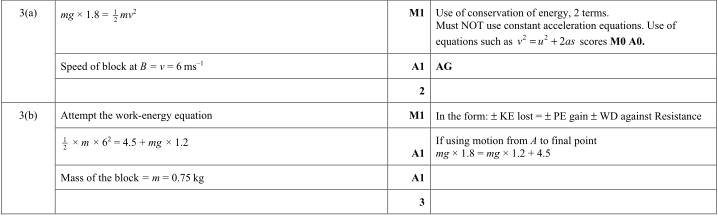
The diagram shows a semi-circular track ABC of radius 1.8 m which is fixed in a vertical plane. The points A and C are at the same horizontal level and the point B is at the bottom of the track. The section AB is smooth and the section BC is rough. A small block is released from rest at A.
Use \(g=10\mathrm{\ m\,s^{-2}}\).
(a) Show that the speed of the block at B is 6 m/s. [2]
The block comes to instantaneous rest for the first time at a height of 1.2 m above the level of B. The work done against the resistance force during the motion of the block from B to this point is 4.5 J.
(b) Find the mass of the block. [3]
9709 P43 - Jun 2021 - Q5 - 9 marks
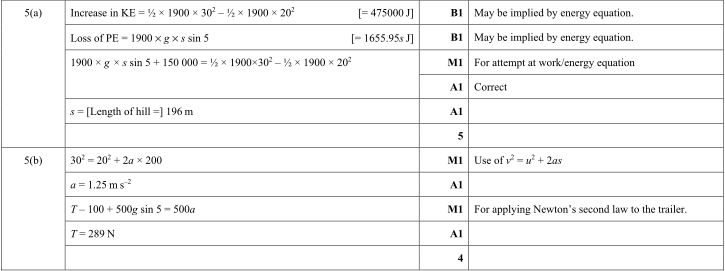
A car of mass 1400 kg is towing a trailer of mass 500 kg down a straight hill inclined at an angle of 5° to the horizontal. The car and trailer are connected by a light rigid tow-bar. At the top of the hill the speed of the car and trailer is 20 m/s and at the bottom of the hill their speed is 30 m/s.
Use \(g=10\mathrm{\ m\,s^{-2}}\).
(a) It is given that as the car and trailer descend the hill, the engine of the car does 150 000 J of work, and there are no resistance forces. Find the length of the hill. [5]
(b) It is given instead that there is a resistance force of 100 N on the trailer, the length of the hill is 200 m, and the acceleration of the car and trailer is constant. Find the tension in the tow-bar between the car and trailer. [4]
9709 P41 - Nov 2023 - Q1 - 3 marks
Take \(g=10\,\mathrm{m\,s^{-2}}\).
A particle of mass \(1.6\,\mathrm{kg}\) is projected with speed \(20\,\mathrm{m\,s^{-1}}\) up a line of greatest slope of a smooth plane inclined at \(\alpha\) to the horizontal, where \(\tan\alpha=3/4\).
Use an energy method to find the distance the particle moves up the plane before coming to instantaneous rest. [3]

9709 P42 - Jun 2021 - Q1 - 3 marks
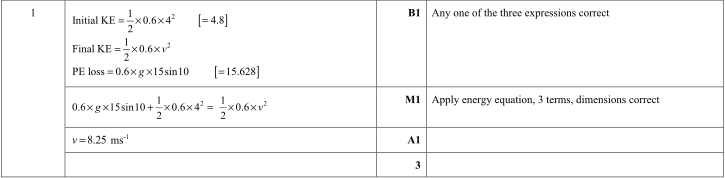
A particle of mass 0.6 kg is projected with a speed of 4 m/s down a line of greatest slope of a smooth plane inclined at 10° to the horizontal.
Use \(g=10\mathrm{\ m\,s^{-2}}\).
Use an energy method to find the speed of the particle after it has moved 15 m down the plane. [3]
9709 P41 - Jun 2021 - Q7 - 11 marks

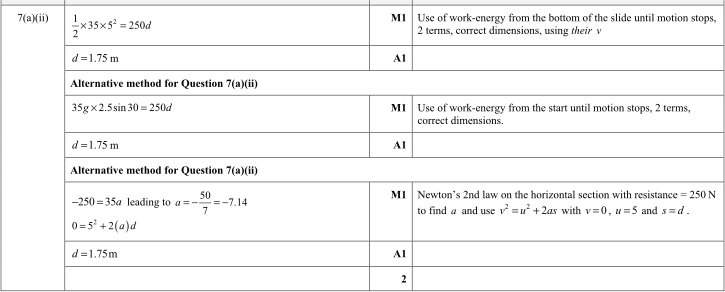
A slide in a playground descends at a constant angle of 30° for 2.5 m. It then has a horizontal section in the same vertical plane as the sloping section. A child of mass 35 kg, modelled as a particle P, starts from rest at the top of the slide and slides straight down the sloping section. She then continues along the horizontal section until she comes to rest (see diagram). There is no instantaneous change in speed when the child goes from the sloping section to the horizontal section.
The child experiences a resistance force on the horizontal section of the slide, and the work done against the resistance force on the horizontal section of the slide is 250 J per metre.
Use \(g=10\mathrm{\ m\,s^{-2}}\).
(a) It is given that the sloping section of the slide is smooth.
(a)(i) Find the speed of the child when she reaches the bottom of the sloping section. [3]
(a)(ii) Find the distance that the child travels along the horizontal section of the slide before she comes to rest. [2]
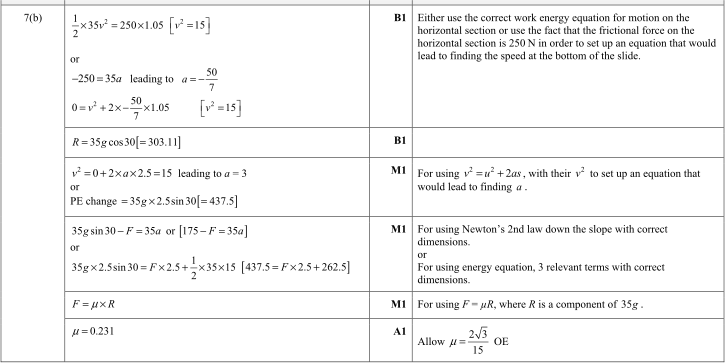
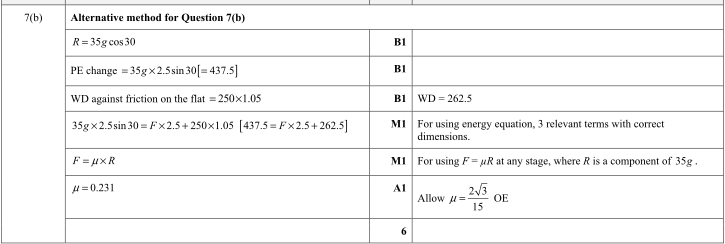
(b) It is given instead that the sloping section of the slide is rough and that the child comes to rest on the slide 1.05 m after she reaches the horizontal section. Find the coefficient of friction between the child and the sloping section of the slide. [6]

9709 P43 - Nov 2020 - Q2 - 4 marks
Where needed, use \(g=10\text{ m s}^{-2}\).
A box of mass 5 kg is pulled at constant speed a distance of 15 m up a rough plane inclined at \(20^\circ\) to the horizontal. It moves along a line of greatest slope against a frictional force of 40 N. The pulling force is parallel to this line.
(a) Find the work done against friction. [1]
(b) Find the change in gravitational potential energy of the box. [2]
(c) Find the work done by the pulling force. [1]

9709 P41 - Nov 2020 - Q6 - 9 marks
Where needed, use \(g=10\text{ m s}^{-2}\).
A car of mass 1500 kg pulls a trailer of mass 750 kg up a straight hill of length 800 m inclined at \(\sin^{-1}(0.08)\) to the horizontal. Resistances to the car and trailer are 400 N and 200 N respectively. They are connected by a light rigid tow-bar. Their speed is \(30\text{ m s}^{-1}\) at the bottom and \(20\text{ m s}^{-1}\) at the top.
(a) Use an energy method to find the constant driving force up the hill. [5]
At the top, the system travels along a straight level road. The driving force is now 2400 N and the resistances are unchanged.
(b) Find the system’s acceleration and the tension in the tow-bar. [4]


9709 P43 - Jun 2020 - Q5 - 9 marks
Where needed, use \(g=10\text{ m s}^{-2}\).
A block \(B\) of mass 4 kg is pushed up a line of greatest slope of a smooth plane inclined at \(30^\circ\) to the horizontal by a force acting in its direction of motion. It passes \(P\) and \(Q\) at \(12\text{ m s}^{-1}\) and \(8\text{ m s}^{-1}\), respectively. The points are 10 m apart, with \(P\) below \(Q\).
(a) Find the decrease in kinetic energy from \(P\) to \(Q\). [2]
(b) Hence find the work done by the pushing force over this distance. [3]
(c) At \(Q\), the pushing force is removed. Find the time from this instant until the block returns to \(P\). [4]

9709 P41 - Jun 2020 - Q5 - 7 marks
Where needed, use \(g=10\text{ m s}^{-2}\).

A child of mass 35 kg swings on a rope, modelled as a particle \(P\) and a light inextensible string of length 4 m. Initially \(P\) is held at \(45^\circ\) to the vertical and released from rest.
(a) There is no resistance. Find the speed when \(P\) has travelled halfway along the circular arc from the initial position to the lowest point. [4]
(b) Instead, resistance is present. The work done against resistance from the initial position to the lowest point is \(X\) J, and the speed at the lowest point is \(4\text{ m s}^{-1}\). Find \(X\). [3]

9709 P42 - Mar 2020 - Q3 - 6 marks
Where needed, use \(g=10\text{ m s}^{-2}\).

The diagram shows a vertical cross-section of a surface containing points \(A\), \(B\) and \(C\). Point \(B\) is \(h\) m above \(A\), and \(C\) is 0.5 m below \(A\). A particle of mass 0.2 kg is projected from \(A\) up the slope at \(5\text{ m s}^{-1}\) and remains in contact with the surface from \(A\) to \(C\).
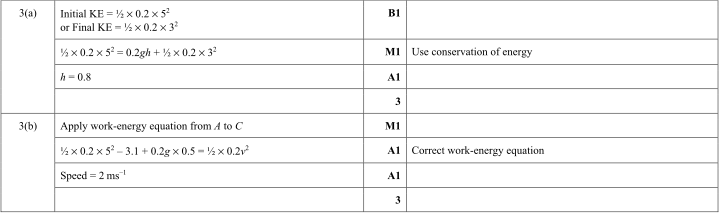
(a) The particle reaches \(B\) at \(3\text{ m s}^{-1}\) and there is no resistance. Find \(h\). [3]
(b) Instead, resistance is present and the particle does 3.1 J of work against it from \(A\) to \(C\). Find its speed at \(C\). [3]
9709 P43 - Jun 2023 - Q7 - 10 marks
Take \(g=10\,\mathrm{m\,s^{-2}}\).

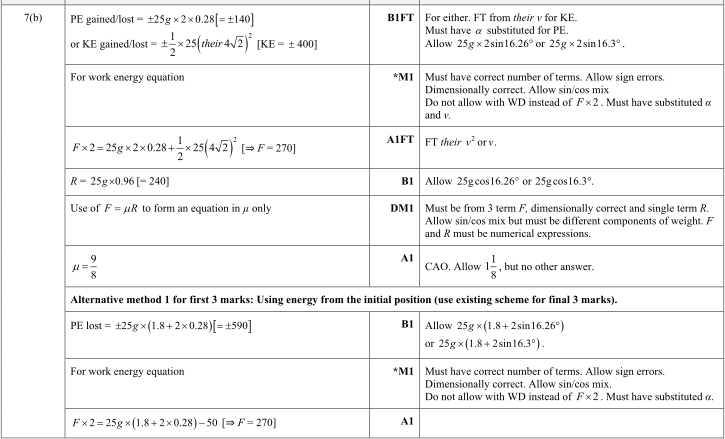
The diagram shows the vertical cross-section \(XYZ\) of a rough slide. Straight \(YZ\) has length 2 m and is inclined at \(\alpha\), where \(\sin\alpha=0.28\). It is tangential to curved \(XY\) at \(Y\). \(X\) is 1.8 m above \(Y\). A \(25\,\mathrm{kg}\) child starts sliding from rest at \(X\); work against resistance from \(X\) to \(Y\) is \(50\,\mathrm J\).
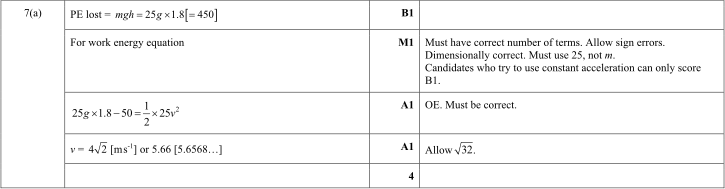
(a) Find the speed at Y. [4]
The child comes to rest at Z.
(b) Use an energy method to find the coefficient of friction on YZ, as a fraction in simplest form. [6]

9709 P42 - Jun 2023 - Q4 - 7 marks
Take \(g=10\,\mathrm{m\,s^{-2}}\).
An athlete of mass \(84\,\mathrm{kg}\) runs along a straight road.
(a) On horizontal road he runs at constant speed \(3\,\mathrm{m\,s^{-1}}\), producing constant power \(60\,\mathrm W\). Find the resistive force. [1]
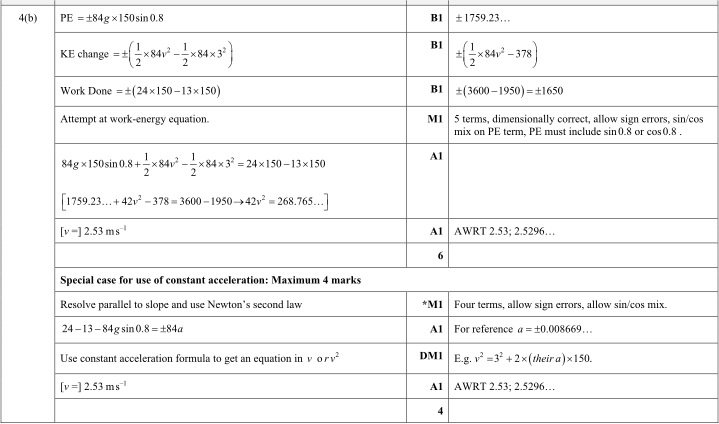
(b) He then runs up a 150 m section inclined at \(0.8^\circ\). His initial speed is \(3\,\mathrm{m\,s^{-1}}\), driving force is constant at \(24\,\mathrm N\), and total resistance is constant at \(13\,\mathrm N\). Use an energy method to find his speed at the end. [6]

9709 P43 - Nov 2022 - Q2 - 4 marks
A box of mass \(5\text{ kg}\) is pulled at a constant speed of \(1.8\text{ m s}^{-1}\) for \(15\text{ s}\) up a rough plane inclined at an angle of \(20^\circ\) to the horizontal. The box moves along a line of greatest slope against a frictional force of \(40\text{ N}\). The force pulling the box is parallel to the line of greatest slope. Use \(g=10\text{ m s}^{-2}\).
(a) Find the change in gravitational potential energy of the box. [2]
(b) Find the work done by the pulling force. [2]

9709 P43 - Jun 2022 - Q5 - 8 marks
A cyclist is riding along a straight horizontal road. The total mass of the cyclist and her bicycle is \(70\text{ kg}\). At an instant when the speed of the cyclist is \(4\text{ m s}^{-1}\), her acceleration is \(0.3\text{ m s}^{-2}\). There is a constant resistance to motion of magnitude \(30\text{ N}\). Use \(g=10\text{ m s}^{-2}\).
(a) Find the power developed by the cyclist. [3]
The cyclist comes to the top of a hill inclined at \(5^\circ\) to the horizontal. The cyclist stops pedalling and freewheels down the hill (so that the cyclist is no longer supplying any power). The magnitude of the resistance force remains at \(30\text{ N}\). Over a distance of \(d\text{ m}\), the speed of the cyclist increases from \(6\text{ m s}^{-1}\) to \(12\text{ m s}^{-1}\).
(b) Find the change in kinetic energy. [2]
(c) Use an energy method to find \(d\). [3]

9709 P42 - Nov 2023 - Q3 - 5 marks
Take \(g=10\,\mathrm{m\,s^{-2}}\).

A \(10\,\mathrm{kg}\) block is at rest on a rough plane inclined at \(30^\circ\). A force of \(120\,\mathrm N\) acts at \(20^\circ\) above a line of greatest slope, as shown. There is a force resisting its motion, and \(200\,\mathrm J\) of work is done against this force when the block has moved \(5\,\mathrm m\) up the plane from rest.
Find the speed after it has moved 5 m up the plane. [5]


9709 P42 - Nov 2023 - Q1 - 4 marks
Take \(g=10\,\mathrm{m\,s^{-2}}\).
A \(15\,\mathrm{kg}\) block slides down a line of greatest slope of an inclined plane. The top is \(1.6\,\mathrm m\) vertically above the bottom. Its speed is \(2\,\mathrm{m\,s^{-1}}\) at the top and \(4\,\mathrm{m\,s^{-1}}\) at the bottom.
Find the work done against the resistance to motion. [4]


9709 P42 - Jun 2023 - Q1 - 3 marks
Take \(g=10\,\mathrm{m\,s^{-2}}\).
A \(1.6\,\mathrm{kg}\) particle is dropped from 9 m above horizontal ground. Its speed just before hitting the ground is \(12\,\mathrm{m\,s^{-1}}\).
Find the work done against air resistance. [3]

9709 P42 - Nov 2022 - Q1 - 3 marks
A cyclist is riding a bicycle along a straight horizontal road AB of length \(50\text{ m}\). The cyclist starts from rest at A and reaches a speed of \(6\text{ m s}^{-1}\) at B. The cyclist produces a constant driving force of magnitude \(100\text{ N}\). There is a resistance force, and the work done against the resistance force from A to B is \(3560\text{ J}\).
Find the total mass of the cyclist and bicycle. [3]

9709 P41 - Nov 2020 - Q7 - 12 marks
Where needed, use \(g=10\text{ m s}^{-2}\).

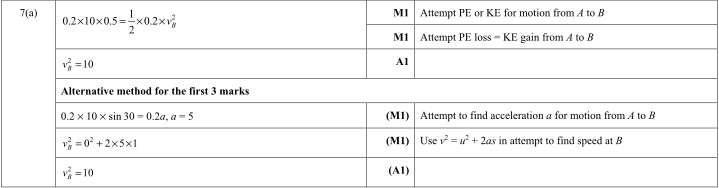
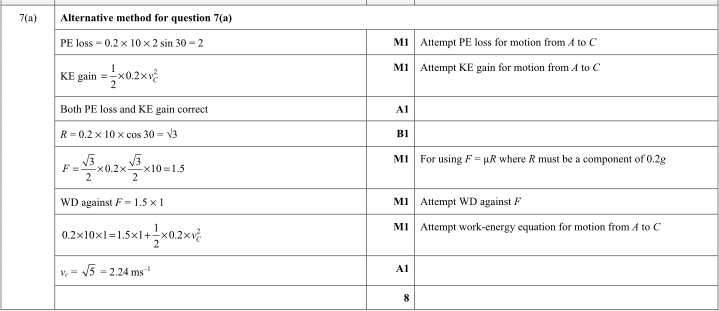
Points \(A\), \(B\) and \(C\) lie on a line of greatest slope of a plane inclined at \(30^\circ\) to the horizontal, with \(AB=BC=1\text{ m}\). A particle of mass 0.2 kg is released from rest at \(A\) and slides down the plane. Section \(AB\) is smooth; section \(BC\) is rough with coefficient of friction \(\mu\).
(a) Given \(\mu=\sqrt3/2\), find the speed at \(C\). [8]
(b) Instead, the particle comes to rest at \(C\). Find the exact value of \(\mu\). [4]



9709 P42 - Mar 2026 - Q4 - 5 marks
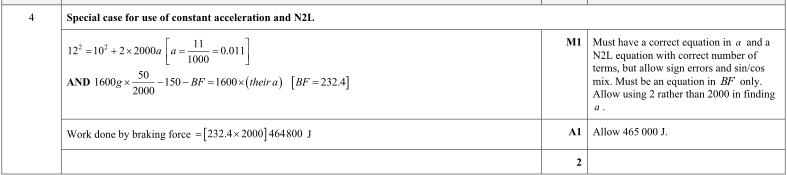
A car of mass \(1600\text{ kg}\) passes through points \(A\) and \(B\) with speeds \(10\text{ m s}^{-1}\) and \(12\text{ m s}^{-1}\) respectively. The distance \(AB\) is \(2\text{ km}\). The heights of \(A\) and \(B\) above sea level are \(250\text{ m}\) and \(200\text{ m}\) respectively. The car’s engine does no work in moving from \(A\) to \(B\). There are two forces resisting the motion of the car, a braking force and an additional constant force of magnitude \(150\text{ N}\).
Use an energy method to find the work done by the braking force as the car moves from \(A\) to \(B\). [5]

9709 P42 - Jun 2026 - Q4 - 9 marks

A particle \(P\) is projected from a point \(A\) with speed \(4\text{ m s}^{-1}\) up a line of greatest slope of a rough plane inclined at an angle \(\theta\) to the horizontal, where \(\tan\theta=\frac43\).
\(P\) comes to instantaneous rest at a point \(B\) on the plane (see diagram).
The coefficient of friction between \(P\) and the plane is \(\frac13\).
(a) Using an energy method, show that the distance \(AB\) is \(0.8\text{ m}\). [4]
(b) After coming to instantaneous rest at \(B\), the particle slides down the plane. Find the total time from the instant at which \(P\) is projected from \(A\) until it returns to \(A\). [5]


9709 P43 - Nov 2025 - Q3 - 7 marks
Use \(g=10\text{ m s}^{-2}\).
A 4 kg block is pulled along a rough horizontal road by a constant 25 N force at \(36^\circ\) above the horizontal. It moves in a straight line from \(A\) to \(B\), with \(AB=120\text{ m}\). The coefficient of friction is 0.4.
(a) Find the work done against friction from \(A\) to \(B\). [3]
The speed at \(A\) is \(7\text{ m s}^{-1}\).
(b) Use an energy method to find the speed at \(B\). [4]


9709 P42 - Jun 2025 - Q7 - 6 marks
Use \(g=10\text{ m s}^{-2}\).
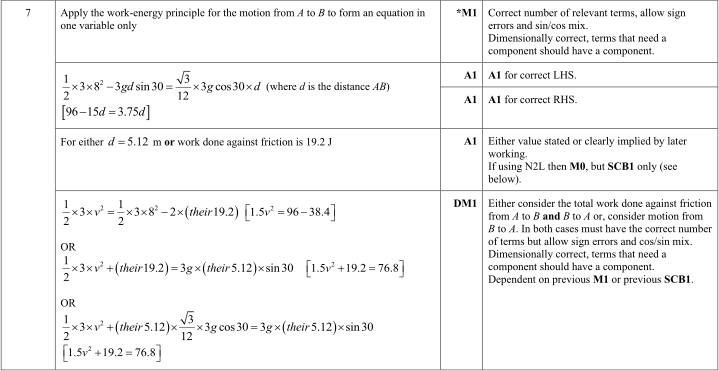
A 3 kg particle \(P\) is projected at \(8\text{ m s}^{-1}\) up a line of greatest slope of a rough plane inclined at \(30^\circ\). It starts at \(A\), comes to instantaneous rest at \(B\), then slides back down. The coefficient of friction is \(\sqrt3/12\). Use an energy method throughout to find its speed when it returns to \(A\). [6]

9709 P43 - Jun 2025 - Q6 - 9 marks
Use \(g=10\text{ m s}^{-2}\).

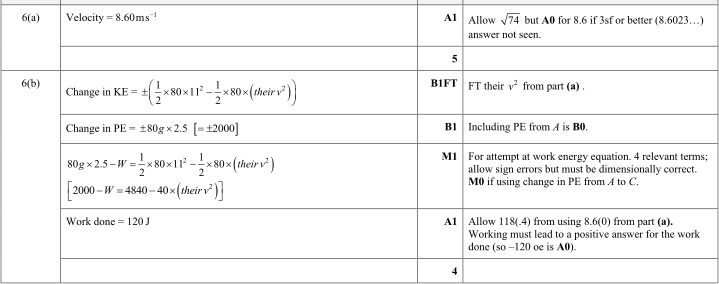
The vertical section of a rough waterslide is \(ABC\). Straight \(AB\) has length 5 m and inclination \(\theta\), with \(\sin\theta=0.8\). \(B\) is 2.5 m above \(C\). An 80 kg man, modelled as a particle, slides from rest at \(A\). The coefficient of friction on the straight section is 0.1.
(a) Find his speed at \(B\). [5]
His speed does not change on passing through \(B\), and his speed at \(C\) is \(11\text{ m s}^{-1}\).
(b) Find the work against resistance from \(B\) to \(C\). [4]

9709 P45 - Jun 2025 - Q1 - 4 marks
Use \(g=10\text{ m s}^{-2}\).
A 25 kg box is pulled 12 m up a rough plane inclined at \(8^\circ\), along a line of greatest slope, against a frictional force of 50 N. The pulling force is parallel to this line. The box starts from rest and ends at speed \(2.4\text{ m s}^{-1}\). Find the work done by the pulling force. [4]

9709 P42 - Nov 2024 - Q2 - 4 marks
Take \(g=10\,\mathrm{m\,s^{-2}}\). A block of mass 20 kg is held at the top of a plane inclined at \(30^\circ\) to the horizontal. It is projected at \(5\,\mathrm{m\,s^{-1}}\) down a line of greatest slope. The work done against a resistance force during the first 2 m is 50 J. Find its speed after these 2 m. [4]

9709 P43 - Nov 2024 - Q1 - 4 marks
Take \(g=10\,\mathrm{m\,s^{-2}}\). An athlete of mass m kg runs along a horizontal road against a constant resistance of 24 N. The work he does while increasing his speed from 5 to \(6\,\mathrm{m\,s^{-1}}\) over 50 m is 1541 J. Find m. [4]

9709 P41 - Jun 2024 - Q3 - 4 marks
Take \(g=10\,\mathrm{m\,s^{-2}}\). A train of mass 180000 kg ascends a straight hill of length 1.5 km, inclined at \(1.5^\circ\) to the horizontal. The work done against resistance is 12000 kJ and its speed decreases from 45 to \(40\,\mathrm{m\,s^{-1}}\). Find the work done by the engine, in kJ. [4]

9709 P42 - Jun 2024 - Q1 - 3 marks
Take \(g=10\,\mathrm{m\,s^{-2}}\). A cyclist and bicycle have total mass 72 kg. On a horizontal road the total resistance is 28 N. Find the work done by the cyclist to increase speed from 8 to \(16\,\mathrm{m\,s^{-1}}\) over 100 m. [3]
