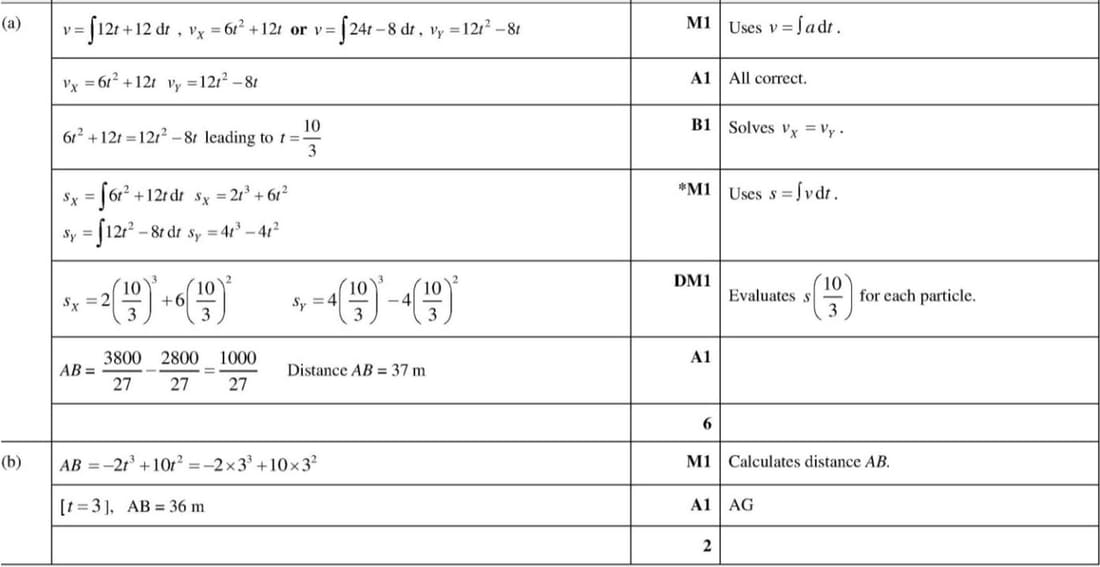
9709 P43 - Nov 2022 - Q5
Particles X and Y move in a straight line through points A and B. Particle X starts from rest at A and moves towards B. At the same instant, Y starts from rest at B.
At time t seconds after the particles start moving:
- the acceleration of X in the direction AB is given by \\((12t + 12) \, \text{ms}^{-2} \\\),
- the acceleration of Y in the direction AB is given by \\((24t - 8) \, \text{ms}^{-2} \\\).
(a) It is given that the velocities of X and Y are equal when they collide. Calculate the distance AB.
\((b) It is given instead that AB = 36 m. Verify that X and Y collide after 3 s.\)
9709 P41 - Jun 2015 - Q6
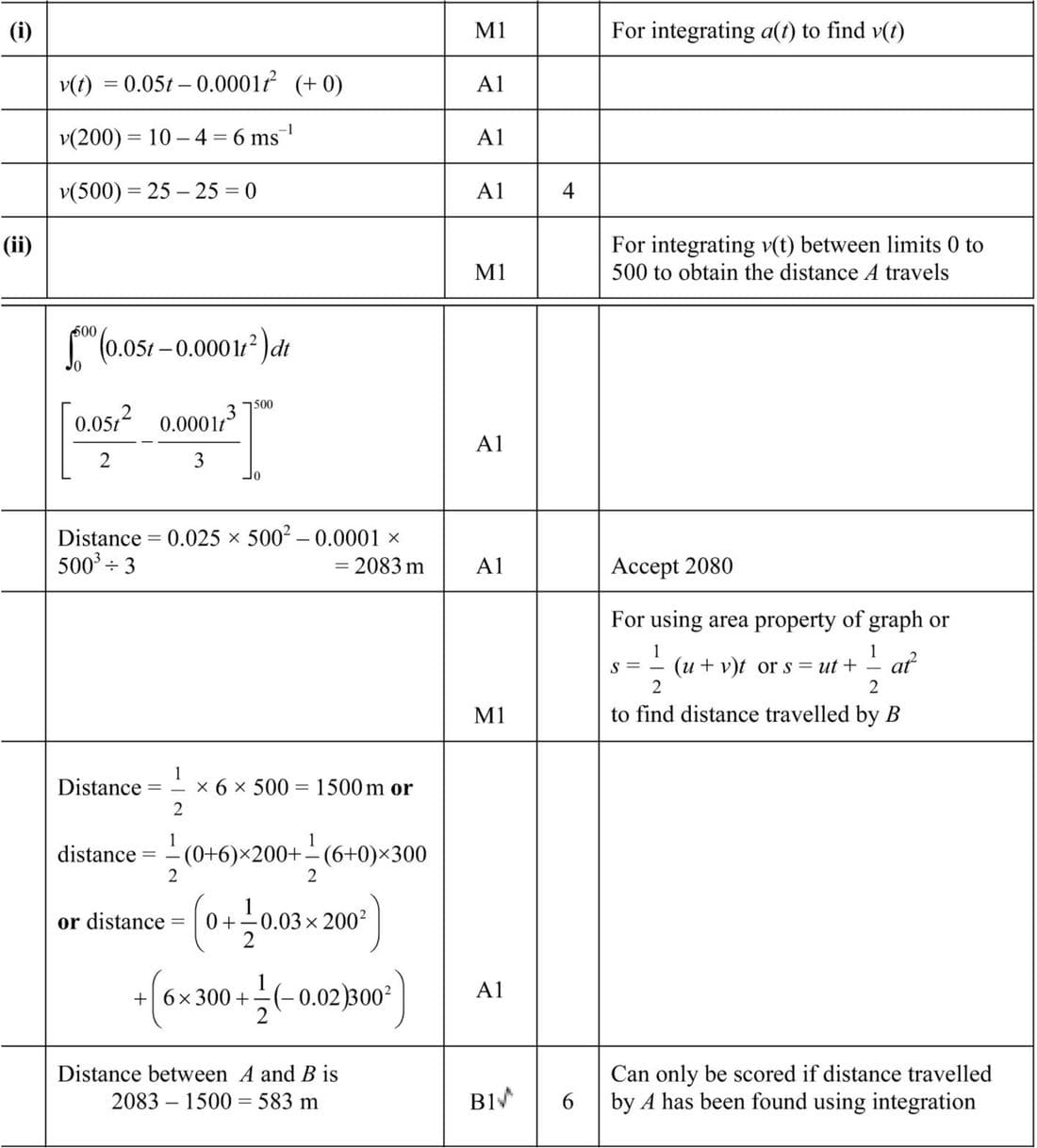
Two particles A and B start to move at the same instant from a point O. The particles move in the same direction along the same straight line. The acceleration of A at time t s after starting to move is a m/s2, where a = 0.05 - 0.0002t.
- Find A’s velocity when t = 200 and when t = 500.
- B moves with constant acceleration for the first 200 s and has the same velocity as A when t = 200. B moves with constant retardation from t = 200 to t = 500 and has the same velocity as A when t = 500.
- Find the distance between A and B when t = 500.
9709 P41 - Nov 2014 - Q4
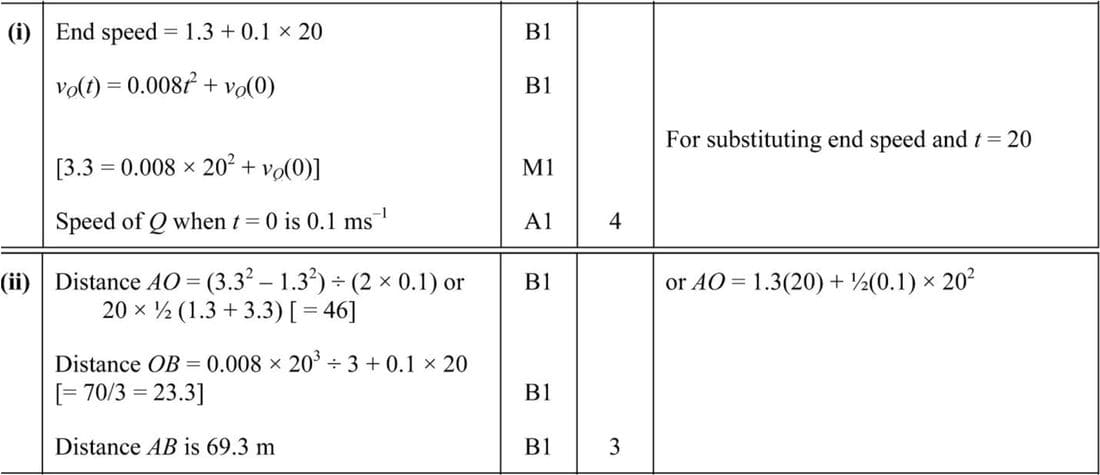
Particles P and Q move on a straight line AOB. The particles leave O simultaneously, with P moving towards A and with Q moving towards B. The initial speed of P is 1.3 m s-1 and its acceleration in the direction OA is 0.1 m s-2. Q moves with acceleration in the direction OB of 0.016t m s-2, where t seconds is the time elapsed since the instant that P and Q started to move from O. When t = 20, particle P passes through A and particle Q passes through B.
- Given that the speed of Q at B is the same as the speed of P at A, find the speed of Q at time t = 0.
- Find the distance AB.
9709 P42 - Jun 2014 - Q2
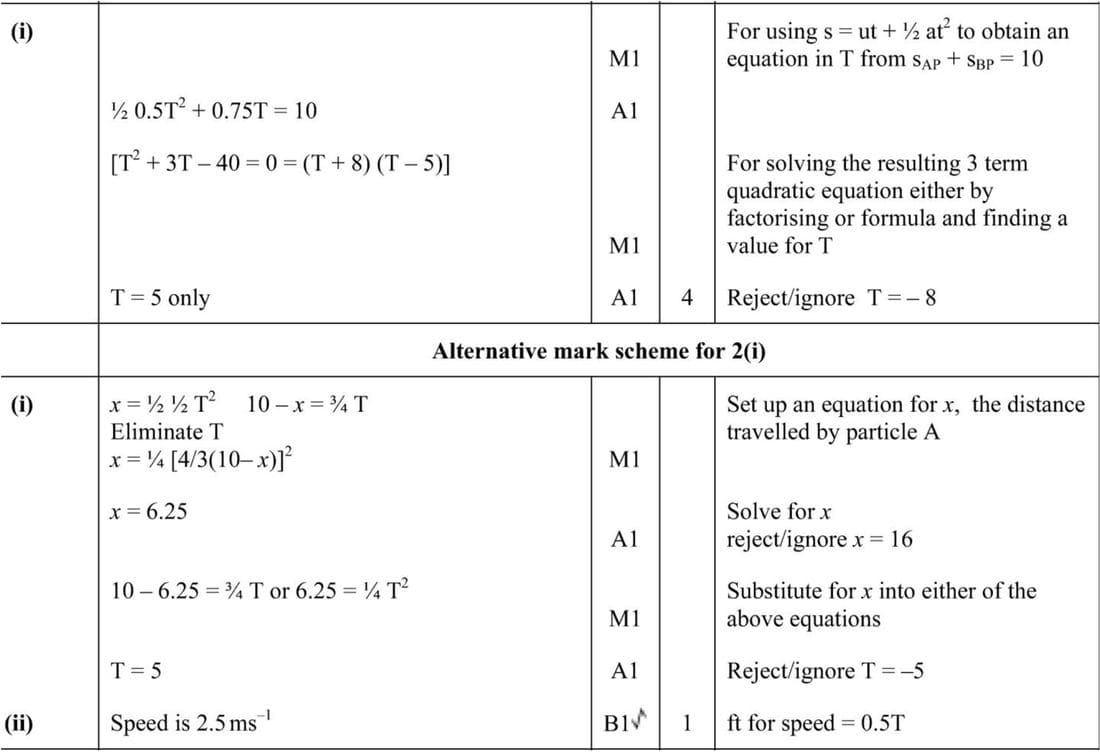
A and B are two points which are 10 m apart on the same horizontal plane. A particle P starts to move from rest at A, directly towards B, with constant acceleration 0.5 m s-2. Another particle Q is moving directly towards A with constant speed 0.75 m s-1, and passes through B at the instant that P starts to move. At time T s after this instant, particles P and Q collide. Find
- the value of T,
- the speed of P immediately before the collision.
9709 P41 - Jun 2014 - Q7
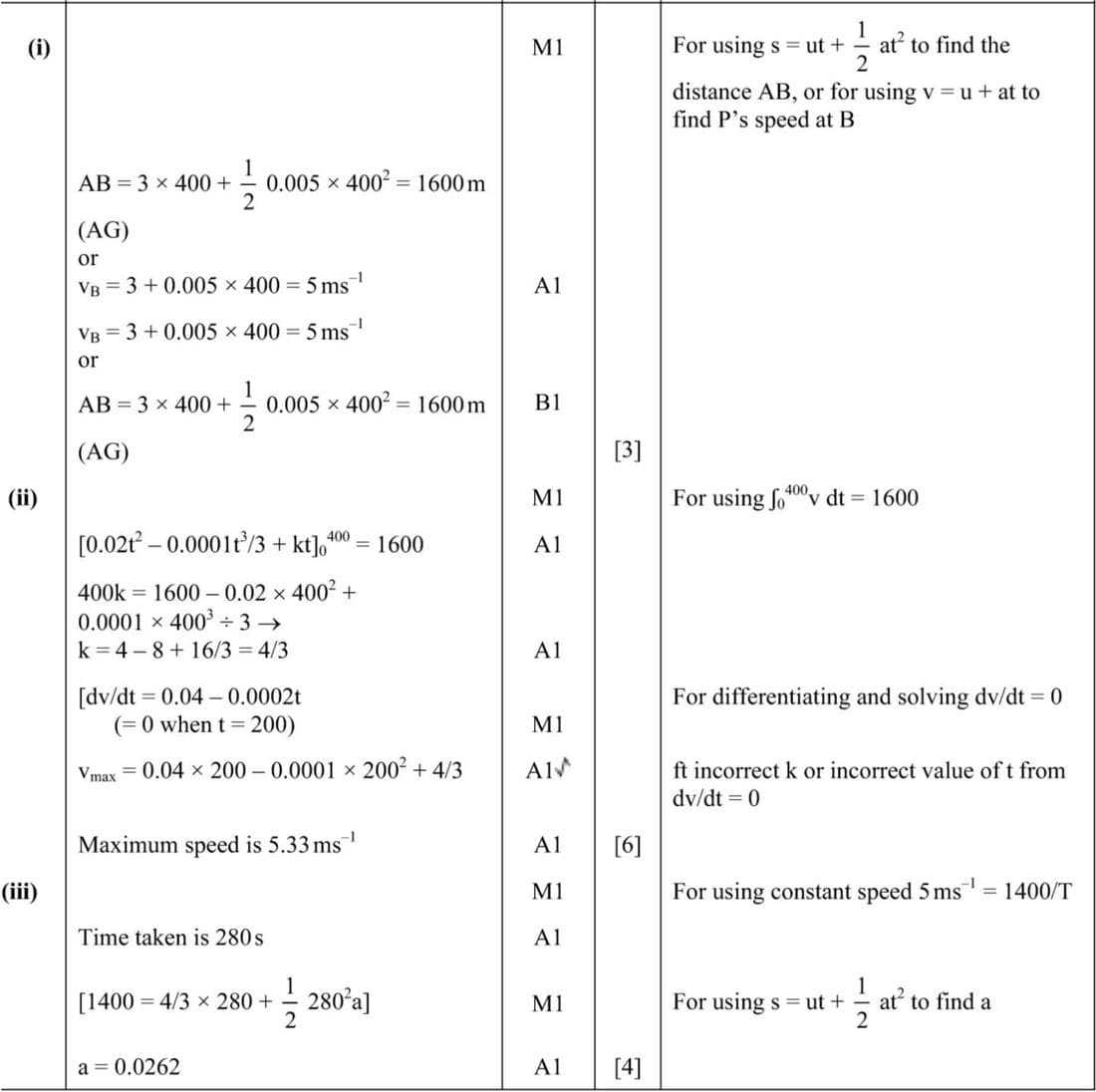
Two cyclists P and Q travel along a straight road ABC, starting simultaneously at A and arriving simultaneously at C. Both cyclists pass through B 400 s after leaving A. Cyclist P starts with speed 3 m s-1 and increases this speed with constant acceleration 0.005 m s-2 until he reaches B.
(i) Show that the distance AB is 1600 m and find P's speed at B.
Cyclist Q travels from A to B with speed v m s-1 at time t seconds after leaving A, where
\(v = 0.04t - 0.0001t^2 + k,\)
and k is a constant.
(ii) Find the value of k and the maximum speed of Q before he has reached B.
Cyclist P travels from B to C, a distance of 1400 m, at the speed he had reached at B. Cyclist Q travels from B to C with constant acceleration a m s-2.
(iii) Find the time taken for the cyclists to travel from B to C and find the value of a.
9709 P41 - Nov 2012 - Q5
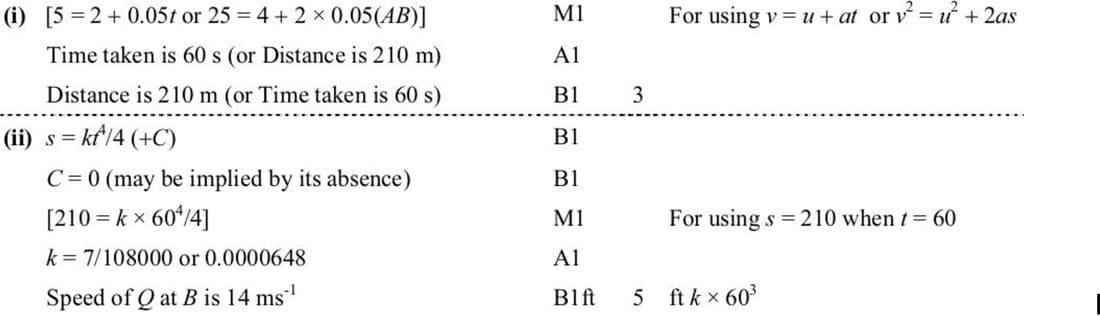
Particle P travels along a straight line from A to B with constant acceleration 0.05 m s-2. Its speed at A is 2 m s-1 and its speed at B is 5 m s-1.
(i) Find the time taken for P to travel from A to B, and find also the distance AB.
Particle Q also travels along the same straight line from A to B, starting from rest at A. At time t s after leaving A, the speed of Q is kt3 m s-1, where k is a constant. Q takes the same time to travel from A to B as P does.
(ii) Find the value of k and find Q's speed at B.
9709 P42 - Jun 2011 - Q7
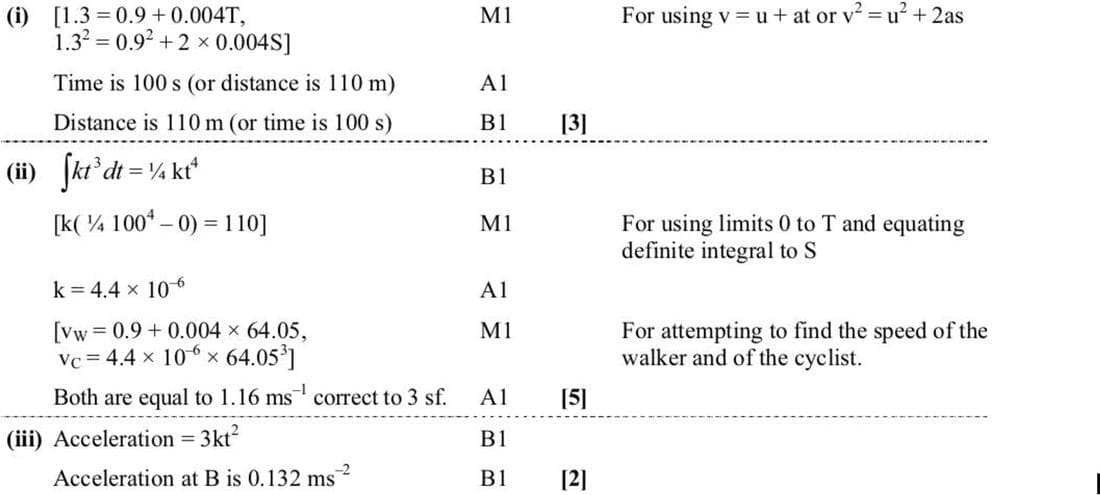
A walker travels along a straight road passing through the points A and B on the road with speeds 0.9 m s-1 and 1.3 m s-1 respectively. The walker’s acceleration between A and B is constant and equal to 0.004 m s-2.
- Find the time taken by the walker to travel from A to B, and find the distance AB.
A cyclist leaves A at the same instant as the walker. She starts from rest and travels along the straight road, passing through B at the same instant as the walker. At time t s after leaving A the cyclist’s speed is kt3 m s-1, where k is a constant.
- Show that when t = 64.05 the speed of the walker and the speed of the cyclist are the same, correct to 3 significant figures.
- Find the cyclist’s acceleration at the instant she passes through B.
9709 P41 - Nov 2010 - Q4
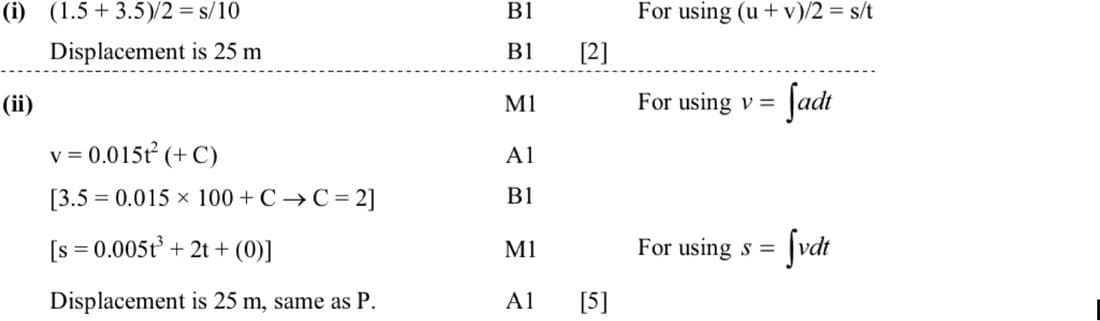
A particle P starts from a fixed point O at time t = 0, where t is in seconds, and moves with constant acceleration in a straight line. The initial velocity of P is 1.5 m s-1 and its velocity when t = 10 is 3.5 m s-1.
- Find the displacement of P from O when t = 10.
Another particle Q also starts from O when t = 0 and moves along the same straight line as P. The acceleration of Q at time t is 0.03t m s-2.
- Given that Q has the same velocity as P when t = 10, show that it also has the same displacement from O as P when t = 10.
9709 P4 - Nov 2007 - Q6
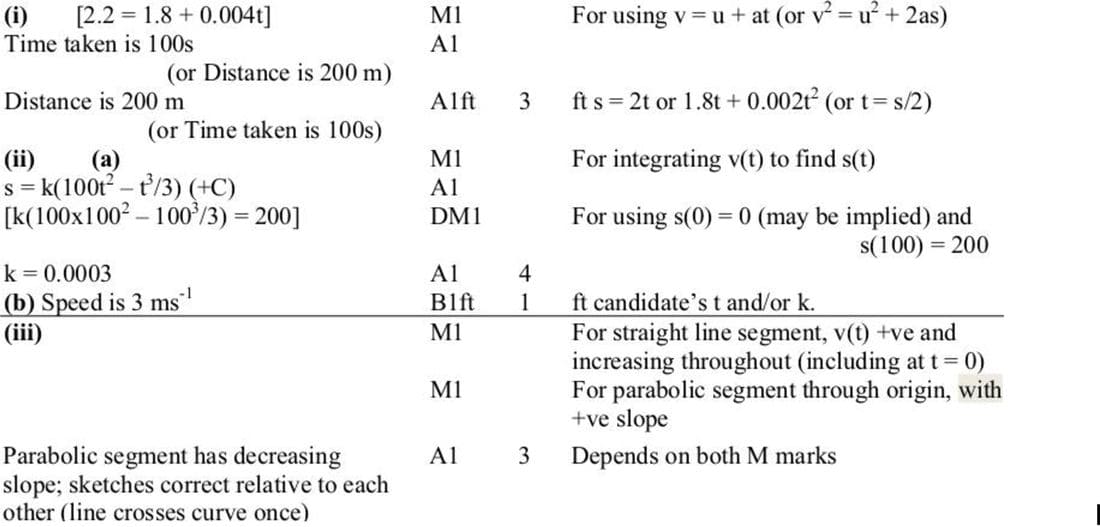
(i) A man walks in a straight line from A to B with constant acceleration 0.004 m s-2. His speed at A is 1.8 m s-1 and his speed at B is 2.2 m s-1. Find the time taken for the man to walk from A to B, and find the distance AB.
(ii) A woman cyclist leaves A at the same instant as the man. She starts from rest and travels in a straight line to B, reaching B at the same instant as the man. At time t s after leaving A the cyclist’s speed is k(200t − t2) m s-1, where k is a constant. Find
- the value of k,
- the cyclist’s speed at B.
(iii) Sketch, using the same axes, the velocity-time graphs for the man’s motion and the woman’s motion from A to B.
9709 P4 - Jun 2007 - Q6
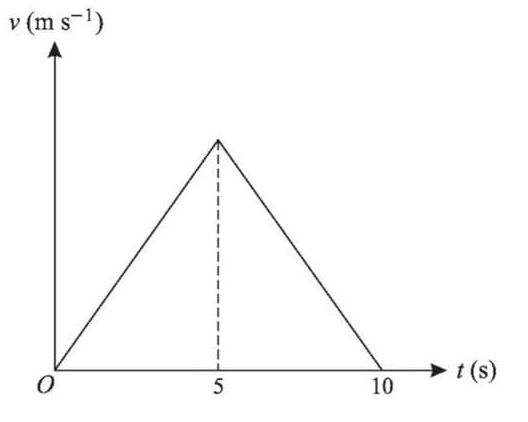
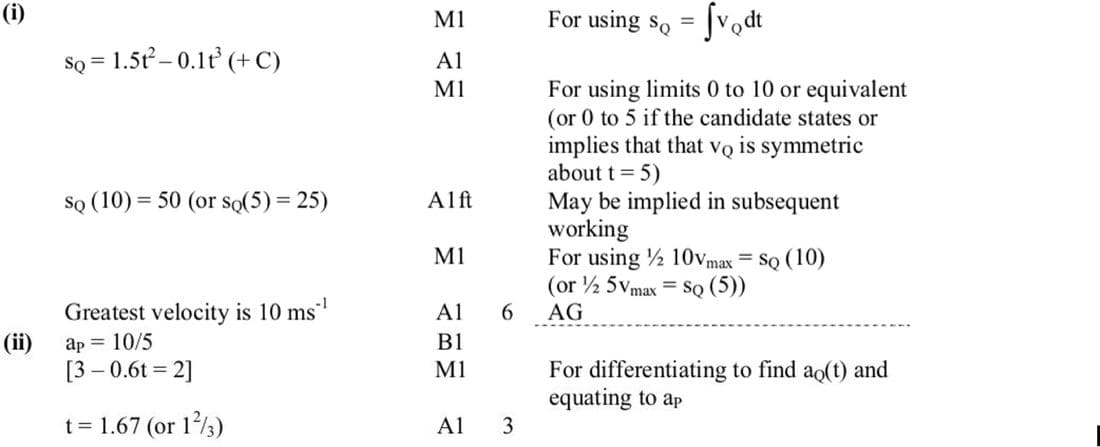
A particle P starts from rest at the point A and travels in a straight line, coming to rest again after 10 s. The velocity-time graph for P consists of two straight line segments (see diagram). A particle Q starts from rest at A at the same instant as P and travels along the same straight line as P. The velocity of Q is given by \(v = 3t - 0.3t^2\) for \(0 \leq t \leq 10\). The displacements from A of P and Q are the same when \(t = 10\).
- Show that the greatest velocity of P during its motion is 10 m s-1.
- Find the value of \(t\), in the interval \(0 < t < 5\), for which the acceleration of Q is the same as the acceleration of P.
9709 P4 - Nov 2004 - Q5
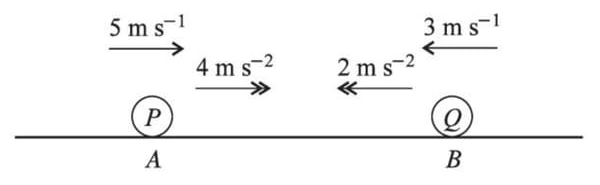
Particles P and Q start from points A and B respectively, at the same instant, and move towards each other in a horizontal straight line. The initial speeds of P and Q are 5 m s-1 and 3 m s-1 respectively. The accelerations of P and Q are constant and equal to 4 m s-2 and 2 m s-2 respectively (see diagram).
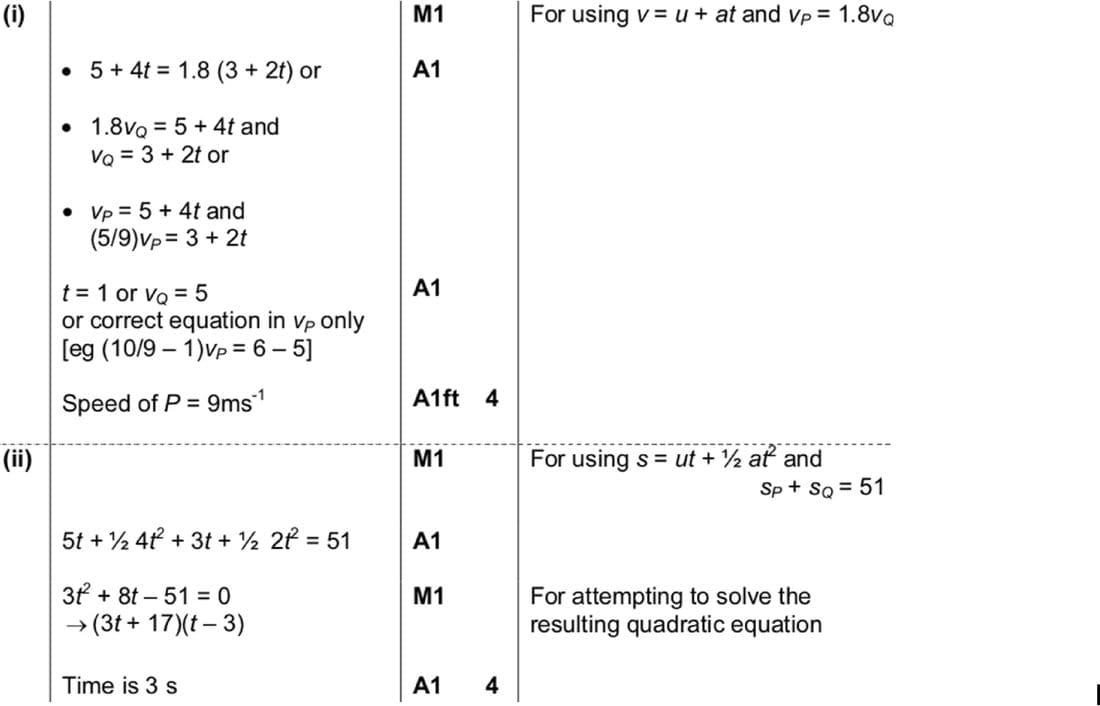
- Find the speed of P at the instant when the speed of P is 1.8 times the speed of Q.
- Given that AB = 51 m, find the time taken from the start until P and Q meet.
9709 P41 - Jun 2021 - Q4
Two cyclists, Isabella and Maria, are having a race. They both travel along a straight road with constant acceleration, starting from rest at point A.
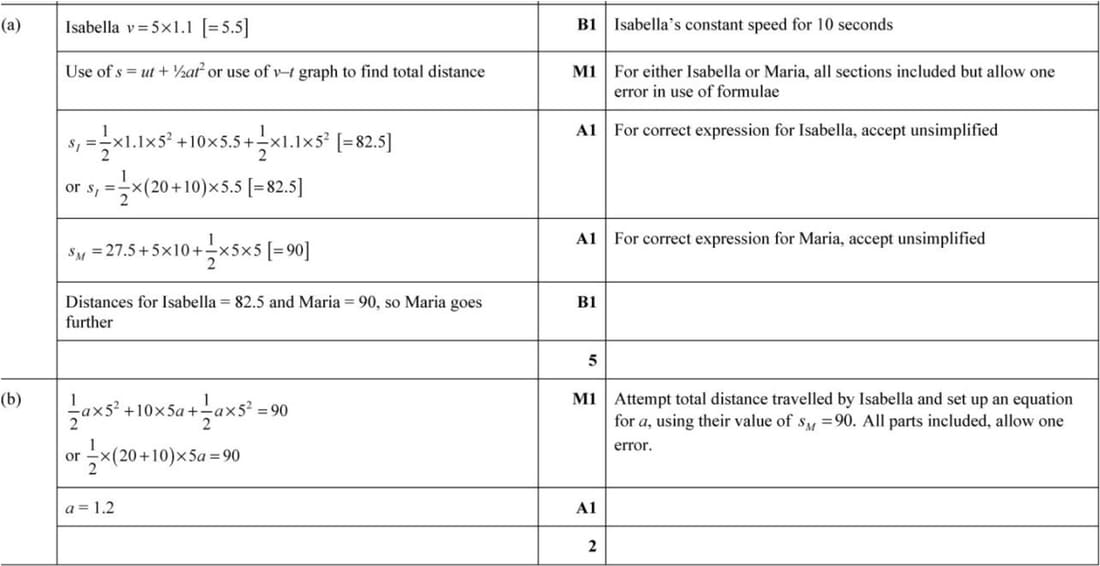
Isabella accelerates for 5 s at a constant rate \(a \text{ m s}^{-2}\). She then travels at the constant speed she has reached for 10 s, before decelerating to rest at a constant rate over a period of 5 s.
Maria accelerates at a constant rate, reaching a speed of 5 \(\text{ m s}^{-1}\) in a distance of 27.5 m. She then maintains this speed for a period of 10 s, before decelerating to rest at a constant rate over a period of 5 s.
(a) Given that \(a = 1.1\), find which cyclist travels further.
(b) Find the value of \(a\) for which the two cyclists travel the same distance.
9709 P4 - Nov 2003 - Q7
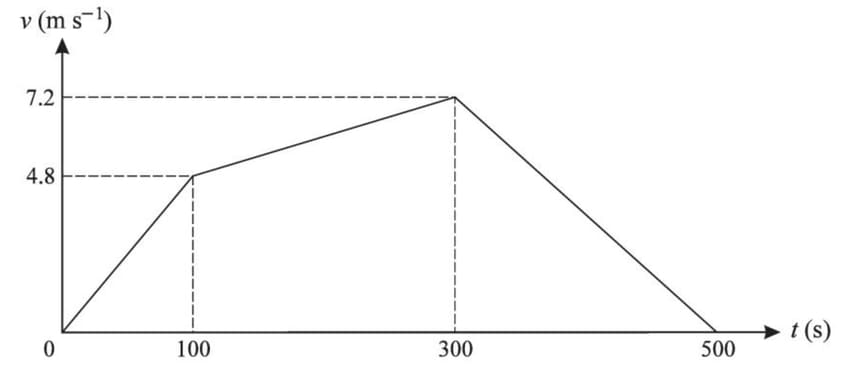
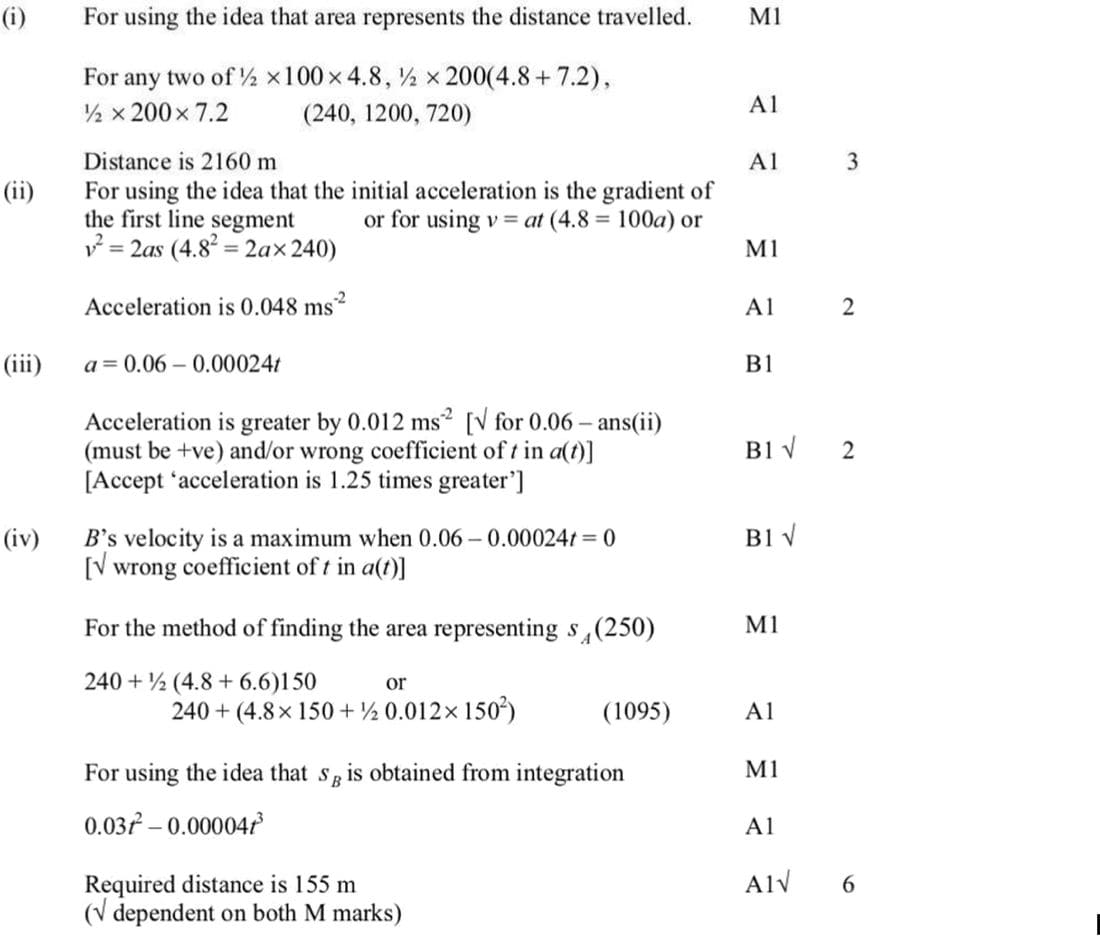
A tractor A starts from rest and travels along a straight road for 500 seconds. The velocity-time graph for the journey is shown above. This graph consists of three straight line segments. Find
- the distance travelled by A,
- the initial acceleration of A.
Another tractor B starts from rest at the same instant as A, and travels along the same road for 500 seconds. Its velocity t seconds after starting is \((0.06t - 0.00012t^2)\) m s-1. Find
- how much greater B’s initial acceleration is than A’s,
- how much further B has travelled than A, at the instant when B’s velocity reaches its maximum.
9709 P41 - Nov 2019 - Q7
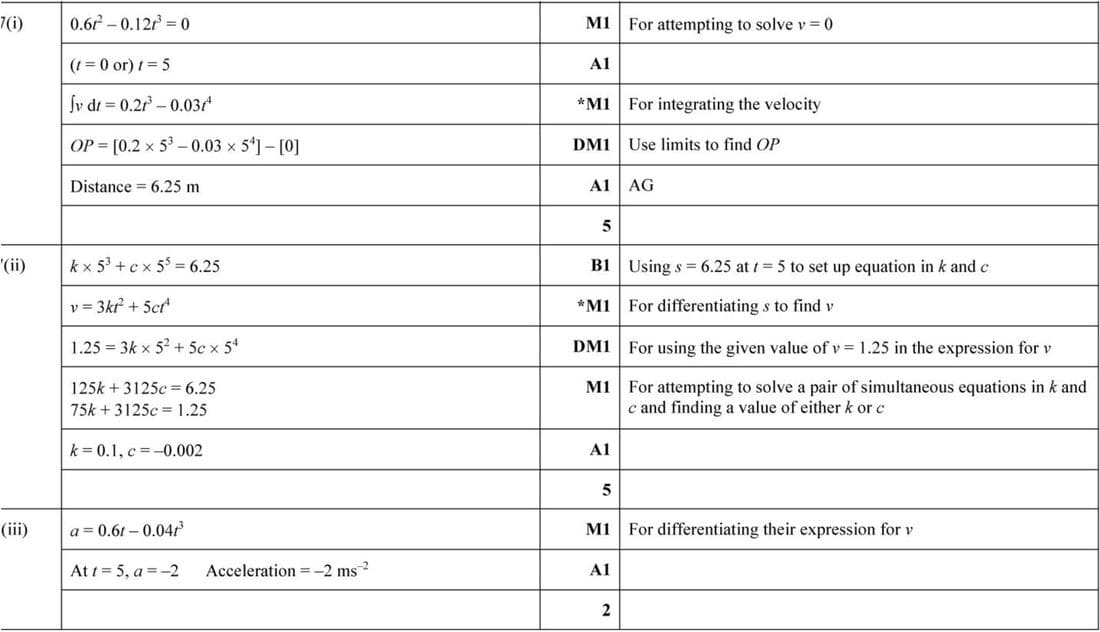
A particle moves in a straight line, starting from rest at a point O, and comes to instantaneous rest at a point P. The velocity of the particle at time t s after leaving O is v m s-1, where
\(v = 0.6t^2 - 0.12t^3\).
- Show that the distance OP is 6.25 m.
On another occasion, the particle also moves in the same straight line. On this occasion, the displacement of the particle at time t s after leaving O is s m, where
\(s = kt^3 + ct^5\).
\(It is given that the particle passes point P with velocity 1.25 m s-1 at time t = 5.\)
- Find the values of the constants k and c.
- Find the acceleration of the particle at time t = 5.
9709 P42 - Jun 2019 - Q7
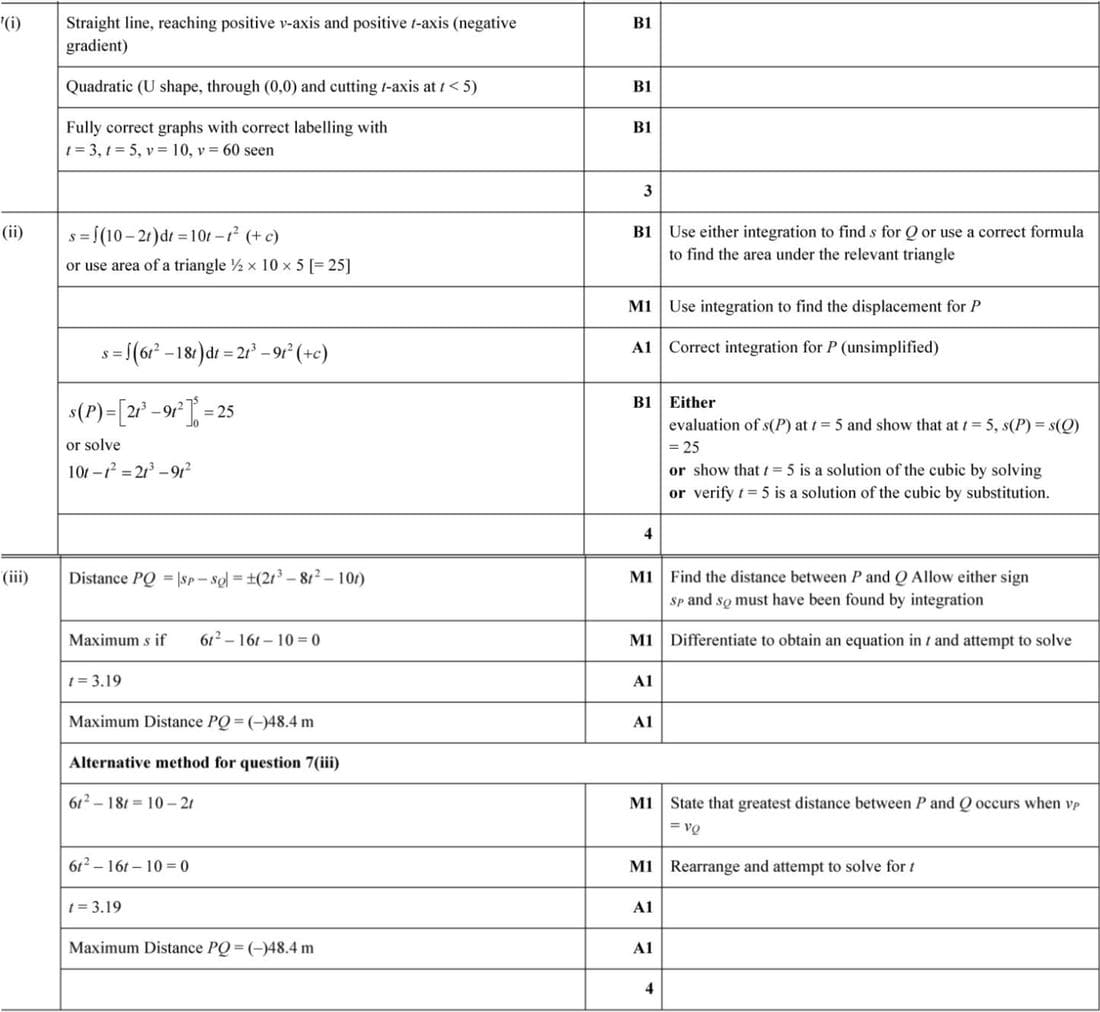
Particles P and Q leave a fixed point A at the same time and travel in the same straight line. The velocity of P after t seconds is \(6t(t-3)\) m s-1 and the velocity of Q after t seconds is \((10 - 2t)\) m s-1.
- Sketch, on the same axes, velocity-time graphs for P and Q for \(0 \leq t \leq 5\).
- Verify that P and Q meet after 5 seconds.
- Find the greatest distance between P and Q for \(0 \leq t \leq 5\).
9709 P42 - Jun 2017 - Q3
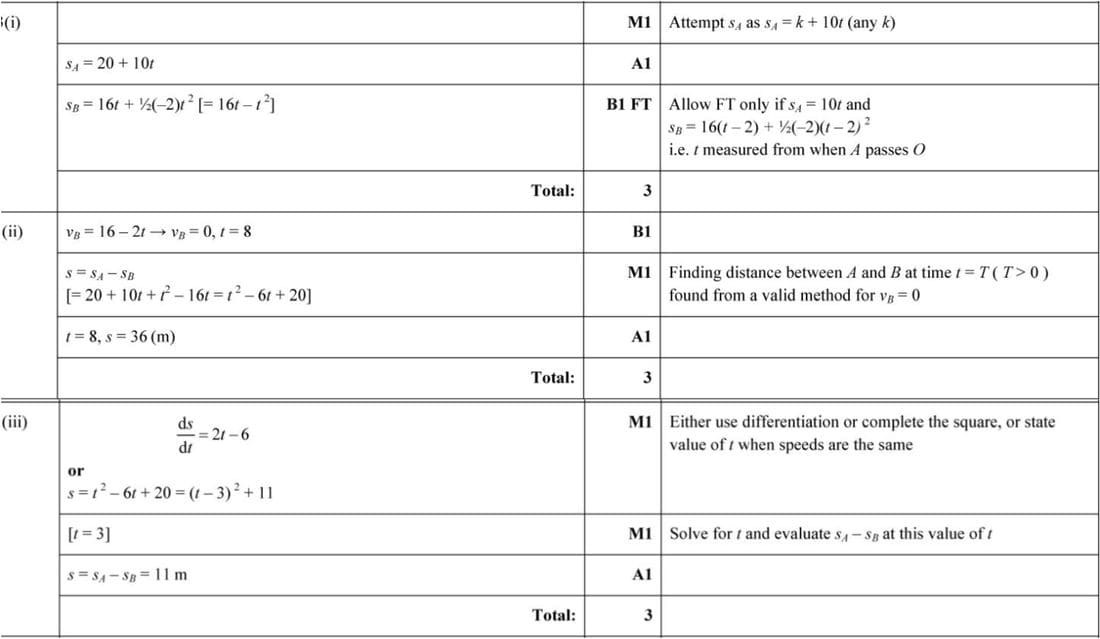
A particle A moves in a straight line with constant speed 10 m s-1. Two seconds after A passes a point O on the line, a particle B passes through O, moving along the line in the same direction as A. Particle B has speed 16 m s-1 at O and has a constant deceleration of 2 m s-2.
(i) Find expressions, in terms of t, for the displacement from O of each particle t s after B passes through O.
(ii) Find the distance between the particles when B comes to instantaneous rest.
(iii) Find the minimum distance between the particles.
9709 P43 - Nov 2016 - Q5
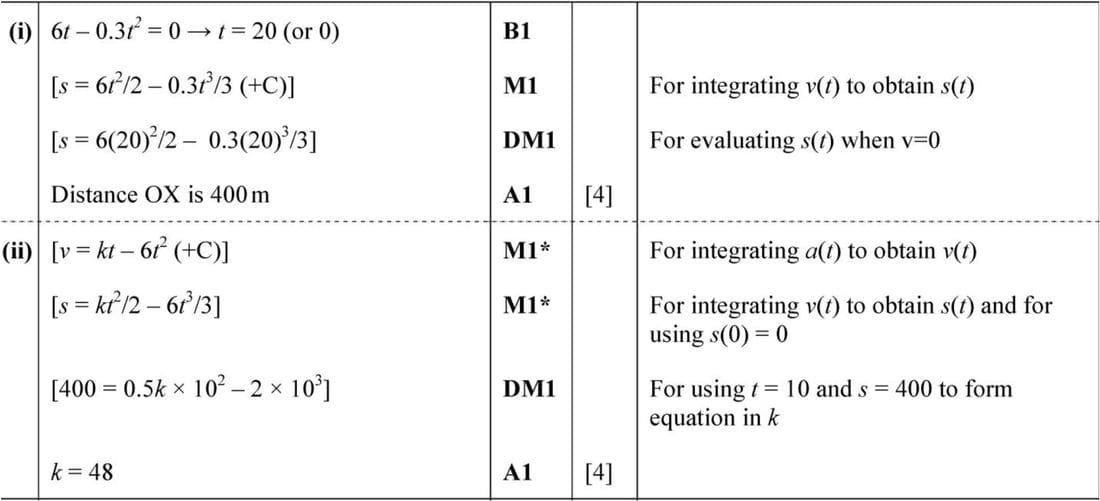
A particle P starts from a fixed point O and moves in a straight line. At time t s after leaving O, the velocity v m s-1 of P is given by v = 6t - 0.3t2. The particle comes to instantaneous rest at point X.
- Find the distance OX.
A second particle Q starts from rest from O, at the same instant as P, and also travels in a straight line. The acceleration a m s-2 of Q is given by a = k - 12t, where k is a constant. The displacement of Q from O is 400 m when t = 10.
- Find the value of k.
9709 P43 - Jun 2016 - Q2
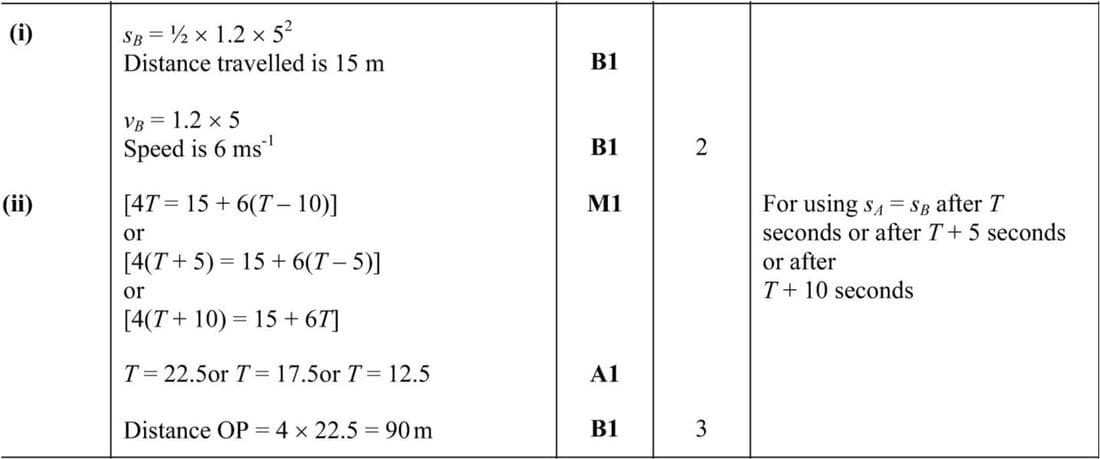
Alan starts walking from a point O, at a constant speed of 4 m s-1, along a horizontal path. Ben walks along the same path, also starting from O. Ben starts from rest 5 s after Alan and accelerates at 1.2 m s-2 for 5 s. Ben then continues to walk at a constant speed until he is at the same point, P, as Alan.
(i) Find how far Ben has travelled when he has been walking for 5 s and find his speed at this instant.
(ii) Find the distance OP.
9709 P41 - Nov 2015 - Q7
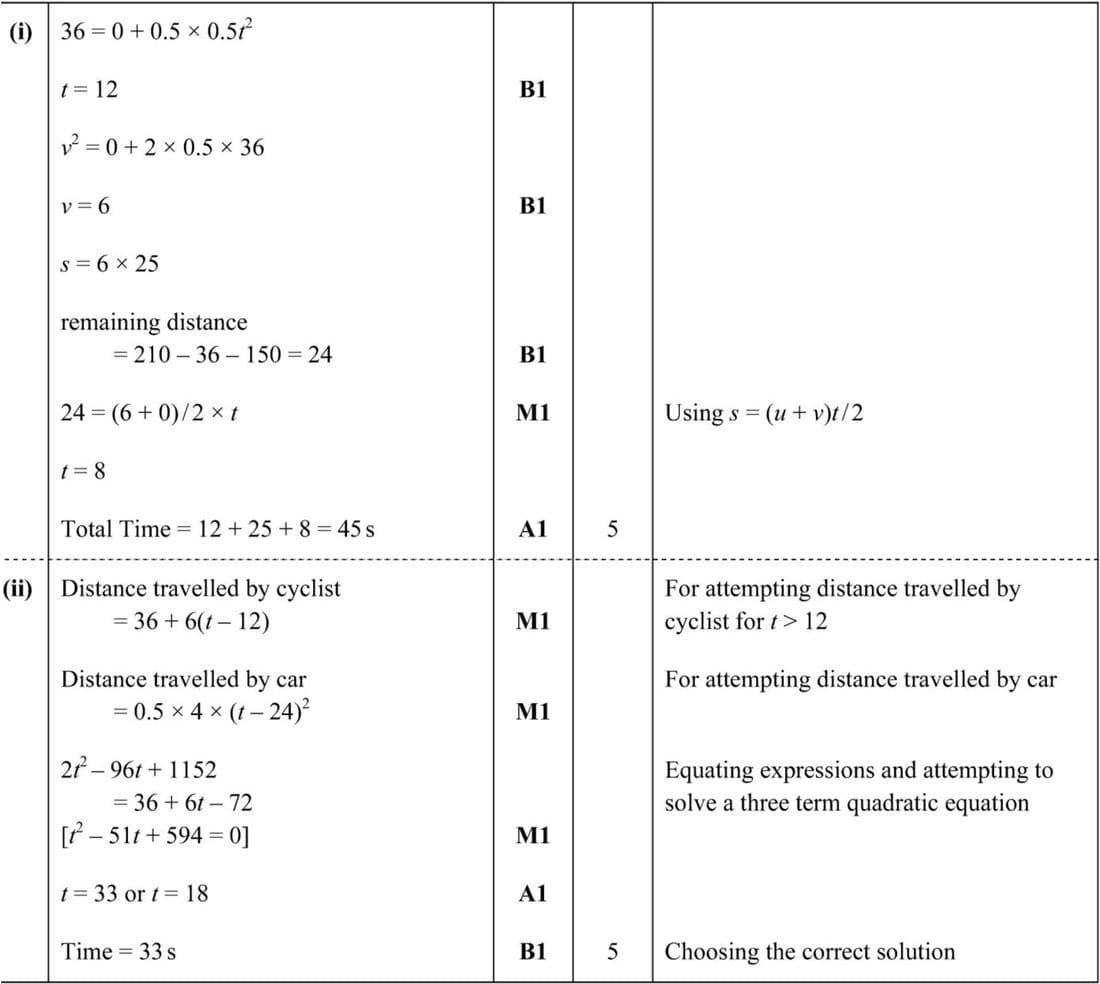
A cyclist starts from rest at point A and moves in a straight line with acceleration 0.5 m s-2 for a distance of 36 m. The cyclist then travels at constant speed for 25 s before slowing down, with constant deceleration, to come to rest at point B. The distance AB is 210 m.
(i) Find the total time that the cyclist takes to travel from A to B.
24 s after the cyclist leaves point A, a car starts from rest from point A, with constant acceleration 4 m s-2, towards B. It is given that the car overtakes the cyclist while the cyclist is moving with constant speed.
(ii) Find the time that it takes from when the cyclist starts until the car overtakes her.
9709 P42 - Jun 2015 - Q5
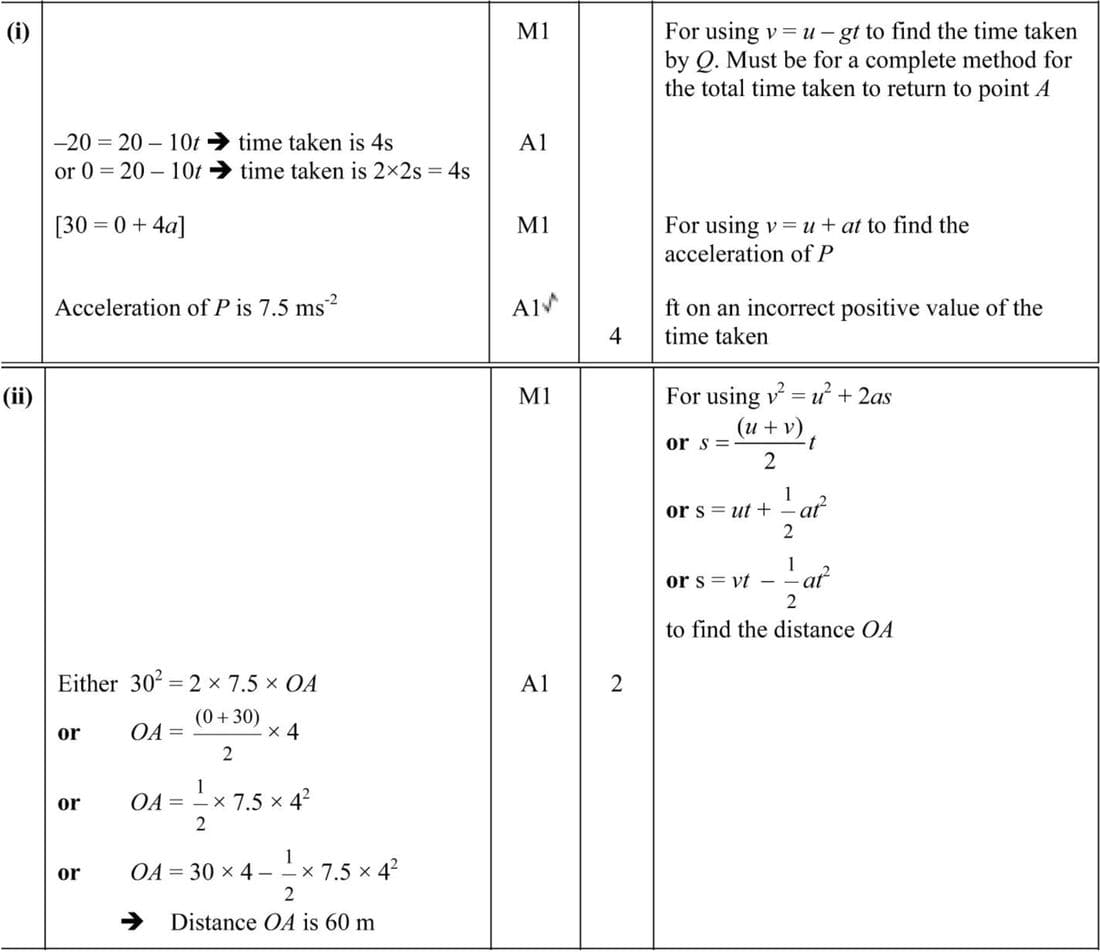
A particle P starts from rest at a point O on a horizontal straight line. P moves along the line with constant acceleration and reaches a point A on the line with a speed of 30 m s-1. At the instant that P leaves O, a particle Q is projected vertically upwards from the point A with a speed of 20 m s-1. Subsequently P and Q collide at A. Find
- the acceleration of P,
- the distance OA.