9709 P42 - Jun 2023 - Q3
Coplanar forces of magnitudes 30 N, 15 N, 33 N, and P N act at a point in the directions shown in the diagram, where \(\tan \alpha = \frac{4}{3}\). The system is in equilibrium.
(a) Show that \(\left( \frac{14.4}{30 - P} \right)^2 + \left( \frac{28.8}{P + 30} \right)^2 = 1\).
(b) Verify that \(P = 6\) satisfies this equation and find the value of \(\theta\).


9709 P41 - Jun 2019 - Q1
Given that \(\tan \alpha = \frac{12}{5}\) and \(\tan \theta = \frac{4}{3}\), show that the coplanar forces shown in the diagram are in equilibrium.


9709 P42 - Mar 2019 - Q3
Four coplanar forces of magnitudes \(F\) N, 5 N, 25 N, and 15 N are acting at a point \(P\) in the directions shown in the diagram. Given that the forces are in equilibrium, find the values of \(F\) and \(\alpha\).


9709 P43 - Jun 2018 - Q3
Coplanar forces of magnitudes 8 N, 12 N, and 18 N act at a point in the directions shown in the diagram. Find the magnitude and direction of the single additional force acting at the same point which will produce equilibrium.


9709 P42 - Jun 2018 - Q3
The three coplanar forces shown in the diagram have magnitudes 3 N, 2 N, and \(P\) N. Given that the three forces are in equilibrium, find the values of \(\theta\) and \(P\).
The diagram shows forces of 3 N at an angle of 60° to the horizontal, 2 N at an angle of \(\theta\) to the horizontal, and \(P\) N vertically downward.


9709 P41 - Jun 2018 - Q2
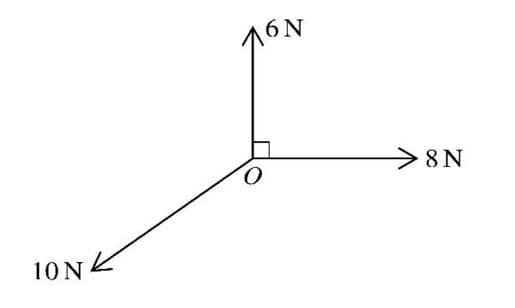
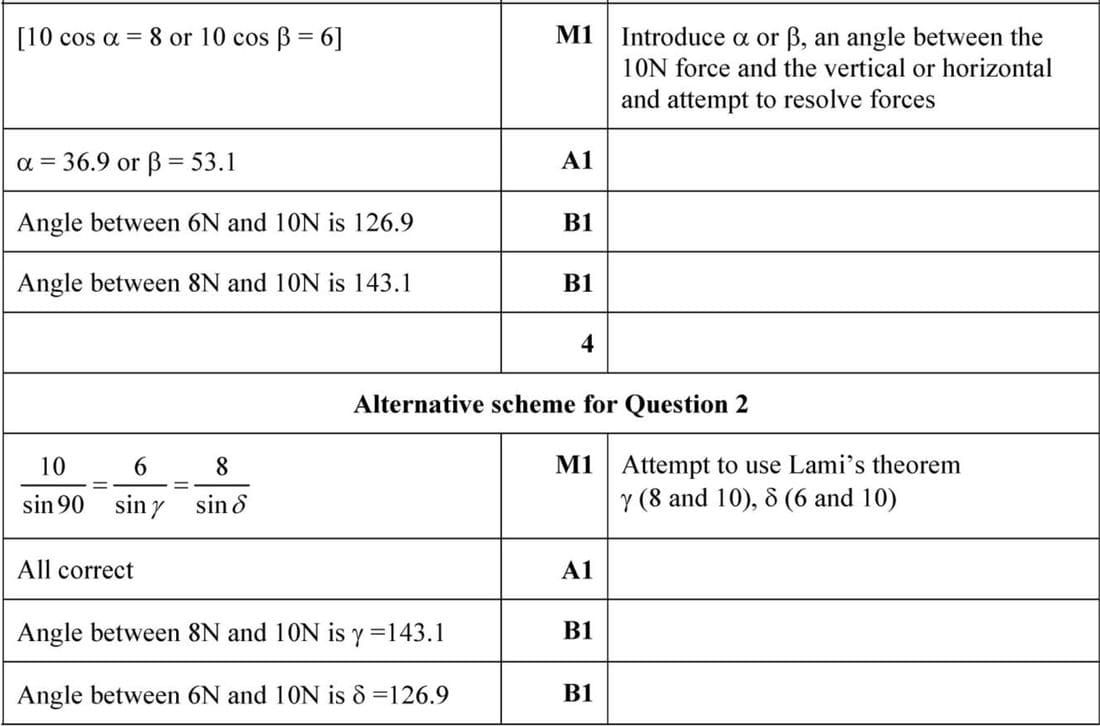
The diagram shows three coplanar forces acting at the point O. The magnitudes of the forces are 6 N, 8 N, and 10 N. The angle between the 6 N force and the 8 N force is 90°. The forces are in equilibrium. Find the other angles between the forces.
9709 P42 - Mar 2018 - Q2
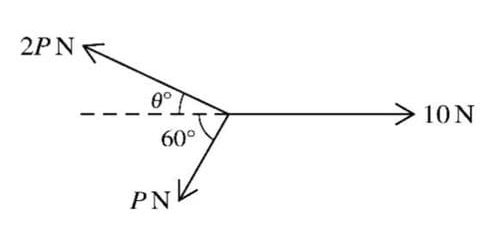
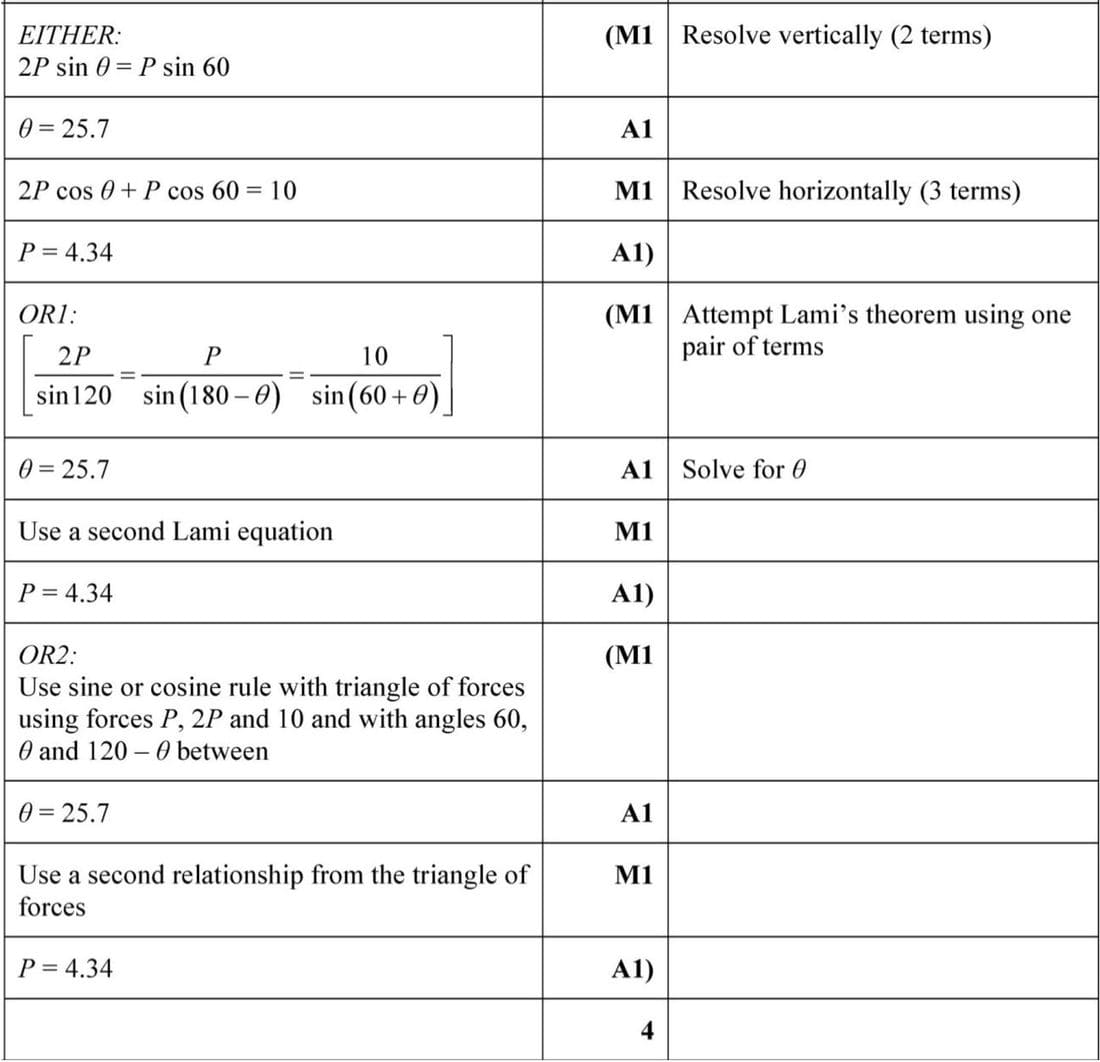
The three coplanar forces shown in the diagram are in equilibrium. Find the values of \(\theta\) and \(P\).
The diagram shows forces: \(2P \text{ N}\) at an angle \(\theta\) above the horizontal, \(P \text{ N}\) at an angle \(60^\circ\) below the horizontal, and \(10 \text{ N}\) horizontally to the right.
9709 P43 - Jun 2017 - Q2
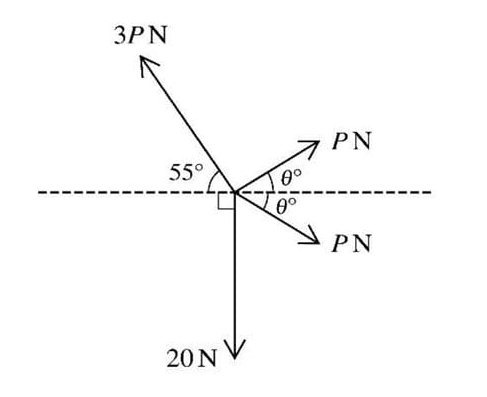
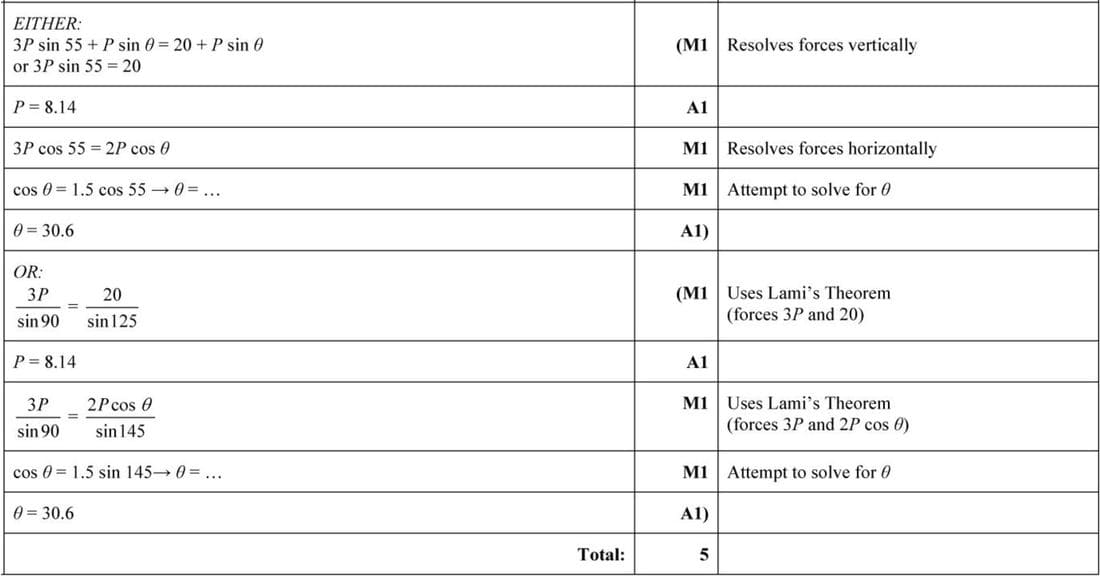
The four coplanar forces shown in the diagram are in equilibrium. Find the values of P and θ.
Forces:
- 3P N at 55° above the horizontal
- P N at θ° above the horizontal
- P N at θ° below the horizontal
- 20 N vertically downward
9709 P41 - Nov 2016 - Q4
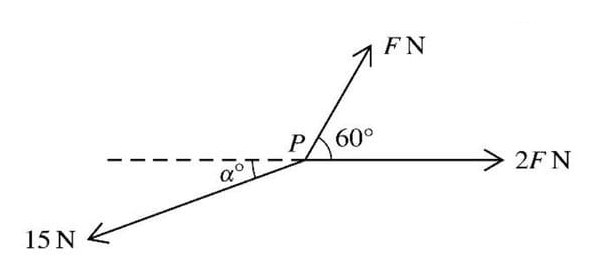
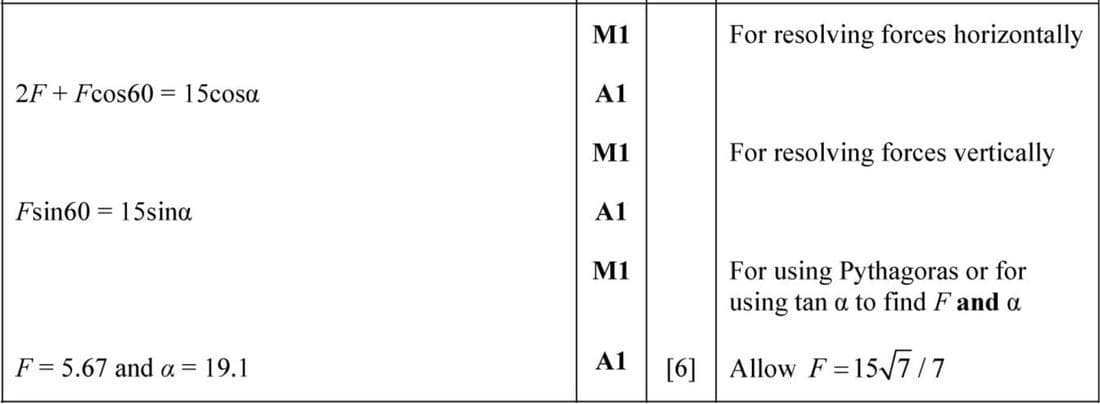
Three coplanar forces of magnitudes \(F\) N, \(2F\) N and 15 N act at a point \(P\), as shown in the diagram. Given that the forces are in equilibrium, find the values of \(F\) and \(\alpha\).
9709 P43 - Jun 2016 - Q3
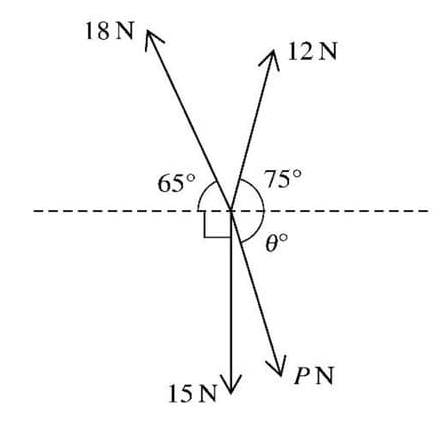
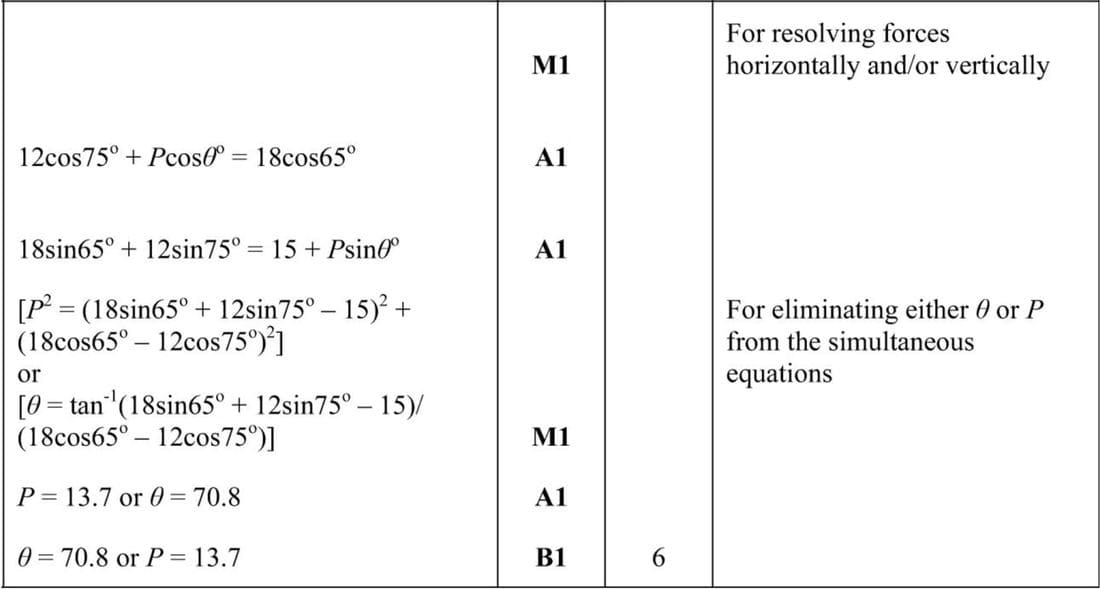
The coplanar forces shown in the diagram are in equilibrium. Find the values of \(P\) and \(\theta\).
9709 P41 - Jun 2016 - Q4
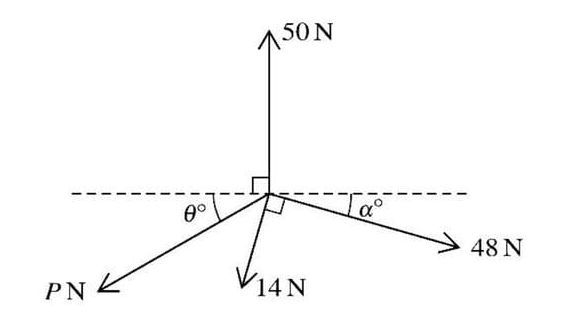
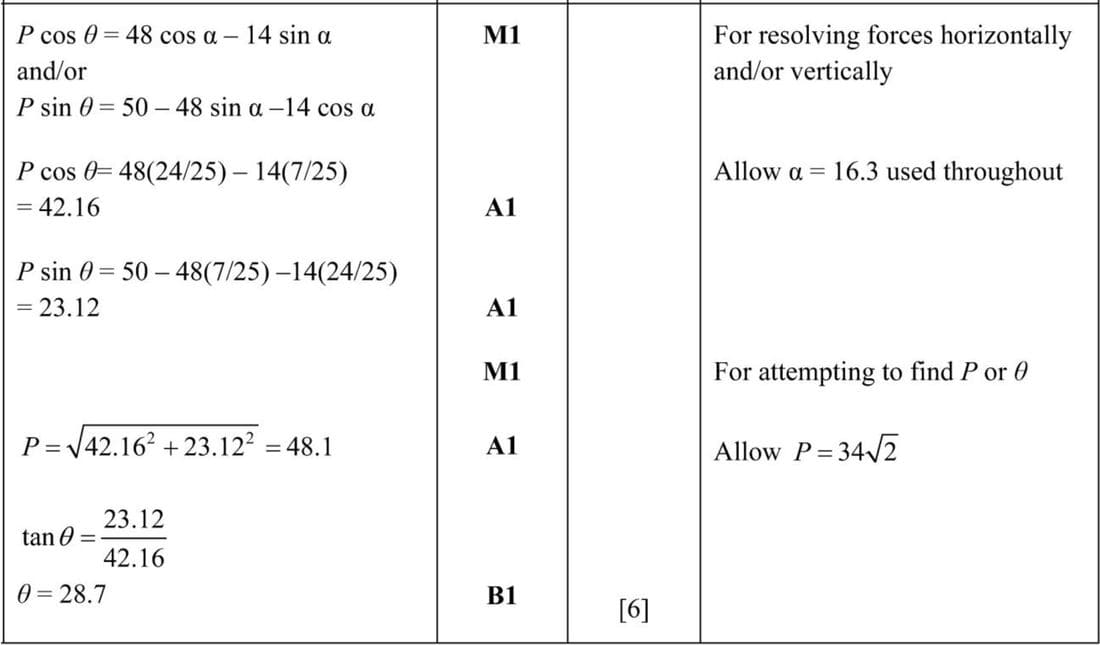
Coplanar forces of magnitudes 50 N, 48 N, 14 N and P N act at a point in the directions shown in the diagram. The system is in equilibrium. Given that \(\tan \alpha = \frac{7}{24}\), find the values of P and \(\theta\).
9709 P41 - Nov 2022 - Q1
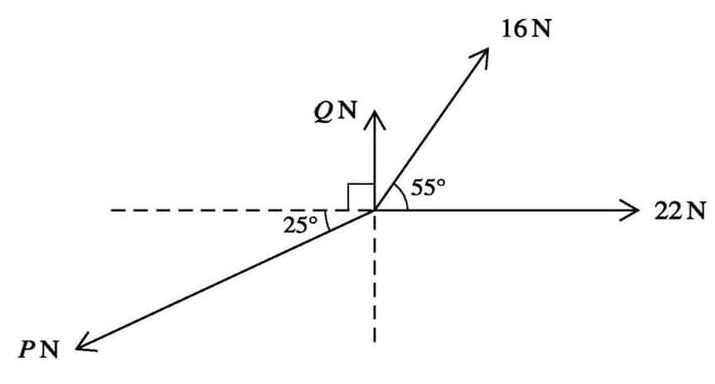
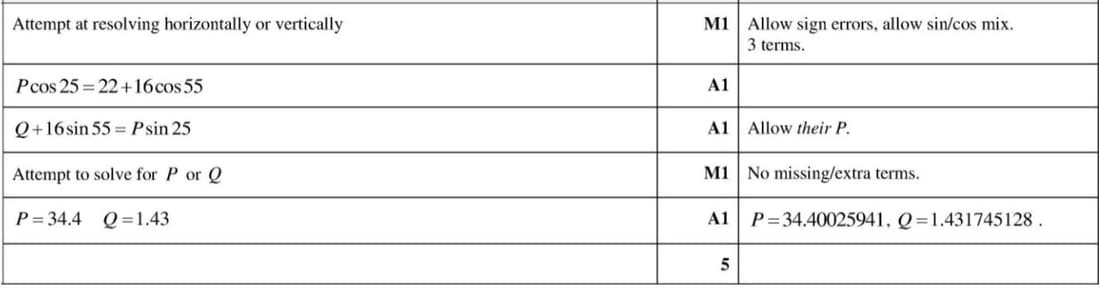
Coplanar forces of magnitudes \(P \text{ N}\), \(Q \text{ N}\), 16 N, and 22 N act at a point in the directions shown in the diagram. The forces are in equilibrium.
Find the values of \(P\) and \(Q\).
9709 P42 - Nov 2015 - Q1
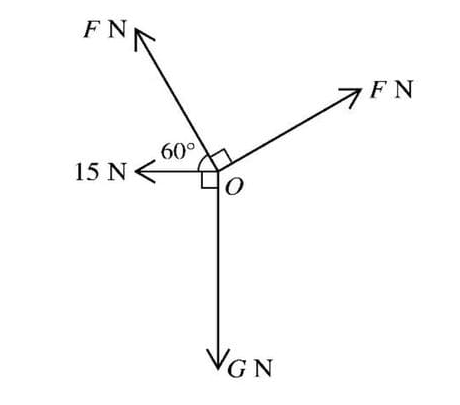
Four horizontal forces act at a point O and are in equilibrium. The magnitudes of the forces are F N, G N, 15 N and F N, and the forces act in directions as shown in the diagram.
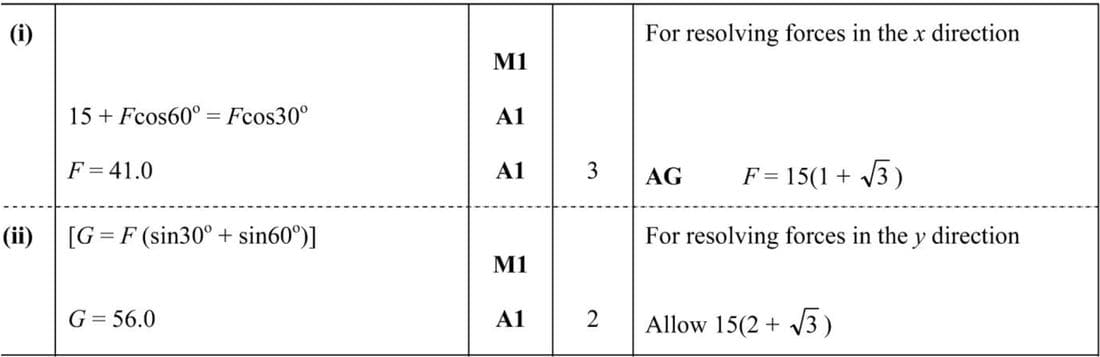
\((i) Show that F = 41.0, correct to 3 significant figures.\)
(ii) Find the value of G.
9709 P41 - Jun 2015 - Q2
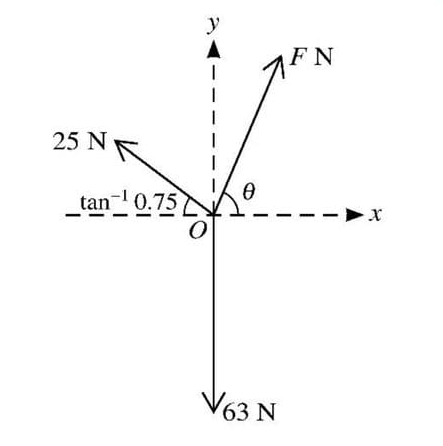
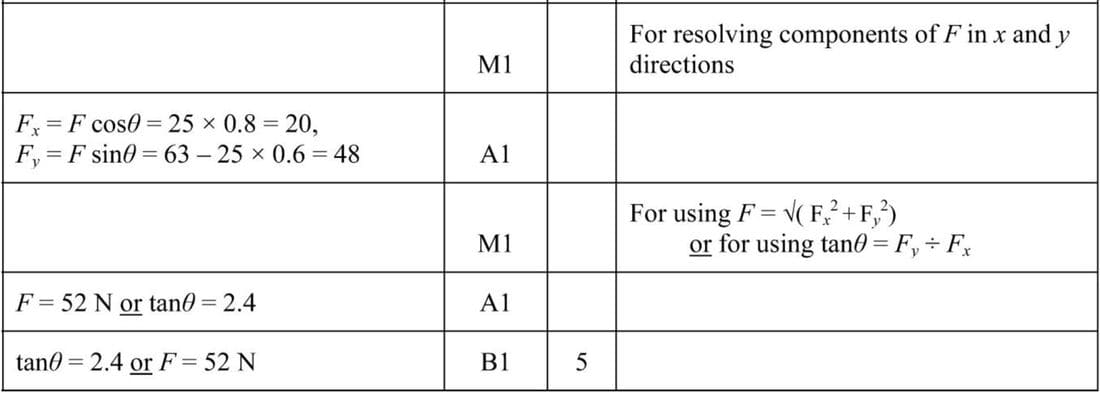
Three horizontal forces of magnitudes F N, 63 N and 25 N act at O, the origin of the x-axis and y-axis. The forces are in equilibrium. The force of magnitude F N makes an angle θ anticlockwise with the positive x-axis. The force of magnitude 63 N acts along the negative y-axis. The force of magnitude 25 N acts at tan-1 0.75 clockwise from the negative x-axis (see diagram). Find the value of F and the value of tan θ.
9709 P42 - Jun 2012 - Q2
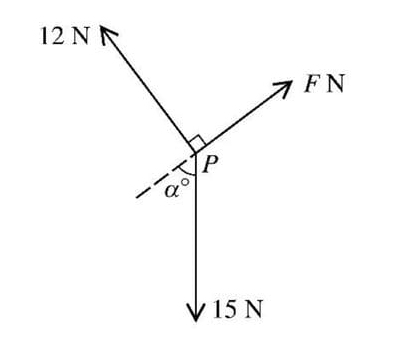
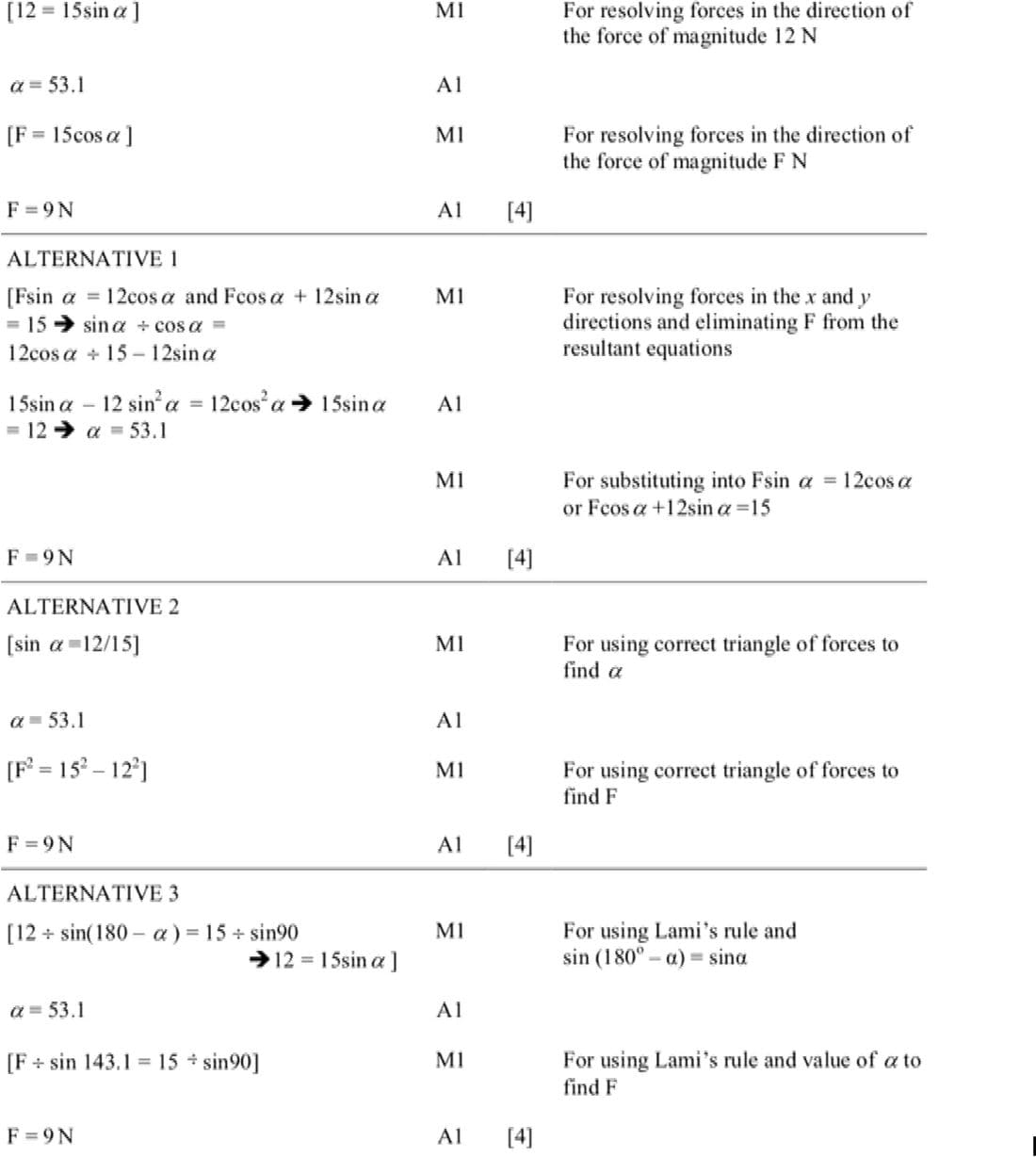
Three coplanar forces of magnitudes \(F\) N, 12 N, and 15 N are in equilibrium acting at a point \(P\) in the directions shown in the diagram. Find \(\alpha\) and \(F\).
9709 P42 - Nov 2010 - Q3
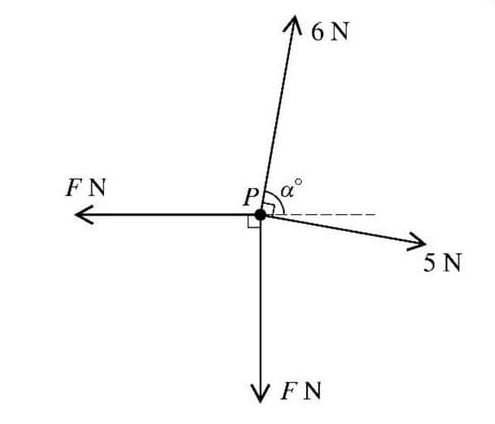
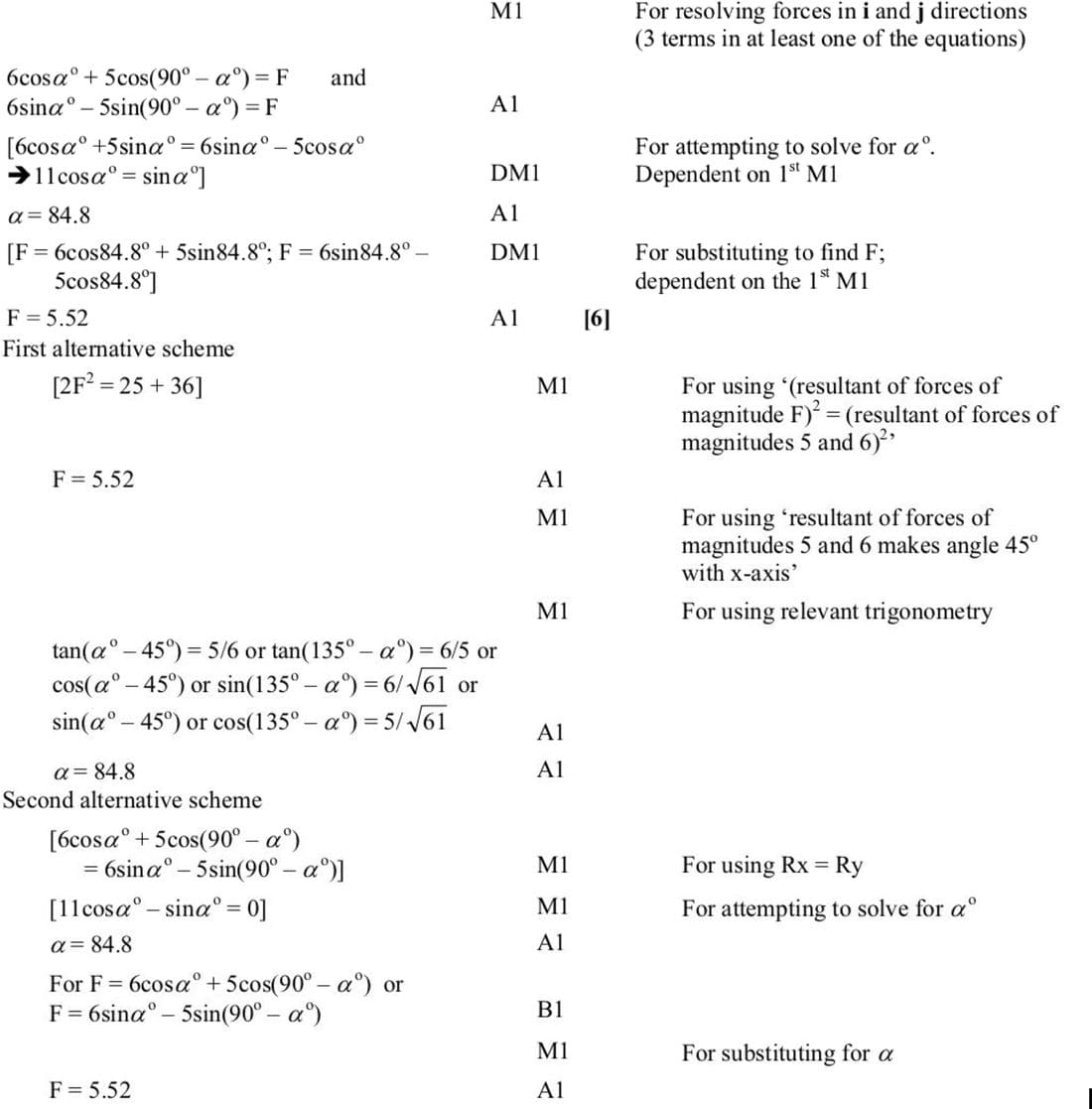
A particle P is in equilibrium on a smooth horizontal table under the action of four horizontal forces of magnitudes 6 N, 5 N, F N and F N acting in the directions shown. Find the values of \(\alpha\) and \(F\).
9709 P4 - Jun 2008 - Q3
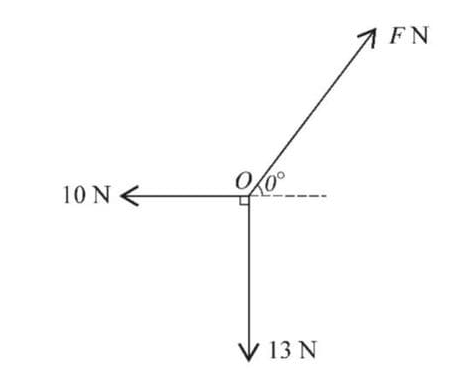
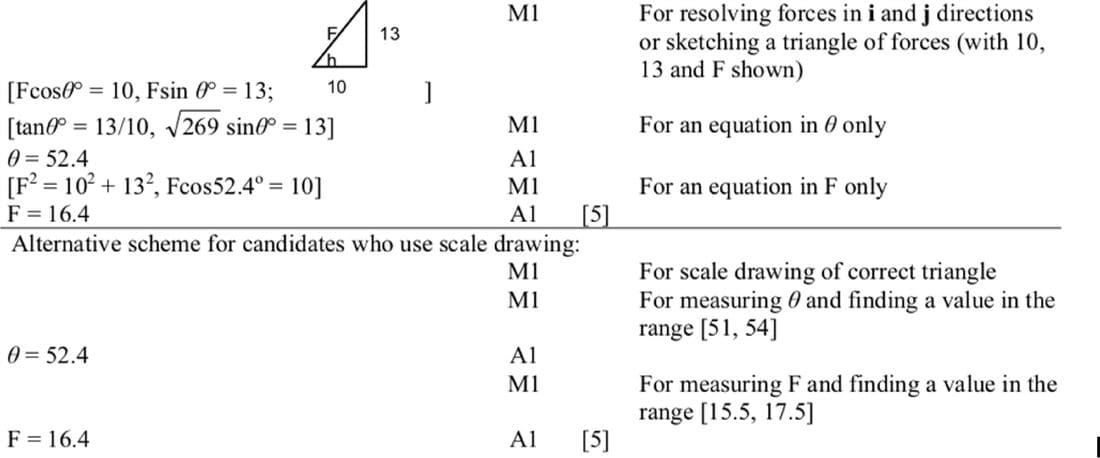
Three horizontal forces of magnitudes \(F\) N, 13 N, and 10 N act at a fixed point \(O\) and are in equilibrium. The directions of the forces are as shown in the diagram. Find, in either order, the value of \(\theta\) and the value of \(F\).
9709 P4 - Jun 2006 - Q3
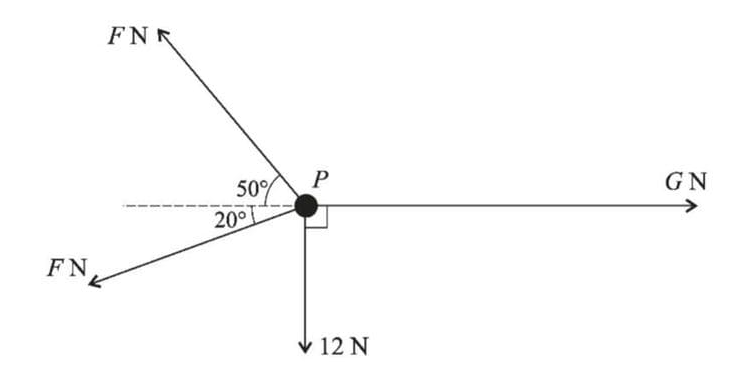
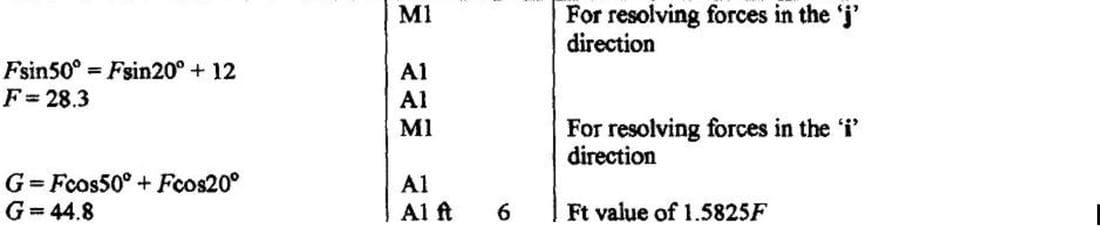
A particle P is in equilibrium on a smooth horizontal table under the action of horizontal forces of magnitudes F N, F N, G N and 12 N acting in the directions shown. Find the values of F and G.
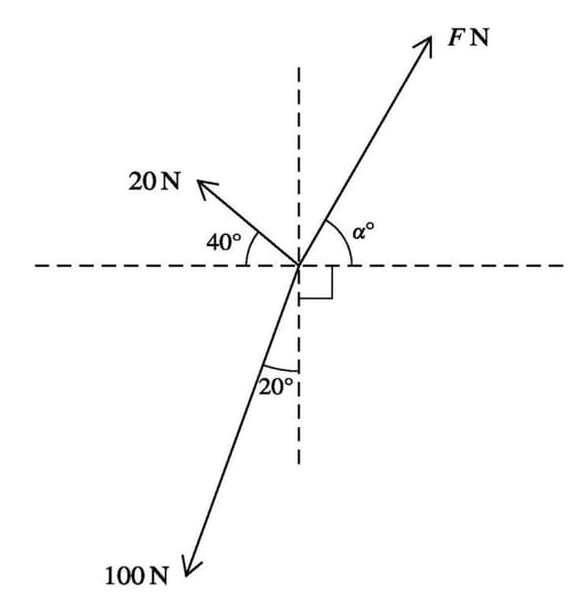
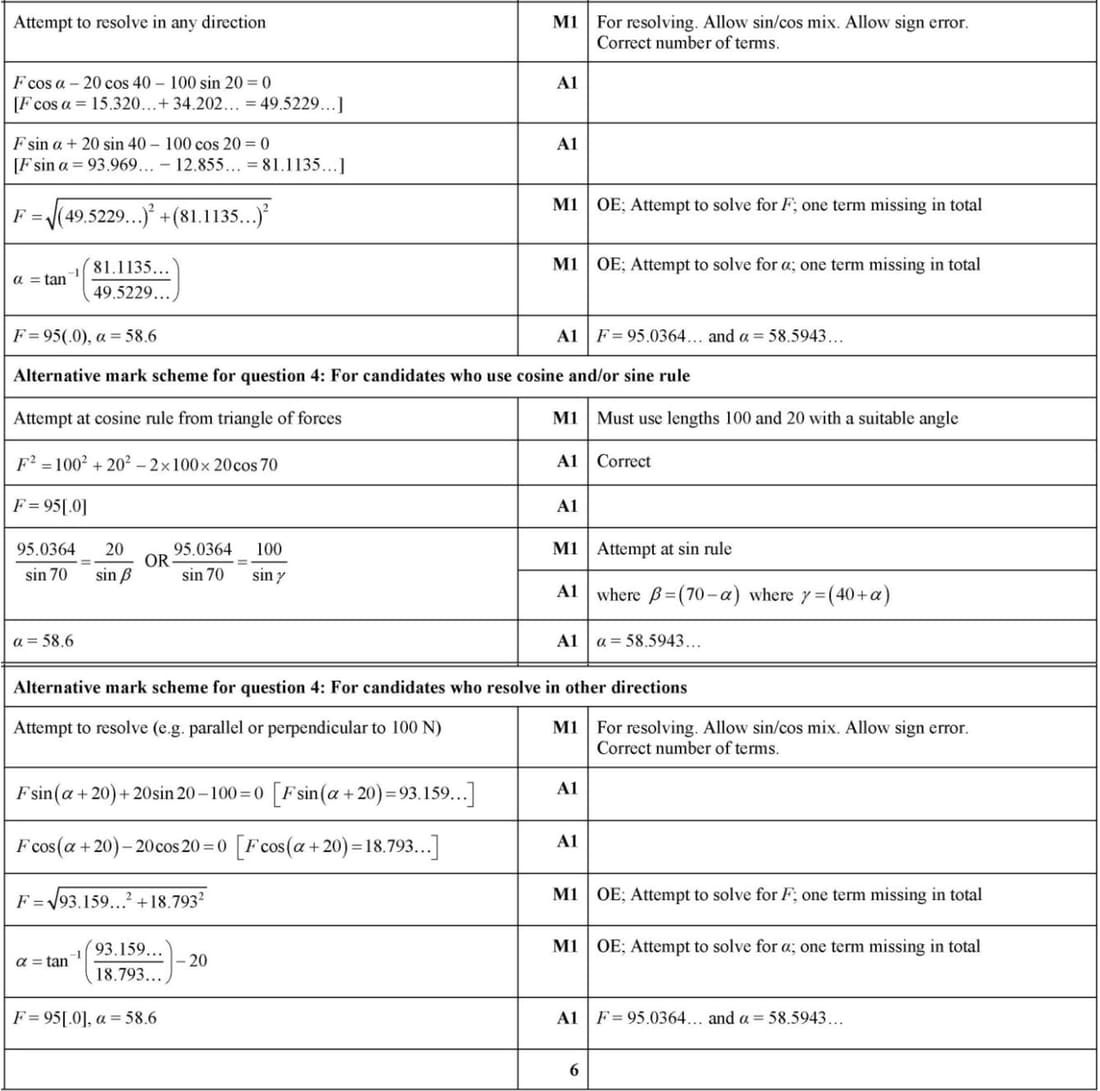
9709 P41 - Jun 2022 - Q4
Three coplanar forces of magnitudes 20 N, 100 N and \(F\) N act at a point. The directions of these forces are shown in the diagram.
Given that the three forces are in equilibrium, find \(F\) and \(\alpha\).
9709 P41 - Nov 2021 - Q3
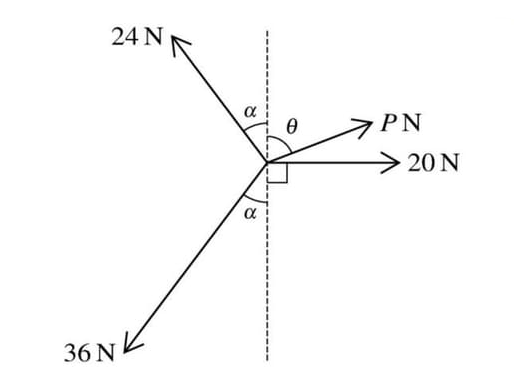
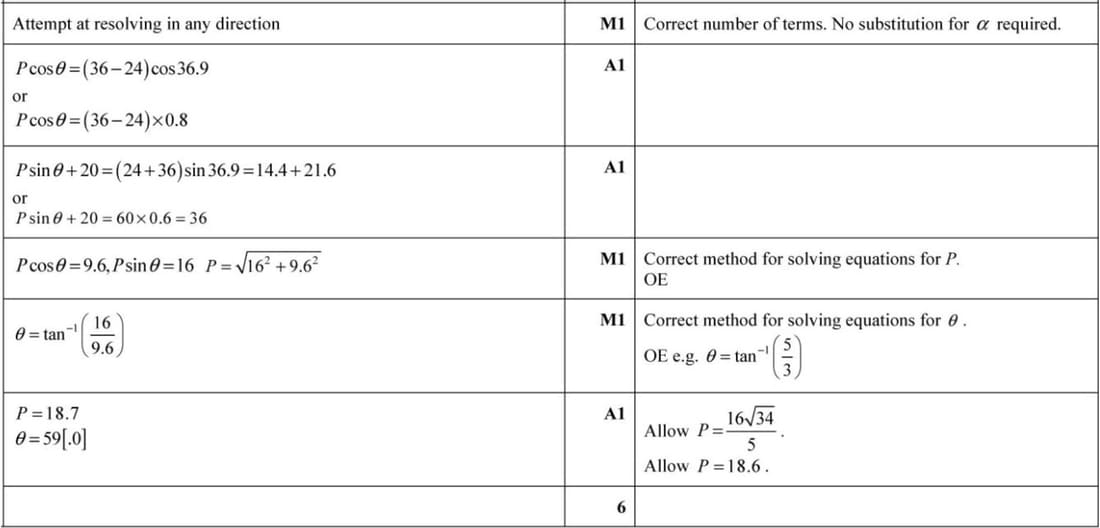
Coplanar forces of magnitudes 24 N, P N, 20 N, and 36 N act at a point in the directions shown in the diagram. The system is in equilibrium. Given that \(\sin \alpha = \frac{3}{5}\), find the values of \(P\) and \(\theta\).
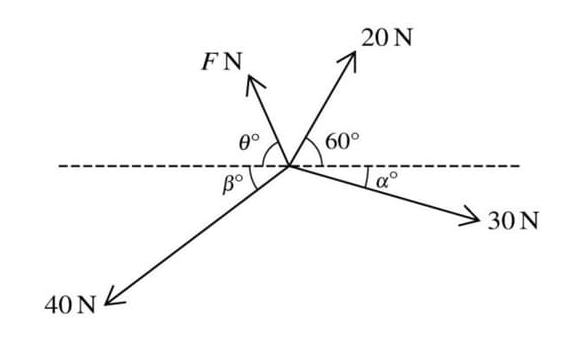
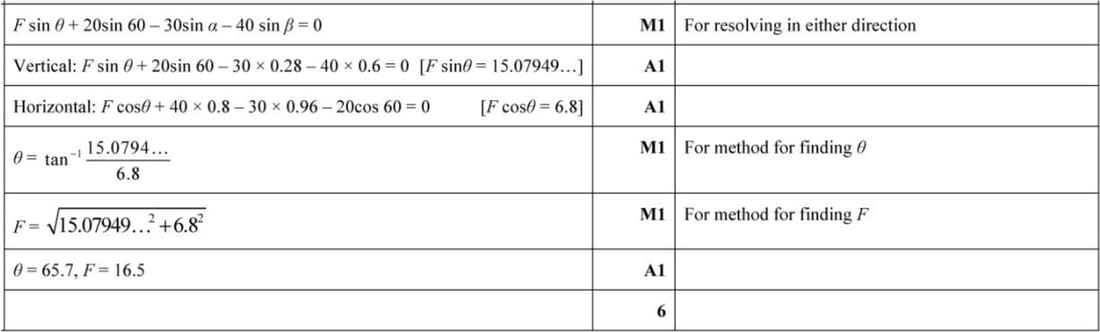
9709 P43 - Jun 2021 - Q3
Four coplanar forces act at a point. The magnitudes of the forces are 20 N, 30 N, 40 N, and \(F\) N. The directions of the forces are as shown in the diagram, where \(\sin \alpha^\circ = 0.28\) and \(\sin \beta^\circ = 0.6\).
Given that the forces are in equilibrium, find \(F\) and \(\theta\).
9709 P41 - Nov 2020 - Q3
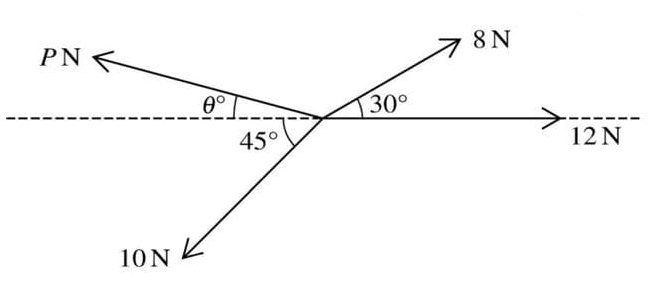
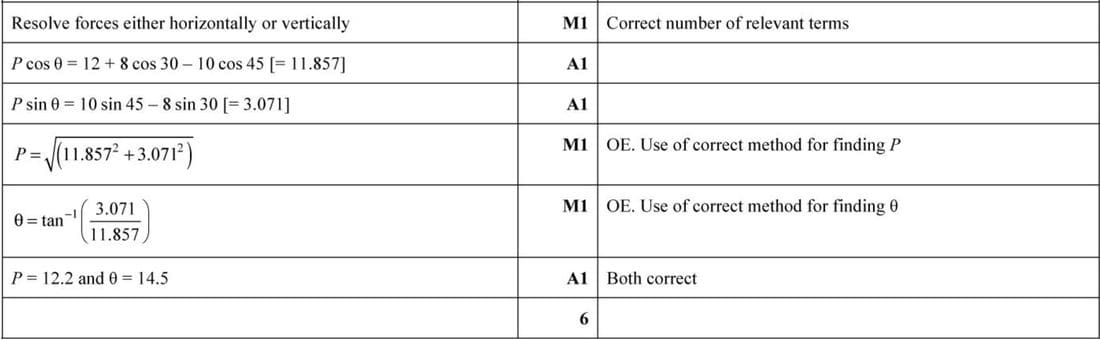
Coplanar forces of magnitudes 8 N, 12 N, 10 N and P N act at a point in the directions shown in the diagram. The system is in equilibrium.
Find P and \(\theta\).
9709 P43 - Jun 2020 - Q3
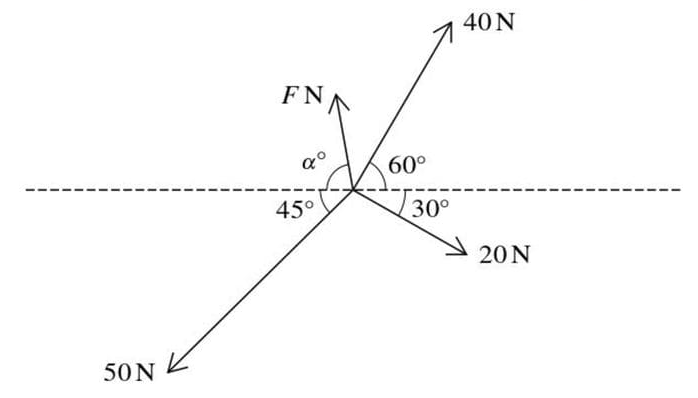
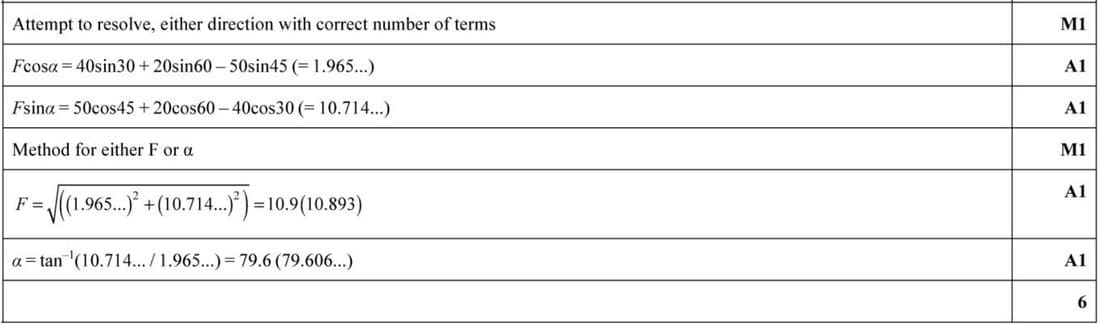
Four coplanar forces of magnitudes 40 N, 20 N, 50 N and F N act at a point in the directions shown in the diagram. The four forces are in equilibrium.
Find F and \(\alpha\).
9709 P42 - Jun 2020 - Q2
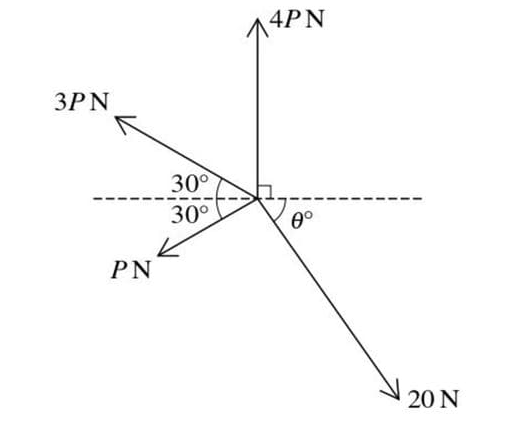
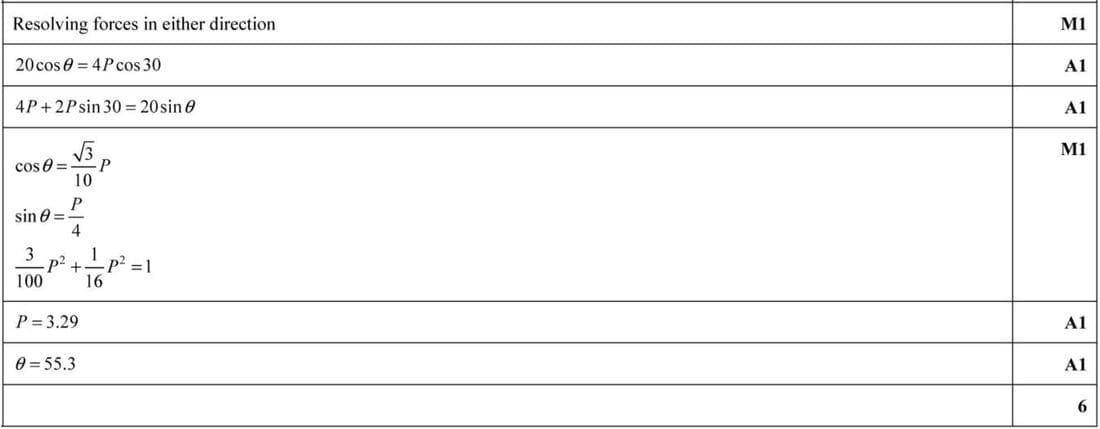
Coplanar forces of magnitudes 20 N, \(P\) N, \(3P\) N, and \(4P\) N act at a point in the directions shown in the diagram. The system is in equilibrium.
Find \(P\) and \(\theta\).
9709 P42 - Jun 2019 - Q1
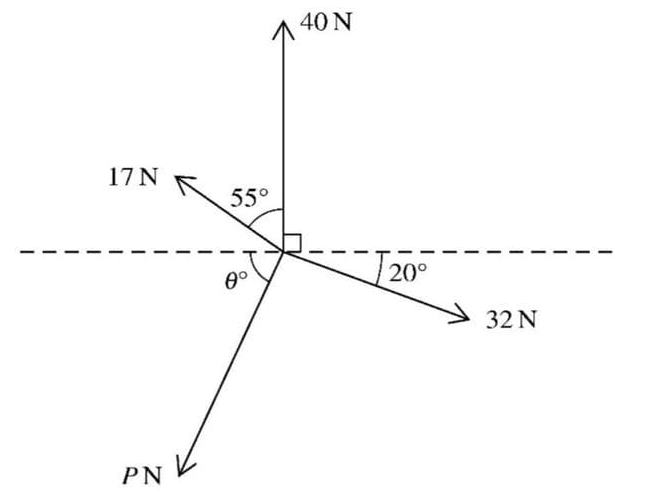
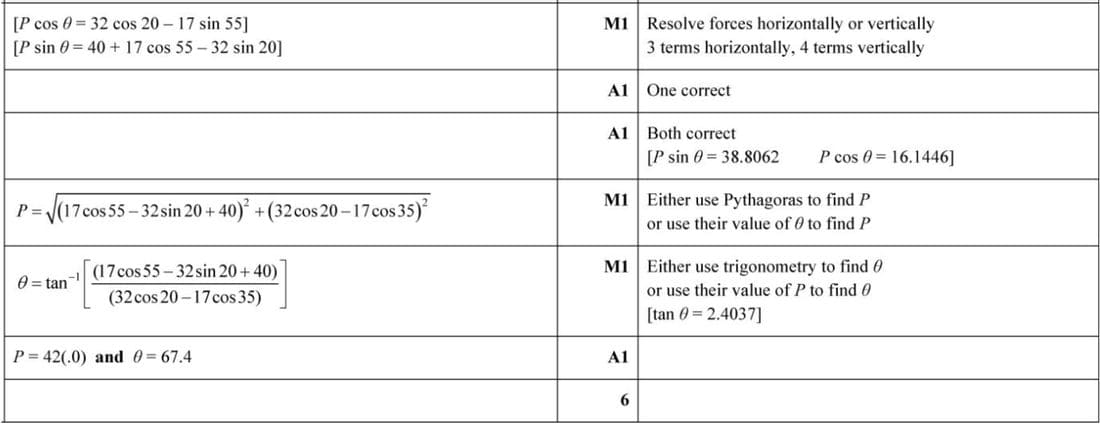
Coplanar forces of magnitudes 40 N, 32 N, P N, and 17 N act at a point in the directions shown in the diagram. The system is in equilibrium. Find the values of P and \(\theta\).