9709 P52 - Nov 2023 - Q1
A competitor in a throwing event has three attempts to throw a ball as far as possible. The random variable \(X\) denotes the number of throws that exceed 30 metres. The probability distribution table for \(X\) is shown below.
| \(x\) | 0 | 1 | 2 | 3 |
|---|---|---|---|---|
| \(P(X = x)\) | 0.4 | \(p\) | \(r\) | 0.15 |
- Given that \(E(X) = 1.1\), find the value of \(p\) and the value of \(r\). [3]
- Find the numerical value of \(\text{Var}(X)\). [2]

9709 P61 - Nov 2014 - Q2
The number of phone calls, X, received per day by Sarah has the following probability distribution.
| x | 0 | 1 | 2 | 3 | 4 | ≥5 |
|---|---|---|---|---|---|---|
| P(X = x) | 0.24 | 0.35 | 2k | k | 0.05 | 0 |
- Find the value of k.
- Find the mode of X.
- Find the probability that the number of phone calls received by Sarah on any particular day is more than the mean number of phone calls received per day.

9709 P63 - Nov 2012 - Q2
The discrete random variable \(X\) has the following probability distribution.
| \(x\) | -3 | 0 | 2 | 4 |
|---|---|---|---|---|
| \(P(X = x)\) | \(p\) | \(q\) | \(r\) | 0.4 |
Given that \(E(X) = 2.3\) and \(\text{Var}(X) = 3.01\), find the values of \(p, q\) and \(r\).

9709 P61 - Jun 2012 - Q3
A spinner has 5 sides, numbered 1, 2, 3, 4, and 5. When the spinner is spun, the score is the number of the side on which it lands. The score is denoted by the random variable X, which has the probability distribution shown in the table.
| x | 1 | 2 | 3 | 4 | 5 |
|---|---|---|---|---|---|
| P(X = x) | 0.3 | 0.15 | 3p | 2p | 0.05 |
(i) Find the value of p.
A second spinner has 3 sides, numbered 1, 2, and 3. The score when this spinner is spun is denoted by the random variable Y. It is given that P(Y = 1) = 0.3, P(Y = 2) = 0.5, and P(Y = 3) = 0.2.
(ii) Find the probability that, when both spinners are spun together,
- the sum of the scores is 4,
- the product of the scores is less than 8.

9709 P61 - Jun 2011 - Q3
The possible values of the random variable X are the 8 integers in the set \(\{-2, -1, 0, 1, 2, 3, 4, 5\}\). The probability of X being 0 is \(\frac{1}{10}\). The probabilities for all the other values of X are equal. Calculate:
- \(P(X < 2)\),
- the variance of X,
- the value of a for which \(P(-a \leq X \leq 2a) = \frac{17}{35}\).

9709 P62 - Nov 2010 - Q1
The discrete random variable \(X\) takes the values 1, 4, 5, 7, and 9 only. The probability distribution of \(X\) is shown in the table.
| \(x\) | 1 | 4 | 5 | 7 | 9 |
|---|---|---|---|---|---|
| \(P(X = x)\) | 4p | 5p^2 | 1.5p | 2.5p | 1.5p |
Find \(p\).

9709 P61 - Nov 2010 - Q7
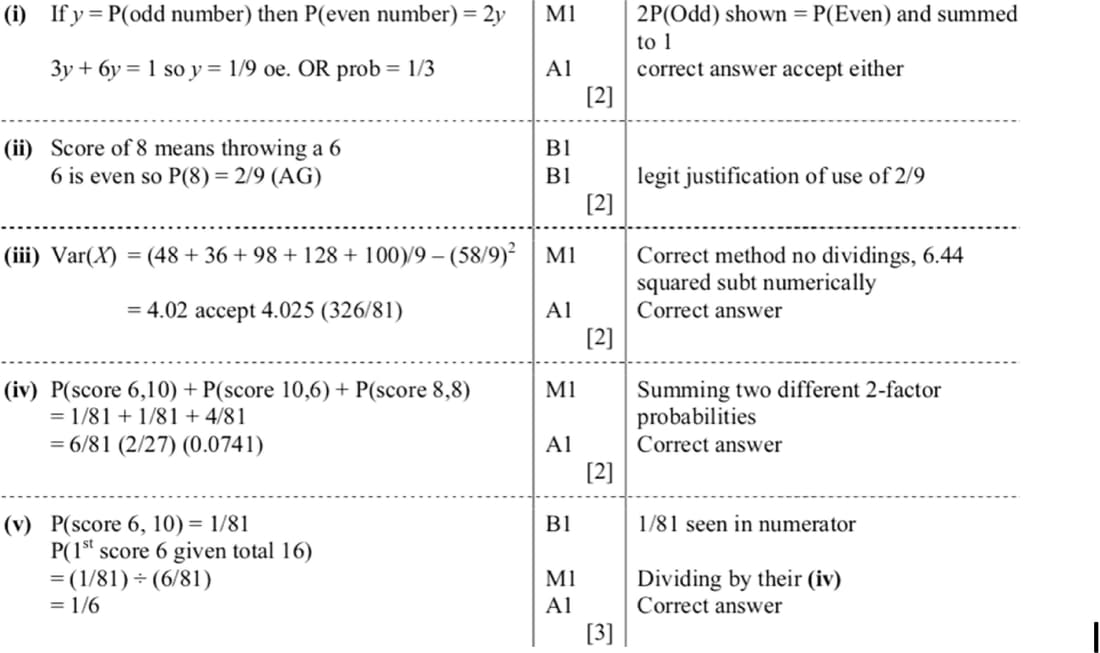
Sanket plays a game using a biased die which is twice as likely to land on an even number as on an odd number. The probabilities for the three even numbers are all equal and the probabilities for the three odd numbers are all equal.
- Find the probability of throwing an odd number with this die.
Sanket throws the die once and calculates his score by the following method.
- If the number thrown is 3 or less he multiplies the number thrown by 3 and adds 1.
- If the number thrown is more than 3 he multiplies the number thrown by 2 and subtracts 4.
The random variable X is Sanket’s score.
- Show that P(X = 8) = \(\frac{2}{9}\).
The table shows the probability distribution of X.
| x | 4 | 6 | 7 | 8 | 10 |
|---|---|---|---|---|---|
| P(X = x) | \(\frac{3}{9}\) | \(\frac{1}{9}\) | \(\frac{2}{9}\) | \(\frac{2}{9}\) | \(\frac{1}{9}\) |
- Given that \(E(X) = \frac{58}{9}\), find \(\text{Var}(X)\).
Sanket throws the die twice.
- Find the probability that the total of the scores on the two throws is 16.
- Given that the total of the scores on the two throws is 16, find the probability that the score on the first throw was 6.
9709 P61 - Jun 2010 - Q1
The probability distribution of the discrete random variable \(X\) is shown in the table below.
| \(x\) | -3 | -1 | 0 | 4 |
|---|---|---|---|---|
| \(P(X = x)\) | \(a\) | \(b\) | 0.15 | 0.4 |
Given that \(E(X) = 0.75\), find the values of \(a\) and \(b\).

9709 P61 - Nov 2009 - Q2
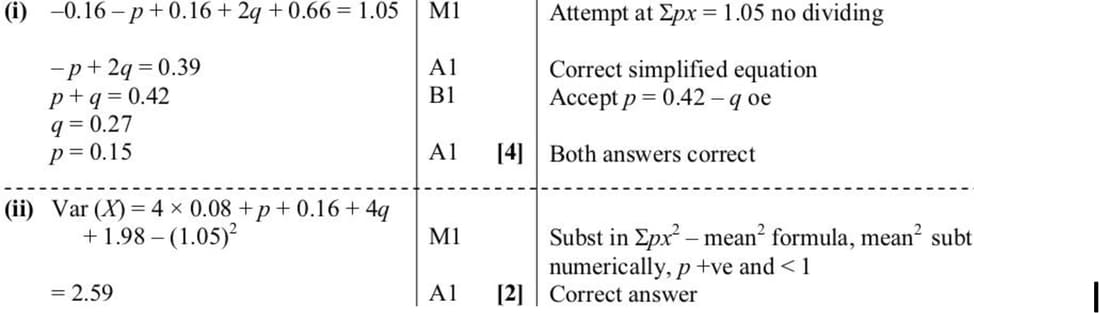
The probability distribution of the random variable \(X\) is shown in the following table.
| \(x\) | -2 | -1 | 0 | 1 | 2 | 3 |
|---|---|---|---|---|---|---|
| \(P(X = x)\) | 0.08 | \(p\) | 0.12 | 0.16 | \(q\) | 0.22 |
The mean of \(X\) is 1.05.
- Write down two equations involving \(p\) and \(q\) and hence find the values of \(p\) and \(q\).
- Find the variance of \(X\).
9709 P6 - Jun 2009 - Q2
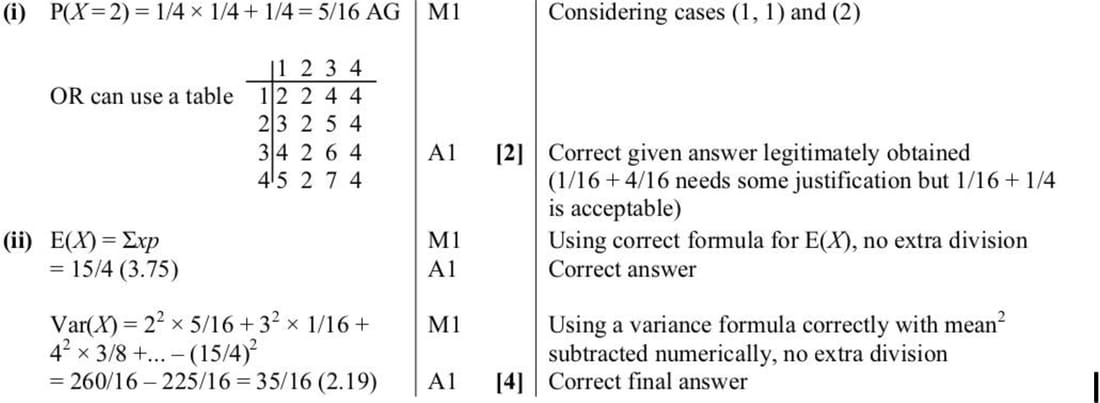
Gohan throws a fair tetrahedral die with faces numbered 1, 2, 3, 4. If she throws an even number then her score is the number thrown. If she throws an odd number then she throws again and her score is the sum of both numbers thrown. Let the random variable X denote Gohan’s score.
(i) Show that \(P(X = 2) = \frac{5}{16}\).
(ii) The table below shows the probability distribution of \(X\).
| \(x\) | 2 | 3 | 4 | 5 | 6 | 7 |
|---|---|---|---|---|---|---|
| \(P(X = x)\) | \(\frac{5}{16}\) | \(\frac{1}{16}\) | \(\frac{3}{8}\) | \(\frac{1}{8}\) | \(\frac{1}{16}\) | \(\frac{1}{16}\) |
Calculate \(E(X)\) and \(\text{Var}(X)\).
9709 P6 - Nov 2007 - Q2
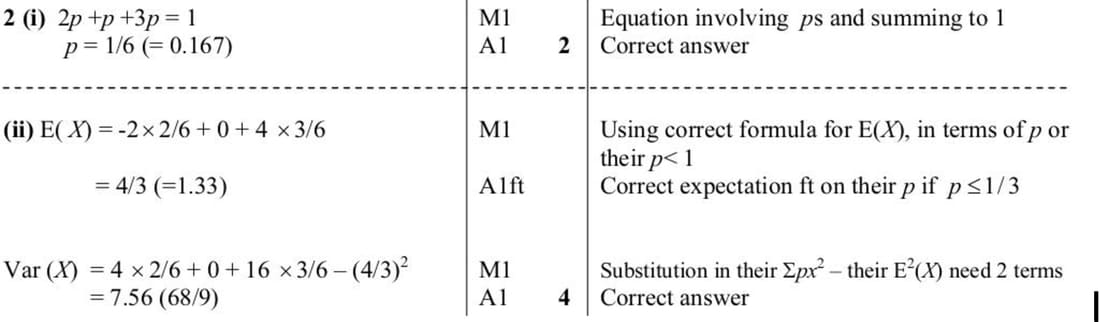
The random variable X takes the values -2, 0 and 4 only. It is given that \(P(X = -2) = 2p\), \(P(X = 0) = p\) and \(P(X = 4) = 3p\).
- Find \(p\).
- Find \(\overline{E}(X)\) and \(\text{Var}(X)\).
9709 P51 - Jun 2023 - Q6
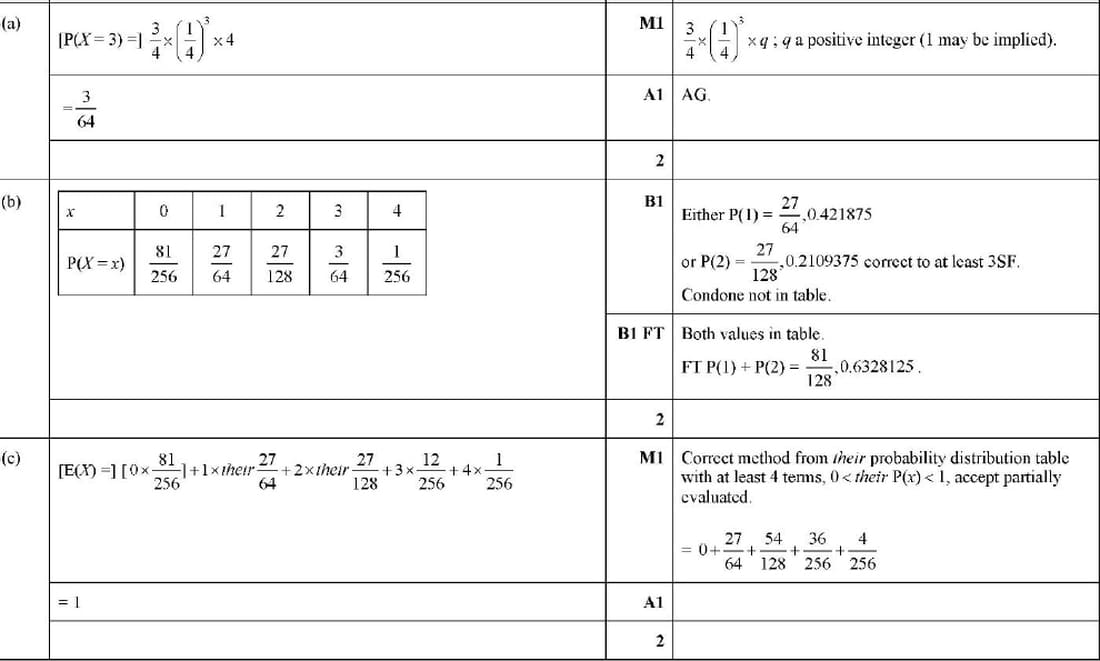
Eli has four fair 4-sided dice with sides labelled 1, 2, 3, 4. He throws all four dice at the same time. The random variable X denotes the number of 2s obtained.
(a) Show that \(P(X = 3) = \frac{3}{64}\).
(b) Complete the following probability distribution table for \(X\).
| x | 0 | 1 | 2 | 3 | 4 |
|---|---|---|---|---|---|
| P(X = x) | \(\frac{81}{256}\) | \(\frac{3}{64}\) | \(\frac{1}{256}\) |
(c) Find \(E(X)\).
9709 P6 - Nov 2006 - Q2
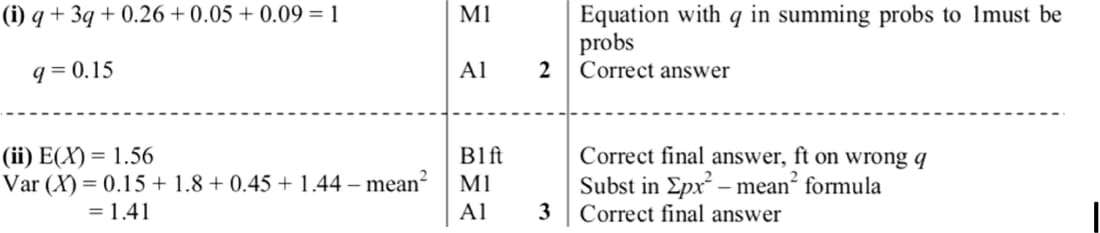
The discrete random variable X has the following probability distribution.
| x | 0 | 1 | 2 | 3 | 4 |
|---|---|---|---|---|---|
| P(X = x) | 0.26 | q | 3q | 0.05 | 0.09 |
- Find the value of q.
- Find E(X) and Var(X).
9709 P6 - Nov 2003 - Q8
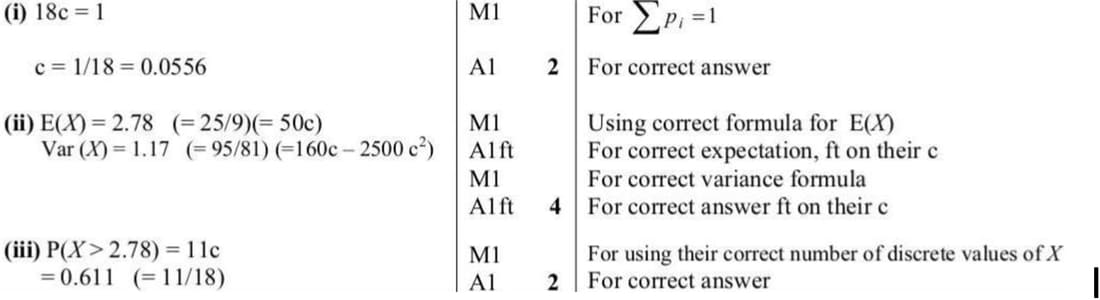
A discrete random variable X has the following probability distribution.
| x | 1 | 2 | 3 | 4 |
|---|---|---|---|---|
| P(X = x) | 3c | 4c | 5c | 6c |
- Find the value of the constant c.
- Find E(X) and Var(X).
- Find P(X > E(X)).
9709 P6 - Nov 2002 - Q1
The discrete random variable X has the following probability distribution.
| x | 1 | 3 | 5 | 7 |
|---|---|---|---|---|
| P(X = x) | 0.3 | a | b | 0.25 |
- Write down an equation satisfied by a and b.
- Given that \(E(X) = 4\), find a and b.

9709 P52 - Mar 2023 - Q2
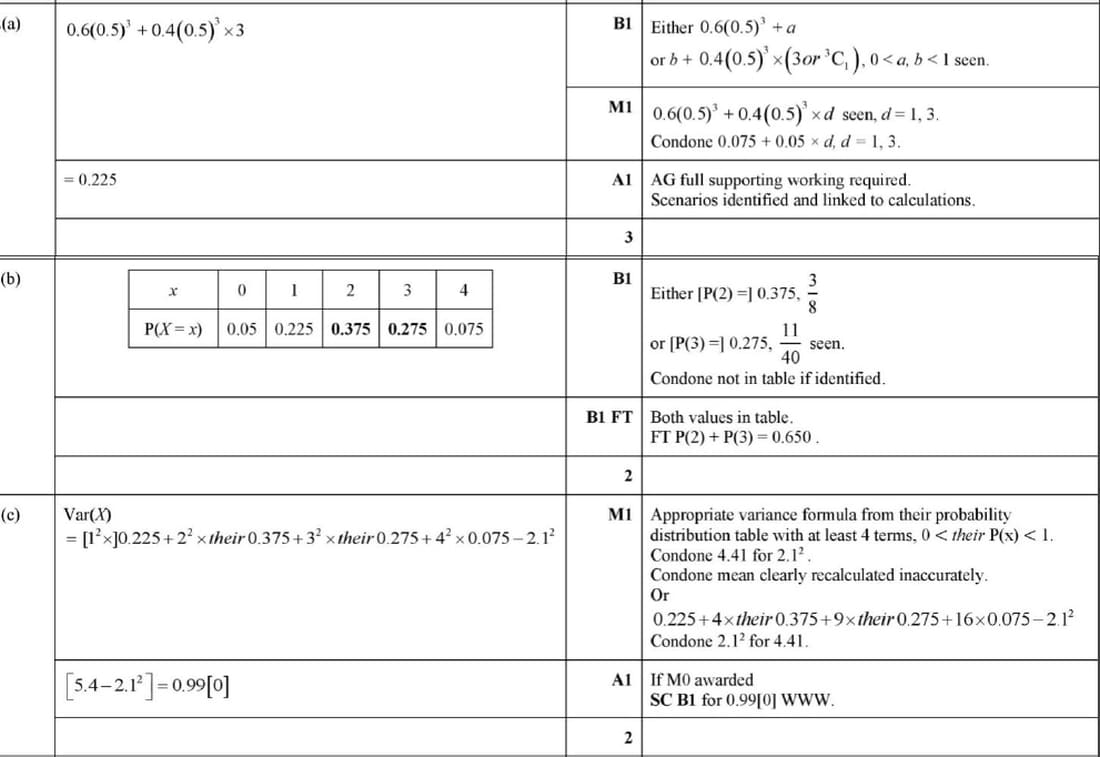
Alisha has four coins. One of these coins is biased so that the probability of obtaining a head is 0.6. The other three coins are fair. Alisha throws the four coins at the same time. The random variable X denotes the number of heads obtained.
(a) Show that the probability of obtaining exactly one head is 0.225.
(b) Complete the following probability distribution table for X.
| x | 0 | 1 | 2 | 3 | 4 |
|---|---|---|---|---|---|
| P(X = x) | 0.05 | 0.225 | 0.075 |
\((c) Given that E(X) = 2.1, find the value of Var(X).\)
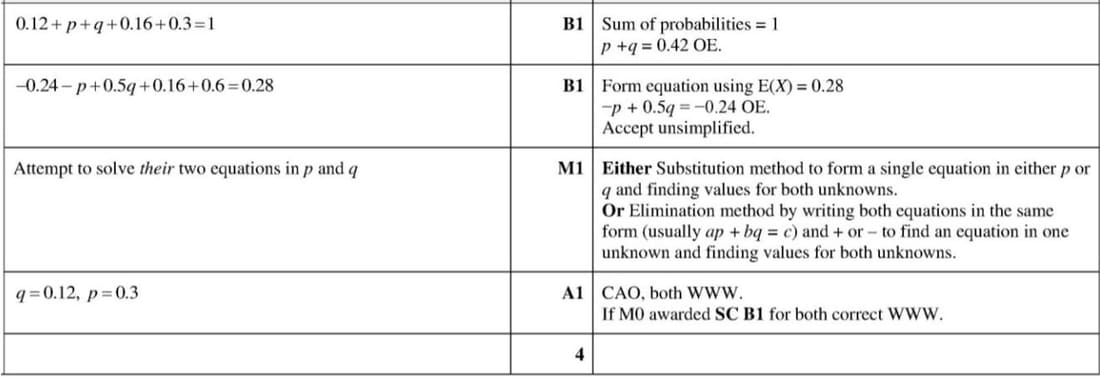
9709 P51 - Nov 2022 - Q1
The probability distribution table for a random variable \(X\) is shown below.
| \(x\) | -2 | -1 | 0.5 | 1 | 2 |
|---|---|---|---|---|---|
| \(P(X = x)\) | 0.12 | \(p\) | \(q\) | 0.16 | 0.3 |
Given that \(E(X) = 0.28\), find the value of \(p\) and the value of \(q\).
9709 P53 - Nov 2021 - Q6
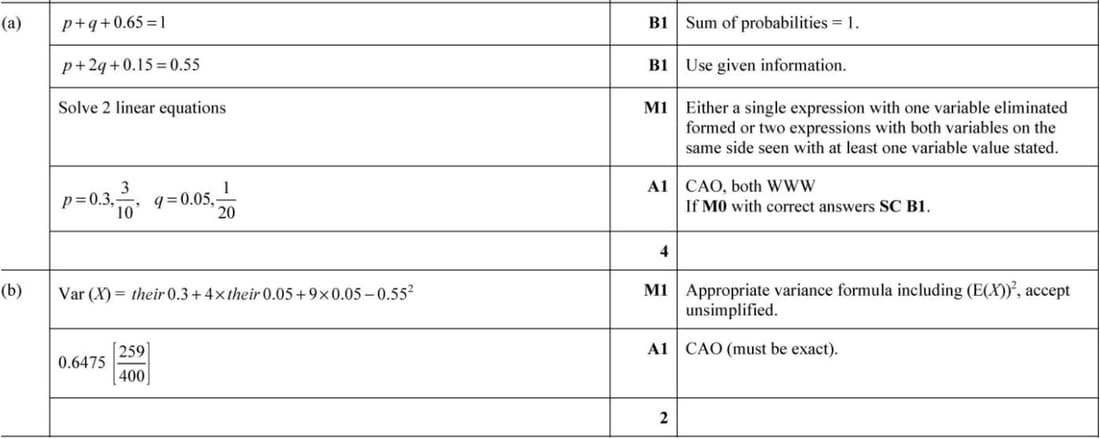
In a game, Jim throws three darts at a board. This is called a ‘turn’. The centre of the board is called the bull’s-eye.
The random variable \(X\) is the number of darts in a turn that hit the bull’s-eye. The probability distribution of \(X\) is given in the following table.
| \(x\) | 0 | 1 | 2 | 3 |
|---|---|---|---|---|
| \(P(X = x)\) | 0.6 | \(p\) | \(q\) | 0.05 |
It is given that \(E(X) = 0.55\).
(a) Find the values of \(p\) and \(q\).
(b) Find \(\text{Var}(X)\).
9709 P53 - Jun 2021 - Q2
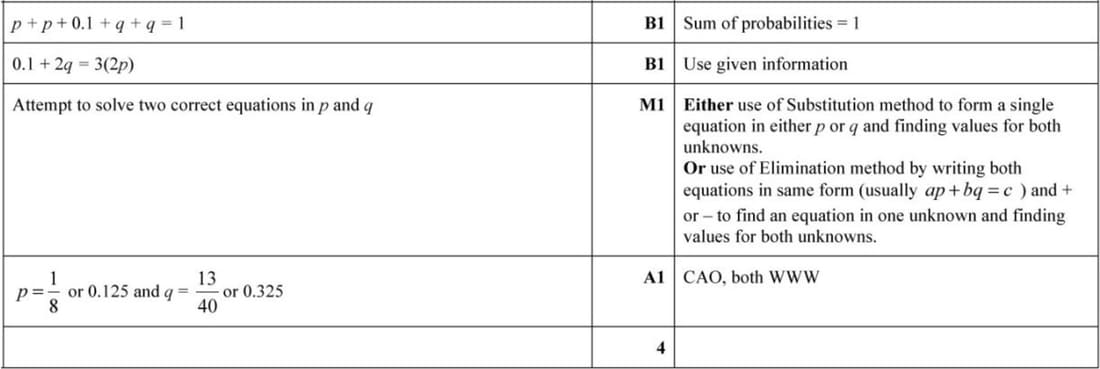
The random variable X can take only the values -2, -1, 0, 1, 2. The probability distribution of X is given in the following table.
| x | -2 | -1 | 0 | 1 | 2 |
|---|---|---|---|---|---|
| P(X = x) | p | p | 0.1 | q | q |
\(Given that P(X \geq 0) = 3P(X < 0), find the values of p and q.\)
9709 P61 - Nov 2019 - Q4
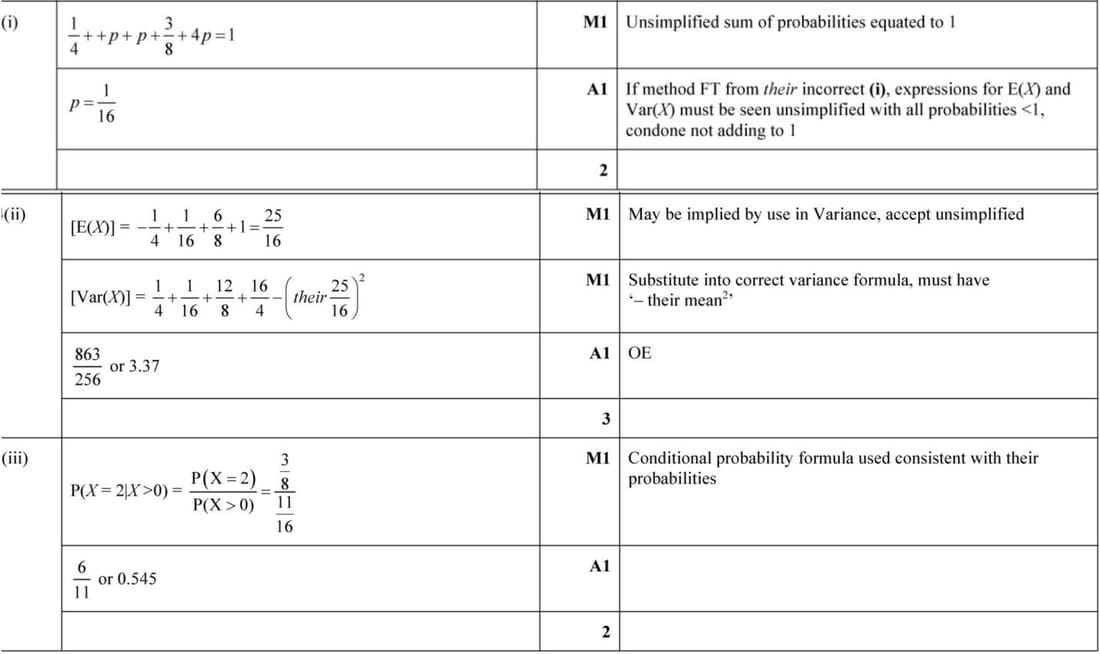
In a probability distribution the random variable X takes the values -1, 0, 1, 2, 4. The probability distribution table for X is as follows.
| x | -1 | 0 | 1 | 2 | 4 |
|---|---|---|---|---|---|
| P(X = x) | \(\frac{1}{4}\) | p | p | \(\frac{3}{8}\) | 4p |
- Find the value of p.
- Find E(X) and Var(X).
- Given that X is greater than zero, find the probability that X is equal to 2.
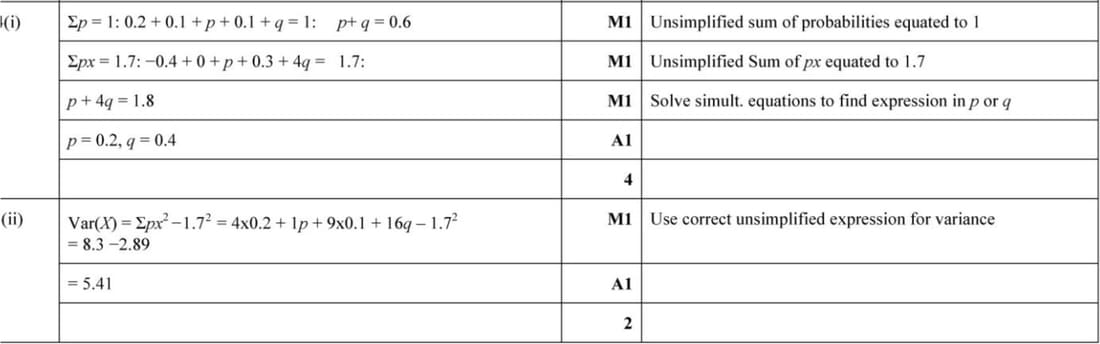
9709 P62 - Mar 2018 - Q4
The discrete random variable X has the following probability distribution.
| x | -2 | 0 | 1 | 3 | 4 |
|---|---|---|---|---|---|
| P(X = x) | 0.2 | 0.1 | p | 0.1 | q |
(i) Given that \(E(X) = 1.7\), find the values of \(p\) and \(q\).
(ii) Find \(\text{Var}(X)\).
9709 P61 - Nov 2017 - Q1
The discrete random variable X has the following probability distribution.
| x | 1 | 2 | 3 | 6 |
|---|---|---|---|---|
| P(X = x) | 0.15 | p | 0.4 | q |
\(Given that E(X) = 3.05, find the values of p and q.\)
