9709 P13 - Nov 2023 - Q6
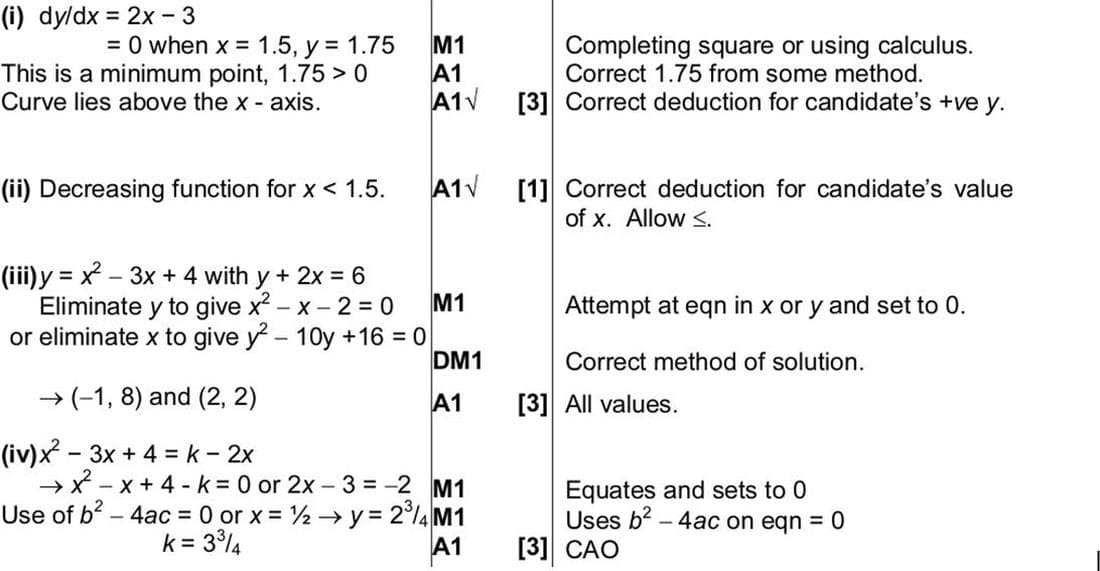
A line has equation \(y = 6x - c\) and a curve has equation \(y = cx^2 + 2x - 3\), where \(c\) is a constant. The line is a tangent to the curve at point \(P\).
Find the possible values of \(c\) and the corresponding coordinates of \(P\).
9709 P1 - Jun 2002 - Q1
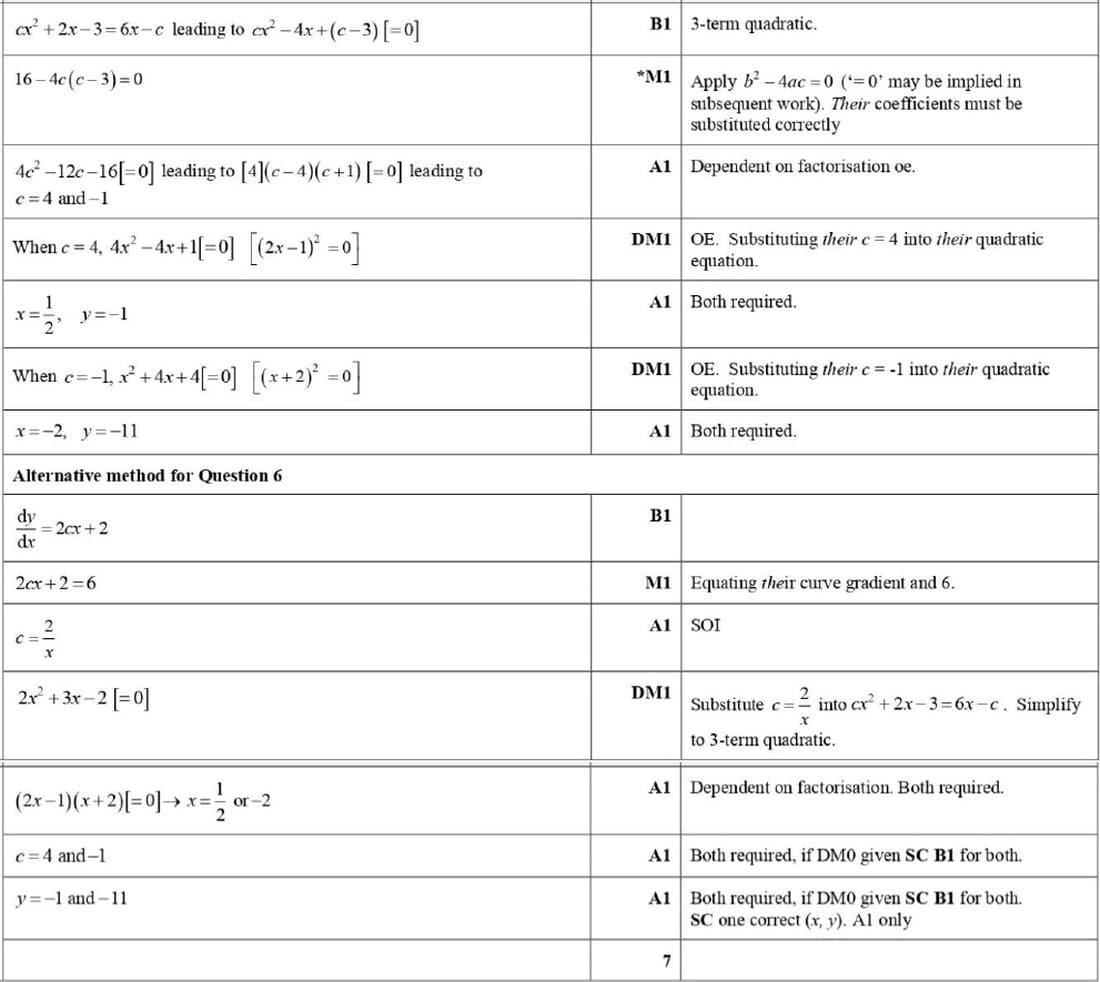
The line x + 2y = 9 intersects the curve xy + 18 = 0 at the points A and B. Find the coordinates of A and B.
9709 P12 - Jun 2022 - Q5A
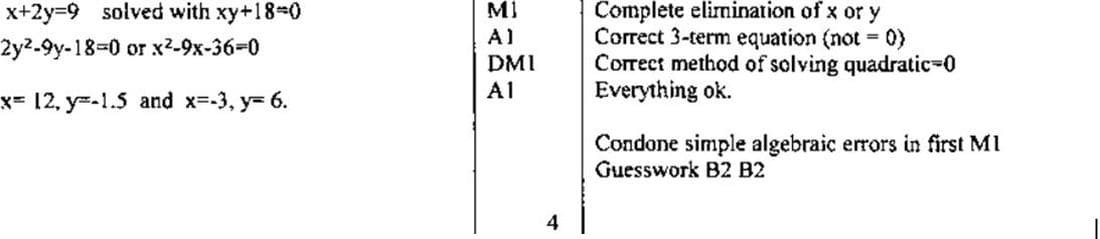
The equation of a curve is \(y = 4x^2 - kx + \frac{1}{2}k^2\) and the equation of a line is \(y = x - a\), where \(k\) and \(a\) are constants.
Given that the curve and the line intersect at the points with \(x\)-coordinates 0 and \(\frac{3}{4}\), find the values of \(k\) and \(a\).
9709 P13 - Jun 2021 - Q3
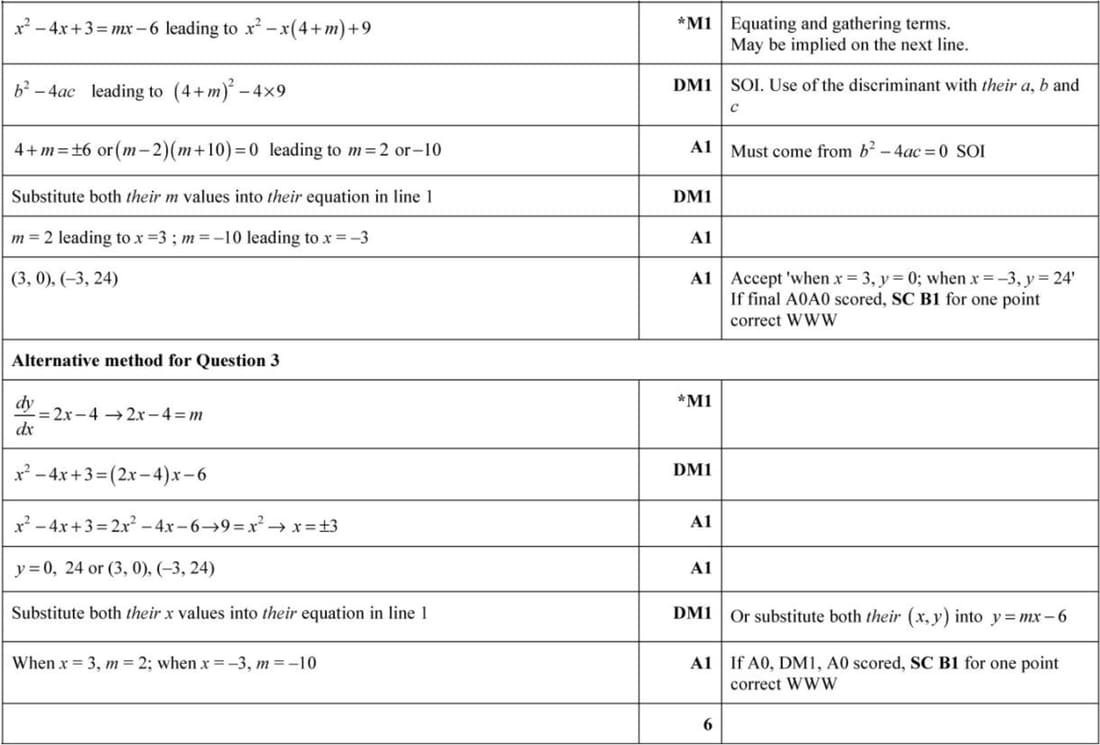
A line with equation \(y = mx - 6\) is a tangent to the curve with equation \(y = x^2 - 4x + 3\).
Find the possible values of the constant \(m\), and the corresponding coordinates of the points at which the line touches the curve.
9709 P11 - Jun 2012 - Q5
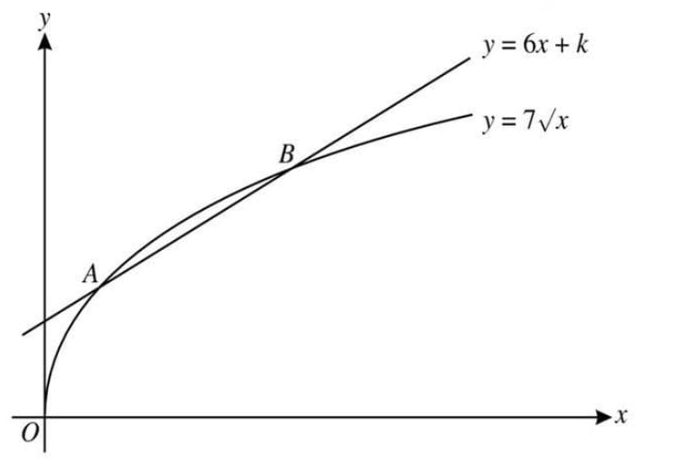
The diagram shows the curve \(y = 7\sqrt{x}\) and the line \(y = 6x + k\), where \(k\) is a constant. The curve and the line intersect at the points \(A\) and \(B\).
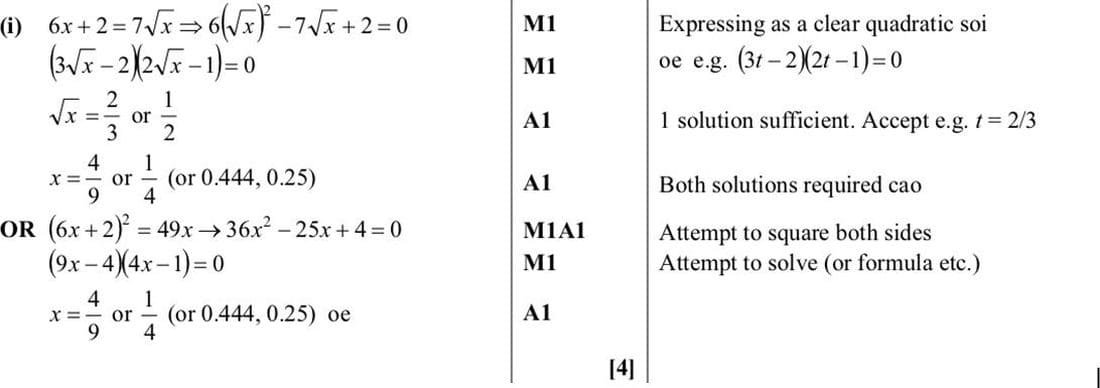
For the case where \(k = 2\), find the \(x\)-coordinates of \(A\) and \(B\).
9709 P12 - Nov 2011 - Q4I
The equation of a curve is \(y^2 + 2x = 13\) and the equation of a line is \(2y + x = k\), where \(k\) is a constant. In the case where \(k = 8\), find the coordinates of the points of intersection of the line and the curve.

9709 P12 - Nov 2009 - Q10I
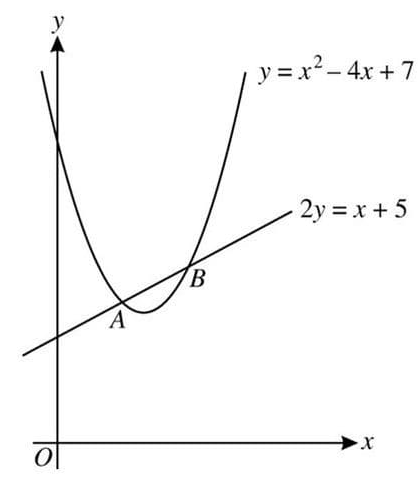
The diagram shows the line \(2y = x + 5\) and the curve \(y = x^2 - 4x + 7\), which intersect at the points \(A\) and \(B\). Findthe \(x\)-coordinates of \(A\) and \(B\),

9709 P1 - Jun 2008 - Q4
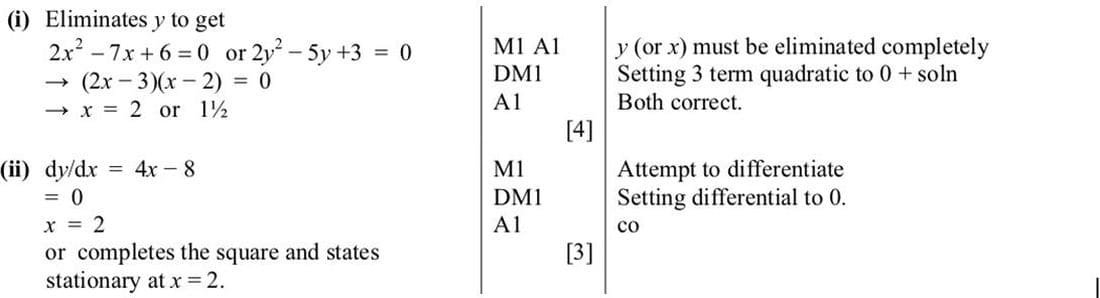
The equation of a curve C is \(y = 2x^2 - 8x + 9\) and the equation of a line L is \(x + y = 3\).
(i) Find the x-coordinates of the points of intersection of L and C.
(ii) Show that one of these points is also the stationary point of C.
9709 P1 - Nov 2005 - Q9I
The equation of a curve is \(xy = 12\) and the equation of a line \(l\) is \(2x + y = k\), where \(k\) is a constant.
In the case where \(k = 11\), find the coordinates of the points of intersection of \(l\) and the curve.

9709 P1 - Nov 2003 - Q1
Find the coordinates of the points of intersection of the line \(y + 2x = 11\) and the curve \(xy = 12\).

9709 P12 - Nov 2018 - Q3
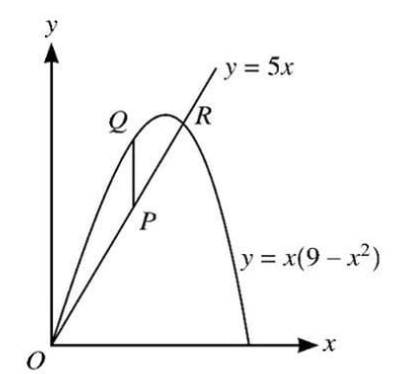
The diagram shows part of the curve \(y = x(9 - x^2)\) and the line \(y = 5x\), intersecting at the origin \(O\) and the point \(R\). Point \(P\) lies on the line \(y = 5x\) between \(O\) and \(R\) and the \(x\)-coordinate of \(P\) is \(t\). Point \(Q\) lies on the curve and \(PQ\) is parallel to the \(y\)-axis.
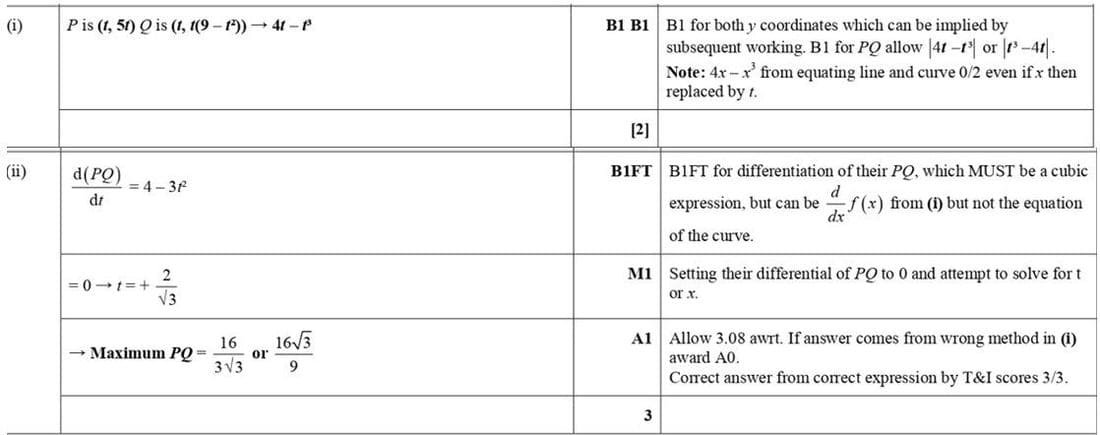
- Express the length of \(PQ\) in terms of \(t\), simplifying your answer.
- Given that \(t\) can vary, find the maximum value of the length of \(PQ\).
9709 P12 - Nov 2017 - Q7
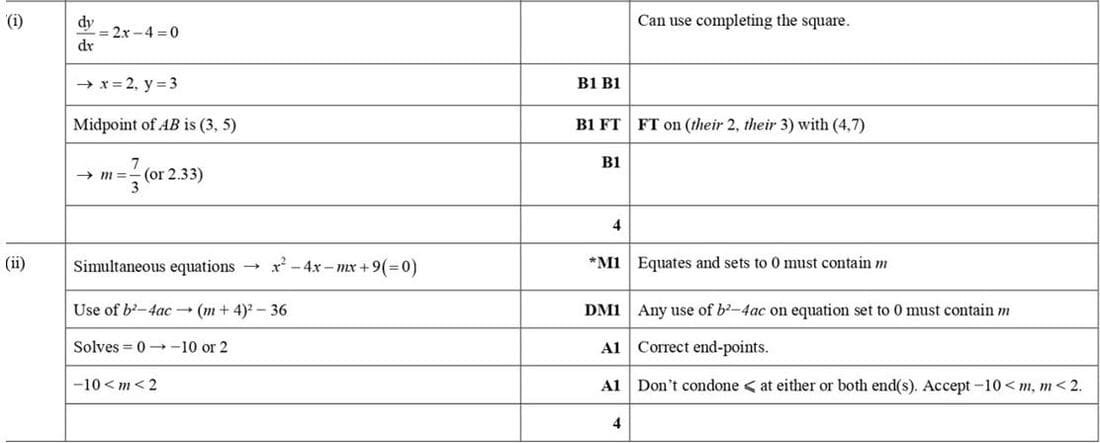
Points A and B lie on the curve \(y = x^2 - 4x + 7\). Point A has coordinates (4, 7) and B is the stationary point of the curve. The equation of a line L is \(y = mx - 2\), where \(m\) is a constant.
(i) In the case where L passes through the mid-point of AB, find the value of \(m\).
(ii) Find the set of values of \(m\) for which L does not meet the curve.
9709 P11 - Nov 2015 - Q6
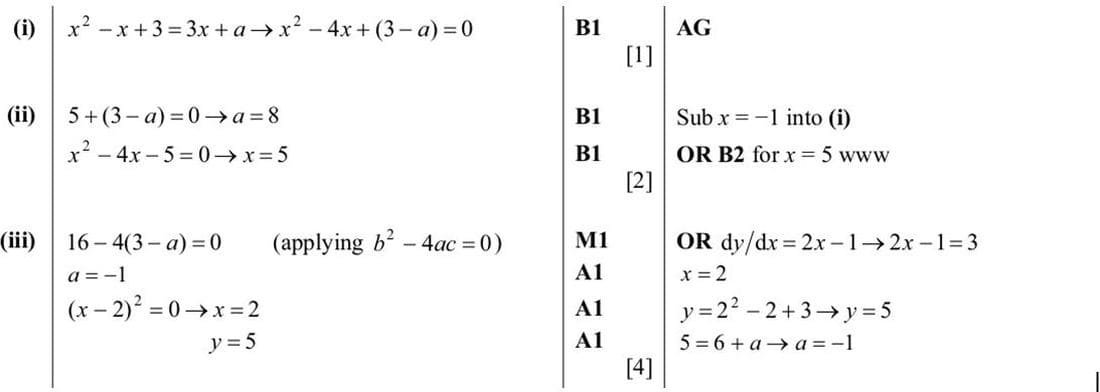
A curve has equation \(y = x^2 - x + 3\) and a line has equation \(y = 3x + a\), where \(a\) is a constant.
(i) Show that the \(x\)-coordinates of the points of intersection of the line and the curve are given by the equation \(x^2 - 4x + (3 - a) = 0\). [1]
(ii) For the case where the line intersects the curve at two points, it is given that the \(x\)-coordinate of one of the points of intersection is \(-1\). Find the \(x\)-coordinate of the other point of intersection. [2]
(iii) For the case where the line is a tangent to the curve at a point \(P\), find the value of \(a\) and the coordinates of \(P\). [4]
9709 P13 - Nov 2012 - Q10
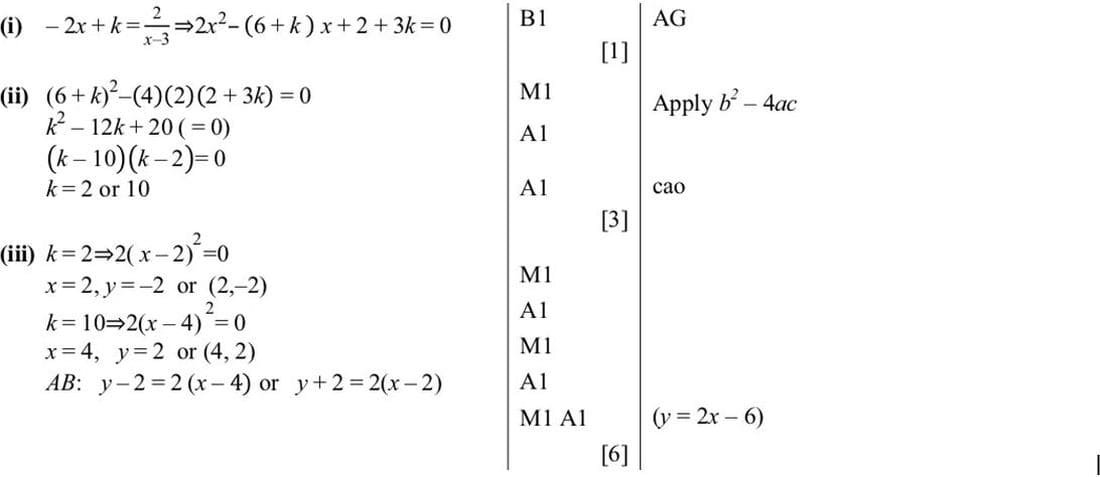
A straight line has equation \(y = -2x + k\), where \(k\) is a constant, and a curve has equation \(y = \frac{2}{x - 3}\).
(i) Show that the \(x\)-coordinates of any points of intersection of the line and curve are given by the equation \(2x^2 - (6 + k)x + (2 + 3k) = 0\). [1]
(ii) Find the two values of \(k\) for which the line is a tangent to the curve. [3]
The two tangents, given by the values of \(k\) found in part (ii), touch the curve at points \(A\) and \(B\).
(iii) Find the coordinates of \(A\) and \(B\) and the equation of the line \(AB\). [6]
9709 P13 - Nov 2011 - Q3
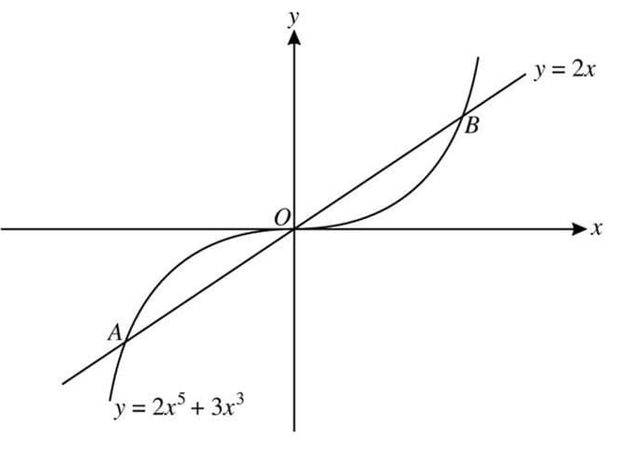
The diagram shows the curve \(y = 2x^5 + 3x^3\) and the line \(y = 2x\) intersecting at points \(A, O\) and \(B\).
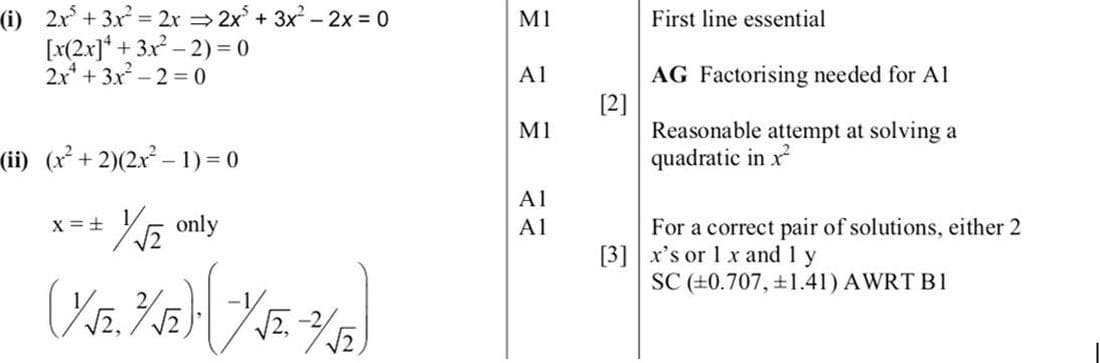
(i) Show that the \(x\)-coordinates of \(A\) and \(B\) satisfy the equation \(2x^4 + 3x^2 - 2 = 0\).
(ii) Solve the equation \(2x^4 + 3x^2 - 2 = 0\) and hence find the coordinates of \(A\) and \(B\), giving your answers in an exact form.
9709 P1 - Jun 2005 - Q10
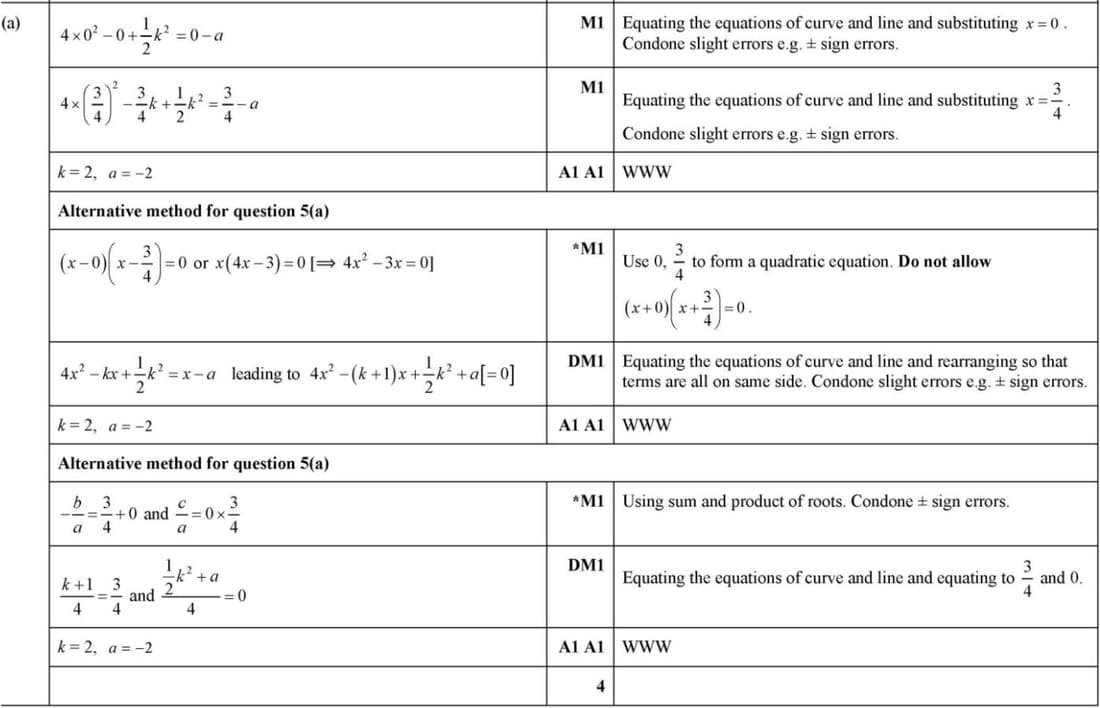
The equation of a curve is \(y = x^2 - 3x + 4\).
(i) Show that the whole of the curve lies above the \(x\)-axis.
(ii) Find the set of values of \(x\) for which \(x^2 - 3x + 4\) is a decreasing function of \(x\).
The equation of a line is \(y + 2x = k\), where \(k\) is a constant.
(iii) In the case where \(k = 6\), find the coordinates of the points of intersection of the line and the curve.
(iv) Find the value of \(k\) for which the line is a tangent to the curve.