9709 P32 - Nov 2023 - Q11
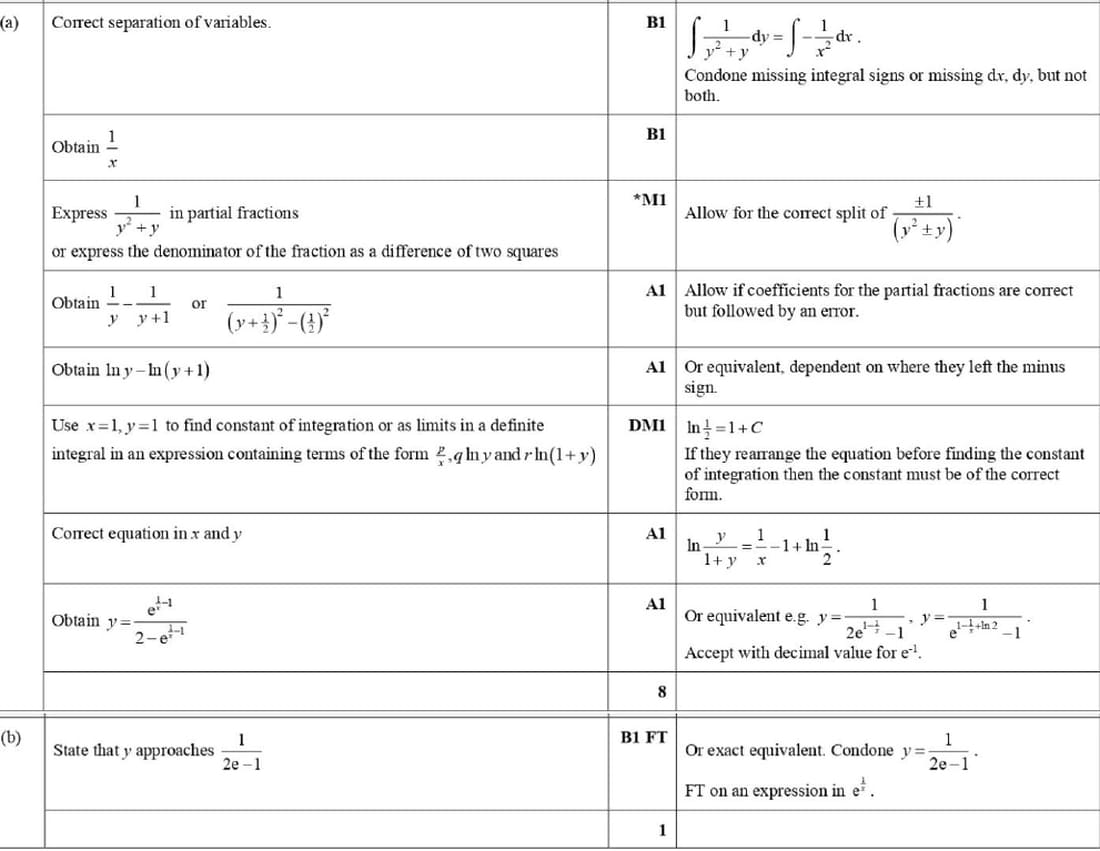
The variables x and y satisfy the differential equation
\(x^2 \frac{dy}{dx} + y^2 + y = 0\).
It is given that \(x = 1\) when \(y = 1\).
(a) Solve the differential equation to obtain an expression for y in terms of x.
(b) State what happens to the value of y when x tends to infinity. Give your answer in an exact form.
9709 P3 - Jun 2009 - Q8
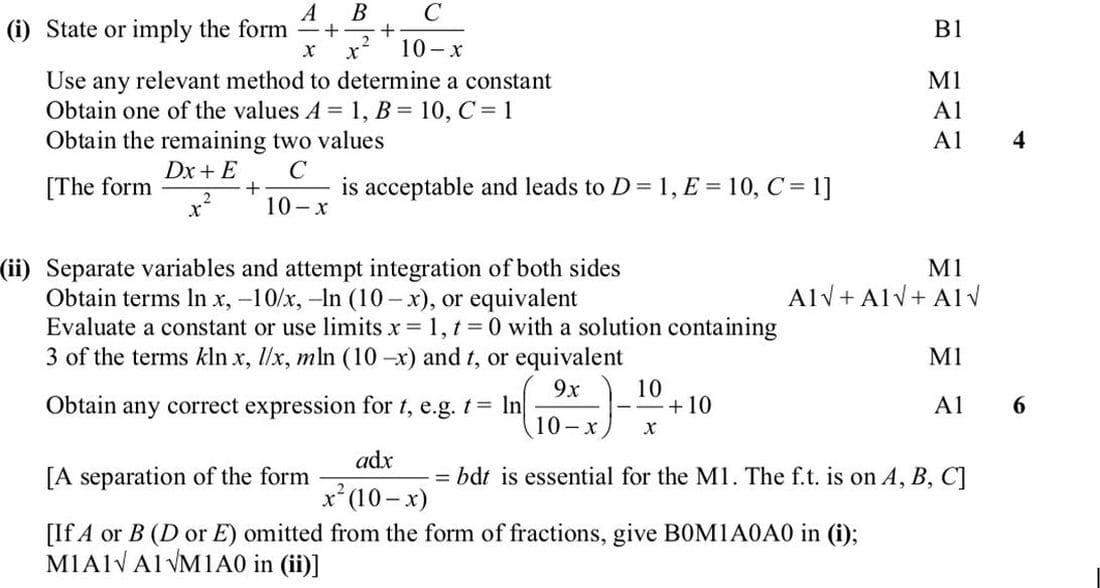
(i) Express \(\frac{100}{x^2(10-x)}\) in partial fractions.
(ii) Given that \(x = 1\) when \(t = 0\), solve the differential equation \(\frac{dx}{dt} = \frac{1}{100}x^2(10-x)\), obtaining an expression for \(t\) in terms of \(x\).
9709 P3 - Jun 2005 - Q8
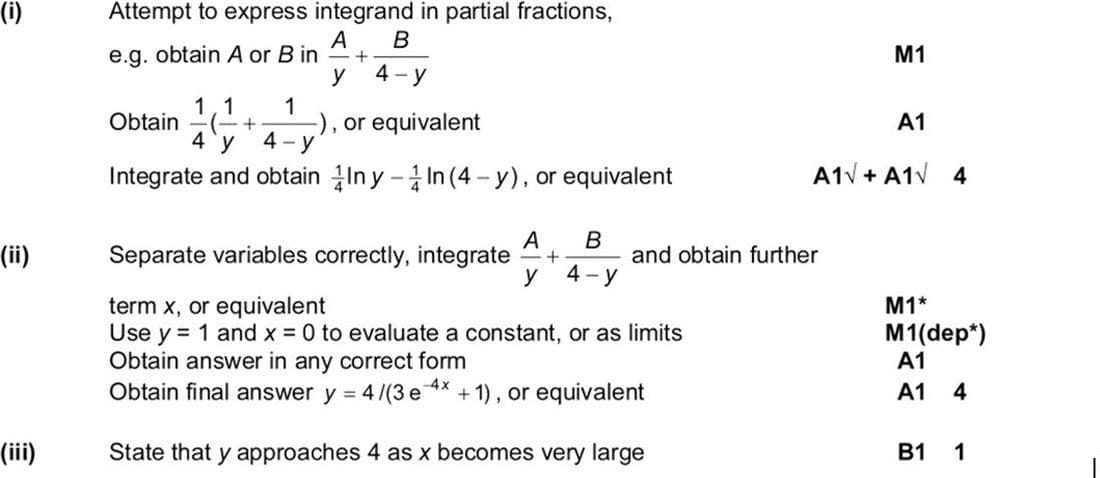
(i) Using partial fractions, find \(\int \frac{1}{y(4-y)} \, dy\).
(ii) Given that \(y = 1\) when \(x = 0\), solve the differential equation \(\frac{dy}{dx} = y(4-y)\), obtaining an expression for \(y\) in terms of \(x\).
(iii) State what happens to the value of \(y\) if \(x\) becomes very large and positive.
9709 P32 - Mar 2022 - Q9
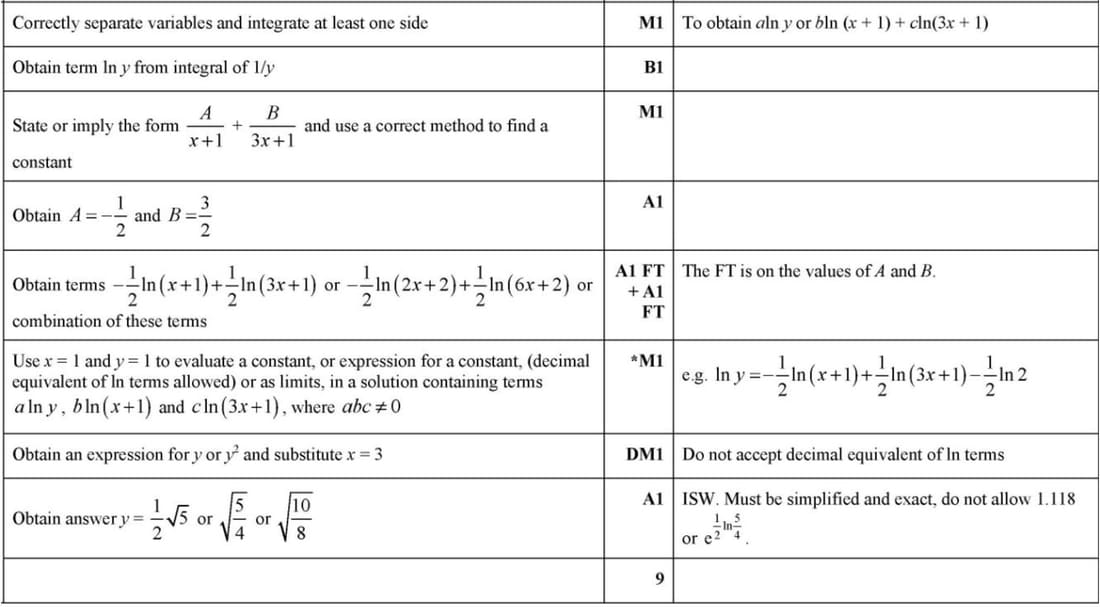
The variables x and y satisfy the differential equation
\((x + 1)(3x + 1) \frac{dy}{dx} = y,\)
and it is given that \(y = 1\) when \(x = 1\).
Solve the differential equation and find the exact value of \(y\) when \(x = 3\), giving your answer in a simplified form.
9709 P31 - Jun 2021 - Q10
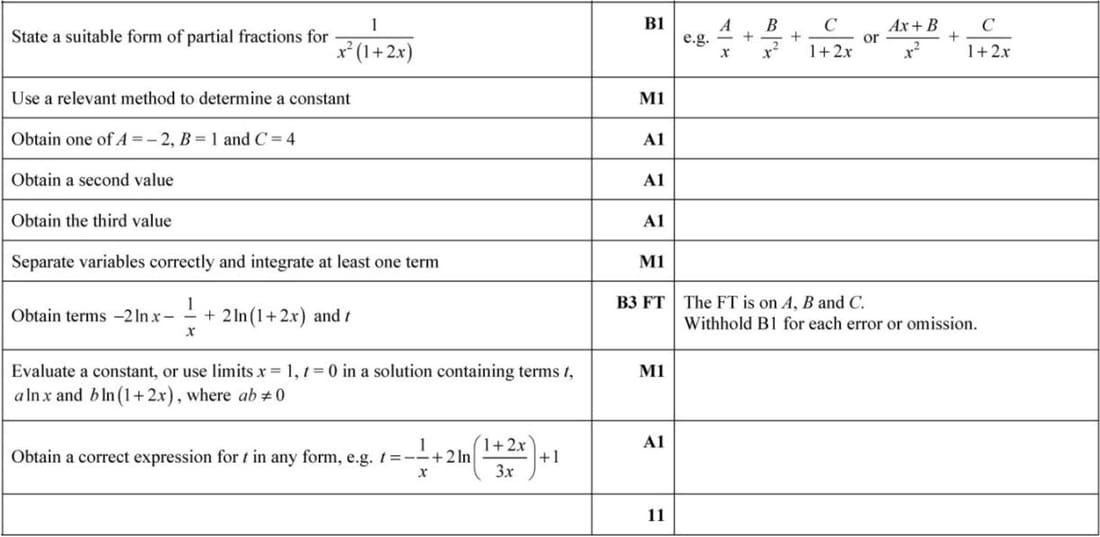
The variables x and t satisfy the differential equation \(\frac{dx}{dt} = x^2(1 + 2x)\), and \(x = 1\) when \(t = 0\).
Using partial fractions, solve the differential equation, obtaining an expression for t in terms of x.
9709 P32 - Jun 2020 - Q7
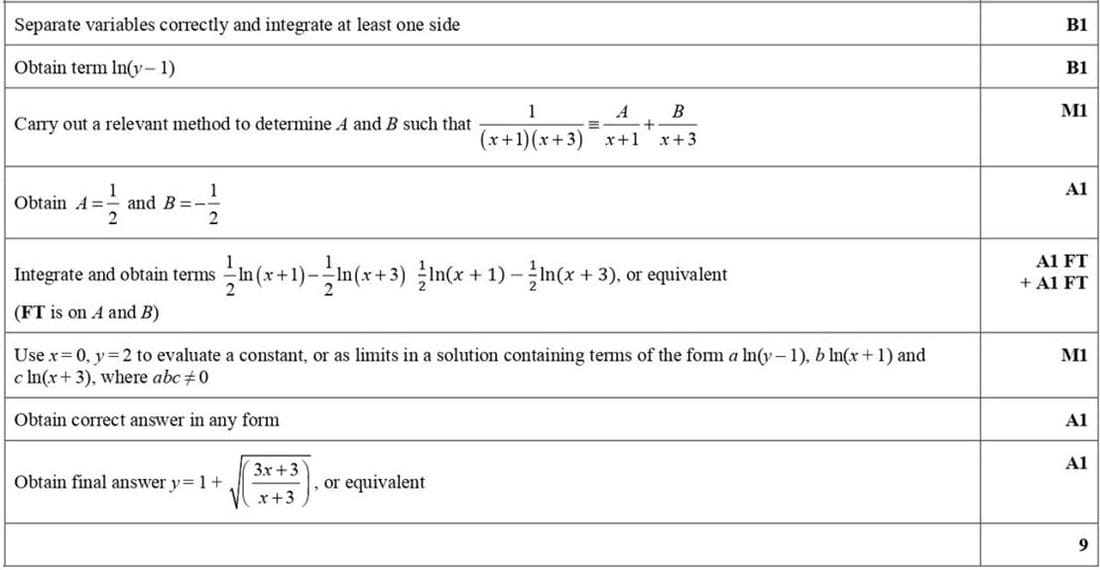
The variables x and y satisfy the differential equation
\(\frac{dy}{dx} = \frac{y-1}{(x+1)(x+3)}\).
It is given that \(y = 2\) when \(x = 0\).
Solve the differential equation, obtaining an expression for \(y\) in terms of \(x\).
9709 P33 - Jun 2018 - Q6
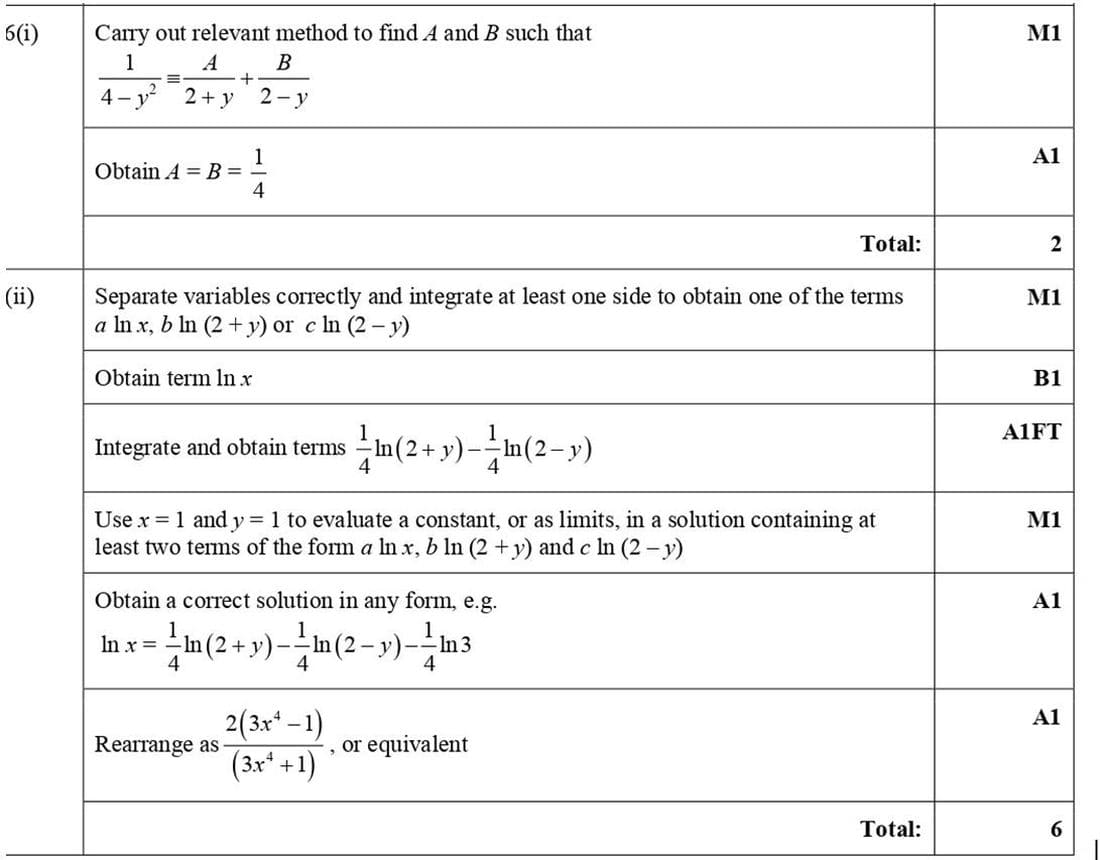
(i) Express \(\frac{1}{4-y^2}\) in partial fractions.
(ii) The variables \(x\) and \(y\) satisfy the differential equation \(\frac{dy}{dx} = \frac{x}{4-y^2}\), and \(y = 1\) when \(x = 1\). Solve the differential equation, obtaining an expression for \(y\) in terms of \(x\).
9709 P31 - Jun 2017 - Q9
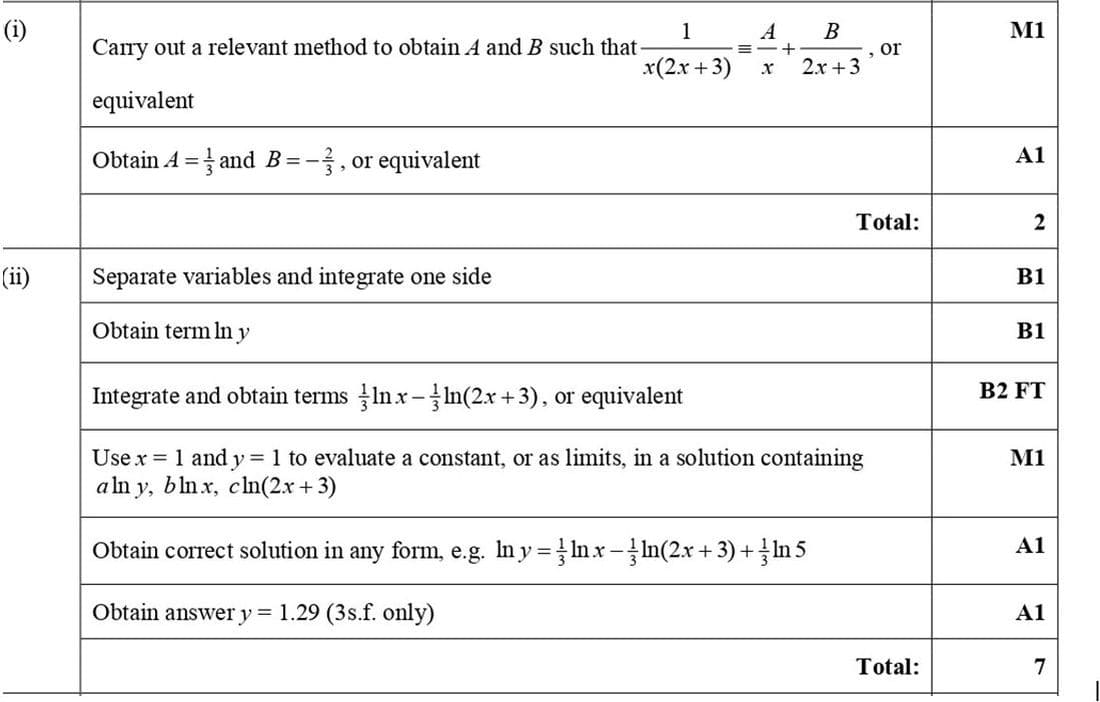
(i) Express \(\frac{1}{x(2x+3)}\) in partial fractions.
(ii) The variables \(x\) and \(y\) satisfy the differential equation \(x(2x+3) \frac{dy}{dx} = y\), and it is given that \(y = 1\) when \(x = 1\). Solve the differential equation and calculate the value of \(y\) when \(x = 9\), giving your answer correct to 3 significant figures.
9709 P31 - Jun 2015 - Q7
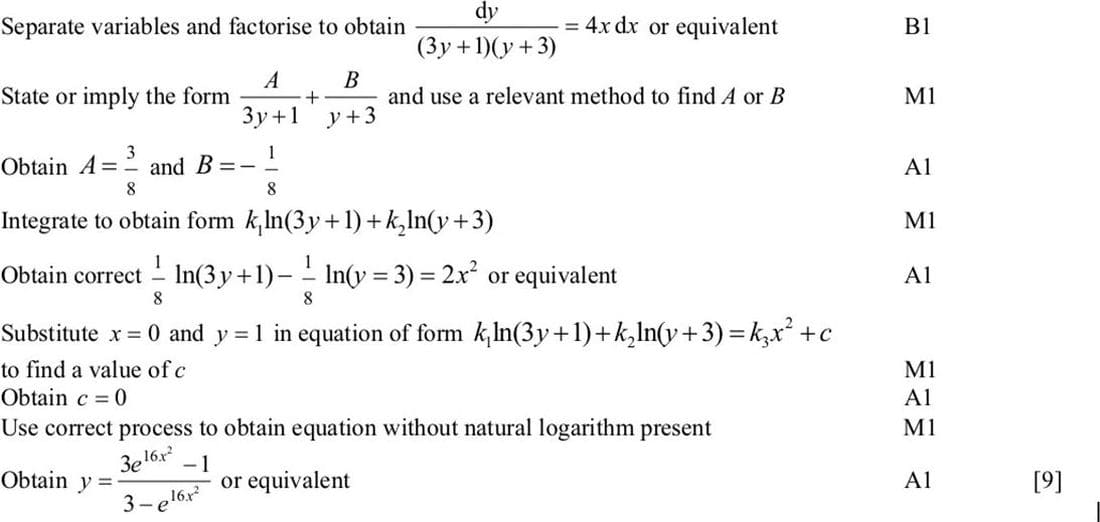
Given that \(y = 1\) when \(x = 0\), solve the differential equation \(\frac{dy}{dx} = 4x(3y^2 + 10y + 3)\), obtaining an expression for \(y\) in terms of \(x\).
9709 P32 - Jun 2013 - Q8
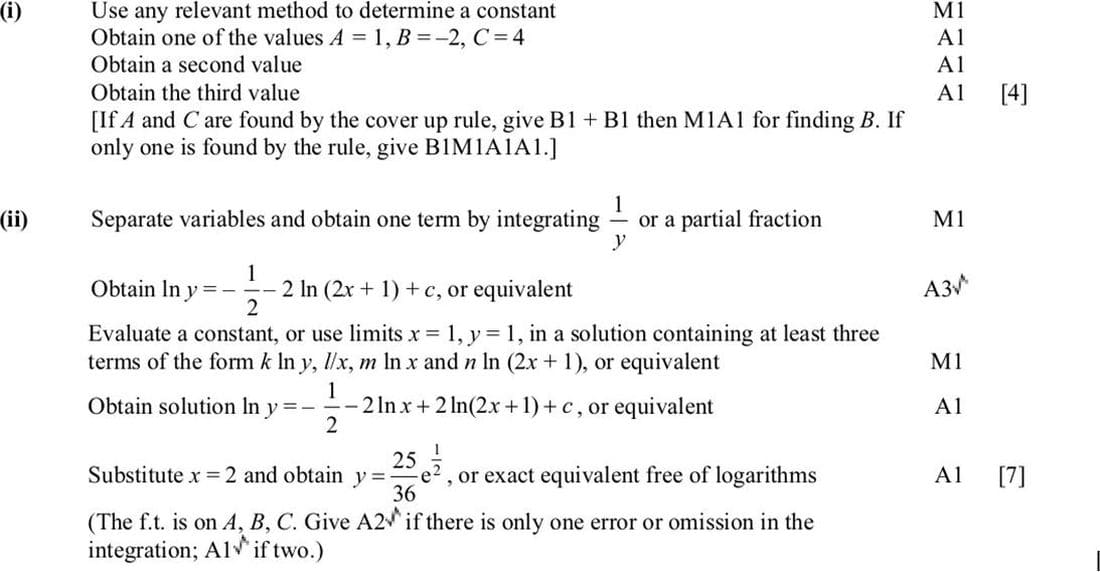
(i) Express \(\frac{1}{x^2(2x+1)}\) in the form \(\frac{A}{x^2} + \frac{B}{x} + \frac{C}{2x+1}\).
(ii) The variables \(x\) and \(y\) satisfy the differential equation \(y = x^2(2x+1) \frac{dy}{dx}\), and \(y = 1\) when \(x = 1\). Solve the differential equation and find the exact value of \(y\) when \(x = 2\). Give your value of \(y\) in a form not involving logarithms.
9709 P31 - Nov 2012 - Q6
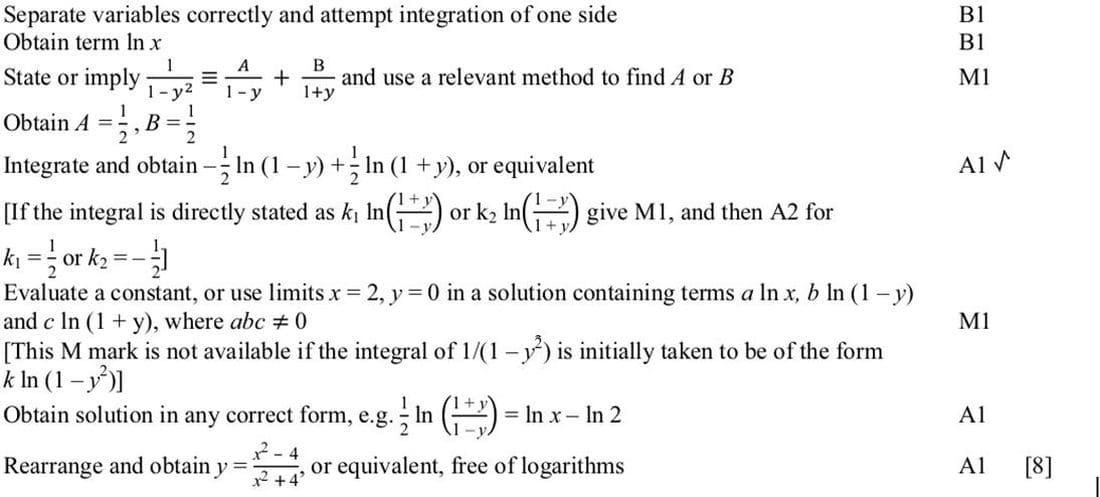
The variables x and y are related by the differential equation \(x \frac{dy}{dx} = 1 - y^2\).
When \(x = 2, y = 0\). Solve the differential equation, obtaining an expression for y in terms of x.
9709 P32 - Jun 2022 - Q6
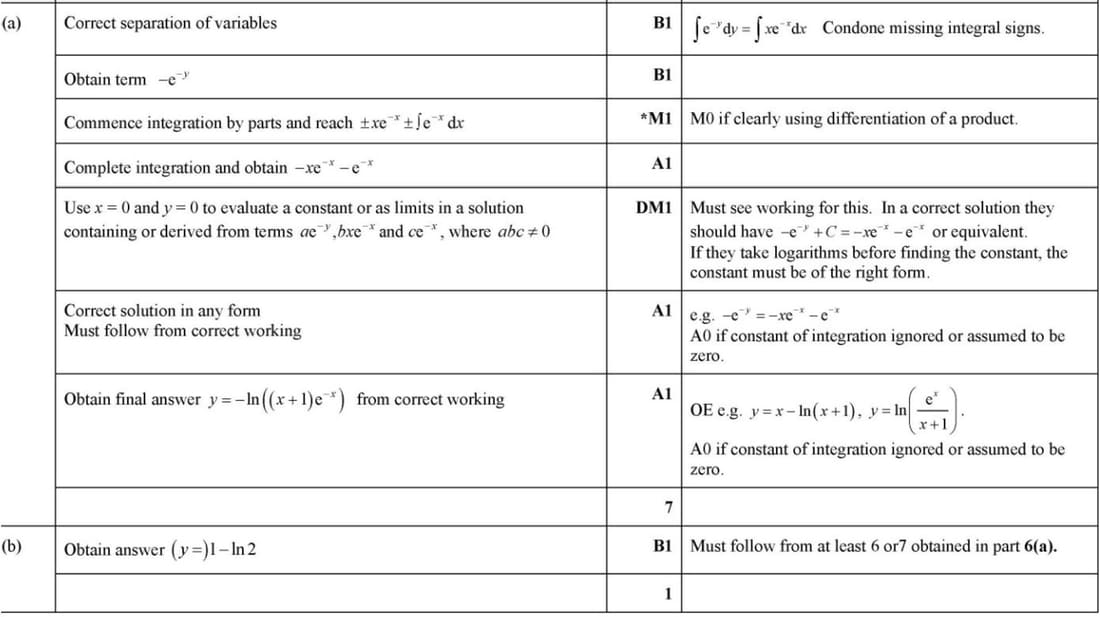
The variables x and y satisfy the differential equation \(\frac{dy}{dx} = xe^{y-x}\), and \(y = 0\) when \(x = 0\).
(a) Solve the differential equation, obtaining an expression for y in terms of x.
(b) Find the value of y when \(x = 1\), giving your answer in the form \(a - \ln b\), where a and b are integers.
9709 P32 - Nov 2021 - Q7
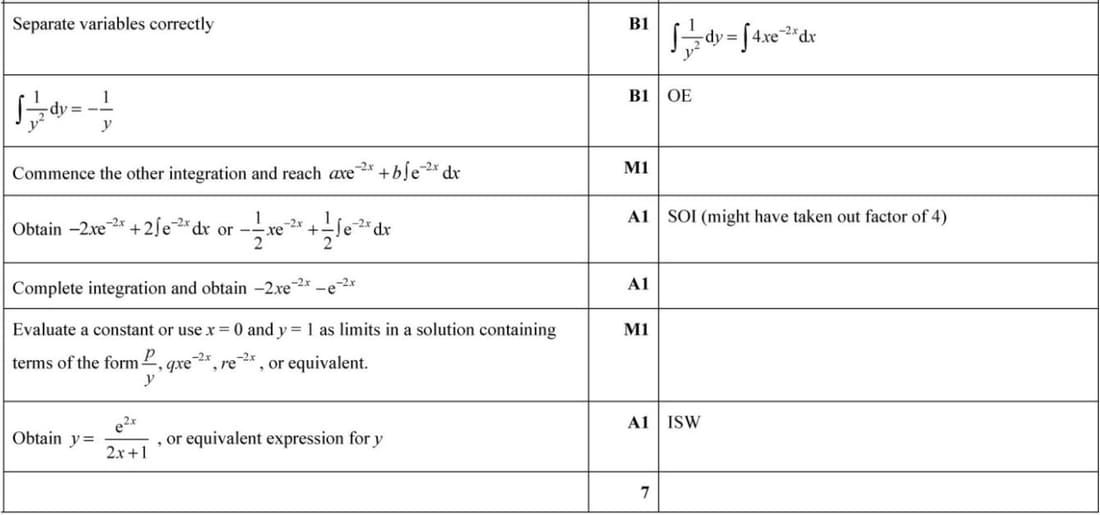
The variables x and y satisfy the differential equation
\(e^{2x} \frac{dy}{dx} = 4xy^2\),
and it is given that \(y = 1\) when \(x = 0\).
Solve the differential equation, obtaining an expression for y in terms of x.
9709 P32 - Jun 2019 - Q7
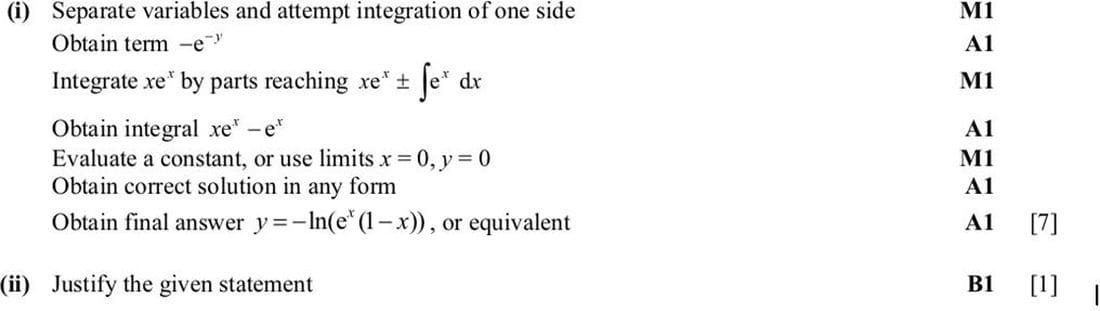
The variables x and y satisfy the differential equation \(\frac{dy}{dx} = xe^{x+y}\), and it is given that \(y = 0\) when \(x = 0\).
- Solve the differential equation and obtain an expression for y in terms of x.
- Explain briefly why x can only take values less than 1.
9709 P33 - Nov 2014 - Q8
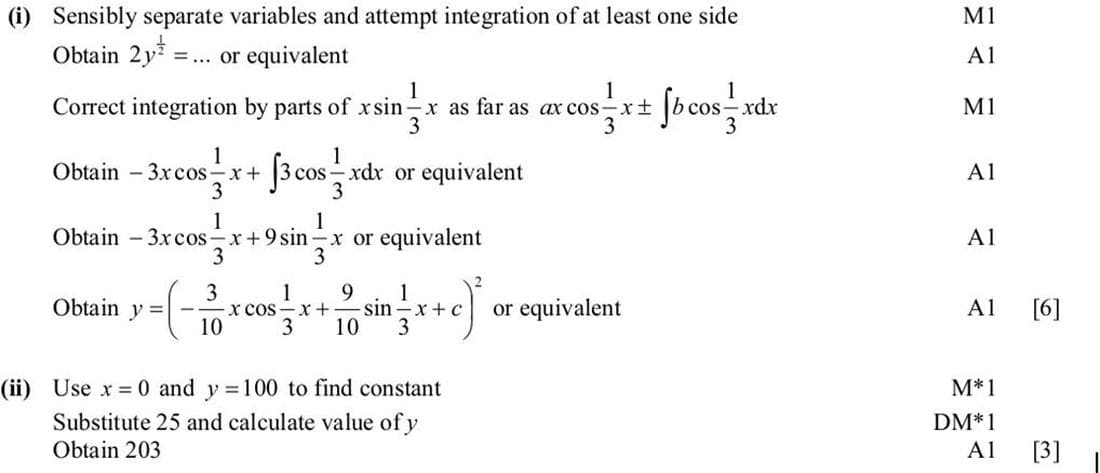
The variables \(x\) and \(y\) are related by the differential equation \[ \frac{dy}{dx} = \frac{1}{5}x y^{\frac{1}{2}} \sin\left(\frac{1}{3}x\right). \]
(i) Find the general solution, giving \(y\) in terms of \(x\).
(ii) Given that \(y = 100\) when \(x = 0\), find the value of \(y\) when \(x = 25\).
9709 P31 - Jun 2012 - Q7
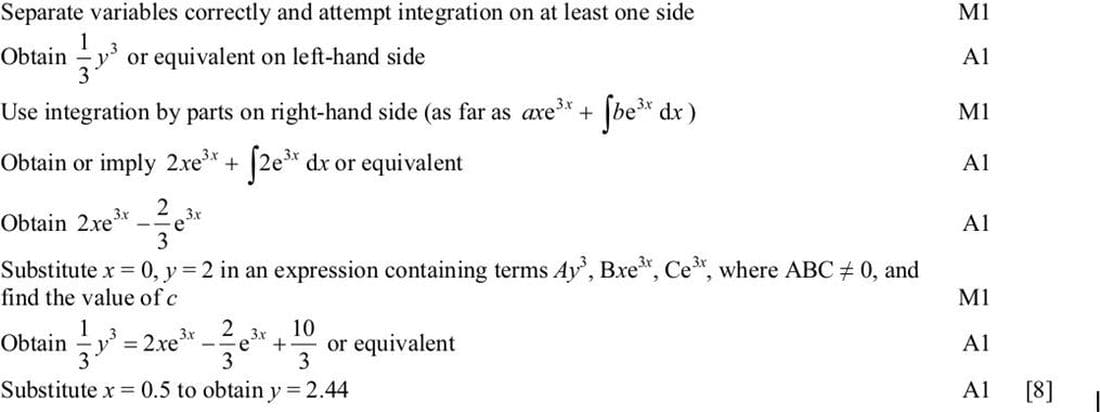
The variables x and y are related by the differential equation \(\frac{dy}{dx} = \frac{6xe^{3x}}{y^2}\).
It is given that \(y = 2\) when \(x = 0\). Solve the differential equation and hence find the value of \(y\) when \(x = 0.5\), giving your answer correct to 2 decimal places.
9709 P33 - Nov 2023 - Q8
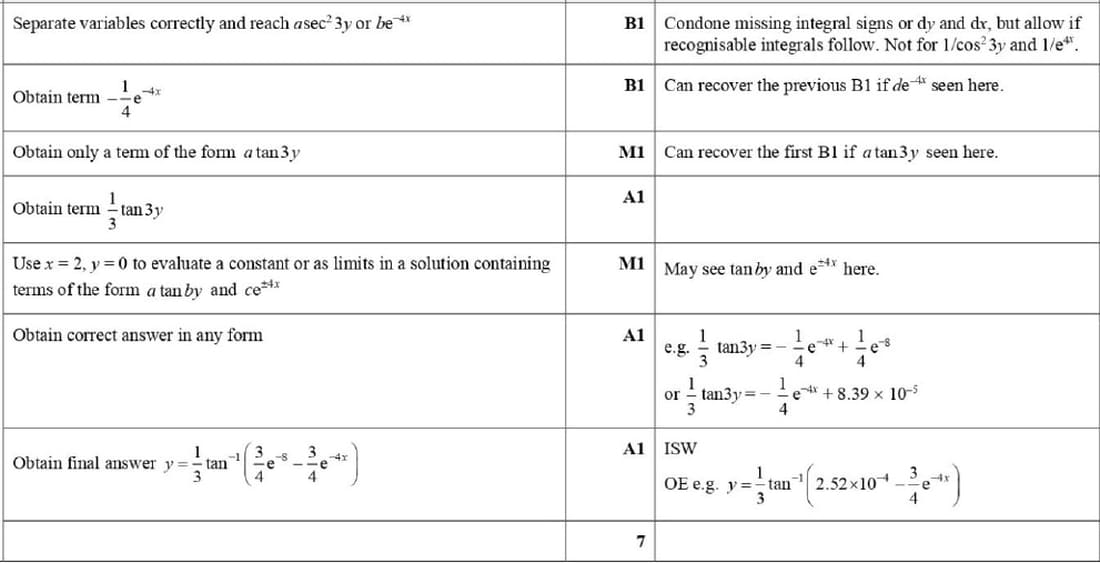
The variables x and y satisfy the differential equation
\(e^{4x} \frac{dy}{dx} = \cos^2 3y\).
It is given that \(y = 0\) when \(x = 2\).
Solve the differential equation, obtaining an expression for y in terms of x.
9709 P32 - Mar 2020 - Q6
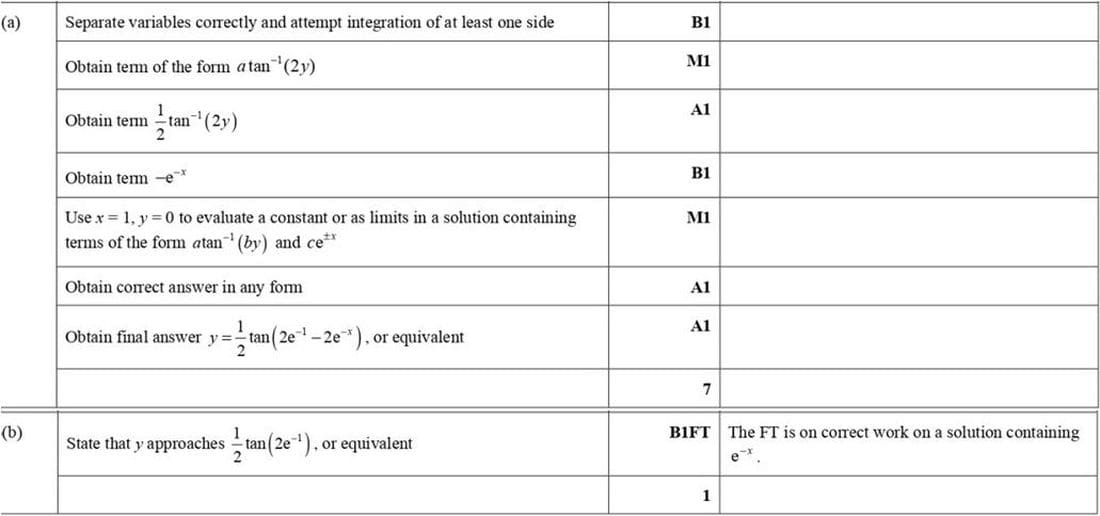
The variables x and y satisfy the differential equation \(\frac{dy}{dx} = \frac{1 + 4y^2}{e^x}\).
It is given that \(y = 0\) when \(x = 1\).
(a) Solve the differential equation, obtaining an expression for y in terms of x.
(b) State what happens to the value of y as x tends to infinity.
9709 P32 - Nov 2019 - Q6
The variables x and θ satisfy the differential equation
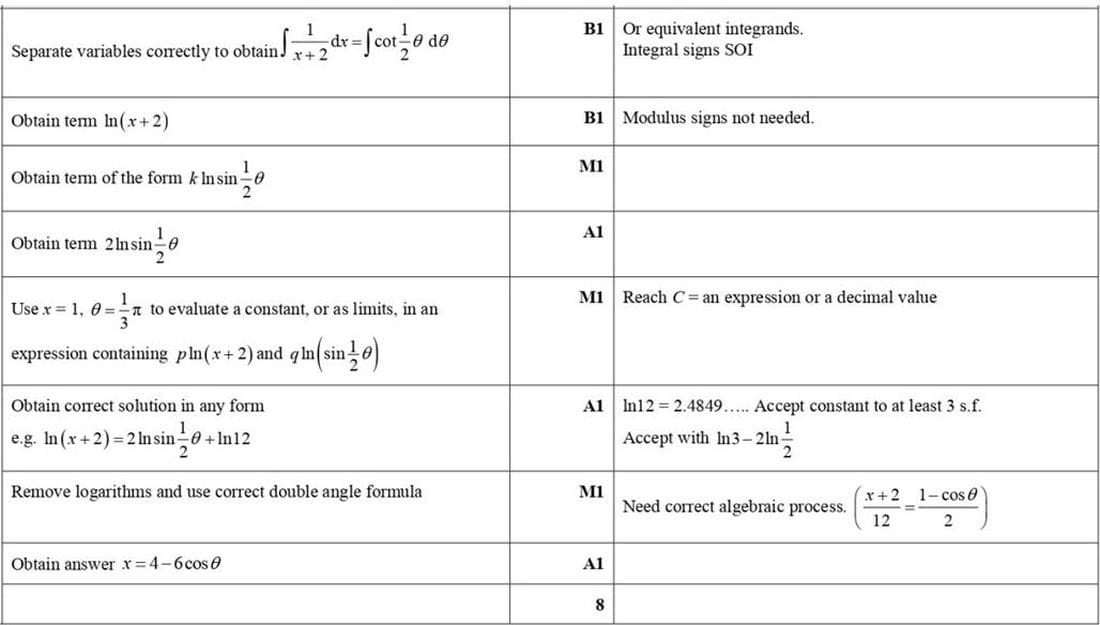
\(\sin \frac{1}{2} \theta \frac{dx}{d\theta} = (x + 2) \cos \frac{1}{2} \theta\)
for \(0 < \theta < \pi\). It is given that \(x = 1\) when \(\theta = \frac{1}{3} \pi\). Solve the differential equation and obtain an expression for \(x\) in terms of \(\cos \theta\).
9709 P31 - Jun 2019 - Q5
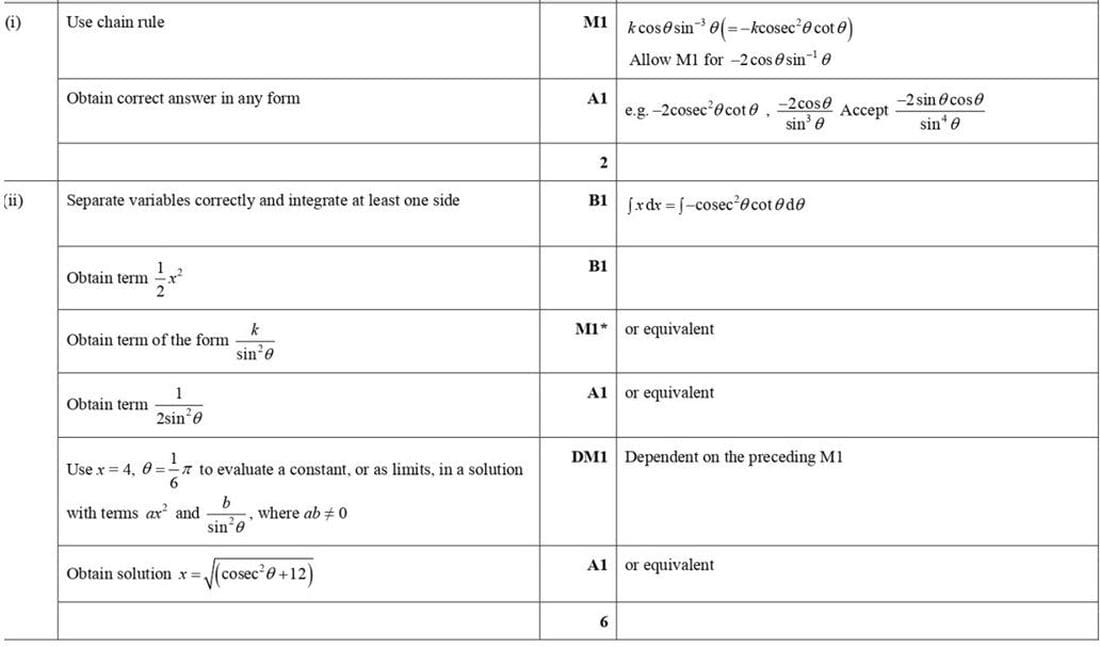
(i) Differentiate \(\frac{1}{\sin^2 \theta}\) with respect to \(\theta\).
(ii) The variables \(x\) and \(\theta\) satisfy the differential equation \(x \tan \theta \frac{dx}{d\theta} + \csc^2 \theta = 0\), for \(0 < \theta < \frac{1}{2}\pi\) and \(x > 0\). It is given that \(x = 4\) when \(\theta = \frac{1}{6}\pi\). Solve the differential equation, obtaining an expression for \(x\) in terms of \(\theta\).
9709 P32 - Mar 2019 - Q6
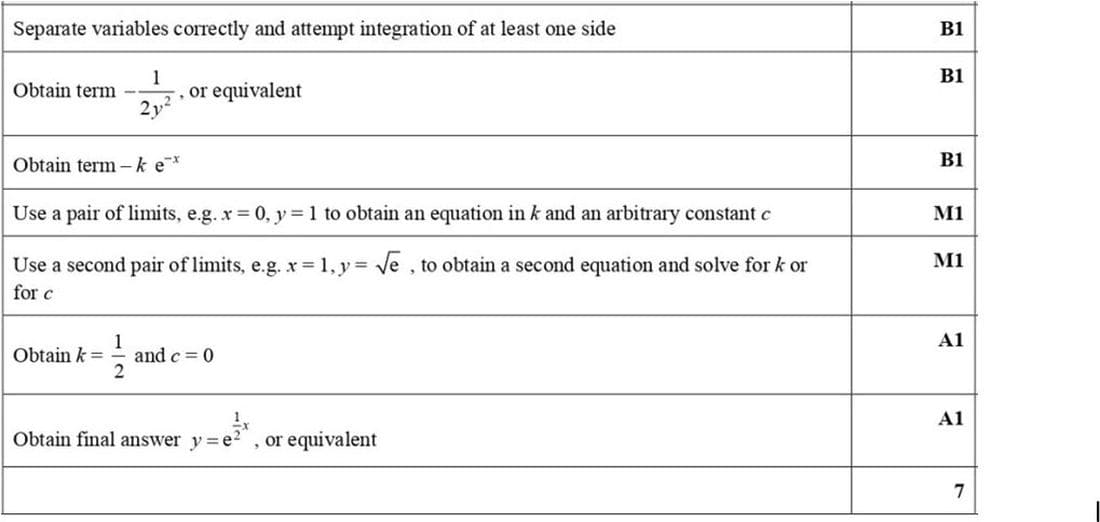
The variables x and y satisfy the differential equation \(\frac{dy}{dx} = ky^3 e^{-x}\), where \(k\) is a constant. It is given that \(y = 1\) when \(x = 0\), and that \(y = \sqrt{e}\) when \(x = 1\). Solve the differential equation, obtaining an expression for \(y\) in terms of \(x\).
9709 P32 - Mar 2018 - Q6
The variables x and θ satisfy the differential equation
\(x \cos^2 \theta \frac{dx}{d\theta} = 2 \tan \theta + 1,\)
for \(0 \leq \theta < \frac{1}{2}\pi\) and \(x > 0\). It is given that \(x = 1\) when \(\theta = \frac{1}{4}\pi\).
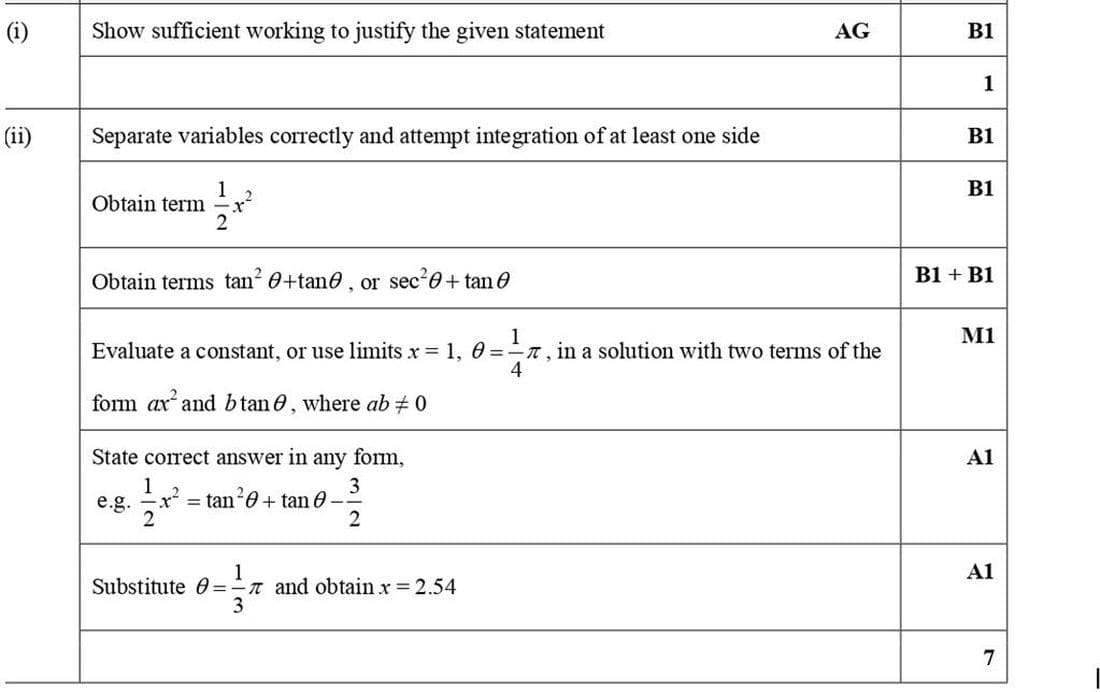
(i) Show that \(\frac{d}{d\theta}(\tan^2 \theta) = \frac{2 \tan \theta}{\cos^2 \theta}\).
(ii) Solve the differential equation and calculate the value of \(x\) when \(\theta = \frac{1}{3}\pi\), giving your answer correct to 3 significant figures.
9709 P31 - Nov 2017 - Q6
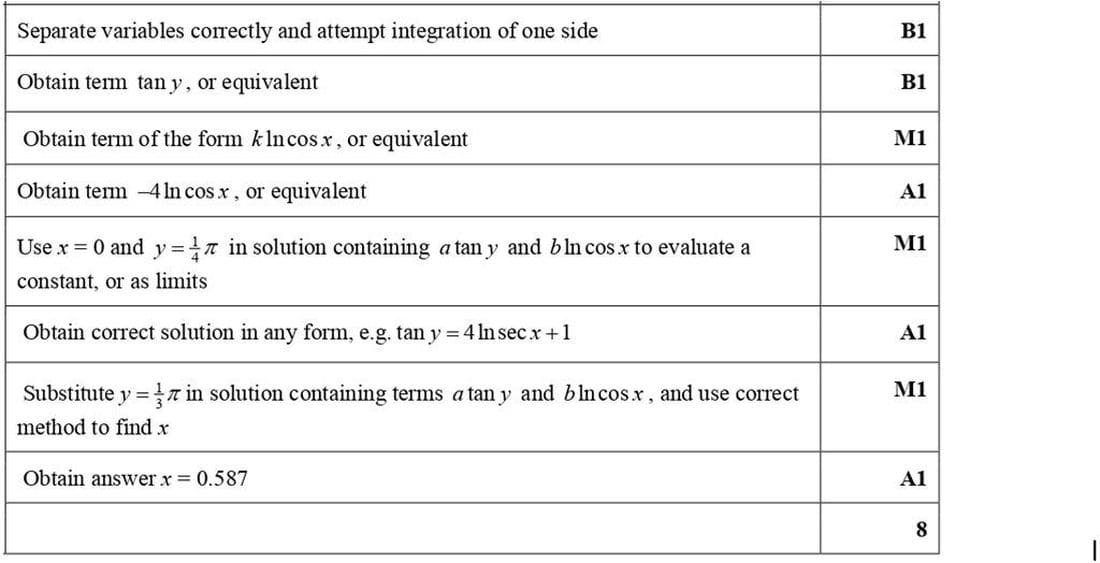
The variables x and y satisfy the differential equation \(\frac{dy}{dx} = 4 \cos^2 y \tan x\), for \(0 \leq x < \frac{1}{2}\pi\), and \(x = 0\) when \(y = \frac{1}{4}\pi\). Solve this differential equation and find the value of \(x\) when \(y = \frac{1}{3}\pi\).
9709 P33 - Jun 2016 - Q5
The variables x and y satisfy the differential equation
\(\frac{dy}{dx} = e^{-2y} \tan^2 x\),
for \(0 \leq x < \frac{1}{2}\pi\), and it is given that \(y = 0\) when \(x = 0\). Solve the differential equation and calculate the value of \(y\) when \(x = \frac{1}{4}\pi\).
9709 P32 - Jun 2016 - Q6
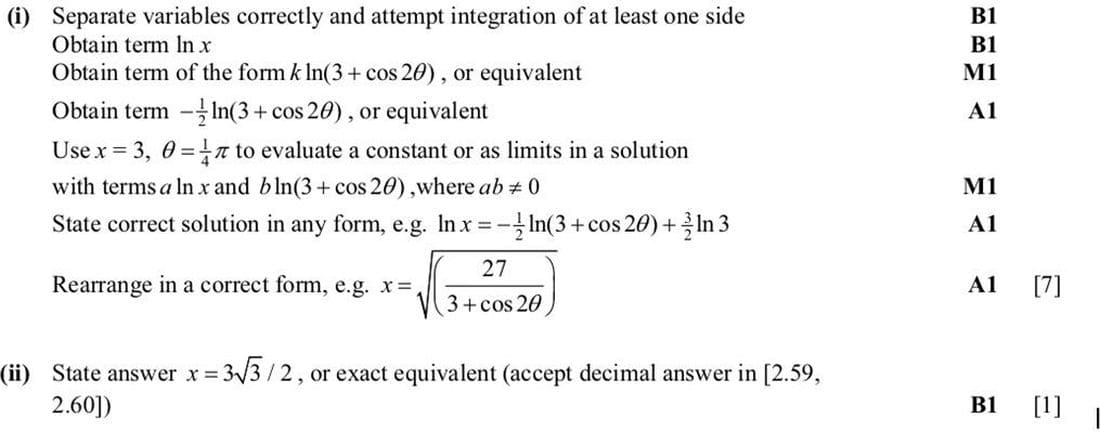
The variables x and θ satisfy the differential equation
\((3 + \\cos 2\theta) \frac{dx}{d\theta} = x \sin 2\theta,\)
and it is given that \(x = 3\) when \(\theta = \frac{1}{4}\pi.\)
(i) Solve the differential equation and obtain an expression for \(x\) in terms of \(\theta.\) [7]
(ii) State the least value taken by \(x.\) [1]
9709 P31 - Nov 2015 - Q8
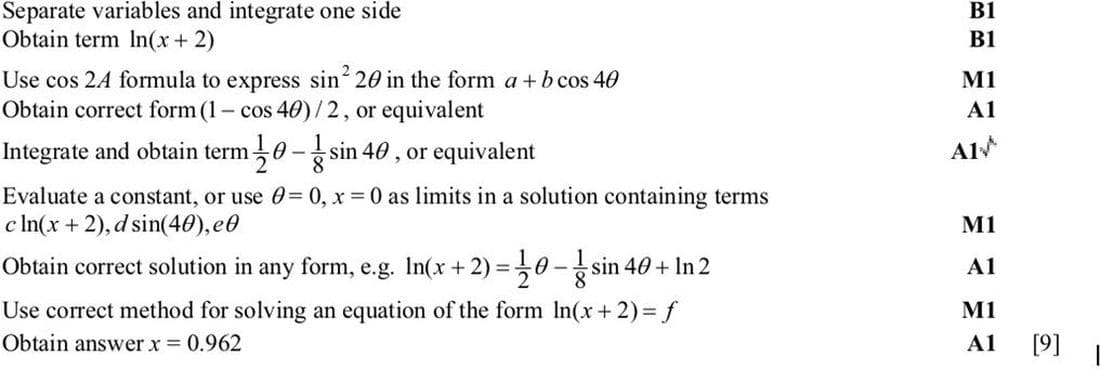
The variables x and θ satisfy the differential equation \(\frac{dx}{dθ} = (x + 2) \sin^2 2θ\), and it is given that \(x = 0\) when \(θ = 0\). Solve the differential equation and calculate the value of x when \(θ = \frac{1}{4}π\), giving your answer correct to 3 significant figures.
9709 P33 - Jun 2014 - Q5
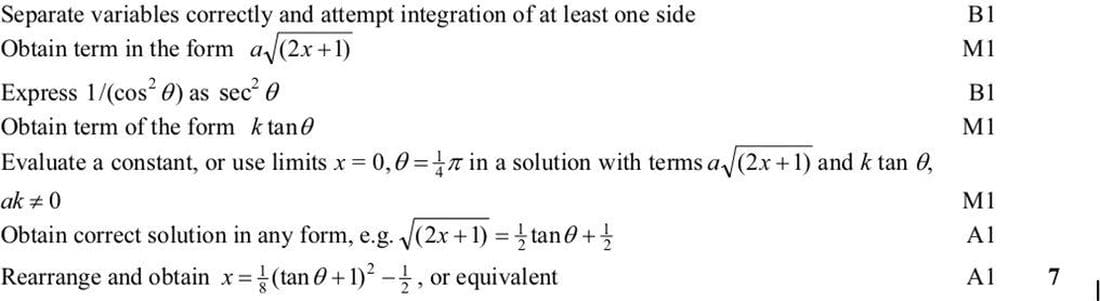
The variables x and θ satisfy the differential equation
\(2 \cos^2 \theta \frac{dx}{d\theta} = \sqrt{2x + 1}\),
and \(x = 0\) when \(\theta = \frac{1}{4}\pi\). Solve the differential equation and obtain an expression for \(x\) in terms of \(\theta\).
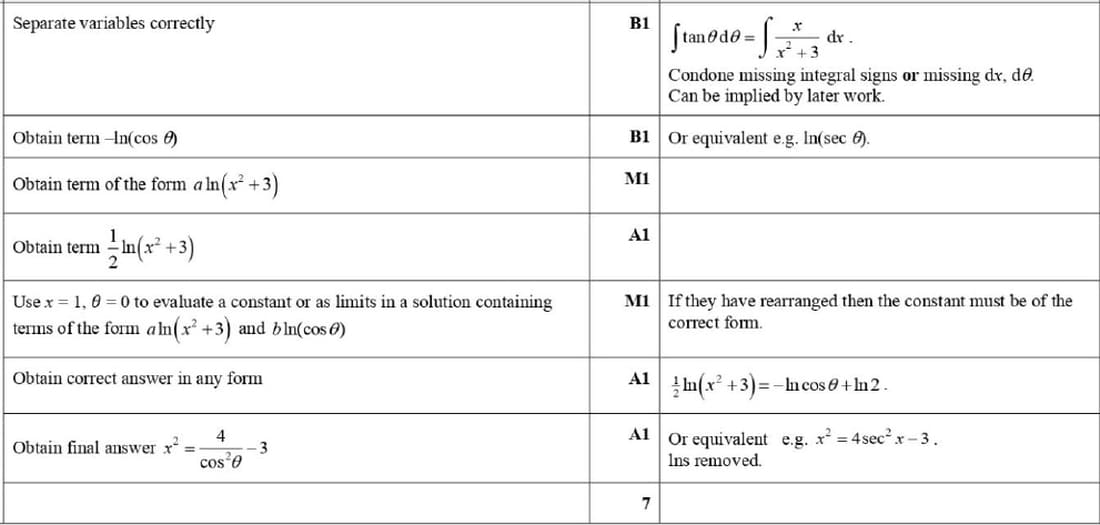
9709 P31 - Nov 2023 - Q7
The variables x and θ satisfy the differential equation
\(\frac{x}{\tan \theta} \frac{\mathrm{d}x}{\mathrm{d}\theta} = x^2 + 3.\)
It is given that \(x = 1\) when \(\theta = 0\).
Solve the differential equation, obtaining an expression for \(x^2\) in terms of \(\theta\).
9709 P31 - Jun 2014 - Q4
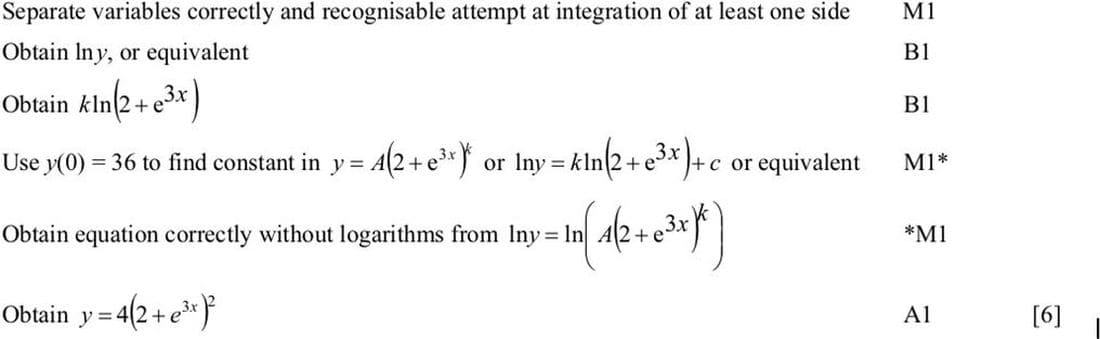
The variables x and y are related by the differential equation
\(\frac{dy}{dx} = \frac{6ye^{3x}}{2 + e^{3x}}\).
Given that \(y = 36\) when \(x = 0\), find an expression for \(y\) in terms of \(x\).
9709 P32 - Jun 2012 - Q5
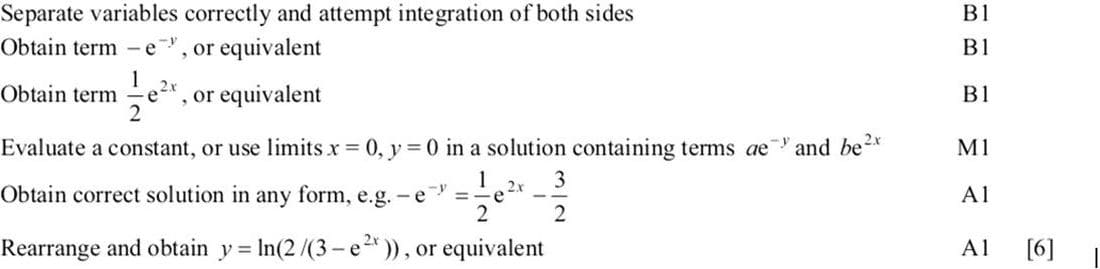
The variables x and y satisfy the differential equation
\(\frac{dy}{dx} = e^{2x+y}\),
and \(y = 0\) when \(x = 0\). Solve the differential equation, obtaining an expression for y in terms of x.
9709 P31 - Nov 2011 - Q4
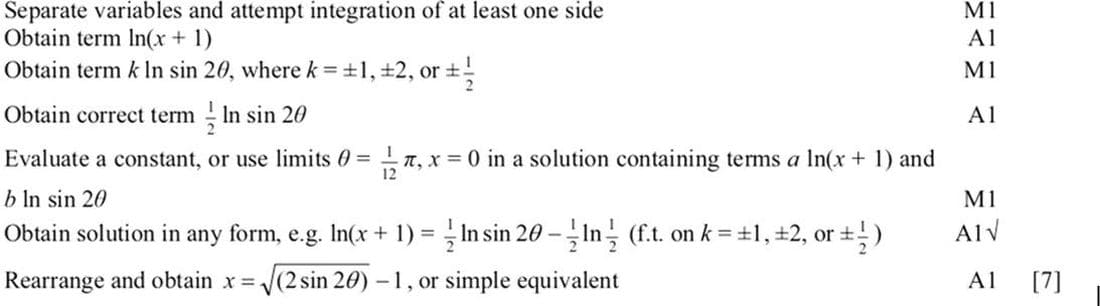
The variables x and θ are related by the differential equation
\(\sin 2θ \frac{dx}{dθ} = (x + 1) \cos 2θ\),
where \(0 < θ < \frac{1}{2}π\). When \(θ = \frac{1}{12}π\), \(x = 0\). Solve the differential equation, obtaining an expression for \(x\) in terms of \(θ\), and simplifying your answer as far as possible.
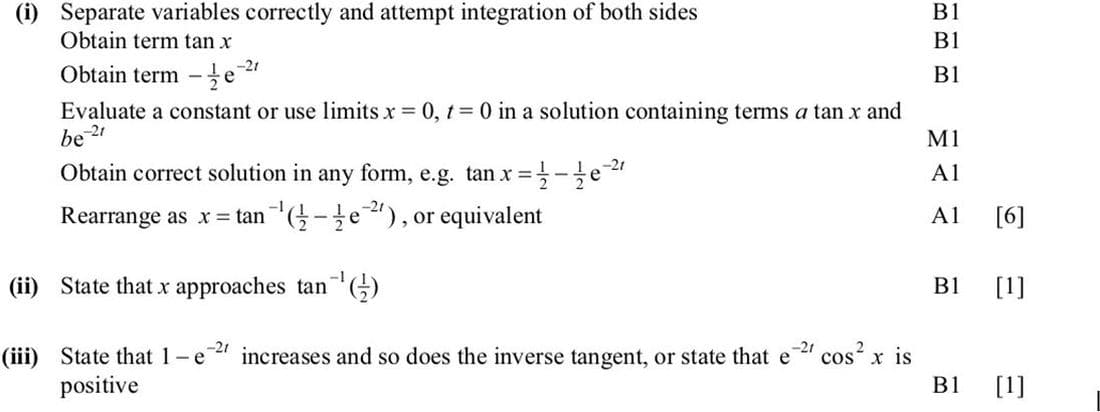
9709 P32 - Jun 2010 - Q7
The variables x and t are related by the differential equation
\(e^{2t} \frac{dx}{dt} = \cos^2 x\),
where \(t \geq 0\). When \(t = 0\), \(x = 0\).
(i) Solve the differential equation, obtaining an expression for \(x\) in terms of \(t\). [6]
(ii) State what happens to the value of \(x\) when \(t\) becomes very large. [1]
(iii) Explain why \(x\) increases as \(t\) increases. [1]
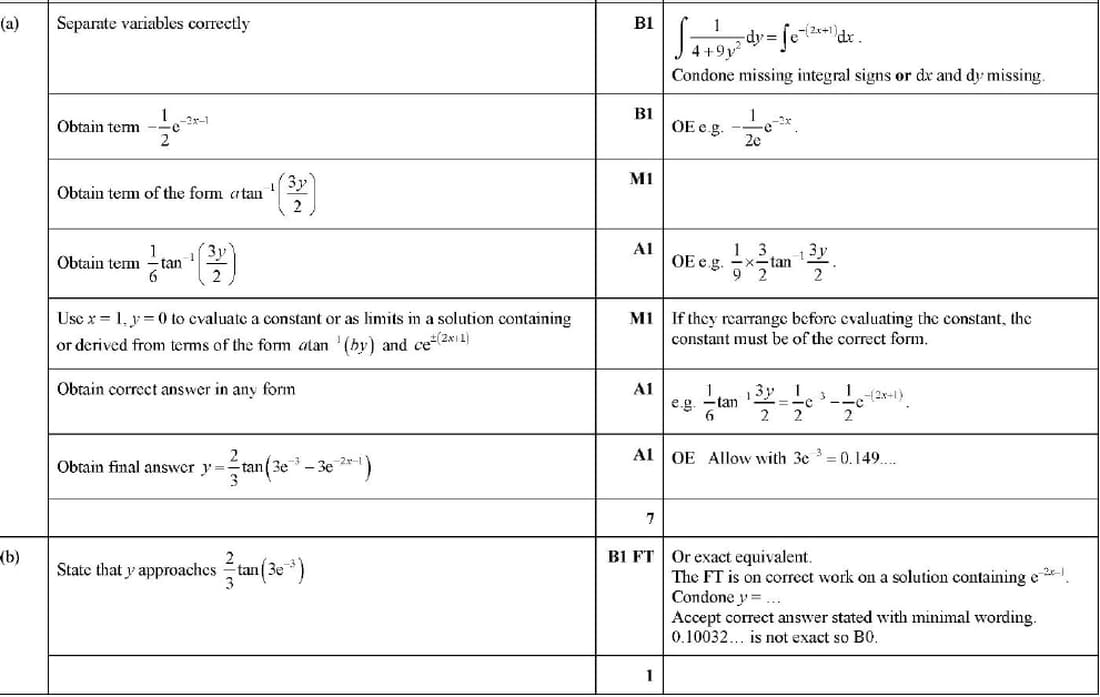
9709 P32 - Jun 2023 - Q8
(a) The variables x and y satisfy the differential equation \(\frac{dy}{dx} = \frac{4 + 9y^2}{e^{2x+1}}\).
It is given that \(y = 0\) when \(x = 1\).
Solve the differential equation, obtaining an expression for y in terms of x.
(b) State what happens to the value of y as x tends to infinity. Give your answer in an exact form.
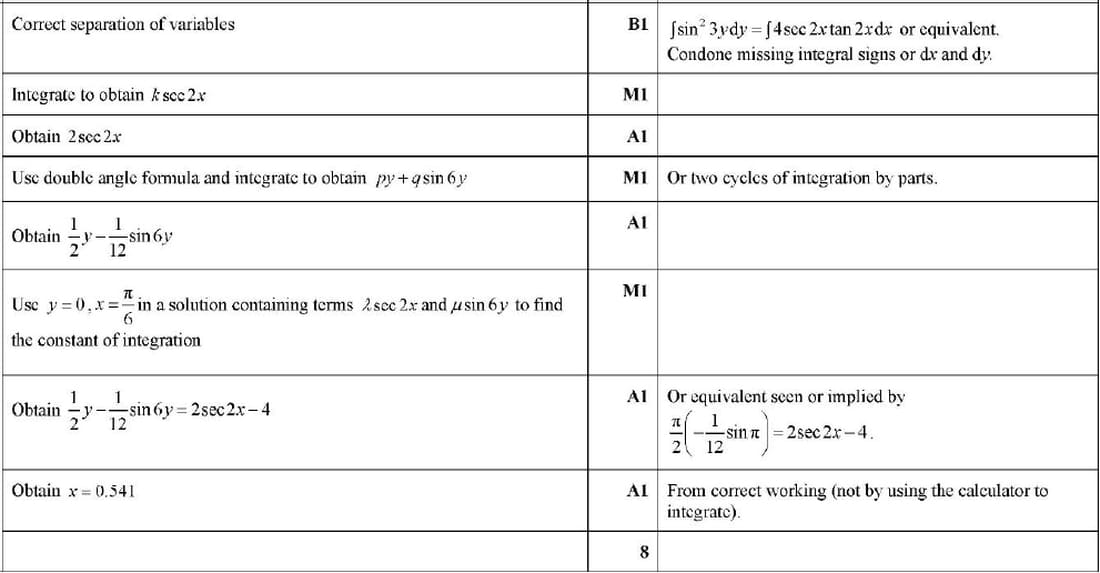
9709 P31 - Jun 2023 - Q7
The variables x and y satisfy the differential equation
\(\cos 2x \frac{dy}{dx} = \frac{4 \tan 2x}{\sin^2 3y}\),
where \(0 \leq x < \frac{1}{4}\pi\). It is given that \(y = 0\) when \(x = \frac{1}{6}\pi\).
Solve the differential equation to obtain the value of x when \(y = \frac{1}{6}\pi\). Give your answer correct to 3 decimal places.
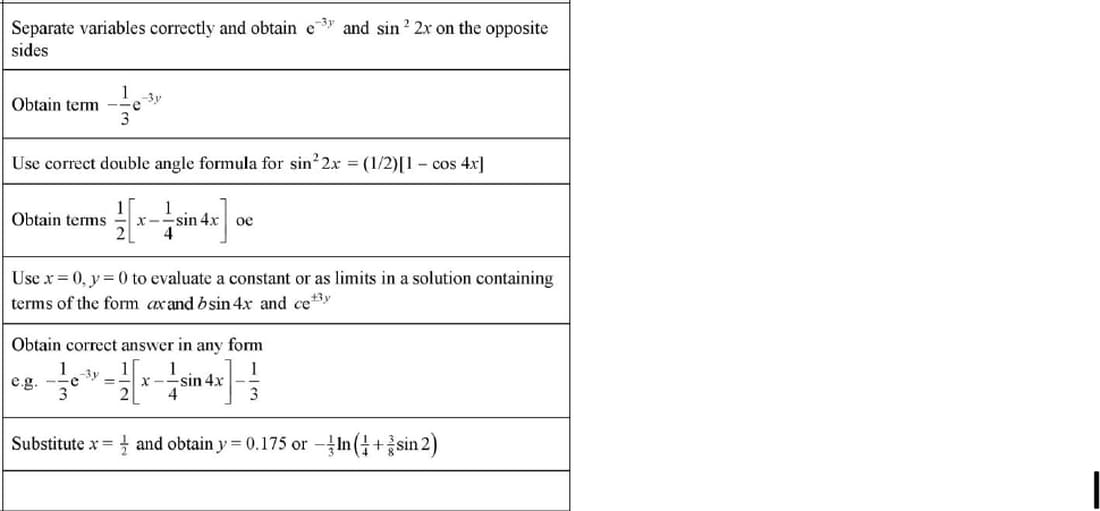
9709 P32 - Mar 2023 - Q9
The variables x and y satisfy the differential equation
\(\frac{dy}{dx} = e^{3y} \sin^2 2x\).
It is given that \(y = 0\) when \(x = 0\).
Solve the differential equation and find the value of \(y\) when \(x = \frac{1}{2}\).
9709 P32 - Nov 2022 - Q7
The variables x and θ satisfy the differential equation
\(x \sin^2 \theta \frac{dx}{d\theta} = \tan^2 \theta - 2 \cot \theta,\)
for \(0 < \theta < \frac{1}{2}\pi\) and \(x > 0\). It is given that \(x = 2\) when \(\theta = \frac{1}{4}\pi\).
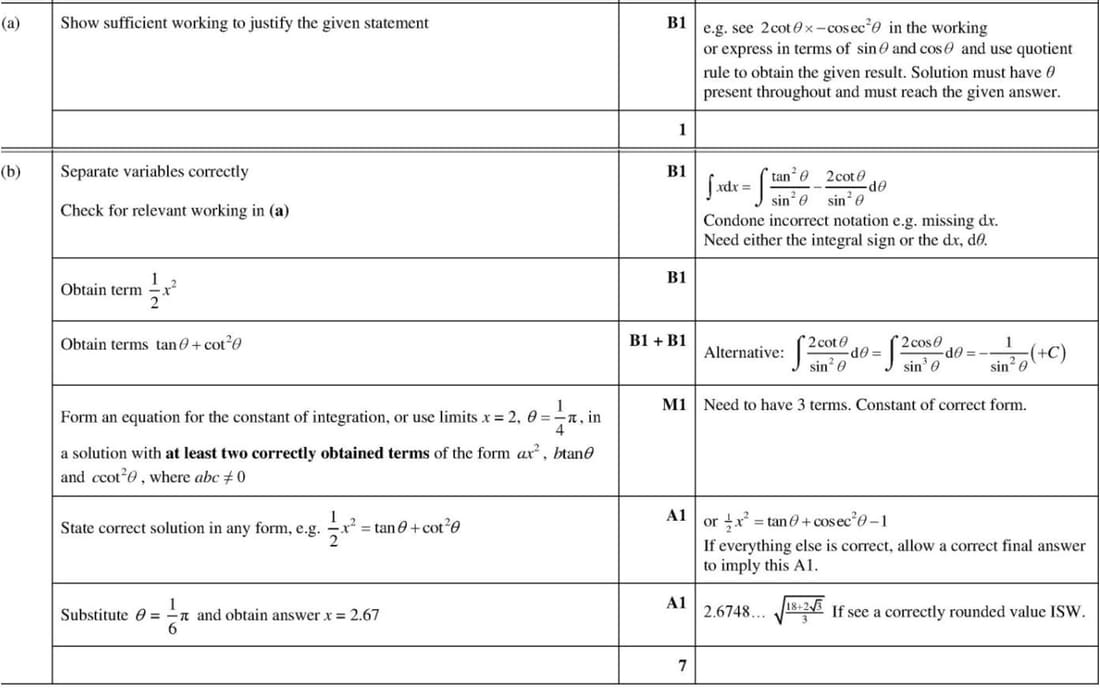
(a) Show that \(\frac{d}{d\theta}(\cot^2 \theta) = -\frac{2 \cot \theta}{\sin^2 \theta}\).
(You may assume without proof that the derivative of \(\cot \theta\) with respect to \(\theta\) is \(-\csc^2 \theta\).) [1]
(b) Solve the differential equation and find the value of \(x\) when \(\theta = \frac{1}{6}\pi\). [7]
9709 P31 - Nov 2021 - Q7
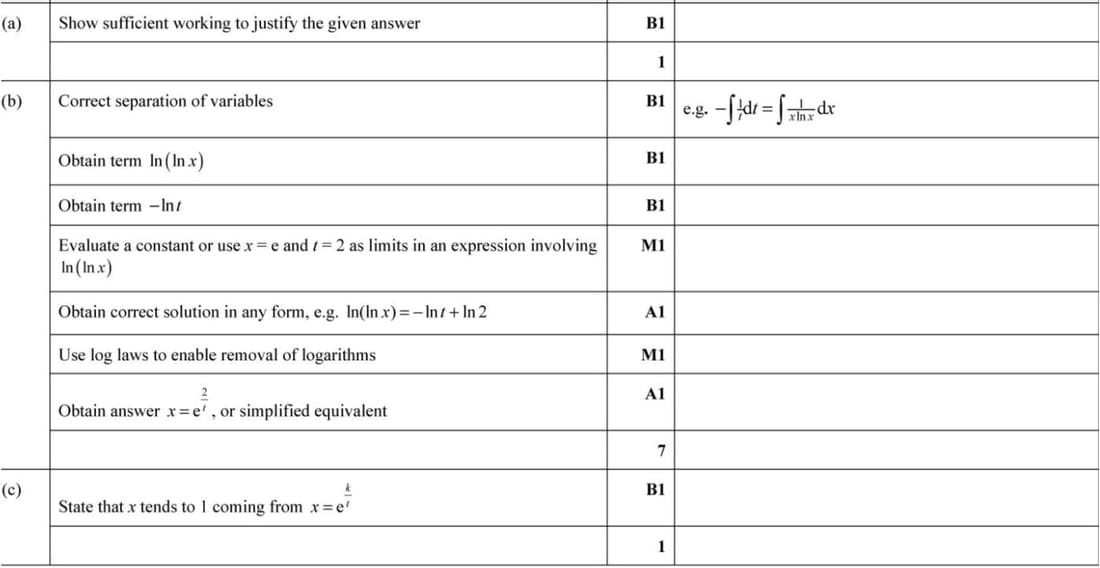
(a) Given that \(y = \ln(\ln x)\), show that \(\frac{dy}{dx} = \frac{1}{x \ln x}\).
The variables \(x\) and \(t\) satisfy the differential equation \(x \ln x + t \frac{dx}{dt} = 0\).
It is given that \(x = e\) when \(t = 2\).
(b) Solve the differential equation obtaining an expression for \(x\) in terms of \(t\), simplifying your answer.
(c) Hence state what happens to the value of \(x\) as \(t\) tends to infinity.
9709 P32 - Mar 2021 - Q4
The variables x and y satisfy the differential equation
\((1 - \\cos x) \frac{dy}{dx} = y \sin x.\)
It is given that \(y = 4\) when \(x = \pi.\)
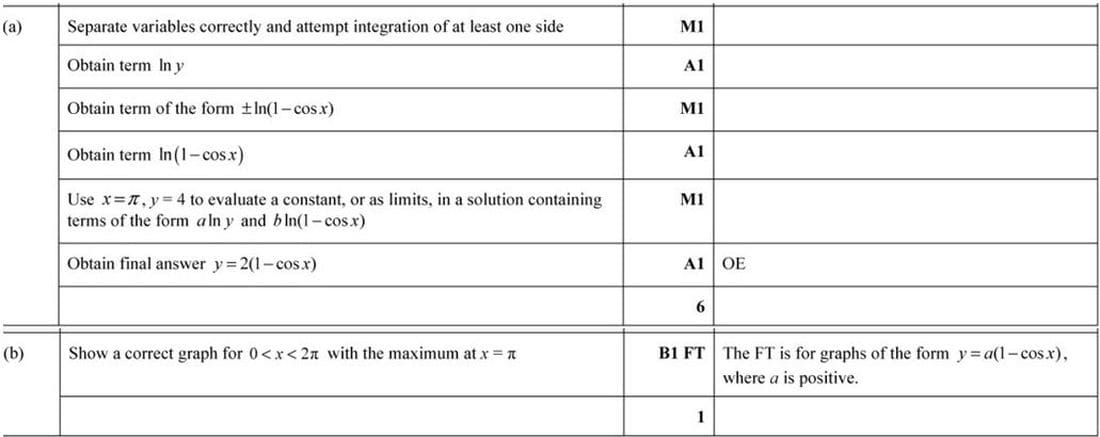
(a) Solve the differential equation, obtaining an expression for \(y\) in terms of \(x.\) [6]
(b) Sketch the graph of \(y\) against \(x\) for \(0 < x < 2\pi.\) [1]
9709 P32 - Nov 2020 - Q7
The variables x and t satisfy the differential equation
\(e^{3t} \frac{dx}{dt} = \cos^2 2x\),
for \(t \geq 0\). It is given that \(x = 0\) when \(t = 0\).
(a) Solve the differential equation and obtain an expression for \(x\) in terms of \(t\). [7]
(b) State what happens to the value of \(x\) when \(t\) tends to infinity. [1]