9709 P31 - Jun 2023 - Q2
Find the coefficient of \(x^3\) in the binomial expansion of \((3 + x)\sqrt{1 + 4x}\).

Problem #2017
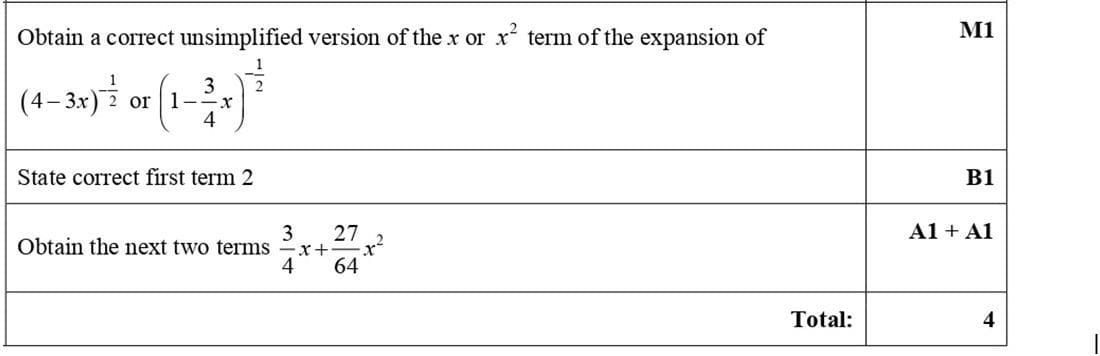
Expand \((1 - 4x)^{\frac{1}{4}}\) in ascending powers of \(x\), up to and including the term in \(x^3\), simplifying the coefficients.

9709 P22 - Jun 2017 - Q2
Expand \((3 + 2x)^{-3}\) in ascending powers of \(x\) up to and including the term in \(x^2\), simplifying the coefficients.

9709 P31 - Jun 2017 - Q2
Expand \(\frac{1}{\sqrt[3]{1 + 6x}}\) in ascending powers of \(x\), up to and including the term in \(x^3\), simplifying the coefficients.

9709 P31 - Nov 2016 - Q2
Expand \((2-x)(1+2x)^{-\frac{3}{2}}\) in ascending powers of \(x\), up to and including the term in \(x^2\), simplifying the coefficients.

9709 P32 - Jun 2016 - Q2
Expand \(\frac{1}{\sqrt{1-2x}}\) in ascending powers of \(x\), up to and including the term in \(x^3\), simplifying the coefficients.

9709 P23 - Nov 2015 - Q2
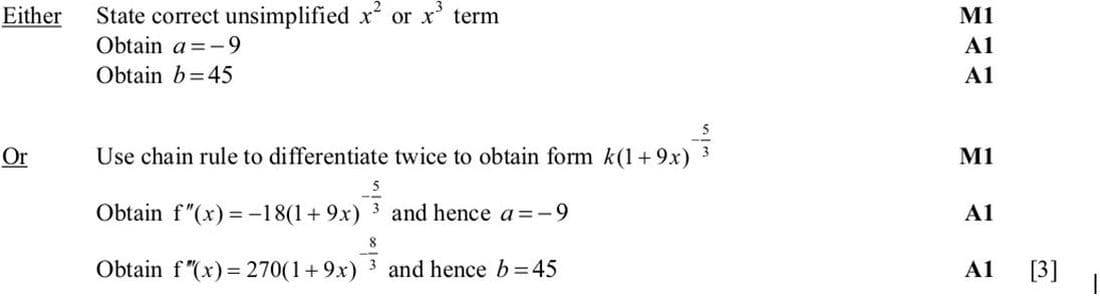
Given that \(\sqrt[3]{(1 + 9x)} \approx 1 + 3x + ax^2 + bx^3\) for small values of \(x\), find the values of the coefficients \(a\) and \(b\).
9709 P31 - Jun 2015 - Q3
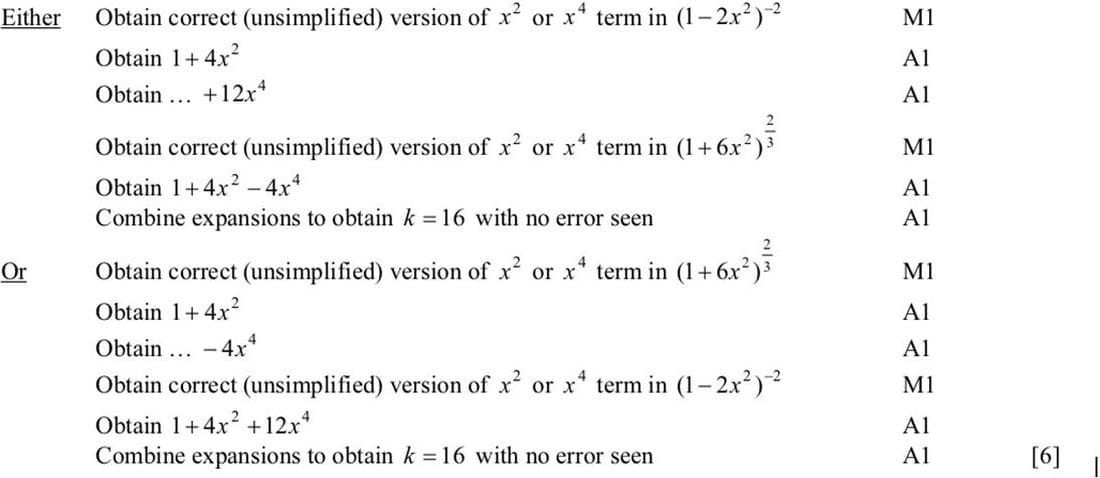
Show that, for small values of \(x^2\),
\((1 - 2x^2)^{-2} - (1 + 6x^2)^{\frac{2}{3}} \approx kx^4\),
where the value of the constant \(k\) is to be determined.
9709 P23 - Jun 2014 - Q2
Expand \((1 + 3x)^{-\frac{1}{3}}\) in ascending powers of \(x\), up to and including the term in \(x^3\), simplifying the coefficients.

9709 P31 - Jun 2013 - Q2
Expand \(\frac{1 + 3x}{\sqrt{1 + 2x}}\) in ascending powers of \(x\) up to and including the term in \(x^2\), simplifying the coefficients.

9709 P31 - Nov 2012 - Q4
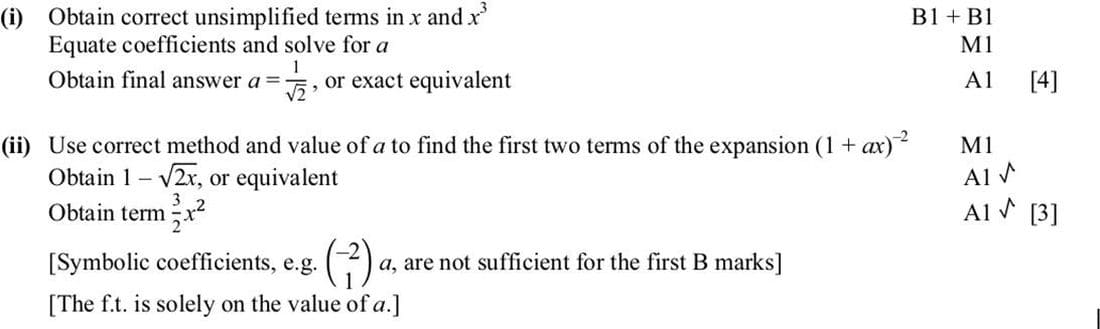
When \((1 + ax)^{-2}\), where \(a\) is a positive constant, is expanded in ascending powers of \(x\), the coefficients of \(x\) and \(x^3\) are equal.
(i) Find the exact value of \(a\). [4]
(ii) When \(a\) has this value, obtain the expansion up to and including the term in \(x^2\), simplifying the coefficients. [3]
9709 P33 - Nov 2022 - Q2
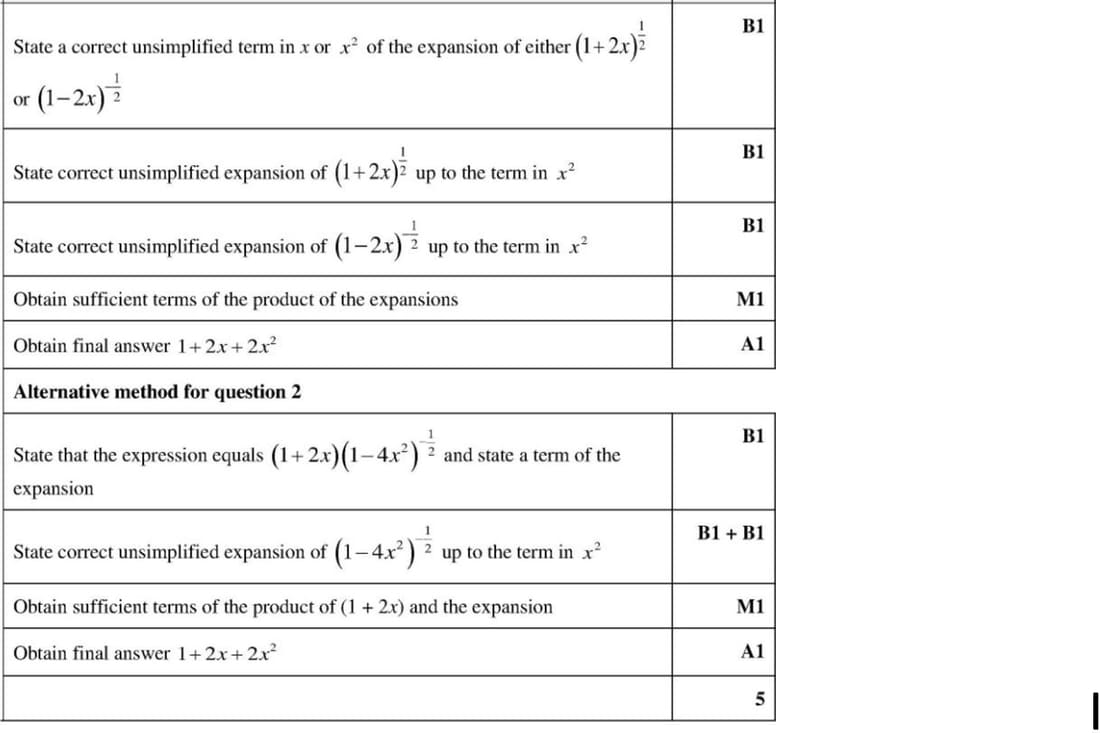
Expand \(\sqrt{\frac{1+2x}{1-2x}}\) in ascending powers of \(x\), up to and including the term in \(x^2\), simplifying the coefficients.
9709 P33 - Jun 2012 - Q1
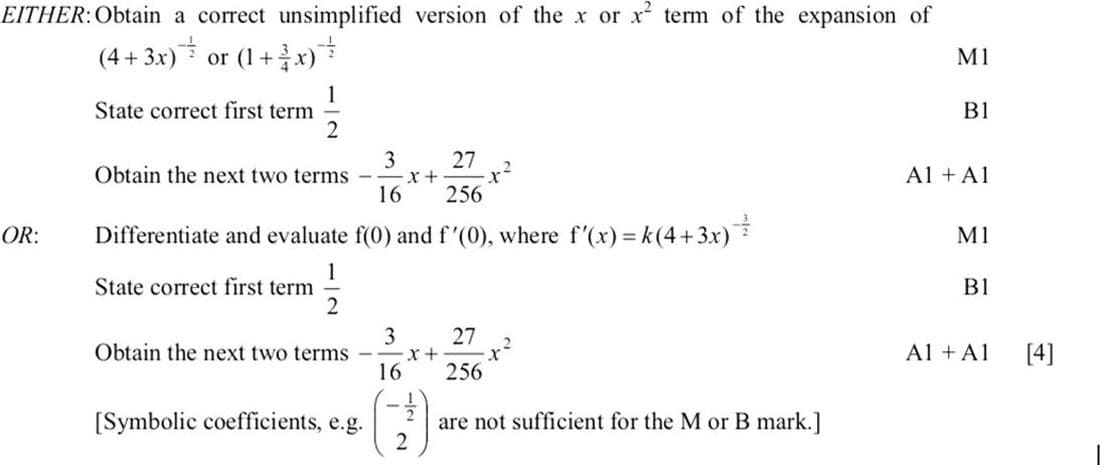
Expand \(\frac{1}{\sqrt{4 + 3x}}\) in ascending powers of \(x\), up to and including the term in \(x^2\), simplifying the coefficients.
9709 P32 - Jun 2012 - Q3
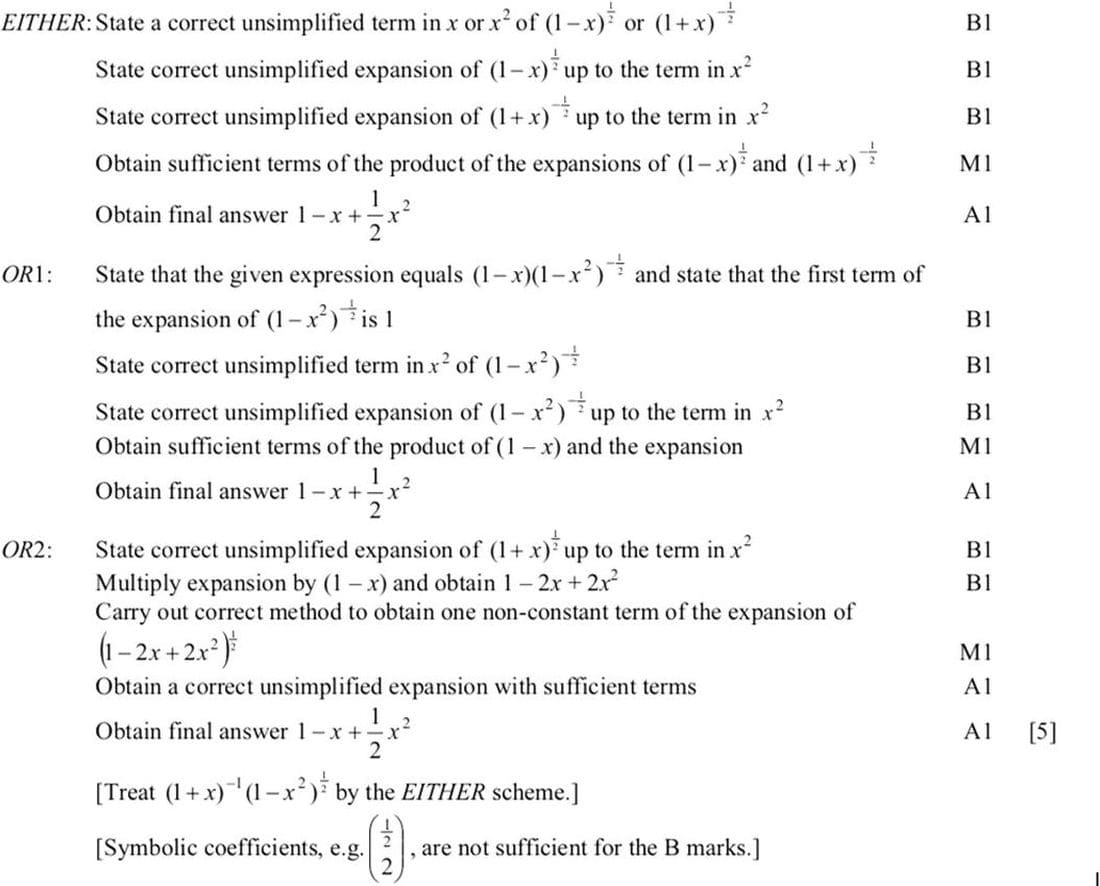
Expand \(\sqrt{\left( \frac{1-x}{1+x} \right)}\) in ascending powers of \(x\), up to and including the term in \(x^2\), simplifying the coefficients.
9709 P31 - Jun 2012 - Q2
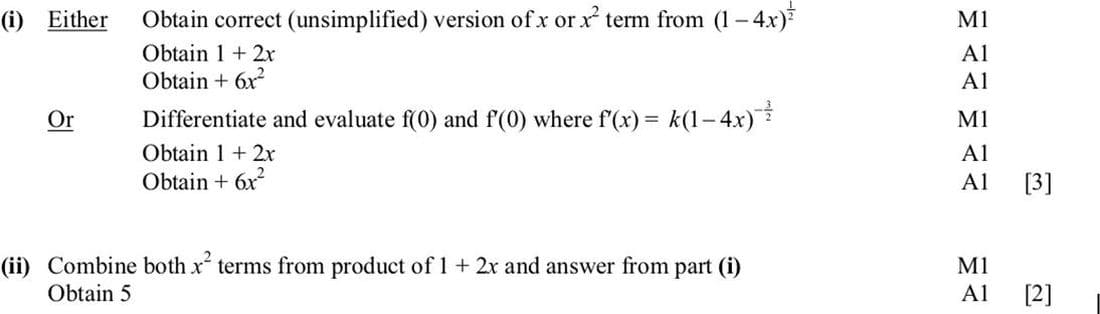
(i) Expand \(\frac{1}{\sqrt{1-4x}}\) in ascending powers of \(x\), up to and including the term in \(x^2\), simplifying the coefficients.
(ii) Hence find the coefficient of \(x^2\) in the expansion of \(\frac{1+2x}{\sqrt{4-16x}}\).
9709 P33 - Nov 2011 - Q1
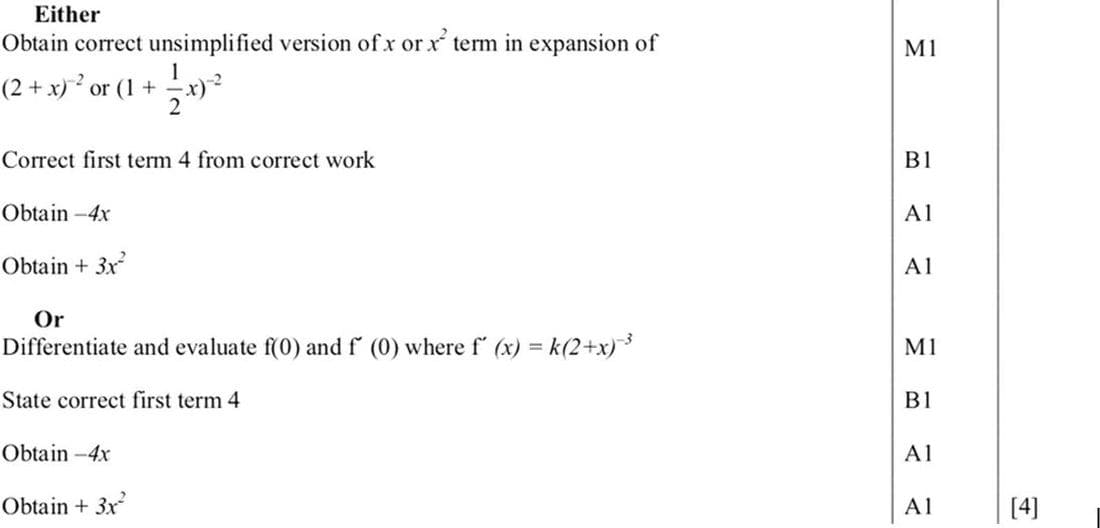
Expand \(\frac{16}{(2+x)^2}\) in ascending powers of \(x\), up to and including the term in \(x^2\), simplifying the coefficients.
9709 P21 - Jun 2011 - Q1
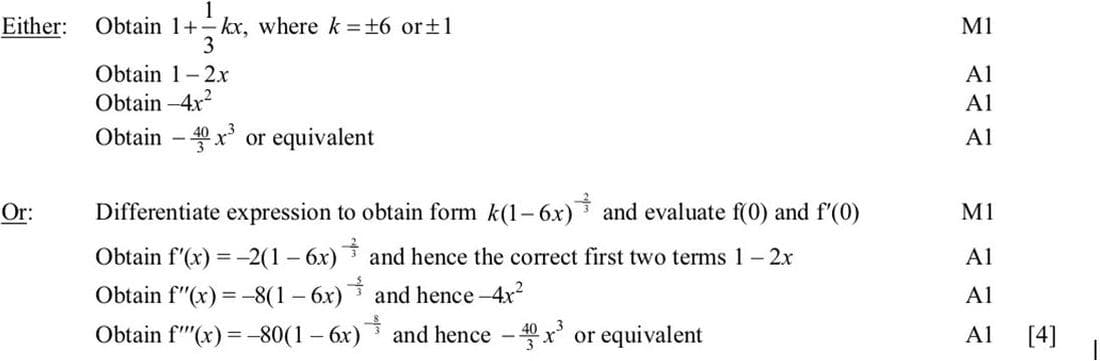
Expand \(\sqrt[3]{1 - 6x}\) in ascending powers of \(x\) up to and including the term in \(x^3\), simplifying the coefficients.
9709 P23 - Nov 2010 - Q1
Expand \((1 + 2x)^{-3}\) in ascending powers of \(x\), up to and including the term in \(x^2\), simplifying the coefficients.

9709 P3 - Jun 2009 - Q5
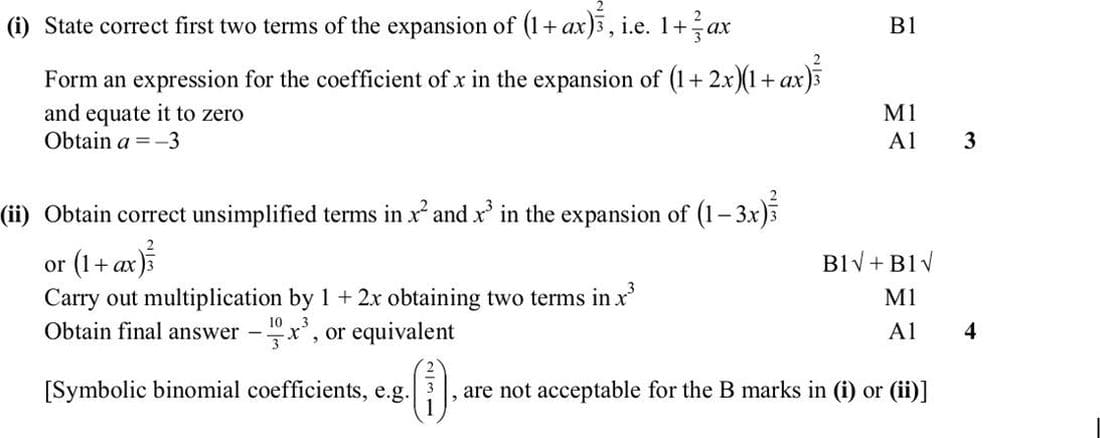
When \((1 + 2x)(1 + ax)^{\frac{2}{3}}\), where \(a\) is a constant, is expanded in ascending powers of \(x\), the coefficient of the term in \(x\) is zero.
(i) Find the value of \(a\).
(ii) When \(a\) has this value, find the term in \(x^3\) in the expansion of \((1 + 2x)(1 + ax)^{\frac{2}{3}}\), simplifying the coefficient.
9709 P3 - Nov 2008 - Q2
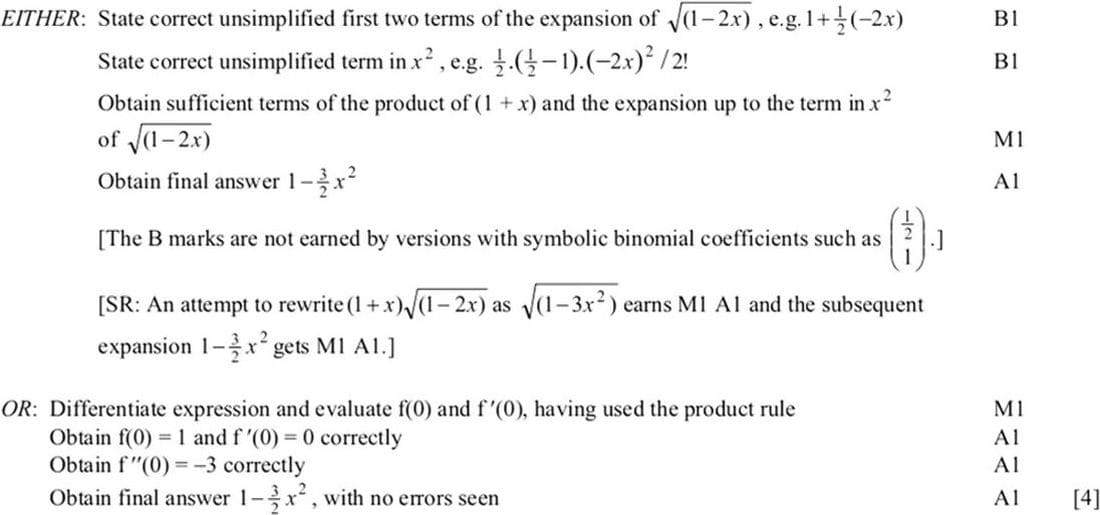
Expand \((1 + x) \sqrt{(1 - 2x)}\) in ascending powers of \(x\), up to and including the term in \(x^2\), simplifying the coefficients.
9709 P3 - Jun 2007 - Q1
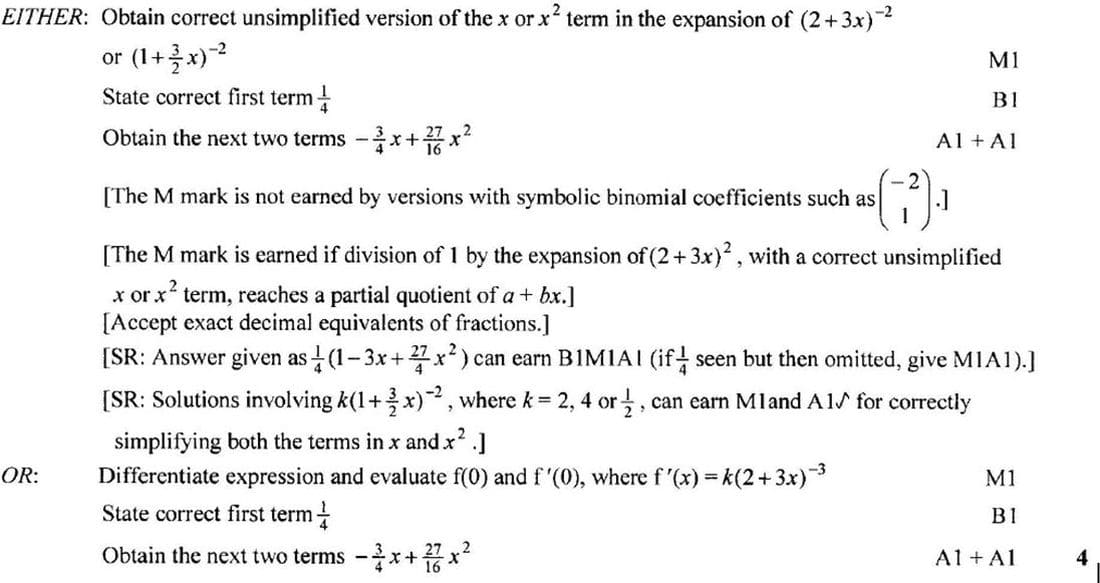
Expand \((2 + 3x)^{-2}\) in ascending powers of \(x\), up to and including the term in \(x^2\), simplifying the coefficients.
9709 P3 - Nov 2006 - Q5
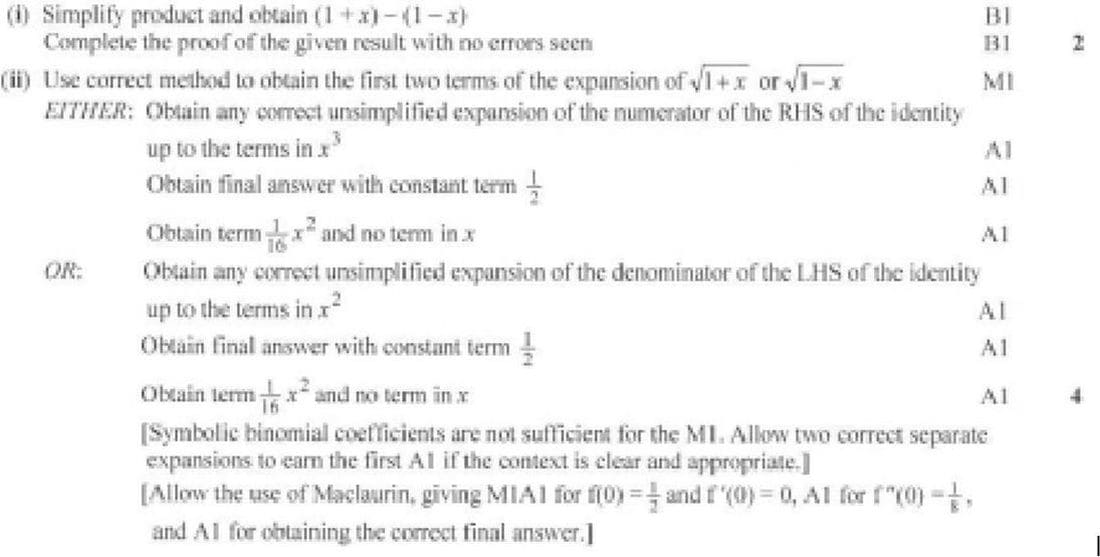
(i) Simplify \((\sqrt{1+x} + \sqrt{1-x})(\sqrt{1+x} - \sqrt{1-x})\), showing your working, and deduce that
\(\frac{1}{\sqrt{1+x} + \sqrt{1-x}} = \frac{\sqrt{1+x} - \sqrt{1-x}}{2x}.\)
(ii) Using this result, or otherwise, obtain the expansion of
\(\frac{1}{\sqrt{1+x} + \sqrt{1-x}}\)
in ascending powers of \(x\), up to and including the term in \(x^2\).
9709 P31 - Jun 2022 - Q2
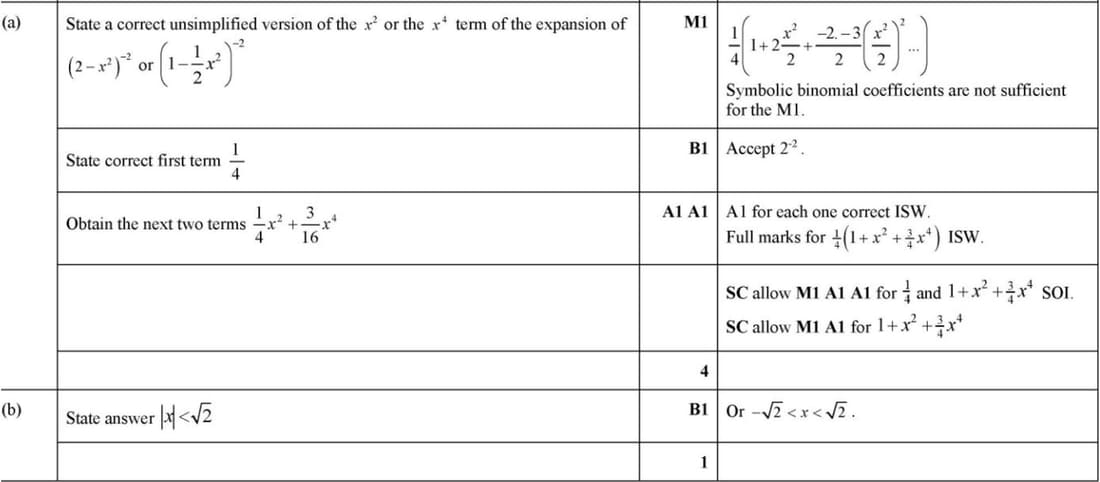
(a) Expand \((2 - x^2)^{-2}\) in ascending powers of \(x\), up to and including the term in \(x^4\), simplifying the coefficients.
(b) State the set of values of \(x\) for which the expansion is valid.
9709 P3 - Jun 2005 - Q1
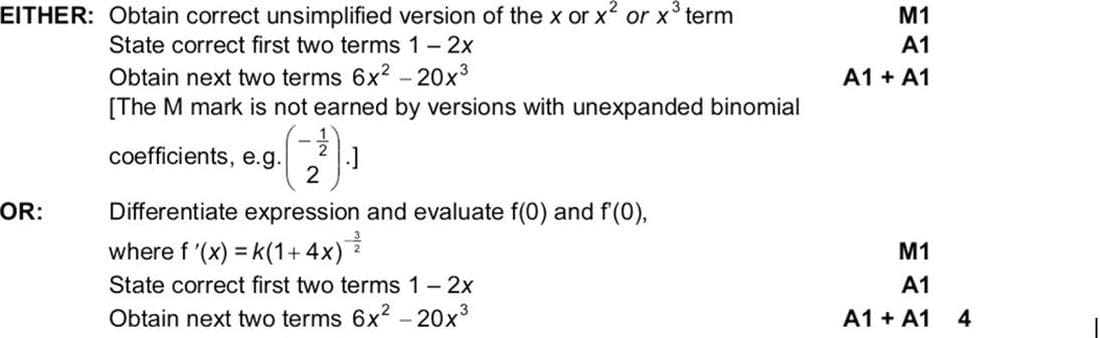
Expand \((1 + 4x)^{-\frac{1}{2}}\) in ascending powers of \(x\), up to and including the term in \(x^3\), simplifying the coefficients.
9709 P3 - Nov 2004 - Q1
Expand \(\frac{1}{(2+x)^3}\) in ascending powers of \(x\), up to and including the term in \(x^2\), simplifying the coefficients.
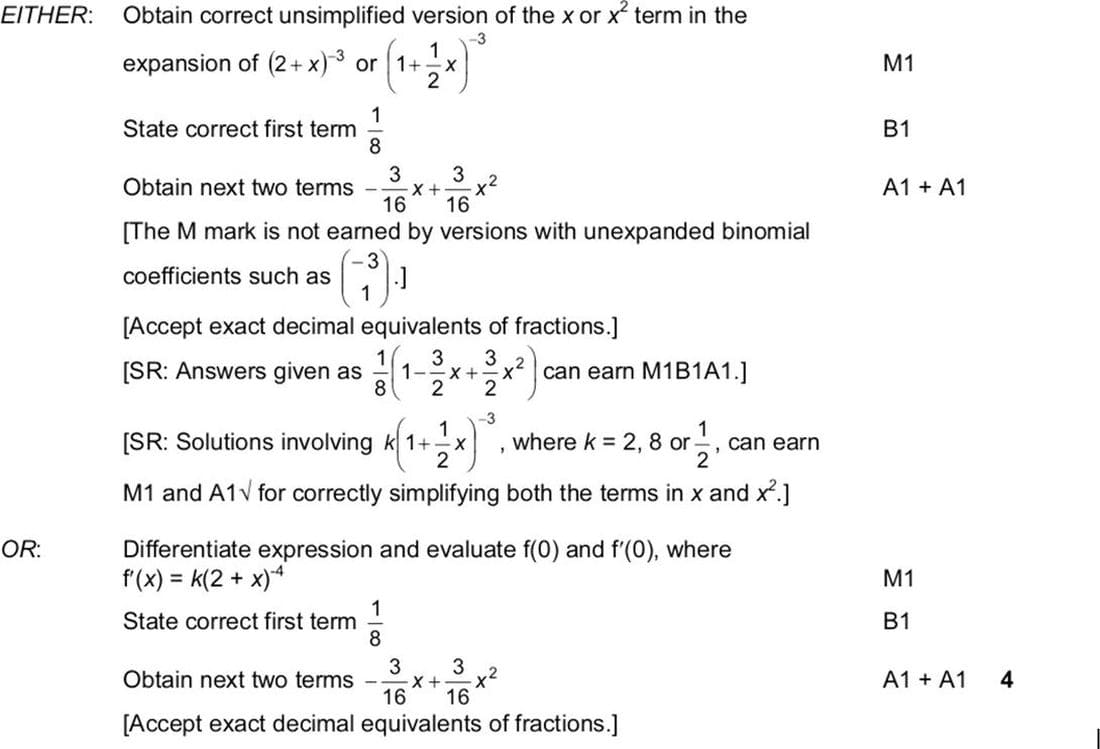
9709 P3 - Nov 2003 - Q2
Expand \((2 + x^2)^{-2}\) in ascending powers of \(x\), up to and including the term in \(x^4\), simplifying the coefficients.
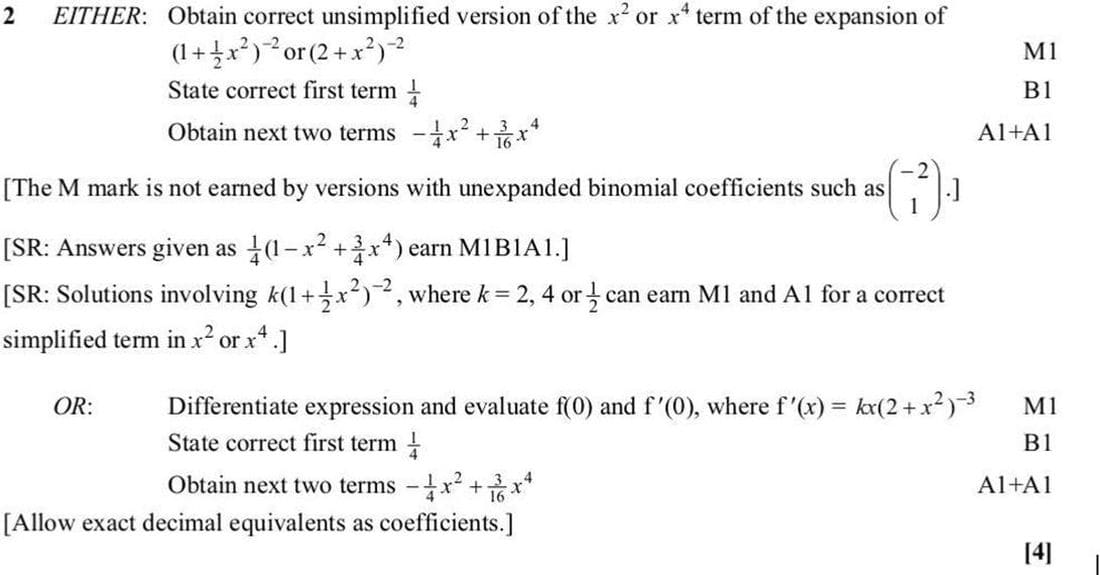
9709 P3 - Jun 2002 - Q2
Expand \((1 - 3x)^{-\frac{1}{3}}\) in ascending powers of \(x\), up to and including the term in \(x^3\), simplifying the coefficients.
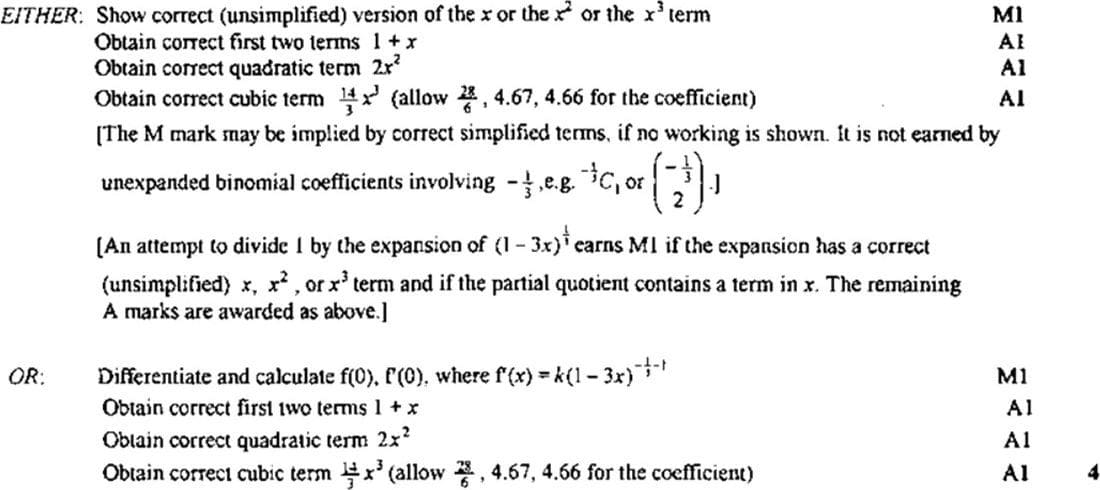
9709 P31 - Nov 2021 - Q6
When \((a + bx)\sqrt{1 + 4x}\), where \(a\) and \(b\) are constants, is expanded in ascending powers of \(x\), the coefficients of \(x\) and \(x^2\) are 3 and -6 respectively.
Find the values of \(a\) and \(b\).
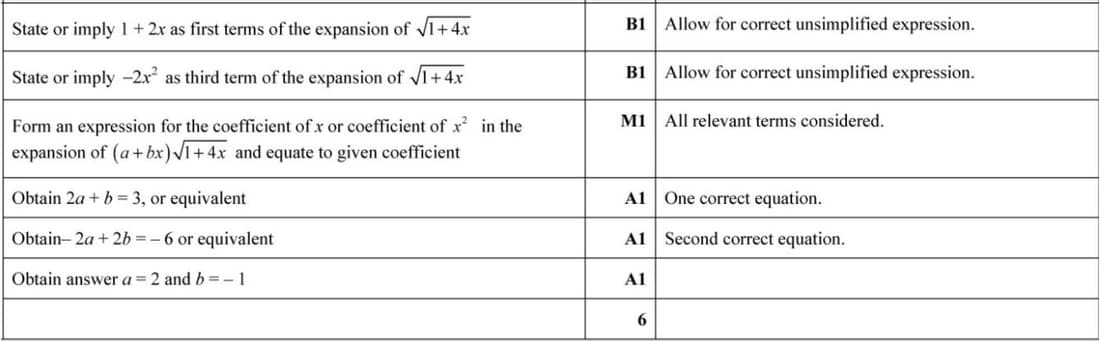
9709 P33 - Jun 2021 - Q1
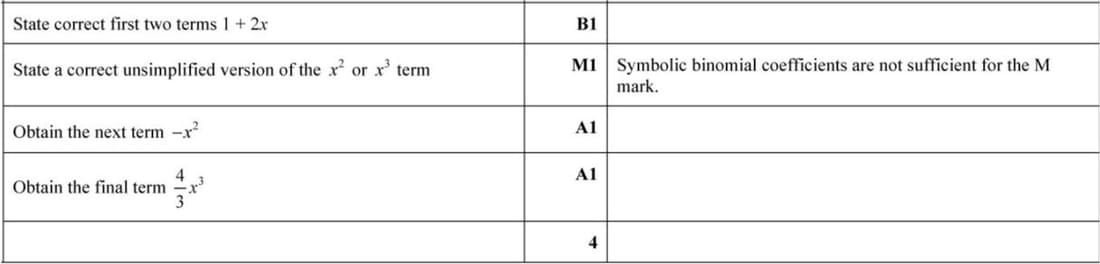
Expand \((1 + 3x)^{\frac{2}{3}}\) in ascending powers of \(x\), up to and including the term in \(x^3\), simplifying the coefficients.
9709 P32 - Nov 2020 - Q2
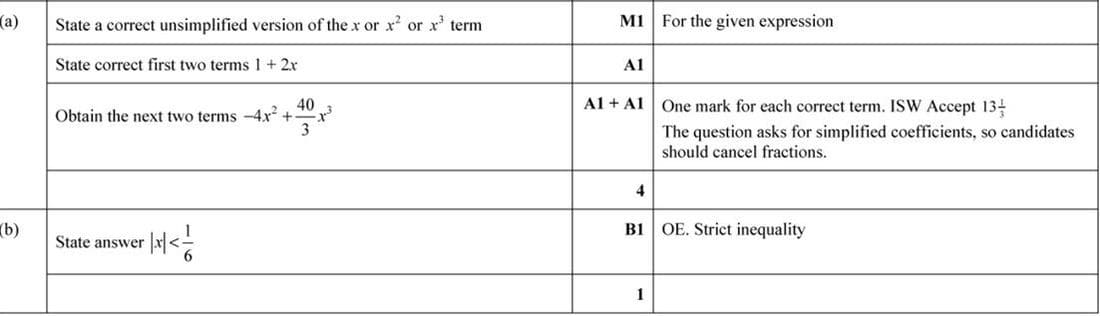
(a) Expand \(\sqrt[3]{1 + 6x}\) in ascending powers of \(x\), up to and including the term in \(x^3\), simplifying the coefficients.
(b) State the set of values of \(x\) for which the expansion is valid.
9709 P31 - Jun 2020 - Q2
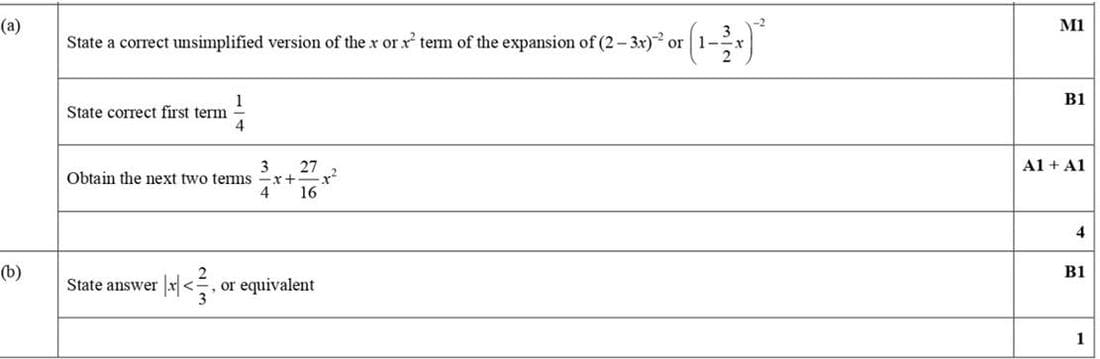
(a) Expand \((2 - 3x)^{-2}\) in ascending powers of \(x\), up to and including the term in \(x^2\), simplifying the coefficients.
(b) State the set of values of \(x\) for which the expansion is valid.
9709 P32 - Jun 2019 - Q1
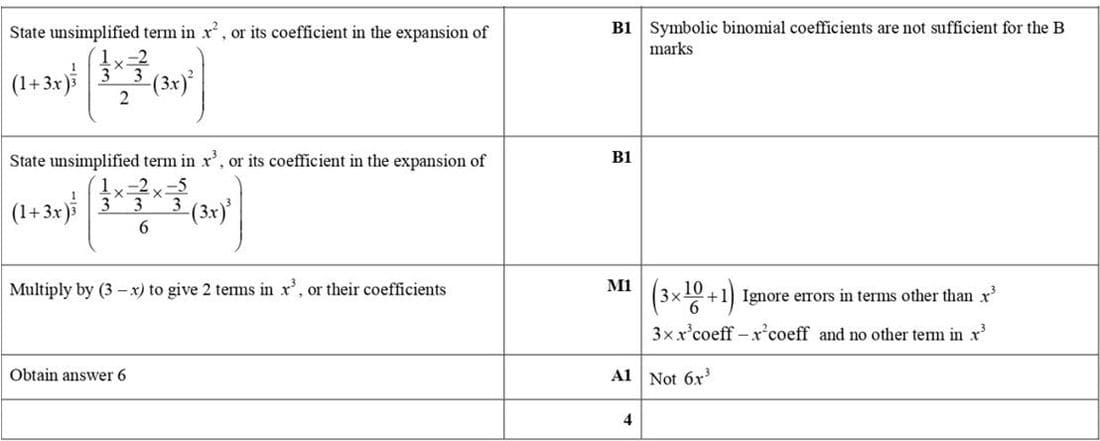
Find the coefficient of \(x^3\) in the expansion of \((3-x)(1+3x)^{\frac{1}{3}}\) in ascending powers of \(x\).
9709 P33 - Jun 2018 - Q1
Expand \(\frac{4}{\sqrt{(4 - 3x)}}\) in ascending powers of \(x\), up to and including the term in \(x^2\), simplifying the coefficients.