9709 P33 - Nov 2023 - Q9 - 11 marks
Let \(f(x)=\dfrac{17x^2-7x+16}{(2+3x^2)(2-x)}\).
(a) Express f(x) in partial fractions. [5]
(b) Hence expand in ascending powers of \(x\), up to and including \(x^3\). [5]
(c) State the exact set of x values for which the expansion is valid. [1]


9709 P31 - Nov 2023 - Q10 - 11 marks
Let \(f(x)=\dfrac{24x+13}{(1-2x)(2+x)^2}\).
(a) Express \(f(x)\) in partial fractions. [5]
(b) Expand \(f(x)\) in ascending powers of \(x\), up to and including \(x^2\). [5]
(c) State the set of values of x for which the expansion is valid. [1]


9709 P33 - Jun 2023 - Q10 - 10 marks
Let \(f(x)=\dfrac{21-8x-2x^2}{(1+2x)(3-x)^2}\).
(a) Express f(x) in partial fractions. [5]
(b) Hence expand in ascending powers of \(x\), up to and including \(x^2\). [5]


9709 P31 - Nov 2022 - Q10 - 10 marks
Let \(f(x)=\dfrac{2x^2+7x+8}{(1+x)(2+x)^2}\).
(a) Express \(f(x)\) in partial fractions. [5]
(b) Hence obtain the expansion of \(f(x)\) in ascending powers of \(x\), up to and including the term in \(x^2\). [5]

9709 P33 - Jun 2022 - Q7 - 10 marks
Let \(f(x)=\dfrac{5x^2+8x-3}{(x-2)(2x^2+3)}\).
(a) Express \(f(x)\) in partial fractions. [5]
(b) Hence obtain the expansion of \(f(x)\) in ascending powers of \(x\), up to and including the term in \(x^2\). [5]


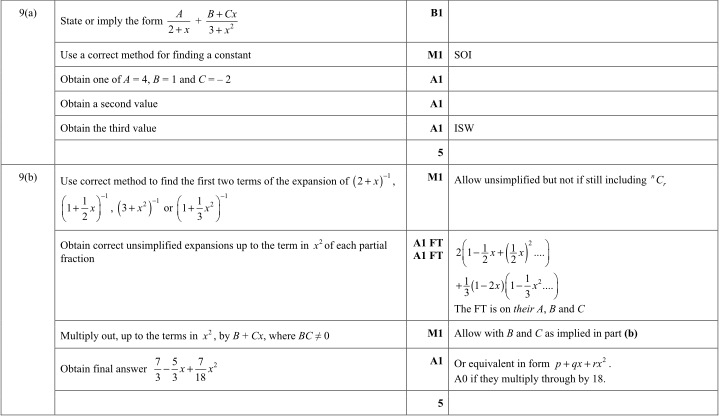
9709 P32 - Jun 2021 - Q9 - 10 marks
Let \(\displaystyle f(x)=\frac{14-3x+2x^2}{(2+x)(3+x^2)}\).
(a) Express f(x) in partial fractions. [5]
(b) Hence obtain the expansion of f(x) in ascending powers of x, up to and including the term in x². [5]
9709 P32 - Mar 2020 - Q9 - 10 marks
Let \(f(x)=(2+11x-10x^2)/((1+2x)(1-2x)(2+x))\).
(a) Express f(x) in partial fractions. [5]
(b) Hence expand f(x) in ascending powers of x, up to and including x squared. [5]

9709 P31 - Nov 2020 - Q9 - 10 marks
Let \(f(x)=\dfrac{8+5x+12x^2}{(1-x)(2+3x)^2}\).
(a) Express \(f(x)\) in partial fractions. [5]
(b) Hence expand \(f(x)\) in ascending powers of \(x\), up to and including \(x^2\). [5]


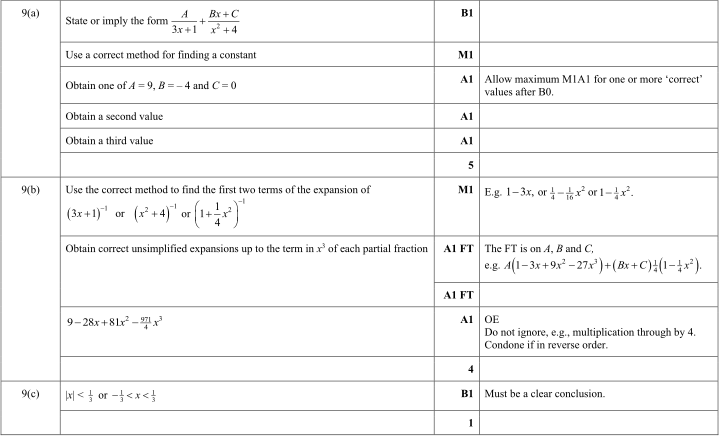
9709 P33 - Jun 2026 - Q9 - 10 marks
Let \(f(x)=\dfrac{36-4x-3x^2}{(3x+1)(x^2+4)}\).
(a) Express \(f(x)\) in partial fractions. [5]
(b) Hence expand \(f(x)\) in ascending powers of \(x\), up to and including \(x^3\). [4]
(c) State the set of \(x\)-values for which the expansion is valid. [1]
9709 P31 - Nov 2025 - Q10 - 11 marks
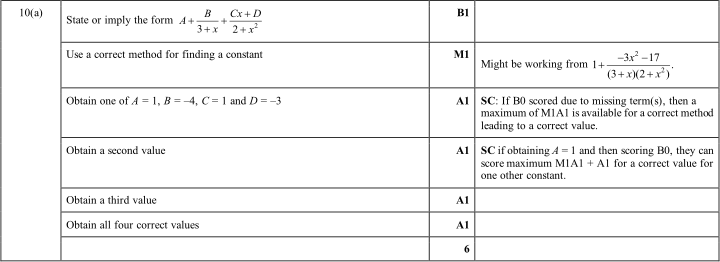
Let \(f(x)=\dfrac{x^3+2x-11}{(3+x)(2+x^2)}\).
(a) Express \(f(x)\) in partial fractions. [6]
(b) Hence obtain the expansion of \(f(x)\) in ascending powers of \(x\), up to and including the term in \(x^2\). [5]

9709 P33 - Jun 2025 - Q7 - 8 marks
Let \(f(x)=\dfrac{3a-5x}{(3a+2x)(2a-x)}\), where \(a>0\).
(a) Express \(f(x)\) in partial fractions. [3]
(b) Hence expand in ascending powers through \(x^2\). [4]
(c) State the set of \(x\)-values where the expansion is valid. [1]

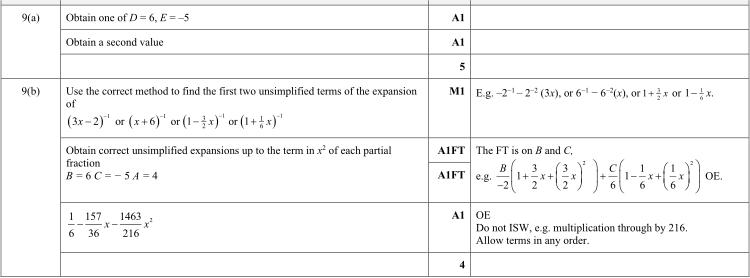
9709 P35 - Jun 2025 - Q9 - 9 marks
(a) Express \(\dfrac{12x^2+55x-2}{(3x-2)(x+6)}\) in partial fractions. [5]
(b) Hence expand in ascending powers through \(x^2\). [4]

9709 P31 - Nov 2024 - Q7 - 9 marks
\(f(x)=\frac{5x^2+8x+5}{(1+2x)(2+x^2)}\).
(a) Express f(x) in partial fractions. [5]
(b) Hence find the coefficient of x³ in its expansion. [4]

9709 P33 - Nov 2024 - Q8 - 8 marks
Let \(f(x)=7a^2/[(a-2x)(3a+x)]\), where a>0.
(a) Express f(x) in partial fractions. [3]
(b) Hence expand f(x) through the x² term. [4]
(c) State the values of x for which the expansion is valid. [1]

