9709 P31 - Jun 2022 - Q6 - 8 marks
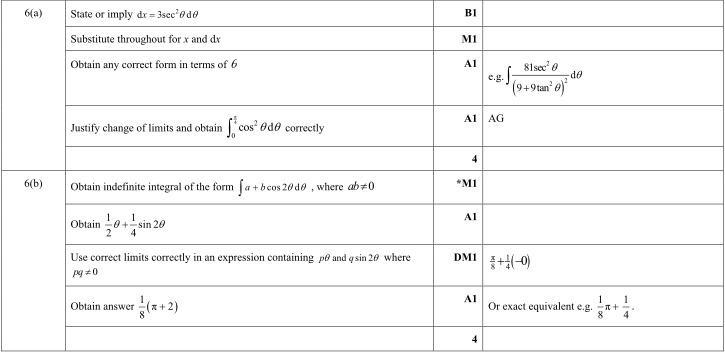
Let \(I=\displaystyle\int_0^3\frac{27}{(9+x^2)^2}\,dx\).
(a) Using the substitution \(x=3\tan\theta\), show that \(I=\displaystyle\int_0^{\pi/4}\cos^2\theta\,d\theta\). [4]
(b) Hence find the exact value of \(I\). [4]
9709 P31 - Jun 2014 - Q2
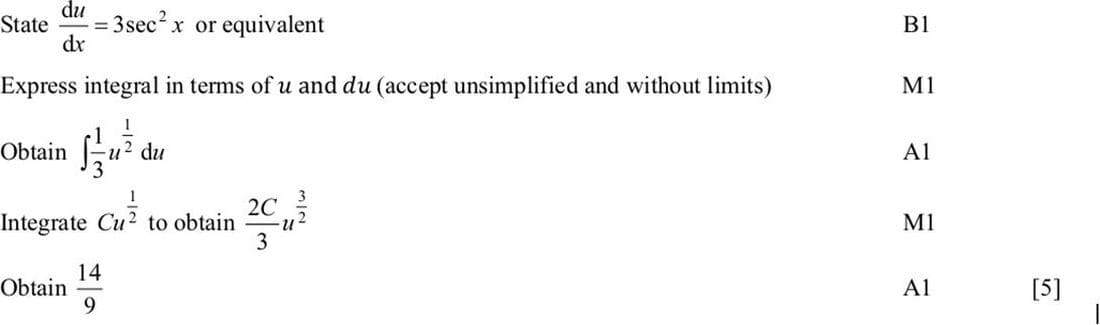
Use the substitution \(u = 1 + 3 \tan x\) to find the exact value of
\(\int_{0}^{\frac{\pi}{4}} \frac{\sqrt{1 + 3 \tan x}}{\cos^2 x} \, dx.\)
9709 P33 - Nov 2013 - Q2
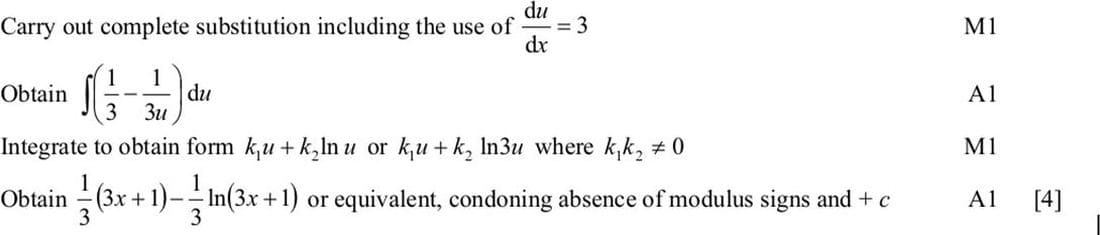
Use the substitution \(u = 3x + 1\) to find \(\int \frac{3x}{3x+1} \, dx\).
Problem #1695
Using the substitution \(x = (\sqrt{3}) \tan \theta\), find the exact value of
\(\int_{1}^{3} \frac{1}{\sqrt{3 + x^2}} \, dx,\)
expressing your answer as a single logarithm.

9709 P31 - Jun 2013 - Q8
Use the substitution \(u = \\sin 4x\) to find the exact value of \(\int_{0}^{\frac{1}{24}\pi} \cos^3 4x \, dx\).

9709 P31 - Nov 2010 - Q5
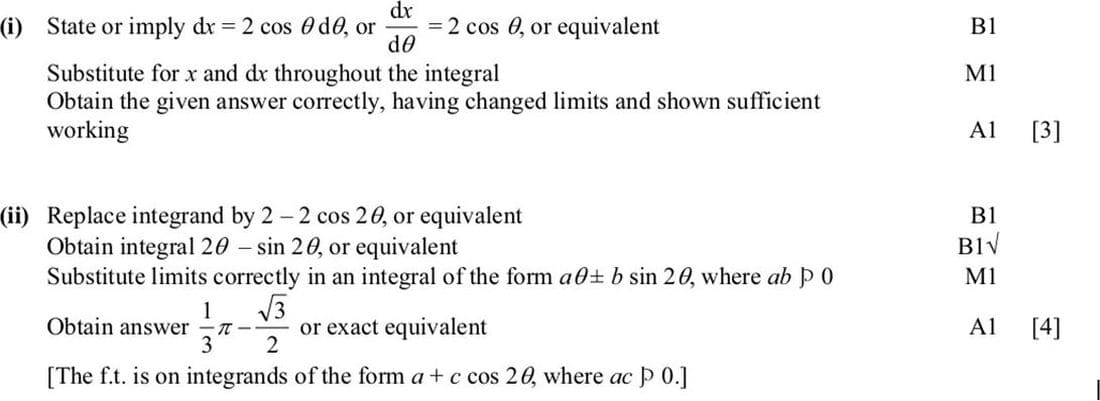
Let \(I = \int_0^1 \frac{x^2}{\sqrt{(4-x^2)}} \, dx\).
(i) Using the substitution \(x = 2 \sin \theta\), show that \(I = \int_0^{\frac{\pi}{6}} 4 \sin^2 \theta \, d\theta\).
(ii) Hence find the exact value of \(I\).
9709 P32 - Nov 2009 - Q6
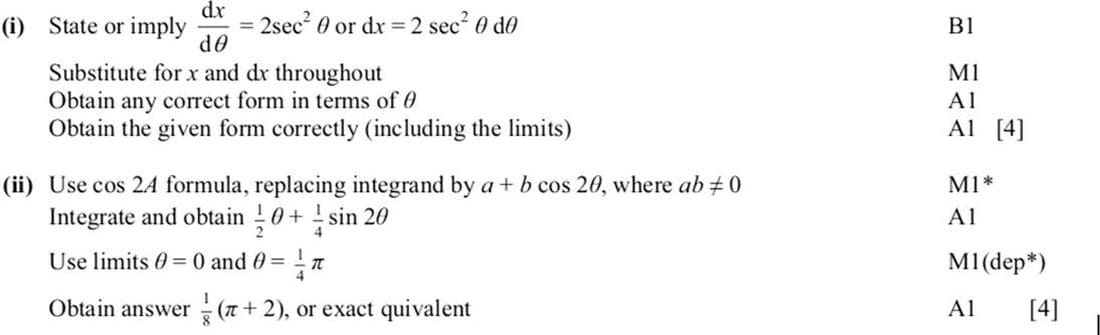
(i) Use the substitution \(x = 2 \tan \theta\) to show that
\(\int_0^2 \frac{8}{(4+x^2)^2} \, dx = \int_0^{\frac{\pi}{4}} \cos^2 \theta \, d\theta.\)
(ii) Hence find the exact value of
\(\int_0^2 \frac{8}{(4+x^2)^2} \, dx.\)
Problem #1699
Let \(I = \int_1^4 \frac{1}{x(4 - \sqrt{x})} \, dx\).
Use the substitution \(u = \sqrt{x}\) to show that \(I = \int_1^2 \frac{2}{u(4-u)} \, du\).

9709 P3 - Nov 2005 - Q6
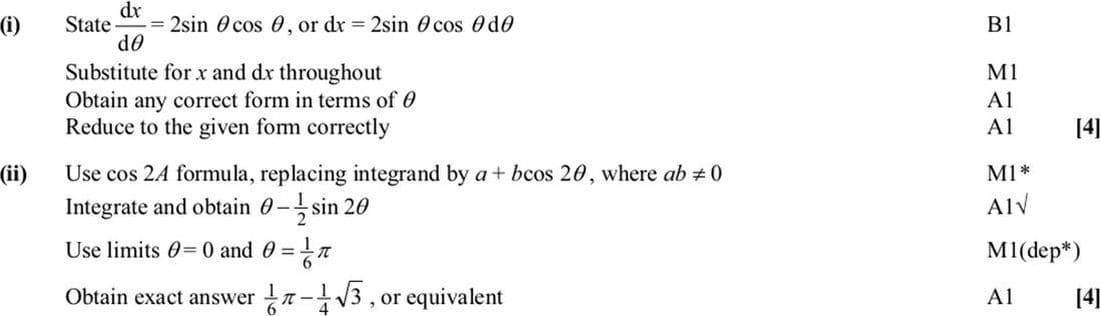
(i) Use the substitution \(x = \sin^2 \theta\) to show that \(\int \sqrt{\left( \frac{x}{1-x} \right)} \, dx = \int 2 \sin^2 \theta \, d\theta\).
(ii) Hence find the exact value of \(\int_0^{\frac{1}{4}} \sqrt{\left( \frac{x}{1-x} \right)} \, dx\).
9709 P3 - Jun 2005 - Q4
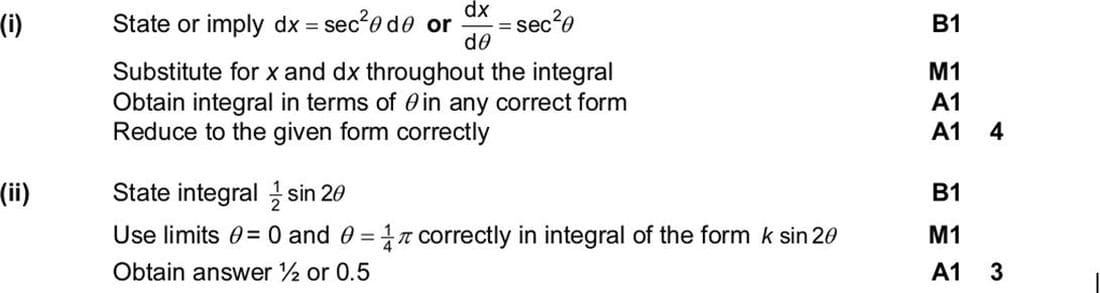
(i) Use the substitution \(x = \tan \theta\) to show that
\(\int \frac{1-x^2}{(1+x^2)^2} \, dx = \int \cos 2\theta \, d\theta.\)
(ii) Hence find the value of
\(\int_0^1 \frac{1-x^2}{(1+x^2)^2} \, dx.\)
9709 P33 - Nov 2021 - Q9 - 10 marks
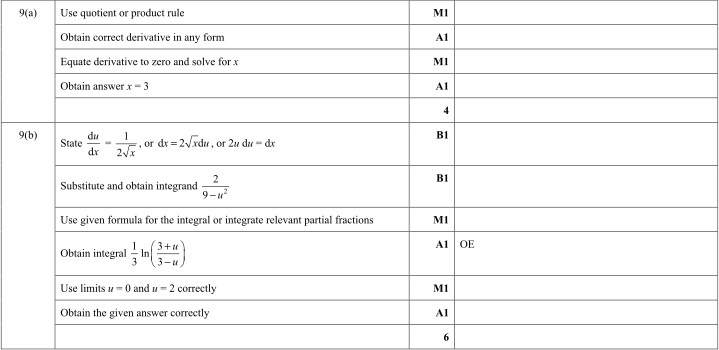
Let \(\displaystyle f(x)=\frac1{(9-x)\sqrt x}\).
(a) Find the x-coordinate of the stationary point of the curve with equation y=f(x). [4]
(b) Using the substitution \(u=\sqrt x\), show that \(\displaystyle\int_0^4f(x)\,dx=\tfrac13\ln5\). [6]
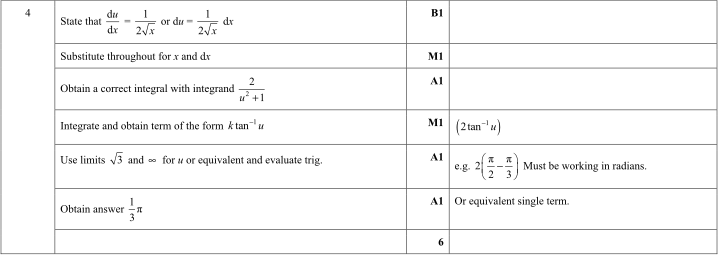
9709 P31 - Nov 2021 - Q4 - 6 marks
Using the substitution \(u=\sqrt x\), find the exact value of \(\displaystyle\int_3^{\infty}\frac1{(x+1)\sqrt x}\,dx\). [6]
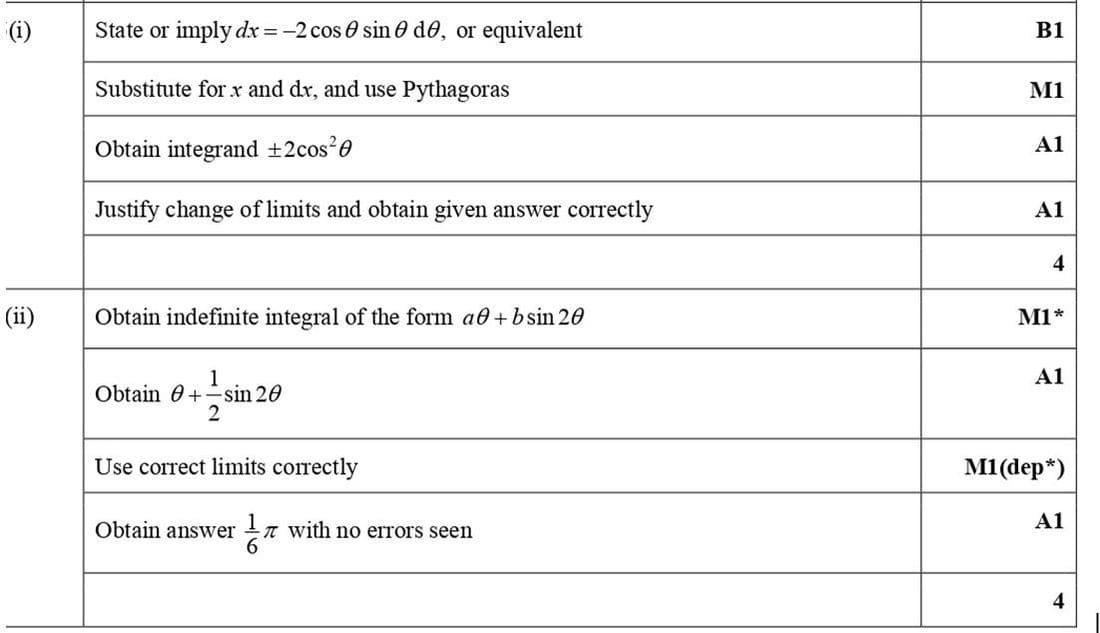
9709 P31 - Jun 2018 - Q5
Let \(I = \int_{\frac{1}{4}}^{\frac{3}{4}} \sqrt{\left( \frac{x}{1-x} \right)} \, dx\).
(i) Using the substitution \(x = \cos^2 \theta\), show that \(I = \int_{\frac{1}{6}\pi}^{\frac{1}{3}\pi} 2 \cos^2 \theta \, d\theta\).
(ii) Hence find the exact value of \(I\).
9709 P33 - Nov 2016 - Q6
Let \(I = \int_{1}^{4} \frac{(\sqrt{x}) - 1}{2(x + \sqrt{x})} \, dx\).
Using the substitution \(u = \sqrt{x}\), show that \(I = \int_{1}^{2} \frac{u - 1}{u + 1} \, du\).

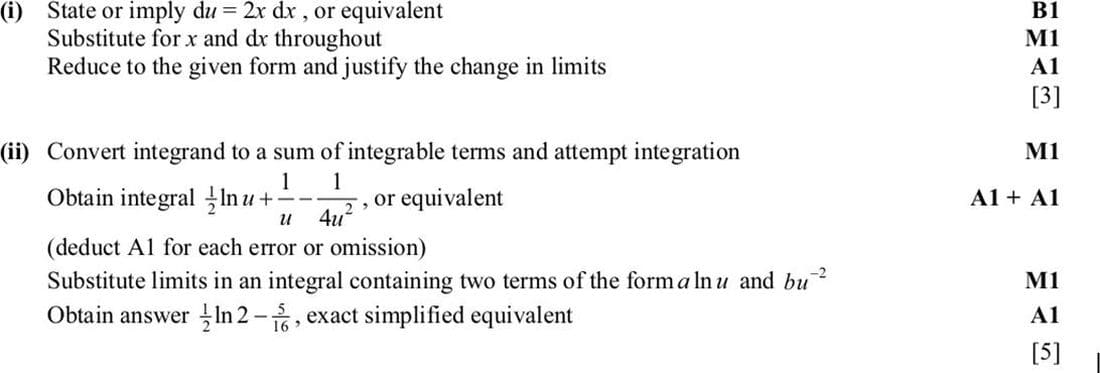
9709 P33 - Jun 2016 - Q7
Let \(I = \int_0^1 \frac{x^5}{(1+x^2)^3} \, dx\).
(i) Using the substitution \(u = 1 + x^2\), show that \(I = \int_1^2 \frac{(u-1)^2}{2u^3} \, du\).
(ii) Hence find the exact value of \(I\).
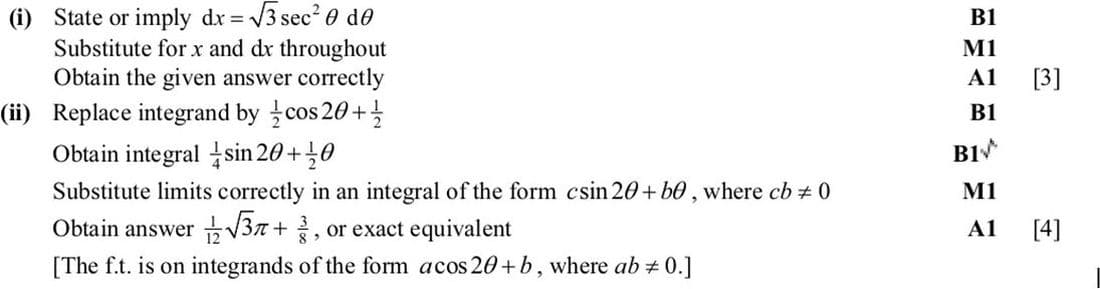
9709 P32 - Mar 2016 - Q5
Let \(I = \int_0^1 \frac{9}{(3 + x^2)^2} \, dx\).
(i) Using the substitution \(x = (\sqrt{3}) \tan \theta\), show that \(I = \sqrt{3} \int_0^{\frac{\pi}{6}} \cos^2 \theta \, d\theta\).
(ii) Hence find the exact value of \(I\).
9709 P33 - Nov 2015 - Q5
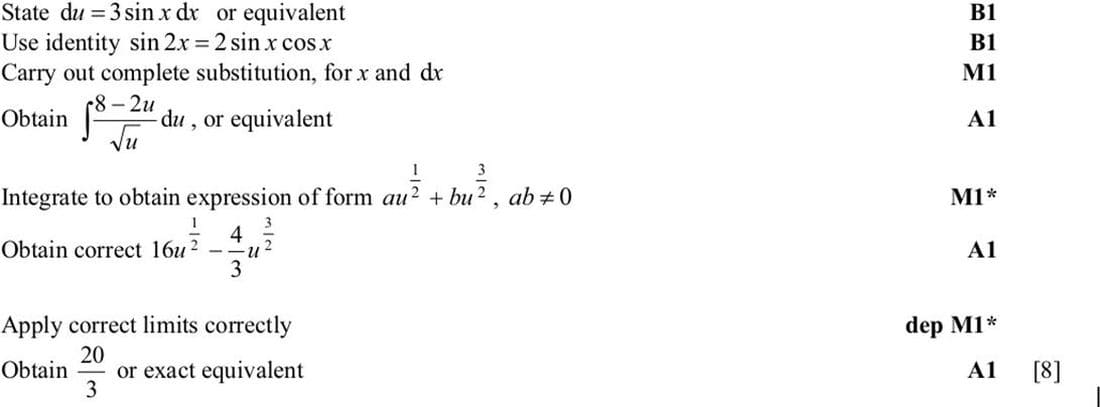
Use the substitution \(u = 4 - 3 \cos x\) to find the exact value of \(\int_{0}^{\frac{1}{2}\pi} \frac{9 \sin 2x}{\sqrt{(4 - 3 \cos x)}} \, dx.\)
9709 P32 - Jun 2015 - Q6
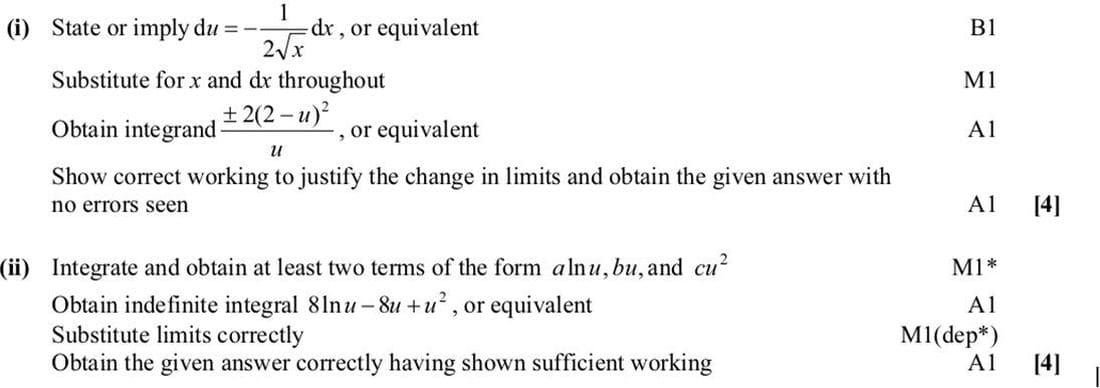
Let \(I = \int_0^1 \frac{\sqrt{x}}{2 - \sqrt{x}} \, dx\).
(i) Using the substitution \(u = 2 - \sqrt{x}\), show that \(I = \int_1^2 \frac{2(2-u)^2}{u} \, du\).
(ii) Hence show that \(I = 8 \ln 2 - 5\).
9709 P33 - Jun 2023 - Q7 - 8 marks
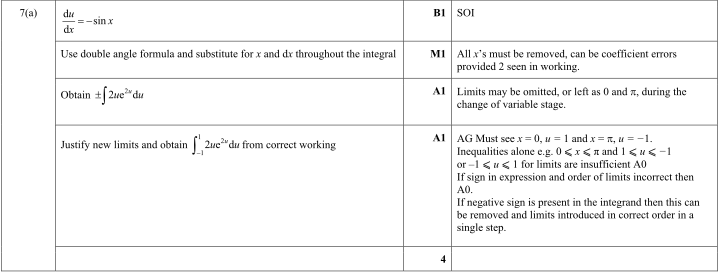
(a) Using \(u=\cos x\), show that \(\displaystyle\int_0^\pi\sin2x\,e^{2\cos x}\,dx=\int_{-1}^1 2ue^{2u}\,du\). [4]
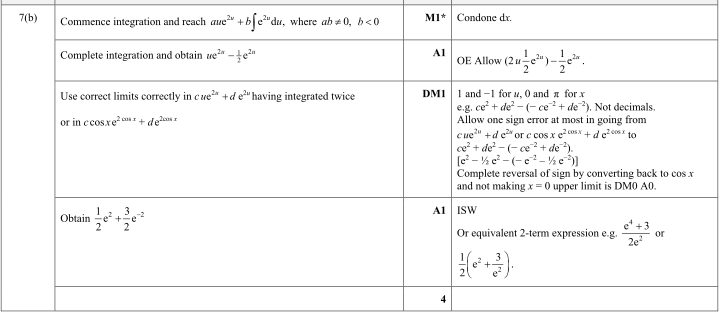
(b) Hence find the exact value of the integral. [4]
9709 P31 - Nov 2023 - Q9 - 9 marks

The curve is \(y=xe^{-x^2/4}\), for \(x\geq0\), with maximum \(M\).
(a) Find the exact coordinates of M. [4]
(b) Using \(x=\sqrt u\), or otherwise, find the exact shaded area bounded by the curve, the \(x\)-axis and \(x=3\). [5]


9709 P32 - Jun 2023 - Q10 - 10 marks

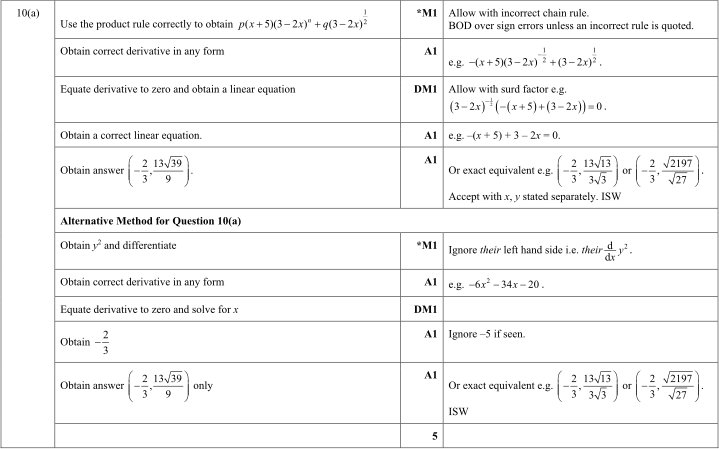
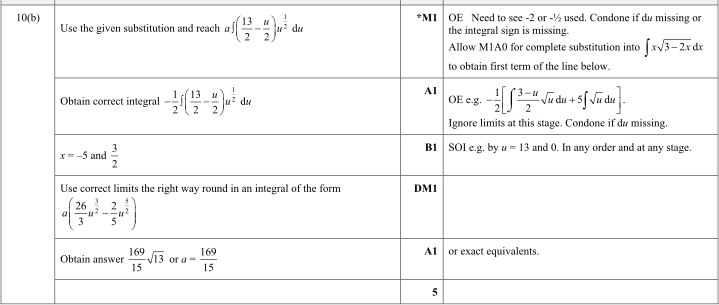
The curve is \(y=(x+5)\sqrt{3-2x}\), with maximum \(M\).
(a) Find the exact coordinates of M. [5]
(b) Using \(u=3-2x\), integrate to find the shaded area bounded by the curve and the \(x\)-axis. Give the answer as \(a\sqrt{13}\), where \(a\) is rational. [5]
9709 P32 - Nov 2022 - Q8 - 8 marks

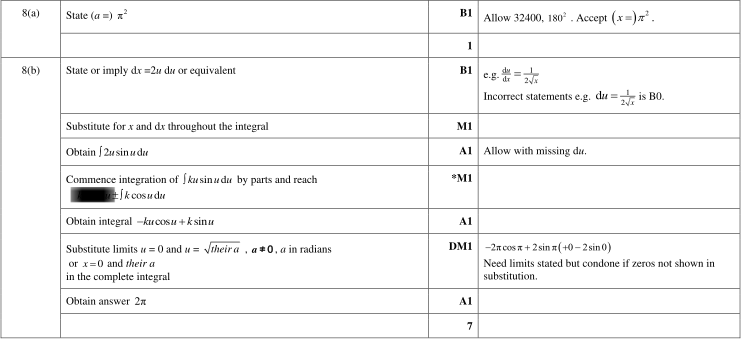
The diagram shows part of the curve \(y=\sin\sqrt{x}\). This part of the curve intersects the x-axis at the point where \(x=a\).
(a) State the exact value of \(a\). [1]
(b) Using the substitution \(u=\sqrt{x}\), find the exact area of the shaded region in the first quadrant bounded by this part of the curve and the x-axis. [7]
9709 P32 - Mar 2022 - Q11 - 11 marks

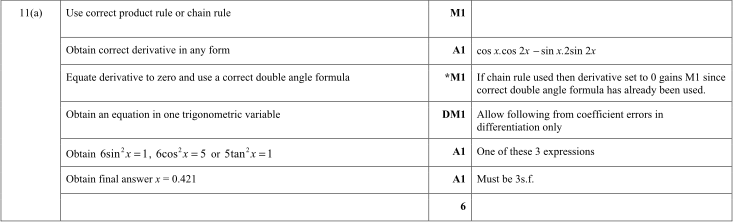
The diagram shows the curve \(y=\sin x\cos2x\) for \(0\le x\le\pi/2\), and its maximum point M.
(a) Find the \(x\)-coordinate of M, giving your answer correct to 3 significant figures. [6]
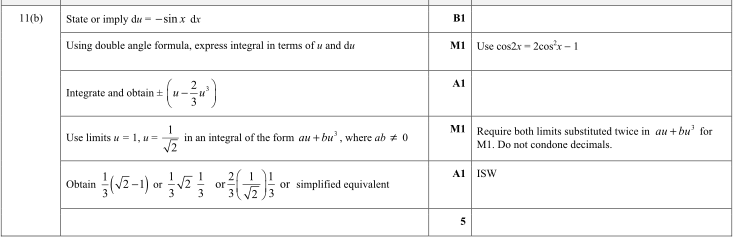
(b) Using the substitution \(u=\cos x\), find the area of the shaded region enclosed by the curve and the \(x\)-axis in the first quadrant, giving your answer in a simplified exact form. [5]
9709 P32 - Jun 2020 - Q6 - 9 marks
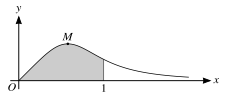
The curve is \(y=x/(1+3x^4)\), for \(x\geq0\), with maximum M.
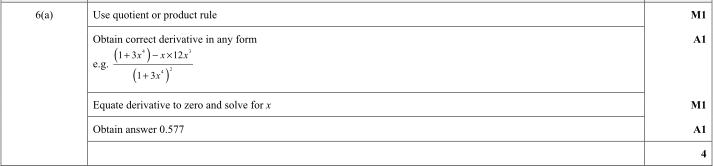
(a) Find the x-coordinate of M to 3 decimal places. [4]
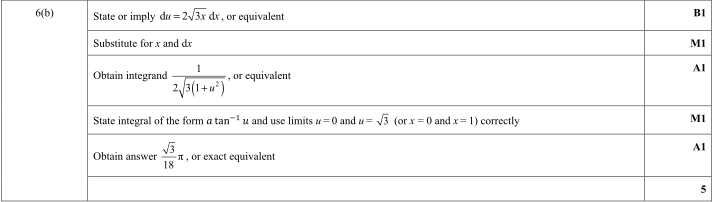
(b) Using \(u=\sqrt3x^2\), find the exact shaded area bounded by the curve, x-axis and x=1. [5]
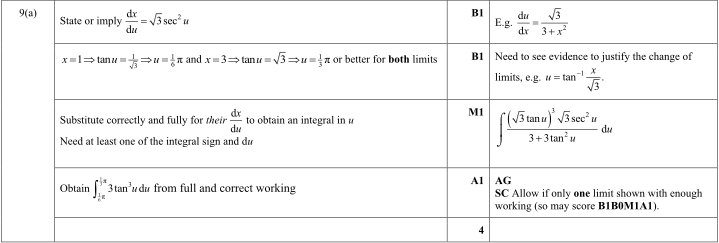
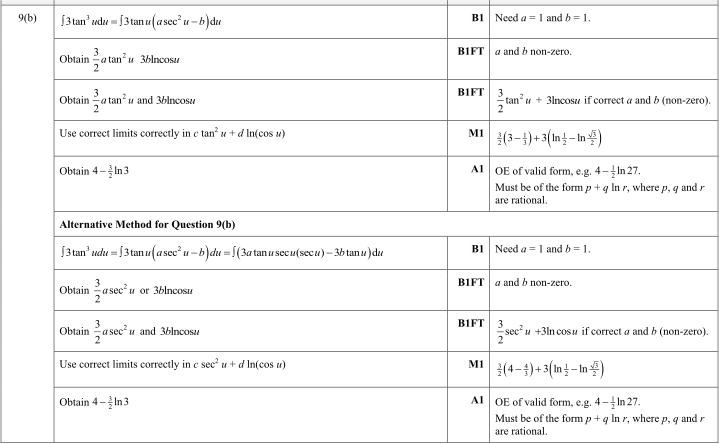
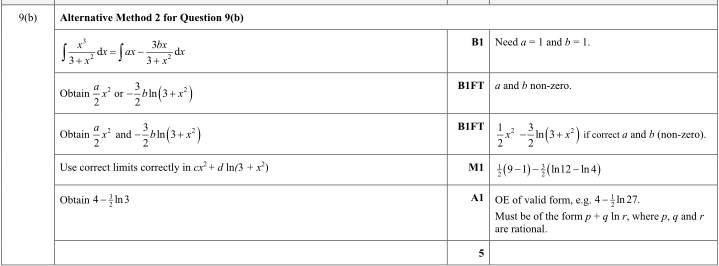
9709 P32 - Mar 2026 - Q9 - 9 marks
Let \[I=\int_1^3\frac{x^3}{3+x^2}\,\mathrm{d}x.\]
(a) Using the substitution \(x=\sqrt3\tan u\), show that \[I=\int_{\pi/6}^{\pi/3}3\tan^3u\,\mathrm{d}u.\] [4]
(b) Hence, or otherwise, find the exact value of \(I\). Give your answer in the form \(p+q\ln r\), where \(p\), \(q\) and \(r\) are rational. [5]
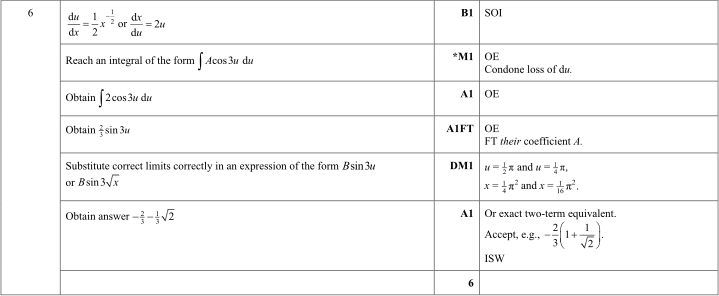
9709 P33 - Jun 2026 - Q6 - 6 marks
Use the substitution \(u=\sqrt x\) to find the exact value of \(\displaystyle\int_{\pi^2/16}^{\pi^2/4}\frac{\cos(3\sqrt x)}{\sqrt x}\,dx\). [6]
9709 P35 - Jun 2026 - Q10 - 8 marks
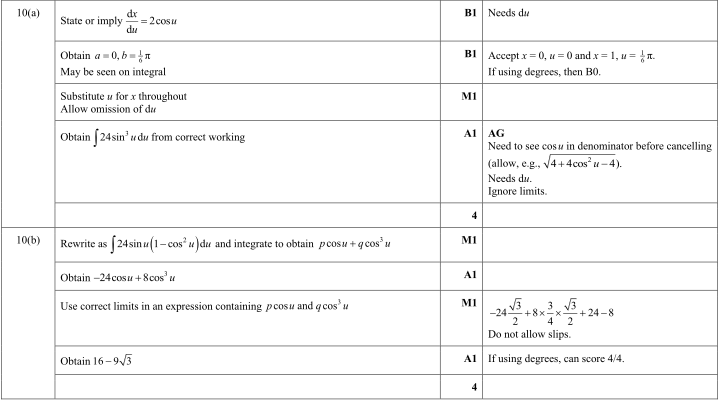
(a) Use \(x=2\sin u\) to show that \(\displaystyle\int_0^1\frac{3x^3}{\sqrt{4-x^2}}\,dx=\int_a^b24\sin^3u\,du\), finding exact \(a,b\). [4]
(b) Hence find the exact value of \(\displaystyle\int_0^1\frac{3x^3}{\sqrt{4-x^2}}\,dx\). [4]
9709 P32 - Nov 2025 - Q4 - 6 marks
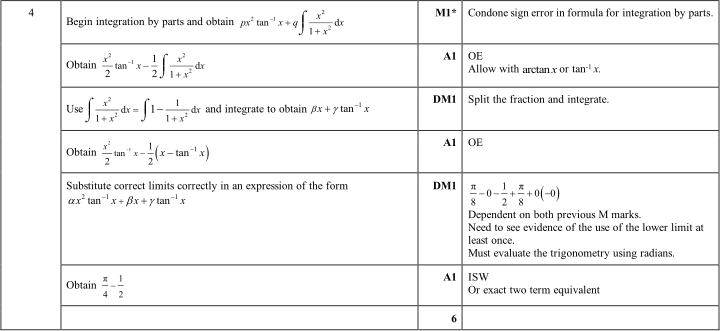
Find the exact value of \(\displaystyle\int_0^1x\tan^{-1}x\,dx\). [6]
9709 P33 - Nov 2025 - Q11 - 12 marks

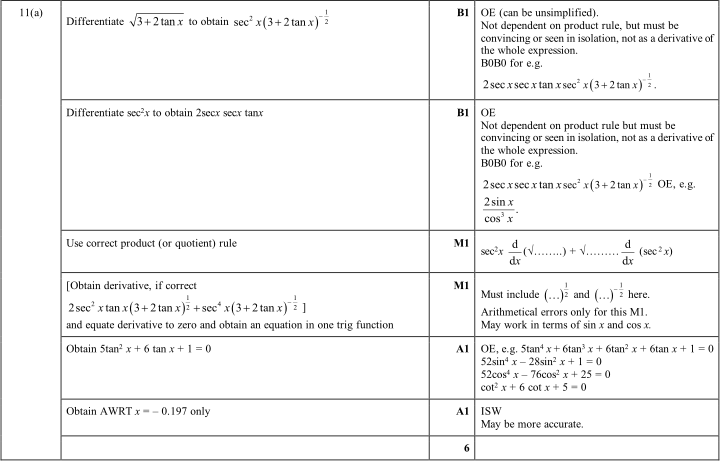
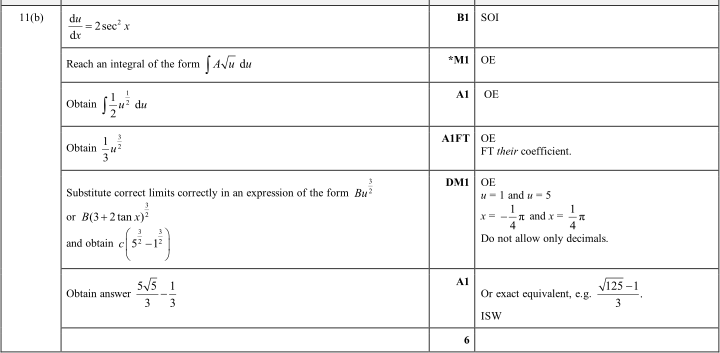
The diagram shows \(y=\sec^2x\sqrt{3+2\tan x}\) for \(-\pi/4\le x\le\pi/4\), and its minimum point \(M\).
(a) Find the \(x\)-coordinate of \(M\). [6]
(b) Using \(u=3+2\tan x\), find the exact area bounded by the curve, the \(x\)-axis and \(x=-\pi/4\), \(x=\pi/4\). [6]
9709 P35 - Nov 2025 - Q7 - 8 marks
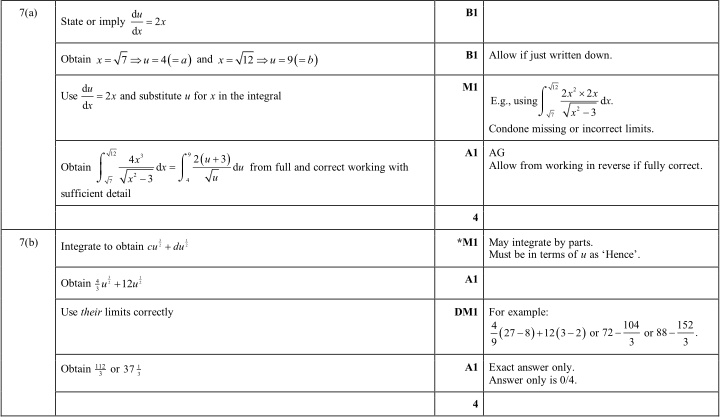
(a) Use \(u=x^2-3\) to show that \[\int_{\sqrt7}^{\sqrt{12}}\frac{4x^3}{\sqrt{x^2-3}}\,dx=\int_a^b\frac{2(u+3)}{\sqrt u}\,du,\] where \(a,b\) are to be found. [4]
(b) Hence find the exact value of the integral. [4]
9709 P32 - Jun 2025 - Q10 - 8 marks
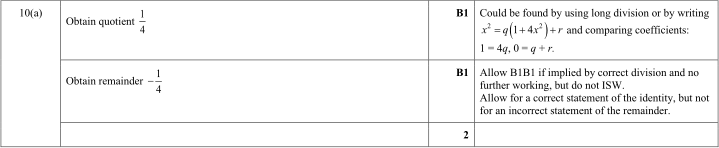
(a) Find the quotient and remainder when \(x^2\) is divided by \(1+4x^2\). [2]
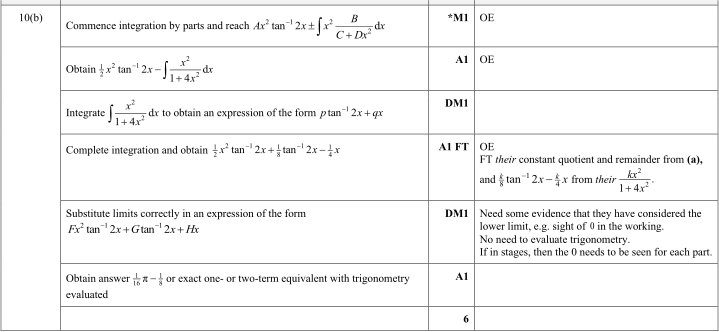
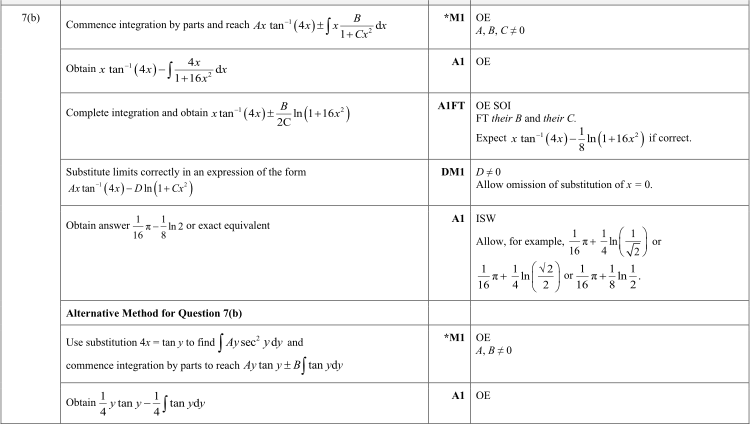
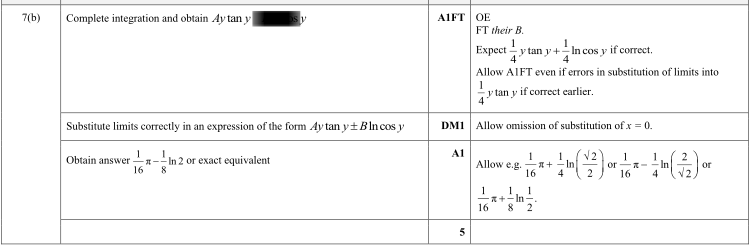
(b) Find exact \(\displaystyle\int_0^{0.5}x\tan^{-1}(2x)\,dx\). [6]
9709 P35 - Jun 2025 - Q7 - 8 marks
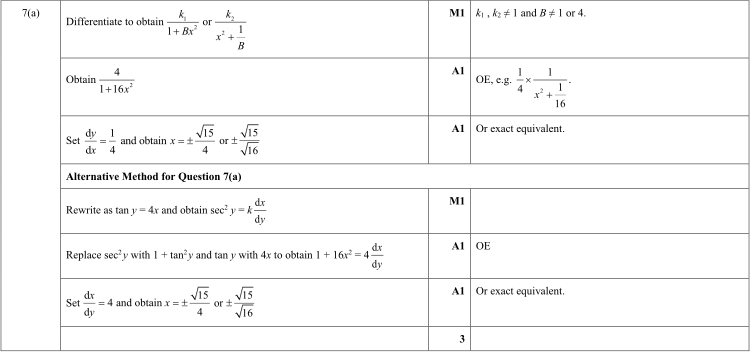
The curve is \(y=\tan^{-1}(4x)\).
(a) Find exact \(x\) where the gradient is \(1/4\). [3]
(b) Find exact \(\displaystyle\int_0^{0.25}y\,dx\). [5]
9709 P33 - Nov 2024 - Q11 - 11 marks

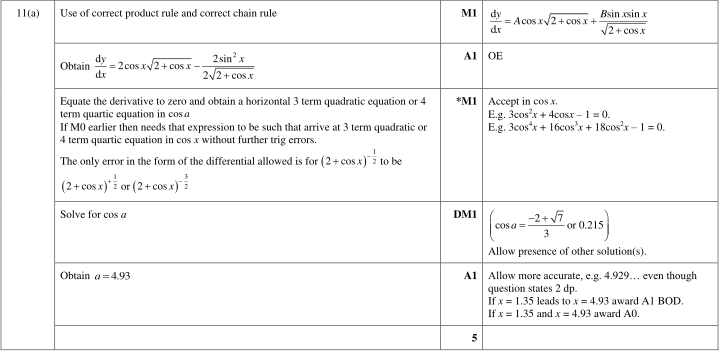
The diagram shows \(y=2\sin x\sqrt{2+\cos x}\), for \(0\le x\le2\pi\), with minimum M at x=α.
(a) Find α to 2 decimal places. [5]
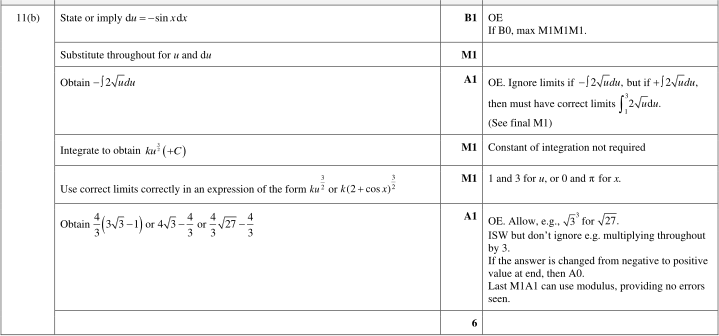
(b) Use \(u=2+\cos x\) to find the exact shaded area R. [6]
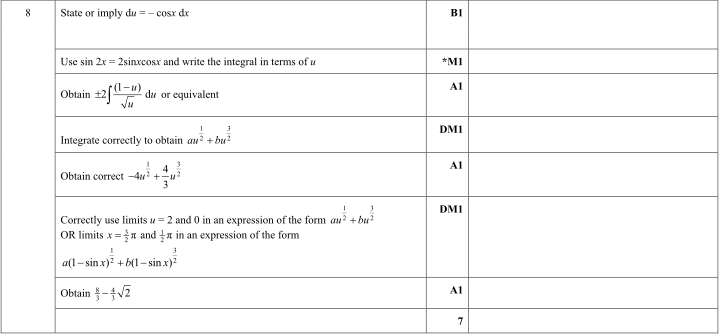
9709 P31 - Jun 2024 - Q8 - 7 marks
Use \(u=1-\sin x\) to evaluate \(\int_\pi^{3\pi/2}\frac{\sin2x}{\sqrt{1-\sin x}}\,dx\), in the form a+b√2 with rational a,b. [7]
9709 P33 - Jun 2024 - Q11 - 9 marks
Use \(2x=\tan\theta\) to find \(\int_0^{1/2}\frac{12}{(1+4x^2)^2}\,dx\) exactly, in the form a+bπ with rational a,b. [9]
9709 P32 - Mar 2021 - Q10 - 11 marks
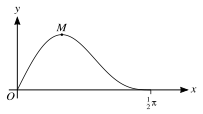
The diagram shows the curve \(y=\sin2x\cos^2x\) for \(0\le x\le\pi/2\), and its maximum point M.
(a) Using the substitution u=sin x, find the exact area of the region bounded by the curve and the x-axis. [5]
(b) Find the exact x-coordinate of M. [6]
Integration by a supplied substitution — problem 1 · Maths4U Original · 6 marks
Info
The integrand is \(f(x)=2 x \left(x^{2} + 1\right)^{3}\), on real x.
Use the substitution \(u=x^2+1\).
- Find the general indefinite integral of the given function. [2]
- Evaluate the definite integral from \(0\) to \(1\). [2]
- Find the primitive G satisfying \(\displaystyle G(0)=0\). [2]
Integration by a supplied substitution — problem 2 · Maths4U Original · 6 marks
Info
The integrand is \(\displaystyle f(x)=\frac{3 x}{\sqrt{x^{2} + 2}}\), on real x.
Use the substitution \(u=x^2+2\).
- Find the general indefinite integral of the given function. [2]
- Evaluate the definite integral from \(0\) to \(1\). [2]
- Find the primitive G satisfying \(\displaystyle G(0)=0\). [2]