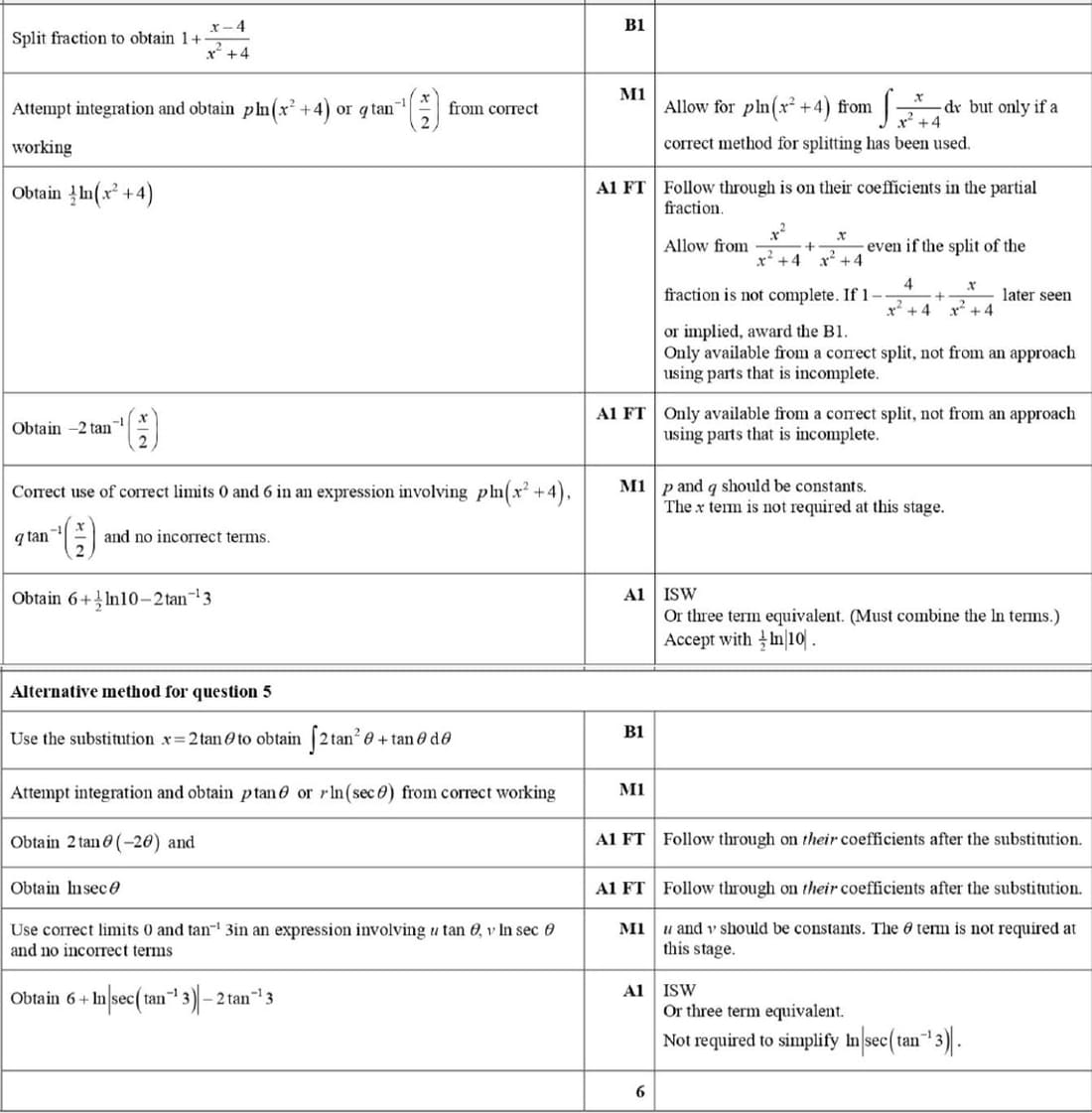
9709 P32 - Nov 2023 - Q5
Find the exact value of \(\int_{0}^{6} \frac{x(x+1)}{x^2+4} \, dx\).
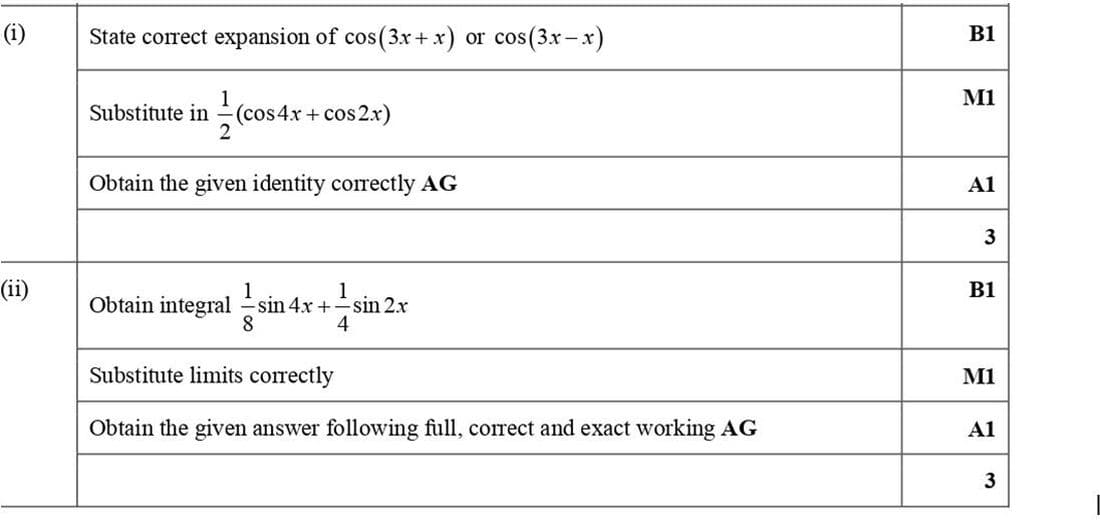
9709 P32 - Mar 2018 - Q3
(i) Using the expansions of \(\cos(3x + x)\) and \(\cos(3x - x)\), show that \(\frac{1}{2}(\cos 4x + \cos 2x) = \cos 3x \cos x\).
(ii) Hence show that \(\int_{-\frac{1}{6}\pi}^{\frac{1}{6}\pi} \cos 3x \cos x \, dx = \frac{3}{8}\sqrt{3}\).
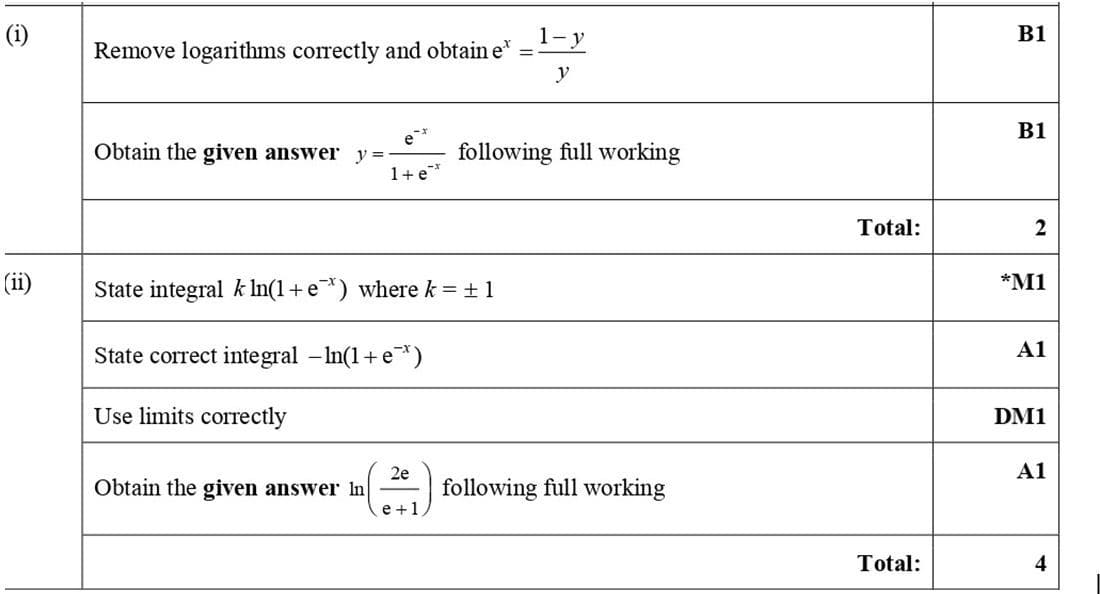
9709 P31 - Jun 2017 - Q3
It is given that \(x = \ln(1-y) - \ln y\), where \(0 < y < 1\).
(i) Show that \(y = \frac{e^{-x}}{1 + e^{-x}}\).
(ii) Hence show that \(\int_0^1 y \, dx = \ln \left( \frac{2e}{e+1} \right)\).
9709 P31 - Nov 2016 - Q5
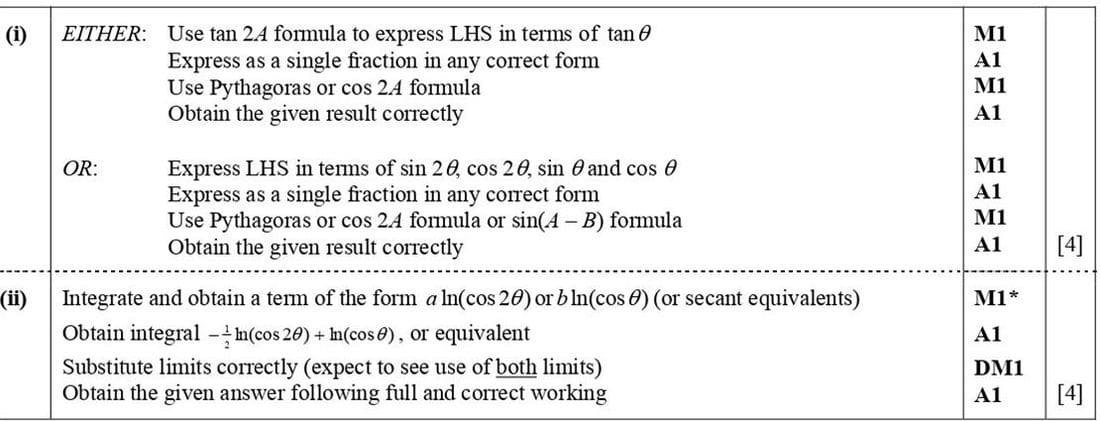
(i) Prove the identity \(\tan 2\theta - \tan \theta \equiv \tan \theta \sec 2\theta\).
(ii) Hence show that \(\int_{0}^{\frac{1}{6}\pi} \tan \theta \sec 2\theta \, d\theta = \frac{1}{2} \ln \frac{3}{2}\).
9709 P31 - Jun 2015 - Q5
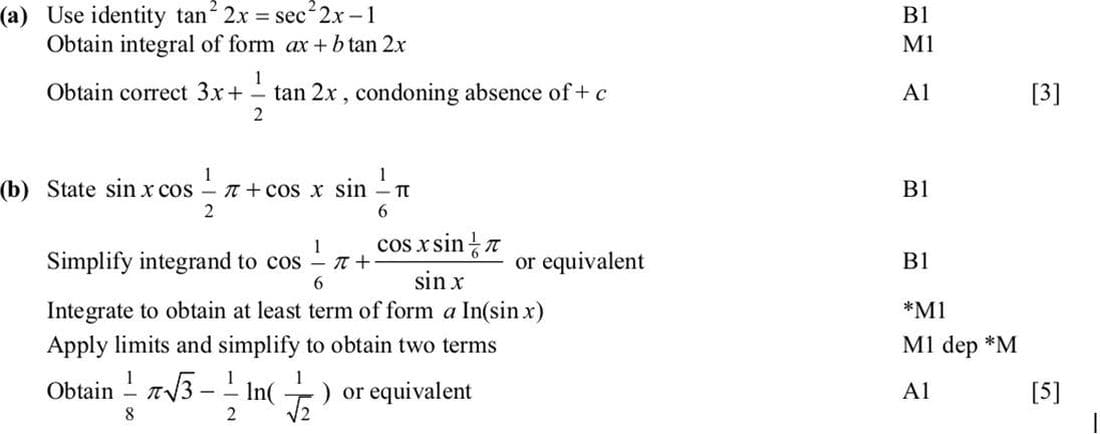
(a) Find \(\int (4 + \tan^2 2x) \, dx\).
(b) Find the exact value of \(\int_{\frac{1}{4}\pi}^{\frac{1}{2}\pi} \frac{\sin(x + \frac{1}{6}\pi)}{\sin x} \, dx\).
9709 P31 - Nov 2013 - Q5
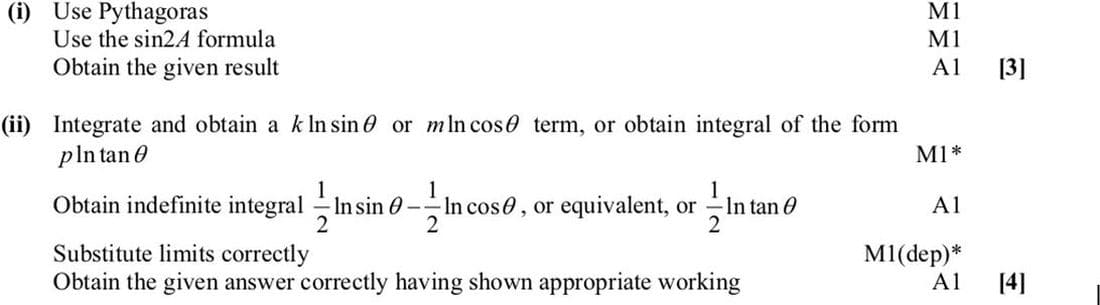
(i) Prove that \(\cot \theta + \tan \theta \equiv 2 \csc 2\theta\).
(ii) Hence show that \(\int_{\frac{1}{6}\pi}^{\frac{1}{3}\pi} \csc 2\theta \, d\theta = \frac{1}{2} \ln 3\).
9709 P31 - Jun 2011 - Q9
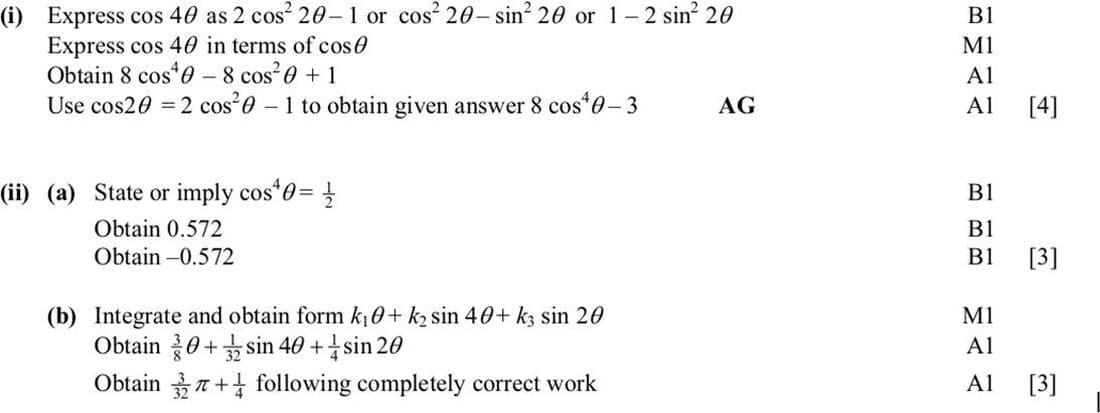
(i) Prove the identity \(\cos 4\theta + 4 \cos 2\theta \equiv 8 \cos^4 \theta - 3\).
(ii) Hence
(a) solve the equation \(\cos 4\theta + 4 \cos 2\theta = 1\) for \(-\frac{1}{2}\pi \leq \theta \leq \frac{1}{2}\pi\),
(b) find the exact value of \(\int_0^{\frac{1}{4}\pi} \cos^4 \theta \, d\theta\).
9709 P33 - Nov 2010 - Q4
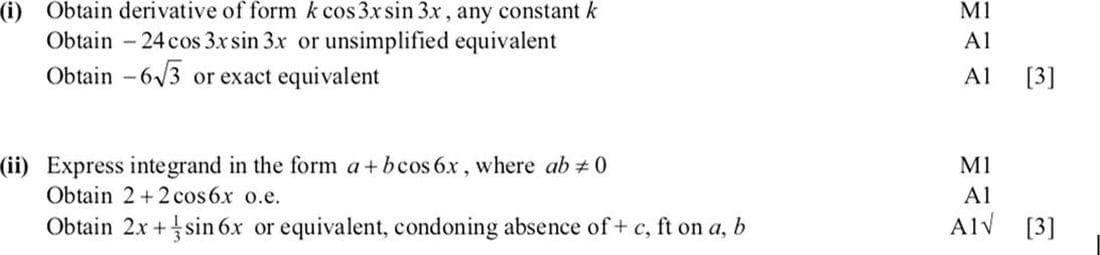
It is given that \(f(x) = 4 \cos^2 3x\).
(i) Find the exact value of \(f'(\frac{1}{9}\pi)\).
(ii) Find \(\int f(x) \, dx\).
9709 P33 - Jun 2010 - Q7
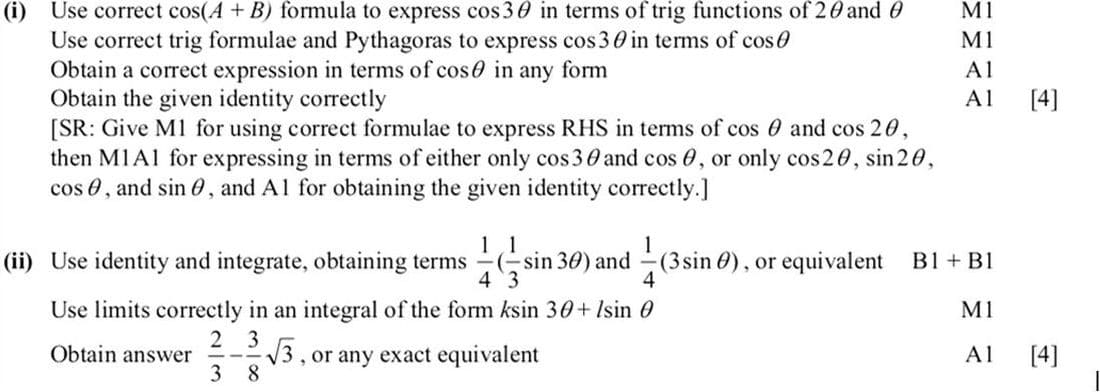
(i) Prove the identity \(\cos 3\theta \equiv 4 \cos^3 \theta - 3 \cos \theta\).
(ii) Using this result, find the exact value of \(\int_{\frac{1}{3}\pi}^{\frac{1}{2}\pi} \cos^3 \theta \, d\theta\).
9709 P31 - Jun 2010 - Q4
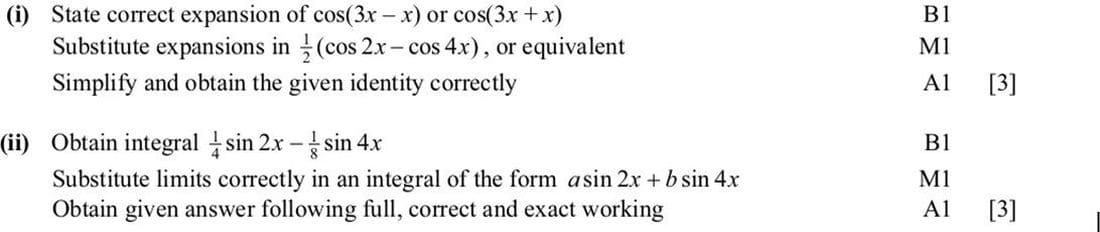
(i) Using the expansions of \(\cos(3x-x)\) and \(\cos(3x+x)\), prove that \(\frac{1}{2}(\cos 2x - \cos 4x) \equiv \sin 3x \sin x\).
(ii) Hence show that \(\int_{\frac{1}{6}\pi}^{\frac{1}{3}\pi} \sin 3x \sin x \, dx = \frac{1}{8}\sqrt{3}\).
9709 P31 - Nov 2009 - Q5
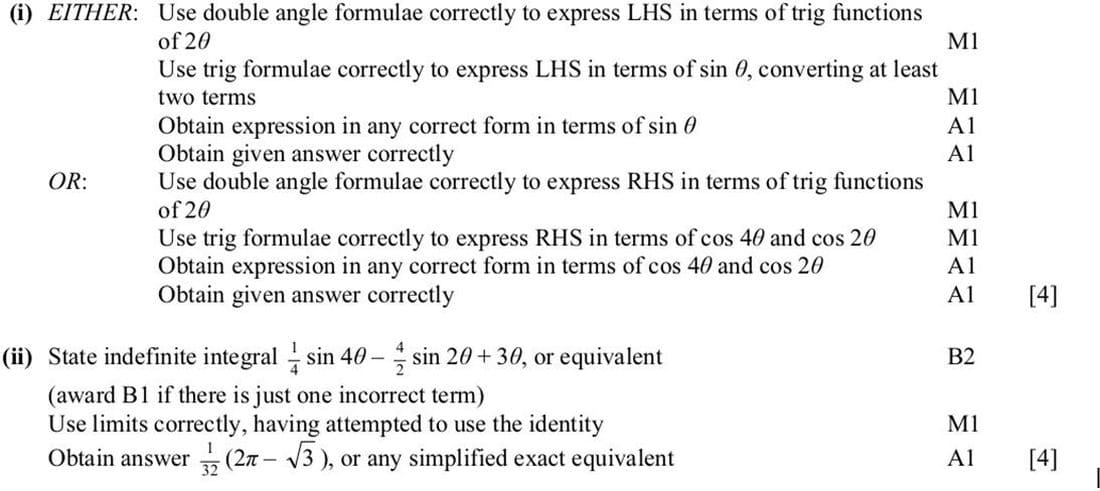
(i) Prove the identity \(\cos 4\theta - 4 \cos 2\theta + 3 \equiv 8 \sin^4 \theta\).
(ii) Using this result find, in simplified form, the exact value of \(\int_{\frac{1}{6}\pi}^{\frac{1}{3}\pi} \sin^4 \theta \, d\theta\).
9709 P32 - Nov 2021 - Q6
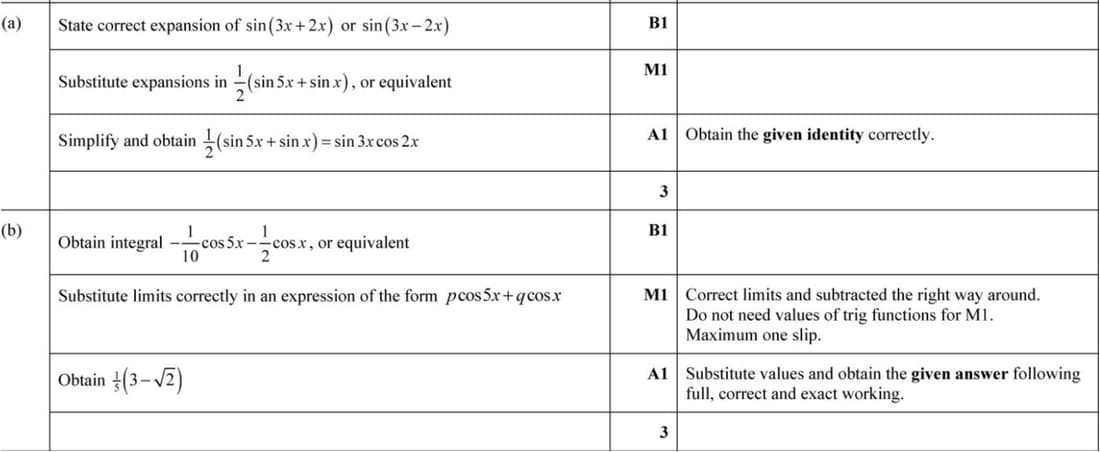
(a) Using the expansions of \(\sin(3x + 2x)\) and \(\sin(3x - 2x)\), show that \(\frac{1}{2}(\sin 5x + \sin x) \equiv \sin 3x \cos 2x\).
(b) Hence show that \(\int_0^{\frac{1}{4}\pi} \sin 3x \cos 2x \, dx = \frac{1}{5}(3 - \sqrt{2})\).
9709 P3 - Jun 2004 - Q5
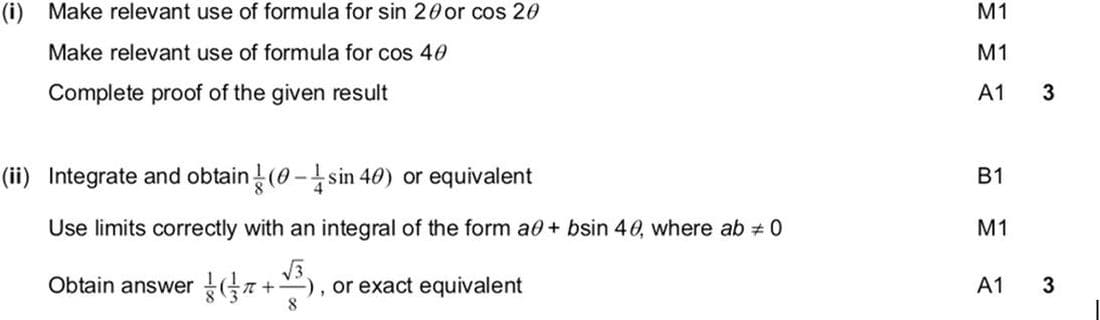
(i) Prove the identity \(\sin^2 \theta \cos^2 \theta \equiv \frac{1}{8}(1 - \cos 4\theta)\).
(ii) Hence find the exact value of \(\int_{0}^{\frac{1}{3}\pi} \sin^2 \theta \cos^2 \theta \, d\theta\).
9709 P3 - Jun 2003 - Q10
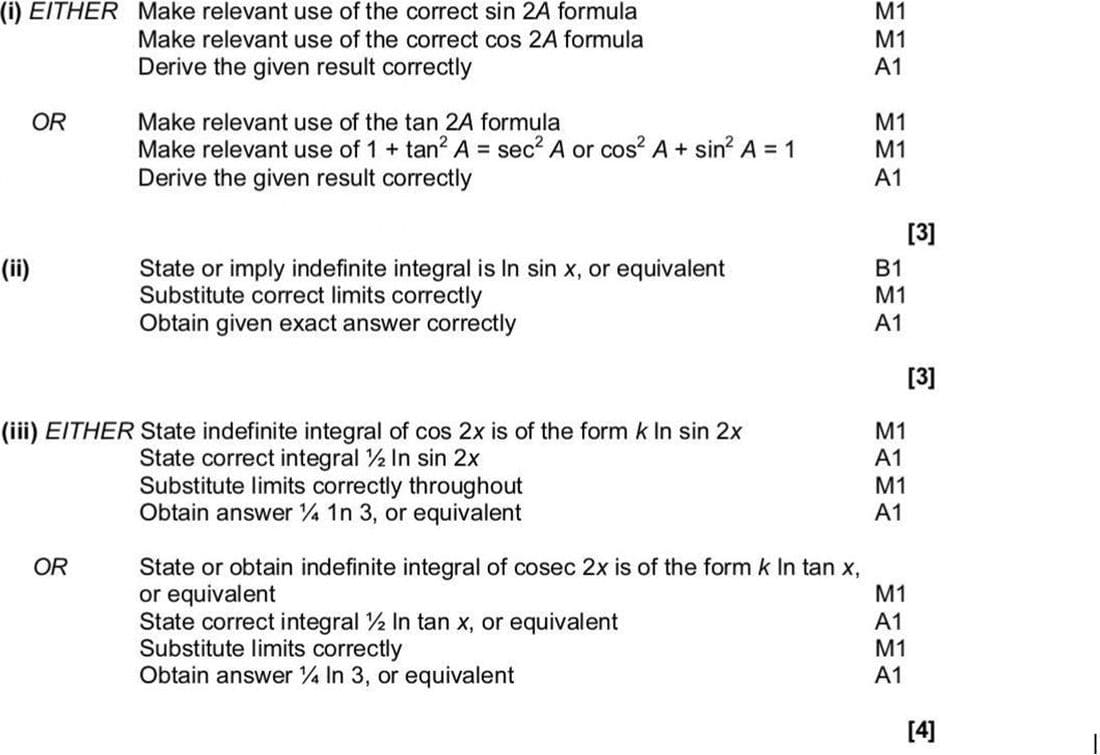
(i) Prove the identity \(\cot x - \cot 2x \equiv \csc 2x\).
(ii) Show that \(\int_{\frac{1}{6}\pi}^{\frac{1}{4}\pi} \cot x \, dx = \frac{1}{2} \ln 2\).
(iii) Find the exact value of \(\int_{\frac{1}{6}\pi}^{\frac{1}{4}\pi} \csc 2x \, dx\), giving your answer in the form \(a \ln b\).
9709 P32 - Jun 2021 - Q6
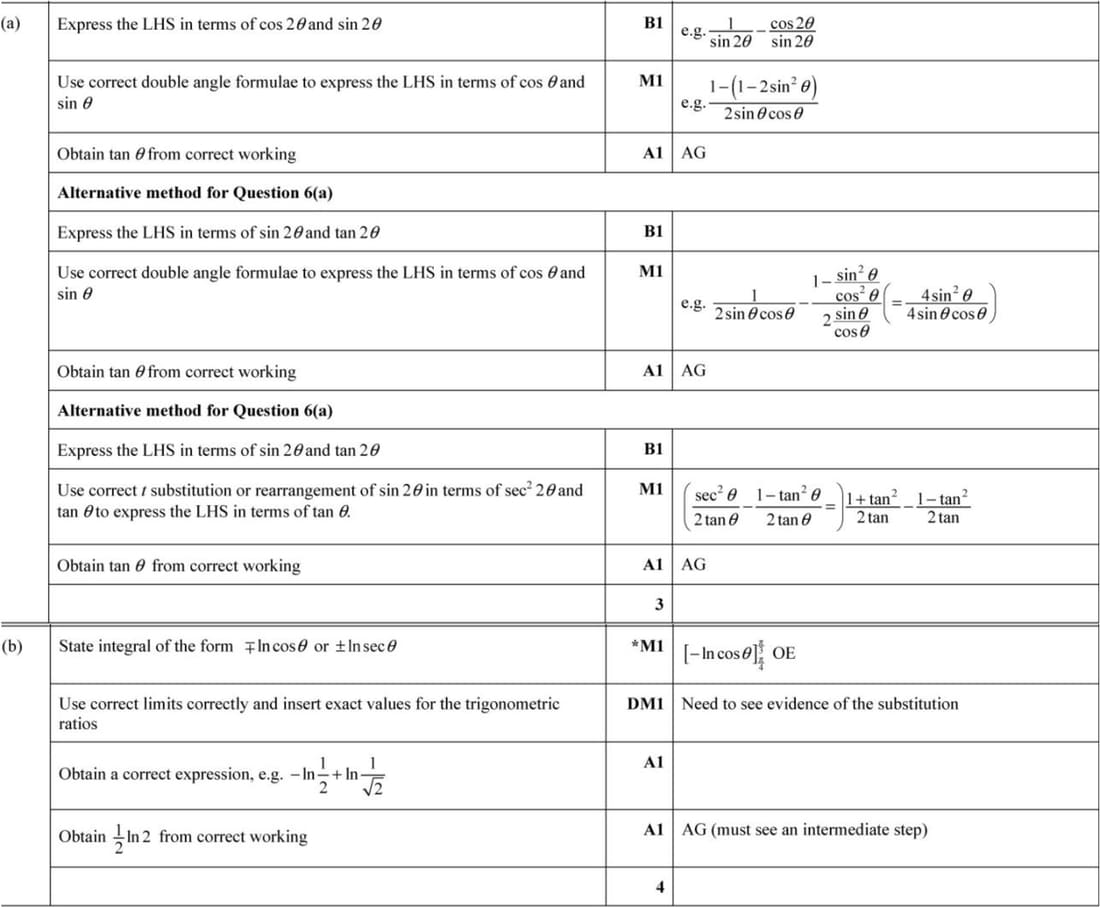
(a) Prove that \(\csc 2\theta - \cot 2\theta \equiv \tan \theta\).
(b) Hence show that \(\int_{\frac{1}{4}\pi}^{\frac{3}{4}\pi} (\csc 2\theta - \cot 2\theta) \, d\theta = \frac{1}{2} \ln 2\).
9709 P31 - Jun 2021 - Q4
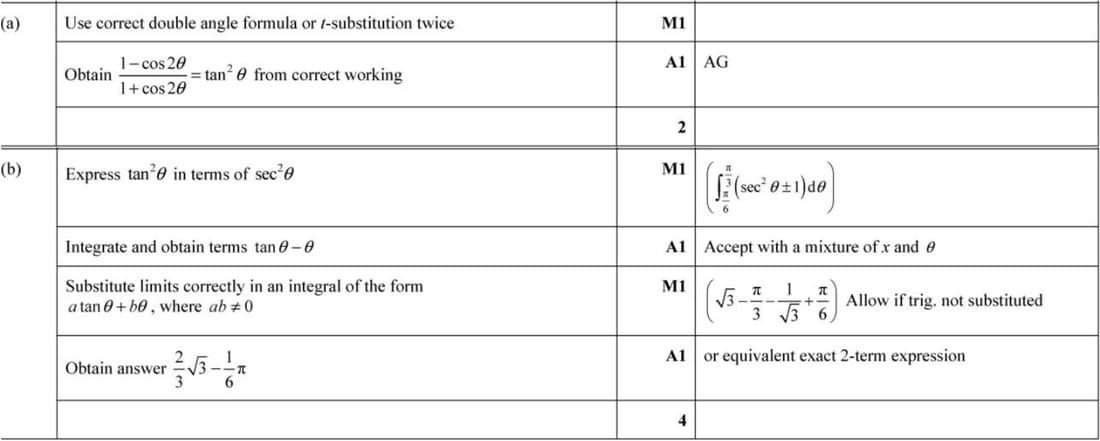
(a) Prove that \(\frac{1 - \cos 2\theta}{1 + \cos 2\theta} \equiv \tan^2 \theta\).
(b) Hence find the exact value of \(\int_{\frac{1}{6}\pi}^{\frac{1}{3}\pi} \frac{1 - \cos 2\theta}{1 + \cos 2\theta} \, d\theta\).
9709 P31 - Jun 2020 - Q7
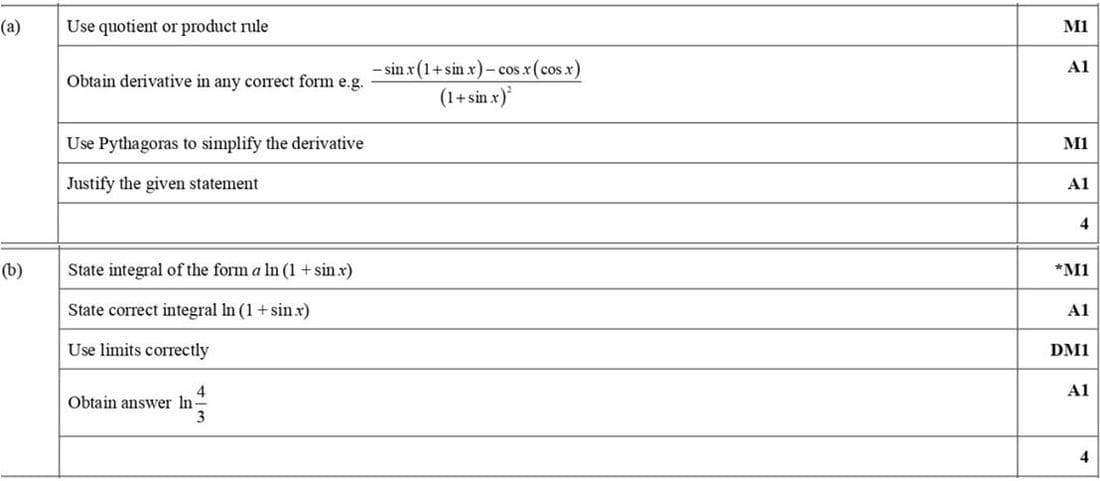
Let \(f(x) = \frac{\cos x}{1 + \sin x}\).
(a) Show that \(f'(x) < 0\) for all \(x\) in the interval \(-\frac{1}{2}\pi < x < \frac{3}{2}\pi\).
(b) Find \(\int_{\frac{1}{6}\pi}^{\frac{1}{2}\pi} f(x) \, dx\). Give your answer in a simplified exact form.
9709 P33 - Jun 2019 - Q3
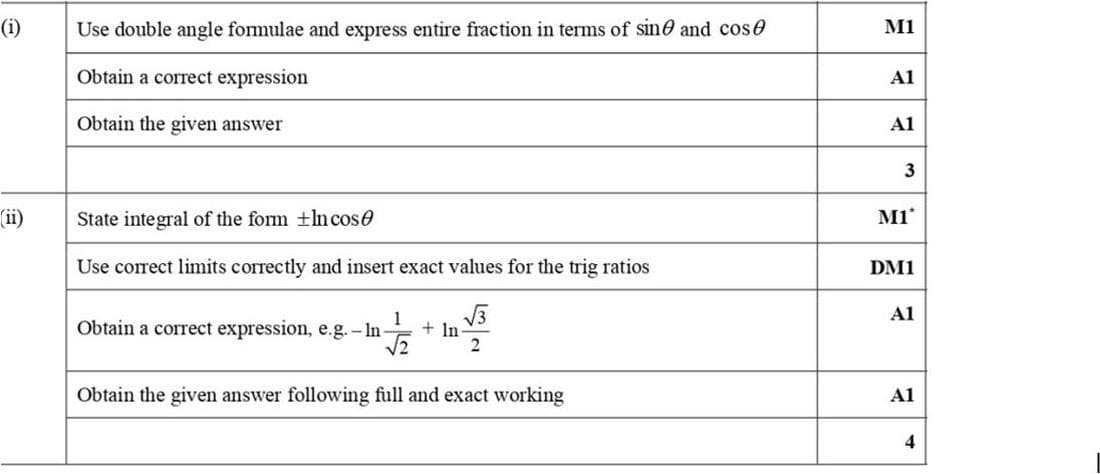
Let \(f(\theta) = \frac{1 - \cos 2\theta + \sin 2\theta}{1 + \cos 2\theta + \sin 2\theta}\).
(i) Show that \(f(\theta) = \tan \theta\).
(ii) Hence show that \(\int_{\frac{\pi}{6}}^{\frac{\pi}{4}} f(\theta) \, d\theta = \frac{1}{2} \ln \frac{3}{2}\).
9709 P31 - Jun 2019 - Q6
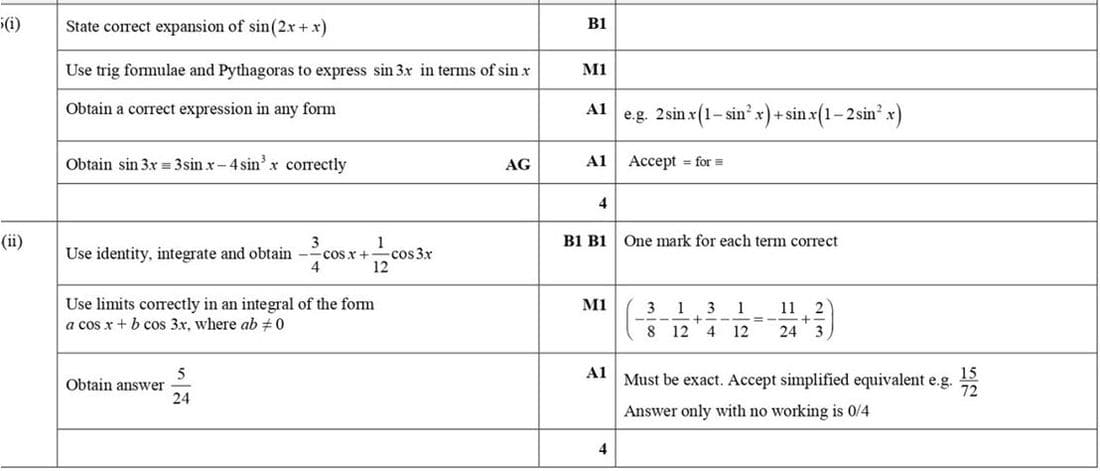
(i) By first expanding \(\sin(2x + x)\), show that \(\sin 3x \equiv 3 \sin x - 4 \sin^3 x\).
(ii) Hence, showing all necessary working, find the exact value of \(\int_0^{\frac{1}{3}\pi} \sin^3 x \, dx\).
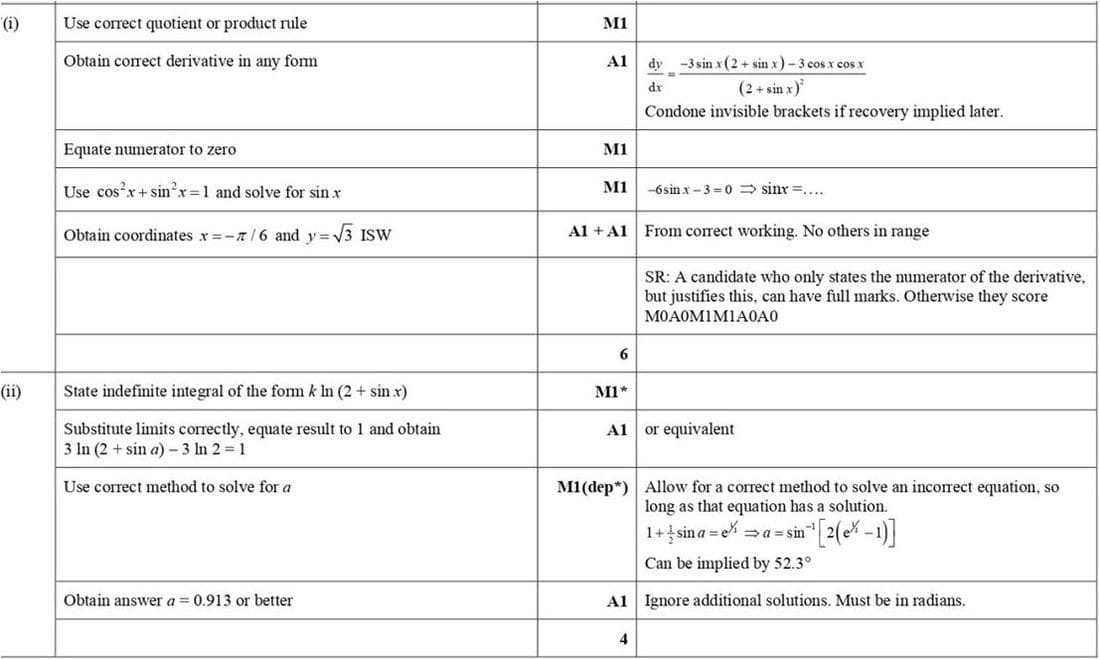
9709 P32 - Nov 2018 - Q7
A curve has equation \(y = \frac{3 \cos x}{2 + \sin x}\), for \(-\frac{1}{2}\pi \leq x \leq \frac{1}{2}\pi\).
(i) Find the exact coordinates of the stationary point of the curve.
(ii) The constant \(a\) is such that \(\int_0^a \frac{3 \cos x}{2 + \sin x} \, dx = 1\). Find the value of \(a\), giving your answer correct to 3 significant figures.
9709 P32 - Jun 2018 - Q4
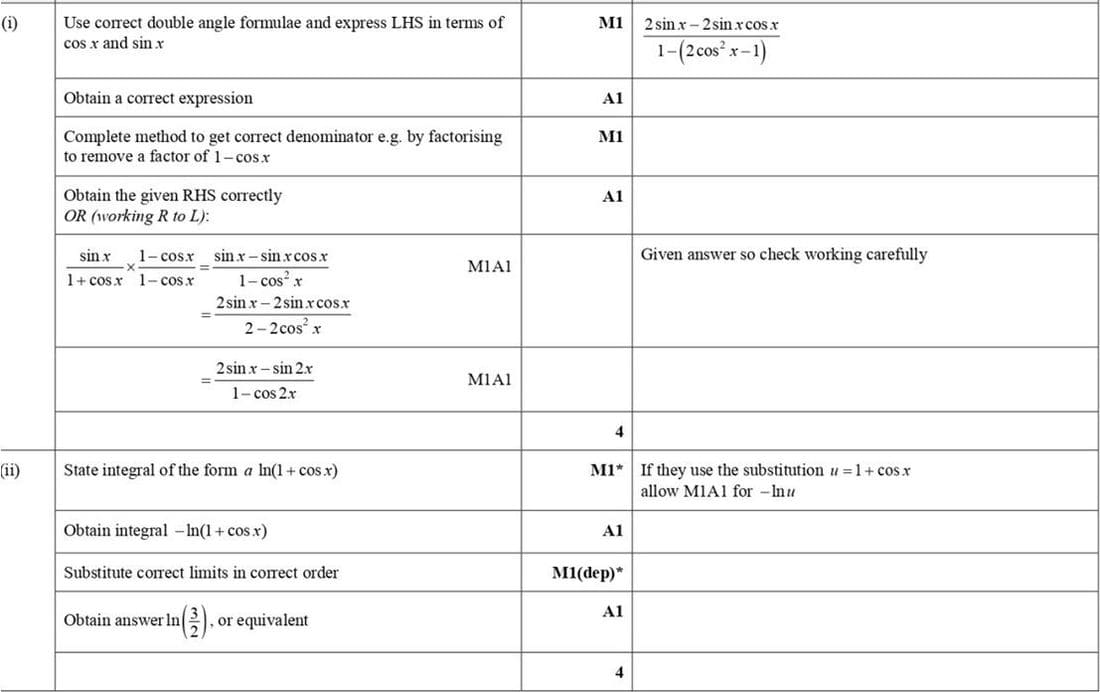
(i) Show that \(\frac{2 \sin x - \sin 2x}{1 - \cos 2x} \equiv \frac{\sin x}{1 + \cos x}\).
(ii) Hence, showing all necessary working, find \(\int_{\frac{1}{3}\pi}^{\frac{1}{2}\pi} \frac{2 \sin x - \sin 2x}{1 - \cos 2x} \, dx\), giving your answer in the form \(\ln k\).