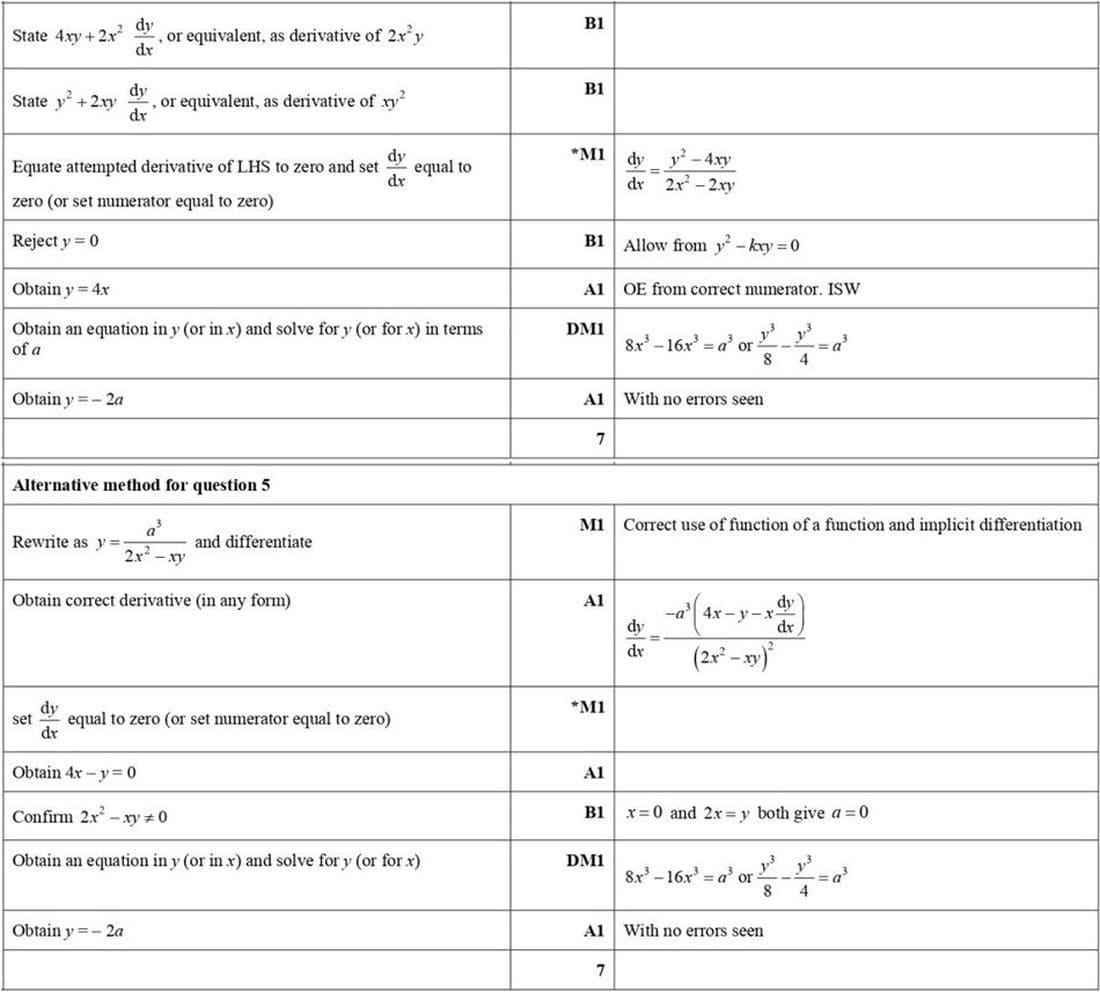
9709 P33 - Nov 2023 - Q7
The equation of a curve is \(x^3 + y^2 + 3x^2 + 3y = 4\).
(a) Show that \(\frac{dy}{dx} = -\frac{3x^2 + 6x}{2y + 3}\).
(b) Hence find the coordinates of the points on the curve at which the tangent is parallel to the x-axis.
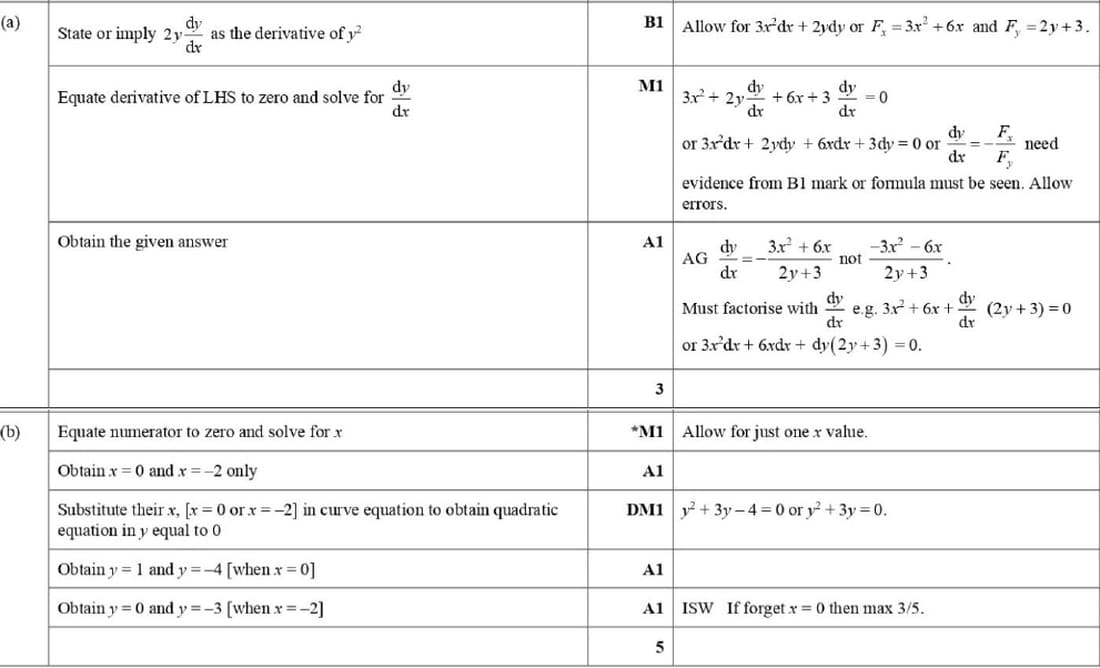
9709 P31 - Jun 2019 - Q3
Find the gradient of the curve \(x^3 + 3xy^2 - y^3 = 1\) at the point with coordinates (1, 3).
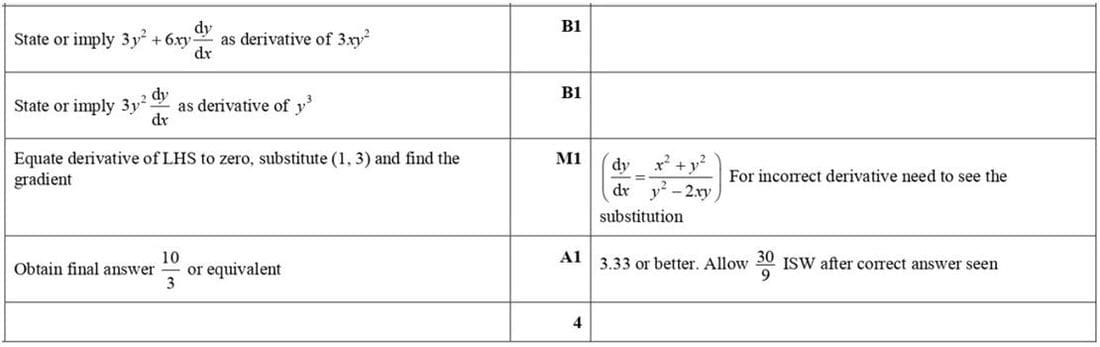
9709 P32 - Mar 2019 - Q5
The variables x and y satisfy the relation \(\sin y = \tan x\), where \(-\frac{1}{2}\pi < y < \frac{1}{2}\pi\). Show that \(\frac{dy}{dx} = \frac{1}{\cos x \sqrt{\cos 2x}}\).
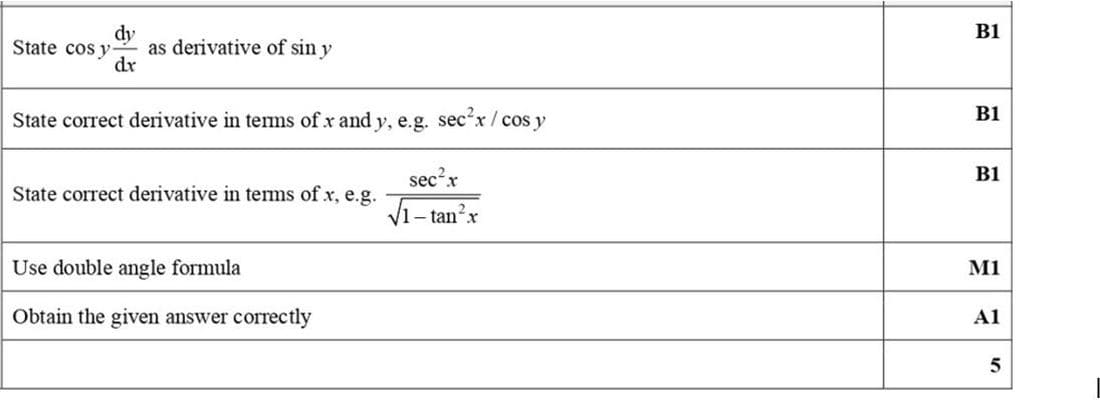
9709 P33 - Jun 2018 - Q8
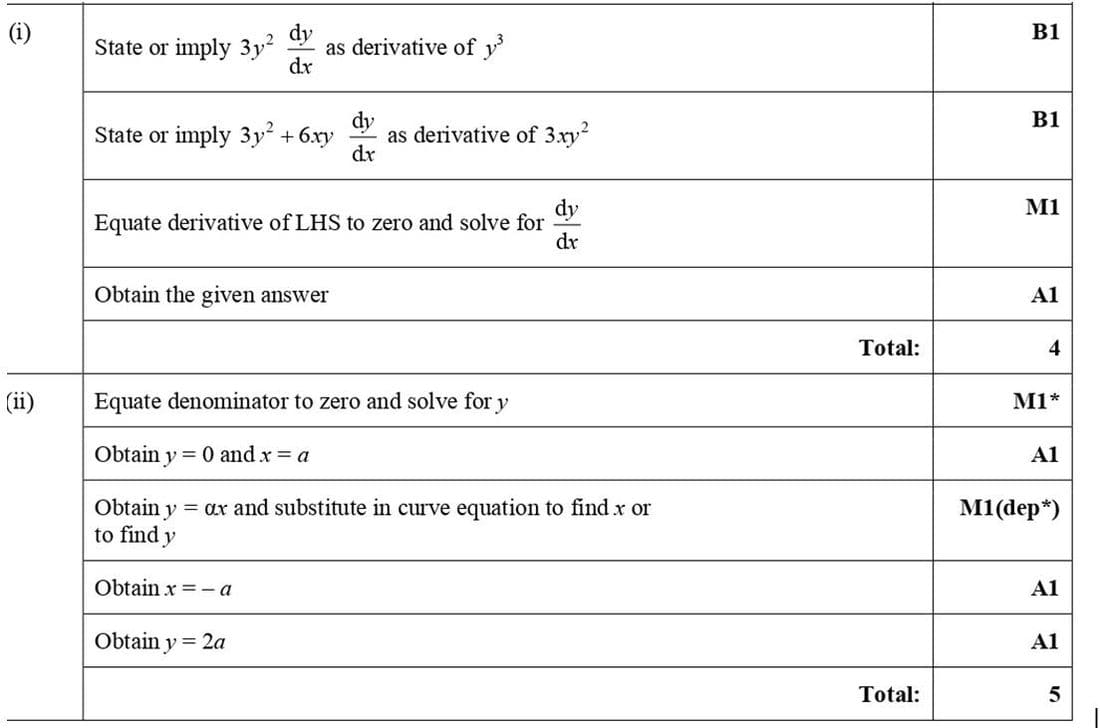
The equation of a curve is \(2x^3 - y^3 - 3xy^2 = 2a^3\), where \(a\) is a non-zero constant.
- Show that \(\frac{dy}{dx} = \frac{2x^2 - y^2}{y^2 + 2xy}\).
- Find the coordinates of the two points on the curve at which the tangent is parallel to the y-axis.
9709 P32 - Jun 2018 - Q5
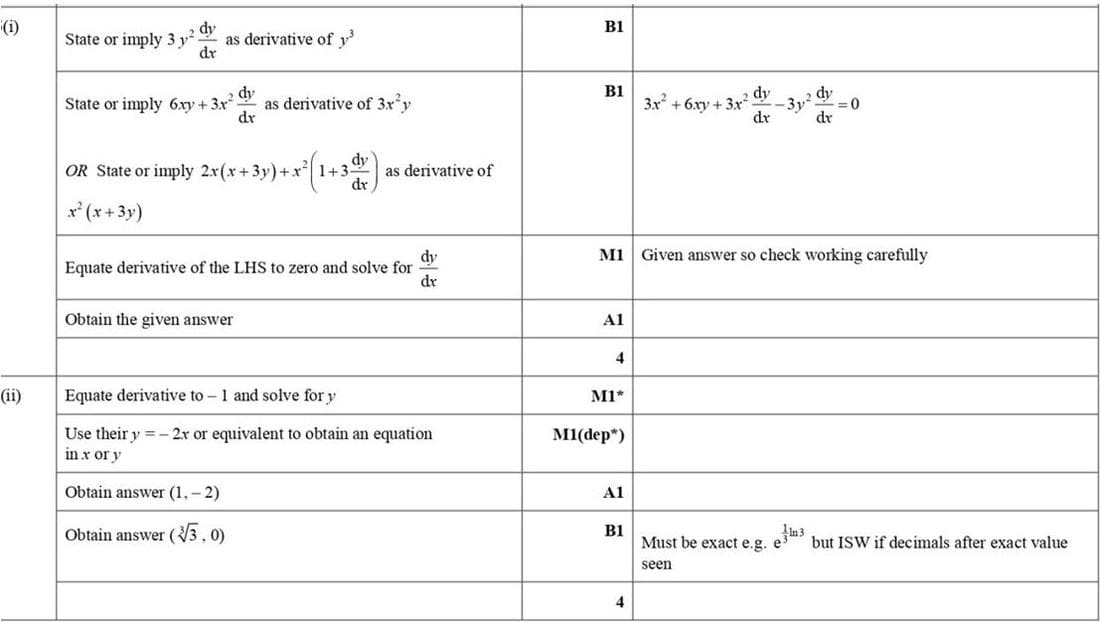
The equation of a curve is \(x^2(x + 3y) - y^3 = 3\).
(i) Show that \(\frac{dy}{dx} = \frac{x^2 + 2xy}{y^2 - x^2}\).
(ii) Hence find the exact coordinates of the two points on the curve at which the gradient of the normal is 1.
9709 P32 - Nov 2017 - Q6
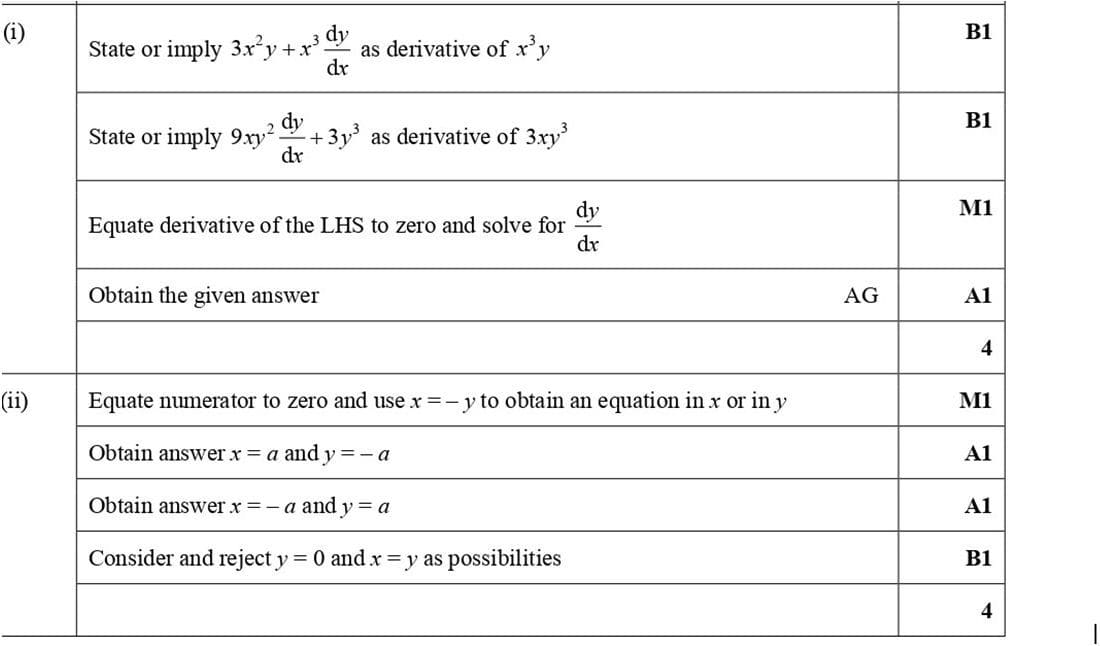
The equation of a curve is \(x^3 y - 3xy^3 = 2a^4\), where \(a\) is a non-zero constant.
(i) Show that \(\frac{dy}{dx} = \frac{3x^2 y - 3y^3}{9xy^2 - x^3}\).
(ii) Hence show that there are only two points on the curve at which the tangent is parallel to the \(x\)-axis and find the coordinates of these points.
9709 P31 - Nov 2017 - Q5
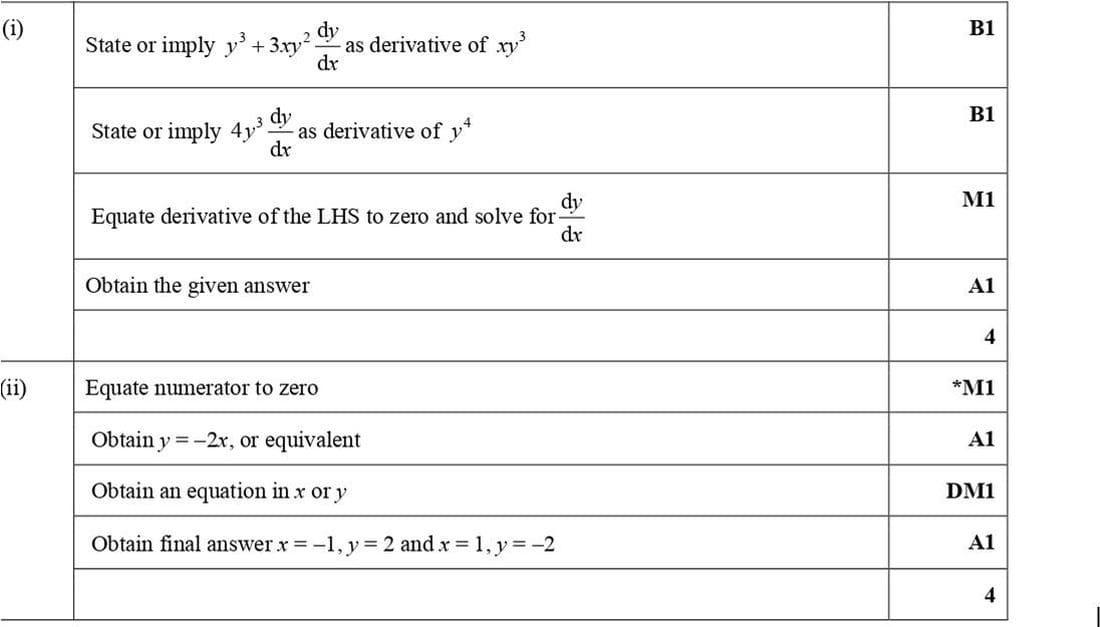
The equation of a curve is \(2x^4 + xy^3 + y^4 = 10\).
(i) Show that \(\frac{dy}{dx} = -\frac{8x^3 + y^3}{3xy^2 + 4y^3}\).
(ii) Hence show that there are two points on the curve at which the tangent is parallel to the x-axis and find the coordinates of these points.
9709 P31 - Nov 2016 - Q4
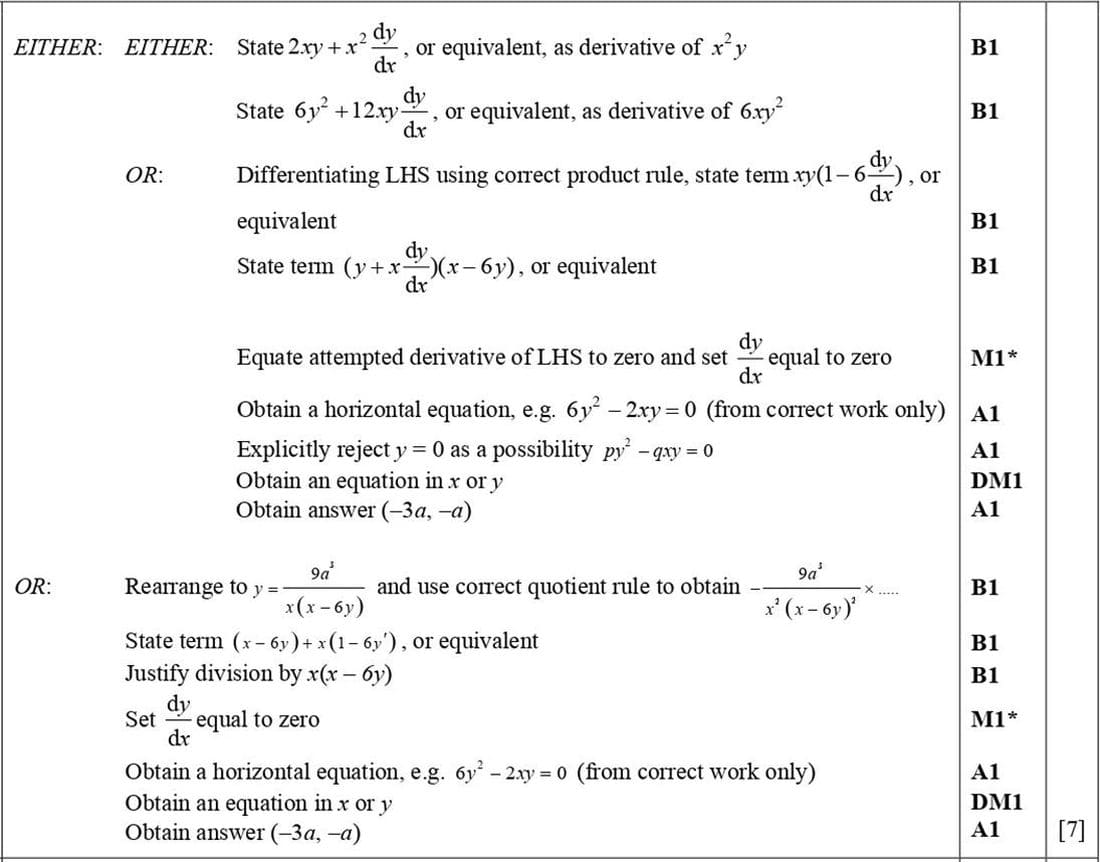
The equation of a curve is \(xy(x - 6y) = 9a^3\), where \(a\) is a non-zero constant. Show that there is only one point on the curve at which the tangent is parallel to the \(x\)-axis, and find the coordinates of this point.
9709 P31 - Jun 2016 - Q7
The equation of a curve is \(x^3 - 3x^2y + y^3 = 3\).
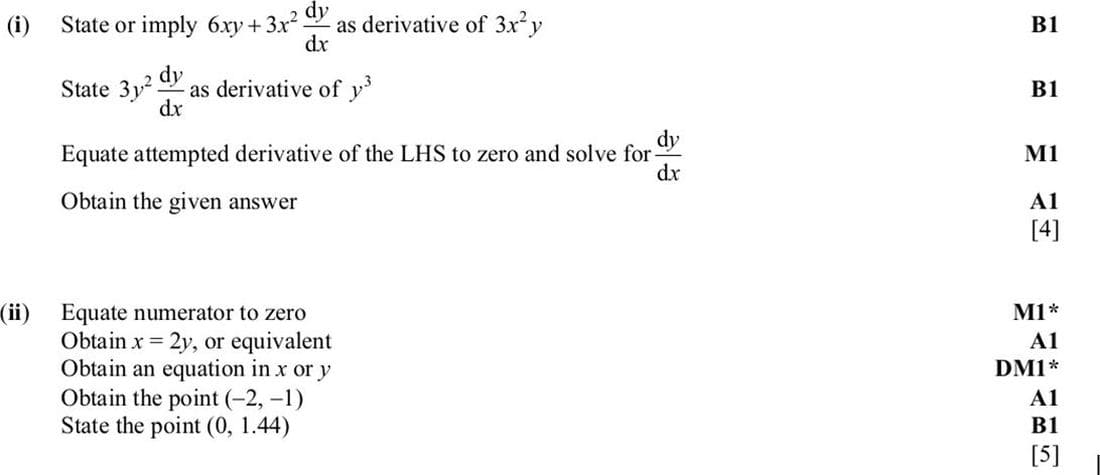
(i) Show that \(\frac{dy}{dx} = \frac{x^2 - 2xy}{x^2 - y^2}\).
(ii) Find the coordinates of the points on the curve where the tangent is parallel to the x-axis.
9709 P32 - Mar 2016 - Q6
A curve has equation \(\sin y \ln x = x - 2 \sin y\), for \(-\frac{1}{2}\pi \leq y \leq \frac{1}{2}\pi\).
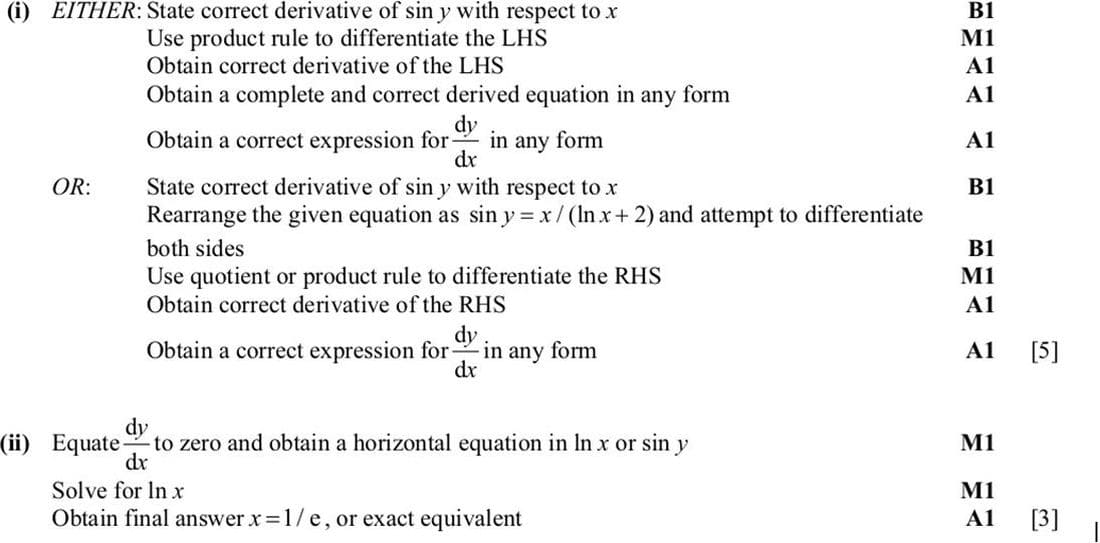
(i) Find \(\frac{dy}{dx}\) in terms of \(x\) and \(y\).
(ii) Hence find the exact \(x\)-coordinate of the point on the curve at which the tangent is parallel to the \(x\)-axis.
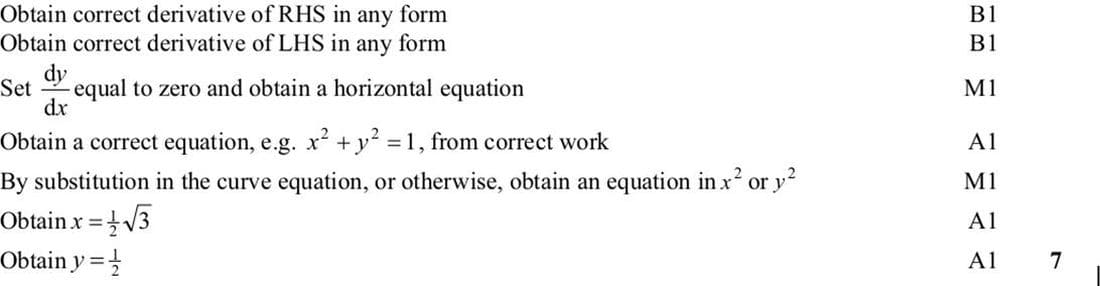
9709 P33 - Jun 2014 - Q6
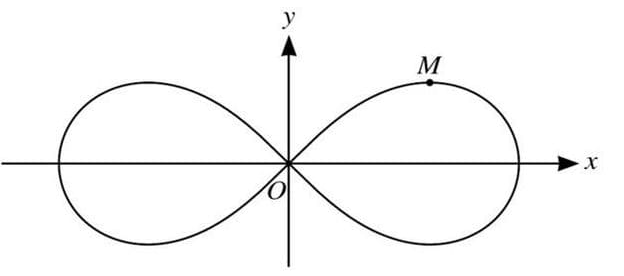
The diagram shows the curve \((x^2 + y^2)^2 = 2(x^2 - y^2)\) and one of its maximum points \(M\). Find the coordinates of \(M\).
9709 P32 - Jun 2023 - Q7
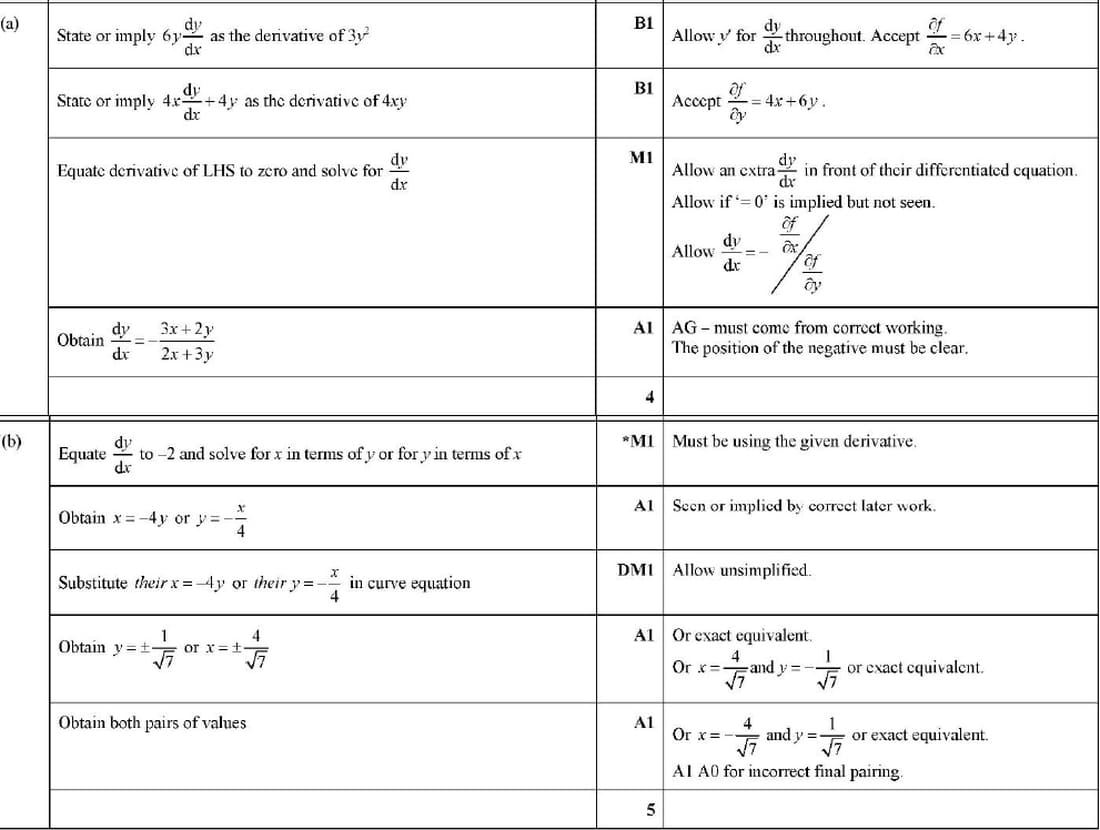
The equation of a curve is \(3x^2 + 4xy + 3y^2 = 5\).
(a) Show that \(\frac{dy}{dx} = -\frac{3x + 2y}{2x + 3y}\).
(b) Hence find the exact coordinates of the two points on the curve at which the tangent is parallel to \(y + 2x = 0\).
9709 P32 - Nov 2013 - Q1
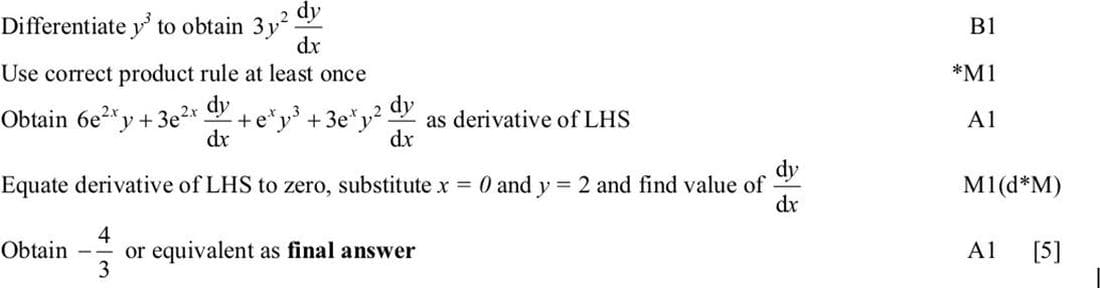
A curve has equation \(3e^{2x}y + e^xy^3 = 14\). Find the gradient of the curve at the point \((0, 2)\).
9709 P32 - Jun 2013 - Q5
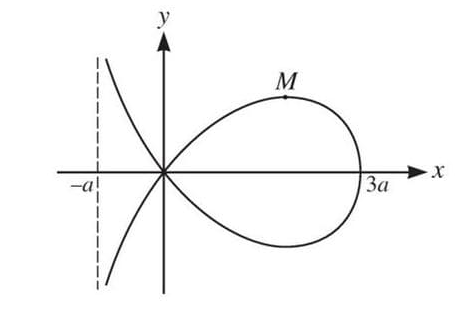
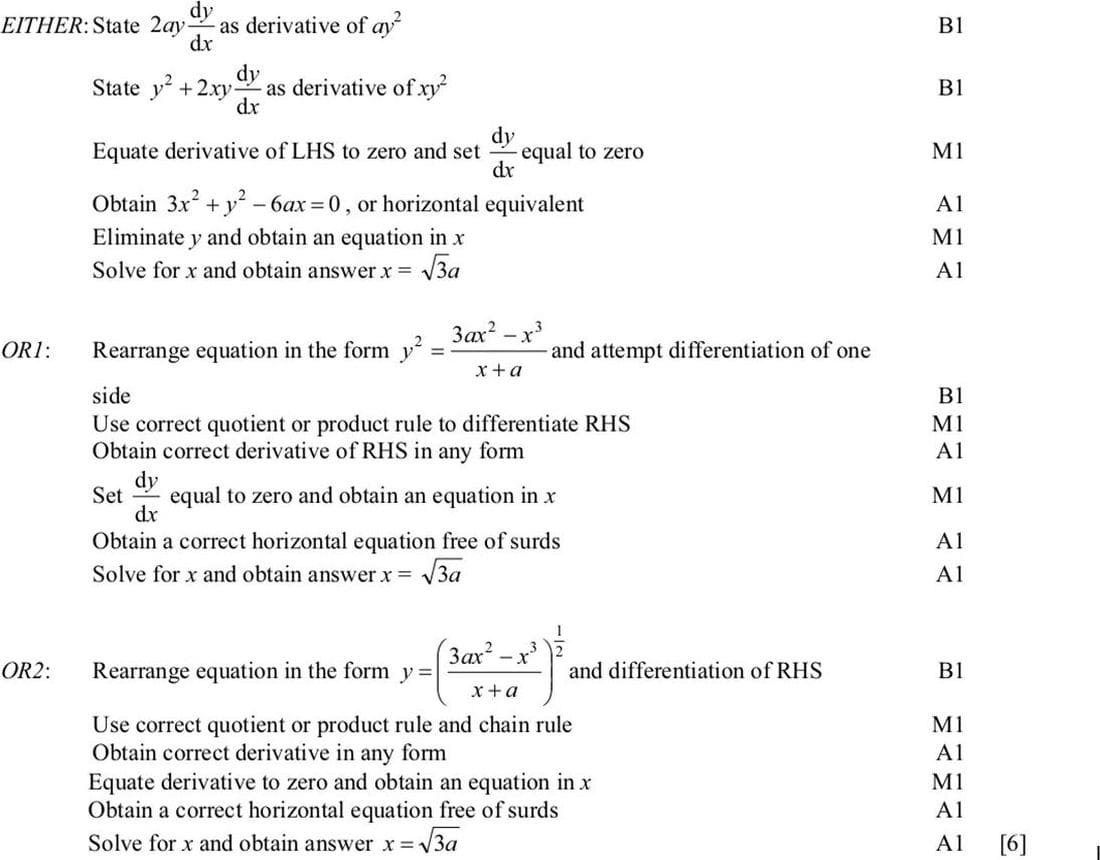
The diagram shows the curve with equation
\(x^3 + xy^2 + ay^2 - 3ax^2 = 0\),
where \(a\) is a positive constant. The maximum point on the curve is \(M\). Find the \(x\)-coordinate of \(M\) in terms of \(a\).
9709 P31 - Jun 2013 - Q5
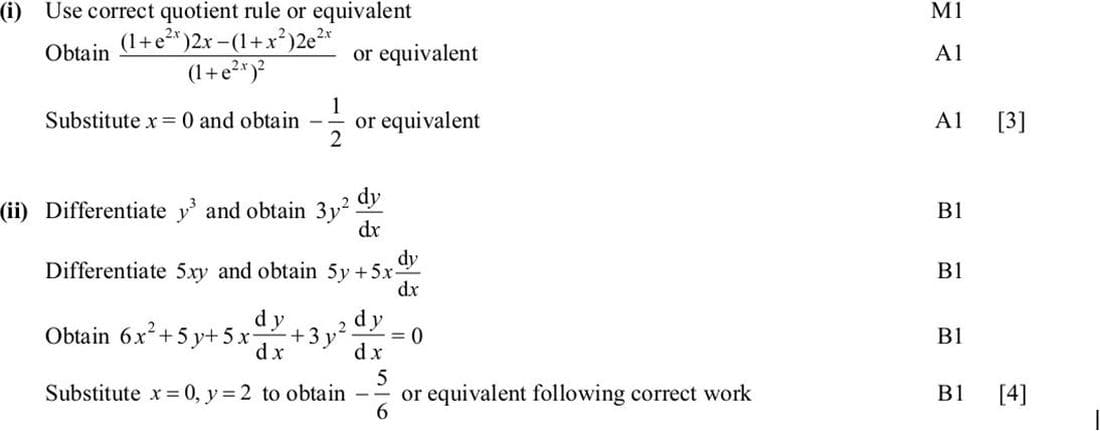
For each of the following curves, find the gradient at the point where the curve crosses the y-axis:
(i) \(y = \frac{1 + x^2}{1 + e^{2x}}\);
(ii) \(2x^3 + 5xy + y^3 = 8\).
9709 P31 - Nov 2012 - Q7
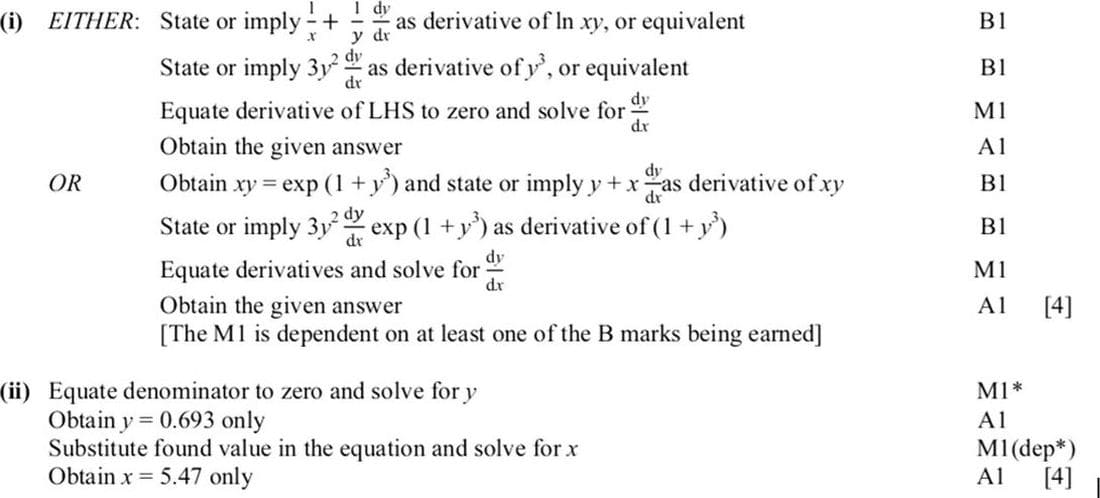
The equation of a curve is \(\ln(xy) - y^3 = 1\).
(i) Show that \(\frac{dy}{dx} = \frac{y}{x(3y^3 - 1)}\).
(ii) Find the coordinates of the point where the tangent to the curve is parallel to the y-axis, giving each coordinate correct to 3 significant figures.
9709 P31 - Jun 2012 - Q6
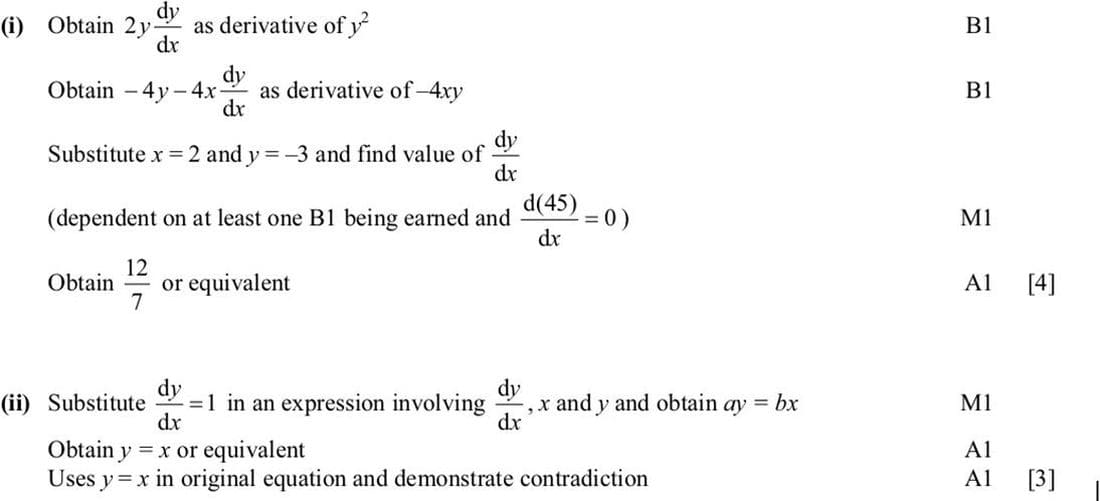
The equation of a curve is \(3x^2 - 4xy + y^2 = 45\).
(i) Find the gradient of the curve at the point \((2, -3)\).
(ii) Show that there are no points on the curve at which the gradient is 1.
9709 P32 - Jun 2010 - Q6
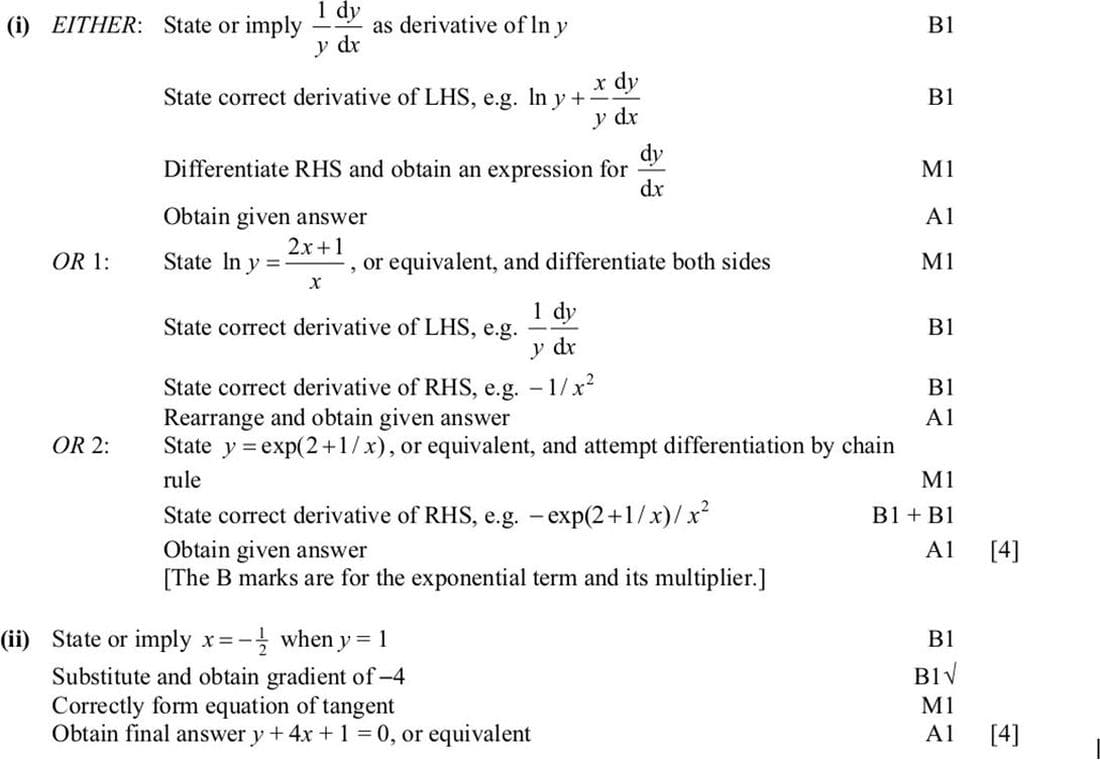
The equation of a curve is
\(x \ln y = 2x + 1\).
- Show that \(\frac{dy}{dx} = -\frac{y}{x^2}\).
- Find the equation of the tangent to the curve at the point where \(y = 1\), giving your answer in the form \(ax + by + c = 0\).
9709 P32 - Nov 2009 - Q3
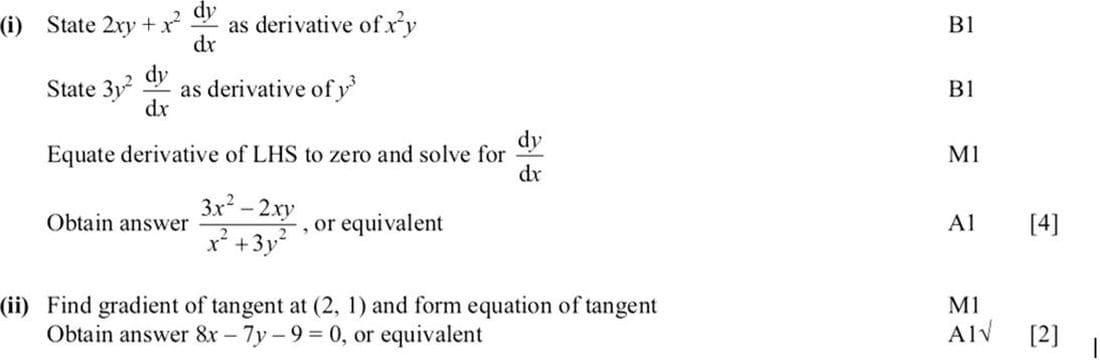
The equation of a curve is \(x^3 - x^2y - y^3 = 3\).
(i) Find \(\frac{dy}{dx}\) in terms of \(x\) and \(y\).
(ii) Find the equation of the tangent to the curve at the point \((2, 1)\), giving your answer in the form \(ax + by + c = 0\).
9709 P3 - Jun 2008 - Q6
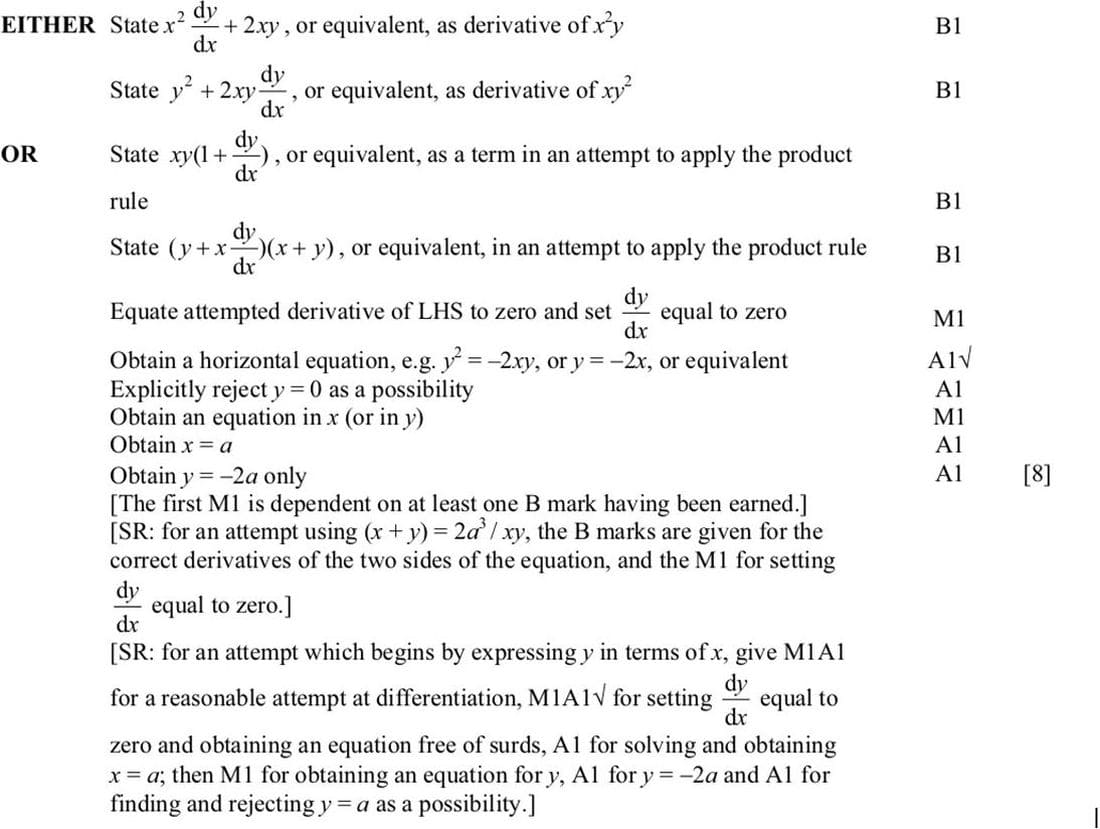
The equation of a curve is \(xy(x+y) = 2a^3\), where \(a\) is a non-zero constant. Show that there is only one point on the curve at which the tangent is parallel to the \(x\)-axis, and find the coordinates of this point.
9709 P3 - Nov 2006 - Q6
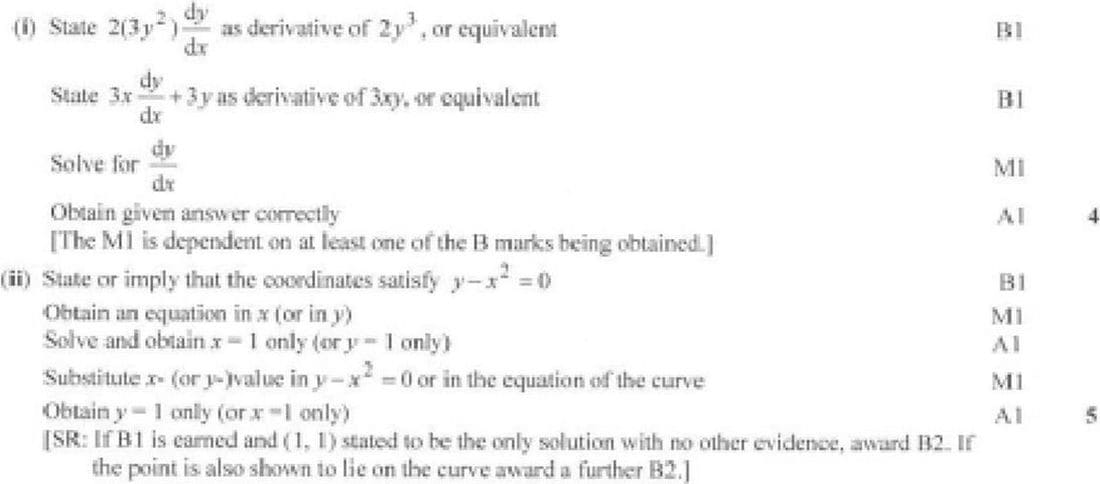
The equation of a curve is \(x^3 + 2y^3 = 3xy\).
(i) Show that \(\frac{dy}{dx} = \frac{y - x^2}{2y^2 - x}\).
(ii) Find the coordinates of the point, other than the origin, where the curve has a tangent which is parallel to the \(x\)-axis.
9709 P3 - Jun 2004 - Q3
Find the gradient of the curve with equation
\(2x^2 - 4xy + 3y^2 = 3\),
at the point \((2, 1)\).
9709 P31 - Jun 2023 - Q5
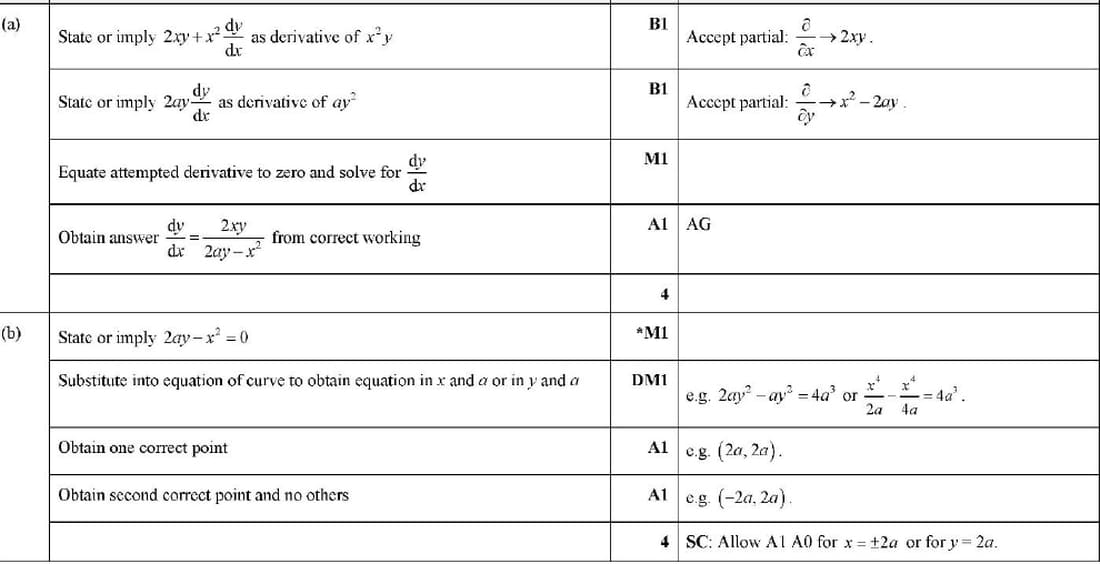
The equation of a curve is \(x^2y - ay^2 = 4a^3\), where \(a\) is a non-zero constant.
(a) Show that \(\frac{dy}{dx} = \frac{2xy}{2ay - x^2}\).
(b) Hence find the coordinates of the points where the tangent to the curve is parallel to the y-axis.
9709 P3 - Nov 2003 - Q4
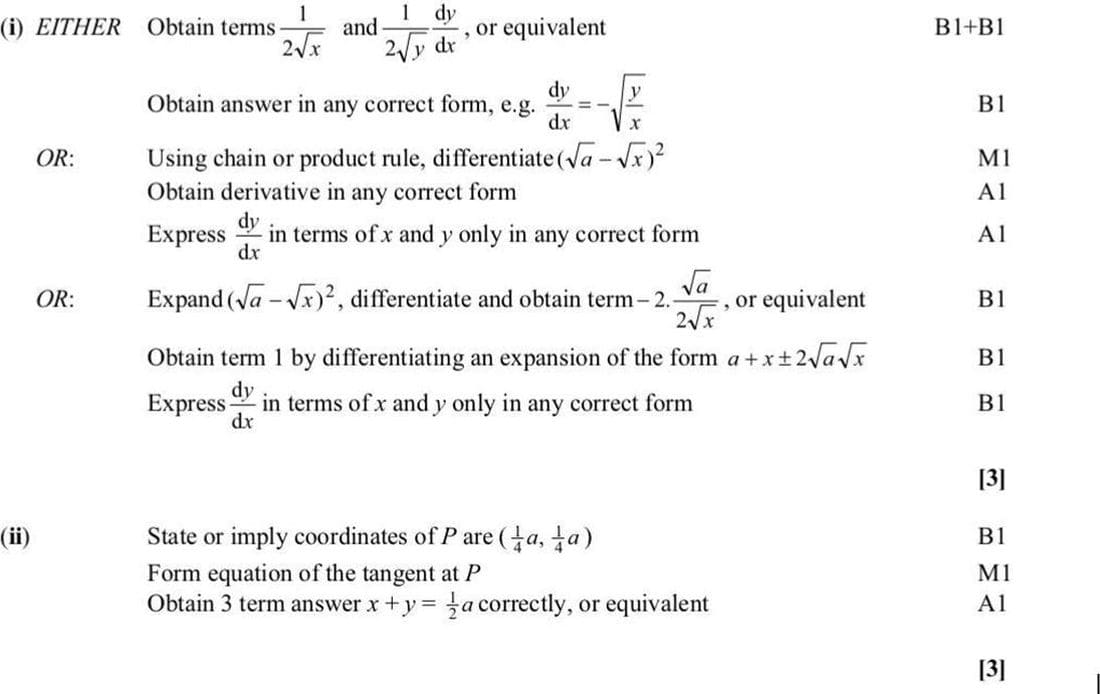
The equation of a curve is \(\sqrt{x} + \sqrt{y} = \sqrt{a}\), where \(a\) is a positive constant.
(i) Express \(\frac{dy}{dx}\) in terms of \(x\) and \(y\).
(ii) The straight line with equation \(y = x\) intersects the curve at the point \(P\). Find the equation of the tangent to the curve at \(P\).
9709 P32 - Jun 2022 - Q7
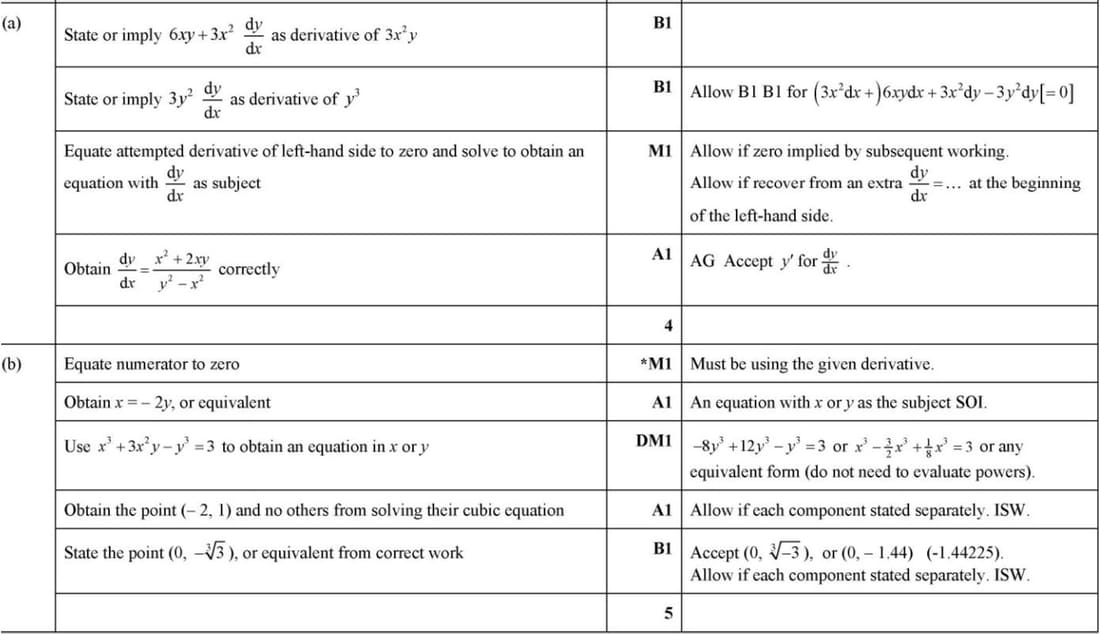
The equation of a curve is \(x^3 + 3x^2y - y^3 = 3\).
(a) Show that \(\frac{dy}{dx} = \frac{x^2 + 2xy}{y^2 - x^2}\).
(b) Find the coordinates of the points on the curve where the tangent is parallel to the x-axis.
9709 P31 - Jun 2022 - Q8
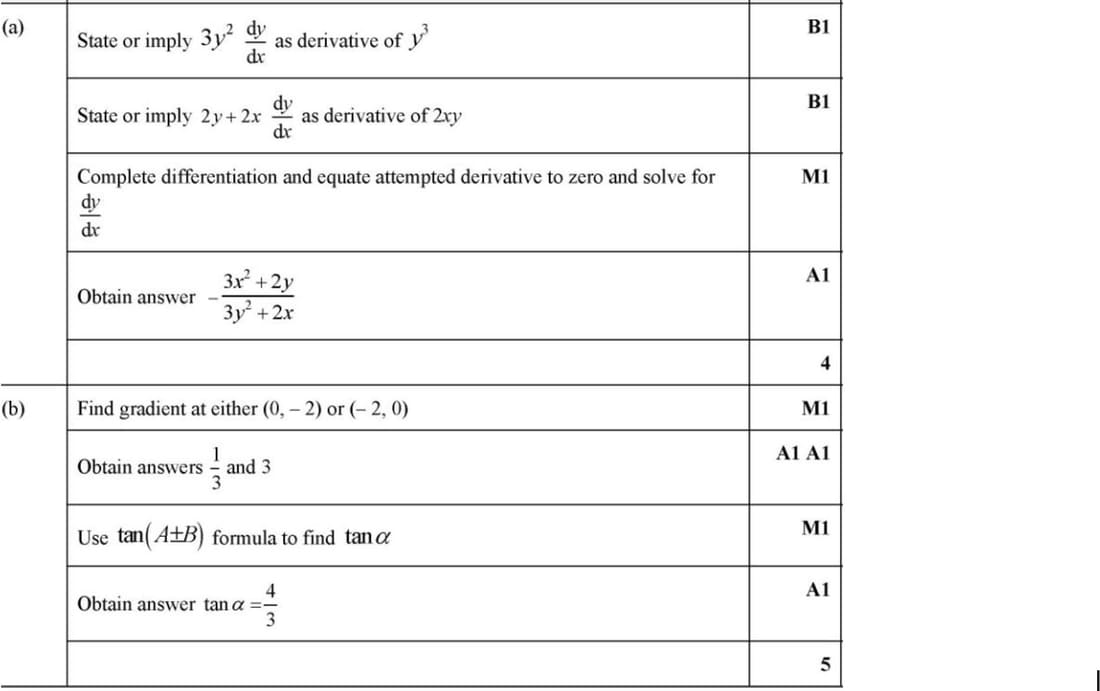
The equation of a curve is \(x^3 + y^3 + 2xy + 8 = 0\).
(a) Express \(\frac{dy}{dx}\) in terms of \(x\) and \(y\).
The tangent to the curve at the point where \(x = 0\) and the tangent at the point where \(y = 0\) intersect at the acute angle \(\alpha\).
(b) Find the exact value of \(\tan \alpha\).
9709 P33 - Nov 2021 - Q7
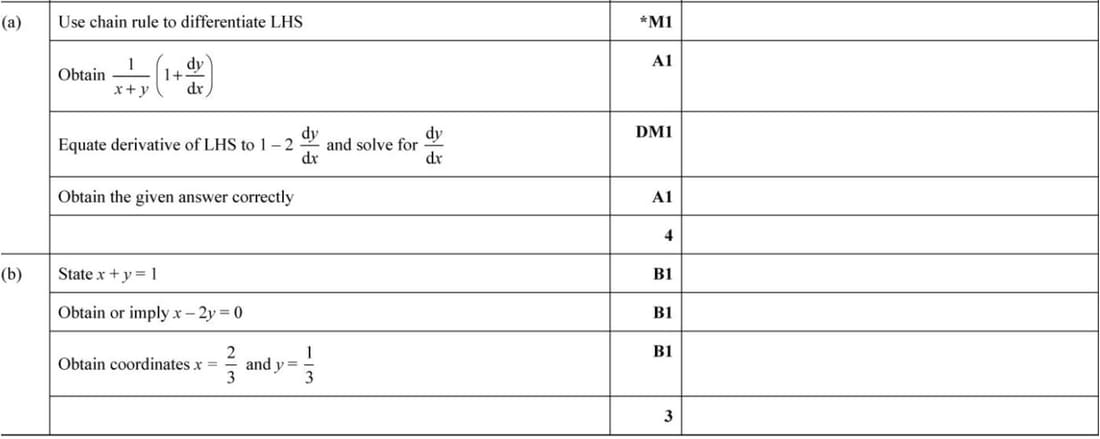
The equation of a curve is \(\ln(x+y) = x - 2y\).
(a) Show that \(\frac{dy}{dx} = \frac{x+y-1}{2(x+y)+1}\).
(b) Find the coordinates of the point on the curve where the tangent is parallel to the \(x\)-axis.
9709 P32 - Nov 2021 - Q9
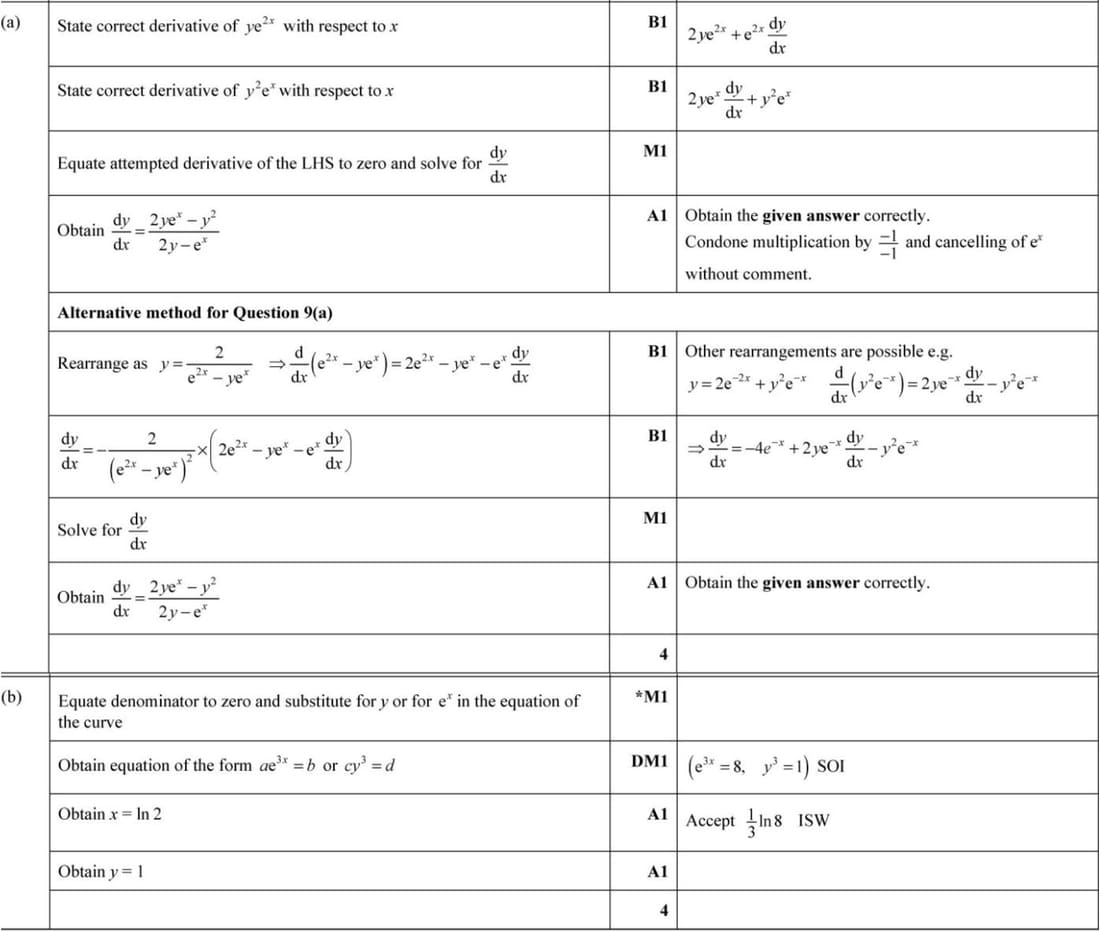
The equation of a curve is \(ye^{2x} - y^2 e^x = 2\).
(a) Show that \(\frac{dy}{dx} = \frac{2ye^x - y^2}{2y - e^x}\).
(b) Find the exact coordinates of the point on the curve where the tangent is parallel to the y-axis.
9709 P32 - Mar 2020 - Q7
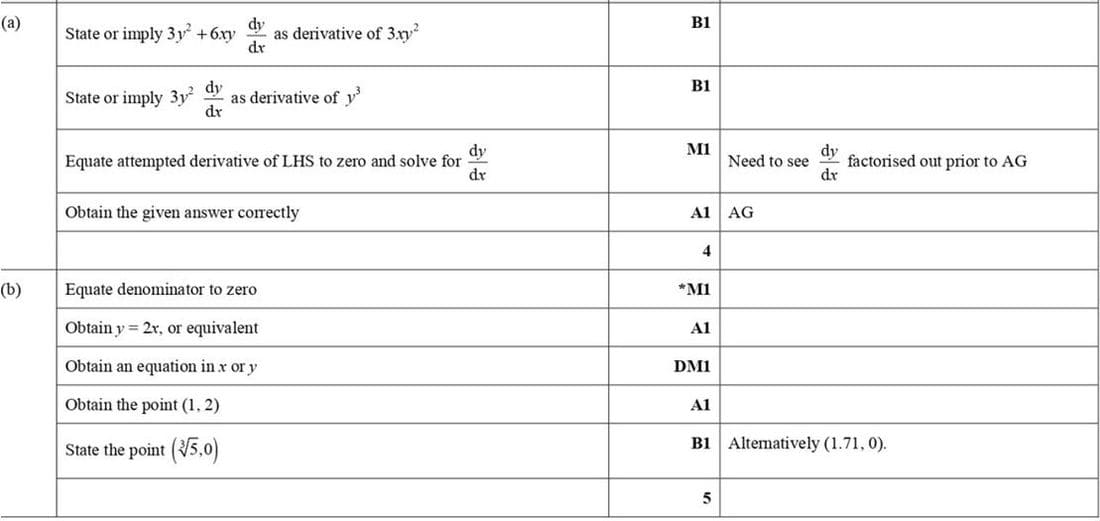
The equation of a curve is \(x^3 + 3xy^2 - y^3 = 5\).
(a) Show that \(\frac{dy}{dx} = \frac{x^2 + y^2}{y^2 - 2xy}\).
(b) Find the coordinates of the points on the curve where the tangent is parallel to the y-axis.
9709 P32 - Nov 2019 - Q5
The equation of a curve is \(2x^2y - xy^2 = a^3\), where \(a\) is a positive constant. Show that there is only one point on the curve at which the tangent is parallel to the \(x\)-axis and find the \(y\)-coordinate of this point.