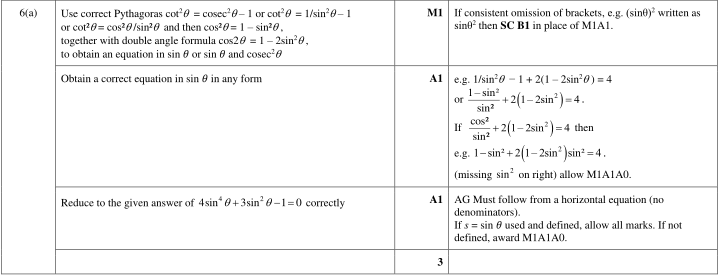
9709 P32 - Jun 2023 - Q4 - 5 marks
Solve \(2\cos x-\cos(x/2)=1\) for \(0\leq x\leq2\pi\). [5]
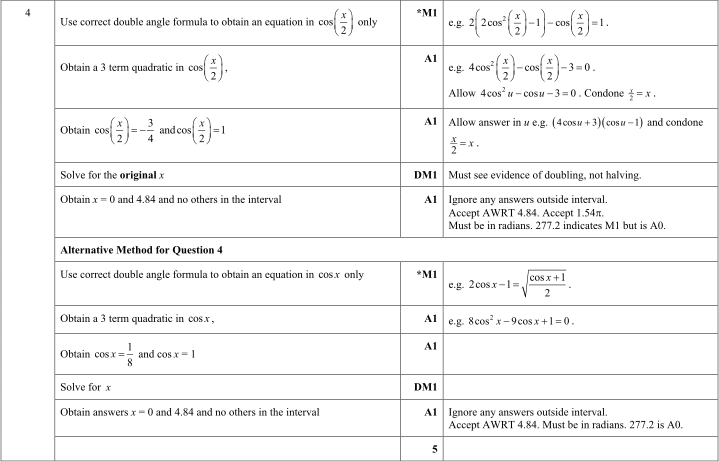
9709 P31 - Jun 2023 - Q4 - 6 marks
(a) Show that \(\sin2\theta+\cos2\theta=2\sin^2\theta\) can be written \(\cos^2\theta+2\sin\theta\cos\theta-3\sin^2\theta=0\). [2]
(b) Hence solve the original equation for \(0^\circ<\theta<180^\circ\). [4]


9709 P33 - Jun 2023 - Q6 - 8 marks
(a) Express \(3\cos x+2\cos(x-60^\circ)\) as \(R\cos(x-\alpha)\), where \(R>0,\ 0^\circ<\alpha<90^\circ\). Give exact \(R\) and \(\alpha\) to 2 decimal places. [4]
(b) Hence solve \(3\cos2\theta+2\cos(2\theta-60^\circ)=2.5\), for \(0^\circ<\theta<180^\circ\). [4]


9709 P32 - Mar 2023 - Q6 - 7 marks
(a) Express \(5\sin\theta+12\cos\theta\) as \(R\cos(\theta-\alpha)\), where \(R>0,\ 0<\alpha<\pi/2\). [3]
(b) Hence solve \(5\sin2x+12\cos2x=6\), for \(0\leq x\leq\pi\). [4]

9709 P32 - Nov 2022 - Q3 - 6 marks
The equation of a curve is \(y=\sin x\sin2x\). The curve has a stationary point in the interval \(0<x<\pi/2\).
Find the x-coordinate of this point, giving your answer correct to 3 significant figures. [6]

9709 P33 - Jun 2022 - Q4 - 7 marks
The curve \(y=e^{-4x}\tan x\) has two stationary points in the interval \(0\le x<\pi/2\).
(a) Obtain an expression for \(\dfrac{dy}{dx}\) and show it can be written in the form \(\sec^2x(a+b\sin2x)e^{-4x}\), where \(a\) and \(b\) are constants. [4]
(b) Hence find the exact \(x\)-coordinates of the two stationary points. [3]


9709 P32 - Jun 2022 - Q4 - 6 marks
The equation of a curve is \(y=\cos^3x\sqrt{\sin x}\). It is given that the curve has one stationary point in the interval \(0<x<\pi/2\).
Find the \(x\)-coordinate of this stationary point, giving your answer correct to 3 significant figures. [6]

9709 P32 - Jun 2026 - Q7 - 7 marks
A curve has equation \(y=\dfrac{3+\sin3x}{2-\cos3x}\), for \(0\le x\le\pi\). Its gradient is \(-3/2\) when \(x=a\).
(a) Show that \(a\) satisfies \(\sin^23a+6\sin3a-3=0\). [4]
(b) Hence find the values of \(a\) for \(0\le a\le\pi\). [3]

9709 P35 - Nov 2025 - Q6 - 6 marks
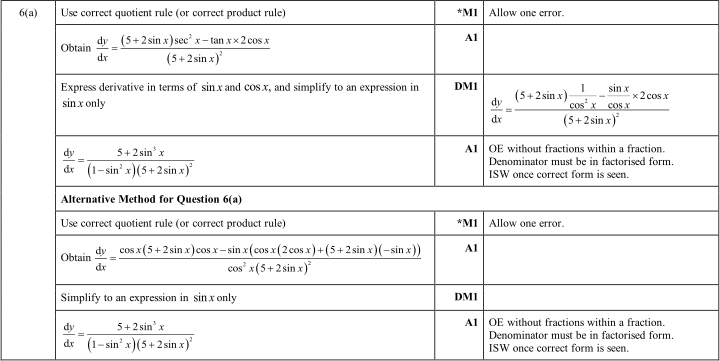
The curve has equation \(y=\dfrac{\tan x}{5+2\sin x}\).
(a) Find \(dy/dx\), giving your answer in the form \(\dfrac{a+b\sin^3x}{(1-\sin^2x)(5+2\sin x)^2}\), where \(a,b\) are integers. [4]
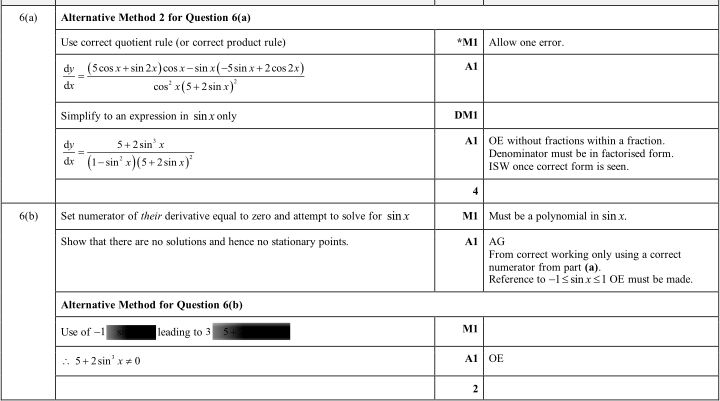
(b) Explain why the curve has no stationary points. [2]
9709 P31 - Jun 2025 - Q11 - 11 marks

The diagram shows \(y=\cos x\sqrt{\sin2x}\) for \(0\le x\le\pi/2\), with maximum \(M\) at \(x=a\).
(a) Find exact \(a\). [6]
(b) The region between the curve and the \(x\)-axis is rotated through \(2\pi\) radians about the \(x\)-axis. Find the exact volume generated. [5]

9709 P32 - Jun 2025 - Q11 - 11 marks

The diagram shows \(y=5\sin2x\cos^2x\) for \(0\le x\le\pi/2\), and maximum \(M\).
(a) Find the exact \(x\)-coordinate of \(M\). [6]
(b) Using \(u=\cos x\), find the area bounded by the curve, the \(x\)-axis from \(x=0\) to \(x=\pi/4\), and the line \(x=\pi/4\). [5]


9709 P31 - Nov 2023 - Q5 - 6 marks
(a) Given \(\sin(x+\tfrac16\pi)-\sin(x-\tfrac16\pi)=\cos(x+\tfrac13\pi)-\cos(x-\tfrac13\pi)\), find the exact value of \(\tan x\). [4]
(b) Hence find the exact roots of this equation for \(0\leq x\leq2\pi\). [2]

9709 P32 - Nov 2023 - Q7 - 8 marks
(a) By writing \(3\theta=2\theta+\theta\), prove \(\cos3\theta\equiv4\cos^3\theta-3\cos\theta\). [3]
(b) Hence solve \(\cos3\theta+\cos\theta\cos2\theta=\cos^2\theta\), for \(0^\circ\leq\theta\leq180^\circ\). [5]


9709 P33 - Nov 2023 - Q6 - 6 marks
(a) Show that \(\cot^2\theta+2\cos2\theta=4\) can be written \(4\sin^4\theta+3\sin^2\theta-1=0\). [3]
(b) Hence solve the original equation for \(0^\circ<\theta<360^\circ\). [3]